




Abstract
This article examines the connections between the economic, social and cultural aspects of a rather peculiar practice – events of domestic hospitality which involve a meal. In formats ranging from the formal dinner party to impromptu potluck events, an economic good is transferred from one household to another, ostensibly as a unilateral gift although often prompting reciprocity. Illustrated with results from a mixed methods re-study of the practice of eating out in England, we explore how, and under which circumstances, reciprocity is, or is not, observed. We discuss how to conceptualise this activity in terms of production and consumption, modes of provision, gifts and reciprocity, practice and culture. Interpreting the meaning and function of domestic entertaining, and explaining why it is so highly regarded, is shown to depend on how repetition is aligned with other specific characteristics of the practice. We draw out some implications for the relationship between production and consumption, for social relations under different modes of provision, and for alternative ways of delivering services.
Keywords
Introduction
In this article we use some findings about domestic hospitality from a recent study of dining out to address some questions about practice, culture and economy. Domestic hospitality in contemporary Britain ranges from having guests coming to live in the house of the host to casual invitations to drop by for a chat or a drink. We focus on one form of domestic hospitality, events where guests receive a main meal from friends or non-resident kin. Terminology is difficult. The most readily recognised form of arrangement for bringing guests together to eat is the dinner party. Both dinner party and entertaining sound too elaborate and formal for the range of events which now occur in Britain. Alice Julier (2013) in Eating Together: Food, Friendship and Inequality, the most detailed and sophisticated empirical study of domestic hospitality around food, shows that hosting non-kin at home in the USA takes different forms, running along a continuum from the dinner party to the potluck. A dinner party is formally organised and directed by the hosts. Potlucks, by contrast, are informal, less controlled by the host, and the food is only loosely planned since guests bring a significant proportion of the food to be eaten. In between, probably most common, are less formal variations on the dinner party, with buffets and barbecues lying towards the informal end of the range. She notes that neither she, as the sociological analyst, nor her interviewees could find a generic term for these different types of event. In the absence of a concise alternative term we talk of ‘hosted meals’ to refer to substantial meals provided in someone’s home to non-residents without any contracted obligation (like, for example, monetary payment) on the part of the guest.
A more precise and elaborate depiction of the defining characteristics of these events of domestic hospitality is presented in the third section of this article ‘The Features of Hosted Meals’, but briefly, this type of event deems that hosts shall provide and prepare food in their own home, issue invitations to guests, serve a comparatively elaborate meal, in suitable surroundings, explicitly requiring nothing in return other than companionable and convivial intercourse around the table and an expression of gratitude at the close of the event. Meals delivered through the channel of domestic hospitality are provided on a voluntary and non-pecuniary basis. They display generosity towards non-household members. The meal is ostensibly a gift. However, in the majority of cases hosts subsequently receive return invitations from their guests. The hosted meal is widespread, resistant to displacement by commercial alternatives and is highly appreciated.
One criticism of practice theory is that it fails to address explicitly the concerns of political economy. We argue that a holistic understanding of the hosted meal reveals a set of political and economic principles intrinsic to the practice. Accordingly, we reflect on the mode of provision underlying a material transfer of a good (a prepared meal) when it is neither produced by commercial organisations nor accessed via monetary transactions, as with its commercial counterpart, the meal in a restaurant or café. Attending a hosted meal is a way of eating out without payment, 1 being an arrangement which involves labour hedged round by distinctive norms of delivery and reception. As we learned from debates about domestic divisions of labour, there are different modes of provision of material services of which the market is just one (Pahl, 1984; Warde, 1992). Exploring the social embeddedness of economic activity, we ask whether the institutional arrangement of the hosted meal, an instance of the communal mode of provision, might provide a template for alternatives to capitalist economic relations based on exclusive property rights, alienated labour, market modes of distribution and severe inequalities in the distribution of goods and satisfactions. In other words, maybe the attractive attributes of the dinner party and its derivative variants can be grafted on to other social practices to beneficial effect. To answer such a question we examine the institutional arrangements that permit hosts and guests to join together in successful interaction rituals around a meal.
The second section describes, briefly, a mixed methods re-study of many aspects of the practice of eating out in England, using a survey and qualitative interviews, where we inquired about the experience of dining out in the homes of friends and non-resident kin. 2 With reference to our findings and to other relevant literature, in the third section we outline an ideal type of the components of the practice of the hosted meal, depicting the fundamental elements of the activity and noting some of its complex and unusual combination of attributes.
The fourth section, ‘The Hosted Meal: Social Form and Social Interaction’ summarises some of the key features of the interactionist account of Julier (2013) which emphasises the role played by the hostess, the preparatory and the emotional work involved, the conduct and content of three different types of event, and the nature of the social interaction with guests during the course of the meal. The consequences for sentimental attachments between the participants are emphasised; she sums up the characteristics of such events in terms of ‘artfulness, solidarity and intimacy’, a fitting description of domestically hosted meals in the USA but an unusual depiction of a process for delivering an economic service. The next section, ‘Reciprocity and Gifts: Evidence of Reciprocation’, explores the significance of return visits, which might be interpreted as evidence of informal economic exchange, the return meal being considered as a ‘counter-gift’, raising issues of equivalence of value, power, competition and distinction. With reference to literature on gift-exchange, it considers data from our study to examine reciprocity.
The sixth section of the article, ‘The Distinctiveness of Domestic Hospitality: A Synthetic Account’, offers a more comprehensive explanation of the activity by bringing together the experiential and economic aspects of hospitality, describing how reciprocity is organised and the implications of the longevity of many relationships forged through hosted meals. Deriving some inspiration from practice theory, it emphasises, equally, several component elements of the ideal typical description – labour, goods, social relationships, gifts and reciprocation. The synthetic account of the practice also considers the consequences of the fact that transfers are usually expected to recur at regular intervals into the future, thereby emphasising the role of sequences of events in building social relationships. The ‘Discussion’ section considers issues arising from this theoretical argument about sequence for understanding sharing, taking turns, informal economic transfers, and repeated social events. Among the features revealed are examples of the relationship between provision and consumption, of power and its diversion, and of the intricate entanglement of the economic and the cultural in the evolution of a practice which provides foundations for enduring social relationships.
A Mixed Methods Re-study
The data come from a re-study of eating out in England. Carried out originally in 1995 (see Warde and Martens, 2000), the study was repeated in 2015 (Warde et al., 2020). Three instruments generated the data used here. The first is a survey conducted over four weeks in April 1995 (n = 1001) which examined, inter alia, the frequency of eating out at different types of restaurants, motivations and attitudes towards dining out in commercial establishments and in the homes of others, and social and demographic information about respondents. 3 The sample was drawn from three English cities, Preston, Bristol and London. 4 The second, a repeat survey, was conducted in the same three cities in Spring 2015 (n = 1101) and asked many identical questions. 5 The design involved random location quota sampling of selected addresses for face to face interviews. The third tranche of data arises from 31 follow-up, in-depth, semi-structured interviews conducted with respondents to the 2015 survey in the three cities. Interviewees representing a range of social characteristics and positions were selected from survey respondents who had reported that they were engaged to some degree in eating out, entertaining and cooking at home. These interviews explored understandings and experiences of eating out and the integration of their routines of eating out and eating at home. 6
The survey recorded many features of the respondents’ eating habits including, and most relevant here, the frequency of acting as host or guest and much detail about the most recent occasion when the respondent had eaten a main meal in someone else’s home, including level of satisfaction, location, food eaten and the company present. 7 Of 1101 respondents to the survey in 2015, 279 had eaten the last main meal as guests of friends or non-resident kin, the others having visited restaurants, pubs, cafes or similar establishments.
The qualitative interviews contained a module on domestic hospitality. This asked about normal practice when interviewees ‘have people over for a main meal to your home’, asking who were the visitors, what was served, how was the work organised and what satisfaction was derived. Interviewees were then asked about similar features regarding ‘the last time you ate at someone else’s home’.
One key finding from the study is that the activity is both frequent and almost invariably very pleasing. As Table 1 shows, a substantial majority of the population of urban England sometimes eat a main meal as a guest in someone else’s home and this occurs no less in 2015 than in 1995.
Frequency of eating out, main meal, 1995–2015, retrospective annual estimate (percentage).
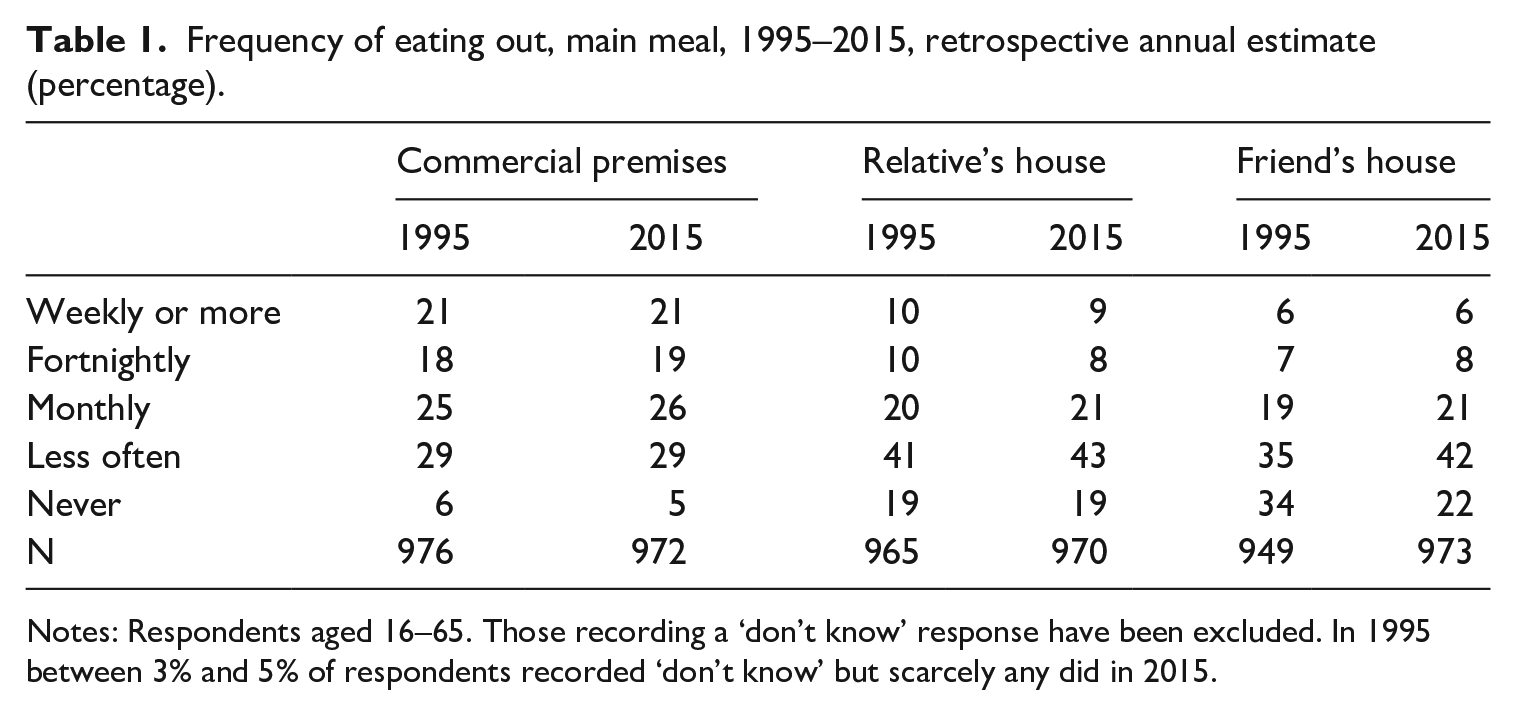
Notes: Respondents aged 16–65. Those recording a ‘don’t know’ response have been excluded. In 1995 between 3% and 5% of respondents recorded ‘don’t know’ but scarcely any did in 2015.
The experience is also immensely gratifying. Survey respondents reporting on their last such meal ‘liked a lot’ all aspects of the experience, and almost every other response was ‘liked a little’ (Table 2). Overall enjoyment of hosted meals is marginally greater in 2015. Accounts of equivalent occasions in the commercial sector were also overwhelmingly positive, but were significantly less appreciative as the evaluation of food, décor and service fell markedly between 1995 and 2015. What, then, are its distinctive, and attractive, features as a practice?
Enjoyment of last occasion at commercial establishment (left) and someone else’s home (right) (percentage).
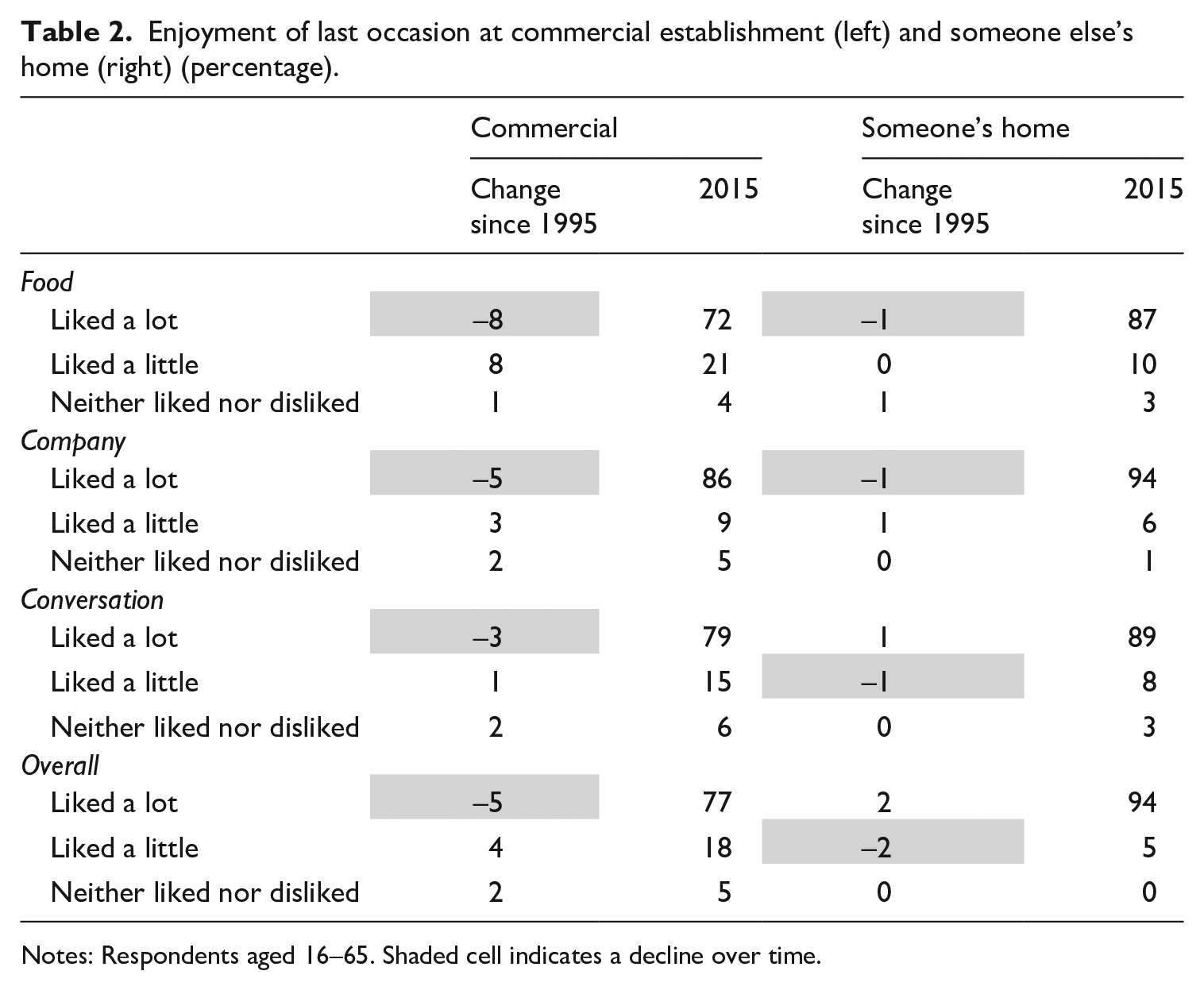
Notes: Respondents aged 16–65. Shaded cell indicates a decline over time.
The Features of Hosted Meals
We have constructed an ideal type of the anatomy of a practice on the basis of component elements abstracted partly from survey responses and the testimony of interviewees (what they say and do not say) in our research project. (See Warde et al., 2020: 90–109, for a more detailed description including the content of what is eaten, nature of participation, reports of experience). We also draw upon participant observation and the social scientific literature on friendship, families, gifts and manners. After describing its anatomy we will try to explain why this complex of elements is such a great source of satisfaction, especially what role reciprocation might play, an explanation which requires it to be placed in the context of the interwoven connections of the elements which make the practice distinctive.
The Elements of Domestic Hospitality: The Anatomy of a Practice 8
The mode of provision and consumption associated with the hosted meal is a complex and unusual institutional configuration with many variants. Not a fixed social form, practices change over time as multiple performances diverge from prescribed rules, as with the modifications associated with informalisation. Its principal components include the following.
Domestic production: Domestic hospitality involves more or less elaborate activities of production – of both food and services. It involves unpaid labour to carry out several kinds of task (planning, shopping, cooking, presentation and clearing up) and the skilled use of a technological infrastructure of kitchen equipment, utensils and tables, etc.
Self-provisioning: This is a form of self-provisioning. The hostess gets to eat the food prepared, as usually will other members of her household. It is thus a form of ‘prosumption’, involving intimate entwining of production and consumption of a product (Ritzer and Jurgenson, 2010).
Food as an ineradicable material component: Prepared food is essential to the event. Eating is a central rationale and food quality a defining feature of the experience. Food content symbolises the type of occasion and the social relationships between those present (Douglas, 1975; Julier, 2013: 188).
Coordinated co-presence and spatio-temporal delimitation: Entertaining inevitably involves face-to-face interaction. It cannot satisfactorily be done virtually. It obliges all involved, hosts and guests, to be in the same place at the same time. The social coordination involves an identified site and more or less precise specification of the time at which the event will begin and end. It requires social coordination and spatial propinquity. The event occurs in a fixed space, by definition someone’s home, and lasts for a delimited period. It may last a few hours, but in most cases longer than it would take merely to eat the food. Its location in the home is of major symbolic significance as the private life of the host opens up to scrutiny. The curtailment of proceedings at an appointed time marks separation of dining together from permanent or temporary co-residence in the host’s private domicile. Predominantly, coordination is achieved by the issuing of an invitation by the hostess who orchestrates the event, ensuring that guests are comfortable: a major task, which is achieved through shared understandings of procedure and manners.
Statement of affinity and token of intimacy: It requires acknowledged affinity between hosts and guests. It implies a relationship more intense than mere acquaintanceship or neighbourliness where proceedings would be less elaborate (Douglas, 1975). Attendance is highly selective. Diners are most often friends or kin. Friends who come together to form the commensal circle tend to be socially equivalent, people of equal social status as judged by external criteria (Allan, 1979). Invitations are also occasionally extended to others, for example business colleagues and members of voluntary associations and community groups to which the hostess belongs. In these cases presence does not express an intimate relationship, yet it still marks social and personal connection.
Badge of mutual respect and social recognition: The interdependent roles of host and guest facilitate the expression of mutual respect and social recognition. The invitation is a compliment to the guest, acknowledging that she is of suitable social status and worthy of the honour of being treated to an event in which the hostess has invested time, thought and money. Accepting the invitation is a form of mutual recognition, acknowledging that the host is worthy of attention and respect and that the effort involved deserves gratitude for both food and welcome which justifies temporary deference. This mutual respect holds the promise of a social bond continuing into the future.
(Re)presentation as a gift: The meal delivered is ostensibly a gift. The host is responsible for provision of the necessary material content and social context of taking dinner together. The only immediate obligation on the guest is to behave in a manner acceptable within the flexible scripts associated with that role. No contract compels the guest to regard the acceptance of an invitation as source of debt or subsequent obligation; it appears, in the single instance at least, as a gift offered voluntarily by a donor to a recipient without requiring that a favour be returned.
Default is repetition: Survey respondents and interviewees however expect that generally the event will be one of a series of occasions where most commonly a guest on the last occasion will subsequently return a favour. That will usually be an invitation to a similar sort of gathering. During such a sequence of events the roles of host and guest are reversed. Interviewees often talk about taking turns. The same people are likely to repeat the episode together on a future occasion. Whether we are interested in domestic hospitality as a system of economy or as a form of social bonding, recurrence is a crucial feature of the practice.
Taken together, these nine component elements exhibit some unlikely juxtapositions. The producer of a service shares in its consumption. Labour is expended and its fruits transferred to others without any clear promise of reward. It presumes equality of prestige for all participants while granting authority to one provider. It is presented as a free gift but has undertones of debt and obligation. The hosted meal seems a bundle of contradictions.
The Hosted Meal: Social Form and Social Interaction
Julier’s (2013) account of hosted meals in the USA is in no way inconsistent with this ideal typical description, unsurprisingly since it is one major prop to its construction. As do all accounts, hers focuses on some features more than others. She offers a thorough and richly detailed account of the procedures associated with the hosted meal and its capacities for generating congenial social interaction and expressing affirmative social relationships. The core of her account is the nature of hosts’ interactions with guests and the intricacies involved in the arrangement of the meal and how that creates intimate relationships, which she describes as ‘experience of connection to others’:
In sum, people create bonds of intimacy with some degree of choice in non-kin relationships, using food and the household as material sites for its enactment. At the same time, the form of the event, the kind of food served, who prepares it, and how it is served indicate the nature of the relationships being created. (Julier, 2013: 207)
Julier emphasises social relationships and interaction in situ. She concentrates on the hosting of events rather than the consumption experiences of guests. Especially interested in the labour involved, she documents the disproportionate contribution of women. Not only do they mostly do the cooking but they are also more concerned with the care of their guests, ensuring that atmosphere is suitable and that appropriate people are invited. Women take responsibility for achieving sociability on these, as on most other, occasions. In terms of emphases, Julier’s account prioritises explanation of the host’s behaviour over the guests, social interaction over exchange, the social over the material, sentiment over negotiation, and positive aspects over potential hazards.
Framed in terms of Simmel’s (1994 [1905]) notion of social form, Julier’s account is based on scrutiny of many instances of delivery of a service by the hostess, on discrete events rather than sequences of visits. This is one aspect where the survey component of our research design is useful because it not only indicates the statistical prevalence of particular elements of the practice but also contains information about reciprocity. She ‘found that reciprocity itself was an ideal rather than an enactment, especially among those who socialized in groups with varying resources’ (2013 discomfort if they could not demonstrate that they contributed, either emotionally by constructing an atmosphere conducive to friendship, or materially, by adding their food or labour to the performance’ (2013: 118). However, she treats reciprocity as a fact rather than a puzzle and never considers meals as having significance as economic exchange. The terms of engagement and negotiation of indebtedness are not part of the account. This leads us to wonder whether theoretical benefit might be gained from considering the nature of exchange in the gift economy.
Reciprocity and Gifts: Evidence of Reciprocation
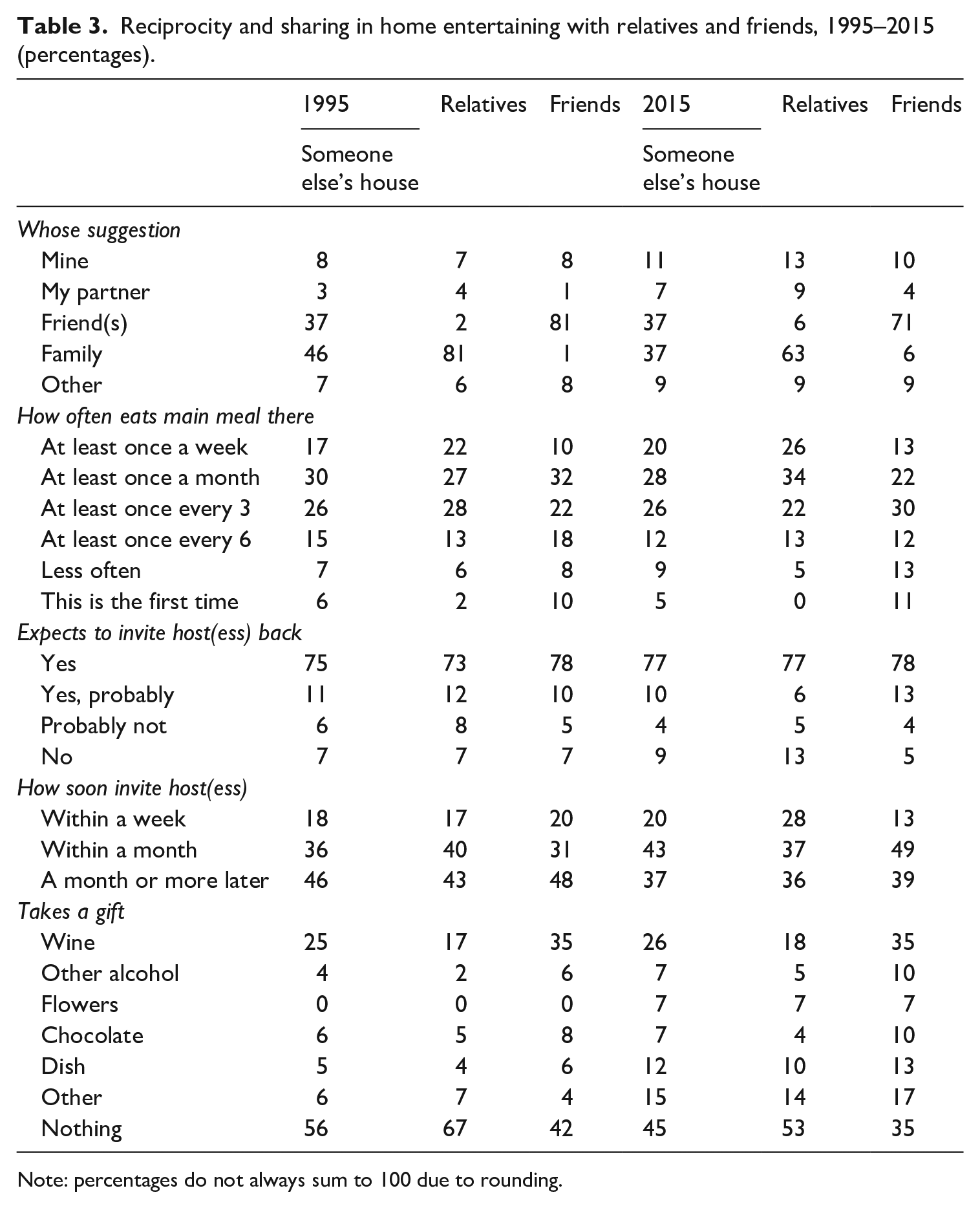
There is no extended empirical analysis of domestic hospitality framed as an economy of gift exchange but the mechanism of gift and counter-gift has immediate resonance for it is tacitly understood that guests typically reciprocate. Our evidence shows that guests will usually offer a return invitation. The survey asked whether a respondent who reports being a visiting guest at the last meal away from home ‘expected to invite the host(ess) back’. Table 3 shows that most people will subsequently invite their erstwhile host to a meal. Three quarters (77%) say they definitely will, 9% say they definitely will not, leaving 14% uncertain.
Reciprocity and sharing in home entertaining with relatives and friends, 1995–2015 (percentages).
Note: percentages do not always sum to 100 due to rounding.
If invitations entail the bestowal of unilateral gifts we might be surprised that so many are returned. If the transfers were a free and unbinding gift, where it matters not who bears the costs of provision, we might expect lower levels of reciprocation. What degree of truth is there to the idea that the reciprocation involved around hosted meals is the type of transaction that a theory of informal economic exchange would see as calculation of items of equivalent value for which there is an implicit notion of debt? Certainly, the frequency of return visits will arouse suspicion among sociologists of a critical disposition that something more than pure altruism is involved.
The interpretation of gift exchange has long fascinated scholars, especially anthropologists and those interested in pre-modern and pre-capitalist economic activity. The social scientific understanding of reciprocity has gradually relegated intimations of mutuality and generosity, replacing them with an economistic, and ultimately more cynical, sense of instrumental exchange of equivalent value. For example, Pyyhtinen (2014: 150) argues that popular idealised understandings of gifts are illusory; the ideal free gift is impossible to enact for he doubts ‘whether it is at all possible for gifts to be exchanged and remain gifts’. In the process he identifies three different types of exchange subsumed under the social scientific category of gift. The gift ‘may appear as merchandise, sacred object and weapon’ (2014: 152) – in other words, it functions as an instrument of exchange, sacrifice or domination. An act of munificence has intimations of charity, which may cast the recipient into a subordinate position. Entering into competitive rivalry through raising the stakes in the value of items exchanged can also mark social and economic superiority; a former guest unable to make an equivalent counter-gift is likely to have to withdraw from any subsequent round and may feel discomfort or shame. Thus, both types of exception to reciprocal gift exchange risk reputational damage. Miscreants may thus be cast as paupers and supplicants or meanies and losers. Respondents, by offering a counter-gift, may be avoiding potential social humiliation by acting in accordance with a norm of reciprocity.
During our study no guest reported an incident that hinted at humiliation resulting from an attempt at blatant social domination. 9 Interviewees nevertheless display some anxieties about domestic hospitality. There is evidence of embarrassment about competence and taste. This is mostly divulged when interviewees talk about acting as host. Hosts and guests know that some performances of hosting (usually of cooking but sometimes of atmosphere) are superior to others. Some hosts profess lack of skill. A retired manager claims that she is an incompetent cook so avoids extending invitations, treating her friends to restaurant meals instead. A 30-year-old vegetarian man in a lower professional occupation bemoans the fact that ‘I usually mess up when I’m cooking for other people’. A London cultural intermediary in his early 30s with a strong aesthetic interest in food worries that his circle of friends consider him, partly because he is not rich enough, insufficiently ‘foody’. These are examples of anxiety that the counter-gift might be insufficient, but they seem minor and do not necessitate withdrawal from further reciprocity. The absence of agonistic behaviour could possibly be a peculiarity of our sample but probably should be interpreted as an inadequacy in a theory of counter-gifts.
A useful intervention in the theory of gift exchange is by Elder-Vass (2015) who mounts an objection to what he calls ‘exchangism’ – a general tendency to inappropriately describe social encounters as exchange. Any implied calculation of equivalent value he deems a theoretical error, one with ideological overtones. 10 He finds two types of very widespread non-antagonistic munificence where recompense is neither expected nor anticipated, ‘positional gifts’ and ‘free gifts’. He finds a basis for ‘genuinely’ unilateral transfers – correctly rejecting the idea that a vote of thanks on the part of a guest constitutes economic exchange. Elder-Vass’s prime examples of free gifts are blood and other organ donation and the circulation of free software on the internet, both instances where donors and recipients are unknown to one another. Because domestic hospitality is based upon personal connection, examples of this type of unconditional generosity are rare, although two couples report preparing meals weekly in a community context as acts of charity. 11 Other interviewees regularly give family and neighbours dishes which they have prepared just as a treat, understated acts of kindness with no expectation of return. Such expressions of civility and generosity are well described by Brownlie and Anderson (2017). 12 The positional gift is much more common, especially from parent to adult child or vice versa. Mothers report preparing Sunday lunch for their non-resident children on a weekly basis. A South Asian woman entertained all her six brothers weekly or more frequently. A daughter has her elderly mother for dinner three times a week. These events seemingly require nothing more than thanks. 13 There may, of course, be other compensating modes besides a return meal; the survey data did not capture exchange occurring via another medium or practice (i.e. as exemplars of the concept of generalised gift exchange) although interviewees implied that this may sometimes be the case.
Just less than a quarter of respondents in 2015 were not certain that they would return an invitation. That could imply a refusal to accept obligations associated with the prior gift, suggesting that the relationship between these people is likely to cease. In some instances this was possibly the case. Even where reciprocity predominates, transfers will sometimes cease and the encompassing relationships break down. Any debt can in principle be paid off fully if the actor who was first the guest reciprocates and the exchange relationship then terminates. Our qualitative interviews indicate that when people cease to exchange invitations it is usually because of geographical mobility or life course changes to one or other party. However, some ‘debts’ will never be amortised. The survey revealed two instances among eleven first visits where no reciprocation was envisaged. The reason for saying ‘definitely not’ when asked if the host on the last occasion will be invited back might be that the event was unpleasant or the social atmosphere oppressive. (In such circumstances the relationship, being based on voluntary arrangement, would rarely survive long.) It may, however, be for other reasons.
Table 3 shows that it is anticipated not only that most relationships will continue into the future but that the event reported also extends temporally back into the past: as the second panel indicates, only 5% of guests in 2015 were making their first visit to the home in question. It is probable also that they would in the interim period have acted as a host in their own home. The impression is of a dense and repeated series of invitations. Repeat visits are the basis for a temporally unfolding aspect of the practice which is not emphasised by, although it is not inconsistent with, either interactionist or gift-exchange accounts.
A significant minority of people fail to return an invitation yet probably without detriment. One reason for the absence of a return invitation is that obligations of reciprocity can be redefined or recalibrated to condone infringements. One interviewee, for instance, said that meals with close family did not count as eating out, implying that reciprocity is not required as one-sided transfers are excluded from accounting procedures. She effectively recontextualised the initial gift so that reciprocity is not required. Significantly, no one complained about inadequate compensation, even though richer hosts give more often, suggesting that events are usually evaluated as fair and sufficiently equal. Moreover, some aspects of even the formal dinner party, increasingly prominent by 2015, allow parts of any perceived debt to be disbursed immediately. Small presents – which Table 3 shows are very common – could be seen as partial compensation. The growing proportion of guests who bring some already prepared food (this occurred on 5% of occasions in 1995 and 12% in 2015) or who help prepare the meal in their host’s kitchen may immediately reduce a sense of debt. Remarkably, Table 3 shows that guests increasingly appear to invite themselves to dinner; on at least 18% of occasions the guest or the guest’s partner had suggested the event. The host seems less in charge. 14 Networks arrive at a modus operandi that diminishes the power of the host and thus tempers agonistic effects. Informality in many aspects of the practice disguises and defrays calculations of material equivalence. In sum, considerable effort is expended to preserve the impression that the transfers involved are not calculated economic exchange.
Cynical accounts of the gift may fit some fields where acts of generosity are suspicious, with power and unfair advantage just around the corner, as when dependence arises from the acceptance of lavish gifts or bribes. However this is rare in domestic hospitality for several reasons. First, devices are employed to create an aura of reciprocity. Second, the power of the host is limited. Third, the purpose of any gift of hospitality is not primarily economic or social advantage. This corroborates Elder-Vass and endorses Sleeboom-Faulkner’s (2014) excellent diagnosis of the complexities of the gift which observes that ‘contemporary societies exhibit countless hybrid exchange forms, some of which are clearly more altruistic and conducive to solidarity than others, most of which do not fit into either of these polarised categories [free gift and reciprocal gift]’ (Sleeboom-Faulkner, 2014: 326). She wisely recommends making a ‘distinction between a range of gift and capital exchanges where gifting is analysed alongside the projects it aims to facilitate in its interaction with the stakeholder communities involved’ (2014: 329).
The Distinctiveness of Domestic Hospitality: A Synthetic Account
We suggest that a synthesis might be developed, drawing on both accounts and subsuming them within a practice theoretical framework. Theories of practice are equally comfortable with the social and economic aspects of experience. By encompassing mutual understandings and agreed procedures dedicated to achieving commonly shared purposes and by utilising a distinction between performances and practices they can explain both similarities and differences between events like the hosted meal. Their emphasis upon habits and routines, norms and institutionalised conduct renders them sensitive to repetition, timing and sequence for the perpetuation of conduct over time. Understanding repetition as a basis for institutionalisation of performance norms highlights the extended series of encounters which typically result from domestic hospitality.
A comprehensive account of the hosted meal will see it as an economic service but emphasise the specific form of its social embeddedness. Although delivering work services to intimates, it is not primarily an economic transaction, for it also involves eating the same meals, creating memories of enjoyable sociable events with others, and fostering a sense of mutual attachment. The dinner party and its much diluted variants offer conviviality, commensality and anticipation of enduring warm social relationships; its remarkable capacity, in Julier’s (2013: 186–187) words, is to achieve ‘artfulness, solidarity and intimacy’. Such a positive gloss on domestic hospitality emphasises not avoidance of humiliation but rather kindness, mutuality and collaboration. Access to company, conversation and affirmation of connections are goods internal to the practice of domestic hospitality, which might in part explain why it is not diminishing in quantity or quality. Mutual good feeling is probably more rewarding than just feeling good about having carried out a charitable act. Work, when it is not purely labour, is experienced, if not as an unalloyed pleasure, then neither as an intolerable burden as is attested by people claiming to like cooking for special occasions. 15 The appeal of the practice can be found in the types of social relations it fosters, including sharing, co-participation and endurance over time.
The Importance of Sharing
Sharing plays no part in gift theory and nor does Julier make it central. However, the fact that the hostess eats with the company, that all eat the same food, and that all have equal rights to participate in conversation, makes for a form of communion. Communal cooperative activity gives high rewards and satisfaction. Doing something with people rather than for them gives specific intrinsic rewards and has mutual benefits. Some of the innovations discussed earlier can also be considered acts of sharing. Bringing a dish, helping in preparation and cooking together imply collaborative work as well as commensal consumption. Co-participation creates intimacy and solidarity; as Julier (2013: 118) notes, people seek to contribute ‘either emotionally by constructing an atmosphere conducive to friendship, or materially, by adding their food or labour to the performance’. Sharing modifies, conceals, compensates and reduces interpersonal distance. A simple exchange of equivalent objects of equal value, like-for-like reciprocity, may be the most straightforward solution to perpetuating a sequence of interactions, but possibly at the cost of relationships being less warm and committed.
The form of sharing is subject to different conventions in different social groups. Collaborative labour on site reinforces the sense of sharing, as perhaps do small presents, especially if they too are collectively consumed. Taking turns in hosting events is a different way of sharing. Nevertheless, not everyone welcomes informal sharing of responsibility for events. A 60-year-old man of Indian descent recalled that he was shocked on the first occasion when he was invited to a meal and instructed to bring a dish. Another interviewee in his 60s said that in his own home he liked to supply the food and drink so that the event might flow easily. Both prefer taking turns in assuming full responsibility for a complete event. 16
Taking turns rather than giving things back is at the core of the practice. Repeat performance of a quasi-ritualised event amounts to consent to the existence of a continuing social relationship. The perpetuation of the relationship is the purpose and the motor of the practice; the woman, mentioned in Note 9, who tries to avoid being the guest of friends who prepare unhealthy food has no intention of thereby ending the social relationship.
Co-participation and Exclusion
Neither the interactionist nor the gift-exchange theories account for people who never take part in the activity. To focus only on the events fails to detect processes of exclusion. While Julier is aware of the classed aspects of the procedures, she has no means to analyse those who never participate. The British survey data make clear the class context of both hosting and being a guest. People hosting friends in 2015 tend to be women, cohabiting, white British, with higher education qualifications, and service class connections. Those who entertain family members are also partnered women, not from the working class, likely to be white British and to have a dependent child at home (for more detail see Warde et al., 2020: 35–40). The socio-demographic features of guests tend to mirror those of hosts when eating at the home of friends; having a degree, not having dependent children, living in London or Bristol, and being currently in the service class, are the most powerful influences on receiving invitations from friends. As regards visiting kin, statistical models are reassuringly extremely weak – for it would be unfortunate if children from less privileged families received fewer invitations from their parents.
Social circles tend to involve people of similar status. Participants in a circle or network tend to have similar material resources, similar holdings of social and cultural capital, and similar capacities and inclinations. Parity of esteem is achieved because of homophily and that, of course, is a system for reproducing social inequality. Reciprocity involving equal sacrifice and benefit within the commensal circle is not a mechanism for social equality. Reciprocity deters those with comparatively few resources, excluding them from participation in an otherwise generally beneficent practice. Distinction can then be conveyed by mere engagement in the practice – one aspect of theories of practice being their insistence on examining rates of participation and the processes of recruiting novices. While to some degree redistributive within the circles that it encompasses – those with more money and resources act as hosts more often – the practice tends to be defined by those with higher social and cultural capital. In addition, of course, reciprocity operates between households, without reference to concealed divisions of labour within the hosting household, which, as all scholars acknowledge, are often to the detriment of female partners in heterosexual couples.
Sequence and Repetition
Events involving domestic hospitality usually occur within an extended sequence. One interviewee reported having met monthly with the same small group of female friends for over 20 years. Many other interviewees implied long-running continuous relationships where the roles of host and guest circulated. Gifts add up, not just as a two-step swap but through many transfers over a long period. Sentiment and solidarity mature through repetition. Were transfers to be unilateral over an extended period, power differentials might arise, although the likelihood of one-sided transfers of resources is reduced because events involve persons of equivalent status, whether of common kinship or friendship. Each party is able to take a turn in provisioning. Turn taking, referred to explicitly by several interviewees, like sharing, seems to go beyond any obligation to return a favour. Turn-taking and mutual engagement in activity – features not stressed in accounts of the social form of the meal – signify an equitable practice. 17 Power is rarely exercised at such events because repeated turn-taking in the roles of host and guest mitigate against control devolving to any one person. Repetition also allows changes in standards and expectations about resource allocation through mutual negotiation; many networks appear to have adopted simpler procedures in order to enhance ease of social interaction. Repetition reinforces and redefines practice in accordance with increasingly informal shared conventions.
Discussion
The Virtues of Cyclical Sequences and a Model for Sharing
Consider whether this particular form of cooperative socio-economic relationship can be transferred to other aspects of economic activity. It has often been argued that the differences between commodities and gifts are overdrawn (Appadurai, 1986, 2015; Carrier, 1995; Sleeboom-Faulkner, 2014). The most distinctive special features of domestic hospitality are probably the fact that the provider shares in the consumption of the meal on an equal footing with the guests – a meaningful form of prosumption and a model for cooperation. The fact of taking turns for provisioning at appropriate intervals is a central feature of a communal economy. If Elder-Vass is correct in his estimate that free and positional gifts are responsible for the major proportion of economic activity, 18 then the addition of this substantial contribution to communal economic production might throw into further relief the marginality of market relationships to everyday material provision. Despite their apparent ubiquity, capitalist economic relations do not entirely swamp cooperative and collaborative provision.
Alternatives to capitalist commodity culture are usually studied as activities of social movements, associated with purposive political projects which seek popular mobilisation to remedy or overturn the dominance of an economic system which depends on private accumulation, competition, instrumentalism and calculation at the expense of personal relationships, autonomy, cooperation and collective well-being. Projects often advocate a radical reorientation of personal dispositions, a transformation in values or behaviour which depend largely on ideological conversion and personal conviction as mechanisms, although the unreliability of the prescription (Warde, 2017: 184ff.) is acknowledged by increased recommendation of prefigurative social experiments (Yates, 2014). The dinner party and its many variants might be considered conducive to prefiguration, for most people have already been exposed to and are predisposed to like its form which is in many ways the antithesis of commercial commodity exchange. Thus, an alternative template exists already in the life-worlds of most people for the integration of economic and social activity, where the economic dimension is thoroughly embedded in interpersonal social considerations of sympathy and care.
Theoretical Matters
Domestic hospitality is a very deeply socially embedded economic activity. A form of service delivery, its motor lies in the specific interpersonal relationships between regular participants in recurrent events. Specific networks develop shared cultural tastes arising from repeat performances with persons in similar social positions or by virtue of kinship. These specific interpersonal social relationships are the foundations for the particular way in which the element of economic service is accessed and appropriated.
Far from obscuring the economic and the cultural, considering domestic hospitality as a practice demonstrates how they are thoroughly entangled. Terms of transfer are more elaborate than notions of reciprocal equivalent exchange can capture. Perpetuation of specific relationships and of the institution as a whole require a considerable degree of impression management and a rather unusual arrangement for taking turns in the provision of a service.
The hosted meal in its current forms is probably not a medium for excessive exercise of power. The possibility does exist, as consideration of the logic of the counter-gift indicates. No doubt some return invitations are attempts to avoid social humiliation. However, parity of esteem and position among participants, the symbolic protection afforded to those vulnerable to an accusation of evading the norm of reciprocity, and the various mechanisms encouraging informality effectively obviate asymmetry of power and diffuse authority.
The concept of reciprocity is no less difficult or contentious than that of the gift. If it is a universal mechanism (cf. Gouldner, 1960) then it takes many cultural forms. Reciprocity often conveys overtones of morally couched instrumental exchange, but that underestimates the varied manner of its operation within specific practices; it is crucial in different ways in the management of intimate personal relationships, the playing of games, conversation and the rituals of social drinking. In the case of hosted meals, the taking of turns at unpaid labour marks a distinctive form of reciprocation.
In this regard, hospitality points to the potential of sharing economies to overturn resource-intensive pathways of mobility, consumption, and production. The household is frequently a target for efforts to reduce the resource intensity of practices central to quotidian daily life, particularly around preparing and eating food (Yates, 2018). Modes of sharing offer ways to make connections and collaborate in creating the necessary time for self-provision and the side-stepping of market modes (Schor, 2011). The domains of food production and consumption provide examples of initiatives for putting a sharing economy into practice; restaurants might use digital platforms to entice diners with offers of meals prepared from ingredients shortly to go to waste, with some enterprises sourcing all ingredients from near to or out-of-date produce donated by retailers and food service providers. Options for consumers to engage in the public domain in the sharing economy are growing. Our account of domestic entertaining contributes original analysis of a less well-understood piece of the puzzle about how practices of eating and sharing occur within and between households. The analysis sketches a theoretical architecture suitable to understanding practices that operate beyond the market yet are not simply gifts.
Conclusion
Domestic hospitality has many positive and attractive features. It does provide that elusive free lunch in a context of enduring social relationships. It is loosely framed and pluralistically enacted yet encompasses strong core principles of conviviality, commensality and mutual voluntary commitment. It is enjoyable and sociable, with positive effects of bonding and solidarity. Its principles of access and appropriation might perhaps be invoked as a model for other practices seeking to avoid commercial logic. It might be celebrated as prefiguring a cooperative and mutual mode of provision. It involves relatively gratifying work from which the worker gets the benefit of the proceeds, as ‘gifts’ that are only partially alienated. It is an instructive example of deeply socially embedded labour from which more people derive pleasure than incur pain. It causes some anxiety around performances and interaction, and, despite precautions taken, unilateral transfers may lead to dependency and humiliation. This outcome is rare, however. Of greater concern is the fact that some people are excluded altogether; most circles are class homogeneous, excluding people of discrepant status. It is also problematic on the grounds of gender inequality; women still do most of the work and shoulder greater responsibility than men. Although not a perfect institution, it may be on balance superior to most and probably deserves to be viewed through a lens of kindness rather than cynicism. Participation in this practice depends little on instrumental orientation or sense of obligation and rather more on mutuality and sentiments of generosity and kindness which make for enduring social relationships.
Theoretically, domestic hospitality is amenable to interpretation in terms of either social interaction or gift-exchange. Both approaches identify important central features of a major social institution despite emphasising different aspects. They are improved when supplemented by a theory of practice which additionally emphasises aspects of repetition and sequence, sharing and participation. The synthetic account reveals some underlying principles constitutive of a political economy of the social relations involved in informal economic production, distribution and consumption. It detects aspects of the distribution of power in society, including processes of class exclusion and the exploitation of women’s labour. It also draws attention to the potential of the communal mode of provision, noting its prefigurative potential in regard to other activities and indicating potential routes to the provision of goods and services not governed by the cold and impersonal arrangements of markets. In sum, the study of domestic hospitality opens fresh vistas for the future development of applications of theories of practice.
Footnotes
Funding
We gratefully acknowledge funding from the Sustainable Consumption Institute (SCI) at the University of Manchester to carry out the research reported in this article.