




Abstract
This article contributes to the debate on individualised and reflexive processes taking place in contemporary cultural work by considering Italian theatre actors’ experiences. Drawing on in-depth qualitative interviews, the analysis focuses on work as the affective and reflexive site where subjectivities are formed. Performing artists display an embodied reflexive stance in which disciplinary practices and self-care instances are configured as both dispositives of an entrepreneurial ethos of work and as reflexive self-affirmative processes. Recognizing the embodied and emotional experiences that tie theatre actors to their professional activities, the paper considers the reflexive circularity that takes place between subjective meanings, affects and embedded experiences of work. Within this ongoing interpretive circle, cultural work emerges as positioned beyond traditional boundaries of work.
In late modernity, the growth of autonomy from social structures has imposed on individuals the responsibility to build their own life paths and desired futures (Beck, 1992; Giddens, 1991). The quest to construct an autonomous subjectivity appears to involve the fulfilling of an individual’s potentialities, which becomes the centre of late modern biographical planning (Honneth, 2004: 469). In this context, social theorists have underlined how work, far from being described as a tedious and necessary obligation, is nowadays central in the narrative space where individuals become themselves and communicate their identity to others. With the aim of increasing individuals’ chances of competing, the transformation of everyone’s potentialities, skills and motivations into human capital has become an imperative of contemporary labour markets (Du Gay, 1996; Feher, 2009; Rose, 1989). From corporate discourses, values of autonomy and competition have escaped the domain of personal development and biographical trajectories in a context in which entrepreneurial neoliberal logics are applied and lived out on an individual level (Bröckling, 2015). Encouraged to make an enterprise of themselves, economic rationales appear to characterise the experiences through which individuals become subjects of human capitals (Foucault, 2008; McNay, 2009). Furthermore, in a neoliberal context, where traditional ties are substituted by competitive relations, psychological resources and self-managing practices have emerged as a central part of subjects’ reflexive activities (Rose, 1989).
The context of creative and cultural work has often been considered as an exemplary case in relation to contemporary processes of individualisation (Banks and Milestone, 2011; Taylor and Luckman, 2020). On the one hand, the problematic role of passion and motivation in experiences of cultural work has been underlined especially in relation to processes of precarisation and self-entrepreneurship (McRobbie, 2016; Scharff, 2017). On the other hand, the creative and cultural industries have been regarded as a discursive space wherein workers are promised the possibility of embarking on a non-alienated and self-realising working activity (Hesmondhalgh and Baker, 2011). Amid the spread of entrepreneurial models of actions into domains of social life that were seen as alternative to performative driven imperatives (Boltanski and Chiapello, 2007), scholars have pointed out the blurring of traditional borders that characterise work and non-work times, spaces and economies and at the consequences that these processes have on workers’ experiences (Duffy and Wissinger, 2017; Gregg, 2011). However, while numerous studies have considered self-exploitation and commodification processes as a product of neoliberal discourses in the cultural arena (Petersson McIntyre, 2014; Ursell, 2000), fewer studies have looked at cultural workers’ practices in ethical and moral terms (Alacovska, 2020; Banks, 2007). Despite playing an active part in precarisation dynamics, emphasis has been placed on the necessity to surpass interpretations solely based on rational economic logics to understand creative workers’ efforts in building a space of good and meaningful work (Alacovska, 2022).
Considering creative and cultural work as a paradigmatic environment for studying notions of individualisation at work, this article aims at moving beyond dichotomic readings of cultural work as torn between aspirational instances of self-realisation and neoliberal self-exploitation and to instead focus on work as the affective and reflexive site where subjectivities are formed. Looking at Italian performing artists’ discourses, cultural work is analysed as a complex space where individual projects of the self and entrepreneurial aims of professional success are negotiated in everyday practices, where self-care and self-monitoring can be seen as both dispositives of the neoliberal ethos of work and reflexive self-affirmative processes. The embodied and emotional experiences that tie theatre actors to their professional activities (Kuric Kardelis, 2023) allow the analysis not only to explore a sector of the creative industries that has often been disregarded but to gain a privileged point of observation on the reflexive circularity that takes place between subjective meanings, affects and embedded experiences of work. Within this discursive framework, cultural work emerges as a terrain positioned beyond wage labour relations, where boundaries between work and non-work time have ceased to be meaningful.
The first section considers sociological debates on individualisation, reflexivity and cultural work in neoliberal contexts. The second section describes the methodological choices and the research design. The third section presents the research results, identifying how affective and reflexive processes in performing arts work are inserted into a circularity of meanings where traditional dichotomies around work are eventually effaced.
Individualisation, Reflexivity and Cultural Work
When exploring workers’ positions in contemporary times, the concept of individualisation – intended as the structural injunction to pursue autonomy and self-realisation outside of traditional social institutions – assumes a central analytical position. Throughout history, individualisation has been recognised as a core characteristic of modern societies and has been considered as a two-fold process. On the one hand, individualisation processes have augmented subjects’ opportunities, while on the other hand, this same growth in autonomy can imply a depletion of societal cohesion (Bauman, 2013). The contemporary form assumed by individualisation is the result of socio-cultural processes in western societies that have expanded the subjects’ possibilities for expression, education and consumption. Detraditionalisation processes have resulted in a decline in traditional identities and, in turn, have opened the possibilities for subjects’ self-realisation (Giddens, 1991). In this context, the work of Beck (1992, 2002) on the concept of reflexivity and second modernity has led social theorists to reflect on the ambivalent nature of the consequences of subjects’ reflexive work. The conditions of structural insecurity that characterise late modernity require subjects to embark on a continuous biographical work to build personal meaning (Lash, 1993). Thus, reflexivity is not an activity that per se grants subjects a more significant life over which they can exert more control but rather concerns subjects’ active engagement and negotiation with the social world (Farrugia, 2013). In this context, the work of Honneth (2004) pointed to the paradoxes of current individualisation processes, where subjects seem to be trapped in an institutional environment that promises freedom and self-realisation at the cost of an increase in social suffering. Thus, self-reflexivity becomes an expectancy posed on the individual subject, and ‘claims for self-realisation a normative aim that is transformed into a productive force in the capitalist economy’ (Honneth, 2004: 473). Having access to a working activity perceived as meaningful is a central part of contemporary processes of individualisation, which, however, has to be related to the current environment where the work takes place. The late work of Foucault (2005) identified a movement towards the economisation taking place not only at the level of professional relations but where rules of competition and autonomy are investing all domains of social life. In contemporary neoliberal times, individuals are called on to become entrepreneurial subjects, investing in their individual paths amid structural risks and uncertainties (Bröckling, 2015). Drawing on Marxist and feminist theories, Weeks (2011) defined the emergence of a post-Fordist work ethic in which workers are promised self-realisation. Studies that have examined neoliberal works’ discursive formations have pointed out how to craft oneself not only involves necessary skill acquisition but also cultivation of positive attitudes (Binkley, 2011; Lamberg, 2021). In such a framework, self-reflexive activities are central resources for developing an affective posture that is possibly able to actualise subjects’ uniqueness and authenticity in a competitive and uncertain environment (McRobbie, 2016; Neff, 2012). In this context, working on the self and engaging in a continuous process of self-improvement occupies an ambiguous position since, on the one hand, it appears to be one of the few ways in which individuals can attempt to master their paths amid various uncertainties (Colombo et al., 2021; Farrugia, 2021; Scharff, 2016) and, on the other hand, is a crucial part of the biographical and reflexive work in which contemporary subjects are engaged.
The growth of creative and cultural industries has often been regarded as emblematic of the extended possibilities of self-realisation given to younger generations in the realm of work (Banks, 2007; Hesmondhalgh and Baker, 2011; McRobbie, 2016). In art schools and higher education programmes, students’ creative and artistic inclinations are cultivated and transformed into skills to fit a job market that has become increasingly liberalised (Allen et al., 2013). From the arts, the value of creativity filtered into the domain of working activities and careers to the point that the ethics of passion, self-expression and authenticity transformed the discursive structure and values of the capitalist workplace (Boltanski and Chiapello, 2007; McRobbie, 2016). At the same time, the creative and cultural industries have been invested by policies of austerity and deregulation, leading workers towards flexible and short-term employment (Gill and Pratt, 2008; Morgan and Nelligan, 2015). As a result, scholars have often highlighted the tight intertwining between risk and passion in workers’ individual experiences of cultural work (Gill, 2014; Neff, 2012) and the relevance of narratives of entrepreneurship and success in imagining a positive future (Colombo and Rebughini, 2019; Naclerio, 2023a). In the context of creative and knowledge work, the consequences of passionate and precarious working experiences have been explored from their emotional and material perspective (Armano et al., 2017; Choonara et al., 2022), emphasising the seemingly paradoxical situation where characteristics such as creativity, autonomy and flexibility are configured as the conditions of existence of self-exploitative practices (Ursell, 2000; Wee and Brooks, 2010). The effects of employment flexibility and workers’ autonomy in creative occupations have been analysed regarding issues of work–life balance. In an environment characterised by entrepreneurial attitudes and labour market competition, workers are often engaged in material and emotional efforts to maintain their reputation and to amplify their future possibility of success that permeate both working and non-working time (Blair, 2001; Gandini, 2016). The absence of a physical workplace and the use of digital technologies for professional networking and communication have also both contributed to (re-)opening emotional and intimate environments to working relations (Gregg, 2011). Furthermore, it has been noted that creative activities’ discursive space is tightly related to areas of leisure and play, exposing the risks of leisure time becoming productively (self-)exploitable (Terranova, 2000). In this context, despite acknowledging the relevance of precariousness and instability for workers’ experiences in the creative sector, recent scholarship has advocated for the development of a more nuanced reading of subjective experiences of cultural work (Alacovska, 2020; Banks, 2017; Luckman and Thomas, 2018; Norbäck, 2021). Critical labour scholars have been accused of prioritising instrumental rationality in their attempts to comprehend workers’ motivations and values, without accounting for the moral and ethical implications of workers’ choices (Alacovska, 2019, 2020; Banks, 2006). Autonomy in creative and cultural work results in a contrasted notion that needs to be understood in its relationship with structural determinations as well as in its value as an ethical goal (Hesmondhalgh and Baker, 2011: 228). Where creative independence ‘exists in tension with capitalist imperatives of profit generation and controlled accumulation’ (Banks, 2007: 6), the notion of good work drives attention to the possibilities of creating ‘good’ cultural work.
Research Context and Methodology
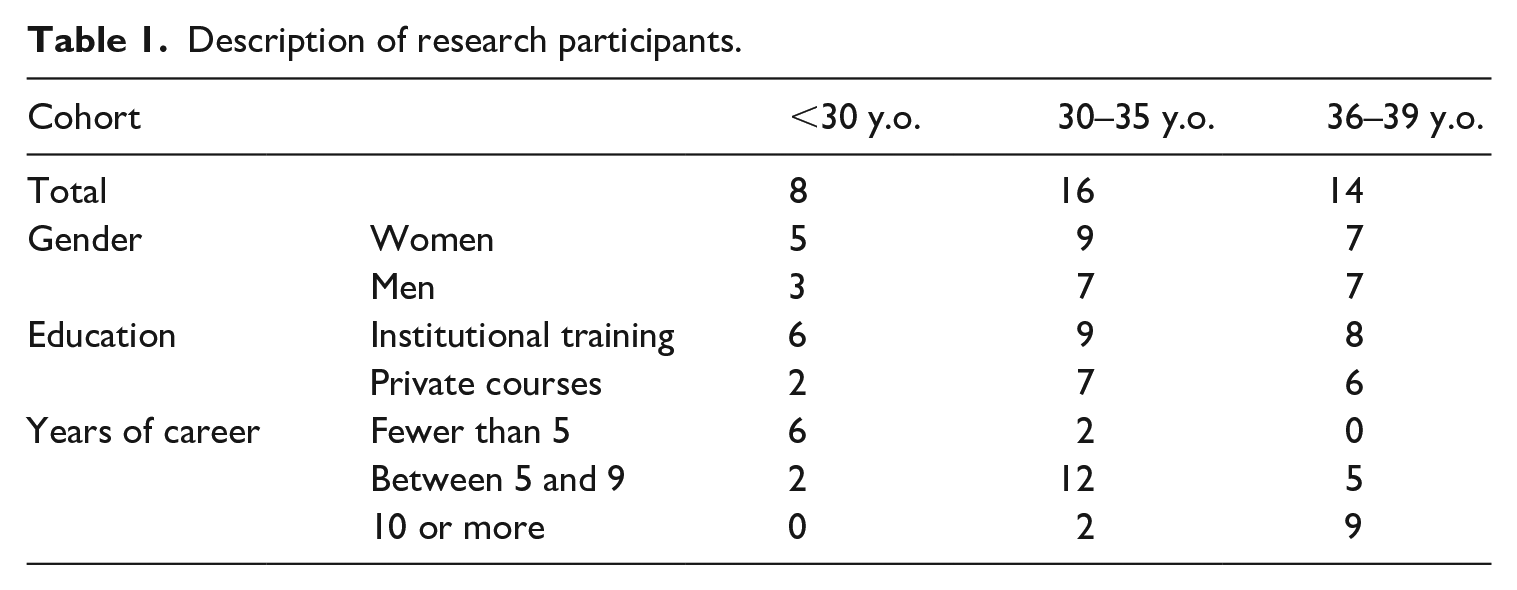
The research presented is grounded in qualitative research conducted between 2019 and 2021 with actors based in Milan, Italy. In recent decades, the city has been considered the centre of Italian creative and cultural industries and scholars have underlined the ambiguous intertwining between gentrification processes and cultural policies (d’Ovidio and Cossu, 2017; Valli, 2015) as well as between passionate creative labour and precariousness in creative workers’ everyday lives (Arvidsson et al., 2010; Vanni, 2016). Between February 2020 and May 2021, all cultural venues were intermittently closed in Italy due to COVID-19 restrictions on social gatherings. This situation led performing artists to experience under- and unemployment and to collectively reflect on their fragmented and precarious experiences in the creative labour market (Naclerio, 2022). In this research context, 38 in-depth interviews were collected with actors aged between 27 and 39 years with career experience in the field of less than 15 years. According to previous research that explored the Italian performing arts sector (Di Nunzio et al., 2017), young adults are the larger cohort of workers in the performing arts and are also the ones more exposed to poverty, vulnerability and unreported employment. In the context of Italian performing arts, the extremely fragmented working experiences and the hybridity of their career trajectories has been recognised (Naclerio, 2023b). Considering previous studies on the sector, the median salary of performing artists has been considered as just above the poverty line and their contribution to social security is often not sufficient to grant access to social protection schemes (Di Nunzio et al., 2017; Iannuzzi and Campolongo, 2023). In the present research, the vast majority of the research participants had access to higher education institutions and shared a middle-class background. Regarding ethnicity, two respondents identified themselves as having non-western origins. At the time of the interviews, some of the research participants had taken part in movies and well-known theatrical shows but none of them had risen to national or international attention. While some of the interviewees were exclusively involved in theatrical activities, the majority were acting in diverse genres and settings (cinema, comedy, advertisements, digital formats). The variance between employment and unemployment is characteristic of actors’ experiences and some research participants complemented their artistic practice with teaching or other working activities outside and within the cultural industries to sustain their income (Naclerio, 2023b). Table 1 summarises research participants’ characteristics in relation to age, gender, artistic education and career length in the performing arts.
Description of research participants.
Soliciting a reflexive posture, after a first open-ended session wherein research participants were asked to introduce themselves and their work, a second session followed a thematic guideline of questions that invited research participants to articulate their working experiences, their motivations for embarking on an artistic career, as well as their desires and expectations. Although some of the interviews were performed during the COVID-19 emergency, the analysis considers accounts that, on the one hand, exceeded the contingencies of the pandemic emergency, exploring topics more broadly related to actors’ experiences of work, but, on the other hand, are inevitably embedded in the emotional and social context in which the data collection took place. As has often been remarked, the analysis and the interpretation of qualitative data is not separate but deeply rooted in the researcher’s stance and in the research context (Atkinson, 2014; Yanow, 2015). The positioning of the researcher as a precarious PhD student living in Milan and a theatre lover who is passionate about the city’s cultural scene not only facilitated access to the field but also the creation of a safe space for discussion. Sharing a generational experience of employment insecurity in the urban environment helped the research participants to feel free to address difficulties related to creative work’s organisation and remuneration. When possible, attending theatre shows where research participants performed enriched the research process with an ethnographic proximity central to moving beyond a cognitive comprehension towards an experiential understanding of the interviewees’ working environments. Usually happening weeks or months after our interviews, depending on theatre schedules and on COVID-19 rules, the opportunity to enjoy actors’ artistic performances, their corporeal presence on stage and their interactions with the audience was relevant not only in facilitating the building of trust and the effectiveness of data collection but especially for the interpretation of the entire research process. Furthermore, doing research about performing arts work in an historical moment where theatrical venues were closed contributed to generating an emotionally resonant space of discussion where past experiences and future projects intersected the momentum’s affective aura.
The interviews lasted from 40 to 90 minutes and were audio recorded after having collected participants’ explicit written consent. Based on COVID-19 restrictions, some interviews were performed in online environments, while others were conducted in public parks, cafes or on a university campus. The language of the interviews, transcriptions and analysis was Italian and only the excerpts reported in the article were translated into English by the researcher. The names of the interviewees were pseudonymised and all the details that could possibly make their identity recognisable were omitted or modified.
The analysis entailed a first extensive reading of the interview data, during which notes were taken, followed by a broad coding process inspired by grounded theory’s presuppositions (Charmaz and Belgrave, 2012). Subsequently, research participants’ reflections about key themes were regarded in terms of their discursive content, considered not only as a central resource for the analytic process but also a way to approach narrative constructions of subjectivities (Weatherell et al., 2001). The analysis looked for discursive patterns in relation to research participants’ practices such as working routines, self-care and motivations to shed light on meaning-making processes. With the aim of understanding affective relations and tensions, all themes were appreciated in their interconnected relationships, as an emerging network and eventually connected to previous literature’s conceptual insights related to contemporary experiences, such as precariousness, entrepreneurship, reflexivity and individualisation.
Reflexivity, Discipline and Self-Care in Creative Careers
Despite the narrative emphasis on passion and pleasure at work, creative and cultural workplaces have been marked by highly competitive standards where entrepreneurial instances coexist with precariousness and exclusion. In this context, scholars have pointed out the relevance that psychological self-help manuals and coaching practices have for entrepreneurial subjects to cope with neoliberal uncertainties (Binkley, 2011; Mackenzie and McKinlay, 2021). From the data collected, embarking on a path of self-discovery and self-care is an essential requirement not only for personal self-realisation but also for professional success. In fact, discovering one’s unique selling points is central to navigating the creative labour market as it enhances attitudes of resilience and positive thinking: I feel that creativity is not only on the stage but also. . . especially when you are not there, we need to be creative, listen to ourselves, what you want to do, what you don’t want to do, trying not to accumulate frustrations because those don’t lead to anything creative but to a dreadful end . . . If you are committed, with passion, you go on, keep calm. (Karla) I knew a few people that were filled with doubt, and it wasn’t, or not only, for emotional distress or weakness, but it was because they didn’t want to do it [this job] profoundly. (Federica)
Cultivating dispositions oriented towards passion, resilience and aspiration emerges not only as a way to enhance individual qualities but is positioned at the core of an affective relation that bonds workers and professional success. In the words of Federica and Karla, passion and commitment generate value for the subject and for their career. In an individualised reading that exalts personal capabilities, disregarding structural features, the responsibility to reach success relies on the workers’ attitudes and psychological resources building on a narrative framework that exalts the transformative power of individual determination and inner commitment. Performers’ engagement in ongoing practices of self-cultivation is ambiguous, moving between the will of experimenting with new forms of corporeal and creative expression and the necessity to be compliant with neoliberal labour market demands: F: Every day I wake up, I train, I try to eat as best as I can, I take singing classes, I learn how to play a new instrument . . . I can see that there are skills that are useful in theatre work, I like the fact that they want me to play. Interviewer: What do you mean? Are these competences required? F: No, I don’t think they are but, who knows, if I couldn’t play the piano, I don’t know if they [the production] would have wanted me for this show. (Fedora)
The emphasis on the ongoing enhancement of personal qualities complements contemporary discourses on forging flexible and entrepreneurial dispositions in the world of work as well as with personal desires of self-improvement. In this regard, the research participants themselves occupy an ambiguous position related to the impossibility of defining whether the desire for self-enjoyment or for skills acquisition came first. This dilemma is especially relevant in the light of the epistemic proximity, which ties performing artists’ bodies and selves to their art in a relation where productive and non-productive self are impossible to distinguish: You are your work, it has to do with how you appear, how you speak, how you look, how you feel, how you think. . . all of your experience . . . When you start realising that, you discover a treasure, it gives you a sense of yourself in the world and, at the same time, you start taking care of yourself, a lot. (Angela) If I had left from time to time to do other things, my path would have been interrupted. It is like growing a little plant: if you are distracted, the plant does not grow strong. (Elena)
Practices of self-care emerge as a central part of research participants’ daily – working and non-working – activities oriented to both enhancing working opportunities and realising oneself. As emerges from the excerpts, devotion, resilience and sacrifice are part of a discourse that not only encourages but configures the enactment of self-disciplinary practices as an indispensable part of reaching individual goals. Thus, control appears to be exerted by the subjects themselves on their own corporeal, psychological and biographical experiences. In such a narrative, failure is moralised and configured as a direct consequence of individuals’ conduct. Furthermore, as an ever-changing context, the necessity for self-care and the cultivation of affects and dispositions is not achieved once and for all, rendering this self-reflexive work ongoing. In this sense, the case considered shows self-reflexive activities entertain an ambiguous relation with the neoliberal and entrepreneurial environment of work, where the emphasis on the development of personal qualities has been interpreted in relation to self-disciplinary practices (Scharff, 2016; Wee and Brooks, 2010): I worked a lot during that year, and from there, I realised that I was suffering, I wasn’t having fun; the actors’ work is based on a game, on a serious game, but we have to play, to have fun . . . It was a turning point, not just for my career but for my life . . . Actors’ life is totalising, it’s a life choice; instead, I needed other stuff. (Carola)
Since subjects are involved in a continuous reflexive activity, the direction of their effort is not predetermined but might change with time, shaping their biographical and professional progression. In Carola’s experience, at a certain point, the element of amusement in her working activities started to fade, draining her creative energies, and her personal enthusiasm led her to a radical change. Abandoning an artistic career and entering administrative work behind the scenes, in this case, was described as a necessary move in order to regain happiness. In the excerpts presented, theatre work is depicted as a totalising reflexive experience where self-care and self-improvement are part of a wider dynamic in which value is generated through the subject’s working activities and where personal and professional development exist in a circular dynamic. If, on the one hand, they cannot be separated since they both aim at increasing the subject’s capacities to enjoy the surrounding world, on the other hand, it emerges how reflexivity produces self-monitoring practices that can enhance subjects’ performances in a neoliberal context.
Beyond Boundaries: Creative Work as a Subjectivising Experience
The role of passion and motivation in directing creative workers’ careers and choices has been regarded as part of a romantic narrative that separates creative jobs from repetitive office routines (McRobbie, 2016). At the same time, it has been noted how the emphasis on being passionate in the workplace is also part of a process of labour aestheticisation characteristic of managerial discourses (Boltanski and Chiapello, 2007). During the interviews, while explaining their relation to their working activities, actors often referred to a sort of irrational involvement described through metaphors. Such narrative tropes were characterised by semantic vocabulary that evoked strongly felt emotions and passionate drives positioned outside the rational domain. The connection between subject and work was described by research participants as somehow impossible to fully comprehend and control, at least in the first years of a career: Being on the stage is a beastly experience, you want to be there, you feel bad when you are not there . . . it is like if you had a little spirit inside you that drives you to be on the stage, everything else, unfortunately, is worth less. (Tim) . . . Maybe because I don’t consider my artistic path in the professional domain but rather in my private sphere, the life one. Then, it is a job, there are rights, economic matters . . . but it is an existential path, not only a professional one. (Romina)
Contemporary discursive formations have been constructing creative and cultural work as an ambiguous space where, on the one hand, its orientation towards autonomy and self-expression is paradigmatic of contemporary neoliberal entrepreneurship and, on the other hand, its material relations are often positioned outside of the domain of work, in the semantic areas of leisure and play. Several narrative tropes can be traced back to a romantic vision of the artist that, in the western ideals, is gifted with artistic creativity, understood as an ethical and transcendental matter (Becker, 1982). From Tim’s excerpt it emerges how acting occupies a position of relevance for personal values and aims, where ‘everything else’ is relegated to a subordinate value. Romina’s excerpt explicitly questions the borders between private and professional lives and positions her working experience as the source of significance in her private life. Painting the contours of artistic work as ‘an existential path’, intimate trajectories and public career paths are often indistinguishable from the research participants’ understandings. While the aestheticist motto ‘art into life and life into art’, made popular during the 19th century, describes a fusion between life and work that was desirable in certain artistic settings, actors described a relation of consubstantiality between life and art. The choice to pursue an artistic professional path is often related to a desire for self-discovery in a process that is enabled by the reflexive character of the artistic practice.
The only thing that I really would like to do is exploring the possibilities that are in me; every work that I do, it leads me to discover small or big things . . . this is for me the biggest richness of this work. (Michelle) It is like an ongoing self-therapy, theatre pushes you towards your limits . . . For me it has been an occasion to grow on a personal level, my attitude, my structure. (Carola)
The value of creative work is situated in a reflexive domain and related to the means that each individual has to discover and cultivate its uniqueness. As the departure point of an existential quest directed towards self-discovery, creative work is framed as a way to reach authenticity and to fulfil the cultural necessity to become oneself. The emphasis on psychological well-being underlines the relevance of goals such as personal growth and happiness, traditionally considered in the private and intimate sphere. What starts to emerge is not only the irreducible reflexive urgency of artistic work but also the individualised nature of this same urgency: You try to plan but it is hard to fit the rest of life, building a family, buying a house, even organising a holiday, with your work. Then you accept the difficulties because the satisfaction that you have in return is very high. (Jules)
As seen in the excerpt, the insecurities related to the labour market endanger subjects’ possibilities of planning the future and entering adulthood. However, in Jules’ words, the sense of efficacy and realisation that can be derived from creative work supersedes the hardships of creative labour. In the interviewees’ accounts, the deep personal and affective investment that binds the actors to their profession is often described as an involvement that goes beyond economic compensation: In my view it isn’t a matter of being young or old, it is the situation where you work, what you want to do, if you perform your show in a pub, you can’t ask a lot but maybe you are satisfied on another point of view, you performed your show, that you built, in an environment that you like; for me this is the point. (Daniel) I prefer to earn less but not lending myself to this market dynamics. (Elena)
In the excerpts above, creative work is described as an activity detached from both monetary rewards and career advancements but oriented towards the subject’s self-enjoyment. Daniel points to gratification that performing a job out of passion can provide, gratification that, in his view, is worth more than monetary goals, while Elena values self-expression, even in conditions of poor economic rewards. The prerequisite for accepting a gig appears to be the possibility of an intellectual and creative involvement of the self in the act of working. Generating revenues from creative work is described as a non-primary aim of subjects’ activities. Indeed, previous literature suggests that the possibility of disregarding economic compensation and favouring self-expression is related to research participants’ socio-economic backgrounds. However, considering subjects’ narratives, choosing to earn less without submitting to commercial logic emerges as a way to self-determination that reinforces efficacy and identity in the subjects’ positioning. In this context, the meaning of traditional borders between paid and unpaid work is blurred since work is described as the place of subjects’ struggles towards self-realisation. Answering an individual need for self-discovery, creative work has an intimate, non-quantifiable value for the self and occupies an ambiguous positioning with regards to ideas of leisure, work and free time: Also on vacation, I assure you that there is something related to work . . . you go to Greece, and don’t you go to Epidaurus theatre? You are off in Milan and your friend offers you a ticket for La Scala, don’t you go? (Rosanna)
In a context where life and work are described as inextricably linked, this excerpt points not only to the blurring borders between leisure and working space and times but to how this same separation ceases to be relevant in subjects’ narratives of their own experiences. Despite originally being constructed in opposite terms, the discursive area of work appears to have engulfed the domain of leisure and game. Research participants’ narratives show how working activities are contextualised as a central variable of subjects’ abilities to derive pleasure and meaning from life’s experiences.
Discussion
The discursive emphasis on passion and commitment in creative and cultural work has often been considered as a dispositive encouraging workers to embrace precarious and self-exploitative workplace dynamics (McRobbie, 2016; Scharff, 2016). However, scholars have also recognised that performing artists conceptualise their working activities as a central instrument for asserting personal autonomy and self-determination. Considering cultural workers’ experiences as exemplary of neoliberal (self-)exploitation has been criticised because of its dismissal of workers’ possibilities of self-determination (Alacovska, 2018; Banks, 2007). From the analysis conducted, performing artists’ work is configured as inextricably related to individualised and reflexive biographical projects and expectations that ought to be considered as immersed in complex nets of power and negotiations that exceed material relations and that radically shift traditional meanings and practices associated with work.
On the one hand, the analysis confirms how the goal of artistic activities is rarely related to economic compensation and how the language of affect and emotion recurs in the description of artists’ work, configuring the contours of a hybrid environment wherein subjectivation processes take shape (Gregg, 2011). On the other hand, it has also emerged how artistic activities are lived out as an active self-reflection aimed at expanding subjects’ experience of the world, remarking the relevance of therapeutic uses of artistic training to enhance personal well-being (Cinque et al., 2021; Taylor and Littleton, 2012). However, the analysis moves further and points at the centrality of self-reflexive practices in research participants’ narratives as the way in which individualisation is enacted through work. In a context where success and failure are navigated at an individualised level, subjects’ efforts towards the expansion and improvement of corporeal and emotional abilities assume an ambiguous nature. Hinting at neoliberal labour market requirements for the ongoing growth of personal capitals, self-care practices shape workers’ aspirational and future-oriented attitudes (Duffy, 2016), as well as fostering the cultivation of emotional qualities of resilience (Binkley, 2011; Gill and Orgad, 2015), letting emerge how self-reflexive instances are ambivalently tied to social structures (Adkins, 2004; Beck et al., 1994). While some scholars emphasised the end of the distinction between productive and unproductive self in immaterial working processes (Hardt and Negri, 2000), the case considered relies on the peculiar configuration that ties workers’ bodies, emotions and affects in the context of the performing arts (Kuric Kardelis, 2023). In the case of performing artists, the value generated by the subject through the working activity is transformed, through a reflexive process, into a broader value for the subject and, vice versa, characteristics inherent of the subject, such as corporeal appearance, affects and emotions, are valuable in the working environment. In this sense, examining the experiences of theatre actors, the analysis provides a case study in which work is configured as an embodied experience, pointing at how the reflexive process produces values that are inserted in a circularity of meanings between subjects and work. In the case considered, subjects’ reflexive activities result intimately related to the resources available to imagine and embody the surrounding relational, emotional and corporeal world (Adkins and Lury, 1999; Crossley, 2001). Without reducing subjects’ investment in personal development to ideological instances, it is necessary to take into account the productive effects that the cultural injunction for self-realisation has on self-disciplinary processes (Du Gay, 1996; Petersson McIntyre, 2014; Rose, 1989) as well as the centrality that working activities have in individualisation and subjectivation processes. Narratives of work take shape in an individualised and neoliberal context where subjectivities are formed amidst ambivalences and tensions. In the case of performing artists, it emerges that personal and professional development are involved in a circularity that, on the one hand, dismantles traditional divisions between productive and non-productive time and, on the other hand, emphasises the disciplinary power of reflexive attitudes. In this sense, it has emerged from the data collected how working practices are the affective and reflexive sites where subjectivities are formed. Research participants openly avoided – when feasible – performing working activities not perceived to be of value, even if economically rewarding, emphasising how the sense of working activities is individual before economic. The moral dimension of cultural work (Banks, 2006) and the tension that, in capitalist environments, often exists between profit and the opportunity to perform a good job well done (Luckman, 2015; Sennett, 2008) opens the field of cultural work to the emergence of discursive tools that can be used to question neoliberal market rationalities (Alacovska, 2022). In this context, the aims of work are positioned within the domain of subjective meanings and existence in the world and, as a consequence, traditional boundaries of work, intended as an economic and structured activity constrained in time and space, are eventually effaced.
Conclusion
The article considers cultural workers’ narratives of work to shed light on how subjectivities are formed amid individualised and reflexive processes. Looking at performing artists’ work allows the study to gain a privileged perspective on the complex and intertwining relationships that exist between bodies, emotions and affects. In a context of work shaped by neoliberal entrepreneurial dynamics, subjects’ reflexive activities are ambiguously related to labour market demands and self-cultivation practices of creative expression. The epistemic proximity that unites art, bodies and selves generates a circularity of meanings, affects and embedded experiences where traditional boundaries of work are effaced in their capacity to describe and capture cultural workers’ experiences.
Footnotes
Funding
The author received no financial support for the research, authorship and/or publication of this article.
