




Abstract
This article relates the lively debate about inequality-induced status concerns in affluent societies to the broader theoretical perspective on changing existential dispositions in modern society, which we reconstruct from the sociological theories of David Riesman, Gerhard Schulze and Ronald Inglehart. We conceptualise experience seeking – aspiring to an enjoyable life – alongside status seeking – aspiring to a successful life – as a presumably increasing life orientation. Using extensive data from the European Social Survey, for 27 countries and over 350,000 respondents over the period 2002–2018, we examine the extent and relationship of these orientations over time, their associations with socio-economic development and income inequality, as well as their social stratification according to individual-level characteristics. The results show that the populations of wealthy and economically more equal societies increasingly prefer an exciting life to a successful one. Within societies, men, younger people and the highly educated value both experiences and status.
Keywords
Introduction
The pursuit of status, success and prestige is a fundamental motive of individuals and a central driver of the prosperity of human societies. Sociologists, psychologists and economists have thus extensively focused on people’s aspirations for having a successful life, which revolves around occupational achievement, material rewards and prestige (e.g. Offer, 2006) – status seeking. Increasing economic inequality, and the debate about its consequences for individuals and societies (Grusky and McLean, 2016; Wilkinson and Pickett, 2010), has only increased scientific interest in status seeking (Delhey et al., 2022; Jetten and Peters, 2019; Paskov et al., 2017; Rözer et al., 2022), and especially in its negative consequences, such as status anxiety (Delhey et al., 2017; Layte and Whelan, 2014). Economic inequality is seen as luring citizens into the rat race in order to gain money and status that prevents them from leading meaningful and truly happy lives (Layard, 2005; Wilkinson and Pickett, 2010). This dovetails with popular accounts of western societies as suffering from widespread consumerism (Barber, 2008), materialism and ‘selfish capitalism’ (James, 2008), especially in the looming climate crisis (Jackson, 2009).
As powerful as this discourse is, it remains unclear whether status seeking is really the prevalent disposition in contemporary societies. Current research seems to consider status seeking as more or less self-evident, and analyses it in isolation of other fundamental dispositions, thereby – intentionally or unintentionally – reducing people to mere status seekers. In stark contrast, various sociological theories of cultural modernisation (Inglehart, 1997; Riesman, 1950; Schulze, 1992) assume that status seeking has already reached its peak in modern society, as the postmodern condition induces a shift to a new fundamental orientation: increasingly, people are concerned with living an exciting and emotionally fulfilling life, rather than with a successful and materially prosperous life.
Against this backdrop, the aim of this article is twofold. With theoretical intent, we first outline the astonishing agreement regarding the sequence of two basic dispositions in major theories of cultural modernisation: Riesman’s (1950) theory of the changing American character, Inglehart’s (1997) postmodern value change theory and Schulze’s (1992) theory of the experience society. While this comparison of theories also helps to clarify the concept of status seeking as the key modern disposition, its main value lies in elaborating on experience seeking as the key postmodern disposition – and in highlighting the assumed association of both dispositions with levels of prosperity and income inequality. Our second goal is empirical and explorative: using extensive data from the European Social Survey for 27 countries, with more than 350,000 respondents over the 2002–2018 period, we examine the prevalence of status seeking and experience seeking, and their evolution over time; the association between these two orientations; their association with macro-societal conditions; and their individual-level structuration.
Status Seeking and Experience Seeking: Theorising Two Fundamental Dispositions
Riesman’s (1950) classical study of the changing character of Americans distinguishes three social characters: tradition-directed (socio-historically the oldest), inner-directed and other-directed (the most recent). These characters are defined by how social conformity is ensured, via traditions, internalised authority and peers (Riesman, 1950: 18f.). Both the relationship between the two modern character types and what they aspire is of particular interest in this study, and Riesman describes them as follows: The inner-directed person, though he often sought and sometimes achieved a relative independence of public opinion and of what the neighbors thought of him, was in most cases very much concerned with his good reputation and, at least in America, with ‘keeping up with the Joneses.’ These conformities, however, were primarily external, typified in such details as clothes, curtains, and bank credit. For, indeed, the conformities were to a standard, evidence of which was provided by the ‘best people’ in one’s milieu. In contrast with this pattern, the other-directed person, though he has his eye very much on the Joneses, aims to keep up with them not so much in external details as in the quality of his inner experience. (Riesman, 1950: 24, emphases added)
The inner-directed character is guided by a strong value compass, yet nevertheless largely strives for external goals such as material prosperity and occupational success, being subject to a ‘scarcity psychology’ (Riesman, 1950: 19). In an increasingly urban and affluent society, however, Riesman saw this character in decline, gradually displaced by the outer-directed character who aligns themself with fellow human beings. Being subject to an ‘abundance psychology’ (Riesman, 1950: 19), this character, as consumerist as it still is, is in a historically unique way concerned with its subjective world of emotions rather than with objective status markers per se (Riesman, 1950: 154–155). The experience content comes to the fore for this new character, and consumables and material goods trigger less arousal than for the inner-directed type, which makes them constantly look for new stimuli (Riesman, 1950: 154–155).
A second major theoretical reference for the transformation of fundamental dispositions can be found in value change theory, and particularly in Inglehart’s (1997) book Modernization and Postmodernization (similar yet not identical explanations can be found in his previous works concerned with the change from materialism to postmaterialism, see Inglehart, 1977, 1990). This theory suggests a modernisation sequence where both societies and individuals have shifting value priorities. Modernisation in terms of industrialisation means that maximising economic growth becomes the core societal goal, which is reflected in the strong achievement orientation of individuals towards occupational success and economic gains (Inglehart, 1997: 66, 77). The dominant individual disposition in modern society thus primarily emphasises status. With postmodernisation, however, the societal goal shifts from materialism to maximising well-being generally (Inglehart, 1997: 66, 76), and subjective well-being specifically. In the postmodern condition, individuals increasingly pursue a self-directed life geared towards subjective well-being, which is largely found in social life, leisure activities and ‘the quality of the work experience’ (Inglehart, 1997: 78). The dominant individual disposition in postmodern society thus primarily emphasises experiences.
The growing existential security in wealthy societies, which is in turn a result of economic prosperity and welfare state protection, is driving the postmodern shift towards a valorisation of subjective well-being. The achievement orientation therefore reflects the condition of scarcity, whereas the subjective well-being orientation reflects the condition of abundance (Inglehart, 1997: 87).
A very similar theoretical argumentation, yet with a much more detailed and vivid description of the postmodern disposition, was provided by German sociologist Schulze (1992) in his work The Experience Society. Under the prevailing conditions of economic scarcity, he argues, individual thought and action were typically focused on securing resources, because the main motivation was to improve, or at least maintain, living conditions and social status (Schulze, 1992: 251–252). This changes with longer periods of prosperity, as Schulze shows for the case of post-war West Germany. He assumes that affluent societies can no longer be described primarily as competitive societies, but as a new, emerging type – the experience society. Here, ‘the meaning of life is defined by the quality of subjective processes. One wants a beautiful, interesting, pleasant, fascinating life’ (Schulze, 1992: 85, own translation). What Schulze assumed is a change in life orientations from being better-off economically – the extrinsic orientation of the presumably fading competitive society – to being better-off in terms of the richness of subjective experience – the intrinsic orientation of the emerging experience society. As emotionally rewarding experiences are key to leading an enjoyable life, the term experience orientation is used to denote this late-modern disposition. Conceived as a culturally comparative category (cf. Schulze, 1993: 414), the experience society represents an ideal type in the Weberian sense: the inhabitants of wealthy countries are in a historically unique way oriented towards enjoying their life, and to being happy and satisfied. This change in basic dispositions from status seeking to experience seeking is a consequence of the abundance of options for shaping one’s own life, and particularly of growing prosperity and an expanding leisure industry (Schulze, 1993: 406–407).
In summary, the theories outlined above have a common core regarding the sequence of the transformation of fundamental dispositions in people, induced by socio-economic progress. First, all three theories assume the existence of two basic dispositions in western-affluent societies, which should be explored in conjunction rather than isolation. Second, one disposition is concerned with achieving socio-economic success and higher status, the other disposition with accumulating pleasant and satisfying subjective experiences. Third, while these dispositions coexist in postmodern society, a specific dynamic is consistently assumed: the ‘older’, status-oriented disposition is expected to stagnate or even to decrease, while the ‘newer’, experience-oriented disposition is expected to increase.
Definitions, Research Questions and State of Research
Status Seeking and Experience Seeking Defined
We conceptualise status seeking and experience seeking as basic dispositions because we are interested in the conscious or unconscious state of readiness of individuals to pursue certain life goals, rather than in specific actions (such as buying status goods, leisure activities, etc.) or their eventual success (achieving high prestige, having an exciting life, etc.).
We define status seeking as a disposition towards the pursuit of occupational and material success on the one hand, and of recognition and prestige on the other. Status seeking implies an external focus, as it aims at objects that are outside the striving person themselves – be it money, luxury goods, authority or esteem. In traditional society social rank is largely determined by ascriptive forces, but modern society links rank to individual achievement, and thus to performance and merit (Inkeles, 1966). The latter, consequently, presupposes – and arguably also generates – a widely shared willingness, a disposition, to social advancement and occupational success that rewards individuals with power, privilege and prestige, to use Lenski’s (1966) famous formula.
In the Weberian tradition (Weber, 1980 [1921/1922]: 177–180), status is often narrowed to prestige or other forms of social appreciation (see Anderson et al., 2015; Maner, 2017). This tradition has guided a number of studies on occupational status and prestige (seminally: Chan and Goldthorpe, 2007; Treiman, 1977). Status as honour, esteem or respect analytically separates it from material success and status goods (cf. Ridgeway, 2014: 2). In this sense, status is relevant sociologically because it matters to people how they are seen and valued by others (Veblen, 1934 [1899]). Accordingly, relative deprivation (Runciman, 1966) is often considered as important or even more important than objective class position, with social comparisons (Runciman and Bagley, 1969) and interactions (Bottero, 2009) playing an important role. For other scholars, however, status denotes both socio-economic position and prestige. For example, Packard (1959) has very vividly described people’s efforts to show their rank through status goods, demonstrating that the pursuit of material success and of prestige cannot really be separated (see Mattan et al., 2017 for a discussion of the different ways to achieve recognition). Bourdieu (1985, 1987) brought together this dual nature of objective and subjective factors of class via the concepts of social space, capital and habitus, which are also relevant to more recent debates about subjective class identity (cf. Rubin et al., 2014: 198; generally, see Bottero, 2004; Evans and Kelley, 2004; Wright, 1997).
We define experience seeking as a disposition towards the pursuit of an enjoyable and emotionally fulfilling life on the one hand, and a stimulating life full of new experiences on the other. Experience seeking aims at subjective psychophysical states that individuals find to be pleasant, such as fun, excitement, enjoyment, fulfilment and bliss (see Delhey and Schneickert, 2022). These inner states are mainly achieved via experiences, that is, through selecting and arranging activities, products and social relations in a way that they are experienced as subjectively rewarding (cf. Schulze, 1993: 409). Hedonism is an important ingredient of this disposition, although experience seeking should not be reduced to a shallow ‘fun morality’ (a common reproach by cultural conservatives, see Bell, 1976), as people also strive for meaningful experiences. The second ingredient, the need for variety, originates partly from the pitfalls inherent in the quest for subjectively rewarding experiences. Adaptation typically diminishes the pleasure derived from repeated experiences, as has been demonstrated for travelling (Quoidbach et al., 2015). Adding to this the general problem of the uncertainty of experiences and the risk of disappointment (Schulze, 1992: 421), it helps to understand why people repeatedly invest energy in creating new pleasant experiences.
Our conceptualisation does not imply a kind of natural opposition between status seeking and experience seeking, as is the case with the well-known distinction between materialism and postmaterialism (Inglehart, 1977). Arguably, both dispositions share a consumerist core in capitalist mass consumer societies, and hence can be expected to be positively associated within individuals, rather than negatively. This is further implied by a specific convertibility of the disposition’s main ‘currencies’: some experiences, especially the market-mediated, require financial means; conversely, many experiences are suitable for gaining prestige with those around us, especially in times of social media.
Research Questions and Theoretical Expectations
The following expectations can be derived from our theoretical framework.
Prevalence of dispositions and development over time
We expect experience seeking to be more widespread than status seeking in contemporary European societies as a whole, especially in the wealthy western and northern parts of Europe. Experience seeking should increase over time, while status seeking should stagnate or decline.
Association of dispositions
We assume status seeking and experience seeking to be positively associated within individuals rather than negatively. We further assume that the positive association between the two life orientations will decrease over time, especially in the western and northern parts of Europe.
Macro-social drivers
We expect the dispositions to be systematically associated with better life opportunities (coming with socio-economic development) and income inequality: a higher level of socio-economic development should be associated with less status seeking and more experience seeking, and a greater scale of inequality should be associated with more status seeking and less experience seeking (as inequality arguably fosters competition and materialism). We further expect an effect on the strength of the relationship between the two dispositions: a higher level of socio-economic development should be associated with a weaker association, and a greater scale of inequality with a stronger association.
Sociodemographic profiles
Within societies, we expect variations in dispositions between social groups differentiated by vertical and horizontal parameters. Previous research shows that men, the younger, the highly educated, migrants and religious people value status seeking more (Delhey et al., 2022; Paskov et al., 2017; Wang et al., 2020), but little is known about individual-level determinants of experience seeking. Following value research as well as Schulze’s (1992) considerations, we assume that the search for experience will be more pronounced among younger and highly educated people.
State of Research
Previous research has almost exclusively studied status seeking, especially at the contextual (country) level. There is a recurrent focus on the effect of income distribution, with the idea that status seeking is more widespread in economically unequal countries, due to stiffer competition in society. The empirical evidence, however, is inconclusive, and differs depending on whether status seeking is studied as a disposition or as observable behaviour: while Walasek and Brown (2016) show in a large international comparison that people in unequal countries search more for luxury brands online, Paskov et al. (2017) provide evidence that Europeans are pursuing status less when there is high inequality. Rözer et al. (2022) found no systematic relationship between income inequality and materialistic attitudes, neither in Europe (comparing 35 countries), nor in the USA (comparing federal states). Materialistic behaviour, on the other hand, was found to be more common in unequal US states, and less common in more unequal European countries (Rözer et al., 2022). Another study investigated the contextual effect of human development (measured by the Human Development Index (HDI)), finding that status seeking is weaker in the European countries with the highest HDI scores (Delhey et al., 2022). This finding dovetails with previous cross-national research that has shown that people in richer countries compare themselves less intensively with others (Clark and Senik, 2010), and that their financial satisfaction contributes less to overall life satisfaction (e.g. Delhey, 2010).
At the individual level, studies quite consistently show that there are mainly differences in status seeking for gender and age, and in some countries for migration background and religiosity (Delhey et al., 2022; Huberman et al., 2004; Paskov et al., 2017; Wang et al., 2020). The effects of vertical stratification characteristics tend to be weaker overall, with status seeking being stronger among the upper strata rather than the lower strata (Delhey et al., 2022).
As we are introducing the concept of experience seeking for the first time, there are at best indirect empirical findings for this life orientation so far, mainly from postmaterialism research. Population averages of postmaterialist value orientations are positively related to a number of indicators of socio-economic modernisation such as national income, life expectancy and service sector size (Inglehart, 1997; Inglehart and Welzel, 2005). Within countries, postmaterialist orientations are more widespread among younger people and those with a stronger socio-economic background, and especially higher education (Inglehart and Welzel, 2005: 70, 221; Kalmijn and Kraaykamp, 2007; Nový et al., 2017). The extent to which these findings also apply to experience seeking, which concerns a conception of one’s own life rather than postmaterialist public policy preferences, remains to be investigated.
Data and Methods
We use data from rounds 1 to 9 of the European Social Survey (ESS) 2002–2018 (see Table A1 in the Online Appendix; European Social Survey (ESS), 2018, 2020). Within the framework of the ESS, population-representative data for individuals aged 15 and older have been collected every two years in more than 30 countries since 2002. Samples are usually at least N = 1000 and are selected using strict random probability methods (https://www.europeansocialsurvey.org). In order to meaningfully compare status seeking and experience seeking across time, we only included countries that participated in the most recent round, and at least twice since 2002. We further excluded Israel, Russia and Turkey from the analyses in order to restrict the sample to European societies in a narrow sense, which leaves us with 27 countries and 202 country–year observations. After performing listwise deletion of missing values on our central variables across all survey waves and countries (n = 15,817, 4.2%), the individual-level working file comprises 362,600 individuals from 27 countries.
Measures
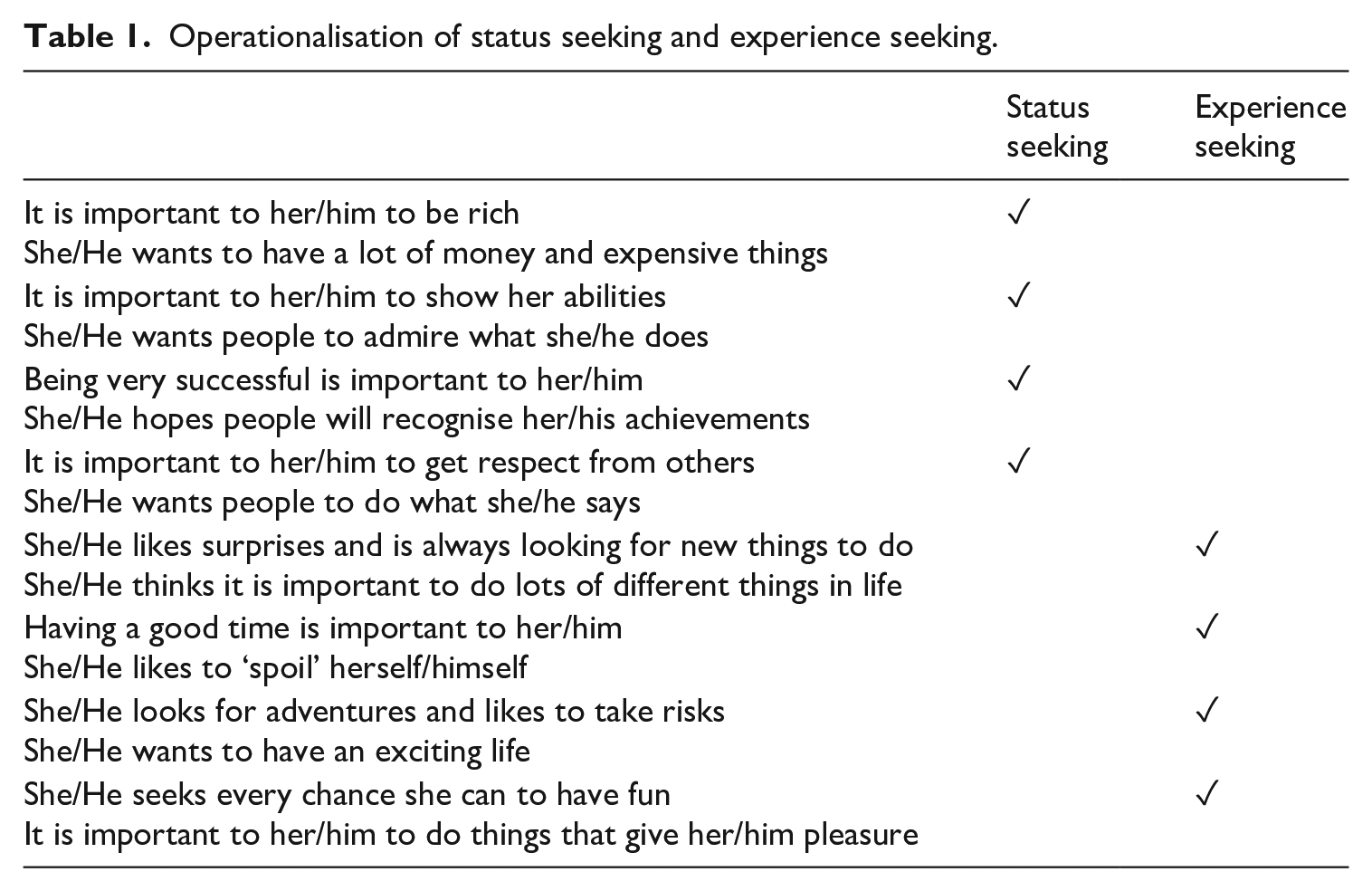
We constructed the indices for status seeking (SSI) and experience seeking (ESI) using eight items from the Schwartz (1992) values battery. Respondents are asked to indicate the extent to which a set of hypothetical individuals described resemble themselves on a six-point scale that ranges from 1 ‘Is very similar to me’ to 6 ‘Is not similar to me at all’. The exact wording of the items is provided in Table 1. We reversed the scales so that higher scores represent stronger agreement. Following Delhey and Schneickert (2022), we measure status seeking via the Schwarz values achievement and power, which together form the higher-order value of self-enhancement, according to the theory of human values (see Schwartz, 1992, 2012). We measure experience seeking via the values hedonism and stimulation, which are part of the higher-order value of openness to change, together with the value of self-direction (see Figure A1 in the Online Appendix for a visualisation). In our data, reliability measures show that the hedonism and stimulation scores fit each other better than each fits the self-direction score. Since we are theoretically interested in the very combination that represents ‘a desire for affectively pleasant arousal’ (Schwartz, 2012: 9), hedonism and stimulation, we consider it reasonable to construct experience seeking on the basis of these two values only. We thus constructed two unweighted mean indices, scaled from 1–6. Scores for status seeking range from 2.9 in France (2016) to 4.3 in Latvia (2008), and scores for experience seeking from 3.2 in Lithuania (2018) to 4.3 in Hungary (2018) (see Table A1 and Table A2 for detailed information; see Figure A1 in the Online Appendix for a discussion of the items used).
Operationalisation of status seeking and experience seeking.
Country-Level Characteristics
As outlined in our theoretical expectations, we focus on two macro-measures to predict how widespread life orientations within populations are: socio-economic development and income inequality.
Socio-economic development is captured by the HDI (United Nations Development Programme and Human Development Report, 2019). HDI scores above 0.700 indicate ‘high human development’; scores above 0.800 ‘very high human development’. In our country set, the HDI ranges between 0.756 in Bulgaria and 0.954 in Norway (see Table A1 in the Online Appendix). We multiplied HDI scores by 100 for better readability of the resulting coefficients in the analyses.
Income inequality. We use the Gini coefficient of equivalised disposable income derived from the Standardised World Income Database (Solt, 2020). The theoretical range of the Gini coefficient is 0 to 100, with higher values indicating a more unequal distribution. In our country set, the Gini coefficient ranges from 23.0 in Denmark and Slovakia to 38.2 in Bulgaria (see Table A1 in the Online Appendix).
As the HDI (a composite index of life expectancy, education and per capita income) captures life opportunities more broadly, it is theoretically more suitable than a measure of economic life opportunities, like gross domestic product (GDP) per capita. Robustness checks (not reported) showed that, using GDP per capita instead of the HDI to tap socio-economic development, or the income share ratio s80/s20 instead of the Gini coefficients to measure income inequality, yields the same results in the subsequent analyses.
Individual-Level Characteristics
We use a short set of individual-level variables in our exploratory time-pooled country regressions (in the section ‘Sociodemographic Determinants of Individual Status Seeking and Experience Seeking’), drawing on the five most relevant factors described in the existing literature on status seeking. Individual characteristics include general sociodemographic information, namely gender (ref. male); age in years; years of education; migration background, based on the respondent’s as well as their parents’ countries of origin (ref. no migration background); and finally, an indicator for religiosity based on the question ‘How religious are you?’, with a scale from 0 ‘not at all religious’ to 10 ‘very religious’. The number of years of education is, of course, a fairly crude proxy for cultural capital, but is common practice in international comparison. Religiosity and migration background are cultural factors at the individual level, which are theoretically closely related to Max Weber’s idea of the relevance of work ethics.
Analytical Strategy and Methods
We conducted our analysis in four steps along the study objectives outlined earlier in the section on ‘Definitions, Research Questions, and State of Research’. First, we provide descriptive information on the extent and development over time of population averages for status seeking and experience seeking. Second, we explore the within-country correlation between experience seeking and status seeking at the individual level, and its development over time. Third, we perform pooled ecological regression modelling in order to explore the effects of socio-economic development and income inequality on the population averages of (a) status seeking, (b) experience seeking and (c) the correlation between status seeking and experience seeking. Fourth, we use time-pooled ordinary least squares (OLS) regressions, by country, to exploratively analyse the individual-level social profile of status seeking and experience seeking in all 27 ESS countries.
Results
Extent and Development of Status Seeking and Experience Seeking
Figure 1 shows the extent and development of status seeking and experience seeking as population averages on the respective indices, scaled from 1–6. Averaged across all countries (upper left panel), Europeans strived more for experiences than for status throughout the investigation period, and especially in the most recent waves. There are, however, considerable differences between countries. Three groups can be distinguished. In the largest group (country names with yellow background), experience seeking clearly dominates status seeking, with the distance tending to widen in recent years in most countries. With the exception of Spain, this group comprises the more wealthy Northern and Western European countries. In a second, smaller group of countries without a clear geographical pattern (country names without background colour), neither of the two dispositions dominates over the study period. Finally, in Croatia, Slovakia, Lithuania, Bulgaria, Poland – all ex-socialist countries – and in Italy, status seeking dominates experience seeking (country names with blue background).
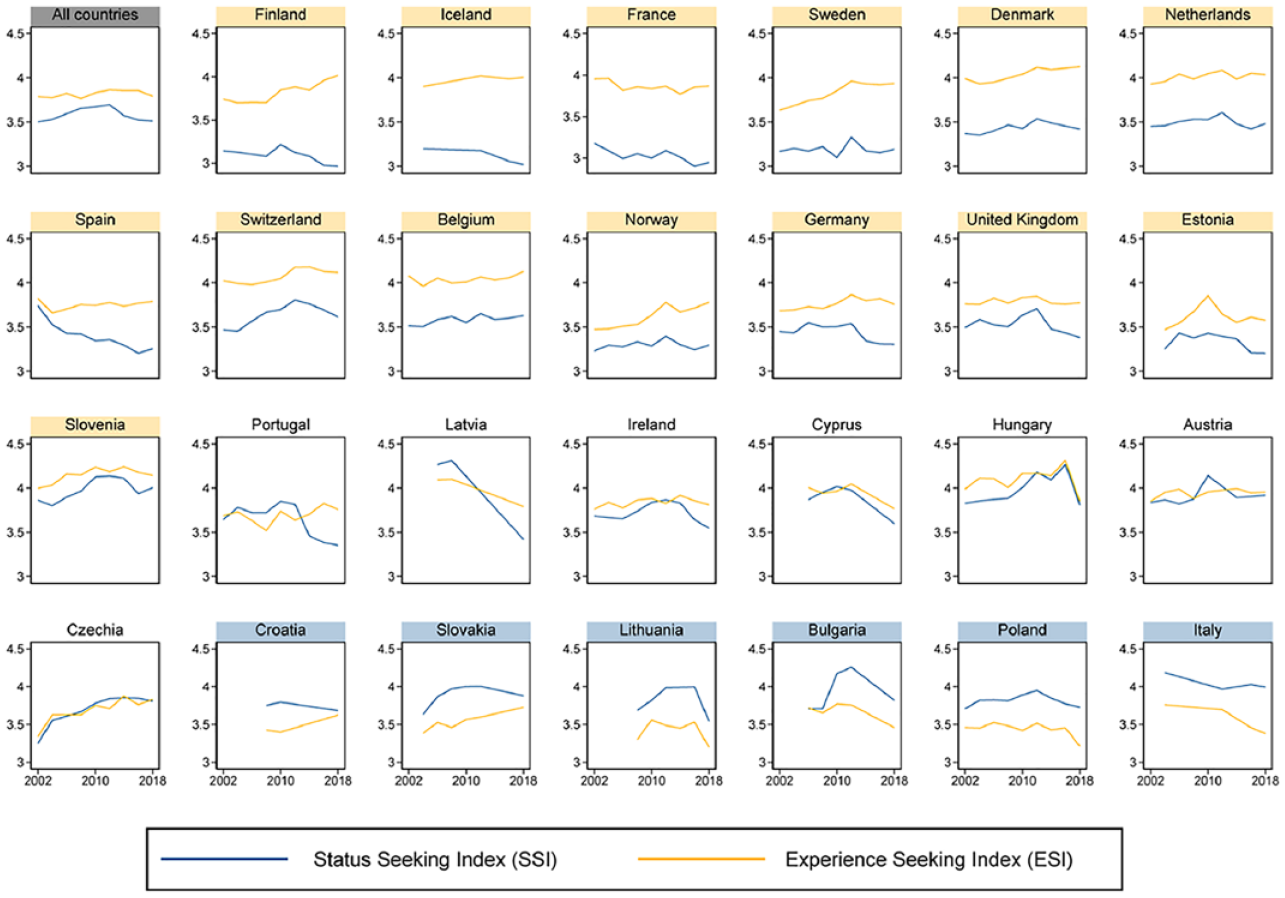
Population averages for status seeking and experience seeking over time, by country.
The Relationship between Status Seeking and Experience Seeking over Time
Our theoretical reasoning also involved the relationships between dispositions within individuals. Technically, the degree of dependence/independence is indicated by the within-country correlation between an individual’s scores for status seeking and experience seeking. The lower the correlation, the more the two dispositions represent distinct – although not necessarily contradictory – life orientations. Figure 2 shows the strength of these correlations by country over time. Averaged across all countries (upper-left panel), the association between status seeking and experience seeking is positive, yet tends to weaken over the study period, from 0.47 to 0.36. This suggests first of all that both dispositions are in principle compatible. The average strength of correlation varies between 0.36 in Switzerland to 0.65 in Slovakia. The ranking of countries suggests a clear gradient running from Northern and Western Europe (moderate correlation) to Southern and especially Eastern Europe (strong correlation). In the majority of societies – except the three Central-Eastern European countries Czechia, Slovakia and Hungary – the strength of correlation decreased since 2002.
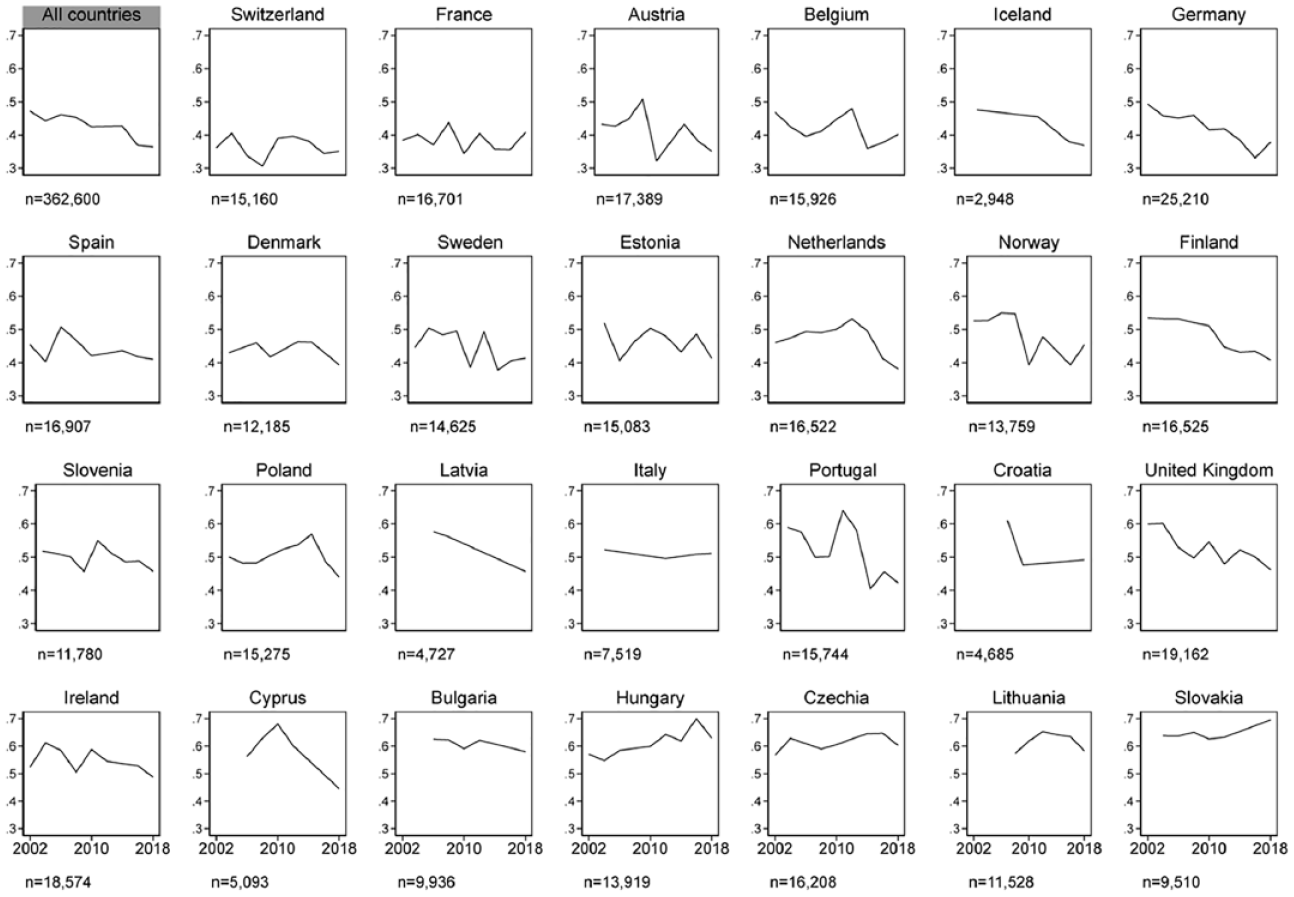
Correlation between status and experience seeking within countries over time.
Macro-Level Determinants of Dispositions
In a next step, we employ time-pooled ecological regressions to analyse which socio-economic conditions are associated with population averages of status seeking (M1), experience seeking (M2), and their association (M3) for 202 country-year-observations across nine waves from 27 countries (Table 2).
Ecological pooled regressions (N=202).
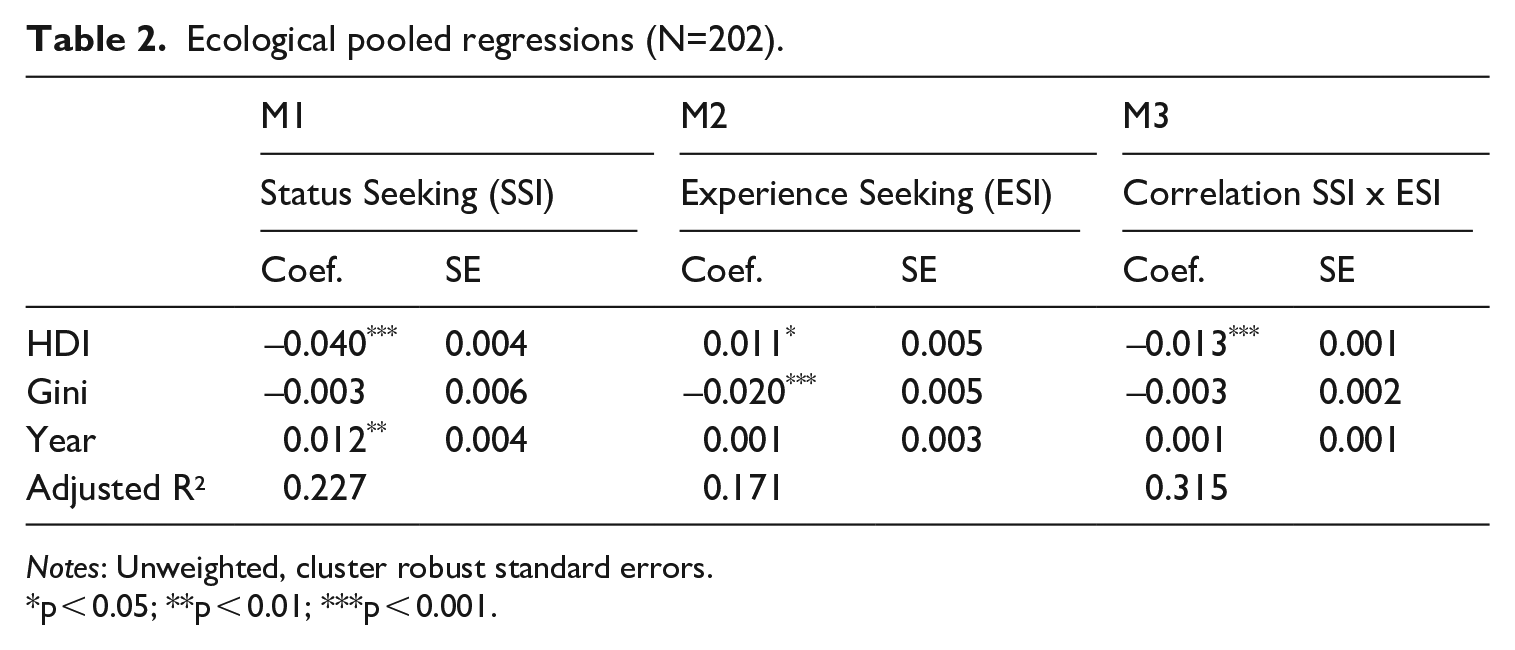
Notes: Unweighted, cluster robust standard errors.
p < 0.05; **p < 0.01; ***p < 0.001.
The level of human development (HDI) is significantly associated with less status seeking (M1) and more experience seeking (M2), confirming the descriptive findings from above. Income inequality (Gini) has a less definite effect: while the Gini coefficient is, somewhat surprisingly, unrelated to status seeking (M1), it is associated with less experience seeking (M2).
When finally considering the within-country correlation between status seeking and experience seeking (M3), higher human development is significantly associated with a weaker strength of association, while the scale of income inequality is uncorrelated. Overall, it is socio-economic development rather than distribution of income that is associated with the extent of and relationship between both dispositions.
Sociodemographic Determinants of Individual Status Seeking and Experience Seeking
Finally, we explore individual-level determinants of the dispositions in terms of sociodemographic characteristics: who are the status seekers and who are the experience seekers? We use individual-level time-pooled regression analyses for each of the 27 countries with five sociodemographic determinants as independent variables and the survey year as control, for status seeking (Table 3) and experience seeking (Table 4).
Pooled OLS regression of Status Seeking Index (scale: 1–6) on sociodemographic characteristics, by country.
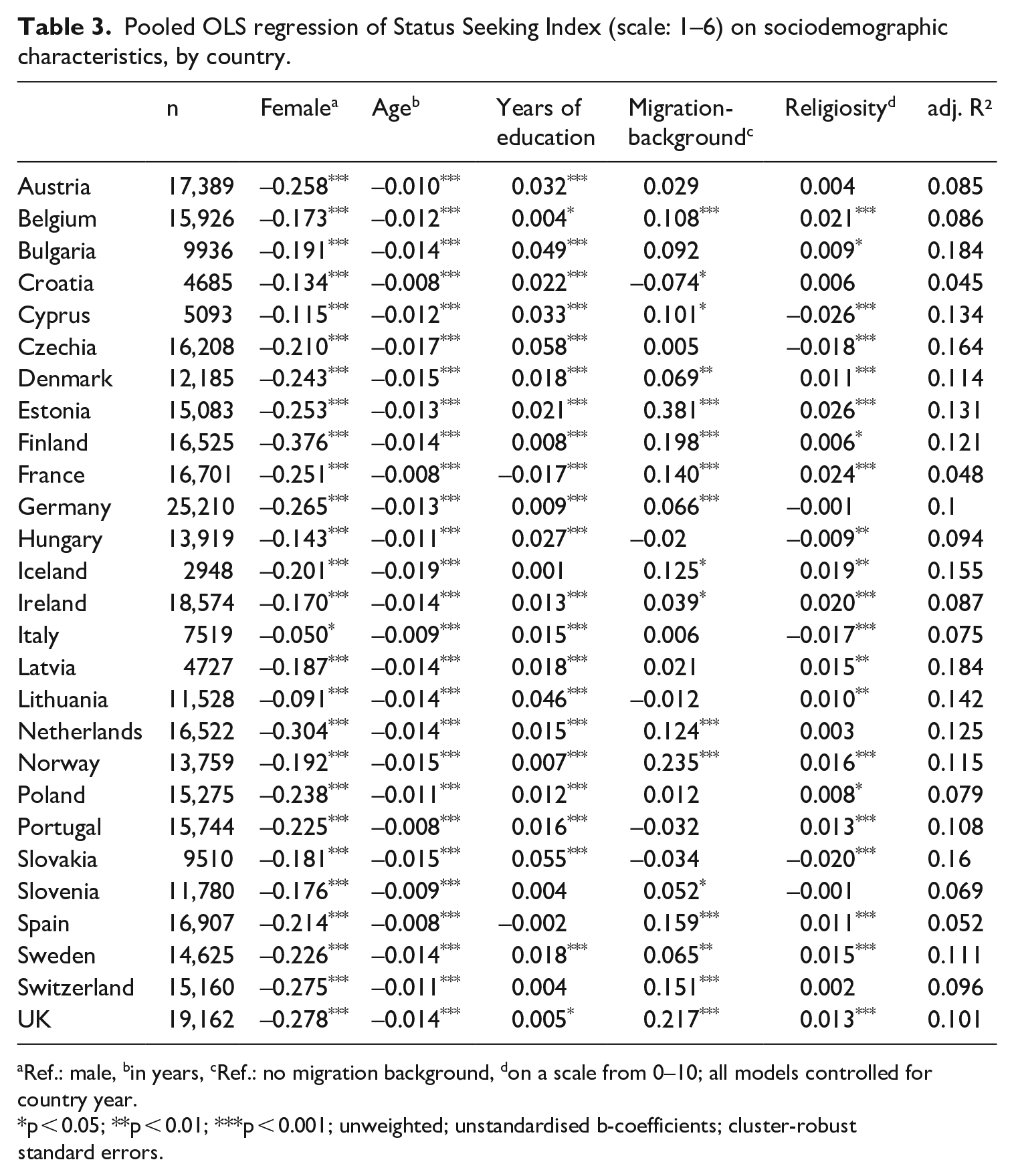
Ref.: male, bin years, cRef.: no migration background, don a scale from 0–10; all models controlled for country year.
p < 0.05; **p < 0.01; ***p < 0.001; unweighted; unstandardised b-coefficients; cluster-robust standard errors.
Pooled OLS regression of Experience Seeking Index (scale: 1–6) on sociodemographic characteristics, by country.
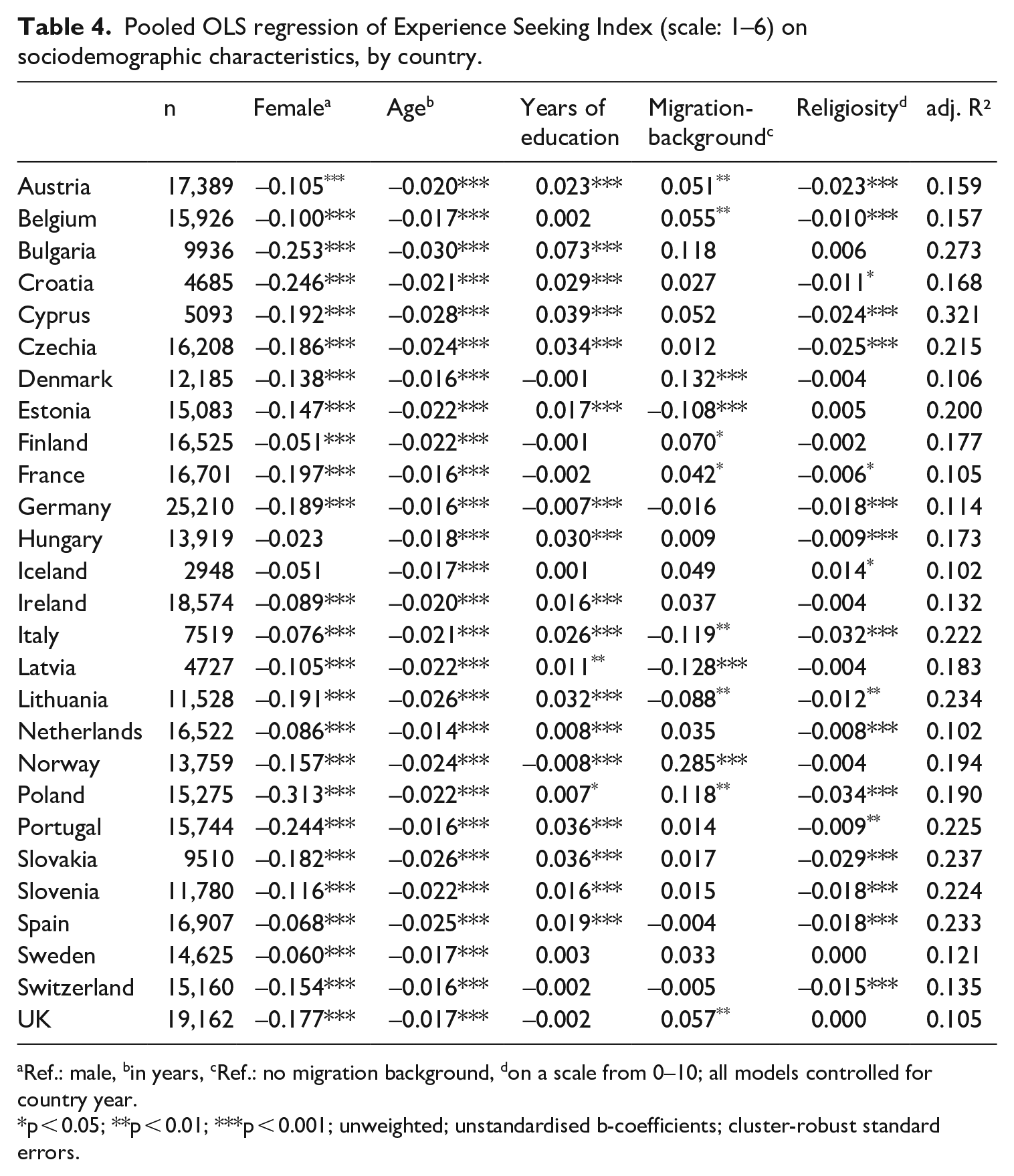
Ref.: male, bin years, cRef.: no migration background, don a scale from 0–10; all models controlled for country year.
p < 0.05; **p < 0.01; ***p < 0.001; unweighted; unstandardised b-coefficients; cluster-robust standard errors.
In almost all countries, women and older people strive for status and for experiences to a lesser extent than men and younger people. The patterns are also quite clear-cut for education, and again very similar for the two life orientations: a longer education is associated with more status seeking in 22 of 27 countries, and with more experience seeking in 17 countries. The reverse pattern prevails in very few countries only: longer education is associated with less status seeking in France, and with less experience seeking in Germany and Norway. Such anomalies indicate the need for in-depth country studies. For example, does a certain understanding of culture in France lead to a reduction in status ambitions, especially among the more highly educated (see Bourdieu, 1984 [1979])? In Germany and Norway, could the expansion of higher education have contributed to the fact that the more highly educated are less experience-oriented, or is this part of a religious-cultural syndrome, as the protestant countries exhibit either a negative or no association between education and experience seeking? Differences in institutional regulations and policies could also operate on these effects, for example for the migrant population.
We find migration background to be related to higher status seeking in 16 out of 27 countries and to lower status seeking only in Croatia. The pattern is less straightforward for experience seeking (significant effects in 10 countries). While migrants in the Baltic states and in Italy seek less experience than non-migrants, migrants in Northern and Western European countries typically seek experiences more.
Finally, religiosity has a quite uniform effect on experience seeking. In 17 of the 27 countries studied, religious people value an exciting life significantly less than their less religious counterparts; the reverse pattern can only be found in Iceland. In comparison, religiosity’s effect on status seeking is less clear-cut, as it relates to higher status seeking in 16 countries, to lower in five countries, and is unrelated in the remaining six countries.
Discussion and Conclusion
This article was motivated by the idea of confronting ongoing debates about the omnipresence of status concerns and materialism in competitive societies (Dugger, 2017), and the expected association with income inequality as their root cause (Wilkinson and Pickett, 2010), with sociological theories of cultural modernisation. The latter suggest a declining importance of (material) status concerns, broadly understood, and a rising importance of experiences, under the condition of affluence. Against this background, we examined whether Europeans strive more for status or experiences, how these dispositions developed over time, and the extent to which they vary among countries and social groups. Our expectations were derived from a core assumption common to major variants of cultural modernisation theory: the idea of an inward-turning modernisation process (Inglehart, 1997; Riesman, 1950; Schulze, 1992). This framework supposes the existence of two basic dispositions in western, postmodern consumer societies; an extrinsically motivated materialist status orientation, and an intrinsically motivated experience orientation. The framework further predicts a shifting ratio towards pursuing experiences at higher levels of socio-economic development, which we put to a test with data from the 2002–2018 waves of the European Social Survey. We consider the following results to be the most important.
First, although both dispositions are widespread, experience seeking is more pronounced than status seeking in the majority of European societies. The more affluent countries in particular may be characterised as experience societies in which people more strongly strive to enjoy life, rather than as competitive societies in which people’s goal is first and foremost a prosperous life. The latter priority still characterises some ex-socialist countries, as well as Italy. This macro-regional pattern is quite familiar from other empirical accounts of cultural modernisation (Pavlovic, 2015; Stam et al., 2013; Welzel, 2013), and broadly correspondents to differences in national wealth (Heidenreich and Wunder, 2008) and quality of life (Delhey and Steckermeier, 2016; Eurofound, 2017) in Europe.
Second, our period of investigation is certainly not long enough to register large shifts in life orientations. In most of the wealthier countries, however, the changes that can be registered are more in favour of experience seeking than status seeking. This direction of change is notable, as not only did two major economic crises, the financial crisis 2007/2008 and the European debt crisis 2013/2014, fall into our period of investigation, but also powerful long-term trends such as increasing gaps between rich and poor (Beckfield, 2019) – all this could have pushed Europeans towards aspiring more for status and less for experiences, but that happened in a few countries only. The effects of contemporary crises such as the Covid-pandemic and the war in Ukraine on the basic dispositions of people remain to be investigated.
Third, we find high socio-economic development and low income inequality to be conducive conditions for relatively more experience seeking, which is largely in line with the expectations of the grand theories of cultural modernisation. Socio-economic development is associated with lower status seeking and with higher experience seeking. However, income inequality plays a role for cultural modernisation in the European context, too. The Gini coefficient is associated with less experience seeking, which suggests that economic inequality distracts people from striving for an enjoyable life. On the one hand, this indicates that more attention should be paid to inequality in theories of cultural modernisation than has been the case to date. On the other hand, inequality is not associated with a greater disposition towards status (see also Paskov et al., 2017), as assumed by the prominent Spirit Level paradigm (Wilkinson and Pickett, 2010). This theoretical perspective would therefore benefit from paying more attention to the beneficial effects of ongoing socio-economic development.
Fourth, the positive individual-level correlation between status seeking and experience seeking testifies to the common hedonist-consumerist core of both dispositions – in the theory of human values (Schwartz, 1992), from which we borrow our empirical indicators, this combination of achievement and hedonism is referred to as ‘self-centered satisfaction’ (Schwartz, 2012: 9). More often than not, sought-after experiences such as travelling, fine dining or attending cultural events do require spending power, and in turn exceptional experiences can be used as distinctive status markers (Bourdieu, 1984 [1979]; Warde et al., 1999). An important complementary finding, however, is that the two dispositions disassociate somewhat over time, especially at higher levels of socio-economic development. Our speculative interpretation is that pleasant experiences are slowly but steadily sought outside the commodified world of markets and pursued for one’s own sake, without necessarily being part of conspicuous consumption (Veblen, 1934 [1899]). This changing character of experience seeking might be an interesting avenue for future research.
Fifth, the individual-level social profiles that characterise the existential dispositions reveal some similarities, first and foremost that men, younger people and the more educated typically strive more strongly for status as well as for experiences. These similarities again support the finding that the two life orientations are in fact associated, in contrast to materialism and postmaterialism, but in line with the social structuration of human values (see, for example, Longest et al., 2013). There are also differences, however, and most clearly so for religiosity, which leads people to pursue status more and experiences less. This is in line with the maxims of most world religions that in general temper hedonistic values (see Roccas, 2005).
Our study is not without limitations, and more work lies ahead. Despite the unique and comprehensive ESS database, the time period it covers is still relatively short in order to conclusively test our theoretical framework. In particular, the timing of the rise of the experience orientation cannot be clarified, and in most European countries certainly predated the introduction of the ESS in 2002. This is evidenced by the growing discussion about the emerging fun morality in the West in the 1970s (for the USA, see Bell, 1976). Regarding country-level determinants, an important next step is to examine other conditions that may affect the prevalence and trajectories of life orientations. Given our findings on the importance of individual religiosity, a prime candidate is secularisation, which has proved important for explaining the variation in work ethic across Europe (Stam et al., 2013). Finally, it would be worthwhile to analyse the individual consequences of shifting dispositions, for example for subjective well-being (Sortheix and Lönnqvist, 2014) or for public policy preferences – not only for affluent European societies but worldwide. The emerging middle classes of the ‘Global South’ would certainly be an interesting case to study the evolution of life orientations in other cultural contexts, be it the Indian caste system or the collectivism of East-Asian societies. For China, most studies point to a pronounced materialism and a great importance for conspicuous consumption, stronger than in the USA (e.g. Podoshen and Zhang, 2011).
In this article, however, our focus was on European societies in which people prefer an enjoyable life (experience seeking) over a prosperous life (status seeking). Looking ahead, however, it is by no means a foregone conclusion that cultural change will continue to increase the valorisation of an enjoyable life. In addition to the current risks of war and global pandemics, the looming climate crisis is becoming increasingly tangible in everyday life. The growing discussion about the necessary societal transformation towards sustainability (Jackson, 2009) puts moral pressure not only on ecologically inconsiderate status seeking, but also on the overly hedonistic pursuit of experiences. Accordingly, the heyday of status seeking and experience seeking, which are both based on a logic of acceleration and growth, may soon be over, and more restrictive and self-limiting dispositions might prevail. The sustainable life may become an important orientation, at the expense of both, the enjoyable life and the successful life.
Supplemental Material
sj-docx-1-soc-10.1177_00380385241231837 – Supplemental material for Europeans Seek Exciting Experiences More Than Status: Exploring the Development of Two Fundamental Life Orientations
Supplemental material, sj-docx-1-soc-10.1177_00380385241231837 for Europeans Seek Exciting Experiences More Than Status: Exploring the Development of Two Fundamental Life Orientations by Christian Schneickert, Stephanie Hess and Jan Delhey in Sociology
Footnotes
Acknowledgements
We thank Leonie Steckermeier and Fabrice Westphal as well as two anonymous reviewers for critical and helpful comments on an earlier version of this article. Any mistakes remain, of course, our own.
Funding
The authors disclosed receipt of the following financial support for the research, authorship and/or publication of this article: this research was funded by the German Research Foundation (DFG), Project: 465345673: ‘Rise, Fall or Transformation of the Experience Society? A Quantitative-Empirical Investigation for Germany and Europe’ [SCHN 1437/2-1 to Christian Schneickert and DE 1892/4-1 to Jan Delhey].

Supplemental material
Supplemental material for this article is available online.
References
Supplementary Material
Please find the following supplemental material available below.
For Open Access articles published under a Creative Commons License, all supplemental material carries the same license as the article it is associated with.
For non-Open Access articles published, all supplemental material carries a non-exclusive license, and permission requests for re-use of supplemental material or any part of supplemental material shall be sent directly to the copyright owner as specified in the copyright notice associated with the article.
