




Abstract
Sociologists – and social scientists more broadly – have often resorted to ‘public sociology’ and ‘activist research’ (AvR) with the aim of producing useful knowledge for the common good and also supporting emancipatory social movements and progressive policies. I define AvR here as collective processes of cooperation between academic researchers and non-academics in order to benefit the latter. This approach bridges theory and practice in ways that enhance the consistency and legitimacy of sociology as an engaged science. Recent debates on public sociology, however, have overlooked the central role of AvR. To reverse this relative omission, I suggest a clear typology of AvR processes and practices that have been used and hold the potential to advance public sociology. I also contend that in contrast to views of AvR as a clearly demarcated method, it encompasses multiple research, collaborative and action techniques so that it may be better conceived of as a ‘methodological toolbox’.
Introduction
Sociologists, in particular, and social scientists, more broadly, have often resorted to ‘public sociology’ and ‘activist research’ (hereafter ‘AvR’) to guarantee that they produce useful knowledge for the common good and even to support emancipatory social movements and progressive policies. However, AvR encompasses multiple social practices and has a long – albeit often confusing – history of methodological reflections. Alternative or overlapping designations such as ‘participatory action research’ and ‘citizen science’ have also been added to the conventional repertoire of research methods in social sciences (Greenbaum et al., 2020; Vohland et al., 2021). This tradition has nurtured recent debates on ‘public sociology’ (Burawoy, 2005a; Clawson et al., 2007; Hossfeld et al., 2022; Jeffries, 2009) but only in a tangential manner. Therefore, this article aims to reinforce the crucial position that AvR represents for advancing public sociology. In so doing, I first suggest a clear definition and typology of AvR practices. Next, I contend that in contrast to views of AvR as a clearly demarcated method, it encompasses multiple research, collaborative and action techniques so that it may be better conceived of as a ‘methodological toolbox’. Drawing on various examples of AvR, I finally identify key guidelines at the core of its methodological toolbox.
As will be shown, I assume that neither AvR nor public sociology are superior forms of achieving scientific knowledge compared with conventional methods and approaches. Depending on the specific contexts and goals, we need to discriminate the pros and cons of every methodological and theoretical choice. This also applies to their emancipatory potential. Participatory methods, for example, can be used by scholars involving dominant or reactionary social groups (corporate managers, authoritarian administrators, military leaders, far-right politicians, etc.) in the research process with the purpose of maintaining and reinforcing their domination, although this is very unlikely. Nevertheless, I am interested in positioning AvR at the centre of public sociology because (1) most practitioners and advocates of AvR developed this approach in connection with the struggles of dominated social groups and progressive political claims (Fals-Borda and Rahman, 1991; Grazioli, 2020; Kollektiv Orangotango+, 2018; Polanska and Richard, 2021; Sanmartín, 2019); (2) AvR is a practical and now widely experienced way of enhancing the societal benefit and legitimacy of social sciences, including sociology, as engaged sciences; and (3) if communities, grassroots activists and different dominated social groups directly participate in the construction of scientific knowledge, it is more likely that they understand, appropriate and use it according to their interests, needs and aspirations (Kemmis et al., 2014; McIntyre, 2008; Reason and Bradbury, 2008).
Furthermore, my call to re-examine, develop and support AvR in association with public sociology is grounded in the need to face current challenges to academic freedom and contribute to the third mission of universities – by granting the social benefits of science and the knowledge transfer to surrounding communities (despite the entrepreneurial turn that has pervaded many late interpretations of this mission: Compagnucci and Spigarelli, 2020). Sociologists have thus the right to express their adherence to political claims and try not to let their scientific contributions contradict, for instance, human rights, workers’ rights, environmental protections and egalitarian welfare policies. Critical and public sociologists should thus engage with poor, marginalised, grassroots and oppressed social groups on many grounds (Mayer, 2020; Piven, 2010), but in order to practically implement this engagement and establish ‘a dialogue, a process of mutual education’ (Burawoy, 2005a: 8), AvR projects may indicate how to do so in a very systematic manner. Although AvR may appear less systematic than other established research methods, I will argue that various effective methodological toolboxes have been developed through practice, and we can learn lessons from their main guidelines. Hence, AvR can bridge theory and practice, science and political action, so that the intended beneficiaries of knowledge may also participate in its co-creation.
The article is organised as follows. The first section defines AvR, drawing on its historical trajectories. Section two discusses the shadows and illumination of public sociology in relation to AvR. Section three suggests new typologies of the social practices involved in AvR. The final section, before the concluding remarks, proposes a series of guidelines that underpin AvR as a methodological toolbox.
Historical, Political and Theoretical Trajectories of AvR
I define AvR as collective processes of cooperation between academic researchers and non-academics while producing sociological knowledge and inciting actions aiming to change social problems, usually for the sake of the non-academic social groups involved (Fals-Borda and Rahman, 1991; Reason and Bradbury, 2008; Villasante, 2006). These processes entail a regular, sustained and deep sharing of needs, data and analyses among the parties involved. Academics aligned with, among others, socialist, anarchist, feminist, anti-racist, anti-colonial or degrowth politics have been frequent practitioners or advocates of AvR. Also embraced by leftist academics, depending on the context, are liberal claims concerning anti-discrimination, anti-segregation, equal opportunities, freedom of speech, the right to protest, democracy and human rights. This does not mean that critical academics and public sociologists always practise AvR. They can simply perform conventional, non-participatory ways of producing scientific knowledge and disseminating their insights via mainstream means. Furthermore, nothing prevents conservative academics from employing AvR in alliance with dominant groups in more regular and profound ways than by merely submitting professional and policy reports. The latter two warnings suggest that an explicit political stance, the disclosed identity of all the participants (unless confidentiality and safety issues apply), and their active engagement in the process of knowledge production are crucial features of AvR. However, as I will discuss later, the distinctions between academics and non-academics seldom are uncontested.
Despite its disparate names (action research, participatory methods, participatory action research, militant research, community-based research, etc.), AvR in the social sciences has been periodically revived. Looking backwards, we see that it is commonplace to identify the roots of activist investigations in the writings of Marx and Engels with their call to change the world instead of merely interpreting it, the attempt to conduct a workers’ inquiry in 1880 being a prime example (Hoffman, 2019: 112; Woodcock, 2014). They collected all sorts of evidence to demystify how capitalism shapes society. Marx and Engels also expressed their confidence in the workers’ power to eliminate exploitation. Ergo, they also expected that workers had the capacity to produce knowledge about their own working conditions. Both were affiliated with workers’ organisations and suggested political strategies from within.
Following the Marxist tradition, more developed experiences of workers’ inquiries and co-research took place in the United States, France and Italy from the mid-20th century onwards. As Woodcock (2014: 506) recalls, the use of questionnaires and interviews was not always sufficiently critical to interpret the collected data beyond superficial accounts of capitalist social relations. However, the participatory or co-research methods were tools for producing knowledge ‘from below’ as much as tools for organising (Woodcock, 2014: 507).
Many prominent leftist intellectuals followed suit. By gathering information about the living conditions and experiences of the dominated social groups through ‘questionnaires, to one-on-one interviews, to more collective fact-finding meetings with selected informants, to the solicitation of individual narratives and other forms of writing’ (Hoffman, 2019: 2) even leftist political parties, organisations and states were questioned by their rank-and-file members with an AvR approach. Among the scholars practising AvR, Foucault and the Prisons Information Group stood out due to their relative success in collecting responses from prisoners and publishing a profound critique of the penal system in 1971–1972 (Hoffman, 2019: 112). In particular, Foucault’s involvement in the group expressed a power struggle between two forms of knowledge production: workers’ and prisoners’ knowledge on the one hand and capitalists’ and state’s administrative knowledge on the other. Activist intellectuals like Foucault might occupy an intermediary position.
Far from being exhaustive here, I recall other significant contributions to the development of AvR, which will serve me later to theoretically outline its features as a methodological toolbox. For example, Alinsky’s (1972) ‘rules for radicals’ in community organising and left-wing inclined sociologists involved in the social movements of the 1960s and 1970s (Oppenheimer et al., 1991; Touraine, 1978) may count as forerunners of public sociology who also endorsed AvR. Across the Global South, it is worth mentioning the experiences and theorisations of participatory action research as ‘peoples-made science’ (Fals-Borda and Rahman, 1991; Rappaport, 2020) and ‘participatory rural appraisal’ (Chambers, 1997) in the mobilisations against colonial capitalism, military dictatorships and authoritarian regimes. Additionally, both the demand and critique of participatory methods, especially after the 1968 transnational protest wave (Cooke and Kotari, 2001), policies such as ‘participatory budgets’ (Streck, 2007) and other ‘real utopias’ after the 1990s (Wright, 2010), added to the broad repertoire of AvR references and approaches led by sociologists and other social scientists.
This political and methodological diversity was renewed after the protest cycle around the global justice movement in the 2000s (Cox and Flesher, 2009; Shukaitis and Graeber, 2007), comprising initiatives and networks such as ‘autonomous geographies’ (The Autonomous Geographies Collective, 2010), critical urban planning and architecture (https://www.inura.org), countermapping (Kollektiv Orangotango+, 2018), engagement with urban squatting (Squatting Europe Kollective (SqEK), 2014), working-class resistance to gentrification and forced displacement (Herzfeld and Lees, 2021; Polanska and Richard, 2021; Sanmartín, 2019; Thörn, 2020; Vilenica, 2021), domestic workers’ (Pimentel et al., 2021) and houseless people organising (Udvarhelyi, 2020), solidarity struggles with migrants and refugees (Dadusc et al., 2021; Grazioli, 2021) and engagement with indigenous communities (Hale, 2006) and racialised youth (McIntyre, 2008), to name but a few.
A common feature of the above legacies is that these scholars are committed to ‘advance the interests and ideas of groups that are at the margins of public life, the people who are voiceless, degraded and exploited’ (Piven, 2010: 807–808). Scientific knowledge produced from below may thus result in weapons of resistance against oppression – especially oppression through knowledge produced from above. Therefore, the main value of AvR would be raising political awareness and empowering the oppressed social groups by facilitating their involvement in the production and appropriation of scientific knowledge (Hoffman, 2019: 123). Hence, AvR does not only consist of writing books and articles about issues raised by the political camps to which the activist researchers are affiliated or resisting the attacks they experience by reactionary forces, as traditional public sociology encourages. Likewise, only teaching or promoting academic conferences on these topics would not suffice to produce AvR. Mayer (2020: 47), for example, proposes engagement with activists and non-academics by discussing and evaluating how well their political struggles and alternatives work, how they connect different social groups and how they could be strengthened and scaled up. She also suggests revealing their side effects and contradictions.
For most AvR practitioners, political work is the priority; scientific work is merely instrumental to that end. This interpretation would contradict the lead of academic labour in practice. Also, if the ideal of science serving explicit political aims were true, AvR would have no preference for any specific method. Every research method would be acceptable as much as it contributed to the collectively agreed political goals and the emancipation of oppressed people at large. This problem will be elaborated further in the fourth section regarding the methodological toolbox. Another general problem of AvR has to do with the lack of consensus about the multiple practices that it entails. In order to solve it, I propose new comprehensive classifications in the third section. Presently, I will consider the AvR’s relationship with public sociology.
When Public Sociology Meets AvR
Burawoy’s (2005a) plea for public sociology was not new (Fals-Borda and Rahman, 1991; Oppenheimer et al., 1991; Touraine, 1978) but was very compelling once disseminated through his ASA (American Sociological Association) address. He simply defined public sociology as a practice that ‘brings sociology into a conversation with publics’ (Burawoy, 2005a: 7). Popularisation of science and bestseller books authored by sociologists could then fall under that category. However, Burawoy (2005a: 7–8) noted that ‘the bulk of public sociology is indeed of an organic kind – sociologists working with a labor movement, neighborhood associations, communities of faith, immigrant rights groups, human rights organizations’. This is the essence of AvR, although Burawoy (2005a: 23) superficially recalls it only once, as ‘participatory action research’, in his seminal article. Instead, he made a more extensive effort to distinguish public sociology from ‘policy sociology’ (‘in the service of a goal defined by a client’: Burawoy, 2005a: 9), ‘professional sociology’ (which ‘supplies true and tested methods, accumulated bodies of knowledge, orienting questions, and conceptual frameworks’: Burawoy, 2005a: 11) and ‘critical sociology’ (which examines ‘the foundations – both the explicit and the implicit, both normative and descriptive – of the research programs of professional sociology’: Burawoy, 2005a: 10). He also claimed that the four types of sociology need one another and exist in ‘reciprocal interdependence’ (Burawoy, 2005a: 15).
This text triggered numerous passionate debates in the following years (Clawson et al., 2007; Hossfeld et al., 2022; Jeffries, 2009). A deep collective professional reflection about sociology as a discipline and its social relevance and impact were at the heart of these debates. Regardless of the position taken on whether public sociology could make sociology thrive and shine or not, the contributors showed that issues such as scientific dissemination, verification and the funding conditions of research lead to much-welcome reflexive accounts of the actual practice of social scientists. However, it is worth noting that AvR (or organic public sociology, in Burawoy’s terms) was barely discussed in these debates and definitely not in a substantial manner.
I contend that the omission of AvR at the core of public sociology was first due to Burawoy’s main focus on traditional rather than organic public sociology. In one of his responses to critics, he highlighted many cases in which public sociologists animated journalistic stories, advised governments and became public figures as moral role models as a way of ‘promoting public discourse’ (Burawoy, 2005b: 423). This participation of sociologists in the public sphere may represent a first step into activism – and one not exempted from risks such as empirically blind partisanship (Glenn, 2009: 139–142) – but yet far from engaging in AvR projects.
Second, several criticisms of Burawoy’s equally celebrated and disputed article pointed out that both critical and public sociology are always marginalised by mainstream (i.e. professional and policy) sociology, so it is not realistic to depict a rosy coexistence between them (Feagin et al., 2009: 76–80; Glenn, 2007; Hill Collins, 2007). Other critics distinguished between ‘elite’ and ‘grassroots policy sociology’ (Kleidman, 2009), with the latter being close to the AvR tradition. Accordingly, more than a harmonious table of four quadrants, I draw on the observations made by many participants in these debates to assume a hierarchical and conflictual relationship between the different types of sociology. Professional (i.e. mainstream academic) sociology and elite policy sociology are placed at the top, with a dominant role over the rest; critical (i.e. non-mainstream academic) and traditional public sociology, on a second or intermediate level, whereas grassroots policy sociology and organic public sociology would clearly occupy the bottom ground in terms of reputation, political influence and available resources. Furthermore, below that ground level, we may situate AvR processes (usually of a transdisciplinary nature) given how scarcely appreciated it is even by contemporary public sociologists.
This AvR’s underground position continues more than three decades after its appearance in mainstream sociological journals and books (Park, 1992; Whyte, 1991) by authors who openly recognised their debt with earlier pioneering initiatives in the fields of education and local development across the Global South (Chambers, 1997; Fals-Borda and Rahman, 1991) and also after the academic incorporation of some feminist and anti-racist social movements’ claims (McIntyre, 2008). As Hill Collins (2007: 103–104) noted, if ‘current practitioners of public sociology are typically not housed in premier institutions, nor do many of them come from privileged groups . . . being classified under the banner of public sociology may foster a kind of sociological ghettoization’. In these intra-disciplinary wars, Burawoy’s classification risked being interpreted as if the existence and legitimacy of public sociology would ‘depend on the restraint and generosity of professional sociologists rather than on the agency and activism of subaltern sociologists’ (Glenn, 2007: 222).
Burawoy (2005a: 11, 2014) noted the reciprocal attacks and eventually admitted the existence of an underlying hierarchy between the different types of sociology that extends to elite and non-elite academic institutions (Burawoy, 2009: 452–459, 466–467). Indeed, professional and policy sociology tend to produce research according to the interests of the ruling classes, that is, those who pay for the sociologists’ services and information without being obliged to share them publicly. Nevertheless, as Burawoy and many of the participants in the ensuing debates disclosed, the identities of particular sociologists may frequently overlap or transition from one type of sociology to another over time. Another controversial issue in which I agree with Burawoy is that no public sociology – and the AvR approach by extension – may exist without the scientific foundations and legitimacy achieved by professional and critical academic sociology because the two latter contribute with particular skills and theories, which are appreciated by non-academics if useful for their purposes. Otherwise, why would the latter engage in joint ventures with scholar-activists? Nevertheless, it is the social scientists’ responsibility to reveal how much their knowledge owes to participatory processes and non-scientists’ insights (Streck, 2007: 122).
In line with AvR practitioners, among the critics of Burawoy’s initial formulations, some have questioned the ambiguous notion of ‘publics’ to engage with because it would not give a straightforward priority to ‘historically oppressed and exploited publics: women, people of color, the poor, sexual minorities, and other socially oppressed groups’ (Feagin et al., 2009: 72; Hill Collins, 2007). These critics coincide with Burawoy in encouraging ‘collaborative research between sociologists and community groups . . . [and] suggest that participatory-action sociologists, teachers and researchers, move outside mainstream sociology and develop alternative solutions to societal problems’ (Feagin et al., 2009: 77–78), although no methodological indications are given. Despite the vast diversity of public sociology experiences presented in these debates, only a few scholars closely associated them with AvR processes (Cossyleon and Spitz, 2022; Kleidman, 2009).
The controversy around public sociology primarily resonated within US sociology but was later expanded worldwide because Burawoy promoted it through his presidency of the ISA (International Sociological Association) between 2010 and 2014 and because the seeds of AvR had already been sown a long time ago (as illustrated, for example, by the presentations in the 1982 World Congress of Sociology: Fals-Borda and Rahman, 1991: 26). However, although public sociology has occasionally met AvR, they did not marry. To advance organic public sociology, I argue, we need to place AvR at its core, which implies clarifying boundaries, relations and endeavours, as the following sections attempt to accomplish.
AvR Practices across Boundaries
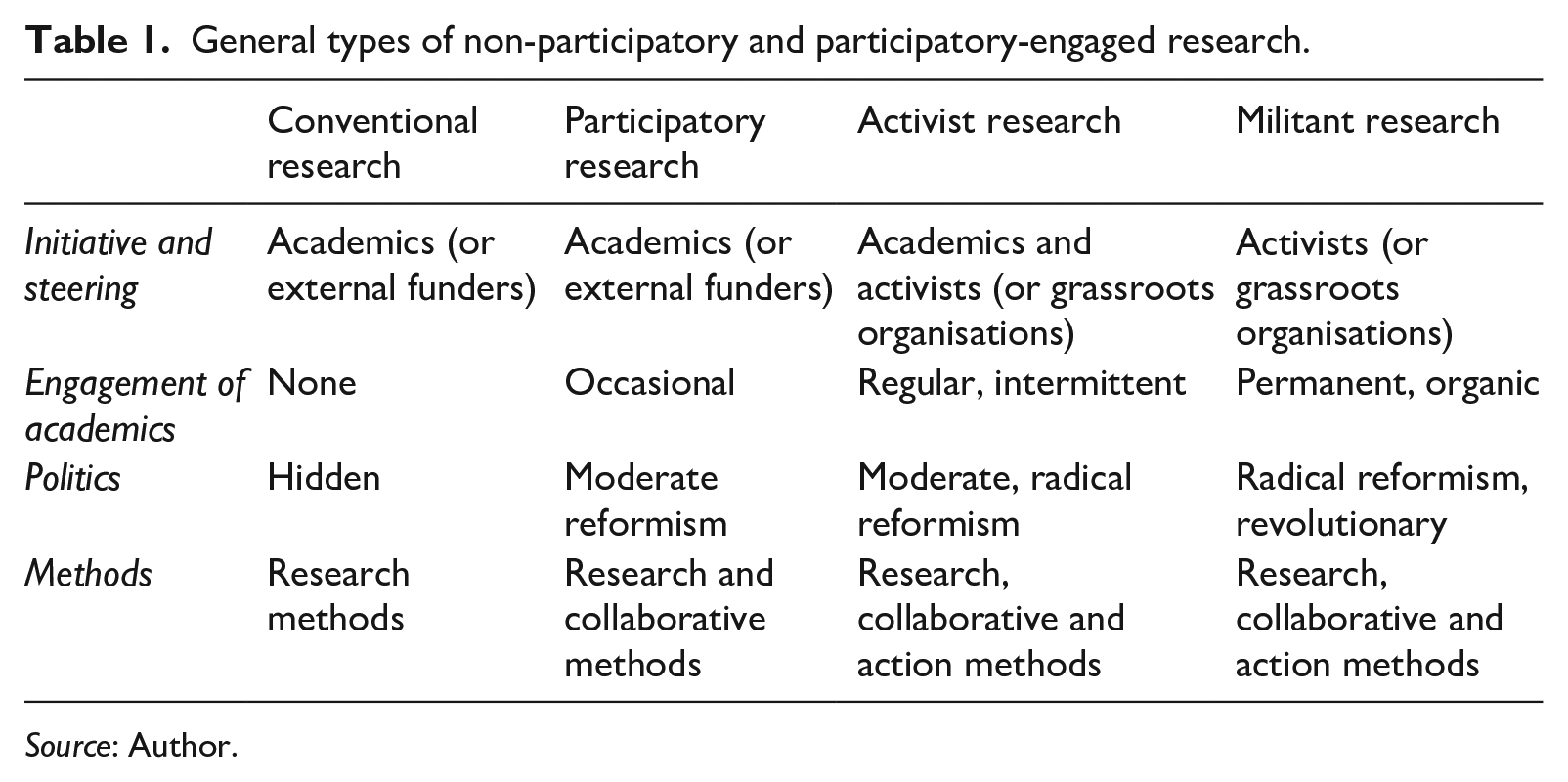
To clarify the scope and breadth of AvR, the first distinction I make is between AvR and two other similar types with subtle but important differences in terms of who leads and steers the process, how regular is the engagement of academics, how radical are the political goals pursued and which methods are used (Table 1). The three collaborative approaches are, thus, coherent with organic public sociology but go a step further to nuance the key distinct features of each. In this classification, AvR is conceptually refined as a process in which both academics and non-academics (usually activists or grassroots organisations) initiate the process, while the former are regularly engaged over a long-term period, and all aspire to achieve moderate or radical reforms by combining different research, ‘collaborative’ and ‘action’ methods. Given the actual constraints of academic institutions and careers, AvR is seldom feasible over a whole professional life but not unusual over durable periods or intermittent engagement. As for the more low-key category (‘participatory research’), cooperation between academics and non-academics is more limited temporally, with a usual lead by academics or funding institutions and moderate aspirations of social change as it occurs in many community-based research and citizen science projects (Greenbaum et al., 2020; Martínez, 2001; Vohland et al., 2021). ‘Militant research’, finally, is the most ambitious politically speaking, but it also means that academics are fully incorporated as members of political organisations, which may result in a lack of critical analysis questioning their organisation’s power structures, contradictions and side effects (Hoffman, 2019; Mayer, 2020).
General types of non-participatory and participatory-engaged research.
Source: Author.
In all cases, when it comes to research methods, the choice should always be rationally guided by their consistency with the goals, research questions and available resources – although, due to the nature of AvR projects, the initial research questions may be revised and changed later on. The activist researchers’ preference for qualitative methods, for example, may overlook that quantitative analyses may be preferable by activists in certain campaigns for policy change. Furthermore, many research methods (from surveys and statistical analysis to ethnographic observations, interviews, focus groups, archival and discourse analysis) may be used with a participatory touch if activists are educated and involved in their use, or the community at large helps to supply data while also engaging in different stages of the research process (proposal, design, implementation, analysis, interpretation, etc.). Cossyleon and Spitz (2022), for example, tell how Chicago-based grassroots organisation affiliates were trained and conducted the administration of questionnaires to their neighbours to understand financial indebtedness and poverty, then discussed the results with the researchers and became involved in negotiations to achieve policy change (debt relief, new criteria in welfare subsidies, etc.).
As Thompson (2021: 287) notes, ‘Organizers need working class intellectuals to give them the facts.’ However, even if carefully produced, facts, figures, statistics and observations alone cannot speak; they need a meaningful and contextual interpretation in which academics offer their critical approach and even cooperate with activists when making sense of the observed and/or measured phenomena. Although the use of conventional research methods may also illuminate emancipatory struggles (Thompson, 2021; Wyly, 2009), we should assume that non-academics cannot always manage to quickly learn the skills to produce data analysis, research designs and academic writing, nor conduct interviews, ethnographic observation and so on. However, even if good quality scientific knowledge is appreciated – especially in times of climate change, pandemics, fake news and right-wing populism – an exclusive focus on conventional methods hardly leads to AvR projects in which some form of knowledge co-creation is required.
Remarkably, AvR and participatory research, in general, imply ‘collaborative methods’, which add to their toolbox repertoire. In other words, the participants in the process (both academics and non-academics) need to know how to organise, deliberate, divide tasks and make decisions. These methods foster cooperation between all involved parties, including third groups indirectly affected by the process but not making decisions about it. These methods also highlight the process more than the results since they focus on various collective gathering and learning methods. Scholar-activists, then, must become familiar with, be trained in and master these forms of collaboration, in which regular activists are often much better educated (Boilevin et al., 2019; Chambers, 1997; Villasante, 2006).
In addition, AvR and militant research integrate ‘action methods’. AvR is not only about a cooperative process to collect, analyse, interpret, disseminate and discuss data with scientific rigour and according to the goals determined in the agreements between academics and non-academics. It is also a political process in which specific actions for change need to be planned, discussed and implemented – ideally, in close connection to the research process and results. In this sense, actions are mostly directed towards the external community beyond the AvR team. These methods may consist of communicative actions (campaigns, webpages, reports, handbooks, maps, pamphlets, magazines, etc.), direct actions (appropriations of spaces and resources, strikes, boycotts, demonstrations, petitions, etc.), setting up new organisations and networks, or institutional negotiations and legal litigations. Engaged academics, then, should participate in these action methods as much as possible.
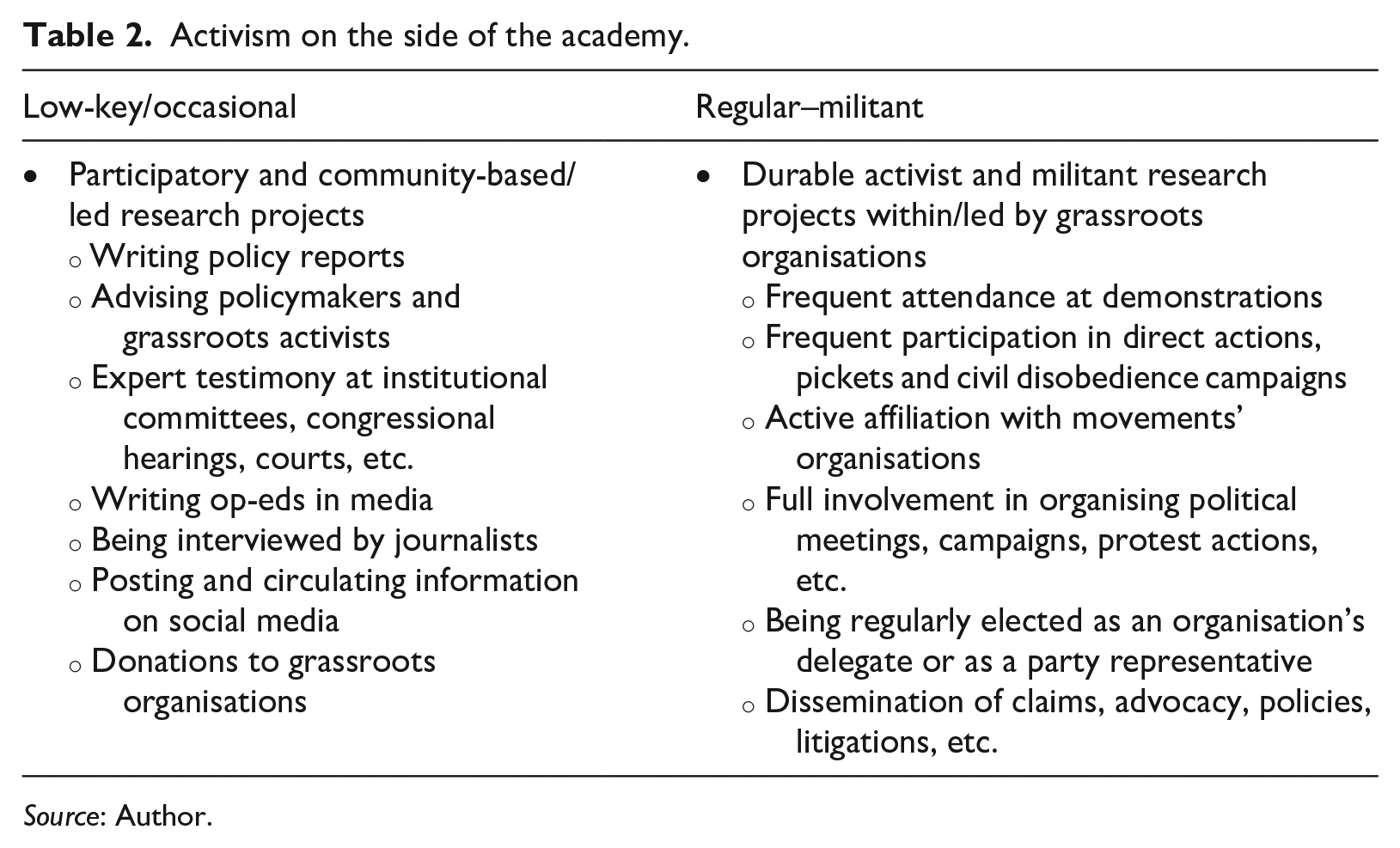
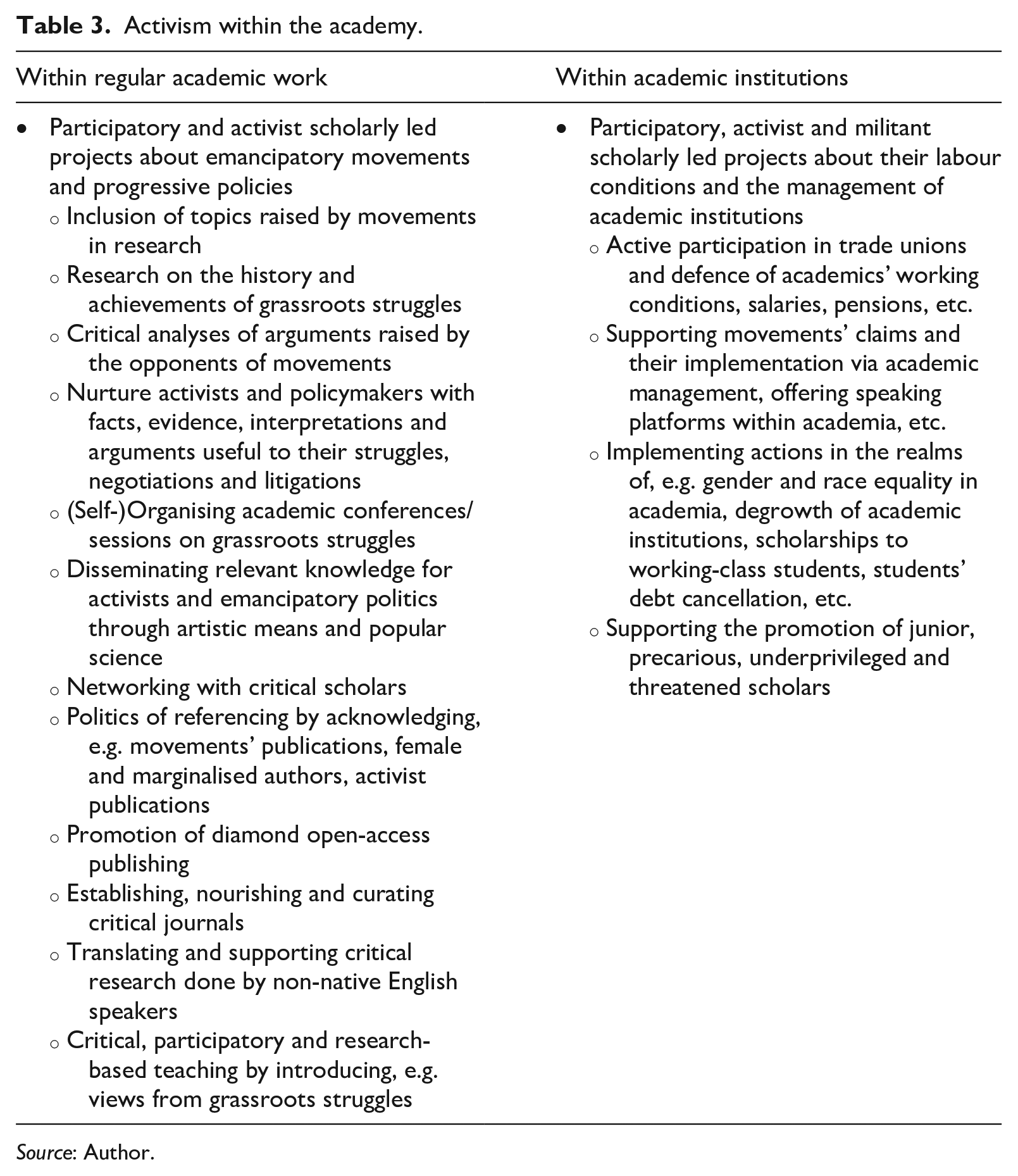
Building upon Piven’s (2010) distinction between AvR practices ‘on the side of the academy’ and ‘within the academy’, and her notion of ‘dual path’ referring to the activist labour of academics usually enjoying less priority than their academic obligations and careers, I suggest two further classifications. They shed light over the multiple possibilities at hand for activist researchers and public sociologists, but also over the often-times blurring boundaries between the identities of academics and activists/non-academics. I thus break down Piven’s categories into ‘low-key/occasional’ and ‘regular-militant’, on the one hand, and ‘within regular academic work’ and ‘within academic institutions’ on the other. Tables 2 and 3 collect some examples for each set of practices (e.g. collaborative and action methods) (○) that can integrate or supplement AvR processes (•).
Activism on the side of the academy.
Source: Author.
Activism within the academy.
Source: Author.
In terms of identities, all the possible activist practices reunited in Tables 2 and 3 indicate that sociologists with and without previous experience as regular activists may participate in AvR projects at different stages of their careers. Moreover, some activists without an institutional academic affiliation may also be engaged in AvR or militant research, as proven by labour rights organisations in the Global South (Choudry, 2014), community-based mapping projects (Kollektiv Orangotango+, 2018) and female domestic workers organising (Pimentel et al., 2021). Rather than being either activists or academics, the frequent crossing of boundaries in the tables points to different moments of practising AvR and the participants’ different skills (Streck, 2007). As Wyly (2009: 312–313) claims, ‘astute divisions of labor negotiated in a spirit of partnership, equality, and trust’ may link these different possibilities with one another. From the academics’ side, their commitment to activism usually comes afloat and thrives once stable working conditions are assured. When the academic workload is too heavy, there is no time left to include activism, especially if it is too demanding, such as the squatting of houses and social centres (Martínez and Lorenzi, 2012; SqEK, 2014). Despite the often-invoked principle by activist researchers of neutralising the separation between researcher and researched subjects (Fals-Borda and Rahman, 1991; Whyte, 1991), there is abundant evidence that many non-academic participants prefer to stress their difference with activist academics (Boilevin et al., 2019; Cossyleon and Spitz, 2022; Gaventa, 1991; Hale, 2006; McIntyre, 2008).
In terms of practices, there is no exclusivity in every table and sub-category, but a higher or lower likelihood of its inclusion and, above all, an easy borrowing of activist repertoires from one category into another. For example, past activism on the academy’s side has paved the way for other forms of activism within academic institutions, such as making claims for gender equality measures, academic workers’ rights, fair recruitment policies and the like. As an illustration, recent struggles in solidarity with migrants and refugees have triggered new engagements by academics with different past political backgrounds, such as in the squatting and housing movements (Dadusc et al., 2021; Grazioli, 2021). In some cases, activism can evolve into more systematic AvR projects. The burgeoning struggles of residents against urban gentrification and home evictions after the 2008 great financial crisis, for instance, led scholars to align their academic projects with their activism (Bishop and O’Connor, 2023; Herzfeld and Lees, 2021; Polanska and Richard, 2021; Sanmartín, 2019; SqEK, 2014; Thörn, 2020).
In general, every single collaborative and action practice included in the tables – that is, making donations, attending meetings and rallies, signing petitions, propagating campaigns, talking to journalists, organising exhibitions – cannot fully engender an AvR process by themselves if they are completely detached from research and knowledge production projects for the sake of emancipatory struggles. Nonetheless, they still help to identify potential allies and foster collaborative networks. As Piven (2010: 809) remarks, they can also ‘fashion the environment that will nourish our activist commitments’.
Not One Single Method, but a Toolbox
AvR is part of a long tradition of participatory and action-research approaches in social sciences. Among the academic pioneers, social psychologist Kurt Lewin conceived this approach as a ‘research method’ consisting of a spiral of planning, acting, observing and reflecting, or learning by trying/doing (Kemmis et al., 2014: 6–15). Participatory action researchers, however, were more embedded in broader political practices, so they named their approach with the looser term of ‘methodology’, which merely resembles technical formalisation while also granting practitioners some acceptance from the academic establishment. Many activist scholars also ambiguously defined AvR as a (research) method but more frequently as a more-than-a-research method. For instance, ‘[participatory action research] is a philosophy of life as much as a method . . . while emphasizing a rigorous search for knowledge’ (Fals-Borda and Rahman, 1991: 29), or: by activist research, I mean a method through which we affirm a political alignment with an organized group of people in struggle and allow dialogue with them to shape each phase of the process, from conception of the research topic to data collection to verification and dissemination of the results. (Hale, 2006: 97)
Actually, instead of formalising one single method, AvR has often opted for an eclectic or strategic combination of different research methods (Streck, 2007). This facilitated its increasing inclusion in textbooks on an equal footing with other research methods, usually qualitative ones. However, this option carried problems, too, because it implied that research methods were the key feature of AvR as a methodology. As I have shown in the previous section, the truth is that collaborative and action methods (or social practices, more generally, even when individually performed) are as important as research ones. From its early development, most AvR practitioners have also singled out ‘creative methods’ (participatory photography and video, theatre, music, art exhibitions, storytelling, podcasts, etc.) as essential in their repertoire (Fals-Borda and Rahman, 1991; Vilenica, 2021), which would add to my concept of the methodological toolbox, although I classify them here as a kind of action method. This reflection, however, leaves one question unanswered: which research methods are specific to AvR, if any? I will address this in the upcoming fourth guideline.
In this section, I continue to argue that AvR is not a research method but a methodological approach that entails a toolbox of research, as well as collaborative and action methods. As a methodological approach, it consists of principles, reflections and decisions made by all participants concerning achieving the desired knowledge and social change. As a toolbox, it is open to deploy all possible methods at hand, according to the available resources and the panoply of activist practices from both within and outside the academy. In particular, ‘each PAR [participatory action research] playbook evolves over time out of a dialectical relationship between the community and external researchers, as well as between theory and practice’ (Rappaport, 2020: xviii).
As advocates of organic public sociology suggested, the political priority of the dominated social groups’ interests, needs and aspirations should steer AvR processes, not the accuracy or validity of the chosen methods. Therefore, there is no single ‘rule book’ for AvR. This, however, does not imply that the process is neither rigorous nor ignorant of the lessons from the accumulated experiences of AvR. These lessons, in turn, epitomise methodological guidelines as they provide insights on conducting research and invoking participation and action from similar projects. The notion of a ‘methodological toolbox’ thus retains the emphasis on methods to ensure that all the procedures are transparent and systematic, so the process of knowledge production and political action is subject to scrutiny and criticism by all (and third) parties (Chambers, 1997; Red CIMAS, 2015; Villasante, 2006). Far from being exhaustive, in the remainder of this section, I highlight five general guidelines or ‘tactical tools’ based on the AvR literature selected here.
First, establishing cooperative relations and agreements between academics and activists as early as possible during the AvR process is a solid starting point (Cossyleon and Spitz, 2022; Fals-Borda and Rahman, 1991). Choices about research topics and methods, political goals, commitments, timing, finances and so on require initial deliberation, negotiations and decisions. To deepen these discussions, it is useful to determine the specific oppressions and inequalities that the AvR process aims to address, but also those that may exist or arise among and between activists and academics. Overt discussion about the intersectional positionalities involved requires awareness, care and measures to deal with them in a sensitive manner (Bishop and O’Connor, 2023; Boilevin et al., 2019; McIntyre, 2008).
Second, in most AvR experiences, activists are considered knowledge producers, not just informants for scientists or passive recipients of scientific data, reports and publications. Activists may raise important research questions that can guide academics. Some activists are full-time employees of non-governmental organisations (NGOs), unions, worker centres and progressive think tanks, while other affiliates derive their livelihood from a variety of jobs. Academics can help, support and strengthen activists’ insights. Activists can also be authors or co-authors of academic publications and reports if they participate in the research and writing work, as domestic workers did in Madrid, for example (Pimentel et al., 2021).
Third, AvR is a collective process of knowledge production. This implies discussions and negotiations between academics and non-academics about how to cooperate collectively, in which tasks and phases of the process, and to what degree of involvement and form of commitment. We mainly learn from practice but also from reflections on others’ practices, not to mention insights from systematic theories and political utopias. Therefore, it is worth asking: how will we work together to produce systematic and reliable knowledge in addition to positive outcomes in terms of emancipatory politics? While complete horizontal relations among all parties in AvR processes are difficult to achieve, some practitioners have proposed observing the ‘potential redundancy’ principle of experts over time (Fals-Borda and Rahman, 1991). The cooperative process must thus empower non-academics to conduct research with their own means so that professional scientists will cease being essential.
Fourth, there are certain research methods in AvR processes that are more privileged than others. Despite the openness of the AvR toolbox to select and combine the appropriate methods to one’s questions and goals, the participatory dimension that can be instilled in all methods is always in sight. Hence, I argue that participatory workshops and meetings should be considered the primary data source, and thus a fundamental research method, from the AvR perspective (and it can be formalised: Chambers, 2002; Estalella, 2017). Other actions (protests, demonstrations, court trials, communicative campaigns, etc.) and the general activist repertoire of Tables 2 and 3 are also essential sources of information, but they are not as regular and controlled by participants of the AvR as workshops and meetings. They all are quite distinct from other conventional research methods, especially qualitative ones, to which, as mentioned, participatory methods can supplement or be intertwined.
Finally, AvR is about engendering social, political, economic and/or cultural change. This may consist of the empowerment of non-academics to solve problems, the strengthening of civic organisations and grassroots social networks, the promotion of counterhegemonic discourses and political agendas, the opening of truly deliberative and participatory arenas (not government- or corporate-controlled), the self-management of resources and services, the advancement of progressive policies and the support of working-class organising efforts, strikes and revolutionary movements (Shukaitis and Graeber, 2007; Wright, 2010). This change depends very much on the variety of needs, demands, aspirations and preferences of the activists and non-academics who are involved in the AvR process, to whom academics must listen as directly as possible, without unnecessary distortions and mediations (as with racialised and migrant residential squatters in Grazioli’s project in Rome: Grazioli, 2020; or as an academic who lived in the same area of other residents subject to rent increases and threatened with displacement in Gothenburg: Thörn, 2020). More often than not, AvR does not produce change but proposals for change. Instead of taking this fact as an unfulfilled promise of AvR, I suggest viewing it as a work in progress that encompasses three tactical approaches: (1) to shatter the monopoly of knowledge production in the hands of elites (including academics and experts); (2) to open up imaginaries and potentialities of emancipation from current oppressions; and (3) to promote autonomous ways of living, independent of capitalist, patriarchal, racist, colonial and authoritarian state rule.
Conclusions
Whether they admit it or not, every academic can be an activist scholar if they do not stay silent on and complicit with human rights violations, labour exploitation and precarity, welfare cuts and repression of struggles for social justice and democracy – either inside or outside the academy. On rare occasions, these multifarious engagements can be militant. Public sociology has called attention to them, but more often than not, the calls become merely a form of scientific popularisation rather than an organic and systematic collaboration with grassroots and oppressed social groups. This is why I have unearthed AvR as a feasible and established methodological approach with a well-tested toolbox of activist practices and specific research methods while also centrally including other collaborative and action methods. Despite its subordinated character in the hierarchy of types of sociology, as launched by Burawoy and discussed by many critics, I argue that AvR should be at the core of (organic) public sociology. This is backed by the acknowledgement of AvR’s systematic, participatory and emancipatory nature, as presented above in some detail.
My second contribution consists of defining and classifying AvR approaches, contents and methodological guidelines to understand how social scientists’ engagement with the dominated public can be performed, as organic public sociology intends. AvR has been defined here as a collaborative process between academics and non-academics in the joint realms of knowledge production and emancipatory collective actions for the sake of the involved non-academics. AvR is not a single research method but a methodological approach that simultaneously encompasses different research, collaborative and action methods. Above all, it resorts to workshops and meetings as key data sources. It can combine different activist practices on the side and within academic work. Often, it entails a dual path of labour, with differentiated identities of the participants, but also with overlaps and changes over time (Piven, 2010). Remarkably, many scholar-activists have also revealed an extensive record of tensions (Boilevin et al., 2019), which should be balanced against the backdrop of benefits for the involved parties. In short, AvR projects aim at productively combining political and scientific work. I thus contend that an awareness of its methodological toolbox, especially as lessons and guidelines from past experiences, may realistically nuance its crafting and ambitions in the light of fostering public sociology.
Furthermore, this article has not justified AvR as a superior form of performing academic work compared with more conventional means of knowledge production. Rather, it has clarified AvR’s scope, variations and promises. The feasibility of AvR varies according to the different stages and labour and personal conditions in the academic career. Precarity in pay and career promotion, the privatisation of higher education, the commodification of academic publishing and conferences, racism and gender oppression (Bishop and O’Connor, 2023; Burawoy, 2014) all substantially hinder the prospects of both public sociology and AvR. More institutional support for AvR processes might certainly enhance its legitimacy, provide social benefits and better train scholar-activists despite co-optation and political neutralisation risks. If institutional support is granted in accordance with the ‘third mission’ of universities and the exercise of scholars’ right to academic freedom, AvR processes may result in the advancement of emancipatory struggles.
Finally, in addition to incrementally growing the number of case studies critically pondering the achievements and contextual constraints of AvR processes and public sociology, I expect that future work will further refine their methodological repertoire so activist researchers can make informed decisions when launching collaborative projects.
Footnotes
Acknowledgements
This text is the result of many discussions with engaged academics around the world. In particular, Tomás R Villasante and colleagues from IOE and CIMAS collectives in Madrid were my initial sources of inspiration some decades ago. Later on, my participation in SqEK (Squatting Everywhere Kollective), INURA (International Network for Urban and Action Research) and SCAN (Scholar Activists Network) helped me to improve my approach to AvR. Conversations with colleagues from Uppsala (Sweden) and Belo Horizonte (Brazil) in the STINT project were also highly beneficial for enhancing my insights about AvR. Javier Gil and two anonymous reviewers gave me very valuable and specific feedback to preliminary versions of the text. I am also thankful for the support of all the CAS Sofia and the GPIO Department of the University of Amsterdam members while I was writing this article in the 2022–2023 academic year.
Funding
The author disclosed receipt of the following financial support for the research, authorship and/or publication of this article: resources from a CAS (Centre for Advanced Study) Sofia individual fellowship, a Stiftelsen Riksbankens Jubileumsfond sabbatical grant (SAB22-0060) and a STINT (Swedish Foundation for International Cooperation) project (BR2018-8011) supported the writing of this article.
 .
.