




Abstract
This article contributes to the sociology of relationships by exploring the moral imperatives that shaped perceptions and negotiations of family life during lockdowns in Australia during the COVID-19 pandemic. We identified dominant discourses from an online qualitative story completion task and situate these in relation to emerging literature on the impact of pandemic-related restrictions on domestic relationships, gender relations, and labour division. We argue that discourses of family connection, clean and tidy homes, and the commodity of time operated as moral imperatives. These imperatives simultaneously offered opportunities for enrichment and agency, as well as operating as unobtainable benchmarks that constrained people’s sense of wellbeing. In this analysis we explore how COVID-19 lockdown stories offer new ways of understanding the interplay between displaying and doing ‘family life’ where gender and labour relations are performed, reinforced and challenged.
Introduction
This article analyses the ways in which family practices during the COVID-19 lockdowns in Australia were constructed through the lens of discursive moral imperatives. We use Morgan’s (2020) concept ‘family practices’ to refer to the complex and diverse ways in which people ‘do’ family within households, and do not assume a fixed or heteronormative definition of what ‘family’ is or might mean. Globally COVID-19 had significant social impact on familial relationships and domestic life with wide-ranging acute and chronic impacts for individuals, families, social systems, services and institutions (Lupton and Willis, 2021; Zhao, 2021). Many governments, Australia included, mandated requirements to isolate for extended periods at home. This meant that adults spent significant and intense periods negotiating work, care (both self-care and caregiving), home schooling, and domestic tasks in one location (Morse et al., 2022; Oakman et al., 2022; Ward et al., 2022). In addition, there was a rapid uptake of online technology for work and social events (Watson et al., 2021). These unique factors provide an opportunity to explore which dominant constructions of how to ‘do’ family life became most pertinent during such rapid reorganisation of relational and domestic worlds.
Sociology of Family Life – Displaying and Doing Parenting during COVID-19
The sociology of families and relationships is a well-established field that has explored how relationalities and intimate connectedness operate as ontological components of our social worlds (Mason, 2018). Morgan (2020) cautions against the term ‘family’, asking us, instead, to consider using ‘family practices’ to avoid assumptions of heterosexuality and the reinforcement of narrow definitions of familial relationships. In recent decades sociologists have drawn upon a range of epistemological approaches to critique homogenous concepts of ‘the family’ and show diverse ways of doing family that do not map directly to white, colonial, heteronormative models of kinship (Nordqvist, 2021; Zindel, 2021). Nevertheless, dominant discursive constructions of domestic family life endure in Australia and elsewhere. Heteronormative family life where cisgender heterosexual partners live together and have children together remains the most privileged display of family, against which other diverse displays are compared (Holmes et al., 2021; May and Nordqvist, 2019). Neoliberal parenting, motherhood and ‘the good mother’ are arguably the dominant ways in which family practices are framed in contemporary ‘Minority World’ contexts (Punch and Tisdall, 2016) such as Australia, the USA, Canada, UK and Europe (Güney-Frahm, 2020; Hjálmsdóttir and Bjarnadóttir, 2021).
Morgan (1996, 2020) developed the sociological concept of ‘doing family practices’ – a way of seeing relational interactions as constituting discursive constructs of family, rather than family being a set entity. This acknowledgement of the social and cultural construction of ways of doing family allows for analysis of the extent to which people have agency to shape their own domestic conditions and wellbeing. At the same time, the application of a family practices lens sheds light on the ways in which rapid and restrictive changes to daily life during COVID-19 compounded moral expectations of domestic life. Drawing on Deleuze and Guattari (1988) we analyse how moral imperatives during lockdown created highly striated spaces within the home. Like Carroll and Yeadon-Lee (2021: 508) we provide a nuanced analysis of the ‘relationship between self-identity and orientations towards various “internal”, “external” and “imagined” audiences’.
This study aimed to create space for people to describe the diverse ways in which they imagined households navigated the challenges of lockdown without reproducing heteronormative assumptions through our research design (Bartholomaeus and Riggs, 2017). We acknowledge that the notion of family does not necessarily equate to household (Finch, 2007: 68). Rather, we look at how the household in lockdown became a concentrated and surveilled site of the performance of family practices. Our work connects closely with that of Auðardóttir and Rúdólfsdóttir (2020), who similarly carried out story completion data collection with parents (primarily mothers) to gather their perceptions of rapid adjustment to lockdown with school-age children. Their analysis speaks to the gendered discourses that shape perceptions of who did what (and how) in heterosexual co-parenting contexts, as well as the possibilities presented for transformation of gender relations. We pick up this analytical thread and apply it to the Australian context, discussing the moral imperatives that emerged from our story completion data and, in addition, explore the significance of negotiating time when seeking to ‘do’ family well in the pandemic and beyond.
Impact of COVID-19 on Family Life
Multiple studies have demonstrated the negative impacts of the COVID-19 pandemic and related public health interventions on mental wellbeing in household sharing families (Helland et al., 2021; Hussong et al., 2022; Neyişci et al., 2021; Singletary et al., 2022). Feinberg et al. (2022) reported quantitative findings that demonstrated large-scale impacts on both parent and child wellbeing, and suggested there was a need for further attention to the ongoing impacts as we move through the pandemic. Giannotti et al. (2022) also found particularly high rates of psychological distress among mothers and younger children. Gunther-Bel et al. (2020) suggested that couples without children reported improvements to their relationships more than those with children, and related this to the pressures of caring for children and the negotiation of more third-party relationships during COVID-19 such as children’s schools, teachers, extra-curricular activities, and peers.
Nevertheless, there is emerging evidence that the COVID-19 pandemic had a mix of negative and positive effects on family relationships across the globe (Jiang et al., 2022; Kerr et al., 2021). Prime et al. (2020) discussed ways in which family processes and belief systems contributed to psychological resilience. Based on a large-scale survey, Canzi et al. (2021) put forward a model that presents family relationships, in particular spending more time with children, as a method of coping that brought about greater wellbeing in Italian families. Similarly, Kerr et al. (2021) suggest that, for some, parenting during the pandemic conferred a deepening feeling of closeness with their children. However, the ways in which families experience relationships during the pandemic have been mediated by gender and socio-economic status, with low-income families, women, and children disproportionately impacted (Gayatri and Irawaty, 2022; Kerr et al., 2021; Ruppanner et al., 2021).
Gender Roles in the Home during COVID-19
The COVID-19 pandemic has perpetuated gender inequities in domestic labour, wellbeing, and family–work-life conflict (Graham et al., 2021; Meraviglia and Dudka, 2020; Waddell et al., 2021; Yavorsky et al., 2021), with women disproportionately undertaking additional care work (Clark et al., 2021; Umamaheswar and Tan, 2020). Auðardóttir and Rúdólfsdóttir (2020: 168) reported that ‘[p]arenting during a pandemic, especially mothering, is constructed as an overwhelming project that requires detailed organization and management’. Both qualitative and quantitative studies have shown that mothers’ working arrangements were more significantly impacted by the COVID-19 pandemic than for fathers (Clark et al., 2021; Collins et al., 2021; Garcia, 2021; Sevilla and Smith, 2020). This is supported by a wide-reaching international time-use study, which found persistent and pervasive gender differences in time spent on household responsibilities (Giurge et al., 2021).
Some studies have indicated a shift towards more egalitarian sharing of household chores and reframing of roles between heterosexual couples, even though women still retain the majority share in most households (Carlson et al., 2022; Garcia, 2021; Petts et al., 2021; Seiz, 2020). In Australia, throughout the COVID-19 pandemic, evidence has consistently told a story of disproportionate impacts on women, and particularly women who are mothers and carers. The Workplace Gender Equality Agency (WGEA) reported in May 2020 on the likely impact of the pandemic on women, who not only constitute the majority of the healthcare workforce, but undertake most of the domestic caring roles. The WGEA further highlighted the potential economic and safety impacts of women having to spend more time at home due to social distancing and isolation and suggested that the pandemic offered ‘an opportunity to change gender and workplace norms’ (WGEA, 2020: 3).
The pandemic amplified the fact that most households, especially those with young children, operate under conditions of time poverty and over-work, resulting in a lack of discretionary time. This was especially true for women. According to Bittman (2002), discretionary time is necessary for restorative purposes and for investment in health and wellbeing. The causes of time poverty are many, but a major cause is an inequitable distribution of family tasks and responsibilities (Strazdins et al., 2015). The Australian Government and others have predicted that fathers might take up more caring and household responsibilities by virtue of being in the home more during the COVID-19 pandemic, and that this might translate into longer-term shifts in dominant social norms that shape gendered division of domestic labour (Hupkau and Petrongolo, 2020; Shafer et al., 2020). With this prediction of a potential shift, our study looks to the ways in which dominant discourses played out in people’s perceptions of family life in lockdown, and we consider whether these became more entrenched or opened up new ways to do family life in Australia.
The Study
This article reports on a qualitative subset from a multi-method, national study, conducted in three phases, which incorporated qualitative story completion and quantitative cross-sectional, online survey methods. Data were collected across Australia between July and October 2020. Ethics approval was obtained from the Flinders University Human Research Ethics Committee (project no. 2091). Following completion of survey and interview phases of the study, participants were given the option of taking part in the story completion component, which required separate consent (phase three). Participants were provided with an AUD$15 voucher following the story completion task. This article analyses the qualitative story completion data from phase three only, with a multi-methods analysis reported elsewhere (Hunter et al., 2023).
Story Completion
Qualitative story completion is a creative method that can assist in identifying the discourses people use to articulate their understandings of events and experiences (Moller et al., 2021). Story completion is increasingly used across health and social science fields to understand ‘patterns of meaning’ in people’s day-to-day lives and their significance for informing social, health and public policies and practices (Braun et al., 2019; Moller et al., 2021; Watson and Lupton, 2022). This approach can provide a separation of self from the data, meaning participants might feel safer sharing narratives that do not involve their own personal details and experiences, as is common in face-to-face qualitative interviews (Braun et al., 2019). The method involves providing participants with a written scenario or ‘story stem’ and asking them to complete the story by themselves, thus reducing the effect of ‘social desirability’ in the research process (Braun et al., 2019). Participants can be creative and there is potential that data from this approach could be more authentic as there is less of a tendency to shape the story in response to their perceptions of direct interactions with the researcher in the room (Moller et al., 2021). However, this also requires attention to ensure writing up of analysis does not slip into referring to story characters as ‘the participants’.
There are other noted challenges of using story completion (Braun et al., 2019); for example in this study the story stems were not intentionally designed for comparative analysis, and we needed to remind ourselves of this at times when tempted to draw comparisons during the write up of analysis. As such we did not include cross-sample comparisons according to demographic characteristics such as socio-economic status or age. Such data collection and comparisons have been made in a write up of the larger multi-method study elsewhere (Hunter et al., 2023).
Setting, Participants and Sample
Data were collected online over the period July to October 2020 in Australia. This was a time when the extent of lockdowns varied across different states and territories, with some instigating shorter, snap lockdowns of a few days or weeks, whereas other areas experienced extended community lockdowns with the state of Victoria having the longest at 112 days (Griffiths et al., 2022). Eligible participants were adults residing in Australia who were biological or social parents/caregivers. A convenience sample was recruited via paid advertisements on social media. Flyers were distributed via Healthy Development Adelaide and various playgroups in South Australia and Victoria. Of 115 participants who completed phase one of the multi-method study, a total of 25 participants went on to complete the story completion component in phase three.
Participants were aged between 27 and 53 years (average age 39 years). All participants reported their gender as female. All were parents of at least one child aged under eight years of age. All participants were married apart from two, who both stated they were in a de facto relationship. In terms of sexuality, all participants other than two stated they were heterosexual, with one stating they were lesbian, and one bisexual.
Story Stems
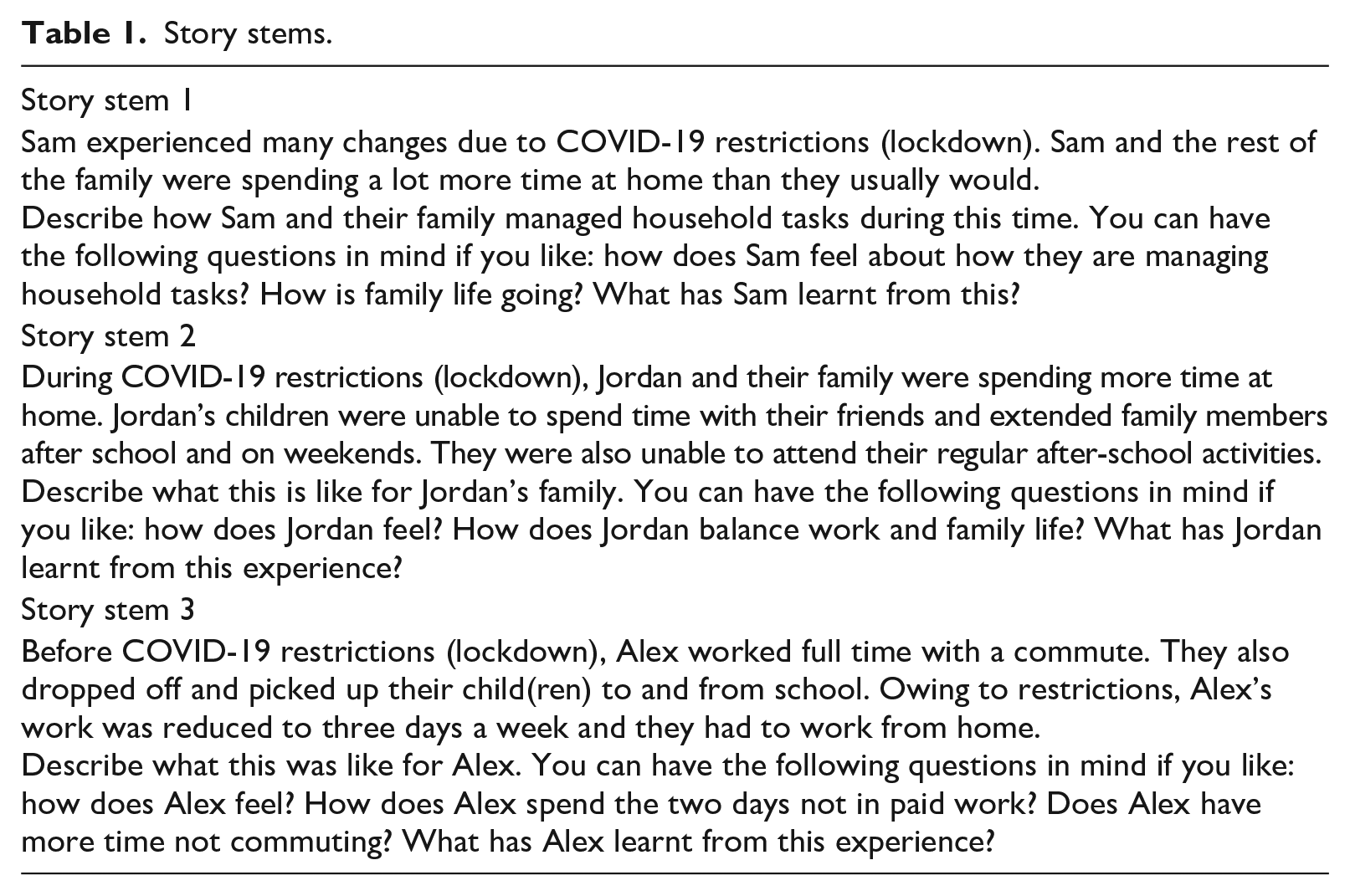
Participants were sent an email containing a link to an online story completion task via Qualtrics (https://www.qualtrics.com). Participants were asked to complete a story in response to a story stem written by the research team, which involved a hypothetical scenario of family life during COVID-19. Names of the characters were intentionally ambiguous in terms of gender, as was family format and number of children, to allow participants to determine this for themselves in their response. Stories were interpreted as reflecting participants’ social positioning and the meanings available to them in their wider social contexts or ‘meaning-making frameworks’ (Braun et al., 2019: 141). Participants were randomly allocated to complete one of three story completion task options shown in Table 1. The use of three stems built in household diversity to the story contexts to allow for examination of different aspects of family practices. For example, stem 1 did not specify the inclusion of children, stem 2 has multiple children, stem 3 has the possibility of one or more children. The stems were accompanied by prompts to aid participants in writing their responses.
Story stems.
Contextual Data
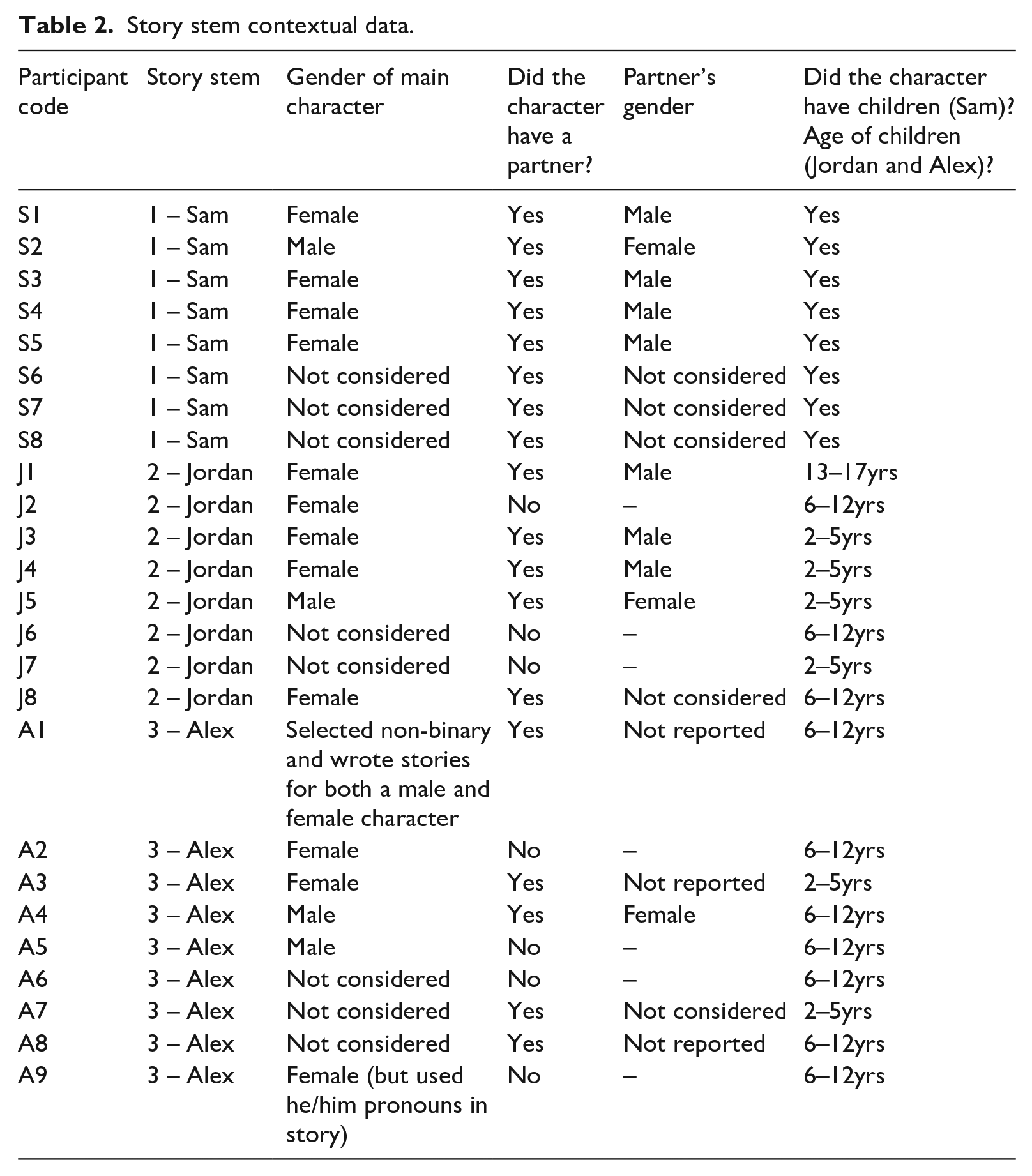
Following collection of the story completion data, we also asked participants to identify: whether they had assumed a particular gender for the main character, whether they had assumed there to be a partner and, if so, their gender, whether the character had children (in Sam’s case), and what age children were imagined to be. This information is provided in Table 2.
Story stem contextual data.
Data Analysis
The qualitative story completion data were analysed using reflexive thematic analysis (Braun and Clarke, 2022). The completed stories were first read by members of the research team to familiarise themselves with the data. One researcher then coded the stories using descriptive labels. The team then came together to review the initial coding and inductively developed discursive themes. On meeting together as a team, we shared our own stories of lockdown and its impact on our home and family lives and priorities. This was an important part of our process of collectively analysing the data and situating ourselves within our own meaning-making frameworks. We acknowledged how these frameworks were shaping our thinking and analysis of the participants’ narratives and how we intended to write up the study. As a research group relatively diverse in age and household composition we brought different perspectives. This enabled us to reflect on how our methodological approach might shed light on the common and divergent rhetorical devices drawn on by our participants to tell the stories and on how our methodology might leave alternative narratives unexplored (from non-white subject positions, for example). After this coming together, members were then allocated to a theme to write up and these were then circulated to the team for review, refinement and theoretical discussion.
Findings and Discussion
Of the 25 participants who completed the story completion task, eight participants completed story stem 1, eight completed story stem 2 and nine completed story stem 3. In addition to the thematic analysis, we also noted the contextual data provided by each participant – shown in Table 2. Of interest for our analysis were the genders inserted into the stories by the participants considering the demonstrated need for research to examine how diverse families negotiated the pandemic in comparison to perceived heteronormative contexts (Hunter et al., 2023).
These descriptive data show that 10 of the 25 stories portrayed characters in heteronormative relationships, seven characters were single parents, and eight had partners but the gender of the character, their partner, or both was not considered in the story. This suggests that the methodology was effective in not reproducing heteronormative assumptions, and the data paint a more diverse representation of characters than would have been possible had gendered story stems been presented. The participant codes from Table 2 are used in parenthesis to identify the quotes that follow. Despite participants being randomised to the different story stems, we developed three discursive themes across all stems: the imperative of connection, the imperative to be tidy and orderly and moral imperatives of time use.
The Imperative of Connection
Across all three story stems, participants drew heavily on the ways in which connections with family, in particular the sense of connection and bonding between parents and children, were shaped in different ways through COVID-19 lockdowns. The ideas of ‘quality time together’ (S3), and ‘reconnection’ (J1) were presented as discursive, moral imperatives. Yet, although the focus on family connection was a central aspirational theme, the realities of how lockdown shaped intimate family relationships, and in turn how negotiating family connection shaped lockdown, were varied.
Some participants described COVID-19 as positively enabling more intimacy and connection with children for the fictional characters, for example having the time to play board games (S2), do crafts and walk or bike with the children to school (A8): ‘They spent more time enjoying one another’s company, making memories and new routines’ (J6). Participant J6 presented a neat picture where more time together correlated to increased ‘quality’ activities. But for others, family connection for the fictional characters was fostered via a shared experience of the mess and challenges of lockdown, something that families might ‘muddle through together’ (J1). Others presented a sense of ambivalence about family connection, feeling simultaneously ‘lucky to have this time together, while also feeling resentment for each other as they have lost their options for escape’ (J7). For the characters in J4’s story, this intense connection through physical presence compounded worry and concern about the impact on mental health and relationships. J4 described the need to look beyond the immediate to an imagined future, where things would be okay: she knows this is just a blip in their lives and that things will get better – at some point. Perhaps they will all look back on this time and wonder how they managed to survey [sic], so long in the same house together without rupturing the ties that bind them. Perhaps they’ll realise that it wasn’t that hard after all. They are strong. (J4)
Thus, for some the story completion task was an opportunity to demonstrate how COVID-19 represented a threat to family connection for the characters, and the need to dig deep in different ways to overcome the threat. Acute challenges were depicted in navigating and working on connection with children when this negotiation became a tricky and sometimes unwelcome burden, demonstrating the additional emotional labour required from everyone in the home to get through (Dean et al., 2022): ‘As the days and weeks wore on, the cracks began to show. The family found it difficult to find their “me” time since someone always interrupted, and tempers were getting shorter’ (S7).
Nearly all the story completions drew heavily on the idea of maintaining positive family connections as a taken-for-granted expectation of family live during COVID. This echoes the findings of a similar study in Iceland where parents in lockdown portrayed positivity as a required attitude to be considered capable of coping (Auðardóttir and Rúdólfsdóttir, 2020). Auðardóttir and Rúdólfsdóttir (2020: 174) argue that this reflects ‘the neoliberal governmentality of emotions [. . .] where happiness, positivity and gratitude are considered the correct and respectable feelings in the face of adversity’. Stories in our study shed light on the tension between meeting the social expectation of ‘display’ of happy relationships versus the ‘doing’ of authentic connections however ruptured or frayed they might be (Finch, 2007). Building on the work of both Goffman (1959) and Morgan (2020), the moral imperative here is to present a frontstage image of flawless positive performance as an imagined ‘family’ even though the backstage realities show the relational and emotional messiness of family practices. Thus, these data show how COVID-19-related lockdown contributed to perpetuation and reinforcement of unobtainable discursive constructions of how family life ‘should’ look and feel. Much like Foucault’s (1995) concept of the prison panopticon, our story protagonists feel under surveillance through online video calls and the matrix of interactions with employers, other parents and family members, and engage in self-surveillance as a result. The aspirational nature of these discourses and the chasm between imagined ideals and realities was most evident in the story by participant A6, who wrote: Alex felt a quiet murderous rage each time another parent commented on how close and connected their family had become. [. . .] Alex’s colleagues talked about sourdough and watching a lot of Netflix and how great it was to ‘slow down’. Alex woke up early and cried a little at the start of each day. (A6)
Here the sense of surveillance is palpable and is presented as having a profound impact on Alex’s wellbeing due to their perceived failure to meet the ‘neoliberal parental demands’ (Auðardóttir and Rúdólfsdóttir, 2020: 172).
The Imperative to Be Tidy and Orderly
The importance of order and tidiness emerged in participants’ stories through practices of household chores and cleaning. Like Auðardóttir and Rúdólfsdóttir (2020) our findings also showed neatness and effective organisation to be moral expectations of successful parenting during lockdown. In the face of continuing dis-order through spending more time at home, the imperative of keeping things in an orderly and tidy manner was evident: Sam felt an enormous burden as (almost) inevitably the household tasks, which had now increased due to the family being around all the time, fell on her shoulders. She got on with it, as nobody else would otherwise, but at times she felt physically and mentally exhausted. (S4)
Here we can see the importance ascribed to household tasks; the labour required to keep home chores going, even if physically and mentally exhausted, was a priority. This story also highlights that household tasks fell ‘inevitably’ to Sam. This inevitability appears to further contribute to the character’s sense of burden and perhaps implies that participant S4 was writing in a gendered interpretation of who is responsible for shouldering this burden. This is supported in their response to the question of what gender they imagined Sam to be.
Often the time for tidying and cleaning the house, which pre-COVID-19 had been timetabled each week, was disrupted leaving less time for household chores. This was, ironically at a time when the amount of household tasks increased: On saturdays Sam’s husband drove the kids to a variety of sporting activities while Sam took the opportunity to tidy up and get on top of domestic chores. Now with everyone at home, the amount of meal preparation, cleaning and tidying has dramatically increased, but Sam is still the only one doing most of this work. (S1)
Similar to the story written by participant S4, in this story by S1 the disproportionate burden of responsibility for household chores fell to the female character in a heteronormative relationship. While not explicitly stated in the story, S1 responded to the contextual questions indicating that Sam was a woman and that she had a male partner. However, participant S3 responded differently in their telling of Sam’s story, presenting greater opportunity for an equal division of labour for household tasks between an identified female Sam and male partner: Sam enjoys the additional time her partner spends at home, which has created more opportunities for a more equitable division of household chores and childcare duties. (S3) Being at home more Sam and the family had plenty more time to work on the household tasks. They were using the dryer less and were able to get those little things done that normally don’t get done like cleaning the ceiling fans, the windows, the pantry and getting out in the garden more. Everybody was a lot less stressed and able to relax more in their clean and tidy home. (S8)
This story from participant S8 shows the importance of ‘orderliness’ and ‘cleanliness’ as symbolic of less stress. Thus, keeping the house under control provides an antidote to the chaos of COVID-19.
In response to the storyline about Alex who no longer has to commute to work, participant A1 wrote two stories, one where the protagonist was male and one female. When presenting Alex as male they wrote: ‘[Alex] may help with household chores but it will cause some friction in the partnership. He would have to be asked to assist or he might ask what he can do to help’ (A1). In this case, though there is a recognition of the importance of household chores, the discursive position of the man as ‘helper’ even in the face of extra work, talks to the relative roles that men and women fulfil (Riggs and Bartholomaeus, 2020). Participant A1 presented a comparison of how Alex as male and Alex as female might approach the scenario in different ways based on their gender. The participant did not specify the gender of the partners in either case. However, the story follows a heteronormative trope in that the imperative to be orderly and tidy rests on the shoulders of Alex’s partner when Alex is male, but on Alex herself if she is female.
Online lessons and meetings rendered the inside of homes visible and evident. According to participant A6 this invited social pressure to present a clean and tidy home: ‘Online zoom lessons meant social pressure to present a clean and tidy home but it was impossible with the children home all the time’ (A6). While previously this home-based and caring labour has been conceptualised as a ‘second shift’, and a shift that largely falls to women (Hochschild and Machung, 2012), lockdown collapsed previous differentiation between working spaces. Drawing on Deleuze and Guattari (1988), people in the stories experienced a smoothness as ‘normal’ structured activities disappeared but, simultaneously, the imperatives to intentionally create structure and orderliness led to hyper-regulation. The lack of boundaries and constant presence or layering of school, work, and caring all in one place creates highly striated space despite the structures of external work and external commitments dropping away.
Moral Imperatives of Time Use
In the story completion responses, time was represented by some as a valuable commodity where the pandemic had both created more time and taken time away. As an example, commute time was presented by some as being ‘saved’ to use in other ways. Whereas others felt the commute had been valuable time lost. Both saving and losing commute time reflect the discourse of discretionary, unstructured time that can be used by individuals in any way they choose. Yet the reorganisation of time allocation that featured in participant’s responses shed light on imperatives to use time in ‘appropriate’ ways, and that these were deeply gendered. In particular, moral expectations of domestic emotional and physical labour expanded particularly for women protagonists in lockdown. For example: Alex’s life remained busy. But in a different sort of way. There was more time for cleaning but more cleaning to be done. More meals to make . . . (A2) [A]lthough there should be more down time with lockdown it’s often taken up with mundane tasks as they can’t really go anywhere now. (J7)
In comparison there were examples of discretionary time being structured into schedules in lockdown, which facilitated a sense of health and wellbeing, particularly for the protagonists identified as men: Sam’s husband frequently mentions to friends how much he likes working from home because he is getting more time to work without having to commute or worry about picking up the kids [. . .] Overall, Sam feels that the practical and emotional labour of lockdown have largely fallen to her to manage [. . .] while her husband has been able to continue to prioritise his work and mental health. (S1)
While there are nuances to the ways discretionary time loss and gain were presented, the story completions spoke to broader evidence of gendered time and labour that consequentially results in gendered patterns of health and wellbeing in heteronormative contexts (Doan et al., 2021). This is evidence that dominant discourses of heteronormativity and hegemonic masculinity (Connell, 1987) facilitate the taking of time for men and perpetuate an imperative for women to give time. Such expectations reinforce women’s responsibility to take on the care work, so that when presented with more time in the context of being at home, women are expected to use this to engage in unpaid care, whereas this time is more likely to be framed as discretionary for men.
Where Australian fathers did increase time spent doing visible domestic work there remained little mention of the unequal distribution of less visible mental load (Dean et al., 2022; Ruppanner et al., 2021). This highlights how cultural and gender norms require deeper interrogation for shifts in labour to prevail beyond the context of the pandemic (Chung et al., 2021). For some of the men there was an imperative to maintain a hyper-focus on paid work, as well as lockdown representing an out-of-the-ordinary opportunity to contribute to childcare and household chores that they may not normally do in day-to-day life (Auðardóttir and Rúdólfsdóttir, 2020; Peukert, 2019). The idea that the look and feel of family practices during lockdown was an anomaly to ‘normal’ life was represented in the story written by participant A5: He tried to focus on the positives: an opportunity to streamline his work practices and spend more time with his children. He was able to independently structure his time around the children’s homeschooling needs and planned new daily and weekly routines for them to follow. [. . .] They do craft activities and order some robotics kits to build together. He knows this kind of intensive parenting isn’t sustainable over the long-term but it’s important for everyone to follow lockdown procedures so life can return to normal as quickly as possible.
There was a dominant discourse across the stories about the nature and quality of time during the pandemic being unique. This phenomenon has been discussed by Ruse et al. (2022) who explain the cultural semiotic processes involved in ‘remaking’ time through the pandemic. The concept of time being reimagined in new ways offers an example of how participants demonstrated agency in lockdown. By consciously reclaiming and reframing time, participants demonstrate the ability to cope and work through the disruption and distress of what Ruse et al. (2022: 235) describe as a ‘despairing frozen temporality’: ‘The “life pause” of COVID is frightening and he’ll [do] anything he can to ensure it’s not a wasted pause on a short life’ (J5).
This collapse of time appears existentially challenging for the character Jordan and the quote flags the intentional process that characters are imagined to have engaged in to restore meaning and legitimacy to personal and family practices (Auðardóttir and Rúdólfsdóttir, 2020; Ruse et al., 2022). Time in lockdown was presented as having a different look, feel and intrinsic value than in non-pandemic, ‘everyday family life’ (Morgan, 2019). As well as varying in quality, time was described as going slower: ‘Family life, while challenging with young children, has a slower pace with fewer social activities, and more time to focus on quality time together’ (S3).
Returning to Deleuze and Guattari (1988), the temporal-spatial smoothness of lockdown poses a discursive and existential threat to the meanings attached to ‘normal’ life, and it is in that smooth space that participants attempt to instate striation in new and transformative ways. Examples of this include creating new work patterns that would have been unachievable prior to the pandemic. While developed out of necessity, participants created new routines to suit their context: ‘It’s hard to get work done, Jordan decides to work early morning and late at night’ (J3). The imperative to create structure in the suspended time of lockdown demonstrates how routines have symbolic value in day-to-day family practices. We argue that externally imposed timetables are only one (albeit significant) element of how families ‘do’ time relationally and subjectively. These findings show that this space of shared and contested meaning, brought about by COVID, provides an opportunity for agency where family practices – previously highly structured by external timetables – can be reimagined.
Conclusion
The stories told by participants in this study suggest that lockdown both compounded and reinforced perceptions of gendered patterns of labour and wellbeing for the fictional characters. While our methods of data collection purposefully left gender of the characters ambiguous, some participants still read the fictional characters as men or women, and predominantly as heterosexual. Where this was the case, the stories implied an inevitability about the social expectations of heteronormative division of household labour. Yet these stories are not unquestioning in this, and they illustrate the emotional, mental and physical impact of navigating gendered norms and tropes within households. This points to the lack of public discourse about diverse family practices during COVID-19 and the need for further research that more explicitly seeks to shed light on queer, non-heteronormative ways of knowing to counter restrictive and oppressive dominant expectations of how to ‘do’ family.
Our findings also show a lack of visible diversity exists regarding the possibilities for messy, imperfect displays of family practices during lockdown. Our analysis contributes to the sociology of families and relationships by demonstrating the slippage that exists between displaying and doing family life; how being in and performing domesticity are entangled in complex ways shaped deeply by social (particularly gender) norms. Increased engagement with social media and online discursive worlds demanded a curated performance of what were previously more private lives. Lockdown reinforced and created new moral imperatives that shape family practices and ways of doing/performing family that compound polished, unobtainable standards of household cleanliness, cooking and happy children. Yet the stories told also demonstrate optimism in some of the characters. Our analysis makes a unique contribution by illustrating the ways moral imperatives structure day-to-day lives, and how they are negotiated and resisted. By writing about how characters coped through the mess and contradictions, participants showed lockdown could present opportunities for agency – ways to remake time and disrupt ‘everyday family life’ for the better.
Footnotes
Acknowledgements
We would like to thank Professor Rebecca Golley for her support and comments on the early stages of analysis and we acknowledge Dr Stefanie Lopriore for her contribution to the initial descriptive coding of the qualitative data.
Funding
The authors disclosed receipt of the following financial support for the research, authorship and/or publication of this article: this study is supported by Flinders University (Internal Grant).
