




Abstract
In this article, I examine how belonging takes place within lives shaped by the hostile milieu of UK immigration policies and politics, by focusing on the everyday experiences of unaccompanied young people seeking asylum. Drawing on Deleuze and Guattari’s assemblage, I suggest an understanding of belonging as a rhizomatic assemblage, comprising the interactions and relations of diverse forces and flows. Based on the analysis of in-depth interviews with unaccompanied young people and the professionals who care for or work with them, I conclude that belonging is reconfigured in-between relations, always incomplete and in transition. I argue that belonging is characterised by inconsistencies and ruptures and made possible by the ‘micro-politics’ of those unaccompanied young people encounter in their everyday lives. I contribute to the literature by conceptualising the sociological notion of belonging in a novel way and exposing its key components and nature formed under precarious conditions.
Introduction
As Europe’s so-called ‘migration crisis’ was unfolding between 2015 and 2016 and being met with inadequate and contradictory responses from European states, the number of unaccompanied children and young people seeking asylum (UYP hereafter) in Europe also rose to its peak. 1 Reflecting this trend, there has been an ‘exponential’ growth in the research literature on UYP since then (Salmerón-Manzano and Manzano-Agugliaro, 2019). This literature has spanned multiple disciplines, exposing various issues faced by UYP in Europe, such as youth migration drivers, journeys, reception and care, and resettlement and integration (Wernesjö, 2015). In the last decade, an increasing number of studies that particularly focused on the experiences of belonging of UYP have also emerged but mainly from Scandinavian countries. These studies have shown that UYP’s belonging is negotiated within relations and challenged by racialised discourses (Wernesjö, 2015); created through making sense of place (Kauko and Forsberg, 2018; Moberg Stephenson and Källström, 2020); and within multiple communities, as they negotiate their shifting positions (Verdasco, 2019). Common to all these studies is the uncovering of the temporality, fluidity and relationality of belonging in displacement and resettlement.
Contrarily, in the UK, such research is largely missing. Relevant research from the UK has been mostly focused on the detrimental impact of asylum policy and procedures in undermining well-being and future outcomes for UYP transitioning to adulthood (e.g. Chase and Allsopp, 2020) and constructions of ‘home’ (e.g. Drammeh, 2019; Sirriyeh, 2013) within care structures. These studies brought attention to the significance of youth who are transiting to adulthood, of multiple and nonlinear pathways to resettlement, as well as highlighting how their experiences are shaped by migration control, states of uncertainty and processes of racial and gendered discrimination. Through using different conceptual foci and frameworks some of these studies have also illustrated the temporality and crucial role of belonging, and how senses of ‘home’ are experienced in multiple ways and spaces while being threatened by the processes of everyday racism (Sirriyeh, 2013) and policy structures that govern UYP’s lives (Chase and Allsopp, 2020).
This article adds to this emerging research area on the experiences of, and inequalities faced by UYP transitioning to adulthood within the UK asylum system. However, it differs through its stronger conceptual focus on belonging itself and how state policies and local-level resistances – ‘micro-politics’ – of individuals influence belonging. More importantly, unlike previous studies, this study suggests a new theoretically informed concept of belonging. Adopting Deleuze and Guattari’s assemblage thinking and its related notions of rhizome, molar and molecular lines, it contributes to and advances this literature by offering a unique approach to the study of belonging to better understand its nature under precarious conditions. It suggests the image of belonging as a rhizomatic assemblage as an alternative to the existing metaphors of ‘home’, ‘root’ or ‘anchor’, as rhizome and assemblage are the expressions of open systems, of the endless movements and formation of connections. Deleuze and Guattari (1987: 21) used the rhizome to oppose the image of the tree-root with its hierarchical, static and fixed connotations. The rhizome explicates assemblages as ‘an a-centred, non-hierarchical, nonsignifying system’. It foregrounds the idea that there is no ‘essence’ or complete, stable ‘whole’ but only multiplicities in connections and relations (Deleuze and Guattari, 1987).
The Concept of Belonging
As a key sociological concept, belonging embraces many aspects of human experience and is studied within diverse disciplines of the humanities and social sciences, most notably psychology and sociology. As Yuval-Davis (2006: 198) contends, belonging is a theme ‘out of which both classical psychology and sociology have emerged’. Belonging is paramount to understanding the interrelationship between individuals and the social world they inhabit and between the self and social change, which are also central concerns for sociology (May, 2011). Studying belonging also enables dynamic analysis of how everyday practices are constrained but also creative, hence conducive to social transformation (May, 2011). And yet the concept of belonging is repeatedly criticised for being ‘vague’ (Harris et al., 2021), assumed as ‘self-evident’ and ‘self-explanatory’ (Allen and Ögtem-Young, 2020) within research and left under-theorised (Antonsich, 2010).
Some scholars from sociology backgrounds, as well as from other disciplines, have offered various understandings of belonging. They conceptualised belonging in different ways to capture the dimensions and dynamism, complexity and multiplicity of the notion – for example, conceptualising belonging as feelings of ‘being at home’ (Yuval-Davis, 2006), as ‘a sense of ease’ with the self and its surroundings (May, 2011), ‘translocational positionality’ (Anthias, 2002) and as ‘belonging-work’ (Kuurne and Vieno, 2022). Among these conceptualisations, Yuval-Davis’ notion of belonging has arguably been the most influential. She separates belonging into both a personal, emotional feeling of ‘home’ and the ‘politics of belonging’ as a way of constructing boundaries and exclusions. Alongside Yuval-Davis, Anthias’ (2002) suggestion of ‘transnational positionality’ as a conception of belonging has also been popular with research around transnational identities and belonging. Both scholars used an intersectional approach and placed belonging at the heart of the interactions of multiple social locations, contestations and narratives. Their intersectional approach has, however, been criticised for being unable to break away from established categorisations in their analyses of belonging (Youkhana, 2015).
More recently, attempts have also been made to provide more fluid and temporal notions of migrant belonging. For example, Grzymala-Kazlowska’s (2016) concept of ‘anchoring’ offers a socio-psychological understanding of how EU migrants develop and maintain their local and transitional relations and connections in their everyday life as ‘footholds’, enabling migrants to adapt and form belonging and integrate into their host country. However, this conceptualisation is based on those who have already established communities, freedom of mobility, employment and the security of legal status, which enables them to engage in activities that have the potential for ‘anchoring’ in the host country. Furthermore, it does not explain how this ‘anchoring’ of migrants is affected by power-structures, and so it seems somewhat insufficient in explaining how belonging takes place for those with uncertain or no legal status.
Therefore, I argue for a new theoretical approach to studying belonging that is ‘against essentialism’ and ‘totalities’ (DeLande, 2017) – one that extends its potentials and possibilities and goes beyond established categories while corresponding to the tenacity, tenuousness, actuality and potentiality of belonging for those who occupy precarious positions. To this end, I adopt Deleuze and Guattari’s ideas of assemblage and the related concepts of rhizome, molar and molecular lines to conceptualise and analyse the ongoing making, the paradoxes and ruptures of belonging in displacement and resettlement – processes that are permeated with exclusions, prolonged ambiguity and violence. This approach provides a theoretically informed account of alternative ways of being, becoming and belonging taking place in the perilous context of forced migration concerning those who have insecure (or are lacking) legal statuses and are subject to state regulations. This approach is a unique and useful advancement of current scholarship on belonging through the original and rigorous application of Deleuze and Guattari’s concepts to the notion and youth migration – something that has not been done in this way before. I also contribute to sociological debates on how social exclusions and inequalities are created in displacement by the politics and processes of immigration, how these hostile state policies are resisted at the local level and how belonging is produced through everyday relations and encounters by focusing on UYP experiences.
Belonging as Rhizomatic Assemblage
Deleuze and Guattari’s novel concepts as a theoretical approach have rarely been taken up within the migration studies and studies of belonging, despite being very popular within the field of educational sociology, other social science disciplines and the humanities (Fox and Alldred, 2017). The assemblage approach to studying belonging offers rich insights into manifold aspects of social processes while recognising that belonging emerges through the relations of a wide range of forces and elements, including policies, representations, desires, feelings and meanings. It turns its attention to relations and events, offering alternative ways to explain power and resistance, social inequalities and transformations as well as new ‘becomings’ and continuities, all of which are central themes of sociology.
Deleuze and Guattari use the notion of assemblage to forefront the relationality, connectivity and multiplicity of the social world. It refers to the co-functioning of many heterogeneous components from diverse dimensions. It is ‘an arrangement in its multiplicity [that] necessarily works at once on semiotic, material and social flows’ (Deleuze and Guattari, 1983: 52). This understanding underlines the interrelatedness of social life with its singularities, constantly evolving and working on each other in mutual and manifold ways. Specifically, the notion of assemblage confronts the conceptions of social existence as embedded in ‘fixed, stable, and predictable ontologies and relationships’, in favour of ‘a vision of social life constituted dynamically and contingently by complex configurations that [. . .] come together in particular social formations’ (Wiertz, 2021: 1375).
Assemblages are made of diverse elements, what Deleuze and Guattari also call, lines;
2
with different functioning and characteristics: molar and molecular lines. These concepts help explain the varied forces and flows within an assemblage. The notion of ‘molar line’ refers to structures, formations and processes that are rigid, segmentary and homogenising in nature and their functioning. Molar lines organise, fix boundaries and delineate spaces, entities and subjects ‘leav[ing] no room for all that is flexible and contingent’ (Surin, 2010: 164). The consolidation and functioning of state apparatuses, power-structures and binary social categories such as gender, class and race can all be understood as molar lines. In Deleuze and Guattari’s thought, the molar is used to elucidate the formation and workings of prevailing, enduring and hierarchical socio-cultural and political entities and meanings. Deleuze and Guattari (1987: 195) state: Not only are the great molar aggregates segmented (States, institutions, classes), but so are people as elements of an aggregate, as are feelings as relations between people; they are segmented, not in such a way as to disturb or disperse, but on the contrary to ensure and control the identity of each agency, including personal identity.
Conversely, the notion of molecular lines explains how local-level creative enactments and characteristics of individuals, events and experiences can work to disrupt and resist the workings of the molar lines (the state policy, legislation, exclusionary discourses, representations or categories). For instance, in her examination of contemporary conceptions and manifestations of masculinity, Hickey-Moody (2019) refers to the dominant discourses and ideals of masculinity prevalent within society as ‘molar’, while describing individual experiences and creative interpretations of masculinity that do not conform to or oppose the hegemonic masculinities, as ‘molecular’ masculinities. As such, molecular lines refer to the subjectivities, enunciations, local enactments and enabling transformations with the potential to contest and destabilise the workings of molar lines – which is, for Deleuze and Guattari, the basis of ‘micro-politics’. Micro-politics are embedded in the actions of the molecular subjectivities and practices, which challenge the rigid inscriptions and stratifications of – and create possibilities of making cracks within – the structures of molar lines. In other words, micro-politics are about perceptions and practices, that are ‘capable of expressing and instantiating a desire to undo the prevailing world order’ (Surin, 2010: 165).
In the analysis of UYP’s belonging, I also use the notion of molar lines to highlight the functioning and effects of the border/immigration policies, processes within the asylum system, and the exclusionary representations and subjectivities imposed on UYP. UYP who enter the UK after their prolonged, traumatic and perilous journeys find themselves amid formal and legal processes and procedures, which compete with, and are privileged over, the policies designed to protect them (Crawley, 2007). As adolescents, they face the challenge of dealing with and navigating a complex legal and asylum system intended for adults – a system involving indefinite periods of waiting and uncertainty, creating high levels of stress and mental-health issues (Huemer et al., 2009). While being processed within such a system, UYP are also met with racial and gendered discrimination, contrasting discourses of ‘vulnerable children’ and ‘undeserving others’ (Wernesjö, 2020).
They are often given temporary leave until they are 17.5 years old, a status that leads to further legal procedures, hence more waiting, and anxiety, affecting their everyday lives and transitions (Chase and Allsopp, 2020). Even their very status as children can be questioned and they are subject to painful, inhumane and unlawful – as well as unreliable – procedures (Kvittingen, 2010) with implications for their asylum applications and care practices. UYP approaching the age of 18 without secure legal status are further disadvantaged, facing the possibility of losing the protection and support afforded to them as minors, with the prospect of becoming undocumented and being deported. The notion of molar lines provides a conceptual tool with which to analyse these processes and exclusions as forces that are entangled with other lines of UYP’s belonging-assemblage. Simultaneously, I use the notions of molecular lines and micro-politics in the analysis of the practices, spaces and individuals that contest and unsettle the workings of state policies, the asylum system, institutional processes and procedures. I map some of the subjectivities, enactments, encounters and relations taking place within care structures and community-based organisations. This mapping illustrate the affirmative affectivities, and creative and hopeful interactions that allow rhizomatic formations of UYP’s belonging.
Researching Belonging
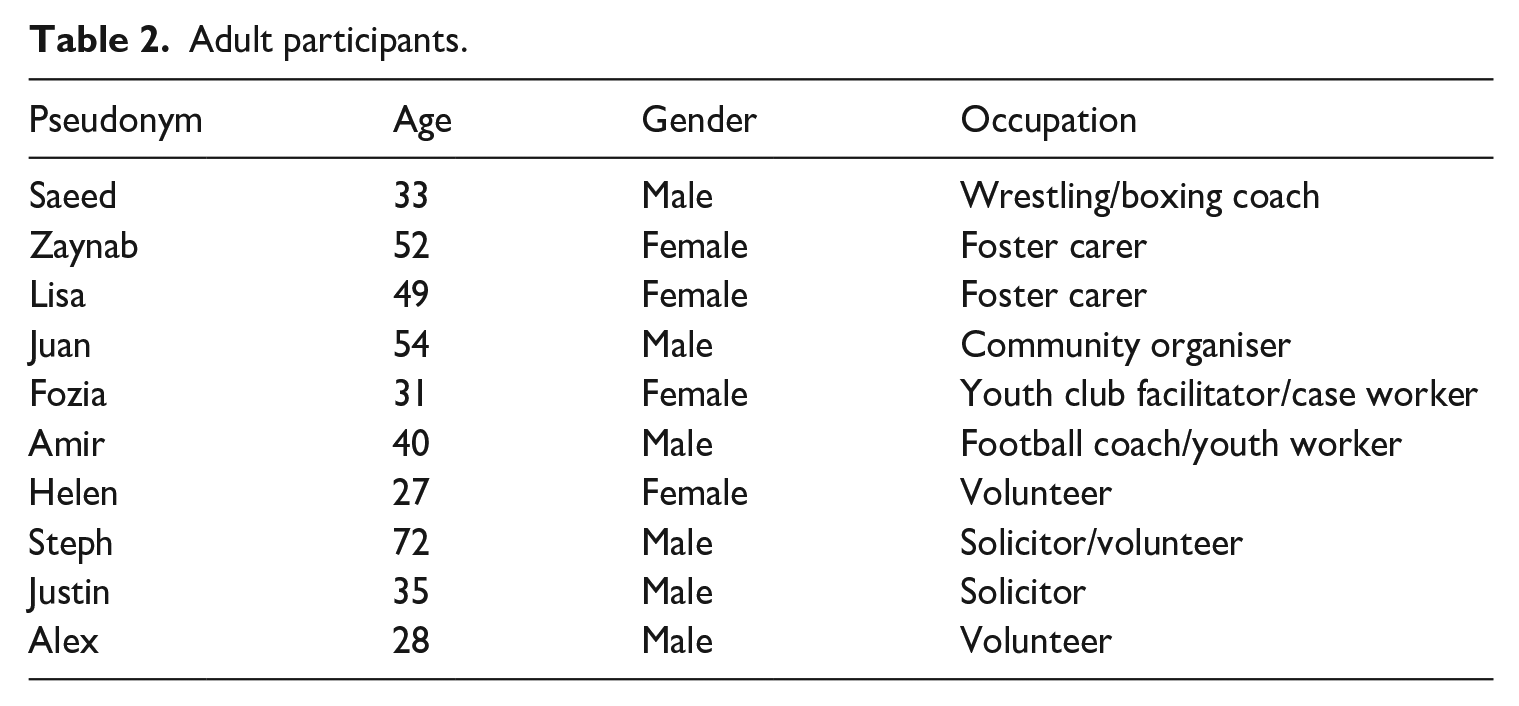
I draw on qualitative interview data to explore the experiences and complexities of belonging by conducting 21 in-depth, semi-structured interviews with 11 UYP and 10 adult participants including foster carers, professionals and volunteers caring for or working with UYP (Tables 1 and 2). All participants were living in Birmingham at the time of the interviews, which explored their experiences of displacement, journeys and resettlement processes and how belonging is experienced and articulated by UYP while seeking asylum in the UK. The interviews took place between 2019 and 2020 and were all conducted in English, lasting between 30 and 90 minutes. The main sampling strategy was ‘purposive’, which meant the research aims/questions influenced how and why I recruited participants for the study. I utilised my networks, identified and contacted individuals from voluntary and community-based organisations working to help and support UYP. I also used the snowballing sampling technique, which involved identifying new participants through already consented participants. The young participants in this research were all male, aged between 16 and 25, with the majority from Afghanistan, reflecting the general trend in youth migration.
Unaccompanied participants.
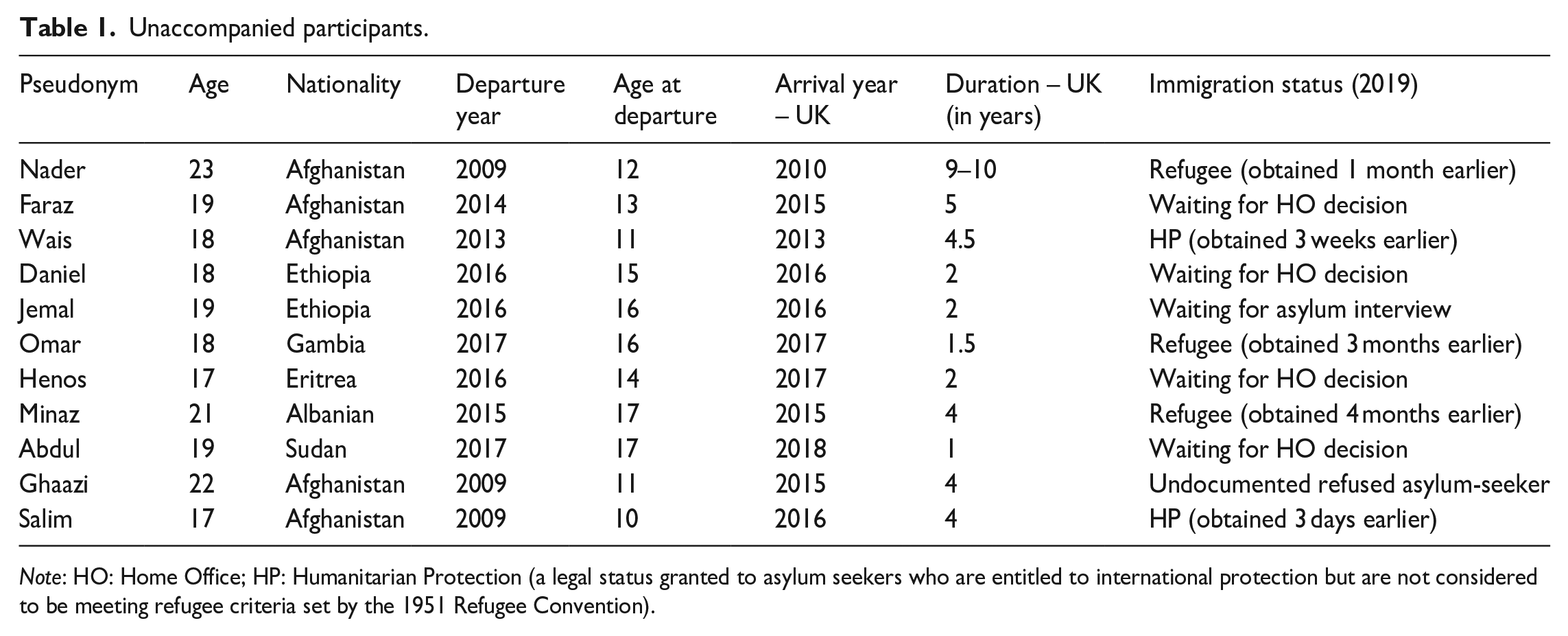
Note: HO: Home Office; HP: Humanitarian Protection (a legal status granted to asylum seekers who are entitled to international protection but are not considered to be meeting refugee criteria set by the 1951 Refugee Convention).
Adult participants.
Ethical approval was gained from the University’s Ethical Review Committee. All participants were provided with verbal and written information before their interviews describing the aims and the process of the research and how their data would be used and stored. They were encouraged to ask questions, seek clarification and were reminded of their right to withdraw before agreeing to participate in the interview. Research diaries involving reflective, analytical and descriptive field notes taken during the research process were also analysed alongside the interview transcripts. This approach to analysis characteristically differed from constructivist analytical processes, going beyond the prescribed coding procedure of dissecting and aggregating data through thematic categories (Alvesson and Sköldberg, 2000). Instead, I wrote analytical pieces on the data that ‘glowed’ and noted its conceptual interconnections (MacLure, 2013) through (re)listening to recordings and reading interview transcripts alongside research observations and reflections taken before, during and after data ‘collection’. Such a process involved constant ‘zigzagging’ within and across the data and reflective pieces, enabling me to engage with emerging themes as they rose to the surface, developing conceptual/theoretical links and foregrounding the relationality and multiplicity of belonging. This process enabled me to contextualise and layer data and to do ‘justice’ to the participants’ rich stories of displacement and belonging.
Conducting research around UYP with multiple vulnerabilities due to their positions as unaccompanied asylum-seeking adolescents is complicated and requires researchers to have heightened reflexivity and an awareness of our positionalities and their effects in the research process. One of these effects is how the researcher-self produces hierarchical positioning and varying effects in research with UYP. My position as a migrant seemed to provide some participants with a sense of ease and a relatedness as they talked about their experiences of migration and belonging, while for others my age, gender and my profession at university meant ‘authority’ and ‘respect’. My positionality as a female middle-aged researcher inevitably produced power imbalances when conducting interviews with young participants, which were important to reconcile. Although various efforts were successfully made to reconcile it, ‘there is no perfect solution in handling power imbalances in research’ with UYP (Chase et al., 2020: 470). There are many more methodological and ethical conundrums and considerations in conducting research with this ‘vulnerable’ research group that would require a significant amount of space to cover, which is not possible within the remit of this article.
Below, I present my analysis of the data through following the trajectory of a participant, Nader, who went through all stages of the asylum system while transitioning from childhood to adulthood – from having temporary status to being undocumented and having to fight for his right to belong in the UK. I then weave other participants’ articulations into his narrative. UYP in this study are from diverse backgrounds, have different legal statuses and are at various stages of their asylum processes (see Table 1). While the article traces the trajectory of Nader’s story, its arguments are based on the examination of data from its larger sample (Back et al., 2012). Nader’s story provides a thread running through the article, providing structure and continuity in presenting my findings and a way of illustrating the issues unique to the diverse stages of the asylum system and in formations of belonging. Thus, this approach is taken to offer a fuller and more continuous picture of life and belonging as experienced, undermined and fostered within UK asylum policy and politics.
Molar Lines of Belonging-Assemblage
Nader left his village in Afghanistan at the age of 12/13 to escape being recruited by the Taliban, after suffering the loss of his father who had been abducted and believed killed by the Taliban. Having gone through a year-long migration journey as a child without a parent or carer, and filled with loss and trauma, Nader tells me of being passed from one country to another and being left in the horrendous conditions of refugee camps. Among the many incidents he experienced during his journey, the most vivid was witnessing the death of his best friend whom he had met during his journey. They both hid in the back of a lorry to be smuggled into the UK from Calais. He continues: The smuggler put us in the lorry. And I think, he [the friend] went to the back of the lorry, in the tyres, in the big metals. [. . .] The driver came and started the [lorry]. I think he [was] picked up [by] the back tyres or froze there. He just died there! I was 14. He was a bit older than me. He was [a] child! And that’s all documented; the other day, I read it. I came [here] because he wanted to come here (he pauses, becomes thoughtful).
Jemal – who left his home in Ethiopia crossing the desert without much water or food, exposed to highly dangerous conditions in Libya before crossing the sea for Europe – said: ‘I was on the sea for three days. It was horrible! I had never been in the sea in my life, I couldn’t even swim at that time, I was afraid of the water. It was hard!’
These perilous journeys were experienced by most of the UYP participants in this study, leaving them with sorrowful memories and affective flows in their psyche – a form of suffering that is created by violent borders and the inaction of states, which is for Deleuze and Guattari a ‘despotic signification’ of molar lines. It is the workings and expression of ‘state policing or lawful violence’ and ‘an incorporated, structural violence distinct from every kind of direct violence’ (Deleuze and Guattari, 1987: 448). The detrimental effects of these migratory journeys are compounded by the complex and protracted processes of the asylum system and by a lack of permanent legal status once UYP arrive in the UK. Deleuze and Guattari consider all hierarchical, legislative, official and institutional policies and practices as molar lines as they function to ‘overcode’, ‘dichotomise’ and ‘territorialise’. The asylum system, immigration policy and procedures as molar lines of the belonging-assemblage organise, represent and treat UYP in particular ways, reducing their ability to become and belong while creating harm and suffering as illustrated by participants’ narratives. Nader’s words highlight the experiences of other UYP who have already gone through the asylum-determination process or who have been waiting for it for an undetermined time: When I first came here, I was 14 years old. I went to interviews. They ask about what happened to me back in Afghanistan, my mum, dad. I told [them] everything then the decision came, they said, ‘You are refused, given [temporary leave] until you turn 17. 5.’ I felt it was wrong, I felt sad. I said, ‘Why didn’t they accept my case? I do not want this!’ [. . .] I came back [home]. After that, I was OK because I was a child, and did not understand. I was going to school. I was just like normal. When I was 17.5, I appealed and after one and half years my case was refused – that’s where things started stressing. As you do not know where your future be, you cannot focus on your education [. . .]. It was just chaos. It affected me [in] many ways and is still affecting me.
Here, Nader offers an account of feeling let down over the unfair decision on his asylum claim as he was deemed to have failed to establish ‘a well-founded fear of persecution’ (UNHCR, 2010: 14) in Afghanistan. The asylum decision-making process often takes away the right to permanent status, causing UYP undue suffering during their formative years as the asylum process and practices are tainted by a ‘culture of disbelief’ (Schuster, 2020). In Deleuze and Guattari’s terms, we might also understand Nader’s and other young participants’ experience of the asylum system as being organised by the concrete machine of molar lines and overcoded by the abstract machines of a ‘culture of disbelief’, which all UYP participants in this study, at different stages of their asylum process – as well as the adult participants – expressed frequently. The abstract machine can be understood as ‘the future orientation of an entity’, meaning the ‘future holds a kind of potential that can be deployed in the present’ (O’Sullivan, 2010: 204). Daniel also spoke of waiting for the outcome of his asylum interview from the Home Office (HO) for 12 months. His feelings regarding his possible refusal decision echoed Nader’s despair: Most people don’t understand the situation: when you are young you don’t leave your country for work. You can’t leave your country just for money or for work. [. . .]. Now HO thinks we live for money. That makes me sad! When you are 15 years [old] you don’t do it like that. When something comes against you, you have to leave to survive [or] die there.
Daniel’s reflection on the materiality of a refusal decision that is yet to be actualised is an illustration of the working of the molar lines of the asylum processes, which perpetuate sustained worry and anxiety due to indefinite uncertainty and ambiguity. Functioning within this ‘culture of disbelief’ and ambivalence, UYP live with the effects of the anticipation of refusals, which is a form of state violence. Daniel’s account clearly illustrates this future orientation of a hostile policy environment that is ‘deployed in the present’, with the accumulative effects of suffering felt by him before it is actualised.
Steph, who is a retired solicitor now volunteering in a refugee support organisation, also spoke about the violent processes and workings of the asylum system and its impact on UYP. He knows only too well how UYP’s lives are dramatically transformed by migration and by the psychological effects of the threat of legal and practical processes of the asylum system: What we’re presented with is a young person who has come from an entirely different background and generally gone through a harrowing set of experiences in making it as far as the UK, and then is thrust into a system which would be very daunting for anybody, even if they were from that culture and even if they were mature adults. They have to cope with this process without any family here. [. . .] The asylum system [. . .] must be extremely difficult for them to understand, cope with. It’s also an extremely threatening situation because they know from a very early stage the hurdles they have to surmount. If they don’t get through that lot, they will be deported. But in a situation, [. . .] fraught with the difficulties of a very inhumane political and legal system, we know just how difficult it is for them to get through and succeed in taking asylum and just how much the odds are stacked against them.
Faraz was also caught up in the rigid segmentation and ‘slow violence’ of the asylum system (Mayblin et al., 2020). Faraz had exhausted all the appeal rights for his initial asylum refusal and was waiting for a decision over his reapplication. His everyday life has been captured and striated by the processes and functioning of the molar lines of the asylum system, whose incremental damage working on his psyche and his body produces affects reducing his capacities to become and belong: Everybody is waiting many years, and I don’t know why! How do people live like that? I have been waiting for 4, 5 years. They haven’t said anything and [. . .] refused my case three times [. . .]. When they give you a chance to appeal again, what do they want to know? I feel very bad, you know, because all the time I have to go to interviews, another interview, speak with solicitors – thinking about it all the time! These things make me sad. I can’t sleep at night-time [. . . until] four in the morning. It’s always on my mind. Yes, I can’t go in early to college [because] I can’t wake up for it.
UYP participants articulated their aspirations for education and training as being paramount in actualising their capacities and aspirations. Education is valued for its power to enable UYP to trace the paths for achieving their possibilities and potentials and for its part in creating important relations and spaces of belonging. Nevertheless, their educational aspirations for carving out alternative futures for themselves are undermined and jeopardised by the processes of asylum as it imposes enhanced stress and anxiety. Meanwhile, the importance of education and the opportunities that education enabled produced feelings of ‘gratitude’ and a desire to ‘give back’ among UYP (Wernesjö, 2020). Nader, and others, spoke of their goals to ‘pay back’ despite their plight within the asylum system: It is hard, but I am thankful. [. . .] I was very young when I came here and I am used to life here. When I went to school, I had a lot of people helped me, like my teachers. I made friends, I learned English from scratch, I met new people. Since I have been here [the] last 9.5 years people helped me. Now I think [it’s] my time to get a job and, give something back to my community and this culture. [. . .] I want to do some good things for this country.
As molar lines of the belonging-assemblage, policy structures and the legal and formal procedures surrounding immigration and asylum expose UYP to experiences that have negative impacts on their transitions and belonging, reducing their capacity to act. Meanwhile, UYP’s belonging and becomings are made possible by the molecular lines of the belonging-assemblage: the subjectivities, enactments and values of those adults who intervene in the workings and effects of the molar forces.
Molecular Lines of Belonging-Assemblage
Located on the top floor of a high-rise apartment block, Nader talked about his flat very fondly. His contentment with his accommodation was partly due to its proximity to the neighbourhood where he had spent his formative years within his foster family. He walked over to the window and pointed the way to the family’s house and the school in the distance, which were once a big part of his childhood/teenage times. He also showed me the printed photographs of life spent in the neighbourhood: family occasions, birthday celebrations, playing in the park and his school friends – all providing visual aids to his happy memories of growing up with the family and his narratives of belonging. These memories, moments and experiences gathered over time connect Nader strongly to the city: I belong in Birmingham because I have been schooled here. I lived before with [foster family for] four and half years; I went to school with their grandchildren. Then I went to college – studied for five years. That’s why, you know, I grew up here, I know a lot of people around here. I met new people who supported me to achieve my goals and dreams.
Connecting the abstract concepts of place, home and identity together, Wais linked his belonging to space and time but particularly to his (foster) ‘mum’: Wais: Home is like where you feel, this is my place, I feel safe here. ‘Home-home’ would be somewhere that I know I’m going to be for a long time. If you were just constantly moving around, you wouldn’t [feel] like that. It’s like you are having an identity. Once you have one home you have an identity, people know where you live; you make neighbours and get to know people, make new friends. Researcher: Where do you feel this sense of safety, home and identity? Wais: With my mum, this feels like a family to me.
The notion of foster carers as parental figures was also evident in the accounts of other young participants. Foster carers ‘were frequently viewed as parent figures, confidantes and companions’ (Wade et al., 2012: 8). Drammeh (2019: 182) notes that foster carers (and other key individuals) who ‘stand alongside the young people and deploy their critical and creative skills can play a role in mitigating, resisting and sometimes overcoming oppression’, creating spaces of belonging – which Zaynab seemed to provide for the UYP she cared for: Most of them came from very traumatic backgrounds. The traumas that they’ve suffered were horrendous. I’ve seen them go through the painful process of having to live certain scenarios where they’ve seen their relatives killed in front of them, sisters being raped – this still lives with them. They have done well despite all this and [. . .] managed to move on in terms of their daily life. [. . .] I sat them down and talked about what sort of interests, [ask], ‘What would you like to do with your future life?’ I advise them to utilise their skills. I found that most of them were very good at sports, in cricket and football. So, I encouraged all this and put them in clubs. And they did well. I’ve found them to be very loyal and loving towards me.
Zaynab’s performances, viewed here as the molecular line of the belonging-assemblage, echoed the enactments of other adults/professionals in this study. For example, Amir, working full-time with multiple other commitments, devotes his spare time to running a football club. He strives to provide a space for UYP alongside adolescents from other marginalised communities. He talks of how the space of his club created lines of belonging: Although this is a grassroots community football club, we’re not even semi-professional, let alone professional, but the fact that they’re wearing a football kit, and they’re playing football, or someone’s taking a video of them scoring a goal, it’s giving them a sense of belonging and being a part of something.
The links and recognitions that sport makes possible within the host country (and with their ‘home’ country) are also expressed by Saeed, who is a wrestling coach. He explains the role of sport in connecting UYP to life here and (positive aspects of) life back in their country, enabling a sense of continuity and a link between past and present. Saeed said: A lot of things define us as humans. I think what they try to do is to define who they are. And that’s not about nationalism or where you are, it’s like something you’re into, like wrestling or boxing. So, if I see one of these lads, I talk about wrestling, or fighting, or [say,] ‘You look pretty fit’; ‘You look like you’re cycling.’ They say, ‘I used to cycle back home’; ‘I used to do wrestling.’ I think that might remind them of a happier time: when they’re on the mat, [. . .] fighting with their mates, having fun, kind of reminds them of more innocent times. So, I say, ‘Why don’t you want to go to this club, that club?’ The good thing about my experience is in wrestling or gyms, nobody gives a toss about immigration status: We are like, ‘Can you wrestle?’; ‘Can you have a little bit of a laugh?
In migration, continuity is about ‘weav[ing] the links between the past and [. . .] new reality’ – a ‘thread’ that connects the images and narratives of home and belonging here and there (Archambault, 2012: 39). In Deleuze and Guattari’s sense, the coaches actively resist hostile politics of immigration and narrow and fixed understandings of belonging predicated on the essentialist ideas of ‘origin’, ‘nationality’. Instead, they created non-hierarchical and non-dichotomising spaces for UYP that enabled them to form connections and relations with their past and present as well as new becomings and belongings. The coaches’ perceptions and practices are underpinned by a recognition of UYP’s potentialities and multiple belonging(s). Their micro-politics supported UYP’s productions of alternative subjectivities and belonging, which are also visible in the accounts of carers, solicitors and volunteers interviewed for this study. Their molecular lines and micro-politics help facilitate and nurture positive affective flows that constitute UYP’s belonging-assemblage, which is rhizomatic in its nature, as its lines reconnect, extend and rupture.
Going back to Nader, with a big smile on his face he tells me how he too is into sports, particularly cycling. He excitedly talks about his long cycling trips to visit different towns and cities. However, his joy was to diminish when he talked about no longer being in contact with his foster family, with whom he grew up and shared ‘family-like’ relations during his formative years. Having lived with his foster family for four years, Nader was forced to leave and was placed in different accommodations across the region. Despite the initial disappointment, he wanted to keep the relationship going. Nevertheless, Nader was to be disappointed: I went there. [. . .] Because they were my family, and they were [going to] be forever my family. I was thinking [. . .] they were my real mum and dad. I stood by the door. I said, ‘I came to see you and everybody.’ I thought they would say, ‘Come in!’ We just stood there for about 15 minutes talking – no sign of [inviting me in]. I came back home thinking, what the hell is going on? What’s the matter with them? I lived with them for nearly five years, why are they treat[ing] me like a stranger? I was very upset for one week or something, [thinking], ‘Maybe I did something wrong’, ‘Maybe I could ask them.’ I went back, knocked the door. I was talking to her, then the husband came from work. We started chatting. I said, ‘Is there anything wrong?’ She said, ‘No.’ I said, ‘I feel something seems no[t] right.’ She was like, ‘No, things are fine.’ I said, ‘Do you want to keep in touch?’ He said, ‘Not at the moment.’ That’s when I realised people change, maybe I grew, maybe they are getting older, but something wrong! I know, I did no wrong. So, I decided not to go again.
The experience of rejection by the family and the resulting feelings of sadness were still with Nader. But he ‘forgave’ them as they had been family to him and cared for him. He also said his religion requires him to forgive. His faith also gave him strength in dealing with his ‘separation and loss and ways of dealing with associated feelings’ (Ögtem-Young, 2018: 12). Nader’s description of his strong sense of belonging with his foster family, and his sadness at the breakdown of the relationship, reminds us of Deleuze and Guattari (1983: 17–18) when they write of assemblages as being rhizomatic, which ‘can be cracked and broken at any point; it starts off again following one or another of its lines, or even other lines’. Nader’s belonging-assemblage, like other young participants, involves mutations, breaks, evolutions and transitions through time and space as its constituent elements reconnect and break away from old connections and move on to make new ones. It is ‘made of transitions, successive shifts and coordinated changes, without and against an essential unity’ (Braidotti, 1994: 22) and therefore it is always rhizomatic and moving. Nader finishes by saying: Before I did not know what’s happening, I was completely lost. [. . .]. Now, I have my [status], I can get a job, become a fire-fighter [. . . and] get on with my life. I can help people [. . . and] contribute to this country.
Kohli (2011: 315) writes, ‘[t]aken together, safety, belonging and success are three dimensions that act as the foundations of a stable life’. After facing nearly 10 years of repeated struggles and refusals by HO and appeal courts, while continuing with his education and everyday life, Nader continuously resisted and challenged the official denial of his belonging in the UK. Nader – alongside other participants – has shown his orientation towards resisting the stationary and fixed existence, subjectivities and the belonging-assemblage, which emerges and exists in the multiplicities, transitions and possibilities of life. While the asylum and immigration system created myriad psychological and material disruptions and violence undermining their belonging, UYP expressed their connections, bonds, ties to sites, events and people as they appreciated and valued the opportunities and possibilities given to them. Their accounts have shown us that belonging is a rhizomatic assemblage that constantly reconfigures, moves and flows through, from and between different experiences, connections and relations. Belonging is carried through bodies, spaces, activities, enunciations and affectivities and is always in process and incomplete.
Conclusion
Drawing on Deleuze and Guattari’s notion of assemblage and its central concepts of the molar and molecular line, I have argued for a conceptual rethinking in our understanding of belonging and applied it to the case of UYP. Belonging in this sense is understood as being a rhizomatic assemblage, taking place in-between relations, always in process, flux, incomplete, perpetually breaking, reconnecting and transforming. Identifying some of the components 3 of the belonging-assemblage as articulated throughout the data presented in this article, I demonstrated how UYP at the critical stages of their development and occupying highly precarious positions reconfigure their belonging within a life characterised by a constant state of liminality and uncertainty. In my analysis border regimes, immigration policies, legislative frameworks and their formal and legal institutions and processes, narrow representations, meanings – are all understood as molar lines of UYP’s belonging-assemblage as they harmed, undermined and constrained UYP’s capacities to belong. Meanwhile, these molar lines are complicated and resisted by the practices, values and relations of individuals and also the spaces of the city where affirmative and transformative, affective flows are produced by the micro-politics of individuals. These are understood as molecular lines of the belonging-assemblage as they intervened in the processes and effects of molar lines, creating ‘cracks’ on the surface of the striated spaces of the molar lines and possibilities for the formation of belonging and becomings for UYP.
This conceptual and empirical engagement has made an empirical contribution to (unaccompanied) youth migration literature, as UYP’s belonging has previously been largely overlooked as a study area within the UK context. In doing so, I also contributed to the conceptual literature on belonging by applying assemblage and its concepts to develop our understanding of belonging in relation to those who hold precarious positions. I also respond to calls that belonging is under-theorised and to the need for a concept of belonging that can incorporate the multiplicity, temporality and complexity of the notion adequately. Additionally, by applying the assemblage to an empirical investigation of belonging, this study made a methodological contribution to the sociological literature on migration and belonging as assemblage has seldom been taken up to these fields, despite its richness and scope and its wider use within other disciplines. Lastly, this article shows the urgent need for policy reform and recognition of UYP’s belonging that emerges and takes shape through everyday interactions, events and relations. This point also highlights the need for a shift in the understanding of belonging in the policy frameworks that govern the lives of UYP, from essentialist ideas of belonging towards an understanding of belonging as a rhizomatic assemblage that is always in transition and never fixed or complete.
With these contributions made to our understanding of belonging come opportunities for further research. For example, this research’s data was entirely drawn from interviews with male UYP who could speak English. Using more participatory methodologies and including female UYP with no – or very limited – English would allow for an exploration of the potential of the concept of belonging suggested here as an ‘assemblage’. Such research would also allow the capturing of the unique experiences of belonging taking place and being ‘assembled’ in different contexts.
Footnotes
Acknowledgements
I would like to thank Professor Nando Sigona and Professor Jenny Phillimore from the Institute for Research into Superdiversity (IRiS) at the University of Birmingham, UK, for their comments on the early draft of the article. I also would like to express thanks to the reviewers for their insightful feedback and suggestions.
Funding
The author disclosed receipt of the following financial support for the research, authorship and/or publication of this article: this article is based on work that received funding from the University Birmingham, School of Social Policy PhD scholarship (2017–2021).
