




Abstract
This article develops a sociological understanding of consumer resilience across three national contexts during a prolonged, global health crisis – COVID-19. We asked 112 individuals from the UK, China and Malaysia to diarise their consumption during the initial lockdowns of 2020. We found that when social subjects were confronted with material, socio-relational and symbolic restrictions, two types of anxieties emerged – health, safety and wellbeing and social alienation – along with three coping-response strategies, consumer purification, consumer policing and consumer sociality. At this anxiety–coping interface, we identify reflexive, emotive and transformative narratives that are productive of consumer resilience. In this era of ‘Permacrisis’ relating to war, health, climate and cost-of-living, it is essential to examine consumer behaviour under conditions of deep uncertainty to comprehend how (resilient) social subjects use the (non-)market domain to cope with anxieties caused by multifaceted restrictions placed on everyday life.
Introduction
That ‘consumption matters’ is a sociological mantra few would disagree with; ‘it matters because it seriously affects self-identity, being a critical part of the creation and maintenance of a valued sense of self’ (Warde, 1994: 882). Thus, we argue that viewing the social subject through the prism of consumption – in the context of a pandemic and constricted global market – can yield valuable insights into the ways in which individuals develop resilience at a time of heightened uncertainty and restriction. Periods of ‘lockdown’ during COVID-19 placed material restrictions on when, where and how people consumed even the most basic commodities and services (e.g. food, transport, education), while new legal measures on ‘social distancing’ placed restrictions upon people’s licence to participate in social relations (e.g. barred from visiting care homes). Restrictions further exacerbated symbolic impediments, truncating or transforming the cultural resources from which consumers could constitute themselves as specific social subjects. While Echegaray (2021: 567) briefly notes that the long-term effects of COVID-19 on consumer lifestyles are ‘based upon individual relations with their material, symbolic and social environments’, we develop these elements much further to explore how consumers navigate profound restrictions to material goods, social relationships and symbolic resources in order to form positionalities of resilience.
During the pandemic, people’s relations with material elements were significantly restricted, causing heightened anxiety around the (in)ability of social subjects to consume objects. This played out in two broad ways depending on whether objects were more essential (e.g. food/energy/health) or hedonic (e.g. entertainment/tourism) in nature, with Di Crosta et al. (2021) viewing restrictions on the former as associated with fear and curbs on the latter as linked to depression. In sociological and consumer research, the value of material goods to social subjects and their wellbeing includes, but extends well beyond, essential physiological demand(s) (i.e. Maslow’s (1943) hierarchy of needs). Indeed, Belk (1988: 159) argues that ‘possessions incorporated in [the] extended self serve valuable functions to healthy personalities’, that is, the consumption of objects produces positive mental states. As an adaptive response to various object-based anxieties, social subjects used the market in alternative ways during lockdown – for example, hoarding, improvising, embracing technology and home-delivery (Sheth, 2020) – suggesting that new positionalities of consumer resilience were emerging.
The pandemic severely restricted social relationships with others in market (e.g. cafes, restaurants) and non-market domains (e.g. home, work and ceremonies), variously impacting wellbeing. Consumer research has long recognised the importance of consumption in the maintenance of vital social relationships (Wallendorf and Arnould, 1991) and the psychological benefits of both belonging to (e.g. Maslow’s hierarchy of needs) and caring for other social actors (Thompson, 1996). For example, Consumer Culture Theory (CCT) sees membership to ‘subcultural’ communities of consumption as inextricably linked to concepts of individual freedom and wellbeing (Ahuvia and Izberk-Bilgin, 2013). We might therefore anticipate that restrictions placed on our social relationships would trigger stress, trauma and anxiety; as some have indicated, ‘social support and closeness may be important, especially during times of lasting stressful events, such as the COVID-19 pandemic’ (Geirdal et al., 2021: 149). In this context, we ask how social subjects use the (non-)market domain to forge more resilient socio-relational positionalities, such as by shopping for vulnerable others, meeting via Zoom and so forth.
The pandemic also restricted access to vital cultural resources that social subjects frequently draw upon to give symbolic meaning to their lives. Shankar et al. (2009: 77) note how individuals at least partially communicate their identity through the ‘symbolic meaning of brands, leisure and lifestyle pursuits’ that they consume, that is, consumers draw on symbolic resources to construct and present the self in certain ways. Not only do symbolic resources help subjects make sense of who they are, but assembling such meanings can in itself be pleasurable (Campbell, 1987) and sometimes liberating from the anxieties and stresses of everyday life (Belk and Costa, 1998). Thapa et al. (2022: 985), for instance, show how isolation during lockdown increased consumer propensity to purchase luxury brands (as a symbolic resource), both to increase social capital – such as, the ‘need to affiliate’ – and to reduce individual anxiety. Nonetheless, it has also been found that symbolic (non-)consumption can also cause anxiety (e.g. status competition) (Warde, 1994), which may prove particularly problematic in the context of lockdown wherein access to material objects and social relationships is already affected. The ‘non-essential’ places, spaces and events (e.g. shops, cinemas, universities, tourism) in which cultural meanings are commonly assimilated, and self-identities forged, became off limits thereby simultaneously causing restrictions to the symbolic resources (e.g. brands, leisure) with which consumers constitute a sense of self.
Therefore, in this article we explore how social subjects – experiencing heightened anxieties from restrictions to material goods (i.e. restrictions to objects), social relationships (i.e. restrictions to others) and symbolic resources (i.e. restrictions for self) – deployed coping response strategies to reconstitute these triadic elements (i.e. objects–others–self) into positionalities of consumer resilience. We contend that our article contributes in three main ways: first, we mobilise a theorisation of ‘consumer resilience’ that situates the social subject in context. Second, our primary data derive from personal diaries that document consumer behaviour (i.e. practices of consumption, choices, challenges, desires and worries) under lockdown conditions; serving as uniquely intimate autobiographical narratives (Hurdley, 2006) at a time of widespread and worldwide uncertainty, when consumers experienced material, socio-relational and symbolic restrictions. Third, we mirror the global nature of the pandemic by drawing on consumer accounts from three distinct national contexts (China, Malaysia, UK). From this, we show how shared anxieties (i.e. health, safety and wellbeing and social alienation) prompted three broad coping response strategies (i.e. consumer purification, consumer policing and consumer sociality), which were expressed though reflexive, emotive and transformative narratives productive of consumer resilience.
Conceptualising Consumer Resilience
Though resilience remains a contested concept with diverse meanings across various disciplines (Hutton, 2016), it commonly describes the adaptive capacities of individuals, families, communities, organisations, supply chains and societies facing adversity. At an individual level, nascent studies in the health and psychology literatures approach resilience as the ability to bounce back from stress and adversity (Baker, 2009). Several studies have found that the possession of resources is instrumental in fostering such resilience, and that an individual’s wellbeing is dependent on how they access these resources (Hobfoll, 2002).
While extant research into consumer resilience remains somewhat incohesive, two broad pathways of studies can be discerned. Most studies of consumer resilience – and allied concepts of ‘coping’ – tend to adopt an individualistic view, examining individuals’ ‘inner world’ cognitive and emotive responses to adversity. This adversity can stem from (micro) individual experience(s), for example, the resilience for a ‘fresh start’ following consumers’ personal difficulty(ies) (Price et al., 2018); corporate adversity, for example, consumers’ psychological resilience following organisational greenwashing (Wang et al., 2020); and (macro) social adversity, for example, consumers’ persistent resilience following the sustained stressors of the 2008 financial crisis (Szmigin et al., 2020). Crucial to such studies are the internal structural mechanisms that, when triggered by adverse external circumstances, enable consumers to cope – for instance by ‘mentally re-framing a stressful situation in non-adverse terms, or through denial’ (Bhattacharyya and Belk, 2019: 490).
While understanding how consumers internally cope with stress, anxiety and trauma is important – and we note some valuable frameworks here (see Duhachek, 2005) – this is only one piece of the puzzle. Other studies have adopted a more relational view, addressing the inter-subjective meanings and strategies that individuals deploy in times of adversity. For example, Hutton (2016) examines how low-income women reframe their relationship to the market through developing active agency, self-care practices and relational coping. In this vein, sociological research has explored the relational coping practices of specific communities – for example, female-led knitting circles (O’Sullivan and Richardson, 2020) – and particularly vulnerable communities, such as army wives (Bruce and Banister, 2020). Equally, such studies have tended to focus on how individuals or groups engage in relationships in response to well-defined and episodic instances of adversity. While the favoured term of ‘coping’ may be relevant in such instances, understanding resilience in relation to both self and context allows us to foreground the embeddedness of consumption when: (1) consumers are confronted with unprecedented material, socio-relational and symbolic restrictions for a lengthy yet indeterminable period; and (2) social subjects are impacted worldwide and en masse.
In an era of ‘Permacrisis’ where adversity is omnipresent and collectively experienced, the macro-level discourse on resilience (surrounding our economies, supply chains, ecosystems, political and financial institutions) is starting to percolate individuals’ lives and, we argue, is increasingly exhibited within consumer behaviour. In this article we aim to understand consumer resilience through the narratives developed by consumers in response to the global restrictions posed by COVID-19. Such narratives will help us to understand how social subjects do (and do not) use the (non-)market domain in their attempts to secure vital and self-affirming material, socio-relational and symbolic resources in times of crisis.
Research Design
Mirroring recent studies in Sociology, our research adopts a diary method (e.g. Broom et al., 2015; Rinkinen et al., 2015). We view diaries as a document or ‘text’ (Coffey, 1996) in which subjects make sense and transform their experience of a given phenomenon and/or event over a certain period (i.e. lockdown). More specifically, we view diaries as well placed for studying respondents’ accounts of anxiety and coping (in the context of a health and wellbeing crisis) given that they enable respondents to ‘openly reveal their thoughts, frustrations and fears’ (Välimäki et al., 2007: 73). The capacity of personal diaries to capture consumer behaviour in and sense-making around quickly adjusting circumstances was also deemed especially pertinent to our research context, given the stark changes between the old and new ‘normal’, before and during lockdown. We thus regard diaries as having the capacity to methodologically facilitate deep reflection(s) of self-in-context as well as the self across time (Götze et al., 2009: 268).
According to the crisis management literature, individuals varyingly cope with uncertainty during different crisis stages (Jaques, 2007). Our study focuses on the crisis occurrence phase where the COVID-19 pandemic was unanticipated, and many activities were thus initiated and implemented in response to policy changes and economic disruptions. It is important to note here that, while a global pandemic, the rate of infection and progression of spread meant that countries (worldwide) were in various stages of entering in and out of their first lockdown at the time of data collection (April–July 2020) (see Figure 1). As a result, while participants wrote their diaries during the same period and about the same global event, their narratives were ultimately reflecting on their individual experiences of consumption during broadly overlapping, yet nationally specific, timeframes.
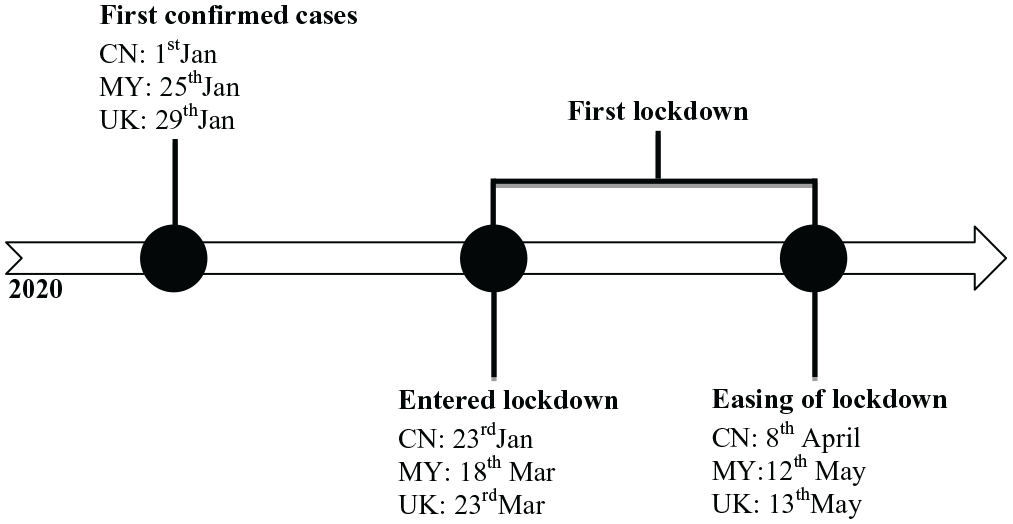
Timeline for the first period of lockdown in China (CN), Malaysia (MY) and the UK.
It is also important to acknowledge that the three countries were selected because the research team – at the time of data collection – all worked at the UK, China and Malaysia campuses of one university. Situating our research within these three national contexts thus facilitated researcher understanding of, and familiarity with, the respective lockdown conditions given that we live, work and consume in the cultural contexts under study. That is not to say, however, that the data collection was limited to the cites in which we ourselves spent lockdown, but indeed spread much further afield within the countries in which we were based. A brief overview of the three contexts is presented below:
China (CN): While COVID-19 was first detected in the Huanan Seafood Wholesale Market (World Health Organisation [WHO], 2020), 30 provinces had activated a first-level public health emergency response mechanism by 26 January following Wuhan’s (epicentre) lockdown on 23 January (Zhang et al., 2020). The Chinese government tightened national borders to contain the epidemic and implemented travel restrictions and isolation strategies, including the extension of the Spring Festival holiday and closure of schools (British Foreign Policy Group (BFPG), 2020). On 30 January, the World Health Organisation (WHO) declared a global health emergency in light of thousands of new cases in China (BFPG, 2020). Although ‘stringent lockdowns remain[ed] in place across other areas of China’, lockdown was lifted in Wuhan on 8 April following a reported 81,740 cases (BBC, 2020). By 18 April, China reported 3,869 deaths (BFPG, 2020).
Malaysia (MY): The first case in Malaysia was detected on 25 January 2020 and by 31 March, 2,766 positive cases had been reported (Shah et al., 2020). The first major lockdown (Movement Control Order) was implemented between 18 March and 12 May, during which − with the exception of access to supermarkets and sundry shops for essential goods − houses of worship, businesses and educational institutions were closed to ensure a ‘complete restriction of movement and assembly nationwide, including religious activities, sports, social and cultural events’ (New Straits Times, 2020). Towards the very end of the first lockdown on 11 May, Ministry of Health Malaysia reported a total of 6,726 cases and 109 deaths (Reuters, 2020).
United Kingdom (UK): The first two positive cases were reported on 29 January 2020 (BFPG, 2020). On 12 March, the UK Chief Medical Officers shifted from a ‘contain’ phase to a ‘delay’ phase, leading to the Prime Minister informing schools, hospitality, gyms and cinemas to close on 20 March (The Health Foundation, 2020). The UK entered full lockdown on 23 March, with individuals only permitted to leave home for basic necessities, one form of daily exercise, medical purposes, travel to and from work if homeworking was not viable, and to care for the vulnerable (The Health Foundation, 2020). The first UK lockdown was eased in four stages, the first of which was on 13 May at a time of 220,437 total cases (Gov.uk, 2023a) and 46,649 recorded deaths (Gov.uk, 2023b).
Data Collection and Analysis
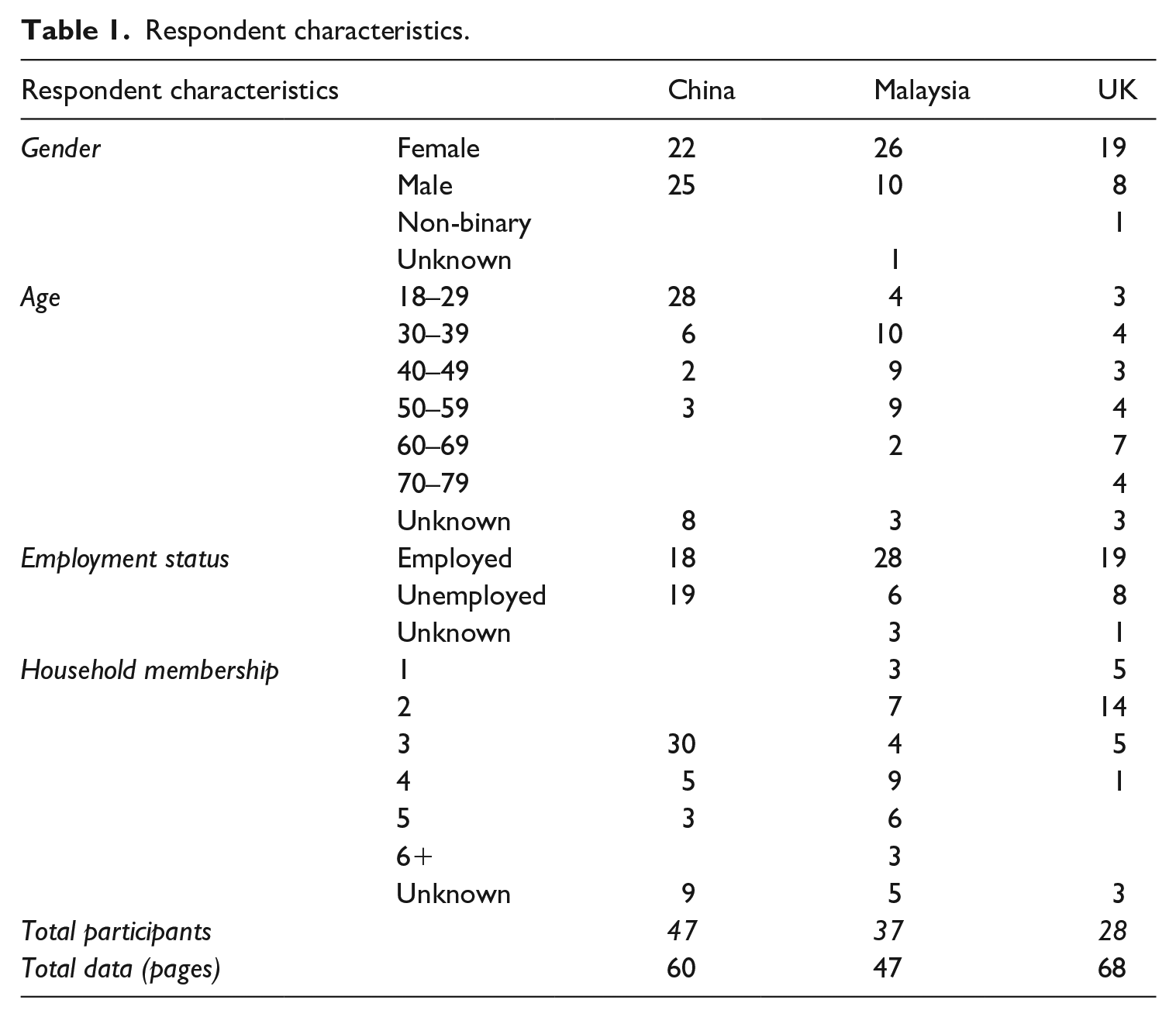
We used personal networks and academic mailing lists to reach potential participants in each country. In total, 112 reflective diaries were emailed to the research team, with respondent characteristics presented in Table 1. Amid such time of anxiety and social disruption, it was important to the research team that the recording of data was not considered stress-inducing or burdensome for participants. While writing about one’s experiences in diary form can be seen as cathartic (Pennebaker, 2000) it can also be emotional and time-consuming. To this end, participants were given agency over: (1) length of reflection, with 1 x A4 document being suggested as a minimum; and (2) content of reflection, with the research team providing prompts for inclusion for any participant who preferred more structured guidance (e.g. types of consumption; highs and lows of consuming in lockdown; comparisons between past and present consumption).
Respondent characteristics.
Submitted diaries were translated into English (where necessary) then a two-stage approach to coding and analysis was performed (Braun and Clarke, 2022). First, we put the diarists’ terms at the centre of our analysis (Gioia et al., 2013), with each author reviewing the data independently before collectively agreeing common themes. This initial stage of analysis revealed a corpus of narratives that (though we did not yet know how) seemed to connect personal identities, behaviours and choices with perceived anxieties. Our approach to coding was more theoretically sensitive in the second stage (Glaser, 1978), bridging concepts of coping and resilience with the material (objects) socio-relational (others) and symbolic (self) dimensions of consumption. We used the objects–others–self triad to perform a researcher-centric analysis, moving iteratively between data and theory via a process of abduction (Dubois and Gadde, 2002). It is within this abductive process that we theorise consumer resilience as a reflexive, emotive and transformative coping response of social subjects to situations of heightened anxieties.
Findings
In this section we first present the anxieties consumers experienced during the initial lockdowns when access to vital material, social and symbolic resources was restricted in both market and non-market domains. Second, we illuminate how these anxieties were accompanied by and addressed via specific coping response strategies that sought to creatively and positively reconfigure such restrictions. Third, we argue that reflexive, emotive and transformative narratives emerged at the anxiety–coping interface through which social subjects developed ostensibly resilient positionalities in response to restrictions. We do not artificially separate the triadic elements (i.e. objects–others–self) into particular coping strategies or distinct narratives of resilience (they often appear in parallel), emphasising, rather, how they are purposively mobilised in constructions of consumer resilience.
Anxious Consumers
Health, Safety and Wellbeing
Anxiety around health, safety and wellbeing was visible in relation to each component of the objects–others–self triad. Respondents across countries wrote how confinement within one’s home impacted the self, with frequent mention of personal ‘stress’, ‘panic’ and ‘depression’. The extract below provides a vivid example of the extent to which mental health and wellbeing was impacted: Quote 1 (UK_28): Lockdown killed me in many ways [. . .]. I still did my normal work [. . .] BUT on various online platforms and formats. These terribly ate up my time and I was also quite stressed and panic[ked]. My 24 hours went so fast but I did not feel satisfied with my productivity. I fel[t] that I was locked in a cave to finish all the deadlines.
Many individuals also reported anxiety around how their confinement prevented or problematised the consumption of material objects via the marketplace. Lack of access to food in the UK was particularly worrying for vulnerable consumers whose health required them to ‘shield’ (Gov.uk, 2020). Quote 2 illustrates a respondent’s distress about (in)access to home-delivery given that neither he nor his wife could leave the house: Quote 2 (UK_6): An initial low was an inability to secure delivery slots on any supermarket websites, despite both being identified as in high risk category of extremely vulnerable from the virus. That initial inability to access delivery created some anxiety as we were/are both shielding in the lockdown.
In this vein, respondents regularly referred to the wellbeing of others, notably anxiety for – but also anxieties of – family and friends. A respondent in China reflected on how familial anxiety was not only temporal, in that it intensified over time, but was also exacerbated by macro (‘news’) and micro (‘living quality’) influences: Quote 3 (CN_47): During the quarantine time at home, I was happy to store a lot of necessities at first, especially when my relatives and friends noticed that they could not go out to buy those. This situation lasted about a week until my family started to complain that we did not have fresh food supply, which gradually made our family anxious. The feeling of anxiety was also from the negative emotions generated by watching the news and the influence and negative impact of our living quality.
Beyond such wellbeing anxieties for those within inner circles, respondents also referred to the health and safety of society at large. This was often but not always done in a pejorative way, with consumers spotlighting the (un)hygienic or (un)desirable actions and behaviours of others. One respondent in Malaysia wrote: Quote 4 (MY_30): Ordering food online wasn’t the safest option because you don’t know about the handling of food, whether the rider is practicing proper hygiene and the list goes on.
While the expression of consumer anxiety was commonly directed at relations with others, it is important to highlight how anxiety accounts frequently – albeit to varying degrees – drew on two or more concepts of the objects–others–self triad. This is perfectly encapsulated in the above extract, whereby health and safety concerns (for the self) arose from ordering food (objects) under conditions wherein the practices of the rider (other) were presumed potentially hazardous.
Social Alienation
A second contextual source of anxiety centred on social alienation, a theme that again cut across the objects–others–self triad, but primarily between other and self. We note at this point that the two over-arching strands of anxiety were not always mutually exclusive, but frequently intertwined, with the effects of social alienation impacting respondent wellbeing, and vice versa. This mirrors Bruce and Banister’s (2020) work, which found that army wives reported decreased wellbeing and heightened anxiety when socially isolated from wider friendship groups. A diary from China reads: Quote 5 (CN_45): As a social creature/person, almost zero social activities with classmates and friends made me depressed.
It is further noted that the extent or degree of anxiety around social alienation varied between respondents and across national contexts. Drawing on Table 1, it is apparent that close to half of the participants based in Malaysia lived in households of four or more (48%) comparative to those in the UK (22%) and China (17%), thus by default engaged with more people in person. For example, one respondent in Malaysia ‘felt that during the MCO [Movement Control Order], it was a great time to spend with [their] family. [. . . As they couldn’t] help but see each other’s face almost all the time’ (MY_24). Overall, however, most respondents reported anxiety around lack of connectivity to others (Quote 6) while some even struggled with perceived alienation of the self through comparison with the other (Quote 7): Quote 6 (UK_11): I am a great hugger and I miss the contact with loved ones. Missing the social groups that I belong to: Knit and Natter and Family History. Although these can be done alone at home they are much more fun with others. Quote 7 (UK_16): It has been good to tick off jobs which have not been done prior to lockdown but at times there has been an element of pressure to get these done within this lockdown time from seeing others doing so on social media and hearing about projects that friends and families have completed.
Although Wiederhold (2020) posits that social media can alleviate anxiety during a pandemic – in that it entertains, informs and connects – we can see through Quote 7 that information on others’ achievements had the capacity to intensify a further sense of disconnect.
Coping Response Strategies
Consumer Purification
Consumer purification accounts conveyed deliberate attempts to enhance (i.e. clean, protect, improve the worth of) the self through or via objects for the purposes of good health, safety and wellbeing. On the one hand, consumers fortified their external self, with individuals across the three countries writing of their active ‘pre-shopping precautions, precautions during shopping, and the sanitising of purchases before bringing into the house’ (MY_36). The primary focus here was on hygiene and disinfection, not only to cleanse oneself while out of the home but further ensure safety within the home, upon return. There was a collective sense of combative ‘fight’ against the virus, with the military tropes in Quote 8 epitomising the extent of consumers’ rigorous endeavours to sanitise objects and protect the self. On the other hand, consumers talked about how they fortified their internal self, as exemplified in Quote 9, through the objects they consumed. Commonly, this eventualised as a form of ‘immuno-biological’ coping, with consumers increasing their purchase of vitamins and supplements: Quote 8 (CN_42): When I went out, I was fully armed (raincoat, gloves, masks, and glasses). After the goods are bought home, they were first fully disinfected, and then cleaned up. Quote 9 (MY_26): There was an increased focus of building up a strong immune system in the face of the pandemic and I was more conscious about my water and vitamins intake (but conveniently forget about sleep quality because having been confined at home for eternity, I cannot differentiate the hours anymore).
In Malaysia, internal self-purification was also a religious act – with consumers purifying themselves, and by extension their homes, again through the objects they consumed (‘We prayed a lot. We ordered lots of fragrant oils and diffused them to make the home happy and godly’ [MY_32]). More broadly, however, internal self-purification manifested across the three countries through an investment of time and effort in, and attention to, oneself. For some, this care of the self was (as above) a means of reducing anxiety. Yet, for others, the lockdowns brought a slower pace of life – and/or freed time – to engage in increased self-care (Quote 10). Multiple respondents reported substantial transformative (physical) effects through this process, such as weight loss (Quote 11): Quote 10 (MY_18): Before COVID19, I don’t really pamper myself because of too much time being involved. I was always travelling [. . .]. Now I am able to be quiet and calm and less impatient. I take more time to pamper myself. Do facials and body oil daily and take my time to shower and relax. I indulged in better quality facial, body and hair products. Quote 11 (UK_26): One aspect of my consumption that has changed significantly and which I am very happy with relates to my consumption of food. [. . .] For the first time in my life, I started paying attention to the calories in the food I was eating and stopped eating certain foods, such as bread and pasta. [. . .] I have lost almost three stone during lockdown as a result and feel much better about being more conscious when I am eating.
It is somewhat of a paradox therefore that – amid a global health crisis – some individuals found that lockdown facilitated space, not only for self-purification and insulative cleansing, but for transformation and self-improvement.
Consumer Policing
A second coping response strategy, consumer policing, transpired more manifestly in relation to the consumption of objects through material disciplining. On a practical level, consumer policing ensured minimal waste of necessity goods (e.g. food) at a time when access to the market (supplies) was limited; while, on an economic level, reduced interaction with the market (consumer spending) benefited personal and familial budgets. This was essential for many at a time of increasing unemployment and financial uncertainty: Quote 12 (CN_12): COVID has had a big impact in our everyday living; most people got unemployed and I am one of them. Every morning, I wake up with the thought in my mind what am I gonna eat today? What should I prepare? Is it healthy? I discipline myself to keep on budget like for breakfast I just ate biscuits and milk and for lunch an egg and rice same with my dinner. I seldom ate fruits.
Some individuals used the constraining aspects of the pandemic as a means of moralising their consumption. Research on #BuyNothingDay has evidenced how consumer restraint is motivated by factors such as personal welfare, wastefulness, environmental concerns, ethics and anti-capitalism (Paschen et al., 2020). In our research, a ‘counter-consumerist trend’ of alternative hedonism similarly emerged, with a few diarists actively (and sometimes pleasurably) moderating object use and in turn reducing their reliance on the market (Soper, 2008). For instance: Quote 13 (UK_5): I have developed a simpler outlook on life and I hope that sticks. I have a concept of having enough and that’s OK – enough food, enough clothes, enough relaxation time. I have been buying food in the village shop and local small supermarket and I’ve been happy (initially overjoyed) when they have what I need. On my first trip to a big supermarket last week I was overwhelmed by the unnecessary excess of goods and choice. I don’t want to go back to being caught up in the sense of things having to be perfect or excessive.
This example shows how consumers reflected on their current, more modest consumption relative to their past ‘overconsumption’ while concurrently projecting the effects of the pandemic on future consumption. In the case of Quote 13 in particular, a clear reimagining of one’s relationship with objects transpires, inspiring a newfound ‘moral complexion’ wherein a ‘high level of consumption [is deemed] morally objectionable’ (Borgmann, 2000: 418) in their imagined future.
Consumer Sociality
Consumer sociality pertains to new forms of relations with others, mediated by and taking place through the self and objects in response to the social alienation engendered by lockdown. From a practical perspective, consumer sociality was a resource for participating in traditional consumption practices in novel ways, as required by conditions of isolation. At the individual level, a prime example was the ‘lockdown haircut’, with respondents reporting their reliance on their non-market nexus (e.g. themselves or family) to perform – to varying degrees of perceived success – a service usually performed in the market domain: Quote 14 (UK_2): My husband cut my hair with clippers as the hair salons were closed – a bit of disaster as it was cut VERY short but lasted until the salons opened again on 4 July.
At the collective level, respondents participated in community-orientated practices – albeit, again paradoxically, as individuals – as a means of overcoming the barriers of social isolation when accessing goods (e.g. ‘community shopping’ [CN_4]) and services (e.g. religious services and ceremonies). One diarist in Malaysia writes about the challenge of alienation for the elderly, emphasising how through the power of technology and a facilitator, their mother was able to maintain her usual customs through alternative means: Quote 15 (MY_16): It was amazing to be able to tune in to Live online Mass – celebrated by Pope Francis in Vatican City, priests in the United States, Singapore, Penang etc. My elderly mother who is a daily mass (church) goer, was able to adapt and access these online mass celebrations.
To this end, the consumption of technology played a central role in facilitating consumer sociality, in that it was a conduit for (re)uniting both public networks (as above) and private networks (as below): Quote 16 (UK_1): I have also hosted a bi-weekly friends quiz with our four closest friends and a weekly drinks get together with two of our closest friends on Facetime and then occasional afternoon teas with one set of friends on WhatsApp and other video chats with friends we see less often. We have had a regular social life on-line which has been fabulous.
This evidences that – while physically separated – many individuals were still able to socialise with one another to some degree albeit in a different form. This extends O’Sullivan and Richardson’s (2020) findings that consumption communities (e.g. knitting groups) – and the social support that they facilitate – are integral in coping with loneliness. We observe how consumer sociality, as a coping response, fosters a strong sense of togetherness when in fact people were spatially and physically apart.
Consumer Resilience
Our research finds that consumer resilience is structured around the objects–others–self triad and emerges at the anxiety–coping intersection. In this section we show that it is the reflexive, emotive and transformative narratives that consumers deploy when recounting their anxieties and coping response strategies that are ultimately productive of consumer resilience (captured in Figure 2).
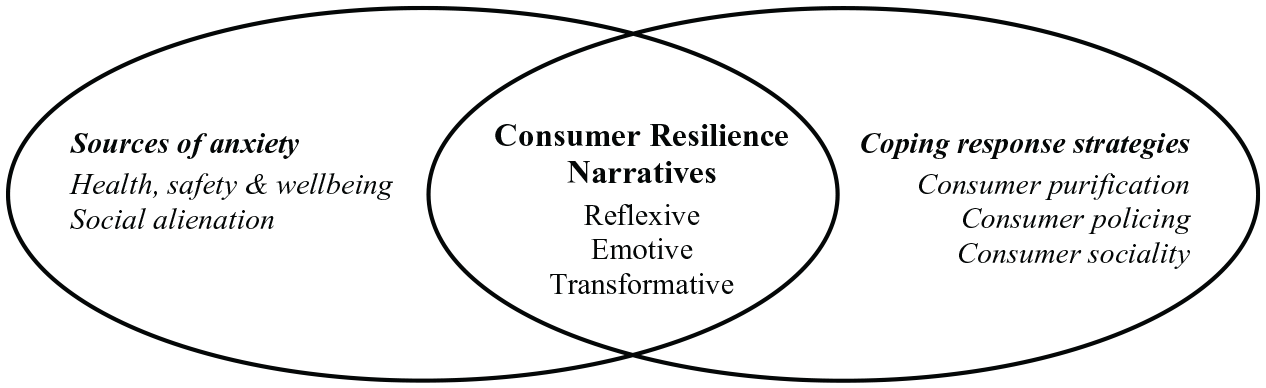
Consumer resilience narratives at the anxiety–coping interface.
Reflexive narratives are those in which respondents are contemplative of their position as a social subject (i.e. consumer/individual) in relation to their context (i.e. market/pandemic) (e.g. Duhachek, 2005). Consumers consciously reflect on their current condition, either by focusing solely on present consumption (e.g. Quote 8, ‘when I went out, I was fully armed [raincoat, gloves, masks, and glasses]’) or by comparing present to past consumption; for example, Quote 9, the participant reflected on their ‘increased focus of building up a strong immune system in the face of the pandemic’ relative to pre-pandemic.
Emotive narratives are those in which consumers convey or refer to a particular feeling or affective state. These emotions are often dynamic and temporal, with Quote 3, for example, conveying how a consumer was initially ‘happy’ to store necessities before this later morphed into a ‘feeling of anxiety’ when fresh food supplies could not be ensured. We posit that the expressing of negative emotions helped consumers resiliently navigate feelings pertaining to social disorder, while positive emotions enabled participants to imbue a degree of resolution within the(ir) (re)constructed social order.
Transformative narratives encapsulate the ways in which consumers, either subtly or radically, adapt or change themselves and/or their situation within the restrictions imposed. We can see how such transformative accounts transpired around a host of areas such as health, physical appearance, outlook, relationships and consumption patterns. A prime example is that evidenced in Quote 11, whereby the respondent’s avoidance of certain foods led to consumer purification, ending in a three-stone weight loss.
We acknowledge that while delineated as distinct, these narratives often (but not always) emerge as interrelated. It is common for reflexive narratives to simultaneously induce emotion; as seen in Quote 1, wherein the participant’s reflection (‘lockdown killed me in many ways’) led to them recounting associated feelings of being ‘quite stressed and panic[ked]’, and Quote 2, wherein the reflection on ‘initial low’ caused ‘some anxiety’. Equally, there were instances where all three narratives were at play, as seen in the policing strategy of Quote 13, which evidences reflexive narratives (‘I have developed a simpler outlook on life [. . .] I have a concept of having enough’), emotive narratives (‘I have been buying food in the village [. . .] and I’ve been happy’) and transformative narratives (‘I don’t want to go back’).
We find that while consumers can assimilate and deploy these three narratives according to their own circumstances and aims, all diary entries across the three countries contained elements of reflection, emotion and transformation in some measure. This leads us to conclude that the material (restrictions to objects), socio-relational (restrictions to others) and symbolic deprivations (restrictions for self) resulting from lockdown triggered broadly similar responses of resilience at the anxiety–coping interface, irrespective of national context.
Discussion
The COVID-19 lockdowns dramatically altered the context of consumption and the subsequent relationship(s) of consumers with objects–others–self. Individuals experienced (non-)market restrictions that contributed to two strands of anxiety (health, safety and wellbeing and social alienation) and triggered three main coping response strategies (consumer purification, consumer policing and consumer sociality). As anxiety and coping responses converged around material goods, social relations and symbolic identities, consumers found expression through a number of reflexive, emotive and transformative narratives that – while distinct in terms of their individual consequences – combined or intersected to facilitate the production of novel social subject positionalities that were ostensibly more resilient.
The concept of resilience, although popular in other disciplines, remains relatively underexplored in the sociology of consumption (Milaković, 2021). Indeed, the study of consumer coping has leaned towards individualistic psychological strategies for ameliorating stressful or traumatic personal events, while wellbeing/anxiety debates have sought to unlock the antecedents that promote more positive states (Taheri et al., 2021). However, through the unique context of our study – a global pandemic – our article offers greater insight into the relational view of resilience by advancing issues of temporality and agency.
In terms of temporality, coping, for example, is often thought to be very time-bound and episodic, with individuals or consumption communities deploying ‘coping strategies within a single stress episode’ (Duhachek, 2005: 41). Yet the macro-collective nature of COVID-19 is rather less time-bound, and our findings reinforce an emerging view of consumer resilience as an ongoing response to persistent ‘fear and anxiety’ (Milaković, 2021: 260). While arguably no-one wants to have to ‘cope’ indefinitely, our findings support the idea that consumer resilience may be a more capacious way of (or term for) comprehending consumer experiences in temporally enduring contexts. Contexts that are emerging for such studies – for example, ‘climate change anxiety’ (Berry et al., 2010) – may render consumer resilience as an appropriate lens for collectively shared conditions precipitated by ongoing crises that have an impact upon public health, security and wellbeing for an indeterminable time.
In terms of agency, our findings chime with emerging views of consumer resilience as an empowered and optimistic disposition where social subjects achieve ‘positive adaption’ of their situation (Milaković, 2021: 260). We extend this valuable research by fleshing out how such adaptations are narratively produced by consumers themselves, creatively reconfiguring the material, social and symbolic dynamics of unsettling anxieties to more affirmative positions. Moreover, while prior research has connected notions of wellbeing, anxiety and happiness to singular resources (e.g. Belk’s Loved Objects), our more capacious conception of consumer resilience (as material, social-relational and symbolic), provides a multi-dimensional and dynamic bridge between people’s personal fears and their strategic responses to complex and shifting sets of public concerns.
In terms of consumer anxiety, our study further broadens the potential scope of subjects who might be considered vulnerable, at risk or existing in precarious circumstances. Sociological studies have tended to focus on marginalised consumers who lack cognitive, social and economic resources in coping with adversity (Bhattacharyya and Belk, 2019). Yet our study extends the parameters of whom we might consider vulnerable, noting that socio-economic factors change the circumstances and intensity of vulnerability. By focusing on a range of more or less affluent consumers across global regions, our research finds a plethora of different top–down triggers underlying consumer resilience; for example (un)availability of material goods and services, restricted spatial movement and connection with people, and so on. We are not saying that consumer resilience is only to be studied where affluent, multi-cultural groups collectively experience shared adversity or crises, but that this could be a hitherto unexplored arena that might complement more issue- or group-specific agents.
Conclusion
COVID-19 provided a unique global context to observe and explore consumer resilience across national settings. Given the socio-cultural and geo-political differences between the UK, China and Malaysia, some variation in consumer experiences was to be expected. Respondents in Malaysia lived in larger households (decreasing feelings of isolation) and reported a greater propensity to draw on religious elements compared with respondents in the UK and China. However, what remained consistent across all three national settings is the reflexive, emotive and transformative narratives that were (re)produced at the anxiety–coping interface, and which were productive of consumer resilience. In future research, it would be interesting to see if, and to what degree, this plays out in other comparative studies (whatever the basis of comparison), or indeed if consumer resilience varies across different kinds of crisis (financial, political, health, climate, etc.).
Rather than decoupling emotional states (anxiety, fear) from cognitive mechanisms (coping) – as is commonly the case in psychological coping (Duhachek, 2005) or wellbeing research (Zarantonello et al., 2021) – our sociological approach has facilitated a discussion on how the two interact and are mutually constitutive of consumer resilience. We invite further sociological research into how consumers construct, and to what ends, the inter-relational strategies between anxiety and coping in this way; especially given our support for the idea that consumer resilience both subjectifies and contextualises consumer experiences while providing powerful insights into the production of social order in times of temporally enduring social disorder. Here, we recommend the use of diaries in research contexts where studying traumatised or anxious social subjects may bear fruit in ways that traditional survey-style or one-to-one style interviews may not.
That said we do not discount the adoption of other qualitative approaches, not least to ‘triangulate’ emerging insights but further to more holistically comprehend how social subjects reconfigure their personal experiences of anxiety within emerging and intensifying public discourse around global crises. Offering the example of the climate crisis, Berry et al. (2010: 123) note: ‘Different aspects of climate change may affect mental health through direct and indirect pathways, leading to serious mental health problems, possibly including increased suicide mortality.’ Future research into the relationship between global crises and public health and security outcomes (both positive and negative) may usefully explore the nature and trajectory of consumer resilience narratives. Not only would this facilitate a better understanding of the resilience pathways and positionalities that people forge, but it would serve to pinpoint areas of (non-)market intervention for subjects who are navigating crisis-based restrictions and uncertainties.
Footnotes
Authors’ Note
Authorship of this article has been listed alphabetically following the corresponding author, who was project lead.
Funding
The authors received no financial support for the research, authorship and/or publication of this article.
