




Abstract
Sociological studies of sustainable transformation have highlighted the relevance of ‘unequal’ and ‘uneven’ transformation dynamics. We argue that a practice-based approach provides far more insight into such unequal dynamics than currently recognized. We re-interpret the political concepts of agonism, antagonism and historic bloc that Gramsci used to analyse domination in order to theorize practice constellations and dynamics that are responsible for the perpetuation of unsustainable practices and the suppression of sustainable ones. Based on empirical findings, we also expand his vocabulary by introducing the concept of synergy. Using the example of urban cycling in Las Palmas de Gran Canaria, we propose a Gramscian-inspired account of power and domination in practices as a way of understanding inequality in transformation efforts.
Introduction
Developing on the background of Wittgenstein’s and Heidegger’s reflections on the priority of practice over cognition, practice theories (e.g. Reckwitz, 2002; Schatzki, 2002; Shove et al., 2012) have of late established themselves as an ontological alternative to such sociological mainstays as individualism, structuralism, interactionism, systems theory, critical realism and actor-network theory. Such theories share the thesis that practices, and not individuals, structures and so on, centrally compose social phenomena. Such theories also offer a rich tradition of sustainability analyses, and numerous calls exist for using them to advance sustainable transformation and consumption (Foden et al., 2022; Hui et al., 2017; Mylan and Southerton, 2017; Nicolini, 2012; Ozaki and Shaw, 2014; Røpke, 2009; Shove, 2010; Shove and Spurling, 2013; Shove and Walker, 2010; Shove et al., 2012; Spargaaren, 2011; Strengers and Maller, 2015; Twine, 2017; Walker, 2013, 2015; Watson, 2012; Welch and Warde, 2015; Welch and Yates, 2018). Meanwhile, social inequality and injustice (‘unevenness’; Grandin and Haarstad, 2020: 292) have been identified as neglected aspects of sustainable transformation and a potential barrier to the successful implementation of interventions (Patterson et al., 2017). Researchers argue that grasping such unevenness requires closer attention to the ‘messy power dynamics’ (Scoones et.al., 2020: 68) that underlie sustainable transformation (Meadowcroft, 2011; Patterson et al., 2017; Scoones, 2016).
We argue that practice ontologies can provide propitious analyses of the uneven dynamics that underlie sustainable transformation. Affirming everyday practices as political because they ‘involve the production and distribution of power’ (Creswell, 2010: 21; cf. Schmid and Smith, 2021), we argue that sociological practice theories have not yet fully conceptualized the politics of relations between practices, for example, how unsustainable practices achieve and sustain dominance over more sustainable ones. By providing such a conceptualization, our practice-based analysis investigates struggles between everyday practices and contributes to conceptualizing ‘what characterizes those practices which have influence over the performance of other practices’ (Watson, 2017: 174).
To show how a practice ontology can help illuminate unevenness and conceptualize domination, we use the example of policy-incentivized urban cycling in Las Palmas, Spain. Despite local policy roll-outs intended to support urban cycling, it remains marginalized vis-a-vis a dominant automobility. We argue that resource competition among practices connected to cycling restricts the resources available for cycling (e.g. access to space, materiality, official support and acknowledgement). Further, we observe that this restriction facilitates the dominance of car driving. We thus offer a complex picture of everyday political dynamics based on the idea afoot in practice theory that the history and fate of individual practices rests on the nexi of practices within which they are located (e.g. Blue et al., 2016). Theoretically, we draw on Schatzki’s (2012) practice ontology to envision the possibility of practices and constellations thereof dominating other practices and constellations. We also draw on a practice ontological re-interpretation of Gramsci’s account of power and domination – in particular, his concepts of historic bloc, antagonism and agonism – to theorize the practice dynamics that result in states of domination. Our account corroborates that practice thinking can address both the scalar relations and ‘larger-scale phenomena’ (Nicolini, 2017; Schatzki, 2016a, 2016b, 2019; Shove, 2022) that are involved in sustainable transformation. We thus contest arguments that have condemned practice theory as incapable of addressing power more broadly (Hargreaves et al., 2013) while helping conceptualize the currently missing politics of practices (Evans, 2011; Scheurenbrand et al., 2018; Walker, 2013). Our particular research questions are: how does a practice-theoretical re-interpretation of Gramsci’s account of power and domination help us understand relations between practices? How in particular does it help explain the dynamics through which unsustainable practices continue to dominate more sustainable ones?
We begin by locating our study within current debates about the missing theorization of multi-scalar dynamics in practices. We then introduce Schatzki’s account of practices and constellations thereof as a starting point for a practice-based re-interpretation of Gramsci’s notion of domination. Section three shows how his concepts of agonism, antagonism and the historic bloc can be used to analyse urban cycling in Las Palmas, in particular, the uneven practice dynamics that keep the practice subordinate. We discuss these dynamics in section four. Concluding, we suggest that a practice ontology is well equipped to address domination if power is conceptualized as an effect of the political interplay of everyday practices (cf. Watson, 2017).
The Political Character of Practice Dynamics
Practice scholars agree that practices rely on tangible and intangible resources such as stuff, skills and sense (Reckwitz, 2002; Schatzki, 2019; Shove et al., 2012). While scholars have identified resource struggles resulting from uneven distributions of resources among practices (Hargreaves, 2011; Mylan and Southerton, 2017; Shove and Pantzar, 2007), only a few papers explicitly frame these struggles as political and show how constellations can uncover inequalities (see Denegri-Knott et al., 2018; Dünckmann and Fladvad, 2016; Evans, 2011; Sayer, 2013; Walker, 2013, 2015). For example, studies that address practice politics in the context of urban mobility (Beveridge and Koch, 2018; Creswell, 2010; Yates, 2015), argue that practices articulate ‘unequal struggles constitutive of the urban terrain itself’ (Beveridge and Koch, 2018: 145). These struggles encompass competition among mobility practices for possibilities, capabilities and forms of movement. Creswell (2010: 21) sees mobility itself as an unequally allocated resource, stating ‘one person’s speed is another person’s slowness . . . [forms of movement] are all related in ways that are thoroughly infused with power and its distribution’. Taken together, these studies emphasize the usefulness of practices for understanding the unequal, messy and asymmetrical power dynamics involved in creating access to the resources and capacities necessary to achieve sustainable development. This literature has established an alternative understanding of transformational politics as decentralized and negotiated in the everyday practical mundane (Evans, 2011; Hargreaves, 2011; Shove et al., 2012). However, these studies say less about when and how practices distribute power and what happens when practices challenge the status quo.
The considerable shortage of studies about how practices distribute power might be reflected in a current critique of practice theory. As a ‘flat’ ontology, practice theory has been interpreted as incapable of addressing the vertically arranged levels that inhibit sustainable change (Crivits and Paredis, 2013; Hargreaves et al., 2013). This critique opposes the idea of theorizing social phenomena, large or small, as transpiring through the same one practice-tissue (Nicolini, 2017). It thereby overlooks the possibility of theorizing the dynamics of social life through processes and mechanisms (Mylan and Southerton, 2017) that play out in the flat plenum via relations among practices. In this view, only by theorizing social dynamics through relations among hierarchically arranged practices and regimes can power and domination in social life be understood.
In this article, we show that processes and mechanisms that play out in the flat practice plenum bring about states of domination and subordination (i.e. hierarchies) among practices and practice constellations. It is through processes that happen to practices and relations among them that certain practices and constellations are rendered dominant and powerful and others subordinate and of lesser power. Such matters help determine the fate of sustainable and unsustainable practices. As indicated, moreover, we also show that Gramsci’s ‘historic bloc’, when understood in terms of practices, holds insights for conceptualizing the processes and relations through which the domination and subordination of practices comes about and is solidified.
Domination in Practice Relations
Understanding domination and subordination among practices as a matter of resource struggles treats these dynamics as transpiring within the practice plenum understood as the ‘total nexus of practices and material arrangements’ (Schatzki, 2019: 39). We build on Schatzki’s (1996: 77, emphasis in original) conception of practices as open organized sets of activities that ‘are organized through (1) practical understandings, (2) rules, (3) teleoaffective structures (normativized ends, purposes, beliefs and emotions) and (4) general understandings’. The activities that compose practices, moreover, are carried out via the performance of bodily activities. Bike riding, for example is carried out by such bodily actions as peddling, looking ahead, holding and turning the handlebars, and so on. In turn, actions such as bike riding are elements in wider activities or projects, which a person carries out partly through the performance of these actions; bike riding, for example, might be a way of getting exercise. Bike riding also joins with other actions such as parking, locking, giving hand signs on the street and manoeuvring in traffic to form the practice of urban cycling. This composition is open-ended: practice bundles grow indefinitely through the commission and omission of activities.
Practices, moreover, relate and form larger bundles, which themselves can join to form even larger constellations. Practices form bundles and constellations through many kinds of relations (see Schatzki, 2019). Prominent examples include chains of action that connect them, material links between the material arrangements among which they transpire, and shared governing understandings, rules or teleoaffectivities (e.g. ends). Through such relations, practices and bundles thereof can become dependent on one another as when ‘one practice [is] a resource in the accomplishment of other practices . . . [and] part of a larger configuration’ (Nicolini, 2012: 228) or when the carrying on of one practice is necessary for carrying on other practices, as cycling and driving are for practices of working, caring for elderly relatives and mothering. Through such relations, practices and bundles can coevolve, undermine one another, obstruct or foster one another’s development. Within such constellations, practices also become competitors for the resources needed for survival or spread. It is through relations such as these that urban cycling is part of larger constellations that embrace varied urban mobility practices. This understanding of composition and size underlies our argument that flat ontologies of a practice sort are well suited to accommodate domination and power.
A Practice-Based Reading of Gramsci: Dominance as Relational Effect
To the best of our knowledge, Gramsci’s conception of domination (Gramsci, 1971, 1977) has not yet been put to use in practice-based studies. Although the account has been critiqued for being overly structuralist, binary and stagnant (Rose, 2002), we believe, as do others (Laclau and Mouffe, 2001; Loftus, 2015; Sevilla-Buitrago, 2016), that it can illuminate contemporary phenomena more deeply than currently acknowledged. Indeed, key post-Marxist thinkers (e.g. Laclau and Mouffe, 2001: ix) encourage re-reading Marxist theory – and versions of it – to produce fresh analyses of the ‘many social antagonisms . . . which are crucial to the understanding of contemporary societies’. The concepts Gramsci proposes to analyse power and domination in contexts of collective action and struggle – those of historic bloc, agonism and antagonism – can be reinterpreted in practice theoretical terms and used to analyse the dynamics of power and domination in practice nexi and constellations.
Gramsci (1971) characterizes domination as a form of consensual, relational power, resulting from social and material forces, which are relations that play out in, respectively, civil (cultural) or political social life (Gramsci, 1971). His idea of domination as relational effect is based on his interpretation of Machiavelli’s prince (Gramsci, 1971, 1977), whom he reads as a metaphor of the intrinsic force that emerges from the aggregation of individuals. Aggregated individuals form alliances as parties and collective entities, which either further align with each other to become dominant constellations or enter into struggle (Forgacs, 2000). The forces that form such alliances are called ‘agonist’. Gramsci also sees hegemony as balanced by the possibility of counterhegemony, that is, the possibility of a once subordinate entity, the ‘antagonist’, becoming dominant.
Gramsci emphasizes the importance of togetherness as a basic requirement for maintaining or becoming dominant and rejects locating power in single individuals (Mouffe, 1979) for two reasons. First, individuals alone are never as powerful as a collective entity, which benefits from ‘agonistic’ supportive relationships. Second, the party is not a standalone entity that possesses power on its own but is made up of several entities among which collective force is negotiated. This relational account of how power emerges from the mutual reinforcement of coalitioning forces and their opposition to opposing coalitions suggests a way to understand how power emerges from relations between practices and between bundles of practices. Just as the prince as powerhouse emerges from collectivity and union, the power of practice constellations results from connections between practice bundles that support each other in opposition to other practice constellations. In other words, understanding the mechanics of domination requires considering both the relations that hold together a dominant entity and those that it maintains with other entities in social life. As we shall show, this account, shorn of its collective agentic connotations, provides a way of relationally understanding power and domination that is useful to theories of practices, which agree that ‘power relations are effects of the ordering and the churn of innumerable moments of practices’ (Watson, 2017: 181) and thus located within the intersections and relations among practices (Hui et al., 2017; Schatzki, 2019; Shove et al., 2012).
A Practice-Based Reading of Gramsci: Understanding Practice Relations through the Historic Bloc
Gramsci offers a way of characterizing relations through his notion of historic bloc. A ‘historic bloc’ (Gramsci, 1971: 384) is the amalgamation of social and material forces through which domination (of a particular party) is maintained. Gramsci introduces the concept of a historic bloc as a basic condition for the existence of dominant entities. Dominant entities such as the bourgeoisie enjoy a resource-rich existence and material as well as socially established privilege. The coalitions that are opposed to dominant entities (e.g. the proletariat) are oppressed and characterized by an inadequate access to resources: they are not sustained by a historic bloc. In encompassing the interdependency of and reciprocal relations among cultural, political and material forces, the nexus-like composition of a historic bloc parallels that of a social phenomenon conceptualized as a constellation of practices and material arrangements.
Alliances within the historic bloc establish consent to a certain social order, a ‘common sense’ (Gramsci, 1971: 685). This common sense is, in practice vocabulary, both developed and expressed through the repeated performance of normatively acceptable or required actions. These effectively ‘lock’ (Newell et al., 2015: 537) practitioners into accepting the status quo, which is normatively accepted or required but not brutally coerced (Sanne, 2002). In the case we analyse below, these performances and patterns are unsustainable ones. While hegemony has often been proposed as a prerequisite for the maintenance of entrenched, long-lasting domination (e.g. Schulzke, 2015), the interesting point here is that dominance cannot be upheld by one entity alone. Instead, it is support from relationships built between allies and from opposition to other coalitioned forces that can make or break the domination of one entity over the other. Gramsci also holds that counterhegemony is an indispensable dynamic in political relationships. Counterhegemony is an oppressed entity trying to establish itself, in the process triggering antagonistic relationships with the hegemonic entity and its historic bloc. As in politics, dominance requires suppression and opposition. Bringing the argument back to sustainability: subordinate sustainable practices often oppose dominant unsustainable ones and struggle to assert themselves.
Using Gramsci’s account of coalitions, agonism and antagonism to look closer into ‘the ability of some practices to orchestrate and align others’ (Watson, 2017: 177), we can see an even more complex dynamics at play. Gramsci’s (1971) account of the historic bloc suggests that agonism and antagonism need to be supplemented by synergism. We use the term ‘synergism’ to describe practice dynamics that do not fall into the binary categories of agonist or antagonist. A synergy exists when side effects are channelled to support a dominant coalition, which might not retain its dominance without this support (Gramsci describes supportive side effects resulting from material and social forces but does not provide a label for them). We do not deny, incidentally, that side effects can work against dominant coalitions. We give a name to cases in which they support such coalitions simply because our example is one in which a dominant coalition persists; we do not aim here to give a full account of the dynamics of all existing nexused practices.
Urban Cycling as Political Entity
Urban cycling as a statistically underperformed practice has been framed as a form of niche resistance to dominant forms of urban mobility (Horton, 2006; Horton et al., 2007; Spinney, 2009, 2010; Watson, 2012, 2013). While abundant literature agrees that urban spaces are dominated by automobility (Featherstone et al., 2005; Furness, 2007, 2010; Sheller and Urry, 2000; Urry, 2000, 2004, 2007), few studies juxtapose urban cycling and car driving by explicitly analysing the taken-for-granted marginalized position of the former (Fincham, 2006; Latham and Wood, 2015). These studies show that resources are unevenly allocated among transportation practices but have not further conceptualized the allocation mechanism. We argue that acknowledging cycling as a marginalized practice that is deprived of spatial resources and held in subordination requires politicizing the relationship between cycling and car driving. We thus oppose the taken-for-granted celebration of urban cycling as empowered ‘resistance’ to car driving.
Methodology
This article is part of a larger research project exploring the marginalized practice of urban cycling in a car-dominated location in Spain (Las Palmas de Gran Canaria). To make the city ‘greener’, cycling has been proposed by policymakers as a solution to heavy traffic.
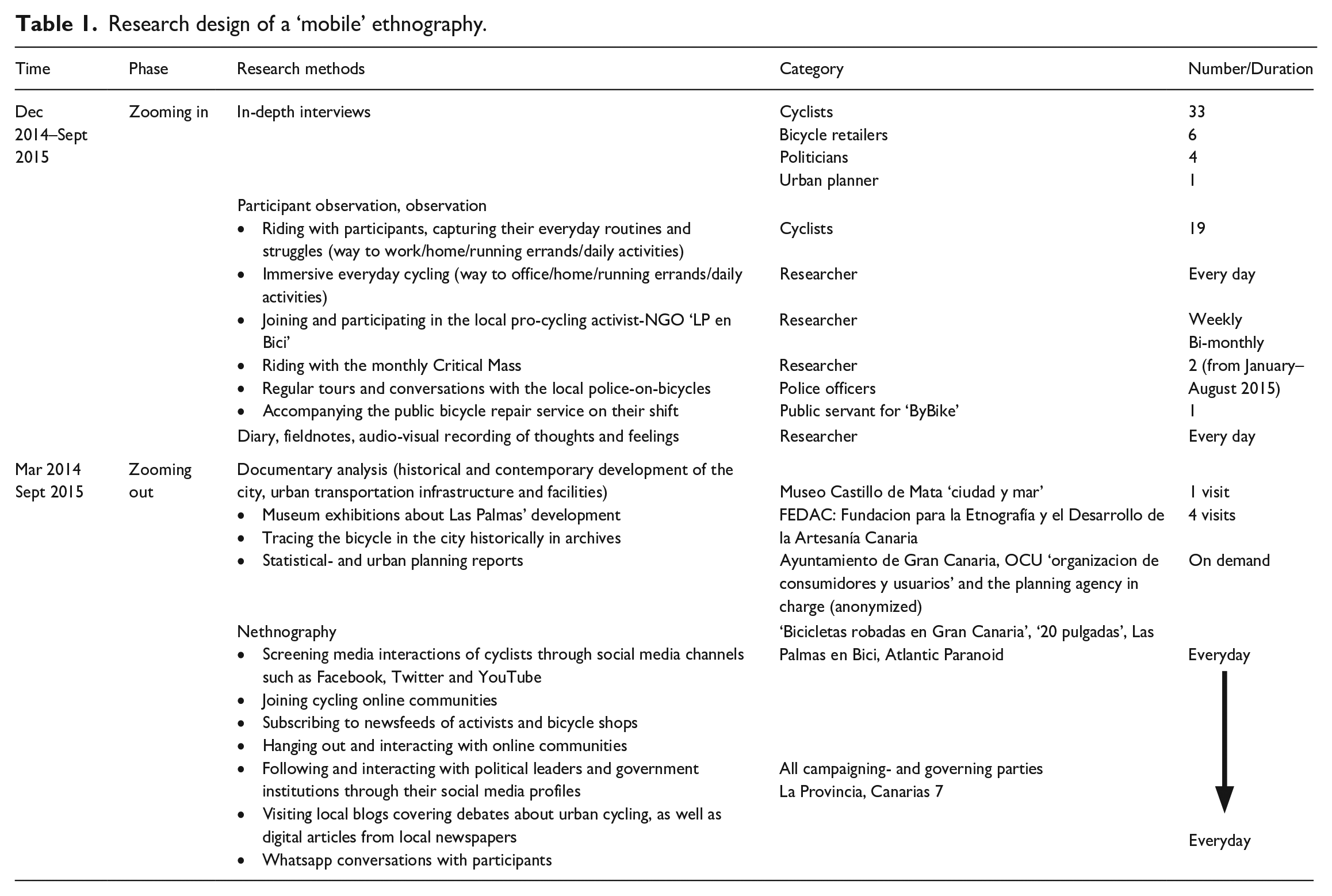
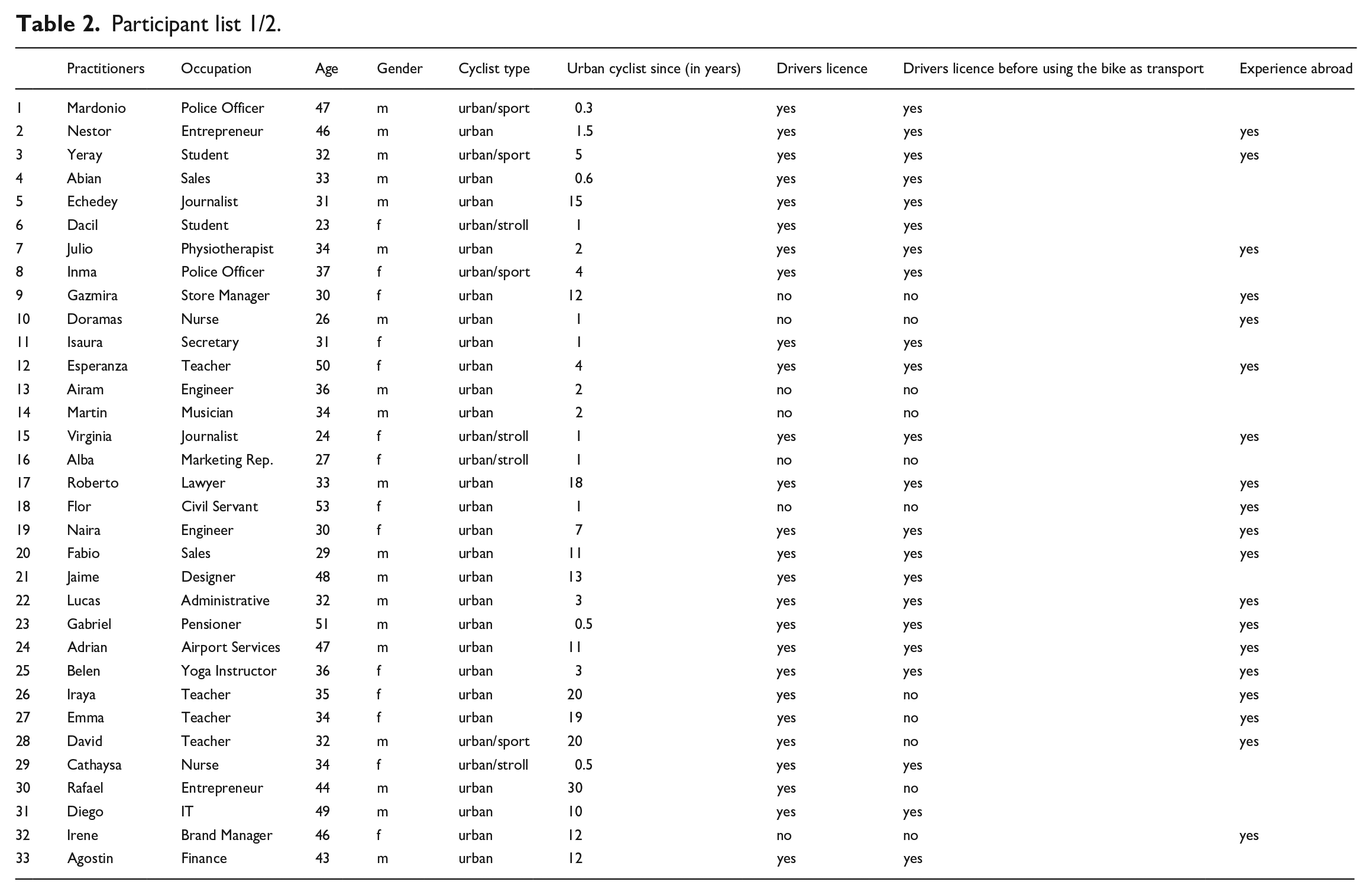
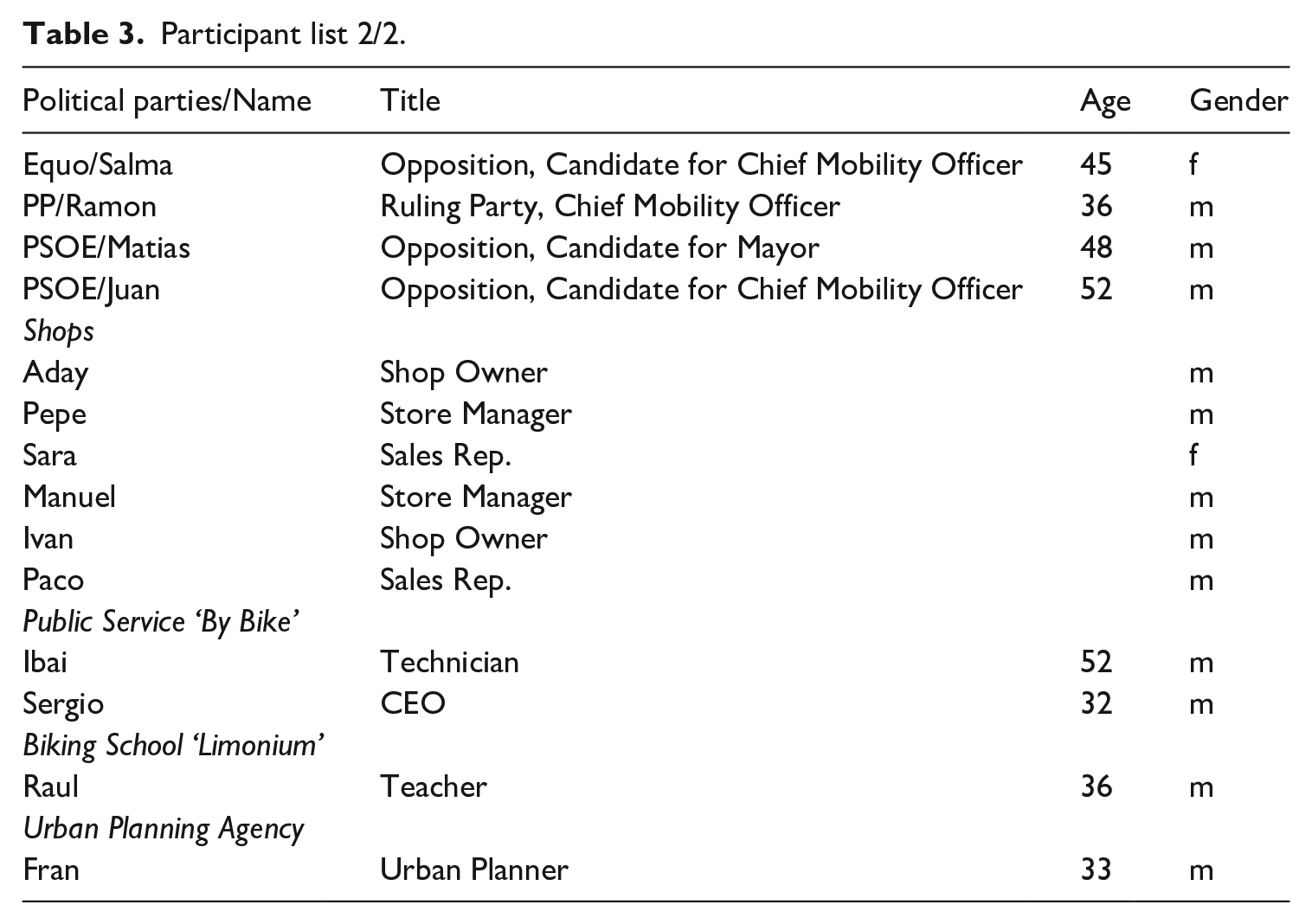
Ethnography as an appropriate methodology for practice-based studies (Hui, 2012; Schatzki, 2002, 2012) has also been recommended for studies on cycling in the form of a ‘mobile video ethnography’ (Spinney, 2011). Accordingly, the present study made use of a variety of ethnographic methods such as participant observation, in-depth interviews (lasting between 60 and 90 minutes), documentary analysis, historical analysis and netnography. Participatory and observational methods were extensive: purely observing traffic without participating in it is just as impossible as participating in traffic without observing. The researcher zoomed in and out (Nicolini, 2009, 2012) of urban cycling to reveal its relationships to other urban mobility practices (see Table 1). Connections to other mobility practices became quickly apparent. The first author fully immersed herself in the practice by cycling every day for commutes, errands and activities, accumulating 40 typed pages of fieldnotes, 846.25 minutes of video material, 10GB of photographs and other visual material, and 53 hours of recorded interviews. Participants were accompanied and video recorded wherever possible in their urban cycling routine (see Figure 1). Participants were recruited purposefully and included urban cyclists, pro-cycling non-governmental organizations (NGOs), policymakers, urban planning managers, cycling police officers and anyone who had some connection to urban cycling, however indirectly (see Tables 2 and 3). The fieldwork also traced cycling’s connections in the past; seeking to understand the existence, development, connections, struggles and competitions of practices over time. The different data sets were analysed thematically and crystallized (Richardson, 2000) according to the practice ontology outlined in the earlier section on ‘Domination in Practice Relations’.
Research design of a ‘mobile’ ethnography.
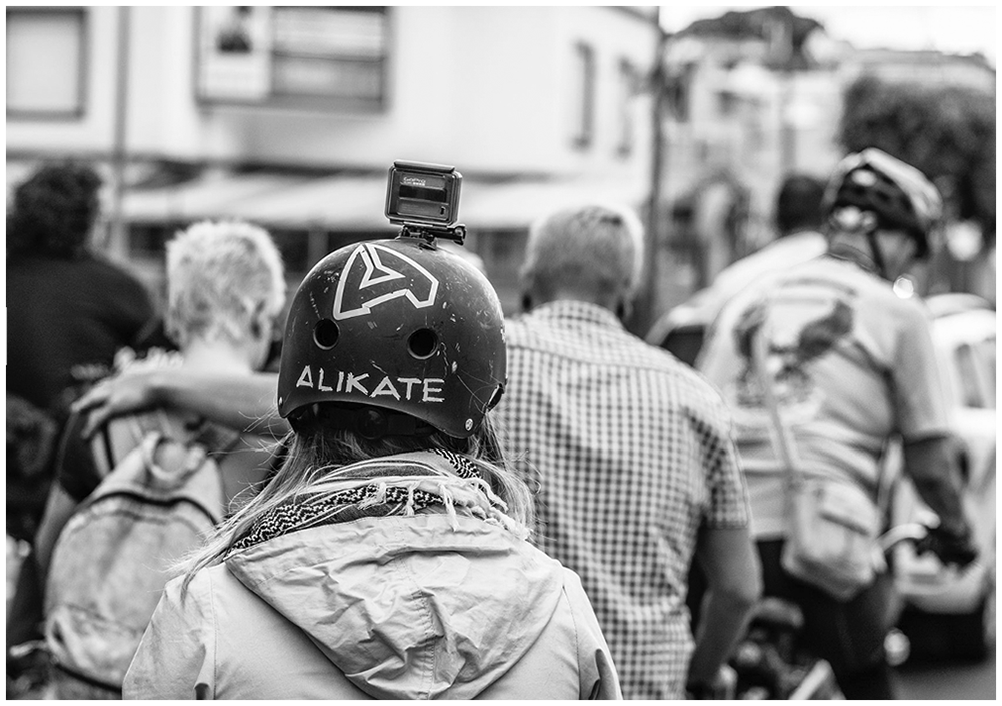
First author in the field.
Participant list 1/2.
Participant list 2/2.
We look at a local and context specific real-life problem and do not claim that our case is representative of cycling everywhere. Urban cycling as a spatio-temporally dispersed practice might not be ‘marginalized’ in other places in the world. Still, looking at specific cases where urban cycling does struggle advances understandings of the dynamics whereby sustainable practices are supressed. These understandings have implications for policy aimed at sustainable transformation (Shove, 2014; Watson et al., 2020) and inform cycling strategies for NetZero 2050 (ECF, 2021).
Following the American Anthropological Association (AAA, 2012) guidelines, the first author solicited informed consent and conducted overt research. She maintained confidentiality and data privacy and anonymized participants’ identities. Ethical concerns regarding the physical safety of conducting a ‘mobile’ ethnography in traffic were addressed by the first author’s efforts to prioritize mutual personal safety by maintaining distance and consciously avoiding dangerous situations. These efforts were approved by the Ethics Committee of the University of Liverpool.
Findings
In this section we empirically illustrate antagonist, agonist and synergist dynamics between four practices – policing, stealing, driving and lobbying – to show how they intersect with our fifth practice, urban cycling. 1
Policing
Operating as a silent enemy rather than by direct attack, policing shaped two aspects that organize practices – rules and general understandings – as well as the ‘material arrangements’ involved in urban cycling. Policing had a strong determinative effect on urban cycling by omitting and denying assistance to it.
Policing practices undermined street rights for cyclists even if the ‘rules’ of the official highway code favoured cyclists. The first author often experienced police officers recommending that cyclists not rebel against car drivers. Consider the following fieldnote when the first author was verbally disciplined by police officers for claiming a legitimate right of way on the cycle path:
[police officers]: I didn’t see you; you need to ride more cautiously – and slower! [first author]: But why do I have to slow down if I have right of way? [police officers, laughing]: Yes, but you will also have broken legs. Cars do not respect your right of way even if you have it because here, there is no cycling culture. Up to you, but we tell you for your own good, the one that gets hurt is you, we’ll call you an ambulance next time and that’s it. Do you want to have broken legs? (field journal)
This interaction represents one slice of the historic bloc surrounding driving and demonstrates how a submissive ‘common sense’ (Gramsci, 1971: 685) is established. By not defending urban cycling’s rights and norms on the roads, policing suggests that urban cyclists must adopt directives favourable to car driving, ‘modifying their own habits, their own will, their own convictions to conform with those directives’ (Gramsci, 1971: 539). Urban cyclists are ‘well advised’ to ride cautiously and to keep their heads down even when they have reason to protest. Indirectly, therefore, car driving enjoys full support from policing, which fosters the dominance of car driving by proposing that cyclists defer for their ‘own good’. Furthermore, policing frames cycling as the ‘wrong’ way of moving; it is illegitimate on the pavement and framed as ‘dangerous’ on the road, thus it is discouraged altogether. If not asserting oneself is proposed as the best way of cycling, then cyclists embody this spatial and behavioural marginalization. Further disfavoured through the lack of police attention to bicycle theft, urban cycling is marginalized in body, thought and symbol, or in Gramsci’s (1971: 707) vocabulary, in ‘content and form’.
Stealing and Vandalism
Just as Gramsci (1977: 167) found in the case of the proletariat, who ‘has no property in its possession and is . . . certain never to have any’, urban cycling struggles to bundle with material arrangements. The material arrangements within the built environment are colonized by ‘historic bloc’ practices that deprive urban cycling of what Gramsci calls ‘form’: materialized presence in the street. Examples of historical practices that oppose cycling are stealing and vandalism. The first author observed how these bite twofold into urban cycling’s materiality: a synergist to driving, agonist in their own right and antagonist to urban cycling. First, stealing severely impacts cyclists’ kinesthetic possibilities on the street. Basic activities like parking and storing are impossible without exaggerated protection measures, and cyclists carry the burden of implementing them. Iraya explains:
In the past, if it wasn’t possible to park it securely in the entrance of my house, I lifted the bicycle, regardless of the four floors – I am very ‘bruta’ [tough, brute], in this regard. I don’t leave it outside and I never leave it overnight in the street. (Iraya)
Others (including the first author) engaged in acrobatic practices in transporting their bikes up and down from their flats. Bikes were kept under constant supervision (Figure 2) to avoid theft and vandalism (Figure 3). As Fabio observes: ‘I left it outside and they destroyed it. I think they couldn’t manage to take it with them. They destroyed the frame, tried to steal the bell. They even put shit on the handlebars. Dog shit.’
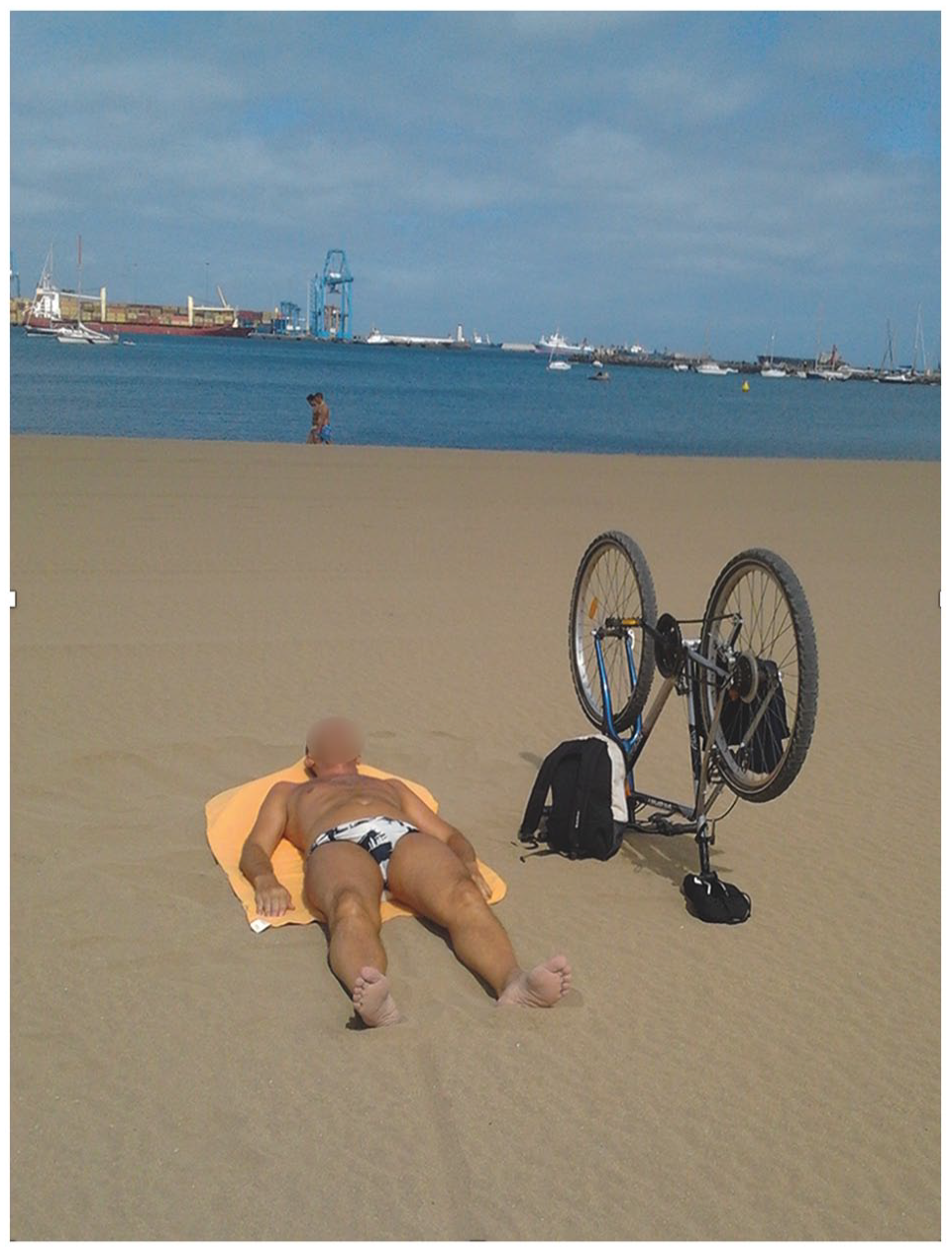
Bike supervision.

Bike leftovers.
Second, stealing seems to be tolerated and shielded in the practice plenum, thereby constituting an agonist practice on its own. The discrepancy between the political and social reality of bicycle theft and vandalism struck the first author when she entered the field. Politicians denied the existence of bicycle theft; however, observations and practitioners’ accounts told a different story. Stealing and vandalism practices challenged the material existence of cycling, including the buying of bicycles impacting cycling shops as well as other bike-related service providers.
Every participant shared an experience about a stolen bike, and they frequently took matters into their own hands. For example, by cyclists posting on a Facebook group page called ‘Bicicletas robadas en Gran Canaria’ [stolen bicycles in Gran Canaria], or bicycle shop owners sharing posts about stolen bikes on their websites and on noticeboards in their shops. Julio states:
It’s pointless to report – it doesn’t lead anywhere. For me it is an effort going there [police station], reporting, spending two hours completing paperwork and for what? Nothing! Wasting time, they won’t do anything, so I just went home, feeling upset about the asshole that stole my bike. (Julio)
His quote bitterly illustrates another nuance of the dominant ‘common sense’ (Gramsci, 1977) and social order in which injustice towards urban cycling goes unquestioned. His account reveals a vicious circle of lethargy in pursuing cases. Cyclists are reluctant to report incidents, which undermines their visibility in official police and council records. Despite town hall efforts to promote cycling in the city, stealing seemed to be overlooked; in fact, stealing a bicycle below the value of €400 was not even considered a crime (Gobierno de Espana, 1995). Thefts, like accidents, were seen as the responsibility of the individual cyclist:
Looking for a safe place to park in front of the museum, I ask a police officer on patrol for a parking space. His answer: ‘desde luego fuera no la dejes [la bici], porque ya sabes como son las cosas aquí!’ [Certainly, don’t leave it outside [the bike], because you know how things work here]. (Fieldnote)
This points towards the normalization of a problem and governing of associated behaviours, since ‘you know how things work here’, it is your own fault if you do not behave accordingly. It also shows how the historic bloc, the constellation of practices, encompasses practices such as policing that can be both agonist to driving (it is unburdened by policing) and synergist to driving since they support the recurring material and spatial marginalization of bikes. This in turn can exacerbate the political impression that ‘people’ do not want to cycle.
Driving
Driving as an agonist practice benefits from the lack of support cycling receives from policing and stealing. This empowering effect is reflected in an assertive style of driving that contrasts with the inconspicuous and insecure riding style of cyclists. This style materially invades the spaces allocated to cycling (Figure 4) and includes verbal bullying. Instead of demanding the right to coexist as an equal mode of transport, cyclists proceed unobtrusively in order to go as unnoticed as possible, as Adrian describes ‘riding like a phantom’:
I remember that I used to hurdle up and down the pavement, all day ‘zigzagueando’ [zigzagging] between road and pavement. With an agility to negotiate streetlamps – amazing [smiles]. Now I realize that this was wrong because really, I should have imposed myself as a cyclist and said, if I ride on the road then they just have to respect me, period. And I didn’t do that. It is like I turned into [pause] I got used to respecting cars and pedestrians. ‘Dejarme abusar’ [I let them exploit me]. As I am more agile, I think of it in a good way and ride like a phantom: I try to attract as little attention as possible, be as inconspicuous as possible . . . it is like I am constantly looking for a way to sidestep the next car. (Adrian)
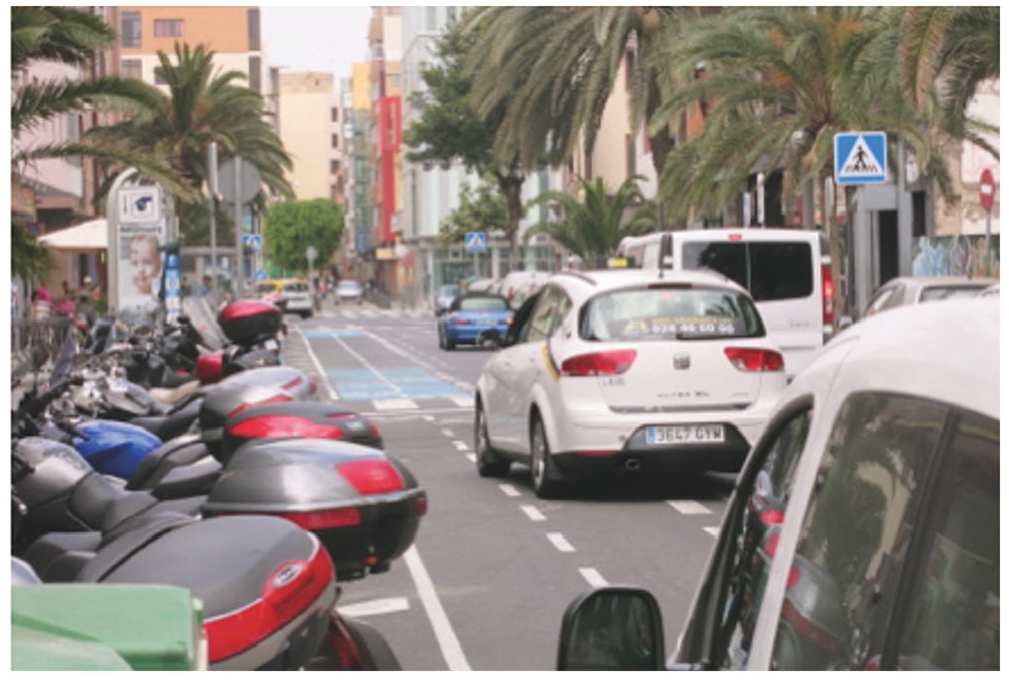
Bike lane invasion.
Attempts to claim the right of way have uncomfortable consequences, such as continuous honking, insults, and road rage. As there is little or no negotiation of the rights of cyclists in traffic, cyclists are forced into a deferential riding style:
I haven’t had any accidents but that’s thanks to myself! I ride very slowly, so I can brake. I never speed, except if I have to do a sprint because I am being bullied and shouted at and I feel distressed. There are a lot of people in a hurry telling me to piss off. I don’t feel like I have any rights. That’s what I feel. It is like you always, always come second or third. I feel I have nothing. What’s more I talked to the police and I tell them that I am being insulted. And the police officers ignore me and give me the impression that I don’t have any rights. (Flor)
These accounts betray a constant need for concession, it is the cyclist’s responsibility to watch out for potential collisions, even if that means committing infractions and relinquishing their right of way. Practitioners explain that they ‘should’ be more self-confident in claiming their right of way but struggle to follow through. They reflect what Gramsci (1971) calls contradictory common sense, in which a subordinate entity struggles with two opposing worldviews (Crehan, 2011). Although Adrian knows that he has the right to be on the streets he still gives prerogative to the car: his ‘theoretical consciousness [is] historically in opposition to his activity’ (Patnaik, 1988: 4). This situation reflects a struggle between the external imposed worldview of the hegemonic entity – car driving – enjoying its prerogative; and the egalitarian worldview of the suppressed entity – urban cycling – struggling to position itself (Gramsci, 1971). In yielding right of way to cars, urban cycling upholds the values of car driving. Although cycling practitioners want to establish themselves on the streets, this requires challenging the reigning order of things and, consequently, is not done. This shows how deeply ingrained is the normalcy of car driving, marking it as a dominant practice, and how practitioners of urban cycling lose sight of their own ‘subjectivity, [their own] potentialities, the causalities of [their own] action’ (Patnaik, 1988: 8).
Pro-Car Lobbying
Observations reveal two ways pro-car lobbying practices suppress urban cycling. First, lobbying operates indirectly as synergist by shaping governmental practices like campaigning and urban planning, which affect sustainable mobility opportunities and policy interventions in the city. Lobbying succeeds in defending space for cars contributing to an uneven allocation of material resources. Second, lobbying maintains a pro-car ideology via newspapers, promotions and sponsoring events. Lobbying literally keeps car drivers in the driving seat. It also represents the biggest industry on the island. Ramon, the town hall’s chief mobility officer, explains:
There is a local association of car importers in the city . . . An entrepreneurial group called DA [name has been anonymized] that distributes different brands . . . Volkswagen, Toyota, Mercedes, etc. . . . It is a powerful sector in the Canaries. Car imports increase due to the rise of rental cars for tourists, so you have a big vehicle fleet in the Canaries, a huge one. Plus, they have to renew frequently, hence it’s a sector that moves a lot of money. (Ramon)
Interpreting the town hall’s pro-cycling interventions – such as the implementation of zones banning motorized traffic – as attacks against citizens who use cars, The National Federation of Car Importers promotes car driving as the only legitimate transport mode by spreading anxiety about the loss of free transportation choice through press releases, predicting a ‘caos circulatorio’ [mobility chaos] (La Provincia, 2016). Lobbying practices could be understood as ‘deputies’ (Gramsci, 1971: 145) of car driving, ‘exercising the subaltern functions of social hegemony’ (Gramsci, 1971: 145). Lobbying blocks change, preventing ‘the great masses . . . [from] becom[ing] detached from their traditional ideologies’ (Gramsci, 1971: 556). Lobbying practices also cast pro-sustainability measures as curbs on individual consumer freedom to move by car. Car driving is presented as ‘a necessity recognized and proposed to themselves [individuals] as freedom, and not simply the result of coercion’ (Gramsci, 1971: 178). By securing the ‘spontaneous consent of the masses’ (Gramsci, 1971: 539), car driving does not even need formal policy intervention to enjoy power.
Discussion
In addressing our research questions, we drew on Gramsci’s (1971) notion of the hegemonic historic bloc, which describes the combinations of social and material forces that effect domination and suppression. Bringing this notion together with Schatzki’s (2019) horizontal understanding of hierarchies among practices allowed us to conceptualize the practice plenum as containing constellations of practices that dominate or subordinate one another. This conceptualization then enabled us to explain how a sustainable practice – urban cycling – struggles to assert itself while an unsustainable practice – car driving – thrives. For example, in considering the relation between stealing and urban cycling we found that the presence of one practice (stealing, agonist) interferes with the being of the other (cycling, antagonist), ‘preventing [it] from being totally [itself]’ (Laclau and Mouffe, 2001: 111). In struggles such as these between opponents, the agonist ‘dominates antagonistic groups, which it tends to “liquidate”, or to subjugate’ (Gramsci, 1971: 212) to maintain its dominance. In this case stealing exacerbates the material suppression of urban cycling on the streets and thereby serves car driving.
Empirical findings also led us to supplement Gramsci’s vocabulary with the concept of synergism, addressing calls for contemporary developments of his work (Laclau and Mouffe, 2001; Loftus, 2015). Our analysis reveals how car driving sustains its intellectual and material dominance mainly through the support of synergist relationships, from which urban cycling, by contrast, does not benefit. It is largely due to the lack of synergism opposing the historic bloc that urban cycling struggles to challenge the social ‘harmony’ that sustains car driving. Synergistic support of historic blocs comes from unexpected sources, such as when conflicts between two practices (e.g. urban cycling and policing) work to the advantage of a third (car driving). Tweaking Laclau and Mouffe (2001: 111, emphasis in original): it is not only in ‘the presence of the “other”’ but in the presence of others (i.e. coalitions of forces) that car driving can remain car driving and urban cycling cannot be itself, that is, cannot fully and unrestrainably develop. Power, in other words, is an effect of multiple practice dynamics. Systemic change needs to be understood as a political endeavour involving multiple intersecting practices bearing on driving and cycling.
A politics of practices allows us to think about power relations beyond ‘chains of interdependence’ (Shove et al., 2012: 88), in which practices support each other via shared resources and interests. Synergists operate as components of a nexus that constitutes and sustains the historic bloc without necessarily linking directly to one another. Synergy thus emphasizes the idea that practice alliances ‘strike together but march separately’ (Laclau and Mouffe, 2001: 55), that is, that different practices can bear incompatible interests but exert effects on the same victim. In short, car driving enjoys power through the unplanned convergence of the disparate effects of different practices. The combination of Gramsci and Schatzki also allows us to contribute to theorizing power as an effect of practices (Schatzki, 2019; Watson, 2017). By revealing the significant role of synergist practices, we demonstrate that power relations are more than ‘always agonistic’ (Watson, 2017: 174). As such, our Gramsci-inspired account of practice domination complements Watson’s (2017) appropriation of Foucault to analyse power between practices.
A series of implications follows for sustainability policy. Synergism demonstrates that transitions to sustainability require ‘parallel transitions’ (Watson, 2013: 129), in our case involving practices surrounding both car driving and cycling. Instead of addressing practices in isolation, policy should thus focus on the plethora of practices that surround particular practices of interest (see also Watson et al., 2020). Careful empirical work is also needed to explore complex power relations between practices and thereby identify where policy efforts should be directed.
Conclusions
In summary, our work contributes to the sociological literature on sustainable transformation in three ways. First, through our politics of practices, we directly address calls to locate a politics of sustainability in the fabric of mundane everyday life (Beveridge and Koch, 2018; Creswell, 2010; Grandin and Haarstad, 2020; Scoones, 2016; Welch and Yates, 2018; Yates, 2015). Second, we advance knowledge about dominant unsustainability, which is essential ‘to alter fundamental systemic structures and paradigms that produce vulnerability in the social sphere’ (Patterson et al., 2017: 7, cf. Foden et al., 2022; Ozaki and Shaw, 2014; Twine, 2017). Third, we have shown how a ‘flat’ practice approach is well suited to address power, contrary to critique.
Finally, we have shown how a small phenomenon (cycling) is representative of large phenomena (sustainability and inequality) and how their inseparability manifests through practices. Understanding that large and small phenomena alike transpire through practices advances knowledge of politics in everyday life and recognition that politics is inherent in small phenomena. We thus contribute to ‘re-framing the possibilities for cycling’ (Spinney, 2021: 13) through a more critical representation of the unequal opportunities for its enactment. Many more such political framings are necessary for achieving ‘cycling futures’ (Horton, 2006), in which cycling is treated seriously as a transformative, sustainable form of moving.
Footnotes
Acknowledgements
We would like to thank Las Palmas en Bici, 20” and MBC Canarias, as entities who most need support for the sustainable transformation of their city, for sharing their network. We are extremely grateful for our participants, their trust, access, connections, insights and extensive riding trips. Finally, we would like to thank the editors and anonymous reviewers for their constructive feedback.
Funding
The authors received no financial support for the research, authorship and/or publication of this article.
