




Abstract
Digitalisation and the use of algorithms have raised concerns over the future of work, the gig economy being identified by some as particularly concerning. In this article, we draw on 70 interviews in addition to participant observations to highlight the role of gig economy platforms in producing a novel form of reputational insecurity. This insecurity is generated by platforms disrupting the traditional operation of industry reputation in freelance markets. We highlight three areas of transformation (recognition, power relations and transparency) in which platforms disrupt the social regulation of reputation and thus algorithmically amplify uncertainty. We also detail how workers individually and collectively attempt to re-embed reputation within interpersonal relations to reduce this novel insecurity.
Introduction
A major concern regarding the future of work is the potential for new digital technologies to produce increasingly precarious working conditions. These fears are exemplified by so-called ‘platform work’ and the ‘gig economy’, which refers to workers using digital platforms to sell labour to clients (Vallas and Schor, 2020). This includes local platform work (e.g. Uber and food delivery gigs), where workers and customers are physically proximate, and remote platform work (e.g. data entry, graphic design and writing gigs on websites such as Upwork, Freelancer.com and Amazon Mechanical Turk), where the work is delivered remotely over the Internet (Huws et al., 2016; Wood et al., 2018). An important feature of this work is that it can be highly disembedded from regulative labour market institutions, such as labour laws, collective bargaining and welfare systems. Such national-level institutions are typically held by industrial relations scholars to both decommodify labour and give rise to national diversity in employment conditions (Wood et al., 2019b). In avoiding legal and normative labour market institutions, platform companies instead regulate exchange via platform governance mechanisms that control how network interactions take place (Lehdonvirta, 2022; Vallas and Schor, 2020; Wood and Lehdonvirta, 2021).
One example of platforms attempting to regulate exchange outside of national legal and normative institutions is the use of reputation systems. However, recent research has highlighted the potential for such systems to generate uncertainty for workers (Gregory, 2020; Griesbach et al., 2019; Rahman, 2021; Shapiro, 2018; Sutherland et al., 2020; Wood et al., 2019a). Reputation systems ask clients to leave reviews or feedback ratings at the conclusion of each transaction, which are then aggregated and displayed to potential future clients. That platform reputation systems may cause uncertainty is concerning, as Kenny et al. (2021) estimate that platforms have come to intermediate 70% of business practices in service industries, accounting for 5.2 million establishments in the USA. Fourcade and Healy (2017) moreover argue that platform scoring and ranking logics are no longer confined to platform work, having become ubiquitous in the wider economy, and thus playing an increasingly important role in shaping economic outcomes. In this article, we provide an in-depth qualitative investigation into the socio-economic implications of platform-based reputation systems. We focus empirically on freelancer reputation in the remote gig economy – a sector in which the importance of platform reputation systems and trust has previously been highlighted (Lehdonvirta et al., 2019; Shevchuk and Strebkov, 2018; Wood et al., 2019a, 2019b).
Trust and reciprocation have always been central to economic activity (Posner, 2000). Even in modern societies, reputation embedded within interpersonal networks is foundational to how markets operate (Granovetter, 1985, 2017). We demonstrate how platforms can disrupt the conventional social regulation of reputation – through transformations of recognition, power and transparency – and thus heighten socio-economic uncertainty and, ultimately, provoke resistance. In doing so we contribute to recent sociological research on the embeddedness of platform work (Shevchuk and Strebkov, 2018; Tubaro, 2021; Wood et al., 2019b) and on the operation of recognition in the gig economy (Newlands, 2022). Our findings also contribute an important insight to economic sociology: as markets become increasingly digitally mediated, the organic social regulation of exchange is progressively substituted with platform code, entailing the transfer of power away from community and towards private technology companies.
Reputation in the Remote Gig Economy
Reputation systems are central to the operation of most online marketplaces and labour platforms (Gandini, 2016, 2019; Kellogg et al., 2020) as they enable short-term and one-off relationships that would otherwise be impeded by a lack of trust (Lehdonvirta et al., 2019; Shevchuk and Strebkov, 2018; Wood et al., 2019a, 2019b). For instance, on remote freelancing marketplaces such as Upwork, workers are rated by clients on various dimensions following the completion of tasks (Wood et al., 2019a). The platforms use the ratings to calculate aggregate scores that determine which workers are prioritised in search results and algorithmic recommendations. The scores are also displayed to prospective clients to inform their choices. In this way, work is funnelled algorithmically to those deemed, on the basis of various customer feedback metrics, to be of high quality and trustworthy. This helps clients to trust pseudonymous workers often located in a different country (Lehdonvirta et al., 2019).
Reputation systems can also function as powerful control mechanisms insofar as they reward workers who conform to clients’ wishes and sanction those who do not (Rosenblat and Stark, 2016; Wood et al., 2019a). Indeed, they somewhat resemble conventional performance management practices that have been found to heighten stress for workers (Taylor, 2013). However, conventional performance management techniques entail intense supervisory pressure and discipline on the basis of detailed measurement and statistical analyses of the labour process, arguably constituting the ‘Taylorisation of white-collar work’ (Bain and Taylor, 2000: 9). In contrast, control via reputation systems entails the collection of customer data at the end of the labour process, with the consequence that ‘platform-based rating and ranking systems facilitate high levels of autonomy, task variety and complexity, as well as potential spatial and temporal flexibility’ (Wood et al., 2019a: 64).
Yet there are large differences in platform workers’ income, insecurity and work intensity, some of which appear related to reputation systems (Demirel et al., 2021; Gandini, 2016; Lehdonvirta et al., 2019; Schor et al., 2020; Wood et al., 2019a). Research into the remote gig economy has highlighted the potential for platform-based reputation systems to create uncertainty and reduce workers’ sense of control (Nemkova et al., 2019; Rahman, 2021; Sutherland et al., 2020). Rahman (2021) highlights that opacity is central to the operation of platform reputation systems in the remote gig economy, because it makes it more difficult for workers to game and inflate their scores. As a result, workers experience difficulty in understanding how to go about achieving high scores and influencing their ranking, causing workers to become paranoid about the operation of platforms’ algorithms. Similarly, Nemkova et al. (2019) find that remote platform workers experience a loss of meaning, disempowerment and reduced control as a result of what they perceive to be unfair and strict rating systems. Wood et al. (2021) found that 62% of the European remote gig economy workers surveyed were worried about clients giving them unfair feedback that would impact their future income. Platform reputation systems can be interpreted as a source of important symbolic power that accrues to some workers and not to others (Wood et al., 2019a). Demirel et al. (2021: 926) argue that platform reputation systems command their ‘own symbolic capital . . . [that] further enhanced and amplified the value of other forms of cultural capital’.
While the formal reputation systems of platforms appear novel, reputation as a mechanism that orders social and economic life is of course not new. In communities and networks both ancient and modern, reputation has helped to deter opportunism and promote cooperation by enforcing a link between actions and consequences (Greif, 1989; Kobrak, 2013). Even before platforms, self-employed contractors and freelancers have long relied on their reputations to obtain work from clients (Antcliff et al., 2007; Barley and Kunda, 2006a, 2006b; Storey et al., 2005). Contractors use previous clients as references as they make their sales pitches, and word-of-mouth about the quality of their work also spreads within their networks. Unlike employees, contractors cannot rely on uninterrupted affiliation with any one employer, and thus ‘the free professional’s well-being rests partially on his or her reputation in a community’ (Barley and Kunda, 2006a: 52). Differences in reputation help to explain some of the considerable heterogeneity in pay, income security and working time security in many types of freelance or contract work. As a result, some freelancers may find themselves in precarious positions, while others enjoy considerable security and job quality (Fraser and Gold, 2001; Gold and Mustafa, 2013; Storey et al., 2005).
Conventionally, reputation is informal and embedded in interpersonal networks (Granovetter, 1985, 2017; Raub and Weesie, 1990; Uzzi, 1996). As a consequence, informal norms and network structure regulate the operation of the reputation mechanism. Contractors can put in a good word to help their close contacts (Antcliff et al., 2007; Barley and Kunda, 2006b), while at the same time, reciprocal obligations and closed networks can restrict opportunities for others (Antcliff et al., 2007). The spread of informal reputation can also be conservative, in the sense that people are more likely to pass on information that confirms existing beliefs and behaviours (Uzzi, 1996, 1997). Communities may ostracise outsiders while suppressing incriminating information about well-liked members. Such network dynamics may help to stabilise distributional outcomes in contract work to some extent, making it easier for winners to keep winning and losers to keep losing (Antcliff et al., 2007; Uzzi, 1996). Another characteristic of informal reputation is that it does not scale very well: as the size of the network grows, information transmission via word-of-mouth becomes slower, until cooperation eventually peters out (Raub and Weesie, 1990). This constrains the size of conventional freelancer networks.
Formal reputation systems, such as those developed by online labour platforms, are designed to overcome some of the limitations of informal reputation as the basis for cooperation (Diekmann et al., 2014; Gandini, 2016; Lehdonvirta, 2022). They collect reputational information from previous online interaction partners via a standardised process and store it in the platform’s central database. Quantitative metrics derived from the reputation information are calculated automatically and disseminated to potential new interaction partners cheaply and instantaneously via the Internet. The platform may also use the metrics to help decide automatically which potential interaction partners to present in the first place. As a result, the reputation system scales better, and outcomes are not shaped as much by informal norms and network dynamics: ratings submitted by previous clients may still be biased or wrong, but biases are not generated or amplified as the information passes from person to person, nor is access to work limited to cliques. Despite much of the extant platform literature highlighting the opacity of algorithmic reputational systems (Kellogg et al., 2020; Rahman, 2021; Rosenblat and Stark, 2016), these systems were originally designed to enhance transparency (Lehdonvirta, 2022). For instance, the founder of eBay, Pierre Omidyar, introduced one of the first digital reputation systems with the aim of creating ‘a level playing field, where everyone [has] access to the same information and [can] compete on the same terms as anyone else’ (Omidyar, 1999: xv). Based in large part on the effectiveness of such formal reputation systems, platform companies have been able to create contract labour markets that are probably unprecedented in terms of their speed, geographic spread and openness (Lehdonvirta et al., 2019).
And yet it is important to recognise that in achieving all this, platforms’ formal reputation systems necessarily impose a particular view of the world on their participants. Conceptually, this can be understood through the sociological concept of ‘recognition’ (Bourdieu, 1977, 1984, 1993; Herzig, 2017; Honneth, 1995), which refers to the manner in which an individual is evaluated by others as legitimate or worthy. Recent research by Newlands (2022) calls attention to contradictions that platforms’ rating and ranking systems entail for worker recognition. We build on this research into recognition in platform work by incorporating Bourdieu’s (1993, 2019 [1982]) insight that recognition is, in fact, a site of struggle in which various actors attempt to symbolically define the interpretations, classifications and understandings of the world that matter within a particular field (Bourdieu, 2019 [1982]; Herzig, 2017). As we will demonstrate, reputation systems disrupt the conventional operation of reputation in markets. We also show how workers respond to the algorithmic amplification of reputational insecurity by attempting to re-embed reputation within the social regulation of interpersonal relations. We focus empirically on one sector of the platform economy – remote freelance work – but in the discussion section we consider the wider implications of the findings.
Methods
Data Collection
Our study included interviews with 70 remote gig workers. These interviews covered the workers’ personal history, experiences of gig work and relationships with platforms and with other workers, and were conducted as part of a wider project on the social, organisational and policy implications of gig work mediated by online platforms. Our sampling frame was limited to platform workers in the remote gig economy meaning it was appropriate for the project to collect data from workers across multiple platforms. These platforms have been given pseudonyms, as have the interview participants.
Recruitment
As many remote gig economy platforms operate a global workforce, it was also important to capture the experiences of workers from both richer and poorer countries. In total, we interviewed six workers in San Francisco, nine in Los Angeles, five in New York, seven in London and 34 in Manila, as well as nine workers located in other cities. Remote platform workers are a hard to reach population and therefore four recruitment paths were followed. The first path entailed identifying and contacting workers who had discussed their work on a public forum, social media platform or petition site. This resulted in 35 initial informants and involved searching for them on Google and LinkedIn so as to contact them via email or LinkedIn messenger. For a minority of workers (seven), it was not possible to locate alternative communication channels so they were contacted via the creation of a job on the platform, as there was no other way to make contact. For these seven workers, it was stressed that the request was not for them to undertake a job but instead an opportunity to participate in voluntary research and the job contract was not enacted.
The second recruitment path entailed snowballing several participants from other informants. This led to the recruitment of a dozen informants. The third recruitment pathway was from attending virtual and physical community events and meetups (with permission of the organiser) and this led to the recruitment of a dozen further informants. Finally, we carried out follow-up interviews with two workers in Manila who had previously indicated that they were part of worker networks during our previous research in the Philippines. For logistical reasons we wanted to narrow down our fieldwork to urban locations. Our final choice of fieldwork locations was thus San Francisco Bay (SF), Los Angeles (LA) and New York City (NYC) in the USA, as well as London, UK and Manila, Philippines.
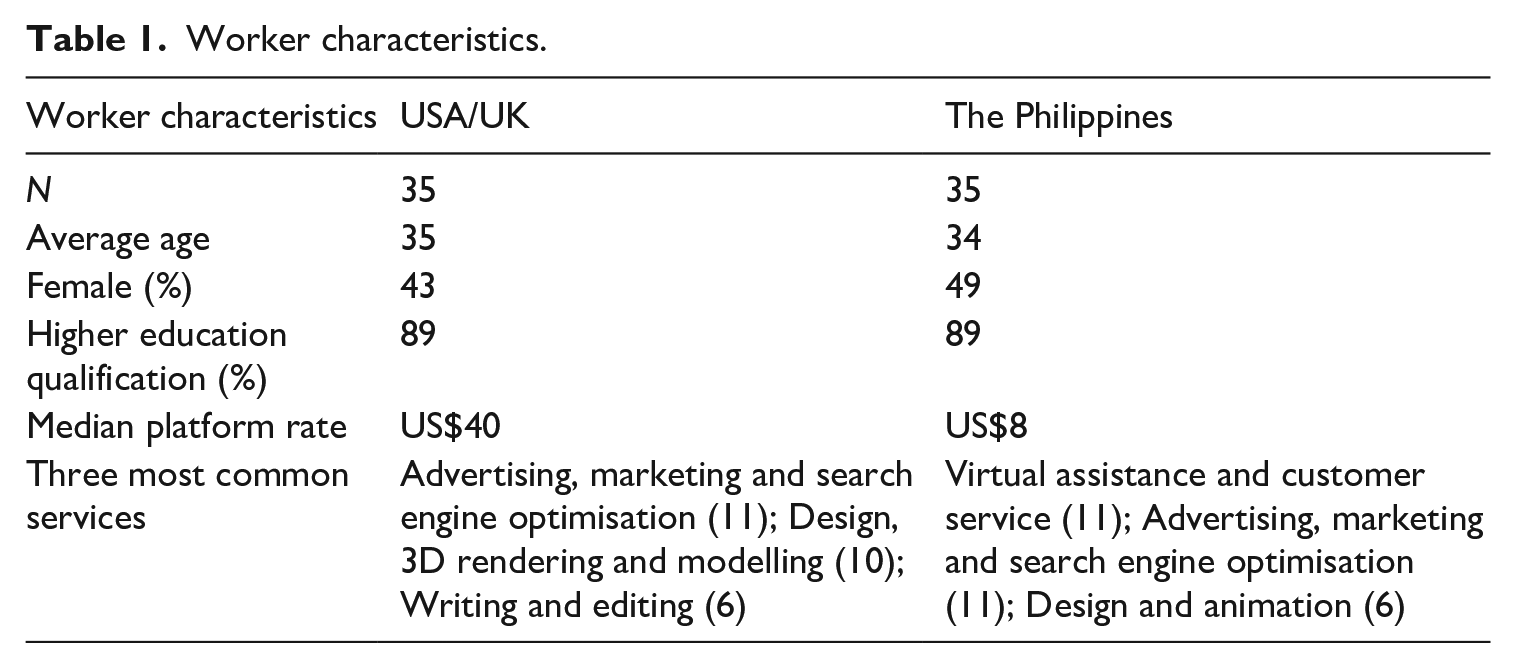
Interviews were mainly conducted in person at local coworking spaces, cafes and similar sites. Each participant had their travel costs reimbursed and, as a token of appreciation, were offered the equivalent of a US$15 gift voucher, except in the Philippines where this was not possible and the informants instead received a cash equivalent. Interviews followed a semi-structured protocol, lasted approximately 90 minutes on average and were audio-recorded (Table 1).
Worker characteristics.
Participant Observation
To gain a deeper understanding of the nature of gig worker community and the bonds between workers it was deemed important to gain experiential knowledge of worker organisation. Therefore, a number of events and meetups attended by remote gig workers were observed. These included four co-working days for freelancers held at co-working spaces and organised by freelancers themselves (LA, Oakland, CA, London x 2), three meetups for freelancers or digital nomads (Manila, San Francisco and Freemont, CA), three events organised by a freelancer union (LA and New York City x 2) and a platform co-op conference. An online meetup of freelancers in the Philippines was also attended, via video conferencing, while the first author was carrying out fieldwork in Manila. In each case, the permission of the organiser was obtained beforehand. The participation of the researcher was, where possible, announced at the beginning of the event and/or individually as the researcher spoke with the attendees.
Analysis
The data in the form of transcribed interview recordings and field notes were coded, following Vaughan’s (1992) theory elaboration approach. In the initial coding rounds, the first author coded transcripts line by line, paying particular attention to mentions of experiences of insecurity or the mechanisms of precarity highlighted above with new codes developed out of an iterative process and informing subsequent data collection so as to ensure theoretical saturation. NVivo enabled systematic theoretical coding to be undertaken and hundreds of initial codes to be generated. Focused coding was then employed to highlight the most common and revealing initial codes and to merge appropriate initial codes into new higher-level codes, as suggested by Charmaz (2006).
Findings
Processes of Reputational Disruption
Our findings highlighted that platforms disrupted the conventional operation of industry reputation and amplified insecurity via the transformation of recognition, power relations and transparency. Below we will first consider each of these processes, how they heightened uncertainty for workers and led workers to respond through a number of individual and collective strategies in an attempt to re-embed reputation within their community.
Algorithmic Recognition
Workers in this study were engaged in providing various forms of remote digital labour via platforms for clients located mainly in the USA and the UK. The most common work activities were those connected to advertising, marketing, writing, editing, design, professional assistance and customer service. In line with previous studies (e.g. Rahman, 2021; Wood et al., 2019a), an important theme of our interviews was that remote platform work could be an important source of income but workers’ ability to earn a living was dependent on their rating on the platform’s reputation system. In what was a highly competitive environment, the informants saw any score other than five out of five as a bad rating that would have a detrimental impact on their ability to access future work. As Holly (digital marketing; LA) explained: ‘Somebody who maybe gave a 4.2 out of 5 stars and that’s bad . . . that’s not really that bad but people look on [and] they want you to have 90% or above [on your job success score].’
The importance of getting a five-star rating was due to clients being only likely to view the profiles and job applications of those ranked near the top. In other words, platform algorithms produced new dimensions of recognition. As Gabe (digital marketing; Manila) explained:
Their algorithm is trying to . . . filter out the ugly, not-so-good applications and then show you the best of the best. The problem is . . . if you’re not top-rated, let’s just say that your application will only be viewed . . . for every 10, you would only be reviewed once or sometimes not even.
Brett (copywriting; LA) highlights that the sheer number of workers meant that the new classificatory scheme represented by platform-based ratings had a much bigger impact than traditional references, recommendations or referrals in freelance work, which circulate through smaller personal networks: ‘In the standard world where that person [giving a rating] would be a reference . . . with a platform it becomes amplified way, way more.’ Platforms thus disrupt the conventional operation of reputation by heightening the importance of being recognised via a strong reputation because of an expanded network of available workers. Moreover, they also create entirely new categories of recognition, in which some workers are classified as particularly high quality or trustworthy. These workers are recognised by clients through the platforms’ use of ratings and labels such as ‘Rising star’ and ‘Top rated’. As Gabe explained, these new categories of recognition displaced traditional markers of quality: ‘[Clients] put so much weight on being top-rated, it trumps . . . the capabilities and skills of the people who are not in the top-rated program.’
As a result of the transformation of recognition, reputation ratings not only had the potential to cast a harmful shadow over workers’ future ability to make a living, but they could also render the worker essentially invisible on the platform. Because of the way in which algorithms appeared to prioritise recent reviews, receiving a single low rating could effectively eclipse numerous positive ones. This created feelings of frustration and hopelessness, as Gabe explained:
it’s run by an algorithm, it’s wrong ’cause people like me who are almost top-rated are not given the chance . . . my application or my cover letter is not seen [by the client] . . . Clients are looking for job success score of 90% and above.
Algorithmic Power
A second process through which the conventional operation of reputation was disrupted by platform companies was via their transformation of power relations between traditional actors within freelance markets: workers and clients. A major theme of the interviews was how platform reputational systems enhanced the power of clients at the expense of workers. This had great potential to create uncertainty for workers as clients were seen to frequently engage in mistaken, capricious or even malicious rating behaviour. As Brad (management consulting, programming, graphic design; LA), explained:
As a freelancer you have no control over how you’re being rated . . . I got literally screwed by a customer. It was outta line . . . and it affected my ability to make money. Because it dropped me on the ass . . . it took like two months for me to get the stuff cleared off [during which I lost a] couple thousand dollars.
Similarly, Jean (ecommerce, website consulting, design; LA), explained: ‘He gave me one out of five . . . I didn’t get a job for three months, four months. It really impacted on my life . . . really it was tough.’
George (UX (User Experience); SF) highlighted that part of the inherent unpredictability in customer rating behaviour was that platforms empowered clients to effectively discipline their workforce, despite clients often having limited previous experience with managing workers or projects:
[I had a] concern about getting bad ratings because I was mostly getting hired by academics who desperately needed stats help. And . . . they’re not experienced with hiring freelancers, [or] with how to manage someone, or with how to set expectations so those led to some other situations [where] . . . I did everything that I thought was conceivably reasonable and they were unhappy.
Likewise, Tim (3D Rendering; LA) also felt that part of the instability was due to inexperienced clients being empowered to arbitrarily sanction workers:
It [the bad rating] was generally because they didn’t know anything about what I do, what the 3D industry is about, and they kind of expected me to school them along the way, and I’m not in the business of schooling you . . . So, we had a conflict of what my responsibilities were and what his responsibilities were, so I got a bad, like, a three out of five rating in that regard.
As Jean (ecommerce, website consulting, design; LA) explained, platforms radically shifted the power dynamics between workers and clients: ‘This review system is really scary . . . the power [it gives to customers].’
Workers had a reciprocal ability to rate clients, which could in theory force opportunistic or otherwise low-quality clients out of the market. But in practice, workers did not feel that they could sanction bad clients. This powerlessness was due to a bad rating being far more damaging for a worker and the prospect of repeat transactions more important.
Algorithmic Transparency
A third process through which platforms disrupted the conventional operation of reputation in freelance markets was the manner in which their algorithmic rating and ranking systems transformed transparency. As noted above, platform reputation systems were intended to level the playing field between market actors by providing equal information to all individuals so that reputation would no longer be shaped by opaque processes of obligation, patronage, discrimination and opportunism (Lehdonvirta, 2022). However, rather than rendering reputation transparent, platforms’ rating systems produced new forms of opacity. This new opacity constrained workers’ ability to manage risks to their reputations. Platform algorithms – their exact inputs, the relative weights given to different inputs and other operational details – are usually not disclosed by platform companies (Kellogg et al., 2020; Lee et al., 2015; Lehdonvirta, 2018). Even the term ‘algorithm’ is a somewhat simplified label applied by scholars to unknown information processing systems that may comprise technical as well as human elements (Shestakofsky, 2017). One frequently cited reason for the opaqueness around these systems is that it is necessary to prevent attempts by users to game and manipulate the results (Rahman, 2021). In some cases, a thorough account might also be so complex as to be effectively unintelligible (Wachter et al., 2018). In any event, we found that this so-called algorithmic opacity made it hard for workers to predict when a crisis of reputation could erupt for them. For example, Laura (digital marketing; SF) described the following experience: ‘Suddenly [my score] went down to 94%. I had no idea why . . . I was getting maybe 15 job invites a week, and [then] it drops to, like, two job invites a week.’
Platform Precarity and Worker Attempts to Re-embed Reputation
As a consequence of the above interlinked processes that had disrupted social regulation in this market, workers experienced reputational instability and uncertainty, which manifested as continuous worry about future access to work. As Marizze (admin and customer support, research; Manila) explained: ‘We’ll always have that worry . . . it will happen again for sure, as, for as long as I continue working, there will be clients who would, who would behave like that.’ Other workers described the stress they experienced as a result: ‘I remember being like oh gosh I need a good one [rating] . . . if you get too many [bad ratings] in a row, you’re gonna be booted off the platform . . . so it is pretty stressful’ (Casey – UX design agency; LA).
Importantly, reputational insecurity was experienced also by many interviewees who had themselves never received a bad rating. As Matthew (voice actor; Liverpool, UK) explained:
I’ve seen some people on the GigOnline forums say that . . . like overnight their job success went from like 93% to 78%, and now they’re not getting any jobs. I’ve thought in the past, if that was to happen to me, that would be really bad. I don’t know what I would do.
Having detailed the reputational insecurity experienced by our informants as a consequence of platform disruption to the conventional operation of reputation in this freelance market, we now turn to explore how workers responded to this risky, uncertain and unpredictable socio-economic landscape.
Unpaid Labour
The most common response to platform precarity was to carry out free supplementary work for clients. One reason that workers undertook unpaid work was in the hope of gaining a higher rating. A frequent dilemma faced by workers was whether to risk the ire of clients by asking for more money when requested to undertake more work than agreed at the start of a project. Afril (graphic design; Manila) was explicit that it was the power that the processes of algorithmic amplification placed in the hands of clients that led to unpaid labour: ‘They [clients] keep asking [for revisions] and the problem is the power is in their hands. They have the money, they can rate you, they can complain about you, and the freelancer doesn’t have any support.’
Arwind (game design and illustration; Manila) stated that his strategy for dealing with reputational insecurity was to give clients the option to either forgo paying him or rate him with five stars: ‘“If you don’t like the project, then don’t pay me.” Always tell [clients] that . . . and then “if you love it, then always give me five star[s]”.’ Likewise, Thomas (programming; London) explained how, fearing that a client would give him a bad rating, he accepted a payment that was half of what was originally agreed:
Even if I had to lose money, or just have extra work to just I don’t know, provide more services, I would even . . . I would probably choose to do that just to protect my . . . score and my ranking.
Reputational insecurity also led to unpaid labour when workers sensed that the client was dissatisfied with their work. Given the importance of platform reputation systems, it was widely felt better to lose some income in the short term to safeguard one’s long-term ability to make a living. As Brett explained:
I refunded a very good chunk – it was probably like 30% to 40% of that flat rate. I refunded it back to him because I just wanted that good rating and I wanted the good feedback. Which was like frustrating . . . I ended up refunding I think a hundred [dollars] . . . Just to get that good rating.
This could equate to quite large sums of money, especially in the Philippines where the relative value of a project was often higher.
Previous research has highlighted unpaid labour as a form of individual ‘reactivity’ to reputational insecurity in the remote gig economy (Bucher et al., 2021; Rahman, 2021; Sutherland et al., 2020). However, our data suggest that online communities have an important role in socially tempering the urge to provide work for free and could even act to encourage resistance to unpaid labour. They can, therefore, be understood as a means of countering platform disruption of industry reputation and an attempt to re-embed its social regulation within community. For example, George explained how he was emboldened by his interactions with other workers to demand payment for his work:
My colleagues gave me some very reassuring firm advice . . . ‘Fuck you, pay me or I’m not working for you.’ Which is something that everyone needs to be reassured about. That’s something where I think community support is helpful ’cause it’s easy to start feeling desperate especially when you’re new . . . [Otherwise] probably I would’ve done some unpaid work for them.
Likewise, Julie (writing; LA) highlighted the online communities were crucial for the avoidance of unpaid labour: ‘Community is the key, you know. Because without a community you don’t know how to support each other. And if you don’t support each other, you can easily get like cheated.’
Managing the Client
Another manner in which reputational insecurity induced workers to undertake additional unpaid labour was through the need to emotionally manage clients. Undertaking ‘emotional labour’ (Hochschild, 1983) towards their clients was thought to reduce the threat that clients posed to workers’ position within the platform’s reputation system, as forging a social bond with a client could create an obligation that the client reciprocate the worker’s display of friendship with a five-star rating – even when the work was below expectations. Again, this can be understood as an attempt to re-embed reputation within the social regulation of interpersonal relations. As Camille (copy writing; Manila) explained with reference to the idiom of ‘rapport’, this could be an effective block to clients giving negating ratings:
It’s [also] more of a rapport thing, how you handle yourself. I mean even if you did not do a good job but . . . if you establish this rapport with the client . . . then that client will somehow think twice before giving you [a bad rating].
Raymond (programming; Manila) was explicit about trying to leverage reciprocity to avoid bad ratings:
I would suggest to them, ‘Okay, since we’re ending the contract, is it okay if we end it on a good note? Like . . . I’ll give you really good feedback. Can you, can you also do the same?’ ‘Oh, yeah, sure, I’d be glad to do that.’
An additional strategy workers adopted to protect their rating in the platform’s reputation system was to screen out those clients perceived as more likely to give bad ratings. As Tim (3D rendering; LA) explained, workers sought to avoid jobs where the client lacked a history of paying workers and providing good ratings, or were disrespectful in how they communicated job invites:
You learn to weed them out. It’s all how people talk. Are they, are they respectful, you know? Here’s a guy who’s trying to get somebody to work for him, and he’s already telling you off, so, is that the kind of person you want to work for? I doubt it.
Effective as these strategies were, they had to be first learned by workers. An important theme of the interviews was how workers looked to online communities for advice, help, and encouragement. As Jean explained: ‘Freelancers help each other, not, not really GigOnline, because GigOnline have their own mindset for their business.’
In line with Korczynski’s (2003) concept of communities of coping, our interviews and observations highlighted that forums and social media communities provided crucial sources of emotional support by enabling remote gig workers to share both negative and positive experiences. As Julie explained:
People ask . . . ‘I’ve got this client who sucks?’ . . . a lot of it is on Facebook groups . . . we talk about bad clients . . . The Facebook groups that thrive are the ones that allow you to just bitch . . . Like ‘Oh I’m writing for this client too. . . what’s it like working for them, do you like it?’
This ‘bitching’ not only had a palliative effect, but it also helped inform workers’ client screening processes. May (customer support and virtual assistance; Manila) provided a particularly illustrative account:
On our community . . . they can post evidence . . . like if you have spent a lot of hours working on this project and then you did not get paid at all . . . Or if [the client is] really rude. So it can be like, ‘Beware’ for other freelancers . . . ‘If you ever encounter this client, don’t apply anymore’ or . . . ‘don’t continue with the work’.
Gabrielle (medical translation; London) highlighted the importance of community as a means of transcending the algorithmic disempowerment that had made it impossible for workers to formally sanction clients through platform reputation systems:
A lot of people use those forums, like, to check ‘Oh I got contacted by this client . . . has anybody worked for this client?’ . . . I will definitely trust what other translators are saying more so than reviews online because when you post something online, your name is attached to it so you feel like if you say something bad about your client, they don’t wanna use you again. So I tend to trust the people in my group.
Discussion and Conclusion
‘Platform work’ or ‘gig work’ exemplifies the potential for new digital technologies to produce increasingly precarious working conditions. This article adds to our understanding of how platform rating and ranking systems generate uncertainty for workers in the remote gig economy. By providing an in-depth account of this experience, we showed how platforms disrupt the operation of reputation in freelance markets, which has conventionally been regulated by social norms and interpersonal networks. Platforms displace this social regulation that tends towards the status quo with their own regime of software code and organisational practice. In doing so, platforms cause the algorithmic amplification of uncertainty via transformations to recognition, power relations and transparency. Our findings also make a novel contribution in demonstrating how workers attempt to re-embed reputation within interpersonal relations. In particular, we highlight the centrality of community in shaping how workers navigate this unpredictable and uncertain terrain.
That reputation moderates outcomes in freelance work is not new or unique to platforms – conventional freelancers and contractors are also to varying extents dependent on their reputations for labour market security (Antcliff et al., 2007; Barley and Kunda, 2006a, 2006b; Storey et al., 2005). However, platforms’ formal reputation systems function differently from the informal reputation of industry networks. Whereas industry reputation is regulated informally by social norms and interpersonal networks, platform reputation systems are regulated to a much greater extent by the platform company’s regime of software code and organisational practice. Thus, where industry reputation tends towards preserving status quo, platform reputation systems can be extremely volatile, algorithmically amplifying the consequences of capricious client behaviour. And where industry norms and networks change slowly, a platform reputation system can be unilaterally upended by the platform company, leaving workers racing to understand the new rules. This results in even presently secure platform workers feeling that the ground under their feet is permanently unstable. It also means that the power to regulate the market shifts from the industry and community to the technology companies that operate the platforms.
However, workers have developed various responses to these shifts. In line with Bucher et al. (2021), Rahman (2021) and Sutherland et al. (2020), we found that workers respond by undertaking unpaid labour, emotionally managing clients and screening clients. Our unique contribution is to show how these practices are underpinned by attempts to re-embed reputation within the social regulation of interpersonal relations. Specifically, workers attempt both to re-embed clients in social relations and to bring platform reputation systems under the regulation of digital ‘communities of coping’ (Korczynski, 2003). In these communities, workers provide each other with moral and practical support in the face of pain and hurt caused by reputational insecurity, disseminate information to support screening practices and develop norms of resistance in the form of refusing to accept unpaid labour. This is an important finding as it demonstrates that by building digital communities, workers can, to some degree, counter platform algorithms that seek to individualise and disempower them. Indeed, Stephenson and Stewart (2001) highlight that worker collectivism continues to persist even under work conditions less conducive to traditional forms of trade union collectivism in the form of a ‘workplace collectivism’, or what Stewart et al. (2021) term ‘workspace collectivism’ when applied to the gig economy. This form of collectivism is rooted within the emotional support that workers provide to each other and stems from a common experience of the labour process. As suggested by Stephenson and Stewart (2001), this workspace collectivism was found to be important in supporting resistance.
In this study we focused empirically on freelance work carried out remotely over online labour platforms. However, the dynamics of disruption and re-embedding that we observed are likely to have parallels in other segments of the platform economy. Platform rating and reputation systems have also been highlighted as a source of uncertainty in the local gig economy of Uber driving and food delivery (Gregory, 2020; Griesbach et al., 2019; Rosenblat and Stark, 2016; Shapiro, 2018), and drivers have been observed responding with unpaid emotional labour, acceptance of customer abuse and cancelling rides to avoid bad reviews (Maffie, 2022; Möhlmann and Zalmanson, 2017; Rosenblat and Stark, 2016). Curchod et al. (2020) find that eBay sellers likewise work in constant fear of negative customer ratings and algorithms that may amplify their consequences. Yao (2020) finds that platform-based lawyers use unpaid emotional labour to manage client feedback. However, more research is needed to understand how ‘communities of coping’ may be related to reputational insecurity in these other segments of the platform economy. Finally, we call for future research to investigate reputational insecurity and its spread in the broader economy as businesses increasingly adopt digital scoring and ranking practices (Fourcade and Healy, 2017; Kellogg et al., 2020; Orlikowski and Scott, 2014).
Theoretically, this study contributes to the economic sociology of embeddedness and disembeddedness of exchange in interpersonal networks (Granovetter, 1985, 2017; Raub and Weesie, 1990; Uzzi, 1996). Previous research has shown that platform companies seek to disembed labour from institutional and interpersonal contexts (Tubaro, 2021; Wood et al., 2019b) but that despite this, platform work remains to some degree embedded within interpersonal networks and communities (Schwartz, 2018; Shevchuk and Strebkov, 2018; Tubaro, 2021; Wood et al., 2018, 2019b). Our study helps to explain this tension by detailing for the first time some of the dynamic processes through which disembedding and re-embedding are carried out in the platform economy, using the issue of reputation as an entry point. Building on Newlands (2022), we also contribute to the sociology of classification and recognition (e.g. Bourdieu, 1977, 1984, 1993; Herzig, 2017; Honneth, 1995). We show how contention over technological versus social regulation of reputation has become a new site of classification struggles over which beliefs, categories and values become ‘consecrated’ within a particular field (Bourdieu, 1993; Herzig, 2017).
Footnotes
Acknowledgements
The authors would like to thank the research participants for their time and insights. We also wish to thank the organisers and participants of the numerous conferences, workshops and seminars at which earlier versions of this article were presented and discussed. We are especially indebted to the detailed feedback and encouragement provided by Steven Vallas, Lina Dencik and Kathleen Griesbach.
Funding
The authors disclosed receipt of the following financial support for the research, authorship and/or publication of this article: this research was supported by the European Research Council (ERC) Horizon 2020 grant agreement number 639652 (iLabour).
