




Abstract
This article argues that in order to engage sociologically with the future the discipline needs to rediscover its historical imagination. It makes three main points. First is the idea that sociology needs to be more historical and to illustrate how this has been done well before. Second, it explores ideas, concepts and theories used in thinking about the past, which are in turn useful in organising how we imagine the future – in particular nostalgia, and especially that surrounding industry. Finally, it offers ways of thinking about the sociologically mediated relationship between past, present and future through the burgeoning field of deindustrialisation studies.
It may seem rather counter intuitive but in order for us to become more willing, and able, to engage in debates about the future we need to be more confident about the past; a rediscovery of our collective critical historical sociological imagination. This article makes three main points. First is the idea that sociology needs to be more historical and to illustrate how this has been done well before. Second, it explores ideas, concepts and theories used in thinking about the past, which are in turn useful in organising how we imagine the future – in particular nostalgia, and especially that surrounding industry. Finally, it offers ways of thinking about the sociologically mediated relationship between past, present and future through the burgeoning field of deindustrialisation studies. My essential point here is that to artificially cut ourselves off from the past limits our ability to understand the present and future as well as the past itself.
Sociology and History
One of the notable features of contemporary academic writing is how much use social historians make of the sociological ‘back-catalogue’. Recent examples include Lawrence’s (2019) Me Me Me exploring post-war British class identity through classic sociological texts including Family and Kinship in East London (Young and Willmott, 1957), The Affluent Worker studies (Goldthorpe et al., 1968) as well as Pahl’s (1984) work on Sheppey, which is discussed below in its own right. Todd (2014) is another social historian drawing on many of those similar studies in telling a rich historical and historiographic story about post-war Britain, its class systems and structures. Let me make it clear this is not to criticise these and other scholars by way of arcane turf-wars – quite the opposite, I applaud the way this sociological research is being repurposed. My point is that sociology used to be far more comfortable in proclaiming its historical roots and interests. Four decades ago, Abrams (1982: ix) wrote: ‘many of the most serious problems faced by sociologists need to be solved historically. . . . many of the supposed differences between sociology and history as disciplines do not really stand in the way of such solutions’. Abrams imagined the reconstituting of history and sociology as historical sociology. His central argument in Historical Sociology was that both disciplines enjoyed a common project, namely ‘a sustained, diverse attempt to deal with what I shall call the problematic of structuring’ (1982: ix).
More recently David Inglis has called for a more robustly historically informed sociology. As he warns: ‘Sophisticated historical consciousness is largely moribund in mainstream British sociology today, posing acute questions about the intellectual solidarity of the discipline as it is currently organized and practiced’ (Inglis, 2014: 101). Inglis (2014: 100) highlights the tendency of contemporary social theorists and empirical sociologists to rely on ‘a range of periodizing constructs – risk society, globalization, late modernity, liquid modernity, network society’; leading to writing that, while seemingly emphasising historical awareness, in reality relies on crude overly simplified accounts of contemporary society and its past. This historical amnesia is in stark contrast to an older tradition in sociology that, like Abrams, stressed the centrality of history as part of the sociological project. Interestingly Savage’s (2021) new book The Return of Inequality develops a sophisticated and critical account of the role of the past in shaping present conditions and future possibilities.
I am going to look briefly at three sociologists – Raymond Williams, Stuart Hall and Ray Pahl – in order to illustrate the way historical consciousness develops a more informed account of the present and potential futures. Williams was no stranger to history. His work was steeped in an understanding of how the past shaped the structure and choices of the present – be it his own in his autobiographical reflections, or his writing on mass culture. This can be seen in The Long Revolution (Williams, 1961), Keywords (Williams, 1983a), The Country and the City (Williams, 1973) and perhaps a neglected work Towards 2000 (Williams, 1983b). Each of these volumes is at home in the past as a repository for analysis of the present, including nostalgic yearning for a past that never was. Towards 2000 revisits some of the themes of the earlier Long Revolution, written two decades before, in the context of the early 1980s. Williams’ command of the broad sweep of history allows him to develop an acute account of Thatcherism and the consequences of the end of the long post-war boom. Towards 2000 projects on from 1983 to the millennium suggesting how the past, and the ‘now’ might play out: In intellectual analysis it is often forgotten that the most widespread and most practical thinking about the future is rooted in human and local continuities. We can feel the continuity of life in a child or a grandchild. We can care for the land, or plant trees, in ways that both assure and depend on an expectation of future fertility. We can build in ways that are meant to last for coming lives to be lived in them. (Williams, 1983b: 5)
Williams, like Abrams, appreciated how multiple modes of historical time operated in concert in framing present and future trajectories. In Williams’ writing we get an appreciation of how myth, legend and nostalgia help to shape collective structures of feeling in the present.
Hall (2021 [1988]) draws on history beautifully in a range of his writing. In the Hard Road to Renewal, first published in 1988, Hall collected a set of essays written across the previous decade. Rereading them for this piece one is struck both by the historical sociological imagination at work, but also by how fresh and prescient his writing was; one would think he was describing contemporary politics rather than the UK under a pre-Thatcherite Labour government. Like Williams, Hall’s historical style sharpens his analysis, aiding his ability to think with the future – both its progressive possibilities, and less benign likely directions. Hall’s historically rooted analysis provides a stinging critique of the paucity of progressive opposition to Thatcherism while simultaneously identifying the right’s success: the failure since then of Labour, and of the left more generally, to comprehend what Thatcherism really represents – the decisive break with the postwar consensus, the profound reshaping of social life which it has set in motion – provides the measure of the left’s historic incapacity so far to meet the challenge of Thatcherism on equal terms. (Hall, 2021 [1988]: 2)
In just this short passage of insight the reader is exposed to a long sweep of post-war history, current dilemmas and the sense of future trajectories already being firmed up if not fully formed. These ideas sit within Hall’s contribution to the influential ‘New Times’ debates occurring within and beyond the pages of Marxism Today (see Hobsbawm, 1981).
Finally, Pahl’s (1984) Divisions of Labour is a master class in historical sociology. Divisions takes an unusual shape, its general first part gives way to a more detailed account of Sheppey, an island off the north Kent coast that he had researched since the 1970s. I have argued elsewhere that Divisions of Labour is essentially a book about deindustrialisation; Pahl described Sheppey as his ‘post-Industrial laboratory’ (Strangleman, 2017). Divisions tells that late-20th-century story through two centuries of the island’s industrialisation, in particular through its naval dockyard, which had closed in the early 1960s. Divisions of Labour is such a clever book as it plays with historical projection back and forth. Pahl interviews those made redundant in the 1960s, some still quite young who went on to work for three more decades, and others who retired at closure who had begun their careers around the time of the Great War. This temporal trick is replicated in his wider project where he got Sheppey school children to imagine their work histories, not as the 15- and 16-year-olds they were, but as mature people at the end of their working lives four or five decades into the future (see Lyon and Crow, 2020). Finally, the book is fascinating as Pahl, like Williams a year before, projects forward from his fieldwork to the millennium; in the process providing an historically informed speculative account of what was then the near future.
We will return to some of these themes later on but for now what I want to stress is how each of these writers is naturally drawing on the past in their analysis of the present, and it is precisely that ease with history that allows them to say interesting informed things about potential trajectories, ideas that, nearly four decades on still seem fresh and insightful.
Nostalgic Sociology
If it appears strange to stress the importance of history in discussions of the future then including nostalgia in that reflection may seem bizarre, but bear with me. In ‘A note on nostalgia’ Turner (1987) writes persuasively of how sociology as a discipline is embedded in nostalgia, or nostalgic reflections and critique of loss. This loss is manifest in the erosion of individual freedom, eclipse of genuine authentic social relations, of simplicity, emotional spontaneity: The nostalgic paradigm is a persistent and prevalent feature of western culture, in literature, art, medical history and social theory. The nostalgic mood is of particular importance in contemporary cultures in association with loss of rural simplicity, traditional stability and cultural integration following the impact of industrial, urban, capitalist culture on feudal organization. (Turner, 1987: 152)
Turner notes that being content is somehow incompatible with knowing who we are as moderns. Turner plays with the idea that nostalgia is inherently backward looking and conservative. Instead, he projects the potential at least for a radical nostalgia, one able to draw on both what has been lost and gained in modernity, but one that also allows itself a critical vision of the future. Here Williams’ ideas on nostalgia, most fully worked through in The Country and the City (Williams, 1973), are useful. Williams identified a near constant nostalgic appeal to a golden age going back a millennium, which had just disappeared over the horizon. Williams used the idea of successive generations stepping on to an escalator and looking over their shoulder at the receding past. This trait, Williams argued, was how individuals, groups and cultures understood change across time. While Williams’ writing often charted the nostalgia for the loss of a rural idyl, others have noted the way industrial society is itself an object of nostalgia (see Strangleman, 2007, 2013).
Since Turner’s landmark essay, nostalgia studies has developed widely across disciplines and fields. Predating Turner’s (1987) ‘Note’, Davis’ (1979) Yearning for Yesterday: A Sociology of Nostalgia seeks to provide a taxonomy of the emotion. Davis noted that nostalgia, while superficially about the past, is in reality almost always a manifestation of current concerns and disquiets. It is precisely the uncertainty of the present and future that drives a focus on the past for stability – imagined or otherwise. The past appears whole and intelligible against a present and future clouded with uncertainty. Yearning for Yesterday was also important in systematically laying out three orders of nostalgia – ‘simple’, ‘reflective’ and finally ‘critical’ nostalgia. Briefly, simple nostalgia was what most people would assume we mean when discussing nostalgia – an unreflective, uncritical wallowing in an imagined past. A false history shorn of its problematic aspects and shades. In reality, Davis suggests, few instances of this form of the emotion measure up to that description. Almost all those who engage in reflecting on the past display more in common with his reflective nostalgia – where one might ask ‘was it really like that?’. This at least offers up space for nuanced questioning, disrupting the link between a remembered past and the actuality of the now. However, second and third order – reflective and critical nostalgia blend into one another. The nostalgic here might ask themselves ‘why do I think like this now?’, and ‘what does it tell me about how I feel about past, present and future?’.
Many others have developed Davis’s ideas and more broadly written about a wide variety of nostalgias. Boym’s (2001) ‘restorative nostalgia’, is an example, where those positive aspects of the past are re-placed in the present. Others have discussed the radical, or oppositional aspects of nostalgia (Bonnett, 2010; Strangleman, 2004) where knowledge of the past makes a dialectic intervention in debates about the present and by implication the future. One aspect of this critique of the present through nostalgia is so-called ‘Ostalgia’ – finding value in the former GDR and by extension other areas of the eastern communist bloc. This is an involved and complex set of issues that mixes nationalism, communism, anti-western/capitalist sentiment. What may be a more positive aspect of this sense of a lost past is the way it yearns for a more progressive sense of future possibilities – through technology and social equality (Cooke, 2005). One stimulus of Ostalgia is that sense of a stamping out of hope for future possibilities. This leads me to my third area of interest, the study of deindustrialisation and its relationship between past, present and future.
Deindustrialisation and the Future
The study of deindustrialisation is an interesting and important area for examining the past, present and future. It deals with the decline and loss of industry of course, but in addition the process acts as a Garfinklian breaching experiment, wherein the ideas, assumptions and identities of the past are revealed and reflected on in the present. Some have talked about the way this can lead to a kind of ‘smokestack nostalgia’, the desire to uncritically return to the past (Strangleman, 2013). This industrial past was often socially unequal, and where the work itself was under written by industrial illness, injury and environmental degradation. But there is also a critical reflection on that past, an era remembered for its high wages for blue-collar industrial workers, health care and pensions. By contrast the jobs that have replaced permanent industrial labour are often low or minimum waged and offer few if any benefits.
In the UK the study of industrial loss really emerged from the late 1970s for obvious reasons. These studies would often straddle past, present and future. Again, Pahl’s (1984) Divisions of Labour is a good illustration of this. The coal industry and accounts of its deindustrialisation provide some of the best examples of where sociologists were prepared to project from the immediate ‘ground-zero’ of industrial closure into an uncertain future. Warwick and Littlejohn’s (1992) Coal, Capital and Culture returned to Featherstone, which was the original site for Dennis et al.’s (1956) classic study Coal Is Our Life. Warwick and Littlejohn emphasised the toxic mix of social problems facing former mining communities, including large numbers of semi and unskilled men being dumped on the labour market in a short period, low educational attainment, poor transport and communication opportunities as well as embedded health issues. All of these factors were being compounded by the coalfield areas being situated in wider economically depressed regions, and where resources for economic transformation were likely to be stretched: The mining communities which we have discussed are being restructured by such forces, largely out of the control of the people who live there. The certainty of employment in a local industry, always subject to the constraints of the market for coal, the geological conditions and the organisation of production, has now virtually disappeared. What may have been a dream, or a nightmare, for boys in these localities [coal employment] is now no more than a fading shadow. (Warwick and Littlejohn, 1992: 206)
Coal, Capital and Culture uncovered the historical specificity of coalfield areas like West Yorkshire in understanding both the problems being faced concurrently around closure while simultaneously projecting the likely trajectory of the long-term decline. Using Bourdieu’s notion of capital – quite unusual in this field at the time – Warwick and Littlejohn (1992: 206) struck a depressing note on the fate of the communities they studied in the late 1980s: The local cultural capital which has been created in the four communities is likely to be eroded within a generation as the reality of coal mining as employment as that basis for social and political organisation disappears. The disadvantage which this will reinforce ought to be the subject of much more scrutiny than it is receiving.
Deindustrialisation studies compels scholars to think within complex temporal frameworks. Those interested in coalfield communities apply the historical imagination to the macro and micro developments of the particular coalfield, or reach back into deep time and the laying down of the original coal deposits that shape events millennia later. Equally researchers are often minded, like Warwick and Littlejohn, to think through the likely consequences of job loss and community decline and potential future economic development.
For a number of years now deindustrialisation studies have been theoretically dominated by Linkon’s (2018) notion of the ‘half-life of deindustrialisation’. Her metaphor of slow toxic decay of nuclear isotopes is used to understand the cultural residue of industrial work and community, presenting us with clear linkages between past, present and future. As she puts it: ‘We see evidence of the half-life of deindustrialisation not only in the slow social and physical decline of working-class communities but also in the internalized uncertainties, as people try to adapt to economic and social changes’ (Linkon, 2018: 6). Continuing: ‘We cannot predict just how long it will take for the influence of deindustrialisation to dissipate, but the half-life of deindustrialisation clearly extends well into the twenty-first century’ (Linkon, 2018: 6). Linkon’s ideas have been influential and productive for the field in numerous ways but I think it is the temporal element and implications that are the most important contribution. In my own work I have tried to think critically through industrial history – from pre-capitalist/proto-capitalist work and community, through industrial labour to the point of deindustrialisation and Linkon’s half-life. Here Thompson’s (1963) conceptualisation of the English working class being present at their own birth is important. Essentially, Thompson showed how ordinary English people made sense of the new world they were entering on the cusp of the industrial revolution by drawing on their own existing culture, habits and customs. There was then a cultural lag, a half-life, or to use Williams’ term a residual structure of feeling drawn on in that sense making. Equally then industrial workers, their families and communities face deindustrialisation by drawing on an established industrial culture being made residual. I have tried to make sense of this in Figure 1, which shows how we might think of industrial society as bookended by pre-industrial and post-industrial epochs. The period Thompson was examining is mirrored in Linkon’s notion of the half-life. Polanyi’s (2001 [1944]) ideas of embeddedness and disembedding speak to the disruption of social orders at the start of the industrial revolution. By implication those countries and regions experiencing deindustrialisation are also again going through a process of disembedding, with all the uncertainty of what follows being captured by the sense of liminality implied by the phrase ‘half-life’.
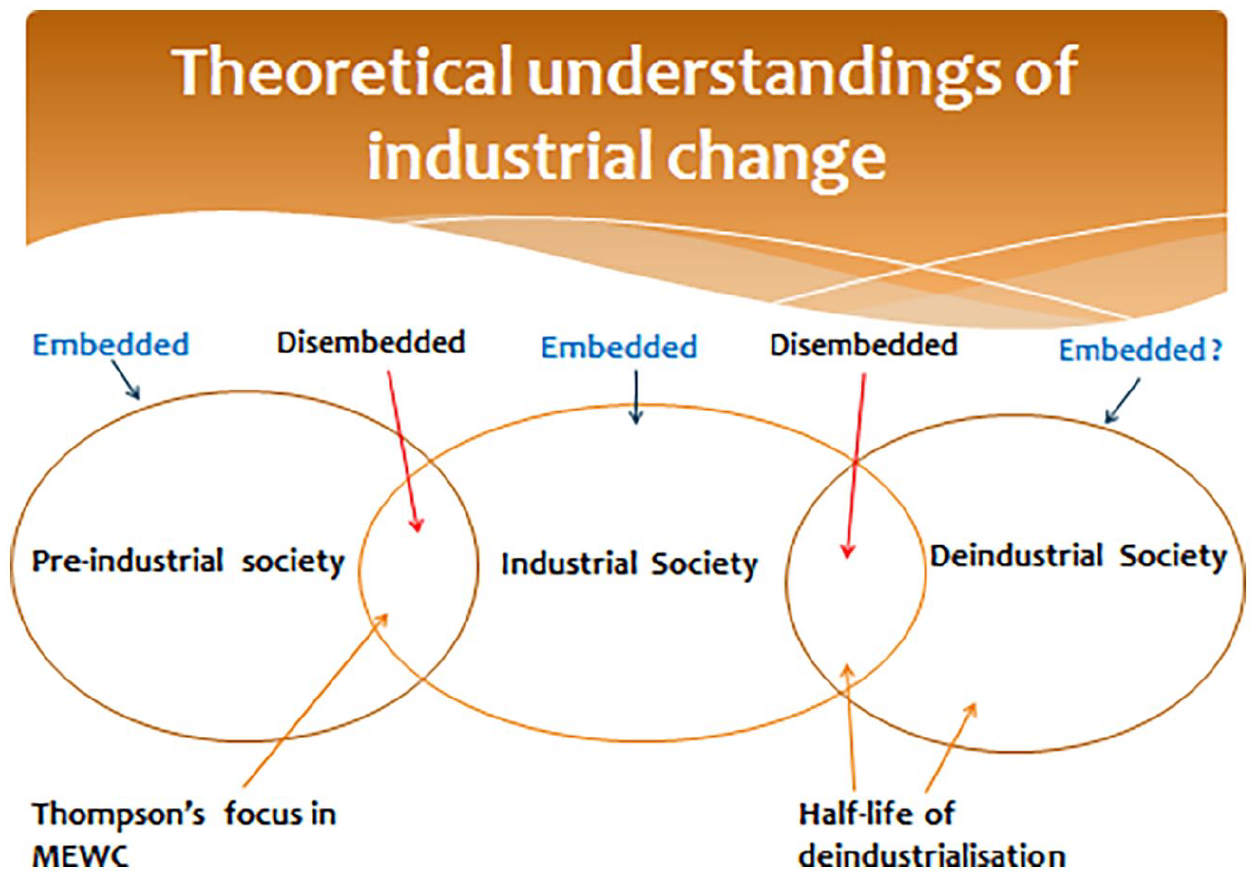
Theoretical understandings of industrial change.
Interesting for me is the question of what comes next? Linkon’s half-life is open ended, a liminal space. A place of uncertainty; for a displaced worker, or possibly an academic trying to make sense of the future. US industrial anthropologist Kate Dudley captures this liminality in deindustrialised communities when she writes of a ‘lost futurity’, a sense of hopelessness in the present with regard to possible futures. Describing the trauma of individuals and communities she notes: This trauma resides in the lost futurity that attends the anticipation and repetition of the mind-numbing awareness that our well-being does not matter to the systems of power upon which we depend. Appreciating what it takes to survive amidst working-class precarity requires tracking the affective histories of social and material landscapes that have been hollowed of economic value. (Dudley, 2021: 203)
Dudley’s writing reveals how individuals and communities not only lack hope of a better future, but have given up the possibilities of such hope emerging, so devoid are their lives of realistic projections of the future.
In a different register, Mark Fisher’s (2014) book Ghosts of My Life expresses alarm at how neo-liberalism has managed to normalise itself in our collective culture. What is longed for, he says, is not a particular period but rather ‘the resumption of the processes of democratisation and pluralism’ (Fisher, 2014: 27). As he goes on to say: What should haunt us is not the no longer of actually existing social democracy, but the not yet of the futures that popular modernism trained us to expect, but which never materialised. These spectres – the spectres of lost futures – reproach the formal nostalgia of the capitalist realist world. (Fisher, 2014: 27, emphases in original)
Fisher poses important questions for us about how neo-liberalism closes down potential futures, while simultaneously rewriting past potential too.
Making Sociological Sense of the Future
This closing down of possibilities for the future and the potential of the past is crucial for understanding how sociology might unlock the progressive potential of the future both in terms of offering ways of seeing the future as well as a more surefooted account of history itself. Sociology has always been most self-confident when it enjoys a sure grasp of history. Williams and Hall were able to draw on a historical sociological imagination in examining and critiquing the present precisely because they knew how their ‘now’ had emerged, been formed and shaped by the past. This understanding of the roots on their contemporary world and the politics and cultures that shaped it enabled them to project forward into the future potential ways of being – good and bad. It is precisely that attachment, or better still grasp of the continuities and rupture of linear time that allowed them to offer up a viable account of future possibilities and trends. This sense of history should not be reduced to legacies, contexts or relics that have given form to the present. Nor is the past ‘simply’ a haunting, a spectral presence that bubbles up from time to time, although this approach has much potential (see Gordon, 2008). Rather, history acts on individuals and societies in multiple ways simultaneously, structuring – restricting and enabling – potential presents and futures (see Savage, 2021).
This sociology of the future needs also to reflect and be aware of its own relationship to the past. Turner pointed this out when he noted how sociology can be read as a project of loss – authenticity, wholeness, rootedness. But also sociology is a project of recovery and the identification of loss in order to make sense of future possibilities. Drawing on deindustrialisation studies our contemporary moment cries out for sense making of past, present and future. Individuals, communities and arguably nation states find themselves in a liminal space, a half-life of industrial society. In this space a vacuum exists where progressive future possibilities could be discussed and shaped. The danger, already emerging, is that a narrow, regressive version of the past forms the only basis for visions of the possible.
Footnotes
Acknowledgements
I am grateful to the special edition editors and the anonymous reviewer for their critical and supportive comments on earlier drafts of this piece.
Funding
The author received no financial support for the research, authorship and/or publication of this article.
