




Abstract
While studying sociology can be empowering and transformative, fostering criticality and reflexivity, this capacity is not being sufficiently harnessed in school/college-based delivery in England. A large survey of sociology teachers revealed that they are required to teach outdated and sometimes discredited studies, which can reinforce rather than challenge stereotypes held by the privileged and which can be disempowering for those students who cannot recognise their own experiences. This article provides a unique insight into the ways that school/college curricula reinforce inequality and contributes to important debates within the sociology of education. Specifically, the article argues that the work being undertaken to decolonise the curriculum in universities, through challenging structural and discursive operations of power, should also inform the revision of school/college specifications. The lessons from this study can be usefully applied to the teaching of sociology beyond England and indeed to other subject disciplines.
Introduction
Teaching sociology in secondary schools and colleges has arguably never been more important. Focused on questions of social justice, inequity and change, sociology constitutes ‘powerful knowledge’ (Young et al., 2014: xi), integral to the development of social consciousness and social intelligence (Dewey, 1916: 9), and the building of ‘education for democracy’ (Nussbaum, 2020). In countering the societal emphasis placed on science, technology, engineering and mathematics (STEM) subjects, Shah (2020) argues that global problems of environment, mass displacement, mental illness, poverty and inequality need the social sciences to devise effective solutions. It is reassuring then to know that sociology is a popular optional choice in secondary schools/colleges in England. In terms of A-Level enrolment – a UK subject-based qualification, most usually taken between the ages of 16–18, facilitating entry to university – sociology is the sixth most popular choice in schools (Gov.UK, 2021a), and the fifth top choice with young women (Gill, 2018). Therefore, in England, in terms of uptake, the subject has great reach, a characteristic that is also found elsewhere (e.g. Chatel and Grosse, 2014; DeCesare, 2008).
However, with such widespread popularity comes a responsibility to teach sociology at its best: a duty, we contend, that is not being fully enacted. This article, in turning the insights of the sociology of education and the sociology of knowledge onto sociology itself, critically assesses the development and formation of school/college-based sociology curricula in England to explore whether the promise of a sociology education is being fulfilled. The focus of the study was on teachers’ views of the current A-Level specification, with the aim of assessing the currency and value of sociology teaching in schools/colleges and to highlight any overt and hidden/unintended impacts of the existing curriculum. Teachers are exceptionally well placed to comment on the curricula because they have practical knowledge of its content and grounded experience of its application in the classroom. Given the latitude teachers possess to develop classroom resources, their insights into how formal curriculum precepts are translated and shared by practitioners and interpreted by students is important (Shawer, 2017). It is undeniable that sociology teachers are passionate about teaching their subject (Cant et al., 2020), but our study suggests that the current specifications need radical revision, not least because they sometimes perpetuate ideas that the academy (school/college/university practitioners) consider to be deeply problematic.
Background Context
All knowledge, including sociology, is shaped by the wider social, cultural, political and economic context. The acknowledgement that an intimate relationship exists between power and knowledge (Foucault, 1980), and that school/college-based subject content itself can reproduce social inequalities – with minoritised and working-class communities consistently performing less well, especially when they encounter disconsonant curricula (Whitty, 2010) – instils a reflexive imperative to check the impact of secondary educational knowledge. In sociology, there have been, and continue to be, demands that attention is given to malestream bias for instance, and to admit that our discipline is shaped by, and constitutive of, the colonial episteme (Meghji, 2021). It is important that sociology is being challenged to acknowledge its own colonial rules of thought, and the decolonising of the curriculum, especially within universities, is beginning to be addressed (Bhambra et al., 2018), a movement that extends to many parts of the world (Connell, 2018). However, this reflexive capacity has not, until now, been turned onto the sociology curriculum in schools/colleges, which is, as we argue here, sometimes, problematic, or even prejudicial and disempowering, through reinforcing those very ideologies that sociology seeks to reveal and unsettle.
The educational context is also shaped by politics. School curricula are influenced by the ideological positions of politicians and policy makers, and so are generally underpinned by neoconservative traditionalism and technical instrumentalism. This produces little appetite to enact change, despite wider social, economic, policy and demographic changes, as Moore and Young (2001: 446) recognised: ‘In the period of 50 years since A-Levels were launched their basic structure has remained unchanged, while whole new fields of knowledge have been created and the economy and society as a whole has changed out of all recognition.’ Rata (2012: 109) identifies other influences that shape school curricula and, in particular, suggests that the shift away from mass schooling and class engagement – where educational knowledge was seen as a means of resource redistribution and social mobility – to, instead, a position where ‘national education systems are increasingly concerned with educating children for their place in a globalised world, either as the beneficiaries of globalisation or as the members of localised communities’, sees class solidarities deliberately unsettled.
Of course, sociologists of education have long noted the role of education in maintaining social order and defusing the conflictual contradictions that capitalist class relations produce, through emphasising meritocracy, and by celebrating middle-class values/knowledge (Reay, 2018). It is not just class-based inequalities that become normalised and legitimised within schools. Patriarchal and white privileges are also reinforced and reproduced (see, for example, Ladson-Billings, 1999; Mills and Keddie, 2007). Important scholarly work has established that both school and university curricula fail to be inclusive, and instead perpetuate inequality and, especially, racism (Gillborn, 1992). Jessop and Williams (2009: 104) described how ‘unintentional and subtle forms of racism were mediated through curriculum, either through the invisibility of minority cultures, or through awkwardness and/or inappropriateness in drawing on the experiences of BME [black and minority ethnic] students themselves’. This is an observation applicable outside the UK, as Ghosh (2008) notes of Canadian delivery, and Ross and Bondy (2013) revealed in American schools. While much of this research focuses on the ‘hidden curriculum’ – the norms and values that are reinforced covertly in the classroom – in this article we turn our attention to the validated/overt taught content: the knowledge that teachers are required to share with their students, and which, as we show, stands as a site where outdated stereotypes are learned and reinforced. We take our lead from Apple (2018) who argues that curricula and textbook content is controlled by right-wing cultural hegemony and should be subject to critical review. Indeed, Gewirtz and Cribb (2014: 115) regard school knowledge as directly implicated in the reproduction of inequality, while masquerading as value-free, rendering ‘capitalist, patriarchal and white sense into common sense’.
Beck (2013) describes this situation as disempowering for socially and economically disadvantaged students who need a curriculum that fosters criticality, and which unsettles entrenched power relations. He bemoans the gradual reduction of sociology teaching in schools and its restriction in teacher training, which serves to ‘deny students access to alternative ways of understanding the situations in which they find themselves (as well as restricting their cognitive horizons more generally)’ (Beck, 2013: 181). In this article, we go further to suggest that the sociology that is taught also fails to fully realise this ambition and may inadvertently derail it.
Students studying sociology in schools/colleges can be taught to be critical and questioning – it is, after all, a key disposition of the discipline (Cant and Hardes, 2021), and they can, in turn, be empowered to question the role and function of education. However, as we show, they also learn about research studies that find the root of unequal educational outcomes lodged in poor parenting and ‘deficient’ familial structures in turn associated with certain socio-economic and ethnic communities. They learn the dated ideas about the functionality of the domestic division of labour and study that while gender is socially constructed there is an incontrovertible biological essence that underpins identity. Deeper questions thus emerge. How can the sociology of education – that reveals the intimate relationship between power, politics and knowledge, be applied to the teaching of sociology itself? Does the school/college sociology validated curriculum, as it is currently configured, enact the very hidden curriculum it seeks to reveal? And does sociological knowledge itself work to discipline the ‘knower’?
In practice, in the UK, the Qualifications and Curriculum Authority sets the subject criteria to which the awarding bodies must comply, with scope for exam boards to design and change the specification. Indeed, Pointon and Wood (2007: 124) describe the curriculum as ‘light touch’, certainly for geography. However, they note that despite the freedom afforded to exam boards, the choices made regarding the content of the specification are still often traditional. Moreover, Whalley (2020) argues, again about geography, certain topics are poorly discussed and there are errors and misinformation in some exam board endorsed textbooks that need to be addressed. For Standish and Sehgal-Cuthbert (2019), getting the curriculum right is at the heart of excellent education but, to date, the sociology specification has not been subject to such critical analysis, a gap that this study sought to address.
Existing research about the sociology curriculum and specification is predominantly concentrated in the USA or is focused on university-level education. The research suggests the need for more inclusive, global sociology (Berheide, 2005; Dennick-Brecht, 1993; Sohoni and Petrovic, 2010; Wagenaar, 2004). In the UK, it is argued that the ‘culture of sociology emphasises critique over analysis, theoretical positions, and qualitative over quantitative methods of enquiry . . . at all levels of teaching, from preuniversity A-Level teaching through to postgraduate training’ (Williams et al., 2017: 132). Cant et al. (2020) showed that some of the A-Level content is outdated, and others have noted that the curriculum does not sufficiently harness the digital and quantitative affordances within the discipline (Buckley et al., 2015; Nuffield Foundation, 2012; Payne, 2014; Ridgway, 2012; Wilder, 2010).
In England, there are three A-Level sociology specifications validated by competing awarding bodies. All are underpinned by the sociology curriculum precepts determined by government (Department for Education, 2014) and which permit broad interpretive freedom by the awarding bodies. The expectation is that the A-Level will focus on contemporary society, but there are no time frames set for this. The curriculum must recognise diversity and emphasise the relationship between the individual and social structures – the essence of the sociological imagination (Mills, 1959). It is established that students must explore both theory and methods and that they should have opportunities to apply their knowledge. Any guidance about actual content is slim but includes order, control, change, conflict and consensus, values and policy, and there is requisite guidance that two substantive issues must be included, namely: (1) socialisation, culture and identity; (2) social differentiation, power and stratification. There are then broad prerequisites but, generally, there is great latitude for innovation and development afforded to the awarding bodies, which, in turn, variously, focus on the topics of education, crime, family and relationships, with optional opportunities to explore health, media, youth subcultures, work, poverty and welfare, culture and identity, religion, belief and faiths, and global development. The theoretical focus is directed at consensus, conflict, structural and social action theories, and encompasses post- and late modern ideas, as well as debates about whether sociology can be considered a science. Ostensibly, then, schools/colleges deliver a broad, staple menu, which has remained largely unchanged for many years, and it is timely to evaluate both the content and the emphasis of the current offer.
Getting the curriculum right is not simply a matter of being reflexive about content. Good delivery is premised on teachers being able to contextualise and, when appropriate, question some of that content. This is more likely when practitioners have disciplinary expertise (Standish and Sehgal-Cuthbert, 2019). However, as previous research has shown, sociology is often taught by non-experts (Cant et al., 2020). This situation may stymie the opportunity for sociology to be ‘powerful’, as Young (2011: 277) describes:
Nowhere in the education system is the lack of specialist subject teachers more crucial than in the part it plays in perpetuating the divisiveness and incoherence of the 14–19 curriculum. This is where specialisation begins and the form it takes will determine the kind of curriculum we have.
Teachers, experts or otherwise, also have latitude to develop their own lesson planning, and indeed are encouraged to do so, but often do not have time to produce bespoke materials, nor feel that they will be rewarded for innovation and extra effort (OECD, 2009). As such, teachers, globally, are reluctant to deviate too far from textbook content (Knight and Wang, 2015; Pinto et al., 2011) and, in the context of the UK, materials listed in the specification.
In the context of this research, we determined that teachers were best placed to explain and evaluate the experience of teaching sociology. Indeed, Pring (2018: 1) argues that to properly assess the strengths and limitations of the current specifications, it is imperative that the ‘beliefs, traditions and values of those who teach’ are elicited, and teachers have been long recognised as important stakeholders, a social community, which is both knowledgeable and central to enacting curricula change (Kerr, 1968).
Methods
To elicit a large sample of teachers that might represent the community, achieve an understanding of how teachers viewed the curriculum and, importantly, hear a teacher-initiated voice, a semi-structured questionnaire was designed. Input for the design was elicited from sociology teachers and exam boards to ensure full stakeholder participation, and an online launch in February 2021 via Qualtrics was secured. Teachers engaged extensively with the open-ended questions, generating over 54,000 words, and this afforded such rich insights into their views and experiences of teaching sociology that it was not deemed necessary to develop follow-up qualitative interviews. Moreover, we achieved detailed qualitative responses from a much larger cohort of teachers than an interview/focus group study alone could have produced.
It is difficult to assess the percentage of teachers that responded as no official UK database of sociology teachers exists. The Department for Education calculated that there were 162,250 secondary school teachers in 2020 (GOV.UK, 2021b) and, from this workforce, 35.3% of teacher time was spent on non EBacc subjects (the English Baccalaureate (EBacc) is an accountability measure in England that measures the proportion of children who secure a grade 5 or above in English, Maths, Science, a humanity and language qualification at the age of 16). Sociology is classed under ‘Other social sciences’, which includes teachers of law, politics, psychology and sociology. Data from 2019 indicated that there were 8471 teachers falling into this category, 7161 teaching A-Levels, but this overall figure does not help understand how many teachers offer sociology. A previous study (Cant et al., 2020), however, estimated that there were just over 1000 teachers of sociology in England in 2019.
The study was advertised via exam boards, the British Sociological Association (BSA), online fora and through research team contacts across the UK. Several prior studies attest to the use of social media sites as viable advertisement platforms for recruiting research participants (e.g. Ali et al., 2020), and the use of exam board Facebook pages and endorsements by the BSA and sociology teachers on Twitter might have bolstered the response rate for this study. Data was collected over four weeks and a total of 416 teachers responded, an excellent response to an online survey, with some variation in level of response by question. Most responses came from England (94.5%: 393) and therefore constitute the focus of this article. If we assume that the number of schools offering sociology has remained stable since the last major study (Cant et al., 2020), just under 40% of sociology teachers in England completed the survey.
While we acknowledge significant pitfalls associated with online surveys – especially, the problems of missing responses, the inability to check bias and representativeness, and chances of duplication (Ball, 2019), we were assured that our sample of English teachers was largely representative of the wider teacher workforce (GOV.UK, 2021b). Our sample was predominantly female (77% [75% in wider workforce]) and mostly self-identified as White British (75% [85% in wider workforce]).
To address any potential privacy issues associated with online recruitment of participants through social media boards, several measures were taken. These included: the provision of an information sheet that described the importance of the survey, research objectives and clear steer about the time it would take to complete the survey. Voluntary consent was secured through a filter question and all data was stored in encrypted files.
The survey included 56 questions and collected data on sociology teachers’ views about the strengths and shortcomings of the sociology curriculum and the current specifications, as well as their evaluation of the main textbooks, and the resources and support available to them. Data was also collected about the characteristics of the schools/colleges in which teachers worked as well as additional demographic information. Most teachers identified as heterosexual (88%) with a further 9% preferring not to answer; 18% were under 30 years of age, with teachers in their 30s and 40s each constituting 30% of the sample, 17% were aged over 50 and a minority (2%) were over 60 (3% preferred not to answer); over half (55%) identified as working class, the remainder as middle class. The descriptive quantitative analysis for the multiple-choice questions used Qualtrics and included only those teachers that responded to the specific question. Qualitative responses were sorted by theme and analysed using the NVivo software (Version 12). In this article, we focus on teachers’ views of the A-Level curriculum in England.
The Sociology Specification
Ostensibly, in England, teachers can make a choice between three competing A-Level examination boards. However, for the most part, teachers did not draw on this facility. For most respondents the selection of exam board was a legacy from a previous decision made by the school/college (38%), and a further quarter (26%) of teachers had always made the same choice in whichever school/college they taught. Overall, then, almost two-thirds of teachers had either inherited the specification or were happy to continue with their usual practice and had not scrutinised the content for best fit within their own classroom.
That most teachers had not made a recent or proactive decision to change/maintain their affiliation with a specific exam board may be explained by the fact that they were largely happy with the specification, as suggested by the quantitative data. For instance, most respondents (87%) agreed that the specification was ‘engaging’, and two-thirds ‘liked’ the specification overall (66%). This positive endorsement was explained by the fact that they valued the empowering promise of sociology. Indeed, teachers were keen in the qualitative opportunities to extol the virtues of a sociological education and challenge the public perception that it was an easy subject:
I think sociology is the best subject. I have numerous emails from past students saying that it has been so beneficial and has ‘opened their eyes’. I am lucky to be a specialist, and this does make a difference. My department has grown mainly because of my enthusiasm and love for the subject.
However, despite overarching support for the subject, important and widespread concerns were raised. More than half of the respondents (59%) chose to describe the sociology specification as ‘dated’. Similarly, 51% of respondents did not think that the sociology specification was ‘inclusive’. Teacher critiques were elaborated extensively in the qualitative comments and coalesced around three prevailing themes – too much content, outdated studies and discredited ideas.
Content Heavy
Muller and Young (2019: 206) emphasise that it is the ‘inner dynamic property’ of a discipline rather than ‘a simple content list that makes knowledge powerful’ and stress how a congested curriculum that lacks conceptual focus and clear progression can invalidate its promise. From this perspective, a school/college curriculum that emphasises a checklist of topics to be covered without rigour and conceptual development can jeopardise the disciplinary framework that breathes life into a particular subject. The sociology teachers strongly suggested that the curriculum was focused on quantity rather than quality, and that this impeded the development of powerful, critical knowledge and deep learning.
A significant number of respondents described the sociology curriculum as content heavy with insufficient attention given to conceptual development and understanding. Teachers also indicated that this adversely affected pupils’ appreciation for the subject:
Overall, I find the amount of content very overwhelming and it is the same feedback that I get from students year after year. Many find it is off-putting and I often find myself moving on from topics I would love to explore in more depth because of time worries. There is too much content, and it becomes a memory game.
Consequently, many teachers bemoaned the removal of coursework from the assessment portfolio, which they saw as limiting the opportunities for students to apply the sociology they were learning from textbooks to their own questions and concerns:
It requires lots of knowledge but at a shallow level, students should have the opportunity to engage with something that they are passionate about at a deeper level and would be able to better apply theory and learn about methods . . . Bring back coursework.
As such, the joy of studying sociology and seeing its enduring relevance was arguably curtailed:
It is a lot to cram into two years, I feel like I’m doing my best to get through the content and lose the ability to foster a love of learning. I would love to be able to have the time for more focus on debates on contemporary issues and follow what students want to learn about.
And this experience was reinforced by institutional changes, where extensive content had to be delivered in shorter time frames and to a larger number of students. Overall, teaching sociology was described as cramming rather than debating and applying:
Too much content. It gets in the way of ensuring students have a deep understanding. With the cuts . . . endured under austerity, there is less teaching time and bigger class sizes . . . We need more time to revisit topics and build a spiral curriculum.
Participants also asserted that the concentration on regurgitative content promoted an instrumental approach, with students taking a narrow focus on exams and grades. In this context, they found it difficult to encourage students to go beyond the bare essential knowledge necessary to pass the examinations. Even though almost all teachers in our sample were keen to go beyond the textbooks (96%), they believed that students were not always able or willing to engage with this effort, and the teachers themselves were concerned that this additional knowledge would not be given credit in examination responses. For example, this teacher described student reservation: ‘they are nervous of this affecting their grades’.
Overall, having too much content in the textbooks meant students and staff were overly focused on memorising material and there was a reluctance to engage with more recent research that was not cited in exam board endorsed sources.
Outdated Knowledge
Yet, specialised knowledge becomes powerful when it is ‘systematically revisable’ and ‘emergent’, produced in response to wider social conditions and contexts (Young and Muller, 2013: 237). Teachers, however, identified several areas within the curriculum that they did not enjoy teaching in their qualitative commentary, as coded below using NVivo. As Figure 1 shows, research methods were the most disliked (deemed ‘dull’), whereas theory was more often described as ‘difficult’. Teaching the topics of the family, education and beliefs was also regarded as problematic because of the outdated content. Of course, it is important for students to learn about classic studies, and so the observation of datedness pertained to those studies deemed no longer relevant and sometimes disempowering.
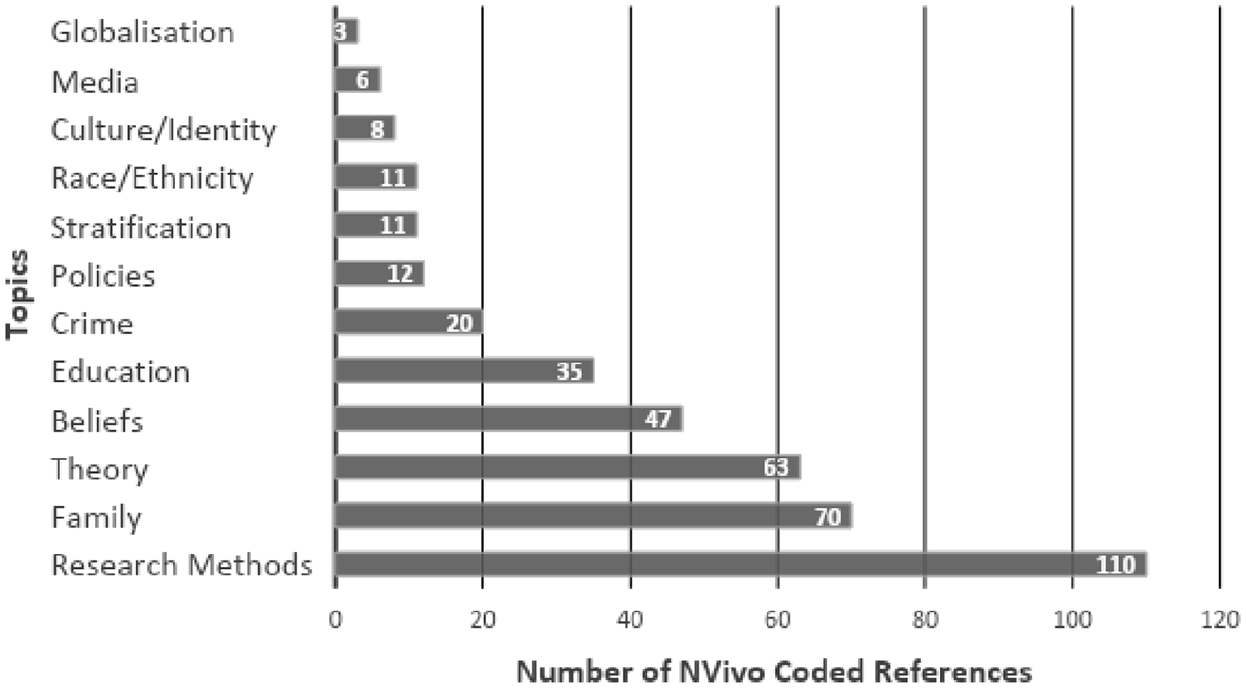
Topics teachers least enjoy teaching.
A prevailing theme in teachers’ qualitative comments was the lack of appropriate as well as contemporary sociology. This example, represents the nearly 150 responses calling for immediate revisions:
There needs to be a rethink of how to phrase the specification so that you don’t have to explain how sociologists saw society in the 1960s/70s/80s. This occurs for example in the gender roles and relationships topic for the family; the theories of crime and social class differences in educational achievement. I have a keen interest in sociological theory, however, when teaching theory and methods there seems to be a lot of old-fashioned issues and debates to cover.
Teachers suggested that dated material, especially that regarding ethnic differences in educational performance and crime rates, should be removed rather than added to, thereby avoiding the encyclopaedic character of the current specifications, and enabling more careful consideration of the research evidence:
It would be good to update some of the differentiated areas which are a bit mundane and old. We seem to add things and must race through topics rather than explore them. Definite updating needed to link with ethnicity.
The inclusion of important and contemporary sociological concerns, which would also chime with student interest, was demanded. Teachers desperately wanted support for this, lacking access to recent research and the time to update their own knowledge:
As a teacher of sociology for 15 years, I would love it if the awarding bodies worked with universities to provide updates on research – such as a review/journal we could subscribe to as it is hard to access academic journals/recent publishing if you’re not in a Higher Education setting yourself.
Most revealing was the concern that the current specification reproduced ideas that teachers recognised as not simply redundant but also problematic:
The studies NEED to be updated – those on the specification from [name of textbook] need to be freshened up so we can push sharing contemporary work with students, they can get frustrated with looking at studies from over 40 years ago! Also, the studies that address Black and Asian communities covered by the specification can be VERY outdated. The studies then need to be shared with teachers so we can be as informed on them as possible (e.g. methods used, sample size, etc.) as students do ask these questions and sometimes the information is not readily available.
Teachers were uncomfortable, as we explore further below, teaching those studies that portrayed some communities as ‘deprived’ or ‘deficient’ and wanted to be able to contextualise and indeed counter some of the research findings that students were being required to uncritically learn. As an antidote to this situation, teachers appealed, especially, for the inclusion of more research on racism and critical race theory, as well as more careful and inclusive discussion of sexual and gendered identity:
A perspective that focuses on ethnicity, in the same way we already have perspectives for gender and class. A greater focus on transgenderism/transsexuals when discussing feminism (recent TERF [trans-exclusionary radical feminist] debates regarding gender and rights etc.) and representations of transgender in media representations lessons.
Discredited and Disempowering Knowledge
Given the widespread calls for the revision of sociological knowledge, to recognise the omissions of colonial history and racial violence (Alexander and Weekes-Bernard, 2017; Bhambra, 2007; Rudolph et al., 2018; Virdee, 2019), it is disquieting that several stereotypical ideas are still perpetuated in the school/college curriculum. Teachers found it immensely difficult to teach cultural deprivation theories, for instance, which tend to blame class and ethnic cultural values for differential life chances. In shortened, bite-size form, some of the nuance of classic Bernsteinian ideas, for example, was reduced to crude deficit models in the A-Level texts. There were also concerns about the underrepresentation of certain scholarly work and the ways that the specification reproduced a white, male, middle-class, cis normativity.
It is important to contextualise these findings by reference to the demography of sociology students in England and the type of school/college in which sociology is being studied.
Sociology in England is predominately taught in comprehensive schools (44%) and sixth form colleges (18%) (see Table 1), a finding corroborated by Gill (2018), and is much less likely to be offered in non-selective schools – establishments that tend to attract children from predominately middle-class backgrounds. Indeed, A-Level Sociology has the highest proportion of students from disadvantaged backgrounds (Plaister, 2022). Moreover, while most teachers were based in co-educational schools (90%), the survey data and national statistics suggest that girls are more likely to study the subject (Gill, 2018). While the Department for Education (GOV.UK, 2021c) statistics suggest that 32.1% of pupils in secondary education are defined as being of minority ethnic background, schools in our survey varied in their ethnic composition (see Table 1). Most schools were described by teachers as having low ethnic diversity – with the majority (40%) indicating their school/college had fewer than 10% of minority ethnic origin pupils. Yet, about one-fifth of the sample also reported teaching at very high ethnically diverse schools/colleges with 50–75% (10% of sample) and over 75% (9%) pupils from minority ethnic origin backgrounds. Thus, teachers suggested that sociology was a popular choice across all ethnicities and that in some schools their classes were predominately taught to minoritised students.
Teacher’s description of school characteristics.
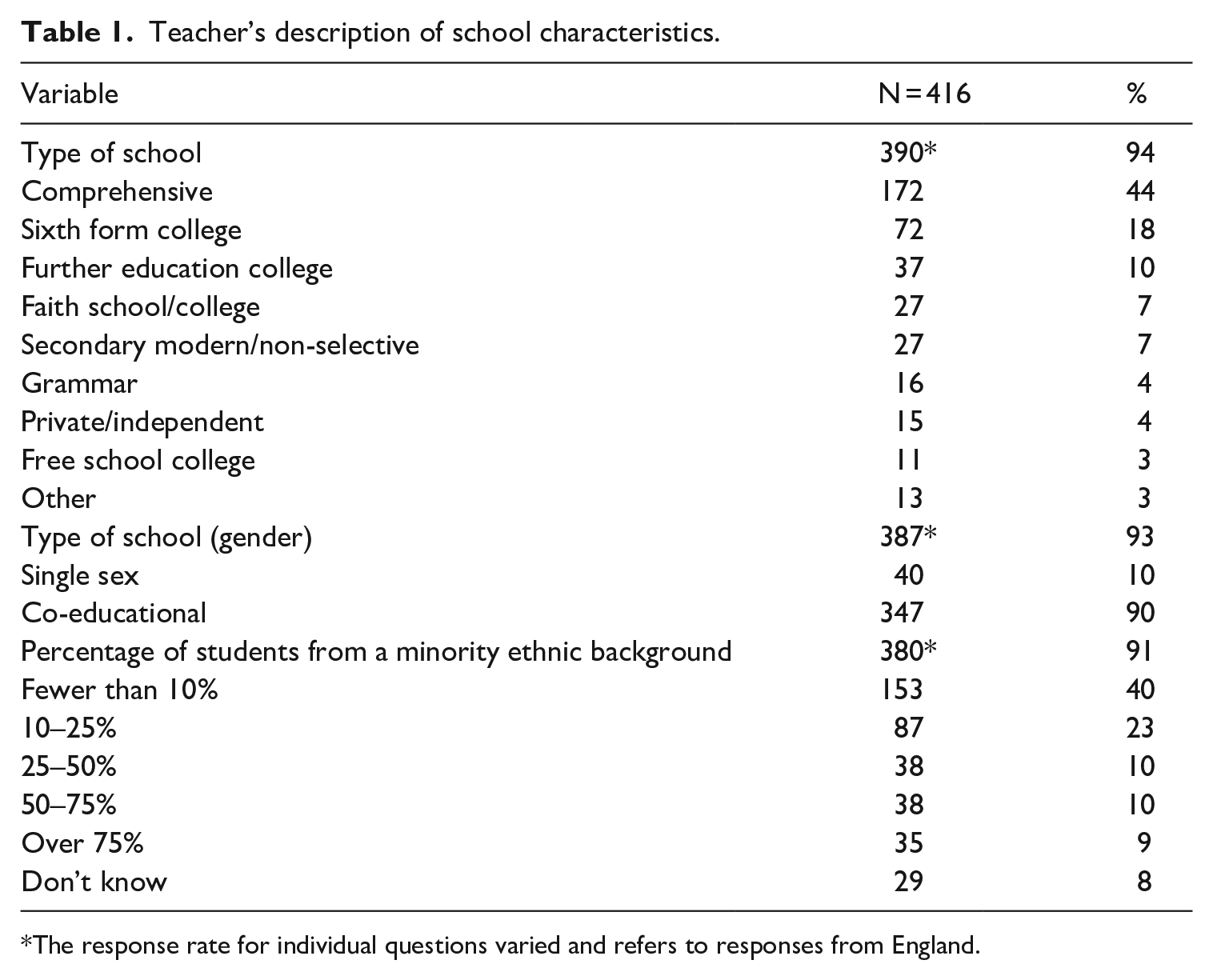
The response rate for individual questions varied and refers to responses from England.
Sociology then has a responsibility to be cognisant of its impact. However, two specific dangers with the current curriculum were identified. First, teachers were concerned about the reinforcement of stereotypes among students with privileged positioning, as the following quotations reveal:
Teaching ethnicity is quite challenging. The school I teach at has very little ethnic diversity and I fear that there is often a danger of perpetuating prejudices from the materials and studies cited in the materials/textbooks. As a predominantly white school it is hard to teach about BAME [black, Asian and minority ethnic] groups in all contexts as the resources seem outdated and tokenist, and perhaps do not encapsulate the experiences felt by groups. I do worry that I perpetuate this in my own teaching, as hard as I try not to. Trying to explain gender inequalities to affluent boys who don’t understand prejudice!
Second, teachers argued that students from minoritised communities often felt disconnected from, and disempowered by, the dated research studies that they were obliged to learn:
Anything to do with ethnicity can be tricky as much of the material feels outdated and occasionally stereotypical. Social class needs to be handled sensitively too.
Teachers pointed to the persistence of the white, male, heterosexual, middle-class perspective and how this served to exclude under-represented communities:
There could be more focus on up-to-date research evidence. I am still teaching some of the same core content I studied in my A-Level. There is also an underrepresentation of minority groups in some areas of the specification, with a significant focus on the white British ‘norm’.
There was therefore support for decolonising the curricula:
It often feels like I have to make a real effort and go outside of the curriculum to ensure I’m not just teaching the thoughts and findings of white men. Current specification is euro-centric with an overemphasis of dead white men. There is a lack of signposting to intersectionality and a lack of positive imagery of disadvantaged groups.
Several teachers drew attention to the negative spotlight that was shone on minoritised ethnic groups and deplored the requirement to rehearse the findings from research now considered to be racist and inappropriate. They explained how research that describes the successes of ethnic minority group communities is not adequately represented in the textbooks, and there were strong demands that this imbalance be addressed:
I would like C.W. Mills’ sociological imagination to be explicitly [turned] on the specification. I would like the topics on crime /education / stratification to include focusing on positives from the BAME community. E.g. increase of positive male role models in black households. I’ve always found it deeply uncomfortable teaching general patterns in crime/education etc., that show ethnic minority communities in a negative light. There is limited time to teach the positives, and these are not explicit in current specification.
Another said this:
The Education topic feels out of date in a number of areas, especially on ethnicity. The proof on institutional racism appears thin and it ignores how black children are now doing better than before in education.
Having to teach outdated material was regarded as often embarrassing:
Not difficult to teach, but uncomfortable when teaching some more outdated theoretical approaches that apply stereotypical ideas about ethnic minority groups and working-class attitudes. Whilst I am aware that some people in society hold these views, a broader range of materials could be used to more sensitively approach these topics in the 21st century.
And there were fears that there was not space to challenge some of the assumptions and, moreover, that critical reflexivity would not be rewarded by the exam boards:
I feel like I often have to apologise on behalf of the specification and assessment objectives for the focus on outdated ideas such as Asian extended families or working-class parents placing less value on their children’s education. I feel like the evaluation of those types of ideas, such as not victim blaming working-class parents who may feel intimated rather than simply ‘not caring’, are left to come from me personally as the teacher and that there would not be enough reward for students for being quite this evaluative on the exam paper.
Overall, teachers wanted the specification to be updated and with the right support, resources, and time, and with reassurance that different content would be valued, they were keen to enact this. However, the lack of subject expertise was also recognised to be a barrier to innovative curriculum design.
At present, as we have shown, sociology teachers are not currently documented by the Department for Education as a distinct category, classed instead as ‘other’. Our survey revealed that a little more than a third of the participants in the sample held a sociology degree (38%), although another 27% had studied some sociology. This said, most respondents indicated that they had been teaching for more than a decade (67%) and considered themselves, as a result, to be a specialist in their field (85%), irrespective of university training. However, not having a sociological background meant that, for many, their capacity to think reflexively about the content and delivery of the discipline had some limitations. They described being under confident when deviating from the textbook, felt less able to question or contextualise some of the dated research and faced difficulties when having to tackle challenging content:
As a non-specialist, I have found it hard to make some of the information engaging or break it down enough to be fully digested by the students. It can be difficult for students to understand that they need to be ‘thinking and speaking like sociologists’ and realise it’s all about presenting a debate – not necessarily stating facts.
These observations highlight the imperative of not only developing an inclusive, up-to-date and careful educational programme suited for all students, but also of the need to provide adequate support for teachers so they are able to deliver disciplinary knowledge with context and confidence.
Discussion
Sociology is a critical and analytical discipline: uniquely tasked with studying and questioning the human-made social world. The sociology of education, for example, is replete with studies that reveal the hidden curriculum and which chart and explain enduring inequalities. To be sociological demands reflexivity and sociologists are cognisant that their own knowledge, while aiming to be objective, is shaped by prevailing social, political, economic and cultural conditions. These insights demand that our own rules of thought, ways of knowing, research questions and methodologies are subject to critique and revision. Taken together, these dispositions mean that sociology has the capacity to be powerful and transformative.
Yet, as this study has revealed, these critical dispositions are not being fully applied to the teaching of the next generation. Rather, the overt (validated) content of sociology specifications in schools/colleges in England is described as content heavy, often outdated and, sometimes, dangerously disempowering. Indeed, we can go so far as to suggest that parts of current sociology specification are directly implicated in the reproduction of inequality. There is then an imperative to remove certain studies, teach classic sociology with care and to update the content, centring the teaching of contemporary theory and research to foster critical and careful engagement.
While many scholars have argued that school curricula reinforce and reproduce inequality, most attention is given to the hidden curriculum and not to the overt textbook content and the teacher experience of what it is like to navigate and deliver specified content. As such, there is little empirical examination of the ways in which inequality is enacted in the classroom (Henry, 2021). This study is therefore unique in its revealing of the ways in which choices about curriculum content are implicated in the unquestioned reinforcement of hegemonic ideas and stereotypes. This is perhaps even more important considering that sociology is taught to a disproportionate number of disadvantaged students.
The teachers, while positive about the promise of sociology, were often uncomfortable with the way that the curriculum content choices had been formed: seeing it failing to instil a questioning disposition because of the emphasis on memorising vast swathes of material, and more concerning, implicated in perpetuating the very ideas that contemporary sociology seeks to debunk. Sociology already has a reputational battle to fight in establishing itself as a credible science and facilitating subject and, therefore, having a dated curriculum can only render the campaign to establish the worth and status of sociology more difficult. Again, this is not to simply suggest that all classic studies are removed, but rather that attention is given to which aspects of the canon should remain, which should be taught with careful contextualisation, and which should be now regarded as redundant. Ensuring that curricula are inclusive and decolonised requires the removal of content as well as the extension of reading lists.
The current specification is highly traditional, encyclopaedic and often conservative, sometimes finding explanations for socio-economic and educational differences, for instance, as rooted in family formations and cultural values, without giving fulsome and careful attention to broader issues of social structure, without debating the nuance of these positions, and, more worryingly, without citing contemporary and conflicting evidence. As such, at a minimum, the sociological specification needs to be updated with more recent studies.
However, we want to go further to suggest a more radical revision of the specification is necessary. First, teachers need to be supported with resources that detail the complexity and nuance of some sociological positions. Second, school/college-based delivery needs to learn from the steps already being taken to decolonise the university curriculum, and it is imperative that similar reviews of the A-Level curricula are undertaken. In sum, a relatable sociology specification needs to challenge taken-for-granted and dated ideas about ethnic divisions, gender roles and gender identity, and needs to assert the continuing importance of a sophisticated and critical analysis of social class. There is an absence of work by black scholars and a dearth of studies that challenge white, middle-class and male normativity. In its present configuration, the specification is problematic, and arguably even prejudicial, in its reinforcement of invalidated stereotypes. Far from being inclusive, some of the A-Level content is experienced as disempowering by teachers and their students, a finding that might well stand for other specialist subjects. But, given that sociology has an opportunity to empower socially and economically disadvantaged students, not least because take up of the subject is higher in comprehensive schools and among disadvantaged students, the curriculum has an added responsibility to be careful and considered.
Sociology is one of the few disciplines that can challenge rampant individualism and culture blaming and can, instead, foster a disposition towards the collective. It is a tragedy that this capacity is not being fully realised. Considering that awarding bodies are, perhaps inevitably, reluctant to radically revise the specification, teachers find themselves powerless to enact change in the classroom. This powerlessness comes from the constraints of time, the lack of access to teacher-friendly resources, fear that their inclusions might disadvantage their students and from some lack of subject expertise rather than the absence of interest or commitment. That so many of the respondents were motivated to complete the survey and extend thanks for our interest, is testimony not just to their passion, but also to their need for advocacy. University scholars and the professional associations need to be central to the campaign to revise the specifications, not simply by lobbying for change, but through offering their expertise and insights to train sociology teachers and inform debates about curricula content. Only then can we ensure that the education of the next generation is not left to chance.
By reflexively turning the insights of the sociology of knowledge and the sociology of education onto the composition and delivery of the sociology curriculum itself we see the opportunities that a sociological education can afford, but also its limitations and dangers. Teaching dated and problematic studies without a strong counter argument and without critique and context, serves to reproduce inequity rather than unsettle it. In so doing, sociology unwittingly leaves the knower disempowered and the promise of sociology unfulfilled.
Footnotes
Acknowledgements
The authors would like to thank the sociology teachers for their time and care in completing the survey and the Sociology editorial team and the two anonymous reviewers for their constructive feedback and helpful suggestions.
Funding
The authors received no financial support for the research, authorship and/or publication of this article.
 ‘Medical pluralism, mainstream marginality or subaltern therapeutics? Globalisation and the integration of “Asian” medicines and biomedicine in the UK’, Society and Culture in South Asia 6(1): 1–21.