




Abstract
Europe has recently become closely associated with LGBTQ rights. It remains unclear, however, what is the role of this association in everyday European imaginations and identifications. Empirical research on European identity hardly ever discusses the role of LGBTQ rights. Nor do we know much about European identifications of LGBTQ people themselves. In this article, I address those gaps from the perspective of Polish LGBTQs in the UK. Drawing on 30 interviews from a recent two-year research project, I discuss my participants’ European imaginations and identifications by developing the concepts of ‘uncanny Europe’ and ‘protective Europeanness’. I show how my participants tend to view Europe as ‘diverse’, ‘open’ and ‘tolerant’, while attributing those characteristics exclusively to Western Europe. I also demonstrate that they tend to readily identify as European in the context of increasingly hostile national identities, with the increasing anti-Polish xenophobia in the UK and growing anti-LGBTQ discrimination in Poland.
Keywords
Introduction
When Conchita Wurst, a bearded drag queen, won the Eurovision Song Contest in 2014, Adam Hofman, then a spokesperson of the Polish nationalist-conservative Law and Justice Party (PiS), reacted: ‘Conchita Wurst is a symbol of Europe that I don’t want. This is not my Europe. My Europe is based on Christian values [. . .] Conchita Wurst is a symbol of the direction Europe takes’ (RMF FM, 2014). In that moment, Wurst’s performance and persona came to stand for everything ‘European’ that the right-wing politician rejected. Sociologists and political scientists agree that, in the last decades, LGBTQ 1 rights have become one of the key characteristics associated with Europe, part of a larger project of defining European values along the principles of democracy and human rights (Ammaturo, 2015; Ayoub and Paternotte, 2014; Mepschen and Duyvendak, 2012). As Ayoub and Paternotte (2019: 2) point out, ‘Even among the most random bedfellows’ – from Conchita Wurst to Vladimir Putin – ‘there seems to be broad agreement that LGBT rights are part of European values’.
It remains unclear, however, to what extent Europeans share the view that Europe has been reimagined as ‘Rainbow Europe’ (Ayoub and Paternotte, 2014). In the vast body of empirical research on European identity there is hardly any discussion of the role of LGBTQ rights in European imaginations and identifications. Nor do we know much about European imaginations and identifications of LGBTQ people themselves, which is why Ammaturo (2015: 1162) calls to ‘investigate the extent to which LGBT persons themselves feel part of a transnational European political community’. Do they see Europe as LGBTQ-friendly? Which countries, cultures and people are included in those imaginations of Rainbow Europe? Do such imaginations help or hinder the promotion of European identity? Under what circumstances? And for whom?
In this article, I address those questions from the perspective of Polish LGBTQs in the UK, drawing on 30 semi-structured in-depth interviews conducted as part of a recent two-year research project into identity, migration experience and social media use of this group (Szulc, 2019b). There are several reasons which make the focus on this group compelling. Unlike the general population in the European Union (EU; Eurobarometer, 2019), most of my participants readily identify as European. This helps to understand some motivations behind strong European identifications and the role of the Rainbow Europe imaginations in this regard. My participants were also embedded in two cultural contexts located in Western Europe and Central and Eastern Europe (CEE), which illuminates the division between the so-called ‘European core’ and ‘European peripheries’ and its role in European identifications (e.g. Arat-Koç, 2010; Kulpa, 2014). Additionally, the interviews were conducted at the time of increasing anti-Polish xenophobia in the UK 2 in the context of Brexit (Rzepnikowska, 2019) and growing anti-LGBTQ discrimination in Poland after PiS won the 2015 parliamentary elections (Szulc, 2019a). Research conducted in such troubling times helps to shed light on the potential of European identity to provide an alternative to and escape from increasingly alienating national identities.
This article first explains a relatively recent tendency to inscribe LGBTQ rights in the imaginations of Europe and reflects on the position of European peripheries, especially CEE, in those imaginations. It then discusses European identity by providing its definition, summarising the literature on this topic and zooming in on the role of ‘catalysing moments’ (Castells, 2018: 192), such as Brexit and the PiS election win, for weakening or strengthening European identifications. Next, I describe my methods and participants, and present my research findings. In two separate parts, I discuss my participants’ European imaginations and identifications respectively by developing the concepts of ‘uncanny Europe’ and ‘protective Europeanness’. The former explains ambivalent imaginations of Europe that feels both familiar and alien, and the latter points to the appeal of European identity in the face of increasingly hostile national identities.
European Imaginations: Rainbow, Fortress and Freezer Europe
Europe is ‘a political, cultural, economic, and discursive formation’ (Boatcă, 2020: 2), a place which includes a set of imaginations about its essence, territory and history. In line with Rao’s (2020: 47) theorisation of place as temporal, processual and relational, Europe should not be considered as a discrete, bounded entity but rather as a dynamic project, which can take on different meanings for different people at different times (e.g. Balibar, 2009). At the same time, particular meanings stabilise over time and are not easily rearticulated. Scholars point out, for example, that Europe has been persistently imagined as White and Christian, at least at its foundation (e.g. El-Tayeb, 2011; Sayyid, 2018), and ‘hailed as a standard of civilization, modernity, development, capitalism, or human rights’ (Boatcă, 2020: 2).
In recent decades, LGBTQ rights have been used as one of the key indicators of these allegedly uniquely European qualities, for which Ayoub and Paternotte (2014) dub Europe ‘Rainbow Europe’. This is clear at the level of European institutions, especially the EU, which has gradually included LGBTQ-related issues in its regulations, for example by introducing asylum rights based on sexual orientation and gender identity (Danisi et al., 2019), and adopting LGBTQ issues as accession criteria (Slootmaeckers and Touquet, 2016). It is also evident at the level of politics (e.g. some politicians referring to Europe as ‘Eurosodom’ or ‘Gayropa’, Cushman and Avramov, 2021), activism (e.g. LGBTQ activists employing Europe as a normative frame for shaping mobilisation, Ayoub and Paternotte, 2012) and popular culture (e.g. the Eurovision Song Contest dubbed the ‘Gay Olympics’, Baker, 2017).
The idea of Rainbow Europe serves not only to affirm the European Self but also to create Europe’s external sexual Others. Ammaturo (2015) and Colpani and Habed (2014) build on Puar’s (2007) concept of homonationalism to propose the idea of European homonationalism: Europe’s self-reinvention as essentially and historically LGBTQ-friendly, and the employment of this rhetoric to cast racialised Others (especially Muslims, migrants and refugees) as inherently LGBTQ-unfriendly. Consequently, Rainbow Europe is used to reproduce the idea of Fortress Europe in relation to gender and sexual liberation: Europe as a ‘sexual fortress under siege’ (Colpani and Habed, 2014: 74) that needs to protect its borders from allegedly sexist and homophobic, as well as sexually predatory, external Others.
Considering that many Central, Eastern and Southern European countries continue to construct their dominant national identities based on exclusion rather than inclusion of LGBTQs (Colpani and Habed, 2014; Mole, 2016), the idea of Rainbow Europe seems to primarily refer to Western Europe. 3 Arat-Koç (2010: 182) explains that neither the end of the Cold War nor the eastern enlargements of the EU radically redefined the meaning of Europe, which continues to be ‘economically, culturally and politically defined by Western Europe – defining itself as the true, real Europe’. Conceptualised this way, Rainbow Europe is employed instrumentally to create not only external but also internal sexual Others, the latter including especially Central, Eastern and Southern European peripheries. European institutions and western politicians use the rhetoric of Rainbow Europe to shame, discipline and manage the peripheries. Kahlina (2015: 75), for example, focusing on western discourses about Pride Marchers in Croatia and Serbia, points out that their absence or violence against their participants ‘came to be used as one of the most visible markers of “Eastern European difference” that has framed this region as not “European” enough’ (see also Kulpa, 2014).
The mechanisms of the construction of Europe’s external and internal sexual Others, while similar, are not identical. Both kinds of sexual Others are defined by a combination of spatial and temporal characteristics: located outside Western Europe and positioned ‘out of time’ (Rao, 2020: 1). I want to suggest, however, that the key difference between them lies in the different emphasis on the spatial and temporal characteristics. For external Others, the key difference seems to be in place, or culture. They are racialised and positioned outside Europe. Imagined as essentially different from Europeans, they are rendered ‘not European at all’ as it is difficult to imagine, within this rhetoric, that they would ever become ‘European enough’. For internal Others, particularly those in CEE, 4 the key difference seems to be in time. Although they may share with Western Europeans the common denominator of Whiteness and Christianity (El-Tayeb, 2011), they are lagging behind them because of their states’ socialist past. Elsewhere, I argue that in CEE ‘the time before 1989 is perceived as wasted, a kind of no-time of no economic, political and social advancement, including the absence of any adoption of LGBTQ rights and any development of LGBTQ activism’; a time freeze in Freezer Europe (Szulc, 2018: 6). This puts CEE in the state of perpetual belatedness and continuous transition (Mizielińska and Kulpa, 2011). Internal Others are therefore rendered as ‘not European yet’ with a (rather bleak) potential of becoming ‘European enough’ (see Figure 1).
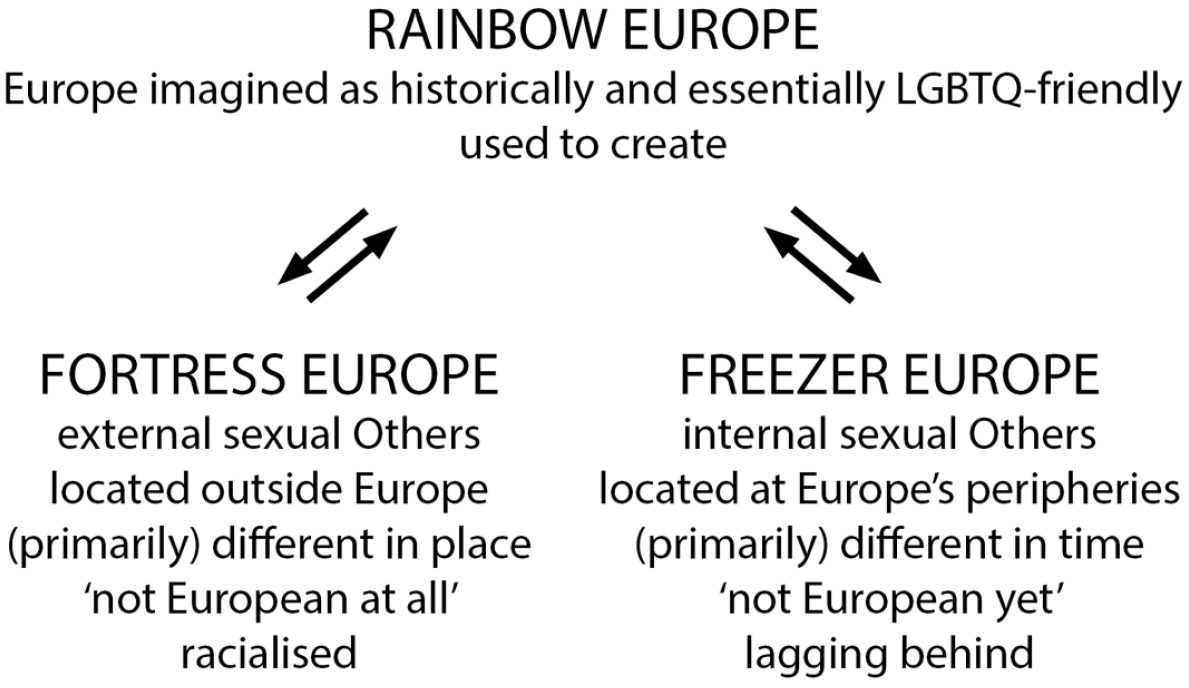
Different forms of European transnationalism.
European imaginations influence European identifications (Scalise, 2015). Before I discuss how the ideas of Rainbow, Fortress and Freezer Europe feature in my participants’ European identifications, I will define European identity and review research on that topic, considering the potential of ‘catalysing moments’ (Castells, 2018: 192) for influencing European belonging.
European Identifications: Queer Europeans in Troubling Times
European identity could be defined as ‘identification with Europe’ (McCormick, 2010: 9), consolidated around shared values that provide meaning to people’s lives, fuelling their sense of belonging to or association with Europe and their self-definition as European (e.g. Grundy and Jamieson, 2007). Scalise (2015: 594) advocates a deeply contextualised approach to European identity, explaining that it is ‘locally embedded and influenced by subjective autonomy, experience and structural social conditioning’. She emphasises the role of local and everyday life contexts for European imaginations and identifications, stressing at the same time that ‘[t]he meanings which are collectively shared in local areas are affected by events occurring in different places’ (Scalise, 2015: 598). This approach to European identity, understood as locally and transnationally embedded, will be useful in my analysis of everyday European identifications that are influenced by Rainbow, Fortress and Freezer imaginations of Europe as well as by larger political events such as Brexit and the PiS election win.
There is a vast body of empirical studies into European identity, dominated by quantitative survey research. According to the 2019 Eurobarometer survey, a large and longitudinal EU public opinion poll, 33% of respondents saw themselves as ‘(nationality) only’ (e.g. Polish only), compared to 2% who saw themselves as ‘European only’, with an additional 8% choosing the option ‘European and (nationality)’ (meaning European first but also national) and 55% ‘(nationality) and European’ (2% answered ‘don’t know’ or refused to answer the question; Eurobarometer, 2019: 46). Some authors see those and similar results as indicating high levels of European identifications: after all, in total, 65% of the 2019 Eurobarometer respondents saw themselves as European to some extent (Pryke, 2020; Wellings and Power, 2015). Others, however, interpret the results as indicating the weakness of European identity, noting that only a small minority of people strongly identify as Europeans (Pichler, 2008) and that for many others, European identity is shallow (Polyakova and Fligstein, 2016), lite (Risse, 2010) or fragile (Castells, 2018).
Delving deeper into Eurobarometer and other surveys, researchers shed light on who is more likely to identify as European, pointing to differences between individuals residing in different countries and of different demographics, experiences and values. For example, Bellucci et al. (2012) report that people in CEE exhibit weaker European identity than those in Western Europe (see also Ceka and Sojka, 2016). Those who identify as European also tend to have transnational relationships (e.g. experiences of intra-EU migration), support the euro currency and enjoy high social status (Castells, 2018; Grundy and Jamieson, 2007). Despite the abundance of studies into the specificities of who tends to identify as European, there is a paucity of research on European identifications of LGBTQs (Ammaturo, 2015) and Eurobarometer does not ask respondents about their LGBTQ identifications. This is particularly surprising considering that in recent decades LGBTQ rights have become closely associated with European values, as explained in the previous section.
Literature on European identity additionally points to the role of significant political events, troubling times or crises for European imaginations and identifications. Authors agree, for example, that the financial crisis starting in 2007 has negatively impacted feelings of being European, creating divisions between Northern and Southern European countries (Castells, 2018; Polyakova and Fligstein, 2016). Castells (2018) additionally considers the so-called ‘refugee crisis’ as well as Brexit as events which have divided Europe and weakened the sense of shared identity, as demonstrated by the lack of solidarity regarding EU refugee quotas and the prominence of anti-intra-EU migrant sentiments in the pro-Brexit campaign (see also Benson, 2020). While those events are usually viewed as negatively impacting people’s self-perceptions as European, Castells (2018: 192) suggests that they also have a potential to strengthen European identity, for example: ‘the refugee crisis has contributed in some countries to greater solidarity for some Europeans, possibly invigorating the collective memory of the catalysing moment that brought Europe together in the first place’.
In the remaining sections of this article, I turn to my empirical data to discuss European imaginations and identifications of Polish LGBTQs in the UK with a focus on the role of Rainbow Europe discourses, European peripheral positionalities and the recent political events of Brexit and the PiS election win.
Methods and Participants
The data I discuss here come from a larger project, which includes 767 online survey responses and 30 face-to-face interviews with Polish LGBTQs in the UK (Szulc, 2019b). In this article, I discuss only the interviews as the survey did not include any questions about European imaginations or identifications. The survey was promoted through multiple online channels, including LGBTQ media and organisations, Polish migration associations in the UK as well as targeted advertising on social media. Survey respondents were asked to confirm that they (1) identify as lesbian, gay, bisexual, transgender, queer or a person of non-normative gender or sexuality, (2) have now or had in the past Polish citizenship and (3) live in the UK (England, Wales, Scotland or Northern Ireland).
Out of 334 survey respondents who indicated that they would like to participate in a follow-up interview, I purposefully selected 30 interviewees, following the principle of maximum diversity. Interviewees included 11 gay cismen, seven lesbian ciswomen, four gender-diverse people, two bisexual ciswomen, two queer trans men, one pansexual ciswoman, one lesbian trans woman, one bisexual trans woman and one straight trans woman. Half of the interviewees were between 19 and 29 years old, 10 were in their 30s, four in their 40s and one in his 50s. Most of them were based in England (23), while four were based in Scotland and three in Northern Ireland. For 16 interviewees, the highest level of education completed was higher education, for 13 it was secondary education and for one it was primary education. All interviewees were white and moved to the UK between 2004 and 2018. When quoting participants, I only provide their pseudonyms, adding additional demographic attributes when relevant. I use their preferred pronouns (for more information see Szulc, 2019b, 2020).
All interviews were conducted face-to-face by the author between mid-2018 and mid-2019; that is, after the 2015 parliamentary elections in Poland and the 2016 Brexit referendum, the two political events which I focus on in the second part of my findings section. The interviews were conducted in places chosen by the interviewees, usually their homes or cafes, and lasted about two hours each on average. Each interviewee received £45 as compensation for their time and expenses to participate in the interview.
I consider myself part of the community under study as I identify as a Polish queer migrant in the UK. I believe that sharing some similar (though surely not the same) identifications, experiences and cultural skills and references with my participants helped me to create a friendly and stimulating research environment, although it also created some challenges of the assumed commonalities (e.g. in terms of values, beliefs and migration experiences). The interviews were conducted in Polish but some interviewees used Ponglish or switched between Polish and English. My knowledge of both languages allowed the interviewees to express themselves spontaneously. I analysed the data using original transcripts and then translated relevant quotes into English, maintaining ‘conceptual equivalence’ rather than providing literal translations (Gawlewicz, 2016: 32).
The interviews were semi-structured and covered such topics as gender, sexual and national identity, migration experience and social media use. European imaginations and identifications were not initially included in the interview topic guide. However, because they were mentioned by some participants during the first five interviews, I explicitly asked the rest of the participants about their imaginations of Europe, if they identified as Europeans and why or why not. For this article, I analysed interviewees’ answers to those questions along with any other mentions of Europe or EU during the interviews (e.g. when interviewees reflected on their identifications more broadly, discussed their national identities or talked about Brexit). I employed thematic analysis and used NVivo software to create relevant codes such as ‘Europe imagined as diverse’, ‘Europe imagined as open’ and ‘stronger European identification after Brexit’. In the two following findings sections, I first discuss my participants’ imaginations of Europe (‘uncanny Europe’) and then analyse their European identifications (‘protective Europeanness’).
Uncanny Europe
Most of the participants expressed positive imaginations of Europe. ‘Diversity’ and ‘openness’ were the most common values attributed to Europe and they were sometimes intertwined with each other as well as with other values such as ‘tolerance’. Tomasz, for example, explained that Europe’s diversity automatically translates into its tolerance: I think that the European community is more interesting to me because it’s bigger. There is more diversity and I believe that when people are in contact with diversity, it becomes a norm for them [. . .] When you see colourful people on the streets, different people from different countries, this is great. (Tomasz)
Some views on Europe aligned with the EU’s motto ‘united in diversity’. Piotr pointed to ‘the similarities between different nations’ in Europe, while recognising their specificities. As an example, he mentioned Mother’s Day, which is celebrated on the second Sunday in May in most European countries and on 26 May in Poland, explaining: ‘So I’m European but I’m doing it a little differently.’ For Piotr, the EU’s motto did not constitute a contradiction but worked as a sound basis for a European identity that incorporates difference, an identity that consists of ‘the adoption of one common attitude in the face of diversity’ (Todorov, 2008: 7). At the same time, in Tomasz’s and Piotr’s quotes, European diversity was primarily defined in terms of the multiplicity of countries, nationalities and cultures rather than races or religions, implicitly reproducing the idea of Europe’s foundational Whiteness and Christianity (El-Tayeb, 2011; Sayyid, 2018).
Like Tomasz and Piotr, Anna enthusiastically identified as European while she associated Europe with ‘cultural openness and, I don’t know, sexual openness, and generally openness to other people’. As an example of cultural openness, she mentioned her own readiness to try local cuisines and visit other countries, while she did not explain what she meant by ‘openness to other people’. She also juxtaposed those forms of openness with ‘sexual openness’, explicitly extending positive imaginations of Europe to Rainbow Europe, that is, Europe characterised by gender and sexual liberation (Ayoub and Paternotte, 2014, 2019). Łukasz too, although less explicitly, invoked Rainbow Europe, when he spontaneously contrasted Poland with the UK and Europe in relation to the legal recognition of same-sex partnerships: In Poland, it’s magic! We fly to Poland, fly to Kraków, and our rights disappear [the legal recognition of his and his partner’s civil partnership]. And this is devastating. If we wanted to move somewhere else, we would move either within the UK or to Europe, where our civil partnership is recognised and where we could later possibly get married. But not to Poland. (Łukasz)
Europe, therefore, becomes imagined not only as a diverse place of intensified contacts between presumably culturally different – yet, racially and religiously similar – countries but also as a place that celebrates sexual openness and recognises LGBTQ rights (Ammaturo, 2015).
A few participants additionally used the idea of Rainbow Europe to create Europe’s external sexual Others (Fortress Europe). Two interviewees criticised what they considered as ‘Islamisation of Europe’, and one of them explicitly linked it to LGBTQ rights: Stanisław recalled a situation when he was refused medical treatment in a hospital in England, which he believed happened because he was gay and atheist, and he believed the doctor was Muslim. Michał, in turn, did not mention the so-called ‘Islamisation of Europe’ but admitted he preferred to date ‘Europeans’, or at least people who grew up in Europe, to ‘Muslims’ and ‘Asians’, considering the former as ‘more modern’ and ‘more open’ than the latter. Michał invoked allegedly uniquely European qualities of modernity and openness (Boatcă, 2020), while simultaneously denying such attributes to Europe’s external Others, specifically Muslims and Asians (El-Tayeb, 2011; Sayyid, 2018).
Not all participants explained what parts of Europe they had in mind when they invoked Rainbow Europe – or, more broadly, Europe that is imagined as diverse, open and modern – but those who did, clearly did not mean CEE (Freezer Europe). Some invoked Western Europe in a subtle way: when talking about the positive attributes of Europe, they spontaneously gave examples of the countries located exclusively on the western side of the former Iron Curtain. Beata said she was ‘fascinated with Europe’, adding: ‘I might as well end up in France or Italy tomorrow and I will surely feel great there.’ Robert explained that ‘Europe is great and open to many things. Of course, not all Europe, but we have many friends in France and Iceland. We also have friends in Spain. It’s great to be part of this entire Europe.’ ‘This entire Europe’ was never explained by giving CEE countries as examples, confirming that ‘the true, real Europe’ – and by extension the true, real Rainbow Europe – is epitomised by Western Europe (Arat-Koç, 2010: 182).
Some other participants were more explicit about ejecting CEE from the imaginations of Rainbow Europe. When asked about with what she associated Europe, Anita replied: ‘Diversity, acceptance, living your life in your own way, being pro-ecological, pro-civil society; these are the West-European and North-European ideals.’ At the same time, Anita contrasted Western and Northern Europe with Poland, which was relegated to an allegedly homophobic and uniform CEE, epitomised by Russia: Poland is closer to Russia than to Germany. Poland is closer to forbidding the manifestation of any orientation but hetero. Poland is closer to uniformity, to bringing everyone to a common denominator, to measure everyone by the same yardstick. There is no acceptance of diversity. (Anita)
Other participants expressed similar views on Poland (occasionally extended to the entire CEE) by pejoratively calling it ‘eastern’ (Jakub), ‘right-wing’ and ‘homophobic’ (Robin) or downgrading it to ‘the Europe’s backwater’ (Maria). These quotes attest to the fact that it is not only European institutions and western politicians (e.g. Ammaturo, 2015; Kahlina, 2015; Kulpa, 2014) but also some CEE LGBTQs themselves that instinctively position CEE outside the ideals of modern and progressive Europe.
While my participants largely reproduced the rhetoric of Rainbow Europe (Ayoub and Paternotte, 2014, 2019), together with its external and internal Others, their positionality at the European periphery provoked ambivalent attachments to these imaginations of Europe. Relegating Poland, often the entire CEE, to European allegedly less diverse, less open and less LGBTQ-friendly peripheries, most of my participants – all first-generation Polish migrants to the UK – continued to identify as Polish. They cherished Rainbow Europe that was imagined as Western Europe, located outside the Europe they came from. I propose to call these ambivalent imaginations and attachments ‘uncanny Europe’, building on Janion’s (2006) seminal book entitled Niesamowita Słowiańszczyzna (Uncanny Slavdom). Janion (2006) introduces the idea of uncanny Slavdom to indicate Polish torn identity between Eastern and Western Europe. She traces the origins of this split identity back to the forced Christianisation of pagan Slavic tribes and Poland’s adoption of Catholic rather than Orthodox Christianity. Slavdom is uncanny – that is, strangely familiar – because it indicates something alien and familiar at the same time, refusing ‘a clear line delineating the East and the West’ (Janion, 2014: 21). Polishness is built on feelings of both superiority over and affinity with Slavdom, the latter conventionally relegated to Orthodox Europe in general and Russia in particular (Janion, 2006: 328).
Uncanny Europe, like uncanny Slavdom, indicates a form of ambivalent imaginations and attachments, Europe that feels both familiar and alien. Some participants explicitly expressed those feelings of ambivalence. Katarzyna explained that ‘Both we, people from Eastern Europe, and we, people from broadly understood Western Europe, navigate the things we like and dislike about the past of Eastern Europe, communism, and so on.’ Jakub, in turn, admitted he would ‘much more readily’ identify as European than Polish ‘because then I wouldn’t have to identify as Polish [. . .] I think that although culturally we’re closer to the East, we’re also European and it affects how we live.’ The use of the word ‘we’ by the two interviewees is indicative of their uncanny geopolitical attachments. Katarzyna clearly differentiates between ‘Eastern Europe’ and ‘Western Europe’, while positioning herself in both of them at the same time. Jakub’s ‘we’ is less ambiguous in its reference to ‘Poles’, whose position however oscillates between ‘the East’ and (presumably Western) ‘Europe’.
While both uncanny Slavdom and uncanny Europe indicate feelings of ambivalence, they work in opposite directions. Uncanny Europe is uncanny Slavdom in reverse. In Janion’s (2006, 2014) conceptualisation, Slavdom is inferior to Polishness; Polishness contains Slavdom, at a deep level, and represses it. Europe, however, imagined as Rainbow Europe and located in the West, is rendered superior to Polishness. This Europe cannot be repressed within Polishness because it has not been there in the first place. It needs to be impressed on Polishness. Asked about their European identifications, Robin replied: ‘It depends if you talk about Western or Eastern Europe. I’d really like Poland not to be in Eastern Europe, you know? That it walked towards Central-Western Europe. That border was moved. But it’s going in the other direction.’ Robin expressed their wish of Poland to symbolically move to the West as a way of impressing Rainbow Europe on Polishness; Polishness that needs a push towards the West to become truly European. In the next section, I will discuss how Europe, despite and because of its uncanniness, offered my participants a viable identificatory option in the troubling context of increasing anti-Polish xenophobia in the UK and growing anti-LGBTQ discrimination in Poland.
Protective Europeanness
Most of my participants readily identified as European while these identifications were of different strengths. Max, for example, ‘definitely’ identified as European as they ‘have always been a superfan of Europe and the European Union’, highlighting the EU’s financial contribution to the infrastructure development in their hometown. Tomasz expressed somewhat weaker European identification. Imagining Europe as ‘diverse’ and ‘colourful’, he explained that he ‘thinks’ he is European: ‘It seems to me that it’s better, I don’t know, wiser to think about yourself in those European categories than locking yourself in Polishness, cutting yourself off from everything.’ Wiktor, in turn, said that ‘it is probably easier for me to call myself European than 100% Polish’, attributing his European identification to his migration experience, which resulted in ‘broadening my horizons’, opening up to the cuisines of different European countries and learning new European languages. Wiktor explained that before migrating to the UK, he identified as ‘100% Polish’ but now, similarly to Tomasz, he does not want to ‘limit’ himself ‘to small, specific ethnic groups’. In those quotes, European identifications build on the imaginations of Europe as modern, progressive and diverse, which is typified by the EU. The European identifications are also contrasted with Polish national identity, which is viewed as narrow and limiting.
European identifications were juxtaposed with other geopolitical identifications in many ways, as European and national, local or regional identifications are not necessarily mutually exclusive (Scalise, 2015). Some participants stated they felt more European than Polish, others created hierarchies of geopolitical identifications more complex than those available in Eurobarometer (2019). Mateusz explained that he identified as ‘British and Polish, 50% and 50%, and 100% European because those are two different categories for me. It’s national belonging and regional belonging.’ He emphasised the importance of ‘the political power in the world’ that comes from the membership in the EU. Krystyna identified as ‘European, Scottish and Polish; Polish in the third place, the lowest one.’ She felt bad about putting Poland in the last place ‘because I grew up in Poland and I still have some roots there’, but added that she is ‘ashamed’ of her Polish citizenship, linking it to the growing nationalist politics in Poland. Kamil, in turn, said that ‘culinarily I’m absolutely Polish, mentally I’m European’, defining Europe as ‘a system created by Western Europeans, a system of democracy, tolerance and a certain way of treating freedom’. Despite the diverse ways of juxtaposing different geopolitical identifications, the participants incorporated Europeanness in their identities in a similar way as a marker of power, progress and liberal democracy.
Some participants explained that their European identifications have become stronger in recent years because of the Brexit referendum and the accompanying rise of anti-migrant rhetoric in the British public discourse (Rzepnikowska, 2019). Alex was the most outspoken about it. She/they was called ‘fucking European’ twice in London ‘around the time of the referendum’, adding: The European identity is more active for me now than in the past. I realised that something is being taken away from me [. . .] Even if I don’t identify as European, even if I don’t want to, I’m being identified as European now, in this political climate. So I’m exploring this identity. (Alex)
Alex’s comment points to the strengthening of European identification in the context in which this identification is being threatened as well as imposed on some people, demonstrating that identifications are not only attributed by oneself but also ascribed by others (Vertovec, 2001).
Brexit has also provoked some negative reactions to Britishness or Englishness, inviting comparisons between the UK and Europe. Barbara, who has been living in England for more than 10 years, has been very disappointed with Brexit. She disclosed that she experienced more xenophobia after the Brexit referendum: from blatantly xenophobic jokes of her boss to casual yet painful comments about her Polish accent in English. This made Barbara question her belonging to the UK. She affirmed she would like to apply for British citizenship, if she had the money for it, adding as an afterthought: ‘I don’t know if I want to be part of the nation which doesn’t want to be part of Europe. It’s something totally unthinkable for me.’ Paweł, based in London, too questioned his attachment to the UK, specifically England, in the light of Brexit, explaining: Europe tries to unite and England what? It was one of the most libertine places in Europe, which now suddenly becomes conservative. It hurts me a lot for different reasons. I think about my future. Do I really want to stay here if I’m not welcome? (Paweł)
Unlike Alex, Barbara and Paweł did not make a direct link between Brexit and their European identifications but they ascribed positive connotations to Europe while Brexit provoked in them feelings of disappointment with and rejection by the UK.
While identifications with Britishness or Englishness have become difficult for many participants in the context of Brexit, Polishness has not offered an attractive alternative. Because the dominant Polish national identity has been built on heterosexism (Szulc, 2016), most participants had ambivalent feelings about their Polishness, especially after the 2015 elections in Poland, when the explicitly anti-LGBTQ party secured the majority of seats in the parliament (Szulc, 2019a). Krystyna, who identified as ‘European, Scottish and Polish; Polish in the third place, the lowest one’, said ‘I’m for Poland with all my heart’, adding ‘Poland is on the wrong side of my heart.’ When asked why she identified more as European than Polish, she replied: ‘Because I can still be an EU citizen [. . .] I’ll be sad when Poland leaves the EU. There’ll be Polexit, I’m sure that PiS will make it happen.’ Krystyna explained that she was afraid that when Polexit happens, Poland will make life more difficult for LGBTQs, for example by making it more difficult to change one’s legal gender: ‘as long as we’re in the EU, the EU won’t allow it’. For Krystyna, the EU guarantees the protection of LGBTQ rights in the member states which fail their LGBTQ citizens. Anita was similarly critical of PiS and disappointed with its popular support: ‘If something changes, I’ll be very happy to identify as Polish, very happy! But only when the entire nation changes its attitude.’
The ambivalence towards Britishness or Englishness and Polishness has not always immediately and directly translated into stronger European identifications, although this was indeed true for some participants, as evidenced in quotes in the previous paragraphs. Nevertheless, Europeanness – when associated with modernity and liberal democracy as well as diversity, openness and the protection of LGBTQ rights – offered a viable identificatory alternative for my participants who felt unwelcome in or excluded from the dominant national identities that were most relevant to them. I propose to call this process of turning to European identity in the face of hostile national identities ‘protective Europeanness’, a concept modelled on ‘protective transnationalism’ (Redclift and Rajina, 2021) and ‘reactive transnationalism’ (Itzigsohn and Saucedo, 2002). Reactive transnationalism describes a situation in which migrants and their families engage in more transnational activities and show stronger transnational identifications because of, or as a reaction to, growing discrimination (Itzigsohn and Saucedo, 2002; Snel et al., 2016). Redclift and Rajina (2021: 208) propose the concept of ‘protective transnationalism’, which works as a type of reactive transnationalism as it is ‘also a product of discrimination, but borne out of a particular desire to protect oneself and one’s future security in the face of it’. Redclift and Rajina (2021) illustrate that by discussing how Bangladesh-origin Muslims in the UK have turned to protective transnationalism in the 2010s context of hostile environment immigration policy and the Brexit referendum.
Research on protective or reactive transnationalism shows that migrants and their families who feel less welcome in their country of residence tend to turn to their or their parents’ country of origin for protection, creating stronger transnational ties and transnational identifications (Redclift and Rajina, 2021; Snel et al., 2016). For my participants, however, Poland and Polishness did not offer any sort of protection, be it material or symbolic, which may explain why some of them readily escaped into protective Europeanness. Krystyna admitted she was ‘ashamed’ of her Polish citizenship because of the recent political developments in Poland. Robin also felt ‘ashamed of what’s going on in my country’, pointing particularly to anti-LGBTQ and anti-abortion bills discussed in Poland in the mid-2010s. Alicja, in turn, who was based in Belfast, found it difficult to identify as Irish or British and avoided introducing herself as Polish because she did not want to be associated with any national stereotypes. She concluded: ‘So, I’d rather say I’m European.’
Europeanness offered my participants a form of not only material protection – against high visa costs, hindered access to National Health Service and obstructed freedom of movement, as some of them pointed out – but also symbolic protection against national identities which have turned towards intensified anti-Polish xenophobia or anti-LGBTQ discrimination. The 2016 Brexit referendum and the 2015 PiS election win worked as ‘catalysing moments’ (Castells, 2018: 192), which extended and exacerbated already existing anti-Polish xenophobia in the UK (Rzepnikowska, 2019) and anti-LGBTQ discrimination in Poland (Szulc, 2019a). While Brexit may have weakened European identifications for some groups (e.g. Benson, 2020), for my participants, a particular marginalised group of queer migrants, it made Europeanness – as a form of transnational identification imbued with largely positive imaginations of modernity, diversity and openness – a more attractive and viable identificatory option, strengthening feelings of being European for some of them.
Discussion and Conclusion
This article offers empirical and theoretical interventions in scholarship on European imaginations and identifications. Its primary contribution lies in providing the first account of how a particular group of LGBTQs, Polish migrants in the UK, imagined and identified with Europe understood as a progressive and liberal place. I show that most of my participants saw Europe in a very favourable light, associating it with such values as modernity, diversity and openness as well as tolerance and LGBTQ rights. They attributed those values primarily to Western Europe, which created ambivalent, or uncanny, attachments to Europe that felt familiar and alien at the same time. Most of my participants also readily identified as European. For some of them, these identifications strengthened in the context of catalysing moments, which alienated them from the national identities that were most relevant to them. Europeanness, associated with the values of Rainbow Europe, offered my participants protection against increasing anti-Polish xenophobia in the UK and growing anti-LGBTQ discrimination in Poland. The uncanniness of Europe did not prevent those European identifications but it did provoke feelings of not being truly or fully European.
Theoretical interventions of this article lie in proposing two concepts, uncanny Europe and protective Europeanness, which emerged from the bottom–up analysis of my data and bear relevance to the broader scholarship on European imaginations and identifications. The first concept, uncanny Europe, zooms in on ambivalent imaginations of Europe. For my participants, this ambivalence came from attributing positive values to Rainbow Europe, while locating it exclusively in Western Europe, the Europe they did not come from. Europe’s uncanniness, however, can be rooted in other ambivalent imaginations. Todorov (2008), for example, reminds us that the history of Europe is also the history of colonialism and slavery. My participants did not mobilise this part of European history. If anything, a few of them reproduced racist discourses of Fortress Europe as well as of Freezer Europe, re-establishing Western Europe as an LGBTQ-friendly ideal at the expense of European external and internal Others. Some participants in Scalise’s (2015) research, unlike most of my interviewees, did intertwine their praise for Europe with critical appraisal of the Fortress Europe discourses and intra-European inequalities. What makes Europe uncanny, for whom and with what effects remain underexplored questions in research on European imaginations and identifications.
The second concept, protective Europeanness, points to the appeal of European identity in the face of hostile national identities. It extends the concept of protective transnationalism (Redclift and Rajina, 2021), which remains within the logic of nationalism, as it describes migrants’ and their families’ turn towards their own or their parents’ country of origin rather than towards any kind of non-national framework such as Europeanness. For my participants, dominant national identities in Poland and the UK have become increasingly hostile in recent years, while Europeanness offered protection against them, providing a viable identificatory alternative. 5 When talking about their European identifications, my participants emphasised their own appreciation for diversity and openness, and their close proximity to westernness, which was most evident in a quote by Kamil who ‘mentally’ identified as European and defined Europe as ‘a system created by Western Europeans’. Europe’s capacity to protect LGBTQs becomes conditional on reproducing the image of Western Europe as Rainbow Europe, an allegedly exceptional ‘standard of civilization, modernity, development, capitalism, or human rights’ (Boatcă, 2020: 2), including gender and sexual liberation. Future research on European imaginations and identifications could further investigate that, if Europeanness can work as a protective identificatory alternative, who is it protecting, from what and under what conditions?
While Adam Hofman found Conchita Wurst’s Eurovision win regrettable, the most popular Polish LGBTQ portal, Queer.pl, celebrated the news: ‘It happened. Europe chose openness, tolerance and a great song’ (Oliwa, 2014). My research shows that Polish LGBTQs in the UK also tend to choose diverse, open and tolerant Europe, and readily identify with it. At the same time, Europe’s diversity, openness and tolerance have been most often explained by my participants in terms of the coexistence on the European continent of multiple national cultures, languages and cuisines as well as in terms of Europe’s allegedly exceptional progress regarding gender and sexual liberation. Multiplicity of races or religions, in turn, has hardly ever been mentioned by my participants as a European characteristic. With the growth of populist nationalisms in Europe – accompanied by intensified racism, xenophobia and Islamophobia – it remains crucial to research what forms European transnationalism takes and where the limits of the allegedly uniquely European qualities of diversity, openness and tolerance are drawn, particularly at the intersections of gender and sexuality on the one hand and race, ethnicity and religion on the other. It remains crucial for scholars of European imaginations and identifications to think Rainbow, Fortress and Freezer Europe together.
Footnotes
Acknowledgements
I would like to thank Professor Majella Kilkey, Professor Sarah Neal, Dr Magdalena Mikulak and two anonymous Sociology reviewers for providing me with valuable feedback on the first drafts of this article. I also thank Dr Jędrzej Niklas for discussing the topic with me on multiple occasions and Professor Myria Georgiou for enthusiastically mentoring me when I was conducting research for this article. My thanks also go to everyone who offered me their constructive comments when I presented the article at conferences. I particularly want to show my gratitude to Dr Kamila Fiałkowska for inviting me to present my research at the University of Warsaw’s Centre of Migration Research, to Dr Thomas Lorman for organising my talk at UCL School of Slavonic and East European Studies and to Dr Marcin Śmietana and Dr Hakan Sandal-Wilson for inviting me to participate in the Queering Authoritarianisms conference at the University of Cambridge.
Funding
The author disclosed receipt of the following financial support for the research, authorship and/or publication of this article: this research was carried out during my postdoctoral fellowship in the LSE Department of Media and Communications and was funded by the European Commission’s Marie Skłodowska-Curie Actions, Individual Fellowship, grant number: 699745–FACELOOK–MSCA-IF-EF-ST.