




Abstract
This article applies the concept of Britain as a community of citizens and a community of communities to the analysis of post-2004 Polish migrants. This concept received its clearest articulation in the 2000 report on The Future of Multi-Ethnic Britain chaired by Bhikhu Parekh, which constituted a hallmark of the national debate on multiculturalism. The report is used as an intellectual inspiration to see post-2004 Poles not just as white labour migrants to the UK, but as citizens and community within the multi-ethnic Britain envisaged by Parekh and his co-authors. The discussion draws on a set of qualitative data gathered in the Northern English district of Wakefield following the Brexit vote. The analysis reveals a high degree of local embeddedness of Polish migrants both as citizens and community, which involves civil relations across ethnic lines and the sense of shared commitment. This inclusion is however undermined by the pattern of paid employment, language difficulties and arbitrariness of the Brexit state, which interviewees experienced both as a community and as individual citizens. While following the dialectical frames set by the report, this article expands notions of the boundary of multi-ethnic Britain by putting this ethnic and post-EU enlargement group within its map.
Introduction
More than 20 years have passed since the publication of The Future of Multi-Ethnic Britain report, chaired by Bhikhu Parekh (Parekh, 2000). The vision of multi-ethnic Britain articulated in the report, which challenged the reductionist view of British political community being an exclusively Anglo-Saxon Protestant and white nation, provoked a defensive backlash, portraying it as an attack on Britain’s history and identity (Uberoi, 2015). Retrospectively, conservative interpretations have described the report as the highest point of multiculturalism not only in Britain but in English-speaking countries more broadly and, simultaneously, the moment when political discourse turned against multiculturalism (Kaufmann, 2018).
In the context of explicit challenge to multiculturalism unleashed by what was described as media and street violence of the Brexit state – referring to the multiplicity of micro, meso and macro exclusionary practices linked to Brexit (Burnett, 2017) – this article’s aim to analyse post-2004 Polish migration through the prism of the Parekh (2000) report may appear counterintuitive. Not only were UK-resident EU citizens excluded from voting in a referendum which directly affected them, but they also lost their transnational citizenship rights without being compensated with full UK national citizenship rights: instead, they were granted a settled status which linked residence rights to the length of labour market participation. This stance of the Brexit state is in clear conflict with what Modood (2013) describes as post-immigration multiculturalism because it treats migrants as guest workers lacking the democratic power associated with national citizenship.
However, there are two important considerations behind reconnecting with Parekh’s (2000) report. The first is empirical: at the start of oral history interviews designed to capture the realities of Brexit’s impact on a Northern English district from the point of view of post-2004 Polish community, alongside experiences of discrimination, a strong current of positive experience gained through living and working in a multi-ethnic society became apparent. Mirroring the investigation conducted by Rogaly (2020) in Peterborough, participants’ lives were characterised by everyday cosmopolitanism involving friendships across ethnic and racial lines, yet at the same time they had a significant Polish-centred community dimension. This social reality of everyday lived experiences connects to viewing Britain as a community of citizens and a community of communities as developed by Parekh (2000). Secondly, the report by Parekh (2000) was both a diagnosis and a prescription: it re-vindicated the multi-ethnic nature of contemporary Britain on one hand and exposed racial and ethnic prejudices on the other. This paper’s analysis and findings connect to the diagnosis offered by the report and apply its normative assumptions to a community study which took place in Wakefield.
This article’s originality lies in showing the continuous relevance of Parekh’s (2000) report. The analysis will show how an insular and everyday nationalism predating and accompanying Brexit did indeed undermine the position of post-2004 Poles in multi-ethnic Britain. The pattern of local labour market participation and narrow economic opportunities further diverge from a vision of Britain as a community of citizens and a community of communities built on cross-group equality and respect for individual rights. However, it will also be shown that in some respects, post-2004 Poles constitute a British community in the making which cannot be wished away by a nativist antagonism. This article relies on interviews conducted between March and June 2021: it coincided with the cut-off date for applying to the settled status scheme. All interviewees applied for it and planned to stay in Wakefield. As 5 years had passed since the referendum, participants considered their place in Britain not in terms of immediate responses to the mayhem of Brexit but through individual and community standpoints related to the experience of residing in Wakefield over a considerable period. This data is also supplemented by interviews conducted with local post-2004 Polish community organizations, adding another group dimension to the discussion and aligning it closer to the approach adapted by Parekh and his co-authors (2000). The fact that the fieldwork was conducted by a researcher from Lithuania, a country with its own long-established Polish community, contributed to this interpretation. Prior to considering empirical data, the discussion begins by outlining key ideas of the Parekh report (2000) and explaining why it is valuable to connect it with the post-2004 Polish community that emerged following EU enlargement.
Locating the post-2004 Polish migrant community in the multi-ethnic Britain of Bhikhu Parekh
The starting point of the Parekh report (2000: XV) was a normative assertion suggesting that ‘Britain should develop both as a community of citizens (the liberal view) and as a community of communities (the pluralist view)’. The simultaneous stress on individual rights and group difference formed an integral part of Parekh’s (2000) proposal. This duality, according to Modood (2013), was neglected by media reporting which associated the report’s findings and recommendations primarily with the need to develop common belonging through the recognition of group difference. However, Parekh (2006: 341) stressed that in spite of group differences, ethnic groups can be ‘committed to each other because they are all in their own different ways committed to the community and bound by the ties of common interest and affection.’
In a conceptual reconstruction conducted by Uberoi (2021), the idea of a community of citizens and a community of communities rests on four key principles. Firstly, the acknowledgement that the nation state is constituted by individuals interrelated with each other, for example as families. Secondly, individual citizens are shaped by their respective ethnic, cultural, political, and religious communities. Thirdly, the existence of differences linked to culture and religion should not prevent individual citizens forming a shared national community. Finally, the concept of a community of citizens and a community of communities deployed by Parekh (2000) implies the reconciliation of individual and group differences; those differences should not be seen as divisive if there is a common sense of belonging to Britain (Uberoi, 2021).
Like Uberoi (2021), Meer (2022) asserted that Parekh’s (2000) report aimed to offer a shared and evolving vision of future for multi-ethnic Britain of citizens and communities: the report stressed that ‘there is a difference between the identities of nations and people’s national identities – and that if anything the former had to catch up with the latter’ (Meer, 2022: 47). The report sought to benefit all citizens and communities (Parekh, 2000) and built what Modood (2020) later labelled as “multicultural nationalism”: the insistence of treating individuals and groups as equal citizens without expecting those of migrant origin to renounce their diasporic identities.
There are several conceptual reasons which make the connection between the report and post-2004 Poles capable of creating an original contribution. Deliberate indeterminacy shown over their future mobility and settlement plans vis-à-vis the UK (McGhee et al., 2017) created a propensity to view post-2004 Poles as a transient and transnational community. The research influenced by post-colonial theory positioned post-2004 Poles not alongside but against other minority groups: it was argued (McDowell, 2009) that to a certain extent Poles and other new EU migrants self-identified as white Europeans entitled to preferential treatment when compared to non-EU migrants. In a more subtle way, this internalised racialisation came across in the denial of discrimination in the UK by this group of migrants: whiteness and EU citizenship were cited as shields exempting members of these communities from ethnic prejudice (Fox et al., 2015). It was also suggested that experiences of discrimination did not prevent post-2004 Poles from displaying prejudiced views against minorities in the UK (Narkowicz, 2023). This contrasts with more complex findings of the pre-Brexit study by Mogilnicka (2022), which pointed out that while post-2004 Poles would express occasionally prejudiced views, they would see their experience of multi-ethnic society in a positive light. However, even Mogilnicka’s (2022) study did not explicitly follow the logic of Parekh (2000) by viewing Poles as individuals and a community forming part of multi-ethnic Britain. Common among these theoretically distinctive studies is the treatment of post-2004 Poles as ambivalent outsiders rather than members of British polity: as labour migrants and transnational EU citizens they experienced discrimination and political hostility, while on the other hand their white European background was treated as an internalised impediment in establishing closer relations with Britain’s non-white ethnic minorities.
This study seeks to explore the complexity of Poles as individual citizens and community in Britain: by connecting this investigation to Parekh’s (2000) report, it seeks to offer what Modood (2022) describes as a rival normative position to those focusing on whiteness or transnational migration. The chosen interpretation of post-2004 Poles in the UK also allows for a reconsideration of the legacies of Parekh’s (2000) report. The report tended to view communities as composed of citizens with full political rights (Uberoi, 2015). In contrast, in Brexit Britain post-2004 Poles were subjected to a partial form of civic integration which did not include the extension of full citizenship rights. It provides further grounds to explore when Polish migrants were able ‘to move around unselfconsciously and with ease’ (Parekh, 2000: 54) or, conversely, to examine conditions undermining their position as equal citizens in Britain. The interpreted empirical data is caught between the two poles of this continuum. This interpretation diverges from positions which primarily locate Brexit and its aftermath for minority groups in UK’s post-imperial, racist and classist politics (Bhambra, 2017; Favell, 2020; Virdee and McGeever, 2018).
Methodology
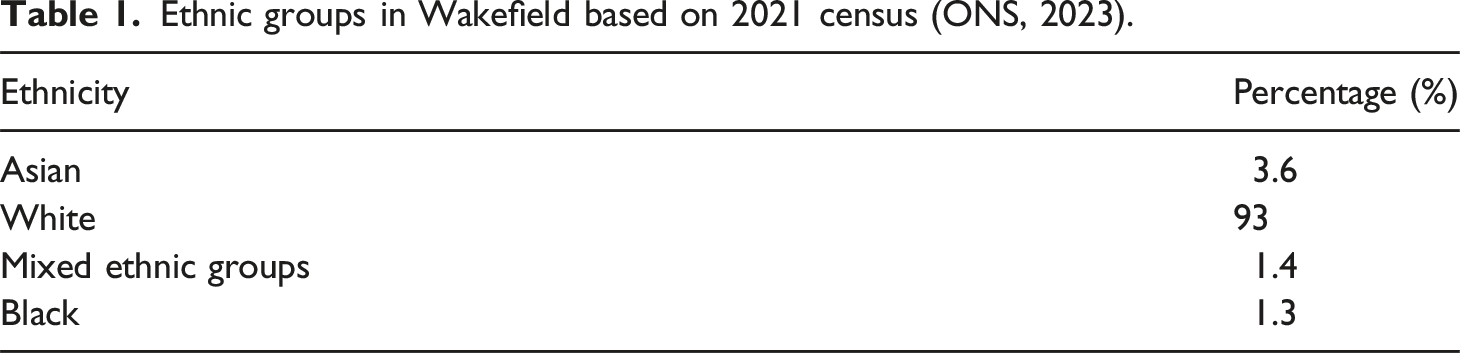
Ethnic groups in Wakefield based on 2021 census (ONS, 2023).
Participants’ details which include employment situation, year of arrival to Wakefield and marital status.
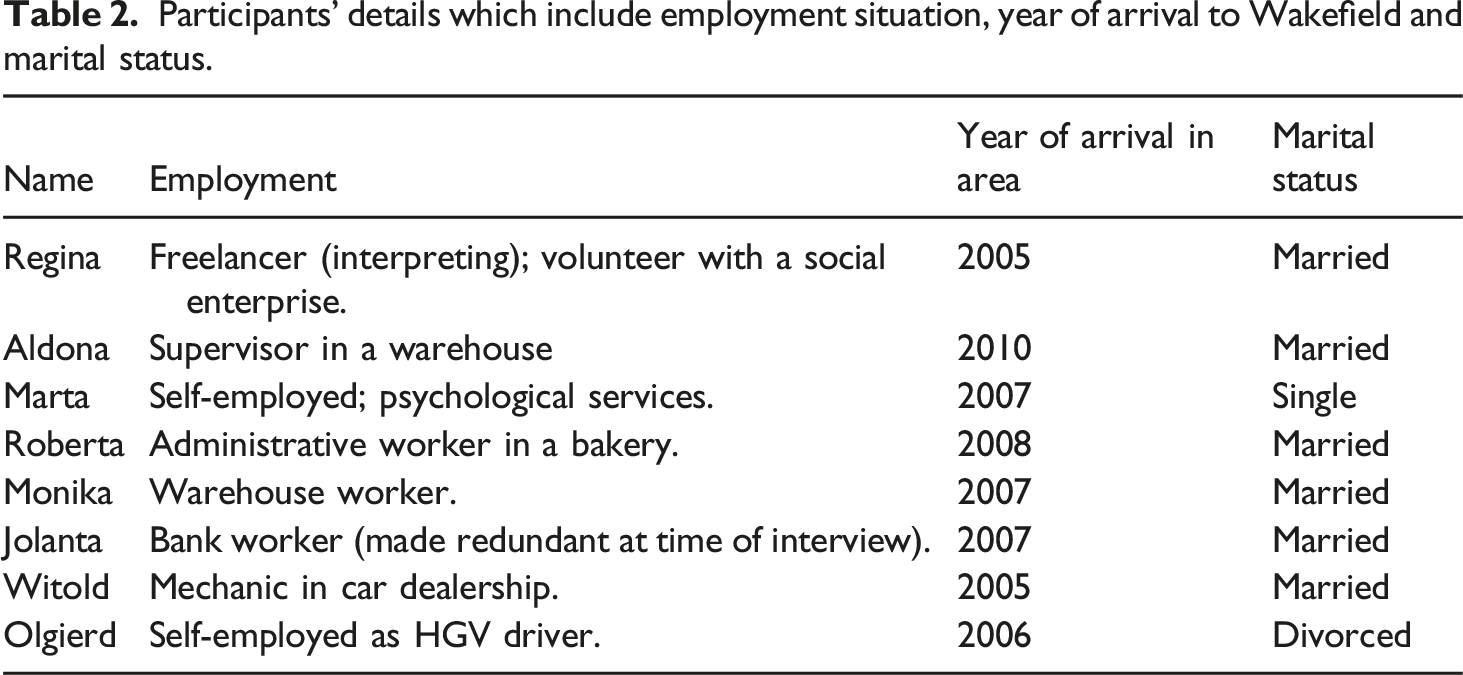
Interviewees were aged between 35 and 48 years old. In addition to eight in-depth interviews, two interviews were conducted with the head of a Polish social enterprise (in March 2019 and October 2020) and the head of a Poland-majority migrant worker branch created by a major trade union (in November 2018). Both organisations were located in Wakefield city centre; they filled a void of community representation because there was no pre-2004 Polish community support infrastructure in the area. While both organisations were approached to assist in accessing interviewees, the social enterprise proved to be instrumental. A volunteer became the first interviewee; through her a second interviewee was recruited. The rest of the interviewees were recruited through the same referral method. Although the social enterprise was essential in securing the first interview, the subsequent interviews were made through contact with participants with no direct link or involvement either with the social enterprise or trade union group. The interviews with the trade union group lead volunteer and the head of social enterprise provided supplementary material towards understanding the needs of Polish community locally. In the case of the union interview, it was a continuation of a long-standing relationship with the group dating back to 2010. Finally, informal conversations took place with the local council officials responsible for community relations.
All individual interviews were conducted in English via Zoom between March and June 2021. Prior to each interview, an email or phone contact was established to explain the purpose of the interview. To build rapport prior to the interview (when contact was made over the phone), the researcher spoke to interviewees in both Polish and English. After it was determined that a potential interviewee’s command of English was adequate to the purpose of this study, the interview’s time would be agreed upon. I, as a researcher with Lithuanian citizenship and with settled status in the UK as well as being knowledgeable about Polish culture, felt comfortable with the use of English. Participants knew that I was a migrant from Lithuania who came to the UK after 2004s EU enlargement, so it created an atmosphere of camaraderie and English was used as a third shared language.
The chosen method of oral history interview helped in seeing beyond a narrow prism of Brexit. Reading and reflecting through interviews and transcriptions led to the discovery of what in Hochschild’s (2016) terms is called a ‘deep story’: it became apparent from the first couple of interviews that it was not the issue of Brexit per se which provoked neutral and indifferent responses, but the dynamics of being included and excluded as individual citizens and a community from British society at large throughout their years of work and residence in Wakefield. Parekh’s (2000) notion of a community of citizens and a community of communities was not imposed on the data but vice versa: mirroring the Bristol schools of multiculturalism (Brahm, 2019), it was the investigation and findings from below which allowed a connection to emerge between experiences of post-2004 Poles and Parekh’s (2000) normative vision of multi-ethnic Britain.
A community of citizens and a community of communities as parts of Polish experience
Wakefield could be a welcoming place to settle for post-2004 Polish migrants as individuals and as a community. Initial encounters could form a view of an unthreatening society in which Polish migrants arriving following EU enlargement would be treated with cordiality by those representing public services, for example, the police. This was especially significant since Parekh’s report (2000) identified interactions with the police as a microcosm of minorities’ relations with the British state and considered practices such as stop and search as both racist and detrimental to community relations. Initially migrants were apprehensive in approaching the police, but positive impressions dispelled pre-migration fears. Olgierd, a self-employed delivery driver at the time of the interview, talked about how a local police officer helped them to find directions: First night when we came to Wakefield and we couldn’t find address, it wasn’t navigation during that time. So we stop and we ask a police officer. And it was something very, very nice because he stopped us and say, “Okay, okay don’t worry guys, don’t worry guys. I show you everything.”
This experience highlighted the importance of first contact experience and demonstrated that when, on arrival, migrants were met in a civil manner rather than stopped and searched as potential suspects, it set a good precedent and created what the Parekh report (2000) identified as a sense of ease. It also encouraged trust, which in turn led to cooperation once post-enlargement migrants acquired longer-term experience of residence locally.
Jolanta, a bank clerk, saw an obligation to look after residents across communities: she reported to the police when she saw her Polish friend going to drive his car when he was visibly drunk. There was also a group dimension to such a relation: once, the local Polish group which worked closely with the migrant worker union branch hosted two white British police officers at one of their meetings. While they spoke about what this service could offer this community, Polish migrants present also raised concerns affecting the wider community: the unacceptability of playing football on cemetery grounds by teenagers. When the Polish community organisation was visited by the researcher 2 years later, there was also a police officer in attendance but this time the officer was a post-2004 Polish migrant. This trend towards trusting, cooperating, and even joining the police as citizens and members of post-2004 community is significant: instead of treating it as isolated experiences, Griffiths (2018) links the existence of such attitudes to the police to the low level of social distance and high degree of civility in relation to established local communities.
The sense of communal conviviality and civil cross-ethnic relations was not reduced to the sphere of public duty but extended to the sphere of work. Local workplaces could also become arenas in which a gradual incorporation into multi-ethnic society could take place. Regina, who later became a volunteer for a Polish social enterprise, initially drew on ethnic networks to enter the local labour market: she arrived in Wakefield with her Polish friend. While working, they forged good relationships with white British and other co-workers, including going out together in mixed groupings on weekend nights, along with white British and other eastern Europeans such as Slovaks but also, in her words, mixed race and Black Britons. This multi-ethnic going out made her comfortable to such an extent that she took local dressing habits as her own: I remember thinking about British girls who wore nothing in the winter, like oh my gosh, what’s going on and then after a year or so, you know, sometimes I was one of them because it was pointless to bring a coat when you were going from pub to pub.
This pattern of spontaneous as opposed to externally imposed multi-ethnic mixing persisted when Poles became more settled in Wakefield over time. Olgierd pointed to the Nigerian co-worker he met in the factory in which he first found employment as his closest friend. Initial joint socialising experiences across ethnic lines were not one-off events. The habit to pass time together was seen as a way to mix across ethnic lines: choosing to forge individual ties with members of different ethnic groups was treated as a natural part of leisure time. Rather than being a daunting experience, for Witold, a car dealership mechanic, it appeared to be both relaxing and mind-broadening: Yes, yes, yes. Yes, I’ve got some English, I’ve got some Polish friends, and like you know, mix of… Like I know them, few Serbian, yes no you know… And we spent, we kind of did like, you know, the English way of living as well. So you know, like Fridays you know Saturdays, go to the pub, meet people, have a few drinks, beers.
Intra-ethnic and multi-ethnic interactions could not only help with relaxation but could also offer companionship in child-centred activities. Interviewees engaged in building relationships with other families (Polish and British) living in the newly built estate: having children of the same age brought them together. Since most interviewees did not have extended family in the area, those relationships formed, in the words of one interviewee, ‘a community family’: joint barbeques and walks were common examples of such activities in the newly built estate in which Regina and Aldona lived: Yes, we used to go out to some parks, or we used to go together, our community, to caravans, like some parties together, or birthdays together. Because most of the people have got children here, so we are here like one big family (Aldona).
The description of ‘a community family’ closely resembles Parekh’s (2000) notion of a community of communities as explained by Uberoi (2021): it views citizens not only as individuals but family members as well as members of one’s own ethnic group (in this case Polish) and broader community, for example, the estate’s residents of diverse ethnicities. During the earlier stages of the Covid-19 pandemic, interviewees would provide emotional support to their neighbours. Having a trusted neighbour from Polish, white British or – as one interviewee reported – from a Middle Eastern background gave a sense of security when leaving the house for longer periods of time during vacations or going to Poland during summer 2020, when interviewees were on furlough. Seeing those coming from different communities as trusted neighbours made the trauma of Covid-19 more bearable.
It is not only the close-knit relations with families, friends, co-workers, and neighbours that pointed to open co-existence as opposed to segregation, but occasional contacts on the street and in shops allowed them to feel a sense of community that was expected to be on an equal footing with others, including the white British majority. Jolanta spoke about how an accidental overhearing of comments made while shopping in the retail park turned into an open challenge to a xenophobic attitude. There were two elderly women just on the other part of the clothes rack…And then, and one of them started saying something about immigrants, why they are coming to this country… But then the other one who was a part of the conversation, the other one looked at us, left that friend, or you know the other lady who was talking about it, and she came to us and said, “I really apologise for my friend’s behaviour. I wanted you to know that I think you are right to come here as we are to be here, because you come for work.”
The response of the elderly British woman who decided to intervene is indicative of recognising Polish individual and group membership. Not only could post-2004 Polish migrants anchored and embedded themselves in the sphere of socio-economic activities themselves (Grzymala-Kazlowska and Ryan, 2022), but their contribution was recognised by those from established communities. The reference to work contributions made by Poles is neither accidental nor linked to internal or external criteria of deservingness based on an economic conditionality (Osipovic, 2015). It rather points to a shared commitment to post-2004 Poles: it acknowledges that they came to the UK as labour migrants and their hard work is a reason to accept them as individuals and community. This expression of acceptance would allow interviewed Poles to differentiate attitudes between local white British residents exhibiting nativist views and those who were more open, even if conditioned to economic contributions, to what Modood (2013: 167) described as an ‘enlargement, hyphenation and pluralizing of Britishness’.
Nonetheless, poor education and a lack of historical knowledge – interviewees would point to the ignorance of Polish and British historic closeness from the joint experience of WWII – were also a problem. This ignorance was re-enforced by multiple instances of negative media coverage. Jolanta spoke of what she described as ‘hate’ in the media and on the Internet towards Polish migrants who, in her words, were blamed for everything wrong. However, she contrasted this with generally cordial relationships encountered by her personally in daily life.
Significantly, living in a multi-ethnic society was not simply about expecting to get equal treatment for oneself but accepting and respecting the differences of others. It could be a gradual process – for example, Aldona, a warehouse supervisor, spoke about being a ‘typical Polish person’ who was not exposed to racial or other forms of diversity such as open homosexuality prior to migration to the UK. Recognising the difficulty associated in establishing meaningful relationships between a community of post-2004 Polish migrants and established residents, Marta, a self-employed therapist, mentioned what she called ‘racisms from both sides.’ Living in the UK helped to ease this sense of being what Aldona called a ‘closed person’ and becoming a participant in multi-ethnic society. This would contrast to attitudes of their parents who, when visiting Wakefield, reacted to its racial and ethnic diversity negatively. In contrast, Aldona became accustomed to racial diversity and the presence of distinctive communities created a sense of attraction as opposed to rejection: she showed a reluctance to deploy her whiteness to differentiate herself from the local ethnic diversity and distanced herself from her parents’ views. Some would go further and engage in what can be described as an active embrace of cultural diversity. Marta exemplifies this approach: When I started to get to know people and I started, there was a job that I did and I was working with I think with women from Pakistan, women from India… You kind of integrate a little bit more and you have a conversation here and there, where normally maybe on the street you wouldn’t have that exposure. I remember the day where it was the end of Ramadan… and all these women came without wearing, you know, scarves and their hair, whatever, and I truly seen the beauty. And they brought loads of food and they were having, you know, enjoying the end of Ramadan and they were really like, and there was so much beauty in this.
This touching testimony showed that Polish migrants could find interactions across different communities and exposure to different cultural practices rewarding – a key finding of Rogaly’s (2020) study in Peterborough too. It also demonstrated that British Muslims with diasporic links to the Indian subcontinent were also comfortable in showing and sharing their cultural practices while a group of white Catholic Poles were present. A certain permeability of ethnic boundaries could also be seen in the existence of mixed marriages: one interviewee married a local white British man, who tried to accommodate her cultural background by travelling to Poland for their wedding and marrying according to Catholic rites. Polish women could also marry not only local UK partners but men from other migrant backgrounds, for example, in the case of an interviewee from France. As the head of the social enterprise suggested, mixed marriages, especially if the partner was British and they would have children, acted as another antidote to Brexit and created what was described as “stuckness” (Zambelli et al., 2023): mixed families were much less likely to leave Wakefield.
In a community context of a Polish voluntary and Poles-dominant local trade union branch, outreaching to other ethnic groups made both economic and social sense. While the social enterprise’s primary activity related to Polish language education of the children of Polish migrants in the form of Sunday school and providing social assistance to adult Polish migrants, the process of Brexit and, specifically, registration for the EU settled status scheme led them to bid for funding aimed at helping EU citizens more generally. As a result, they would assist both new and existing EU citizens in the UK, as well as marginalised groups like Roma, to gain settled or pre-settled status. Similarly, Polish volunteers in a local trade union branch for migrant workers would seek to organise not only Poles but other groups such as Lithuanians, Latvians and Romanians and would produce and distribute union leaflets in the relevant languages. As a result, the membership grew from initially being Polish to over a third of EU migrants coming from different nationalities and languages. Expanding the sense of shared commitment beyond one’s own ethnic group was a logical step because of commonality of socio-economic interests associated with paid employment and the preservation of residence rights under the threat from the Brexit state. This shared commitment to community could involve non-migrants: some British managers and landlords occasionally offered to assist in getting settled status. Only when I first started at work, when I had been talking to my manager first she did ask me, she did say to me, the one in the hotel when Brexit first came, she said to me that if I ever needed any help like if we need any visa or anything, she is always happy to, you know, support (Roberta, a bakery employee)
In a moment of uncertain future for post-2004 Polish migrants as citizens and community, some British citizens contemplated steps of active support to Poles they knew as employees and tenants. From such an interpretation of interactions and relations in venues of leisure, workplaces and places of residence, it is apparent that it would be more accurate to see interviewed participants not as transient labour migrants with settled status granted by the Brexit state, but as locally embedded citizens and community. However, the experiences of Polish migrants as individuals and community have also involved formidable inequities, discussed in the next section.
Post-2004 Poles as citizens and community undermined: barriers, hostilities and costs of Brexit
The problem of English language fluency among post-2004 Poles was among the main barriers for fully participating in a multi-ethnic society. It has been particularly notable when accessing healthcare, where resorting to the use of interpreting was necessary. In the words of Regina: Language barrier, which loads of people struggle to understand, to communicate and obviously they need help with that a lot.
Regina was personally familiar with this barrier in her capacity as a volunteer with the social enterprise, where she acted as a language mediator. It exemplified barriers but also emphasized the role of one’s own community in fostering broader inclusion within the local community at large. Causes of the language barrier could be traced not solely in individual willingness or learning capacity but in the pattern of labour market concentration. Interviewees pointed out that upon arriving in Wakefield, most of them would find jobs in warehouses already employing a high number of fellow post-2004 Poles, thus their ability to improve their language skills was reduced. Roberta clarified that not all migrants struggled in the same way: there were those who managed to expand their social networks, as the discussion in the earlier section on cross-ethnic friendships in workplaces confirms, but for those less successful in acquiring language skills, it created disadvantages: It’s like the people who speak the language, they have a different experience from people who struggle.
Local Polish migrants both as individuals and community used a variety of ways to overcome the barriers which reduced the scope of their social interactions but also prevented accessing better jobs. One participant took private language classes from an English-fluent Polish student, while another interviewee managed to enrol in English language classes in the local college. The trade union branch also organised classes for English for their members, but they were poorly attended, primarily because local Poles lacked time. The social enterprise approached English language learning provision in a strategic way: first, its location in the centre of Wakefield allowed easy access via public transport. Second, it offered classes over the weekends when migrants would have days off. The enterprise’s premises were attended by Polish children as a Saturday school which further encouraged parents to join and pay fees for their own classes. In everyday life, language facilitation could be also provided by strategically located individuals. For example, private enterprises such as banks showed the ability to accommodate the language and cultural needs of post-2004 Poles as a community and individuals: Jolanta, who worked in a local branch of a major bank, said her Polish language knowledge was used to attract new customers and reduce cultural anxieties over having a loan.
Post-2004 Polish newcomers would be expected to acquire language skills drawing on their efforts, based on their monetary and non-monetary resources as well as the provision of Polish migrant-supporting institutions. In contrast, there was a lack of interest in learning the Polish language and culture from the side of their British co-workers. The only expressions in Polish which Aldona heard from a British co-worker were profanities: One English guy wanted to, I don’t know what to do, but he started swearing to me in Polish, and I was like, why are you saying that to me? Oh, because you are Polish and you are supposed to swear a lot and I was like, oh all right.
This exceptional episode of language exchange was not only sexist but also culturally prejudiced as it transmitted a group stereotype of Poles as individuals fond of using foul language and being heavy drinkers.
While language problems did not prevent Poles from acquiring jobs in warehouses, the nature of the work did not always allow for fuller social inclusion. Structural positions in the local labour market constituted a major impediment for Poles attaining equality as citizens and community. This could have reinforced an image of Poles not as a new community but migrant workers performing a particular function. The interviewed union branch volunteer indicated that some workplaces in West Yorkshire would tend to employ up to 90% migrants, mainly Polish but also other post-2004 enlargement migrant workers, especially in meatpacking plants and warehouses. In contrast to historic racism and discrimination of British Blacks and Asians that resulted in higher unemployment, difficulties in finding jobs and getting promotions to managerial jobs in the private and public sectors (Parekh, 2000), members of the Polish community in Wakefield did not suffer from unemployment or employers’ reluctance to hire or promote them – instead they experienced a particular form of ethnic labour market concentration. Roberta stated the following while speaking about the post-2004 Polish community: Here, in Wakefield especially, ninety per cent of people I know they do work on the productions in factories. Not necessarily packing and picking jobs, some of them they have got good jobs as managers or supervisors.
Unions, like the mentioned migrant worker branch, typically would not be placed in such workplaces but would operate outside of them, offering its members legal advice. Employment contracts were insecure, which undermined the ability to forge social relations: Marta mentioned being dismissed at short notice which resulted in losing contact with people she met in the workplace. Polish migrants had a greater financial motivation to seek extra pay through bonuses and overtime, which created tensions with some white British workers. As Monika, a warehouse employee, said: English people jealous you know, especial when someone from different nationality gets more when she working hard.
Interviewees had different ways of coping with such an environment. Those in supervisory positions like Aldona who worked in the same warehouse with her husband said that they were satisfied with their work: they were not embarrassed by it even if it did not match their level of education. Witold said that he and his wife found any type of labour dignifying and found doing manual warehouse labour tolerable until their language skills improved. For others like Monika, it was a pragmatic choice – she was working between 6a.m. and 10a.m. and saw this arrangement as flexible since it allowed her to dedicate more time to her children. Such rationalising did not prevent Jolanta describing the reality of warehouse work as resembling a prison-like environment. The pandemic response points to a similar acceptance of locally available work as a necessary means to earn as opposed to being intrinsically meaningful: warehouse workers furloughed during the Covid-19 lockdown saw this period as the best in their lives in the UK: there was no desire to return to work, as Monika said, ideally for her the Covid-19 arrangements would last forever.
The acceptance of furlough administered by employers but funded by the state among salaried interviewees contrasted with a reluctance to access welfare support. While interviewees had rights to access in-work benefits, Marta and Aldona said that they had not done so. Aldona put it this way: I don’t want anybody to tell me I am taking benefits for children and I am not English… I will go to work and work extra rather than claiming.
This could be seen as a way of shielding oneself from the manifestation of ethnically-underpinned resentment on one hand and the feeling that not all in Wakefield recognised Poles as citizens and community entitled to social rights on the other. By pointing to the choice of working longer hours as opposed to receiving any support, Aldona was also stressing her own agency and an image of post-2004 Poles as a community building their livelihoods independently from the Brexit state’s ambivalence towards EU migrants’ rights. Monika stressed that Poles like herself did not owe anyone favours and were able to sustain themselves through their own efforts. Nonetheless, not all Wakefield-born white British residents accepted Poles as having equal rights as individuals and community. The hostile environment of the workplace post-referendum exemplified this: England will leave EU yes, that some people in my work they’ve been so happy, they clapping, they you know shouting, “Yes! Finally!” (Monika)
Monika was later asked if she and fellow Poles planned to return to Poland. For Monika, the most upsetting part was that some people who expressed such sentiments were on friendly terms with her. When she confronted them by pointing out that calling for EU migrants to leave the UK would include her as a Pole, they claimed that it was not personally directed against her. Monika’s negative reaction to an aggressive anti-European sentiment, which Parekh’s (2000) report broadly labelled as “gut” nationalism, indicated that she wished to be accepted not only as an individual but as a Polish community member who came to the UK following EU enlargement. This “gut” nationalism contrasted with the manifestation of racism explored by Parekh and his colleagues (2000) which focused on Asian and Black communities. Monika and other participants experienced what Modood (2013) described as “cultural racism”: this form of racism is attached not to phenotypical differences but to socio-cultural and political attributes which in the case of post-2004 Poles was linked to EU freedom of movement.
Brexit also provoked a sense of socio-economic insecurity: the trade union representative said that local Poles, especially those owning houses, had fears over jobs and their rights post-Brexit. The social enterprise interviewee suggested that weaker language and digital skills among some migrants acted as impediments in applying for and getting settled status; he also added that while there was some employer-led assistance with settled status application, it was limited. Although for the study’s participants, applying for settled status was a straightforward experience – which could be explained by their good English language skills – they still started to reconsider their families’ position in the UK. Brexit also led some to think about applying for British nationality: if not for themselves, then for their children. While those born in the UK could do so without problems, for children like Witold’s daughter, who arrived in the UK with her parents, the process proved difficult: She lives in this country twice as more than my son, and she do English school and this and that. And she is less English than my son. It’s a bit crazy and then it’s, I think in the same paper it was like if we pay £1,000 or something she got to go for this whole process, she might have passport.
Furthermore, a potential UK citizenship application was not the only financial cost created by the Brexit state: interviewees reported paying higher fees for shipments between Poland and the UK. Jolanta also pointed to rising prices in the local Polish shop which she attributed to Brexit as well. The rise of costs which specifically affected the transnational consumption of the interviewed Poles is a concrete example of the price imposed by the Brexit state on the post-2004 Polish community.
Conclusions: post-2004 Poles, Brexit, and the Parekh report
In October 2022, the vision of multi-ethnic Britain advocated by the Parekh report reappeared in the public sphere: following his accession to the throne, King Charles III stated to a meeting of community leaders: ‘I have always thought of Britain as a ‘community of communities…’’; the King pointed out that understanding the nature of modern Britain creates an imperative ‘to protect the diversity of our country, including by protecting the space of faith itself and its practice through the religions, cultures, traditions and beliefs to which our hearts and minds direct us as individuals’ (quoted in The Times, 2022: 29). Uberoi (2023) traced this vision of Britain to Parekh’s (2000, 2006) work and suggested that such a statement was correct for the head of state, while noting its insufficiency: there was no acknowledgement of Britain’s colonial and racist pasts. It could be added that Brexit further undermined the vision of multi-ethnic Britain as a community of communities and a community of citizens.
This article sought to provide a bottom-up interpretation of the lives of Poles as citizens and community in Wakefield. The article shows that the post-2004 Polish community could withstand the xenoracism of the Brexit state, pre-dating and accompanying the process of Brexit not through denying instances of discrimination but by challenging it individually, forging friendly ties across ethnic lines at work and in living estates, and by choosing to remain in the UK despite the costs imposed on them as individuals and as a community. More specifically, interviewed Poles felt comfortable enough to approach the police and saw the force as protective of both themselves and the wider community. Their family lives and leisure activities involved interactions with co-ethnic residents of different ethnicities. On an individual level, they did not resent a multi-ethnic environment surrounding them but were instead open to learn. They also experienced the cordiality of non-Polish people in everyday relations. From an intra-group perspective, interviewees contested prejudicial statements directed against Poles as a community in Britain even if it was not directed against them personally. A further sense of community, which might not affect every member in the same way, was related to cultural barriers associated with English language skills and a particular form of local labour market concentration. While some interviewees exercised upward mobility in the local labour market and showed success in language acquisition, they still empathised with challenges facing fellow community members. Local post-2004 Polish community organisations, including an autonomous migrant union group, were not ethnically exclusive but open to other EU migrants. This openness contrasted to the Brexit state’s xenophobia, which spilled over into workplaces.
By looking at the post-2004 Polish community in Wakefield, this article sought to broaden the boundary of multi-ethnic Britain and added a new communal layer to the report which in its original form interpreted British ethnic diversity from the prism of Jewish, Irish, Asian and African-Caribbean diasporic experiences (Parekh, 2000). The discussion brought to light different forms of inclusion and exclusion that affected Poles as citizens and as a community. Those dimensions form two opposing and overlapping currents intersecting each other locally and pushing the national event of Brexit into the background.
Since it has been observed that post-2004 Poles are a diverse group (McGhee et al., 2017), it should be acknowledged that this examination of post-2004 Poles cannot be generalised to most of the Polish people in Britain due to its location, small sample size, participants’ English fluency, and the length of residency criteria. Nonetheless, there has been a sufficient depth in the qualitative data to state that a community of citizens and a community of communities’ vision of multi-ethnic Britain still carries relevance in the context of post-enlargement migration and Brexit. The interpretation also offers a view of a Northern English district as a complex site of individual and communal relations rather than a reservoir of white British disaffection. However, while arguments in this article do not contradict the spirit of the original findings made by Parekh and his co-authors (2000), the discussion also points to differences. The acknowledgement of such differences can allow to add a breadth to the Parekh report (2000) and contribute to the development of inclusive Britishness understood as the reconciliation of national identity with multicultural policies (Uberoi and Modood, 2013).
This article discusses a newly settled white European group: by doing so it goes beyond a white versus Black binary (Modood, 2013). Another crucial distinction lies in exclusion from national citizenship – key element of the Brexit state. As Modood (2013: 309) stresses, ‘sectoral integration, even when achieved in a number of sectors such as employment and housing is not full integration’. Modood (2013) asserts that minority inclusion rests on a mutually agreed membership in the national community and full citizenship rights: this was clearly not the case for post-2004 Poles, particularly since EU enlargement but especially with the advent of the Brexit state. The Brexit state is an antithesis of the multicultural state, at least as understood by Modood, who associated it with ‘active discouragement against hostility and disapproval’ (2013: 59). Following Cohen-Almagor (2021), it would be logical to ask what would be a reasonable and just form of Britain’s multiculturalism vis-à-vis post-2004 Poles? A possible answer would be to extend citizenship rights to post-2004 Polish families who have already settled and pre-settled status. It should be done both from the point of political symbolism and by removing barriers related to costs. At present, post-2004 Poles are subjected only to a very narrow form of liberalism: those with settled status have socio-economic rights. A more comprehensive form of liberalism in line with Parekh (2000) would include full citizenship rights in the UK. In the aftermath of the Windrush scandal linked to the denial of citizenship to some members of the Afro-Caribbean community and subsequent insecurity and even deportation in spite of living in Britain for the greater parts of their lives, there is a pro-active duty not to allow the repetition of similar Orwellian “memory holes” in the UK’s state bureaucracy (Meer, 2022). Parekh’s (2000) report also stressed that close relations with other European countries is a key criterion for Britain being a community of citizens and a community of communities. In respect to Poles as a diasporic community, it would involve a close political relationship with Poland, especially in view of the threats it faces from a belligerent Russia. There are also specific policies which could help the post-2004 Polish community in the UK and meet the pluralist criteria set by Parekh (2000). Financing voluntary groups, which provide Polish language lessons to children and English classes to adults, would recognise their special cultural needs. Moreover, the creation of a Polish History Month would help to reduce manifestations of historic ignorance witnessed by post-2004 Poles locally and nationally.
Footnotes
Author’s note
Zinovijus Ciupijus is a lecturer in HRM and Employment Relations; his research involves two main interests: (1) the impact of migration and labour market regulations on migrants’ employment experiences and (2) local experiences of ethnic diversity in the North of England.
Declaration of conflicting interests
The author(s) declared no potential conflicts of interest with respect to the research, authorship, and/or publication of this article.
Funding
The author(s) disclosed receipt of the following financial support for the research, authorship, and/or publication of this article: Economic and Social Research Council.

Data availability statement
The primarily qualitative data that support the findings of this article are available from the author, Dr. Zinovijus Ciupijus, upon reasonable request.