




Abstract
This article examines how intensifying inequality in the UK plays out at a local level, in order to bring out the varied ways polarisation takes place ‘on the ground’. It brings a community analysis buttressed by quantitative framing to the study of economic, spatial and relational polarisation in four towns in the UK. We distinguish differing dynamics of ‘elite-based’ polarisation (in Oxford and Tunbridge Wells) and ‘poverty-based’ polarisation (in Margate and Oldham). Yet there are also common features. Across the towns, marginalised communities express a sense of local belonging. But tensions between social groups also remain strong and all towns are marked by a weak or ‘squeezed middle’. We argue that the weakness of intermediary institutions, including but not limited to the ‘missing middle’, and capable of bridging gaps between various social groups, provides a major insight into both the obstacles to, and potential solutions for, re-politicising inequality today.
Keywords
Introduction
It is widely known that the UK has seen a remarkable increase in inequality over the last half-century. In the late 1970s, the UK was one of the least unequal nations in the world measured by income and wealth disparities, in large part attributable to high and progressive taxation on income and inheritance (Atkinson, 2015; Jenkins, 2016; Piketty, 2014). Since the 1980s, however, income inequality in the UK has grown substantially, especially during the Thatcher years, and it has persisted at a high level since the turn of the 21st century. These inequalities are increasingly seen as driving wider processes of social and political polarisation (e.g. Savage et al., 2015), manifested by growing political volatility and the outcome of the Brexit referendum. Recent analyses of these developments have considered how social polarisation takes a linked economic and geographical form, and especially how marginalised locations are peripheral to more prosperous and dynamic urban centres, including but not confined to London (see Ford and Goodwin, 2017; Goodwin and Heath, 2016; Hobolt, 2016).
This research, important though it is, runs the risk of reducing social divisions to abstract variables and their distribution across geographical space. In this article, we argue that we need to give more attention to the differing local processes which affect how social polarisation may be happening ‘on the ground’. These processes can at times over-ride geographical variation and reveal commonalities that occur across apparently contrasting areas. We will argue that social relations at the local level can play out differently depending on whether polarisation is concentrated at the bottom – (‘poverty-based’) where it is defined by large numbers of poorer people within a locality – or at the top, driven by the prosperity of a large and visible local elite (‘elite-based’). It is precisely by paying closer attention to how these social relations ‘play out on the ground’ that we can understand better how local political cultures and profiles are generated.
We therefore supplement a macro perspective on economic and spatial polarisation with a micro focus on relational polarisation across four contrasting towns: Margate, Oldham, Oxford and Tunbridge Wells. Our mixed method approach, that links quantitative methods with a revived community analysis, allows us to investigate both similarities and differences in the social realities of inequality across and within the four sites. In all four towns, marginalised communities express a sense of belonging and attachment to their localities. Yet, this takes different forms. Tensions between different social groups within each town are strong and articulated along distinct lines: in the case of Oxford and Tunbridge Wells, where polarisation is elite-based, privileged groups claim a sense of moral ownership over their towns at the expense of more disadvantaged groups. By contrast, in Margate and Oldham, where polarisation is poverty-based, working-class inhabitants are more able to claim the towns as rightfully theirs. However, such claims can also fracture along ethnic and racial lines, thus creating tensions between groups that otherwise confront similar structural disadvantages. Finally, these forces are compounded by the fact that all four sites are marked by a weak or ‘squeezed’ middle of mid-range income inhabitants, which therefore tend to weaken social cohesion at a local level.
We will argue that this focus on the middle is important in countering a strong tendency in recent analyses to over-emphasise the disorganisation of popular voices and identities in the wake of the power of stigmatising forces (see, in general, Tyler, 2020). Thus, sociologists, drawing upon a Bourdieusian tradition, have looked at how the imprint of class leaves its mark on the damaged identities of dominated populations, disabling their voices from being heard (e.g. Atkinson, 2010; Bourdieu et al., 1999; Charlesworth, 2001). In a different though compatible manner, urban anthropologists have analysed the impact of neoliberal policies on intra-community tensions, and their fracturing into racial tensions (Dench et al., 2006; Edwards et al., 2012, 2017). While both perspectives provide a useful framework for understanding how intensifying inequality can erode the prospect of collective contestation of inequalities, this perspective can under-estimate how working-class identities defined as ‘ordinary’ or ‘down to earth’ remain not only strong (Savage et al., 2005) but also continue to create solidarity in daily life (e.g. Koch, 2018; McKenzie, 2015).
Rather than locate the muted extent of politicisation in sweeping conceptions of ‘mis-recognition’ or in ‘neoliberalism’ per se, we focus on the local mechanisms that facilitate or prevent different groups collectivising around shared struggles. Our conclusion draws together how the lack of mediating figures or institutions, including those located in but not limited to the ‘squeezed’ middle, and capable of bridging strongly felt divides between social groups, thwarts the possibilities of collective action. Extending insights on brokers in both social network analysis (Burt, 2004, 2009; Stovel and Shaw, 2012) and recent anthropological work in settings of austerity (Koch, 2020; Koch and James, 2020; Koster, 2014; Tuckett, 2018), we argue for the importance of strengthening local intermediaries and their institutions that can link different constituencies around common agendas while assuming legitimacy among broad support bases. Far from assuming then a generalised crisis of disengagement (Evans and Tilley, 2017), we argue that the challenge consists in building local mechanisms concerned with networks of exchange that can cut across social groups, whether these are defined in ethnic and racial, socio-economic or any other terms. Ultimately, our analysis not only identifies crucial obstacles to, but also potential solutions for, (re-)politicising inequality in Britain today.
Our article proceeds as follows. The first section sets out our mixed methods comparative community study methodology. We explain the dimensions by which we conceptualise social polarisation and set out our mixed methods approach in relation to our four case studies. The second section explores quantitative evidence on economic and spatial polarisation, while the third section discusses the relational aspects of polarisation that emerge from our ethnographic accounts, nuancing these simple aggregate patterns. The concluding discussion draws together these different evidence bases, discusses in more depth the ability of differently positioned groups to lay claims of moral ownership in their towns and theorises the implications of weak intermediary institutions as a starting point for understanding the difficulties of mobilising collective contestations around inequality in Britain today.
A Mixed Methods Comparative Community Analysis of Social Polarisation
Economic, Spatial and Relational Polarisation
There are a range of powerful abstract economic measures, such as the Gini co-efficient or income shares which boil down inequality to a single metric. However, the experience and meaning of inequality needs to be understood in nuanced ways which are attentive to the possibility that similar economic distributions can lead to different social outcomes. This is especially true when considering whether inequality may lead to a wider process of social polarisation. Whereas inequality may refer to variation across a continuous distribution of outcomes, polarisation exists when the extremes of a distribution are growing, and where there is a shrinking ‘middle’. Social polarisation can be framed from economic, spatial and relational perspectives. First, in economic terms, it is typically investigated through the changing shape of the distribution of structural outcomes, such as income or occupational class. Thus, in economic terms, the labour market has been polarising in high-income countries over the last two decades, with mid-skill and mid-pay jobs declining, while at the other end of the spectrum high-skill and low-skill jobs are both increasing (Goos and Manning, 2007). There is hence an increasingly ‘bimodal’ distribution described by Marcuse (1989: 699) in terms of the image of ‘the egg and the hour glass’: whereas ‘the population is normally distributed like an egg, widest in the middle and tapering off at both ends, when it becomes polarized, the middle is squeezed and the ends expand till it looks like an hour glass’.
Second, social polarisation also invokes the notion of spatial segregation, a concept which can be traced back to the Chicago School of sociologists from the early 20th century (Savage and Warde, 1993). It has been given regular attention by US sociologists examining the segregation of African Americans into distinct city neighbourhoods (Johnston et al., 2003) but has also included the study of segregation by income or age (Reardon and Bischoff, 2011; Sabater et al., 2017). Thus, we might say that a city is polarised when certain social groups are segregated into different locations. On the other hand, polarisation might refer to diverging social outcomes between geographically defined neighbourhoods – the idea that the gap between the ‘best’ and ‘worst’ neighbourhoods is growing wider, for example in terms of health, income, wealth or educational outcomes (Dorling and Rees, 2003). Again, the concept of a ‘missing middle’ is crucial: as Wacquant (2008) has pointed out, in the USA – and other parts of the global North (Slater, 2018) – increasing geographical divides between those living in territories stigmatised as ‘ghettos’ and wealthier, mostly suburban populations, remain stark, and map onto racialised and classed distinctions between minority-dominated working-class populations and their wealthier middle-class counterparts.
Third, relational polarisation acknowledges the increasing withdrawal of a population into two (or more) groups that live essentially parallel lives with few networks or connections between them. This is the kind of perspective which is best revealed by qualitative local studies. Community studies was a powerful research repertoire in the UK from the 1950s to the 1970s, and examined what Stacey (1960) famously called a ‘local social system’ by unravelling how different social groups co-existed, mingled, interacted and organised hierarchies within small scale relatively bounded environments (Savage, 2010). However, following the criticism that in an increasingly globalised environment it was not possible to delineate distinctive ‘local social systems’ (Saunders, 1983), its influence declined. Some currents became more specialised within anthropology (Cohen, 1985; Edwards, 2000; Koch, 2018; Rapport, 1993), with ethnographies focusing on particular communities or even subsections thereof. Although elements of this approach persist in sociological and geographical neighbourhood studies – such as gentrified locales (Butler and Robson, 2003), or middle-class enclaves (Savage et al., 2005), we see it as crucial to return to a wider focus on town-level analysis, in which the relationship between different kinds of neighbourhoods is examined.
Taken together, economic, spatial and relational perspectives on social polarisation indicate how inequality takes a linked social and geographical form, and how ‘left behind’ locations are distinctive from more prosperous and dynamic, urban centres, including but not confined to London. Yet, if left unqualified, each of these perspectives also runs the risk of neglecting how polarisation may be happening within as well as between specific localities. This, in turn, can lead to an over-linear analysis of inequality which assumes a rigid mapping of social relations onto geographical divides. In this vein, Young (1999: 23), for instance, uses the metaphor of the ‘cordon sanitaire’, to show how cities are materially and culturally divided and how, within sequestrated areas, gentrification can result in rich and poor living ‘chic by jowl’ (1999: 9). Butler and Robson (2003: 93) prefer the analogy of tectonic plates to capture the reality of radically different lives played out in the same London streets. Insightful as they are, these descriptors fail to capture the complexity of difference and interaction in towns, and to explore the interplay between different groups living in proximate locations as well as more nuanced ways in which divisions are articulated within localities.
We therefore caution against the too simplistic application of concepts of polarisation. Rather, our take follows Pratschke and Morlicchio (2012) in calling for a complex and carefully contextualised analysis of the ways in which ‘generative mechanisms’ interact in different towns. Following the lead of researchers studying migration and race and ethnicities (Gilroy, 2004; Rishbeth and Rogaly, 2018; Rogaly and Taylor, 2011; Tyler, 2012), our revived community analysis sees places as simultaneously convivial and demarcated and, furthermore, links these dynamics to broader processes of elite versus poverty-based polarisation. This allows us to bring our data to bear on the key question of our times: namely, how to understand, and hopefully address, the existing mismatch between inequality and politicisation, or, to put it slightly differently, how to make sense of the weakness of political mobilisation around inequality against the backdrop of growing polarisation. In what follows, we introduce our case study towns.
A Mixed Methods Approach
Our study focused on four English towns with very different histories, trajectories, geographies and identities, but with close relationships to larger cities – three of them to London and one to Manchester. They provide an important analytical comparison since the first two – Margate and Oldham – are economically depressed areas, whereas Oxford and Tunbridge Wells are by many measures among the most prosperous places in the UK. These four towns are also revealing because their political profiles represent strikingly different trajectories. Figure 1 visualises the 2016 EU referendum result and the 2019 general election Conservative vote share for all UK parliamentary constituencies. Figure 1 shows how polarisation can play out politically in different ways. On the one hand, there is a strong divide between Margate and Oldham, which voted strongly to leave the EU, and Tunbridge Wells and Oxford which voted to remain. This appears to conform to the standard argument pitting ‘left behind’ poor areas as supporting the ‘Leave’ campaign and richer and more prosperous areas supporting ‘Remain’.
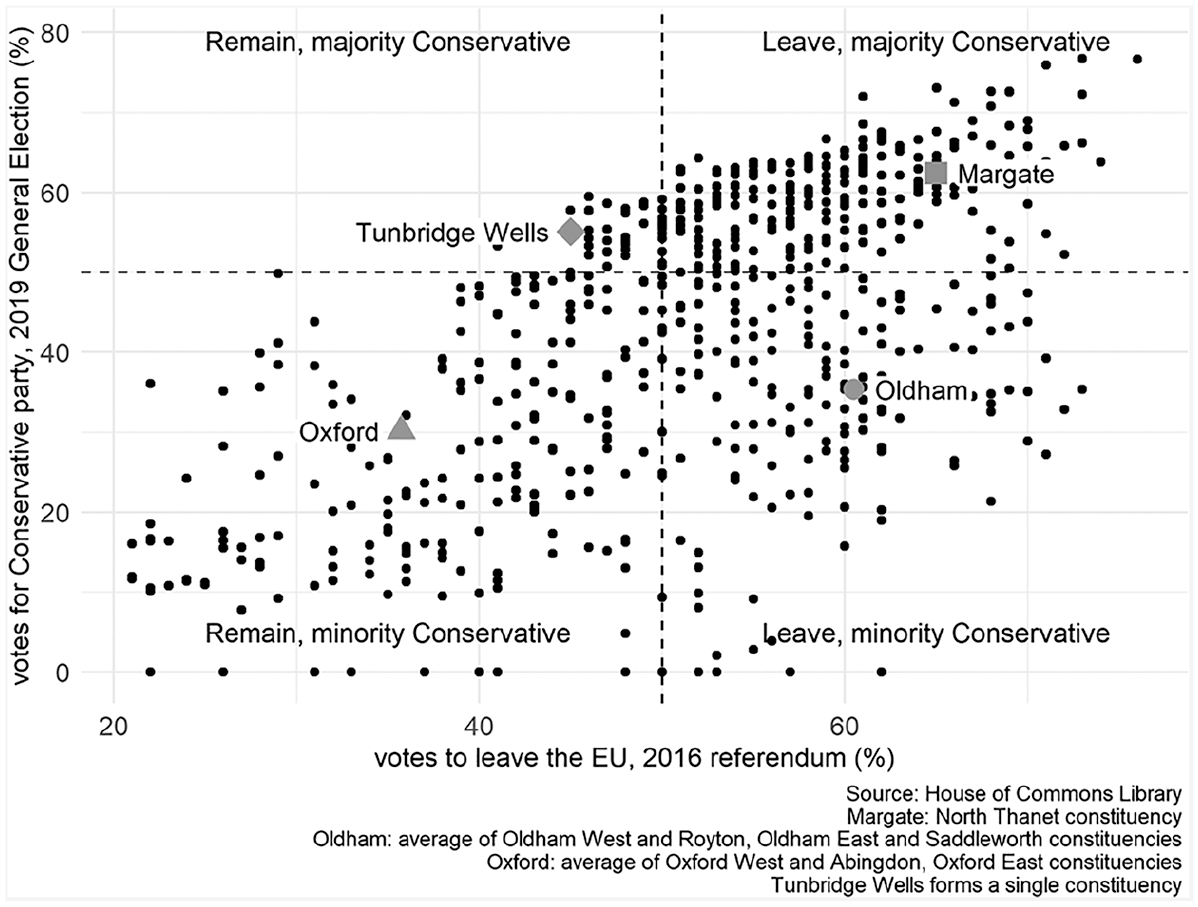
Percentage voting Conservative 2019 versus voting leave 2016, UK parliamentary constituencies.
However, Figure 1 shows that the Conservative vote is strongest in Margate, one of the poorer constituencies, but much weaker in Oldham. Prosperous Oxford has the lowest Conservative vote of any of the four towns. The Liberal Democrat vote (not shown) is strongest in the richer towns, while the areas of Labour Party strength straddle poor Oldham and rich Oxford. Despite the swing towards the Conservatives across the north of England in the 2019 general election, Oldham retains a recognisable profile of a more classic working-class constituency, with Labour as comfortably the biggest party.
The results of these votes show the difficulties of any simplistic ‘left behind thesis’ which typically explains the leave vote in terms of a nationalistic ‘white’ working-class vote in poor areas. Indeed, this thesis has been criticised from various angles, including that it overstates the significance of the so-called ‘left behind’ to electoral results (Dorling, 2016), that it cannot explain why so many abstain from voting altogether (Koch, 2016), and that ethnic minorities are altogether absent in these accounts (Rhodes et al., 2019). Given these problems, we focus on the specific character of local social relations, which is important for unravelling broader processes of social polarisation across our sites. It is in this spirit that we argue that we need to interrogate local social dynamics, and that a mixed methods perspective which is attuned to local social relationships has a vital role to play.
Quantitative Methods
Evidence of economic and spatial polarisation is drawn from official statistics, namely income, occupational class, area deprivation and population distribution by ethnic group. We present simple analyses that describe states of polarisation that are comparable across space at a point in time; as in our qualitative analysis, we do not include a longitudinal component. For the purposes of the quantitative analysis, our towns are defined by the built-up urban area (strictly, the Office for National Statistics (ONS) ‘Built-up area subdivision’), but income data are only available for the larger local authority area which (excepting Oxford) includes some rural areas outside the towns.
For income, we analyse the gross equivalised household income distribution 1 from ‘Pay As You Earn’ income (labour income paid by an employer) and cash benefits (such as child benefit, unemployment benefit and disability benefits), provided by ONS. It does not include income from self-employment, property income or other investments. It is ‘equivalised’ household income, adjusted to account for the size of the household (larger households needing higher income to meet their needs). As well as plotting the distributions of income, we report the ratio of the income at the 90th centile to the income at the 10th centile as a summary inequality measure. For occupational class, we use the three-class version of the National Statistics Socio-Economic Classification (NS-SEC) at the 2011 England & Wales Census. As a measure of polarisation, we report the proportion of working age people in the middle occupational class.
In our spatial analysis, we map data from the 2015 Index of Multiple Deprivation that measures multiple social deprivation within neighbourhoods (‘Lower Super Output Areas’ or LSOAs) using indicators of income poverty, unemployment, education, local services, housing and crime. This ranks areas relative to all other areas in England (e.g. ‘among the most deprived 10% of areas’). To explore patterns of spatial polarisation we plot simple maps that show the location of those areas that are among the 20% most deprived and 20% least deprived areas in England, relative to each other and to the towns’ commercial centres. Finally, we provide a short description of the composition of the population by ethnic group according to the 2011 Census. This is accompanied by a measure of residential population distribution, the Index of Dissimilarity, that indicates the tendency for people not identifying in the ‘White British’ ethnic group to concentrate in particular LSOAs. It varies from 0 (completely even distribution) to 1 (complete concentration).
Ethnographic Methods
While census and neighbourhood statistics are widely used to examine social divisions, they cannot capture the intricate ways that people live, work and interact in the community. Here, it is essential to combine our statistical analysis with ethnographic methods central to the school of community studies. For a period of at least 12 months between 2018 and 2019 we had four designated ethnographers trained in either or both sociology and anthropology working in each fieldsite: Insa Koch in Oxford; Sarah Cant in Margate; Jill Ebrey in Oldham; and Luna Glucksberg in Tunbridge Wells. Mike Savage participated in focus groups in Margate and Oldham. We also employed locally based research assistants who helped us collect and analyse the data (including Sasha East in Oxford).
This qualitative research captured the views and experiences of a number of groups residing and working in the towns, namely: residents from disadvantaged working-class communities; the town’s economic elites (if any) and business people; artists; local authority frontline workers and professionals; as well as young people aged 18 and over who had grown up in the towns. Here, we focus predominantly on the data from the towns’ marginalised communities facing structural inequalities and on those in the ‘squeezed’ middle which we see as crucial to analyse how local social dynamics are organised as well as to identify the potential for politicising inequality. Our interest in the latter also means that we have opted not to focus on the town’s economic elites in this article as they tended to be either absent (in the case of Margate and Oldham) or live completely separate lives (in the case of Oxford and Tunbridge Wells). We devised an open-ended questionnaire that would allow us to cover broad themes in interviews and focus groups, including: people’s experiences of community life; of divisions and tensions in the town; of politics and change; and of their hopes and thoughts for the future. Before each interview, we gave participants a chance to ask us any questions and all participants signed a consent form. As we got to know our fieldsites better, we revised the questions to make them speak to each of the town’s unique challenges and concerns.
To build trust with individuals we spent time in places where we would meet potential informants. Our fieldsites spanned community centres, foodbanks, local authority offices, housing associations and ranged from police stations to business conferences and people’s homes, cafes and pubs. In order to ensure consistency across the research sites, we held regular meetings and, to the extent that this was possible, visited each other’s fieldsites. In the later stages of the data collection, we also held workshops with the statistical team to discuss the different types of data collected. In total, we conducted 38 recorded interviews and five focus groups in Oxford; 39 recorded interviews and eight focus groups in Margate; 34 interviews in Tunbridge Wells; in Oldham, 12 focus groups, and 11 recorded interviews; and countless more hours were spent collecting data by way of participant observation and informal interviews.
Economic and Spatial Aspects of Polarisation
We now turn to our main aim of showing that economic and spatial polarisation takes varying forms in our four case studies and that we need to be attuned to these dynamics to properly comprehend how polarisation plays out ‘on the ground’. We lay out the statistical patterns first, before turning our attention to the ethnographic data. Figure 2 shows a percentile plot of the estimated gross household income distribution in 2015/2016, in the four local authority areas that encompass the towns in our study. The vertical axis shows gross equivalised household income from ‘Pay As You Earn’ income and cash benefits. The horizontal axis shows the centile of the distribution. For example the 90th centile of the income distribution in Thanet, the local authority that includes Margate, is £46,000. This means that 10% of households in the Thanet area have incomes of this or higher. At the other end of the distribution, the 10th centile income means that 10% of households have this income or lower.
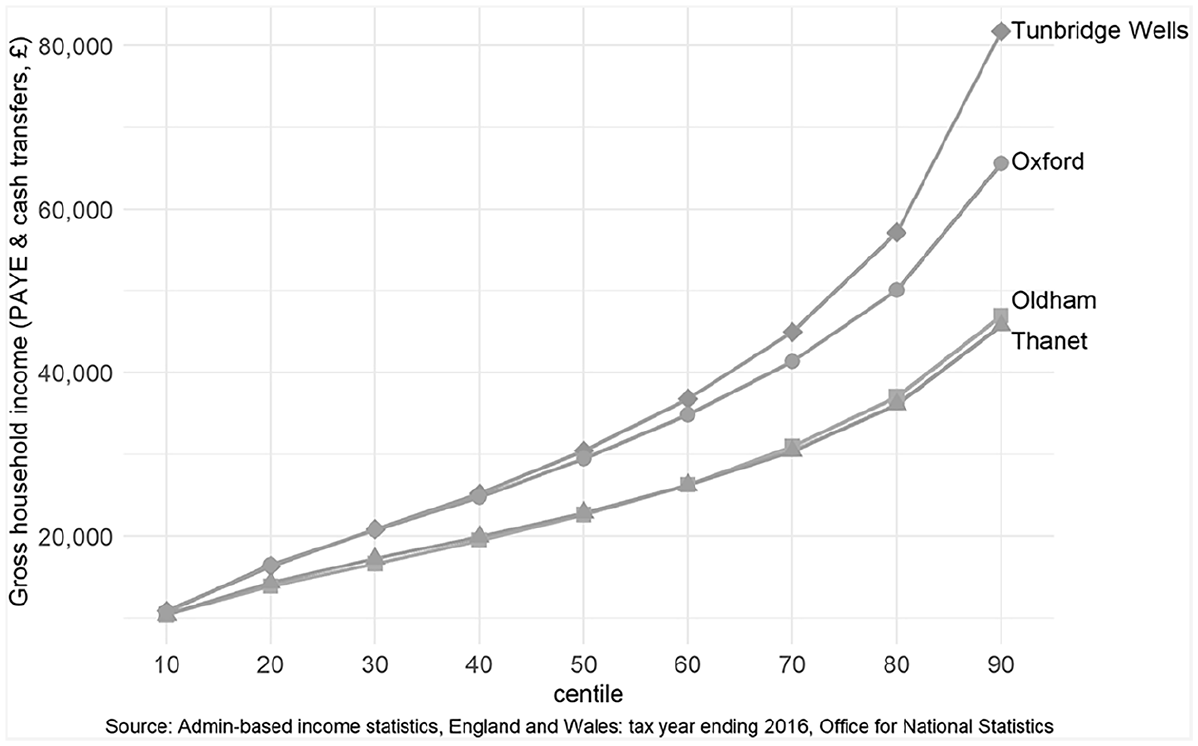
Decile plot of household income distribution, tax year ending 2016.
Three features of the distributions stand out. First, the income distributions in Thanet and Oldham are strikingly similar, with close similarities also between Oxford and Tunbridge Wells. Second, there is no evidence of an obvious ‘bimodal’ distribution with a hollowed out middle – if this were the case, there would be a distinct ‘kink’ in the middle of the chart. Instead, the lines are smooth showing a classic skewed distribution of income, with some low incomes, many people grouped around a central value and a minority with high incomes stretching away from others.
Third, the extent of this ‘stretching away’ is evident to a much greater extent in Oxford and Tunbridge Wells. The top 10% of households in Tunbridge Wells have (equivalised) incomes of £82,000 or more, in Oxford their incomes are £66,000 or more. In Oldham and Thanet the equivalent figures are £47,000 and £46,000. Consequently, the gap between rich and poor is much greater in Oxford and Tunbridge Wells, where the ratio between top and bottom 10% of households is 6.1 and 7.5 respectively, compared to 4.5 and 4.4 in Oldham and Thanet. On the other hand, the incomes of the poorest 10% are remarkably similar across all areas, between £10,400 and £10,900 per annum (though incomes at the 20th centile diverge significantly between the areas). This is reflected in very different estimated rates of income poverty in the four towns: 9% in Tunbridge Wells, 11% in Oxford, 24% in Margate and 30% in Oldham (estimates from the English Indices of Deprivation 2015, compared to 15% England average).
Figure 3 shows the breakdown of the working age population in each town by class (NS-SEC). The 2011 distribution of occupational classes for England shows something of a polarised distribution – with just 22% of working age people in the second ‘intermediate’ class, a lower proportion than in the first or third classes. By this measure, Oldham, Tunbridge Wells and Margate are polarised to a similar degree as England, with 19%, 22% and 25% of working age people in the intermediate class, respectively. Oxford stands out as being more polarised, with just 15% of working age people in the intermediate class. In Oxford and Tunbridge Wells it is the ‘managerial/professional’ group that stands out as being overrepresented relative to the other two while in Margate and Oldham the reverse is true with the third ‘routine/manual’ class overrepresented.
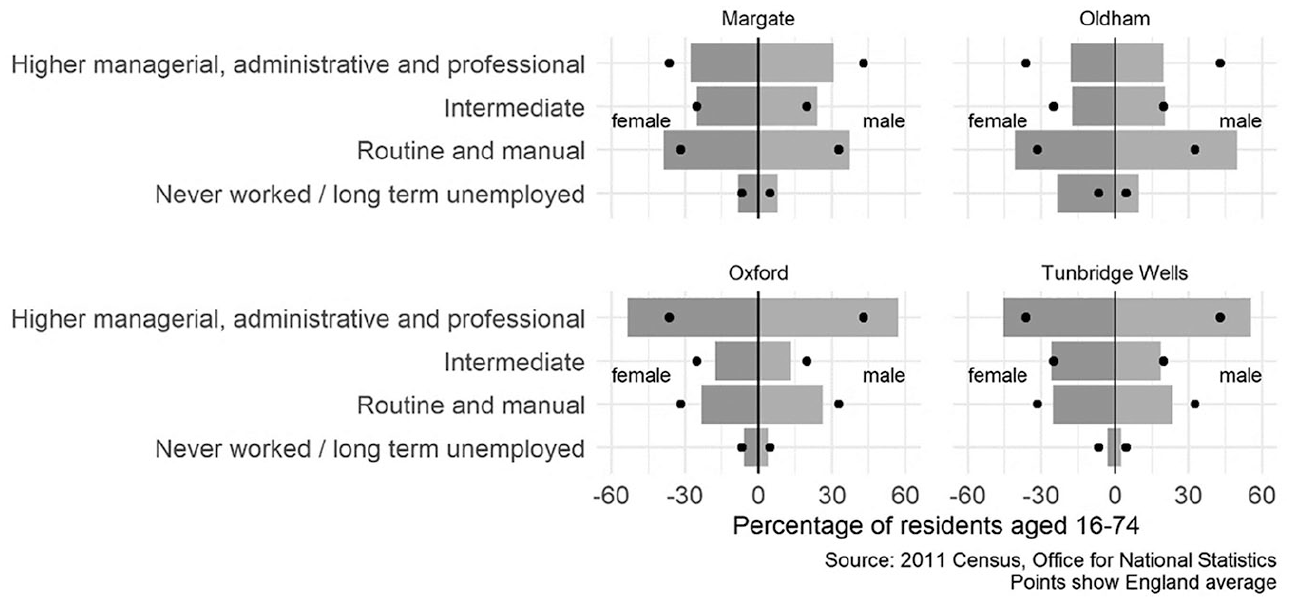
Occupational class of working age residents by sex, 2011 Census.
The maps in Figure 4 show the classification of small neighbourhoods (LSOAs – ‘Lower Super Output Areas’) according to the English Index of Multiple Deprivation (IMD) 2015. The hatched areas are those that are among the most deprived 20% of areas in England; the dotted areas are among the least deprived 20%.
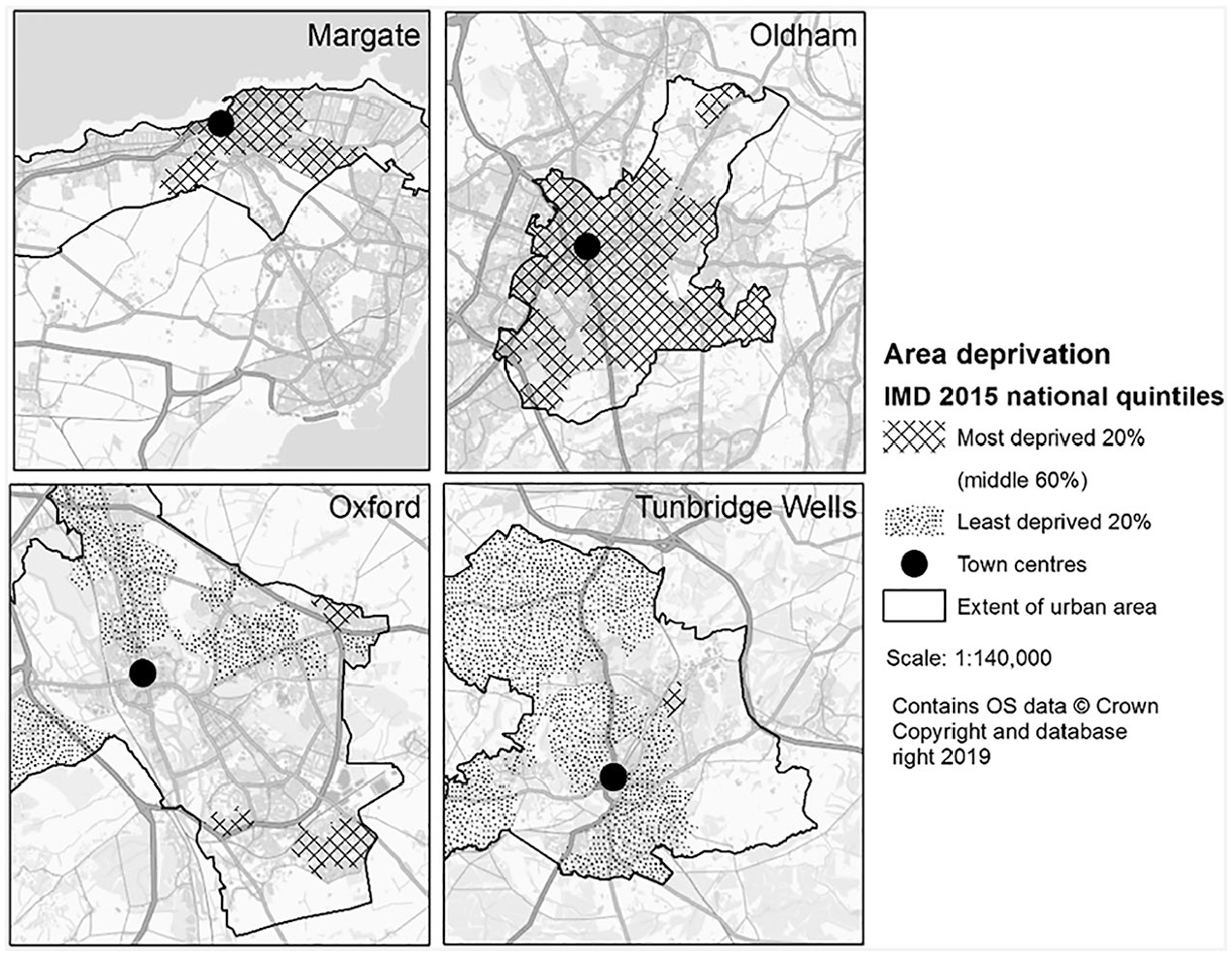
Index of Multiple Deprivation 2015 for ‘Lower Super Output Areas’.
There are very different patterns of neighbourhood deprivation in the four towns. First, the intensity of area deprivation in Margate and Oldham is much greater – they have four and five neighbourhoods respectively that are among the 1% most deprived in England whereas Tunbridge Wells and Oxford have none. Second, the most deprived parts of Margate and Oldham are the town centres, whereas in Tunbridge Wells and (for the most part) in Oxford, the most socially deprived areas (those among the 20% most deprived in England) are on the periphery, outside the town centres and located on the towns’ council estates.
In Figure 5 we show the distribution of neighbourhoods according to the IMD. Areas to the left are among the most deprived, areas to the right among the least deprived in England. Margate and Oldham have an overrepresentation of neighbourhoods that are in the ‘most deprived’ quintile of the IMD, and none that are in the least deprived quintile. Tunbridge Wells has one area that is in the ‘most deprived’ quintile but an overrepresentation of areas in the ‘least deprived’ quintile. In Oxford the distribution is much more even.
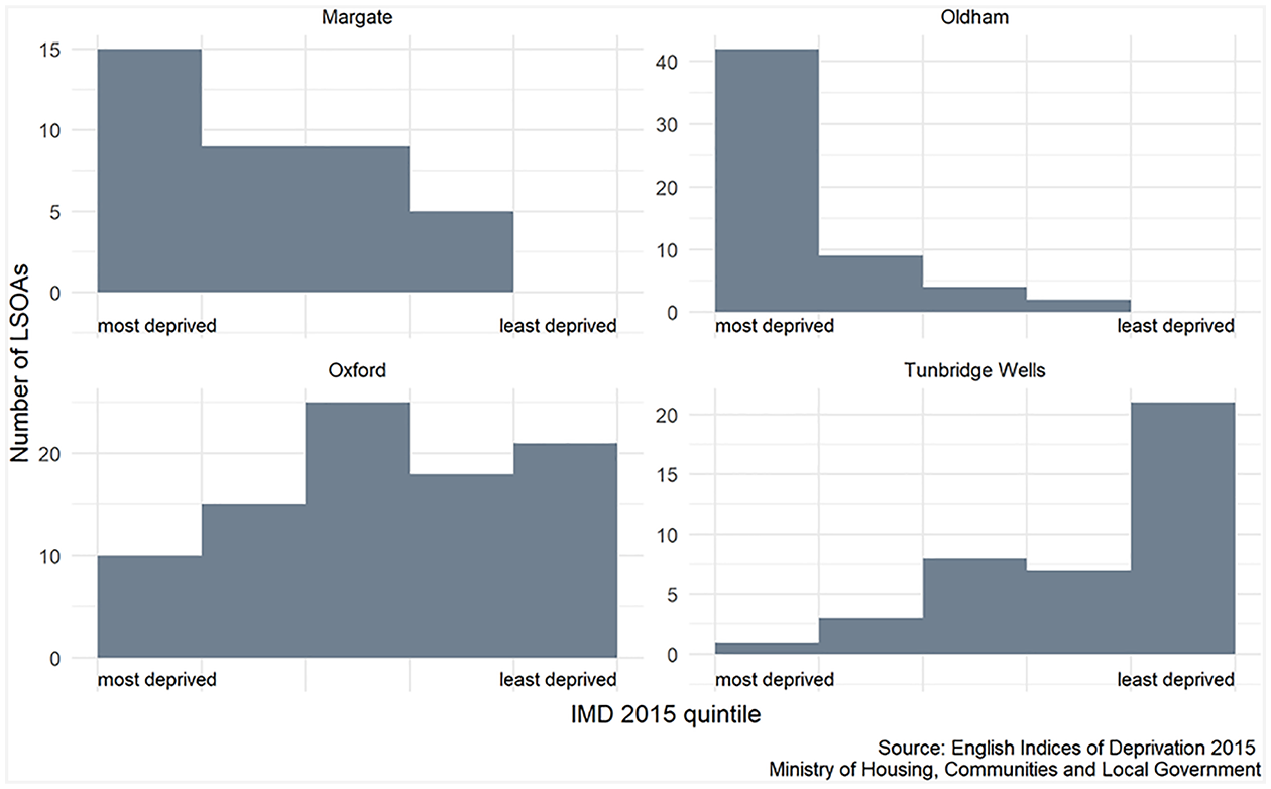
Number of ‘Lower Super Output Areas’ by national deprivation quintile, Index of Multiple Deprivation 2015.
Margate and Tunbridge Wells have populations that overwhelmingly identify as being of White British ethnicity (89% and 86%), the majority of the remaining residents identifying as from ‘other White’ ethnic groups. In Oldham just over half the population identifies as White British, and a third as Pakistani or Bangladeshi. Two-thirds of the Oxford population identify themselves as White British, 12% as other White, 12% as Asian and 4% as Black, this latter group concentrated in the peripheral social housing estates. The Index of Dissimilarity is very high at 0.64 in Oldham, reflecting its striking pattern of residential settlement by ethnic group, with areas that have less than 10% White British residents next to areas with over 90% White British residents. The index is relatively low in Oxford (0.14) and Tunbridge Wells (0.17), reflecting less population concentration by ethnic group. Margate has a middling value of 0.33, as people identifying as in ‘other White’ ethnic groups tend to concentrate in the centre of the town.
In summary, we can distinguish two different patterns of economic and spatial polarisation. In Margate and Oldham, deprivation concentrates in the town centre, and inequality (and polarisation where it is evident) is poverty-based. Here, areas are characterised by high levels of poverty, intense social deprivation and a higher than average proportion of people in the lowest ‘routine/manual’ occupational class, with little evidence of very high incomes at the top end and a low proportion of people in the ‘managerial/professional’ class. By contrast, Oxford and Tunbridge Wells exhibit the opposite pattern, where inequality is elite-based and people experiencing social deprivation are pushed to the geographical periphery of their towns. Rates of income poverty in both towns are below the national average, but incomes at the top of the distribution are very high (even excluding self-employment and investment income). Again, there is some evidence of polarisation in terms of occupational class, particularly in Oxford, but this is driven at the top of the distribution where there is an overrepresentation of people in the highest status ‘managerial/professional’ class. We will now show how these patterns of economic and spatial polarisation sit with our qualitative evidence on relational polarisation.
Relational Aspects of Polarisation
Conviviality and Grass-Roots Activism among Marginalised Populations
Let us now consider how these processes of elite-based and poverty-based polarisation intersect with our ethnographic analysis of the quotidian activities in the four towns. It is immediately clear that different kinds of people living in the same towns do not command equal value. Tyler (2013) discusses the ways in which marginalised groups are ‘laid to waste’ (Bauman, 2004) and how this process works through the production of ‘labor precariousness’, which produces ‘material deprivation, family hardship, temporal uncertainty and personal anxiety’ (2013: 24–25); ‘the relegation of people to decomposing neighborhoods’ in which public and private resources are dwindling; and heightened stigmatisation ‘in daily life as well as in public discourse’ (2013: 24–25). Skeggs (2004) similarly reminds us that these processes are never just physical but involve processes of symbolic devaluation too. All four fieldsites exemplify the damage caused to people in this process, as sometimes entire towns – in the case of Oldham and Margate – and at others, particular neighbourhoods (usually the outlying housing estates) – as in the case of Oxford and Tunbridge Wells – come to be defined as places of both abject failure and, in the case of Oxford, paternalistic control by the town’s local establishment who see residents in need of moral guidance and sometimes outright disciplining.
Our interlocutors expressed a strong sense that certain populations and the places that they inhabit did not count as ‘proper’ as part of a complex and riven politics of claiming ‘moral ownership’ of towns. Typically, we found that devaluation and stigma was most strongly experienced by the (by now largely post-industrial) working-class populations who consider themselves to be ‘local’ to their towns, including mostly British and white residents and, in the case of Oxford, also those of African-Caribbean descent (often second or third generation migrants). In both Margate and Oldham, people were thought to sound ‘poor’, ‘working class’, ‘common’ and ‘rough’ by those living in the region. Our working-class interlocutors spoke of how, when meeting outsiders, they did not want to give away where they were from, for fear of being judged. Sue, for example, a white working-class woman in Oldham explained: ‘If somebody says, “Where do you come from?” You’re like–, I just say, “Near Manchester”, rather than Oldham.’ Another white woman called Martha, now in her 30s and living in South Manchester recounted growing up in Oldham:
So, when I was growing up . . . I would not be proud of being from Oldham and I would never like to admit that I was from Oldham. And my brother and I would pretend that we were from Manchester because we spent all our time in Manchester, all our social time.
While in both Margate and Oldham, the entire towns and their inhabitants were associated with images of being rough and common, the dynamics in Oxford and Tunbridge Wells were somewhat different. Here, the towns themselves were commonly considered to be ‘success stories’ due to their prosperity and histories; however, residents on the peripheral housing estates spoke of how their neighbourhoods were devalued, and written out of the ‘official’ narratives of their towns. In Tunbridge Wells, the large housing estates are located barely more than half-an-hour’s walk from the wealthy town centre, yet, they feel a world apart. Jack, a white working-class resident who had always lived on one of the town’s estates, spoke of how people like him were constantly ridiculed for their manners and habits, including for eating badly, going to McDonald’s and ‘not cooking as “proper” people would’. Similar stories were recounted in Oxford, on the Blackbird Leys estate, the town’s most notorious and largest post-war housing estate located four miles from the town centre. Joe, a working-class man of African-Caribbean descent who had lived in Blackbird Leys all his life spoke of how the estate had only ever counted in Oxford’s imaginary as its poor and destitute ‘other’, and how local authorities had always infantilised its residents by treating them with mistrust and arrogance.
And yet, despite feeling devalued, older residents also expressed a sense of pride associated with their working-class histories. Stories of an industrial past offered an alternative source of value, a way of rewriting people’s relationships to – and claiming a sense of ownership over – the towns they lived in. In Oldham, this tended to be expressed by white residents and recounted in memories of the heritage of the cotton manufacturing industry. In Margate, despite a frequently repeated narrative that it had suffered economic and social decline, nostalgia for the vibrancy of working-class tourism served to anchor contemporary community identity among white working-class people. Over a lunchtime pint, retirees Trevor and Bill explained:
it was a really thriving area, every one of these places down here, all the hotels and they were full . . . this pub on a Friday evening, this time of the year you would be standing in line, little bit piano over there, everybody would be singing.
Similarly, in Tunbridge Wells and in Oxford, neither of which are commonly remembered in dominant societal imaginations for their industrial past, people told tales of clay pits, brickworks and of timber merchants (Tunbridge Wells), as well as of the ‘Cowley works’ when estate residents used to work in the car industry (Oxford).
In addition to stories of an industrial past, people expressed more mundane and highly localised forms of belonging to their localities. Informal networks have been at the forefront of both the ‘classical’ community studies (Young and Willmott, 1957) and more recent anthropological (Degnen, 2005; Edwards, 2000; Koch, 2018; Mollona, 2009; Tyler, 2012) and sociological (McKenzie, 2015; Skeggs and Loveday, 2012) work. Our interlocutors spoke of the intense familiarity of the people and places they lived in. In Tunbridge Wells, Jack, a white man in his 60s walked Luna down the streets of his childhood, showed her the windows of the flat he lived in when he was a child and then pointed out where his family was, nearby, in a tightly knit web: ‘My aunty used to live there; my mum used to shop there, and play bingo there.’ On the Blackbird Leys estate in Oxford, people often spoke about how ‘everyone knows everyone’, and while this was undoubtedly an exaggerated claim, it illustrated how people lay claims of ‘connectedness’ (Edwards, 2000) through shared social networks of neighbours, family and friends. Such connectedness was also expressed by migrant communities. For example, South Asian women emphasised how Oldham was their home. For Sama, ‘the best thing about Oldham is the close-knit community’. In Margate, Frieda, an Eastern European working-class migrant, told Sarah:
[It’s] exactly like a small community, everybody knows each other. I went on a holiday to Peterborough last year and it was different, a different environment, not that many Czech and Slovak people, here it feels like there are lots of Czech and Slovak people. In Margate, you don’t have to be scared to go out in the evening. In Peterborough it’s different, people don’t want to go out in the dark.
It was this sense of shared belonging to a place and ‘community’ that provided the basis for much grass-roots activity, as disadvantaged populations mobilised, often along informal lines, to help one another. These are not de-moralised and atomised communities, with plenty of evidence of organisation in the face of austerity politics. Residents and local authority officials in all four towns blamed Universal Credit (a means-tested cash benefit introduced from 2013) and years of austerity for rising levels of food poverty, rent arrears and mental health problems. On the Blackbird Leys estate in Oxford, various initiatives were in operation, ranging from a local foodbank to an affordable community-run cafe to, most recently, in light of the unfolding coronavirus crisis in the early parts of 2020, informal networks of neighbour support for those struggling to afford even the most basic necessities and to leave the house due to self-isolation. Similar initiatives existed in the other three towns. In short, then, across all four towns, our working-class interlocutors continued to express a strong sense of belonging and were part of mutual relations of support, despite – or perhaps in the face of – stigma and devaluation that were heavily associated with the towns’ respective working-class populations. But alongside this, there are also clear divisions which were articulated.
Divisions and Differences between Town Residents
If people in the neighbourhoods narrated a sense of belonging and ‘connectedness’, this should not romanticise town communities: evidence of division and tension was stark. There was a strong sense articulated by our white and non-white working-class interlocutors of an ‘us’ and ‘them’ that was both geographically and socially specific to the localities they inhabited. This sense of difference was articulated in distinct ways. In both Oxford and Tunbridge Wells, working-class residents tended to narrate a sense of antagonism towards the town’s wealthier people, including the landed elites who had long formed part of the towns’ business and political establishments, and the comfortable middle classes. Residents also expressed frustrations about particular urban planning projects or regeneration initiatives that were experienced as unilaterally benefiting the rich and typically also ‘outsiders’, including commuters who had moved down from London. In Tunbridge Wells, this was exemplified by a £77m development project for a new theatre intended to ‘bring the West End to Tunbridge Wells’. On the estates, residents were angry about such investments: ‘This town is not for local people, it is only for the rich’, Jack told Luna. ‘There’s nothing in this town for the people of Sherwood [name of the estate he is from].’
Similarly, in Oxford, various regeneration and property development projects were commonly perceived to benefit only the wealthier groups. A development project that had attracted much discussion concerned the recently opened Westgate shopping centre, a multi-million-pound covered shopping mall in the centre of the city which housed a range of mostly high-end high street brands and expensive restaurants on the roof terrace. But for many town residents, the prices were simply beyond their means and few of them ever went to the shopping centre that they considered to be catering for the ‘rich’ and ‘tourists’ only. For them, the local council’s approval of the shopping centre was proof of a tight imbrication of the business elites with the local Labour-run council that had let local people down. Both were constructed as a common enemy that failed to look after local people and their needs by promoting investment opportunities that were designed to ‘smarten up’ the town for wealthy tourists and elites. Sue, a white working-class resident and former housing activist, explained the Westgate development in the following terms:
The council make a lot of money out of property developers and that’s why they pushed through the Westgate Centre against every–, all the consultation, against everybody that was asked, they relocated vulnerable adults from their sheltered housing in order to build a fricking shopping centre that is absolutely going to bankrupt the rest of Oxford city centre. All the other shops in Oxford city centre that can’t afford to be in the Westgate Centre are losing business hand over fist, the Covered Market [an old market area in Oxford city centre] is a ghost town, but the council, Labour city council, will do that because . . . they have a very neoliberal attitude towards planning decisions.
To say that in Tunbridge Wells and Oxford divisions pitched residents against the council and business elites is not to say that other, intra-class tensions did not exist. For example, the sense of difference that our interlocutors articulated frequently extended to those living in adjacent neighbourhoods, including other working-class populations. At times, such tension could also be expressed along racial and ethnic lines. In Oxford, particularly the older white working-class populations sometimes spoke of how migrants were given preferential treatment. Long queues at the pharmacy, extended waiting periods for doctors’ appointments, and insufficient housing could be blamed on ‘foreigners’. At the same time, ties between the Caribbean and white working-class communities were strong and during the period of fieldwork in 2017 and 2018, several grass-roots initiatives were active on the Blackbird Leys estate both in support of people affected by the ‘Windrush scandal’ and for refugees. The former council leader explained that the relative absence of racial tensions in Oxford was a positive unintended effect of its dire housing crisis: because housing was so unaffordable, migrants tended to be ‘pepper potted’ around the city, thus preventing ‘ghettoisation’ and creating the space for diverse ethnic and racial communities to meet.
By contrast, in Margate and Oldham narratives of racial and ethnic tension were more common. In Oldham, the major topic of conversation was austerity but this was sometimes refracted through the lens of racism and migration. The scarcity of everyday services is evident in the conversational narratives Jill experienced in focus groups. These service cuts produced resentment among all sections of the long-term resident working class, both white and South Asian, who feel ‘others’ are accessing those resources unfairly, with the Roma people who have recently settled in Oldham bearing the brunt of the current wave of racism. Likewise, in Margate, the white working-class population routinely expressed resentment towards the large group of predominantly ‘marginal whites’ (Garner, 2007) – which, since 2008, has largely included economic migrants from countries of Eastern Europe, predominantly Poles, Slovaks and Czechs, many of whom are Roma. White British working-class people routinely reported feeling threatened by these groups, being made to feel like they were foreigners in their own town as the streets they called their own had been ‘taken over’ by others. Christine, a white English working-class woman from Margate in her 70s said:
I mean, there is a big influx of immigrants . . . in our market, you can’t help but see them. Singly, or two or three of them together, fine, but when you see crowds of them together, you know, it does get a bit much. I’m not racist by any means at all . . . you know? It’s changed the whole demographics of it, it really has . . . I feel like an outsider.
There was, like in Oxford and Tunbridge Wells, a nuance to this overarching narrative, however (see also Rhodes et al., 2019). In Oldham, attempts to bridge existing gaps between different ethnic and racial groups included initiatives by the local Labour group, the Interfaith Forum, which connects various religions and myriad civil society organisations working together in a spirit of solidarity. More mundanely, our interlocutors often drew a distinction between types of immigrant – the ‘hard working’ and the ‘non-deserving’ – a recognition that migration brought some clear advantages, but also an easy scapegoat/explanation for personal difficulty, attached to a belief that the white ‘indigenous’ population had a greater entitlement to services. Some people also recognised that working-class migrants were undertaking work that the local population would not do – fruit picking, salad farming and care work – but this was blamed on structurally low wages and unfair competition, not that the ‘locals’ were lazy. And there were attempts to call out racism too. One white working-class woman described how, concerned about the lack of opportunities for the children, she contacted the council for support and then set up a community group and applied for funds to bring the communities together. Charles, a white working-class resident in Margate told Sarah:
I am fed up . . . I just can’t stand racism and there is so much racism in this area . . . everybody blames all the migrants that are here . . . yes, they are here and yes they have been ghettoised . . . but that’s not their fault . . . take this road . . . the bottom end is the poor end, and top is the posh end. I live in the top end, but in the bottom end there are flats with 20, 10, 15, 20 flats, all bed sits in each house, and they are all refugees or Europeans that have come from a different country. They get the blame for everything . . . absolutely everything . . . and it frustrates me . . . I point out often enough that 97% of refugees and asylum seekers work and pay taxes . . . but if you only take 3% that’s what people focus on but if you take 3% of British people in the same position they are exactly the same . . . the fact is that there is a higher percentage of British workers out of work than 3%.
To sum up, across all four towns, conviviality co-existed alongside a marked sense of difference, with our working-class interlocutors in Oxford and Tunbridge Wells expressing this in terms of a strongly felt antagonism towards the towns’ elites, while in Oldham and Margate, differences tended to fracture along intra-class and inter-racial/ethnic lines. However, it is also important to acknowledge the nuances to such a picture, including the efforts made to overcome such divisions by inter-faith and inter-ethnic groups. We now turn to a third area of similarity and difference across our towns: namely, the relative weakness of a ‘middle’ – of a middle-income group of residents – and the implications of such a situation for town relations.
The Missing Middle and Its Conditioning of Town Politics
We saw earlier that polarisation has been understood in terms of a situation in which the extremes of a distribution are growing, and where there is a missing or shrinking ‘middle’; Marcuse’s (1989) image of the hourglass springs to mind. This perspective has been applied in Wacquant’s (2008) discussion of occupational polarisation in the USA and in a UK context. At an urban level, Stenning (2020) has studied ‘just about managing’ low- and middle-income families in North Tyneside. Roberts (2011) has coined the term of the ‘missing middle’ in youth transitions and the ‘squeezed middle’ has been explored by Antonucci et al. (2017) in the context of Brexit. However, our statistical analysis above showed that across all of our four towns, there were ‘middles’ in terms of large numbers of households with incomes intermediate between high and low. Nonetheless our ethnographic research revealed how middle-range groups felt increasingly ‘squeezed’ in the case of Oxford and Tunbridge Wells, experiencing anxiety about loss of social mobility, while in Margate, their relative absence was being filled by the arrival of a new class of ‘creatives’. These ‘middle’ groups, however, had little connection with the towns’ existing working-class populations, thus adding to a sense of divisions.
In both Oxford and Tunbridge Wells, local authority workers and professionals were concerned about the pressures experienced by, and the subsequent lack of, a middle-range income group of residents who sat between the wealthy elites and the working-class populations. In Tunbridge Wells, this ‘squeezed’ middle was articulated in both generational and economic terms, especially in middle-class circles. There was a remarkable absence of people aged between 18 and 40 as people tended to leave the city for university education and return to settle with families later on in life. Moreover, people in middle-range incomes often could not afford to live in the town and lived in the surrounding villages. Their positions were clearly more comfortable than those of the working-class people we encountered above and from whom they clearly distinguished themselves. But, at the same time, they lacked the economic means to keep up with even wealthier people. This is how a white, middle-class and self-ascribed left-leaning professional described her experience of living in the town:
When my children were at school I understood a lot more about Tunbridge Wells than I had ever. When my youngest was in primary school, I felt we were too posh for the school; my accent was not right at the school gate, we would occasionally go on holiday, my partner and I worked. Then she moved to secondary school, and all of a sudden we were too poor: she did not have a horse, or an iPad, and her phone was not top of the range; we were not holidaying in Europe every few months, and having a ‘proper’ holiday somewhere further afield in the summer. It was like being always slightly off kilter, there was never a middle ground to hold on to. Or if we were the middle ground, we were definitely in a minority.
In Oxford, similar anxieties over the lack of a middle were articulated. Local authority officials were acutely aware of the fact that the town was unaffordable for middle-range income people working in the public health, charity, university administration and business sectors, with 40,000 people commuting from surrounding villages and towns into the city on a daily basis. Linda, a white comfortably middle-class woman in her late 50s, also expressed concerns about the ‘squeezed middle’. She and her husband lived in an owner-occupied house in a nice part of town, but spoke of how ever-rising property prices meant that the same privileges no longer existed for their university-educated children. She explained: ‘I think there are people like us who bought our houses ages ago when it was still relatively affordable and we’re sitting fat and happy and, you know, we’re fine, and we’ll probably just, you know, hang in there.’ But Linda also worried that ‘there are fewer people in Oxford in the middle and that we’re becoming more kind of wealthy people and really desperate people’.
The ‘missing middle’ further conditioned town politics in interesting ways. In Tunbridge Wells, there was a lack of progressive politics/political initiatives in what has always been a Conservative party-run local authority. In Oxford, the situation was somewhat different, it being a Labour-dominated council and a ‘liberal’ university town. Local activism flourished, including a recently formed housing cooperative; a community land trust project; and a social enterprise that reclaimed under-used buildings in the city and rented them out to local groups at a not-for-profit rate. These projects, often consciously presented as alternatives to a neoliberal housing market, also faced much resistance, including from private developers and a conservative rural lobby opposed to more housing. But their activists’ cultural and educational capital, and their social networks also meant that they were able to tap into national political agendas to further their own purpose in ways that the working-class populations could not. What is more, these activities tended to remain almost entirely divorced from the grass-roots activities of the more disadvantaged populations. This, as well as the highly class-specific nature of these projects, meant that the working-class populations often regarded activists with suspicion or even anger, seeing them as yet another example of a tight imbrication of the local establishments in town.
By contrast, in Oldham and in Margate, the story played out somewhat differently again. There, the middle was not ‘squeezed’ but rather absent, often by choice, as in both places middle-class professionals tended to live outside the towns. Each town has also embraced, in recent times, a ‘culture led’ development strategy. In Oldham, a middle-income group of mostly public sector professionals, while mostly living in the ring around the city centre and in surrounding rural areas, travel to work in the town, and still participate both in more old-fashioned forms of civic culture such as choirs and amateur theatre, initiatives in the newly regenerated town centre, as well as in groups campaigning around social issues. In Margate, an art-led regeneration strategy that saw the opening of the Turner gallery, had heralded the arrival of the ‘creative classes’ from London, referring to themselves as ‘dfl’ – ‘down from London’ – attracted to the town because of its ‘edginess’, its ‘buzz’, as well as its affordability. Margate was presented as a sort of terra nullius, an unspoiled territory, on which to play out a creative life, distinct from conventional middle-class values. Damian, a white British artist in his mid-30s, used family money to buy the home he could not afford in London and explained what attracted him to the town:
I now adore Margate and I sort of fell in love with it when I got off the train really . . . being on the beach was good . . . the feeling of space and emptiness was really nice . . . it felt really exciting . . . and I sort of like derelict things and so it was very atmospheric . . . so it was a good mix between desolation and friendship I suppose . . . it’s multicultural and it’s contemporary . . . like I walked down there the other day and there were . . . clearly families of all different ethnic backgrounds . . . and then there were girlfriends holding hands . . . there were camp gay guys chatting with their friends . . . there were straight couples . . . there were lads out . . . there were people there with their kids . . . and it was like . . . this feels like the modern world, like Modern Britain.
In Margate, the appropriation of the areas for creative endeavours occurs in numerous ways: not only are the hipster spaces expensive and exclusive, but the other shops and cafes can be confidently inhabited by the new residents – who enjoy ‘an occasional fry up’. Hence, the ‘new’ middle in Margate (similar to the ‘squeezed’ middle in Oxford) was not breaking down divisions with the existing working-class population but reinforcing them, and in doing so is actively shaping local power imbalances. Interestingly, however, the working-class population in Margate did not seem to resent the presence of the ‘new creatives’ in town. In marked contrast to the resentment that was articulated by Oxford and Tunbridge Wells’ working-class residents towards the wealthier strata of their towns, there was a sense that these ‘creatives’ were welcome, certainly more so than the Eastern European working-class migrants. A white second hand British shop keeper put it in the following words:
They are a better class of people. They are a mixture of people moving down from London they are buying up big houses in these roads . . . they’ve sold up in London and buying property here. [They are] what I call serious buyers.
In short, across all four towns, despite the existence of middle-income groups, socially and culturally the middle was weak and unable to leave its own ‘stamp’ on local social relations. This thereby further exacerbated town divisions. In Oxford and Tunbridge Wells, a ‘squeezed’ middle and, in Margate, an incoming group of ‘creatives’, championed their own social and cultural projects that were almost wholly divorced from the lived realities of the towns’ respective working classes. But while working-class residents in Oxford and Tunbridge Wells were resentful of the relative privileges still enjoyed by the ‘squeezed’ middle, in Margate no such antagonism was expressed towards the ‘creatives’. One reason for this difference might be that the arrival of these classes has not (yet) driven up property prices and started displacing local people. This makes it possible for residents to read the arrival of the ‘creative classes’ through a lens of ‘smartening’ the area, which appeals to the white working-class population, many of whom feel that Eastern European working-class migrants have been dragging down the ‘tone’ of the place, and have a stronger affiliation and respect for white middle-class residents. It is possible that in the future, as more and more ‘creatives’ gentrify Margate and start to drive up housing prices, local discourses around who is welcome and who is not might well become more focused upon the wealthier ‘elites’.
Conclusion: Re-Politicising Inequality in Britain Today
The concept of polarisation, where the extremes of a distribution are growing and where there is a shrinking ‘middle’, has attracted recent interest driven by concerns about the consequences of inequality in British society. However, this can lead to a dichotic picture, seeing Britain as increasingly divided between the ‘left behind’ in contrast to its elite cosmopolitan counterparts. While the growing gap between poor and rich is undeniable, our qualitative and quantitative analysis has cautioned against drawing a simplistic picture at the local level. Thus, our quantitative analysis has distinguished important differences between the towns, one where inequality is characterised by the presence of a large elite class (in Oxford and Tunbridge Wells) and one where inequality is characterised by the depth and extent of poverty (in Oldham and Margate); linked to social deprivation concentrating in the town centre versus one of social deprivation being pushed to the periphery. Our ethnography has further nuanced this picture. Notwithstanding broader patterns of polarisation, across all our fieldsites, we have shown that marginalised populations narrate a strong sense of belonging and engage in grass-roots activity. But divisions are also articulated in each town, with respect to both the towns’ elites (in Oxford and Tunbridge Wells) and to ethnic and racial minorities (in Oldham and Margate), and reinforced in each case by the lack of a strong presence of groups in the middle, who might be intermediaries.
While we warn against the risks of simply mapping relational dynamics onto spatial and economic polarisation, it is instructive to place our qualitative data in conversation with our statistical analysis, particularly in relation to understanding the claims of moral ownership that residents feel able to make over their towns. In Oxford and Tunbridge Wells, wealth is highly visible in the form of property developments, regeneration projects and, in Oxford, the university located in the town centre. These initiatives mask the economic and spatial alienation that residents on outlying estates might experience towards a town centre which they rarely visit, and reinforce a felt inability to claim the town as being rightfully ‘theirs’. At the same time, a lack of felt ownership can generate unexpected forms of (inter-ethnic) solidarity, such as in Oxford where de facto policies of ‘pepper potting’ immigrants in different neighbourhoods have produced a shared sense of ‘us’ and ‘them’. In comparison, despite considerable investment in regeneration projects, significant wealth is not visible in Oldham and Margate. In Oldham, this allowed both white and ethnic minority working-class residents to retain a greater sense of moral ownership, whereas in Margate there was greater evidence of the white working class seeking to reclaim their desire for moral ownership in the face of a racialised narrative of loss, leading to stronger anti-immigrant sentiment (as evidenced by the unusually strong presence of UKIP in that town).
Statistical data on economic and spatial polarisation also elaborate our ethnographic observations with respect to the ‘squeezed’ or ‘missing’ middle. Across the four towns, we noted the relative weakness of middle-income inhabitants, with this group being almost entirely absent from Oldham and Margate, and being increasingly pushed out in Oxford and Tunbridge Wells. In both Oxford and Tunbridge Wells, this polarisation driven by wealthier groups created a situation whereby those on a middle-range salary are effectively ‘squeezed out’: both unable to get on social housing register lists and to buy into the local housing market, these people experience a precarity – and an anxiety that comes with it – that is specific to their particular class position and age. Meanwhile, in Oldham and Margate, poverty-based polarisation and spatial patterns of the towns’ socio-economic make-up meant that the same problems of unaffordability do not arise. Here, middle-income people often choose to live outside of town out of their own volition, partly because, as we have seen, the town centres are very deprived. While in Oldham, this has reinforced the solid working-class make-up and reputation of the town, Margate has recently seen the arrival of the ‘creative classes’ who are escaping high property prices in London and feel attracted to Margate for its ‘edginess’.
Notwithstanding these important differences between the towns, we also found some strong common themes cutting across the broader patterns of polarisation. Across all four towns there were impressive efforts to form solidarity movements that link up marginalised constituencies and connect them to more powerful ones, often against the grain of austerity and housing pressures. Nonetheless, there was generally an absence of effective communication or interrelations between different social groups. There were exceptions: in Oldham, most notably, we found this to be particularly the case with respect to initiatives that attempt to bridge ethnic and racial tensions. Here, efforts to shore up mediation between different groups included initiatives by the local Labour group and the Interfaith Forums. Meanwhile in Oxford, attempts to speak on behalf of broader social issues included a range of local projects undertaken around the local (and national) housing crisis. However, notwithstanding the good intentions and efforts put into them by mostly middle-class activists, such and other initiatives remain far and few between. Crucially, in Oxford, they also tend to be riddled with the same suspicion and paternalistic relations common to interactions between disadvantaged and more privileged groups, rather than providing genuine spaces for exchange.
The limits of these grass-roots initiatives speak to a broader issue: that of how local configurations of social relations can help explain the weakness of popular mobilisation around growing levels of inequality in Britain today. It is striking that despite the growth of economic inequality, meritocratic beliefs have, if anything, become stronger (Mijs, 2019). Likewise, civic society movements capable of ‘capturing’ broad constituencies have been in decline, while the Labour Party and political left have increasingly been colonised by well-educated groups, thus losing a large part of their traditional working-class vote (Evans and Tilley, 2017; Piketty, 2020). Recent explanations have tended to locate the causes of de-politicisation in the broader power dynamics acting upon the most marginalised, whether this is along the lines of a Bourdieusian analysis of mis-recognition and symbolic violence (e.g. Atkinson, 2010; Bourdieu et al., 1999; Charlesworth, 2001), or alternatively, in terms of a perspective that locates intra-class alienation in the conditions of neoliberal rule (Dench et al., 2006; Edwards et al., 2012; Kalb and Mollona, 2018). Instructive as these insights are, these stark accounts can over-dramatise more mundane day-to-day dynamics: namely how the relative lack of intermediary institutions and actors explains both the weaknesses of, but also potential remedies for, organising collective struggles.
Indeed, the angle adopted here fits well with recent attempts in both social network analysis (Burt, 2004, 2009; Stovel and Shaw, 2012) and anthropological engagements in settings of austerity (Guderjan et al., 2020; Koch, 2020; Koch and James, 2020; Koster, 2014; Tuckett, 2018) to foreground the importance of brokers in mobilising broader collectives. The former strand has shown that within corporate organisations brokers who form bridges between cliques who would otherwise not be in contact, can enjoy disproportionate influence and can be crucial vehicles of mobilisation and organisational efficacy. Similarly, the anthropological lens has looked at how brokers:
move between their clients and the institutions, authority figures and actors that their clients struggle to access, occupy a veritable in-between position, deriving their legitimacy from their seeming proximity to the ‘common people’ while also possessing specialist skills and knowledge that the latter lack. (Koch and James, 2020: 7)
Applied to community relations, our data show equivalent kinds of local mediators are frequently absent from, or may not be able to operate to bridge different social groups, whether these be neighbourhood or interest-based, into effective alliances. It follows too that these intermediaries are not necessarily members of a particular social class or ethnicity, but are individuals or institutions who occupy a position of trusted leadership typically grounded in localised networks of exchange. This kind of framing might help explain why Margate and Oldham, despite experiencing similar ‘poverty-based’ polarisation have such varying political trajectories. In Oldham, the persistence of older civic infrastructure and working-class urban presence has facilitated ongoing command by the Labour Party, whereas the outsider led arts-regeneration strategy in Margate has failed to stem longer-term tensions associated with immigration, and it is striking that despite its high deprivation, it remains a very safe Conservative seat (though this partly reflects the fact that it has wealthy wards within it).
How then can inequality be re-politicised from within different localities? In a context of stark polarisation, what does it take to mobilise collective energies for redressing growing polarisation? First, and foremost, our analysis suggests that local mediating institutions and actors who can bridge the gap between different groups need to be strengthened. These mediators can come from different walks of life, and while historically, many have been drawn from what we identified as the ‘squeezed’ middle, this is not necessarily the case. Rather, they can include professional service providers, civil society groups, political organisations and, crucially, also grass-roots social movements. Second, intermediaries have to be recognised as legitimate leaders or representatives by their constituencies. This typically requires them to invest into long-term and reciprocal relations with local people through the pursuit of a ‘bread and butter’ politics (Koch, 2016), and to link these effectively to more vertical channels of power. Finally, adequate funding and resources need to be available to support those engaging in grass-roots action so that groups can build long-term platforms for sustainable action. This, however, not only requires an urgent stop on British austerity politics but a deeper reversal of the damages caused by longer-term patterns of inequality.
Supplemental Material
sj-pdf-1-soc-10.1177_0038038520975593 – Supplemental material for Social Polarisation at the Local Level: A Four-Town Comparative Study on the Challenges of Politicising Inequality in Britain
Supplemental material, sj-pdf-1-soc-10.1177_0038038520975593 for Social Polarisation at the Local Level: A Four-Town Comparative Study on the Challenges of Politicising Inequality in Britain by Insa Koch, Mark Fransham, Sarah Cant, Jill Ebrey, Luna Glucksberg and Mike Savage in Sociology
Footnotes
Acknowledgements
Many thanks to our colleagues on the wider project ‘Challenging urban decline narratives: Enhancing community resilience’ that this article was part of: Liza Ryan, Tom Kemeny, Andrew Miles, Neil Lee, Aaron Reeves and David Soskice. Special thanks to Liza Ryan for her assistance with financial and project management, and to Sasha East, our research assistant in Oxford.
Funding
This research was generously supported by the Rockefeller Foundation through the LSE Institute for Global Affairs.

Supplemental material
Supplemental material for this article is available online.
Notes
References
Supplementary Material
Please find the following supplemental material available below.
For Open Access articles published under a Creative Commons License, all supplemental material carries the same license as the article it is associated with.
For non-Open Access articles published, all supplemental material carries a non-exclusive license, and permission requests for re-use of supplemental material or any part of supplemental material shall be sent directly to the copyright owner as specified in the copyright notice associated with the article.
