




Abstract
Weddings are collective rituals that enable couples to show their solemn commitment to an invited audience. In this sense, weddings can thus be viewed as important forms of ‘display work’. While there are clear commonalities between rituals and display work, particularly in terms of their emphasis on spectacle, demonstration and audience, little attention has been given to how display work can inform and indeed transform wedding rituals. We use display work as a lens for exploring how same-sex couples construct and enact their wedding. In particular we show how heteronormative, gendered traditions that underpin the wedding rite are negotiated. Our findings demonstrate the interplay between display work and normative ritual elements. We identify four tactics of ‘reflexive display’: strategic compliance; playful appropriation; annexation; and conspicuous absence. Together, these show how the wedding rite is done, undone or redone, to reflect each couple’s unique relationship and perspective on same-sex union.
Introduction
In this article we investigate a previously under-explored area in the sociology of families, namely display work as applied to rituals. Specifically, we explore how same-sex couples negotiate wedding rituals that are rooted in heteronormative meanings and traditions, and consider the ritual scripts and artefacts that couples use in their display work in this context. We approach same-sex weddings as a semi-public rite, a critical episode that necessitates intensive display work (Almack, 2008), drawing on the sociological concept of display (Finch, 2007) and focusing on the ‘doing’ of traditions before and during the wedding ceremony. This framing allows us to explore how display work can be a means of re-drawing hegemonic scripts and symbols so that the wedding rite is transformed.
While sociologists of personal life and families have extensively investigated same-sex commitment ceremonies (e.g. Smart, 2007, 2008) and same-sex marriage more broadly (e.g. Einarsdottir, 2013; Heaphy, 2017), there is little empirical research that delves into the inter-relationship between ritual and display work in this context. This is an important area to address because rituals are highly visual, performative rites of passage intended to display profound and extraordinary meaning to an audience, and they are laden with ritual actions that build ‘systems of belief and feelings of belonging’ (D’Orsi and Dei, 2018: 121; Rook, 1985). Furthermore, rituals are typically rooted in the past, yet they may also offer the possibility of transformation (Driver, 1998; Myerhoff, 1984; Turner, 1986; Wuthnow, 1989). The micro wedding theatrics performed by couples in front of their audiences therefore have significance beyond their immediate audience and community: the wedding ritual influences macro discourses and perceptions surrounding same-sex relationships, and sexuality and gender norms more broadly.
We draw on in-depth interviews with 18 married same-sex couples that shared their experiences of the wedding rite through their collaborative, verbal accounts, as well as through a photo elicitation technique. Looking at the motivations behind same-sex couples’ decisions to replicate, appropriate or entirely reject well-established, heteronormative rituals, this article demonstrates the contestations facing same-sex partners as they negotiate identity, commitment and validation through the wedding rite, and seek to make their relationship and their roles more intelligible to their kinship networks. We thus contribute to the literature on display by exploring how individuals reflexively negotiate rituals scripts and artefacts in their wedding ceremony. This provides a more expansive definition of display work, which has previously tended to focus on partners doing (hetero)normative conceptions of family as a means through which to legitimise their union (Almack, 2008; Harman and Cappellini, 2015; Heaphy, 2011; James and Curtis, 2010). By contrast, we find that undoing and redoing normative traditions are equally powerful forms of communication in this context. Lastly, the article demonstrates how different forms of display work can inform and indeed transform the wedding rite itself.
Ritual
A ritual is a formalised social practice laden with extraordinary, sacred meanings (Bell, 1992, 1997; D’Orsi and Dei, 2018; Durkheim, 1912/2001). It brings together the personal and the socio-cultural (Mason and Muir, 2013) in an affirmation of social cohesiveness and belonging (Bell, 1992, 1997; D’Orsi and Dei, 2018). Furthermore, it sends a message of order and continuity of the past, present and future (Driver, 1998; Myerhoff, 1984). Rook (1985) identifies four elements that comprise ritual performances: a script which specifies the order of events that unfold; performance roles; an audience; and ritual artefacts.
Personal life rituals combine these four elements to generate social interactions that are underlined by patterns of meaning that reflect the cultural values of the community to which participants belong. Rituals often have religious associations, but they may also be secular events that celebrate important occasions. They are also often characterised by excessive consumption (Pleck, 2000).
Turner (1986: 24) refers to rituals as ‘cultural performances’ in which ‘creative actors’ enact a rite for an audience, but he notes that they may also choose to perform ‘more apt or interesting “designs for living”’ through the ritual. These alternative ‘designs for living’ are not just performed; they can be actualised and reinforced by couples’ display work, which enables same-sex couples to manifest their commitment. We now turn to the literature on display to show how display work is a means of enhancing and enabling such wedding rites.
Display Work
The word ‘display’ (from the French word despleir – ‘to unfold’) refers to a show or exhibition of something to an audience. As such, display can also be viewed as a narrative device or as narrative action, an unfolding of a story. There has been a significant amount of literature in the sociology field on display, particularly in relation to personal lives. Seymour and Walsh (2013) have counted over 135 studies in the sociology field that draw on Finch’s (2007) displaying family framework. Her study, which has defined the field, notes that families need to be displayed as well as done, emphasising the social nature of practices, or the doing of ‘family things’ in order to signify kin relations (Finch, 2007: 67). Almack (2008) makes the observation that display work materialises relationships, and this raises the issue of interpretation; how can the actors ensure that the audience responds in the intended manner to the relationship they are materialising or the story they are telling through the wedding ceremony? This points to the importance of recognisable cues if the full meaning is to be understood (Almack, 2008). It also points to the interactive nature of display, and the importance of positive feedback from an audience (Finch, 2007).
From Christmas gatherings to Sunday lunches, kin relations are recurrently celebrated, ‘done’ and displayed through ritual performances that provide cultural connectedness (Pleck, 2000). These performances are often a tribute to conventional family forms and roles, allowing members to communicate to themselves, as well as to others, that they too subscribe to cultural ideals of togetherness. Participants thus use a symbolic system of display during the ritual to connect with broader social and cultural practices, and to make claims about themselves and their kin (James and Curtis, 2010; Smart, 2007). A wealth of studies has explored how individuals tell stories and use artefacts to communicate to their audiences what is ‘family-like’ about them, hence asserting the nature and strength of their relationships (Finch, 2007). Interaction and feedback are key elements of display work (Finch, 2007), and this aspect may also be fraught, as it involves exposition of something that may be wrongly interpreted. To ensure that the audience responds in the intended manner it is therefore necessary to have unambiguous cues.
The Wedding Ritual
The wedding ritual is a rite of passage, a highly theatrical, liminal space that creates separation, transition and then a reintegration of the newly married couple into society (Turner, 1986; Van Gennep, 1960). It serves to formalise commitment and is comprised of a series of interpersonal display performances that rely on kin involvement. From a macro-analytic perspective, these performances are orchestrated by cultural and political scripts that, in turn, organise social life and structures at a higher level through their social, legal and financial ramifications. As such, weddings are comprised of primarily normative and often prescriptive practices that maintain social stability, and they are deeply associated with institutional and legal conformity and respectability (Bell, 1997; Rook, 1985).
Typically, through their scripts and symbols, wedding rituals can produce and reinforce norms around gender and sexuality (Kimport, 2012). Deeply embedded in wedding rituals are assumptions about sex roles, normative gender signifiers and heterosexual depictions that stereotype gender identities. Indeed, Oswald and Suter (2004: 883), argue that weddings are written through a heterosexual narrative and comprise of a ‘tight symbolic infrastructure produced through multiple forms of spoken and physically enacted heterosexual pairings’. If we agree with Butler (2004) that gender is a doing, an activity conducted with as well as for others, the symbolic demands of rituals come to regulate the ‘doing’ of gender and sexuality by subjecting them to abstracted norms. This gender performativity is deeply enshrined in the traditional wedding ceremony, which has remained remarkably unchanging and persistent in its key elements, assumptions and practices in relation to heteronormativity (Kimport, 2012). However, this is not to deny the ability of the wedding ritual to also disrupt and challenge tradition, and bring about significant change at a wider macro level.
Display Work in Same-Sex Weddings
The wedding rite in same-sex weddings also draws on the public, ritualistic and solemn nature of the multiple rituals that underpin it. Unlike the ‘dry, accounting like connotations of registered partnership’, the marriage ceremony offers ‘rich cultural meaning and emotional value’ to same-sex couples (Badgett, 2009: 203). It also must have similar, normative reference points, argues Kimport (2012), otherwise it will be dismissed as not a ‘real’ wedding. However, the ceremony is often adjusted to suit the styles and beliefs of the couple. Indeed, this move away from marriage as a legal, religious and social contract, to marriage as a celebration of a couple’s love and commitment to one another, enables couples to express their individuality and uniqueness, as much as the ‘cultural and communal significance’ of the rite (Probert et al., 2015: 2).
A number of studies on same-sex weddings highlight a bricolage approach, whereby couples assemble, adapt, improvise or invent, while making sufficient reference to traditional elements to ensure the marriage ceremony is recognised as such (Carter and Duncan, 2018; Gillis, 1997; Kimport, 2012; Myerhoff, 1984; Peel, 2015). The ceremony therefore straddles traditional ritual norms and practices, and personal and political elements (Carter and Duncan, 2018; Probert et al., 2015). These studies provide evidence that rituals are not fixed, but evolve over time to reflect social change. So, while the wedding ritual may look to the past, it also brings present and future aspirations into the ritual space (Gillis, 1997; Myerhoff, 1984). This perception of ritual as an agent of transformation is particularly pertinent and indeed potent, we suggest, in same-sex weddings, and its empowering aspect is revealed through the display work undertaken by couples.
Finch (2007) argues that the need for display is possibly greater in non-conventional contexts, where the desire for approval, validation and legitimisation may be even stronger than in a heteronormative context. This observation is supported by Smart (2007), who found that those same-sex couples who were particularly intent on demonstrating the political importance of their marriage intensively used display work. This ensures that its political significance is both proclaimed and understood, as by contrast ‘a very quiet affair . . . perpetuated the invisibility of gay and lesbian relationships’ (Smart, 2008: 772).
While all families display to some extent, those that challenge normative conceptions of what makes a ‘proper’ family, such as lesbian parent couples (Almack, 2008) and blended families (Lahad et al., 2018), are forced to negotiate and indeed interrogate ritual symbols and meanings more intensively (Almack, 2008). Display then, becomes a form of work (Almack, 2008), which serves social goals by communicating that the ritual commitment and solemnity signified by the traditional marriage ceremony is the same in terms of its symbolic and socio-cultural power, but framed, inscribed and performed differently in order to emphasise distinctiveness from the heterosexual norm.
Weddings are a critical event that adds a ‘layer of outness’ the couple has to negotiate (Almack, 2008; Donovan et al., 1999), as they are called upon to engage more directly with their kinship networks, and seek legitimation through the institutional formalisation of their relationship. During this transition to marriage, the couples engage with well-established ritual scripts to connect their own experiences of coupledom to the more generalised patterns of meanings represented by the wedding ritual. Yet, same-sex weddings are also contested, as partners are called upon to negotiate the heteronormative and gendered aspects of the rite, while still utilising its legitimising power. In this process, the components comprising rituals, including scripts, artefacts, couple roles and audiences, become the elements that the couple has to manage as part of their display work. Accordingly, in this article we ask: how do same-sex couples display during their wedding rite and how do they engage with ritual elements that are grounded in heteronormative meanings and traditions? How is the wedding rite (re)produced during this process?
Overview of the Study
Data were collected through 18 in-depth, phenomenological interviews with 36 participants in the United Kingdom that lasted between 90 and 150 minutes. All interviews were conducted in 2017–2018, with both partners in attendance (11 female couples and seven male couples, as per their own identification), producing a collaborative account of their experiences (Valentine, 1999). Couples were recruited through various means, including personal networks, lesbian, gay, bisexual, transgender and questioning (or queer) (LGBTQ) mailing lists, social media and newspaper leads. Participants are relatively homogenous in that only gay, lesbian and bisexual members of the LGBTQ group are represented (as per their own identification), although some of them refused to identify with such labels altogether. The majority of the participants were in their 30s at the time of the interview (n = 18), followed by a few participants in their 40s (n = 7), 20s (n = 7) and 50s (n = 4). Our sample can also be broadly characterised as middle class, with most participants educated to degree level and holding white collar jobs. Culturally, the sample is more diverse, comprising of eight international marriages, two of which are also inter-racial. Cultural diversity turned out to be significant for our findings. Ritual participation delineates cultural membership (Durkheim, 1912/2001), and so couples’ understanding of wedding customs and their willingness to negotiate their associated meanings was largely driven by their socialisation in distinct socio-cultural milieus.
The first author collected the data following a phenomenological approach that sought to: (a) contextualise participants’ stories by tapping into their individual life histories; (b) reconstruct the lived experience of planning and living through the wedding; and (c) reflect on the experience by placing emphasis on the existential meanings participants derived (Bevan, 2014). Fourteen couples had a wedding ceremony between 2014 and 2018, while four couples had civil partnerships which they converted to marriage after legislation change in the UK enabled them to do so in 2014. These couples held both civil partnership ceremonies and wedding (conversion) ceremonies and in those cases the interview covered both experiences. The interview specifically focused on the time preceding the wedding, including coming to a decision about getting married, preparations for the day and involvement of friends and family, as well as the day itself. All couples were interviewed together. This resulted in the production of collaborative accounts, allowing partners to corroborate each other’s stories, as well as to jog each other’s memories on significant incidents that had taken place during the wedding timeline, or the details of how events unfolded (Valentine, 1999). To further contextualise such experiences, the researcher also acquired background to the life stories of partners individually (in the presence of the other partner), listening to their stories of ‘coming out’. In that sense, interviews combined couple scripting, allowing the researcher to observe how partners are ‘doing’ the relationship in practice, with biographically rooted personal scripts (Heaphy and Einarsdottir, 2013).
The richness of our data was greatly aided by the dynamics of interviewing couples together. During the interview, partners often engaged in communication with one another independently of the researcher, probing stories out of each other that may have not been revealed otherwise (Bjørnholt and Farstad, 2014). A common drawback of joint interviews is that one of the partners can dominate the conversation, which Heaphy and Einarsdottir (2013: 58) term ‘scripting capital’, although to the best of our judgement all 18 couples offered a balanced account of their experiences.
Each interview also employed a photo elicitation technique to re-connect participants with their wedding. Participants shared pictures in either a physical or digital album, which included photos from the couple’s wedding day and, on some occasions, images from their stag/hen party or their engagement. The use of photographs during the interview both made up for the lack of a participant observation component in our study, and became an additional device for couples to communicate their experience and to share ‘the story behind the picture’. Images enabled interviewees to ‘retrieve’ from memory and probe deeper into their consciousness (Harper, 2002). Importantly, sharing the wedding album with the researcher became an act of display in itself, validating the couple and their identity in the eyes of an outsider to the relationship. We utilised pictures alongside the interview transcripts to provide fuller descriptions of participants’ accounts, but refrained from utilising those in written accounts of our work so as to preserve the anonymity of those depicted.
We analysed the interview transcripts focusing first on each individual couple in isolation, and subsequently comparing to identify patterns of common experience across the full dataset. Data collection was spread over a period of 14 months and analysis was conducted on an ongoing basis so that emerging findings could inform subsequent data collection. This allowed us to follow an iterative process in uncovering themes, whereby we abstracted, compared and integrated, while going back and forth between theory and data. Our analysis was largely grounded. We approached the data with a relatively open mind about its theoretical significance, but it quickly became apparent that all accounts shared one characteristic in common: couples used ritual components as tools for display work. We initially operationalised display as those instances where couples’ wedding-related planning and decisions were at least in part driven by a desire for recognition of their formalising relationship status by others, and where partners’ engagement with wedding-related practices and artefacts wanted to communicate something to others. Then, in line with previous works, such as Harman and Cappellini (2015) and Gabb (2011), we used display as a sensitising concept, to anchor our analysis to the literature as well as to further inform and provide specification to the concept itself (Blumer, 1954), particularly in its interconnectedness to rituals.
Findings
To contextualise our findings, we provide some background in relation to how couples in our sample perceive marriage, as well as to the broader struggles that participants have faced due to their sexual orientation. First, all the couples we interviewed perceive civil partnership as different from marriage, something ‘separate and not equal’ (couple 13) that ‘differentiates us from our married friends and relatives’ (couple 12) and that is ‘not held in the same esteem’ (couple 10).
Second, couples had very diverse experiences of kin acceptance when it comes to their sexuality and subsequent same-sex relationships. These experiences tend to be harder to manage and negotiate when it comes to family networks, as friends often constitute a ‘family of choice’ (Smart, 2007: 672). The majority of participants had complex experiences of ‘coming out’ that cannot be readily classified as acceptance or rejection. Discussions around sexuality often lead to broken relationships with family members, some of which are only mended after years of emotional labour and with enduring emotional cost for all parties involved.
Third, many of the couples explain that even within accepting kinship networks, there is often a perception from some that their (same-sex) relationship is ‘other/lesser’ (couple 13) or ‘not a proper relationship’ (couple 8). They partly attribute this to a lack of understanding on their heterosexual peers’ part, regarding sexual identity and partner roles in same-sex coupledom. Participants state, for example, that some relatives ‘don’t know what it means to be gay’ (couple 16) or that ‘people impose limitations around sexuality and roles that we don’t necessarily subscribe to’ (couple 12).
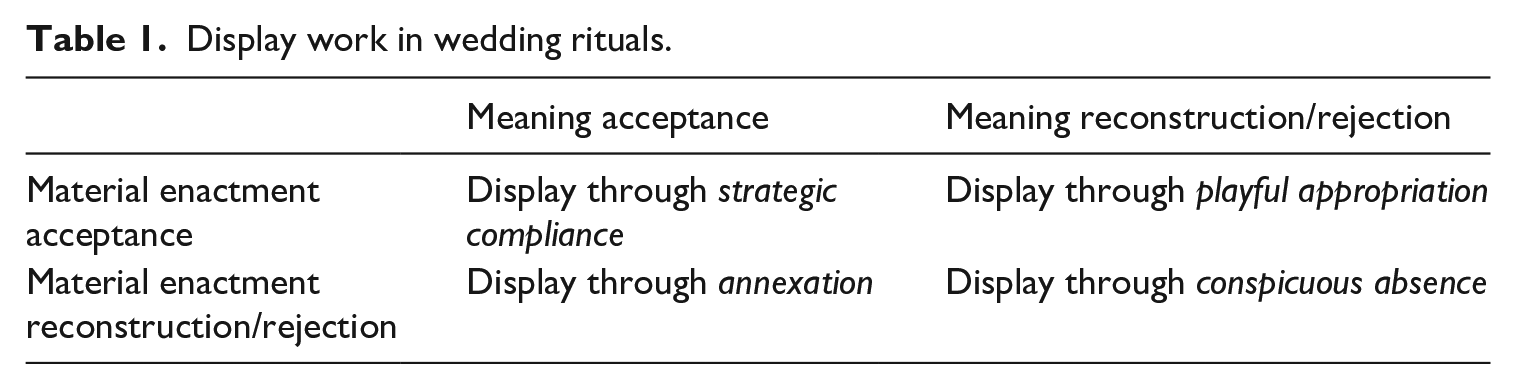
In light of these complex relational landscapes, the couples we interviewed use their wedding as a platform for relational work. Specifically, they ascertain that ‘what you do on the day, all of it is a reflection of who you are as a couple’ (couple 8) and that ‘it is also about helping others understand what this [relationship] means and that [the wedding ceremony] is such a concrete way of doing that’ (couple 7). Our analysis offers a systematic theorisation of how rituals intersect with display work. The data extracts we analyse below focus on couples’ decision making surrounding the enactment of ‘milestone’ wedding moments. Each extract was chosen because it exemplifies how ritual symbols, scripts and artefacts are mobilised in display work, and represents one of four different tactics: strategic compliance; playful appropriation; annexation; and conspicuous absence (Table 1).
Display work in wedding rituals.
Strategic Compliance
Strategic compliance describes display work where the use of traditional symbols and re-enactment of ritual scripts, are significant means of legitimisation. Jason and Peter organised their wedding in a pub, in a bid to keep the spirit of the day informal, which they both felt was more aligned with their lifestyle. Here, they explain what made them decide to walk down the aisle with some degree of ceremonial formality that was not aligned with the rest of their celebrations: We only decided that we were going to walk down an aisle maybe a month or two before the wedding. What we really didn’t want to do is have it too ‘wedding-y’. A lot of things associated to a wedding is what women do and it’s traditional. So we were thinking an aisle was going to be very traditional. Then, after months and months of talking about it, and because our two friends were marrying us [as opposed to a marriage officiant], what we were really conscious of is people going, ‘Why do they have their friends marrying them? They didn’t walk down an aisle. Are they married? What is this? This wasn’t very wedding-y.’ We didn’t want to devalue the wedding. We wanted to still make sure that people knew it was a wedding.
This account demonstrates how the modern need for individualisation involves relationality, in that successful display work requires the guests’ correct reading of the ceremony (Carter and Duncan, 2018). Jason and Peter’s display is then directed by a ritual script which, even in the absence of the patriarchal ‘giving away’ of the bride, carries connotations of the marriage as a site of traditional hetero-gendered roles. Yet, the power of the ritual as a ‘social and cultural jockeying’ (Bell, 1997: 79) tool with guests, makes tangible the couple’s status as a romantic kinship unit. Despite their initial resistance to the hegemonic grip of the rite, then, the couple feels that they have no choice but to enact it in order to sanctify their bond in the eyes of others. They also demonstrate their agency, as their compliance is reflexive and has a clear and conscious legitimising goal.
The legitimising power of tradition is demonstrated in many other instances in our data. For example, Daniel and John describe the significance of the ring exchange as an instrumental, symbolic statement:
We had, at least I had, a very clear idea. I wanted to have a very old-fashioned Italian-style wedding band.
What is an old-fashioned Italian-style wedding ring?
So basically it had to be very, very simple with no decorations and they had to be exactly the same.
And gold.
Yes. Today usually the man and the woman, they do choose different rings. I didn’t want to have anything like that, I wanted to have something that looked like a very standard wedding band. And this goes again to the thing that I wanted to clearly state that this was a normal wedding, basically.
The plain gold band, a choice made by many of the participants, claims ordinariness via the production of convention, an approach commonly followed by couples in same-sex relationships (Heaphy, 2018), and it ensures that the meaning and significance of the ceremony is fully understood.
The process of regulation that we see in both these accounts can be taken as evidence of the cultural autonomy of tradition, in that rituals have to be reproduced, at least in part, with clear referents in the image of the structure (Gusfield and Michalowicz, 1984). This renews an established system of organising sexualities, grounded in heterosexual relations, and ensures same-sex couples’ commitment to it. Compliant display work, then, conscientiously reproduces the traditional wedding rite, but as our data show, this is a strategic choice.
Playful Appropriation
Playful appropriation describes display work where partners materially engage with, or at least make reference to, established and recognised rituals. This occurs by engaging with conventional ritual practices or by utilising sacralised ritual artefacts, but is enacted in ways that challenge or indeed mock the ritual’s original meaning. Not unlike heterosexual couples’ attempt to individualise their wedding, we find that for our participants tradition provides a guide that is easy to follow, but its elements can be questioned or adapted (Carter and Duncan, 2018; Peel, 2015). This type of display work is especially prominent among female couples in our sample. By comparison to the male couples we interviewed, and in line with previous research (Peel, 2015), female partners were more critical of the hetero-patriarchal associations of marriage and more likely to challenge the meanings underpinning wedding rituals. By appropriating aspects of the traditional wedding, these couples can communicate their objection to traditional or static gender roles and prompt the audience to be more reflexive towards the same.
One such example is the appropriation of the hegemonic masculinity of the stag do (Thurnell-Read, 2011) by a female couple, Olivia and Kelly: We had a stag do together, and called it a ‘stagette’. We organised it together with our male friends. It was all things that we’d never done before, like really out of bounds. So, we went to dog racing, then we went to a football match to see Millwall [an English football team whose supporters are notorious for their associations with hooliganism], and Kelly and I are not those kind of people – we don’t do that sort of thing normally. Then we went to play golf, then we went to an old man’s pub. . . The whole thing was humour, it was basically funny, ironic. Because it was so not what we’re about, so it was a very deliberate pastiche of a very male tradition. But fun.
Olivia and Kelly’s humorous normative gender reversal is meaningful when interpreted in the context of the couple’s respective day-to-day identities. Both partners work in the publishing business in positions that constitute them as taste-makers and influencers, and they display an eclectic femininity in their self-presentation. The exaggerated display of masculinity during their ‘stagette’ is blatantly contradictory to their habitual disposition, evident in Olivia’s desire to highlight that ‘this is so not what we are about’. This skilful adaptation of the established stag ritual playfully draws attention to the lack of ‘butch’ traits that are stereotypically associated with gay women, allowing the couple to display who they are by highlighting who they are not.
A different instance of display through appropriation is the disruption of the traditionally gender segregated throwing of the bouquet by the bride to a line-up of single women. Three of the female couples we interviewed engaged in the ritual after altering its script by purposefully organising mixed gender or male-only line-ups of catchers. Lynda and Maria justify this decision as more ‘inclusive’, an attempt to ‘teach them [men] something about the pressure that women get to get married’, while Olivia and Kelly recognise the moment as ‘a bit of theatre’ and attribute their motivation to ‘wanting to do things slightly differently and not the same way as everybody else’. The re-inscription of the ritual underlines their uniqueness and individuality as a couple, and playfully communicates a departure from traditional, heterosexist, normative assumptions that women actively pursue marriage as a life goal. These couples, then, use an established ritual script but challenge the cultural values and beliefs upon which it rests. They attempt to ‘educate’ their audiences towards a more genderless conception of marriage, to the extent that their display succeeds in deconstructing bride and groom and gender stereotypes.
As we show in these examples, display through appropriation acts produces rituals that are paradoxical and carnivalesque because it combines tradition imagery with creativity and innovation. Appropriation is a common mechanism of display for couples that seek to express diverse or contradictory values. For example, Ramdya (2010) describes how Indian-American couples appropriate ethnic symbols to combine expectations of Indian ancestry with American individualism. Similarly, couples in our research are ‘cherry picking’ (Peel, 2015) ritual elements, which allows them to situate their wedding as ordinary and traditional, while mocking its heteronormativity. This process entails the integration of objects that embed cultural norms, such as stereotypical male paraphernalia and pursuits, or the bridal bouquet, to scripts that divert from the dominant form of the ritual, resulting in striking visual juxtapositions and ironic humour.
Annexation
Display through annexation refers to instances where partners challenge normative assumptions by altering or consolidating the material components of traditional rituals. For example, Layla and Moira are a couple that wear three rings on their ring finger, deviating from the usual practice of women to wear two. This seemingly minor material alteration is used as a prompt for them to narrate their journey as a same-sex couple:
So, my engagement ring is the band which is engraved, and then when we got married [refers to the civil partnership in this instance] we got ones with diamonds on because we could afford a tiny little bit more by then.
And then, because we did it again, when we converted [to marriage], we got wedding rings.
So, you have three rings on the same finger?
Yes. So, that’s my original engagement ring, this one is what I consider my second engagement ring [laughter] when Layla proposed to me. And then my actual wedding band. They are a status symbol, aren’t they?
Yes, I suppose so.
It’s like anything else, it’s almost a marker of achievement.
We see here that the partners are not reinterpreting the symbol per se, as they still view it as a medium of romance and status, but by materially interfering with tradition they are able to tell their story and to render their experience comprehensible to others. Display in this instance fulfils its narrative function (Finch, 2007) through what the rituals literature identifies as ‘framing’ (Bell, 1997): the couple sets up a deliberate interpretive framework by engaging with the tradition, so that others can understand the symbolism of the ring in the context of the three stages of their relationship journey.
Annexation tactics demonstrate how important ritual artefacts are for display work. We draw on the story of Mark and Kevin, an inter-racial couple, to show the communicative function of sacralised objects. Kevin was cut-off from his deeply religious African-American relatives 15 years ago, after he started to openly date men as an adult. None of his relatives attended the wedding. Kevin describes how, with Mark’s help, they memorialised his kin connections during the ceremony, by engaging in the ‘jumping the broom’ ritual: Slaves had no legal precedent for getting married, so this is something they would do to signify marriage. Once they had been joined in union they would then signify this by jumping over a broom. . . This ritual has been in my family for years. My great grandmother was born a slave, so we were definitely going to do that. The same broom has been in my family for years, from my great grandmother to my mother, everybody jumped the same broom. But I was not going to be allowed to use that broom and my family was not there for the day. So we got our own broom. We decorated it ourselves, we made it look real nice and did our own thing. We gave a card to everybody before the ceremony to explain what it was and why we were doing it.
The couple displays their union in a manner that incorporates Kevin’s roots, compensating for the absence of his relatives, and affirming his right to partake in an important cultural and family ritual. Holmes (2019) documents how the ‘doing’ of kinship is enacted through practices of passing on objects. In this case, unable to use the authentic heirloom broomstick, Mark and Kevin are forced to materially alter, or re-do, the ritual. By producing and sacralising a replacement artefact, they are able to inscribe kinship imaginatively (Holmes, 2019). The new broom embodies historic meanings, but it also comes to display the creation of a new kinship unit that does, as Kevin puts it, ‘their own thing’. The couple further ensures that their display performs its communicative function with guests through the distribution of cards that explain the origin of the ritual and mark it as ‘sweeping away the old and welcoming the new, making way for all things good’. Through a romanticised narrative that is symbolically linked with Kevin’s racial and cultural roots, and mediated by the broom artefact, the partners tell a sacrosanct and transformative story about themselves that links the past with the future.
In both the examples of the three rings and the broom, we see how interference with the material aspects of the ritual provides opportunities for story-telling, allowing partners to synthesise the established meanings of certain objects, with a narrative that relates to, as well as builds on and consolidates, their personal biography as a same-sex couple. The updating of traditional symbols by these couples also demonstrates how the meanings that are associated with the archetypal version of these rituals are not necessarily fixed and static but can evolve to accommodate contemporary flux and roles, underlining the transformative potential of rituals (Driver, 1998; Myerhoff, 1984; Turner, 1986; Wuthnow, 1989).
Conspicuous Absence
Lastly, display through conspicuous absence entails a rejection of the material enactment of normative scripts, alongside the meanings that underpin them. This form of display is distinguished by the purposeful absence of paramount ritual artefacts or scripts, something which is leveraged by participants to communicate relationship roles to attendees. As noted by Macherey (1966/2006), for example, often the meaning of a narrative is revealed as much by the omissions as by that which is included; the absence of something can thus function as a frame of narration; it can both articulate and subvert.
We first demonstrate this form of display through the story of Sophia and Alice, two brides that opted for colourful, floral cocktail dresses and blazers instead of the traditional white wedding ensemble: By not wearing white we showed that there was more complexity there. It wasn’t just either two people in a wedding dress with their hair up, or be wearing dungarees or something, there is a whole range of ‘in the middle’ options that you could make.
Sophia and Alice, both of whom have had conflicted relationships with members of their families as a result of their sexuality, felt that rejecting the customary white, while still choosing very feminine ensembles for the day, was an effective way of explicating the multiplicity of gender identities that can comprise a same-sex relationship. Their decision exemplifies how the wedding day provides opportunities for partners to confound stereotyped conceptions of lesbian couple roles, enabled by the conspicuous absence of the flagship white dress artefact, while still enjoying the allure of a beautiful dress to mark the occasion.
In a different instance of conspicuous absence display, we observe the rejection of the walking down the aisle tradition by a female couple. This ritual was problematised far more intensely by female couples in our sample, all of whom were conversant with the patriarchal ideology underpinning its script, and either rejected it or embraced it as a form of honour to their parents. Three of the female couples refused to have anyone walk them down the aisle, explicitly recognising this as a heteronormative practice. Lynda and Maria reflect on how their decision was received: One of my cousins’ daughters, it was her first ever wedding, so when the family received the wedding invitation, this little girl was super excited that she was going to be able to go to her first wedding, and my mum’s comment was, ‘Oh well, she’ll be disappointed because she expects the walking down the aisle bit.’ We said, ‘Really? If this is her first wedding maybe we can deconstruct the stereotypes a bit about what marriage is.’
Heteronormative wedding rituals have real material consequences, not least manifested in assumed husband and wife identities that then go on to define domestic life through practices such as the gendered division of labour (Kimport, 2012). Through the conspicuous elimination of the practice, this couple enables a different story to ‘unfold’ (Finch, 2007) that confounds expectations, including those of a four-year-old girl. The couple’s strategic intent is prominent, seeking to expose others to a different conception of coupledom, which asserts their equality as a couple, and underlines to others that their story is not a stereotypical one.
Notably, conspicuous absence is diametrically different to strategic compliance tactics, where couples faithfully embrace rituals in a bid to gain audience recognition. Conspicuous absence denotes that in some cases the ritual’s ‘leakage of meaning from the past’ (Carter and Duncan, 2018: 115) is so inflammatory that partners have no choice but to reject it. Another important implication of conspicuous inactivity is that the non-performance of certain acts becomes meaningful and noticeable within certain contexts, and hence is an act of display in itself. Existing literature has primarily defined display work through ‘doings’, in that families need to be seen doing family things in order to be understood as such (Finch, 2007). By contrast, in our data, the rejection of ritual scripts and artefacts such as wearing white and walking down the aisle, has signifier value because these are expected by audiences in the context of the rite. Here, couples challenge their audience, by attempting to bring into focus the cultural norms and values from which the distinctly absent script originates.
Discussion
Our research extends work that suggests less-than-conventional families are capable of reflexively investing in convention (Heaphy, 2017; Lahad et al., 2018), by demonstrating how display work can inform and indeed transform wedding rituals. Specifically, we show how through their display work, partners (re)produce and broaden the wedding rite to reflect each couple’s unique relationship and perspective on same-sex union. This process is highly reflexive, as partners display to achieve concrete social goals, and they do so after carefully evaluating their life history as a couple, as well as those that they display to. In line with previous works, we find that this process is based on a ‘bricolage’ approach (Carter and Duncan, 2018; Gillis, 1997; Kimport, 2012; Myerhoff, 1984; Peel, 2015). Couples engage with the heteronormative and highly gendered roles and traditions underpinning the rite, utilising ritual scripts and symbols as a form of currency in their display work.
Further, we show that display work, which is largely conceived of as practices of complying with hegemonic norms (Almack, 2008; Harman and Cappellini, 2015; James and Curtis, 2010), does not solely revolve around the normative doing of rituals and traditions. By contrast, we see that while display is indeed entangled with normative frameworks, this occurs in more complex ways than mere compliance, and includes the un-doing and re-doing of the rite. Instances of strategic compliance entail the strategic doing of rituals, whereby the couple purposefully replicates tradition to gain social recognition from their audience. Display through playful appropriation and conspicuous absence un-does the ritual, in the first case by integrating material symbols in diverse scripts and in the latter by rendering invisible heteronormative scripts and symbols. Lastly, annexation display re-does the rite by consolidating and personalising established scripts to fit the couple’s life history. Each of the four tactics that we found in our data shows that partners manipulate traditions at the level of the lived experience of the wedding, extending the wedding rite beyond its heteronormative origins, while ensuring that the display is socially understood.
Our theorisation of the wedding rite as display work also sheds light on the transformative, liberating potential of rituals. This perspective is in line with previous works that suggest same-sex commitment ceremonies are able to mould a new institution both through the assimilation and transformation of values and ideals surrounding coupledom (Lewin, 1998; Peel and Harding, 2004). While rituals ostensibly denote order and community, they are not necessarily bastions of conservatism. On the contrary, ritual, through its liminal processes, can be deeply transgressive, as such processes hold the generating source of both culture and structure and thus have ontological power to challenge the status quo (Turner, 1986). In effect, then, rituals are not only powerful agents of transformation; they may also have the potential to be subject to change themselves (Driver, 1998; Turner, 1986). Display work during the same-sex weddings we studied occurs well within the institutional boundaries of coupledom as the dominant mode of arranging sexualities, personal lives ordered by the rule of law and heteronormative notions of commitment and romance. Within those boundaries, however, couples find a liberatory space to articulate alternatives, particularly as these pertain to gender and sexual identities, and relationship roles. It is through display, then, through the ‘unfolding’ of a story, including its gaps and subversions, that ‘ritual becomes part of the work through which a body politic (a people) throws off its chains’ (Driver, 1998: 190).
In conclusion, through display work the ritual performance is made more complex and unique, while still retaining its original, sacred elements that mark it as a ‘real’ wedding ritual. It is the same but different, recognisable but transformed into something new, unique and significant for the couple.
Footnotes
Funding
The authors disclosed receipt of the following financial support for the research, authorship and/or publication of this article: this project was supported by a Seed Corn Funding award from the School of Management, University of Bath.
