




Abstract
Recent sociological discussions have examined the classic theme of social integration from the point of view of belonging and multiple solidarities. As a research topic, migration importantly elucidates these general sociological questions. Literature on migration, integration and transnationalism lacks an encompassing theoretical model, which limits our understanding of complex integration processes. We propose a multifocal model of migrant integration including three key foci of integration: the host society; transnational sphere; and co-ethnic community in the host society. Moreover, the model considers integration in terms of different dimensions. With this model, we define multifocal marginalisation and study Russian, Kurdish and Somali migrants in Finland. We find that the different foci do not compete with each other, but are in a moderate positive relationship. There are clear group differences in integration patterns. Determinants of multifocal marginalisation include Kurdish background, weak Internet skills and older age. Discussion themes include belonging and social change.
Introduction
Recent sociological inquiries draw on theories of belonging in examining the dynamic, complex and multidimensional relationship between the self and society in the context of social change (May, 2011, 2013). Migration provides an important perspective to the general questions of integration and belonging, because it typically disrupts or questions the habitual social relationships and ways of being (Bottero, 2009; May, 2011; Thomas and Znaniecki, 1926). Besides creating new social networks (Waldinger, 1995; Wessendorf and Phillimore, 2019), migrants’ integration is also about identification and creating a new sense of belonging (Krzyżanowski and Wodak, 2008).
May (2013: 3) defines belonging as ‘the process of creating a sense of identification with, or connection to, cultures, people, places and material objects’. Belonging can be described as a feeling of ease in social situations or as feeling at home. It resembles Bourdieu’s (1979) ideas of habitus and social fields, according to which a person’s habitus reflects a certain social field and a ‘feel for the game’ in this field (see also Brubaker and Cooper, 2000). However, people can feel a sense of belonging to several ‘fields’ simultaneously and, thus, the concept of belonging acknowledges the possibility of hybrid identities and multiple solidarities (May, 2013).
Considering this background, this article proposes a multifocal mode of integration. In section 2 (‘Multifocal Integration’), we present and criticise prior integration approaches. The main critique is that they do not consider all the key domains, fields or – as we call them – foci of integration: the host society; transnational sphere; and co-ethnic community in the host society. All these foci present different possibilities for immigrants who face the concrete problem of how to secure resources – or different forms of capital – for their well-being, social recognition and basis of identity (Erel and Ryan, 2019; Esser, 2004; Paugam, 2018; Thomas and Znaniecki, 1926). Section 2 presents the argument for the multifocal model in detail, but let us here anticipate its central sociological advantage. Considering immigrants’ integration in a multifocal and multidimensional way helps in formulating the question of social marginalisation, isolation or disaffiliation (Castel, 2000; Durkheim, 2007b [1897]) in a theoretically meaningful and empirically fruitful way. The most radical form of marginalisation covers not only all the dimensions of integration (see ‘Prior Approaches’) but also the three key foci of immigrant life. The question is not only academic, because it is of high policy relevance to understand the phenomenon of marginalisation and know who are the most exposed to its risk.
Empirically, we use our theoretical model to examine three immigrant groups – the Russian, Somali and Kurdish – in Finland, using high-quality, face-to-face survey data from a stratified random sample drawn from the population register. We study:
How the different dimensions of integration – structural, cultural, social and identificational – are related to each other;
How the different foci of integration – the host society, transnational sphere and co-ethnic community – relate to each other. For instance, are they in competition or do they support each other?;
Who faces the highest risk of multiple marginalisation; in other words, the loss of integration regarding all the three foci.
Multifocal Integration
Prior Approaches
The research strand stemming from classic assimilation theories (Bogardus, 1930; Park, 1950; Park and Miller, 1921) typically focuses on how host society integration relates to the engagement with one’s co-ethnic community in the new host society. Later theoretical developments include the multidimensionality of integration (Eisenstadt, 1953; Esser, 1980 in Schunck, 2014; Gordon, 1964; Heckmann, 2006), which implies that integration refers not only to labour market position but includes other dimensions, such as social, cultural and identificational, as well. Work on bicultural integration has shown that the trade-off between original and new cultures is not inevitable (Berry, 1980, 1992; Esser, 1980 in Schunck, 2014). Furthermore, the modes of incorporation approach (Portes and Manning, 1986; Portes and Zhou, 1993; Waldinger, 1995) describes how governmental policies, societal reception and the characteristics of the co-ethnic community shape integration outcomes. Finally, there is extensive literature on the intergenerational aspects of integration, including studies on segmented assimilation (Portes and Rumbaut, 2001; Portes and Zhou, 1993). Recent research has called for further attention to racial segregation and discrimination, which shape the assimilation paths of different immigrant groups (Chaudhary, 2015). Despite these developments, however, this research strand does not provide sufficient tools to address the role of transnational involvement and the consequent multiplicity of solidarities and identities (May, 2013).
New communication technologies and the ease of travel have facilitated the contemporary forms of transnational involvement (Baldassar, 2007; Levitt, 2014; Vertovec, 2001). The term ‘transnational’ denotes connections, practices and feelings of belonging that cross national borders (Vertovec, 2001). For example, one may possess multiple formal citizenships, identify transnationally or have family members living abroad. Consequently, patterns of integration may also cross borders in complex ways. Glick Schiller et al. (1992) argue that contemporary immigrants are simultaneously attached to their host and home societies, whereas earlier immigrants often had to cut the social and cultural ties to their home society. A strand of research on transnationalism has investigated the relationship between host society integration and transnational activities (e.g. Bakker et al., 2014; Bilgili, 2014; Schunck, 2014; Waldinger, 2015), but work on the role of co-ethnic minority communities remains scarce and undertheorised (however, see Bilgili, 2014; Schunck, 2014).
Multifocal Integration
As argued above, research strands on integration and transnationalism have largely remained isolated from each other (see also Schunck, 2014). Consequently, theoretical work on the complexity of immigrants’ social integration in the contemporary world needs further development. This study proposes a multifocal model of integration to fill this theoretical gap. In short, the proposed model includes the transnational domain as a possible focus of integration, along with the host society and co-ethnic community. This way, we emphasise that there are different foci – or social ‘units’ (Wessendorf and Phillimore, 2019) – that need to be considered if we want to understand migrants’ integration in its complexity. Moreover, recent sociological research on immigrant integration has discussed the relationship between social and structural dimensions of integration (Cheung and Phillimore, 2014; Wessendorf and Phillimore, 2019) and some take the Bourdieusian approach to discuss the complex dynamics of different forms of capital in immigrant integration (Erel, 2010; Erel and Ryan, 2019). We consider integration as a multidimensional concept, including not only labour markets and other structural aspects but also cultural, social and identificational dimensions.
With this multifocal and multidimensional theoretical solution, we can better understand the key possibilities, tensions and problems in immigrants’ lived realities. First of all, the different foci of integration may compete with each other. The classic assimilation thesis follows this kind of zero-sum logic (see Tsuda, 2012). There may be a certain optimisation in securing valued goals or forms of capital, such as physical well-being and social approval (Erel and Ryan, 2019; Esser, 2004; Paugam, 2018). Given that one obtains these from, say, the co-ethnic community (Portes and Manning, 1986), there is no compelling motivation to form or maintain other social ties with the larger community or transnationally. Therefore, those who want to retain contact to their culture of origin are satisfied with their co-ethnic community and feel no need to maintain transnational contacts, or vice versa. This dynamic works both ways: difficulties with a specific focus are coped with by a compensatory or reactive integration to other foci (see Itzigsohn and Giorguli-Saucedo, 2005, 2006). For instance, the experiences of discrimination faced when trying to integrate to the host society may push to seek support from the transnational sphere (Itzigsohn and Giorguli-Saucedo, 2005, 2006) or co-ethnic community.
On the other hand, integration to one of the foci may support integration to others (Tsuda, 2012). An example of this is the case of cumulative (dis)advantage (Merton, 1968): finding a social context where one feels at ease (May, 2011) enhances self-efficacy (Bandura, 1977), which facilitates similar behaviour in another context. More generally, the resources obtained from a given foci may enable integration to others (see Itzigsohn and Giorguli-Saucedo, 2005, 2006). For example, income from labour market integration facilitates the sending of remittances (Itzigsohn and Giorguli-Saucedo, 2005, 2006), while engagement with co-ethnics invokes interest in what is happening in the country of origin (Bilgili, 2014). Moreover, contacts with co-ethnics may support structural integration to the host society by helping with employment and housing in the early settlement period (Cheung and Phillimore, 2014; see also Wessendorf and Phillimore, 2019). The case of positive relationship between different foci may tell also about individual behavioural dispositions. For example, those interested in maintaining ties to their culture of origin may be driven to integrate both to the co-ethnic community and the transnational sphere. Personality traits (Barrick and Mount, 1991) or attachment styles (Bowlby, 1969; Griffin and Bartholomew, 1994) may come into play as well.
Finally, the foci may be independent from each other. The diversity of integration patterns may be so strong that no general pattern of either positive or negative associations can be detected. At an individual or subgroup level, there may be positive and negative relationships, but they cancel out each other at the aggregate level.
Multifocal Marginalisation
Multifocal thinking sets a convenient theoretical frame for approaching the question of social isolation or marginalisation (Durkheim, 2007b [1897]). We draw on Berry (1980, 1992), Castel (2000), Esser (1980 in Schunck, 2014) and Tsuda (2012) to explicate the concept of multifocal marginalisation.
Castel (2000: 525) distinguishes work-based integration and attachment into family and social relationships and depicts a continuum of integration that extends from full integration to disaffiliation; that is, the ‘absence of work and social isolation’. Esser (1980 in Schunck, 2014) and Berry (1980, 1992) lay foundation for the bicultural model of migrant integration, which implies the possibility of marginalisation from both the host society and one’s original cultural background. Discussing transnationalism, Tsuda (2012: 635) presents the case of negative reinforcement, where ‘decreased engagement with one society causes disengagement with the other as well’.
Extending and synthesising these works, we present the concept of multifocal marginalisation, where the migrant loses contact and a sense of belonging to all three integrational foci and is left without a source of physical well-being and social approval (Esser, 2004). In the most severe cases, the process advances along all integrational dimensions, including work and income, attitudes, social contacts as well as identification (cf. Castel, 2000).
Key Prior Findings
Prior evidence points towards hypothesising moderate positive relationships between the foci. Recent studies have found that immigrants’ orientation towards their ethnic culture is not necessarily in conflict with integration into the majority culture (Alba and Nee, 1997; Berry et al., 2006; Hällsten et al., 2018; Lauglo, 2017; Nandi and Platt, 2015; Nguyen and Benet-Martínez, 2013; Sam and Berry, 2010), although contrasting viewpoints exist (Battu et al., 2007). There is a scarcity of high-quality quantitative studies on transnationalism, particularly in Europe (Schunck, 2014). Nevertheless, prior studies have documented a positive association between the host country and transnational integration (Bakker et al., 2014; Bilgili, 2014; Erdal, 2013; Kuuire et al., 2016; Lacroix, 2013; Levitt and Glick Schiller, 2004; Schunck, 2014; Snel et al., 2006; Van Bochove et al., 2010). However, there is some evidence concerning the competing nature of these two foci (De Haas and Fokkema, 2011; Ley, 2013). To our knowledge, only Bilgili (2014) and Esser (2006) consider all three foci simultaneously. Esser (2006) accounts for various factors related to the host society, co-ethnic community and country of origin. In the study of different immigrant groups in the Netherlands, Bilgili (2014) found that transnational socio-cultural activities were associated with both co-ethnic and host society integration. Despite certain shortcomings (e.g. the lack of official peer review in Esser and the problems in the sampling design in Bilgili), these studies spur on the important discussion of multifocality in immigrant integration.
Study Context
We describe briefly the study context from the perspective of the modes of incorporation approach (‘Prior Approaches’), which argues that governmental policies, societal attitudes and already existing ethnic communities all modify immigrants’ integration patterns. The Finnish integration policy has multicultural aspects; for example, support for the activities of maintaining minority cultures and languages. However, Saukkonen (2013) argues that integration policies, in practice, focus on immigrants’ adaptation to the Finnish society. Finnish national identity is still constructed upon the idea of a homogenous nation, based on language and historical traditions, which is reflected in the general anxiety and hesitation towards multiculturalism (Saukkonen, 2013).
This study examines Russian, Somali and Kurdish immigrants, which together comprise more than one-fourth of the foreign-born population in the country (Statistics Finland, 2019a). Migrants from Russia have generally moved to Finland voluntarily, and much of this migration is related to labour or marriage. A large part of immigrants with a Russian background consists of the Ingrian Finnish, who were able to obtain a residence permit on the basis of remigration under certain specified conditions. In 2018, the size of the Russian-speaking population was 79,000 (Statistics Finland, 2019b). Russian origin persons are considered to be less visible and culturally more proximal to the Finnish population than many other immigrant populations (Liebkind and Jasinskaja-Lahti, 2000). However, there is evidence of discrimination against immigrants of Russian origin (Liebkind et al., 2016).
Migration from Somalia to Finland began in the early 1990s, following an acute need for involuntary emigration. The size of the Somali-speaking population in Finland is around 21,000 (Statistics Finland, 2019b), and they face significant prejudice (Jaakkola, 2009). Tiilikainen et al. (2013) argue that feeling unwelcome in the Finnish society is a major obstacle to integration among Somalis. Kurdish immigrants have generally moved to Finland as refugees and asylum seekers or for family reunification. The size of the Kurdish-speaking population in Finland is 14,000 (Statistics Finland, 2019b).
Data and Methods
Data
This study used data from the Finnish Migrant Health and Wellbeing Study (Maamu) (Castaneda et al., 2012). The target population were immigrants aged 18–64 who had resided in Finland for at least one year, in the cities of Helsinki, Espoo, Vantaa, Turku, Tampere or Vaasa. The Russian target population was defined by birth in the former Soviet Union or Russia and a mother tongue of Russian or Finnish; the Somali with birth in Somalia; and the Kurdish with birth in Iraq or Iran and a mother tongue of Kurdish. The random sample was stratified by the immigrant group and the city of residence. The data were collected in 2010–2012 by trained personnel who spoke both the language of the respective target group and Finnish. Overall, of the total immigrants invited to take part in the study, 70 per cent of the Russians (n = 702), 51 per cent of the Somali (n = 512) and 63 per cent of the Kurdish (n = 632) participated in at least one part of the survey.
Indicators
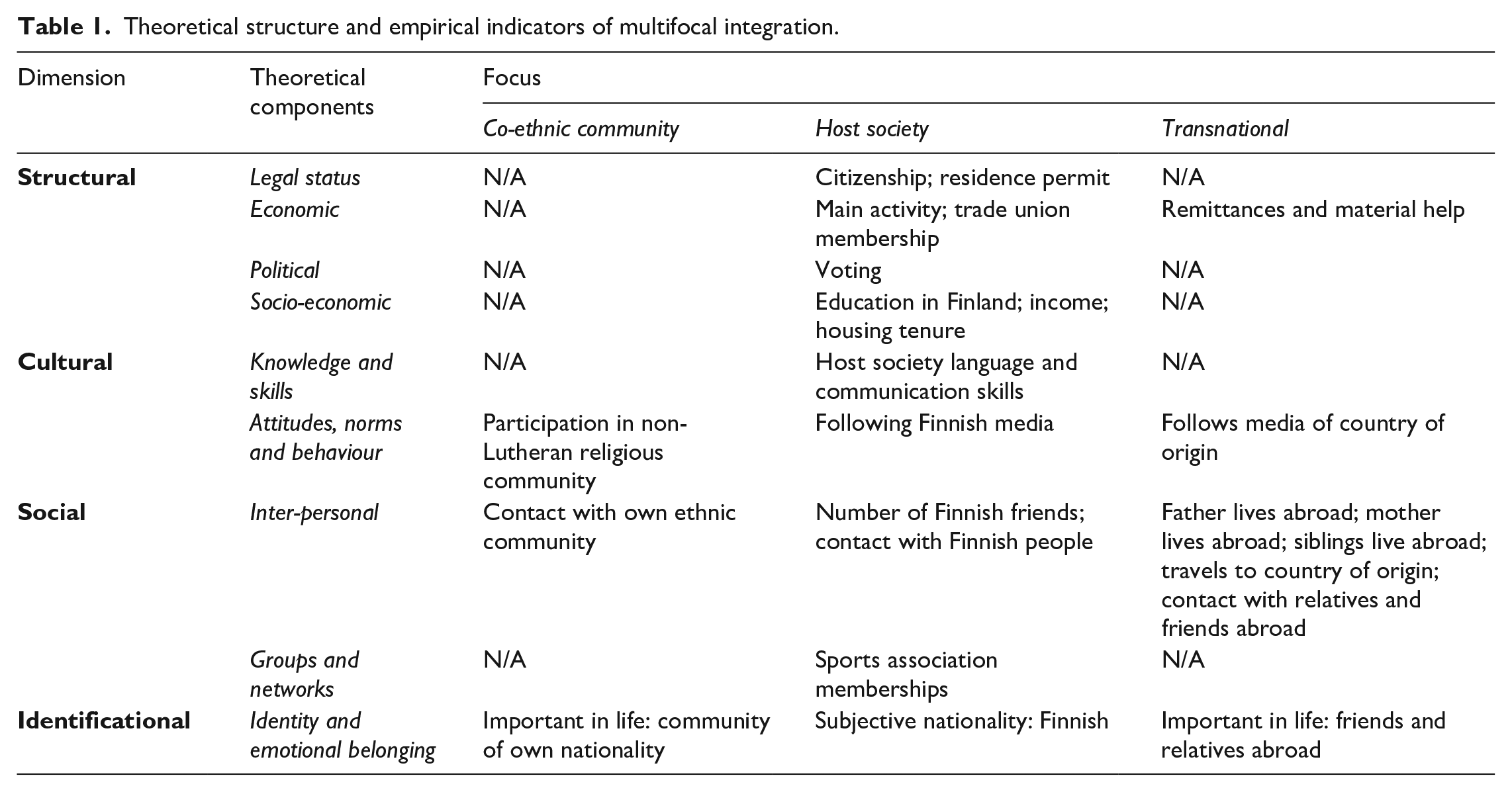
Following Heckmann (2006), each dimension of integration was further conceptualised. For example, structural integration was categorised into legal, economic, political and socio-economic integration. Cultural integration comprises knowledge and skills, and also attitudes, norms and behaviour. Suitable indicators were selected from the survey data for each focus and dimension (see Table 1).
Theoretical structure and empirical indicators of multifocal integration.
Methods and Empirical Strategy
We used multiple correspondence analysis (MCA) separately for each focus to identify the underlying structure of integration. MCA resembles factor or principal components analysis and enables data reduction for categorical variables. We ran MCA using Burt’s approach and extracted the standard normalised coordinates (Greenacre, 2007; Le Roux and Rouanet, 2010; StataPress, 2015). In this way, we derived a limited set of final indicators of integration and could study their relationships using linear regression models. Differing inclusion probabilities and nonresponse were managed by adjusted sampling weights. Response propensity adjustment was on age, gender, immigrant group, study location and marital status. Prevalence, correlation and regression analysis accounted for the adjusted sampling weights, stratification of the design and finite population correction. Our data were observational and cross-sectional, which limits causal interpretations due to the possible omitted variable bias and reverse/reciprocal causality. Analyses were conducted with STATA 15.
Findings
Table 2 includes the descriptive statistics for the integration variables. Appendix Table 1 presents the descriptive statistics for the rest of the data.
MCA coordinates and unweighted descriptive statistics. Integration variables.
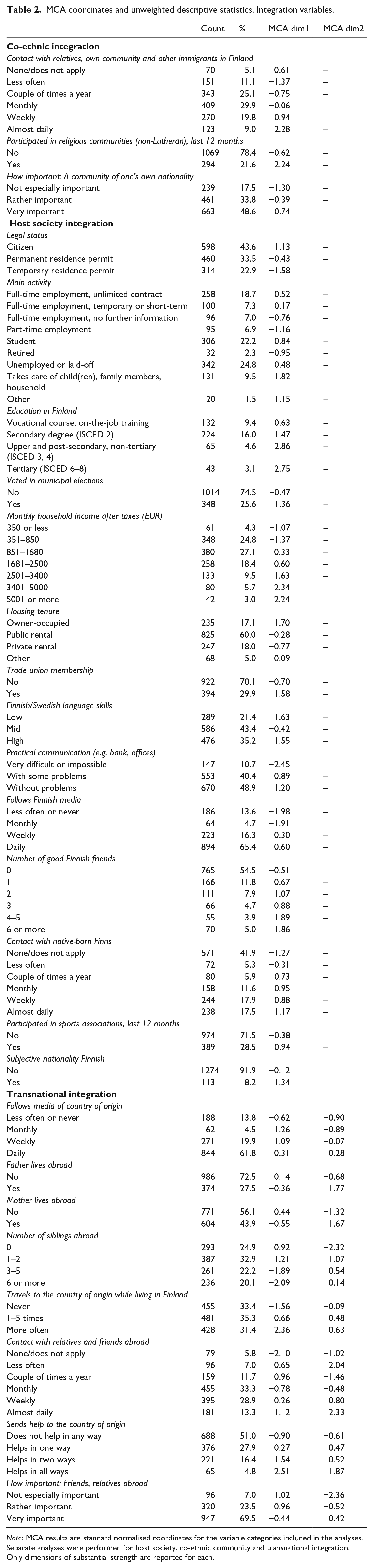
Note: MCA results are standard normalised coordinates for the variable categories included in the analyses. Separate analyses were performed for host society, co-ethnic community and transnational integration. Only dimensions of substantial strength are reported for each.
Multiple Correspondence Analysis of Integration
Running MCA for the indicators of host society integration resulted in one dominant indicator (HS), which expressed 64 per cent of the total variation in these indicators. The categories that theoretically should indicate strong integration had higher coordinate values than those indicating weak integration (see Table 2). For example, good Finnish language skills rank high (1.55) on the HS indicator, while weak skills rank lower (−1.63). Those who consider Finnish as their subjective nationality differ markedly from those who do not (1.34 vs. −0.12), and so on. Thus, our set of indicators for HS has remarkable covariation, which means that integration into the host society is empirically one-dimensional, ranging from those with many strong ties to the host society to those who are marginalised from it in multiple ways.
In a similar vein, MCA for the indicators of co-ethnic community integration produced one strong indicator (CEC), which expressed 72 per cent of the total variation. The interpretation was clear. For instance, those who consider that the local community of their own nationality is very important in their life score higher than those with the opposite opinion (0.74 vs. −1.30; see Table 2).
In contrast, transnational integration was empirically two-dimensional. The first MCA dimension captured 33 per cent of the total variation, and the second 32 per cent. Substantially, the dimensions could be called weak and strong forms of transnational integration (WT and ST, respectively). They both indicate remittance practices, which has a clear diagonal pattern in the MCA plot (Figure 1; WT on x-axis, ST on y-axis; for full value labels, see Table 2).
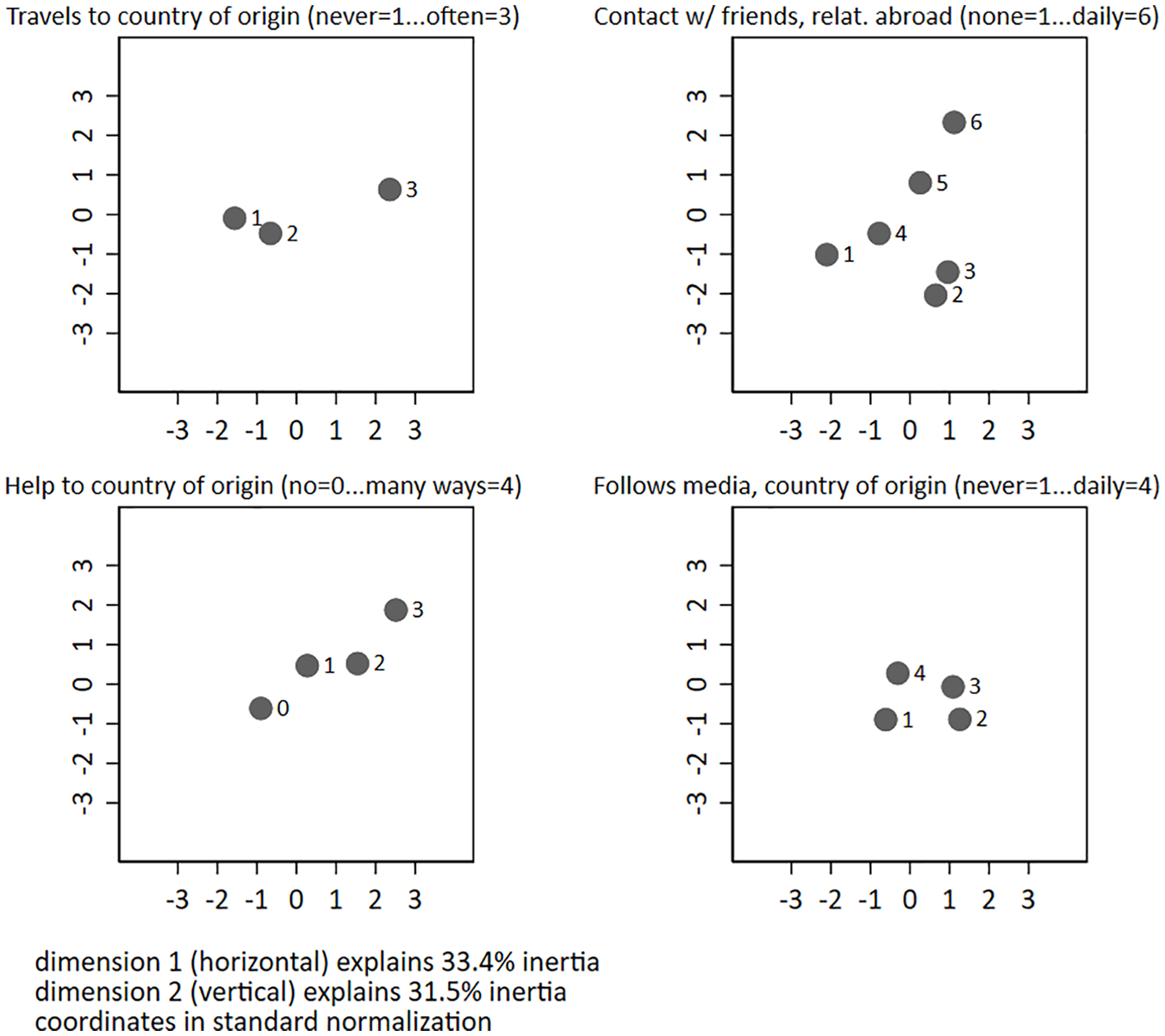
MCA results on transnational integration (1/2).
WT indicates also travelling to the country of origin, which has a clear horizontal pattern. ST indicates where family members live and, relatedly, the emotional significance of the transnational sphere (Figure 2; same axes). ST also indicates more frequent media following of the country of origin. Contact with friends and relatives abroad shows a less clear pattern, but there is a somewhat diagonal main trend, which implies that both WT and ST indicate this aspect of transnational involvement.
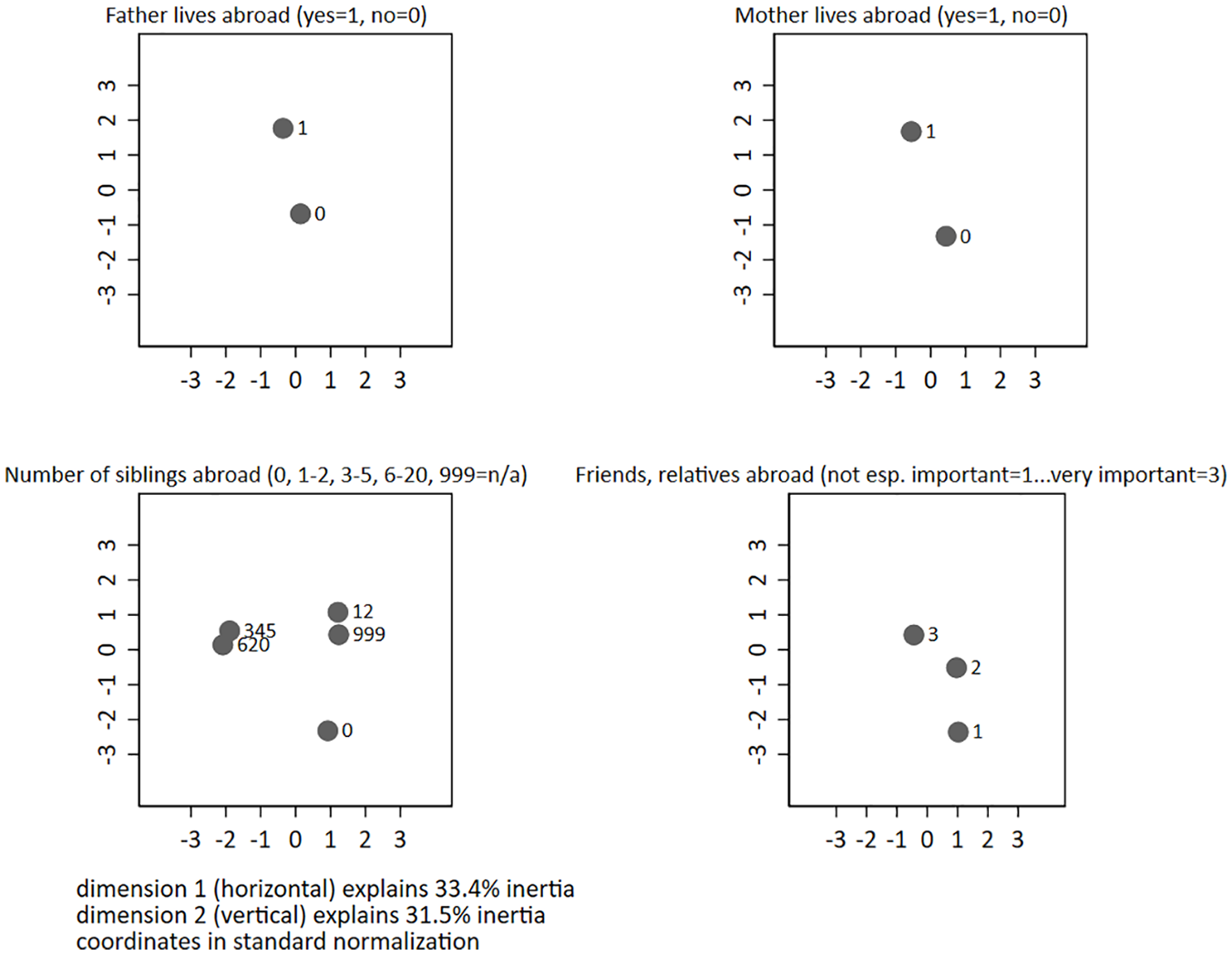
MCA results on transnational integration (2/2).
Regression Analysis of Integration Patterns
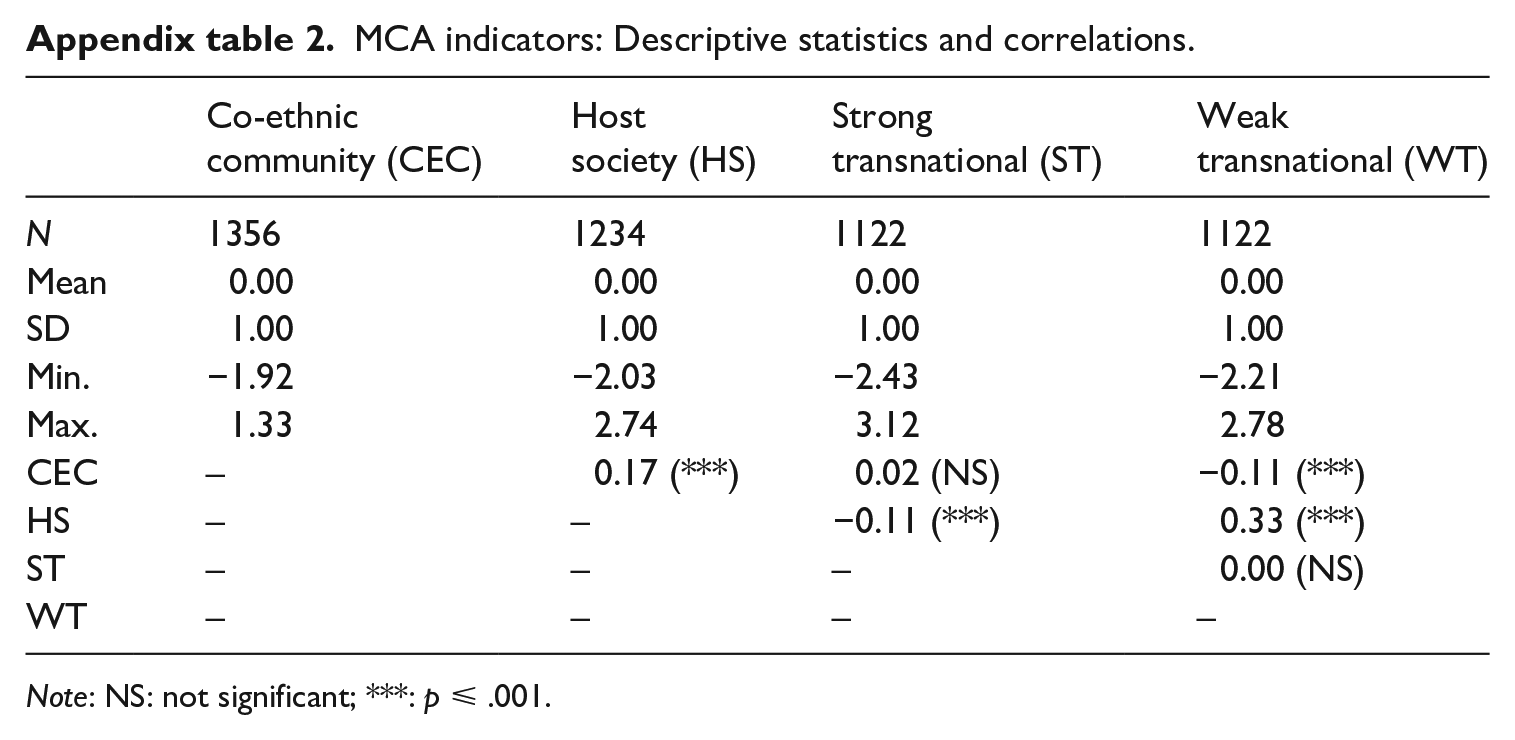
Above, we identified four theoretically meaningful composite indicators for the three foci of integration. Correlations of these four integration indicators are presented in Appendix Table 2, along with descriptive statistics for these variables. Of the six pairwise correlations, four were statistically significant, although relatively small, ranging from 0.11 to 0.33 in absolute values. Correlations among CEC, HS and WT were positive, while the correlation between ST and HS was negative. The correlation between ST and WT was zero since MCA produces orthogonal composite indicators.
We continued by estimating four linear regression models, one for each MCA indicator, using the other MCA indicators as the main independent variables. The following control variables were used: immigrant group; age; gender; basis of residence permit; time one has lived in Finland; capacity to use the Internet; and the city of residence. However, in the models of WT and ST, the other transnational integration variable (WT in the model ST, and vice versa) was omitted as orthogonal.
CEC (Table 3, Model I) was positively associated with all other integration indicators, with the following regression coefficients: HS = 0.17 (***), WT = 0.09 (*) and ST = 0.13 (***). Moreover, CEC was highest among the Somali immigrants; the difference to the Russian immigrants was 1.40 units (***): a strong result, amounting to 140 per cent of the standard deviation (SD) of the outcome variable. Men had higher values compared to women (difference of 0.12; *). A work-based residence permit was associated with a 0.48 point (**) lower score on CEC compared to asylum seekers; again, the gap is remarkable, about a half of the SD. Also, a residence permit based on the status of a spouse or a child of a permanently residing immigrant was associated with a lower level of CEC (−0.20; *).
Linear regression models for multi-focal integration.
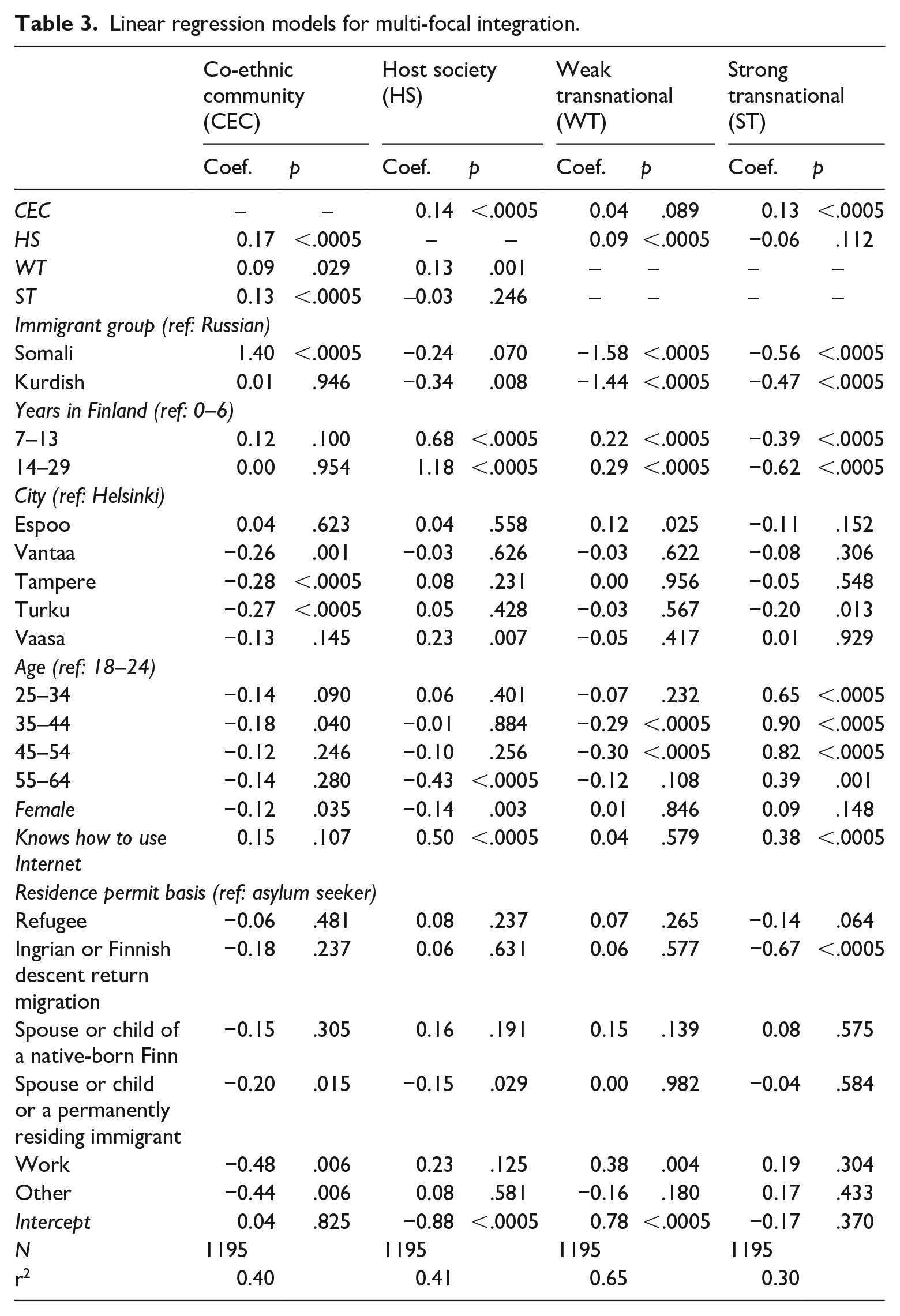
Model II shows that HS was positively associated with CEC (0.14; ***) and WT (0.13; ***); association with ST was non-significant. The Kurdish immigrants had the lowest values on HS, with a difference of −0.34 units (**) compared to the Russian immigrants. With increasing time spent in Finland, the HS increases steeply; the difference between the extreme categories was 1.18 (***), 118 per cent of the SD of the outcome. The oldest immigrants had the lowest scores on HS (−0.43; ***). As above, men scored higher than women, with a difference of 0.14 points (**). The capacity to use the Internet was a strong determinant of HS: the difference between those who can and cannot was a half SD (0.50; ***). As above, the residence permit for spouses or children of permanently residing immigrants was associated with a lower level of HS (−0.15; *).
Model III on WT reveals that HS (0.09; ***) was positively associated with the outcome. CEC was non-significant. Both the Somali (−1.58; ***) and Kurdish (−1.44; ***) immigrants had clearly lower scores than the Russian immigrants; these differences are extremely large, ranging from 144 per cent to 158 per cent of the SD. The longer one had lived in Finland, the higher the score; the difference between the extremes was 0.29 (***). Of the age categories, the middle-aged respondents had the lowest WT scores (−0.29 and −0.30; ***). Those with a work-based residence permit scored highest (0.38; **) among the different categories of resident permits.
Model IV on ST shows that CEC was positively (0.13; ***) associated with the outcome. HS was non-significant. Again, the Somali (−0.56; ***) and Kurdish (−0.47; ***) immigrants scored markedly lower than the Russian immigrants. Those who had lived in Finland longer tended to have lower scores on ST; the extreme categories differ by 0.62 units (***), which is more than half of the SD. The youngest respondents had the lowest scores, with differences ranging from 0.39 (55–64 years; **) to 0.90 units (35–44 years; ***). Those who know how to use the Internet scored clearly higher than those who do not (0.38; ***). Concerning residence permits, those with an Ingrian or Finnish descent background scored the lowest (–0.67; ***).
Multifocal Marginalisation
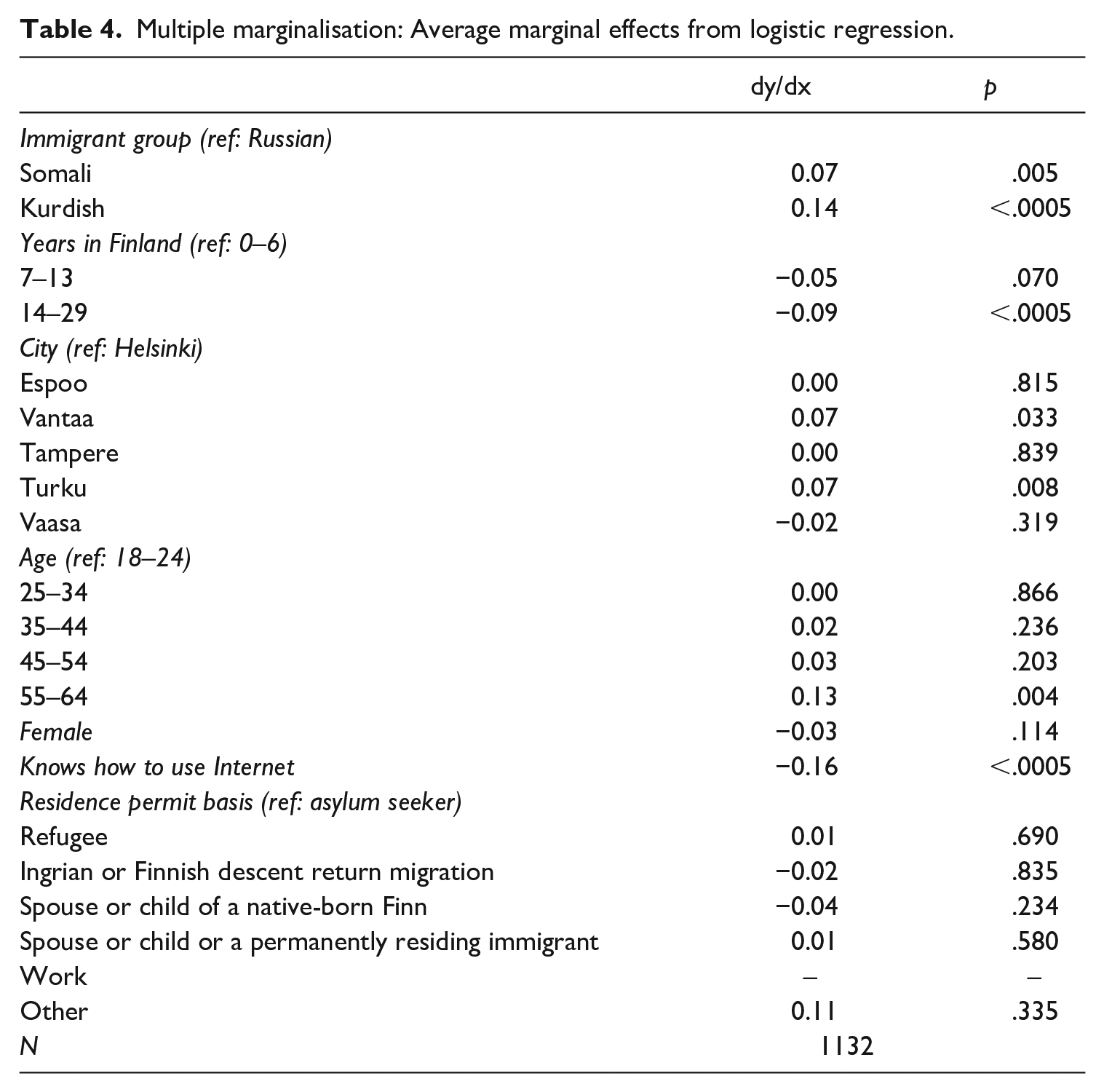
We continued with our last research question and examined the determinants of multifocal marginalisation. The indicator gathered all those respondents who scored below the mean in all four MCA indicators. The estimated prevalence of multifocal marginalisation in the study population was 8.3 per cent (95% CI: 7.0–9.8%). Table 4 shows the average marginal effects from an adjusted logit model of multifocal marginalisation. Compared to the Russian immigrants, multifocal marginalisation was clearly more frequent among the Somali (7 percentage points) and, especially, the Kurdish immigrants (14 percentage points). Years in Finland showed a gradient-like pattern, where those with the longest time of stay have a 9 percentage points lower rate of multifocal marginalisation. Those aged 55–64 years are more clearly exposed to multifocal marginalisation than the younger groups (13 percentage points). Also, self-assessed capacity to use the Internet was associated with a clearly lower rate (16 percentage points). In the model, work-based residence permit was automatically excluded because there were no available cases of multifocal marginalisation in that category.
Multiple marginalisation: Average marginal effects from logistic regression.
Discussion
This study proposes a multifocal model of integration to theorise immigrants’ integration in a transnational context. The model explicitly accounts for the three key foci of integration – co-ethnic community, host society and the transnational sphere – and enables us to conceptualise and empirically examine the complexity of integration in an encompassing and systematic way.
We found, first, that there is a simple underlying pattern behind the multitude of concrete indicators; for each focus, integration was found to be either one- or two-dimensional. Integration into the host society and co-ethnic community were both one-dimensional, which implies that the different theoretical dimensions largely coincide. This corresponds to Durkheim’s insight in Division of Labour (2007a [1893]), where he argues that having a position in the system of production translates to a feeling of being useful and a part of something beyond oneself. In contrast, transnational integration had two empirical dimensions, depending on the degree of emotional and social attachment. In the familial-emotional type (‘strong’ transnational integration), having one’s parents and siblings living abroad deepens transnational integration in emotional and identificational terms, while in the other type (‘weak’), this emotional-identificational dimension was not prominent (cf. Botterill, 2014; Friedkin, 1980; Paugam, 2018; Pfeffer and Parra, 2009). Taken together, these findings remind us to keep in mind how identification and sense of belonging relate to the more objective, structural side of integration. Their relationship is eventually contingent and merits careful empirical attention.
Second, we found that there was no zero-sum game or competition between the foci (see Tsuda, 2012). In most of the cases, the foci were found to be in a moderate positive relationship with each other, which is consistent with the dominant view in literature (see ‘Key Prior Findings’). However, due to the moderate effect sizes, the main pattern is independence, which emphasises that social integration is individualised and highly diverse, perhaps ‘super-diverse’, characterised by a multiple and complex set of affiliations, identifications and distinctions (Vertovec, 2007). Importantly, our study extends the scarce prior literature on the relationship between transnational and co-ethnic integration by showing that they are not competing but, rather, in a positive relationship. Being able to examine all these aspects in a single framework is a key advantage of the proposed theoretical model.
We further elucidated the diversity of social integration by examining the differences between three immigrant groups in our data. Considering transnational integration patterns, the Russian immigrants were found to be more active than the other groups, which may be explained by Finland and Russia being neighbouring countries. Although travelling has become increasingly affordable by western standards, long international trips may still be too expensive for many immigrant households, especially if labour market integration has been difficult. The Somali immigrants had a markedly stronger attachment to their co-ethnic community communities than the Kurdish or Russian immigrants, which may be a reaction to the discrimination and prejudice the Somali community faces in Finland (Jaakkola, 2009; Tiilikainen et al., 2013; see Itzigsohn and Giorguli-Saucedo, 2005). In terms of host society integration, group differences were smaller but considerable. The Russian immigrants’ highest score may depend on their closer cultural proximity (Liebkind and Jasinskaja-Lahti, 2000), which may facilitate their host society integration.
Our third key finding concerns multiple marginalisation. Durkheim (2007a [1893], 2007b [1897]) was deeply concerned about weakening social integration and its harmful implications, such as excessive individualisation, a sense of feeling useless and the risk of suicide. Combining this insight with immigrants’ multifocal integration led us to examine which immigrants are most at risk of being marginalised from all foci. We found that immigrants with a Kurdish background, a short time of living in Finland, an older age and weak Internet skills were associated with a higher risk of multifocal marginalisation. These findings are consistent with the recent evidence on the prevalence of mental health problems among the Kurdish immigrants in Finland (Rask, 2018). They also shed light on digital inequalities (Robinson et al., 2015), which may form a vicious circle with social exclusion (Chen et al., 2003).
Not belonging is studied widely from the perspective of political belonging, and misrecognition, but less from the perspective of a subjective sense of not belonging or ‘elective’ belonging (however, see Krzyżanowski and Wodak, 2008); our study included the identificational-emotional dimension of integration and thus provides more evidence on the subjective aspect. However, belonging is also a question of power. Not everyone is allowed to belong, but belonging includes claim-making for recognition (May, 2011). The case of immigrants emphasises the political nature of belonging when newcomers must struggle for recognition as full members of the host society. Global inequalities are visible in migration in the form of different opportunities and life chances stemming from the unequal distribution of various resources, depending on one’s socio-economic status and situation in the receiving country, as well as in the country of origin (Faist, 2016). Our results on multifocal integration raise further questions regarding the particularities of this power struggle; in other words, individuals may have to seek recognition simultaneously in one focus without compromising their status in the other.
Rapid social and environmental changes may trigger the sense of not belonging (Casey, 1993; May, 2011). As the social context changes and diversification diversifies (Vertovec, 2007), people may end up feeling they no longer belong to, say, their neighbourhood or society. Thus, super-diversification is not only a question of migrants’ integration into their new host society, but it creates a new context of belonging for the majority as well. Not belonging may also contribute to social change by challenging the traditional ways of being (May, 2011) and calling for more reflexivity, which may lead to creative solutions and social change. Those integrated into several contexts are in a situation of questioning the traditional customs and norms of all their foci of belonging. They can thus act as agents of social change by introducing new ideas to their host society and by returning their newly learned ways of thinking to their cultures of origin. From this perspective, studies on immigrant integration provide greater insight into the dynamics of contemporary societies.
Footnotes
Appendix
MCA indicators: Descriptive statistics and correlations.
| Co-ethnic community (CEC) | Host society (HS) | Strong transnational (ST) | Weak transnational (WT) | |
|---|---|---|---|---|
| N | 1356 | 1234 | 1122 | 1122 |
| Mean | 0.00 | 0.00 | 0.00 | 0.00 |
| SD | 1.00 | 1.00 | 1.00 | 1.00 |
| Min. | −1.92 | −2.03 | −2.43 | −2.21 |
| Max. | 1.33 | 2.74 | 3.12 | 2.78 |
| CEC | – | 0.17 (***) | 0.02 (NS) | −0.11 (***) |
| HS | – | – | −0.11 (***) | 0.33 (***) |
| ST | – | – | – | 0.00 (NS) |
| WT | – | – | – | – |
Note: NS: not significant; ***: p ⩽ .001.
Acknowledgements
The authors wish to thank Professor Vanessa May (The University of Manchester), Senior Lecturer Emmanuel Deutchmann (University of Göttingen), the participants of the ECSR workshop on Migration at the Robert Schuman Centre for Advanced Studies (Florence, April 2019) and participants of the seminar ‘Attachements et immigration’ at Centre Maurice Halbwachs (Paris, May 2019) and the anonymous reviewers for their comments.
Funding
The authors disclosed receipt of the following financial support for the research, authorship and/or publication of this article: the research was funded by the Academy of Finland (grant 312310 for the Centre of Excellence for Research on Ageing and Care, RG 3 Migration, Care and Ageing), the Strategic Research Council at the Academy of Finland (grant 327145 and 327148 for the DigiIn project), Kone Foundation (project Crossing Borders for Health and Well-Being), Helsinki Metropolitan Region Urban Research Program and the City of Turku/West-Finland Housing Association of Public Utility (Länsi-Suomen Yleishyödyllinen Asuntosäätiö).
