




Abstract
The right to a supported independent life is a central dimension to disability politics. This focus has been used to challenge institutionalised living and the exclusion of disabled people from areas such as education and employment. The importance given to independence has also led to a critique of care. This critique has been a point of contention between disability studies and feminist theorising. In this article I argue it is important to return to these debates because contemporary conditions mean advocacy of independence is being co-opted into rhetorics of self-sufficiency. At the same time care on its own does not offer a productive alternative. The article draws from an ESRC project undertaken with disabled young people to advocate for the importance of both supported independence and of support being caring. It concludes by arguing that an expansive welfare state is required to create the conditions that can make that possible.
Keywords
Introduction
A key focus of disability politics is advocating that disabled people should have greater independence (Morris, 1993, 1997; Oliver and Barnes, 1998). This emphasis has led to a rejection of the language of care; with care being seen as a factor in the oppression of disabled people by both state organisations and charities. Instead disability groups and researchers have argued that what is needed is supported independence, where disabled people are in control of the additional practical assistance they require to live an ordinary dignified life (Brisenden, 1992). In the UK this has translated into personalisation of welfare, with policy innovations such as direct payments (Rummery, 2011). However, the rolling out of personalisation of state provided support, now sits alongside a sustained period of significant cuts in welfare provision; this has reduced significantly the funding and services available (Beatty and Fothergill, 2015; Mills, 2018). For example, in the UK the move from the Disability Living Allowance (DLA) to Personal Independence Payments (PIP) has brought tighter criteria that has left many disabled people with less support than they had previously (Machin, 2017). Alongside has come a shift (or perhaps a retreat) in the rhetorical framing of welfare. It is increasingly positioned as something that is a barrier, rather than facilitator, to people being independent and a temporary stepping stone back into one’s proper place: work and self-sufficiency (Watts and Fitzpatrick, 2018).
Both materially and discursively the current climate appears to minimise support and focuses instead on pushing for independence to be the property and responsibility of the individual, including those disabled (Power and Hall, 2018). This is not the version of supported independence advocated by independent living activists in the UK and elsewhere. In response some in disability studies question whether independence, however differently defined, is the right approach for enabling self-determination. The concern is that it is not distinct enough from the privileging of self-sufficient independence to offer a counter imaginary. As a result, some are exploring whether returning to the values of care could be beneficial. Clearly, this is a contested move given the history of care in disabled people’s lives (Shakespeare, 2000). The justification made is that something has been lost in its rejection and that it could be useful to think of support as – within particular conditions – involving care. One way in which people are doing this is to draw from feminist ethics of care ideas that argue that care is (or could be) an important social practice embedded in our interdependencies with each other (Kittay and Feder, 2002; Sevenhuijsen, 1998).
In this article I want to engage in the debates around support and care in the context of disability through discussion of empirical research with one particular group: disabled young people. The particular empirical project I draw from is focused on young people with primarily physical impairments that affected their mobility, dexterity and strength. I focus on disabled young people because they have a particular relationship to support. They may have experienced greater levels of it during their lives; while research in disability studies has detailed how lack of support as they move towards adulthood can limit their chances of making a successful transition (Beresford, 2004; Kirk, 2008). At the same time youth studies literature argues that in this era of self-sufficiency and welfare reductions, independence is becoming an even more important and challenging marker for all young people to achieve (Catan, 2004; Prout, 2000; Wyn et al., 2012). This literature also indicates that these contexts are increasing inequalities between young people, this is because factors such as class, gender, race and ethnicity and disability help some young people more easily navigate a pathway to an independent adulthood (Bradley and Devadason, 2008; Holland et al., 2007; Roberts, 2011). In the context of disabled young people’s experiences of support as they have grown up; their priorities for adulthood and the challenges they recognise around them, how do they think about the place of care, support and independence in their lives?
The article begins by exploring the differing positions on care and support across disability studies and feminist debates; while making the case for why working across these differences could be useful. After describing the research the article draws from, I discuss how a group of disabled young adults approach care and support in their lives. I argue that as they approach adulthood they increasingly seek to narrow the presence of both in their lives in order to present themselves as the self-sufficient independent good subject.
Disability and Feminist Debates on Care
The disability movement, particularly in the UK, has long argued that institutionalised models of ‘care’ are central pillars in the oppression of disabled people. While the closing down of large institutions of enforced confinement was an important step, this was seen as only the beginning. Focus turned on how the help disabled people received, from both formal and informal sources, produced dependency by being provided without choice and control. Care was so associated with dynamics of charity and passiveness that it could not be reconciled with a political movement seeking to empower and position disabled people as full citizens (Morris, 1997; Woods, 1991).
The independent living movement, which has a long history in disability politics across the globe, campaigns for disabled people to have a greater say in all aspects of their lives and for them to have the same opportunities for a dignified life as others. The move to personalisation of welfare is one outcome of this, in particular the shift to disabled people receiving provision such as direct payments, which enable them to create contractual arrangements with the support workers they employ, or to make their own choices about the resources that can aid them to live independently (Beckett, 2007). In advocating for provision such as direct payments, some independent living advocates have argued that putting the selection of this support into the hands of the individual, and away from collective provision, also aids the state by reducing the costs of welfare (Zarb and Nadash, 1994).
It is hard to underestimate the importance of disabled people’s campaigning to the greater control they now have over their lives. The right disabled people have to an independent life is no longer questioned (although not necessarily enabled). However, there are good reasons now for evaluating whether independence through personalisation of welfare is the best, or only way to ensure that disabled people can enact self-determination. For a variety of reasons researchers in disability studies and feminist sociology are arguing that the current social and political climate mitigates against this route being a fully useful strategy for gaining equality and good welfare provision.
First, researchers examining the implementation of personalisation of welfare argue it contains significant limitations in its capacity to improve the lives of disabled people (Beatty and Fothergill, 2015; Rummery, 2009, 2011). This is because it has increasingly become embedded in an individual liberal consumerist logic, disregarding societal factors in the production of disability (Barnes et al., 2015; Reeves and Loopstra, 2017). Some disability movement advocates do acknowledge that their rejection of collective welfare provision, and their argument that a benefit of individuals gaining direct control is that it is cheaper, has provided legitimacy to government policies of withdrawing or reducing welfare provision. For example, Jenny Morris (2011: 3) has argued that independent living arguments have ‘fitted well with the individualist political framework’ of Conservative governments.
Second, there is increasing concern over how personalisation of welfare and austerity have come together to create very poor working conditions for people employed by the private agencies providing much of the support available for disabled people to purchase. Many people providing personal assistance are now on hours based or zero hours contracts. This leads to support workers being increasingly exploited and working without a living wage. As well as having negative consequences for workers, it also raises doubt about the quality of support they can provide (Pearson et al., 2018; Rummery, 2009; Rummery and Fine, 2012). Support workers can be treated in this way because what they do is not seen as particularly significant or important. Primarily seeing support as a set of practical tasks, as some in the disability movement have, provides legitimacy to treating it, and the people who provide it, as low skilled. This leaves it easier to minimise the time it takes and what is involved in the practice of it. Bathing someone is simply about keeping them clean, rather than a complex human intimate interaction, which requires skill and understanding to be done in a way that is respectful of the person and their identity (Barnes, 2012; Twigg, 2000).
The advocates of welfare austerity justify the reduction in benefit provision through neoliberal arguments, which assert that ‘generous’ welfare provision generates problematic dependency (Garthwaite, 2014; Heeney, 2015; Mattheys et al., 2018). By limiting and removing support, recipients are encouraged back to a better path of employment and self-sufficiency. Disabled people have been a particular target of this argument (Shakespeare et al., 2017). In all this support is flipped from being a facilitator to independence to being a barrier. This is obviously not what the disability movement had in mind for supported independence. One response could be to continue advocating for the concept by critiquing self-sufficiency and highlighting the need for disabled people to have support given the extent of the social barriers to full participation that exist. While this is important to do, here I want to explore also the value of drawing care into challenging current attitudes to support (Watson et al., 2004).
To do so I build on contemporary feminist work seeking to both value care as an important social practice, and to give equal focus to the social and material conditions within which it can occur. Much of this work is rooted in Joan Tronto’s (1993) four components of ethical care: attentiveness; responsibility; competence; and responsiveness. It is important to note that these values have resonance with independent living advocacy, particularly their demands for greater freedom, choice, control and dignity. However, it is these values that have been lost in the translation of independent living into personalisation of welfare. Therefore, returning to care by advocating it is a vital social practice, offers one way to regain important values lost in state co-option and minimisation of independent living.
Given the disability critique of care, drawing it into the advocacy of the right to effective support needs to be done with some ‘care’. This is why the emphasis given by contemporary feminist work on care to the conditions within which it occurs is extremely important (Barnes, 2012; Silvers, 1995) – in particular that equality is required and that this is best ensured by the state having responsibility for ensuring it (Sevenhuijsen, 1998; Tronto, 2013). One of the problems created by the contemporary focus on self-sufficiency is it has obscured ‘the collective responsibility of the state to provide adequately for its citizens’ (Ward, 2015: 54). Providing adequately for citizens includes recognising more fully the value of support as an activity that goes beyond immediate practical tasks; that to be done well it requires care and adequate resourcing by the state. Williams (2001) argues that this approach to care can connect with disability movement calls for independence and self-determination. In particular that care is more likely to occur when the person being supported retains the right to determine what it will involve.
I want to contribute to these explorations by working across disability studies and feminist ideas to reflect on a research project where a group of disabled young people discussed their thoughts on the support and care in their lives as they worked towards their transition to adulthood. Through examining their perspectives, I will argue that when care is separated out to the private domain and welfare provision’s role is minimised, both support and care are identified as barriers to independence. In this context disabled young people feel it is important that they prioritise the presentation of the self-sufficient independent individual. Therefore, ensuring that the intricacies of support can be caring involves creating a context of supportive welfare and societal structures, which materially and symbolically value the role of interdependency in human life. Before working through this argument, I will briefly detail the research project.
The Study
The article draws on data from an ESRC funded study that explored how a group of disabled young people engaged with and thought about their bodies as they moved towards adulthood. The project was connected to a mainly statistical study of participation and quality of life among disabled children all with a diagnosis of cerebral palsy: SPARCLE. 1 The research aimed to return to a group of young people who, as children, had been part of a small qualitative study within SPARCLE. As this group was small, we invited young people in SPARCLE who were not part of that qualitative work to join. In total, 17 disabled young people participated: 11 from the original group, two from the wider study and four from a local school for disabled young people. The sample included 10 young men and seven young women aged 14 to 20 who lived in and around the North-East of England. The participants had a range of physical impairments that affected their levels of mobility and dexterity to varied degrees; all made some use of assistive technologies in their day to day lives, from walking aids, to wheelchairs and communicative aids. The empirical work was gathered (2011–2013) while the North-East was particularly affected by economic uncertainty and welfare austerity. From participants’ description of their families and their social context, there was a mix of class background present in the group, which meant that some had access to social and material capital that would provide some protection against the challenges this context in the North-East created; while others faced, and knew this, many serious challenges now and into the future.
Our intention on working with this group was to understand what had been happening to them since the childhood interview and how they were thinking about adulthood as they moved towards it (a fuller account of the methodological and analytical process can be found in McLaughlin et al., 2016). Key themes that shaped research design included: how their relationship to their body had changed over time; what they thought about the medical interventions they experienced now and in the past; and what futures they thought were possible for them. We adopted a range of methods that let the young people convey their thoughts as ‘capable, social actors’ (O’Kane, 2000: 133). We used face-to-face narrative interviews, photography, photo-elicitation and craft-making – methods shown to be particularly effective in research with children and young people (Morrow, 2001). By having participants produce images or objects that spoke to their own experiences, while retaining narrative modes of interviewing, we aimed to allow the participants to piece together complex stories about their lives (Rich and Chalfen, 1999).
We allowed participants to decide the extent of their participation, and how and what they used to take part, for instance in creating or gathering images or physical objects. Interestingly, despite the range of methods we employed, most opted to be part of a one-off face-to-face narrative interview only. Time was a consideration, particularly in light of the demands of school work and exams, and some preferred brevity to a more extended involvement. Seventeen took part in the interviews, with eight doing the visual work, six of whom participated in a photo-elicitation interview. Three participated in the craft-making workshops. During the research it became quickly evident that one of the strongest concepts that was articulated by the majority of participants – regardless of gender and class background – was their desire to obtain independence and their expectation that they would. Other publications have explored the embodied practices that they engaged with in gendered ways in order to work towards independence (McLaughlin and Coleman-Fountain, 2018) and the class dynamics that would influence their chances of obtaining it (McLaughlin et al., 2016). This article examines what their prioritisation of independence may tell us are the consequences of state prioritisation of self-sufficiency and why greater place for and recognition of care within state welfare practices would be a useful response.
Providers of Support and Care
Participants often acknowledged the importance of support in the discussions with us. Unsurprisingly it was family who came up most commonly as the key actors in the past and present who provided support and care. Across the interviews and the visual materials they detailed what their families provided. There was a great deal of practical support such as helping them to go places, or helping them do day to day tasks. Family members also provided support with physiotherapy or visiting them when in hospital for surgery or other treatments. Participants acknowledged that they believed that family support was particularly important for them given their impairments and they knew this would continue into the future, including when they left home (which most assumed they would do): Well because family’s important for anyone, but especially with a disability ’cos like, suppose life’s harder in a way with a disability and I suppose that [pause] the worst ones you see, like the ones who are quite disabled, like if nobody cared for them [pause]. (Sean, Interview 1)
In addition, again as one would expect, family support was articulated as care. The talk by participants of the practical things that family members do, was also interwoven with a sense of the deeper relationships between the people connected to them. The provision of emotional support, security and understanding that filled their narratives about family speaks to the relationship having an intensity that goes beyond a notion of practical support. It reflects the interdependency of deep and abiding human relationships: So it’s good and most me life, 90 per cent of the life I feel included, got a brilliant family, absolutely brilliant family, couldn’t ask for a better family. . . if it wasn’t for the love, support, understanding and acceptance of me parents and me sisters and all me family, every single member of me family, my life wouldn’t be so great. I mean me parents take us to hospital appointments, they take us to physio, they’re always there, me mam sat beside me hospital bed when I’ve needed her to. (Sean, Interview 2)
This care provided by family members was spoken of warmly as something central to their lives. This was a theme that came across particularly strongly in the photo journals, where family members and their role in caring for them was a common theme. When asked to capture happy memories, Hannah included a set of pictures taken from holidays when she had gone scuba diving with her dad (Figures 1 and 2). Alongside the pictures she positioned text explaining why she had selected them, notably ‘being relaxed under water, feeling peaceful, no pain. Seeing lots of good fish and being with dad’. The second image that shows her dad swimming alongside, holding the tank provides a representation of support as care. His act of holding does more than enable Hannah to float, it provides security, comfort and is based in trust and love. His role in enabling her to have this moment without pain is extremely important to Hannah; the image captures this specific time, but also the broader resonance it displays of her life as cared for and valued.

Hannah’s photo journal.

Hannah’s photo journal.
The supportive nature of family also came through in the craft-making workshops. Kate created a charm bracelet to represent the different family relations that sustained her (Figure 3). At the centre was a fabric rose – a charm chosen by her to represent herself as both pretty and strong. The other charms were all different types of leaf chosen to represent different family members, capturing some aspect of their personality, via the different plant type the leaf shape came from. The leaf charms were made by finding images of plant type leaves online, tracing them onto plastic, which was then shrunk using a heat torch. While working with us to make the charms Kate explained that what she wanted to capture was how her strength was made possible by her family and the love and care they provided for her.
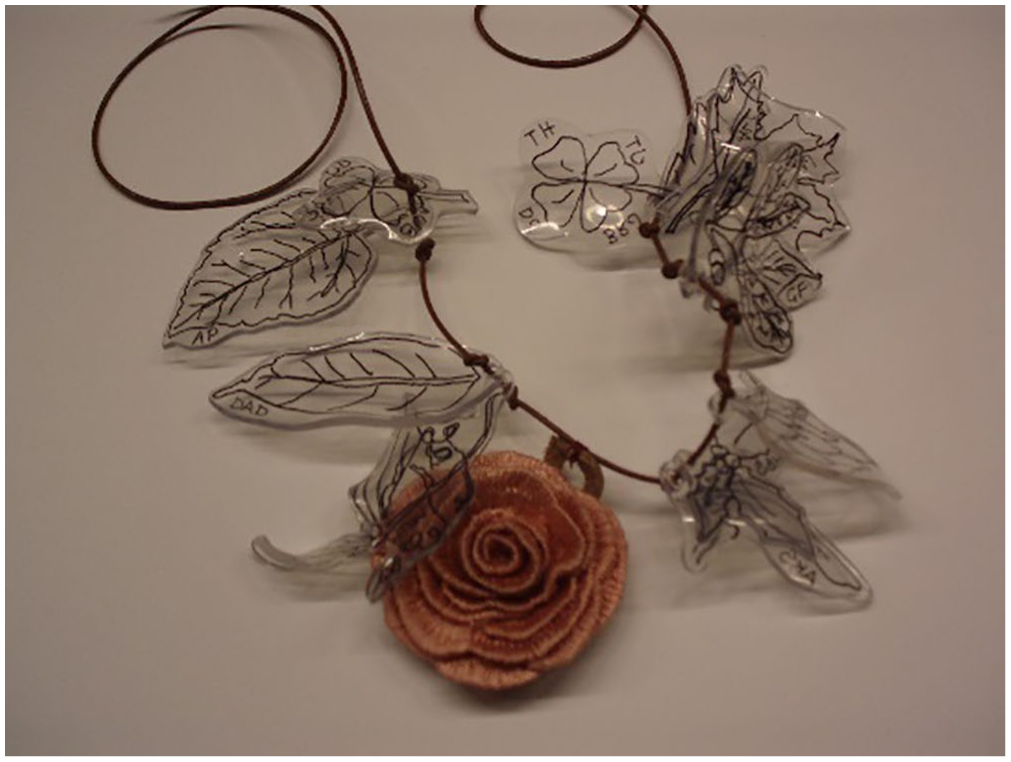
Image of family tree charm bracelet made by Kate.
On one level it is to be expected that family was represented and spoken of as a set of interdependent relations that provided valued care, rather than just practical support. This is what families are assumed to do. However, I also want to position those narratives in their social conditions of possibility, conditions which may inform why participants were more at ease with this account of care, rather than discussing other sources of support, such as assistive technology and welfare provision. In doing so I want to highlight the limitations of care narratives when read through the private framework of family and intimacy.
Support and Care Contained
It was noticeable that when talking about things or people that helped, participants were more comfortable discussing that as occurring within the care they received from family, rather than other sources of more practical support, such as support workers or assistive technology. They expressed frequent unease with these other sources of practical support. Instead they preferred to do things with as little help as possible, favouring doing things by themselves – even if this meant it was harder, more painful or took longer than using non-family forms of support.
If there’s really fiddly things to do. If I find something I have trouble with then I’ll ask for help, but I’ll only ask for it if I really need it.
What do you mean by that?
I don’t know, I’ll try and do it myself before I ask for help. (Jenny, Interview 1)
While assistive technology was used by many, those who could would avoid using it in public spaces.
Like I tend to try and hide it by putting my calliper under my trousers but some of them I can’t, some of them need to go over and I don’t like that.
Because you can see them?
Yeah, I do try to hide my disability, ’cos I just feel more better if I try to hide it. (Hannah, Interview 1)
In contrast, care was presented as an everyday familial activity, which occurred in their life in pretty much the same way it occurred for other people. The practical support they were at ease with was strongly associated with relational ties that emphasised care over support. What I want to argue is that participants frame support as something connected to ties of care and intimacy so that it can be contained and normalised as something not specific to them due to disability: Well they [family] just look out for me, in whatever I do, any exams, any hobbies that I’ve got, that kind of thing they’ll just always support me in that, help me out with things, take me shopping just do things that you would usually ordinarily do and support me in that way really. (Kate, Interview 1)
So is family, would you say that family is quite important to you?
Oh yeah. I love me family. Family’s me, that’s stupid that question to say to that. Family’s important to everyone. (Sean, Interview 1)
The normalisation of the support they received was also achieved by a strong gendered narrative within their accounts.
I was making a cup of tea this morning, if you’re not gonna make a cup of tea you’re probably not gonna be able to drink while you’re in your own house. It wouldn’t be what I’d be thinking about for a while. I don’t think I’d be able to live without my mum there, so I don’t think moving out will be on my agenda any time soon. But yeah, it’s something to be thought of and obviously you need to be able to do things for yourself, cook, make drinks, just look after yourself in general really.
So why would you, why do you not envisage living without your mum?
Oh it’s I just couldn’t, not a chance, not gonna be able, not moving out for a good while yet. I just think, no I just couldn’t, not at the moment, not a chance.
So what is it do you think?
I don’t do my own washing either which is probably the reason why. (Mark, Interview 1)
There is something very familiar about Mark’s narrative, while he acknowledges there are some key things, such as making tea, that are more difficult for him due to his impairments, he also provides a recognisably gendered account of a young man’s reliance on his mother to do their washing. When participants discussed who within their families provided support or care, mothers were often the most prominent. In addition, familiar gender divisions were present in the different aspects of support parents provided (e.g. fathers took participants to places, including to sporting activities, while mothers stayed with them in hospital). The strong presence of gendered familial responsibilities for and expectations of care normalises it as simply what happens in families. Mothers do their adult sons’ washing.
Similarly with friends, they emphasised how they were part of everyday mutual care support networks: Well, I suppose I’ve got to do the same back. It’s what friends have got to do, not just because of physical disability. I can’t think of an example, just like, if they need to talk I make sure I am there for company. (Craig, Interview 1)
Support provided by family or friends could be framed as more about what people do in those relationships – rather than being something they particularly required.
So who do you normally go out with, your parents?
And my helpers.
And your helpers?
#yeah#
Yeah. So sometimes you would like to go out just by yourself. Or with. . .?
And with my friends. (Matthew, Interview 1)
How do you go about being well ‘as normal as you can be’?
Just going with my friends rather than helpers. (Sara, Interview 1)
The way that participants preferred to talk of relationships of care, rather than being provided with formal support or help, shows up the problems created by not considering state and societal responsibilities to care. Namely the erasure of disability. Being part of private mutual care networks made it a more ‘normal’ everyday form of caring practice – something that did not position them as different from others. I have discussed elsewhere (McLaughlin, 2017) how disabled young people seek normality by minimising the visible presence of disability in their lives, as one response to the stigma associated with being different. These dynamics of stigma and normalisation are encouraged by the valorisation of self-reliance in contemporary state and media discourses; discourses that became increasingly present in participants’ discussions of looking to their future adult selves.
Adult Independence as Self-Reliance
In discussions about the future, it was clear the majority of participants were actively seeking to reduce the amount of support that they required from others, including family. What came across very strongly was if they could, they aimed to reduce visible external help. Doing this was very closely linked to what they understood independence in adulthood to involve: self-reliance. Participants associated adulthood with greater independence and independence was associated with doing things by yourself: At the start of high school I got a helper to come around with me. I didn’t like that though ’cos everyone was like ‘Oh she’s got a helper’, you know, but I didn’t like having the helper anyway ’cos obviously I’m more, I’m wanting to be independent. (Sara, Interview 1)
Although family care was something they valued as being an important factor in enabling them to be the person they were, now and into the future, they also wanted to reduce their visible reliance on it. ‘Over reliance’ on family appeared to be a barrier to being the type of adult they were trying to become, holding them in a childlike state, as they moved towards adulthood: I love me grandparents [who were the participant’s primary carers] but they wrap you, they are your grandparents and they do spoil you and stuff like that and me Grandma does, she always spoils us. My grandma, always ’cos obviously she knows she’s gone through the whole stage of me epilepsy being increased and getting worse and she still treats us, wraps us in cotton wool and she’s ‘Ah you can’t do this’, ‘You won’t be ready for that yet’. (Rachel, Interview 1)
This may, in part, capture some of the ways research has acknowledged that parents/carers of disabled children can be over protective and resistant to enabling them to have greater independence (Hirano et al., 2018; Pilnick et al., 2011). However, it also speaks to a strong association made by participants that many forms of help are not compatible with the enactment of recognisable independence. The casting away of forms of support, even those embedded in the narrative of loving care, took on an important symbolic marker of who they were trying to become.
It would be a mistake though to say that no forms of family support would not be important as they continued into adulthood, even if not discussed with us. I am thinking here of the support that was accessible to those from more middle class backgrounds, who could draw on the social and material capital available via their families. This kind of family support has been identified within youth transitions literature as a growing source of inequality between young people as state forms of support (such as support for higher education) significantly reduce (Wyn et al., 2012). Among our participants, accounts of plans to go to university and having a career (rather than a job) were more commonly provided by those from more middle class backgrounds (e.g. one participant was being advised on how to prepare for applying for a medical degree by a GP friend of the family). In public discourse, the opportunities made possible by class background are not framed as undermining one’s ability to claim self-sufficiency, although they are embedded in someone’s opportunities to achieve any measure of it. Therefore, there is no need to disavow, or indeed acknowledge, this form of support, as it is not positioned as counter to the values of self-sufficiency young people are supposed to aspire and work towards. Indeed, working class families are criticised for not installing this aspiration in their children (MacDonald et al., 2014).
This leaves only one form of visible support that they were comfortable to acknowledge – support that contributed to their enactment of independence.
If I had a house, I will need some kind of assistance, I probably will need some kind of help, like people checking in on me and seeing if I’m all right and having alarm systems if I fall over. . . that just comes with having cerebral palsy. I will need special equipment so yeah. [. . .]
I’m an independent person, I travel independently and things. (Hannah, Interview 2)
Support was only legitimate when productive of independence, rather than connected to the vulnerability or fragility of the body, or to help manage or improve a disabling environment. This recognition of the usefulness of support to enabling independence does echo the disability studies/movement argument that disabled people should have additional support – provided via the state – in order to gain independence. However, the willingness of participants to frame independence as something requiring additional support was comparatively circumscribed. In the balance between being able to be and being able to be seen as the self-reliant independent actor – in comparison to the actor in need of some extra help – the self-reliant actor was the stronger presence in their narratives: I’d rather be independent than trying to get people to wait on me hand and foot, it might take 10 minutes extra but if you’re doing it yourself for 10 minutes, what’s 10 minutes if you’re doing it yourself, rather than somebody that’d take five, if you did it yourself it takes 10, take 10 and do it yourself. (Mark, Interview 1)
What I want to argue is that the prominent rejection of support in favour of independence was tied to participants presenting themselves to others (and to us as researchers) as the right kind of adult subjects. While they legitimated the support they had received through their lives by positioning it within narratives of family care, as they look towards the future, the emphasis was on minimising practical support. Family provided support still had some presence, but only when normalised as the care others continue to receive from family, often mothers, while they worked at living independently. Being able to work towards an individualised independence was the imperative most were engaged with. This occurs in a context where this is the form of independence strongly valorised by the world around them. They are seeking to enact the ‘compulsory individuality’ (Skeggs and Loveday, 2012: 475) required of the good neoliberal subject.
Participants evoked the disability studies movement call for an independent life, but it was not a supported independent life they advocated, instead it was primarily self-reliance. Likewise, while they celebrate modes of interdependence akin to that advocated by feminist ethics of care arguments, they so associate it with family that it does not reach out beyond a privatised gendered concept of what people who care for each other do out of love. As such both supported independence and interdependency are trumped by the individualism of the adult independence narrative they present and enact. This means that neither disability studies’ focus on supported independent living, or feminist ethics of care’s prioritisation of interdependency, offer a way on their own to make the case that support and care are legitimate aspects of a good, independent, adult life.
The question this generates is what could? The disability movement rightly advocates supported independence, but in the desire to escape paternalism it minimises emancipatory aspects of care to focus on practical modes of support. In current contexts of welfare austerity, the prioritisation of personalisation, with the individual selecting how they want to be supported, is problematically removed from demanding a broader responsibility for the state to value welfare recipients as human subjects. It does not address the advantage some have due to their social background, such as the social and material capital they acquire from family, which may enable them to work within consumerist, liberal frameworks within personalisation practices. For example, other research has highlighted ways middle class families can make use of their social and material capital in their negotiations through individualised welfare provision such as direct payments (Hansen et al., 2014). It also risks validating the current minimalist approach to the provision of welfare, which deskills what support workers do and undermines their working conditions; alongside reducing disabled people’s opportunities to purchase support that can enable their independence. Not demanding that welfare services be funded adequately enough to provide care retains the pretence that care is what happens within families, privatising it in a gendered narrative, which minimises the importance of support in enabling independence.
Care needs to be drawn back into what occurs within good formally provided support; but in a way that avoids the paternalism and oppression of the past. This can only happen when the disabled person has a genuine say in what support is provided and the assistant is paid and trained in an adequate way to be responsive to the disabled person and valued for being able to do so. It therefore requires both a reframing of welfare as a matter of rights and obligations of the state to those in greater need and a reinvestment in it. By valuing the depth of the interrelationship in caring support, through celebrating it and providing it with the resources required for it to happen, the state would acknowledge the value of supported independent living and varied interdependence.
Concluding Discussion
The article has sought to develop a positive path for bringing together the disability movement’s advocacy of independent living, with feminist ethics of care’s prioritisation of care as a crucial social practice. While the values associated with both are characterised at times as being at odds, I argue it is possible to bring them together through the way they both seek to displace the current neoliberal supremacy of individualism and austerity, with recognition of the responsibilities people and state institutions have to provide support to others. Where they differ is how they express that sense of responsibility and detail what support entails. I believe it is worth working through those differences because on their own, disability movement advocacy of independent living and ethics of care celebrations of care, cannot provide a much needed counter to the current valorisation of self-reliance and demonisation of welfare support we see in the UK and elsewhere.
While current welfare provision maintains a rhetoric of independent living through the provision of policies such as direct payments; the social and economic reality is that independence is rarely possible for disabled people. This is because the broader societal infrastructure is missing that could enable independence and the form of independence valorised by the state is a mode of self-reliance not feasible for anyone. At the same time, care needs to go beyond the privatised realm of family to have a broader political meaning, which incorporates equality into its enactment and validation. This can happen by connecting care to the values of supported independent living. However, this will require two things. First, acknowledging that the support required to have an independent life has a broader meaning than simply involving practical/contractual components; good support involves relational interaction and connection. Second, support needs to be provided in a material context that allows it to flourish and avoids the risk of inequalities between those involved. An expansive material context requires an enhanced, rather than ever shrinking, welfare state. An enhanced welfare state would not only better look after people, it would also provide an important social marker that people in its care (used deliberately) and the people that provide that care (used deliberately) are valued subjects. What is envisaged here is a ‘benign but powerful welfare state’ (Rummery, 2011: 151) to ensure that the support people receive is enough to sustain a supported independent life, while also providing a different interdependent rhetorical framing of the purpose of providing care.
I believe that bringing together aspects of disability studies’ resistance to care with feminist advocacy of it is useful because it provides a framework that connects interdependency, independence, care and support together in a way that justifies a strong but responsive welfare state. From disability studies is retained the arguments that: (1) there are people who have greater needs due to the disability created by environments not designed to accommodate to their impairments; and (2) it is a matter of rights that varied needs should be fulfilled; without seeing recipients as lesser citizens. From politically oriented ethics of care approaches this is connected to recognition of care practices as social goods and foundations to responsive citizenship. Bringing these points together enables the assertion that there is a role for the state in providing the material conditions that enable those care practices and specific needs to be fulfilled in a way that generates social justice. Crucially, drawing the arguments together provides two important criteria to underpin greater state involvement in the provision of support: (1) it should not reduce the agency of disabled people to have a vital say in what they receive; (2) support is more likely to be caring in its responsiveness when those receiving and providing it are recognised as actors of value.
Footnotes
Acknowledgements
I would like to thank the reviewers and editors of the journal for extremely helpful and considered responses to the article as it moved through the review process. I would also like to thank my colleague Sarah Winkler-Reid whose comments on an early draft brought great insight and clarity to improving the argument and identifying the article’s contribution.
Funding
The author disclosed receipt of the following financial support for the research, authorship and/or publication of this article: The article is based on research undertaken with the support of the ESRC. ESRC Grant: ‘Embodied Selves in Transition: Disabled Young Bodies’, PI: Professor Janice McLaughlin, CIs: Professor Allan Colver (Newcastle University) and Professor Patrick Olivier (Monash University), RA: Dr Edmund Coleman-Fountain (Northumbria University). RES-062-23-2886.
