




Abstract
Personal assistance (PA) is a model of support where disabled people take control of recruiting, training and managing their support staff. Direct payment relationships and symbolism borrowed from the corporate world frame PA relationships as instrumentally focused and largely free from emotional entanglements. Yet complicating this picture is research showing that PA often involves moral dilemmas and interpersonal conflict. We report on data from 58 qualitative interviews with disabled people and PAs. Findings reveal PA to be an embedded form of work, which entails convergent interpretive schemes informed by the world of work and also by indeterminate social relations. Applying Emerson and Messinger’s micro-politics of trouble, we outline how trouble comes to be framed in either conflict-resonant or deviant-resonant ways. This focus upon the moral dimensions of trouble sheds light on the relational dynamics of this prevailing model of care and embedded work more broadly.
Introduction
Personal assistance (PA) is a model of support where disabled people take control of recruiting, training and managing their support staff. PA differs from other forms of care work, such as domiciliary care, because the disabled person is in control of how, when and by whom they are supported. In this sense, PA is key to the disability rights movement and the philosophy of Independent Living, and variants can be found across Europe (Mladenov, 2020).
In the UK, PA is usually made possible through direct payments – cash payments made to individuals in lieu of traditional care services – first introduced by the Community Care (Direct Payments) Act 1996. Direct payments mean that disabled people access cash, rather than services, and an estimated 70,000 disabled people directly employing their own staff in the UK (Skills for Care [SFC], 2020). Typically, disabled people become direct employers, meaning they are required to meet duties around pensions, paying minimum wage and statutory leave. A less common arrangement is for disabled people to enter into a contact for services with self-employed PAs. Where this happens, PAs do not have the same rights as an employee and they also assume responsibility for tax, insurance and pension arrangements. A third (and less common still) arrangement is for PAs to be employed by a third party, such as a user-led organisation (ULO) or care agency. Where this happens, PAs have rights as an employee of that agency, and employer duties are met by the agency rather than the disabled person. The latter two of these arrangements share many of the characteristics of direct employment by an individual employer despite their distinctiveness in legal terms: substantial continuity of engagement with a single employer, lack of control over working times and obeying instructions in everyday routines (Behling and Harvey, 2015). Irrespective of the model in place, the disabled person typically leads the process of advertising roles, conducting interviews, negotiating working arrangements and managing everyday work practices.
Support for disabled people who employ and manage PAs is variable, and while some local authorities maintain a register of PAs for recruitment purposes or offer payroll support, many do not. Where such services are available, they usually involve a cost to the disabled person and so uptake is mixed. PA recruitment processes are therefore highly varied; some disabled people access ULO support to formulate job descriptions and conduct interviews, but many undertake these tasks independently. Support for PAs is yet more inconsistent; a recent survey of PAs (N = 105) found that none were members of trade unions, and many erroneously believed that they would be supported by the ULO they had registered with to access employment opportunities (Woolham et al., 2019). Compared to care workers, PAs are less likely to be employed full-time (12% compared to 44%), less likely to work under zero-hours contracts (21% compared to 44%) and less likely to hold formal care qualifications – yet tend to earn more than their care worker counterparts (£9.53 compared to £8.80) (SFC, 2020).
Direct payment relationships and symbolism borrowed from the corporate world frame PA relationships as commercial arrangements, instrumentally focused and largely free from emotional entanglements (Shakespeare et al., 2018). The ability of disabled employers to remunerate PAs in lieu of direct reciprocity means that disabled people are often less susceptible to a negative imaginary surrounding dependency, or the pernicious feelings of indebtedness common to supportive relationships (Fraser and Gordon, 1994). Yet complicating this picture is research showing that PA often entails emotional dilemmas and interpersonal conflict. As in other home care arrangements, disabled people and their families may struggle to adapt to having strangers in their home space, as the once private haven of home takes on the features of a public or institutional space (Milligan and Wiles, 2010). Both parties may hold divergent and conflicting views about the extent to which they wish to share in one another’s personal and social worlds (Porter et al., 2020). For the disabled person, recruitment and retention can be further sources of stress, particularly where the PA workforce are unfamiliar with personalised approaches to support, or are from cultural backgrounds unfamiliar with independent living (Ungerson, 1999). Research has also shown that a small proportion of disabled people suffer deeply improper behaviour, such as theft and abuse, at the hands of rogue employees (Grossman et al., 2007).
The working circumstances of PAs may also be challenging, despite their relatively positive employment arrangements (SFC, 2020). Christensen (2012) reports ‘master–servant’ style dynamics, where the choice and control exerted by the disabled person comes directly at the expense of their PA’s autonomy, thus advancing the idea that the empowerment of disabled people may come at the expense of marginalised workers in precarious work (Hughes et al., 2005). PAs often have few opportunities to undertake training or qualifications and it is not uncommon for PAs to have no colleagues, while migrant workers face the added difficulty of unfamiliar working cultures (Glendinning et al., 2000). Studies of PA in Sweden highlight distinct sources of worker dissatisfaction, including insufficient training; isolation; personal and managerial complaints with employers; a lack of control in unstructured work; and onerous levels of responsibility for the wellbeing of their employer (Ahlström and Wadensten, 2010). Such situations are likely exacerbated by the fact that PAs may feel unable to express their emotions at work. Falch (2010) describes this scenario as PAs needing to wear an ‘emotional façade’ – a form of emotional labour to disguise their feelings of dissatisfaction from the person they support.
There exists, therefore, a disjunction between the ideal image of PA as a commercial relationship free from emotional dilemmas, and a disparate literature charting moral dilemmas and interpersonal conflict within PA relationships. This article explores trouble within the PA relationship, and by illustrating the socially derived and relational basis of moral interpretive schemes, offers an understanding of PA as an embedded form of work.
Trouble and morality in embedded work
Various models of workplace conflict and resolution exist (Frone, 2000), but the hybrid nature of PA (Ungerson, 1999) means that normative workplace boundaries are subverted, and therefore theory tailored to the formal workplace is limited. In PA, the home space of one party becomes another’s workplace; everyday tasks involve social and bodily intimacy; and typical working arrangements mean that both parties spend prolonged periods of time in one another’s company, often disclosing deeply personal information about one another’s lives.
For these reasons, it is useful to recognise PA as an embedded form of work, which is shaped by interpretive schemes derived from both social and employment domains. The concept of socially embedded labour has diverse taproots, but is commonly underpinned by Polanyi’s conceptualisation of labour as a ‘fictitious commodity’ and the assertion that market economies are sustained by social relationships and political institutions, and are thus inherently moral (Polanyi, 2001). This analysis remains influential in its eschewal of a strand of economic orthodoxy, which unduly marginalises the moral dimensions of individual agency and economic cooperation in preference of rationalist formulations (Bolton and Laaser, 2013). Adapted and advanced by Granovetter (1985), embeddedness depicts economic relations as inextricably social, with attendant ethical dimensions being key to understanding economic practice. This perspective assumes that successful and sustainable economic cooperation requires trust and the abstention from opportunism, both of which are characteristic features of informal social ties. But these same moral conventions are not wholly benign, as the trust they engender may also give rise to greater opportunities for malevolent action, meaning harm is felt more deeply and for a longer period than would be the case between atomised economic actors (Granovetter, 1985).
The centrality of trust in embedded economic action indicates social foundations, but simply recognising the social basis of exchange fails to adequately incorporate these moral concerns. To this end, insight may be gleaned from parallel theories of trouble within informal social relationships, which give analytic primacy to concrete social relations and the subjective, indeterminate and historically situated nature of social interaction. Emerson and Messinger’s (1977) micro-politics of trouble is helpful in conceiving of relational trouble as a continuum between normal conflict and normative deviance, with morality the keystone to conflict and cooperation.
People who experience trouble in their relations with others come to define these problems in different ways (see Table 1). Trouble begins when one party senses dissatisfaction or disaffection towards the other, but this does not typically escalate because trouble is framed in non-moralistic ways. One way that trouble is framed non-moralistically is for the troubling actions of others to be attributed to personal preferences, rather than explicit transgressions of rules – ‘it’s just the way they are’. In framing trouble this way, the troubled party perceives transgressions as being within the bounds of normal variation, within a given social tie, which affords legitimacy to the other’s actions. A similar response is to interpret the behaviour of others as the unintended consequences of ordinary actions. This involves the tacit assumption that trouble stems incidentally from the other’s pursuit of legitimate goals, rather than any malicious intention – ‘they did not mean to cause offence’.
Typology of trouble.
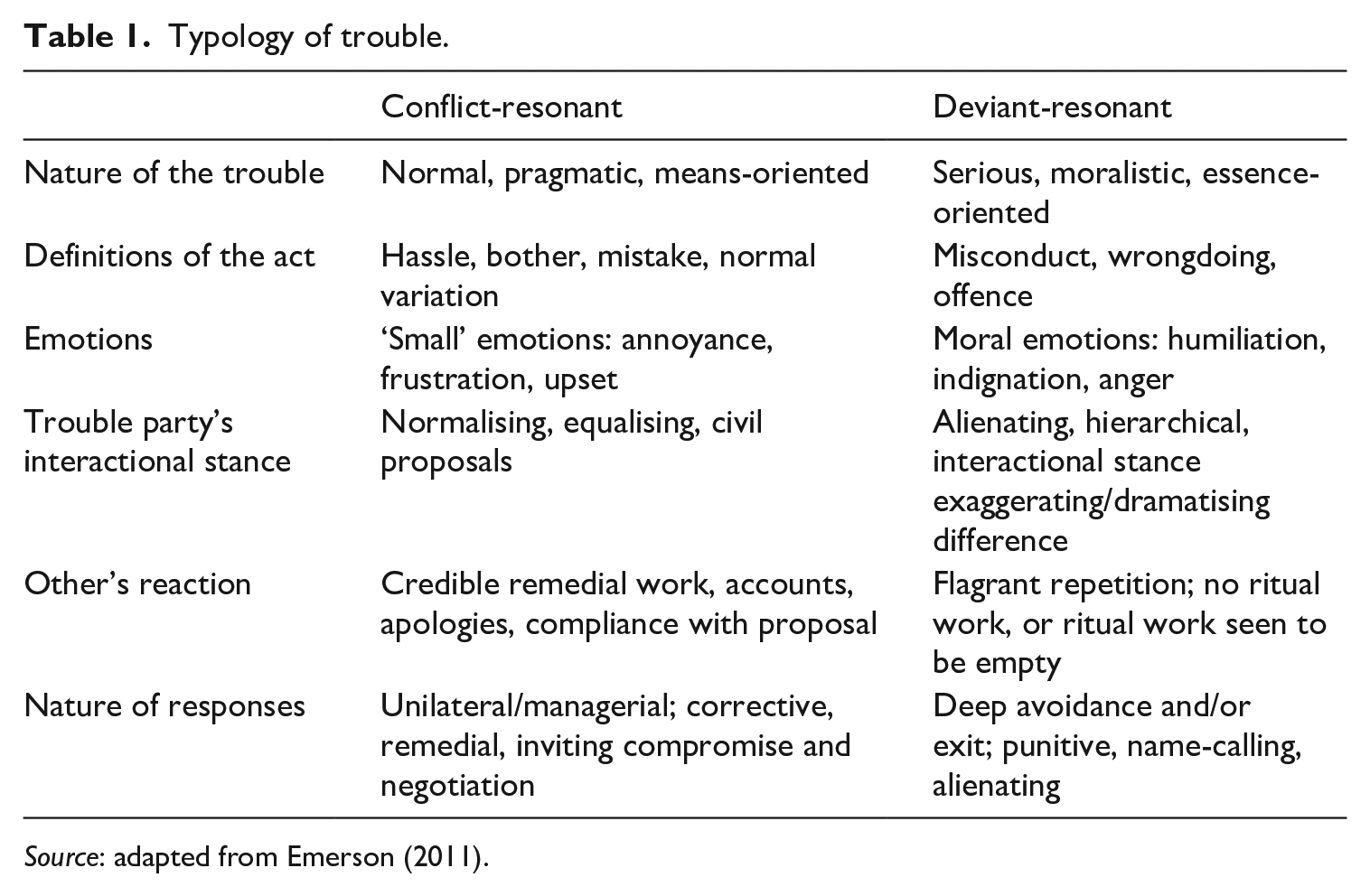
Source: adapted from Emerson (2011).
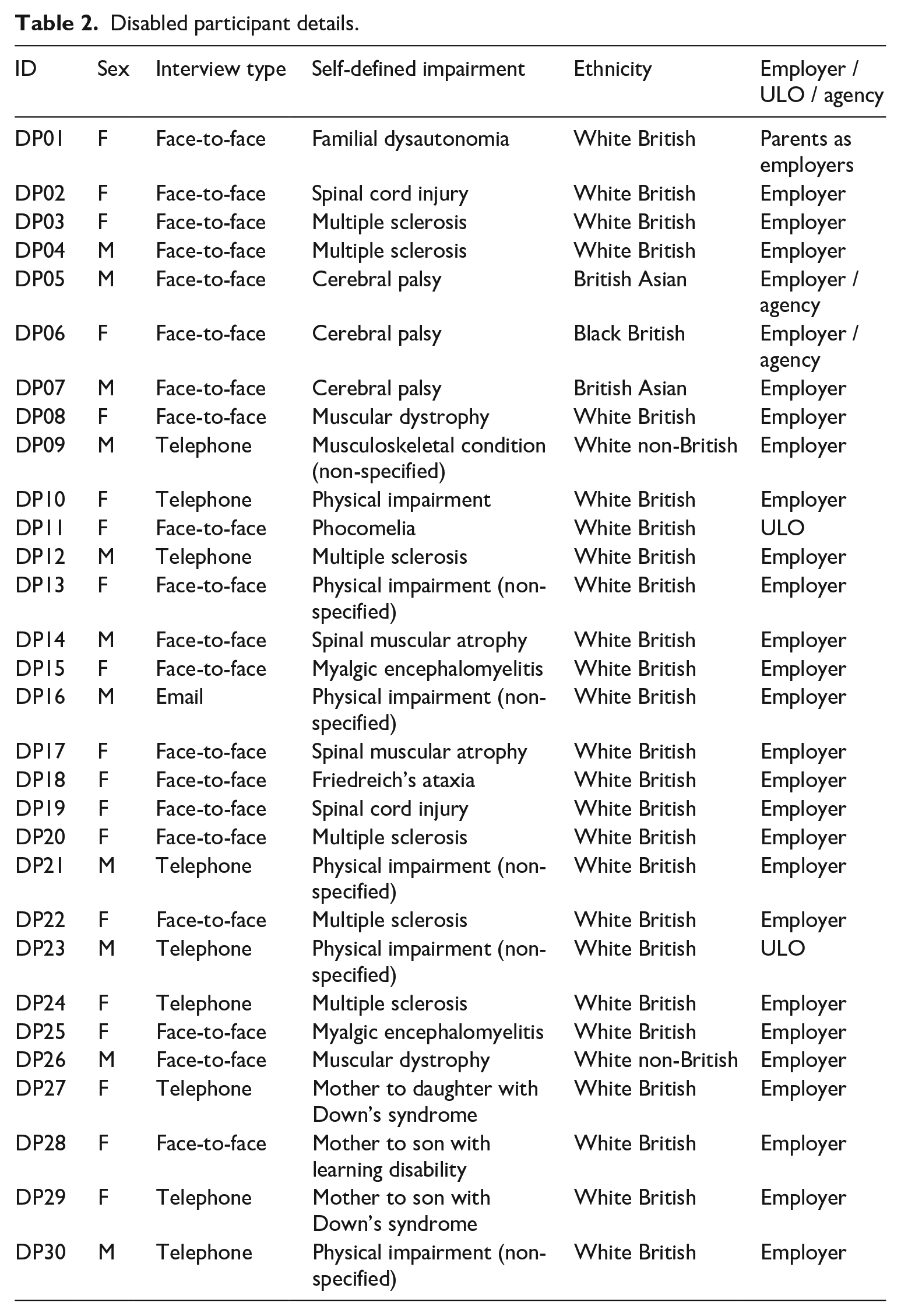
Disabled participant details.
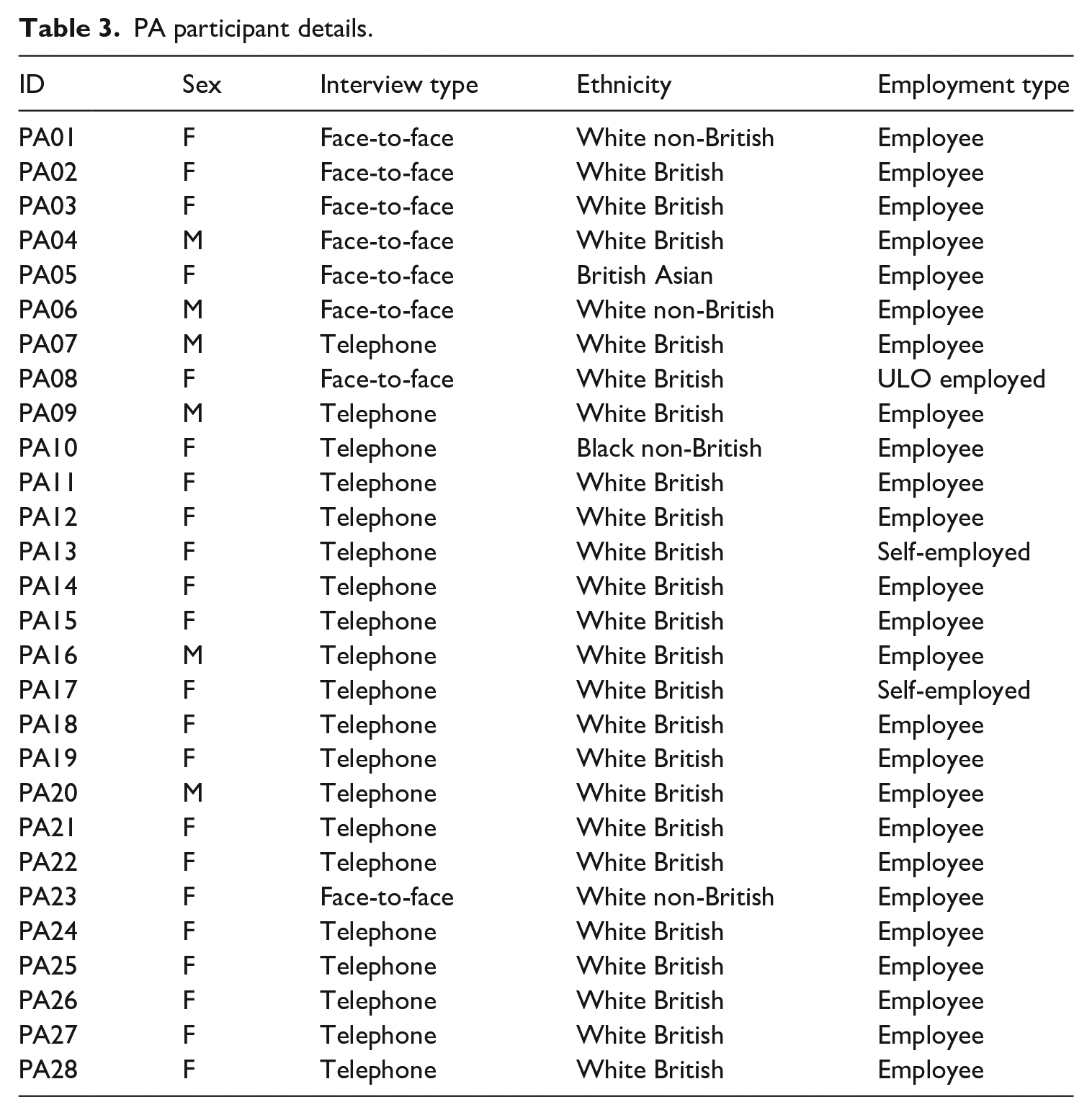
PA participant details.
Both responses here are ‘conflict-resonant’ framings as they promote cycles of remedial action involving ‘managerial responses’ (Emerson, 2011), which aim to test the troubled party’s interpretation of the trouble. If such responses fail, however, the troubled party will begin to see trouble as an indication of deeper, more sinister intentions. When managerial responses are continually frustrated, the other’s integrity begins to be questioned; their actions are seen as malevolent, while their character is revealed as untrustworthy and, ultimately, morally reprehensible. Troubling behaviours are no longer ‘mistakes’, but rather ‘offences’, which summon indignation, anger and even fear. Remedial responses are no longer offered nor pursued, as the troubled party acts punitively towards the offending other, and terminally towards their relationship more broadly.
Following this formulation, this article explores how trouble emerges and the ways trouble comes to be framed in conflict-resonant and deviant-resonant ways. Central to this is an analysis of how disabled employers and PAs manage converging interpretive schemes from social and work domains. This interpretive action reveals the embedded nature of PA work, which in turn helps to explain how this distinctive mode of care work is experienced by both parties.
Study methodology
The data we present are taken from an ESRC funded study into PA relationships, which aimed to gain a deeper understanding of PA relationships, and to explore how disabled people and PAs manage challenges within these relationships. Qualitative semi-structured interviews were employed because the study was concerned with how participants made sense of their experiences (Brinkmann and Kvale, 2015).
Sampling and recruitment
Disabled participants were sampled purposively through ULOs on the basis that they currently managed PAs. Four participants were actively involved in these organisations, and all were recipients of ULO communications. PA informants were recruited initially through ULOs and online forums, and later using snowball sampling. All PA participants were working as PAs at the time of their interview.
Participants recruited through ULOs were contacted by representatives from each ULO, who introduced the study and provided an information sheet and consent form. Participants recruited through snowballing, and those responding to online study adverts, initiated contact with the research team. After making contact with the research team, all participants had the opportunity to ask questions about the study. The researcher ensured that each participant understood what involvement would entail. Informants gave informed consent prior to each interview and researchers reaffirmed this after the interview had finished.
The sample of disabled participants consisted of 19 women and 11 men, including one black British, two white non-British, two British-Asian, and 25 white British participants. The sample included a range of physical impairments, neurological disorders, musculoskeletal conditions and three parents to children with developmental and learning disability. The sample included 25 individual employers; two were simultaneously individual employers who also used self-employed PAs; two managed PAs employed through a ULO; and one participant used PAs employed by her parents.
The sample of PAs consisted of 22 women and six men; including one black non-British, one British Asian, three white non-British and 23 white British. Twenty-five PA participants were directly employed by disabled employers (or guardians), two were self-employed and one was employed by a ULO. Six PAs supported disabled children; the remaining PAs supported adults. The employment status and demographic status of the sample are broadly consistent with estimates of the UK PA workforce (SFC, 2020; Woolham et al., 2019)
Data collection and analysis
Data collection took place between 2015 and 2017 and included participants from England, Wales and Scotland. Three types of interview were offered: face-to-face, telephone and email. Twenty disabled informants took part in face-to-face interviews (all but one of these took place in informants’ own homes, with one taking place in a public space), nine took part in telephone interviews and one opted to take part in an email interview. Twenty PAs took part in telephone interviews and eight in face-to-face interviews.
Telephone interviews mean that the visual features of communication are precluded from data generation; however, telephone interviews also offer distinct benefits including an enhanced sense of participant anonymity, meaning participants often feel comfortable disclosing personal and sensitive information. The richness of interview data, whether generated through face-to-face or telephone interviews, relies primarily on the experience and skill of the interviewer (Trier-Bieniek, 2012). In this study, each member of the research team conducted interviews and all were experienced qualitative researchers at a post-doctoral level.
Interviews followed topic guides, which were tailored to disabled participants and PAs, but mirrored one another: both topic guides explored participants’ experience of PA in a biographical context, with specific questions focusing on recruitment, training, the status of the role, ethical aspects of the role, and comparisons to other forms of care work. Interviews were transcribed verbatim and anonymised. Data storage, administration and analysis were conducted using NVivo, Version 11 (QSR International Pty Ltd).
Constructivist Grounded Theory (Charmaz, 2014) provided a practical procedure for analysis. The first stage of coding was ‘initial coding’ followed by conceptually driven ‘focused coding’. Focused coding involved identifying and expanding the most theoretically significant and frequently occurring initial codes. A final stage of ‘theoretical coding’ analysed categories of codes generated through focused coding. During theoretical coding, Emerson and Messinger’s theory of trouble (1977) was consulted as a means of bringing coherent form and clarity at this conceptual level.
Ethical considerations
The host institution’s Faculty of Medicine and Health Sciences provided ethical approval for the study, and while no particular ethical issues were encountered during data collection, the study design was shaped by two requirements of ethical approval. The first was that the study did not recruit people with learning disability or participants under the age of 18. This is a regrettable omission, and a limitation of this study, because PA relationships involving children or disabled people with intellectual disability are likely to be distinctive. However, there exists significant and high-quality research into these kinds of relationships in the UK context (Williams et al., 2009). Another ethical requirement was that dyadic participants were not recruited, meaning disabled participants and PAs in this study did not work together. This feature of the study’s design was required by the approving ethics committee to maintain privacy and to ensure autonomy.
Findings
Every participant in this study reported trouble in their PA relationships at some point. In the sections that follow, we outline three distinct forms of trouble: practical, personal and proximal. We then illustrate how these relational troubles are framed and subsequently move in either conflict-resonant or deviant-resonant directions (Table 1). In discussion, we consider the implication of these framings for PA as an embedded form of work. Data from disabled participants and PAs are presented in each section, and are labelled DP and PA and numbered sequentially.
Practical trouble
Practical trouble emanates from instrumental processes and outcomes, yet also relates to the relational context of these concerns. Disabled informants and PAs spoke of different practical troubles: disabled people focused primarily on the performance of their workers, and PAs emphasised working conditions and the management style of the person they worked for.
Among disabled informants, many said that practical problems were common when hiring workers with experience of traditional care roles, such as domiciliary or residential care. DP10 said that PAs with this background were less willing to take instruction: ‘They seem to think they know it all already, because they’ve had training’. This informant spoke about a particular PA who struggled to make the transition from care home worker to PA: She was quite challenging to work with. She got very upset because in her experience of working in a care home she was used to having bleach and certain materials locked away in a cupboard, and of course this being a private house, I just had my bleach under the sink not locked away or anything like that. (DP10)
Informant DP06 provided another example, saying that her direct style of management frequently caused disagreements with PAs: ‘In their head, I shouldn’t be telling them what to do; they say, “Well, we’ve been trained”; I say, “I don’t care, you’ve been trained wrong”’ (DP06). In these examples, instrumental tasks act as the locus for trouble involving broader interpretive schemes; between workers, who understand their actions as instrumental tasks, and disabled employers, for whom the actions of PAs directly affect self-determination and the meaning of the home space.
PA informants also spoke of practical problems, with many raising concerns over the appropriateness of tasks. Informant PA01 provided a clear example, saying: I shouldn’t be mending a wheelchair or mending electricity – I don’t have a clue. So, I say to this person, ‘You have to call the electrician, you have to call the doctor, you have to call the gardener’, because it’s something I don’t know how to do. (PA01)
Asked whether she felt able to discuss these misgivings with her employer, PA01 said: ‘No, she will say, “The other PA user does this, so why are you complaining about it?”’. Questioned about how this made her feel, PA01 replied: ‘It’s nasty, you think you are being a bit horrible to them . . . maybe she just thinks I am posh that I don’t want to do this’.
PAs also revealed frustrations over their employer’s management style, or the fact that other people – such as the employer’s partner, parents or children – were involved in their day-to-day supervision. Informant PA06 felt that he was being micro-managed by his adult employer’s mother, a situation he found both unnecessary and dispiriting: ‘At lunchtime, she would call to make sure that I had arranged things on the plate! It’s absurd to me.’ This dynamic prompted ambivalence as PA06 felt at once ‘frustrated’ but also feeling ‘some allegiance with the user [employer] because I was in the middle of the relationships’. These frustrations arise not only from being micro-managed, but also from the micro-politics of his employer’s filial relationship, and his unrealised hope that his employer should act independently of the mother. As with the foregoing examples from disabled employers, these practical problems are not to be understood as singularly instrumental. Trouble originating from an employer’s management style interconnects with the psycho-social dynamics of the employer’s relations and home space and play out in ways that test both parties’ ability to reconcile converging moral schemes informed by the world of work, the home space, and the nascent relationship between the PA and the person they support.
Personal trouble
Personal trouble stems from antagonistic personalities or values. Employers and PAs spoke about personal trouble in broadly similar ways, with both identifying personality clashes and disagreements over antagonistic values. PA work is distinctive not only because it routinely involves intimate tasks, but because the purpose of a PA’s labour is to support the realisation of their employer’s social world. In this context, both parties frequently engage in tasks that require harmonious personalities and value preferences. Personal trouble often occurs when such tasks prompt discordant personalities and values to become visible and to conflict.
In one clear example of conflicting personalities, PA informant PA23 described her frustrations when working for an employer she described as emotionally immature: ‘She is a very intelligent person, but emotionally, as a child’. This informant said that she had been fond of her employer, but explained that their conflicting personalities and lifecourse positions made their working relationship untenable: Because of my knowledge . . . I was mother, twice divorced, I had a company. My experience was much bigger than most women my age. She was like a child, but she was my boss and I was working for her, and that was a very difficult part. (PA23)
Values were also the cause of personal trouble and disabled employers reported clashing with PAs over issues as wide-ranging as religion, culture, social justice and sexuality. The clearest example of this was given by informant DP08, whose use of sex workers led to the breakdown of a PA relationship. DP08 required his PA to drive him to these appointments, and he recalled having agonised over whether or not to disclose the purpose of these visits to his PA. When he did, DP08 described his PA’s response as ‘really angry’ and ‘really upset’. DP08 explained that his PA’s faith had played a role, saying: She was a very strong Catholic and very religious and we had this chat in the car and she said: ‘This is really difficult, I can’t do this’. (DP08)
Their relationship deteriorated as disagreements ‘became personal’; quoting his PA, DP08 said, ‘You use the escorts, so that means you’re a pervert’. The task of sexual facilitation was central to this informant’s self-determination, yet was regarded by his PA as an immoral licentious act. Reflecting on this episode and the response of his PA, DP08 said: ‘That’s part of my life that I have struggled with for many, many years to feel comfortable with . . . and by attacking my values . . . I had to let her go’.
Proximal trouble
Proximal trouble arises from the socio-spatial organisation of PA work, which usually involves working with a single person, often for prolonged periods of time in relatively close confines. PA informants frequently raised issues of interpersonal proximity, and informant PA19 provided a clear example when discussing the breakdown of a former relationship. This informant said that trouble with her employer had not occurred immediately, but rather ‘came over time’, saying: I was spending a lot more time with her, she built in more hours . . . a morning and an evening thing . . . then she added an early morning and late evening. (PA19)
As PA19 spent more time with her employer, her employer grew frustrated at her continual presence and became increasingly critical of her work. This ultimately led PA19 to end their relationship, and when asked whether she attributed her employer’s behaviour to the amount of time they spent together, PA19 said: ‘Yes, I do wonder if I hadn’t have done so much, whether it would have been different’.
Disabled informants also spoke of troubles arising through socio-spatial proximity, with many saying that they preferred to employ multiple PAs rather than working with just one. Informant DP07, who had employed PAs for over a decade, described how his preferred pattern of support had changed: It’s kind of weird, because I have always wanted to have one person; when I was younger it made it easier, but when I got older . . . I found that having one person nine-until-five, every day of the week, it was difficult. (DP07)
This participant likened the interpersonal dynamics of PA relationships to those of marriage, adding: ‘I just find that I can work with someone for two or three days, but after two or three days it becomes difficult . . . on an emotional level’. DP07 preferred to employ four or five PAs, and to arrange his support so that each PA worked a similar number of hours. Reflecting on his experiences, this informant used a spatial metaphor to emphasise the difficulty of working with a single person: You’re with someone all the time, little things . . . something they may forget to do – because people aren’t perfect, we all make mistakes – you have to give space for that to compensate. But when you’re with someone too much, it becomes too much. (DP07)
From normal conflict to normative deviancy
All respondents in this study, both disabled informants and PAs, reported feelings of dissatisfaction or disaffection at some point in time, but the significance and consequences of this trouble varied. At its worst, informants spoke about intractable problems and irreconcilable differences, which resulted in relationships damaged beyond repair. Less significant troubles were more common, and informants spoke frequently of relationships harmed by low-level relational problems. Left unattended, such underlying troubles are likely to deepen as the intentions and character of the offending other come to be questioned. When this happens, trouble shifts from conflict-resonant framings to deviant framings, with concomitant changes in the troubled party’s response, their emotions and their interactional stance towards the other (see Table 1).
Conflict-resonant framings predominantly occur in response to low-level dissatisfaction, often concerning practical problems rather than personal issues. Many disabled informants spoke of PA relationships in these terms and criticised aspects of their PA’s performance, without actually confronting their PA because, on balance, their needs were being met or because mutual affinity encouraged managerial responses. In this sense, the social relationship between both parties mediates the interpretation of instrumental action. DP26 provided a clear example as he expressed mild annoyance when describing his PA’s performance, saying: ‘He’s a bit lazy, not in the personal task stuff but in other stuff. If I say, “Can we fix this?”, he’ll say, “Maybe we can do it tomorrow”’. Later in his interview this informant reiterated these issues, but attributed this trouble to permissible, rather than malevolent, character traits of a PA he liked and admired; ‘he’s a procrastinator, in a way, but it’s never bothered me too much because as long as he does his main job’.
Other disabled informants reported instances of PAs curtailing their autonomy, and while all found this infuriating, most framed this trouble in conflict-resonant ways and pursued managerial responses. Informant DP07 provided a clear example, and detailed a cinema trip with his PA: A PA of mine said, ‘Can we go to the cinema?’, and I said, ‘We can either watch 50 Shades of Grey or we can watch Birdman’ and she went, ‘Oh, I’m not watching 50 Shades of Grey’. (DP07)
This informant accepted his PA’s preference, but he soon began to question this decision: ‘the next day and a few days after I sat there and thought “should I be letting my PA dictate and choose what I watch?”’. In his interpretation of this encounter, this informant reveals competing moral schemes associated with PA work. As a formal care role, PAs should not impinge upon the choice and control of the disabled person they work for, yet taking account of his PA’s preferences comes naturally to DP07 in a relationship he labelled as ‘friendly’. Reflecting on his response, DP07 stated clearly that his managerial response was intended to avoid overt conflict: I should have said ‘I am going to watch this film, we’re going to watch this’ . . . [but] I can’t do that. I don’t have the balls to do it. I would feel really uncomfortable. (DP07)
Typical of preliminary managerial responses, trouble is defined as bothersome rather than offensive, and DP07 attributes self-blame rather than criticising his PA. Yet what is also clear, is that the underlying dissonance between competing moral imperatives is unresolved; DP07 comes to resent this managerial exchange, and the relationship is harmed by ongoing trouble.
Trouble moves towards deviant-resonant framings when managerial responses fail or where trouble is perceived to result from an essential moral failing of the other (Table 1). At the core of most deviant framings are concerns over safety and trust, which when breached, are near impossible to recover. This observation highlights a key aspect of the embedded nature of PA work, as disabled people are typically required to share private information and personal spaces, with reciprocal admissions often granted by their PAs. Far from precluding trouble, however, the trust required for such admissions leaves both parties open to malevolent action. DP19 gave a clear example as she described the breakdown of a PA relationship following the deceitful actions of her PA: ‘She turned out to be absolutely awful, she stole from me and my children, told lies, and, in the end, we had to get the police involved’. Informant DP17 provided another example and spoke of a former PA’s manipulative behaviour: I actually got a recording of her . . . just being the nastiest person I ever heard in my life, completely fabricating things and saying that I was embezzling money. (DP17)
Upon hearing this recording, DP17 dismissed her PA immediately and explained that this experience had been ‘very, very intimidating’. Her abiding framing of this PA is as a morally deficient and malevolently motivated, deviant individual.
PA informants also spoke of the breakdown of PA relationships using deviant framings, and while less common than those reported by disabled informants, these accounts vividly illustrate the embedded nature of PA work, marked by socially derived interpretive schemes. PA informant PA18 spoke about one such dispute with a long-standing employer, saying: ‘I met this person when I was about 25, I was a PA for her when she was a parent when I was about late-30s’. This informant explained that their relationship involved deep mutual affection, adding that she had played a central role in helping her employer to raise a son: ‘I had enabled her to have a proper bond, I saw that as my role . . . to cement that bond and that connection in a positive way’. However, PA18 proceeded to recount a disagreement that followed her employer’s decision to employ PA18’s former partner, despite knowing theirs had been a deeply acrimonious relationship. Reflecting on this episode and the significance of her employer’s actions, PA18 said: She went and employed my ex, and it really annoyed me [. . .] I found it very difficult . . . it was a bit like she chose him over me. Even though I had given her years of utter devotion and exceptional, exceptional PA support. (PA18)
Feeling betrayed, PA18 was unable to continue working with her employer and their relationship deteriorated beyond repair. This perspicuous case illustrates the potential for PA work to become embedded within personal and social networks, with lives closely interwoven. When trouble occurs in these circumstances, the potential for socially informed deviant framings increases, and the ensuing emotional harm is likely to be felt more deeply, and more enduringly, than would be the case between more atomised economic actors.
Discussion
Empowering disabled people to take charge of their support arrangements enables them to control how, when and by whom they are supported. In this sense, PA can be revolutionary, emancipatory and is a principal tool of independent living (Morris, 1997). But trouble is ubiquitous in PA relationships, and so trouble must be understood if disabled employers and their workers are to attain sustainable and mutually rewarding working arrangements. Our analysis of trouble in PA relationships illustrates the embedded nature of this work, while the concept of embeddedness helps to explain the often divergent interpretations of trouble experienced by both parties.
This article identifies three forms of trouble emanating from practical, personal and proximal beginnings. Practical trouble primarily concerns instrumental processes and outcomes; personal trouble stems from antagonistic personalities or values; while proximal trouble speaks to the socio-spatial organisation of PA work. This typology is a heuristic aid, but as data in this article have shown, the boundary between instrumental and social action is porous. In PA, the home space of one party becomes another’s workplace; everyday tasks involve social and bodily intimacy; and typical working arrangements mean that both parties spend prolonged periods of time in one another’s company, often disclosing deeply personal information about one another’s lives. PA subverts normative workplace boundaries and means that the ensuing relationships frequently resemble informal social ties, with both parties describing their working relationships as akin to friendship, and even family members (Shakespeare et al., 2018). For these reasons, we argue that PA represents an embedded form of work, marked by converging interpretive schemes derived from the world of work and also concrete social relations. The consequence of embeddedness is that social relations mediate the meaning of instrumental action, and correspondingly, that social relations are themselves mediated by instrumental reason.
The embedded nature of PA work also means that disabled employers and PAs often hold divergent expectations of one another, as PA lacks a clear ‘social script’ apparent in traditional care work (Ungerson, 1999). Disabled employers may prefer PA relationships that resemble friendship, while PAs may desire work relations more akin to typically demarcated care roles. Alternatively, the opposite scenario is possible, and employers who prioritise performance over conviviality may encounter trouble when working with PAs who prefer relaxed working practices. Our data show that practical trouble may often be less problematic when both parties share mutuality and affinity. In cases such as this, the transgression of expected norms around performance and working practices may be permitted in ways that would not be possible were both parties relative strangers. PA relationships may also come to resemble social ties to such an extent that they are marked indelibly by expectations and obligations derived from social and familial analogues; here the potential for profoundly rewarding working relationships grows, but so too does the risk of deeply damaging personal disputes. As anticipated by Granovetter (1985), far from precluding trouble, the trust engendered within embedded economic ties gives rise to greater opportunity for malevolence, and means that any ensuing harm is felt more deeply, and for a longer period, than would be the case in more clearly demarcated roles (Granovetter, 1985).
In the UK, disabled people and PAs are free to organise their working arrangements with few formal restrictions. Indeed, participants in this study expressed preferences for a diverse range of working arrangements. This variation speaks to an inherent indeterminacy within embedded work, and, in PA, moral cues depend on a range of contextual factors including individual support needs, social and economic circumstances, experience of parallel care roles, and each individual’s awareness of independent living as a philosophical and civil rights standpoint. This indeterminacy also means that practice solutions, such as training, must be flexible enough to accommodate difference, and should enable disabled people and PAs to reflect upon their preferred modes of working, while supporting them to understand the implications of these choices. The PA and care literature suggest strategies that might inform practice. Personal and practical trouble may be minimised by more exacting selection of suitable staff. It is clearly preferable to match PA users with suitable PAs: this, if based on ‘mutual interests and expectations’ (Guldvik, 2003) will likely limit clashes over values and personalities. A probationary period is also sensible to ensure that practical arrangements and performance are agreeable to both parties. Issues over proximal conflict appear mitigated by employing several different PAs, rather than relying on a single employee. However, such strategies assume a choice of workers, which will not be possible when local labour markets fail to provide sufficient choice (Grossman et al., 2007; Ungerson, 1999). Another suggestion is for disabled employers and PAs to have access to training about this unique form of support relationship: such training could include problem-solving and conflict resolution, and managing the emotion work inherent to the role (Matsuda et al., 2005). Others emphasise the benefits of ‘perceptive awareness’, meaning each party needs to be able to enter into one another’s role, thus achieving greater empathy and understanding (Ahlström and Wadensten, 2011). At the heart of this, is respect for difference: both employer and worker need to respect one another, and be willing to accommodate some degree of difference, be that personality, values, or preferred modes of practice. This ideal is sometimes easier to describe than to achieve, but the aforementioned strategies of vetting and probationary periods should limit incompatible pairings.
This study’s sample consisted predominantly of disabled people who were individual employers and PAs who were employees. However, other models of PA exist where the disabled person uses self-employed PAs, or manages PAs employed through a third-party agency. This study included a small number of participants from these latter categories, but it was not possible to draw conclusions about whether these alternate arrangements affect the relational aspects of the role. The experience of self-employed PAs appeared similar to directly employed PAs: long-standing working relations with a single disabled person, exerting limited control over their working times, and following close instruction in their everyday routines. In this sense, future research should consider if such roles represent a genuine form of self-employment (Behling and Harvey, 2015), or whether they contribute to a more diverse understanding of what self-employment means in a changing landscape of care work. For disabled people it is conceivable that managing PAs employed by a third party will affect relational aspects of the role. If facilitated by a ULO and informed by a philosophy of independent living, such arrangements may lead to more embedded PA work given that employer duties are undertaken by the third party. If the third party employing PAs is a traditional care provider, without a genuine commitment to independent living, then the PA relationship will likely resemble paternalistic models of care, in which the disabled person lacks genuine choice and control. There are some indications that the latter of these employment arrangements are becoming increasingly common in the UK (Woolham et al., 2019), and future research must consider the implications this has for PA as a distinct form of care work.
Finally, this article has demonstrated the ubiquity of trouble and has shown how trouble unfolds in conflict-resonant or deviant-resonant ways. Maximising conflict-resonant framings relies, in part, on both parties understanding their relational preferences and being able to communicate and negotiate these choices effectively. In the UK, the lack of support for disabled employers and PAs in this area is striking; where employer support is available (such as training or payroll services), this usually involves a cost to the disabled person. Formal support for PAs is yet more inconsistent, and again, access is typically contingent upon the disabled person meeting any costs (Woolham et al., 2019). A small number of disabled people in this study said that meeting the interpersonal demands of PA were simply too onerous, and, as a result, stated their preference for agency-provided care. This is deeply regrettable if such choices stem from a paucity of support, rather than an authentic expression of choice and control. It also underscores the fact that managing the convergence between one’s social world and the world of work often entails complex and unrecognised work. Support for disabled people and PAs must therefore be acknowledged, transparently costed and appropriately funded by state care settlements if the right to independent living is to become an equitable reality for all.
Footnotes
Acknowledgements
The study team would like to thank all research participants for being so generous with their time. The first author would also like to thank both co-authors and WES editors for their patience and support during a very challenging academic year.
Funding
The authors disclosed receipt of the following financial support for the research, authorship, and/or publication of this article: the data presented in this study were generated as part of an ESRC project grant.