




Abstract
Debates about gentrification continue to occupy a significant part of research investigating social change within urban communities. While most gentrification studies have focused on ‘incoming’ groups or those forced to leave, there is limited knowledge about those remaining in neighbourhoods undergoing community change. This study explores the experiences of older residents who have lived much of their adult lives in the same locality but whose views have been largely ignored in gentrification research. The article presents findings from seven focus groups (N = 58 participants) and 30 in-depth interviews with people aged 60 and over living in Chorlton, a gentrifying neighbourhood in Manchester, UK. These highlight both daily challenges and exclusionary pressures, as well as how people are active in creating a sense of belonging in a neighbourhood undergoing social change. The article concludes by discussing the need for interventions which promote the ‘age-friendliness’ of communities and ensure that older people have a space to be seen and heard in their neighbourhood.
Introduction
Debates around the causes and consequences of gentrification continue to occupy a significant part of research investigating social change within urban communities. The topics covered include: studies of the range of actors and institutions involved in the gentrification process (Lees et al., 2010; Paton, 2014); evidence for displacement from gentrifying neighbourhoods (Freeman et al., 2016); strategies of resistance (Lees et al., 2018); the role of cultural, social and economic capital (Butler and Robson, 2001); and variations in gentrification across different types of urban areas (Brown-Saracino, 2017). Research has also linked gentrification to broader patterns of urban change, notably increased segregation within cities, and the impact of changing patterns of work and consumption (Hall and Burdett, 2017).
Much of the research on gentrifying neighbourhoods has focused either on the lifestyles of ‘incoming’ social groups or on those forced to leave (Brown-Saracino, 2017). However, Lewis (2017: 1325) argues that limited attention has been given to understanding the ‘views of those who remain living in sites of urban change’ (see also Jeffery, 2018). This is especially the case with older people who may have spent much of their adult lives living in the same locality but whose experiences have been largely ignored in the gentrification literature (Lees et al., 2010). Although attention has been given to the experience of ageing in neighbourhoods characterised by ‘multiple deprivation’ (Scharf et al., 2005), the potential impact of gentrification is less well understood (Burns et al., 2012; Greenfield et al., 2018). Smith et al. (2018: 28) suggest that because of the lack of research on those who continue to live in gentrifying neighbourhoods: it remains unclear whether they are advantaged or disadvantaged compared to those living in low-income or affluent areas. Even less is known about economically vulnerable older adults who may be stuck in place. Although gentrification could bring new investment and services that improve health, it may also negatively affect health via skyrocketing housing costs, loss of informal supports, or the threat of eviction.
Research on the impact of gentrification suggests that, especially if homeowners, older people are most likely to remain in gentrifying neighbourhoods (Freeman et al., 2016). Indeed, they may be among the ‘beneficiaries’ with rising house prices and improvements in infrastructure such as transport and shopping (Pearsall, 2012). However, they may also experience social exclusion resulting from limited financial resources and alienation from new groups moving into the community (Burns et al., 2012; Scharf et al., 2005).
Understanding the range of experiences associated with gentrification has become especially important given the emphasis in public policy on what has been termed ‘ageing in place’, defined as helping people to remain ‘living in the same community, with some level of independence, rather than in residential care’ (Davey et al., 2004: 133). The development of this policy raises questions about whether the types of changes associated with gentrification create barriers for people wishing to remain in their own homes. This is considered in this article through, first, examining the research literature on older people’s attachments to their neighbourhood, linking this to debates around gentrification; second, a qualitative study of a gentrifying community in Manchester, UK; and, third, a discussion of the relevance of the findings for understanding the impact of social change on older people living in urban communities.
Gentrification and ‘Place Attachment’
This article explores the experiences of older people living in an urban neighbourhood undergoing residential and commercial gentrification. An important question concerns the extent to which the changes associated with gentrification – new retail outlets, increases in housing costs and alterations to public spaces – may alter the sense of ‘attachment’ or ‘belonging’ which individuals have developed over their life course. May (2013: 78) cites Miller’s definition of belonging as a: ‘sense of accord with who we are in-ourselves’ and ‘a sense of accord with the various physical and social contexts in which our lives are lived out’. May (2013: 83) argues that: If belonging is what connects us to the surrounding world, it stands to reason that the world must allow this connection to take place in order for this sense of belonging to be sustainable. Thus ‘belonging’ entails more than identifying with a particular group – it means being accepted by others as an integral part of a community or society.
Rowles (1983) suggests people who have resided in the same community for a long period of time maintain different types of attachment. These he frames using the concept of ‘insideness’, identifying three complementary dimensions: physical insideness, reflecting ‘body awareness’, an intimate familiarity with the physical configuration of the environment; social insideness, arising from integration with the social fabric of the community; and autobiographical insideness, reflecting the way in which lifelong accumulation of experiences in a place can provide a ‘sense of identity’ (1983: 302–307). Developing this approach, Rowles and Watkins (2003) suggest that the making of spaces into places is a skill that evolves over the life course, and if unhindered by (environmental or personal) change, may allow individuals, over time, to experience a sense of ‘being-in-place’.
Gentrification, defined as a process where new residents of a neighbourhood are drawn from a higher social status than current or previous ones, might have the potential to undermine forms of place attachment. Such a possibility is suggested by Savage et al. (2005) with their concept of ‘elective belonging’. This idea refers to the way in which the ‘place biographies’ of particular localities have become less important for some groups, as compared with their own personal biographies and identities. Increasingly, it is argued, people are making conscious choices about where they want to live and the lifestyles they wish to live by. In relation to gentrification, a key issue concerns both the impact of the financial resources of the ‘incomers’ as well as the influence of the routines and activities which they bring to a community, and the forms of social and cultural capital which these represent.
Butler (2007: 175) makes the point that in Savage et al.’s study: it is those who exercise choice to move, ‘the incomers’, who are more socially integrated and at ease with their localities which become their habitus of choice – than the ‘born and bred’ who often remain there precisely because of their lack of choice.
Indeed, Savage et al. (2005: 51) refer to the fact that in two of their study areas: ‘there was a pervasive sense for locals that immobility was a mark of failure’. The authors comment in relation to one of their ‘gentrifying’ localities (the neighbourhood studied for this article) that: ‘there is no sense of a past, historic, community that has moral rights on the area: rather, the older working-class residents, where they are seen at all, are seen mainly as residues’ (2005: 332). But the issue is almost certainly one of age and social class, with many older working-class residents lacking the resources to match the lifestyles of younger middle-class professionals (Phillipson, 2007). For older people, then, it may be that ‘stuck in place’ (Smith et al., 2018) is a better descriptor than ‘ageing in place’, with the absence of alternatives forcing people to remain despite threats posed by changes to their neighbourhood (Smith et al., 2018).
However, the question remains whether gentrifying neighbourhoods produce mostly disadvantages for older people, leading to various forms of ‘exclusion’ (Burns et al., 2012; Scharf et al., 2005); or whether the incoming ‘elected’ groups may also confer advantages for existing members of the community. On the latter, Freeman et al. (2016: 2811) make the point that: In societies where so much of what makes a neighbourhood desirable (e.g. low crime, good schools, shopping choices) is commonly commodified or based on one’s ability to pay, people may be more likely to want to ‘stay put’ in neighbourhoods where the socioeconomic status and concomitant desirability is increasing.
This may be especially the case with older people, who may view the positive benefits of improvements to the neighbourhood as outweighing the negatives associated with the moving in of new social groups. Moreover, while gentrification has the potential to exclude, forms of adaptation or even resistance may also develop (Lees et al., 2010). Older people, as long-term residents, are an important group to consider in understanding the range of possible responses to gentrification.
To examine experiences of gentrification among older people, this article draws on a study which included the Manchester neighbourhood of Chorlton, the subject of previous research by Savage et al. (2005) and Ward et al. (2010). The next section discusses the methodology of the research, focusing on the training of older people as co-researchers; the demographic and social characteristics of the neighbourhood; and details of the sample of older people interviewed.
The Study
The research in this article derives from a study which aimed to train older people as co-researchers in developing ‘age-friendly communities’ (Buffel, 2018a, 2018b). These are defined as ‘inclusive and accessible urban environments that promote active ageing’ by adapting structures and services to accommodate the varying needs and capacities of older people (World Health Organization, 2002: 1). The study built upon a community–academic partnership strategy 1 for researching and working with older people in inner-city neighbourhoods in Manchester (UK), aimed at improving the city’s ‘age-friendliness’ (McGarry, 2018). The research was conducted in three neighbourhoods, selected for diversity regarding social characteristics, patterns of deprivation and ethnic composition. This article discusses findings based upon data collected among older residents of Chorlton, a suburb of Manchester.
Chorlton is an area of urban gentrification, located four miles to the south of the centre of Manchester. In the 1960s, the area had been relatively poor, with a predominantly working-class population but subsequent decades have brought a steady influx of white-collar workers, living alongside long-term residents. Chorlton’s population grew by 26% over the census years 2001 and 2011 (compared with a Manchester average of 19%). Much of this was drawn from an influx of younger people (median age of the ward in 2011 was 33 years) from elsewhere in the UK. In line with the City as a whole, people 65 and over are a demographic minority, representing 9.6% of the population. Those who have moved into the area have been described as having ‘cultural capital and moderate amounts of economic capital’ (Savage et al., 2005: 207), reflecting a higher than average population in terms of educational attainment and a higher proportion in ‘higher managerial’ occupations (i.e. 22.6% in comparison to the Manchester average of 8.6%) (2011 Census).
Average property prices in Chorlton increased from £100,461 in 2001 to £311,305 in 2018. Reflecting the buoyancy of Chorlton’s housing market has been the change in land uses, with care homes, garages and small independent hotels being converted into or replaced by new apartments or houses (Ward et al., 2010). Other visible signs of gentrification in Chorlton include an increasing number of wine bars, coffee shops, vegetarian cafes and specialist boutiques, these representing ‘new consumption spaces’ (Zukin, 2009: 47) for incomers pursuing a ‘creative cultural’ lifestyle.
Research Design
The project used a participatory action research (PAR) framework (Kindon et al., 2007), centred around three principles: participation; collaboration; and community action. A ‘co-research’ approach was adopted to allow older people’s active participation as partners in the research process (Buffel, 2018a, 2018b). Older people took a leading role both in developing and implementing the study as well as translating findings into policy recommendations and action. This approach was selected for three reasons: first, it presented an effective means of accessing and incorporating the views of marginalised groups into the process of knowledge production (Ward and Barnes, 2016); second, it ‘helps ensure that the topic under investigation matters locally’ and increases the relevance of findings to the end-users of research (Blair and Minkler, 2009: 651); and third, it promotes the empowerment of older people to bring about neighbourhood changes and contribute to the quality of services relevant to their needs (De Donder et al., 2013).
Eighteen people (10 females and eight males), aged between 58 and 74 years, were recruited and trained as co-researchers who collaborated on the development of the research design. Co-researchers were drawn from a range of networks, voluntary organisations and community groups, using a variation sampling strategy to reflect the social diversity of the research areas. Strategies which enhanced the recruitment of co-researchers included: the building of trust and rapport with potential participants; promoting awareness about the project in the broader community; and developing relationships with a variety of community groups and gatekeepers. Co-researchers were heterogeneous in terms of age, gender and ethnicity, and the majority had been involved in professional/semi-professional roles during their working lives.
All co-researchers participated in several training workshops and reflection meetings, these addressing relevant stages of the research cycle, from designing research objectives to collecting and analysing data and disseminating findings. The format of the workshops was adapted to suit the participants and to facilitate interaction, practice and reflective conversation. The study received ethical approval through the University of Manchester, with the development of strategies to minimise or mitigate risks to participants forming a key theme in the training workshops with co-researchers. Previous articles have focused on the methodological approach of the project in more detail (Buffel, 2018b), and on the benefits and challenges associated with the peer-research approach (Buffel, 2018a).
In Chorlton, the group of co-researchers first assisted the research team with organising and facilitating focus groups, and then conducted individual interviews with older residents (aged 60 and above). In total, seven focus groups with older residents of Chorlton (N = 58) (see Table 1) were conducted. These took place in community centres and local meeting places (Buffel, 2015). Participants were recruited through a local history group, a community-based care group and a range of community organisations and networks. The aim of the focus groups was to identify key themes in terms of the contextual constraints and opportunities for older people ageing in place, which could then be explored in more depth in the individual life histories during the individual interviews.
Focus group and individual interviews with older residents: demographic and social characteristics.
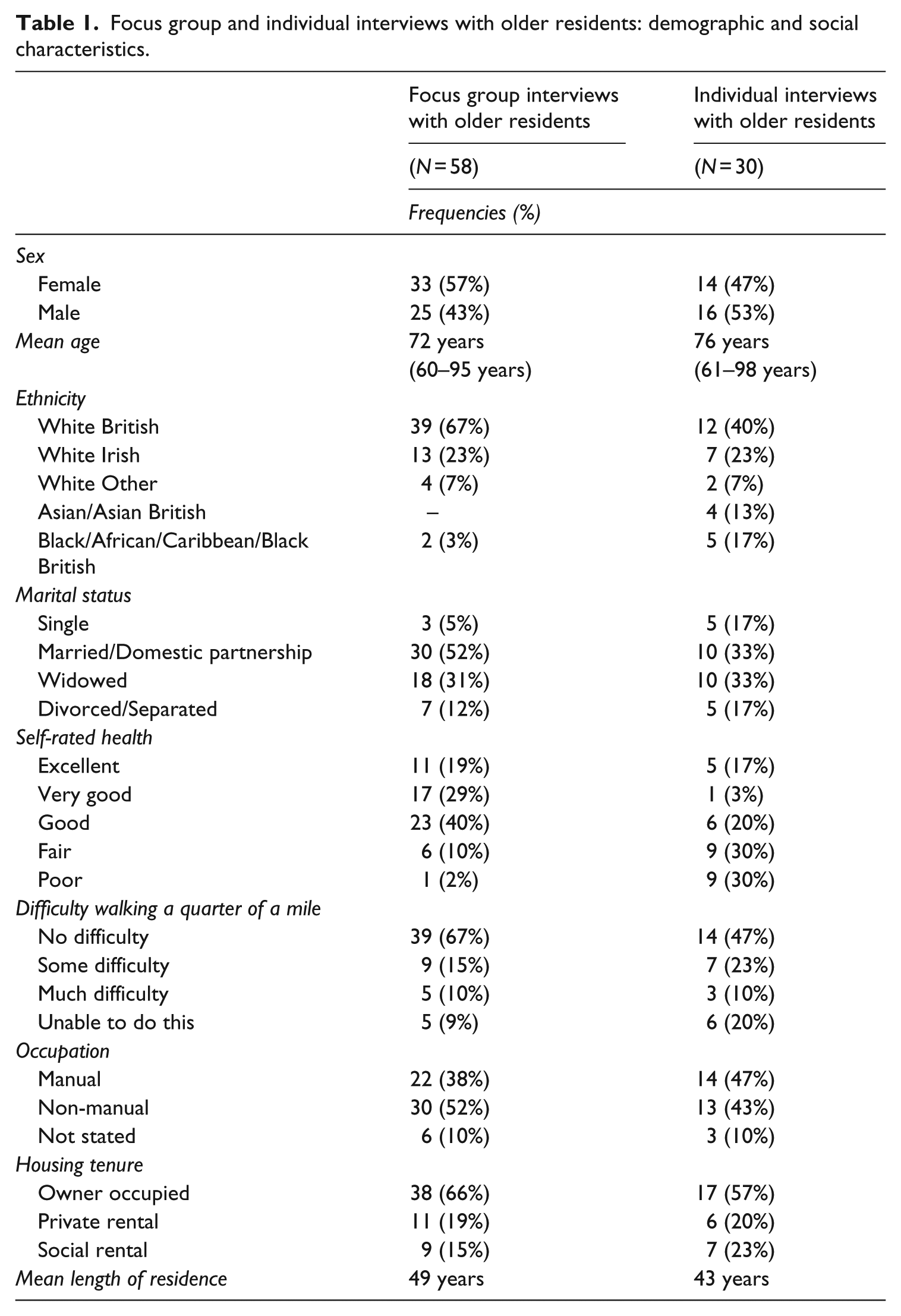
The co-researchers completed 30 individual interviews with residents of Chorlton aged 60 and above. Participants were purposively selected to reflect the different age, social and ethnic composition of the research area, but with a focus on those experiencing social exclusion and isolation. This sampling strategy sought to target a heterogeneous group including older people who were not active in the community, those with limited social relationships and those facing health or mobility problems. Table 1 shows that in comparison to the focus groups’ participants, the sample of the individual interviews was older (average age of 76 versus 72 years) and more ethnically diverse (30% versus 3% ethnic elders). It also included proportionally more single, widowed and divorced older people (67% versus 48%); people rating their health as fair or poor (60% versus 12%); those experiencing difficulty or unable to walk a quarter of a mile (53% versus 34%); and people renting (as opposed to owning) their homes (43% versus 34%).
The interviews focused on the conditions for ageing well in the neighbourhood and developing the ‘age-friendliness’ of the area. Co-researchers used a semi-structured interview guide developed during the training workshops, addressing themes such as experiences of living in the area and whether these had changed over time; views about the physical environment including transportation, public space and housing; and perceptions of community life and neighbourhood relationships.
All interviews were audio-recorded, transcribed verbatim and analysed using a combination of thematic and content analysis. Co-researchers were involved in several data analysis sessions, with a first step involving the reading and re-reading of transcripts (Buffel, 2018a, 2018b). The second step of the analysis entailed the coding of interviews based on themes that were derived from the conceptual framework as well as directly from the interview data. This resulted in a coding framework which was used for the analysis of data presented in this article, with the first author taking the lead in conducting further analysis of the transcripts using the software package ATLAS.ti. Once the interviews were coded, the interrelations between themes were explored, with the next step involving the clustering of codes into key themes reported in the Findings section. The authors jointly re-read the interview data to refine and verify overall themes, with the selection of quotes subject to review by the co-researchers.
Findings
The evidence from this article suggests that pressures from gentrification illustrate both forms of exclusion facing older people, as well as the way they strive to create a sense of home and belonging in an urban neighbourhood experiencing social change. These aspects are grouped under two main themes which emerged from the focus groups and interviews: experiences of community change and strategies of control.
Experiences of Community Change
The interviews were carried out in a community which had changed from an upper working-class/lower middle-class neighbourhood, to one dominated by public-sector professionals together with a sizeable number of new media professionals (Ward et al., 2010). Although the intention of the study was to focus on how the community could be made more ‘age-friendly’, most participants preferred to talk about developments currently affecting their neighbourhood. Opinions varied from expressions of unease – reflected in comments about the ‘invasion’ of ‘yuppies’ or ‘snobs’ – to statements expressing tolerance and even a ‘cosmopolitan mentality’ among others. Narratives about potential tensions between so-called ‘born and bred’ Mancunians and those moving into the area, indicated how community change contributed to experiences of rejection or exclusion from the locality among some of the interviewees. This was especially significant given the length of time participants had lived in the neighbourhood – 49 years on average for focus group participants and 43 years for individual interviewees. A 62-year-old working-class man who had lived in Chorlton since the mid-1970s commented on the impact of population change: There’s the young kind of middle-class professional group of people that are artistic and creative … and they like all the trendy bars and restaurants. And then you’ve got the kind of born and bred Mancs who have lived here all their lives, and then suddenly everything is changing with all these yuppies, and I suppose that creates a kind of conflict between the new population and the old. Chorlton seems to be focused much more on young professionals … and I suppose older people feel a bit left behind and priced out.
Some respondents expressed the view that the ‘close-knit relationships’ that once characterised Chorlton had been lost. Others commented on the moving away of family and friends leading to fewer people of a similar background to themselves. Developing relationships with those termed as ‘incomers’ was seen as difficult due to contrasting lifestyles. The impact of population change on feelings of exclusion from local social relationships was reflected in the following comments: I’ve fallen out of love with Chorlton because the community isn’t the same [as it used to be]. Where I live, it was residential at first, but now it’s student accommodation and professional people that won’t be here too long. There isn’t that spirit of friendliness anymore. You see people, but they might just say a quick ‘hello’ but then they’re … dashing off. (65-year-old woman, Black British, former accountant, 32 years resident in the neighbourhood)
In some cases, feelings of exclusion were reinforced through a context where patterns of home ownership were changing, with the conversion of what had been large multi-tenanted housing into flats. This had caused a gradual drift from the area of people on lower incomes unable to afford the increases in house prices and rents. Although the majority of older people interviewed were home owners, the likely increase in value of their own properties did not feature in the interviews. Instead, the focus of concern was much more on how rising house prices meant that their own (grand)children were unable to live in the local area: Like my kids, they can’t afford a house in Chorlton. The house prices around here have been pushed up to unrealistic figures, so my two sons moved out and live in other parts of Greater Manchester. That’s what’s happened, the younger generation has dispersed, and it’s become property for professional people. (69-year-old male home owner, former transport manager, retired early because of health issues, 69 years resident)
References to a ‘loss of togetherness’ (Blokland, 2003) figured prominently in the narratives of those single and widowed, many of whom expressed difficulties in maintaining relationships in their neighbourhood. Those participants who were reliant upon their immediate environment for contacts but did not have family or friends close by, were especially likely to express nostalgia for a ‘lost community’. This was evident, for example, in the case of an 84-year-old woman, a former dinner lady who had lived in the centre of Chorlton for 59 years, when she talked about population changes in the context of her own fears about becoming isolated: I see a lot of changes. When I came here first, you had good shops … and there was a sense you might meet somebody … Now that’s gone. There doesn’t seem to be any cohesiveness. They’re all separate groups, more concerned with your professional or business background. They work and haven’t got the time … I live alone, so I presume I’m concerned with isolation and getting older and not being able to get out as much … But the whole planning of the community is not focused on people of our age.
This comment illustrates how older people’s feelings about the past often reflected a sense of exclusion from the present, especially when they experience community redevelopment as something beyond their control (Buffel et al., 2013). However, the analysis suggested that nostalgic feelings should not be interpreted solely as ‘passive forms of reminiscence’ (Lewis, 2016: 13). Indeed, as Bonnett and Alexander (2013) argue, fond memories of the past and a sense of loss also shape and sustain people’s engagement with, and attachment to, their neighbourhood. This was reflected in the above comment through concerns about the lack of ‘age-friendly’ community planning. It was also evident among people who, despite adverse comments about the ‘loss of community’, expressed a strong identification with their neighbourhood: ‘It’s not the old Chorlton anymore but it’s still Chorlton and I consider myself to be a Chorltonian anyway, I’m proud of where I live’ (69-year-old man, white Irish, retired warehouse manager, 42 years resident).
Although the disadvantages of changing patterns of home ownership were often stressed, the advantages of new groups moving into the area were also highlighted. For example, some people mentioned the positive contribution of new residents bringing fresh ideas to contribute to changes in the neighbourhood which were of potential benefit to all age groups: We are going through a demographic change in Chorlton and some of the new ideas will come, I think, from the people moving in. Sometimes when you’ve lived here, you grow up with it, you accept things and can’t see what needs to change. (68-year-old man, white British, former clerical worker, 59 years resident)
Some of the older interviewees reported direct benefits from new social groups coming into the area. An 84-year-old woman, who had been volunteering in a local care group for most of her adult life, talked about how she now benefitted from support from ‘young professionals’: This is something that is a bit new in Chorlton Good Neighbours [a local care group] … we have quite a lot of young professionals helping as volunteers. Now there is a girl called Emily and believe it or not, she is a journalist for [a national newspaper]. We have quite a few young professionals here now. That’s the way it has changed. I’ve always been a volunteer, but now I’m on the other end, I get help, which is nice. (84-year-old single woman, white British, retired teacher, 48 years resident)
Responses to Gentrification: Strategies of Control
Although the findings indicated exclusionary pressures resulting from gentrification, control strategies were also identified. Here, the study demonstrated the role of what Gardner (2011: 263) terms ‘natural neighbourhood networks’; that is, the web of informal relationships that enhance well-being and shape the everyday social world of older adults ageing in place. Relationships with neighbours played an important part in such networks and were often described as reciprocal and mutually supportive. A 73-year-old widow, a former shop assistant who suffered from poor health, had formed close relationships with a family living in her street: The lady across the road – she and her husband, they both work, so I help out and take their dog out for a walk on Mondays and Fridays, and they look out for me, you know: they take me to the hospital; they check on me when I’m poorly; they ask me if I want anything from the shop … and when I make jam, I always give them a jar … So yes, we do a lot for each other.
A further strategy was to contribute to developing collective responses to issues of community safety, embracing activities ranging from collective litter picks to supporting informal social control through Neighbourhood Watch schemes and resident committees. A 98-year-old widow who had retired from a career in caring for older people moved into sheltered housing a few years prior to the interview because of her declining health. She described how she contributed to setting up an informal ‘social club’ for people living in her building. She highlighted the importance of re-creating a sense of community when ageing-related constraints prevent people from engaging with the wider environment: When you get older and you aren’t able to walk to places it is best to be in a community. So we’ve set up what we call the ‘five o’clock club’. It’s like a social club. We started with just two of us, then three of us … and now we have six coming. So we’re getting a community together here. We’re a family … You look after the ones who can’t look after themselves … There’s a gentleman here who told me he’s got prostate cancer. He was a man who kept himself to himself. So I put a note through his door saying don’t feel alone; you must never feel that you can’t call on us. And it’s made such a difference to him. You’d be surprised.
The research also highlighted the role that ‘third places’ (Oldenburg, 1999) play for many older people in maintaining social links, as well as to achieve visibility in the community. These are informal social places outside the home, often in walking distance, where people feel they can socialise and build connections, examples including public libraries, pubs and bowling clubs. There was evidence that the redevelopments in the area had led to disinvestment in such spaces with considerable impact on long-term residents. However, given that the majority of those interviewed did not participate in any of the new activities (such as aerobics courses or wine tasting events), the findings suggested that there is a need to maintain such ‘third places’ to ensure that older people have a space to be seen and heard (see also Burns et al., 2012). The next section shows that such social spaces also have a clear gender dimension, illustrated through the neighbourhood practices of the participants.
Gendered Neighbourhood Practices
The findings confirmed differences between older men and women in the sources and strategies used to alleviate stressful changes in the neighbourhood: women tended to socialise in the context of activities for older people organised by a local voluntary group; men – especially those drawn from working-class occupations – were more likely to visit public houses. For many in this group, the local Wetherspoons
2
was seen as the only place left where they could meet former work mates without having to commit to membership of a group – an issue that was commonly seen as ‘more of a female thing’, as one 81-year-old man explained. With new local amenities attracting mainly those with relatively high incomes, the pub was not only seen as ‘the place to meet friends’, but also especially valued for its informality and affordable meals. A 66-year-old man explained it as follows: You can go there and sit with people without having to be in a [more formal social] group. But you get the social aspect, yet you don’t feel obliged to do anything. You get more out of it than you have to give in, really: you can get a cheap meal, there’s lots of other people of my age, because quite frankly all the little eateries … around Chorlton are quite expensive. But I might not want a panini. I might not even know how to say panini (laughs), so I think Wetherspoons fills an amazing gap in Chorlton. (66-year-old retired labourer, 52 years resident)
This comment reflects the way that the pub was seen as a cheaper alternative for those working-class men who felt unable to afford the more expensive eating places which were now common in the area. It was the place where men sustained friendships, exchanged information and shared stories about how the neighbourhood had changed. One 68-year-old man described the pub as a ‘good social network’ where he and his mates ‘laugh and joke and drink together’. For older men living on their own, the pub seemed to operate as a ‘home away from home’, providing a sense of ‘social connectedness’; a sense of possession as in ‘my local’; and a way of reinforcing feelings of community in the context of changes affecting their neighbourhood. A 67-year-old divorced retired builder, who had lived all his life in Chorlton, explained how his visits ‘down the pub’ became an essential part of his daily routine: I live on my own, so when I go home, I just shut the door and that’s it. So I come out in the morning, I come in here [the pub] every morning – it’s only just round the corner – and I have all the contact I need.
Older women highlighted the importance of local social meeting places in the context of environmental pressures linked to gentrification. A community-based care group ‘Chorlton Good Neighbours’ received several mentions. This group, which comprised women from different social backgrounds, engages older people through services and activities such as coffee mornings, exercise classes and individual visits to people in their own homes. For many of the female interviewees, the group played a central role in their life: some took on a voluntary role, organised group activities or reached out to isolated people in the community; others attended the group’s social events. The group was a point of contact for women living alone who did not have family living nearby or whose neighbours could not always be called upon for help. One 74-year-old woman described the care group as her ‘lifeline’: ‘if all the people in the road are at work, and I really need somebody, I ring up Good Neighbours and say “look, I’m stuck”, and somebody will always help you, that’s very important’. Interviewees valued the way in which the group ‘draws you into the community’ (97-year-old woman).
Activism: Older People as ‘Place-Makers’ and Drivers of Change
An additional strategy of control involved social and political action, with some of the interviewees taking an active part in initiatives to improve the liveability and sociability of the neighbourhood for different groups. Examples included: an 80-year-old woman who volunteered at the local foodbank; a 76-year-old man who was a voluntary driver for people who could not get to their community group meetings; a 91-year-old woman who looked after young children as part of her involvement with the toddler’s group in her local church; and a 66-year-old woman who ran the coffee meetings at the local care group while assisting with recruiting volunteers, and helping home-bound people with their food shopping. Some of the participants also took an active role in fighting neighbourhood redevelopments through activism and campaign or protest groups. An 84-year-old retired male book binder who had lived most of his life in Chorlton, for instance, decided to join a public demonstration against plans to replace the local bookshop with a restaurant: It was this year that the bookshop was going to be shut down for another bar or bistro. But we stood on the corner with our placards. And as I said earlier, it wasn’t the council that was the problem; it was the city planner. It all comes back to buildings. But there were 800 of us. We all got together and signed petitions and … eventually we won the bookshop.
As part of their involvement in such groups, some of the interviewees spoke against plans for regeneration projects at community board meetings or during debates about local planning projects. While much of this activity was rooted in a sense that the area had suffered from social and economic changes linked to gentrification, it was also bolstered by deep-seated attachments to their locality, and a desire to change it for the better. Indeed, their commitment to campaign on issues that were not ‘older people specific’ partly reflected the length of time they had spent in the locality, which had resulted in a strong sense of collective identity. One 64-year-old woman had lived in the neighbourhood since she was born, and had looked after her children and family at home all of her life. Together with other older residents, she contributed to improving the user-friendliness of public spaces for children in the area: Yesterday I went along to a consultation about making [a local] park more user-friendly for young people, and interestingly, it’s the older people who came to that who have grandchildren, who are coming to talk about how we can raise the money, and how to engage other residents in the area and bring them aboard. In that way, older people are very engaged and involved. I suppose it’s because once you get older, you have more time, and you tend to get more interested in your local area, rather than, you know, a wider interest.
Discussion
This article has examined a range of experiences reported by older people living in an area undergoing long-term gentrification. Research on the impact of gentrification has to date paid limited attention to issues facing older people, a group who are the most likely of any to remain living in homes in which they may have spent much of their adult lives. Part of the problem is that the focus of gentrification studies has been upon either people ‘dislodged’ from their communities or on the characteristics of ‘incomers’. But Kelley et al. (2018: 58) argue that displacement is not as high a risk for older people compared to: ‘the potential to be erased or rendered invisible, in their own neighbourhoods’ (see also Paton, 2014). The researchers suggest that: Erasure is a concept used as a social critique of the ways certain groups of people are simply ‘unseen’ in policy, research or institutional practices. It is a form of social exclusion so embedded in the cultural assumptions of a society that the absence of these groups is not even recognised. (Kelley et al., 2018: 56)
Another factor driving the ‘invisibility’ of older people in gentrification research may also be uncritical reliance upon stereotypes about the way they are likely to respond or behave in the context of change. Woldoff (2011: 39) makes the point that: ‘Stereotypes of the elderly as submissive, fragile, childlike and passive may be the reasons that this group is painted with too broad a brush in urban research on … neighbourhood transitions.’ However, the growing demographic importance (and diversity) of older people within urban areas underlines the need for a new approach and the development of studies which place older people at the centre, rather than at the margins, of urban life. Studying the lives of older people in gentrifying areas contributes a great deal both to the broad picture about the impact of urban change, and about the various ways in which people develop strategies for managing their lives. In this last respect, the findings from this article support the arguments of Lees et al. (2018: 351) that responses to gentrification are: ‘More often small-scale, haphazard, and simply reactive practices of survivability, which in some cases spark collective organizing but in others do not.’
The findings presented illustrate the variety of responses – negative as well as positive – to gentrification. Many older people do experience urban change as damaging to the quality of their life and the networks of which they are a part. The cost of housing – though potentially beneficial to older home owners – was a problem for their children if they wished to stay in the area. Changes in the type of shops – with the closure of traditional grocery stores and the opening of high-end delicatessens – was experienced as alienating by at least some, notably those from working-class backgrounds (see also Paton, 2014 for a similar finding). And many did report feeling marginal to an urban discourse whereby the housing and service needs of working-age residents and their children were prioritised. But the positives are also important and revealing about the relationships through which people constructed their lives. Neighbourhood networks were sustained despite the pace of residential mobility; ‘third spaces’ were used or created to ensure that important social ties were maintained; and people’s commitment to the area was displayed in powerful – albeit small-scale – forms of social action or resistance at the ‘micro-scale’ using Lees et al.’s (2018) term.
The research reported in this study also contributes to debates which view the spatial as an important dimension to the way in which old age is experienced and managed. On the one side, there is increasing evidence of people organising spaces congruent with the lifestyles they wish to adopt in later life, manifest in examples such as retirement communities, second homes and various forms of specialist housing (Phillipson, 2007). On the other side, spatial characteristics may lead to forms of social exclusion, illustrated by neighbourhoods undergoing economic decline, urban regeneration or forms of gentrification such as those described in this article.
However, as the interviews suggest, even in areas undergoing rapid social change, older people will respond in a variety of ways when trying to influence the environment in which they live. Building on this point, the findings of this article suggest a more nuanced picture than one which presents older people as ‘stuck in place’ within gentrifying communities. Instead, we find older residents managing both the advantages (e.g. improvements to local facilities, support from incoming groups) and disadvantages (e.g. population turnover and rise in housing costs). The balance between the positive and negative aspects of gentrification may itself change over the life course, with adverse consequences experienced as a result of the impact of long-term illness, the loss of a partner or diminished financial resources.
The research confirms the need for supporting interventions which can promote the ‘age-friendliness’ of urban communities (Buffel and Phillipson, 2018). Certain groups of older people – notably those on very low incomes, those who are single or widowed and those renting their accommodation – are especially vulnerable to the kind of ‘cultural erasure’ referred to earlier. This group will require policies and programmes which will assist their ‘ageing-in-place’ and limit the exclusionary pressures arising from gentrification (Smith et al., 2018). Here, attention must be given to devising new interventions at a neighbourhood level, given the policy emphasis on community-based care. Some organisational developments (notably in the USA) which have emerged merit closer attention; for example, the Village model, and Naturally Occurring Retirement Communities (NORCS). Villages are membership-based associations, created and managed by older people that provide supportive services and social activities. NORCS represent partnerships between statutory and voluntary bodies to enhance services for older people living in neighbourhoods with relatively high densities of older adults. Both approaches stress the advantages of older people working in a collective way to solve many of the issues they face as individuals – whether accessing reliable home repair services, organising food co-operatives, help with technology or getting financial advice.
The co-research methodology used in this study presents a contrasting view to ‘constructions of older people as […] passive recipients or apolitical beings’ (Ray, 2007: 87). The views of the co-researchers also present an alternative narrative to older people’s experience of community change. Rather than seeing them as ‘victims’, this study illustrates their potential to act upon, and contribute to, change within their community, drawing upon their experiences across the life course, and their attachments to the neighbourhoods in which they live (Thomése et al., 2018). The project discussed in this article demonstrates that older adults are an undervalued natural resource, bringing important skills which have the potential for bringing tangible improvements to the communities in which they live. Following their involvement in the study, the co-researchers developed as ‘ambassadors’ for the co-production model, promoting the age-friendly approach through activities such as: contributing to the development of policies within the local authority; speaking at (inter)national conferences; participating in new research projects; and contributing to change within the community, including the restoration of a much-valued bus service within one of the neighbourhoods (Buffel, 2018b).
Although this study identifies important dimensions to the experiences of older people in a gentrifying neighbourhood, the research also has some limitations. First, the research was restricted to a particular area in the north-west of England and further studies are required in contrasting areas in respect of demographic, economic and social characteristics. Second, issues are also raised by the PAR methodology used in the study, the limitations of which include: inequalities among the various community groups involved in the research; tensions arising from power differentials between co-researchers and interviewees; and managing conflicting expectations and responsibilities in the research process (for a discussion see Buffel, 2018a, 2018b). Third, there was an underrepresentation of particular groups in the community in the study including older people with poor health and/or with mobility problems as well as those from Black, Asian and other minority ethnic groups.
Finally, incorporating issues about ageing in urban environments with the wider debate concerning spatial justice is also essential. Here, we would underline the relevance of Soja’s (2010: 19) argument that the ‘geographies in which we live can have both positive and negative effects on our lives’. Soja writes: ‘They are not just dead background or a neutral physical stage for the human drama but are filled with material and imagined forces that can hurt us or help us in nearly everything we do, individually and collectively.’ He concludes: This is a vitally important part of the new spatial consciousness, making us aware that the geographies in which we live can intensify and sustain our exploitation as workers, support oppressive forms of cultural and political domination based on race, gender, and nationality, and aggravate all forms of discrimination and injustice.
Ensuring spatial justice for older people living in gentrifying as well as other urban areas is an important theme to add to the debate.
Footnotes
Acknowledgements
The authors would like to express gratitude to the Age-Friendly Manchester team at the City Council, Chorlton Good Neighbours, Whalley Range Community Forum, the Manchester Institute for Collaborative Research on Ageing and all of the co-researchers and participants in the study. The authors are grateful for the feedback and constructive comments from three anonymous referees in the preparation of this article.
Funding
This work was supported by the European Commission through a Marie Curie Intra European Fellowship within the Seventh European Community Framework Programme (Grant No: 330354); and by the Economic and Social Research Council (ESRC) under the Future Research Leaders scheme (Grant No: ES/N002180/1).
