




Abstract
The UK ‘citizenship process’ subjects immigrants to requirements ostensibly intended to enhance their identification with ‘British values’. Policy-makers suggest the policy will facilitate immigrants’ integration: as they learn about ‘life in the UK’, they will become better able to understand and navigate core institutions. Many external observers, by contrast, believe that the requirements exacerbate immigrants’ marginalization. I use panel data from ‘Understanding Society’ to investigate political participation among non-citizen immigrants at Wave 1, comparing those who became citizens by Wave 6 to those who remained non-citizens. Those who became citizens subsequently reported lower interest in politics, relative to those who remained non-citizens; in addition, they were not more likely to be active in organizations (e.g. political parties and trade unions). These findings reinforce the concerns of critics: the UK citizenship policy appears to do more to alienate new citizens than it does to facilitate their integration in the political sphere.
Introduction
Do naturalization policies requiring citizenship tests and ceremonies enhance prospects for integration of immigrants? Arguably, the real ‘targets’ of these policies are not the immigrants themselves but rather those who are already citizens and voters: assimilationist integration policies are perhaps intended primarily to reassure anxious citizens that the government is ‘doing something’ about immigration (Byrne, 2017; Fortier, 2017; Goodman and Wright, 2015). But political elites can also claim, with some plausibility, that tests and ceremonies will result in benefits for immigrants as well: they are vaunted as ways to increase immigrants’ knowledge about core social institutions, encourage destination-country language abilities, foster attachment to national identity and so on. If successful in these respects, citizenship policies of this type might improve immigrants’ ability to participate in core institutions on similar terms to existing citizens.
Scholarly investigations of these policies are much less optimistic; a key theme is they exacerbate exclusion of immigrants rather than enhancing inclusion (e.g. Kundnani, 2007). Insofar as the policies identify a ‘remedy’, they also signal a set of alleged deficiencies among immigrants (e.g. Osler, 2009): they do not know enough, or they are not ‘like us’. Many observers suspect that the policies mainly erect barriers and reinforce divisions, in part (but not only) by making naturalization itself more difficult to achieve (Ryan, 2008). If those suspicions are correct, one might expect to find negative consequences for immigrants’ experiences in a broad sense, consequences that would perhaps be evident in data, for example, on their subjective well-being.
But a prediction of that sort seems less plausible in connection with immigrants’ participation in political and civic life. One might instead find grounds for optimism: naturalized citizens who had to pass a test and participate in a citizenship ceremony might become more interested and more willing to participate in various forms of political activity. People who satisfy these requirements might regard it as an achievement that gives them a greater entitlement for participation (Hansen, 2008). If they have genuinely learned something via preparing for the test, that knowledge might foster greater interest in the institutions they have learned about.
Investigation of the UK ‘citizenship process’ has consisted mainly of analysis of the policy itself: many observers describe the historical context of policy development, or write about the nature of the questions on the test (e.g. Brooks, 2016). Using analyses of this sort, one can derive predictions about consequences for immigrants. But what is then needed is direct empirical investigation of consequences, using data gained from immigrants. There is some excellent qualitative work exploring participants’ perceptions of the process (e.g. Bassel et al., 2018; Byrne, 2017; Fortier, 2017; Monforte et al., 2018). This article focuses specifically on consequences for political engagement among immigrants who become UK citizens via these requirements.
The article uses data from ‘Understanding Society’ (the UK household panel survey) to explore engagement among immigrants in the UK who (at the initial data collection stage, in 2009/2010) were non-citizens and then five years later had become citizens, with comparisons to those who remained non-citizens. Use of panel data mitigates concerns about endogeneity (associated with cross-sectional analysis) and enhances prospects of empirical results that could underpin statements about causality: given data about immigrants’ pre-naturalization interest in politics, we can be confident that any association between naturalization and interest is not simply a matter of selection into naturalization via prior levels of interest.
Previous Research on the UK Citizenship Process
The ‘Life in the UK’ test was made a requirement for naturalization by the 2002 Nationality, Immigration and Asylum Act, implemented in 2005. The Act emerged in response to ‘riots’ in northern cities in 2001 (McGhee, 2009). A report (Cantle, 2001) commissioned by the government explained the riots via the notion that people in various ‘communities’ (defined by ethnicity) were living ‘parallel lives’, partly via residential segregation. In this frame, people whose parents/grandparents arrived as British subjects from the so-called ‘New Commonwealth’ (a euphemism for UK former colonies with mostly non-white populations, e.g. India, Pakistan, Bangladesh, and a number of African and Caribbean countries) had allegedly failed to integrate (Modood, 2012), leaving the UK with impaired ‘social cohesion’. To avoid aggravation of this difficulty, immigrants applying for UK citizenship would be required to demonstrate sufficient knowledge of ‘life in the UK’ as well as competence in English (Byrne, 2017); a ‘citizenship ceremony’ would reinforce new citizens’ affective ties to British national identity (Fortier, 2013).
The new requirements mirrored similar developments in other countries, for example, the Netherlands, Denmark, Canada and Australia (Joppke, 2013), and formed part of an ‘assimilationist turn’ in integration policies (Back et al., 2002; Brubaker, 2003). A discourse of ‘social cohesion’ has underpinned anxieties about immigration; for example, the idea that large-scale immigration damages social trust and social capital by fostering ‘too much’ ethnic diversity (Goodhart, 2004; Putnam, 2007). This conceptual frame gained currency in UK public discourse generally (Cheong et al., 2007) and especially in the Home Office (Pilkington, 2008), leading officials to seek policies that would restore cohesion by demanding loyalty from immigrants (Yuval-Davis et al., 2005). Consistent with broader trends under ‘New Labour’, this discourse downplayed class and sought (under pressure from the tabloids) to accommodate a racialized notion of Britishness (Pilkington, 2008).
Insofar as the discourse and the requirements could be framed in the language of ‘integration’, the government could plausibly claim that the policy would benefit the immigrants themselves – in particular by promising to improve prospects for political participation among new citizens (Van Oers, 2009). The policy thus extended an earlier concern with ‘active citizenship’ – for all, to be fostered in a revised schools curriculum (Kiwan, 2008). An early version of a study guide for the test included an introduction by the Home Secretary (David Blunkett) making exactly this sort of claim to a positive vision: ‘[t]he Government is also concerned that those who become British citizens should play an active role, both economic and political, in our society, and have a sense of belonging to a wider community’ (Home Office, 2004: 3). Dina Kiwan (2008: 72), a social scientist who was part of the Home Office’s ‘Life in the UK’ Advisory Group (which developed proposals for the test), argued that the test did not represent a restrictive turn for UK citizenship but rather was ‘part of a set of measures to promote the integration of newcomers and develop an inclusive understanding of national citizenship’. Increased participation, then, is a key mechanism for achieving greater cohesion. The requirement to demonstrate English-language ability in particular can be portrayed as facilitating inclusion and participation in core social institutions – an agenda identified by politicians (as always, seeking to enhance their positions) as urgent especially for women arriving from South-Asian countries as spouses in arranged marriages (Blackledge, 2006).
Many observers, however, perceive the UK ‘citizenship process’ (and especially the test) in much more critical terms, implying and/or predicting that immigrants will experience the requirements as unwelcome, intrusive, exclusionary and so on. In some instances, these implications are derived from consideration of the questions (and answers) themselves. Brooks (2016) identifies numerous instances where the ‘correct’ answer is in fact false; an inevitable consequence is that some applicants will experience confusion and sometimes even fail the test. For Osler (2009), the test conceives of immigrants as unlikely to know certain things that ‘we’ ought to know: for example, to believe that one should pose questions about following the law and participating in voluntary organizations, one must imagine that immigrants are less likely to follow the law and to volunteer. This idea was articulated by people interviewed by Byrne (2017: 332), some of whom perceived that ‘the test assumes a high degree of ignorance by testing knowledge […] which would inevitably be absorbed by living in the country (rather than in a cave)’. More broadly, Kostakopoulou (2010) argues that by specifying what immigrants must do to ‘earn’ citizenship, the policy signals the notion that they do not really deserve it in respect of their own attributes; it also obscures the contributions they make to economic and social life.
A key theme in academic research is the idea that the requirements exacerbate exclusion for immigrants – a claim that contrasts directly with the stated intentions of British policy-makers. One indication of exclusion emerges in pass rates for the test: people from certain origin countries find it much harder to pass (e.g. Turkey, Bangladesh, Afghanistan, Iraq, relative to Americans and Canadians) and so are excluded from full citizenship in quite a direct sense (Ryan, 2008; Van Oers, 2010). Exclusion is also connected to social position in the UK: those who are comfortable with secular principles of liberal individualism are more likely to succeed in demonstrating the sort of ‘shared values’ that inform dominant ideas about ‘life in the UK’ (Morrice, 2017). The requirements are thus seen to aver the inferiority of minority cultures (Kalra and Kapoor, 2009), highlighting and reinforcing the ‘alien’ nature of young Muslims in particular, constructing them as objects of presumptive suspicion (Burnett, 2004) – to such an extent that the policy amounts to ‘anti-Muslim racism’ (Kundnani, 2007).
Do these critiques resonate in the experiences of the individuals who actually engage with the citizenship process? Some qualitative studies suggest they do. Respondents interviewed by Cooke (2009) discern the ‘gate-keeping’ function of the tests; they are keen to learn English but feel great anxiety about the way the test is a precondition for the secure status afforded by naturalization – especially given funding cuts for language classes. Drawing on ideas from psychoanalysis, Fortier (2017) perceives anxiety as a core consequence as well: the test requirement fosters anxiety among immigrants in order to mitigate the anxieties some citizens feel about immigration – in part by reassuring them that British citizenship is actually worth having. The test also fosters divisiveness among immigrants, with some respondents adopting a discourse of ‘deserving citizens’ versus ‘undeserving Others’ (Monforte et al., 2018).
There are, then, sharp divergences in what observers see in and expect from the new citizenship requirements. One possible reason for these divergences is that many of the critical analyses are decidedly exegetical: they ‘read’ consequences from texts – in particular, from the tests themselves and from the policy debates and documents that gave birth to them. Only a few scholars (e.g. Bassel et al., Byrne, Cooke, Fortier and Monforte et al.) have attempted to investigate immigrants’ experiences of UK naturalization via empirical research that gains data from people who have met (or tried to meet) the requirements. While their findings are important, there is also a need for complementary research grounded in data drawn from large-scale representative samples.
Some evidence of that sort is available via cross-national comparative research. Just and Anderson (2012) find an association between citizenship and political action among immigrants (those who become citizens participate more than those who remain non-citizens) in European countries generally, but they can only speculate on whether ‘citizenship regimes that contain a heavier component of teaching civic skills and knowledge are more effective in inculcating new citizens with the resources to become politically engaged’ (2012: 507). Subsequent work extends this general finding to consider the impact of citizenship policies: Hunger (2018) finds that in countries with less restrictive policies, gaining citizenship leads to a smaller increase in political participation (relative to the impact in more restrictive countries), probably because those who remain non-citizens already enjoy more substantial rights in more inclusive countries. Goodman and Wright (2015) conclude that there is some evidence showing that strong ‘civic integration’ requirements in Europe are associated with greater interest in politics, though these requirements do not help close the gap in this respect between immigrants and those who are already citizens. All three contributions use cross-sectional data.
Data and Analytical Strategy
The data for this analysis are drawn from ‘Understanding Society’, the UK household panel survey, initiated in 2009 (University of Essex, 2016; for technical details, see Buck and McFall, 2012). In panel surveys of this sort, the same respondents are interviewed repeatedly, in successive ‘waves’, so that researchers can see whether/how they have changed in particular respects. The survey is especially well suited for analysis of research questions pertaining to immigrants: there is a substantial ‘boost sample’ of ethnic minorities (enhancing coverage of immigrants beyond what is typically available through conventional sampling), and the questionnaires have been translated into many of the languages spoken by the largest immigrant groups.
The sample analysed here consists of 997 people who indicated at Wave 1 (data collected in 2009/2010) that they did not hold UK citizenship (all were born outside the UK). As of Wave 6 (2014/2015), 407 of these individuals had gained UK citizenship; 590 remained non-citizens. Attrition from Wave 1 to Wave 6 was significant: in Wave 1, 3729 respondents reported not having UK citizenship, and in Wave 6 only 1258 of these respondents participated in the survey (for 261 of these, data on citizenship status in Wave 6 was missing). Concerns that attrition might lead to bias in results are addressed via use of longitudinal sampling weights (Lynn and Kaminska, 2010). 1 Key survey design features (e.g. clustering and stratification) were addressed (where possible via Stata’s ‘svy’ feature, and otherwise via clustered standard errors).
Broadly, citizenship comprises four components: status (e.g. eligibility for a passport); rights; participation; and identity/belonging (e.g. Bloemraad et al., 2008; Bosniak, 2006). The component explored here is participation. The analysis focuses first on degree of respondents’ interest in politics (cf. Goodman and Wright, 2015). Respondents were asked: ‘How interested would you say you are in politics?’, with a set of answers comprising ‘not at all’, ‘not very’, ‘fairly’ and ‘very’. ‘Interest in politics’ is relevant inasmuch as one believes that those who are interested in politics are more likely to participate in some form of political action (a concept by no means limited to voting – non-citizens can and do take part in demonstrations, work to support election campaigns by candidates, etc.). Note that the question might evoke answers rooted in an immigrant’s interest in origin-country politics (as against UK politics); however, questions immediately preceding this one focus on UK politics (e.g. by referring to UK political parties), likely undercutting this possibility. The analysis also considers whether respondents participate in specified organizations; political engagement need not pertain to ‘Westminster’ politics alone but extends to a broader involvement in public/civic life. A binary variable is constructed from separate questions asking whether the respondent is a member of, for example, political parties, trade unions, voluntary services groups, tenants’/residents’ group and so on (16 types in total) – and, if not a member, whether they are nonetheless active in any of these groups.
The main independent variable of interest is citizenship status at Wave 6. The goal is to distinguish between people who have become UK citizens – and thus who have met the requirements of the citizenship process, that is, the ‘Life in the UK’ test and the naturalization ceremony – and those who have not. The citizenship variable in Understanding Society is imprecise in this respect: as of 2007, the test requirement was imposed also on those applying for permanent residence (‘indefinite leave to remain’) – so, some respondents who were non-citizens in Wave 1 and remained non-citizens at Wave 6 would have passed the test for that purpose. (Others might have taken the test but failed it.) They would not, however, have taken part in a citizenship ceremony. The variable is therefore useful in identifying those who participated fully in the UK citizenship process. 2
Control variables in connection with participation were determined by consulting previous research on political activity among immigrants (e.g. González-Ferrer, 2011; Leighley, 1995; Ramakrishnan and Espenshade, 2001). The analysis here includes straightforward questions about sex and age; the square of age (divided by 100) is included as well, to accommodate declining interest in politics during old age (as well as rising interest during earlier adulthood). Household income is adjusted for household size, via the Organization for Economic Co-operation and Development’s (OECD) equivalence scale; where responses were missing, Understanding Society provides imputed values. Binary variables for home ownership (vs renting) and presence of children in the household are used, as is a variable indicating difficulty speaking English. A binary variable for whether the respondent has a health problem is included, as well as a variable for whether one has a partner (the various forms of living without a partner are collapsed into one value). Categories for economic status are collapsed into ‘unemployed’ and ‘not unemployed’.
Controlling for education requires some significant manipulation of the data, given that the immigrant population can vary not only by level of education but also where one’s education took place (especially for those who were brought to the UK as children). In addition, the survey asks a large number of questions about education, contributing to non-trivial non-response for some of them. Using questions about highest qualification, where the qualification was achieved, age of leaving school and location of the school, five categories were constructed: primary/no education (the reference category); secondary school abroad; secondary school in the UK; university abroad; and university in the UK.
Variables pertaining to immigrants include place of birth. Given the sample size available for analysis, the origin countries must be collapsed. The categorization used here constructs regions: Europe; North America/Australia/New Zealand; South Asia (India, Pakistan, Bangladesh, Sri Lanka); Africa; and ‘other’. For some countries, it might be considered unclear which region to use (e.g. Russia and Turkey could be either Europe or Asia). The analysis below is entirely robust to alternate decisions of this sort. Additional variables likely important for immigrants’ experiences include time spent in the UK. Following Nandi and Platt (2015) who analyse the same data, we start with years (by subtracting year of arrival from year of the interview) and then construct categories: less than five years (as of Wave 1); five to nine years; 10 to 19 years; and 20 years or more. Immigrants’ concern with politics might relate to their perception/experience with harassment and threat, and so the analysis includes a variable drawing on questions asking whether the respondent has been attacked/insulted, or feels unsafe in public places.
Table 1 summarizes these variables in a univariate mode, with separate columns indicating values for naturalizers and non-naturalizers. An obvious difference apparent in this table is that people from South Asia are much more likely to become citizens, while people from Europe and the English-speaking settler societies are much less likely to do so.
Sample characteristics among non-citizen immigrants (Wave 1), by citizenship status at Wave 6.
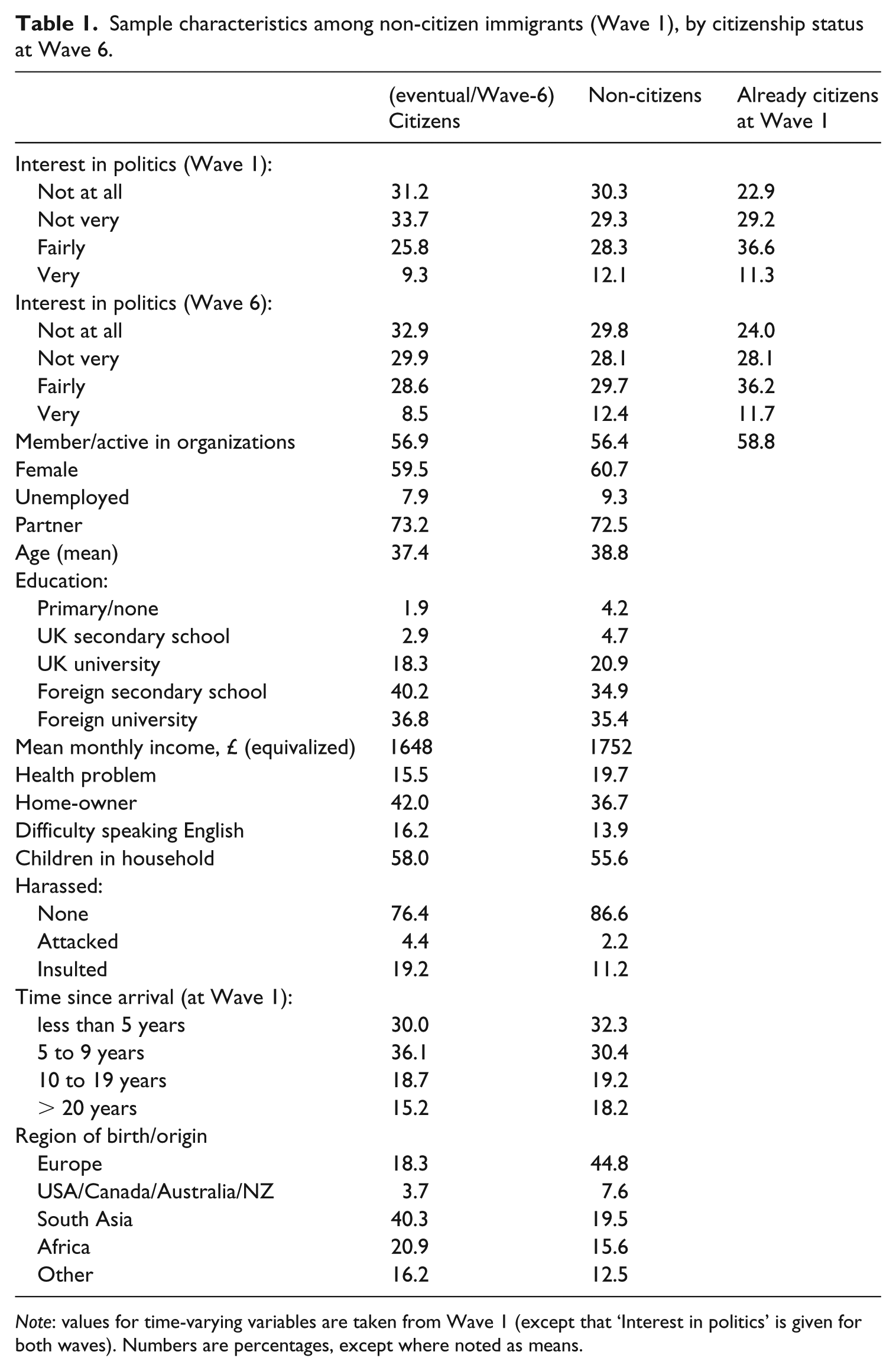
Note: values for time-varying variables are taken from Wave 1 (except that ‘Interest in politics’ is given for both waves). Numbers are percentages, except where noted as means.
The core of the analysis in the next section (for the ‘interest in politics’ variable) uses methods designed to exploit the panel data structure, particularly through specification of random-effects models for ordinal dependent variables (see, for example, Rabe-Hesketh and Skrondal, 2008). An option that focused more directly on within-subject variation (i.e. a variant of fixed-effects models applicable to ordinal data) would offer a more stringent test for evaluating causal relationships 3 – but there is too little within-subject variation (as well as too few respondents) to allow for this approach. 4 Random-effects models are also more appropriate when there is reason to believe that time-invariant characteristics are likely to influence outcomes; in this context, that belief pertains to the likelihood that country/region of origin could affect one’s interest in politics (a question that a fixed-effects analysis could not address). These models also underpin inferences to the population of interest (again in contrast to fixed-effects models).
The analysis of the participation variable is cross-sectional (a probit model); the questions about activity in organizations were not asked in Wave 1, so longitudinal analysis is not possible. These results are interrogated by considering how findings from the earlier analysis of ‘interest in politics’ differ across longitudinal and cross-sectional models; if one assumes that the same patterns would apply for the analysis of participation in organizations, one could form tentative ideas about what a longitudinal analysis of the participation variable would yield.
Results
Model 1 in Table 2, using only Wave 6 citizenship status as a predictor, suggests that, if we look at naturalization on its own, it does not appear that gaining citizenship is associated with interest in politics. The apparent overall lack of difference between naturalizers and non-naturalizers might, however, mask compositional differences in these two groups that could be associated with the choice to become a citizen (or not) and one’s level of interest in politics.
Random-effects ordered probit regression of ‘interest in politics’.
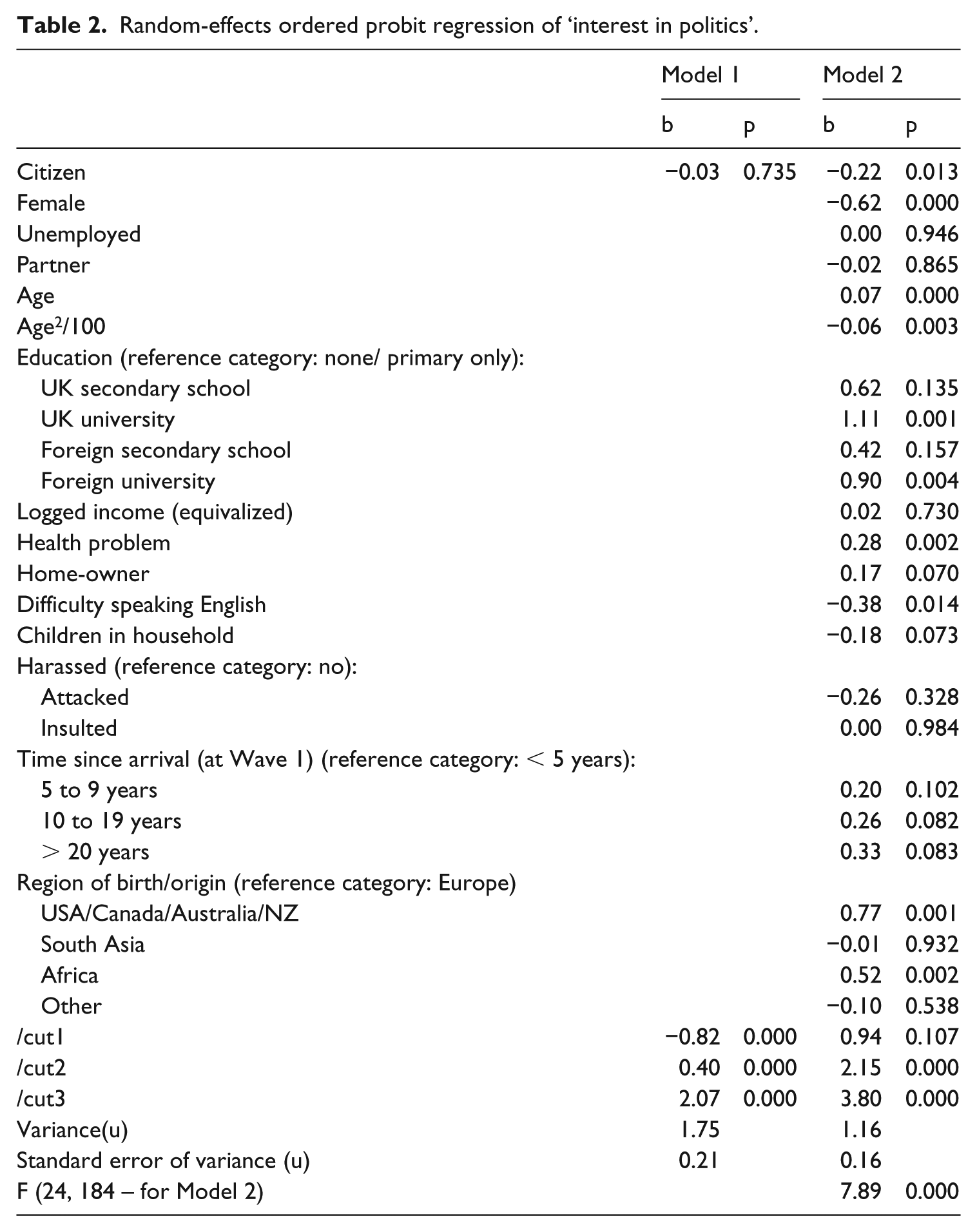
When we introduce control variables, the picture changes markedly. Model 2, controlling for other determinants, suggests that becoming a citizen is indeed associated with lower interest in politics (relative to those who remain non-citizens), with p = 0.013. The coefficient is not directly meaningful; post-estimation analysis (marginal effects) reveals that 36% of those who become citizens are ‘fairly’ or ‘very’ interested in politics, as against 41% of those who do not become citizens (all else equal, via the regression model). Becoming a UK citizen, then, is associated with lower likelihood (by five percentage points) of reporting interest in politics at those levels (and thus a corresponding increase in being ‘not very’ or ‘not at all’ interested). That difference might seem (intuitively) small – but in a context where roughly half the population (including citizens – see Table 1) expresses low interest in politics, a negative impact of any non-negligible size is surely a matter of concern. It is worth emphasizing that this finding cannot be explained away with reference to pre-existing differences in interest – the longitudinal analysis protects against exactly that possibility. Additional models were explored, to consider robustness to alternate explanations (e.g. perhaps the result is an artefact of occupational status, or social networks, or sense of local belonging) – but the finding persisted in those models as well, and none of the additional variables was a significant predictor (results available on request).
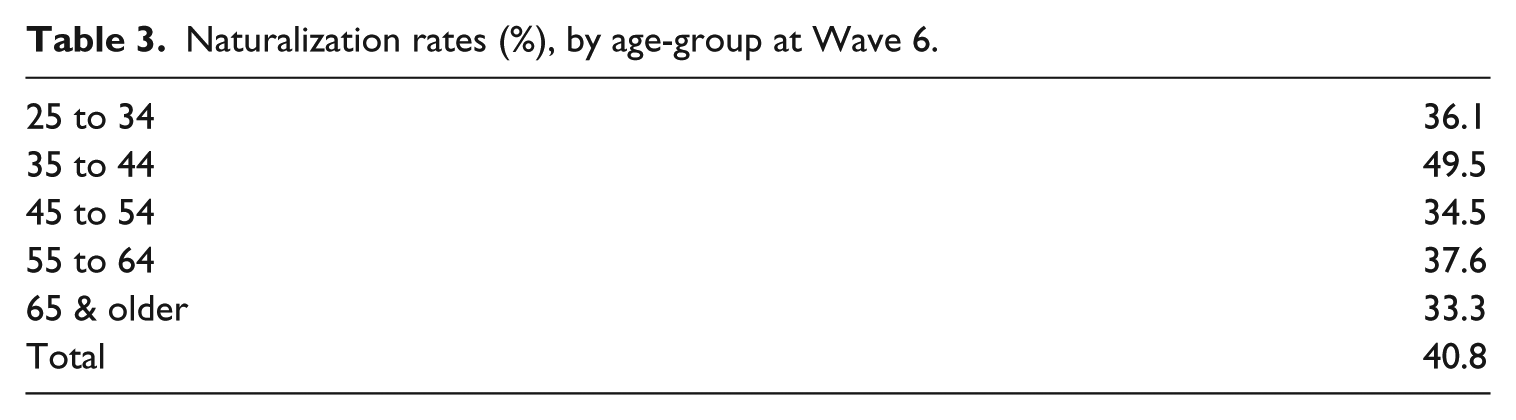
The impact of naturalization, evident in the full model, must be ‘suppressed’ in the simpler model because of failure to control appropriately for other variables. The variable having the largest impact in this respect is age; when age (together with age-squared) is added to the model containing (only) naturalization, the significance of the naturalization variable approaches the conventional threshold of 0.05 (p = 0.054; results available on request). Age is associated with both naturalization and with interest in politics; as is apparent in Table 3, the peak age-group for naturalization is 35–44. Naturalization is less evident among people who are older, though interest in politics rises with age (and later falls). Controlling for age reveals the negative impact of naturalization on interest in politics (and that impact persists when other variables are included as well).
Naturalization rates (%), by age-group at Wave 6.
The lower interest in politics among those who become citizens is given via an association that indicates an average difference for the sample as a whole. That association might vary across the different types of people who immigrate to the UK. An obvious possibility for exploration in these terms is region of origin. People making choices about naturalization consider their options differently depending on their perceptions about security and status in the destination country; those who feel more vulnerable (e.g. because if they lose rights of residence they might have to return to a more ‘difficult’ origin country) are perhaps more likely to naturalize, that is, for instrumental reasons. If these patterns are also associated with interest in politics (something suggested in the results for the region variables in Table 2 Model 2), then we might expect to find varying associations for the citizenship status variable.
That question is explored via interaction terms for citizenship status and region of origin. The results (available on request) do not support the notion that associations vary in this way; coefficients for the interaction terms are nowhere near a conventional threshold for significance. The size of the subgroups is worth noting: numbers for the ‘North America, Australia and New Zealand’ group are in double digits and are not large for any of the groups we can distinguish here. A cruder distinction between ‘developed’ and ‘developing’ origin countries was also attempted but gave similar results (i.e. nothing of significance).
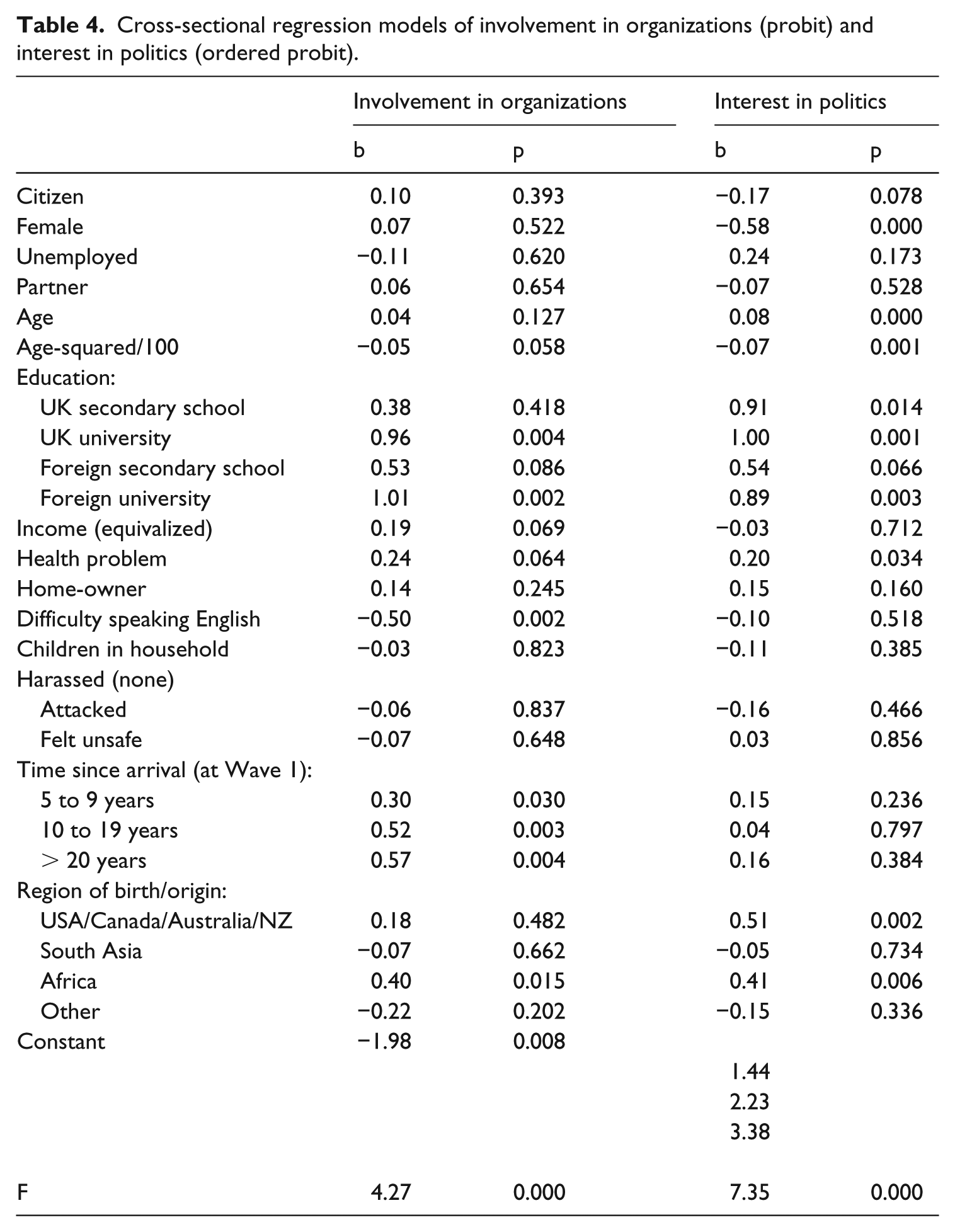
Results for the probit analysis of the ‘participation in organizations’ variable appear in Table 4. There is no support here for the notion that gaining citizenship is associated with involvement; the coefficient for citizenship/naturalization is nowhere near a conventional threshold for significance. Again, this is a cross-sectional model; it is not possible to consider whether involvement differed between non-citizens and (eventual) citizens at an earlier point, prior to naturalization. To gain some leverage on that point, Table 4 also includes an equivalent cross-sectional (ordered probit) model of ‘interest in politics’ at Wave 6; we can then consider whether/how these results differ from those in the longitudinal analysis of the same variable in Table 2. The coefficient for citizenship in the cross-sectional model (of ‘interest’) is slightly smaller (−0.17 as against −0.22, and significant only at a less demanding threshold), but the conclusion is the same (people who become citizens are less interested in politics than those who remain non-citizens). If we were willing to assume that a similar pattern would apply for the ‘involvement in organizations’ variable (i.e. results would not differ substantially if we had Wave 1 information on involvement), we could tentatively conclude that even in a longitudinal model we would be unlikely to see a significant impact (positive or negative) of gaining citizenship.
Cross-sectional regression models of involvement in organizations (probit) and interest in politics (ordered probit).
Discussion and Conclusion
The core result presented above – naturalization in a context coloured by the requirements of the UK citizenship process leads to lower interest in politics (relative to those who remain non-citizens) – is perhaps surprising.
Proponents of the citizenship process would have hoped for evidence of a positive impact. But even critics might have expected to find only that the requirements do not produce tangible benefits for those who meet them – in other words, no impact of UK naturalization on one’s interest in politics.
The conclusion that the UK citizenship process instead has a ‘negative impact’ on political participation is reinforced via consideration of Just and Anderson’s (2012) finding that, among immigrants in Europe, those who become citizens are more politically active than non-citizens. That research used an instrumental-variables approach to support the finding that naturalization in Europe (including the UK) generally led to an increase in political engagement (i.e. the increase is not simply a matter of selection into naturalization). The analysis above demonstrates, at a minimum, that this pattern no longer prevails in the UK; gaining citizenship is not associated with an increase in engagement. Insofar as one might reasonably expect an increase among those who become citizens (and indeed as noted above this expectation was articulated by policy-makers as a goal motivating the new requirements), the failure of an increase to materialize is reasonably construed as evidence of a negative impact emerging from the specific conditions that form the context for naturalization in the UK. Note that that conclusion applies even if one is sceptical (e.g. on grounds of omitted variables) 5 of the negative coefficient emerging from the random-effects model presented above. It would be sufficient to observe that people who become UK citizens do not experience increased interest in politics; in that instance, the contrast to the findings emerging from Just and Anderson’s (2012) work – and to policy-makers’ expectations – would still lend credence to critiques of the policy. The finding that naturalized citizens do not participate in organizations more than those who remain non-citizens is directly relevant to that point.
In other words, if the UK had not adopted new requirements (tests and ceremonies) for naturalization, perhaps we would observe a pattern in line with Just and Anderson’s (2012) research; that is, an increase in political engagement among those who become UK citizens. That counterfactual formulation is best explored via a more historical approach: it would be useful to consider the consequences of UK naturalization before and after the adoption of the new requirements, using the same analytical framework. There are no longitudinal data for the UK enabling a direct comparison of that sort (the British Household Panel Survey, the predecessor to ‘Understanding Society’, did not track changes in citizenship status). Instead we are restricted to comparison of findings using different data: the analysis by Just and Anderson (2012) draws on data from the European Social Survey collected in 2002/2003; that is, before the new UK requirements were implemented. The comparison of findings across time offers some support for the notion that the negative impact (as construed here) is not simply a consequence of naturalization per se but rather a specific impact of the particular context in which UK naturalization is carried out (the ‘citizenship process’).
Having found evidence that naturalization in the UK does not increase (and indeed perhaps inhibits) engagement in politics, we are led to consider possible ways of accounting for such an unexpected result. One possibility is that the requirements alienate the people who must meet them – that is, ‘must’, as a precondition for gaining secure status and the full set of rights that come with citizenship. Being forced (in a mandatory citizenship ceremony) to feign a loyalty one does not already genuinely feel might instead foster a sense of alienation (cf. Hagelund and Reegård, 2011 on voluntary ceremonies in Norway). 6 Analyses of questions on the test (e.g. Brooks, 2016; Byrne, 2017) suggest that it requires knowing things that do not seem pertinent to an immigrants’ actual ‘life in the UK’ (especially with more recent versions focused on factoids about British history, as against practical information about daily life). A significant proportion of the test does involve questions about politics – but these typically refer to facts about distant institutions (e.g. what is the role of the Whips in Parliament, or what is the name of the Prime Minister’s country house?). Occasionally there are questions with relevance to individuals’ own political engagement, but even then the focus is on rules of conventional participation (e.g. what is the current minimum voting age, or what time of year are local government elections held?). This knowledge is hardly inspiring. It is quite distant from what Isin (2008) calls ‘acts of citizenship’, where citizens attempt to hold the powerful to account, in the name of justice. The test does nothing to enlighten potential citizens about democratic rights (speech, assembly, etc.) that might facilitate dissent and/or disruption of the current order. Instead, the test seems to entail a ‘depoliticized’, even obedient and submissive version of politics (cf. Hammett, 2018; Suvarierol and Kirk, 2015). Knowledge of this sort is arguably inconsistent with the notion of fostering meaningful public engagement; one might speculate that it sometimes dulls the inclination one might have in that direction.
It is not possible to produce empirical verification for these notions via use of the data from Understanding Society. A more qualitative approach to this question would likely yield more insight.
In research on migration generally, integration is defined broadly as adoption of patterns prevailing among the majority/long-standing population, after accounting for key characteristics, for example, educational attainment (Bartram et al., 2014). In the political sphere, it is not evident that integration in this sense is occurring among immigrants in the UK – certainly not among newly naturalized citizens (for whom expectations in this regard would be higher, relative to those who remain non-citizens). In comparison to long-standing UK citizens at Wave 1 (Table 1), interest in politics among immigrants is lower (more immigrants say they are ‘not at all’ interested and fewer say they are ‘fairly’ interested) – and their interest does not move towards parity with existing citizens following naturalization. Byrne (2017) suggests that migration can foster increased interest in politics and citizenship (as individuals become aware of the regulations that impinge on their situation); we cannot know from the data here whether an increase has occurred relative to UK immigrants’ pre-migration situation, but it does not appear that interest increases following their arrival. 7
The components of the UK citizenship process, then, would seem to hold little value in connection with political integration – and possibly the requirements are downright harmful. This result is interesting in light of comparative analysis of the test content: Michalowski (2011) argues that the British test is relatively liberal (at least in comparison to the Dutch test), in the sense that it focuses on knowledge of facts rather than attempting to elicit agreement about what is ‘good’ in hopes of fostering cultural homogeneity (see also Joppke, 2013). One question for future research is whether negative outcomes are even more pronounced where tests are less liberal.
A recurring theme of scholarship on the UK citizenship process and the ‘social cohesion’ discourse is that they emerge from a faulty diagnosis of the 2001 northern riots (focusing on race/ethnicity rather than class and material inequality) – and so it should come as no surprise when citizenship tests and ceremonies prove to be an ineffective and even counterproductive ‘solution’ (Ratcliffe, 2012). In a more cynical mode, it might seem that this conclusion misses the real point about the requirements: again, the policy is arguably designed mainly to reassure citizens/voters, not to integrate immigrants (Byrne, 2017; Fortier, 2017). That intention carries its own internal logic as a political imperative – but the findings presented above make it harder to justify assuaging citizens’ anxieties by claiming that the policy does good for the immigrants as well. At best, naturalization in the UK does not lead to an increase in civic participation (despite a reasonable expectation that it would do so) – and the requirements associated with gaining citizenship evidently lead new UK citizens to a lower level of interest in politics.
Footnotes
Acknowledgements
I am grateful to Patrick White and Pierre Monforte for feedback on an earlier draft, to my other project colleagues (Leah Bassel and Barbara Misztal) and to the University of Leicester for a period of study leave to support this work. The data used for this research are available via the UK Data Archive ( ).
).
Funding
This research was conducted as part of a project funded by the Economic and Social Research Council [ES/K010174/1]: ‘The UK Citizenship Process: Exploring Experiences’.