




Abstract
This article explores how migrants utilize and access different forms of capital. Using a Bourdieusian approach to capital, we focus on how migrants’ temporal and spatial journeys are shaped by and in turn shape their opportunities to mobilize resources and convert them into capitals. These processes depend on migrants’ social positioning, including their gender, class, ethnic and national positioning, as well as citizenship status, and how this is articulated in relation to different fields in different spatial and temporal contexts. Drawing upon our combined corpus of data on migration to the UK, and a lesser extent Germany, with third country nationals and EU citizens and new data collected since the Brexit referendum, we examine these issues through biographical approaches to migrant women’s life stories. In so doing, we build theory on capital accumulation as dynamic, multi-level and spatio-temporally contingent.
Introduction
Migrants encounter various opportunities and obstacles in their strategies to convert and accumulate different kinds of capital across national borders. As researchers are increasingly interested in understanding the dynamic and contradictory ways in which people form and validate capitals in diverse geographical and structural contexts, an analytical framework is needed to understand migrants’ opportunities and strategies in seeking to generate cultural, economic and social capital. Migrants routinely experience a mismatch between the spatial contexts where their resources were formed and the new contexts where they look to validate these as capitals. However, we suggest that our analytical framework may also be relevant for understanding experiences of mismatch and dissonance in cultural and social resources and their transformation into capitals beyond the migrant experience. Combining the macro-level factors of economic and political structures, the meso-level of networks with the micro-level of personal narratives, the article proposes that such a multi-level analytic framework, that is sensitive to temporal and spatial dynamics, is useful in highlighting the fractures, hierarchies and exclusions in specific fields. This article contributes to theorizing migration, cultural, social and economic capital, drawing on empirical data from the UK, and a lesser extent Germany, encompassing EU and non-EU migrants (Erel, 2009, 2010; Ryan, 2011, 2018). What is at stake in this article is the development of an analytic framework for understanding migration and capital formation as part of fast-paced national and transnational social change.
We propose that such a spatio-temporal multi-level analysis can also highlight migrants’ agency and strategies to mobilize resources as capitals; building new capitals in new places. This in turn challenges the idea that migrants’ integration and accumulation of capitals follows linear trajectories, an urgent task for research on the role of time in migration (Griffiths et al., 2013). Our spatio-temporal approach instead allows for a more nuanced understanding of ebbs and flows in the valorization of migrants’ resources through space and time. We pay attention to the temporal and spatial dynamics of how migrants use different capitals. In so doing, we emphasize the significance of changing socio-political factors in how migrants are positioned as privileged or subordinated and how this affects opportunities and strategies for social and spatial mobility. Our body of work contains rich qualitative data from migrants including EU citizens and third country nationals with different migration trajectories and citizenship statuses. By combining longitudinal, multi-sited, multi-researchers’ qualitative data sets, to inductively generate new theory, the article also contributes to methodological innovation. While we present life stories of women migrants, we believe the analytical framework may be also applicable to men.
Our starting point is Bourdieu’s (1986) conceptualization of social, cultural and economic capital, emphasizing the dynamic role of capitals in making and negotiating fields. We conceptualize capitals as resources, which can be converted into advantageous positions in social fields; what distinguishes capital from a resource is its convertibility. Mobilizing resources to constitute cultural, social or economic capitals is not simply based on individual efforts but a systemic process, entailing the mobilizing of such resources and position-taking in fields and those with access to capital can ‘expect returns which exceed their initial investment in the given capital’ (Savage et al., 2005: 45). We are influenced by Bourdieu’s theory, though this is not intended as a contribution to specialist Bourdieusian literature. However, as argued previously (Erel, 2010), migration studies literature broadly frames capitals in two ways: a human capital approach and a Bourdieusian approach. We position this analytical framework as part of Bourdieusian approaches. The analytical framework we are proposing can feed into understanding the formation of capital in diverse and changing social contexts more widely, informing understanding of fragmentations, dissonances and mismatches of capital formation for those who are socially and spatially mobile.
Theorizing a Multi-Level Spatio-Temporal Analytical Framework
This article develops a multi-level analytical framework based on the interconnections of macro-, meso- and micro-levels through a spatio-temporal perspective. By paying attention to a spatial dimension in researching mobility (Neal et al., 2015), we conceive of place as an ongoing production based on a particular constellation of social relations, meeting and weaving together at a particular locus (Massey, 2006). As Sarah Neal et al. (2015) note, by crossing national boundaries, migrants are actively engaged in place-making. For example, particularities of place both shape and are shaped by gender and the relationship between masculinities, femininities, migration, mobility and transnationalism is usefully understood as mutually constitutive (Yeoh and Ramdas, 2014). We are informed by that body of work to explore migrants’ narratives of accessing, generating and mobilizing capitals in specific spatial and temporal contexts.
While the mobilities turn has led to foregrounding the spatial in migration research, there has been less attention to the temporal aspects of migration (Robertson and Ho, 2016). Hence, there are gaps in migration studies in relation to understanding time, especially gender and time, as well as in the application of longitudinal research (Griffiths et al., 2013). This article contributes to addressing those gaps. Analytic attention to time is important in order to understand the complex and subjective dimensions of time as a social construct (Adam, 2000; May, 2017). Our understanding of time is informed by the work of Glen Elder (1998). In analysing how time is experienced on different levels, he uses the notion of ‘historical time’ to represent specific macro socio-political contexts. These ‘moments’ in historical time and place, such as war or economic recession, shape individual opportunities and strategies (Elder, 1998). That is not to suggest that these socio-political events are a product of time passing but rather that they unfold in time as a result of political decisions and struggles. We argue that this spatio-temporal lens is useful to understand the particular socio-political contexts, which migrants encounter and navigate.
Elder’s (1998: 3) work also shows the interconnectedness or ‘synchronicity’ of time across different dimensions and relationships: ‘Historical events and individual experience are connected through the family.’ Thus, individual lives, on the micro biographical level, are not only situated in the wider macro context of historical time but also experienced through relationships on the meso-level.
On the meso-level, families and networks are shaped by normative ideas of the life course (Halberstam, 2005). These culturally specific ideas about life course also affect migrants’ opportunity structures of mobility and labour market access. On the micro-level, for example, time to care for children may be devalued (Felski, 1999) and impact women’s migration experiences and opportunities to access skilled work. Therefore, in the case studies below we demonstrate that the degree to which migrants fit in or synchronize (Elder, 1998) with meso and macro structures and norms is an important factor enabling or hindering their development and use of capitals. As we discuss below, whether and to what extent migrants’ biographical time synchronizes with the requirements and opportunities of meso (networks) and macro (labour markets, political systems) time scales makes an important difference to how well they can use their social, cultural and economic capitals.
In advancing a multi-level analytical framework, we propose that research should look at the formation of migrants’ capitals through the micro-level of personal narratives, the meso-level of networks and the macro-level of structural factors, such as changing global, national and transnational socio-economic and political relations and conditions. While it is useful to distinguish between these levels for analytical purposes, in social life, they simultaneously constitute the social fields in which migrants operate. For our analysis in this article we focus on three inter-related fields: work, reproduction and citizenship 1 as these are important fields for developing and validating migrants’ capitals.
In crossing national borders migrants often experience how cultural, social and economic resources are valued differently in specific places as capitals (Kelly and Lusis, 2006). Indeed, the ability to legally cross borders, access labour markets, skilled professions or self-employment is differentiated according to access to information, cultural, social and economic capital as well as national belonging, often intersecting with racialized markers (cf. Kaufman et al., 2004). National citizens and some naturalized or settled migrants are able to access such privileges (Bauder, 2008). By contrast, migrants from the global South or peripheral nations not only encounter obstacles to border crossing, but may also routinely experience the devaluation of their cultural capital (Nohl et al., 2006) leading to de-skilling and de-classing (Trevena, 2011). By refusing to accept the equivalence of educational qualifications, institutions in the country of settlement create hierarchical access to labour markets, reinforced by immigration legislation, educational and professional regulations. These processes of exclusion and subordination of migrants’ cultural capital are reinforced by employers, for example, discounting work experience gained in countries of origin.
This macro-level view, needs to be supplemented by micro-level analysis of strategies that migrants may adopt by developing subtle cultural capital of bodily comportment, language, gestures, familiarity with local and institutional cultures (Cederberg, 2015; Deeb and Bauder, 2015). Individuals do not realize these strategies in isolation: an analysis of the meso-level of networks shows how migrants’ relational ties with migrants and non-migrants may facilitate mentoring and access to information which are crucial for re-validating formal cultural capital and gaining access to skilled work (Ryan, 2011, 2016). By paying attention to all three levels simultaneously, as well as being sensitive to change over time, we argue, it is possible to understand the significance of broader structuring factors and also migrants’ agential strategies.
This framework also speaks to wider sociological interest in fragmentations, incongruities and breaks of cultural capital, in particular as expressed in the notion of ‘habitus clivé’ (Bourdieu, 2008). While Bourdieu’s work emphasized the durability of the habitus as a link between individual and social structure, his notion of ‘habitus clivé’ referred to the inner contradictions and conflicts of socially mobile people (Friedman, 2016). Migration research has pointed out how the experience of mobility across differing socio-spatial contexts leads to a mismatch of cultural resources and opportunities for their recognition and validation (Erel, 2010; Ryan, 2011). The experience of migration can also be translated into a cross-cultural habitus of non-belonging as migrants may be accorded a marginalized position within the destination nation (Noble, 2013). A focus on migrants’ capital formation may provide further insights into the relationship between mobility, fragmentation, social change, capitals and habitus more generally.
How different capitals are valorized or devalued may change over time, therefore we caution against the idea that migration follows a linear trajectory of loss or accumulation of capitals (cf. Griffiths et al., 2013). It may be assumed that after an initial loss of capitals, migrants gradually begin to accumulate cultural, social and economic resources. However, we argue instead, it is necessary to look at how gains, losses and reorientations of capitals are connected across different social fields. Furthermore, differential class, gender and generational positioning of migrants within the family, the ethnic or migrant group as well as the wider context of the society of residence and the transnational context affect access to capitals (Anthias, 2007; D’Angelo, 2015; Erel, 2010; Holgate et al., 2010).
Thus, looking at the interrelation of migrants’ positioning across different fields of work, family and citizenship can show that gains in one field may be accompanied by losses in others. In addition, migrants can also attempt to compensate for losses in one field by investing more heavily in another. The advantages of a multi-level analytical framework become apparent here. Immigration regimes, labour markets as well as large-scale political change, such as Brexit, impact on migrants’ opportunities for social and spatial mobility including rights to residency. Furthermore, these large-scale changes also affect the strategies that migrants may adopt in their efforts to convert resources into capitals. The analytical framework we propose suggests that all levels of analysis micro, meso and macro are relevant for understanding migrants’ capital formation (Figure 1). However, as illustrated by the case studies below, we recognize that, at specific moments in time, some levels may play a greater role than others. We propose that, on each of these levels, changes over time and space need to be better understood in order to address different experiences of migrant groups and the dynamism of capital formation, as migrants’ capitals cannot be understood as simply increasing over time.
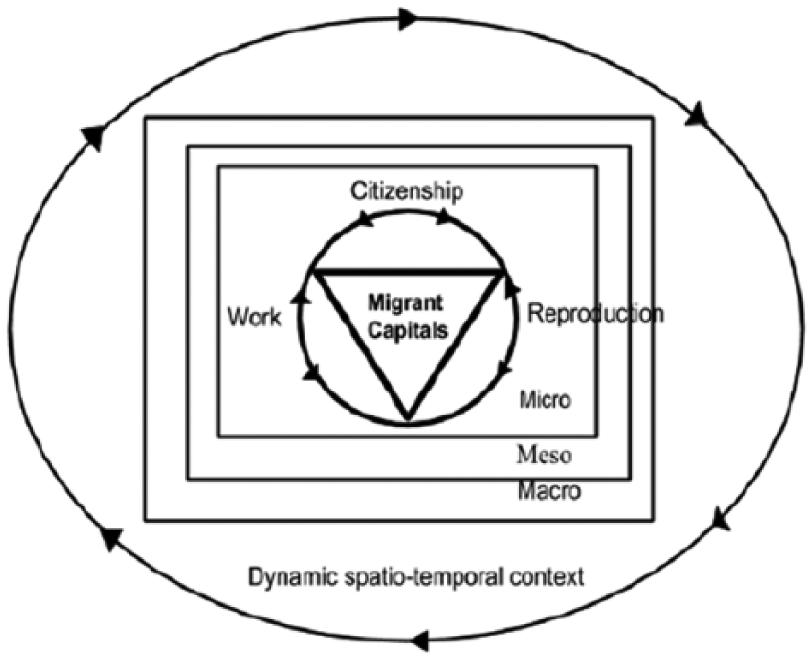
Multi-level spatio-temporal framework for analysing migrant capitals.
Since 2004, migrants from Eastern European countries to the UK have experienced dramatic changes in how they can use their citizenship for purposes of spatial mobility and settlement. Citizenship status is a key factor stratifying migrants’ ability to be mobile, access valued parts of the labour market, such as formal employment with rights and benefits, skilled work and certain state-regulated professions as well as the rights to engage in family reunion and extend their stay over time (Ryan et al., 2009). Yet, as noted above, such developments are not uni-directional. As discussed later with Brexit, the citizenship rights of EU migrants in the UK may be undermined, leading to insecurity regarding working and residency rights (Kilkey, 2017). Hence, opportunities for mobility and settlement may change in new and unanticipated ways. We explore these issues through the following three sections focusing on the themes of work, reproduction and citizenship. First we briefly discuss the methods we used and the individual research we drew on to write this article together.
Methods
This article draws upon our large corpus of qualitative data generated over several decades. Through this work, we each developed concepts and arguments to help understand how migrants validate and generate different forms of capital in destination countries (Erel, 2010, 2012; Ryan, 2011; Ryan et al., 2008, 2016). Although we have worked separately on these projects, there are similarities in our analytical approach emphasizing the significance of skill, gender, family networks and citizenship, which we explored together in a book (Ryan et al., 2015). Writing this article, we have spent considerable time discussing and sharing our data to develop an analytical framework that can take account of the migrants’ dynamic negotiations of capital.
Umut has been researching gender and migration for two decades and during that time has conducted a number of separate but related studies. She carried out research on the life stories of skilled migrant women from Turkey in Germany and Britain, in the late 1990s with a sample of 10 participants (Erel, 2009). In 2008, she studied 15 pairs (total 30 participants) of mothers and children who were Polish, Turkish and Kurdish migrants in London, looking at experiences of migration, citizenship and intergenerational relations (Erel, 2013). Most recently she completed a study of 30 migrant women from EU countries in London, where most participants identified as middle class. This focused on questions of belonging, mobility and citizenship, and raised a lot of interesting material on cultural capital. All three studies, using a biographical approach, have been located in a theoretical framework of intersectional social divisions and how these affect citizenship, participation, agency and belonging.
Louise has similarly been researching migration for proximately two decades with a particular focus on intra-EU mobility. She has an established body of work on Polish migration built up over several research projects including longitudinal work following particular Polish migrant women over more than a decade (Ryan et al., 2016). In the mid-2000s with colleagues, Louise conducted a study on recently arrived Polish migrants in London involving over 50 male and female participants (Ryan et al., 2009). In 2014, she carried out a project with 20 Polish migrants resident in the UK for approximately 10 years (Ryan, 2016, 2018) aiming to understand how migration plans, especially initial expressions of temporariness and uncertainty, may develop over time into longer-term settlement. Nine of these participants had been interviewed previously. Louise re-contacted all 20 participants from the 2014 study again after the EU referendum in 2016; hence, developing a large corpus of longitudinal data from the same participants. An underlying focus across all her studies is relationality and the role of social networks in both maintaining and accessing particular forms of capital in specific social contexts and how these may change over time.
These combined bodies of work cover a range of migration trajectories, experiences and statuses. In particular the differential and changing citizenship, mobility and settlement rights in our sample are instructive for building an analytical framework on the spatio-temporal dimension that is attentive to change, as well as opening up understandings of migrants in diverse socio-economic and legal positions. Clearly, in a journal article it is impossible to discuss the full extent of our data, and these have been discussed elsewhere (Erel, 2007, 2009, 2012, 2013; Ryan et al., 2016). Instead, here, we have worked together to identify particular biographical case studies which help to illustrate recurring theoretical themes of the significance of work, family and citizenship across the wider datasets. Our data are drawn mainly from the UK but we also include some examples from Germany. It is not our intention to undertake a comparative analysis but rather to use these case studies to show how the spatio-temporal matters. In so doing, we add to theory building by analysing how migrants validate and generate different forms of capital in particular spatio-temporal contexts and how these are mediated by gender, class and nationality.
The use of individual case studies to explore broader themes in large bodies of data is an established part of qualitative research. As Bren Neale et al. (2012: 8) observe research case studies are a good way to ‘condense cumulative data into a meaningful narrative that carries interpretation and analysis’. As Stanley (2015: 838) argues ‘macro questions concerning social change can be analytically explored through the small-scale and specific’. The individual case study can locate subjectivity in a cultural and historical context (Thomson, 2007). We selected these particular case studies because they each depict pertinent and thought-provoking issues. While each is unique in its own way, they reflect wider patterns found across each of our broader datasets.
Dynamic Constructions of Capitals in the Field of Work
In this section we demonstrate the application of a multi-level spatio-temporal framework through two biographical case studies. We show how these women’s strategies of mobilizing networks and capitals in the field of work are not simply economically motivated but also connect to their other life plans, such as gendered and sexual identities. Hence, we indicate the interaction of micro-, meso- and macro-levels through space and time.
Originally from Poland, Gabi, interviewed in 2014, had worked in the USA for three years before migrating to the UK after her US work permit expired. As an EU citizen she took advantage of her mobility rights to move to London and explore job opportunities, highlighting the salience of socio-spatial immigration regimes. Gabi also thought that moving to London would help the process of separating from her Polish husband. This separation was crucial for her to explore her sexuality and develop a lesbian identity and lifestyle. Gabi believed that her lifestyle disrupted traditional Polish gender norms, hence she avoided Polish community and religious associations in London which she perceived to be conservative and traditional.
Like many Eastern European migrants, despite being a graduate, Gabi experienced initial de-skilling in the London labour market (Trevena, 2011), while attending IT courses to build up locally recognized credentials. In her waitressing job she met an English banking professional who became an informal mentor sharing educational and career advice. This helped Gabi to find employment in a high street bank, where her Polish degree was recognized, enabling her to transfer her institutionalized cultural capital across borders. It is likely that her locally acquired cultural capital through the qualification in computing and her embodied capital, through years of English-speaking work experience, also helped. At the time of interview she had gained further qualifications, moving to a more senior finance job. Thus moving to London, using her mobility and residency rights as an EU citizen, provided Gabi with opportunities to build up her economic capital through enhancing her cultural and social capital. It also allowed her to explore new gendered and sexual identities.
Tulin’s case, elicited in 1999, further highlights how gender, or particular embodiments of femininity, co-constitute social and cultural capital. Tulin migrated from Turkey to a small town in southern Germany in the early 1970s, accepting a lower skilled position as she was hoping that the migration might help to save her marriage. When she eventually separated from her husband, Tulin lost her social networks as she moved to a large German city, to flee his stalking, again highlighting the salience of place in migrants’ access to sources of support. To find accommodation, employment and social and emotional support in the new city, she turned to a Turkish advice centre, which initially set her up with a contact in the Turkish community for accommodation. However, this exposed her to sexual harassment and stigmatization as a divorcee, with supposedly ‘loose morals’ in a migrant community dominated by patriarchal-oriented social networks (Eryilmaz, 1998). As her German language was limited, she built her social networks with an alternative Turkish community around cultural activities sponsored by the embassy. These new networks accepted her performance of an independent femininity, as this resonated positively with the then hegemonic form of Turkish state sponsored ‘republican capital’ (Sanli, 2011). These alternative social networks were instrumental for Tulin, as she met an informal mentor who helped her establish her own small business by lending her economic capital and contributing cultural capital in the form of local information. She worked for many years by herself in her business, thus bearing the brunt of risk and also limiting her ability to expand or gain a more secure income. At the time of interview, Tulin had moved her business to a more upmarket commercial part of the town, where she expected to work until her retirement.
Both cases highlight the significance of temporal and spatial contexts for capital formation. On the macro-level, ‘historical time’ (Elder, 1998) is useful for understanding the specific context of immigration regimes and the associated citizenship rights. Following EU enlargement in 2004, as an EU citizen Gabi had secure residence status in London, unlike the USA. She was legally allowed to work in a profession and place of her choice, though it took some time, effort, social and cultural capital to realize these formal rights substantively. Tulin, on the other hand, did not initially have citizenship rights in Germany. Having been recruited as a guestworker in the 1970s, restricted her residence rights, which were linked to specific employment and places of residence, forcing her to move to a city where she had no contacts. Foreign citizens, due to a convergence of migration legislation and professional regulations, were only allowed to become self-employed in specific niche occupations (Alberts, 2003). Structurally, as a woman of Turkish background, Tulin encountered discrimination in Germany, which made it more important for her to build social support networks with an alternative Turkish community. The meso-level is important in understanding how both women responded to initial economic challenges by mobilizing social capital to access information and support for professional and social mobility. These meso-level strategies were shaped by Gabi’s and Tulin’s specific articulations of gendered, ethnic identity at the micro-level. While differing in their educational qualifications, with Gabi holding a degree and Tulin lacking formal qualifications, their gendered strategies were similar: as single women, and more specifically Tulin’s stigmatized status as divorcee, and Gabi’s identification as lesbian, shaped their avoidance of ethnic-specific networks. As childless women, they both disrupted normative reproductive life courses, while this freed up temporal resources for their reskilling and professional projects. As a counter-strategy to heteronormative and patriarchal family and ethnic-based networks, they established networks, which did not stigmatize their alternative forms of femininity.
While this section on the field of paid work highlighted the significance of a multi-level analytical framework, the next section looks at the field of reproduction to show how the interplay of time on the micro-, meso- and macro-levels impacts on building social and cultural capital in new places.
Reproduction as Investment and Resource
Our analytical framework highlights the role of time as a resource, which can be invested in relationality. In the field of reproduction, time is differentiated by caring roles and relationships through the life course (Felski, 1999). The gendered and classed aspects of caring show the ambivalence of care and reproduction as both an obstacle and a route to building capitals. So, while working mothers may have little time to invest in networks of colleagues or other mothers, by contrast, stay-at-home mothers may find it helpful to devote time to building relationships with other mothers for social and emotional support. While not suggesting that migrants are overly instrumental and invest in networks deliberately to accrue capital, we recognize that networks may provide opportunities to convert and build new capitals.
Klaudia, interviewed in 2014, moved from Poland with her young son to join her husband in London. An analysis of her class positioning poses several challenges, as the post-socialist context in Poland presents different configurations of class, education and identity (Mayblin et al., 2016), so that she did not have ready access to the cultural, economic or social resources for claiming – and achieving recognition of – a middle-class identity in Britain. On arrival in the UK, as a full-time mother, she had a low economic position. Nonetheless, Klaudia’s case shows how care for children can help migrant women to build wider social networks. Through activities at local children’s groups she enhanced her social capital. Then by volunteering at her son’s primary school she expanded her networks with English parents and gained a good understanding of the wider macro-system of education (Sime and Fox, 2015). After a short time, Klaudia was elected a parent-governor of the school. The cultural capital and information to successfully navigate the British education system became crucial to her re-training as a teacher. In this sense, time was important as a resource to invest in her networks. Time also mattered in terms of her life course, being a young mother, at the time of her migration allowed her to build networks with other parents, on the meso-level. These, in turn were enabled by historical time through the macro-level policy context when the Labour government invested in children’s centres in the late 1990s and early 2000s, thus creating more resources and opportunities for mothers of young children, including migrants. These resources became available at a particular moment in historical time as a result of a specific political decision to invest in children.
Julieta, interviewed in 2011, is an educational professional from Spain who previously lived in the USA. She has three children and is married to a Spanish man. Julieta’s job allows her a degree of flexibility in organizing her work and caring responsibilities. Like many migrant mothers, Julieta put effort into transmitting her home language to her children. This is part of her labour and time-intensive mothering activities where she takes her children to a range of extra-curricular activities, characteristic of middle-class parenting strategies to enhance children’s cultural capitals (Lareau, 2003). In contrast to many working-class and non-European parents, Julieta and other European middle-class parents, viewed the transmission of language not simply as enabling family relations with those back home, but further as an important investment in their children’s cultural capital as she believes the Spanish language itself will open up valuable educational and career opportunities. Moreover, she believes multi-linguality constitutes a cultural capital that allows her children to grasp global opportunities and gain an edge in a globally competitive professional world (Reay et al., 2007; Weenink, 2008). This confidence to plan the future of her children was also based on a sense of security vis-a-vis citizenship, mobility, residency rights and class (Atkinson, 2013).
Julieta’s and Klaudia’s stories show the centrality of time as both a framing context and a potential resource. Migrating post-2004 allowed Klaudia to become part of a legal migration from Poland to the UK, accessing most of the social and working rights available to UK citizens. A temporal analysis allows us to see the significance of ‘synchronicity’ (Elder, 1998) of temporal developments on the micro-, meso- and macro-levels. The micro-level of reproductive and caring time in Klaudia’s life course coincided with the specificities of that historical time (Elder, 1998). During that period New Labour pursued particular policies, resulting in state investment in early years children’s services. This synchronicity of Klaudia’s life course with macro, socio-spatial developments provided opportunities for building social and cultural capital aimed at parents’ inclusion in the labour market, such as English as a Second or Other Language classes and employment advice on the meso-level (Erel, 2011; Lister, 2006). The ways in which the ‘historical time’ of reproduction, migration, education and work synchronizes can enable or prevent migrants’ ability to build and validate resources (cf. Lisiak and Nowicka, 2017).
For Julieta, the strategy of investing in her children’s cultural capital through multi-linguality is contextualized by her confidence in the value of the Spanish language as an internationally recognized form of cultural capital, and her understanding of globally competitive educational and job markets for this new generation of middle-class educated young people, drawing on contemporary discourses on education (Saito and Igarashi, 2014). Julieta’s investment strategies in her children’s future show another example of the significance of timing, on the micro-level her migration and childrearing ‘synchronized’ with a ‘moment in historical time’ (Elder, 1998) where notions of a globalized education on the meso-level of educational institutions, generated a notion of cultural capital thought to be instrumental for succeeding in a globalized labour market, on the macro-level. The next section explores citizenship as a field for migrant capitals.
Citizenship – Brexit and Beyond
Citizenship is significant both as an arena of rights which enable access to legal residence and bestow mobility rights, work and social rights, but also as a field in which belonging and participation, and most critically questions of who can belong, are enacted.
The significance of a spatio-temporal lens is shown when analysing Eastern European citizens’ trajectories in the UK. In 2016 the UK referendum to leave the EU, subsequent triggering of Article 50 and beginning of exit negotiations have caused a shifting and uncertain spatio-temporal context, rendering the previously clear distinction between intra-EU and third country nationals fuzzy as EU citizens in the UK fear that restrictions hitherto applicable to non-EU migrants will begin to affect them (Kilkey, 2017). When European migrants enjoyed mobility rights, they had the opportunity to consider staying or leaving and, indeed, returning (re-migrating) in the future as personal circumstances change, allowing for a projected flexible invocation of citizenship rights in the UK, the home country or other EU member states (Erel, 2011; Ryan, 2018; Ryan et al., 2008). However, with Brexit, intra-EU migrants’ citizenship and migration status are re-configured and refracted. Louise’s Polish participants worry that their investment into social, cultural and economic capital in the UK is now at risk, putting into question their existing strategies of building capitals and belonging, so that narratives of mobility may now be replaced by strategies to secure status and residency.
Before analysing the situation of EU nationals after the Brexit referendum, we discuss the case of a third country national as this can give helpful context for understanding the role of time in constituting and contextualizing capitals in the field of citizenship.
The ways in which citizenship and mobility can be converted into capitals can be seen in Birgul’s story, a medical doctor, interviewed in 1999, who fled Turkey after the 1980 coup d’etat. Joining her sister in Germany, Birgul decided that rather than initiating the lengthy asylum process, she would apply for a working visa. Birgul eventually was able to start working but three years into her specialization training, despite dedicated support from her senior consultant, her professional permit was not renewed. As these decisions are taken on the level of regional government, highlighting again the salience of place, her boss recommended she move to another region, to take a position with a friend of his. This aspect of her story underlines the key role of inter-personal networks. Moving to this new region, Birgul eventually was able to complete her specialization training. When she wanted to open a surgery, she encountered new legal obstacles as she lacked German citizenship. Only as a result of taking legal action was she finally able to open her surgery. Her argument in this legal case centred on the distinction between ‘Volk’ (nation) and ‘Bevolkerung’ (population), whereby she argued that opening a surgery was important to serve the multi-ethnic population’s health needs.
Birgul’s story exemplified how lack of citizenship rights affects third country nationals in the EU. The experiences of Karina, a Polish woman, illustrate the salience of spatio-temporal context for citizenship, mobility and residency rights. Karina moved to London in 2004 after Poland joined the EU. Realizing that her Polish qualification in psychology would not enable her to work as a clinical psychologist in Britain, she had to re-qualify at a London university. When Louise interviewed Karina in 2014 she had secured a job as a psychologist in the National Health Service (NHS) and married her British partner. At that time, having lived in London for a decade, she was enjoying life in the city and had no plans to return to Poland. One key reason for this was that her British husband did not speak Polish. Thus, as a woman, her mobility was shaped, at least in part, by relationality.
Shortly after the EU referendum in the summer of 2016 Louise re-contacted all her Polish research participants to enquire about their reactions to Brexit and how it might impact on their migration plans. Karina was among those who provided fulsome answers, pointing out that she felt devastated and took the vote as an expression of xenophobia and anti-migrant feeling. However, although ‘heartbroken’ by the xenophobia and ‘racial crime’ such as attacks on Polish people, she also felt ‘trapped’, as neither her husband’s nor her profession would be easily transferable to another country, she did not consider it possible to migrate elsewhere, without a severe drop in income. Building on Erel (2010) who pointed to the difficulty of bringing cultural capital from the origin to the destination society, Louise has noted that highly skilled migrants may also experience difficulty transporting their newly acquired cultural capital from the destination back to the country of origin or elsewhere. Highly specialized, skilled work is often built on place-specific accreditations, contacts and experience, hence, the more specialized one becomes within a profession, the less mobile one may be (Ryan and Mulholland, 2014).
Bringing a spatio-temporal lens to the analysis of migrants’ experiences of citizenship shows how particular political decision making, within historical time (Elder, 1998), needs to be taken into account when analysing the changing conditions for capitalizing on resources such as citizenship, ethnicized and classed positions. In particular changes on the macro-level, such as the Brexit process, show the potential variability of citizenship rights. Such rights can be put at risk in changing socio-political contexts, illustrating that migrants cannot assume that their cultural, social and economic capital in the country of residence will continue to accrue value or even be maintained. Continual effort is required to maintain a recognized sense of legitimate belonging. As Bourdieu (1990: 66) suggests, to participate in a field players have to develop a ‘feel for the game’, however, we argue that the rules of the game can change significantly over time due to socio-political changes in citizenship and rights regimes, requiring migrants to adapt and develop new strategies.
As Brexit loomed, Karina felt the need to secure her status and rights long-term by applying for British residency. Thus, Brexit may force migrants to make difficult choices including to apply for British citizenship. In this way, changing nationality, or acquiring an additional nationality (in the case of dual-citizenship) becomes a strategy for protecting social, economic and cultural capital as well as claims to belonging.
A temporal analysis is particularly fruitful to draw attention to the ways in which change, fluidity or stagnation are experienced in migrants’ strategies in the field of citizenship. While Karina’s experience draws attention to the ways in which time is marked by changes in citizenship status and rights, Birgul’s story underlines the significance of lack of change. Reading the story of Birgul’s professional journey in Germany may feel painfully repetitive, underlining the significance of the spatio-temporal dimension for migrants’ negotiations of the field of citizenship. Citizenship rights, or their lack, are characterized by a long duration – at the time of Birgul’s interview, the earliest opportunity for migrants to apply for citizenship was after eight years of regular residence in Germany. As Birgul found, a coherent professional biography, often a precondition for an upward career trajectory, is rendered contingent for migrants who are subject to immigration control and depend on a variety of permits to access residence rights, the labour market in general and particular professions. The possibility to develop an upward career trajectory, then needs to be seen not simply as an expression of individual efforts to accumulate cultural capital in a professional field, but as contingent upon citizenship status and rights. Therefore, drawing on Elder (1998), we argue that a temporal analysis needs to bring the micro-level of biographical analysis together with the meso-level of relationality and networks and the macro-level of socio-political conditions to fully appreciate the conditions and strategies for migrants’ capital formation.
Analysing these stories we draw attention to the role of nationality, ethnicity and racialization as affecting the constitution of the field of citizenship. Brexit reaffirms the role of the nation-state and the importance of national boundaries, which had been assumed to be less important in the context of intra-EU mobility. Place now matters more than ever. Taken together, these two case studies present racialized migrants with the repeated challenge of having to prove their right to be here (El-Tayeb, 2011; Erel, 2007), which makes it very difficult to claim belonging and legitimate social, political and cultural participation. While such everyday bordering practices are affecting increasingly larger numbers of migrants and non-migrants (Yuval-Davis et al., 2018), it is also important to acknowledge that they affect different groups differentially, often enacting old and new forms of racialized hierarchies and hierarchies of migration status.
Conclusion
We set out to explore what strategies migrants adopt to convert resources into different kinds of capital and build new forms of capitals in new places over time. To address this issue we propose a spatio-temporal analytical framework. Drawing on Elder’s (1998) conceptualization of how time is experienced on different levels and in particular contexts, our framework brings together the micro-level of biographical analysis with the meso-level of networks and the wider macro-level of socio-political structures to analyse migrants’ capital formation. In so doing, we have focused on the fields of work, family and citizenship to examine four key articulations of migration and capital. Our analytical framework underlines the importance of specific opportunities and limitations for building capitals, afforded by the socio-political context at a specific place and ‘moment’ in historical time. Nonetheless, we also suggest that our approach may have wider applicability beyond migration.
First, our analytical framework highlights interconnections and inter-dependencies across different levels. For example, wider macro structures such as qualifications, professional accreditation and language requirements, within the field of work, impact on micro- and meso-levels as migrants develop strategies to access social capital (through networks) and overcome de-skilling by building new cultural capital (credentials) in the destination society.
Second, our multi-level analysis shows how migrants’ strategies and positionings operate across different fields. For example, as we have shown, within the field of reproduction, caring for children may be an obstacle to migrant women accessing the labour market and building economic capital. Nonetheless, over time, through the life course, child-based sociality may open up new networking opportunities, especially for migrant women, fostering greater knowledge and understanding of the destination society. This can have implications for how these women build capitals across other fields especially in relation to the field of work or to invest in the cultural reproduction of their children, enabling them to strategize for children’s future.
Third, and relatedly, a spatio-temporal analysis allows us to understand the synchronicity between individual biography, care and reproductive periods, migration trajectories and wider socio-spatial political contexts in historical time. These links can work to enable, shape and restrict opportunities and strategies for capital accumulation. The more migrants’ life course is in tune with normative meso-level and macro-level socio-structures, the more opportunities may be available to build resources and capital. As we have shown, for example, rejecting particular heteronormative models of femininity and culturally ascribed female roles may shape women’s access to specific kinds of ethnic social capital. By contrast, the extent to which biographical time synchronizes with particular political policies contexts, such as child-care or language provision, may hold specific opportunities for migrants. Hence, the extent of synchronicity of migrants’ life course and historical time, as well as migrants’ fitting into geographical and social space, are important conditions for building capitals.
Finally, our analysis highlights how key resources such as citizenship are both structured and structuring migrants’ opportunities and strategies for capital accumulation. The ability to be mobile and indeed to secure settlement is dependent upon citizenship status structured by differentiated hierarchies of rights and entitlements. However, rather than setting up a clear dichotomy between third country nationals and intra-EU migrants, our analysis has used a spatio-temporal lens to show how rights for different categories of citizens and residents change over time because of socio-political decision making. In the context of Brexit, EU citizens in the UK, for example, may find that their rights to move, to settle, work and access a range of social services are restricted in ways similar to non-EU migrants. This highlights the importance of the dynamic nexus between nationalism, racism and citizenship for understanding the formation of migrants’ capital.
Footnotes
Acknowledgements
We would like to thank Majella Kilkey and Christian Klesse, the editors of Sociology and the three anonymous reviewers for their critical in-depth engagement with the article and their helpful comments.
Funding
We gratefully acknowledge that part of the data on which this research is based was funded by the Economic and Social Research Council (RES-000-221552) Recent Polish Migrants in London (2006–07). We also gratefully acknowledge that part of the research is based on the ESRC funded Project Migration Making Places and Making People: New Narratives of Inclusion (1710-KEA-322).
Notes
 ). She is part of the ‘Who Are We?’ Project at Tate Exchange, reflecting on migration, citizenship, participation and belonging across arts, activism and academia (https://www.whoareweproject.com). Recent publications include: (with Tracey Reynolds and Erene Kaptani) ‘Migrant mothers’ creative interventions into racialized citizenship’, Ethnic and Racial Studies (2017); (with Karim Murji and Zaki Nahaboo) ‘Understanding the contemporary race–migration nexus’, Ethnic and Racial Studies (2016) ; and a co-edited book (with Louise Ryan and Alessio D’Angelo) Migrant Capital: Networks, Identities and Strategies (Palgrave Macmillan, 2015).