




Abstract
This article examines the emergence of a new immigration regime in the United Kingdom, following its exit from the European Union, to uncover the entanglements and intersections of biopolitics, geopolitics and ideology in migration and migration governance. It draws a clear line between Brexit as a political and geopolitical rupture, the ideological project of “Global Britain” that emerged from it, and the forms of migrant and citizen subjectivity that these paired projects produced as the body politic was re-modelled in this image. It demonstrates this through a critical analysis of recent immigration data and trends that consider who is coming to the UK, through what routes and under what conditions, and of recently introduced changes to the immigration system, including the curtailment of asylum and the emergence of new humanitarian routes. Building on scholarship that has shown the impact of migration on the outcome of the 2016 Brexit referendum, our analysis of migration and migration governance after Brexit offers unique insights into how migration continues to play a central role in the ideological reimagining and geopolitical repositioning of the UK on the global stage and develops the concept of rebordering to capture the nexus between ideological and geopolitical transformations and the making — through migration and migration governance — of a new body politic and its “others” that embody and can serve their purposes.
Keywords
Introduction
In the wake of Brexit, with the end of Freedom of Movement for European Union (EU) nationals and the exit from various “burden sharing” arrangements for managing the mobility of Third Country Nationals (TCNs), the UK's migration and asylum regime has undergone significant reform and re-orientation. This has had consequences that include the changing demographics of migration to the United Kingdom, further stratification of migrant rights and the increasing criminalisation of migrants arriving through particular routes.
We critically explore these consequences through a set of examples — the bespoke humanitarian visas offered to the people of Hong Kong and Ukraine, bilateral mobility agreements within the UK's post-Brexit trade deals, and deportations and detentions. Specifically, we consider the rationale underpinning the decisions of the Conservative government between January 2020 and July 2024, when a new government led by labor was voted into power. As we argue, to maintain a clear line between Brexit as a political conjuncture, the geopolitical realignment that followed, the ideological project of “Global Britain” that sustains it and the forms of migrant and citizen subjectivity that this project produces, requires an approach attuned to the intimate connection between immigration and asylum reform, the ideological shift engendered by Brexit and the repositioning and reorientation of the United Kingdom following its exit from the EU.
In the first instance, this paper contributes to the emergent body of social science research that focuses on understanding the relationship between Brexit and migration. It builds on our observations elsewhere about the blind spots in this field of research with respect to questions about what Brexit means for migration, migrants and migration research (Benson et al. 2022). Of relevance for the current paper are a number of blind spots, including the failure to consider how the new legislation brought in to repeal the EU Free Movement paved the way for wide-ranging reform of the United Kingdom's immigration and asylum regime, and a lack of consideration of how Brexit and its impacts on migration are caught up in broader state-making projects, regional politics and international relations, including the geopolitical struggles associated with these. A further blind spot is the dislocation of empirical research on Brexit and migration from the longer histories of controls on migration and mobility and their connection to racialized exclusion and the politics of belonging (for notable exceptions see Benson and Lewis 2019; Burrell and Hopkins 2019; Lewicki 2024). We address these blind spots through our critical analysis of migration statistics, and the policy and legislative developments of successive Conservative-led administrations between 2020 and 2024. In particular, we argue that the analysis of migration and migration governance needs to be re-centered in an understanding of what Brexit has meant for borders and bordering.
Further, our close examination of the United Kingdom's post-Brexit migration regime offers important insights into how the redrawing of borders and bordering interplays with a nation-state's shifting position on the world stage — and the geopolitical struggles through which this is mediated — as well as the Government's political project of belonging and the ideologies underpinning this. It seeks to offer a novel conceptual framework focused on rebordering to describe the interplay of ideological and geopolitical transformations in the reshaping of the migration-citizenship nexus.
Specifically, our approach centers on the complex interplay of reimagining, repositioning and rebordering in the making of post-Brexit Britain. This necessarily requires a multi-disciplinary approach, the main advantage of which is two-fold. It enhances our analysis of migration governance and migrant experiences by situating them within wider political and ideological contexts and agendas. It also provides us with a conceptual scaffolding to investigate the political and geopolitical significance of events such as Brexit through the analysis of its impact on migration, migrants and migration governance. To these ends, we build on extant models of international migration research, bringing together scholarship from across a wide range of disciplines, including sociology, human geography, international relations, sociolegal studies and social policy.
Brexit may be peculiarly British, but it is also a product of these times. The inculcation of politics and population movements around the world is once more in the ascendant. While his call came 35 years ago — at the end of the Cold War and the fall of the Berlin Wall — we find ourselves mindful of Aristide Zolberg's identification in this journal of approaches within migration theory agile enough to respond to the conjunctures of the time. As he outlines, such approaches should be: (1) … generally historical … in paying appropriate attention to the changing specificities of time and space; (2) … focusing on the social forces that constrain individual action, with special emphasis on the dynamics of capitalism and of the state; (3) they are generally globalist, in that they see national entities as social formations as interactive units within an encompassing international social field, permeable to determination by transnational and international economic and political processes; and (4) they are generally critical, sharing to some degree a commitment to social science as a process of demystification and rectification…. (Zolberg 1989, 403–4)
In the intervening years, the shape of the world order that Zolberg anticipated has become clearer. The dominant axes of power established following World War II are now accompanied by the world powers that have emerged in the intervening years. With multiple axes of economic and political power at play, global politics and the international order have been reshaped. Indeed, as we discuss in further detail, the transformation of the United Kingdom's migration regime in a consequence of Brexit — and with it the latest reshuffling of the migration-citizenship nexus — makes starkly visible the contours of this geopolitical conjuncture. While elaborated through an in-depth consideration of Brexit and the consequent reforms and re-orientations of the immigration and asylum regime, we argue that the framework developed in this paper is also of value for thinking about changes to borders and bordering elsewhere, such as those introduced in the context of social, economic and political crises (e.g., the European Sovereign Debt Crisis) or indeed, in the case of the Covid-19 pandemic.
As such, our analysis not only provides timely insights into the United Kingdom's post-Brexit migration regime through its critique of the project of “Global Britain”, but also into why this matters for thinking about migration at this point in world history. In the context of the themes and questions explored in this special issue, it offers a contribution to migration studies that identify how immigration policy and governance are mobilized in, and respond to, major economic, social and political transformations, and how such shifts — and the geopolitical repositioning that these entail — affect the way states respond to regional and global migration management and policies, as well as the social and demographic impacts of international migration on individuals and societies.
In what follows we first introduce the relationship between Brexit and migration. Highlighting how this emerged in the context of the so-called “Hostile Environment” approach to migration, we demonstrate how government rhetoric and practices of bordering increasingly encompassed EU citizens prior to Brexit. We then turn to consider the significance of “Global Britain” as an ideological project in driving reform of the United Kingdom's migration regime after Brexit and consider the theoretical and conceptual tools that can usefully be employed to explore how this intersects with the production of specific migrant subjectivities. It achieves this through a critical analysis of migration to the United Kingdom since Brexit, which considers who is coming to the United Kingdom, through what policy pathways and under what conditions. It examines, in particular, the changes introduced to the asylum system and humanitarian protection, international student mobility and immigration enforcement. Through this analysis, we develop and offer a heuristic lens which brings to the fore the nexus between migration governance and the ideological project of “Global Britain”. We conclude by drawing the discussion back around to consider what this approach offers for thinking about migration research more generally, and outlining the key concepts developed in the piece.
Brexit and Migration
After almost 50 years of membership, the United Kingdom — which had played a central role in the development of the European Union (EU), institutionally, politically and socially — became only the second member state to leave the Union after Greenland. It did so on the basis of a referendum held in June 2016 to gauge public opinion on the future relationship between the United Kingdom and the EU. The outcome of this was a success for supporters of the “leave the EU” position who welcomed it as a restoration of national sovereignty and “taking back control” of immigration.
The relationship between the Brexit campaign and migration has been well-documented (Sobolewska and Ford 2020). Indeed, anti-racist scholarship and migration research has repeatedly highlighted the extent of the weaponization of migration within the pro-leave Brexit referendum campaigns. Such work draws attention to what this makes visible about race, class and migration in the United Kingdom today and considers the ideology underpinning this — whether that is understood as “Empire 2.0” or “Island Nation” (Bhambra 2017; Burrell and Hopkins 2019; Virdee and McGeever 2018; Winter 2016, 2017). The role of the politicization of migration within Brexit emerges as an example illustrative of the mainstreaming of anti-immigrant sentiment (see also Mondon and Winter 2020; Winter 2016); popular demand for anti-immigrant measures cultivated and manipulated by politicians and the media to distract attention from the role of the elites in the production of social injustice and inequality.
While the focus has been on how the success of the “Leave” campaign was produced by domestic politics, this was also caught up in ongoing tensions within the EU about responses to and the governance of immigration from non-EU countries. The United Kingdom had largely endorsed freedom of movement of EU citizens over the course of its membership. This included taking a more liberal stance than other Western member states at the time of the accession of Poland and other central and northern European countries in the EU. Yet, in more recent years, the United Kingdom signaled its intention to reduce access to welfare rights as a tool for reducing intra-EU mobility (Sumption and Altorjai 2016).
In the wake of the European sovereign debt crisis — and following the introduction by then Home Secretary Theresa May MP of the “Hostile Environment” approach to immigration — EU citizens increasingly became part of the politics of migration (see, e.g., Botterill, McCollum and Tyrrell 2019; Dennison and Geddes 2018; Outhwaite and Menjívar 2019). By the time of the 2016 Brexit Referendum, there had been a notable shift in discourse and rhetoric, and EU mobile citizens had been recast as EU immigrants (see, e.g., D’Angelo, Kofman and Keles 2020; Godin and Sigona 2021; Guma and Dafydd Jones 2019; Lulle, Moroşanu and King 2018).
In the years preceding the referendum, the UK Government had also introduced mechanisms by which, under certain conditions, they could restrict access to welfare and social entitlements for EU citizens (see, e.g., Lafleur and Mescoli 2018). This was a process that challenged their sense of belonging (see, e.g., Botterill, McCollum and Tyrrell 2019). Brexit was a geopolitical episode experienced by migrants as unsettling (Kilkey and Ryan 2021). As such, some EU nationals found themselves caught up in processes of what Yuval-Davis et al. define as bordering: “a principal organising mechanism in constructing, maintaining and controlling social and political order” (2019, 5). Such bordering was brought into everyday life as access to work, healthcare, education and housing became contingent on status checks, a state of affairs in which the work of bordering was deputised to ordinary people (Godin and Sigona 2023; Griffiths and Yeo 2021; Jones et al. 2017; Sigona, Kato and Kuzetnova 2021; Wemyss and Cassidy 2017; Yuval-Davis, Wemyss and Cassidy 2018, 2019).
Understood as the biopolitics of immigration, bordering reinforces the symbolic boundaries of citizenship and its “others”, distinguishing between “us” and “them” (Anderson 1981, 2013; see also Gonzales and Sigona 2017). As foundational work on citizenship has highlighted (see, e.g., Brubaker 1992), the contours of citizenship reflect nationhood and specific (national) ideologies. These simultaneously demarcate symbolic boundaries of inclusion and exclusion that are sustained not only by immigration controls in liberal nation-states but also by policy agendas that focus on migrant integration, citizenship acquisition and naturalization processes (Favell 2016, 2022a, 2022b). In the British case, inspired by the turn toward coloniality in understanding present-day migration regimes (see, e.g., Mamdani 2020; Mongia 2018; Sharma 2020), scholarship has begun to consider inter alia the significance of colonial governmentality to present-day immigration controls, citizenship deprivation and asylum (see, e.g., El-Enany 2020; Kapoor and Narkowicz 2019; Mayblin, Wake and Kazemi 2020; Naqvi 2022).
After the referendum, successive Conservative-led administrations claimed a mandate for reforming immigration in ways that extended far beyond ending the Free Movement. As we make clear below, that examination of these offers insights into the remaking of the United Kingdom's body politic — new migrant, national and citizen subjectivities made through bordering. Analyses that link migration and citizenship to the visions of nationhood and ideologies that support these imaginaries offer important context for thinking about the biopolitical dimensions of the United Kingdom's migration regime after Brexit. We argue here that Brexit required a reimagining of Britain and with it a revisioning of the politics of belonging that could become the ideological underpinning of a community of values (Anderson 1981, 2013). The contours of this are at least in part evident in the emerging scholarship on Britain's borders after Brexit. Scholars have highlighted the differentiation of rights among nationals and among those legally designated as migrants, alongside the exacerbation of the apparent racial logics embedded in the migration-citizenship regime (see, e.g., Benson 2023; Benson and Boatcă 2023; Lewicki 2024; Tudor 2023; Varriale 2023).
However, making sense of the immigration reforms requires attention not only to Brexit as a political process, but also to the United Kingdom's shifting position on the world stage after Brexit, as well as the ambitions and ideology that underpin this. Such an approach offers new sightlines into the making of the post-Brexit migration regime in all its complexity.
Migration and “Global Britain” Imaginaries
On one level, the ideology behind these post-Brexit reforms to immigration and asylum was hidden in plain sight. Announcing the Government's objectives for the Brexit negotiations in January 2017, then-Prime Minister Theresa May stressed that this offered the prospect of Britain embarking on a new political project: It means taking the opportunity of this great moment of national change to step back and ask ourselves what kind of country we want to be […] I want a truly Global Britain — the best friend and neighbour to our European partners, but a country that reaches beyond the borders of Europe too. (May 2017, npg; emphasis added)
The “Global Britain” imaginary incorporated in this statement was initiated not by May but by Boris Johnson MP in a column advocating for Britain to leave the EU (Johnson 2016). As Ward and Rasch argue in their account of the imperial underpinnings of Brexit, it “became a coherent strategy, invoking Britain's historical track record to instill confidence in a post-Brexit future” (2019, 2). Indeed, as Adler-Nissen, Galpin and Rosamond (2017) have argued, this was an ideology that is notable both for its promise of an alternative future and for doubling down on a particular version of history.
Following the transition period, ending freedom of movement was celebrated as a major Brexit success by the UK government and as a step toward the making of its post-EU future as “Global Britain”. Then Home Secretary, Priti Patel MP, marked the achievement by tweeting, “We’re ending free movement to open Britain up to the world” (Patel 2020). While Brexit shaped the geopolitical reality, it also shaped imaginings for the future of Britain's international relations.
The significance of controlling immigration to these “Global Britain” imaginaries is evident in the inclusion of further measures in the White Paper, “Global Britain in a Competitive Age, the Integrated Review of Security, Defence, Development and Foreign Policy” (HM Government 2021a). This included plans aimed at deterring people from crossing the Channel in small boats for the purpose of claiming asylum, new humanitarian migration routes and the introduction of digital immigration statuses.
Making “Global Britain” through immigration is informed then, not only by domestic politics and priorities but also by foreign policy and geopolitical ambitions. In the context of Brexit, the reworking of foreign relations and international cooperation makes this visible. Critical analysis of the relationship between bordering, geopolitical priorities and foreign relations requires conceptual and theoretical tools that take account of the different factors and scales that come together in the making of migration regimes.
In his review of sociological scholarship, FitzGerald (2022) points out that the prominence of borders — the boundaries of the nation-state — in critical analysis means that the sociology of migration rarely considers the significance of foreign policy and affairs to the production, shape and function of immigration policies. Indeed, this reflects the broader trend of methodological nationalism in research on twenty-first-century migration in liberal democracies. All too often this retains and reproduces a predominant focus on and framing of migration dictated by the state's perspectives and priorities and oriented to a large degree toward policy.
This is particularly noticeable in the case of research on the United Kingdom's immigration regime, with the result that there are only rare scholarly examples that consider how the geopolitical informs the biopolitical and vice versa. Karatani's (2003, 2019) work on defining British citizenship stands out for its consideration of how domestic, imperial and external events coalesce at key moments in the evolution of the United Kingdom's citizenship legislation. Notably, her 2019 work identifies Brexit and the Windrush Deportation Scandal as possible events leading to a further reconsideration of British citizenship, the shape of this coming further into view through the introduction of the 2022 Nationality and Borders Act and the 2023 Illegal Migration Act.
The relative absence of the geopolitical in sociological considerations is in stark contrast to research on migration developed in the field of international relations. Hollifield's (2004) concept of the “migration state” — where the regulation of international migration is one of three key functions vital for national development undertaken by the state — and the work that developed this framework further is particularly valuable for thinking about the relationship between migration and the “Global Britain” imaginaries. The “liberal paradox” (Hollifield 1992), which describes the contradiction between economic openness and restricted membership of the political community, governed by law and politics, is seemingly front and center in the ambitions laid out for “Global Britain”. Most recent work in this area of scholarship highlights the interplay of international relations, foreign affairs and controls over the movement to demonstrate, among other things, how geopolitics intervenes in and is brokered by migration legislation and policy (Adamson and Tsourapas 2019; Hollifield 2022; Tsourapas 2018).
While these approaches consider the significance of the geopolitical writ large in the formation of immigration controls, they have paid less attention to how this shapes specific migrant subjectivities. The interplay of these is visible in work within international relations and feminist political geography which has also sought ways to rescale geopolitics, centering subjectivity in their analyses of global migration and refugee regimes. Such works show how particular patterns of power — including for example coloniality, Cold War legacies or the “War on Terror” — are implicated in and by individual bodies.
Considering the interplay of the geopolitical and biopolitical, this field of research has powerfully demonstrated the connections between the politics of asylum and refugee provision in Western liberal democracies with conditions in the Global South that leave people in protracted exile (see, e.g., Hyndman 2019; Hyndman and Giles 2016). From the political technologies that discipline and control people by keeping them in perpetual motion, to “hotspots” (see, e.g., Lesvos) as sites of debilitation where people are prevented from both living and dying, this body of work highlights the continuing significance of the biopolitical for bordering practices, forced mobility and displacement (Minca et al. 2022). We take inspiration from such approaches as we consider the interplay of the biopolitical and geopolitical in the making of “Global Britain” and its body politic through the post-Brexit migration regime.
Immigration After Brexit: The Brightest, the Best and the Rest
In the following section, we critically analyze key trends and policy reforms in post-Brexit immigration related to arrival, settlement and immigration enforcement. In this way, we highlight the central features of the post-Brexit migration regime, and how these embody, reflect and are affected by the geopolitical considerations and power struggles intrinsic in the “Global Britain” project. The “New Plan for Immigration” launched in 2019 was followed by a series of legal and policy initiatives designed to take stock of the changed policy and legal framework. At the heart of this regime was a point-based immigration system offering a route to the United Kingdom for the “brightest and the best” from around the world (HM Government 2020).
Estimates of migration from the EU since Brexit by the United Kingdom's Office of National Statistics have shown two parallel trends, declines in new arrivals from the EU (EU immigration) and increased numbers of EU nationals leaving the United Kingdom (EU emigration), with overall EU net migration now negative. They also point to an overall growth in net migration, standing at 685,000 at the end of 2023, a number that can be attributed solely to a rise in non-EU nationals migrating to the United Kingdom. For example, before Brexit the EU was one of the major sources of work-related migration to the United Kingdom (Migration Observatory 2022), yet by the end of 2023, non-EU immigration comprised 85 per cent of those migrating to the for work-related reasons. Indian and Nigerian nationals alone constitute almost half of those arriving through such routes (ONS 2024). This demonstrates that the United Kingdom's relationship with countries in the Commonwealth has taken on a new significance in the post-Brexit migration regime.
As shown in Figure 1 below, the proportion of international migrants arriving in the United Kingdom from the EU has seen a rapid decline, from 58 per cent at the end of 2018 to 10 per cent in 2023. In terms of the immigration system, the Office of National Statistics (ONS) data are also a reminder of the dramatic transformation of immigration bureaucracy during this period, considering that up to the end of 2020, roughly half of the immigrant population — namely EU nationals — was managed through visa-free “freedom of movement” and the EU Settlement Scheme (EUSS), the legal status awarded to eligible EU citizens and their families so that they could stay in the United Kingdom following Brexit.
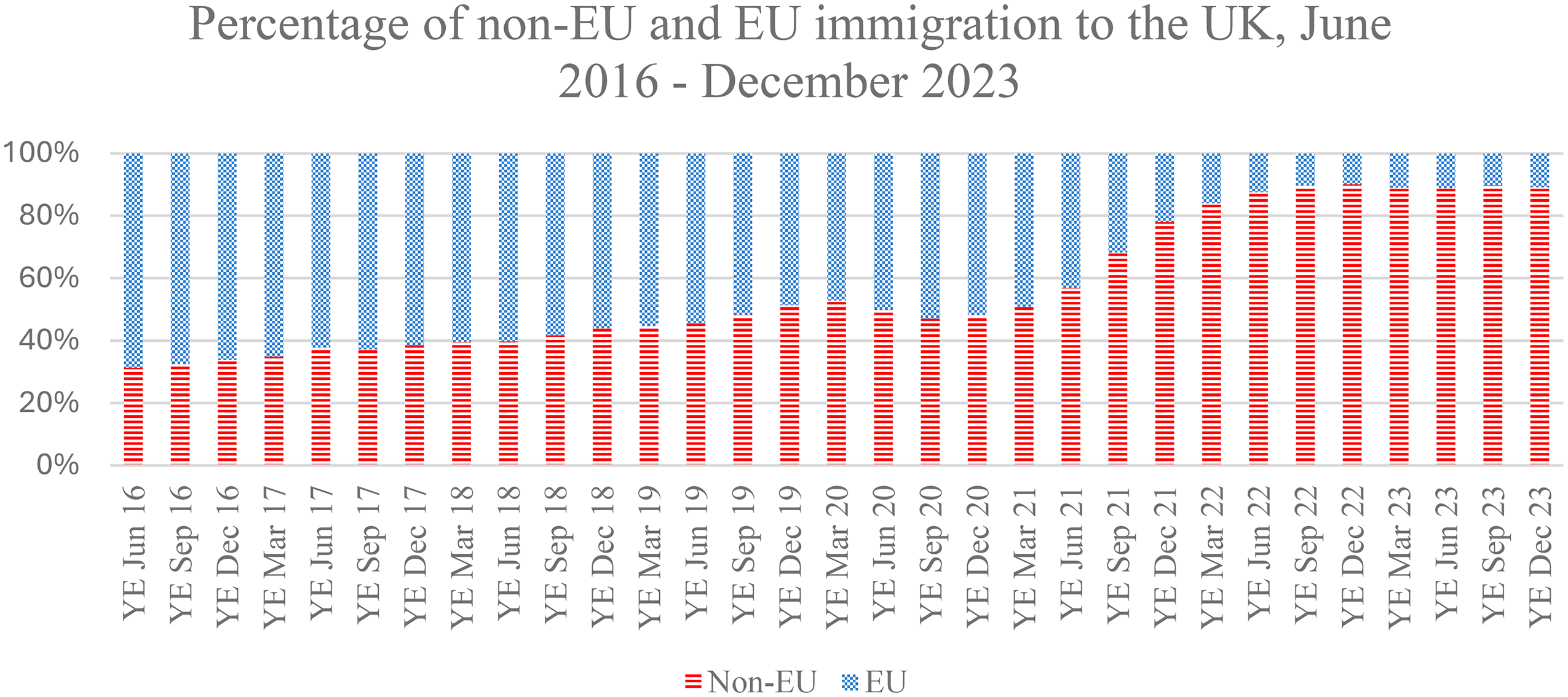
Percentage of Non-EU and EU Immigration to the UK – from Year Ending June 2016–Year Ending December 2023 (ONS 2024).
Since Brexit, migration to the United Kingdom is organized predominantly via two legal pathways, the points-based system — which manages work, study and family visas — and the humanitarian pathway, which includes the asylum system and the ad hoc humanitarian visa schemes introduced post-Brexit. Figure 2 shows the changes that occurred in terms of main entry routes between the years ending June 2019 and December 2023. It records the magnitude and speed of change in non-EU immigration, particularly the rise through work and study pathways and the impact of the bespoke humanitarian visas for Hong Kongers and Ukrainians.
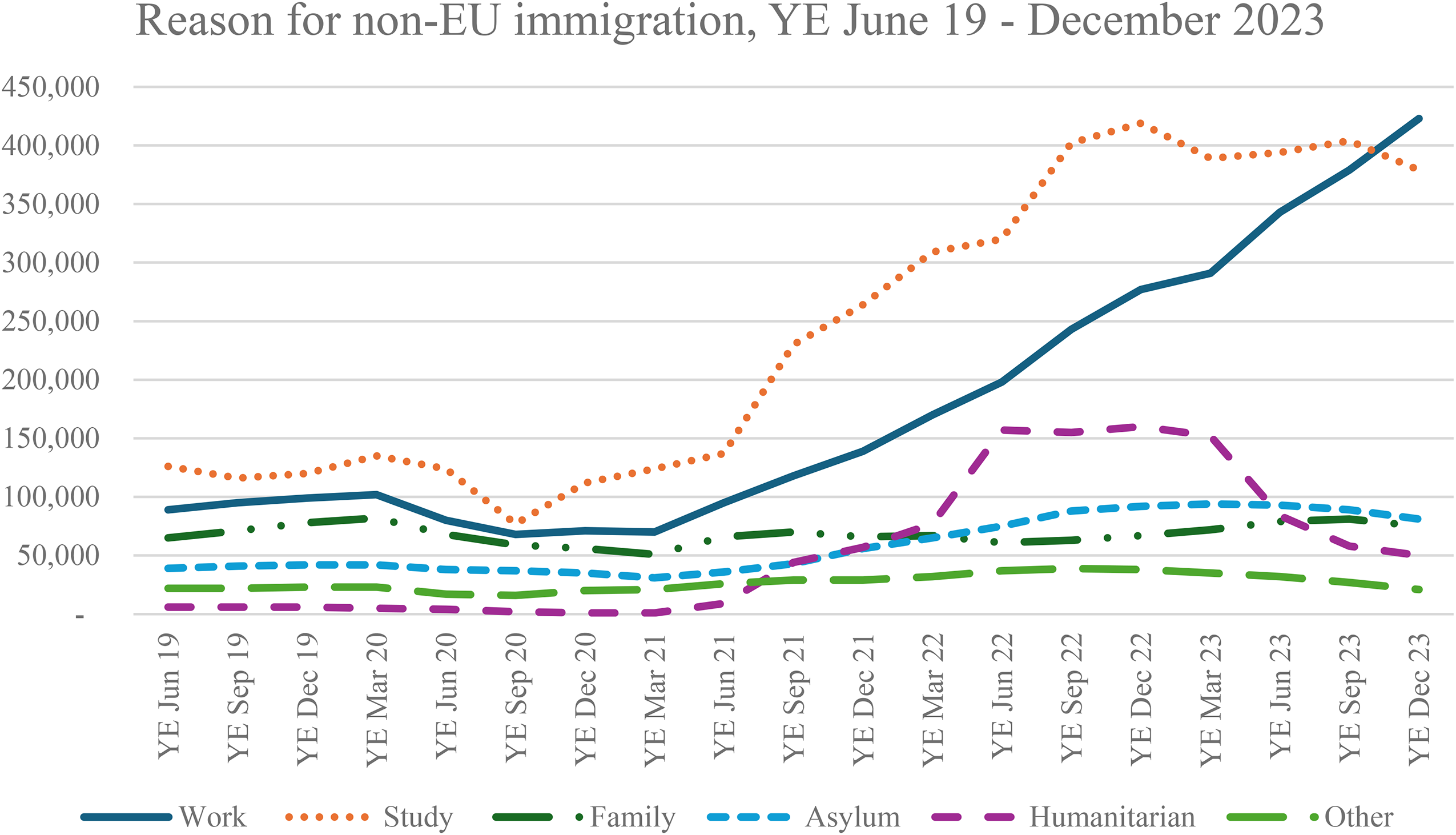
Reasons for Non-EU immigration, YE June 2019–Dec 2023 (ONS 2024).
Rather than the overall reduction in immigration flows that had been both implicitly and explicitly promised during the Brexit referendum campaign, “taking back control” of immigration resulted in a decline in EU immigration, a rise in the number of migrants coming to the United Kingdom from the rest of the world, and a rapid change in terms of where these new immigrants came from and the legal routes they took.
Student visas were one of the two main pathways into the United Kingdom in 2023 (Figure 2). A brief look at the changes that occurred in the population of international students can help us appreciate the magnitude and speed at which immigration flows have changed since Brexit. Similar to the broader pattern identified above in terms of the changing provenance of new migrants, we identify two main contrasting trends when it comes to international students (see Figure 3): (1) the marked reduction in student migration from the EU since the academic year 2021/2022 and (2) a rapid increase in the overall international student population driven by the significant growth in non-EU international students.
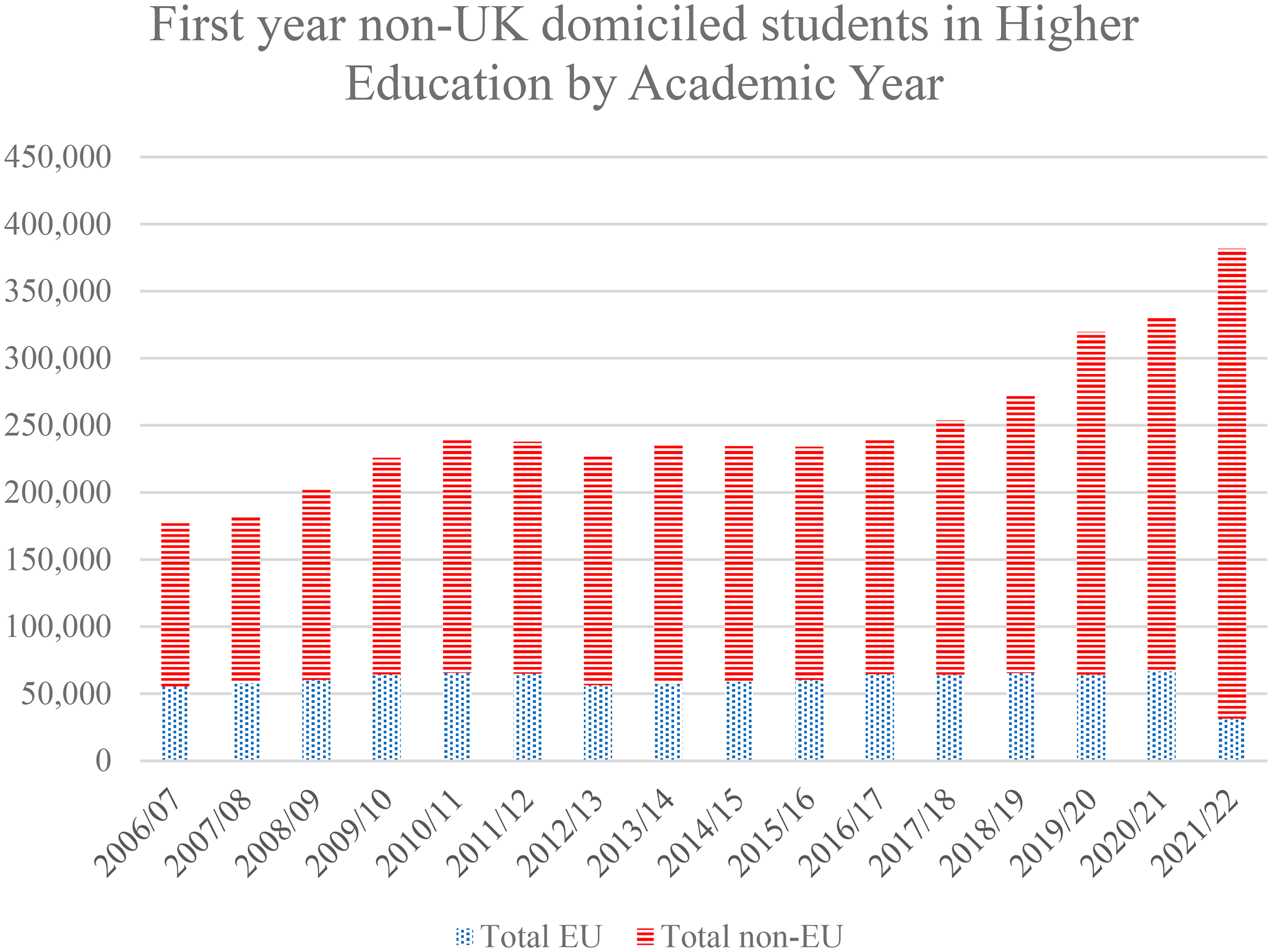
First-Year Non-UK Domiciled Students in Higher Education by Academic Years (HESA 2023).
The timing of the first is significant and linked to changes whereby newly enrolled university students from the EU were no longer charged as “home students” and become subject to the same rules as other international students. This included the need to apply for a student visa, pay higher international fees for their studies, and cover costs without access to UK Government-backed loans. The official figures on new enrolments show a fall of 53 per cent in the number of EU nationals compared to the previous academic year.
The growth in the international student population gained pace after the 2016 Brexit Referendum, with numbers increasing from academic year 2017–2018 (Figure 3). In terms of the overall number of international students, French nationals — ranked at number 15 — are the only EU students who figure in the top 20 nationalities of international students, which is dominated by Indians and Chinese nationals who together account for 50 per cent of international students. 1
The rapid increase in the number of international students was deemed central to achieving the new geopolitical aspirations of the United Kingdom and was negotiated between the government and the UK Higher Education sector. However, seemingly in response to high net migration figures, the government abandoned the strategy (HM Government 2023) leaving the universities exposed to severe financial pressures as a result.
While we have observed a shift in terms of political rhetoric toward a “fairer migration system” open to the “brightest and the best”, the analysis of immigration data shows a re-orientation of immigration flows toward former colonies and Commonwealth partners. This is also evident in the use of visa liberalization, such as the offer of a “free movement” arrangement with Australia 2 , and memoranda of understanding (MOU) on mobility and movement (as in the case of the UK-India MOU, the first such agreement signed following Brexit), which encouraged legal and orderly movement based on historical connections between the two countries (HM Government 2021c), as part of the international trade deals that have been the central components of the “Global Britain” strategy.
Curtailing Access to Asylum, Extending “Safe and Legal (Humanitarian) Routes”
Another major feature of the post-Brexit immigration regime is a shift away from humanitarian protection grounded in the 1951 Geneva Convention and a universal asylum system (i.e., accessible in principle to any person in need of international protection irrespective of their country of origin) toward a more selective approach.
In the preface to the New Plan for Immigration, the former UK Home Secretary Priti Patel stated, We have a generous asylum system that offers protection to the most vulnerable via defined legal routes. But this system is collapsing under the pressures of what are in effect parallel illegal routes to asylum, facilitated by criminals smuggling people into the UK. The existence of these parallel routes is deeply unfair as it advantages those with the means to pay traffickers over vulnerable people who cannot. (HM Government 2021b)
Since Brexit, the UK Government has launched a two-pronged approach that gives them greater control over who is offered protection, while still claiming to meet their international obligations in the arena. On the one hand, this approach designates certain routes of entry as unauthorized, criminalizing those entering the United Kingdom this way and introducing sanctions that include deportation and removal of the right to claim asylum in the United Kingdom. On the other hand, it includes the provision of bespoke humanitarian provisions through a suite of “safe and legal (humanitarian) routes” offered on the grounds of nationality.
The back-story to this is the increased number of people reaching the United Kingdom after risking their lives crossing the Channel — the 30 mile stretch of sea between the United Kingdom and France — in small boats. On 31 October 2022, then UK Home Secretary Suella Braverman announced in a statement to the House of Commons that “an invasion of illegal migrants” was reaching the United Kingdom through this route (HC Deb 2022). Home Office data show an increase in arrivals since the loosening of Covid-19 traveling restrictions and the end of the Brexit transition period, reporting that “small boat arrivals accounted for 44% of asylum application in the year ending March 2023” (Home Office 2023, npg). After Braverman's initial statement in 2022, finding ways to “stop the boats” became one of five main priorities of the Sunak-led Conservative administration. While the tagline has been changed to “smash the gangs” by the incoming labor administration, the securitization of the Channel continues with the appointment of a new Border Security Command (Sigona 2024).
Part of the strategy designed to stop irregular crossings involved plans to criminalize and penalize asylum applicants who enter the United Kingdom without prior authorization. Measures in support of this include restricting the rights and entitlements of successful asylum claimants to the tout-court exclusion from the asylum pathway for irregular entrants in the 2023 Illegal Migration Act and the Rwanda Deportation Scheme which would give the Home Secretary the power to forcibly remove to Rwanda those who enter the United Kingdom irregularly.
This curtailment of access to asylum starkly contrasts with the introduction of ad hoc humanitarian visa schemes for Hong Kong BN(O) and Ukrainians. To date, in excess of 386,000 people have been made beneficiaries of these bespoke humanitarian protections. These schemes offer direct evidence of how foreign affairs have been mediated through the United Kingdom's post-Brexit migration regime.
While the resettlement schemes for Afghanis and Syrians also included in this set of protections predated Brexit, the numbers of people able to take advantage of these were negligible, since eligibility was highly restricted and quotas limited. In total, those arriving through the Afghani and Syrian resettlement schemes constitute only 10 per cent of those granted humanitarian protections since 2021.
What this makes visible is how, since Brexit and in the context of “Global Britain”, “safe and legal routes” have taken on new significance. They have operated simultaneously as forms of migration diplomacy (Adamson and Tsourapas 2019), sending strong signals about the United Kingdom's position on emerging and ongoing international conflicts, and revealed further the shape and scope of the United Kingdom's “Global Britain” imaginaries. This is evident, for example, in the way that the Hong Kong BN(O) visa is presented as evidence of world leadership on human rights, and the characterization of “safe and legal routes” as delivering on the Government's moral and historical responsibilities (Benson and Sigona 2024; Benson, Sigona and Zambelli 2024a, Benson, Sigona and Zambelli2024b).
The Hong Kong BN(O) visa scheme was explicitly launched when the United Kingdom judged that Basic Law — the central pillar of the Handover agreement between the United Kingdom and the People's Republic of China (PRC) on the future of Hong Kong — had been breached by the imposition of National Security Law in Hong Kong SAR. It was driven by the United Kingdom's China Policy and foreshadowed in the Foreign, Commonwealth and Development Office six-monthly reports on Hong Kong. The visa was introduced as part of a suite of foreign policy sanctions against the PRC. It offered an unprecedented route to settlement in the United Kingdom for its former colonial citizens, with no limits placed on the number of people who could apply.
In the case of the Ukraine visas, the UK government initially offered limited concessions to Ukrainian refugees, focusing on those with family ties to the United Kingdom. The Ukraine family scheme, launched on 4 March 2022, was criticized on the basis that it was less generous than the EU's Temporary Protection Directive, and public outcry led to the introduction of two additional schemes, the Ukraine sponsorship and extension schemes. These schemes were uncapped but required sponsorship. Between March 2022 and September 2023, 241,846 visas were granted, mainly to women and children due to Ukraine's martial law reserving men aged 18 to 60 years These visas were part of a broader support package that included military aid to Ukraine, indicating the United Kingdom's stance on the war.
The significant post-Brexit expansion of “safe and legal routes” points to the strengthening in some parts of the British establishment of anti-globalist sentiments, particularly toward rule-based multilateral international institutions and legal frameworks (e.g., the ECHR; UN 1951 Geneva Convention). The presentation of these as alternatives to “unsafe and illegal” routes through which people can claim asylum as per the terms of international conventions, shows how they are in tension with these international obligations.
The HK BN(O) visa does not resemble these other humanitarian protections. It is contingent, inter alia, on an individual being able to pay a visa fee and related costs to access the NHS, support and maintain themselves without recourse to public funds (NRPF) 3 and seek their own housing and accommodation once they arrive in the United Kingdom. Through this status, they have immediate access to the labor market, to the NHS and to education. Yet, their status in the United Kingdom comes at a cost not shared by others entering the United Kingdom for the purposes of humanitarian protection. In contrast, the Ukraine schemes had no fees, included pre-arranged housing and allowed immediate access to work, education, healthcare and welfare benefits. However, the visas were limited to three years with no route to settlement. We briefly highlight the differences between these two schemes to reflect on the ongoing processes of differentiating within the United Kingdom's offer of humanitarian protections. As such, these bespoke provisions offer insights into the entanglement of the biopolitical and geopolitical in the United Kingdom's post-Brexit migration regime.
Presented as evidence of the United Kingdom meeting its international obligations, the total number of beneficiaries of both the Hong Kong BN(O) visa and Ukraine visas substantially inflates the numbers that the United Kingdom claims to be offering humanitarian protections to, at a time when they are also intent on reducing the numbers of those coming to the United Kingdom to claim asylum.
Detention, Deportation and Immigration Enforcement After Brexit
I am determined to end the burden of illegal migration on the British people. That is why we have taken action to stop the boats, return hotels to their local communities, and deter those wanting to come here illegally from doing so. (Rishi Sunak, 2 January 2024)
In this section, we argue that the analysis of these latest trends in the United Kingdom's policy and practice of immigration enforcement is revealing of the distance that exists between the United Kingdom's “Global Britain” aspirations and the reality of its diminished international standing.
Beyond considerations of who can enter the United Kingdom and on what terms, immigration enforcement has also gone through significant transformations since Brexit, notably in the arenas of migrants’ removal and detention. Perhaps the most striking aspect is that, despite the UK government's rampant anti-immigration rhetoric and making “stop the boats” one of its top five priorities, the number of people removed from the United Kingdom remains at a record low, while irregular entries detected, particularly in small boats, have soared since the end of the Brexit transition period (ONS 2024). Figure 4 demonstrates that since Brexit, the United Kingdom has found it more difficult to return “unwanted” migrants to their countries of origin, in terms of both forced and voluntary return. We argue that these trends are the result of a reduction in the United Kingdom's powers to remove, due to a combination of changed legal conditions, geopolitical circumstances and political opportunity.
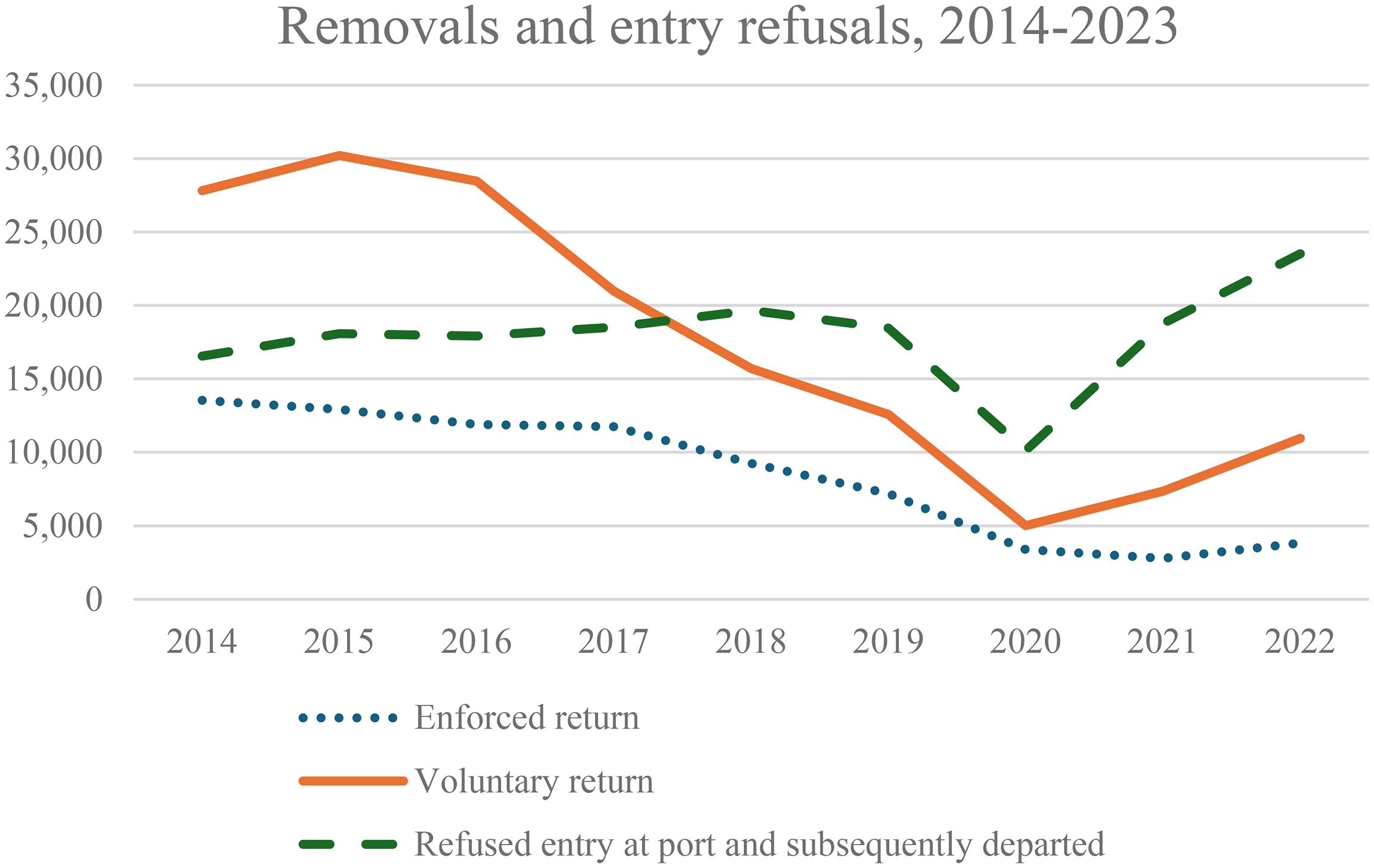
Removals and Refused Entries, 2013–2022 (Home Office 2023).
While refusal of entry at UK borders remains within the control of British authorities, once the unauthorized immigrants are on British territory, their removal to another country relies on close international cooperation and bilateral agreements. As far as forced removal is concerned, the reduction in numbers is indicative of United Kingdom's reduced capacity to negotiate bilateral return agreements with other countries post-Brexit as well as reduced diplomatic leverage. “Voluntary” return does not require the authorization of receiving states, so the decline in removals can be taken, instead, as an indication of how unauthorized immigrants assess the United Kingdom's capacity to persuade them to leave, as well as of the diminished resources given to supporting “voluntary” returns.
Brexit means that the United Kingdom is no longer party to the Dublin Regulation that establishes the criteria and mechanisms for determining which EU member state is responsible for examining an application for international protection. It has also no formal voice in the EU's New Pact on Migration and Asylum and is excluded from “burden sharing” and border control initiatives, including Frontex. 4
Prior to Brexit, participation in EU mechanisms allowed the United Kingdom to return potential asylum seekers to other EU member states if they were deemed responsible as the first port of entry. Since leaving the EU, perhaps unsurprisingly, the United Kingdom has found it more difficult to return asylum seekers and irregular migrants to EU member states (Sigona and Benson 2022) with the exception of France, with whom a bilateral partnership was established via the 2003 Le Touquet Treaty. Negotiating return agreements with third countries and countries of origin is expensive and requires greater trade-offs than when the United Kingdom was part of a large bloc of countries.
When we turn to consider detention since Brexit, juxtaposing the figures on those entering immigration detention in the last decade with the percentage of those who left the country at the end of detention reveals two things. First, while quantitatively the number of people in immigration detention has not changed significantly, the British state's capacity to remove people from the United Kingdom at the end of detention has been negatively affected. In 2013, they forcibly removed 56 per cent of those leaving detention, but only 13 per cent in 2023 (see Figure 5).
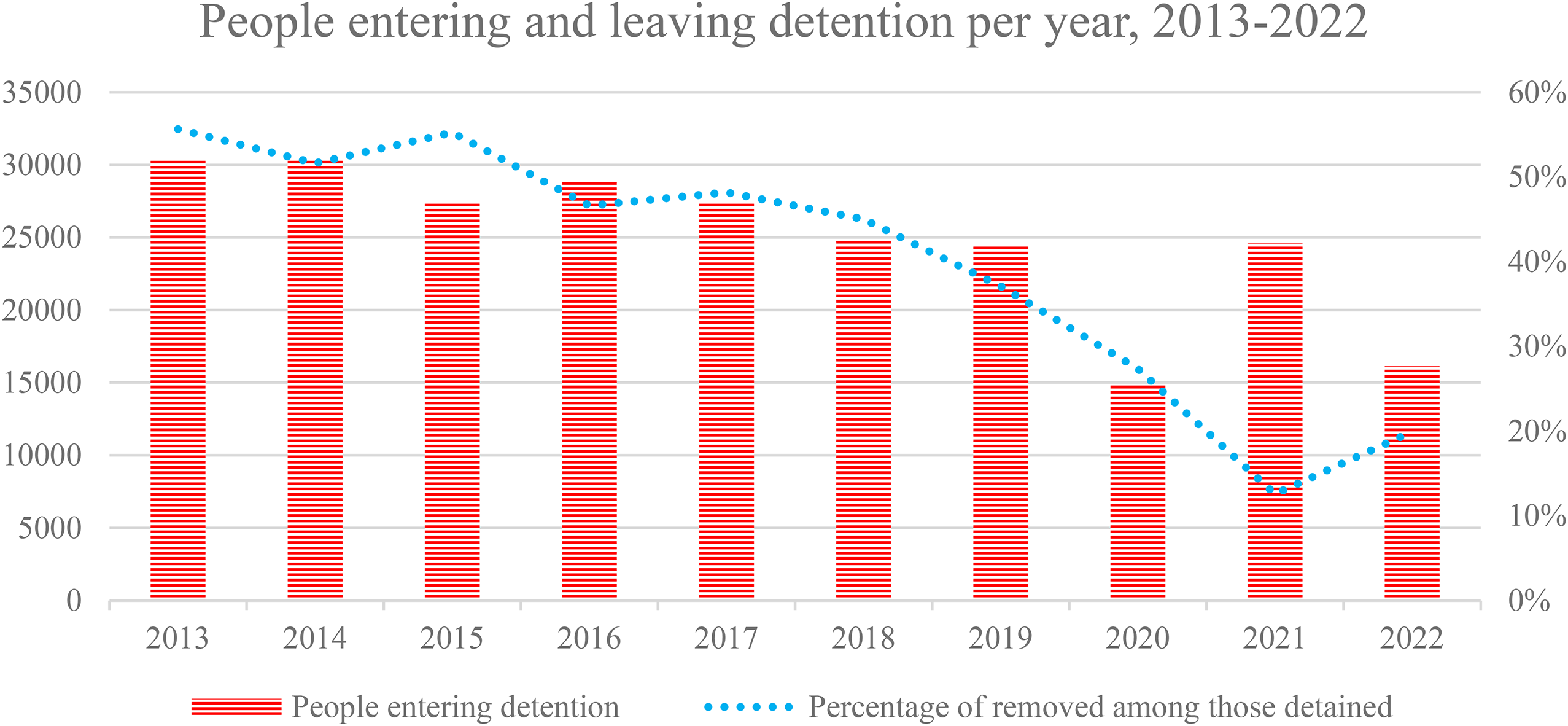
People Entering and Leaving Immigration Detention Per Year, 2013–2022 (Home Office 2023).
Second, a closer look at the population in detention reveals a change in the profile of detainees. Over the past decade, there have been increasing numbers of EU nationals among those entering detention, particularly in the period that followed the 2016 EU referendum. Data also show that EU nationals make up a larger portion of those eventually removed. Figure 6 shows how EU citizens made up almost 50 per cent of those forcefully removed by the United Kingdom in 2022. In 2013, they constituted just over 10 per cent of all of those removed. These figures signal the increased visibility of EU migrants to the immigration control and enforcement apparatus. Interestingly, the removal of EU nationals has become the “easy” target for the Home Office wanting to retain some “tough on immigration” credentials and make a point about the United Kingdom having moved on from the EU. Home Office data also show how this power of removal targets some nationalities, with Romanian nationals disproportionately and consistently more affected by removal orders over the last decade than any other EU nationality (see also Benson 2021a, 2021b).
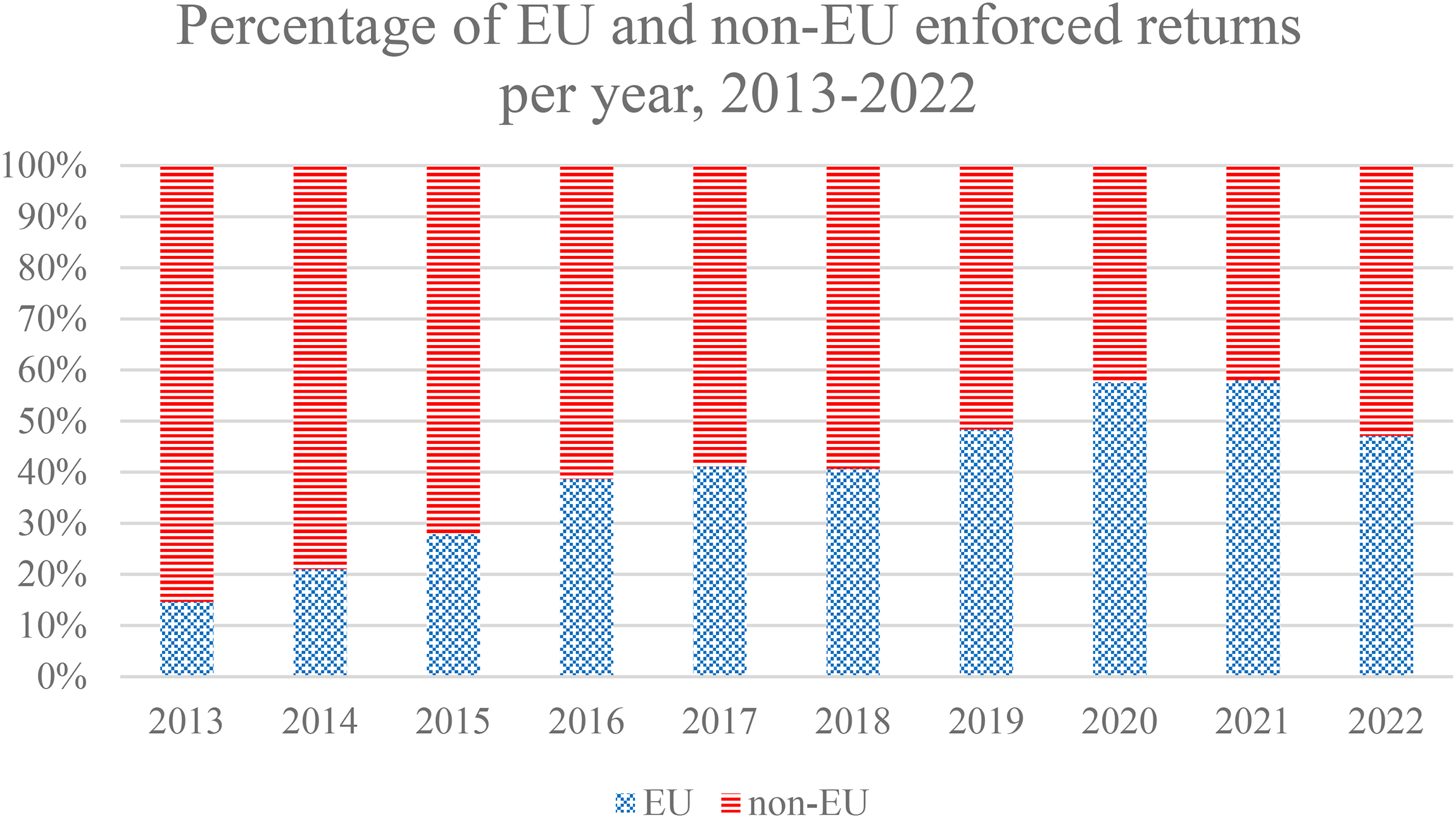
Percentage of EU and Non-EU Forced Removals, 2013–2022.
To overcome the challenges of removal, the Government spearheaded the Rwanda Deportation Plan. Officially named the UK-Rwanda Migration and Economic Development Partnership, this was an asylum partnership deal agreed in 2022 whereby the United Kingdom offered Rwanda £120 million in development funding and agreed to cover the costs of processing charges for each asylum seeker “relocated” from the United Kingdom to Rwanda. It was presented by the UK Government as offering Rwanda greater visibility in the Commonwealth of Nations. In return, provision was made for those who arrive in the United Kingdom through irregular and unauthorized routes to be relocated to Rwanda, where their asylum claims would be heard and, in the case of a positive decision, for the applicant to receive asylum there. They would have no right to claim asylum in the United Kingdom now or in the future.
Speaking from Kigali, Rwanda to announce the partnership in April 2022, then Secretary of State for Home Affairs Priti Patel MP declared this as a “world first” in tackling “illegal migration” at the hands of “evil people smugglers”. 5 The announcement claimed that this was the latest in the United Kingdom's long track record of providing safe haven to those in need, highlighted Rwanda's record of refugee resettlement, and stressed “[I]t is also very much in keeping with our vision for a Global Britain that harnesses the potential of new relationships and stimulates investment and jobs in partner countries”. Adamson and Greenhill (2023) argue that the Rwanda plan was an example of “Transactional Forced Migration”, identifying migration management deals of this kind as a form of migration diplomacy, externalization and the weaponization of migration with historical precedents.
This partnership was blighted from the start. Domestic and international opposition grounded the first deportation flight; multiple legal challenges were brought to court. On 15 November 2023, the UK Supreme Court unanimously upheld the Court of Appeal's judgment and found the government's “Rwanda Policy” to be unlawful. The sitting Government responded by introducing emergency legislation declaring Rwanda a safe country and stating that the policy would not be stopped by the European Court of Human Rights (ECtHR). By the time of the General Election in July 2024, not a single person had been removed to Rwanda. The incoming labor Government immediately announced that the Rwanda plan was to be abandoned with immediate effect.
As we have demonstrated, one consequence of Brexit was the decreased and altered capacity of the United Kingdom to remove unauthorized migrants. We have also evidenced how this changed the geographies of removal and the boundaries of exclusion, with particular nationalities becoming more or less vulnerable to immigration detention and removal. This transformation was produced through the intersection of domestic priorities and discourses on immigration, and changes in external opportunity structures and priorities. In response, the Government sought ways, most notably via the Rwanda Deportation Plan, to sustain the narrative of control over the borders at the heart of “Global Britain” imaginaries, and in this way, laid claim to and sought legitimacy for a revised position on the world stage.
Conclusion
In this article, inspired by Zolberg's notion of “conjuncture” — a specific historical moment at which various social, economic, political and cultural factors converge to create significant shifts in political regimes, social structures or institutional transformations — we have analyzed the interplay of Brexit and migration. We have argued that understanding the re-orientation of migration flows and reforms to the migration-asylum regime — and through this the production of a highly fragmented immigration system in the United Kingdom characterized by bespoke and stratified routes to entry and settlement and differentiated rights for migrants — requires close attention to the specific political and geopolitical conjuncture produced by the Brexit referendum, and the process of political reimagination and geopolitical realignment that followed.
Our analysis of migration flows and migration governance since Brexit reveals a complex process of rebordering, a concept that we intend here to describe the nexus of ideological and geopolitical transformations and the role of migration and migration governance in the consequent making of a new body politic and its “others”. As such, we have made visible how Brexit as a geopolitical project and the “Global Britain” vision that has driven the political reimagining of the United Kingdom shaped immigration and asylum reform, with consequences for who is able to come to the United Kingdom and on what terms. As we argue, an analysis of the changes to the immigration regime, including the expansion of humanitarian protections and changing immigration enforcement practices, reveals the institutionalization of an increasingly selective process of picking and choosing who comes to the United Kingdom, as well as who is forcibly removed and on what terms.
Such close examination reveals the role of migration and migration governance in defining the contours of the newly imagined community of Britain while also capturing the shift that has occurred in the politics of migration, how these mirror the repositioning of the United Kingdom on the world stage and the growing hiatus between the United Kingdom and the EU. The analysis of migration data, however, also reveals the challenges faced by the Conservative Government in realizing its “Global Britain” project and the reality of a diminished international standing that affects, for example, the United Kingdom's capacity to remove unauthorized migrants to their countries of origin or to negotiate deals for offshoring “unwanted” migrants with third countries like Albania — a practice that has echoes in British colonial history.
As we make visible in this article, while the predominant focus of such processes considers what this reveals about the politics of migration, shifts in the United Kingdom's international relations, foreign affairs and global geopolitics are implicated in these processes. They shape what at first seem like contradictory approaches to immigration controls and enforcement. And through these processes, what we are witnessing is the stratification of the protections and rights those with or seeking migrant status can expect. How they came to the United Kingdom, their nationality, the relationship between the United Kingdom and their country of origin, and the United Kingdom's position on current geopolitical struggles are all potential factors in determining where they are positioned in this new hierarchy of belonging.
Why does this matter for migration research? This is a question that we have faced repeatedly in preparing this paper and in our previous research on Brexit and migration. The framework that we have developed in the paper, which focuses on reimagining, repositioning and rebordering through the study of the demographic shift, reform and reorientation of the migration-asylum regime, brought about through a particular geopolitical transformation, has relevance beyond Brexit. Our foregrounding of the intertwined significance and interplay of politics, geopolitics and ideology for the redrawing of borders and processes of bordering offers a novel approach to examining the impact of major social, political and economic transformations on migration and asylum regimes. Other examples might include those geopolitical transformations produced by political and economic crises, such as the European Sovereign Debt Crisis, the Arab Springs, and the repositioning of a nation-state through increased cooperation and integration at a supranational level (e.g., the European Union, the African Union) and in cases of escalating geopolitical conflict and its impact on the movement of people. Such transformations, alongside political imaginings of the body politic and the ideologies that underpin these, shape who immigrates, on what terms and with what outcomes for the migration-citizenship nexus of societies and individuals.
Footnotes
Declaration of Conflicting Interests
The authors declared no potential conflicts of interest with respect to the research, authorship and/or publication of this article.
Funding
The authors disclosed receipt of the following financial support for the research, authorship and/or publication of this article: This work was supported by the Economic and Social Research Council (grant number ES/V004530/1).
