




Abstract
This article examines Russian human service non-profit organisations (NPOs) to investigate the nature of civil society in a managed democracy. Specifically the focus is on emerging vertical ties between NPOs and ruling and governing elites. Drawing on qualitative data collected from health and education NPOs in three industrial regions, we find that in establishing such vertical ties the role of organisations and individuals within is changing – they have moved away from ignored outsiders towards accessing the circles of power and being tasked with managing the boundary between the state and civil society. In exploring these arrangements this article highlights that in the post-Soviet space, NPOs and the state are closely intertwined resembling co-optation. As a result the democratisation potential of human service NPOs is constrained. In discussing these insights we also draw parallels to contexts in which the state has outsourced welfare service to human service NPOs.
Introduction
Traditional approaches to civil society assume a political context that is supportive of both civil society activity and public participation (Hsu, 2010). The Tocquevillian participatory conceptualisation of civil society thus dominates the understanding of this concept (Hayes and Horne, 2011; Muukkonen, 2009; Petrova and Tarrow, 2007). Emphasising the ‘space located between the family and the state’ (Henry and Sundstrom, 2006: 5) it excludes the market (Ehrenberg, 1999) and political parties (Henry and Sundstrom, 2006). Hence, civil society is a societal space or public sphere and is made up of self-organising agents (Henry and Sundstrom, 2006). Civil society is also considered the home for social movements, that is the grouping of various agents for the specific purpose of pursuing political or social objectives (Diani, 1992; Tarrow, 1988). It is these voluntary associations that form the basis for the concern of this study – non-profit organisations (NPOs). Thus NPOs are institutionalised actors within civil society and some can be described as organisations that engage in providing services to a designated constituency (Muukkonen, 2009). They are frequently referred to as human service NPOs (Almog-Bar and Schmid, 2014). However, the participatory nature of NPOs is an uneasy fit when examining behaviours and characteristics in contexts where NPO activity and/or public participation therein is constrained. In such a context NPOs lack public support and refrain from engaging the public often focusing instead on maintaining, rather than challenging or attempting to challenge the state or its agents (Hsu, 2010; Lewis, 2013). In this article we explore the concept of civil society in such a context.
The experience of NPOs in post-Communist countries tests the assumption that NPOs actively seek public participation and encourage associational life (i.e. commonly referred to as the democratising outcome of NPOs (Putnam, 1995)) as a means to hold the state to account or influence public policy. Petrova and Tarrow (2007), studying NPOs in Hungary, highlight how rather than mobilising the public to support their cause, NPOs in this post-Communist context engaged with their peers (i.e. horizontal ties) and with ruling and governing elites (i.e. vertical ties) enabling them to hold the state to account and influence public policy, without soliciting public participation. Thus, Petrova and Tarrow (2007) argue that in a post-Communist context NPOs focus on engaging in ‘ties – enduring and temporary – among organised non-state actors and between them and political parties, power holders, and other institutions’ (Petrova and Tarrow, 2007: 79); a transactional model of civil society. We examine this understanding by focusing on Russian human service NPOs’ vertical ties.
Following the end of Communism, the societies of the successor states of Central and Eastern Europe (CEE) and the former Soviet Union took different developmental trajectories. Pickvance (1998) observed that relatively weaker states and stronger media interests created favourable conditions for civil society development in CEE countries such as Hungary. In contrast, within the Russian Federation conditions were less favourable for civil society development (Pickvance, 1998). Fragmentation of the social movements that contributed to the collapse of the Soviet Union and limited resources emanating almost exclusively from overseas meant that civil society development remained in a holding pattern of under-development (Sundstrom and Henry, 2006). As a consequence, Russian NPOs focused on developing relationships with foreign donors rather than collaboration with other organisations, the Russian state (Jakobson and Sanovich, 2010) or engagement with their constituencies (Salmenniemi, 2008). Furthermore, NPOs faced hostility from the state (Pickvance, 1998) and although there was no direct suppression of NPO activities, the state simply ignored NPOs and any demands made by them (Jakobson and Sanovich, 2010).
After a period of economic turmoil and the ascendance to power of President Putin, a system termed managed democracy, in which the state controls all significant areas of societal activity has emerged (Wegren and Konitzer, 2007) – this ultimately curtailing the activity of Russian NPOs. Charitable donations in the Russian Federation also remain persistently low (CAF Russia, 2014) and so the state has emerged as a vital, and in many cases only, funding source to NPOs encouraging such organisations to contribute to social service provision. At the same time the passing of successive pieces of legislation has effectively outlawed donations from overseas as well as restricting advocacy and protest activities (Crotty et al., 2014; Ljubownikow and Crotty, 2014, 2015). Daucé (2015) terms this development duality of coercion, where the state use regulatory powers to suppress NPO activity, in particular (horizontal) domestic or international cooperation for advocacy or protest purposes and holding the state to account, as well as simultaneously encouraging NPOs to contribute to what it considers the amelioration of social ills. As a result NPOs rely on ties with ruling and governing elites to navigate this complex environment and survive.
Mosley (2012), in examining the impact of state funding of NPOs in the United States, finds that as a result of state funding, human service NPOs have developed working relationships with the state to ensure cash flow. These relationships have also provided NPOs with access to power holders, enabling them to engage not only in service provision but also in advocacy. As advocates both for their constituents and their key issue(s) NPOs can leverage these closer ties and resultant access and thus contribute to public discourse, decision making and hold relevant state authorities to account (Mosley, 2012). Moreover, such relationships often result in key individuals becoming boundary-crossers, moving ‘backwards and forwards across [sector] boundaries’ (Lewis, 2008: 572). Boundary-crossers are engaged in one sector (state or NPO) at a time, yet their frequent movements between sectors enables them to ‘oil the relationship between government and third sector [NPOs]’ (Lewis, 2008: 572). The resultant ties both with the state and the NPO sector provide key individuals within human service NPOs with the opportunity to advocate on specific issues pertinent to their organisational goals, though the literature indicates that this is often on an informal basis (Mosley, 2012; see also Chaves et al., 2004; Jung et al., 2014; Neumayr et al., 2015). Hence, in an established democratic system, ties emerging from closer cooperation between the state and human service NPOs due to resource dependencies, provide such NPOs with a basis to contribute to wider governance, albeit limited to their area of expertise and engagement (Mosley, 2012).
In a democratising context, the literature attributes primacy to organisations that promote (human) rights and are mainly focused on protest or advocacy (Muukkonen, 2009; Petrova and Tarrow, 2007; Tarrow, 1988) and, therefore, often neglects the role human service NPOs could potentially play (Javeline and Lindemann-Komarova, 2010). Rights-focused NPOs tend to be confrontational and are consequently, as in the Russian case, more likely to be closely regulated by the state to negate dissent (Daucé, 2015; Lewis, 2013; Ljubownikow et al., 2013; Robertson, 2009). Conversely, human service NPOs, while almost exclusively reliant on the state for resources are thus less confrontational and likely to have the opportunity to develop ties with power holders. It is the emergence and use of such vertical ties and the operationalisation of such ties by Russian NPOs that this article examines. We ask, how do Russian human service NPOs engage in or establish vertical ties in a managed democracy? Also, what sort of organisational behaviours and responses do these emerging vertical ties encourage? To answer these questions we operationalise data collected from health and education NPOs (HENPOs) in three industrial regions in the Russian Federation. This enables us to deepen our understanding of contextual influences on NPOs and provide a more nuanced insight into the emerging civil society arrangements within Russia’s managed democracy. Before doing so we first give an overview of the development of civil society in the Russian Federation so as to set the research in context. After presenting our research study and empirical findings, we close our article with a discussion and conclusions.
Civil Society Development in the Russian Federation
Contemporary civil society development in the Russian Federation traces its roots to the dissident activities of the environmental movement during the Soviet period 1 (Weiner, 2002). The intelligentsia, staff and students at the Soviet Union’s elite universities, pursued these activities, with no aspirations to become a mass movement, and hence these groups viewed themselves as separate from the public (Mendelson and Gerber, 2007; Weiner, 2002). However, during perestroika, the wider public viewed environmental issues a safe way to campaign against the excesses of central planning (Weiner, 2002). As a result it subsequently became a mass movement and played a key role in the collapse of the Soviet Union (Weiner, 2002).
With restrictions on personal expressions lifted and mirroring other contexts undergoing market-based economic reforms and democratisation (Choudry and Kapoor, 2013), NPO numbers grew rapidly in post-Soviet Russia. However, public support for NPOs dwindled and mistrust between the public and governing elites that had dominated Soviet culture was extended to NPOs (Howard, 2002). In addition, the continuing dominance of Soviet cultural values in political institutions (Hedlund, 2006), as well as in social organisations such as NPOs (Spencer, 2011), meant that the majority of Russian NPOs remained parochial and inward-looking (Crotty, 2006; Mendelson and Gerber, 2007; Spencer, 2011) and uninterested in engaging the wider public. Despite this, and although human service NPOs tend to be more professionalised and managerial (i.e. hierarchical) in nature (Hwang and Powell, 2009), in western democracies their engagement with both the wider public and their constituencies enabled them to behave as agents for their cause, promoting transparency and accountability of the state (Mosley, 2012), if not necessarily of themselves.
However, post-1991 the Russian state ignored NPOs (Pickvance, 1998), which meant that very little domestic state support was available to them. Russian NPOs were thus forced to rely on donations from overseas (Henderson, 2002), as with no tradition of charitable giving, the public failed to offer support to Russia’s emerging civil society. This overseas funding was administered through competitive tendering and resulted in domestic groups adopting the agenda of the donor rather than that of the Russian public (Jakobson and Sanovich, 2010; Javeline and Lindemann-Komarova, 2010). Consequently, rather than focusing on the development of horizontal ties with their peers and engaging the public, Russian NPOs focused on developing (vertical) ties with overseas donors as they were their only consistent funding source (Salmenniemi, 2008).
More recently, the state has attempted to re-nationalise 2 civil society and its agents (Ljubownikow et al., 2013; Robertson, 2009) via the adoption of a restrictive regulatory environment (Crotty et al., 2014; Ljubownikow and Crotty, 2014). These regulatory changes allow the Russian state to scrutinise NPO activity and membership and have placed restrictions on the receipt of overseas funds (Machleder, 2006) with NPOs that are engaged in, loosely defined, political activity and receiving overseas funding now considered foreign agents (Bennetts, 2012). Other regulatory developments affecting NPOs include heavy fines for unofficial demonstrations (Bryanski, 2012) and the criminalisation of libel and increased internet censorship (Lewis, 2013).
Reflecting the duality of coercion approach (Daucé, 2015), the state has stimulated state–NPO interaction by establishing the Civic Chamber of the Russian Federation (Richter, 2009). The Civic Chamber and its regional and local offshoots are portrayed as providing an institutionalised setting for NPOs to raise concerns and represent the interest of their constituencies or clients or hold the state to account (Richter, 2009). The Civic Chamber has also been given the responsibility of administering state funding for NPOs (Richter, 2009). The de-facto outlawing of overseas funding and persistently low donations per head (only 6% of the Russian population made a donation to charity in 2013 (CAF Russia, 2014)) have made resources provided by this channel an important if not the only income source for Russian NPOs. Therefore, we argue that this specific Russian context makes vertical ties increasingly important to NPOs for both obtaining legitimacy and their day-to-day activities (i.e. service provision). However, this does provide them with the opportunity potentially to influence power holders in order to advance the causes and social movement they represent. To examine this proposition we utilise qualitative data collected in industrialised provincial Russia. Before we present our insights, we outline our research study.
Research Study
The cities of Moscow and St Petersburg are said to be unrepresentative of most of Russia (Javeline and Lindemann-Komarova, 2010). Therefore, to capture a better representation of NPOs and their activism in Russia, we base our study in the regional cities of Perm, Yekaterinburg and Samara. All three reflect the industrialised nature of most Russian provincial towns (Federal State Statistics Service, 2010) and are also the capital cities of their respective regions (Oblast’) or territories (Krai), which means a concentration of state authorities and thus power holders. By examining organisations in these three cities it enables us to compare whether political opportunities 3 differ. Therefore, focusing on vertical ties provides us with an analytical lens to establish political opportunities and whether NPOs create protest fields, that is engagement ‘in action opposing formal power arrangements’ (Ray, 1999: 8).
In order to capture vertical ties and to record accurately and probe respondents’ own interpretation of events and behaviours, a quantitative approach was deemed less appropriate (Salmenniemi, 2005). Therefore, we operationalised a qualitative approach to capture the respondent’s own interpretations assisting us in evaluating how respondents understand the institutional environment of their organisations, which are shaping organisational characteristics and behaviours. Data collection was done via semi-structured interviews with key organisational decision makers, via observation of organisational activities and via organisational documentation.
The literature on civil society development in Russia (Sundstrom and Henry, 2006) and idea of transactional activism (Petrova and Tarrow, 2007) informed a semi-structured interview protocol which was translated into Russian for data collection. The interview protocol contained questions such as what projects/activities organisations engage in, whether and how they cooperate with other similar organisations, whether, how and for what purpose they engage with ruling and governing elites. The interview questions were kept as open as possible to ensure that respondents were able to provide an extensive narrative of their organisations modus operandi (Lincoln and Guba, 1985).
The interviews were conducted with leaders/directors of HENPOs. These are mainly middle-aged women (reflecting the feminine nature of human service NPOs observed by Salmenniemi (2005)) with most having at least one higher education degree. As with other Russian NPOs, HENPOs in this study were dominated by ‘democratic centralism’ (Spencer, 2011: 1080), where the leader’s ideas are automatically adopted by full member consent. Hence our study focused on interviewing leaders/directors as their response represents the most relevant opinion to organisational decision making. On average, interviews lasted 45 minutes and were conducted in Russian without an interpreter. To reduce self-reporting bias, interview data were triangulated by observational data (captured in a daily research diary (Silverman, 2005)) and artefacts collected by attending HENPO events (such as flyers, pamphlets and published material).
HENPOs were initially identified using web-based resources as well as through the assistance provided by partner universities in Perm, Samara and Yekaterinburg. In order to select organisations purposefully (Siggelkow, 2007) for this study, NPOs were screened for their objectives and whether or not they understand themselves as social organisations (i.e. obshchestvennyye organisatsii – a commonly accepted term used by both HENPOs and the Russian state to classify NPOs). An initial list of 35 organisations was extended using local phone directories and the snowballing technique, with the latter also providing insights about interaction between NPOs. The study had 80 participating organisations across the three regions with 49 providing health-related services, 25 providing educational service, one organisation providing both and five organisations providing infrastructure service to HENPOs, such as, for example, access to office space.
For analytical purposes all interviews were transcribed and translated simultaneously into English, calling on the skills of native speakers wherever discrepancies arose. The interview material was coded inductively. As the interview transcripts were read and reread in the coding process, new codes emerged and existing codes were adjusted (Charmaz and Mitchell, 2007). Codes carried labels such as ‘activities of NPOs’, ‘interaction with other NPOs’, ‘collaboration with other NPOs’, ‘interaction with state authorities’, ‘collaboration with state authorities’ or ‘access to state authority X’. These codes were brought together to form emerging themes, which described the characteristics of vertical ties and behaviours of HENPOs (i.e. engagement in vertical ties, engagement in horizontal ties, operationalisation of ties).
To ensure reliability, the emerging codes were discussed with field experts (academics with extensive knowledge of the development of Russian civil society) who helped to reduce ambiguities. This enabled the grouping of the evidence according to the similarity of the respondents’ discourses and geographical locations forming a basis to compare any differences from and similarities to how HENPOs engage in vertical ties. The discussion that follows explores these aspects using narratives from these interviews.
Findings
In reviewing the data, we find that HENPOs’ behaviours are indicative of aspects of the transactional model of civil society observed by Petrova and Tarrow (2007). While our data indicate that Russian HENPOs lack engagement with horizontal ties, respondents focused their engagement on power holders and thus build vertical ties. Institutionalised contact points such as the Civic Chamber have led to the emergence of myriad roundtables (kruglyye stoly) or committees (Richter, 2009) and have facilitated this process giving HENPOs access to state structures (Jakobson and Sanovich, 2010).
In reviewing the respondents’ narratives we find that there were some regional differences in HENPOs’ portrayal of how relationships with governing elites were established, their outcomes and the assessment of these developments. This is suggestive of differing political opportunities within these regions, particularly when comparing Perm Krai with Samara and Yekaterinburg Oblasti. In presenting HENPOs’ engagement in vertical ties we also highlight that these did not create protest fields in which such organisations could engage to hold the state to account (Ray, 1999). Instead narratives were dominated by the phenomenon of sucking in. Sucking in occurred when key individuals within HENPOs were incentivised to deploy their expertise within the state apparatus. However, sucked in individuals would also retain a role within their HENPOs thus spanning and blurring the boundary between civil society and the state. We present these findings in more detail below.
Vertical Ties of HENPOs in Yekaterinburg
In reviewing the data from HENPOs in Yekaterinburg we found that respondents engaged in various roundtables and committees organised by the state. Some highlighted that as a consequence they had been sucked in to ‘work for the state’ (Respondent 49, Org01Yek; Respondent 51, Org03Yek; Respondent 61, Org11Yek; Respondent 62, Org12Yek). This resulted in the acquisition of ‘a desk in the state administration’ (Respondent 51, Org03Yek), acting as regular consultants or as ‘an expert with the department of education’ (Respondent 52, Org04Yek), providing ‘advice as an expert’ (Respondent 49, Org01Yek), or working in close physical proximity with state agencies – ‘our office is down the corridor from the department of social protection’ (Respondent 75, Org26Yek). Further, respondents outlined that their government role overlapped with their organisational role. Respondent 51 (Org03Yek) indicated that part of her role was to oversee accessibility regulations for public buildings throughout the city. At the same time, a key objective of Org03Yek was to promote and ensure accessibility to public buildings and spaces.
However, rather than considering this as compromising the organisation’s ability to monitor the state’s policy adherence, Respondent 51 considered this as a ‘good way to collaborate with the state’ (Respondent 51, Org03Yek). Others also reflected this, highlighting that such a set-up ensured that ‘when we work with the state, it is always a win–win’ (Respondent 52, Org04Yek) and ‘[we] make friends in the administration’ (Respondent 79, Org30Yek).
Respondents also illustrated the operationalisation of emerging vertical ties to secure resources. For example, Respondent 52 (Org04Yek) stated that her government role meant that they could access premises from which to run her organisation, ‘many old nursery buildings were in decay, [and subsequently] we were given this building here [by the state], which we refurbished with money from sponsors and the state’. Org04Yek now uses this building as a base for their work with children with mental health needs. Similarly, Respondent 65 (Org16Yek) illustrated how her organisation was unable to pay staff a wage. As a result of her participation in state-run committees she was able to convince state authorities to ‘hire me and the organisation’s other employees’ (Respondent 65, Org16Yek). Now all staff were employed full time by the state while they ran their HENPO promoting physical activity among children with learning difficulties. Both Org04Yek and Org16Yek indicated that, without these ties, their HENPOs would not be ‘helping all these children’ (Respondent 52, Org04Yek) or continue ‘enabling such children to do physical activity’ (Respondent 65, Org16Yek).
Others who highlighted being sucked in stated that they could also use these ties to secure government ‘support’ (Respondent 60, Org11Yek) without which ‘it will be difficult for us to do our work’ (Respondent 81, Org32Yek) or ‘talk to the people that could help [them do their work]’ (Respondent 64, Org15Yek). Thus, by being sucked in, these individuals ensured that organisations continued their day-to-day activities and building these vertical ties helped to ensure their organisation’s future.
The sucking in narrative of respondents, and their lack of operationalising the emerging vertical ties for dissent, mirrors the process of co-optation in particular limiting and managing dissent by bringing challengers into the governance system (Coy, 2013). However, rather than seeing it as co-optation, respondents saw this process as a way of aligning their organisation’s objectives with that of the state. Thus respondents understood themselves in a dual role – spanning and indeed managing the boundary between civil society (i.e. what their organisation does) and the state (i.e. what the responsibilities of the state are) rather than achieving full insider status (i.e. shaping state policy). However, while it allowed organisations to engage with the state and thus created potential opportunities for influence, it simultaneously reduced their potential fields of protest (i.e. opposing formal power arrangements (Ray, 1999)). It was therefore difficult for a Russian NPO of any type to protest state policy that it has been a part of delivering. Respondents in Samara Oblast’ expressed similar narratives.
Vertical Ties of HENPOs in Samara
HENPOs in Samara replicated the accounts of respondents in Yekaterinburg in so far as they demonstrate the sucking in narrative. Respondent 19, for example, was responsible for the implementation of the city’s youth programme and policies as part of her role in the state: ‘I do not work here all the time [in this HENPO]. I work for the state and I focus on the development of youth policy’ (Respondent 19, Org20Sam). Org20Sam worked on the same issues with their objective being ‘improving the life of children’ (Mission Statement, Org20Sam). Similar to Yekaterinburg, the nature of the roles of sucked in individuals made it difficult for them and their organisation to protest formally state policy – they had become an extension of it. In the case of Org20Sam, to criticise state youth policy would in effect be criticising the work of their organisational leader, thus restricting the fields of protest such organisations could participate in. Other than in Yekaterinburg, HENPOs highlighted the attendant benefits of being in charge of managing the boundary between NPOs and the state. These were in the form of cooperation or collaborative activities and included closer ‘contact to the department’ (Respondent 15, Org16Sam), increased ability to ‘cooperate with the state’ (Respondent 3, Org03Sam) and to ‘work with state institutions’ (Respondent 22, Org21Sam). Respondents also considered having key decision makers sucked in from HENPOs as a way of building cross-sector partnerships or collaborations: ‘Without between sector interactions you would not survive a day, so we build good relations with the regional powers. These relations are constructive because we offer services and programmes, which they [the state] accept and support’ (Respondent 1, Org01Sam).
An attendant benefit of these arrangements provided access to resources such as ‘office space’ (Respondent 1, Org01Sam; Respondent 2, Org02Sam; Respondent 3, Org03Sam; Respondent 14, Org15Sam; Respondent 23, Org24Sam). In turn this enabled HENPOs to work ‘closely together with the government authorities’ (Respondent 05, Org05Sam). These closer ties provided individuals with opportunities to engage policy makers, highlighting how they not only sucked in or co-opted but were able to negotiate and manage the boundary between state and civil society. Therefore, HENPOs in Samara viewed this as a ‘positive development’ (Respondent 4, Org04Sam). They could utilise vertical ties with the state to support their work. They also perceived being sucked in as a way to engage with the state, that the state now ‘listens to our problems’ (Respondent 15, Org16Sam) and showed ‘appreciation’ (Respondent 19, Org20Sam; Respondent 9, Org09Sam).
The Samara narratives highlight that by being sucked in, NPOs might be co-opted to serve as agents for the state, but they are also able to better navigate Russia’s institutional environment and are even in a position to make their issue heard by relevant authorities. Hence, sucked in individuals are responsible for managing the boundary between the state and civil society agents. In so doing, the sucking in narrative reflects a process of political socialisation (Fillieule, 2013) turning respondents from ignored outsiders into appreciated insiders (Jakobson and Sanovich, 2010). However, as in Yekaterinburg, this development limited organisations’ potential to protest. In contrast, respondents in Perm Krai had a more critical assessment of these developments.
Vertical Ties of HENPOs in Perm
HENPOs in Perm also reflected the sucking in narrative constructed by those in Yekaterinburg and Samara. However, unlike their counterparts, HENPOs in Perm expressed unease at the potential outcomes: ‘I think the danger is that an elite of HENPOs is emerging. As a result, the state will only interact with them and other organisations will have no chance to work with the state’ (Respondent 37, Org12Per). Resonating with this statement, other HENPOs feared that sucking in was a double-edged sword, positive for those that were able to establish vertical ties and access resources and negative for those that missed out. Informal probing of what organisations would benefit positively from such civil society arrangements led to the consensual suggestion that individuals from HENPOs, in particular those working with children or the disabled, were more likely to be sucked in than those from organisations dealing HIV/AIDS or drug abuse (Respondents 25, 30, 37, 43, 45, 48). As a result, HENPOs from which individuals were sucked in might become supporters or legitimisers of state policy (Cook and Vinogradova, 2006). Thus, as observed in similar contexts, this contributes to the legitimacy of current power arrangements rather than challenging them (Hsu, 2010; Lewis, 2013).
In Perm, HENPOs also illustrated that the interest of the state was not with the organisation, as the narrative of respondents in Samara and Yekaterinburg suggested, but targeted at specific individuals (who possess some specific human capital or expertise): ‘They [the authorities] look for the key decision makers in civil society and then work with us to develop the third sector so it can do what it needs to’ (Respondent 45, Org20Per). This was a sentiment shared by respondents that had not been sucked in. They perceived that ‘the administration only works with the organisations they like’ (Respondent 31, Org07Per), specifically those organisations that did not explicitly challenge the state. Moreover, organisations that had access to the state were viewed as part of the state structure and so had lost their ‘connection with the public’ (Respondent 42, Org17Per).
The narrative of respondents in Perm suggesting that sucking in focused on individuals rather than organisations demonstrates a selective co-optation of individuals. Like in Yekaterinburg and Samara, the co-optation increased opportunities for the sucked in individuals to informally, via vertical ties, advocate for their cause, but it also reduced their, and their associated organisation’s opportunities to protest formally. Thus the sucking in narrative leads to a more silent (i.e. informal) way of protesting, a development that has also been observed during so-called NGOisation processes elsewhere; that is, the professionalisation and institutionalisation of social action (Alvarez et al., 1998; Choudry and Kapoor, 2013; Lang, 1997).
Despite the more apprehensive assessment of the sucking in development, HENPOs in Perm were also required to liaise, collaborate and integrate more closely with power holders. Hence across all three regions the experience of HENPOs and key individuals reflects civil society arrangements dependent on vertical ties rather than mobilising the public. We now turn to discussing the insight from all three regions and its meaning for civil society development in the Russian Federation.
Discussion and Conclusion
In this article we set out to examine NPOs in a managed democracy. In illustrating Russia’s managed democracy we demonstrate how this encourages civil society arrangements where NPOs are required to develop vertical ties with power holders. In order to be able to exist and participate in civil society we show that HENPOs now see themselves as sharing their ‘professional approaches’ (Respondent 49, Org01Yek), skills and expertise to help the state in addressing societal problems. In turn this facilitates the emergence of vertical ties, which respondents illustrate as facilitating access to resources and bestowing legitimacy. However, in order to encourage the sharing of expertise, the state sucks in key organisational decision makers. Consequently, these individuals become what we term boundary managers responsible for managing the boundary between civil society (i.e. what their organisation does) and state (i.e. the activities of the state in their organisation’s area of activity). The concept of boundary managers extends our understanding of Lewis’s (2008) boundary-crossers concept into a managed democratic setting. Thus we define boundary managers as individuals responsible for shaping, articulating and overseeing the boundary between civil society and the state in this managed context.
These sucking in processes are reflective of co-opting and to some extent professionalisation processes observed in other contexts, which have seen an increased reliance on government funding. 4 In the Russian context it reflects the changing of principals, which are co-opting Russian civil society. With the state’s duality of coercion approach, encouraging participation to alleviate social ills (Jakobson and Sanovich, 2010), and provision of relevant resources, NPOs are now co-opted by the state. This mirrors Chourdy and Kapoor’s (2013) argument that NPOs and civil society remain a contested area. As respondents in Perm indicate, it empowers some individuals active within civil society and sidelines others. Under the Russian state’s current agenda it also redefines NPOs as being mainly service delivery agents, and doing this in collaboration with rather than against the state. At the organisational level, this effectively encourages the reinforcement of democratic centralism in organisations where boundary managers reside. Sucked in individuals will see their internal organisational power base increase even further as they are now even more important with regards to accessing resources. Thus the emergence of boundary managers in managed democracies highlights that it is more important to be represented in relevant state structures rather than mobilising the public. This mirrors processes of professionalisation and NGOisation elsewhere where NPO activity becomes less about politics and more about efficiently addressing social problems (Alvarez et al., 1998; Choudry and Kapoor, 2013; Lang, 1997). Therefore, the experience of Russian NPOs contributes to the emerging question in civil society literature about whether NPOs can be drivers of democratisation. The Russian context shows that they are all too easily co-opted, moulded and restricted – be it by a political regime as demonstrated in this article, forces of neoliberal ideology as observed in the global south (Alvarez et al., 1998; Choudry and Kapoor, 2013) or resource dependencies and staff professionalisation driving hybridisation processes with NPOs losing their associational nature (Billis, 2010) in developed democracy contexts.
The insights provided in this article provide an indication of the role of human service NPOs in managed democracies which is more reflective of a transactional than a participatory model and which we summarise in Figure 1.
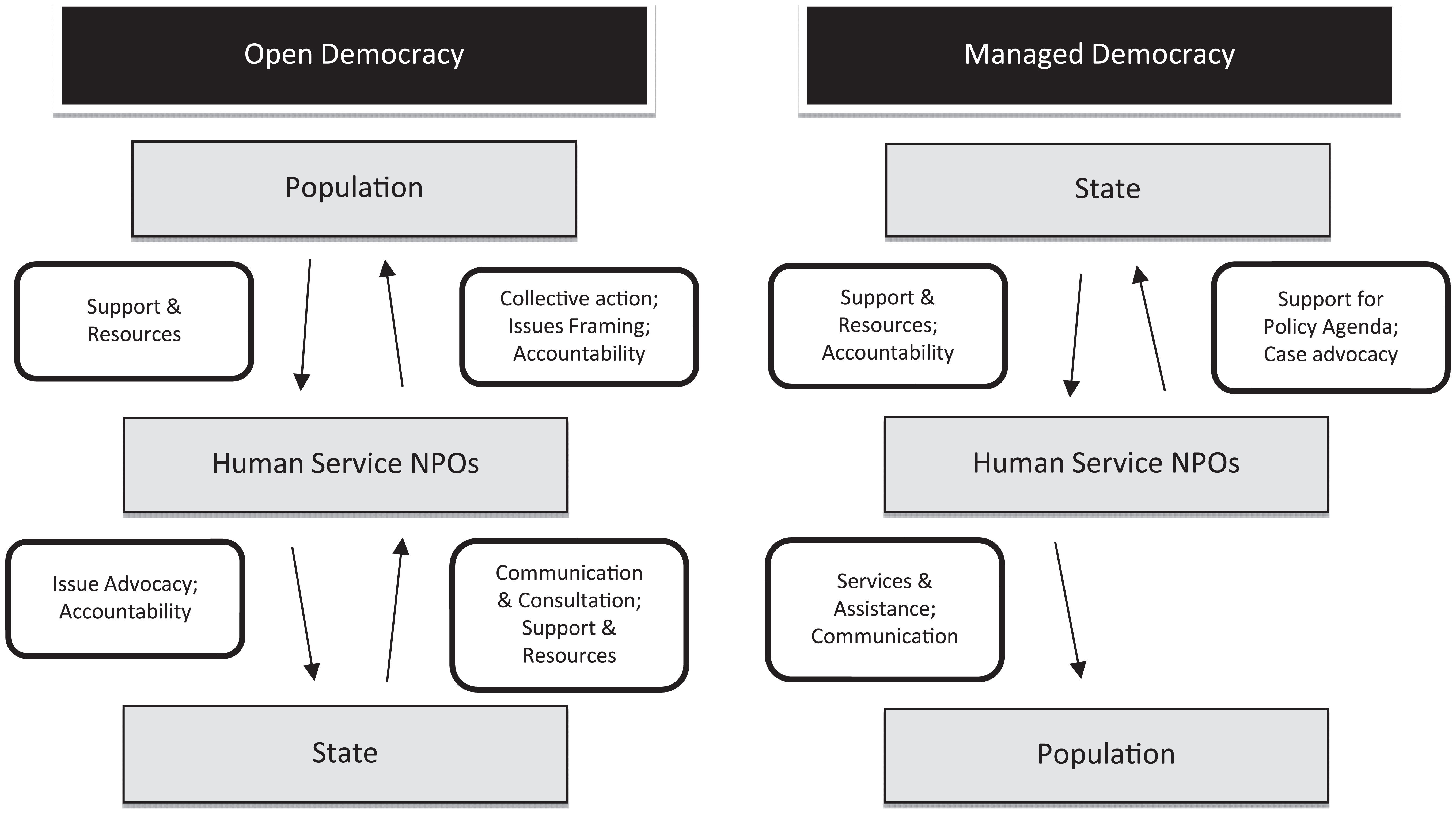
Civil society arrangements in a managed democracy.
Although dependency on government resources and professional staff has turned NPOs into more hybrid organisations (Billis, 2010), in an unmanaged democracy, human service NPOs still have diversified income streams with often the public providing a consistent and important part of their required resources (Mosley, 2012). In Russia’s managed democracy, where public support for NPOs remains constrained, the state is the only source of consistent funding. Whereas, despite resource dependencies, human service NPOs are able to challenge the state’s policy agenda in an unmanaged democracy (see Chaves et al., 2004; Mosley, 2012; Neumayr et al., 2015 for an illustration that state funding does not necessarily restrict NPOs’ political or advocacy activity), in a managed democracy human service NPOs become purveyors of that policy agenda (see also Lewis, 2013 on the role of NPOs in restrictive/authoritarian political regimes) but also address social ills by providing services. In providing services, NPOs still bridge between the individual and the state and in some cases substitute the state to address the socio-economic needs of marginalised groups (Lewis, 2013). Thus, human service NPOs are allowed to exist because they carry out an important social function the state is unwilling or unable to carry out (Hsu, 2010; Uphoff and Krishna, 2004). It seems that even Russia’s managed democratic state considers NPOs as a panacea for its social problems (Choudry and Kapoor, 2013), which should provide such organisations and boundary managers with political opportunities. However, as the arrangements illustrated here are still emerging, capitalising on these political opportunities to advance the interest of their constituencies will take time. In the longer term this could enable Russian HENPOs not only to build fruitful vertical ties with governing elites, but also, as many respondents hope, facilitate ‘change from within’ (Respondent 32, Org08Per). Thus in the longer-term, boundary managers may be able to carve out broader campaigning opportunities for their organisations (Newman, 2012) as a result.
Nevertheless, there were also similarities between human service NPOs in managed and other contexts, particularly western democracies with the organisation in the latter contexts increasingly providing welfare service outsourced by the state. Choudry and Shragge (2011) note that the subsequent professionalisation of, and focus on vertical ties (see Mosley, 2012) by such organisations can temper their appetite for dissent turning them into parts of the state’s governing arrangements. Hence sucking in mirrors a form of ‘regulation and containment of interest representation’ (Choudry and Kapoor, 2013: 1) contributing to the institutionalisation, depolitisation and demobilisation of social movements (Choudry and Kapoor, 2013). This then leaves rights-focused NPOs as the sole agents that will hold the state to account often through protest and other more direct methods.
The data presented in this article indicate that the re-assertion of control by the state over Russian civil society has solicited organisational responses that have reshaped this particular organisational field. A civil society that during the earlier part of transition was separated, neglected and ignored by the state is now, where it poses no threat to the state, closely intertwined. This outcome reflects the duality of coercion approach by the Russian state (Daucé, 2015) and institutionalised civil society in more restrictive and authoritarian contexts (Lewis, 2013). The current resource dependency arrangements (i.e. power distribution) and the undemocratic nature of NPOs themselves (i.e. reflective of current political culture) ensure the maintenance of a political field (Ray, 1999) where opportunities for protest are limited.
Our conclusions have to be seen in light of the limitations of this study. Our study provides an insight into the behaviours of human service NPOs in two types of industrial regions (i.e. Krai and Oblast’) and is thus not directly representative of those in more rural and less industrial regions, the urban centres of Moscow and St Petersburg or regions, which enjoy more political autonomy. Furthermore, a larger sample, different methodological approach and different sectors may have pointed to different illustrations of organisational and key individuals’ behaviour and their narratives. In particular future research will need to focus on NPOs, which are less resource dependent on the state. Nevertheless, our results do show a strong relationship with the extended literature of civil society in Russia (Crotty, 2006; Henry, 2006; Jakobson and Sanovich, 2010; Spencer, 2011; Sundstrom and Henry, 2006) and thus a potential basis for understanding civil society in the Russian context.
Thus, notwithstanding its limitations, our article makes two key contributions to the discussion of the concept of civil society. First our article contributes to the question of what civil society is in the post-Socialist/post-Communist context. We show that in Russia, active, reasonably well-funded human service NPOs are now intertwined with the state. This reflects the traditionally more (inter)dependent institutional arrangements found in other transition states including many of the Central Asian Republics and China (Richter and Hatch, 2013). In such a context we conclude that we require a different model to understand prevailing civil society arrangements (see Figure 1). Second, our article contributes to the discussion of civil society in restrictive contexts. As illustrated at the onset of the article, human service NPOs have the potential to contribute to the democratisation process by holding the state to account within their area of expertise (Muukkonen, 2009). However, Lewis (2013) suggests that in such restrictive contexts civil society agents do little to contribute to further democratisation as they lack public engagement, horizontal cooperation and reflect dominant political culture. Our findings dovetail with this assertion. However, our study highlights the need to understand NPOs’ use of vertical ties and whether it enables NPOs to work the spaces of power (Newman, 2012). In the Russian case, although sucking in individuals is reflective of co-optation by the state, as boundary managers these individuals are put in positions that may in the longer term provide them with the potential to work the spaces of power.
Footnotes
Acknowledgements
The authors would like to thank the Sociology editorial team and in particular Professor Sophie Watson and the two anonymous reviewers for their thoughtful, detailed and developmental comments.
Funding
This research received no specific grant from any funding agency in the public, commercial or not-for-profit sectors.