




Abstract
This article builds on Hillcoat-Nallétamby and Phillips’ (2011) conceptualization of sociological ambivalence within the relational framework to examine a particular consumption practice, the funeral. We develop understanding of social, cultural and relational issues that arise from the experience associated with funeral-arranging. This is not a voluntary behaviour but one engaged with through force of circumstance and which involves commercial and relational decisions. Drawing on data from 10 interviews from a larger UK study, we focus on ambivalence surrounding choice and its impact on relations, showing how sentiments including love, obligation, regret and revenge evolve and transform past and future relationships.
He didn’t talk about his funeral, he was slightly jokey I suppose, oh just have a party sort of thing……When I had to say what clothes, that was just ridiculous and actually he was so unconcerned about clothes so I just got a clean shirt trousers, socks and it was just a bit funny.
Introduction
The quote above came from an interview with Anne talking about the death and funeral of her partner five years previously. To begin, she presented her dying partner as expected to be involved in a process that he could only feel ambivalent about. She then expressed incredulity regarding the cultural norms of dressing the dead for a partner not interested in clothes. The dying person’s ‘slightly jokey’ suggestion to have a party reflects Merton’s (1976) account of a socially structured role, albeit one we play only once, that expresses simultaneous acceptance and rejection of a particular social norm, behaving well in the face of death. Similarly, the participant’s reaction recognizes the irony of following the expected norm of clothing the dead for someone unconcerned as to what he wore when alive.
In this article, we apply theories of ambivalence to a particular consumption situation, the funeral. Our aim is to show how sociological ambivalence can reveal and explain some of the complexities of this consumption practice. Funeral-arranging involves commercial and relational choices, even if these are through force of circumstance. Unlike many other consumer decisions where ambivalence would not be an issue, the funeral involves multiple social complexities alongside this array of choices. Our article does not make normative conclusions regarding ambivalence, rather the descriptive research illuminates how this is manifest in funeral consumption. For example, if not previously specified by the deceased, members of their social group are often unsure of the deceased’s funeral wishes. This creates problems for which solutions are not always satisfactory. Individuals are faced with situations often inherent in the social and/or cultural structure of the ritual that they find difficult, or which seem inappropriate or even anomalous to the personality or experience of the deceased or the mourners. In this study, participants discussed conflicts among the bereaved that in some cases left them with ambivalent feelings about their own role in the funeral, towards others taking part or attending the funeral, the nature and organization of the ceremony, and in some cases the deceased themselves. Participants expressed ambivalence sometimes as a result of uncertainty in terms of what they ‘should’ do, either determined by what they considered the deceased would have wanted or because of the influence of existing social structures or cultural traditions and how they and others felt about or interpreted them.
While ambivalence has a long history in psychology and sociology, its exploration and application within the context of consumer research has been limited (Celsi et al., 1993; Otnes et al., 1997; Sherry et al., 1993). Sociological research into ambivalence in areas such as family relationships, social structures and role theory are, however, potentially useful in contributing to understanding how individuals deal with the norms and social roles they enact in the context of consumption. Although we recognize the legacy of psychological research (Bleuler, 1950; Freud, 1918; Smelser, 1998), in this article, we draw from sociological examinations of ambivalence to understand experience associated with organizing a funeral. This is a very particular type of consumption, but one which most individuals will experience in their lifetime.
The article draws from recent research on the relational approach to ambivalence (Hillcoat-Nallétamby and Phillips, 2011) and is broadly structured as consumption because we focus on ambivalence revolving around choice and its impact on relations. The article begins by introducing consumption before considering aspects of sociological ambivalence of relevance to understanding the funeral ritual and then the importance of multilevel relations in terms of decisions and choices made. The descriptive analysis of our research findings is presented in three sections. Firstly, we examine issues around ambivalence that arise from power and choice, the outcomes of cultural and social expectations or requirements are then explored, and finally, we consider the relational ambivalence revealed by participants arising from the previous themes and the relations with the dead and the living.
Sociological Ambivalence and Consumption
In this study, we use a view of consumption taken from sociology (Edgell et al., 1997) where social relations are seen as shaping the experience of consuming with the social construction of the consumer being a consequence of these processes. Therefore, our focus is on the shaping of the consumption experience rather than the technicalities of funeral decisions, such as choice of funeral director or service. From a consumption perspective, one of the most important attributes of ambivalence is that it is intrinsically multi-vocal. Levine (1985: 8) referred to ‘the ambiguities of life’ as being underrepresented but that man has an inherently ambivalent disposition and society requires some discordance to ‘attain a determinate shape’. In a consumer culture often defined by increasing and even hyper choice, consumers live in a multi-vocal world where they have to develop strategies for coping with conflicting priorities and their consequences. This article focuses on how sociological theories of ambivalence deal with ‘the ‘countervailing forces’ of social structures in which paradox and contradiction arise from situated practices’ (Arribas-Ayllon and Bartlett, 2014: 337).
Sociological ambivalence is traditionally ‘located in the social definition of roles and statuses’ (Merton, 1976: 7) and is integral to the social positions we occupy and situations that involve conflict (Sincoff, 1990). While Goffman (1961: 98) described role distance as actions which ‘convey some disdainful detachment of the performer from a role he is performing’, Coser (1966: 175) emphasized the essential relational aspect of roles, concluding that Goffman’s examples ‘can be subsumed under the one concept of sociological ambivalence’. In Coser’s analysis, Goffman’s physician, who apparently shows role distance through joking in the operating theatre, is actually using humour to ensure role conformity among members of his team. Similarly, the dying man making light of his funeral arrangements may be simultaneously ‘highlighting and denying the existence of ambivalence’ (Coser, 1966: 179), but he is doing this in relation to the expectations of others. The importance of roles may be seen to cross between the psychological and sociological aspect of ambivalence, what has been termed social psychological ambivalence by Earle and Harris (1985), reflecting that while we may respond individually to the ambivalence related to our roles, these responses are also the result of the normative structure in which we live. A daughter organizing her mother’s funeral may feel personal affective resentment that she and not her brothers is engaged in this role, but she may also be concerned that others recognize her role and contribution in ensuring an appropriate and thoughtful occasion.
While sociological ambivalence has been presented as reflecting the contradictory normative requirements that may be identified in status, roles and norms of social structures, Connidis and McMullin (2002: 559) suggest a conceptualization that focuses on ambivalence as a ‘feature of structured sets of social relations’. They argue that as social actors look to exercise agency (Giddens, 1984) in their relationships, and social structures inhibit or constrain their ability to do so, they are prompted to either reproduce or change the existing social order and structure. In this way, Connidis and McMullin represent ambivalence as a bridging concept operating between individual agency and social structure, that is negotiated and re-negotiated throughout life. Their conceptualization of ambivalence is one of structurally created contradictions that are experienced in interaction with others. Particular contexts give rise to experiences of ambivalence, and in turn are more or less tolerated or promoted (Levine, 1985). Levine (1985) suggests, for example, that while the Navy has little room for the tolerance of ambiguity, college students are trained to deal with controversy, and contradiction of ideas and ambivalence is encouraged. Different cultural traditions similarly have degrees of tolerance within the funeral setting. While the structure of the funeral and burial in religions such as Islam, Judaism or the Quakers is tightly structured and controlled, an Anglican funeral may be performed in different ways giving rise to issues around choice and the potential for ambivalence.
Although ambivalence is inherent in roles and status, we follow Connidis and McMulllin (2002), in recognizing that by examining how individuals deal with conflicting roles, e.g. mother or worker, we may miss the structural issues of social domains such as family or work and the accepted cultural expectations of role behaviour (Risman, 1998). In their analysis of roles, however, there is a tension between how much choice a person has in their role and the exercise of agency which may result in the change of social roles. In arranging a funeral, people have to cope with a multi-faceted structural context which includes cultural traditions, social expectations, existing family roles and power relations and the transitory functional role of arranging the event. The family alone represents a range of resources and responsibilities that reflect norms and rules which have been built into the structure of social relations (Giddens, 1984). The experience of ambivalence is important in our understanding both of individual agency and the structural issues inherent in such a consumption situation (Luscher and Pillemer, 1998), which can include inaction as a response to ambivalence (Connidis and McMulllin, 2002).
Ambivalence and Relationships
The relational aspect of ambivalence is central to the current study. Early work by Coser (1966) emphasizes the need to focus on the relationship aspect of roles, suggesting that it is relationships rather than particular behaviour that determines role structure with role requirements geared to the maintenance of relationships. Hillcoat-Nallétamby and Phillips (2011) set their framework more widely when they critique the emphasis in some previous research on the interpersonal rather than the broader socio-structural context, with ambivalence manifested as what people do to resolve ‘mixed feelings’ or emotions. This, they suggest, has led to a focus on the individual rather than the relationships with which they engage. They argue that the interpersonal approach has led to ambivalence being perceived as a largely static concept rather than as the outcome of a range of interdependent elements of the social world and people’s relational networks. This reflects Lorenz-Meyer’s (2004) emphasis on the importance of many and often opposing forces in terms of understanding the multidimensional nature of ambivalence. An important aspect of Hillcoat-Nallétamby and Phillips’ view of ambivalence is that it derives from ongoing transactional processes in which social actors are always engaged; thus imbuing it with transformative qualities. Ambivalence can therefore act as a catalyst for coping strategies (Otnes et al., 1997) or social action and negotiation (Connidis and McMullin, 2002). This view of relational ambivalence is particularly relevant for a complex situation involving many people with different needs and expectations of the consumption process and outcome.
Hillcoat-Nallétamby and Phillips’ (2011: 212) relational perspective on sociological ambivalence places the individual within what they refer to as ‘a dynamic and continuous set of transactional processes’. Different patterns may emerge over time, reflecting emotional reactions and counter actions which shape and change an existing structure. In their study of parents and children in informal caring relationships, these transactional processes were presented in the changes in feelings of older people as they become dependent and vulnerable where previously they had been the carers of their children in a broader relational network. Death can dramatically impact the relational network, where the relative is no more and those left behind face new responsibilities and decisions which may involve a wider and different relational network. Smelser (1998) describes the loss through death as one of the strongest evocations for ambivalence, although anticipatory grief, i.e., when there is a long expected death, may lessen this. When we lose a person with whom we have had an emotional attachment, we have lost someone with whom we have a particular relational tie. An aged parent may have become functionally dependent on their children but remains a parent – as Smelser describes (1998: 9), ‘emotional dependence, however, is always a part of the picture’. This article recognizes ambivalence both at a structural level and as the subjective experience of individuals, and their relationships (Connidis and McMullin, 2002). The agency individuals have in terms of dealing with ambivalence is constrained and inseparable from the structure, the dynamics of the situation and relationships with others (Emirbayer, 1997). Funeral arrangements require individuals to enact social roles that are complex and may involve many conflicting elements, and this needs to be considered when examining ambivalence experienced in this particular consumption situation (Otnes et al., 1997).
Methodology
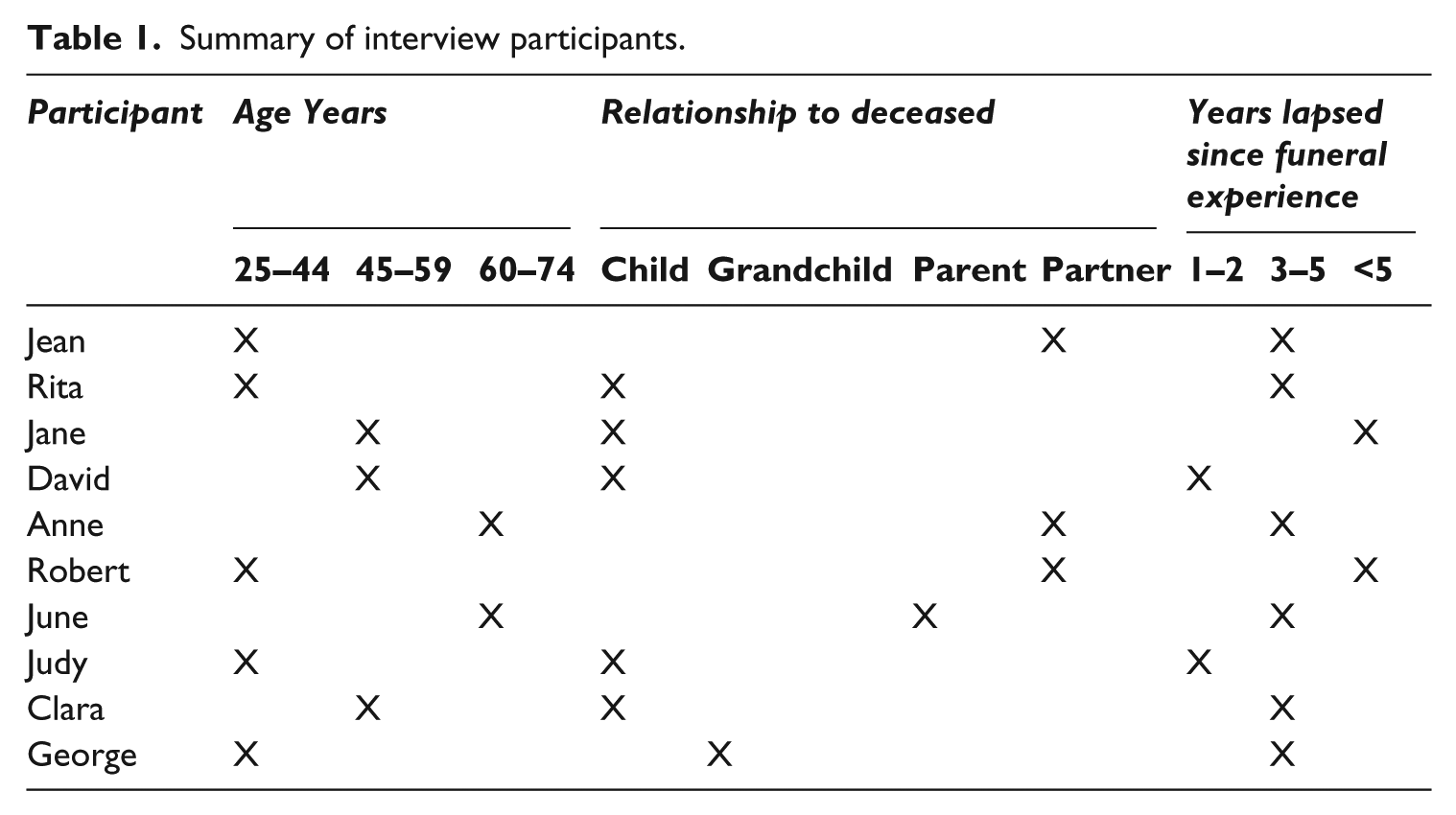
Funeral rituals vary according to institutional and cultural settings (Walter, 2005). In this study, we focus on the United Kingdom, examining the experience of the bereaved in the funeral of a close member of their social group. Participants were drawn from an invitation placed with educational establishments and places of worship. Following university ethics committee guidance, only those volunteers whose funeral experience was more than one year previous, were contacted for interview. Although participants were sought from varied religious and cultural backgrounds in the West Midlands, the 21 respondents who contributed to the investigation were all white, Christian or agnostic, which we recognize as a limitation in terms of ethnic and cultural diversity. Individual in-depth, semi-structured interviews lasting 45–60 minutes, conducted in a private setting, were analysed using an inductive exploratory approach (Miles and Huberman, 1994). Each researcher independently conducted thematic analysis of verbatim transcripts which acted as the basis for subsequent coding and iterative analysis of the data. In this article, we focus on 10 participants to ensure an in-depth examination of their experiences (see Table 1 for further demographic details of these 10 participants). We do not assert that these 10 are representative, as individual experiences differed, but the themes identified here were represented to some extent across all participants. The thematic analysis identifies power and choice, social and cultural expectations, and relational ambivalence in participants’ experiences of the funeral process. In each area, we examine the coping strategies used to manage the context (Otnes et al., 1997). The themes are presented within an overarching relational framework, reflecting what Hillcoat-Nallétamby and Phillips (2011) refer to as notions of historical and prospective ambivalence. Here, historical ambivalence reflects relational transactions over a long period of time, and prospective ambivalence anticipates participants’ concerns with outcomes of the funeral, as well as future situations and relationships.
Summary of interview participants.
Ambivalence, Power and Choice
Hillcoat-Nallétamby and Phillips (2011) present power as stemming from each individual’s location within a network of interdependent relations. Death placed participants in roles that most had not previously encountered. As partners, parents, friends or children of the deceased, they were required to organize and/or mourn. For Jean, who described the funeral of her father and her partner, historical and prospective ambivalence were evident in the difference in the power she had across the two funerals. In the case of her father, she described how he had agreed with her older step-siblings the format of the funeral, thus limiting her participation in its organization. While she accepted this, an emotional response reflecting relational ambivalence was manifested regarding her father’s removal of her involvement (and its transference to her step-siblings) when deciding on music to be played: So they organised that, we didn’t have very much input. And we didn’t know what he would have wanted or anything at all, which didn’t distress me too much apart from when it came to choosing music, and I got quite upset because I didn’t know what sort of music would be the best to play at his funeral. (Jean)
For Jean, the music was emblematic of her relationship with her father and step-siblings; they knew what he would want played and she did not, reflecting Hillcoat-Nallétamby and Phillips’ (2011) interpretation of power as being in relation to another. Here, the relational network is across the late father, siblings and Jean, where Jean is effectively disempowered by both father and siblings. The funeral organization reflected the hierarchical familial roles and relationships and the power therein. This remembered powerlessness influenced Jean when her own partner died and allowed her to exercise agency. Her partner’s brother volunteered to organize the funeral but she turned him down: I said no, I want to do it, I want to organise every little detail of it, and so I did. (Jean)
Jean’s determination to organize her partner’s funeral reflected the regret she felt over her father’s; the power she was able to inhabit now helped express the value of her relationship with her partner. The lack of agency that Jean had at her father’s funeral and how it impacted her subsequent behaviour is in contrast to Rita who had been involved to varying degrees in a number of funerals. Importantly, she and her mother had what Hillcoat-Nallétamby and Phillips (2011: 212) refer to as a ‘dynamic and continuous set of transactional processes’ whereby their relationship both developed and changed particularly as her mother came towards the end of her life: I’d had to bring her up to the Midlands to put her into a care home and when she died there was just me to handle everything so she had actually had a conversation with me several times in the months leading up to the death in which she’d said ‘Here it is, I’ve put it in my will, these are the hymns I want sung, these are the prayers I want said’. She didn’t have any faith particularly but she wanted personal poems read. (Rita)
Across a series of transactional processes, Rita had been responsible for her mother’s care but her mother, by exercising control with clear instructions ensured her personal autonomy and, knowing she only had Rita to organize the funeral, ensured her instructions were unambiguous thus maintaining her choice and power but also ensuring that Rita was included and not disempowered: And she said ‘As long as I have some pink roses and I’m dressed in a pink nightdress and there’s a good number of friends there’, those were the things that mattered to her so…we just did exactly the same. (Rita)
Rita maintained the pre-death transactional relationship with her mother, who in turn had removed ambivalence through her exercise of power. Others found their roles more complex and open to interpretation. When there was no explicit request made by the deceased, organizers had to take others’ sensibilities into consideration. Alongside the ambivalence this created, participants negotiated continued transactional processes with the living and the dead. Judy describes how she let her mother’s partner choose the music for when the coffin was taken away. Here, there is a nuanced power relation where emotion influenced choice, whatever misgivings one party might have over that choice: If I had to give anyone advice, ask people what they want because you don’t know. So a huge decision which I didn’t mention was the music. What music do you have? …my mum, we knew what she would want but …you know when the coffin gets taken away John wanted, and I felt John had to make this decision, it couldn’t be me but I was sure it wasn’t right but he was convinced she would want ‘I Just Called To Say I Love You’ and me and my little brother were trying really hard not to laugh because it’s so bound up with emotion anyway. (Judy)
The feelings of ambivalence discussed here are multilayered with Judy trying to satisfy her dead mother and her mother’s partner but finding this difficult in terms of the choices made. We witness the confusion that can occur if the deceased has not made their wishes explicit and how personal autonomy can be transferred at times of emotional pain to help others. In each of these cases, some power remained with the dead and the decisions they had or had not made before death, showing that inaction as well as action can impact choices and power relations (Connidis and McMulllin, 2002).
Cultural and Social Expectations of Funeral Choice
There was a variety of cultural and social expectations regarding how the funeral should be organized and conducted. Some related to traditional norms such as the singing of certain hymns, who should be in the mourners’ cars, and who the funeral director should be. Jane had lived in Wales where she recalled that there was a clear idea of what was required at a funeral, while June described how a Quaker funeral was conducted and Judy talked about the traditions of her local community: . . . in the Welsh speaking chapels, so there is still a very traditional approach to death and dying, there are certain things that you do and almost must be seen to be doing. (Jane) It’s so unceremonial, there aren’t hymns to choose or flowers, people go ‘well we know what to do’ and I have to say a large proportion of the Society of Friends in Britain are fairly elderly and funerals come along pretty often. (June) She was very clear, my mum had friends and relatives who had been cremated at the same place she was being cremated so again there was that sense of tradition, that’s what you did. (Judy)
The above illustrates some of the examples of these expectations whether structured ritual in the case of the Quakers, cultural norms in Wales or in the tacit sense of tradition in the choice of crematorium by Judy. Participants tended to follow the cultural norms of a church service and what that entailed even if they did not believe. How they felt about this was affected by the nature of relationships among the mourners and their social and cultural expectations and what is ‘allowed’ by the organization or religious body. Jean’s ambivalence revolved around wanting a ceremony for her partner which expressed his character while having to conform to what others wanted and what the church would allow. Her agency in terms of consumption choice was constrained by church regulations. She gave the example of Pink Floyd being played as they entered the church being acceptable but a line from the same song not allowed to be placed on her partner’s grave stone. Her ambivalence was also exacerbated by the involvement of her mother-in-law in choosing hymns: Ian was in a church because he was buried in the churchyard, but I’m not religious at all so there’s no religious aspect for me. We had some hymns, two or three hymns that his mom chose, and nobody knew them. I thought that was hideous, because nobody was singing, everyone was just looking around a bit, embarrassed, they were just hymns no one had ever heard of. I should have thought and checked what she’d chosen I suppose, but I thought I’ll leave that to her because I didn’t know any hymns. So if I was organising another funeral I would look at the hymns or not have any hymns, I’d make sure people could sing along. (Jean)
Jean chose for her partner to be buried in a churchyard; this she rationalized as having somewhere for their children to visit but it had no religious significance for her. She left the choice of hymns to her partner’s mother. This was not only a symbol of not being religious but also as part of the process of engaging with her partner’s grieving mother. In retrospect, she decided this had been a mistake, expressing her embarrassment when no-one sang, which in turn led to prospective ambivalence in terms of how to conduct a future funeral. This is an example too of ambivalence working on different levels including the individual’s ambivalence to the religious aspects of the service, the relational ambivalence with her partner’s mother, and the overall frustration with the cultural expectations of the church.
While Jean was affected by cultural norms associated with the nature of the funeral service, Judy’s experience was bound up with the social and cultural norms of her local community where a ‘good send-off’ was crucial. While some of this surprised Judy, she was also aware of how it would be construed by her mother’s neighbours in terms of the family having done what was appropriate. The extract begins with her surprise at the turnout of neighbours as the hearse left her mother’s house where all the flowers were laid out on the front lawn: God, (I thought) what’s all this about? But other neighbours came to have a look so I know my mum would have been pleased because it was a good turn out with flowers on the lawn and all the rest of it. There was that sense that they all knew what was expected, they had a very clear picture of what made a good funeral so there had to be enough people looking suitably sad, there had to be a good spread so it was very important that there was a lot of food. My big brother put money behind the bar, so all the drink was free and that was something that my mum would have liked because everybody could drink and have a nice time and they’d all be saying ‘God they must have really loved her’, so yes, those are the kind of things I think that really hit me. (Judy)
Judy describes the elements that made the good funeral, the flowers, food and free drink as representing not only what the mourners would interpret as successful, but also their reaction as indicative of the love felt for her mother by Judy and her family. So while her initial description of ‘people looking suitably sad’ seems to reflect some personal ambivalence of social expectation, her reflection on the event was satisfaction to have followed not only the traditions of her community but also continuing the parent–child relationship in a way she believed her mother would have wanted. Here, the multi-vocal relational transactions include Judy’s own reaction, her relation with her mother and the wider social norms of her community.
Some participants were faced with difficult situations because of the last wishes of the deceased which went against their own perception of what was appropriate, which led to emotional and/or practical coping strategies. David’s mother chose, without consulting her family, to donate her body to medical research. Along with the difficult organization this entailed, it meant the family had a series of experiences such as a multi-faith service at the hospital that they found difficult to engage with: It was multi-denominational, multi-faith, there were Muslims, Sikhs, mainly Christians, well I should think mainly people of no religion at all, and various lessons were read and I think there was a short homily of some kind, prayers were said of various kinds, no singing. My father couldn’t hear anything and looked pretty glum throughout, he didn’t really like it very much. (David)
This alternative communal ceremony was a difficult occasion to bear for David and his family, partly because it did not fit with their expectations of what would be appropriate for their mother’s funeral and also because this was the result of a decision made by the deceased with no consultation. The family was required to engage in relationships they did not feel comfortable with. Perhaps in order to cope with their dissonance and despite his mother’s wishes, the family organized an alternative event to celebrate her life which David describes below: We were determined we weren’t going to have absolutely nothing, so we had an event and this was not a funeral, this was a lunch party and we had it in a local golf club near where my father lives and about 50 people, members of the family made it all the way up there, not an easy time to travel, just after Christmas, but it seemed the best time… we …family members and friends of theirs from round about in the villages there, and it was very nice, it was really good. (David)
Here, the family’s behaviour shows an exercise of agency in the face of the accepted role of fulfilling the request of the deceased to ensure that their own cultural expectations were met (Connidis and McMullin, 2002). While David and his family were uncomfortable about not having a traditional funeral and resolved this through their lunch party, Robert, who helped to organize his partner’s funeral, was determined to ensure it was in keeping with the disco-loving personality of his partner rather than traditional expectations. To do so, he had to negotiate with organizations and other mourners in order to manoeuvre and transform the situation. This involved convincing the deceased’s mother of his plans and negotiating double time at the crematorium to ensure the service he wanted: We had a very good friend of ours who was a very close friend of Edward’s and he actually made a disco compilation tape of many of Edward’s favourite hits. And we felt, in part, as a tribute, that we wanted to have a bit of smoke and some disco lights at the event. And we did actually have the disco lights but we weren’t allowed to have the smoke. (Robert)
Robert’s ambivalence revolved around trying to find a line between the traditional (they had humanist readings) and what he thought appropriate to the memory of Edward and the sensibilities of his partner’s mother. He was pleased with the result, reflecting that ambivalence can be ‘endowed with a transformative property’ (Hillcoat-Nallétamby and Phillips, 2011: 206): And, in fact, Mrs Johnson was so . . . She was so over the moon about it because it was such a contrast to what she’d had for her own husband. (Robert)
All participants encountered cultural or social traditions which they either wished upheld or resisted. Some, such as in the case of the Quaker funeral, were clearly prescribed and non-negotiable, others derived from traditional or social norms of a community. In some cases, participants found themselves having to fight against the accepted norm or structure to ensure the celebration they wanted, or, in the case of David, reinstate the cultural norm of the wake despite his mother’s wishes. In all these cases, the participants experienced ambivalence which they coped with, negotiated and resolved through the relational network of other mourners and their own decisions. As none could do this with the deceased, there were differences in their reflections on how their decisions might have been seen by the dead relative or friend. While for Judy and Robert, this was a largely positive experience, it was less so for David, who remained bemused by his mother having chosen to give her body to medical science.
Relational Ambivalence in Funeral Consumption
The deceased’s instructions for their funerals varied. Some made them explicit in written documents, others were understood, expected or assumed and others were unknown and had not been discussed, even in cases where people knew they were dying. For David, the instructions were also surprising as the family had expected his mother to be cremated, not knowing that she wished to donate her body to medical science. Relational ambivalence stemming from differing understandings of arrangements and wishes were evident among organizers, mourners, and, in some cases, between the participant and the deceased. David was particularly perplexed by his mother’s wish which involved having to manage arrangements very rapidly after her death. Neither his father nor sister were happy that she had chosen this: My view was that since my mother had expressed that as her wish, we should do our damnedest to try and carry it out, and my father wasn’t very happy about it, but when you’ve lived with someone for 63 years and they’re taken away from you quite suddenly….he is a very strong character indeed but he wasn’t really in the mood to discuss the ethical ins and outs of this, he just shrugged his shoulders and said ‘well if that’s what’s going to happen…’. I think it was actually later that he felt it more, rather than at the time, I think he felt the absence of a proper funeral. (David)
David’s reflection on his relations with and duty to his deceased mother was something he returned to throughout his interview. While pleased that he had managed to fulfil her wishes, he also thought about what it would mean if he had not: Rationally, there are no consequences that the deceased person can inflict upon you for not fulfilling their wishes, people who die might leave all sorts of batty wishes in their will, supposing for example the one that my mother had originally left was that she should be cremated and her ashes scattered in France, well I don’t know whether we would have carried it out or not, but had we not, I suppose we wouldn’t have felt that bad about it. (David)
David’s use of the term ‘batty’ suggests that he did not approve of his mother’s choice. He reflects on the lack of power of the dead and the likely collective feeling that his family might have had if they had not succeeded in accomplishing his mother’s wishes. As noted earlier, his father was unhappy about his wife’s decision and David thought it had coloured his father’s memories of their life together. This case is an example of the ineluctable finality of death in terms of no longer being able to negotiate decisions. In terms of relational ambivalence, the deceased has made what appears to the bereaved a bizarre decision and one that impacts the nature and history of their relationships with her, but there is no opportunity to resolve that ambivalence. Some other participants had a strong sense of what was required by their family or friends who had died and doing what seemed ‘right’ for them was important: We knew that she would want it to be quite a spectacle, she wouldn’t want to go quietly. So we knew that she would want lots of people to notice. Not in a flashy flamboyant…. or anything but, yes, she would want lots of emotion shown and all the rest of it. There would be some sort of sense of how much you loved her would be in this thing and you have to remember she was a publican so she knew a lot of people in the community. Cars were a huge thing. My brother’s wife never visited my mother once when she was ill so there was this huge thing about will she come in the car so in the end we didn’t ask her to come in the car. Me and my Auntie Sheila made that decision together. (Judy)
Judy gives a sense of her mother’s personality that required both spectacle and emotion. The externalized display in terms of the cars, flowers and food at the wake, represented the love felt for her mother and symbolized both the emotions resulting from her death and the memory of someone who had been loved. This display also suggests something that was rare in our interviews, a lack of ambivalence regarding what was the right thing to do for the deceased. In this extract, we also see what was evident in a number of participants’ experiences; dealing with family grievances or issues. In this case, Judy and her aunt were able to express their disapproval of how the deceased had been treated by one family member through their organization of the funeral. Others found that existing family tensions were exacerbated in the context of the funeral, and strategies had to be put in place to manage their behaviour: It was kind of a committee to try and stop my Auntie Ruby cocking everything up, but in our family I’m one of the strongest personalities that can say things and get away with it without getting over emotional or het up, me and my father, so my mother had asked me and I said ‘When do you want me to come up’ and she said ‘As soon as possible, I need somebody to try and steer Ruby a bit.’
So Ruby was trying to make the decisions? Yes, like a Mafioso on payday, she had lost her father but everything had to be done her way and the one that got my mother was ‘Oh we’ll have Abide With Me at the funeral’, but my granddad detested Abide With Me, because they had this conversation when my Nan died and he refused to let them have it. My mother said ‘You can’t have Abide With Me Ruby, he hated it’ and she said ‘You’re talking rubbish’. (George)
From the way in which George describes Ruby’s behaviour, it is evident that the family viewed her as wanting to impose her will on the organization of the funeral. In this case, there is a three-cornered ambivalence among members of the family, Ruby and the possible wishes of the deceased. What is apparent is the impact of this ambivalence when there are differing views of the choices the deceased might have made. While such consumption decisions, as David noted earlier, will have no impact on the dead, they can reinforce existing relational issues among the living.
The resolution of this problem was difficult for George and the antagonism evident here continued throughout the funeral and wake, yet others were able to successfully transform difficult situations and develop stronger relational ties through the funeral process. Robert and his friends, as described above, had decided to have an unconventional funeral for their friend but had engaged with and explained to the deceased’s mother how they felt this celebrated the kind of man Edward had been. He explained that the funeral for Edward’s father had been very traditional and originally this was what Edward’s mother thought appropriate for her son. However, after the funeral experience which involved disco music and a meal with lots of photos of Edward decorating the room, Robert describes how she felt: She was just absolutely blown away by it because she’d never been to anything like it. … That it wasn’t this dry service that just had its usual start, middle and end with an insertion of, ‘Oh, and here’s the deceased. And now we’re going to press the button and away they go’. …… What she liked about this was the group of friends – that she didn’t really know very well at all: she didn’t know much about Edward’s personal life … (Robert)
So not only was Edward’s mother able to enjoy a service for her son, that she would not have chosen herself, she was able to develop new relationships with his friends. Her inaction in letting Robert and his friends do the funeral ‘their way’ had a transformative effect and resulted in solutions that strengthened relational ties.
Dealing with the choices for your funeral when you know you will die shortly cannot be easy, and although some participants did talk about how the experience of managing someone else’s funeral had made them think it better to have it documented well in advance, few of them had done so. The emotions such choices raise when near to death seem to go to the heart of relational ambivalence in terms of acceptance of the end of the living relationship: We only really talked once about the fact that she was going to die, and we both got so upset that we didn’t sort of deal with it. I mean, after she died my dad came out with ‘Well your mom wanted this and your mom wanted that and your mom wanted the other’. I have to say I was a little dubious about some of the things he said that she wanted, I’m not sure that they’d really discussed it. (Clara)
Discussing what Clara’s dying mother might want for her funeral meant having to recognize the reality of her death, and that was difficult for both mother and daughter. This inability to make post-death consumption choices meant that her father took control and presented his choices in terms of what he thought Clara’s mother would want. Whether these were correct or not perhaps would not have mattered to her mother despite Clara’s comment that she did not think they discussed it. Here, her mother’s inability to act leads to a declared certainty on the part of her father but more ambivalence for Clara, revealing another side to inaction, lacking in transformative qualities but which was defined by the emotion involved in making these choices both within a particular relationship and its wider social structure.
Conclusions
Hillcoat-Nallétamby and Phillips (2011) suggested that the conceptualization of sociological ambivalence within the relational framework be extended to other social phenomena such as divorce and separation where sentiments such as love, obligation and fear are mediated by socially structured expectations. In using the relational framework to examine funeral experiences, we show that love, obligation, regret and revenge evolve and transform past and future relationships. The ambivalence felt by individuals involved in this context highlights the richness of ambivalence to illuminate a complex consumption experience where the relational influences choices and experiences.
Regarding the sociology of funerals, we shed light on three important aspects: firstly, sociological ambivalence is present in the relational framework of those involved; secondly, consumption choices impact this sociological ambivalence, and thirdly, historical and prospective ambivalence is important particularly in terms of transformative capacity. Starting with the first aspect, applying Hillcoat-Nallétamby and Phillips’ (2011) relational framework to funerals has demonstrated the contradictions which stem from transactional engagement and its social and cultural circumstances. Power and choice in the relational context acted as strong influencers for some participants. Jean and David had power taken away through a historical decision of their parents, Rita and her mother had negotiated what to do, and Judy had a strong sense of what her mother would have wanted. These examples show the dynamic and continuous properties of ambivalence over time in terms of how relationships are managed and how ambivalence impacts future decisions (in Hillcoat-Nallétamby and Phillips’ terms, prospective ambivalence). Importantly for some these choices became transformative; in the case of Jean to organize her partner’s funeral, for David to conduct a wake for his mother and Robert’s taking control from his partner’s mother.
In terms of the second aspect, the research reveals the importance of structural issues regarding the social domain of the family and wider cultural expectations of the funeral (Risman, 1998). The ceremony became a focus of ambivalence regarding what should or should not happen and how others responded; the expectation of others always playing some part whether accepted or not. The final empirical section further exemplified this, considering specific relational elements of choice in funerals and in particular what these signified in terms of emotional reactions to the dead and the living. Ambivalence was experienced by David concerning what might be thought acceptable choices made by the dead which impact the living. The living too, have to work through their relational networks with regard to who takes control of situations and whether others let them. For Robert, the funeral became a vehicle for the expression of his partner’s personality and involved a transformative response from his partner’s mother in her shift from the assumed traditional funeral to Robert’s alternative approach. Grievances such as in the case of Judy’s sister-in-law not visiting were also worked out in the choices made.
Concerning the third aspect and Hillcoat-Nallétamby and Phillips’ (2011) view that historical ambivalence recognizes the characteristics of relational transactions over time and prospective ambivalence is concerned with anticipating future needs in those relationships, most of the choices made reflected a historical and future perspective, in terms of past relationships and how the future might be the same or different. Otnes et al. (1997) identified coping strategies that people engaged with in ambivalent consumption situations. In funeral organization, we found that most participants had to develop coping strategies to deal with current relational ambivalences and those they maintained with the deceased as well as in their negotiations with the social structure encountered. While for some, this led to transformative results, for others the constraints of the relational context were more difficult to contend with, but both shaped their funeral consumption experiences.
Footnotes
Funding
The research was supported by a British Academy Grant.