




Abstract
Drawing on the theoretical framework of ‘relational work’ in economic sociology, the article examines the phenomenon of ‘precarious commitment’ – when employees’ commitment to their work and colleagues simultaneously exposes them to the risk of self-exploitation. The study analyses semi-structured interviews with game developers in the Swedish digital games industry. The article demonstrates the negotiated meanings, relations and compensations for seemingly voluntarily unpaid or paid extra work and the ambiguities and mismatches that emerge when the norms of favour exchange and formal exchange intersect. The analysis highlights accounts of collegial reciprocity, non-reciprocated favours as well as self-blaming and guilting practices. The article contributes to the relational work literature by demonstrating the dynamic interplay between reciprocal and transactional relations within the formal structure of employment. It shows that it is the very intersection between the formal and the informal – where the boundary between morally induced favour reciprocity and formal expectations is indistinct – that may harbour precarious commitment. Hence, it adds new knowledge to the sociology of work through a nuanced analysis of the interactive processes through which precarious commitment is both questioned and potentially reproduced. The article suggests that the unspoken and hence hidden character of gift-giving opens opportunities for exploitation without accountability, which may transfer responsibility to individual employees while obscuring collective solutions.
Introduction
Although passion for one’s work is generally seen as positive, there is a vast debate about the downsides of such commitment. Studies of work in the creative and cultural sectors have highlighted how precarious conditions, where individuals voluntarily work very long hours or for free, are hidden behind the overall epithet of ‘passionate work’, which often includes creative and seemingly egalitarian and ‘cool’ work (Arvidsson et al., 2010; Gill, 2002; Hesmondhalgh & Baker, 2011; McRobbie, 2016). Passionate work as a more general ideal for working life has also been scrutinised (Hong, 2022). For instance, under the umbrella of a ‘new spirit of capitalism’ (Boltanski & Chiapello, 2005; Kirkpatrick, 2013), it has been highlighted as a form of work ethic that emphasises independent and flexible work, promoting an informality that blurs the boundaries between work and life and between professional relationships and friendship. Such prescribed informality has further been referred to as ‘normative control’ (Etzioni, 1964; Grugulis et al., 2000; Kunda, 2006), a ‘culture of fun’ (Fleming, 2005) or, depending on the degree to which individual self-expression and autonomy are encouraged, as ‘neo-normative control’ (Fleming & Sturdy, 2009). This merging between the employees’ self and the organisation has been shown to be deeply ambiguous, making work both a promise and a threat (Kunda, 2006).
This article sheds light on the inherent ambiguity of the phenomenon that we here describe as ‘precarious commitment’. This implies a commitment to work and to colleagues in which informal relationships and friendship reciprocity play a major role while simultaneously exposing employees to the risk of self-exploitation. By combining two key concepts that have been thoroughly analysed in current research, we want to add nuance to the generally positive connotations of the term ‘commitment’ and explore the ambiguity it involves. Our study context is the digital games industry in Sweden. The digital games industry has been described as encouraging excessive dedication to work while obscuring precarious conditions with a high-pressure pace and long hours (Bulut, 2020; Chia, 2019; Cote & Harris, 2023; Espersson et al., 2024; Sotamaa, 2021; Szczepanska, 2023; Wright, 2015), revealing the ‘double-edge sword’ of passionate work (Keogh, 2021).
The specific characteristics of the digital games industry, such as ideals of playfulness, creativity and adventure (Kirkpatrick, 2013, 2015), may affect the working environment, as well as context-specific variations such as different work ethics related to sustainable production practices in large corporations versus small independent producers (Whitson et al., 2021). Although these characteristics are specific to the industry, we believe that the relational dimensions point to a more general phenomenon in today’s working life, shedding light on workers’ commitment and consent to precarious work. Some scholars argue that the digital games industry, and the gaming culture more generally, manifests the spirit and logic of work in today’s networked society (Kirkpatrick, 2013). In line with this, we consider the digital games industry to be an illustrative context to shed light on precarious commitment.
Our approach takes its starting point in a relational perspective from economic sociology, focusing on how everyday interactions and meaning-making shape both economic practices and social relations. Building on Zelizer’s (2012, 2013) ‘relational work’ approach to understanding workers’ consent (Mears, 2015), we start from the assumption that an in-depth analysis of social relationships at work and different forms of socio-economic exchanges – including friendship reciprocity – can add new knowledge to the question of why workers seemingly voluntarily give much more of their time and commitment to work than is considered healthy, also by the workers themselves. While previous literature has identified the ambiguity involved in this phenomenon, we still know little about how such ambiguity is both sustained and questioned. By analysing how game developers describe and account for work, work relationships and compensations for work, the article aims to understand how precarious commitment is (re)produced. In line with a relational work perspective, we ask what forms of socio-economic exchanges employees in the digital games industry are engaged in – reciprocal, transactional or something in between (Andersson Cederholm & Åkerström, 2016). We also ask what norms of reciprocity and forms of social exchange are considered appropriate.
The study contributes to the sociology of work by integrating the literature on informal relationships and precarious work, particularly in the digital games industry, with the economic sociology literature on reciprocity, gift-giving and relational work. It also adds new knowledge to the field of relational work by shedding light on the dynamic and interactive processes where reciprocal and transactional relations are intertwined, albeit within the context of formalised employment. Hence, the article contributes with new knowledge on the social processes by which loyalty to colleagues and devotion to work are both sustained and questioned – which may lead to silence, self-blame as well as voice and exit.
In the following, we first provide a theoretical background focusing on the relational work literature, followed by a discussion of literature on the gift economy. Thereafter, the methodology section begins with a background description of the digital games industry. The findings that follow are structured according to an analytical illustrative device – ‘labour as gift versus labour as commodity’ – where we emphasise the complex interplay between these different systems of exchange. The article concludes by demonstrating how precarious commitment can be sustained as well as questioned and resisted.
Literature review
We focus on everyday social interaction in economic contexts beyond a common – and culturally and normatively reinforced – understanding of work versus leisure, collegiality versus friendship, and friendship reciprocity and market relations (see also Alacovska, 2018; Alacovska et al., 2024; Andersson Cederholm & Åkerström, 2016; Glucksmann, 2005; Mears, 2015; Taylor, 2004). Hence, we aim to highlight the collegial relationships, expectations and exchanges that go beyond formalised job descriptions and instrumental exchange and can thus be described in a broad sense as informal and personal.
The literature on ‘management by culture’ has demonstrated how boundaries between friendship and formal collegial relationships are blurred in a form of managerial control (Costas, 2012; Fleming, 2005; Fleming & Sturdy, 2009; Kunda, 2006). Studies taking a broader societal perspective have highlighted the phenomenon of network sociality, implying that relationships today to a large extent are transformed into networks that benefit professional life (Wittel, 2001). These studies point to a blurring of formal and informal relationships as well as an increasing instrumentalisation of social relations. In addition, literature on the digital games industry has demonstrated a type of networking and connecting with others that is characterised by a complex combination of the personal and the transactional in contexts where the commercial dimension is downplayed (Whitson et al., 2021). Assuming that the digital games industry is not unique in this regard, we suggest a theoretical perspective that takes into account the nuances and dynamics of relationships at work and the moral dimension embedded therein.
The notion of ‘relational work’ (Zelizer, 1983, 2012, 2013) takes a ‘connected world’ approach with the presumption that ‘the economic’ and ‘the social’ are inherently intertwined. It is the relational dimension that is the focus of Zelizer’s work, in a more constitutive sense than in Granovetter’s (1985) notion of ‘embeddedness’, which in a similar vein emphasises the social embeddedness of economic actions. Zelizer proposes:
The objective is to move beyond an approach that centers on ‘embedding relations’ – how existing social ties constrain or facilitate economic activity – toward one that focuses on ‘constitutive relations’. How can we analyze the continuously negotiated and meaningful interpersonal relations that constitute economic activity? (Zelizer, 2012, p. 149)
The theoretical framework of ‘relational work’ is a means to capture the constitutive dimension of social relations in activities that can, in a broad sense, be called ‘economic’. The concept of ‘relational packages’ (Zelizer, 2012) provides an operationalised analytical tool to do so. The concept includes ‘distinctive interpersonal ties’, ‘economic transactions’, ‘media’ and ‘negotiated meanings’ (Zelizer, 2012, p. 151).
The character of the economic activity varies depending on the relations among the actors involved, the type of transaction and the type of medium being used as the appropriate currency – whether it is money or other quantified means that can be used in transactions, such as goods or gifts in the form of artefacts or favours. Another crucial aspect in the relational work perspective concerns the symbolic boundaries erected by the social actors involved, separating different ‘relational packages’ in constantly negotiated boundary work. For instance, intimate social relationships are often clearly separated from relationships that are considered transactional, initiating lively symbolic construction work when the line is transgressed (Bandelj, 2012, 2020). One such transgression is when money is used as a gift in intimate relationships, which can be illustrated through various culturally embedded narratives of inappropriateness. However, in the social context presented in this study, the symbolic boundaries appear to be fluid. Gifts in the form of favours are considered appropriate and even expected if they occur within the framework of paid labour. The normative regulatory narratives that set boundaries for when something becomes too much or inappropriate for the situation are, as we will show, not entirely given.
Previous research on reciprocity within formal work relations has shown that workers reciprocate according to a norm-gift-exchange model, hence questioning the neo-classical economic model of paid labour as merely a commodity (Akerlof, 1982). A more recent stream of literature has demonstrated the close intertwinement of a gift-economic system of exchange with a monetary economy (Andersson Cederholm & Åkerström, 2016; Darr, 2017; Mears, 2015; Scaraboto, 2015; Shahid & Syed, 2023; Weinberger & Wallendorf, 2011). Some studies have demonstrated how gifts and commodities can be intertwined to the extent of being hybridised (Darr, 2017, 2022). Researchers adopting a relational work lens have pointed at the interactive, dynamic and situated dimension of socio-economic exchange. For instance, in her study on women who perform free labour for the VIP nightclub scene, Mears (2015) has adopted the notion of ‘relational mismatches’. This occurs when gifting is not considered as such but as a commodity, turning the receiving of a gift into something dubious. She demonstrates how the workers avoid self-exploitation by reconfiguring an ambiguously transactional relationship into a reciprocal one. Furthermore, Shahid and Syed’s (2023) study of domestic workers in Pakistan demonstrates the constant interplay between gift exchange and market exchange and how such conditions may be simultaneously beneficial and exploitative for the employee. The potential blurring, or marking, between both forms of relationships and forms of socio-economic exchange highlights a moral dimension that, we argue, may be a key to understanding subtle forms of exploitation. Focusing on the tensions, or mismatches (Mears, 2015), between different systems of exchange may shed light on the subtle processes behind, for instance, friendship reciprocity slowly and unexpectedly turning into a transactional (labour) exchange.
Several studies highlighting the dynamic character of relational work have focused on relatively loosely structured, network-oriented or non-regulated economic practices or work environments, such as self-enterprising or lifestyle-oriented enterprising (Andersson Cederholm & Åkerström, 2016; Mears, 2015), academic work (Andersson Cederholm et al., 2023), platform-mediated creative work (Alacovska et al., 2024; Hair, 2021) or informal contexts (Alacovska, 2018; Kim, 2019; Lainez, 2020; Shahid & Syed, 2023). In creative work, it has been demonstrated how workers depend on friendship networks to make a living in the industry (Alacovska, 2018). Our study, however, focuses on work within the structure of formal, fairly regulated and relatively well-paid employment, which may seem more secure both financially and in terms of working conditions than much other work in the creative industries. This means that the type of informal work in focus here is unpaid voluntary work, such as doing extra work to help out, often framed as favour exchanges, or working overtime but refraining from reporting hours to the employer. Even agreeing to paid overtime is sometimes seen as an expected act of loyalty or a favour to colleagues. This makes this case illustrative of our argument that reciprocal relationships are largely intertwined with regulated work relationships. This, in turn, implies that the informal dimension is more obscured than in less regulated contexts, which differentiates it from the focus taken in previous studies of relational work (Mears, 2015).
Overall, studies of gift exchange and norms of reciprocity in work and market exchange shed light on the moral interpersonal dimension of economic exchange, since the rationale behind gift exchange is to build and sustain relationships (Cheal, 1988; Godbout, 1998). One of the more interesting aspects of such reciprocity also relevant to understanding the exploitative dimension of work is that unlike market exchange, gifting only works if its underlying rules are not expressed (Godbout, 1998). According to the implicit norm of the gift, a favour exchange can never be articulated as an obligation. Hence, although reciprocity and friendship exchanges are abundant in formal working environments, they remain hidden, as they belong to the realm of the unsaid. This is particularly relevant in understanding the subtle forms of exploitation that can take place within the boundaries of formal employment, as the transition from one logic of exchange to another is insidious and could encourage opportunistic behaviour by one party (cf. Shulman & Grayson, 2023). Co-workers or employers may, for instance, take advantage of reciprocal systems by acting according to a transactional logic without showing any obligation to reciprocate. To understand how precarious commitment is (re)produced, our analysis will demonstrate the dynamic interplay between ‘labour as a gift’, a reciprocal system of helping out and doing favours, and ‘labour as a commodity’, which implies that the value of work is measurable and commensurable in the form of hours and salary. In the present context, labour as a commodity is embedded in formal work where obligations to compensate are linked both to what can be measured and to what lies within the regulatory framework.
Methods, materials and the study context
The digital games industry is considered one of the most expansive and successful industries in Sweden, launching games that achieve international success, such as Minecraft, Battlefield and Candy Crush, to name a few (see also Game Developer Index, 2025). Indeed, the success narrative of the Swedish digital games industry often begins with a description of how a particular studio started with a group of young guys, developing a (later well-known) game in someone’s basement. As studies of the digital games industry in various countries have pointed to, it is a labour-intensive industry, generally non-unionised, although a limited but growing collective commitment to labour issues has been identified (Weststar & Legault, 2019). Even in Sweden, which traditionally has had a high level of union participation and a generally high level of collective bargaining, the digital games industry is an exception (Kjellberg, 2023). Few companies have collective agreements, which is an issue that has been discussed in both Swedish and international media (Bergvall, 2021). Overall, the digital games industry can be described as an individualistic, non-collectively orientated industry, although teamwork and personal networks are often emphasised (Whitson et al., 2021).
The present study consists of 29 semi-structured interviews, of which 23 were with game developers with experience of permanent employment (11 women and 12 men, see Table 1). We also interviewed 6 representatives from trade unions and industry organisations (4 men, 1 woman, 1 non-binary; see Table 2) to gain insight into the issues and current discussions within the industry. We strived for heterogeneity in terms of the gender and age of our interviewees, although the Swedish digital games industry is male dominated and only 23.5% are women (Game Developer Index, 2025) and most game developers are relatively young. The gender dimension was important in the overall research project, but it is not highlighted in this particular article. Most of our interviewees are of Swedish origin, but some of them originate from other Northern European countries or North America. Although we here use the more general label of ‘game developer’, the industry includes several sub-disciplines, from more tech-oriented to artistic disciplines (see Table 1). Almost all interviewees have experience of working in different studios.
Overview of interviewed game developers.
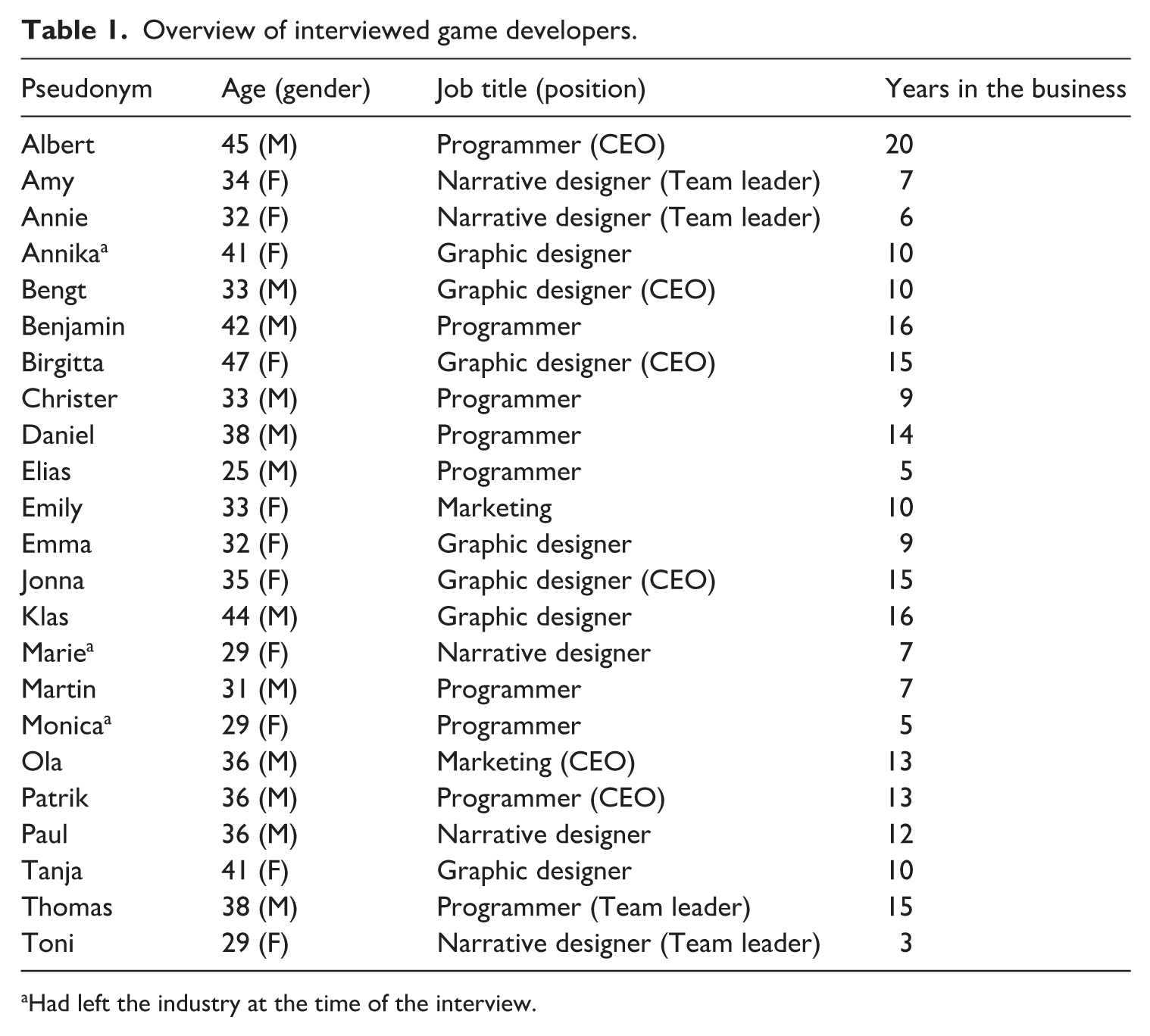
Had left the industry at the time of the interview.
Overview of interviewed representatives from trade unions and industry organisations.
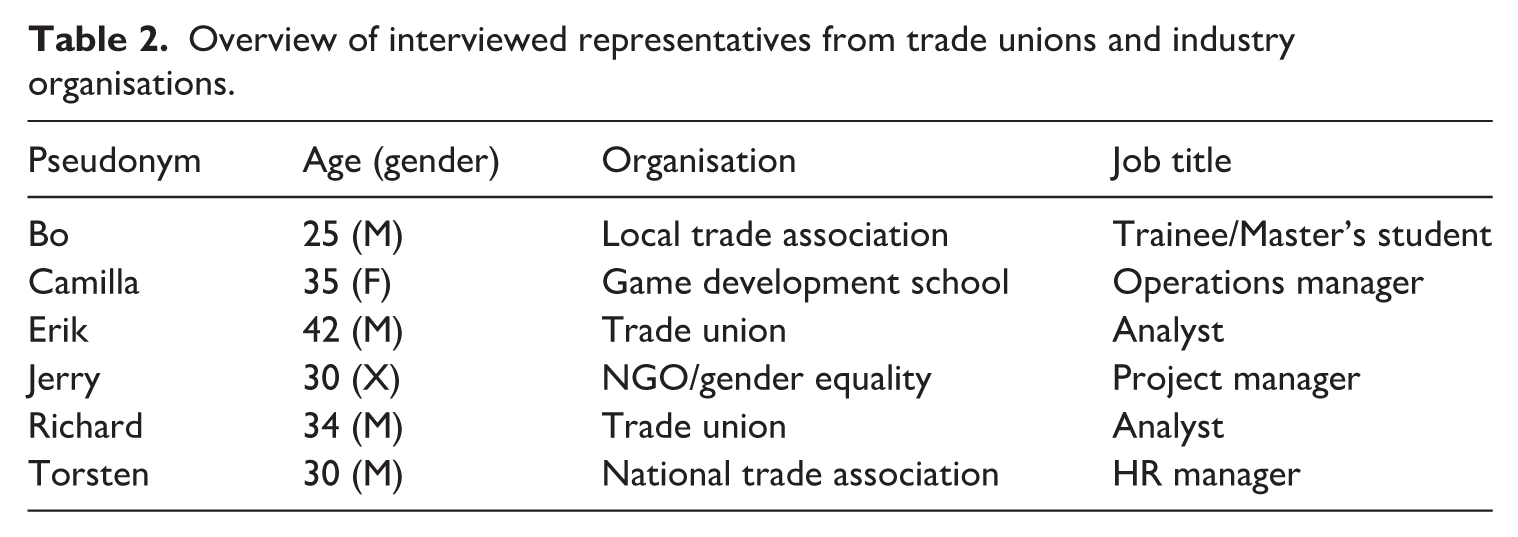
The interviews lasted 1.5–2 hours; some were conducted face to face and others via Zoom. The interviews revolved around a few general themes: the game developers’ motivations and what made them enter the industry; what the work consists of, how it is performed and organised; descriptions of relationships with colleagues and managers; and experiences and descriptions of work culture and working conditions. In addition, we analysed documents – such as job advertisements and media reports – and conducted observations and engaged in conversations with game developers at events and conferences. Most of the data collection took place in 2021 and 2022. All material has been pseudonymised and the study has passed ethical review.
We interpreted the material by focusing on the game developers’ stories and ‘accounts’ (Scott & Lyman, 1968) of their experiences of their work and work situation. We focused on how the interviewees presented themselves and how they articulated norms and ideals, often through various forms of justification or explanatory reasoning. Since game developers seem to be in a field of tension with contradictory values of individual work versus collective work, and artistic integrity versus commercial and organisational pressures, we discerned a constant negotiation of what is socially and morally reasonable and defensible. Hence, we found ‘accounts’ to be a suitable analytical tool as it captures the inherent justifying dimension in descriptions and narratives, revealing the sometimes hidden moral and normative explanation of one’s own behaviour and that of others. This was expressed, for instance, in the way the interviewees highlighted the pleasure of work despite expectations of working overtime. In particular, we have looked for instances where the interviewees have experienced ambiguity and reflected upon such situations in retrospect.
Between gift and commodity
As we aim to capture the dynamic and situated process through which work and work relationships are described and accounted for, the structure of our analysis follows a dramaturgical order. To some extent, this arrangement also follows a chronological order for the interviewees. We begin with the theme that may seem the most positive, namely how the interviewees emphasise the closeness and friendship between colleagues, but also the intrinsic value of creative work – Friendship and reciprocity. Our second theme highlights the more twisted situations where the flipside of reciprocity and loyalty emerges in their accounts, and where there is ambivalence about which form of exchange applies in a given situation – Labour as a gift and/or a commodity? The third theme – When the gift is not reciprocated – illustrates accounts of how the precariousness of the labour situation is pushed to the extreme and the blurred boundary between labour as a commodity and labour as a gift brings out a new kind of clarity. The process shows how relational work takes on different meanings, which the workers perceive to have various consequences.
Friendship and reciprocity
The notion of game development as a passion-driven job is clear among the interviewees. The concept of ‘passion’ is not only used among workers to describe why they like working in the industry and what brought them there; it also seems to have taken on a discursive form, as variants of ‘this is a passion’ are used in job advertisements as well as in the marketing of education programmes in game development. For example, in the following advertisement for a Swedish vocational programme that we call ‘The Game Factory’, they describe themselves as follows: ‘The Game Factory is more than a school. We are a family and we take care of each other.’ Under the heading ‘With a passion for games’, they write: ‘The Game Factory is looking for people with a passion for games, drive and determination and a strong ability to collaborate.’
Given the discursive establishment of ‘people with a passion for games’, love for one’s work is culturally sanctioned in the industry. However, it lacks the top-down dimension and subsequent cynicism that previous literature has shown around the ‘culture of fun’ and workplace familiarisation (Fleming, 2005). The game developers we interviewed can easily find adjectives that describe the joy of working with game development. As the advertisements from the industry also indicate, passionate work is performed in an environment where you are expected to ‘take care of each other’, as a family.
One of our interviewees is Annie, a game developer employed by a medium-sized company. She has been working in the industry for six years, first in marketing and now as a narrative designer and team leader. Her description of what she finds the most rewarding about her job echoes the discursive context:
. . . It’s very fun to work, to have different types of creative people working together on a project and getting a combination of everything; how to put together art and music, and script and voice acting, and all that stuff – in one. It creates a very strong sense of community. Like, ‘we created this together – and look how well it turned out!’ [. . .] That’s also what can happen when people are so passionate about what they do.
The joy of the work, as well as the sense of being part of a community, seems to extend beyond the workplace. The following quote is from Jonna, a game developer who has been working in the industry for 15 years. She started out as an employee but later set up her own small studio.
The game industry is so very close-knit, with each other. You are friends with so many people in the game industry. So many people who know someone who knows someone. So if you need people to come in and play, you can just post a question on Facebook. And then . . . you get a bunch of people from different studios who come and test.
This wide social network, also described by the game developers as a friendship network, largely seems to be supported by social media. This network is also described as generous, with people giving each other tips and recommendations, thus encouraging an exchange of gifts in the form of favour exchanges. This is a form of commitment to work seen from its more positive side.
Labour as a gift and/or a commodity?
The game developers’ accounts express a strong sense of loyalty to their work. This seems to be driven not only by intrinsic motivation and community but also by internal competition, where the game developers feel the need to prove their worth by showing their commitment. This can be expressed through the willingness to put in long working days, days that sometimes turn into nights. This, however, seems to be expected. ‘Putting three chairs together to make a bed’, as Jonna jokingly puts it, is described as an established ‘truth’, almost like a saying in the industry. Although framed jokingly, the expression has a more serious undertone about competition for jobs and what it takes to be included in this desirable workplace.
However, this is not necessarily considered negative; it also makes the work special and particularly attractive. Toni, who works as a narrative designer, explains: ‘That’s the charm, that you must work a little extra.’ Yet, having to work a little harder to get the job done can get out of hand. Toni continues by describing a particular incident at a time when she also had a role as team leader:
It was, uh, on one occasion where . . . shit hit the fan a little bit, and I myself pushed my colleagues. And I’m in a position where I can do that. And, uh . . . everyone kind of joined in . . . And we solved the problem, and it was . . . In the moment I thought: ‘This is fantastic!’ So it was so, oh, wow, that this happened and we all did this, and everyone let go of what they were doing and really just [makes swishing sound] there was a rush and, uh, ‘now we did the thing’. I really thought it was such an adrenaline rush – I’ve never experienced anything like it at a job . . . almost like a concert atmosphere, that it was like a kind of, well, a rush, a suction in the body – that everyone was really so goal-oriented. And I told a colleague who also is familiar with the industry about this, and she said to me: ‘Well, that was a crunch. Now you have pushed your colleagues to crunch.’ And it’s true, so it was . . . And it’s so easy, [laughs a little], so it’s so easy for it to happen.
The feeling of being part of a community, of solving the task together, provided an adrenaline rush, a high. This euphoric feeling had a bitter aftertaste when it was brought to Toni’s attention that she had been pushing her colleagues to ‘crunch’, which is a term used in the industry to describe extremely high work intensity. This is something that went against her own moral conviction about reasonable working conditions. It was only when a colleague pointed out that it might not be so good that she began to reflect. In the specific interactive situation referred to, the norms of reciprocity and gift exchange came to the fore. Toni continues her self-reflective analysis:
. . . one of them [the colleagues] said like: ‘But . . . I have people who . . . who sort of . . . who owe me a favour.’ That’s how it . . . kind of how it works, [laughs] like that. Uh . . . it’s a bit of a favour . . . like this, to make it work out. [. . .] And it feels a bit like it [laughs a bit] . . . It was as if I was like, ‘aah, yes, but now, now I owe you’, like that. And it was like . . . it’s like some kind of . . . I don’t know. I think that if that’s how you might think . . . But no, there was no one who . . . was . . . grumbling about this [the crunch situation]. Instead, those who . . . helped out in this case were those who were, well, were prepared for it.
Favour exchanges seem to be taken for granted in Toni’s workplace. You show up for your colleagues, and that’s the way it is, seems to be the message. Furthermore, none of Toni’s colleagues seem to be upset by the fact that she pushed them to crunch; on the contrary, they were ‘prepared for it’, as she puts it. This demonstrates her expectation of the interactive norm of reciprocity being evoked in the situation. It displays a system of exchange that was not articulated until Toni’s colleague pointed it out and she felt that she had to take action.
Afterwards, Toni explains how she, together with some colleagues, wrote an incident report of what happened. The reciprocal dynamic of gift exchange then turned into a form of formalised work. Labour as a gift was turned into something else when the act of reciprocity was scrutinised in an organisational document. This is an example of how a gift only works if its underlying rules are not visible (Godbout, 1998); when formalities come to the fore, the gift dimension fades away.
The example shows that the two dimensions of labour – as a gift and as a commodity – are constantly present, but depending on the specific situation and its framing in the relational package that the social actors are part of, one dimension is more visible than the other. However, in this case, when friendship reciprocity and the expectation of gift-giving is articulated and reflected upon, the transformation of the gift into a commodity is accompanied by a sense of guilt, revealing a clash between two systems of exchange. The ‘clash’ in this context represents ambiguity and the unclear status of labour – whether it is a gift, a commodity or something in-between.
The normalisation of long working hours is a recurring theme in the interviews. The long hours are generally described not as a burden but as a natural part of one’s life. For some game developers, work is their entire life, including their social life. Benjamin is a programmer and has been working in the industry for 16 years, in one large and several small companies. He left the industry for a few years but has now returned and works in a medium-sized studio. Looking back on this period of his working life, he describes it as being like living in a big bubble, where all you thought about was games and all your friends were those you worked with. Benjamin started to question this all-encompassing characteristic of work when he realised that he had no other life beyond work.
Several interviewees speak in terms of ‘wake-up calls’, which are moments when they realise that they had been in some form of bubble. For Elias, a 25-year-old programmer, the realisation was positive, at least initially:
One thing that started to ring a bell was when I had the same amount – when I doubled my salary on overtime. Er . . . that was, yes! [laughs]. I think back to that and just . . . how the hell do you double your salary? And this was only reported overtime as well. Because I . . . I had this thing where I didn’t want to report too much overtime either. Because I was afraid that I would report too much, so I preferred to under-report.
In Elias’s account, the realisation of having doubled his salary through reported overtime opened his eyes, and in the interview he questions how it was even possible to work that much. This is a sudden realisation of the monetary value of work and a questioning of it. While the commodity dimension of labour here may benefit Elias financially, it was also a wake-up call about the unreasonable working conditions. Elias had been giving away part of his labour for free, since he was ‘afraid of reporting too much’. However, the gift-giving he describes here was not part of a reciprocal relationship with colleagues but with an employer. What this account also shows is that Elias seemed to take a personal, individual responsibility for his overtime work, as he wanted to conceal his overtime from his employer. It seems as though he was blaming himself for the overtime. The overtime became a gift with no expected payback, from either colleagues or the employer, highlighting the precariousness of too much commitment.
The image of what is perceived as normal may change, and so may the boundaries between work and life. Long working hours may bring employees closer together and create bonds of loyalty, reinforcing the friendship ties as well as the moral dimensions of reciprocity and favour exchanges. Prioritising work instead of private life is in some cases so obvious that anything else seems unreasonable and could even be perceived as a betrayal. Thomas, a senior programmer in his late 30s, explains:
I had a colleague who had a three-month-old baby at home. And he went home at eight o’clock on a Friday night. And I was so damn pissed off at him for going home. In retrospect, it’s absolutely crazy. How, like . . . who thought it should be like that? I think . . . it will never, it must never happen again. I can’t be like that again. No, it was very strange, when you look back on it. [. . .] It was very . . . very unhealthy.
Thomas describes how, in retrospect, he questioned his professional as well as personal identity, who he had become, and realised that it was ‘absolutely crazy’. Although he did not realise this at the time, the incident highlights how the boundary between work and leisure had blurred, far beyond what Thomas considered healthy.
This is an illustration of how loyalty to one’s work and to one’s colleagues can be interpreted as destructive and undermine care for one’s colleagues. These quotes also show how the value of work may shift when ‘work as an entire life’ or ‘the bubble’, as Benjamin described it, is questioned. When the bubble bursts, the value of work is renegotiated.
When the gift is not reciprocated
The third theme concerns accounts of situations where the working conditions are experienced as harsh, to the point where they become intolerable. The boundaryless situation that has become normalised at work holds back an awakening, and it takes time for the clash between the two systems of exchange – gift exchange and market exchange – to become apparent.
Part way through the interview with Elias, he takes a deep breath, explains ‘I’ll see if I can summarise this briefly . . .’, and then describes in detail how he was working more and more, longer and longer days in an endless existence of more work and less sleep. After several years working in this mode, he became increasingly tired. He and his colleagues were working 60–80 hours a week, if not more. He travelled extensively, to various trade fairs around the world, and describes coming home jet-lagged and trying in vain to get back to a normal life. In the end, it was no longer possible. He could no longer sleep. His mother took him to the emergency room, and he was admitted to a psychiatric ward and put on sick leave:
And then, after that month, just . . . The psychologist, the psychiatrists wanted me to start working part-time and stuff. But the boss was like, ‘all or nothing’. Either start working full time or I’ll be on sick leave for longer. And then I thought: ‘Ah, then I’ll go back to work.’ And now it began, now it began to emerge more clearly that there wasn’t really any . . . Uh . . . That there wasn’t really anyone in charge or anything. Because . . . The idea was that I would get more help and . . . with planning and stuff and so on. But it didn’t materialise, because we didn’t have a . . . We didn’t really have a manager, he was more of a project manager, a creative leader. But he wasn’t a manager.
This is a situation also reported by other game developers, namely that a lot of companies in the industry have not developed proper labour management with managers who take responsibility for the staff. Elias’s story shows that constantly being there for work, colleagues and the company was normalised, while the responsibility for such commitment is individualised. However, when the commitment to work is not reciprocated by the management, the status of the work as a commodity becomes apparent. Elias describes in the interview how he found himself in a situation where the informal, seemingly egalitarian and friendship-oriented relationships in the workplace – also between employees and management – concealed the transactional nature of the work. It is worth noting that Elias, like the other interviewees in our study, had a permanent position in a company with regulated employment conditions and salaries that are considered reasonable or even high, which highlights the self-exploitative dimension of precarious commitment.
The non-reciprocated gift may lead to an awakening, and sometimes also an exit. Marie is a game developer who left the industry after becoming burnt out. In her account of this exit process, she describes her relationships with her colleagues in the game industry as different from those with her colleagues in the software industry where she worked for a couple of years. She describes the close bonds she had with her colleagues at the game studio. They were all friends and hung out, which demonstrates how the relational dimension accompanies all forms of socio-economic exchange. The following account also demonstrates how Marie became very committed to improving the working conditions for both her and her colleagues, raising her voice against unsustainable working conditions. However, she felt that her commitment was not reciprocated:
Because I felt like I had spent years standing up for them. I had fought for their wages, I had fought for their job security and everything. And also their health. So . . . When I had gone and talked to people and heard that people had started to get depressed, how they were being treated and so on, I went straight to the boss and talked. Because they didn’t dare to do it themselves. And said, ‘this is what it looks like, I think you need to do something about it’. And then when it was me who needed help, nobody was there for me. So that . . . it felt a bit . . . a bit like a betrayal.
It is not clear why Marie’s colleagues did not seem to appreciate what she did for them. Perhaps they did not see her commitment to their working conditions as a personal favour, as it was outside the scope of the work itself. However, what we can see from the account is that she sees it as some kind of mismatch in the relational package she was part of. In the following quote, she contrasts her work in the games industry with her other workplace, in the software industry, where colleagues are described as ‘ordinary’.
So ordinary, so to speak, colleagues in the software industry, I have no expectations that they will be there for me. It’s like . . . It’s nine to five that we work together. Then after that it’s like this . . . It’s nice to hang out, but I have no expectations. But it was a completely different thing with my colleagues from the games industry.
The quote illustrates the image of an ‘ordinary’ work relationship, with ‘ordinary’ colleagues. In such a relational package, there is no expectation of gift exchange, at least not in the same way as in the digital games industry. In the latter case, a boundary was erected between different forms of relational packages, and the ambiguity of the relationship between gift and commodity was reduced. To Marie, labour was turned into a commodity.
For those who choose to stay in the industry, awakenings can spark new reflections that makes the work less passionate. Thomas has, like Elias, been on sick leave due to burnout. But his story also involves ‘coming out on the other side’, and Thomas explains how he raised his voice in his role as a manager.
. . . when I was a manager, I also tried to . . . that was my message to everyone who worked under me, that it’s okay to say no, it’s okay to be like this . . . even if our executive producer tries to guilt you into working overtime, just fuck it. I will back you up. Like this, you can’t [laughs a bit]. Unless you absolutely very much want to and are aware of it, you shouldn’t do it. Because it’s there, because you don’t get anything for it. Uh . . . and the company is not . . . a thinking individual, so the more you give, the more it will take.
Thomas is still in the industry but says he now sees his work less as a passion and more as ‘just’ a job. He has also acquired new hobbies and sees the benefits of having what he describes as a ‘more boring’ job that does not burn him out. Thomas’s clear call to regard labour as a commodity and to not allow anyone to ‘guilt’ others into work is an example of relational work being enacted.
Amy is another game developer who has been working in the industry several years. She relates to the narrative of ‘passionate work’ and takes an even more individualised approach to the issue of overtime:
It’s easy to think that the industry is just overtime and a lot of work. And a lot of this . . . people being exploited in passion-work. I know that’s very much the narrative. But it’s not true for all teams – certainly not. And it does . . . it’s a bit what you make of it, too, I would say. I don’t want to victim blame in any way, but it’s often that people get so involved in what they’re doing that they, they lack distance. And that’s something you also have to work on as a person, to know: Where is my limit? So that you don’t let yourself be swallowed completely. Because the more you give, the more the company will take. Obviously.
Both Thomas’s warning against ‘guilting practices’ and Amy’s more blunt ‘it’s a bit what you make of it, too’ illustrate how the overtime narrative has become a reflexive discourse in the industry. It also illustrates intense relational work. The boundary between labour as an intrinsic value and labour as a commodity is renegotiated, as are the different forms of exchange and hence the forms of relationships that accompany it. In these cases it resulted in a more instrumental approach to work.
Discussion
The study has shown how game developers in the Swedish digital game industry describe and value their work as well as their relationships with colleagues. In many ways, it seems to be passion-driven work, with positive associations. However, there are downsides. Our study has shown how the commitment to work and to colleagues develops a bitter aftertaste when the game developers realise and experience the conditions they have consented to work under, and expose others to, which leads to guilt, self-blame, disappointment or experiences of emotional betrayal. We have illustrated how loyalty to work and colleagues, as well as voice and possible exit (cf. Hirschman, 1970), are part of a complex and dynamic process, characterised by precarious commitment when driven too far.
The theoretical framework of relational work provides a means to understand these processes. Our notion of ‘labour in between gift and commodity’ is an illustration of the ‘connected world’ perspective that characterises Zelizer’s (2012, 2013) understanding of economic practices and relationships. Work is performed in a relational context, where it is attributed different meanings and value, not necessarily of a monetary kind. Our analysis demonstrates how moral dimensions of reciprocity are intertwined with, but also marked as separate, from a transactional logic. The work of a game developer shifts back and forth between different forms of social exchange and different valuations of work. Although work performed within the framework of employment is to be considered a commodity in a structural meaning, it is more than that. Friendship reciprocity and favour exchanges are regarded to go beyond work and are integral to formal labour relationships.
Ambiguity emerges when there are clashes, or mismatches, between different systems of exchange. In these moments, the blurred boundary between work as a gift and work as a commodity is more obvious. This is also when stories about guilt and self-blame are brought to the fore as the flipside to being dedicated to work. Mismatches occur, for instance, when favour exchanges are expected and received at the expense of colleagues’ well-being, evoking guilt and shame. The verb ‘guilting’ is sometimes used by workers as a form of collective warning, and stories emerge of a sudden awakening from a situation of self-destructive loyalty and reciprocal exchange. In such articulations and reflections, the passion/guilt complex is brought to the surface, and reflections on the value of work and work relationships may pave the way to voice and potential exit. At some point, when an employee has decided to leave, the line between work as a commodity and work as an intrinsic or social value had become clear. Here, accounts of ‘boring but safe’ workplaces emerge, linked to a more instrumental approach to work.
Conclusion
This article adds new knowledge to the sociology of work by contributing to various debates. Firstly, it contributes to the discussion on relational work in economic sociology by pointing out that the line between different forms of socio-economic exchange can be simultaneously blurred and separate (Andersson Cederholm & Åkerström, 2016; Bandelj, 2020). The notion of labour as a gift as well as a commodity, as an ambivalent whole, provides an analytical tool to pursue an analysis of such ambiguity and reveal how reciprocity is ubiquitous, yet often hidden, in many types of work. Gift exchange has the characteristic, as highlighted by Godbout (1998), that the gift only works when it is not accompanied by an articulated demand. The magic of the gift lies in the unspoken, which hides this dimension of labour beneath the surface. This also makes the reciprocal system vulnerable to opportunistic behaviour, demonstrated in our analysis by the non-reciprocated gift. Our study shows that the very intersection between the formal and the informal – where the boundary between morally induced favour reciprocity and formal expectations is indistinct – may harbour precarious commitment and expose employees to the risk of exploitation. Previous research on favour exchanges in small businesses has highlighted the importance of this indistinct boundary, demonstrating how blurred boundaries keep the doors open to different types of relationships and hence socio-economic exchanges (Andersson Cederholm & Åkerström, 2016). Our study focuses on the Swedish digital games industry, which has a certain status as successful both within the country and globally. Our case is thus illustrative of a working environment that does not appear particularly precarious on the surface but rather is both regulated and financially secure. By focusing on work relations within regulated employment, our study shows how a relational work perspective can help understand how informality operates within the structures of a formal economy. It demonstrates how indistinct boundaries in relational work may obscure, and hence sustain, precarious commitment. The unspoken nature of the gift is, we argue, key to understanding how precarious commitment can be reproduced, as it opens opportunities for exploitation without accountability. Such elusive accountability may in turn transfer responsibility to individual employees while obscuring collective solutions.
Secondly, we contribute to the literature on creative labour by detailing how the ambiguity of passionate work, or tension between potential exploitation and consent, is sustained. The precariousness of the work in creative industries is often assumed to be linked to the nature of the work, as it is often driven by passion. This, we argue, may only be part of the explanation. We want to emphasise that whether work is acted upon as a commodity or a gift is not solely related to the intrinsic value of the work – nor is it solely related to forms of management-induced normative control. By taking an interactionist approach, we focus on relationships and interactions rather than the content of the work. This opens up for an explanation where the ambiguity of precarious commitment is related to the forms of socio-economic exchange being performed and the relational, and hence moral, dimension that constitutes such exchange.
Thirdly, we contribute to the literature on work in the digital games industry. Intensified relational work will be enacted when informal networks play an increasing role for work in what has been described as a network sociality (Wittel, 2001). Although this is expressed in many different work environments, including knowledge-intensive professional work (Andersson Cederholm et al., 2023) and low-wage interactive service jobs (Farrugia et al., 2023), it is a form of sociality that is nurtured in the digital games industry (cf. Kirkpatrick, 2013, 2015; Whitson et al., 2021). While previous literature has highlighted the culture of informality and shown how new and ambiguous boundaries are being formed within the industry – such as between ‘good and bad’ crunch (Cote & Harris, 2023) and between large companies and small indie studios (Whitson et al., 2021) – we suggest that a relational work approach can shed new light on the nuances of self-exploitation in the industry. Building on previous research on mismatches between systems of exchange (Mears, 2015), our study demonstrates the relational process involved and offers an explanation as to why it may be so difficult to raise a voice or even exit in the digital games industry. It also shows how clashes and mismatches in relational packages allow for reflection and change. In Sweden, there is an ongoing discussion within the industry about working conditions, and the Swedish media has raised the issue of working conditions and the relative absence of collective agreements, among other things. Furthermore, in our material we have seen tendencies towards a critical and reflexive discourse surrounding an ‘awakening’, not least among game developers who have moved on to more senior management positions. Future studies could explore the potential organisational consequences of such a critical conversation and how it plays out in different organisational and national contexts.
Footnotes
Acknowledgements
We would like to thank colleagues, anonymous reviewers and editors whose insightful and helpful suggestions contributed to the final version of the article.

Funding
This research received funding from the Swedish Research Council for Health, Working Life and Welfare (grant number 2020-00248).
Declaration of conflicting interests
The authors declared no potential conflicts of interest with respect to the research, authorship and/or publication of this article.