



Abstract
This article advances sociological debate on how families enact and negotiate public displays of family. By extending Janet Finch’s ‘tools of display’, we theorise extravagance as a distinctive and dynamic practice used to confirm and legitimise relationships as familial. Drawing on a qualitative multi-method study of a spectacular community event, we reveal how families deploy embodied and emplaced forms of extravagance to navigate tacit display norms, while responding to and collaborating with diverse audiences. Our findings demonstrate that external audiences actively shape displays through iterative interactions with families that escalate or de-escalate extravagance. By reframing Finch’s concept of ‘degrees of intensity’ as a fluid dynamic negotiated between families and publics, we illuminate the dual role of external audiences as both insiders and gatekeepers in sustaining and contesting norms of display. We further show how situating family display in shared public places intensifies social exposure, creating deliberative arenas where displays are compared, validated or critiqued. Our study contributes to sociological understandings of family display as a collaborative, risky and place-bound performance through which families negotiate identity, belonging and legitimacy beyond the domestic environment.
Introduction
Sociological research underscores the role of family display as a means through which familial relationships are validated and given social recognition (Carroll & Yeadon-Lee, 2022; Mamali & Stevens, 2020; Zadeh et al., 2022). Family display requires considerable effort, sacrifice and deployment of resources that can occur in extraordinary family rites of passage (Mamali & Stevens, 2020), as well as in mundane rhythms of family life (Finch, 2007; Haldar & Wærdahl, 2009; Harman & Cappellini, 2015; James & Curtis, 2010). Even within mundane practices, such as mealtimes, family display can be an extravagance that stretches family capabilities and resources (Cappellini & Parsons, 2012). Such extravagant efforts intensify when family display is publicly visible to external audiences (Finch, 2007). Extravagance is therefore often implicated in family display (Mamali & Stevens, 2020; Tremlett, 2014), yet current sociological understandings of extravagance in relation to family display are limited.
Existing research on extravagance has prioritised cases of extraordinary (Gronow & Warde, 2013) and conspicuous consumption (Patsiaouras & Fitchett, 2012) in which extravagance is used to signify social status (Greenberg et al., 2020). Within more mundane family practices, extravagance is used by families through ‘treats’ that require extra resources of time, labour and money to make them exceptional and special (Cappellini & Parsons, 2012). Despite its salience across both extraordinary and everyday consumption, existing research continues to overlook extravagance (Greenberg et al., 2020) and its sociological significance for family life. To address this oversight in current understanding, we examine the utility of extravagance as a tool of family display. We are guided by two research questions: How do families use extravagance during intense public family displays? What roles do internal and external audiences play in navigating tacit norms of family display?
We examine how families use extravagance through the context of an annual family festival. The Bo’ness Children’s Fair Festival is a centuries old regional social event in which children and families celebrate the end of the school year through street processions, elaborate house displays and theatrical costumed performances. Located on the east coast of Scotland, Bo’ness is a post-industrialist town with approximately 15,000 residents (Falkirk Council, 2020). Families elect to participate in the Fair by allowing their children to adopt various retinue roles, such as Fair Queen, Lady in Waiting and Queen’s Champion. The Fair Day centres on the ritual crowning of an elected Fair Queen followed by staged performances, where hundreds of visitors congregate in the local park to enjoy musical and dance routines by local children. For over 120 years the Fair has been celebrated by the entire community (Edwards, 2002) and is now live-streamed for diaspora audiences across the globe. Our study draws on 46 in-depth interviews with Fair participants and is informed by an ethnography of the Fair and associated events that occur before the Fair Day itself.
In this article, we posit extravagance as a tool of family display which we define as intense display work produced by families through excessive resources of time, labour and money to meet tacit norms and audience expectations. Our theorisation broadens the scope of Finch’s (2007) ‘tools of display’ beyond material culture and narratives to include bodies and place, by identifying embodied extravagance and emplaced extravagance. We illustrate how tacit norms of family display are navigated by internal (familial) and external (community) audiences through deploying a range of tactics which have capacity to both escalate and de-escalate extravagance. We advance current understanding of the roles internal and external audiences play in shaping family display by revealing the collaborative and iterative navigations underpinning extravagant family display.
Literature review
Extravagance
Research on extravagance has unsurprisingly focused attention on conspicuous consumption (Patsiaouras & Fitchett, 2012) and the consumption of luxury brands (Wang, 2022) that is often driven by status-seeking behaviours (Greenberg et al., 2020). Extravagance is typically associated with aesthetic excess, overstatement and flamboyance (Young, 2011). This design perspective situates extravagance in the domain of extraordinariness where desires for status and uniqueness lead consumers to favour luxury brands (Greenberg et al., 2020) in constructing their identity-projects. Extravagance has also been implicated in rites of passage such as weddings, bat mitzvahs and quinceañeras (Otnes & Pleck, 2003) in which excessive outlays of time and financial resource have been normalised and sanctioned by communities as well as the marketplace. Otnes and Pleck (2003) argue that such examples of ‘scripted extravagance’ may wrongly attract critique that overlooks these events as meaningful experiences in people’s lives.
On the other hand, consumers may feel obligated to justify extravagant consumption due to negative associations with wastefulness (Patsiaouras & Fitchett, 2012). This may prompt so-called ‘luxury shaming’ (Khan et al., 2010) in which perceived misappropriation of extravagance can expose consumers to negative judgement by external audiences. Extravagant displays are subject to class prejudice and may be perceived by external audiences as tasteful for upper and middle classes, yet tacky and distasteful when displayed by working classes (Tremlett, 2014). For example, traditional extravagant family displays of Gypsy and Traveller weddings are often critiqued by non-travelling communities as tasteless excess that reinforces their perceived otherness (Tremlett, 2014). Negative judgement can intensify when extravagant family displays are visible to external public audiences through media representations, in which ‘extravagant, showy wedding dresses and lavish and seemingly over-the-top parties’ reinforce negative stereotypes (Belfiore, 2020, p. 387). Belfiore (2020) regards such representations as symbolic violence that is harmful to families and communities. As such, extravagant family displays are socially and culturally contingent and at risk of public scrutiny.
Extravagance is often extraordinary and ‘lies outside the mundane’ (Cappellini & Parsons, 2012, p. 129), yet nascent sociological research demonstrates how it can emerge within more quotidian occasions. For example, Cappellini and Parsons’ (2012) work demonstrates how extravagance can emerge during family mealtimes by mothers deploying excessive resources of time, labour and money. The additional effort and resources transform even mundane family practices of eating into special and extravagant ‘treats’ for family members. Such micro extravagances highlight the complexity of extravagance as a concept that can emerge in a broad range of circumstances from once-in-a-lifetime celebration to daily practice. We argue extravagance is relative for different socio-economic circumstances, as what is extravagant to one household may appear ordinary, cheap or thrifty to another. In following Cappellini and Parsons’ (2012) operationalisation of extravagance, we proffer extravagant family display as intense display work that is produced by families through excessive resources of time, labour and money to meet tacit norms and audience expectations. We turn our attention to current sociological thinking on family display, and the roles internal and external audiences play in shaping these familial performances.
Family display
Sociological thinking has evolved from understanding family as an entity, to regarding it as a practice. Originating from Morgan’s (1996) concept of family practices, family is not a structure or social institution, but rather family comprises sets of practices embedded within everyday routines. Finch (2007) furthers this discussion by recognising the dual importance of doing and displaying family. Display is a process in which individuals or groups of individuals engage in actions, practices and symbols that denote family relationships (e.g. Harman & Cappellini, 2015; Henze-Pedersen & Järvinen, 2021; Zadeh et al., 2022) that confirm or even legitimise which relationships are family-like.
Displaying family can be achieved by utilising what Finch (2007) refers to as ‘tools of display’ that include material culture (e.g. personal and domestic objects) and narratives (e.g. storytelling) shared about the family. These tools create associations between practices and meanings of family. For example, mothers may use lunchboxes to link discourses and practices of successful motherhood (Harman & Cappellini, 2015). Similarly, single parent fathers may use displays of official documentation to legitimise ‘non-conventional’ families and produce family legacy (Zadeh et al., 2022). This illustrates how certain objects become ‘normatively highly saturated products’ when incorporated in family display because they are produced for an external audience (Haldar & Wærdahl, 2009, p. 1145). The audience who observes family display is just as important as the display itself as they reinforce the ‘family-like nature of what they see, hear or learn about’ (Finch, 2007, p. 74). Therefore, exploring how family is displayed through these objects and narratives can demonstrate how norms are shaped by the omnipresence of others (Haldar & Wærdahl, 2009).
Audiences can be both internal (familial) and external (non-familial) (Finch, 2007), real or entirely imagined (Almack, 2011; Carroll & Yeadon-Lee, 2022). Family display is often practised differentially with perceived audiences in mind (Henze-Pedersen & Järvinen, 2021). External audiences evaluate display through a process of reception, interpretation and validation (Walsh et al., 2020). This relies on wider systems of meaning (Morgan, 1996) for displays to be understood and audiences to effectively associate practices with meanings of ‘family’. This process is complicated in the presence of multiple audiences (Walsh, 2018) as the diversity of the audience (i.e. internal and external) can play different kinds of roles in co-constructing (Doucet, 2011) and determining the normative boundaries of acceptable family display (Henze-Pedersen & Järvinen, 2021). For family display to be validated as legitimate (Heaphy, 2011), it must adhere to familiar norms that are accepted and confirmed by external audiences (Dermott & Seymour, 2011). Not all audiences will receive or interpret family displays the same way (Walsh et al., 2020), meaning reaction to and understanding of display may vary across audiences.
Weak displays are ‘alternative or critical displays of family’ (Heaphy, 2011, p. 37) and may result in negative judgement, stigma and, in more extreme cases, family exclusion and shame within communities (Carroll & Yeadon-Lee, 2022; Walsh et al., 2020). For example, some migrant families report modifying their familial displays, not kissing, or not smacking their children in public for fear that this will be interpreted as abuse (Walsh, 2018). As migrants sense they are subject to government surveillance, they seek to minimise their position as other and conform to dominant cultural norms. This example highlights the risk of family display, and while display offers some families opportunity to communicate privilege, others are subject to negative attention (Walsh, 2018) and the unwelcome gaze of others (Henze-Pedersen & Järvinen 2021).
Situating family display in a socio-cultural context is essential to appreciate the consequences of family display. Finch’s (2007) work has been critiqued for prioritising family units’ efforts to convey meaning that locates family display within a social and cultural vacuum (James & Curtis, 2010). James and Curtis (2010) argue it is vital to acknowledge that family displays are situated within socio-historical and cultural contexts that continue to constrict and inform politicised ideals and imaginaries of family. In presenting family display to an external audience ‘feedback may be more critical, reflecting wider cultural norms and values’ (James & Curtis, 2010, p. 1166). Scrutiny may intensify when family displays involve children (Doucet, 2011). Walsh et al. (2020) question the degree of agency children have during family display and highlight the complex decisions families encounter regarding how to display family in different spaces. In addition to understanding how families utilise extravagance in family display, we examine how such displays unfold in public space. Public displays of family implicate a diverse and external audience which has the capacity to intensify family display.
Intensity of family display
The need for legitimate family display varies at certain times and in particular circumstances. For example, extraordinary rites of passage can intensify external audience scrutiny, such as weddings, (Mamali & Stevens, 2020) which are often perceived as ‘once-in-a-lifetime’ moments. This is what Finch (2007) conceptualises as ‘degrees of intensity’ in family display. Public visibility of family displays may heighten their significance because of external audience appraisal. For example, attending intergenerational family gatherings exposes family display to significant others (Finch, 2007), while vacationing or dining in restaurants exposes family display to the gaze of the general public. In the digital age, where private family moments are frequently shared on social media (Barnwell et al., 2023; Cabalquinto, 2020), functions like hashtagging open up family display to what Thimm (2015) refers to as ‘mini-publics’ who follow family accounts on social media platforms. The normalisation of displaying family life online raises the importance of interrogating the evolving roles external audiences play in shaping family display in which digital co-presence (Cabalquinto, 2020) can expose families to potentially global public audiences.
Community festivals offer occasions to bring families together in a public space (Abushena et al., 2025). Participating in festivals can be ‘purposive leisure’ that Harrington (2013, p. 329) defines as ‘a way of being, doing or “practising” family both at home and in public’. Such public displays of family can also reveal the impact socio-cultural belonging has on family display. Public family display can affirm broader community belonging. Indeed, Walsh et al. (2020) argue that boundaries between family and community identity are interdependent and blurred, in which family display may be driven by desires to establish a collective identity. Shannon (2022) draws similar conclusions, and finds families use community festivals to define family through community participation. This highlights the complexity of family identity that can involve an interplay of familial and community belonging. Public spaces may increase intensity of family display due to managing multiple audiences (Walsh, 2018) but also managing risk. Abushena et al. (2025) find tensions in family display surface in urban spaces that are perceived as risky. Mothers perform a hyper-intensified version of intensive motherhood to help manage risk and ensure child safety. This temporal reading of intensive motherhood reveals mothers intensify their behaviours at particular times (e.g. visiting Christmas markets) that is driven by their concern to meet ‘expectations of “good” motherhood display’ (Abushena et al., 2025, p. 634). As such, intensive motherhood is often implicated in producing family display.
Private spaces of the home also imply that intensive family display can emerge in different forms. In contrast to the assumed visibility of display, mothers may adopt ‘managed invisibility’ in which they hide practices from external audiences that are at odds with socially accepted behaviours. In the context of Brexit preppers, for example, mothers engage in what Kerrane et al. (2021) refer to as survivalist intensive mothering through food stockpiling. Such behaviour requires discontinuous trade-offs, such as buying unhealthy long-life foods that counter health-conscious norms. It is widely recognised that intensive motherhood is normatively driven and involves practices that are ‘child centred, expert-guided, emotionally absorbing, labor intensive, and financially expensive’ (Hays, 1996, p. 9). In our examination of extravagance, we draw attention to the connections between the intensity of family display and intensive motherhood that require considerable effort, commitment of resources and external audience scrutiny. In doing so, we demonstrate how extravagant family display is shaped by diverse external audiences through the context of an annual community festival.
The study
While various ritualised events that celebrate the end of the school year are commonplace across the UK, the Bo’ness Children’s Fair Festival is particularly unique for its 120-year history. Located a short distance from Edinburgh, the town of Bo’ness lies on the east coast of Scotland. With historical links to industry including coal mining, oil refining and steel production, the town maintains a post-industrial legacy. These connections are sustained through monuments dedicated to local iron work, contemporary tours of disused mines and steam train demonstrations. The Bo’ness Fair was founded in 1779 to mark the beginning of coal miners’ summer holiday. To celebrate Queen Victoria’s Diamond Jubilee in 1897 the Fair shifted focus from coal miners to children (Mair & Clark, 2022) and signified the end of the school year (Edwards, 2002). The Bo’ness Fair occurs annually in June with opportunities for all community members to participate, ranging from families, schoolteachers, local businesses and dressmakers to town elders who have witnessed the Fair unfold over decades. The Fair encompasses various fundraiser events, shows and tours, culminating in the Fair Day in which a host school crowns a Queen, followed by dance performances, street processions and social festivities (see Figure 1).
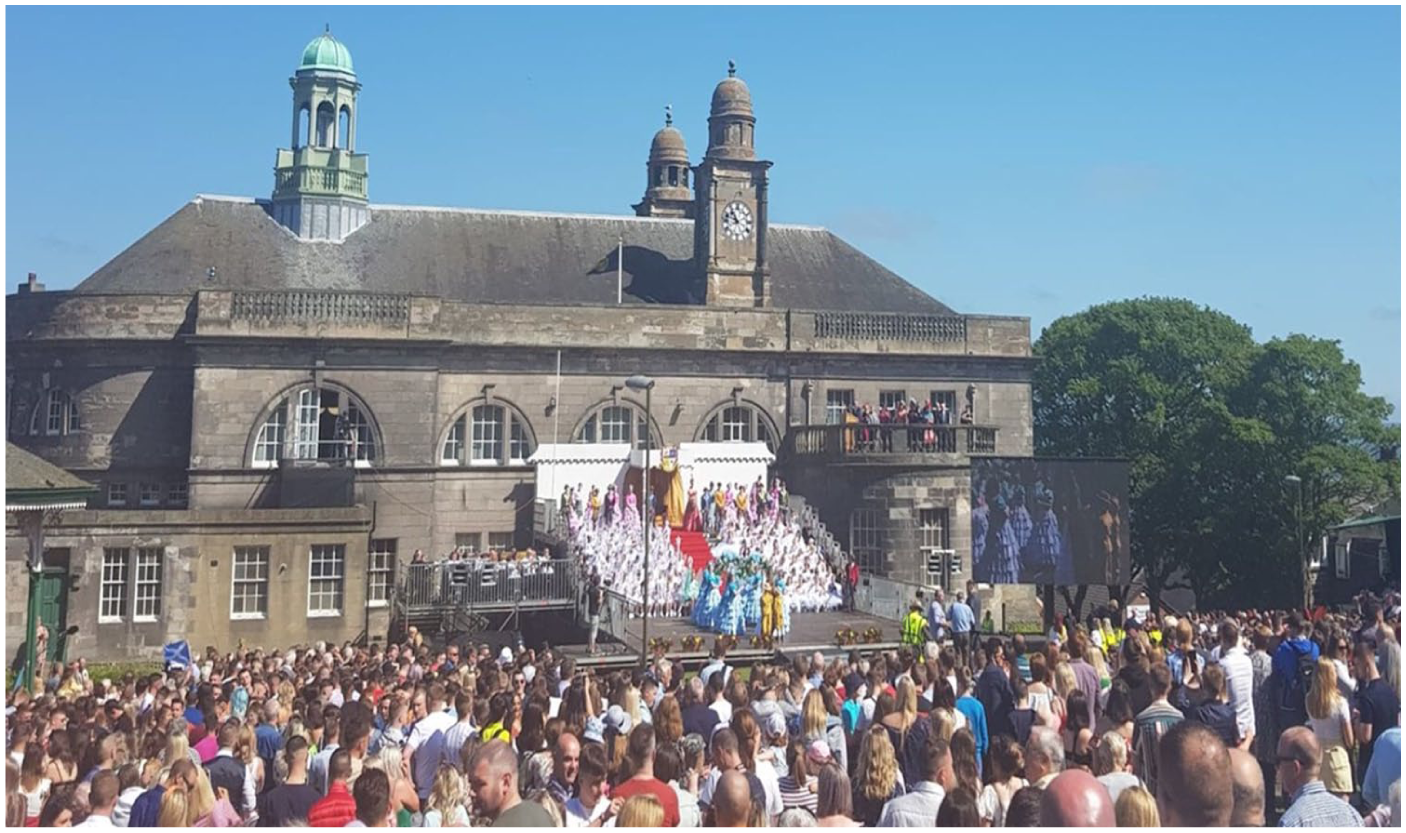
Crowning of the Queen of Bo’ness Fair.
The host school selects a ‘retinue’ that is comprised of key characters including the Queen, Chief Lady, Chief Lord, Champion and Queen of the Flower Girls. Hosting the Fair retinue rotates between five local schools and the other four schools elect children to be fairies, flower girls or presentees (children who create themed dance performances for the Fair Day). Participation in the Fair Day is seen as an important rite of passage in the community with children having one chance to play key characters. Participants must wear themed costumes that adhere to long-standing traditions. For example, Bo’ness fairy dresses must be entirely white, with a full skirt sturdy enough to balance a teacup, complemented by a silver wand, wings, white shoes, frilly socks, ruffled pants and a small tiara (see Figure 2). As displayed in Figure 2, Fair characters follow heteronormative gender norms where girls are queens and fairies, and boys are lords and champions. These normative gender portrayals remain unchallenged across the storied history of the Fair. Despite broader cultural shifts towards gender fluidity (Gabb, 2011), these entrenched norms remain deeply embedded in Fair traditions.
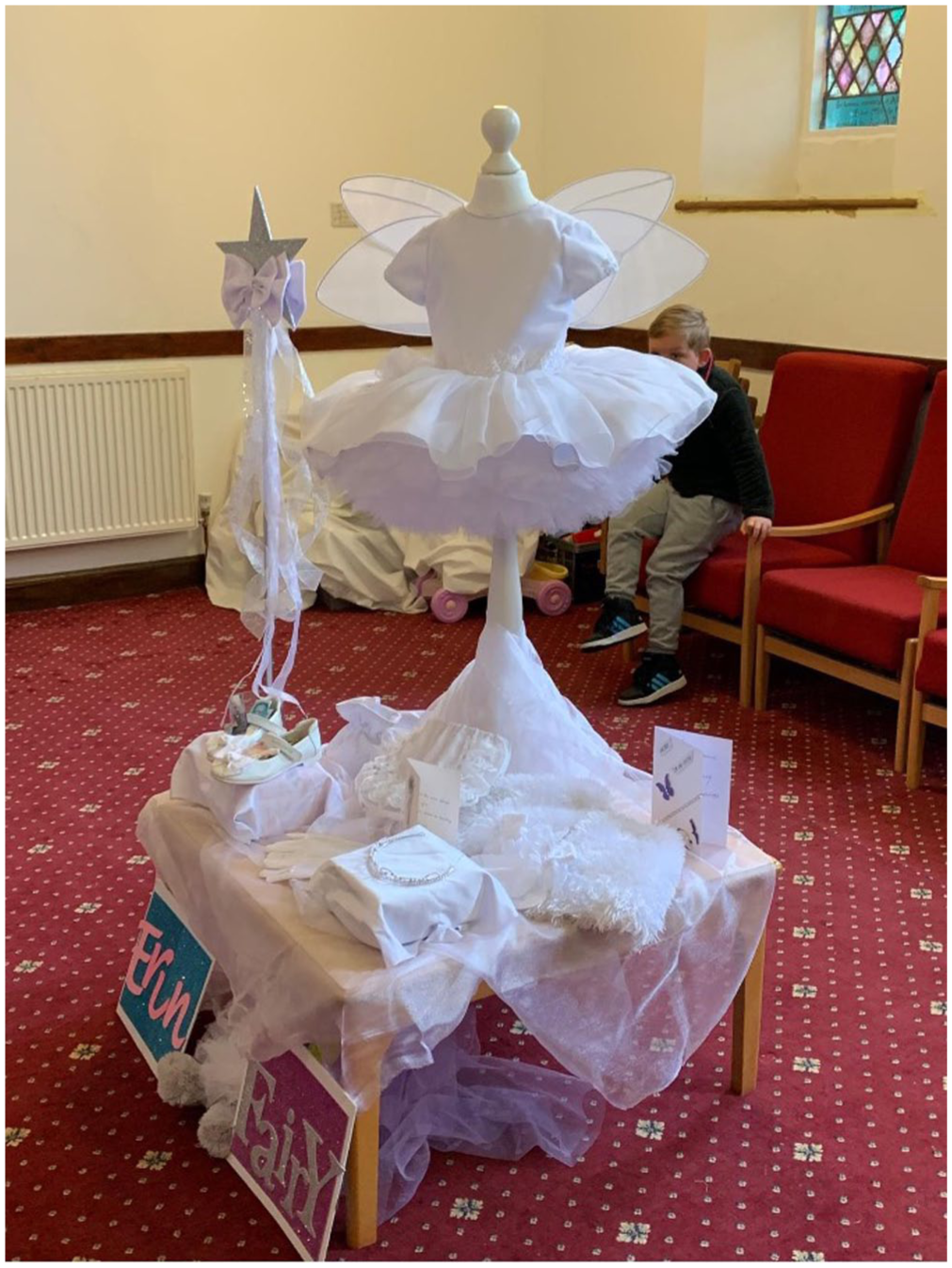
Bo’ness Fair fairy costume.
Although subtle personalisation is allowed, costume traditions are reinforced by gatekeepers including the Fair Committee, schoolteachers and dressmakers. Parents are responsible for their child’s participation, including hiring dressmakers, sourcing materials and hosting social events. All families with children in local schools can participate in the Fair. Children are required to provide a signed consent form from parents or guardians to be considered for a Fair Day role. While no child is explicitly excluded, some families elect not to participate due to perceived costs of taking part.
Nevertheless, most families in the community participate in the Fair in some capacity and in multiple ways. Almost all families hang bunting over their home and may use landscaping services to tidy gardens before the Fair Day. Most families attend the Fair’Een, the evening before the Fair Day, in which the community walk around the town viewing decorated houses (see Figure 3). While children are the focus of the Fair Day, it is commonplace for Fair spectators to purchase a new outfit for the Fair Day. Parents and family members of key characters often dress in occasion wear to watch the crowning ceremony from Bo’ness town hall balcony and attend a celebratory dinner with the Fair Chairperson and Committee members.
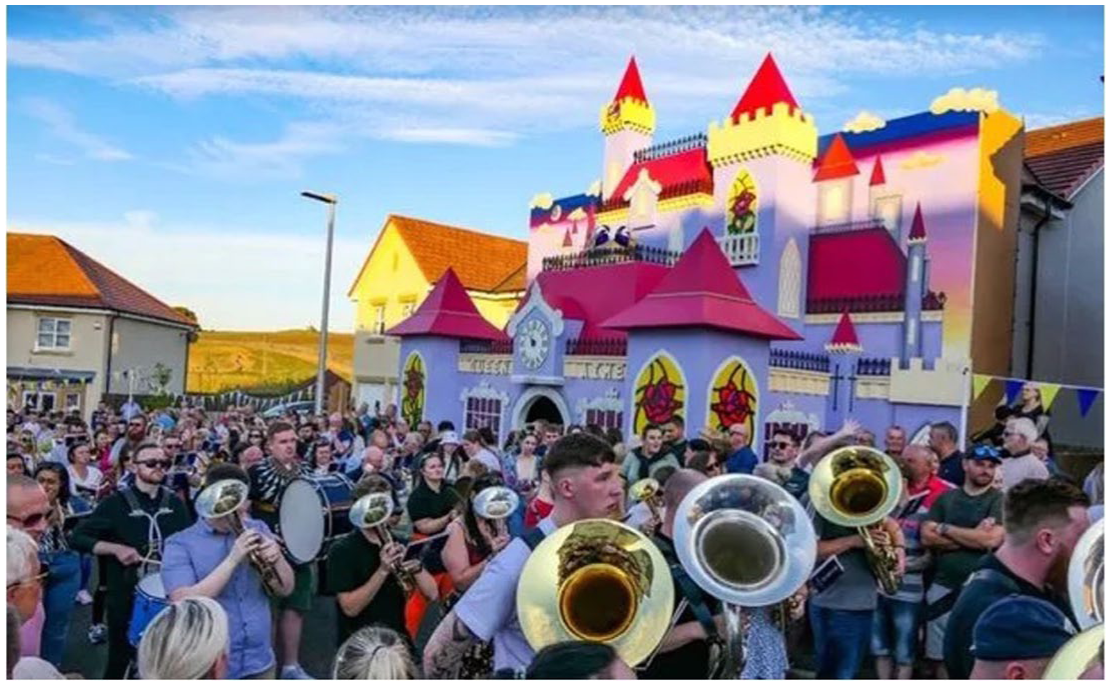
House extravagantly decorated for the Fair.
The Fair is organised by the Fair Committee, which is composed of local volunteers, who adopt various roles including chairperson, treasurer and general members. Previously, the local authority was responsible for providing infrastructure, permits, sanitation, security and crowd management. Since 1996, however, Bo’ness was incorporated into the broader Falkirk Council area (Falkirk Council, 2025) which led to a reduction in funding and a transference of administrative oversight for the Fair. Now, the Fair Committee coordinates fundraising activities and manages all logistics and operations. Local businesses support the event by providing unique Fair Day items, including the sale of wooden wands at the hardware store and custom-made costumes from various dressmaking shops.
The method
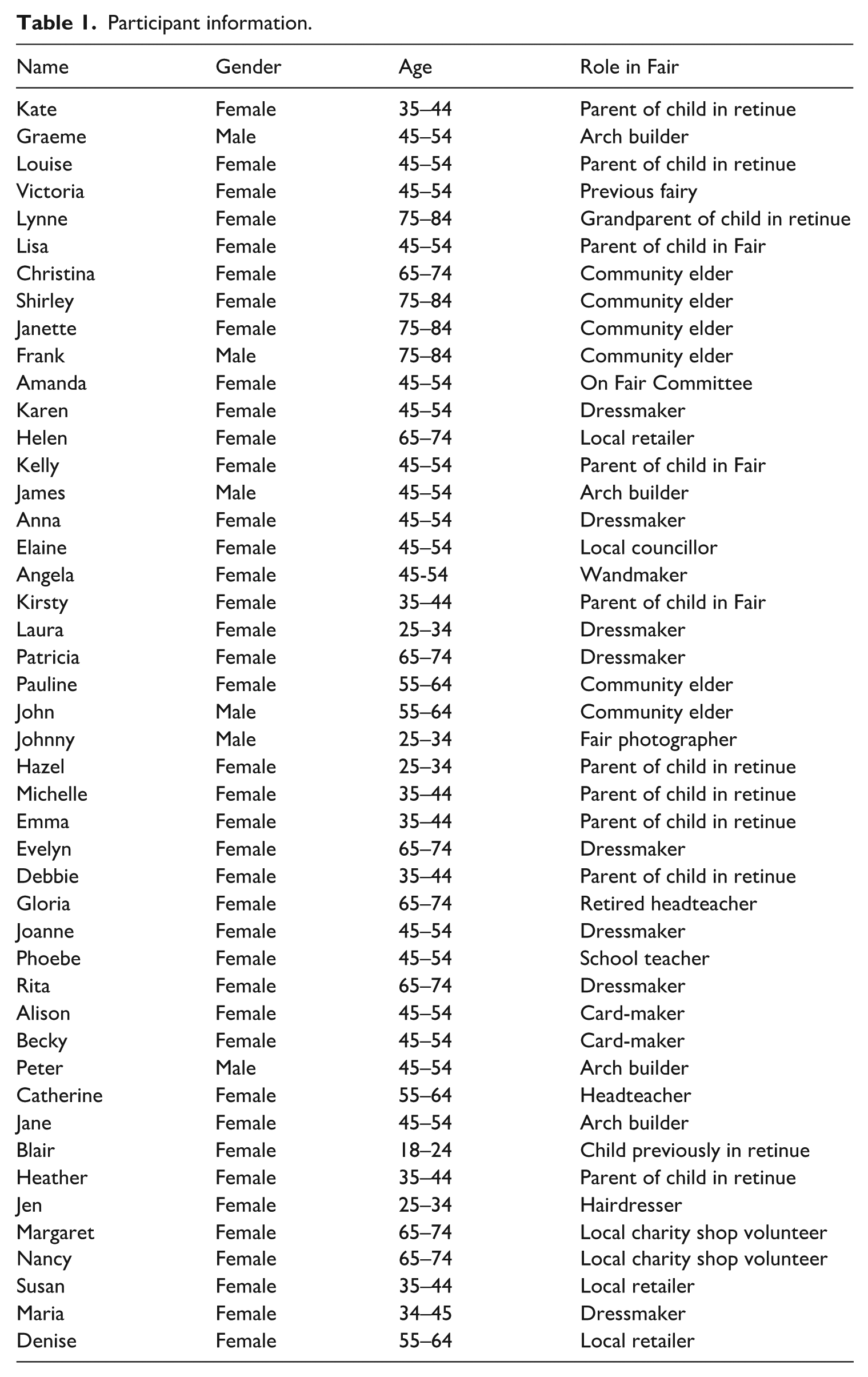
This research employed a multi-method approach to provide a rich, comprehensive ethnographic account of participants’ experiences over a 12-month period that included overt observations at social gatherings, photographs of events and family displays, and in-depth interviews with Fair participants. Interview data were gathered from 46 members of the Bo’ness community who adopted diverse roles in the Fair (e.g. dressmakers, card-makers, schoolteachers, committee members), parents of children taking part, as well as spectators. Due to ethical considerations children were not interviewed directly but were present within the ethnography due to their omnipresence in the Fair. Bo’ness, as a geographic community, comprises a broad range of deciles (e.g. employment, access to amenities, education) representing degrees of affluence and deprivation (Scottish Index of Multiple Deprivation [SIMD], 2020). This profile was relevant for sampling as participants’ (lack of) access to resources could offer differing perspectives of inclusion to the event. The town has a working-class and middle-class demographic with an array of occupations varying from small business owners and stay-at-home parents to headteachers and chartered accountants. The sample reflects this socio-economic diversity, with participants ranging from 18 to 84 years old, underscoring the broad appeal of the Fair. All participants were assigned pseudonyms to ensure anonymity (see Table 1).
Participant information.
One author was born in Bo’ness and lived in the town throughout their childhood. This existing connection provided valuable insider insight into Fair traditions and supported recruitment of participants through snowball sampling from the author’s extended social networks. Calls for participation were also posted on Fair social media pages and recruitment posters placed in local shops. In-depth, semi-structured interviews were conducted in participants’ homes and local shops with the schedule covering broad topics starting with Fair involvement, Fair history and the role of community members and families. Photo-elicitation provided context for stories that allowed participants to recount their first-hand experiences of the Fair. Several participants shared photo albums, presented researchers with keepsakes, and some sent photographs of memories after interview. This illustrates participants’ willingness to engage with the research process in addition to demonstrating the importance of conveying family display to an external audience. The use of images during interview allowed participants to retrieve memories (Harper, 2002) from previous Fair Days to explore stories of their past. All aspects of data collection received ethical approval from the University of Glasgow ethics board prior to the start of the project.
We conducted a thematic analysis of the data, guided by Spiggle (1994) with codes developed to analyse sources of data iteratively and systematically. The constant-comparative method (Glaser, 1965) was adopted to allow the authors to move between concepts, the field and data, resulting in findings representative of the observations made during data collection. All authors independently open-coded for emerging themes, using descriptive codes to represent the data in a way that preserved participant meanings. We started with current literature on family-based consumption that revealed the significance of display (Finch, 2007) to family identity performance. Family display provided an initial anchor for our analysis within relevant literature as well as enabling further understanding of the concept itself (Harman & Cappellini, 2015). One theme that emerged during data analysis was differing family expressions of extravagance. Drawing on existing theory on extravagance, we conducted systematic and iterative rounds of discussion of our coded themes (Glaser, 1965). This led to a refinement of codes around embodied and emplaced expressions of extravagance that formed the basis of our emerging theorisation. While extravagance is proffered as way of understanding family display, we consider extravagance as a relative term and are cognizant that extravagance for one family could be meaningfully quite different for another, suggesting our interpretation should generate further discussion of extravagance relating to family display in broader social context.
Findings
Display is central to the Bo’ness Fair, visible in the reels of bunting that traverse the streets, colourfully decorated homes and intricate handmade costumes worn by children participating in Fair Day activities. Executing these displays requires significant effort and financial commitment from families. It is expected that retinue families, whose child plays a key Fair character, will host fundraising events (e.g. prize bingo) to raise money for children’s costumes, hiring dressmakers and decoration materials. These events are an important part of the Fair social calendar and raise between £2000 and £5000. In contrast, families of minor characters (e.g. fairies) do not typically host fundraisers and will bear the costume cost themselves. This means families must balance financial resource, capabilities and personal values to meet community expectations of successful family display. A record of family display is documented through local and national press coverage, family photography and the Fair Programme that lists all participants’ names and details the history of the event.
Our findings focus solely on the costumes and how the tacit norms of extravagant family display are navigated by families and influenced by an omnipresent and diverse public audience. We identify two tools of display that are utilised by families during intense public display work. Firstly, we demonstrate how families embody extravagance in which family display becomes aestheticised by adorning the body in costume. Second, we demonstrate how families emplace extravagance in which family display becomes arranged in community space and place. In each section, we discuss the numerous ways tacit norms are navigated by both internal (familial) and external (community) audiences.
Embodying extravagance in family display
Displays of extravagance are most visible in children’s handmade costumes. As explained in the Study section, costumes must follow specific rules that are reinforced by the Fair Committee and dressmakers, who act as gatekeepers maintaining Fair traditions. We interpret these garment displays as embodying extravagance, where displaying family becomes aestheticised by adorning the body in costume.
Costumes are extravagantly designed with luxury fabric and personalised to each child to attract spectator gaze, becoming evocative objects (Turkle, 2011). It was common for parents to ‘go nuts’ (Debbie) and create displays that ‘make a statement’ (Kelly) with associated high expenditure part of families’ aspirational identity work. Displays described as ‘plain’ (Hazel) often receive negative audience reception and may be condemned (Gabb, 2011) as a weak display. Participants described how extravagance escalates as friends and family members contribute to costumes. For example, participants shared stories of travelling to London for branded accessories from the gift shop of Buckingham Palace (Michelle), and Links of London (Louise). Such trips were deemed extravagant but were also commonplace. This creates pressure for families to ensure family displays at least meet, if not exceed, community expectations.
Many participants compare the spectacle of Fair costumes to wedding dresses. Evelyn, a local dressmaker, explains Fair costumes are exposed to a wider public audience: ‘[I]f she did have a wedding, it’s only who you invited that’s going to judge it. [In the Fair], [i]t’s the whole of Bo’ness. Not everybody’s going to like her dress.’ The diverse spectating audience determines the success of material display (Heaphy, 2011), yet the scale of audience exposure increases the risk of negative scrutiny. Such intense public display (Finch, 2007) escalates the attention to detail that families apply to costumes. Victoria recalls in her own fairy dress that she wore 45 years ago:
It was white because they have to be white. Sleeveless with a round neck and it was handmade. The top was satin but overlaid on the top and the top of the skirt was lace. It was all little butterflies. I wore my Mum’s wedding thing which I had on my head. My Mum when she got married it went over her head but she kind of stitched it and it was on the top of my head. (Victoria, Fair fairy in 1978)
Victoria vividly remembers the intricate butterfly details and luxurious fabrics. Her account highlights that rules around fairy dress design have remain unchanged since the 1970s. Victoria’s dress gains layers of personalisation (Holmes, 2019) through repurposing elements of her mother’s wedding dress. Such objects interweave old and new family narratives to form material-kin biographies (Holmes, 2019). Embellishing costumes with special possessions adds to embodied extravagance and enhances the enduring performative lifespan for these items.
The breadth of embodying extravagance is not only confined to costuming but also includes styling the body. Children participating in the Fair engage in ‘beauty work’ (Kwan & Trautner, 2009, p. 50) by wearing elaborate make-up and hair styles to coordinate with their costume. Maria, a dressmaker who works closely with families, explains the extremes of such embodied aestheticisation that she has witnessed:
. . . they’re at the hairdressers at half five on the Fair morning getting their hair done. . . they’re all going around with their rollers in. [T]hey will go and get their hair done, they will get a fake tan. . . [. . .] Yes, some of them will get their makeup done. [. . .] And you’re like, they’re five? But it’s mothers, it’s not the kids, it’s the parents. [. . .] Some of them are all right, others are very over-the-top. It’s almost like they’ll spend anything on it because nothing’s too good for the fairy or the flower girl or whatever. (Maria, dressmaker)
Maria visually describes scenes of children preparing for Fair Day through costuming and cosmetics. These tools of display extend beyond material culture and narratives (Finch, 2007), to include the body. By embodying extravagance, children’s bodies become performative artefacts that can attract positive and negative judgement (Stewart, 2017) from external audiences’ gaze. Maria’s ‘contempt’ (Skeggs, 2015) for young children wearing fake tan is attributed to mothers’ decision-making that prioritises aesthetic display over normative ideals of childhood purity. This so-called ‘age drag’ is critical of children ‘performing an excessive version of womanhood’ (Zaborskis, 2015, p. 118) and highlights the entangled dimensions of ethical and aesthetic evaluative judgement (Stewart, 2017) espoused by external audiences. This example reiterates how mothers’ attempts to balance enriching childhood experiences with the risk of ‘exposure to crowds of unpredictable others’ (Abushena et al., 2025, p. 626) can result in a weak family display (Heaphy, 2011), as here embodying extravagance becomes associated with femininity ‘done to excess’ (Skeggs, 2004). This approach to extravagance is interpreted as tasteless and tacky by external audiences and not legitimate as family-like.
Navigating expectations: Embodying extravagance
Families rely on the marketplace to support their efforts to embody extravagance through purchasing outfits, accessories and mementos and enlisting services of dressmakers, beauticians and hairdressers. These goods and services come at a cost that is not accessible to all families. We identify numerous ways the tacit norms of display are navigated during embodying extravagance at both familial and communal levels.
Firstly, families may engage in reuse to minimise excessive consumption and expenditure. In displaying family, there is a tacit norm that Fair Day attire requires new outfit purchases each year. Such outfits have transient performative lifespans as they can only be worn once. Debbie reflects on this perceived expectation and the issue it creates:
The same with the buying expensive outfits, you can bring that on yourself. [. . .] [W]e’re both very sensible. We just weren’t interested in kidding on we were going to the races. [My husband] already had a beautiful suit. (Debbie, parent of child in retinue)
After some family deliberation, Debbie’s husband wore his existing suit rather than buying a new one for the Fair. Consumers may disengage from excessive consumption as an expression of thrift (Cappellini & Parsons, 2012). Debbie’s family reframes the narrative from performative public displays towards being financially ‘sensible’ in re-wearing an existing suit. This contradicts the implied norms of buying new, and instead reveals families employ reuse to navigate the perceived social expectations of attending the Fair.
Secondly, parents may use substitutes to minimise the cost of family display to make participation in the Fair more manageable. Parents often commission local retailers to make personalised wands, tiaras and other accessories (see Figure 4); however not all families can afford these bespoke items. Kirsty, mother of a Fair fairy, explains how she navigated expectations by sourcing, often low-cost, substitutes for her daughter to wear due to her constrained economic circumstances:
Tiaras for the actual Fair Day, actually the one that she wore on the Fair Day was the second one I bought, sent all the way from Japan, it was a tenner or something like that, so inexpensive. When it arrived, it was broken but I really liked it so I just ordered another one I mean I could have bought a tiara here and spent a couple of hundred pounds, but it was a tenner, it was lovely. (Kirsty, parent of child in Fair)
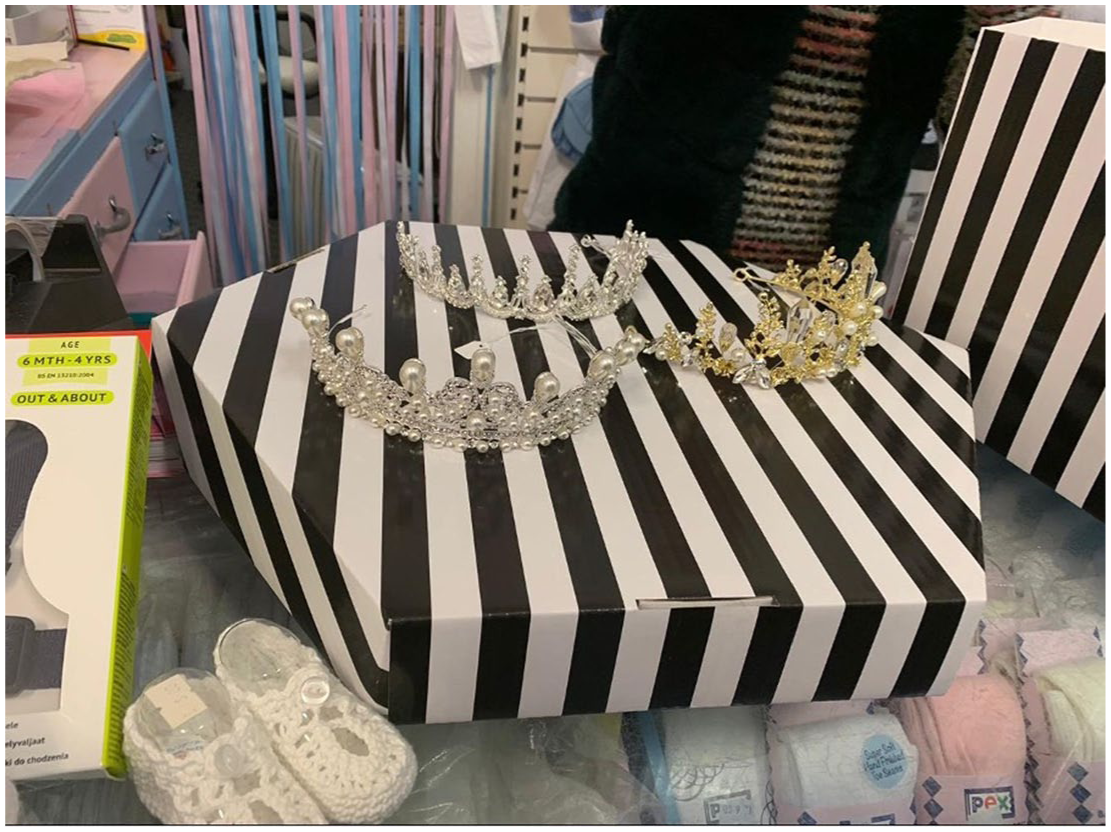
Tiaras on sale for the Fair.
Using substitutes allows Kirsty to create an extravagant embodied display without incurring excessive cost. Kirsty acknowledges that she ‘could have’ bought the tiara locally, however it was cheaper to buy a mass-market tiara to manage her budget. Despite the lower cost, this purchase involves excessive labour of searching online for an appropriate tiara that meets the aesthetic norms of the Fair, and then additional labour of reordering a replacement tiara when it arrived damaged. In contrast to family trade-offs that are hidden and negotiated backstage (Kerrane et al., 2021), Kirsty proudly uses substitutes to demonstrate her familial thriftiness. Parents demonstrate tacit awareness of the boundaries of acceptable family display that still meets aesthetic expectations of extravagance without the financial sacrifice. This highlights the cautious balance between risking a weak display (Walsh, 2018) and managing family resources that are negotiated at the familial level.
Thirdly, at the community level, dressmakers use creative workarounds to help families reduce the cost of extravagant designs. Local dressmakers act as an ‘all-knowing sage’ (Bonsu & Belk, 2003) advising on appropriate designs and fabrics. Joanne, a dressmaker, recalls explaining how to reduce costs to worried parents:
[W]hy would you spend thousands? I said you’ve still got about another £200 for your netting, but I was getting that for her online. Because the mums had said to her you need to spend that way, I said you didn’t need to spend it. The same with the Queen of the Flower Girls. Her mum was shocked how much she didn’t pay for the material. She was going should we maybe go and buy more expensive material, and we said why. If you can get effect for £6.99 duchess satin, why go and spend £25 a metre on Carrington? [. . .] There are some parents who will say that’s too cheap. (Joanne, dressmaker)
Joanne’s account reveals how norms of extravagance gain traction between families and within the community in which reducing costs risks being perceived as ‘too cheap’. Here we see concerns over the ‘caliber’ of display (Pugh, 2011, p. 8) in which mothers equate a lack of extravagant fabrics with a weak display (Walsh, 2018) that may receive negative judgement from other mothers and spectating audiences. For Joanne, it was important to persuade parents to reduce the expense of costumes to limit extravagance. In doing so, dressmakers like Joanne promote counternarratives to prevailing norms of children being ‘agents of materialism’ (Pugh, 2009, p. 10) that subsequently de-escalates extravagance. It is common for families to seek additional financial, emotional and practical support from close kin to negotiate demands on parenting (Carroll & Yeadon-Lee, 2022). In contrast, we demonstrate such support extends beyond the family to include community members, revealing negotiations relating to extravagance can also occur at the community level.
Emplacing extravagance in family display
It is tradition to host dress-showings in the weeks before the Fair. Family, friends, teachers and community members are invited to view the dress displayed on mannequins in local venues over tea, cakes and refreshments (see Figure 5). We interpret these dress-showings as emplacing extravagance, where family display becomes arranged in community space and place.
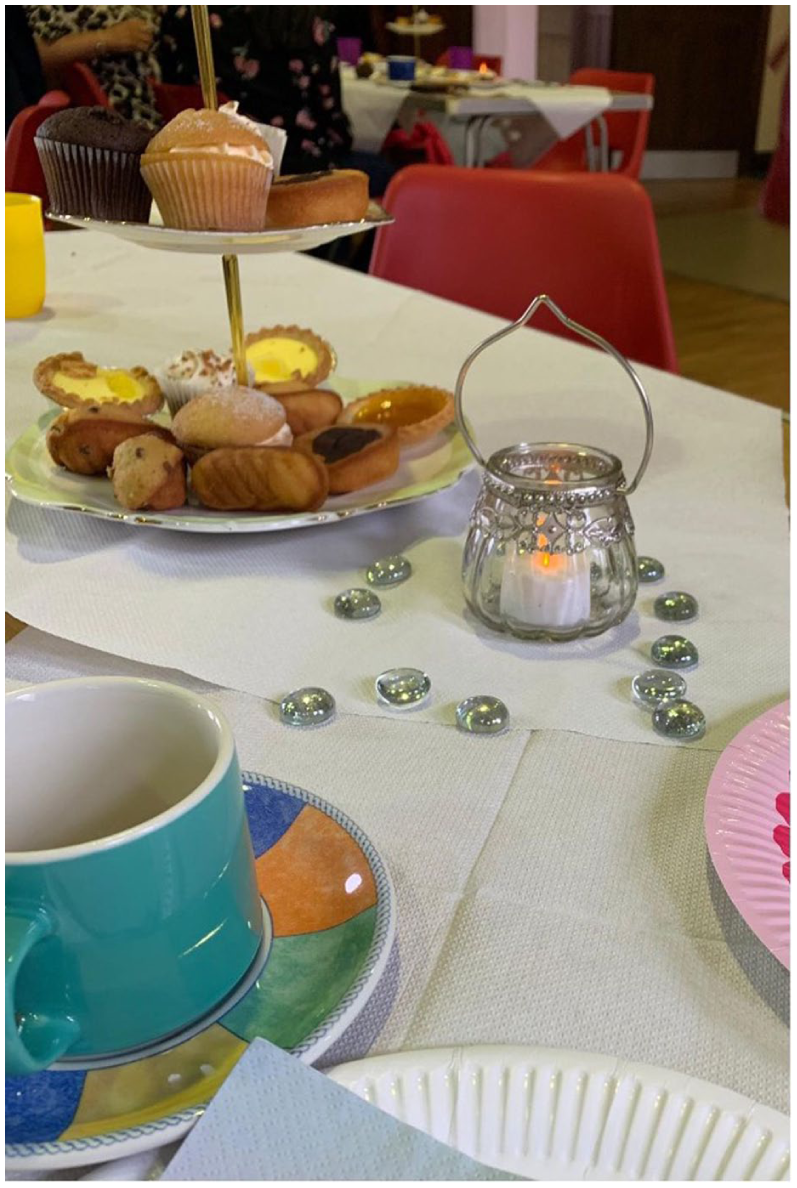
Afternoon tea elegantly set out for a pre-Fair dress-showing.
Dress-showings offer families a moment in the spotlight to display their children’s costumes and host external audiences of the local community. Lisa recalls the effort her family committed to her daughter’s dress-showing.
We made it like an afternoon tea sort of affair. It was really nice, it was lovely. But you have to have it all set up nice as well, you don’t just plonk the dress. . . You’ve got to have like nice material and little crystals and all this jazz, you know, you can’t just plonk the dress down it’s got to be all decorated around it. (Lisa, parent of a Fair fairy)
For Lisa, family display involved personalising material artefacts including ornamental centrepieces, hand-embroidered names and embellished mementos to be positioned around the displayed dress. Extravagant family display extends beyond the dress as a material tool of display (Finch, 2007) to become emplaced and arranged in public space. This is illustrated in Figures 2 and 5 in the arrangement of artefacts on display tables, and in the favours and refreshments served to attendees. Lisa’s account reiterates the perceived norms of dress-showings that must be extravagant captured in her words as decorated in ‘all this jazz.’ Such ‘unarticulated rules’ (Pugh, 2011, p. 8) govern families’ material displays and reinforce the necessary labour committed to execute these social events to be considered family-like.
Hosting a dress-showing for the first time can be overwhelming for families who are unaware of the tacit norms attached to these events. Louise, a parent of a retinue character in the Fair, residing in an affluent part of Bo’ness, describes her experience as ‘really stressful’:
It’s those unwritten rules. You get told by the Fair Committee that there are certain people. All the teachers from the school get invited. [. . .] Everybody got invited. All the Fair Committee got an invite. The chairperson, their wife got an invite. [. . .] It just grows arms and legs. All the kids in the class they [are] all invited, their parents got an invite. You’re talking about hundreds of people. [. . .] Then you had to have table decorations, so we went through [to] Ikea buying vases and fresh flowers to thistles and flowers, table covers. You hired crockery from the Fair. We went totally OTT and totally staged. [. . .] [The headteacher] wanted to make it perfect. It was really stressful. I think it was a relief when she came in and saw the dresses. She had that vision around what it would look like and what the stage would look like. (Louise, parent of child in retinue)
Louise’s account reveals a complex identity project depicted by the range of expectations associated with dress-showings, ranging from inviting the correct guests, material decorations and refreshment provisions. These ‘unwritten rules’ are passed on verbally by Fair Committee members and are reinforced by gatekeepers, such as teachers. This highlights the way in which displays become ‘normatively highly saturated products’ (Haldar & Wærdahl, 2009, p. 1145) through community reinforcement. After receiving directions from the Fair Committee, Louise reflects on her family’s response as ‘OTT and totally staged’. This highlights the collaborative effort of emplacing extravagance whereby external audiences co-construct tacit norms that shape family display and community tradition. Gatekeepers of community tradition (Tremlett, 2014), such as teachers and dressmakers, are equally concerned in delivering a perfect ‘vision’ for family display. This reinforces the blurred boundaries of family and community identity (Walsh et al., 2020) by revealing external audiences’ concern for successful family display as representative of community identity. Such input can escalate extravagance and reveals the iterative process of external audience evaluation in which they become actively involved in executing extravagant family display.
Navigating expectations: Emplacing extravagance
Families electing to participate in the Fair must manage family capabilities, resources and values. We identify three responses to navigating tacit norms of family display that emerge during emplacing extravagance occurring at familial and community levels.
To avoid weak displays (Walsh, 2018), families may seek to rectify family displays that fail to meet normative standards. Kate recalls the stress of her daughter’s fairy dress-showing:
I was very stressed about my dress-showing and I’m quite sociable and I have people here all the time. Very stressed about my dress-showing. What if people didn’t turn up? What if I haven’t got enough food? What if I run out of wine? [. . .] There was a little bit wrong with her dress, so I was freaking out about that at one point. I had to get [the dressmaker] to put more net in it because it wasn’t as sticky up as I wanted. She put another two layers in it. (Kate, parent child in retinue)
Kate lives in an affluent neighbourhood of Bo’ness and is a self-proclaimed ‘perfectionist’. She repeats ‘my dress-showing’, which reveals the sense of ownership she felt over hosting the event for her daughter. Kate panics about the dress not meeting fairy dress standards, prompting her to seek further alterations to make it perfect. This underscores the anxiety that mothers (Abushena et al., 2025) experience during intensive display work that can intensify when children are involved (Doucet, 2011). Rectifying potentially weak displays (Walsh, 2018) is a means to proactively protect the family from negative audience scrutiny. This reveals the double character of display that both empowers some families to creatively communicate their family ideals (Finch, 2007) yet may disempower other families who cannot meet normative expectations. Family displays that underscore privilege are more likely to be positively received, interpreted and validated (Heaphy, 2011; Walsh, 2018). However, in the latter case, family display uncovers latent vulnerabilities and disparities between families and makes these visible to the wider community. This sensitises families to reflect on their own family circumstance and self-scrutinise their emplaced displays as they are concerned about being judged by others as not family-like.
Families may also substitute market products and service providers with homemade alternatives to gain control over the display. Kirsty recalls an issue she encountered with bespoke invitations she had commissioned from a local card-maker:
I wasn’t happy with the invites because [. . .] they were cut wrong [sic] and Robert [my husband] was like ‘It’s fine.’ But I said, ‘It’s not fine though they’re going to this person, that person.’ I had this big drama over an invite. He actually went and bought me a printer so I could do them the way I want them [. . .] when you price compared to the price of a printer, it was cheaper getting them, doing them myself than it was to get somebody else to do them. (Kirsty, parent of child in Fair)
Dress-showing invitations set the tone for each event and are often kept for children as keepsakes (see Figure 6). Kirsty uses homemade invitations as an alternative to professional products that were deemed ‘wrong’ by Bo’ness standards. A core element of Kirsty’s concern over the invitations was the interpretation of the recipients. She cites an imaginary external audience (Almack, 2011) who may notice the perceived imperfections of the invite as an ‘unsuccessful display’ (Zadeh at el., 2022) that could result in negative judgement of the family (Carroll & Yeadon-Lee, 2022). We see mothers regain control over family displays through using homemade substitutes that additionally allow families to constrain resources.
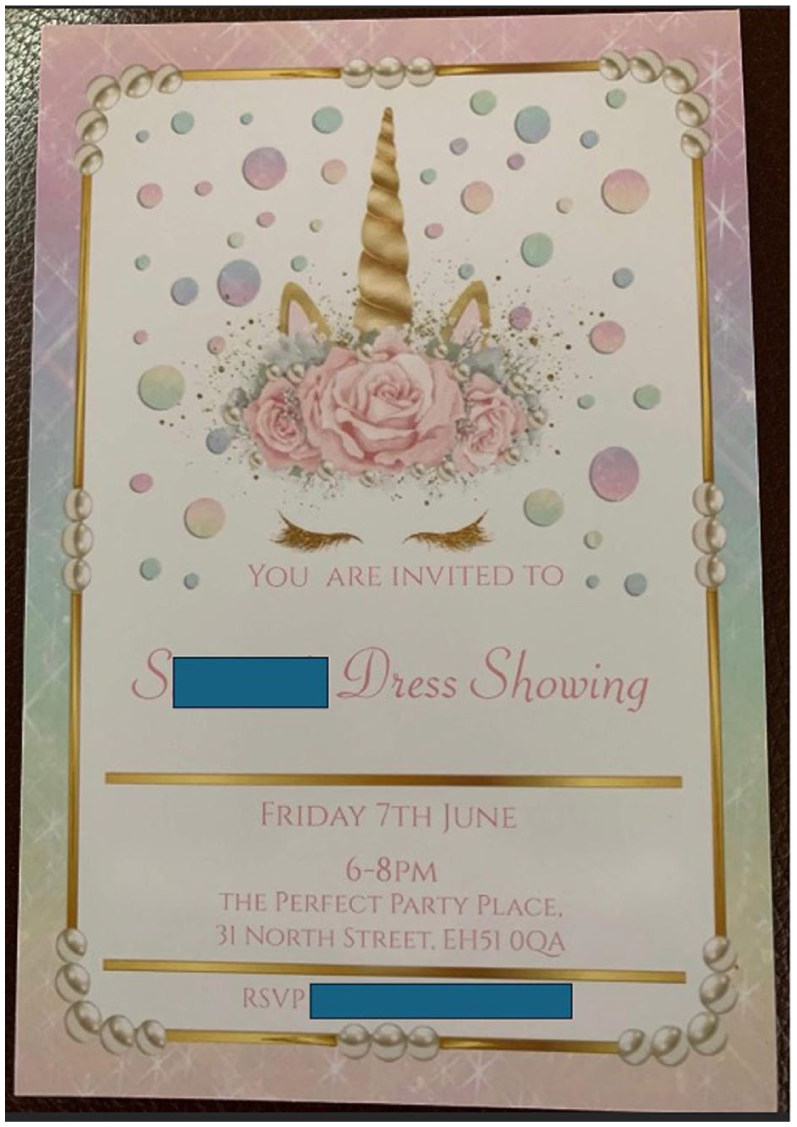
Keepsake invitation to a dress-showing.
At the community level, community members may seek to shield families from negative audience judgement to help navigate tacit norms of display. Audience commentary is central to dress-showings, offering opportunities to judge the emplaced extravagance of family displays against previous years’ displays. Gloria, a retired headteacher, reflects on a particular dress-showing of a pupil that transgressed Fair norms:
People are going to comment on whether they like or dislike something. Everybody’s got different tastes. Some people will think that’s amazing; some people won’t like it. This year Taylor had a ballerina length dress on. It was stunning, and then I thought, ‘Good for you, a wee change.’ She was absolutely beautiful, like a young Audrey Hepburn. Her dress was modelled on Audrey Hepburn’s wedding dress. It was absolutely stunning. It’s just individual tastes. I’ve seen some disasters and thought, ‘Oh no, that looks hideous.’ But I would keep that to myself. (Gloria, retired headteacher)
Taylor’s ankle-length dress became ‘the talk of the town’ (Evelyn) as it contravened floor length hem norms. In addition to stretching family capability and resources (Cappellini & Parsons, 2012), extravagance can stretch the norms of acceptable family display. In this case, the child was adamant she wanted an ankle-length dress inspired by her idol Audrey Hepburn. This example demonstrates how child’s preferences are taken into account (Tinson & Nuttall, 2011). Fieldnotes from attending Taylor’s dress-showing noted whispers and deliberations from onlookers over cups of tea. Despite legitimising Taylor’s dress as inspired by an iconic design, Gloria’s account also reveals a tension between positively supporting change and negatively evaluating displays as ‘hideous’ and ‘disasters’ that fail to meet audience expectations. Gloria is silent in negative instances to shield children and families from personal taste. Emplacing extravagance through dress-showing events creates deliberative spaces for multiple, yet connected audiences to converge (Walsh, 2018). Hosting these events creates a space for deliberation in comparing material displays that naturally escalates expectations for ‘bigger and better’ (Gloria) displays year-on-year. Attending audiences act as insiders (Tremlett, 2014) and gatekeepers in determining the parameters of family display that can both escalate and de-escalate tacit norms for extravagance. Importantly, the diversity of audience roles offers insight into different reactions to emplaced extravagance, illustrating the complexity of negotiating a ‘legitimate’ family display.
Conclusion
Our research advances sociological debate on family display by theorising extravagance as a tool of family display. Extravagant family display involves intense display work produced by families through excessive resources of time, labour and money to meet tacit norms and audience expectations. In addressing our first research question, our analysis identifies two forms of extravagant display used by families: embodying extravagance in which family display becomes aestheticised through adorning the body in costume, and emplacing extravagance in which family display becomes arranged in community space and place. This broadens our understanding of the scope of Finch’s (2007) tools of display beyond material culture and narratives, to include bodies and place. By means of a contribution, we outline the sociological implications of bodies and place to family display.
Embodying extravagance can be particularly troublesome, as excessive ‘beauty work’ (Kwan & Trautner 2009, p. 50) on young children invites critique from external audiences for flouting childhood norms. This issue raises sociological debate on determining appropriate displays of childhood (Dermott & Seymour, 2011) that may be at odds with aestheticised styling (Stewart, 2017; Zaborskis, 2015), and spotlights the additional scrutiny encountered when family displays involve children (Doucet, 2011). Emplacing extravagance can be socially exposing as it situates family display in public place that exposes families to scrutiny from wider external audiences. This spatial focus builds on our current understanding of mundane family displays in public such as eating out in restaurants (Finch, 2007), to include more extraordinary family displays in public place. In our case, participating in community traditions becomes a performative exercise in what Otnes and Pleck (2003, p. 270) refer to as ‘scripted extravagance’ that heighten expectations and potential scrutiny from external audiences. By attending to the spatiality of family display, our research illustrates the significance of the emplacement of family display in shaping how families display their kinship to external audiences. The two forms of embodying and emplacing extravagance reveal the double character of extravagant family display that can be simultaneously an opportunity or threat to family identity. Families not only risk producing weak displays (Heaphy, 2011) but also risk misappropriating extravagance which can further erode displays of family. Families jostle competing demands to present family-like displays as well as displaying extravagance to adhere to community traditions. Our research builds on extant research on perceived misappropriation of extravagance (see Belfiore, 2020; Tremlett, 2014; Zaborskis, 2015) by unpacking the embodied and emplaced forms of utilising extravagance as a tool of family display.
Extravagance can intensify due to the temporal character of the event. Performing as a key retinue character is a once-in-a-lifetime opportunity for children, and most displays are single use. Building on Finch (2007), we offer a temporal reading of tools of display by revealing tools operate in two ways. First, some family displays have transient performative lifespans. For example, dress-showings are emplaced, assembled and disassembled for one afternoon, and aestheticised hair and make-up are embodied for one day. Second, other family displays have enduring commemorative lifespans. For example, bespoke costumes and personalised cards become family keepsakes. Transient displays can become enduring through documentation highlighting the entanglement of displaying (Finch, 2007) and documenting (Zadeh et al., 2022) family. Displays can transcend their material affinities to become ‘family reminders’ (Holmes, 2019, p. 175) that exhibit family-like displays for future generations. Additionally, the public visibility of community events (Shannon, 2022) and pervasiveness of social media sharing (Barnwall et al., 2023; Cabalquinto, 2020) expose family displays to ‘mini publics’ (Thimm, 2015) and enshrine family display in enduring digital legacies. The potential for enduring reminders of family display further intensifies the need for interpretation and affirmation of successful display.
In answering our second research question, we demonstrate how families navigate tacit norms of family display. In contrast to family displays that work against normative boundaries (Mamali & Stevens, 2020), we find families exert considerable effort to work within normative boundaries of display. Families deploy various tactics including reusing existing materials, buying mass-market substitutes, rectifying potentially weak displays, and crafting handmade alternatives. These tactics allow families to manage resources, capabilities and personal values, while ensuring overall conformity to normative boundaries. This conformity is supported by gatekeepers who deploy tactics of creative workarounds and shield families from negative judgement at the community level. Such tactics can de-escalate extravagance by finding alternative means to create the illusion of extravagance with limited resources or promoting counternarratives to extravagance to help families justify thriftier displays. This underscores the centrality of negotiation that occurs during family display (Finch & Mason, 1993) which can occur at both familial and community levels. Collectively, this reduces the risk of weak displays (Walsh, 2018) that allows space for negotiation within normative boundaries.
This research contributes to understandings on public dimensions of family display (Finch, 2007), by shedding light on the collaborative roles diverse public audiences play in shaping family display. Our empirical case includes internal and external audience members to better understand the evaluation of family display from multiple and differing perspectives (family, spectating audience, community members, gatekeepers). Previous research demonstrates external audiences evaluate family display through a linear process of reception, interpretation and acceptance or rejection (Henze-Pedersen & Järvinen, 2021; Seymour & Walsh, 2013). Our findings enrich this perspective by revealing external audience judgement can occur through an iterative process in which they collaborate with families to directly influence family displays. External audiences function as both insiders (Tremlett, 2014) and gatekeepers to determine display norms that have the capacity to escalate or de-escalate extravagance. We build on Finch (2007) by reconsidering ‘degrees of intensity’ as an ongoing dynamic that moves between escalation and de-escalation of extravagance. By including gatekeeper accounts, this research demonstrates the dual role of external audiences that both reinforce and dismantle tacit expectations of family display.
Emplacing family display in space and place creates deliberative spaces for internal and external audiences to comment, compare and discursively validate displays as family-like. These deliberative spaces intensify social exposure that can escalate extravagance as families attempt to better previous years’ displays. Families risk luxury shaming (Khan et al., 2010) and negative stereotypes (Belfiore, 2020) for distasteful displays of excess that extend beyond accepted tacit norms. This risk is enhanced within public spaces that are uncontrolled (Abushena et al., 2025). In complement to observations by Abushena et al. (2025) that some valuable childhood experiences can pose perceived existential risks, our analysis reveals family displays are performatively risky to family identity. This contributes to understandings of family display in public (Abushena et al., 2025; Mamali & Stevens, 2020) by underscoring that obligations to display family extend beyond intensive motherhood to include community belonging.
While this study offers valuable insights into the role of extravagance in family display, certain limitations and opportunities for future research can be discerned. First, developing a fraternal perspective to family display is a fruitful avenue for future research to explore. Our findings primarily reflect maternal perspectives on family display. Fathers were not included in this data sample, reflecting their limited involvement in the highlighted rituals of dress-showing and costuming preparations, which are predominantly organised by women in the community. Second, children were not interviewed directly due to ethical considerations. However, their presence was central to the ethnography and captured through observation, visual data and interviews with adult participants. We also included young people with recent Fair experience, offering retrospective insights, though these may not fully reflect current children’s immediate experiences. Future research could benefit from including a broader range of family voices, particularly from fathers and children, to further deepen understanding of extravagant family display.
Footnotes
Funding
This research was funded by the Academy of Marketing Research Council AMRC18-04.
Declaration of conflicting interests
The authors declared no potential conflicts of interest with respect to the research, authorship, and/or publication of this article.