



Abstract
There is a growing heterodoxy of sociological social mobility scholarship which offers an alternative to dominant research and policy paradigms. This article aims to develop this body of literature through qualitative case study analysis of two young women – one upwardly mobile, one socially stable – and their classed and gendered trajectories into (and potentially out of) the nursing profession. Bourdieu’s theory of practice provides a framework for understanding the temporality and the intersectionality of these trajectories. Data are drawn from a project on the experiences of final year BSc Nursing students in England during the 2020 COVID-19 outbreak. The narratives presented in this article are drawn from two interviews which included the production of a ‘lifeline’ to prompt the story of the participants’ lives so far, and their hopes for the future. Employing this tool as part of a case study approach offers an appreciation of the temporal ordering of a biography, as well as highlighting key life events in the context of an overall trajectory. The analysis highlights the workings of capital, habitus and field in shaping these young women’s lives, along with their investments in the illusio of higher education and experiences of symbolic violence. By exploring their past, present and imagined futures at a time of crisis, the analysis considers the temporality of practice and demonstrates how accumulated intersectional inequalities over the lifecourse shape how individuals can deal with disjuncture.
Introduction
Research on upward social mobility has often focused on access to, and experiences of, academic degrees and professional careers, but there has been a relative neglect of the ‘lower professions’ like nursing which have elements of practice-based learning. 1 Nursing is a feminised occupation in the sense that women dominate the workforce, but also because of the associated gendered qualities of caring and compassion (Huppatz, 2012). This article uses an analysis of classed and gendered trajectories into the nursing profession to address areas for development in the critical sociology of social mobility. Through exploring the responses of two young women to a period of crisis in the context of an overarching biographical narrative, it aims to develop the field of social mobility research though a focus on temporality and intersectionality.
Widening participation in universities has typically been rationalised by the view that higher education is a driver of social mobility (Lawler & Payne, 2018). By increasing the number of graduates from diverse backgrounds, the argument goes, we will in turn diversify graduate-level, professional careers. A wealth of sociological literature has questioned these assumptions, focusing on unequal outcomes stratified by class, ‘race’ and gender for ‘success’ in higher education, access to graduate occupations and ongoing inequalities in professional careers (Bathmaker et al., 2016; Friedman & Laurison, 2019; Ingram et al., 2023; Lawler & Payne, 2018). Previous research has highlighted that nursing is a relatively open profession (Friedman et al., 2017) but suggests a potential ‘class ceiling’ in which social and cultural capital, along with class origin, affect nurses’ income and inferred career progression (Snee & Goswami, 2021).
In the next section, I outline the growing heterodoxy of social mobility scholarship that has attempted to offer alternatives to dominant research and policy paradigms, highlighting considerations of temporality and intersectionality. I then outline the project which underpins this work, which explored the experiences of final year BSc Nursing students in England during the 2020 COVID-19 outbreak in the context of their social mobility journeys. I suggest that qualitative case study analysis offers an under-utilised approach to explore life histories that can become disjointed in the cross-sectional analysis that dominates qualitative social mobility research, illustrated with two narratives taken from the COVID-19 project. The case studies explored in this article demonstrate that gaining access to the nursing profession is only one point in a longer trajectory, in which experiences of inequality and thwarted ambitions for some can be contrasted with access to capitals that allow others to realise their goals and ‘weather the storm’. These stories highlight how bringing together the temporal (in terms of past, present and imagined future trajectories at a time of crisis) and the intersectional (in which class and gender structure both individual lives and the occupational field) provides a more nuanced account of social mobility beyond access to a professional job.
Social mobility and nursing
The status of feminised professions like nursing reflects the classed and gendered social position of ‘women’s work’ (Huppatz, 2012). The historical location of nursing outside the academy has shaped an ongoing ambivalence over the professional status of nursing and the discipline is something of an anomaly in its orientation to higher education. For much of the 19th and 20th centuries, nurses were trained in hospitals, with a gradual shift to higher education. A degree became a requirement for Registered Nurses relatively recently (for those starting their training in 2013) (Willis, 2012). In response to these developments, debates in the discipline and beyond have focused on whether an academic education is desirable for nurses, despite the research which indicates better clinical outcomes with graduate nurses. Nursing degrees have even been presented as a barrier to social mobility, in contrast to the dominant rhetoric about higher education in general, because it blocks people without academic qualifications who would otherwise be ‘good nurses’ (Snee et al., 2021). Thus, while nursing is ostensibly a professional occupation that requires an undergraduate degree to practise and has a ‘middle-class’ socio-economic classification, 2 it offers insights into the complexity of social mobility.
The dominant paradigm in social mobility research for many years was driven by the seminal work of Goldthorpe et al. (1980), which undertook large-scale quantitative analysis of patterns of movements between socio-economic categories. Recent work in the sociology of social mobility taking a qualitative approach has increasingly recognised it is not automatically a progressive ‘good’ (Friedman, 2016; Lawler & Payne, 2018; Reay, 2013; Scandone, 2022). These trends have been influenced by Bourdieu’s understanding of multidimensional classed locations (Bourdieu, 1984; Savage et al., 2015; Sepúlveda & Lizama-Loyola, 2022), in which movements in the social space are not only about labour market changes but also involve cultural and social shifts. Influential work on the subjectivities of social mobility has highlighted the potential negative psychological consequences of moving across cultural and symbolic boundaries, as well as the material (Friedman, 2016; Walkerdine, 2003). Against this backdrop of ambivalence over the benefits of social mobility as social justice, two themes have emerged in the literature: temporality and intersectionality. Considered together, they offer a framework for understanding the nature of social mobility journeys as classed, ‘raced’ and gendered trajectories: movements over time that are shaped by intersectional forces.
Temporality
Social mobility, by definition, has a temporal dimension, as it is concerned with the movement between social class positions over time (Savage, 2007, p. 313). In the work of Goldthorpe et al. (1980), and subsequent work taking inspiration from this approach, social mobility is ‘measured’ by the movement of socio-economic categories between two fixed points in time. Point 1 is when an individual is still a child at home, with the ‘origin’ class taken from the main breadwinner’s occupation; Point 2 when the individual is an adult with a ‘destination’ class. Temporality also features in this approach as it provides the means to analyse rates of social mobility and changing class structures in different historical periods. However, there is a growing recognition that movement between socio-economic categories is only part of the social mobility story. The ‘class ceiling’ (Friedman & Laurison, 2019) highlights the ongoing influence of class background beyond entry into professional careers; class inequalities continue to matter among those with the same ‘destination’ NS-SEC category. Moreover, linear transitions between two social class categories cannot capture the ‘multidimensional weaving together of life’ (Savage & Flemmen, 2019, p. 99) in personal narratives of social mobility.
The narratives presented in this article take place against the backdrop of a particular moment in historical time: the COVID-19 pandemic and its impact on the Nursing Class of 2020. The participants’ trajectories also take place in relation to ‘temporal opportunity structures’, in which the timing of lifecourse phases is organised by the normative expectations and structural possibilities in specific time periods (Nilsen, 2024). Bourdieu provides us with a theoretical framework to engage with these temporal concerns. Habitus is ‘embodied history, internalized as a second nature and so forgotten as history . . . the active presence of the whole past of which it is the product’ (Bourdieu, 1990, p. 56). Adkins (2011) highlights how this fits into a wider theory of practice as temporalisation. For Bourdieu (2000) the future, too, is present in everyday practice, as the dispositions of the habitus pre-reflexively anticipate the forthcoming in relation to the probabilities of the field (Adkins, 2011). Drawing on Bourdieu (1990, 2000), we can conceptualise an individual’s movements in the social space as facilitated by the volume and composition of their capital accumulated over time; and that the dispositions of the habitus which shape experiences of mobility are inculcated in the past, and shape current and future actions and outcomes (Friedman & Savage, 2017). This provides an understanding of class positions as more than socio-economic categories defined by employment, which need to be understood in the context of the ‘temporal structures’ used to make sense of life narratives (Güell & Yopo Díaz, 2021). Bourdieu’s theory of practice has thus influenced the contemporary analysis of social mobility narratives as multidimensional trajectories – movements over time (Savage & Flemmen, 2019; Sepúlveda & Lizama-Loyola, 2022). Such journeys are not ‘transitions of social class alone’ (Savage & Flemmen, 2019, p. 98) however, and require an analysis that incorporates an intersectional perspective.
Intersectionality
While social mobility has an explicit concern with socio-economic positions, the ways in which class fluidity or stability differs by gender, ethnicity and other social divisions has been recognised by the dominant paradigm (see Bukodi et al., 2017; Macmillan & McKnight, 2022). Innovations in exploring patterns of social mobility have indicated the cumulative ‘double disadvantage’ for women and minoritised ethnicities (Friedman & Laurison, 2019, pp. 50–52). Increasingly, work on the subjectivities of social mobility have sought to move beyond a ‘class and’ approach to multiple inequalities and adopt an intersectional analysis that recognises the ‘mutually constitutive character of identities and inequalities of class, race, ethnicity, religion, and gender, as they shape and are being shaped by individuals’ experiences of social mobility’ (Scandone, 2022, p. 175; my emphasis). This literature has been influenced by a body of work which develops Bourdieu to explore complex intersectional trajectories, with experiences of (and the dispositions and resources to negotiate) class positions inherently gendered and racialised (Ingram et al., 2023; Rollock et al., 2015; Singh, 2022; Wallace, 2017). This has considered the subjective experiences of social mobility beyond those of upwardly mobile white British men, such as Scandone’s (2022) work on the experiences of Bangladeshi Muslim women, and Sepúlveda and Lizama-Loyola (2022) on social mobility among indigenous populations in Chile.
Understanding these trajectories can also be aided using concepts from Bourdieu’s toolbox that are under-utilised, according to Threadgold (2019), such as illusio, defined as when a subject is motivated by the stakes of (and promises of) the field: the interest underlying action (Bourdieu & Wacquant, 1992, p. 26). Illusio involves anticipation of the future; our actions are guided by the idea that if you do ‘x’ (e.g. you undertake an undergraduate degree), you will gain ‘y’ (e.g. a professional job). Illusio is not only about exchange value, or the ‘hidden profits’ of practice, as there is an ‘affective dynamic’ to investment in the game (Aarseth, 2017). This might result in symbolic violence – ‘the violence which is exercised upon a social agent with his or her complicity’ (Bourdieu & Wacquant, 1992, p. 167) – for example, being unable to afford university subjectively interpreted as not being ‘good enough’ (Threadgold, 2019); or the anxieties and desires that shape different middle-class fractions’ fears about ‘failing or falling’ (Aarseth, 2017).
Much qualitative social mobility research adopts cross-sectional analysis but has yet to explore the potential of in-depth case studies. In an alternative approach, two young women’s biographical narratives are examined here in depth in chronological order, so that we may explore how their trajectories were shaped by intersecting inequalities with a sensitivity to the holistic ‘temporal structure’ (Güell & Yopo Díaz, 2021) of their stories during a time of significant disruption. The following section introduces the wider project, which explored trajectories into nursing. This aimed to focus attention on a feminised ‘lower profession’ that was significantly affected in profound ways by the COVID-19 pandemic. The project explored the role of class, gender and ‘race’ in experiences of this crisis, and how participants were able to respond, in the context of a past, present and future life story.
Background and method
The data for this article are grounded in the experience of a specific cohort of nursing students: the ‘Class of 2020’, in their final year of a pre-registration undergraduate nursing degree in England at the start of the COVID-19 outbreak. As with all educational establishments, university campuses closed to in-person teaching for undergraduate nurses. In addition, the placements in clinical practice required by the Nursing and Midwifery Council (NMC) to qualify as a registered nurse were also cancelled. Academic learning could continue online, but without these practice hours, this cohort would face delays in graduation and entry into the nursing labour market. Health Education England (2020) proposed that nursing students could both support the effort of the National Health Service (NHS) to combat the pandemic and be compensated for the loss of practice hours through a newly created position entitled ‘Aspirant Nurse’. This was an optional but paid role located on the NHS pay scale between a Healthcare Assistant and a newly qualified Registered Nurse (RN). Opting in as an Aspirant Nurse involved an application process in which nursing students could indicate their nursing specialism preference. By July 2020, over 28,000 nursing students had ‘opted in’ to work as an Aspirant Nurse (Health Education England, 2020).
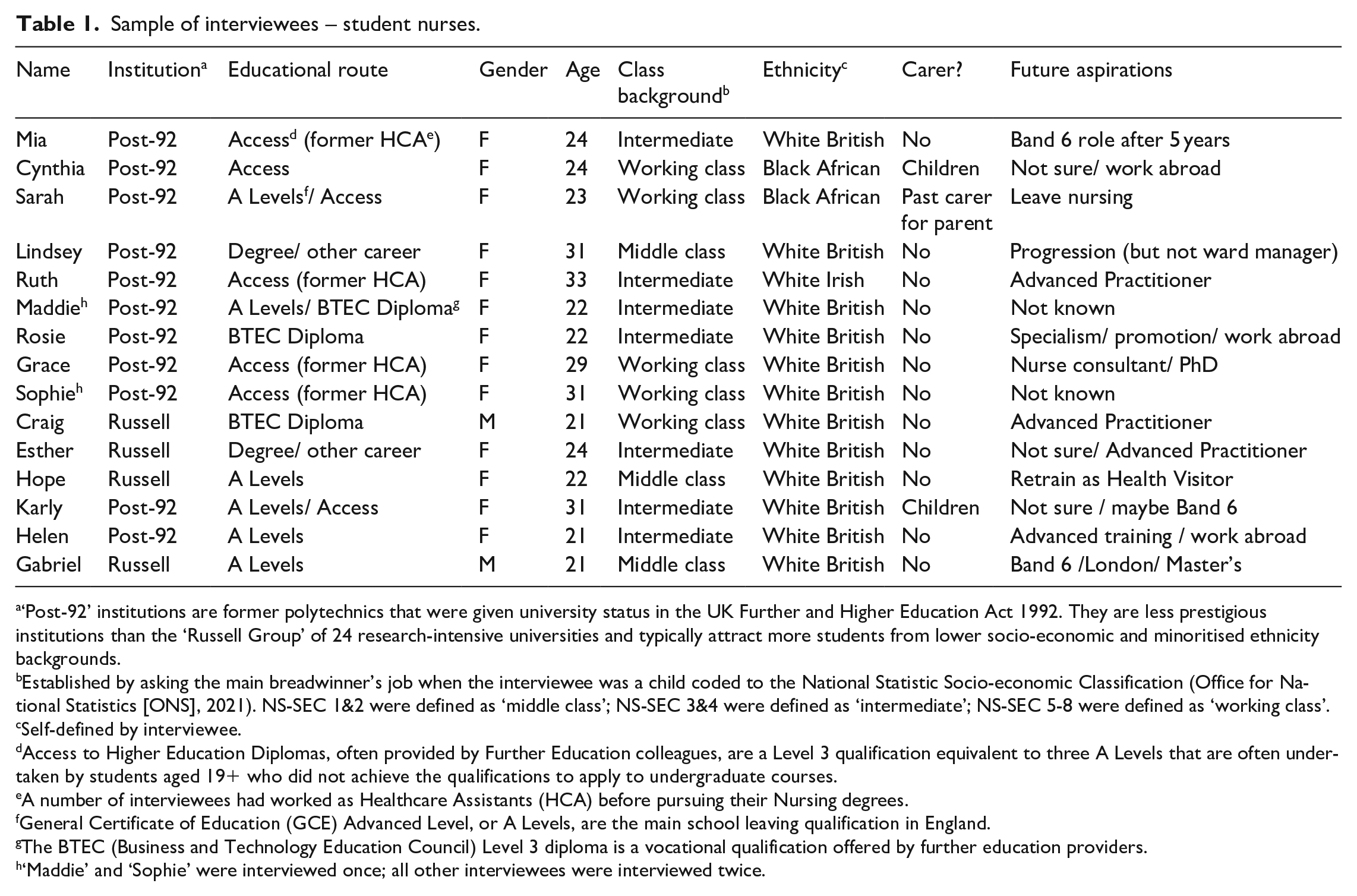
The wider project from which this article is drawn aimed to capture the impact of the pandemic on nursing education as it was still being played out. Fifteen participants who were final year nursing students during the outbreak of the 2020 COVID-19 pandemic were recruited through an advert circulated via their universities. They were drawn from two institutions: a post-92 university and a Russell Group university both in the North of England. All 15 were interviewed in September–October 2020, shortly after completion of their undergraduate studies that summer, with follow-up interviews conducted with 13 of the participants around six months later. In addition to the nursing students, four stakeholder interviews with nurse educators and practitioners provided wider disciplinary and professional insights, although I focus on the experiences of two participants from the student interviews in this article. Demographic information about the student sample is outlined in Table 1.
Sample of interviewees – student nurses.
‘Post-92’ institutions are former polytechnics that were given university status in the UK Further and Higher Education Act 1992. They are less prestigious institutions than the ‘Russell Group’ of 24 research-intensive universities and typically attract more students from lower socio-economic and minoritised ethnicity backgrounds.
Established by asking the main breadwinner’s job when the interviewee was a child coded to the National Statistic Socio-economic Classification (Office for National Statistics [ONS], 2021). NS-SEC 1&2 were defined as ‘middle class’; NS-SEC 3&4 were defined as ‘intermediate’; NS-SEC 5-8 were defined as ‘working class’.
Self-defined by interviewee.
Access to Higher Education Diplomas, often provided by Further Education colleagues, are a Level 3 qualification equivalent to three A Levels that are often undertaken by students aged 19+ who did not achieve the qualifications to apply to undergraduate courses.
A number of interviewees had worked as Healthcare Assistants (HCA) before pursuing their Nursing degrees.
General Certificate of Education (GCE) Advanced Level, or A Levels, are the main school leaving qualification in England.
The BTEC (Business and Technology Education Council) Level 3 diploma is a vocational qualification offered by further education providers.
‘Maddie’ and ‘Sophie’ were interviewed once; all other interviewees were interviewed twice.
Both the first and second interviews were conducted online via video conferencing software, recorded and transcribed. For the first interview, a topic guide was designed to gather demographic information about the participants, and provide prompts for participants to ‘tell the story’ of their pandemic experiences and what they felt the impact had been on their education. In the second interview, participants were asked to provide an update on what had happened since they had graduated, reflections on their studies, and an open question in which an invitation to provide a ‘lifeline’ was used as a prompt to provide a biographical narrative of their trajectory so far, and to project their hopes for the future. The ‘lifeline’ as a research tool was developed to research imagined futures (Thomson et al., 2002) but can also be a technique to explore the past (Allen, 2016). This was an invitation for participants to present their trajectories as a series of events in which ‘critical moments’ (Thomson et al., 2002) were highlighted. The biographies presented in this article are thus a collaboration between the participants’ own perspectives and the researcher’s questions and interpretive reading of the multidimensional forces at work.
Reviewing the participant key information as reported in Table 1, the projected future trajectories of two cases stood out. While most participants had broadly similar plans to continue on the same path, Sarah and Hope wanted to make significant changes: Sarah to leave nursing altogether and Hope to undertake postgraduate study to train as a Health Visitor. 3 Sarah was interviewed in October 2020, when she had completed her academic studies but had not yet qualified as a Registered Nurse, as she still needed more practice hours to meet NMC requirements. Hope was also interviewed in October 2020 but had already joined the NMC Register and started work as an RN the month before. At the time of the second interview, they were both in same socio-economic position – NS-SEC 2 – as the rest of the sample. But how did their histories lead to divergent potential future pathways from their peers? To consider the trajectories of these social mobility journeys, a case study approach was adopted.
Case studies in social mobility research
Case study research can be broadly defined as investigating a small number of cases in considerable depth to capture processes at work (Hammersley & Gomm, 2000, p. 3). It is a holistic approach, ‘suitable for studying phenomena that are highly complex . . . and/or embedded in their cultural context’ (Verschuren, 2003, p. 137). To this, I would add it is also useful in studying the temporal context of phenomena, both in terms of historical time and time as a process. The case study approach is a potentially important part of the methodological toolkit for social mobility research, but it has been under-utilised since the work of Bertaux and Thompson (2007), who suggested it was vital to develop the field beyond the dominant survey approach. An analysis of life stories centralises ‘subjective perceptions and evaluations in shaping life choices’ (Bertaux & Thompson, 2007, p. 7). For example, a biographical approach was employed in the Inventing Adulthoods study to explore the transitions from youth to adulthood that captured both fragmented pathways at the turn of the 21st century and the ongoing influence of classed and gendered differences (Thomson et al., 2002). This approach was sensitive to both the wider social context and the ‘micro-processes’ of agents’ choices, highlighting the socially structured ‘critical moments’ of biographical significance that shaped their trajectories (Thomson et al., 2002). Using lifelines as an interview tool enables a grasp of the temporal ordering of a biography as a whole as well as highlighting these moments in the context of an overall trajectory.
Drawing inspiration from these studies, this article analyses the pathways into nursing of Hope and Sarah and their imagined futures. Their stories bring into question how we classify mobility trajectories between socio-economic categories. Hope’s is a relatively stable intergenerational trajectory that, thanks to her comparative privilege, will likely remain on an even keel despite her expected exit from the nursing profession to an allied profession in health visiting. Sarah has been upwardly mobile, and should be a ‘success story’, yet closer exploration reveals thwarted ambitions and an uncertain future. Taking a snapshot places both young women in the same socio-economic category at the same point in time, but exploring their trajectories reveals a different story. The stories of the two young women represented here are, of course, not statistically representative. But as Bertaux and Thompson (2007) point out, ‘the primary goal of the case study approach is not to prove, but to make sense of the phenomena by proposing interpretations’ (Bertaux & Thompson, 2007, p. 12; my emphasis). This article aims to make sense of classed and gendered journeys of the two young women with a consideration of processes over time, at a key moment in historical time. The proposal here is not, of course, to displace the cross-sectional analysis which has provided considerable insights into the subjectivities of social mobility, but to complement such analyses. In doing so, the analysis pays attention to the resources that the young women can mobilise; indications of their dispositions to action; and the nature of the social spaces they encounter. As such, it draws on Bourdieu’s (1984, 1986, 1990) theory of practice and associated concepts, alongside the critical developments to this toolkit that recognise the intersectional forces that shape social mobility trajectories.
Case studies
Sarah’s story
Sarah was of Black African heritage and was born in the Middle East, where her father worked as a lorry driver. The family moved to a country in Eastern Africa when she was an infant and Sarah still had citizenship of the Eastern African nation. After living there for eight or nine years, Sarah experienced more upheaval when she moved with half of her immediate family to the North of England. As her reflections show, the cultural, social and economic capital of migrants which have value in one geographical context may be devalorised in another; social mobility has a spatial dimension, alongside the temporal (Erel & Ryan, 2019):
I had a great life back home in [country], no stress, we were rich whatever, a big house, everything. Then my dad decided to come here with my mum, he didn’t want to be in the country for political reasons. . . Move[d] to England in 2008 or 2007, I was ten years old, went to primary in [town], not easy, it wasn’t easy, I didn’t speak the language, everything was different.
Sarah moved to the UK with only her father and older brother at first; her mother and younger brothers joined the rest of the family later when Sarah was 15. Sarah’s mother had a chronic mental illness and, as one of the eldest children and only girl, it fell to Sarah to be her carer due to the long hours her father now worked as a taxi driver.
The illness had a significant impact on family life, and Sarah thought that the situation at home was a direct reason why she did not get the results she wanted in her A Levels. Her aspirations were to become a psychologist, shaped by observing her mother’s interactions with mental health services. She was accepted onto a Psychology course at a London university but couldn’t afford to live there and was not accepted on the same course at a local institution. Although she described this as ‘failing’, it later transpired she had achieved Cs, but that this wasn’t enough for the university and subject of her choice. This is a ‘critical moment’ (Thomson et al., 2002) in her lifeline, and one of the instances of symbolic violence that emerges in her narrative: a subjective perception that she has ‘failed’ when there are clear material barriers at work. Despite this setback, she remained invested in the illusio of the higher education field. Her thoughts then turned to nursing and she completed a Higher Education Access course so that she could enrol on a nursing degree at her local university: ‘I was a little bit disappointed, but I knew I couldn’t get there [the qualifications needed for Psychology] in time and I needed to earn, I had left home, so I needed to earn something, and nursing seemed like a great option.’ Faced with the ‘temporal opportunity structures’ (Nilsen, 2024) in front of her, Sarah needed to be pragmatic. Sarah’s whole trajectory had been shaped by gendered notions of caring. She had cared for her mother because she was the ‘only girl’ and had worked as an adult carer to support herself during her Access course, and she picked the ‘obvious’ choice of nursing as appropriate feminised work (Huppatz, 2012). After some ups and downs during her degree, Sarah had a Registered Nurse job lined up for when she qualified; before the COVID-19 outbreak everything seemed to be working out.
Like other participants in the wider study, Sarah was stressed by the confusion and uncertainty around what would happen to her degree course at the start of the pandemic. When offered the Aspirant Nurse (AN) role, she initially decided to opt out as she would not be able to see her mother and it was a lot of responsibility. However everyone else seemed to be opting in and she needed her practice hours to qualify: ‘I’m not going to see my mum for a month or two, but I still get my degree and still get, you know, my education, and I’ll get paid as well.’ The fact that she could work on the ward where she already had a job lined up as a Registered Nurse was another positive incentive.
During this time Sarah still had assignments to complete for university and was writing her dissertation, sometimes during her night shift. She was also working as an agency Healthcare Assistant as she was saving money for a deposit for a flat. Although Aspirant Nurses were offered free accommodation during their contract, this finished when the role ended. Due to illness during her first year at university, at the time of the first interview in October 2020 Sarah still had practice hours to complete before she could qualify. This meant she had to work on unpaid placements to make up her hours and work two to three days per week as an HCA to provide an income:
They just said you have to do what you have to do, 48 hours. Even though I explained, financially I would be struggling and I’m in a house, I have to pay rent now because the free accommodation was finished in August, as soon as my contract finished that free accommodation was finished. So, I was sort of left empty-handed, basically, yeah.
The second time I spoke to Sarah was in March 2021. She had now qualified and was working full-time as a nurse on the same ward. The pressures of COVID-19 on the healthcare system had taken their toll and they were understaffed. As a Black African woman, Sarah was at increased risk herself; there is considerable evidence of the disproportionate impact of the pandemic on racialised minorities who were ‘over exposed and under-protected’ (Haque et al., 2020). Although her experience as an AN gave Sarah confidence, she felt it was a big jump in responsibility. She had some support from her manager but was worried and stressed, and getting upset about making mistakes:
. . . about a month ago, I had a good talk with my manager where I thought, I don’t think I want to do this anymore, nursing in general . . . I didn’t think I would go to uni for three years to experience this amount of stress every day, thinking about work, coming out . . .
The responsibility and pressure were ‘not what [she] signed up for’, and the emotional and psychological atmosphere at work was also negative. She was toying with leaving her current role and doing agency work, but was still figuring it out; she was aware she was still new so wanted to give it a bit more time. Sarah also looked back with fondness at her time at university, particularly missing the social life compared to the stress of work. Looking ahead to the future, Sarah could see herself as a nurse for maybe three more years – not in her current job but maybe at an agency or GP practice. Yet sadly, in the longer term: ‘I don’t see myself during nursing in ten years, definitely not.’ Sarah wanted to do something different, something that could be self-taught: ‘no writing assignments for me’. She had a ‘side hustle’ 4 in online sales and thought she could develop this as a business. Nursing was not what she had expected or hoped for. For Sarah, the promise of social mobility – a better life – had not been delivered. The illusio of higher education gave Sarah a sense of what she ‘ought’ to do (Aarseth, 2017): attend university to gain a professional career. Yet again, Sarah experiences the symbolic violence of thwarted ambitions, ‘where one’s trajectory meets moments of desire that do not match expectations or even possibility’ (Threadgold, 2019, p. 40). As a new starter in healthcare during a global health catastrophe, Sarah was experiencing exceptional circumstances, but she was not alone in these experiences, and her story stands in stark contrast to that of another young woman from the same cohort.
Hope’s story
Hope was born in London. Her father was a professor at an elite university, providing her with a familial environment enriched with cultural capital. Her mother owned her own textile business before joining a large department store and working her way up to management. When asked about her family’s standard of living, she mentioned a nice Victorian terraced house, and that they’d always been ‘comfortable’. After her parents divorced when Hope was six years old, she moved out of London with her mother and brother to be closer to her mother’s family. Her paternal grandmother paid for Hope to go to a private primary school, indicating access to a certain level of economic capital, which had a strong focus on sport. Hope was on the hockey and athletics teams and competed at a national level. Finances meant that she was not able to stay on at the attached secondary school, and she moved to an academy, which she liked less. This had an entrance exam and a strict routine with lots of emphasis on academic achievement.
I think a big thing for me was coming from a private school into a public school. Well I just didn’t really tell people that to be honest because where I went to secondary school was a slightly rougher part of [county]. I just don’t think that would have gone down so well. So I didn’t like secondary school as much. Also I feel like university was very pushed on you and there wasn’t another option to university. My dad is a university lecturer so I mean not going to uni wasn’t an option for me at all.
Like many middle-class families, it was taken for granted that Hope would attend university (Bathmaker et al., 2016). Her exposure to higher education provides a clear sense of what ‘ought’ to be the appropriate path (Aarseth, 2017). Her brother received a bursary so was able to stay at the private school until 18 before going to university himself.
Hope was close to her grandmother, spending every other weekend with her, and when she was ill the care of the nurses made an impact on her. Her other grandmother was a nurse and she loved talking to her about it. The social capital of her family’s experiences was also evident in how Hope’s university choice was influenced by visiting her older brother at university (who was expected to study a more ‘academic’ discipline) in a city in northern England. She liked the idea of being away from home in the north. She did not think she would have been suited to a more ‘academic’ degree but was set on nursing as a career anyway. Hope had no caring experience before starting her degree and unlike Sarah, did not undertake any agency work in healthcare. She worked one day a week as a waitress, but ‘I didn’t want to do it [nursing] any more than I needed to because I’m very aware that I’m probably going to be doing this for a very long time’. During her studies, her mother was made redundant after 25 years at the same company. Hope could no longer count on any financial support and sought hardship funds from the university. At this point, Hope has limited economic capital. However, as will be seen below, the cultural capital that has been a constant throughout her life sees her through further challenges.
As with Sarah and the other study participants, Hope initially did not want to opt in as an Aspirant Nurse and moved back in with her mother; but upon realising it was the only way to graduate on time – ‘[it] really wasn’t an option for me because I needed work. I needed money’ – she changed her mind. She was not immune to financial pressures, even though she had come from a relatively comfortable background. Administrative problems with the opting in process meant that Hope did not get a community nursing role as she wanted, and she ended up working in an intensive care unit (ICU), a completely different type of nursing role. As Aspirant Nurses were guaranteed a job when their contracts finished, she decided to stay on when she qualified. At the time of the first interview, Hope was not sure where to take her career. She could see herself staying on ICU for a while; she liked the autonomy and the relationship between doctors and nursing staff seemed more equal and respectful than in other settings.
By the time of the second interview in April 2021, Hope said that work had been ‘unbearable’. The second COVID-19 wave in winter 2020–21 had meant that ICU was manic; a combination of high patient numbers compounded by reduced staffing levels due to shielding or illness. The emotional toil of the job was exacerbated by long working hours and a lack of opportunity to socialise. She had decided she would stay on ICU for a year and then take a career change to the allied profession of Health Visitor, and had an interview for the required Master’s which she would start in September 2021 if accepted. The impact of COVID-19 was undoubtedly and unavoidably a factor, given that she was only in ICU in the first place due to the Aspirant Nurse role, and the level of work due to the pressures of the pandemic meant it was more likely she would burn out. Although she wanted to change track, she could not see herself doing anything completely outside healthcare, as she would not get the same rewards. She worried about the ongoing impact on other student cohorts:
It comes down to individual confidence, doesn’t it, and also how much you want to get your degree which I think that’s not what it should come down [to] really. I hope that they feel safe and supported.
By implication, Hope felt she was able to get through a period of difficulty on her resilience, confidence and drive. Her understanding of her situation and her vision of an eventually positive and successful outcome was centred on her own individual attributes, which obscured her structural advantages, such as her considerable cultural capital (Bunn et al., 2020). She remained invested in the game, with the illusio of the higher education field intact.
Intersectional pathways over time
Sarah and Hope’s journeys encapsulate the multidimensional nature of classed social mobility trajectories (Scandone, 2022). Both young women were in the same labour market position and socio-economic category at the time of the second interview. Sarah is, on the surface, a success story of upwards mobility, with Hope in a position of social stability. Introducing a more multidimensional perspective, however, explores the mobilisation of forms of capital (Bourdieu, 1986) over time, particularly economic capital in the form of income and assets; cultural capital in the form of knowledge about the education system, confidence in being able to negotiate it and values held; and social capital, in the form of accessing resources in wider social networks (Ball, 2003). This provides an alternative ‘social mobility’ narrative, in which the class privilege of Hope provides her with the resources to navigate the crisis in ways that Sarah cannot. Hope’s access to economic capital ebbs and flows after the breakdown of her parents’ marriage, but her inherited cultural capital is an exceptionally valuable resource, providing her with confidence and a focus on education as a route out of adversity. Sarah, on the other hand, has been left disillusioned, and never really pursued the career in Psychology she wanted. Her route through a time of intense difficulty is turning to entrepreneurialism. In recent work on the rise of ‘side-hustles’ among university students, Allen and Finn (2024) note such entrepreneurialism is precarious work that is both risky but also a strategic response to the gendered and racialised inequalities in the graduate labour market, particularly among young migrant women and women of colour. Sarah’s financial pressures are chronic and enduring, anchored in necessity as opposed to Hope’s acute economic capital problem when her mother is made redundant. Fundamentally, however, it is cultural capital that is significant; the limited cultural capital that Sarah can access shapes her expected move away from healthcare altogether, whereas it provides Hope with a recourse to postgraduate education. It is the power of Hope’s cultural capital that can carry her through economic difficulties and times of crisis towards expectations of an ultimately successful career, whereas Sarah plans to leave and hopefully fall back on entrepreneurial self-reliance. Considering the past, present and future of these trajectories challenges popular understandings of upwards social mobility as a ‘successful’ outcome. Working-class young women like Sarah may have benefited from ‘fair access to a professional career’ (Milburn, 2012) but if the journey is difficult, and the future uncertain, then the root causes of classed inequalities remain unchallenged (Reay, 2013).
Alongside the complexities of their classed trajectories, these are also gendered pathways, in which we see the young women’s capitals operating in conjunction with habitus and field. The educational and employment fields of nursing are feminised: not only dominated by women, but seen as ‘women’s work’ (Huppatz, 2012). Sarah and Hope’s educational journeys have been influenced by expectations about suitable roles for girls. Huppatz (2012) explores how a gendered habitus reinforces the division of labour, where the social order is internalised, leading individuals to make ‘choices’ influenced by these ingrained predispositions (Huppatz, 2012, p. 29). Gendered dispositions are also evident in the disruption to Sarah’s education when it falls to her to undertake a caring role in her family when her mother is unwell, rather than that of her brothers. An intersectional approach, however, can also capture the ways in which class and gender are ‘mutually constituted’ (Scandone, 2022); nursing provides a respectable route for Hope as a middle-class young woman who doesn’t see herself as ‘academic’ (as long as she attends a Russell Group institution) but her brother is expected to pursue a more ‘professional career’. A working-class young woman like Sarah could not realise her aspiration for a profession like Psychology but was able to access the gendered and classed Nursing degree. A significant limitation in the data is an explicit discussion of ‘race’ and the racialised privilege of Hope compared to Sarah. Her whiteness presents itself as unseen and unremarkable yet emerges through her self-perspective as someone with ‘confidence and drive’. Sarah did not confide anything relating to her racialised or migrant position during the interviews beyond a discussion of language difficulties when she first arrived in her English primary school as a child. Wider context from one of the stakeholder interviewees of Black African heritage provides an indication of the hesitancies that a young Black woman may have when discussing racialised barriers with a white interviewer:
So, for example, for me as an African person in nursing . . . I might find that telling you that doing this in three years, maybe I haven’t learnt enough, depending on who I say this to, it can be treated against me, it can be used against me, that I’m admitting that I’m a failure and therefore get deprived on opportunities. (Stakeholder interview)
This is a powerful example of symbolic violence in action. When discussing institutional contexts where whiteness and middle-classness are valued, talking to a researcher who occupies this position may result in silence regarding racialised inequalities. The experiences of upward mobility across classed, gendered and racialised spaces can generate misrecognition of structural effects as individual failures (Scandone, 2022, p. 184).
The young women’s narratives also provide insights into the wider context of social mobility. They are driven by social capital in terms of access to advantageous resources in social networks, for example Hope’s two grandmothers funding private school and providing inspiration for nursing as a profession. Family ties and relationships also shape choices (Heath et al., 2010). The paths taken by older siblings; the impact of divorce and separation; upheavals in life at home; and difficult intimate relationships all shaped these young women’s lives. Such considerations support calls for social mobility research that looks beyond the individual trajectory to incorporate family relationships and wider relational dynamics (Born, 2024; Savage & Flemmen, 2019). Social mobility – or intergenerational stability – is not experienced in a vacuum. A consideration of the spatial also provides a challenge to the idea that local higher education students are ‘less independent’ (Finn, 2017). Sarah was both global and local. She has been born overseas and spoke about the potential for future work abroad as she could speak Arabic; while she lived close to her immediate family and went to a local university, she was financially independent. Hope was a traditional student, who in a popular understanding was more spatially mobile, having moved ‘away’ to university (Finn, 2017). Yet she had the privileged safety net of moving ‘home’ during the first lockdown. Most strikingly, the ripples of past events surface in these young women’s present and future lives. For example, Sarah’s story of the choices she made during a tumultuous time in her life when a teenager – moving out of home, changing her choice of subject to nursing – have resulted in her uncertainty about her prospects. Time is also a factor in feelings of not having ‘enough’ time – that training needs to be completed ‘now’ so that qualifications can be gained and earning can begin. This was mentioned by both young women as motivating factors in their desire to opt in as aspirant nurses, yet there were some differences in their temporal orientations. Hope’s response to career stress and dissatisfaction is to invest more time by returning to university; Sarah cannot imagine anything worse than further study and her future looks more uncertain.
Conclusion
This article has proposed reconsidering the case study approach to social mobility research to explore the ‘underlying processes of the particularity of contexts’ (Bertaux & Thompson, 2007, p. 12). Considering Sarah and Hope’s stories as complete narratives, rather than through the cross-sectional analysis that has dominated qualitative social mobility research, draws out the ways in the lived experience of social mobility can be understood as more than movement between occupational categories by individuals and towards a more multidimensional understanding as influenced by Bourdieu (Savage et al., 2015; Sepúlveda & Lizama-Loyola, 2022). The forms of capital held by Sarah and Hope shaped their entry into nursing and their future plans for next steps. The classed and gendered histories of nursing (Huppatz, 2012; Snee et al., 2021) have moulded the field of educational options and guided the sense of what is possible via the habitus (Bourdieu, 1990). Trajectories are also informed by relational ties and family life, as evidenced though the impact of Sarah’s wider family life on her trajectory. These case studies also challenge standard narratives of upward mobility through higher education and entry into a professional career as success for Sarah, who is dissatisfied and whose future is uncertain. Hope’s intergenerationally stable trajectory, in contrast, left her in a position of relative privilege. At the time of the second interview they were both at another ‘critical moment’ (Thomson et al., 2002), but it seemed that Hope’s original aspirations of community nursing would be realised. While the classed and gendered nature of pathways into nursing was apparent in these case studies, the data were limited in terms of intersections with ‘race’ and ethnicity. More research is required on the impact of racial inequality on pathways into and through nursing, particularly in light of the recent NHS review (NHS Race and Health Observatory, 2022) and the disproportionate impact of COVID-19 on minoritised ethnicities (Haque et al., 2020).
Alongside the intersectional structures shaping social mobility trajectories, this article has brought the temporality of social mobility to the forefront of analysis. The dispositions of the habitus inculcated while young – the forces of the past – shape the present and anticipation of the future (Adkins, 2011; Friedman & Savage, 2017). The COVID-19 pandemic can be viewed as a distinct moment in historical time, one of crisis or even as widespread hysteresis (Graham, 2020), in which everyday life is so disrupted it feels like a ‘different time’ (although one in which the risks and harms are not experienced evenly). Adkins et al. (2023) alternatively suggest that COVID-19 was a period of both rupture and continuity due to the temporalisation of contemporary capitalism; those with assets were protected due to an economy orientated to future gains, whereas those without continued to live in a perpetual present. Who has the resources to invest in the future, and who is living in a precarious here and now? While the illusio of higher education can be observed in how both young women are ‘taken in’ by its social games, their experiences demonstrate the temporal and classed nature of these investments. Sarah experiences symbolic violence throughout her trajectory, and finally decides, with all the emotional and psychological cost this entails, that this is not for her after all, and cuts her losses. Hope can continue to move towards her aspirations through investing in her future through more education.
It is not the intention of this article to suggest that a case study approach is the only way to research social mobility. However, it does suggest that it provides a valuable means of understanding the processes and forces which shape intersectional social mobility trajectories with a greater understanding of its temporal dimensions. The stories of these two young women and their pathways into – and potentially out of – nursing exemplify a growing sociological understanding of social mobility beyond access to the professions.
