



Abstract
Food and eating are critical sites for analysing everyday life and social change. Amid growing concerns about health, sustainability and neoliberal pressures for individual responsibility, there is increasing pressure to reshape how individuals relate to food. This study addresses the evolution of food practices across the life course, examining how social class and trajectories shape food-related habits. Drawing on a Bourdieusian relational phenomenology, the research explores how individuals adapt their food practices in response to evolving social contexts. Using life history interviews and ethnographic accounts, the research shows that while early familial socialisation establishes foundational food repertoires, key life transitions and experiences of social mobility often prompt a re-evaluation of food practices. Upwardly mobile individuals often frame dietary changes as projects of self-reinvention, leveraging cultural capital to align with health-conscious or cosmopolitan norms, whereas working-class participants emphasise pragmatic adjustment to constraints and expectations. The findings challenge deterministic readings of Bourdieu, while demonstrating that practices are dynamically reshaped through accumulated knowledge and reflexive engagement. Crucially, narratives of change are themselves classed, reflecting inequalities in symbolic mastery. The study underscores how food practices both reproduce and occasionally contest social inequalities through the enduring influence of class trajectory. It further argues that even though institutional interventions are more effective in promoting socially desirable change, they often carry symbolic violence.
Introduction
Food and eating are critical sites for analysing everyday life and processes of social change. In recent years, amid growing concerns about health and climate change, and within the sociopolitical context of neoliberalism – characterised by reduced state intervention and an emphasis on individual responsibility – initiatives have emerged to reshape how individuals relate to food. For instance, health and nutrition experts highlight early childhood eating patterns as critical targets for promoting healthy food habits, as they become deeply ingrained early in life. However, research has also shown that engagement with food evolves continuously across the life course, shaped by macro-level forces (e.g. changes in production, distribution, market infrastructure and marketing) and micro-level dynamics (e.g., family life, ageing, migration and health). Additionally, a growing body of research suggests that life-course transitions create opportunities for changes in food-related activities. Still, important sociological questions persist concerning what drives these changes and the sociocultural repertoires individuals draw upon when changing their eating habits.
In the social sciences, food-related habits and routines are commonly framed as social practices. However, given that such patterns evolve throughout the life course, a purely synchronic analysis of practice seems insufficient. A case in point is Bourdieu’s (2002, 2010) seminal work and well-known thinking tools (habitus, field and capitals). Even sympathetic readers acknowledge that Bourdieu’s treatment of temporality and the phenomenological dimension of practice remained underdeveloped (Atkinson, 2010, 2016; Strand & Lizardo, 2017). To address these limitations, scholars have incorporated Schutz’s concepts of stock of knowledge and lifeworld into a Bourdieusian relational phenomenology (Atkinson, 2010, 2016), as complementary tools for analysing micro-level adjustments in practice. Hysteresis describes the divergence between habitus and fields and has also been employed to explain how changes in social context lead to new forms of conduct (Graham, 2020; Steadman et al., 2023; Strand & Lizardo, 2017).
By integrating relational phenomenology (Atkinson, 2016) with a life-course perspective, this article addresses how food practices evolve throughout life, while also accounting for class-based differences. The empirical data stem from a research project on food practices and life-course transitions conducted in Portugal, where class-based contrasts in food consumption have been observed quantitatively but received scant qualitative exploration (Ramos, 2023). The study examines whether and how life transitions prompt individuals to reassess their engagement with food. In terms of methods, the study employs life history interviews and ethnographic accounts.
The findings indicate that, while significant life transitions create opportunities for reshaping engagements with food, both changes in practice and narratives of change are shaped by embodied knowledge and accumulated repertoires. Crucially, changes (actual or narrated) are not uniform; rather, they are classed and mediated by individuals’ social trajectories, with cultural capital playing a key role in conveying them. These results challenge the assumption that classed engagements with food remain static over the life course, while also contesting that change stems primarily from individual volition. Therefore, I affirm the validity of viewing food and eating through a Bourdieusian relational phenomenology that foregrounds social class experiences while demonstrating the usefulness of the concepts of hysteresis, lifeworld and stock of knowledge for studying food consumption and the life course.
Theoretical perspectives on food practices and social change
Crisis, rupture, disruption, (mal)adjustment, discontinuity, transition, turning point, critical or fateful event and epiphany are among the many terms used within the life-course sociological perspective to illustrate how social agents adapt to new circumstances (e.g. Hunt, 2017; Mortimer & Shanahan, 2003). Change is not a pathology but an inevitable, often desired, aspect of individual life. Entering school, starting a job, leaving home or retiring are actively sought by individuals and facilitated by institutions. Some transitions introduce agents to new roles that require adjustments, resocialisation and new responsibilities, leading to insecurity and uncertainty. Others challenge individual identities and prompt a reassessment of past and present practices.
Previous research demonstrates that life-course transitions have ripple effects across multiple domains, including food practices. However, not all transitions are treated equally in the literature, with scholarship predominantly focusing on specific junctures. A substantial body of work, primarily rooted in the Global North, examines biographical moments such as students’ eating habits after leaving their parental home (Blichfeldt & Gram, 2013) or dietary changes related to couple formation (Bove & Sobal, 2006; Darmon & Warde, 2019; Kaufmann, 2010; Marshall & Anderson, 2002). Additional studies have explored transitions to parenthood (Burningham et al., 2014; Karademir Hazır, 2024; Moura & Aschemann-Witzel, 2020) and post-midlife transitions (Plessz et al., 2022). Research also investigates how motherhood, retirement or migration promote sustainable consumption (Burningham & Venn, 2020; Schäfer et al., 2012). While some research attempts to ‘join the dots’ (e.g. McKenzie & Watts, 2020; Plessz et al., 2016), for the most part, the literature overlooks whether such changes fundamentally challenge ingrained ways of relating to food (i.e. dispositions and practice).
Bourdieu’s pioneering Theory of Practice (ToP) sought to uncover the internal logic underlying the actions of social agents. While his concepts later became crucial for understanding differences in consumption patterns, food was not a central focus of his writings and was addressed only sparingly. In his earlier accounts, Bourdieu (1972) drew parallels between the symbolic categories that imbue meaning to temporality and everyday life, positioning food and cooking techniques as indicators of fundamental differences in modes of existence and practical knowledge of the world. In Distinction (2010), he illustrates how food consumption (an aspect of culture) acquires an alchemical power, transforming various forms of capital into symbolic value and prestige. Taste, explicit in judgements and tacit in avoidances and preferences, is embodied in physical bodies and movements – class culture rendered as nature (Bourdieu, 2010, pp. 685–691).
Beyond expenditure differences, Bourdieu (2010, pp. 279–309) highlights contrasts in how food is prepared, arranged and appreciated, reflecting dispositional oppositions between form and substance, deferred gratification and immediate satiation, and restrained manners versus unrestrained indulgence. Further research building on Bourdieu emphasises the significance of class in underpinning eating practices and how they are inscribed into bodies (Beagan et al., 2015; Vandebroeck, 2016). For example, Beagan et al. (2015) demonstrate that class trajectory shapes eating practices by influencing perceptions of what constitutes healthy food. Additionally, differences in what are considered homemade, nutritious and balanced meals are cultivated from early childhood, playing a role in reproducing taste hierarchies and maintaining symbolic boundaries (Karademir-Hazır, 2021).
Public discourse may have attenuated class distinctions, with health concerns being shared by middle- and working-class families. However, food continues to act as a marker of class boundaries, signifying alignment or distancing, leading to taste distinctions that contrast form and functionality (Beagan et al., 2015; Wills et al., 2011). Moreover, the link between class and food also relates to moral boundaries between what is considered ‘good’ and ‘bad’ food (and the people consuming it), and to differences in the adoption of ‘alternative’ food cultures (Paddock, 2016). These boundaries are fracture lines in a dynamic hierarchy of taste, continually redrawn by state interventions and market forces that influence food appropriation, (re)signification dynamics and health perceptions. Plessz et al. (2016) further demonstrate that individuals with higher cultural capital 1 are better equipped to master symbolic discourses, aligning their practices more closely with health prescriptions and norms. Karademir-Hazır (2021, p. 1210) adds that middle-class families are increasingly moving on from concerns to adopting a more advanced and sophisticated critical nutritional framework, while increasingly discarding practical guidelines designed for a broader public as inadequate and untrustworthy. Consequently, while working-class families prioritise dietary variety, middle-class families foster children’s culinary agency, encouraging experimentation.
While Bourdieu laid the foundation for understanding the relationship with food as a practice, more recent theories offer a different perspective that focuses directly on the enactment of practices. The second wave of ‘practice theories’ that emerged in the last two decades is an umbrella term for a range of approaches inspired by the works of Reckwitz (2002) and Schatzki (2016), among others. Like Bourdieu, these theories aim to transcend the subject–object dualism by focusing on how practices are enacted and sustained, irrespective of individual or collective agents’ identities. A notable shift in these perspectives is the emphasis on actual practices – the doings, sayings and emotional engagements – as the primary units of analysis rather than the role of agents (practitioners). There are promising efforts to integrate earlier and more recent accounts of practice within the sociologies of consumption and food (Warde, 2005, 2016).
However, some newer ‘practice theories’ downplay power relations – related to class, gender and race – identities and social trajectories. This decontextualisation often neglects agency and intentionality in shaping, resisting or reappropriating practices, limiting their applicability to particular contexts (for notable exceptions, see Hargreaves, 2011; Karademir Hazır, 2024). In contrast, Bourdieu’s framework, with its focus on habitus – the set of socially ingrained and durable dispositions – used in conjunction with field and the plural notion of capital, is central to understanding how experiences influence present conduct. This approach links individuals’ active engagement with practices, including resistance and reappropriation (Bourdieu, 1972, 2005). Nonetheless, Bourdieu’s theoretical framework has also faced criticism for its perceived reductionism (Alexander, 1995), its lack of a model of the internal contradictions of capitalism (Calhoun, 1995), and its inability to account for change amid the multiple forces shaping individual practices (Lahire, 2003). Habitus, whose reproductive nature has been dismissed as class determinism (Jenkins, 1982), remains a point of contention in depictions of Bourdieu’s ToP as an unremitting account of social reproduction, which became almost orthodox (Fowler, 2020; Yang, 2014). Despite these criticisms, we hold that Bourdieu’s framework remains valuable for explaining social change, as his project inherently includes a theory of crises (Fowler, 2020).
Accounting for changes in taste: Hysteresis, lifeworld and stocks of knowledge
Bourdieu argued that alterations to the properties of fields and capitals lead to disadjustments in the habitus, prompting efforts to restore balance and transform practice. While various domains are relevant, the social structure – the field of social classes – and the family field serve as key observation points. To better understand change, we must consider hysteresis – an often underutilised notion that accounts for habitus–field imbalances and subsequent attempts to address them (Hardy, 2012). Alongside lifeworld and stock of knowledge, these concepts offer a nuanced understanding of rupture or stability in social practices (here concerning food) during the life course.
Hysteresis (Bourdieu, 1972, 1999, 2000, 2010) was proposed as a concept that describes the dissonance between embodied dispositions and changing social structures. The notion has been used in understanding historical transformation (Fowler, 2020) and experiences of individual social mobility (Friedman, 2016). Crises often disrupt the alignment between agents’ habitual practices and evolving contexts, making prior conduct unfeasible or socially incongruent. Strand and Lizardo (2017) refined hysteresis as a mismatch between agents and their environments that occurs when individuals enter unfamiliar fields or when field dynamics shift, as seen in academic changes post-May 1968 (Hardy, 2012) or disruptions during the Covid-19 pandemic (Graham, 2020). Such misalignment can trigger heightened self-awareness and adjustments. While more often associated with permanent and rapid change, it can also occur because of fleeting or unsettling moments, such as encountering unfamiliar food ingredients that disconcert the senses (Steadman et al., 2023). Ultimately, it reflects an embodied sense of being out-of-sync, rooted in genesis amnesia (Bourdieu, 1972) – the tacit knowledge of practices that may no longer apply.
Under these circumstances, for change to occur, three conditions must be met: (1) reflexive recognition of the need to adapt, (2) explicit pedagogy and (3) an open system (Yang, 2014). Unlike the implicit and embodied formation of habitus, this process depends on deliberate reflection and conscious effort, i.e. an explicit pedagogy that blends formal learning with lived experience. In food practices, this may involve marshalling information about ingredients, dishes and techniques that extend beyond the agents’ formative experiences. Globalisation and technological advancements contribute to an increasingly open system, expanding the circulation of information, people, goods, foods and symbols. Importantly, while these processes have created more widespread access to diverse food cultures, they are not universally shared across social classes and cultural contexts. Furthermore, these trends intensify mismatches between habitus and social fields, which are no longer coterminous with national borders. For example, Darmon and Warde (2019) illustrate how cross-national couples negotiate food habits through an interplay of desires, fears and bodily dispositions, mediated by discourses that legitimise change. They suggest that adaptations often involve temporary suppressions rather than complete transformations of habitual repertoires. Ultimately, changes in food practices stem from forming new associations, often shaped by notions of health, care and aesthetic pleasure, though these meanings may vary across social and cultural contexts.
Importantly, the range of experiences is limited by individual social trajectories. Here, it is worth drawing on Atkinson’s (2010) reworking of lifeworld and stock of knowledge, concepts proposed by the phenomenologist Alfred Schutz. Atkinson defines lifeworld as the totality of what individuals encounter in their temporal and spatial trajectories – including people, objects, tools, foods and culinary techniques. It pertains to the ‘stream of incoming experience afforded by the recurrent material, spatiotemporal, and interpersonal – and always socially differentiated – milieus and read by the extant perceptual schemes of the habitus, which, because of recurrence, sediments into the latter as familiar and taken for granted’ (Atkinson, 2010, p. 8). Social agents perceive these entities as ordinary, as they pre-exist their arrival in the world.
Food practices – what people eat, how they prepare meals, and where they procure and consume food – are deeply embedded within specific lifeworlds. Access to ingredients, exposure to different cuisines and social interactions involving food are, of course, impervious neither to socio-spatial structures and locations or biographical trajectories. Atkinson argues that lifeworld is individual, not collective; however, although unique to each agent, experiences retain a degree of similarity due to shared conditions of existence and field effects associated with their positions. Therefore, ‘habitus and lifeworld are . . . analytically separable, such that even if the constitution of the former is embedded in the nature of the latter, their interplay can be analysed’ (Atkinson, 2010, p. 8). Thus, while habitus refers to enduring dispositions, understood as criteria of cognitive classification and embodied inclination, the lifeworld constitutes the specific environmental context in which habitual patterns take shape.
Stock of knowledge, on the other hand, refers to accumulated individual past experiences, shaped by encounters and material and cultural conditions of existence. It serves as a residue of lived experience that, alongside long-held dispositions, informs future actions and understandings. Atkinson (2010, p. 13) elaborates that stocks of knowledge consist of multiple layers, divided into interpenetrating levels: from conscious and declarative forms – derived from past experiences – to bodily forms, which may not be explicitly recognisable but remain readily accessible. The concept effectively integrates routinised (subconscious) conduct learned from experience – an indispensable element of frequently performed tasks, such as many non-reflexive, food-related activities (e.g. cooking, seasoning) – and more consciously directed activities, which align with intellectually charged accounts of reflexive agency (shopping, budgeting) (e.g. Archer, 2012). Therefore, the stock of knowledge aligns with Yang’s critical account of agency-driven change, wherein reflexivity is neither a permanent process nor uniformly distributed but is activated when habitual dispositions prove inadequate. At the same time, it also connects to Archer’s (2012) theory of contextual dis/continuity, which offers further insight into how individuals negotiate shifts in food practices. Moments of discontinuity – when past knowledge no longer seamlessly applies – necessitate reflexive adaptation, whereas continuity reinforces habitual practices.
In this article I explore how the interaction between embodied dispositions and evolving contexts of action influences the evolution of food practices over time. Drawing on the concepts of hysteresis, lifeworld and stock of knowledge, I show that while food practices are open to change and shaped by transitions, they remain linked to social trajectories and the embodied knowledge accumulated throughout them. Class plays a crucial, though not exclusive, role in these dynamics. Furthermore, I argue that in capitalist consumer societies distinctions in food practices emerge through the symbolic mastery of agency in food-related engagements.
Data and methodological approach
As part of a research project on food during the life course, the study focuses on individuals who have recently become parents (all within heterosexual relationships). Understanding food practices is challenging because they are part of everyday routines, conveying ways of understanding and bodily knowledge about the world. Like recent practice theories, Bourdieu’s ToP emphasises that understandings and knowledge are expressed discursively but implicitly and tacitly embedded in actual performances. Therefore, they are elusive and difficult to assess literally in the present or the past. Such an epistemological stance encourages methods that, alongside narrative techniques, allow researchers to get closer to situated knowledge. The study included a few activities (food mapping exercises, kitchen tours and do-along activities) that shifted the focus from saying to actual doing. The sociological practice of interviewing is also an instance where meaning is discursively constructed: expressed or underlying dispositions can differ from meanings ascribed in other contexts; there may be post-hoc rationalisations in which certain aspects of conduct may be underreported while others are exaggerated or corrected. Yet, because the main interest is food practices throughout life, the study inevitably relies more on narrations of events and circumstances, which brings up issues of reflexivity.
I contacted participants at different points during the research process and used several methods. First, I conducted 19 food-focused life history interviews. Interviews covered engagements with food throughout life, including routines, experiences and opinions about food and eating, among other related topics. A second interview with 16 of the participants took place 8 to 11 months later; in this instance, the focus was on on-site practices, using several activities such as kitchen visits, cupboard and fridge rummages, food-mapping exercises and observation (Evans, 2014; Joosse & Marshall, 2020). These interactions were intended to bring participants closer to the context of practice, thus shedding light on dimensions that are performed unreflectively and difficult to articulate without actual engagement in given tasks.
Fieldwork took place from late 2021 to early 2023 using a purposive sampling strategy that aimed for maximum variation in social class by intentionally recruiting individuals from different class backgrounds and trajectories, along with diversity in gender, migrant status and location. Participants were recruited through posts on online bulletin boards for parents and snowball referrals, inviting recent parents to share their experiences with food and participate in interviews. All participants live in the Greater Lisbon Area, including areas within the city and suburban residential areas to the north and south. The research protocol received approval from the host institution’s Ethics Commission. The final sample includes 13 women and 6 men, with ages ranging from early 20s to late 40s. It comprises single parents and couples with children, native Portuguese and migrants, and diversity in class positioning.
Data analysis of interviews and additional material began with a deductive approach that applied concepts from the life-course perspective to organise the data chronologically. This step included identifying key stages such as childhood, adolescence and adulthood and mapping significant events like migration and transitions (conjugality, parenthood, divorce/separation). In the second stage, I integrated emerging themes related to engagement with food at various life stages and transitions, drawing connections to the literature on food practices and patterns from the data. Among others, these included main concerns, changes in taste and responsibilities over foodwork, including cooking strategies and budgeting. Finally, I developed shorter summaries for each case and compared them, focusing on class origin and social trajectory.
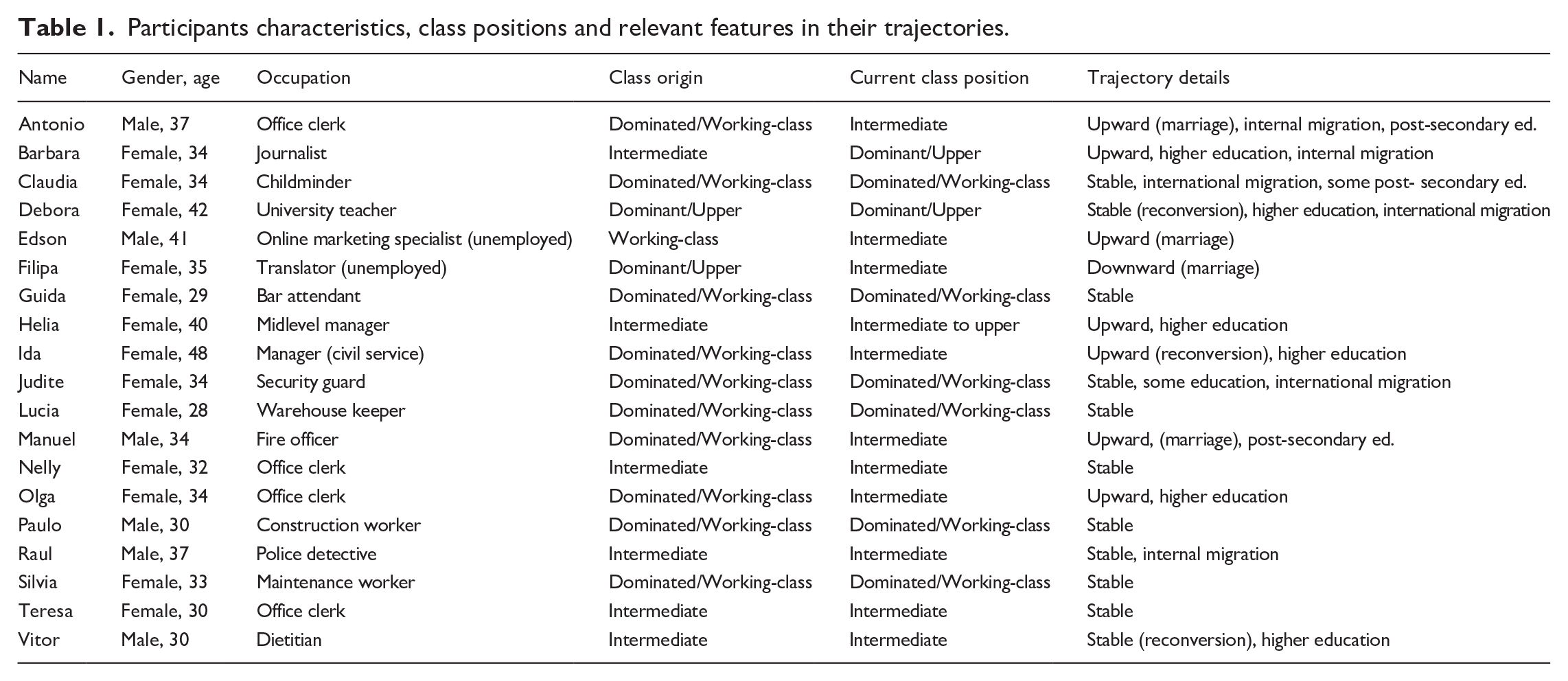
In this study, social class is understood relationally, as a combination of multiple forms of capital that: (1) reflect broader sociocultural inequalities, and (2) shape embodied dispositions and practices. Following Ramos and Carvalho (2021), I used occupations, income levels and the education of individuals, their partners and families of origin as proxies for their current position in the social structure. Seven participants were closer to the working (dominated) class, with stable (or horizontal) trajectories, while 12 were closer to intermediate-class positions. Of these, four had stable trajectories, and eight were ‘newcomers’ with upwardly mobile trajectories, primarily through university education, and in some cases, migration or partnerships. Within the sample, disparities in institutionalised cultural capital were more pronounced than in economic capital. None of the families was extremely wealthy or experiencing financial stress. An overview of participants is given in Table 1.
Participants characteristics, class positions and relevant features in their trajectories.
Results
In this section, I examine participants’ accounts of changes in food practices over the life course. The data are ordered chronologically according to common life-course stages without following a singular trajectory. Comparisons are established at each stage, relating to class position and trajectory.
Early experiences with food and class trajectories
Reflecting on their early childhood, individuals often recall first noticing differences when encountering unfamiliar dishes and flavours outside their home environment. Some describe these experiences as unsettling, sometimes leading to behaviours such as avoiding certain places and social gatherings or reinforcing a self-perception of being a picky eater. However, early encounters with unfamiliar foods do not result in lasting feelings of displacement. Research shows that childhood is often a period of heightened food neophobia – a reluctance to try new foods – that tends to diminish with age (Dovey et al., 2008; Fischler, 1990) as children’s food preferences gradually expand. Furthermore, children have limited control over their food-related experiences. For the most part, their lifeworlds are closely tied to school and family environments, with the latter providing a daily sanctuary and defining the boundaries of their experiences.
In this regard, the effect of class differences on early engagement with food is well established in the literature (Karademir-Hazır, 2021; Wills et al., 2011). However, what stands out here is how reflections on early familial food practices reveal contrasts that, to some extent, align with subsequent class trajectories. Individuals that experience upward mobility often critique past food habits as part of the distancing process from their origins. A point of criticism is portion size at main meals, with references to ‘industrial doses’ (Barbara) or ‘I was raised with food that was a bit heavier, casserole food’ (Vitor), said with an intonation that emphasises excess. These reappraisals focus on the perceived undesirable effects of excessive eating and cooking – such as food waste, obesity and other health issues – which were less of a concern in their parents’ practices, particularly regarding food provision and daily meal preparation.
Ida’s account is telling:
. . . [at parents’ house] there was always an abundance of food, even to excess. I don’t know if it has to do with some deprivation my father experienced when he was a child. . . he always insisted on having a house full of food. The freezer is full; the pantry [is] overflowing. So, we always ate a lot at home. And there were always weight problems on my mother’s side. [. . .], I also deal with weight issues. My relationship with food is a love/hate relationship, in the end, because I know I love to eat, but I can’t eat everything I like.
Among those who are upwardly mobile, overreliance on meat and less variety in ingredients – particularly vegetables – are also disparaged. Some stress parental reluctance to experiment with new ingredients and preparation modes they now view as desirable. These critical observations are framed benevolently, as the inevitable result of limited economic and cultural capital. Essentially, it reflects a lack of knowledge – ‘not knowing better’ – and a limited receptivity to nutritional discourse. As Manuel reflects:
I don’t think they had much food awareness back then. They bought without much consideration. [. . .] what they needed at the time, just because [it was available]. And the information, the difference is also very much about that. . . because I don’t remember my parents being as careful with food as I am today. [. . .] I can’t blame my parents, they had different priorities and meant well. . . however, nowadays we have other [more] information about food.
Descriptions of ‘troubled’ relationships with food are sometimes attributed to primary socialisation along with dispositions from which individuals find it difficult to move away from – an assertion that echoes nutritional science discourse on the importance of early intervention. As shown later, this informs their feeding practices as parents. Such descriptions suggest a sense of normative ambivalence, or hysteresis, where past and present dispositions collide. Early experiences forming a working-class habitus – marked by an appreciation of abundant hearty meals, rich ingredients and fatty preparations (Wills et al., 2011) – contrast with the mastery of health-consciousness, omnivorousness and a broadened stock of knowledge acquired through social mobility. Such newer dispositions emphasise moderation through restraint and reduction of ‘unwholesome’ modes of preparation. Viewed through the acquired prism previous practices – and the bodies they shape, aligned with standards of desirability (Vandebroeck, 2016) – are reinterpreted with a more critical eye.
Tensions can arise during family get-togethers due to differences between familial and contemporary ways of engaging with food. In these instances, the origins of certain aspects of practice are brought to light, along with efforts to adjust and make sense of the differences (Strand & Lizardo, 2017). Some describe attempts to educate their parents on ‘modern’ dietary expectations, often with limited success. Barbara’s account exemplifies the contrast between her current food preferences and her parents’ focus on indulgence and tradition. While Barbara enjoys exploring diverse cuisines and experiences abroad, she also finds comfort in indulgence, conviviality and traditional food, leading her to engage in a self-reflexive effort to reconcile these differences.
For us, for my family, food is all about comfort. When I am abroad working or even here, I derive the most pleasure from trying out new restaurants and experiencing cuisine from different countries. But returning and enjoying a traditional soup truly feels like ‘home’.
Conversely, individuals with more stable trajectories, particularly within the working class, report fewer qualms about their food socialisation and experience fewer conflicts with their parents over food practices. As shown later, this does not mean that their food practices and preferences have remained unchanged since childhood. Actually, many describe a growing awareness of and deliberate adherence to nutritional guidelines, leading to shifts in the consumption and preparation of specific foods (for example, restrictions on salt intake, fried foods, and meat – especially pork), as well as an increased reliance on technology for food acquisition and preparation (e.g. kitchen robots).
Navigating food practices in transition: Moving out, away and up
Different trajectories develop upon leaving the parental home: some individuals begin living alone, others move in with friends or colleagues, and some enter conjugal relationships. Notably, some – more often women from working-class backgrounds – have already assumed high levels of responsibility and knowledge regarding food-related tasks from an early age. Regardless, this transition prompts reflections and a reassessment of eating habits and proficiency (or lack thereof) in food procurement and preparation skills, leading to the accumulation of distinct stocks of knowledge.
For men who transitioned to living alone, whether for work or education, the shift often involves an initial disengagement from cooking and increasing socialisation around food. Interestingly, this move can open opportunities for sensory exploration and taste acquisition. Antonio, for example, recalled that after moving to Lisbon to study, even though he always had staples and easy access to stores, he preferred going out with friends. Such an experience led to heightened experimentation and expanded his knowledge of foods, flavours and tastes. Paulo, who became independent at 16, recalls that he broadened his stock of knowledge while waiting tables at breweries and traditional Portuguese restaurants. Limited previous cooking skills and a certain level of ‘contextual discontinuity’ (Archer, 2012) informed and inspired their later engagements with cooking and eating through observation and re-creation attempts.
Conversely, moving in with colleagues for educational purpose can lead to distinct experiences. Support networks may ease these transitions by providing ‘contextual continuity’ (e.g. mothers continuing to cook, prepare and send meals, or offer guidance). However, for many, relocation soon requires cooking, procuring and managing food on a tight budget, leading to hysteresis, especially among migrants (as observed by Beagan et al., 2015, ch. 7). Claudia experienced shock upon arriving in Portugal: ‘food and ingredients were so different [. . .], I almost wouldn’t eat anything’. Despite being a skilled cook, she struggled with unfamiliarity and missed staple foods. However, through interactions with flatmates and various part-time restaurant jobs, conventional Portuguese staples gradually became a part of her stock of knowledge. Similarly, Judite, a migrant from a former Portuguese colony, describes coming into contact with ‘tasty things that we didn’t have back home’. For both women, migration profoundly changed their lifeworlds, particularly as they were exposed to the allure of variety available in supermarkets. Claudia and Judite – whose practical dispositions were shaped by pronounced material need and a desire to fit into what they viewed as standard in their new environment – illustrate socially classed patterns of dietary acculturation among migrants (Terragni & Roos, 2018). ‘Contextual continuity’ (Archer, 2012) and homogamy/heterogamy within the newly formed networks also play a role.
Crucially, individuals who experienced upward mobility often reflect critically on their past food habits, illustrating changes in their stock of knowledge over time. Barbara, who relocated to Lisbon for her studies, observes: ‘Now I understand that there was so much that I ate during those years that isn’t the best option [. . .] but it was the easiest.’ Similarly, Debora’s account underscores different forms of knowledge acquisition and adjustment. She regrets frequent trips to McDonald’s in her teenage years: ‘I went a lot, but everyone did at the time.’ However, moving abroad for higher education was a turning point. Socialising in a multicultural environment expanded her culinary horizons, while also moving her away from the less diverse meals of her teenage years. This transformation was underpinned by an expanding stock of knowledge, shaped by both system openness and explicit pedagogy (Yang, 2014). Through deliberate investment in new foods, ingredients and techniques, Debora developed an omnivorous culinary repertoire, much like Barbara. in Debora’s case, this process also fostered a sense of gastro-nationalistic pride, as she became known among her peers as the ‘Portuguese cook’ (see Yalvaç & Karademir Hazır, 2020). Her long-term relationship with a Levantine partner further enriched her culinary repertoire, deepening her engagement with diverse food cultures. After returning home, she maintained these elements in her diet, mobilising sensory pleasure and practicality – illustrating the interplay of reflexivity and volition in reshaping food practices over time.
The dishes I made with him are the ones I make now. I continue to follow the same diet because it makes sense; it makes sense in my life. It [. . .] ended up being an accumulation of knowledge as well as daily routines. Needs that were created and that are satisfied with those dishes [in terms of flavours].
In contrast, those with stable working-class trajectories experience changes but their accounts focus more on health concerns, economic constraints and the lasting influence of familial habits, rather than the pursuit of diversity. For example, Guida claims that food at home sometimes feels ‘monotonous’.
We are always eating the same things to avoid chorizos (all types of sausages) and that kind of stuff [. . .] I avoid eating the good stuff that is bad for you. But it doesn’t bother me too much, even though it could be more varied [. . .] it’s better to play it safe.
For Silvia, food at home still mirrored her parents’ typical meals: ‘It was too much rice and potatoes with some type of protein – it was never very different.’ To control her weight, she turned to professional nutritional guidance, which led to more structured meals focused on vegetables and balanced portions. Her knowledge expanded to include healthier options, aligning with her pursuit of improved well-being. Paulo also recounts how he broadened his food knowledge through interactions with colleagues from other countries at restaurants. However, while culinary knowledge in working-class circles is adaptable, it tends to be less cosmopolitan than in upwardly mobile or multicultural lifeworlds.
Navigating change with partners and children
Conjugal relationships often bring significant changes in food engagement (e.g. Bove & Sobal, 2006; Bove et al., 2003; Darmon & Warde, 2019), as seen in Debora’s case, where such change changes persist after separation. Similar dispositions and class trajectories between partners (i.e. couple homogamy) can lead to ‘early single-stage dietary convergence’ (Bove et al., 2003). Ida humorously attributes their weight gain to a shared love for hearty meals, saying, ‘Love made us fat.’ Timing plays a role, as the couple formed in their fifth decade of life. Although both experienced upward social mobility, moving from humble rural backgrounds to managerial roles, their original dispositions – favouring abundance and indulgence – exert a lasting pull effect despite awareness of the dominant nutritional discourse that promotes lightness and leanness.
While differing dispositions within couples may lead to conflict, they also provide food-broadening experiences (Bove et al., 2003), i.e. an enrichment of stocks of knowledge. Debora and Antonio found that previous conjugal relationships expanded their food appreciation and cooking skills. Edson, who left his parental home upon marriage, notes the transition deepened is understanding of food, from acquisition – from stock management at home and cooking to eating a more balanced diet. This shift involved ‘careful planning of meals, something that has since [because of parenthood] become more of a last-minute thing’. Influenced by his health-conscious partner, this planning meant moving away from ‘the famous fried potato and adding more carrots, broccoli, cauliflower, green beans, and similar side dishes’.
Differences may even emerge during dating. Nelly recalls noticing the portion sizes of food served by her in-laws, which reinforced indulgence – a contrast to her own experience – requiring intervention to pre-empt conflict before moving in with her partner.
The quantities! The quantities! They usually had seconds and thirds. At my parents, it was one and done. No, they always ate more and told me ‘You poor thing, eat a little more.’ They had this thing with quantities, and they always had soda with food. I couldn’t take it.
Adjustments between couples are shaped by the negotiation and distribution of foodwork, gender roles and identities (Bove & Sobal, 2006; Darmon & Warde, 2019; DeVault, 1994). However, high levels of heterogamy, in terms of class background, can induce hysteresis when entering conjugality. Silvia’s account is informative: growing up in a poor working-class family and describing herself as a ‘promotion geek’, she struggled with the ‘contextual incongruity’ (Archer, 2012) of dating her partner, whose middle-class family often dined out.
It confused me at first. . . every weekend we went out with [partner’s] parents to dinner. It was very tough to accept, and I told him I couldn’t go because I couldn’t pay. He said it was stupid because ‘my parents are paying’. [. . .] It didn’t make any sense. . . it was very tough for me to accept and be okay with that. Especially because it wasn’t like we were going to a tavern around the corner, these might not be the absolute best, but they were undoubtedly good restaurants.
Silvia’s lifeworld changed, enabling her to explore new practices and broaden her stock of knowledge. She began experimenting with higher-quality ingredients, move away from bargain-hunting shopping routines, and developed an interest in meat-free meals. However, in highly heterogamous couples, individuals from lower socioeconomic backgrounds often feel inadequate, as if they are constantly playing catch up or missing something from their repertoire. Manuel, whose background is like Silvia’s, describes his trajectory as an ‘awakening’ regarding food. Yet, he still feels behind, even compared to his toddler, in terms of exposure to and enjoyment of food diversity. ‘She [wife] is at the root of this change, but my goal is to reach my son’s level. I still have a lot of catching up and learning to do.’ Despite these changes, original dispositions may persist, manifesting in ingrained habits like buying in bulk, maintaining ample supplies, and even designing a large pantry to stockpile discounted groceries in his new home.
Entering parenthood fosters a child-centred approach to food, where pragmatism and efficient time management become guiding principles for decisions ranging from list-making and provisioning to meal preparation. Regardless of class or trajectory, all parents report increasing their investment in cooking, including preparing meals in advance and relying on soup – a Portuguese staple and recommended food for baby weaning. Transitions like parenthood may heighten perceptions of change in food practices, but these accounts reflect diverse patterns of a lifelong stock of knowledge accumulation. Ultimately, time-management and decision-making strategies reveal the interplay between ingrained dispositions, lifeworlds and stocks of knowledge. The meaning of pragmatism and efficiency – whether in the kitchen, while shopping, and beyond – seem to differ based on social position and trajectory, shaping different forms of conduct.
For example, middle-class individuals often use online shopping or subscription-based food delivery services, which provide fresh, organic and often pre-selected produce. These services offer seasonal variety and occasional surprises, appealing to those who value sensorial pleasure, exploration and discovery – qualities these parents wish to pass on to their children (Karademir-Hazır, 2021). Many initiatives also address sustainability concerns in their marketing. Filipa, experiencing ‘eco-anxiety’ since her child’s birth, enrolled in a sustainability programme, shifted to plant-based, home-cooked meals, and experimented with baby-led weaning. Trying new ingredients and introducing them to her child aligns with her dispositions that emphasise sensory pleasure and discovery, and an expanding repertoire of tricks and techniques (i.e. stock of knowledge). What might worry some parents is an exciting challenge for her – and opportunity to experiment. Barbara’s reasoning further illustrates these points.
. . . [food baskets] are seasonal. You cannot choose. You can add stuff, but they choose the basic ingredients. I always wanted it like this because I enjoy being surprised. To see what’s in season. [. . .] I try to store produce to make it last and have a few tricks in my bag. [. . .] And I have this thing of going to the fridge, seeing and cooking with what’s there.
While similar services were available, working-class individuals tend to prefer supermarkets, with price, efficient budgeting and time management being central to decision-making. When procuring food from multiple locations, the main motivation was price, not the search for specific or exotic products. As Guida explains: ‘It is more practical not to go many places. It’s easy to manage available time.’ Experimentation and discovery – especially with small children – are less important than routine and predictability. Novelty can create pressure and disrupt daily routines, particularly with unfamiliar ingredients and techniques. Familiarity takes precedence over the excitement of trying new things, influencing both ingredient choices and mealtime structures, as seen with Paulo and Guida.
A healthy diet is the right diet, with the right routines. One day it’s boiled potatoes, another day it’s rice, another day it’s boiled potatoes, another day it’s rice. [. . .] They [daughters] must understand. We instil ‘you might not feel like eating this right now, but you will because it will be good for your body. (Paulo) I don’t add more variety to meals, to avoid the foods we don’t need. (Guida)
Concerning cooking, pragmatism is used to justify investing in new children’s kitchenware appliances, including multi-food processors. The Thermomix, showcased through in-home demonstrations highlighting its ease of use and suitability for preparing family meals (Truninger, 2011), including sophisticated recipes and traditional classics, is a prominent fixture in many middle-class kitchens. Less expensive, similar appliances are also commonly found in working-class households. Beyond their practical utility in cooking children’s staples like soup or bolognese, these appliances are associated with broader explicit pedagogical efforts, including consulting recipes and books or speaking with friends, colleagues and professionals, that aim at adjusting food practices and fostering overall healthiness. In general, however, the intensity and diversity in its use seem to diminish over time, to the detriment of what works. A key reason for this is that, ultimately, adjustments in cooking mean devising a finite and, crucially, efficient repertoire of dishes and solutions that suit children and parents. Often, this involves simplifying the diet for adults as children’s food takes centre stage. However, as Silvia puts it, these adjustments are also driven by the desire, ‘not to make the same mistakes my parents made with me’, or because, as Teresa claims, ‘reality was different in the ’90s; a lot has changed’. One common approach is trying out baby-led weaning, which, as in Karademir-Hazir’s (2021) study, we observed to be more commonly adopted by those who are middle class or have experienced upward mobility. Another way of addressing past practices involves making mealtimes more playful, aiming to create a better environment for implicit pedagogy. Even if not always strictly followed or only briefly experimented with, choosing methods like baby-led weaning allows parents to recognise the food agency of children (Locke, 2015) while also attempting to reconcile with the past, as with Lucia:
I was never there [saying] ‘You must eat everything; you must finish this!’ So, for her, it’s very natural and, at school, they tell me she eats well and is independent.
Concluding discussion
This article has examined how food practices evolve across class trajectories. Drawing on a small-scale, multi-method study, the analysis integrates Bourdieusian theory with relational phenomenology. The findings reveal that food practices are not merely expressions of ingrained class dispositions but can be reshaped through encounters with new social contexts – whether through mobility, migration or life transitions – that add to existent stocks of knowledge. Three contributions emerge from our work, with implications for the theories of habitus and social change.
First, familial socialisation establishes a foundational repertoire – including dishes, flavours, seasonings, cooking skills and techniques, and food procurement strategies. Yet, the sheer immensity of possibilities within a culture ensures that individuals inevitably encounter and negotiate unfamiliarity as soon as they move beyond their familial sphere. Critically, it is when classed or transnational spaces are traversed that stocks of knowledge can expand and diversify more significantly. As agents engage with different ways of relating to food, their original knowledge is questioned, and the dissonance between habitus and field can act as a catalyst for change. Consequently, this research challenges deterministic interpretations of Bourdieu by demonstrating that stocks of knowledge develop relationally and build upon the habitus, thus reinforcing the link between structuralist and phenomenological traditions (Wacquant, 2016).
A second implication concerns narratives of change, which are shaped by class and intersect with processes such as migration, displacement and heterogamous couple formation. Experiences of social mobility provoke feelings of being out of place, prompting adjustments in both practice and discourse. For example, upwardly mobile and middle-class individuals often frame changes in food practices as projects of self-reinvention, drawing on symbolic mastery of discourses around environmentalism, health consciousness, cosmopolitanism and frugality (Plessz et al., 2016). In turn, working-class narratives often express agency differently, with modifications being framed as conventional, necessary adaptations to evolving social norms or external pressures rather than a form of reinvention. Here, change is linked to new cultural mores – driven by medical advice, exposure to new information or the wider availability of options – rather than the pursuit of aesthetic pleasure, discovery or status. These patterns may also further intersect with generational shifts in engagement with food, shaped by the rapid social changes following the 1974 Democratic Revolution and Portugal’s integration into the EU – a topic worth exploring further.
However, the key issue here is not the extent of actual change – since tangible evidence is limited – but rather how change is framed and conveyed. These contrasts highlight two fundamental and inseparable aspects of social practice: volition – the ability to consider, plan and execute actions – and reflexivity – the process of reflecting on and adjusting conduct and discourse. Cultural capital operates in both the actual practices and their legitimation (Lareau, 2015); and as such, inequalities are reproduced through the everyday stories and narratives that individuals construct and share.
A third implication has broader relevance for questions of inequality and social change, extending beyond food practices. Since all practices involve embodied gestures and movements, what is considered habitual is often recognised when established regularities no longer align with lived or desired realities. In this sense, institutional action – through policies such as economic support, market regulation, school programmes and health interventions – offers effective and less agonistic ways of enacting socially desirable change without placing a burden on individuals. Such measures can reduce symbolic violence, i.e. the internalised sense of inadequacy when practices do not align with dominant norms. For example, and returning to food, as sites of secondary socialisation, schools play a role in expanding and democratising gastronomic repertoires, contributing to fostering equality between families (O’Connell et al., 2022). However, given that distinction and positioning strategies are already present among children from different classes (Oncini, 2020), care must be taken to avoid unintentionally privileging middle-class norms and expectations.
The research also demonstrates that the sensation of being out of place coexists with efforts to realign with the situational field of practice (Steadman et al., 2023) and reconcile with the past. When agents become aware of a mismatch, they adapt to new circumstances. For some, the gap between their formative habitus and current positions creates significant inertia, leading to a feeling of ‘catching up’. Future research could further explore the temporal layering of habitus and reflexivity. Strand and Lizardo’s (2017) typology provides a useful framework by categorising reflexives as radical, anomic, traditional or ironic. This classification depends on institutional stability, the persistence of past practical beliefs despite recognised discrepancies, and the conditions for forming new, coherent beliefs. Reflexivity is not fixed and emerges dynamically at different life stages, shaped by an agent’s lifeworld, capacity to adapt and accumulated experiences.
The relationship between social trajectories and food practices is complex, and this study contributes to a deeper understanding of these dynamics. By examining how dispositions and stocks of knowledge shape food practices, this research opens avenues for further exploration. Future studies could focus on class-based comparisons using large-scale quantitative panel data on lifeworlds and culinary capital – a subcategory of cultural capital (e.g. Kahma et al., 2016) – or more focused qualitative investigations into specific mobilities and trajectories. Existing research highlights the crucial role of gender in food practices, particularly concerning foodwork, emotions and body image (e.g. Cappellini et al., 2019; DeVault, 1994; Fielding-Singh & Cooper, 2023). While our study foregrounded class, gender and generation also influence food practices across the life course and during transitions – areas that warrant further investigation. Ultimately, the relational phenomenology approach and its tools offer a model for studying change and inequality, and valuable insights for future research.
