




Abstract
The article delves into the governance of urban marginality, focusing on the interplay of the Wacquantian distinction between the left and right hands of the state in governing urban marginality and the gender dimension of this governance. Studies of state involvement in managing urban marginality have concentrated on the content of policies and services, neglecting their modes and forms. Our research sheds light on the concrete forms of implementing ‘left hand’ services and on the role of women involved in delivering them. We develop a case study linked to a sudden crisis in urban governance: a fire and the subsequent relocation of a Roma community in a Transylvanian city. Based on two rounds of interviews (2018/2019 and 2023), we reveal a distinctive albeit short-lived shift in approaching urban marginality in the aftermath of the crisis. We define this as the feminisation of governing ‘Gypsy Urban Areas’ (GUAs), which we contrast with previous masculine forms. While highlighting the increase in the responsiveness of women decision-makers to the challenges facing the Roma, we also draw attention to the limitations of this feminised governance. Our findings reveal that the feminised governance of GUAs has an emancipatory potential in challenging the right (punitive) hand of the state but, paradoxically, it also enfeebles its left (supportive) hand. Feminised governance is thus inherently ambiguous: it indicates an alternative space of governance that previously seemed unachievable but is still unable to effect structural changes and tends instead to reproduce neoliberal forms of urban discipline.
Introduction
In the literature on Roma segregation in Eastern Europe, several cases stand out due to their brutality and impact on Roma lives (Alexandrescu et al., 2021; Filčák & Škobla, 2013). One of these occurred in the Transylvanian city of KT (anonymised name) in which a Roma community residing on a central street was forcefully relocated to several improvised barracks in the immediate vicinity of the local wastewater treatment plant (Amnesty International, 2010). Interviews that we carried out in KT (2018/2019) with male decision-makers involved in the 2004 forced relocation revealed a revanchist stance and harsh treatment towards all segregated Roma communities in KT, epitomising the punitive regulation discussed by Wacquant (2009). Then, in January 2021, a fire destroyed dozens of homes in one of KT’s ‘Gypsy Urban Areas’ (GUAs) (Picker, 2017). Based on our previous research, we expected a severe and forceful reaction to the new homelessness experienced by the poor Roma. Two years after this event we went again to interview the local authorities. Compared to the previous visit, two significant changes commanded our attention: several women had been tasked with ‘Roma affairs’ and their attitudes were considerably more supportive of the Roma.
We explore these changes by setting them in relation to two bodies of literature. The first is the Wacquantian preoccupation with the role of the state in governing urban marginality, including the left and right hand concepts (Bourdieu, 1998; Wacquant, 2009). The second strand highlights the gender dimension of statecraft (Lovenduski, 2005) and how this may shape concrete forms of urban governance. Studies of the ‘left hand’ of the state in managing urban marginality have primarily focused on its contents (education, health, etc.) and less on its modes and forms. We employ an abductive approach, which starts from the observation that the crisis unleashed by the fire revealed the inability of the local state to continue addressing racialised poverty by the ‘double punitive regulation’ of the left and right hands (Wacquant, 2019, p. 31). Instead, we explore how this crisis-induced break in the usual forms of governance of urban poverty was met by a new city administration, which had little experience with the Roma community affected by the fire. Several women within the administration were tasked with addressing the housing-relocation crisis and in the process revealed a self-conscious and emancipatory approach to Roma marginality but also uncovered the boundaries of their agency.
Our argument is that within the punitive governance of GUAs in contemporary cities, women decision-makers face a paradoxical situation: bereft of structural power to address racial banishment and marginality they nevertheless generate valuable contextual knowledge for reducing some of this marginality. We call this the feminised governance of GUAs, by which we understand a form of governance which, under the overwhelmingly right-hand type of governing GUAs in Europe, opens a space of possibility for progressive change in cities. Broadly inspired by post-structural feminist thinking, we explore how several women in charge of social welfare create local knowledge (Wendt & Boylan, 2008) that can reinvigorate the devotion to social service originally associated with the left hand (Bourdieu et al., 1999) or what was later called the ‘ethics of care’ (Bond-Taylor, 2015) or the ‘care economy’ (Sawer et al., 2023). We argue that a feminist approach to policy implementation might help the field of social service delivery to embrace more effectively a ‘multiplicity of voices, subjectivities and ways of knowing and doing . . . [including] emotive ways of working’ (Carey et al., 2019, p. 153), that cushions the straightforward punitive implementation of the right-hand governance of GUAs.
We advance this argument based on an abductive approach, by building on the experience of some of the women involved in addressing the aftermath of the fire from KT. Since the abductive methodology requires an ‘iterative movement between empirical materials and theory’ (Bryant, 2019, p. 8), we engage with the literatures on urban marginality and feminised forms of governance to problematise an alternative form of governing GUAs. Feminisation is neither a closed concept nor an end in itself but rather a movement towards a more progressive form of urban governance. Our case shows how a rare window of opportunity was created by a crisis in urban governance, how the opportunity for some progressive change was seized by women decision-makers and how their experiences point towards the possibility of a more inclusive urban politics. Our case study is meant to problematise Wacquant’s account of the ‘double punitive regulation’ by asking whether its inexorable logic can be suspended if the left hand is entrusted to previously marginalised groups such as women decision-makers. We are nevertheless mindful of the possibility that women’s involvement might also signal an enfeeblement of the left hand within the prevailing neoliberal urban order.
The article is structured as follows: we present the intersection of research on the left hand–right hand nexus in deepening and entrenching marginality and the mediating effects that a feminised form of governance might have on this relationship. We then describe the case study and explain the two stages of the data collection. The fourth section presents the analysis and interpretation divided into three subsections dealing with the participation of women in the unfolding of the crisis, the modes and forms of their involvement and also the limits of feminised governance. The conclusion summarises the argument and points towards its broader implications.
The left hand and the feminisation of urban governance
The origins of the left hand–right hand distinction go back to Bourdieu et al.’s (1999) The Weight of the World: Social Suffering in Contemporary Society. In a chapter dealing with the ‘Abdication of the State’, he defined the left hand of the state as consisting of ‘civil servants, and those charged with carrying out the so-called “social” functions, that is, with compensating, without being given all the necessary means, for the most intolerable effects and deficiencies of the logic of the market – [including] social workers, educators’ (Bourdieu et al. 1999, p. 183). In Punishing the Poor and subsequent work, Wacquant (2009) took up this distinction and equated the ‘left hand’ with that side of the state that ‘nourishes and sustains, [and] protects the dispossessed from the threats of life and reduces inequalities’, while the ‘right hand’ is ‘charged with the enforcement of order, moral and economic as well as legal’ (p. 285). With the advancement of neoliberalism, he also saw a ‘growing fusion’ between the two ‘hands’ of the state (Wacquant, 2009, p. 286). In applying these ideas to social work, Cummins observed that the left hand of the state has been subject to a virtual colonisation by the ‘doxa, tropes, techniques and rationale of the Right hand’ (Wacquant as cited in Cummins, 2016, p. 271). Wacquant (2010) even spoke of a ‘remasculinization of the state’ and a shift from the ‘kindly “nanny state” of the Fordist-Keynesian era to the strict “daddy state” of neoliberalism’ (p. 201).
The weakening of the left in favour of the right hand in governing GUAs has been documented extensively (Picker, 2017). Vrăbiescu and Kalir (2018) showed how the left hand of the state and civil society is manifested in tandem with an increasingly repressive right hand. Clough Marinaro (2019) and Parker (2012) have explained the rules and policies of spatial confinement among the Roma as carceral-assistential mechanisms that turn the poorest of them into a spatialised, inferiorised ‘race’.
In Eastern Europe, which is home to most Roma, neoliberalisation has taken increasingly stark forms, especially in relation to housing (Chelcea & Druţǎ, 2016). Punitive governance also restricts access to social benefits (Raț, 2009), education (Voiculescu, 2019) and employment (Van Baar, 2012; Vincze et al., 2019). The incorporation of Eastern European states into the neoliberalised world economic system has pressured many of these governments to downsize their social security systems, thereby rendering them unable to address the social consequences of the free market economy (Appel & Orenstein, 2018; Bohle & Greskovits, 2012).
The operation of the left hand has often been criticised in the literature on GUAs (Raț, 2019; Vrăbiescu & Kalir, 2018; Zamfirescu, 2025). This stems partly from Wacquant’s (2009) general discussion of the centaur state that consists of a liberal ‘head’ atop a punitive ‘body’, with the latter enforcing a paternalistic and authoritarian regime towards the poor and marginalised.
Despite agreement on the punitiveness of the centaur state, the unilaterality of this argument has begun to be challenged. There are instances in which actors acting supporting the left hand elude or soften the strictness of neoliberal rule towards the poor (Ball, 2019; Bond-Taylor, 2015). However, the role of women as decision-makers has been left unexamined. Instead, the gender dimension of governance has been predominantly approached from the perspective of women as beneficiaries of left-hand services (Cummins, 2016; Measor, 2012; Povey, 2019). Focusing on single Black mothers, Blokland (2019, p. 74) concluded that Wacquant’s double punishment occurs in a ‘deeply gendered way’. Media representations of women’s resistance to violent right-hand interventions have also been critically interrogated (Tremlett, 2014). These contributions are essential in revealing the complex and capillary operation of neoliberal governance in cities. We push forward these insights through a complementary approach that explores the role of women as administrators and decision-makers in delivering left-hand services during crisis situations. Rather than isolated exceptions, women’s specific ways of making decisions have received increasing attention, particularly during crises, a topic to which we now turn.
Early on, Reingold (1996) argued that a feminine or feminist political style values ‘compromise, consensus-building, equality, and honesty’, as opposed to masculine leadership styles that frame politics as a win–lose situation, in which a hierarchy is often enforced through manipulation and coercion (pp. 464–465). Jones et al. (2009) compared the ‘consensual politics’ of feminised political culture – which are less aggressive, more cooperative, and associated with ‘feminine’ approaches – with a more ‘adversarial style’ – characterised by oppositional, efficient and ‘macho’ forms of masculinity. In her study on the feminisation of politics in the Podemos Party in Spain, Caravantes (2019) described it as the exercise of power ‘through a collaborative and generous leadership that accepts vulnerability, hesitation, and internal conflict while encouraging dialogue with diverse political actors’ (p. 472). While these positions may be read as supporting a feminist ideal of a growing political voice for women, we extract two analytically useful clues from this literature: a dissatisfaction with mainstream politics in all its forms, and an increasing assertion of alternative, feminine, styles of political governance.
The crisis generated by the Covid-19 pandemic has provided a good context for reconsidering the feminine style of leadership (Johnson & Williams, 2020; Piscopo & Och, 2021). Scholarly attention to gendered political leadership (Waylen, 2021) was drawn after female political leaders were portrayed by mainstream media as more effective in dealing with the health crisis, signalling the ‘success of femininity’ in political leadership and the ‘failure of masculinity’ (Lak & Hussain, 2022).
For Johnson and Williams (2020), the health crisis has created favourable opportunities for women leaders to manifest (and be valued for) their protective femininity. Dada et al. (2021) found out that, in their discourses, women leaders were more inclined to address a wider range of social welfare services, such as mental health or substance abuse and emphasised more global cooperation. Garikipati and Kambhampati (2021) explained the effectiveness of women leaders in managing the pandemic, manifested through proactive and coordinated policy responses to it, through gender differences in behavioural and leadership styles: women utilise clear communication strategies, have more aversion to risks to life and show more empathy. Piscopo and Och (2021) analysed the pandemic responses of women leaders at subnational levels in six countries. Unlike the male chief executives in their countries, who either ignored the threat or prioritised the economy or electoral gain over the health and safety of the citizens, the women holding power at the local level demonstrated inclusive and justice-oriented coronavirus responses. They prioritised clear communication and swift action and oriented the policies towards softening the economic and social impact of the pandemic on vulnerable individuals. This leadership style of women governors, mayors and local elected officials was framed as consistent with feminist approaches to policy-making, offering ‘powerful counterpoints to hypermasculine bravado and slapdash policymaking’ (Piscopo & Och, 2021, p. 562). All this shows that there is an increasing sensitivity towards new, feminised forms of politics and policy-making. Along these lines, we explore an alternative, non-punitive style of weathering urban crises but we also refrain from committing to an essentialised notion of feminised governance as inherently ‘better’. We choose instead to look at our findings critically and relationally, by connecting them to the arguments articulated above.
Case study and research process
The city of KT (pop. under 50,000) is located in Transylvania and has a Hungarian majority population (72%), which is in turn a minority within Romania. The Romanian population of KT is about 15% and, according to the 2021 census, fewer than 1% are self-declared Roma. The Roma from KT live both dispersed and in segregated settlements and according to the assessments made by local authorities, the segregated Roma represent about 1.5% of the city’s population.
The city has seen its elected representatives change in 2020, with the new mayor replacing a long-term incumbent and advocating a more reformist approach to urban policy-making (Gherasim, 2020). This included a woman elected to a top decision-making position. The staff in charge of social protection also changed after the 2020 elections, with more progressive women being appointed.
Our article deals with a crisis that affected the settlement on SUB Street (fictitious name). It was caused by a fire that engulfed the Roma community on the evening of 7 January 2021. Because of the fire, 58 families (261 people) living in shacks have been urgently relocated by the municipality to the sports arena of KT (hereafter Arena). Over most of the next two years, 23 families continued to live in the Arena while local authorities struggled to find appropriate housing for them.
The analysis reported here is based on two stages of field research that were carried out in KT in 2018/2019 and 2023. During the first stage, our main aim was to explore the expulsion of Roma families from inner-city housing, roughly following the Wacquantian argument on the punitive state. The second stage in 2023 aimed to capture possible changes in attitudes towards the displaced Roma among the local authorities after the 2020 elections and the fire of 2021. The discourse had indeed changed and women’s stories on how they handled the crisis offered grounds to test the Wacquantian assertions in a gendered context.
In the first stage, we carried out eight interviews with 10 individuals, including deputy mayors and department heads. In the second stage, we did five interviews with eight participants fulfilling similar roles to those in 2018/2019. In terms of ethical considerations, we ensured the informed consent and anonymity of all our respondents and there was no conflict of interest or problematic power differential between researchers and respondents.
The profiles of five of our interviewees in 2023 stand in contrast to the previous leadership. Our recent interviewees were women and had professional backgrounds (in psychology, European studies, public administration) rather than technical training, as was common among the previous male leadership. They were newcomers to politics or the local administration. Four of them belonged to the Hungarian minority and one to the Roma minority in Romania and one respondent was also a former NGO head. However, none of our respondents was from the fire-affected community as our institutional interviewees dissuaded us from contacting the members of the SUB Street community.
All interviews were conducted in Romanian, which is the working language of the researchers and also the official language known by all the local representatives, whether Hungarian or Roma. They lasted between one and two hours and covered the topics of evictions (reasons, processes and outcomes), the aftermath of the SUB Street fire and the current solutions for housing informally residing Roma families. All interview excerpts included in this article were translated to English by the authors, ensuring that the intended meanings within the interview contexts were carefully preserved.
Before heading to the field for the second stage of our research, we knew from the national press that KT had a new leadership compared to the one in 2018/2019 and that the SUB Street fire had caused a commotion in the municipality. After the interviews, we were surprised to discover that only women were put in charge of managing the post-disaster housing situation and that they manifested incredible resourcefulness. This was so unexpected that one of our female colleagues and co-author exclaimed with surprise: ‘this looks like a feminisation of the state!’
This serendipitous observation served as a catalyst for the article. Theoretically, we asked how to account for women’s positive involvement in dealing with Roma issues, given that our previous experiences in KT had revealed deep-seated racism and punitive urban governance. The observation of our colleague prompted us to look for empirical clues that might substantiate the idea of feminised governance, and for this purpose we employed in-vivo coding of the interviews. While this is usually associated with grounded theory methods, our approach employs an abductive perspective, which ‘is a logic that organizes the process of coming up with a new hypothesis based on surprising research findings’ (Timmermans & Tavory, 2022. p. 3).
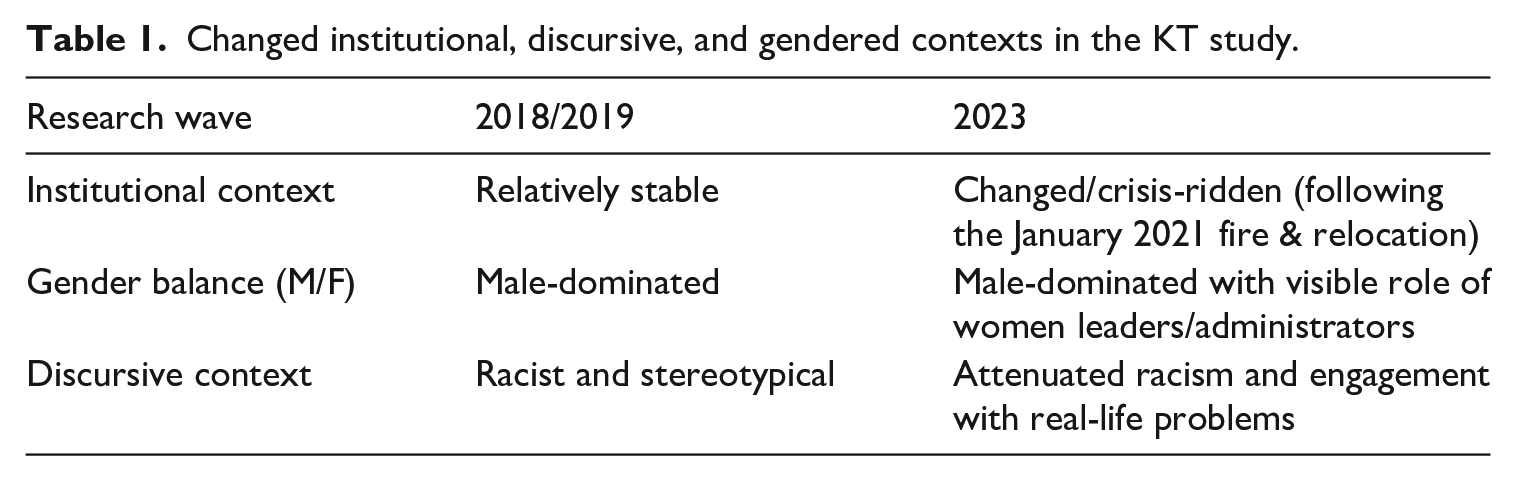
This enabled us to rethink the 2018/2019 research stage by setting it in contrast to the second stage (see Table 1). The institutional context had shifted from being relatively stable and punitive towards one of crisis management. The gender balance in relation to the governance of poor urban areas shifted from male-dominated towards one in which women had greater say. Finally, the discursive framing of the Roma issue changed from overly racist and stereotypical to engaging with real-life problems, which challenged some of the previous stereotypes.
Changed institutional, discursive, and gendered contexts in the KT study.
We explored the attitudes and actions towards the Roma communities of local politicians and administrators by comparatively analysing the interviews conducted with men and women in the two periods. We scrutinised the interviews and identified a set of categories which describe feminised forms of GUA governance, using NVivo Plus12. The in-vivo codes emerged from the interviews (2023), providing an ‘abstract insight grown out of self-reflection’ (Timmermans & Tavory, 2022, p. 14). The identified in-vivo codes referred to negotiating and finding solutions, the safety and health of the (fire) victims, expressing emotions, communication and dialogue, and personal improvement. The topics were markedly different from those in 2018/2019, when such themes were virtually absent, while forms of coercion and punitive measures prevailed. Other codes were derived from the literature on neoliberalism and its disciplinary effects on subaltern subjects. The in-vivo codes and the insights from the literature were integrated into an abductive account of feminised forms of governing GUAs.
Analysis and interpretation: Positions, modes and limits of feminised governance
The analytical section is divided into three parts, each of which sheds light on one specific aspect of the feminised governance of GUAs. The first deals with the position of our female respondents within the local administration and the concrete challenges they were called upon to address. The second distils from the interviews some forms and modes that suggest a distinct approach to marginality in the post-disaster period, in contrast to that of the previous administration. The third section problematises this feminised governance by asking to what extent it is empowering for disenfranchised Roma or whether it still tends to subject them to an overall neoliberal logic.
Women’s role in the unfolding of the crisis
To understand women’s involvement in the governance of GUAs, we describe the crisis from KT as a staged process. Following the fatality-free fire on SUB Street on 7 January 2021, these stages consisted of: (1) the emergency evacuation of the inhabitants of SUB Street to the Arena of the city; (2) providing assistance over an extended period in the Arena (up to 20 months for some families); and (3) managing the relocation of the victims to more ‘suitable’ locations to be created over the longer term. What may sound like a linear process was, in fact, riddled with tensions and uncertainties.
The first stage was relatively unproblematic as it developed rapidly in response to the fire that destroyed a large part of the Roma settlement on SUB Street. The crossover from the first to the second stage was placated by the tremendous solidarity shown by the KT community and other actors who donated substantially to help the victims. The crisis has thus sensitised the urban community to the plight of the Roma for a while, but anti-Gypsyism has subsequently resurfaced. During the second stage, the presence of the Roma in the Arena became a problem in itself and an ‘open wound’, as one of our key respondents described the situation (Rita, interview 2023). For the victims, the cramped space, the lack of intimacy and the social exposure to authorities and volunteers increased the level of stress and anxiety. For the KT non-Roma residents, the fact that their new sports Arena was being used as an emergency shelter and that the Roma ‘roamed’ the centre of the city at will created feelings of hostility. For the city authorities, the costs and efforts of maintaining the emergency shelter gradually became unbearable. The costs were both economic and political in terms of losing electoral support among the non-Roma voters. The third stage was a highly problematic ‘solution’ of relocating the victims to other locations. We call this problematic because the authorities lacked any available space where the fire victims could be adequately rehoused over the long term. This led to a spontaneous self-relocation of some of the affected Roma to SUB Street, in the part of the community unaffected by the fire, and with the tacit approval of the local authorities. Two years later, almost all former victims had returned to SUB Street, some in their houses while others were housed in steel barracks provided by national and city authorities.
Understanding female decision-makers’ overall involvement in the crisis requires two sets of distinctions: the first is between a masculine-cum-punitive and a feminine-cum-collaborative idiom of difference in explaining marginality (cf. Picker, 2013). The second distinction is between women’s formal roles in dealing with ‘social issues’ and their efforts to exceed the legal framework in addressing the acute housing needs of Roma families. The masculine idiom of difference was revealed during a 2019 interview, when a male local representative admitted that the growth of the SUB Street community in a circumscribed space was a ‘ticking time bomb’ but he had no solution other than enforcing law and order to contain the growth of the community. In contrast, his female counterpart of 2023 used the same ‘time bomb’ metaphor but explained instead that Roma communities throughout KT had always been on the brink of crisis, thus hinting at the segregationist urban policies of the municipality (Kovács, 2015).
The second distinction captures what is legally feasible and what requires an unusual approach to solve a problem that was formally unsolvable. In short, there was an attempt by the local administration to move Roma families from the Arena to a crisis centre equipped with government-provided emergency steel barracks. The site was to be located in the proximity of several industrial businesses some distance away from SUB Street. Several businessmen mounted a legal challenge that the industrial area was unsuitable for housing. After a local judge ruled that the relocation of the Roma families in that area would be illegal, the male city representative announced in front of an audience of incredulous Roma that they would need to leave the Arena ‘the next day’ without alternative accommodation. The women were flabbergasted: ‘and I looked to Mr. Mayor [and asked]: what do you mean?’ (Rita, interview 2023). Even if the mayor was formally correct, the women instantly understood that the information could not be handed over to the Roma in these brutal terms, leaving them essentially homeless. Subsequently, we learned that the women went to great lengths (as detailed in the next section) to ensure that the affected Roma would be provided with minimally decent housing but at the same time ease the racist disquiet among the public and ensure peaceful living (Van Baar et al., 2019).
The aftermath of the fire has served as a catalyst for women’s distinct way of dealing with marginality and GUAs. They understood that right-hand punitive measures can hardly address the dynamics of exclusion and segregation and, worse still, would threaten urban peace. Consequently, they engaged in a mission to restore the enfeebled left hand of the local state, in response to the crisis, and in this process they opened new modes and forms of addressing urban marginality more sensitively and humanely.
Modes and forms of feminised governance
For our construct of feminised governance we build on a set of observations that show that even in a highly racialised and punitive context, a self-assumed feminine style of governance can make a significant difference. Self-assumed means here that women explicitly take on the role of changing the state of affairs they confront (Gherasim, 2020). Based on the 2023 interviews, we identified several features that define this style in relation to GUAs. These include (1) a focus on the health and safety of unsheltered or precariously sheltered Roma; (2) talking about emotions in dealing with the crisis; (3) a focus on communication and dialogue with the victims and other stakeholders; (4) the recognition of one’s own weaknesses accompanied by a (mild) criticism of male authority; and (5) the willingness to negotiate in finding solutions rather than imposing abstract rules.
In 2019, ‘safety’ was a matter of securitisation of the surrounding communities, against the Roma (Van Baar et al., 2019). Roma were blamed for their attempts to satisfy their housing needs by extending the living space through unauthorised constructions. ‘Needs’ were correspondingly defined as illegal claims and immoral expectations from the wider community. In response, the local representatives advocated punitive measures against Roma’s quest for housing (Flavian, interview 2019). After the fire, the emphasis on the safety and well-being of the affected Roma became a more prominent theme in the post-crisis interviews. This seems to align with a traditional view about women as addressing needs and providing care (Gentry & Sjoberg, 2015; Johnson, 2020) but can also be read as a common-sense reaction to the revanchism of previous urban policies.
Indeed, after the fire, securitisation was doubled by a concern with internal community safety. When explaining the cause of the January 2021 fire, Rita talked about Roma’s need to heat their improvised homes in the extremely cold winters of KT and their inability to get fuel sources other than domestic waste. It was an acknowledgement that energy poverty puts the whole Roma community ‘on the brink of crisis’ (Rita, interview 2023), in a way that resonated with current Europe-wide concerns with energy poverty among the Roma (Lakeman, 2023).
The accommodation of about 260 people in the Arena raised additional concerns regarding the safety and health of those who had been evacuated from SUB Street. The level of care, and the corresponding high demand on the women in charge, can be gleaned from the following: But after three months, after keeping 260 people in the Arena, you can imagine, in one room with 20 toilets, but no. . . it was terrible. And to provide them with [all] necessities, hot food, breakfast, dinner, plus everything they needed for personal hygiene and to maintain order and quiet. So, it was a very intense crisis intervention. (Rita, interview 2023)
Rita’s statement offers a window onto the lived experience of providing care, carrying out a duty but being aware of the burdens placed on the female decision-makers. This insight will be deepened in the subsequent paragraphs.
Being displaced to a central-city location, the welfare provision for the Roma consisted of a mix of security (internal) and securitisation (wider community). This was a dynamic context with occasional tensions that were mitigated by the presence of women as negotiators in the day-to-day labour of care (Hayes, 2017). As an experienced social worker, Eva recounts a violent incident in the Arena in which the (male) police officers called for her presence to end the conflict: You know, I also had the situation where at 12:30 at night, the [police officers] were in front of my house. [. . .] They said that two men [from the Arena] were fighting. I was upset, but I got dressed and came back [to the Arena]. (Eva, interview 2023)
The range of situations that female decision-makers had to deal with was wide indeed. Apart from resolving conflicts, attention was also given to children and their well-being. During their stay in the Arena and also after their return to SUB Street, children were provided with care and education services by the social workers, but also play and sports activities organised by volunteers (Erika, interview 2023).
Talk about emotions among our female respondents is another hallmark of feminised governance. In the interviews they expressed a range of negative feelings that they experienced during the crisis intervention but also spoke empathically about the feelings of those they cared for, as has been observed elsewhere (Garikipati & Kambhampati, 2021).
During one interview, Eva, the tough-talking social worker, recounted the anguish of a family which as some point found life in the Arena unbearable and insisted on returning to their ‘home’, despite the unfavourable living conditions on SUB Street: Sure, we couldn’t force them to stay here, they didn’t even want to, they cried so much, there were about three families who were in crisis and they told us if we didn’t let them go home, [. . .] they would hang themselves. (Eva, interview 2023)
Such spikes in the emotional tensions in the Arena had to be accommodated by the overworked female decision-makers but without blaming the victims (cf. Vrăbiescu & Kalir, 2018). When the construction of the temporary crisis centre was blocked, municipal social workers told us about their efforts to maintain a good mood among the fire victims disheartened by their extended stay in the Arena: ‘And we tried to fill their hearts, to give hope to these families in the community, for a [whole] year and a half’ (Rebecca, interview 2023).
The management of the crisis and the ongoing interactions with the victims had a noticeable impact on the emotional well-being of our interviewees. They shared their worries, as well as their anger, frustration and fatigue that frequently overwhelmed them. Rita recounted the reaction she had when she saw the improvised electrical system on SUB Street, to which some Roma families had already returned. This could have always caused a new fire disaster: And then I decided, when I saw what was there, [after] I went into several houses, and I said [to myself]: ‘I won’t be able to sleep’. So just thinking about me worrying, [I] decided [to intervene], of course, also because of their safety. (Rita, interview 2023)
For Rita, the emotions sometimes assumed an explicit gender dimension: she was aware that her work could prove psychologically overwhelming but she made a conscious effort to resist the conflation of being a woman (involved in politics) and being emotional (Schneider & Bos, 2016): And no, it’s not easy and often I’m very exhausted. So I can’t say I’m frustrated, but [still] I’m also frustrated. And tired, very tired, that it weighs down on [me]. And always being on your toes, knowing that what happens doesn’t happen because it’s you as a woman and as a beginner. (Rita, interview 2023)
A third characteristic of our construct of feminised governance is the focus on communication and dialogue both with the Roma and with the members of the neighbouring community on SUB Street. The openness to dialogue was presented by our female interviewees as essential in managing the crisis situation. It stands in contrast with the imposition of ‘truths’ by the local authorities, as some male representatives did in 2019. Rita explained the differences in approaches and communication styles between her and the male representative, when the Roma had to be given some bad news: . . . when we received the decision from the court that it’s over, there is no crisis centre anymore, I said to the mayor that we have to be the first to communicate to them, not to let them find out from the newspapers. (Rita, interview 2023)
It is important to note that, in Rita’s view, crisis communication is not only aimed at improving the public image of local politicians, but rather as an effort to make clear to the victims that the authorities are interested in solving their problems (Garikipati & Kambhampati, 2021; Piscopo & Och, 2021). This is a very different perspective from the way politicians in Romania generally relate to citizens from vulnerable groups, who are often blamed in public discourse for relying on state aid (Raț & Szikra, 2018).
Awareness of one’s own limits in dealing with uncertain situations and the willingness to take some measure of self-blame are further features of feminised governance. This has certainly a structural component because our female interviewees did not command the necessary resources to address the difficult tasks they were faced with. On the other hand, this reflexive awareness stems in part from their professional or life experiences and their own fragile status in the political-administrative setting (Piscopo & Och, 2021).
A female representative of the social work department acknowledged, with some regret, her inability to influence policy decisions regarding Roma evictees, but refrained from being too critical of the decisions made by her male superiors: Every situation is different, [. . .] Each [of the authorities] did as they thought best. I would have done it differently [but] I don’t really want to talk about that part. (Matilda, interview 2023)
More than two decades ago, Bourdieu (1998) noted that ‘those who are sent into the front line to perform so-called “social” work [are not] given the means to really do their job’ (p. 3). This was echoed by Matilda who complained that public promises to solve the problems of the evictees could not be kept, due to the lack of resources: The only thing is that you’re not allowed to promise anything. . . And they [mayor] came with promises and went to the press and made statements and then we tried to make them happen, but it can’t be like that. (Matilda, interview 2023)
A fifth, and final, feature of feminised governance of GUAs was the willingness to negotiate and find solutions, rather than to impose standard and abstract rules. When sharing the story of the KT crisis and of their attempts to manage it, the women decision-makers described their struggle to solve the victims’ problems as a series of negotiations they had to conduct with (male) political leaders, (male) business owners, NGO representatives or community members, including the victims. Every deadlock or difficulty they faced made them search for alternative solutions that had to be negotiated once more with the same (male) actors.
When the partly planned/partly spontaneous relocation of the Roma from the Arena to SUB Street or other locations took place, female local representatives tried not only to reassure the evacuees, but also to convince their fellow male politicians that the Roma still needed shelter, that they were on the edge: Yes, of course after Mr. Mayor left, we stayed there [and asked the Roma] to look even harder if they have opportunities to move out. And of course, it also took us time to convince the mayor and the council that these people really don’t have anything, [. . .] and we have to keep them there until we can help them. (Rita, interview 2023)
Their ability to negotiate often goes beyond the administrative and legal bounds, which would otherwise make further action impossible. When the municipality was blocked by court order from opening the crisis centre on the industrial site, Rita turned directly to the companies that had taken legal action against them. Daringly, she asked the former claimants for sponsorships to pay for the containers that the state could no longer finance, provided the municipality would use a different location: . . . what I couldn’t do through the state, through state grants or programmes, I had to do as a civilian. And then I said ‘look, there are five entrepreneurs who sued us’. And they were the first ones I went to! (Rita, interview 2023)
While the above features of feminised governance have emerged from a very specific spatial and temporal context, they nevertheless can signal a change in how the left hand engages with urban marginality when women are in charge. The most remarkable pattern that unites all the five features above is the ability of women decision-makers to partly suspend the plethora of stereotypes that have been historically and steadfastly attached to GUAs (Powell & Lever, 2017). In this process, they generated experiential and grounded knowledge as an alternative basis for a more progressive urban politics towards marginality. However, despite its progressiveness, feminised governance is not immune to the prevailing neoliberal order of European cities, a topic to which we now turn.
The consequences of feminised governance or neoliberalism with a ‘silk glove’
The above section has shown how feminised governance, as we were able to glean from our case study in Transylvania, is more a matter of style and practice rather than actual urban policy. Overall, the Roma from SUB Street were resettled in an emergency, kept under reasonable conditions in the Arena and subsequently returned to the same segregated urban area, under marginally improved living conditions. The reason for this is twofold. First, there were clear structural limitations to what women decision-makers could achieve in a patriarchal and racist context. Second, urban governance has been penetrated by the neoliberal order to such an extent that even left-hand dedication and feminine care are impregnated by its tropes and ways of reasoning (cf. Fraser, 2023).
In structural terms, the Roma issue is not only a social problem but rather a question of unequal local development. Inadequate housing, absent and poor infrastructure and extreme spatial segregation are mounting challenges for the Roma as a result of urban policies throughout Eastern Europe (Alexandrescu et al., 2025; Berescu et al., 2012; Kovács, 2015). Even when these issues are addressed, the projects and programmes implemented tend more often than not to reinforce spatial or educational segregation (Kostka, 2019). On the other hand, the most frequently used institutional means of addressing Roma issues is social work, which usually falls under the responsibility of women.
As has been observed in general, policy remits are gendered (O’Brien & Reyes-Housholder, 2020) and this also happened in our case study. Soon after taking office, the mayor and deputy mayors publicly introduced their areas of responsibility. Unsurprisingly, the woman deputy mayor was put in charge of culture, health, education and social work, while her male counterpart was assigned the areas of urbanism, investments and public acquisitions. Consequently, responsibility for dealing with the SUB Street crisis fell to the female deputy mayor.
While the women decision-makers in KT had to deal with the sudden emergence of 260 homeless persons, they could only marshal the limited resources of social work, some national-level emergency funding (including steel barracks) and a sports facility. The task was daunting for the women given the available resources, but it had its political expediency: women’s weak overall position in the administration meant that their eventual success could be touted as one of the municipality, while their possible failure could be explained away by a prejudiced image of them as inexperienced newcomers to politics. We interpret this as evidence for an enfeeblement of the left hand.
We noticed that women truly galvanised the left hand of the state in dealing with the misfortune of the SUB Street community. However, this was insufficient, as women’s modes and forms of governing the crisis – through concern for health and safety, open dialogue, empathy, etc. – were not followed by concrete measures and allocation of resources for properly housing the Roma.
Besides the structural reasons, the forms of feminised governance we explored also revealed inherent limitations, in that our women practitioners were acting in an environment steeped in a neoliberal urban logic. Women decision-makers regarded the emancipation of marginalised Roma through a limited number of neoliberal tropes that transpired in their discourses, as detailed below.
During a visit to the Arena, Eva handed us at the end of an interview a three-page leaflet (dated March 2022) with activities organised for the victims of the SUB Street fire, structured in sections for adults, youth and children. The list of activities included ‘second chance’ schooling, ‘education for health’, ‘anger management’ and a ‘women’s club’, among others. Without contesting the good intentions of the women administrators, the document itself suggested a form of education-driven management of the impoverished Roma housed in the Arena. State-supported education has often been read in light of a neoliberal form of disciplining marginal populations (Voiculescu, 2019). The conditions for applying these methods were propitious given the high level of control that the social work department was able to exert on the evacuated Roma and also because the latter were more receptive to control following the crisis.
Disciplining the Roma is premised on the idea of the invisibilisation of anti-Roma racism (Powell & van Baar, 2019). This implies that social problems (lack of education, social exclusion, poverty) can be resolved by offering Roma subjects soft resources to overcome their precarious situation while ignoring the lack of structural solutions (desegregation, adequate housing, non-segregated schools) that would enable a meaningful family and community life.
As has been observed elsewhere (Blokland, 2019), social work initiatives are much less about securing resources than about acquiring ‘personal skills of “coping” and individual forms of self-management’ (Blokland, 2019, p. 67). The overcrowded space at the Arena turned the ‘management of feelings’ into an indispensable means of social control.
In a complementary way, Roma who have climbed up the social ladder rationalised their own education and willpower as the key to their success. Eva’s testimony of how she herself became a ‘powerful woman’ in the Roma community is telling: This powerful position [vis-a-vis the other Roma] that I have is due to me being a Roma woman, and part of the Roma community, but only [one’s] willpower and self-education can help one achieve positive change. (Eva, interview 2023)
In her account, ‘power over’ the other Roma is based on her ethnic identity. In this way she was able to gloss over the deep ambivalences that are known to accompany ‘Roma success’ (Tumbas, 2023). On the other hand, willpower and self-education are the means by which the same Roma ‘identity’, with its negative connotations, can be jettisoned.
A related neoliberal trope is the step-wise personal improvement and growth of Roma. The experience of being in the Arena revealed to the women social workers the ability of Roma to ‘better themselves’. As the overseer of the social work department, Matilda highlighted these positive changes: They’re clean. They speak much nicer. They understand that they have to work, they have to go to school, they started the second chance [educational programme]. [. . .] I’d say that in one year they have evolved a lot. They also treat children differently. [. . .] If we can work with them, [they] have a chance. (Matilda, interview 2023)
In a few short sentences, Matilda outlined the logic of recouping neoliberal subjects from the previously amorphous mass of a GUA: adults are seen to evolve at a fast pace, they go to school and to work, they improve their child-rearing practices, and they are on the way to becoming deserving and responsible citizens.
Responsibilising the Roma is also a goal of the neoliberal discipline. Once they have proved able to evolve, making them responsible can be achieved by various means, some of which our respondents have explicitly indicated. For example, the social work department has hired a man to work in the SUB Street community. He was described as: A well-built man, who communicates nicely, so he doesn’t talk badly, he respects them, but he’s still a man. [. . .] He’s not Roma, but you can tell he’s interested and he wants to work with them, he can motivate them with his authority. (Rita, interview 2023)
Another way of creating responsible subjects is by enforcing some level of financial self-discipline. This was achieved by planning to equip the households from SUB Street with prepaid electric metres. In this way, the women decision-makers sought to avoid the arrears in the payment of the electricity used.
From their position as middle-class professionals, our respondents were sensitive to the differential development potential of their Roma ‘clients’. The women in charge could show themselves competent enough in recognising that they cannot help all Roma adults to ‘become used to a more emancipated way of life’ (Rita, interview 2023). They were eager to help and even ‘push’ the Roma to the extent to which they had the will to develop professionally, get a job in Romania or abroad, ensure permanent income, and ultimately solve their housing predicament. This chimed well with already observed discourses about the activation of supposedly idle Roma (Van Baar, 2012). What has been less recognised is that this discourse legitimates authorities’ role in disciplining subaltern individuals (Soss et al., 2011).
The firm hand of neoliberal discipline transpired from under the silk glove of our middle-class respondents. The families unwilling to emancipate themselves were seen as holding back the more ambitious Roma and ultimately reinforcing the trope of the ‘underserving Gypsy’ (cf. Picker, 2013).
In brief, these women ended up reproducing the neoliberal urban order due to two factors: first, they were denied the means of effecting structural change as they were embedded in an ultimately patriarchal and racist political system. Second, they shaped Roma political subjectivities into neoliberal moulds and in this way allowed themselves to redefine their own neoliberal personae.
Conclusions
This article has sought to advance a relational understanding of the possibilities and limits of the feminisation of governance within a right-hand dominated urban politics. The feminisation concept captures a change in approach that was spearheaded by women in our case study. Theoretically, it brings back the emancipatory promise of the left hand of the state, as originally conceptualised by Bourdieu, by challenging the punitive logic of the right hand.
Still, the left hand cannot be reconstituted in its structural meaning because the urban policy environment we have investigated has been stripped to its bare bones under the neoliberal sway. Therefore, the feminisation of governance is more a question of style, of what is often called ‘soft governance’, that cannot be expected to achieve redistributive goals (Fraser, 2023). Despite this limitation, the feminisation of governance places women actors at the intersection of several dimensions that can bring about change in governing urban marginality and are thus worthy of further critical exploration.
First, there is the important dimension of improving the lives of really existing poor and thus disrupt taken-for-granted understandings about racialised minorities by comprehending their circumstances, trying out mutually agreed solutions, and envisioning bold alternative futures. Second, women’s weak structural position in the local and national administration makes them acutely aware of how ‘abandoned and disowned’ the left hand of the state can become (Bourdieu et al., 1999, p. 183) and thus try to rectify its hard-to-tolerate diminishment.
Third, our analysis reveals the deeper empirical purchase of post-structural feminism. Our female interviewees revealed how knowledge is constituted in relational ways (Carey et al., 2019), how it emerges when new actors have to deal with urban crises, when gender and racial vulnerability intersect and when emotions and self-reflection are allowed to play a role in urban governance. All these challenge the prevailing doxa of mostly male-dominated urban politics and reveals the untapped possibilities of change that emerge once various positionalities are acknowledged and brought into interaction. Feminised governance has significant emancipatory potential for a progressive urban politics, but one also needs to understand its conditions of possibility. We hope we have offered an even-handed discussion of both its promise and limitations.
Footnotes
Acknowledgements
We would like to thank our respondents who have shared their words and feelings with us, the Roma community on SUB Street for hosting us in 2019, and God for keeping the community unscathed from the raging fire of 2021.
Funding
This work was supported by a grant of the Ministry of Research, Innovation and Digitization, CNCS – UEFISCDI, project number PN-III-P1-1.1-TE-2021-1254, within PNCDI III.
