



Abstract
The Covid-19 pandemic created extraordinary conditions for social protection systems globally, with both material and discursive implications. In the UK, these unprecedented circumstances led to an influx of (first-time) social security claims, expectations of increased social solidarity and more positive public discussion around benefits. One might expect this to affect attitudes towards claiming. This article focuses on the accounts of claimants themselves, and how they conceived of their own claims during the pandemic. We analyse in-depth interviews conducted during the Covid-19 pandemic with a large, diverse sample of social security benefit claimants, and draw on concepts of deservingness to show how social security claimants negated stigma through appealing to specific deservingness frames. We show how frames relating to the normative criteria of need, control, contribution and identity were deployed by those who began claiming during the pandemic, as well as those whose claim began pre-pandemic. Despite important points of variation, especially in relation to the categories of control and identity, we find that these deservingness frames did not appear to be disrupted in a major way by the pandemic context, suggesting their notable durability in extraordinary circumstances, with implications for the conditions that can (and cannot) precipitate discursive change or rupture.
Introduction
The Covid-19 pandemic put extraordinary strain on social protection systems around the world and brought about unique conditions for claiming benefits (Machin, 2021). Countries reacted to protect the living standards of households within a radically altered and fast changing economic context (Clegg et al., 2023; ILO Social Protection Platform, 2024). The UK was similar to other Western European countries in that it did not impose public health restrictions as quickly or as severely as in other parts of the world, such as Eastern Europe (Popic & Moise, 2022) or East Asia. In the UK context, the government’s eventual decision to suspend much economic activity to protect public health in March 2020 led to unprecedented numbers of applications for social security benefits. Alongside the newly created ‘Coronavirus Job Retention Scheme’ (a short-term work scheme with no recent policy legacy in the UK context), the reinforcement of the social assistance system was central to the UK’s pandemic income protection response; characterised (albeit selectively) by increasing eligibility, adequacy and removing barriers to access (Clegg et al., 2023). Most of the UK’s social security pandemic measures were introduced in March 2020, with some withdrawn in summer 2020, and others extended into autumn 2021 (Hobson, 2021). The beginning of pandemic era social security was reasonably clear cut in the UK context, but shifts to a post-pandemic system were stepped and not necessarily in sync with public health developments. The UK was similar to several other European countries in increasing the generosity of working age benefits (via the ‘Universal Credit £20 uplift’, introduced in March 2020 and ended in September 2021) (International Social Security Association [ISSA], 2022, p. 52), and was mid-ranking among OECD countries in terms of public social spending between 2019 and 2022 (OECD, 2023). Notably, there was no reinforcement of unemployment insurance provision, marking a further sidelining of contributory benefits in the UK. In the five weeks from the 16 March to the end of April 2020, 1.8 million new claims were submitted for the main working-age benefit, Universal Credit (UC). 1 Department for Work and Pensions (DWP) civil service staff were redeployed at pace to support the processing of these claims. The relatively developed digital claim system meant services were able to cope with processing the sudden surge in demand (Freeguard et al., 2020, pp. 17–18). Other changes were put in place to account for the pandemic, altering institutional norms, including the suspension of conditionality requirements and face-to-face meetings.
Several unique conditions occurred during the pandemic period. First, claims became more common, including first-time claims by people with no previous experience with working-age social security and from more advantaged economic strata (Edmiston et al., 2020). Second, a collectively experienced crisis was expected to increase general social solidarity (de Vries et al., 2023). Third, pandemic claimants could point to a clear universal reason for their claim that lay transparently outside their control (Summers et al., 2021). Finally, attitudes around social security benefits in surveys with the general UK public were noticeably more positive (de Vries et al., 2021). It is plausible to expect that these unique conditions would affect both public attitudes 2 towards claimants, as well as the discourses around the benefits system articulated by claimants themselves.
With respect to the former, existing research has not documented a distinct shift in British public attitudes during Covid-19 (Curtice, 2020; Curtice et al., 2022; de Vries et al., 2023). Rather, these were stable following a longer-term, gradual softening of attitudes towards benefit claimants (Curtice et al., 2022; Geiger et al., 2023). Looking over the longue durée, against the received wisdom that there has been a hardening of attitudes following the ‘post war consensus’, a more faithful reading of available evidence shows cycles of hardening and softening of attitudes towards welfare alongside changing political and social backdrops (Hudson et al., 2016, p. 238). An important nuance is that attitudinal surveys show that those claiming during the pandemic were to some extent mentally ‘bracketed away’ from other claimants by the public and perceived in more favourable terms (de Vries et al., 2023). Trends in attitudes towards ‘benefit claimants’ overall were driven more strongly by attitudes towards traditional claimants, and therefore concealed substantially different attitudes towards ‘pandemic claimants’.
In this article we focus on the perceptions of claimants themselves towards claiming. How did ‘Covid claimants’ (i.e. those who started their claim during the pandemic) and pre-existing claimants navigate and conceive of their own claims during the pandemic? Existing evidence on experiences of the claims-making process demonstrates an ambivalence as to the effects this can have on individual identity and welfare attitudes for those receiving social security (Peterie et al., 2019). Against a backdrop of ‘anti-welfare commonsense’ in the UK context (Jensen, 2014; Jensen & Tyler, 2015), qualitative research has shown how claimants ‘other’ fellow claimants and disassociate from ‘the poor’ and ‘welfare dependent’ (Edmiston, 2018; Lister, 2017), a longstanding finding (Dean & Taylor-Gooby, 1992, p. 117) which can be understood as ‘discursive devices deployed to protect the self from social and psychic blame’ (Shildrick & MacDonald, 2013, p. 301). Other research, based on both UK and international evidence, has shown how claimants internalise the stigma associated with social security receipt (Chase & Walker, 2013; Garthwaite, 2014, 2017; Patrick, 2017; Roelen, 2020) or resist and critique the social security system, and their treatment and status within it – asserting their entitlements and legitimacy (Edmiston & Humpage, 2018).
These experiences and responses typify the ‘hidden injuries’ of class, where those at social and economic margins internalise societal attitudes, resulting in feelings of shame, inferiority or powerlessness – with those affected compensating through new boundary-making (Sennett & Cobb, 1972). However, prior UK-based research was conducted at times of high ‘scroungerphobia’ and corresponding stigmatisation (Shildrick & MacDonald, 2013). The Covid-19 pandemic represented a very different environment for claimants – including a mass onboarding of new claimants, an absence of de facto benefit conditionality and the invocation of new ideals of collective solidarity as social groupings were redrawn and reevaluated within the pandemic context (Burchardt, 2020). The social, economic and political instability of the pandemic opened up spaces of contestation around the welfare state, its ideals and its future (Martin & Allen, 2023) and commentators, both internationally and in the UK, saw the pandemic as an invocation and opportunity for a ‘new social contract’ (Clair et al., 2021; Guterres, 2020). This article examines the claiming experiences of claimants during the pandemic, and asks whether discursive lines pertaining to becoming and being a social security claimant were redrawn. We do so to establish the extent to which deservingness frames are malleable to context and circumstance. Through analysing the experiences of a large, diverse sample of social security claimants, this article shows that, despite some notable nuances, there was remarkable consistency in claiming discourses centring on articulations of one’s genuine need, lack of control in the face of economic forces, contributions in the form of work (ethic), and classed signifier of identity, that did not appear to be disrupted in a major way by the pandemic context. These findings inform us about the (surprisingly constrained) potential for, and nature of, attitudinal and social change, which we reflect on in our conclusion.
Identity and claiming social security benefits
In political, media and public discourse, benefit claimants are often constructed as a group with specific characteristics (Baillie, 2011; Jensen, 2014; Jensen & Tyler, 2015), which in the UK can be traced back to the Poor Laws and beyond (Hudson et al., 2016; Renwick, 2017). We have seen important fluctuations over time in attitudes towards claimants (Hudson et al., 2016; O’Grady, 2022), but it is possible to pick out some durable features (Golding & Middleton, 1982). These include, to a greater or lesser extent over time, questioning benefit recipients’ commitment to, and participation in, paid work (Sage, 2019); suspicion around fertility decisions and couple formation as it relates to benefit entitlement (Andersen, 2020; Jun, 2019); and concerns about the genuineness of claims and the potential to defraud or cheat the system (Pemberton et al., 2016). Different groups have been more or less subject to these characterisations, for example from the 2000s onwards disabled claimants have been placed under greater scrutiny in relation to their commitment to paid work and the ‘genuineness’ of their health condition (Garthwaite, 2014; Geiger, 2021), and there are ongoing debates on the position of in-work claimants, with the UK at the forefront of the introduction of in-work conditionality (Wright & Dwyer, 2022).
Stigma and deservingness as key to understanding the identity of ‘benefit claimant’
To consider claimant identity as negotiated by claimants themselves, we draw on two concepts that are well established in the literature: negating stigma and proving deservingness. Welfare stigma functions on multiple levels. At a structural level, we can understand welfare stigma as being about the exercise of power and a way of maintaining the functioning of the status quo (Baumberg, 2016; Bolton et al., 2022). At an individual level, claimants suffer stigmatisation and adopt strategies to bear, navigate and potentially negate the psychic cost this incurs (Lister, 2017).
Welfare deservingness helps us to understand how different groups of claimants are assigned different levels of deservingness based on various characteristics. Some have conceptualised deservingness as being about social affinity or proximity (Cavaille & Trump, 2014); while others see deservingness judgements as being primarily about the extent to which a benefit claimant is seen as unlucky or lazy (Petersen, 2012). Probably most influential are the CARIN criteria of deservingness, originating in the field of social policy, which see deservingness judgements as stemming from five key criteria: perceived control over one’s situation; the attitude of the claimant; the extent to which the claimant has reciprocated; the extent to which the identity of the claimant is similar to those making the judgement; and the neediness of the claimant (Van Oorschot, 2000). The criteria are built on principles of distributive justice, drawing on the work of Cook (1979) and De Swaan (1988). They have been extensively tested and applied, predominantly in European settings (Van Oorschot et al., 2017).
There is a large body of work examining liberal, or residual, welfare regimes that draw on the concepts of stigma and shame to understand how and why people might aim to distance themselves from ‘benefit claimant’ as an identity (Baumberg, 2016; Bolton et al., 2022; Chase & Walker, 2013; Tyler & Slater, 2018; Walker, 2014). Research has identified strategies, most notably that of ‘othering’ (Lister, 2017), deployed by claimants to negate negative stereotypes (Shildrick & MacDonald, 2013) and to protect their self-image and self-esteem. It has been well documented how, on a structural level, public and institutional assessments of who is deemed undeserving of welfare operate as the ‘machinery’ of stigmatisation (Tyler, 2020). From the perspective of claimants, deservingness perceptions tend to be thought about as the corollary of othering strategies. That is, claimants engage in othering in order to demonstrate their own deservingness (Patrick, 2017; Shildrick & MacDonald, 2013). A slightly alternative perspective posits deservingness from the perspective of claimants as part of the negotiation and assertion of social rights (Dwyer, 2002; Edmiston & Humpage, 2018).
This article engages with the broad question of how claimants expressed the basis of their claim within the Covid-19 context in the UK. We mean this in terms of how they established subjective deservingness, which may not necessarily be tied to objective or administrative standards or criteria. Specifically, we apply this question to the ‘extreme case’ (Gerring, 2016; Seawright, 2016; Seawright & Gerring, 2008) of people claiming during the Covid-19 pandemic. We understand the pandemic context as an extreme case because a large, heterogeneous, cohort of citizens became social security claimants, many of whom previously had little contact with the benefits system. Consequently, this was a time when boundaries between claimants and non-claimants became more porous than ever before, as a large group without previous exposure to the system became claimants. This new claiming environment was bolstered by the explicit expectation that large numbers of people would make a claim for social security as large sections of the economy were shut down to suppress the spread of the virus.
Methods
Our data comprised qualitative interviews from the ESRC Welfare at a (Social) Distance project, a large national project focusing on experiences of claiming benefits during Covid-19 and its aftermath. We conducted in-depth interviews with 74 social security claimants in spring/summer 2020, and again with 60 of the same claimants in spring/summer 2021. We added a booster sample of 20 claimants in spring/summer 2021 to enhance diversity across key demographic criteria (in particular, younger participants were sought) to create a corpus of 94 participants and 154 individual interviews in total. Our sample was drawn from across England. While we are examining aspects of the UK social security system in this article, directed in large part by the UK government, there are some important functions that are led by the devolved administrations. For example, during the pandemic some additional support schemes varied between the devolved nations. For clarity of analysis, therefore, the sampling strategy chose to focus on claimants in England. We handled our data cross-sectionally for the purposes of this article.
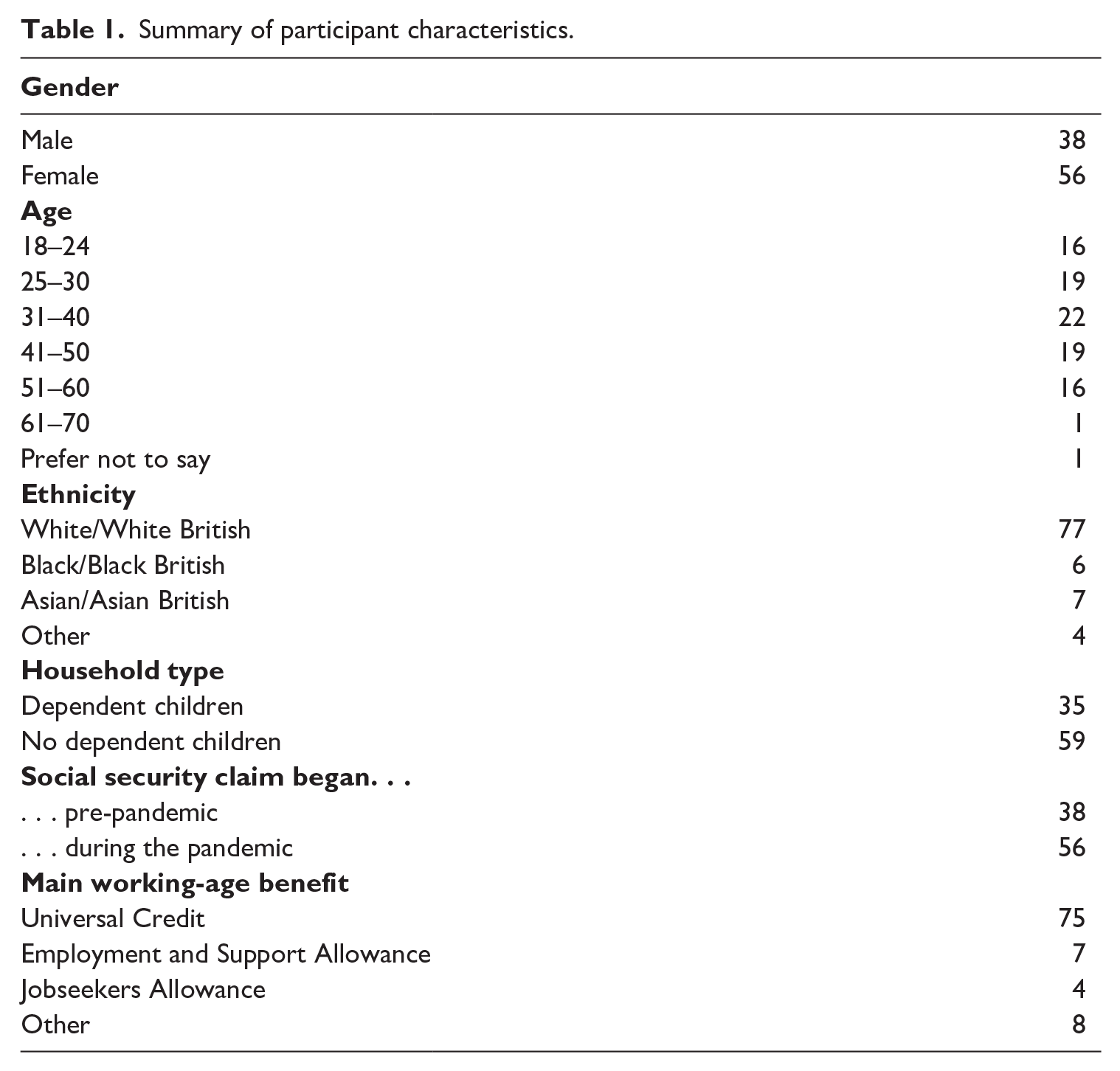
We achieved diversity in our sample in terms of age, gender and household composition. Much qualitative research with social security recipients relies on gatekeeper organisations that either work with or support benefit claimants who are struggling with aspects of their claim or low-income life (for example, welfare rights organisations, community groups and charities). This focus on those at the ‘sharp end’ has implications for interpreting research findings and the extent to which they reflect the experience of the wider claimant population. For this project, alongside ‘traditional’ gatekeeper organisations, we used a specialist research recruitment agency to access a broader cross-section of the claimant population, which comes some way to addressing this issue. All were in receipt of working-age social security benefits: most commonly Universal Credit, but also ‘legacy benefits’ such as Jobseekers Allowance and Employment and Support Allowance. Participants’ characteristics are summarised in Table 1 below.
Summary of participant characteristics.
As a mitigation to account for the Covid-19 context, we conducted all interviews remotely using video conferencing software, or telephone calls for a small minority of participants. The research team were mixed in terms of gender, age and seniority, and all came with longstanding research interests in the UK social security system, sensitising them to the particularities of the pandemic context. The topic guide was structured around eliciting experiences and views on claiming and receiving social security. Most of the conversation was organised around the processes of claiming, receiving and using social security money. Later questions went into more detail on perceptions of self and others as a claimant. For example, participants were asked: ‘How would you describe your personal reasons for claiming?’, ‘How do you feel about claiming benefits?’, ‘Have you told other people you are claiming benefits?’, ‘How do you think other people see you?’, ‘Do you think you’re the sort of person that usually claims benefits? In what ways are you similar/different?’ Topics were raised open-endedly, allowing participants to emphasise what was most salient to themselves. Stigma and deservingness were not introduced explicitly by the interviewer, but rather were raised and emphasised by participants. The research was approved by the University of Salford research ethics committee, interviews were audio recorded, transcribed verbatim, and securely stored with access limited to the research team. Participants received a shopping voucher as a ‘thank you’ for giving their time and insights.
Data analysis took a thematic approach that was focused on participants’ discursive strategies in relation to their claim and self-identity. The main focus of the coding process described below was on the discursive strategies of participants: that is, an awareness that language is shaped by and shapes social reality, and an understanding of context in both a proximate and broad sense (in this case predominantly in respect to the social security system) is important when interpreting the use of language (Wodak, 2004). A further central analytic focus were the bases upon which group membership was navigated (Jenkins, 2008), in this case as a social security claimant. An important conceptual tool was that of ‘boundary-making’, which considers how symbolic and social boundaries are created and negotiated (Lamont & Molnár, 2002). Following Lamont and Molnár (2002), ‘we advocate a more elaborate phenomenology of group classification’ (pp. 187–188), specifically here, in terms of how social security claimants express their own identity, by moving beyond binary distinctions of deserving or undeserving to further unpick the multiple bases upon which deservingness for social security benefits is expressed. Thus, we were attentive to the ways in which participants articulated their claim and rather than consider whether participants expressed being deserving or undeserving, instead aimed to identify the multiple facets underlying such articulations, and how participants identified with or distanced themselves from them.
Our data analysis involved the following steps. We first conducted descriptive coding to organise the entire corpus of interview transcripts. Codes were initially deductively generated, guided by the overarching research aims and secondary literature, and were further refined and added to during the process of coding. Next, we selected key codes that related to aspects of claimant identity. These codes were considered vis-a-vis the drawing of ‘symbolic boundaries’ (Lamont et al., 2015). Situational and contextual analysis was conducted in parallel, where we drew on secondary and grey literature to frame and interpret the discursive elements that were being identified. The analysis was then refined iteratively. Specifically, we moved between: (a) analysis of individual codes and relevant individual interview transcripts in their entirety; and (b) situational/contextual factors and specific elements of the transcripts. This process continued (led by KS) until the output from the analysis was deemed coherent by all members of the research team, which we present in the findings section. To give an example, it was at a later stage of coding that the CARIN criteria were specifically applied to the data, following discussion among the research team about how best to capture expressions of deservingness. At first the final three stages of analysis were only applied to ‘new’ claimants, i.e. whose claim had begun during the pandemic (March 2020 and onwards). However, it became clear that the distinctions between new and existing (i.e. pre-pandemic) claimants in terms of expressions of identity and their prior claims history did not exist in such a binary fashion, and to proceed with analysis in such a way was artificially enforcing this distinction. Instead, both new and existing claimants were incorporated into the analysis and are both considered in the findings.
Discourses of deservingness
We found that central to articulating the reasons for one’s claim were discourses of deservingness. It is surprising that deservingness remained so central to pandemic-era accounts of claiming social security money given the extraordinary social and economic context, whereby it was still important to participants to distance themselves from negative aspects of claimant identity and associate themselves with positive aspects.
We found it was coherent to organise our findings along the CARIN criteria of deservingness (Van Oorschot, 2000), which are typically used to understand public attitudes as opposed to claimant discursive strategies: the first centres on need, and showing that one was genuinely in need of financial support; the second on one’s lack of control in the face of economic forces; third, identifying one’s work ethic and commitment to participation in the labour market (‘reciprocity’); and fourth, drawing on classed aspects of identity to distinguish oneself from perceived ‘lower’ class or ‘underclass’ categorisations of benefit claimants.
‘Genuine’ need
Among our participants who began claiming during the pandemic, need was central when explaining their decision to apply for social security benefits. It was common for participants to talk about delaying making a claim until they felt they had exhausted other options (Kempson et al., 1994; Summers et al., 2021) and could not meet their needs in any other way. Despite the cessation of various eligibility requirements and the online application process intended to make the process straightforward, participants still discussed how the administrative burden and hassle (Bennett, 2024) dissuaded them from putting in a claim until their need outweighed these barriers and pushed them to apply.
Belinda, a single woman in her late 20s who started claiming during the pandemic, described how it was only when she had no other income streams that her need was great enough and she considered putting in an application.
I probably could have done. I was working – because I was working and getting money coming in, I just thought, well, there’s no need for me to – it hadn’t really crossed my mind. I hadn’t really thought about it. It wasn’t until, okay, literally nothing is coming through at all, that I thought, okay, I need to apply and do it. I think I am quite, I don’t know, I like to think that I manage my money well and so I don’t really, until it got to the last point, I was like, okay, I need help now.
Note that it is not strictly the administrative requirements that Belinda is referring to, for example, capital limits that dictate benefits eligibility (Bennett, 2024). Moreover, she is talking in a broader moral sense that as someone who ‘manages their money well’, she had waited until the ‘last point’ to apply once she really needed to. Note also that Belinda mentions her employment status, perhaps marking an assumption that benefits are for those who are unemployed, despite the shift under Universal Credit to merge in- and out-of-work benefits. The criteria of need legitimated Belinda’s claim for her and overrode other factors that had dissuaded her from claiming.
Need weighed against countervailing factors that dissuaded participants from claiming. As a new claimant during the pandemic, Erin described in 2021 how she delayed her application the previous year until she had run down her other resources. She had previous negative experience of the benefits system to support herself and her daughter, which had put her off applying again. It was the criteria of need that pushed her to apply.
I was probably struggling for a good few months before I thought I just can’t do this anymore, I’m going to have to do something about it. Obviously, I just thought I can’t be bothered with the hassle, because I thought they were always doing things wrong and leaving you with overpayments that you’ve got to pay them back, then you end up being in a worse situation. I just had a lot of those negative things in my mind, and that did really stop me doing it when I did need to do it.
The criteria of need was also present in discussion of the ‘£20 uplift’ (a £20 a week increase in Universal Credit to recognise the impact of Covid, introduced in March 2020 and withdrawn in October 2021). For most participants this represented a very welcome, and essential, supplement to their social security payments to go towards everyday living costs. For the minority, including Joel, a single man in his 40s whose Universal Credit claim began before the pandemic, the uplift prompted feelings of guilt as he questioned whether he truly needed it.
Yes, I do. Strange to say, and I’d be very clear that I do realise there are those who are genuinely struggling, and that’s without appearing or trying to be Mother Theresa because I’m really not, I’m trying to help, but I actually felt a bit guilty when they started giving us the £80 a month uplift because I felt I didn’t need it, and I felt I was very lucky to get it.
It is notable that those who began their claims during the pandemic were still engaging with the criterion of need to weigh and articulate the deservingness of their claim. When we compare this to our participants whose claims had begun pre-pandemic, we find less surprisingly that need was widely articulated as a condition upon which entitlement should be (both administratively but also morally) justified. For example, Paula was a working mother of one in her 30s who had been claiming Universal Credit for three years at the time of interview following the end of a relationship. She was clear that benefits should not be thought of as something that one is entitled to regardless of circumstances, but instead as support if you truly needed it. When asked what made claimants similar or different to one another she replied:
I think it all depends on why, the reason behind why some people are claiming! I know that there’s some people who have a sense of entitlement maybe who feel they’re owed the money, like it’s my money. I personally don’t think it’s your money because it’s not! It’s a support. It’s support when you need it. That’s what I think. It’s just a support system that’s there.
We know that need is a key criterion that the public use for assessing deservingness of social security recipients in the UK context (Baumberg, 2012, p. 151). We find in our interviews that claimants themselves also emphasised the criterion of need when explaining their receipt of social security. Existing cross-national qualitative work also found that the criterion of need was given particular weight in the British context (Laenen et al., 2019), which can be related to the dominance of means-testing and the residualisation of the contributory principle in the UK system. We observe need as central to the accounts of participants who began their claim pre-pandemic, but also more notably among those whose claim began during the pandemic, when we might have expected the radically altered social context to diminish such framings.
Lack of control in the face of economic forces
We observed participants expressing the legitimacy of their claim through emphasising their lack of control in the face of economic forces. Most obviously, this was found among participants whose claim began during the pandemic with reference to the imposed lockdown measures. However, again, there was striking congruity across those whose claim had begun during and before the pandemic, with those before the pandemic also pointing to wider economic conditions outside of their control as precipitating and explaining their claim.
Faye, a participant in her late 20s who lived with her boyfriend and a flatmate, applied for Universal Credit for the first time during the pandemic. She described how,
It’s [applying for Universal Credit] not something I see me doing, if it wasn’t for this pandemic I could go my entire life without claiming for benefits because I’m quite a planner, I plan for things, I always have some savings, I always have some buffer, but I think this is something that no one could have planned for.
Faye cited the pandemic as something that nobody could have foreseen, and it was only because of these overwhelmingly unpredictable circumstances that she ended up making an application for Universal Credit. Many pandemic era claimants identified the economic conditions of the pandemic as exceptional, and it was only these external forces that led to their need to claim. The relevance of external, uncontrollable forces was also found in our other attitudes work based on surveys with the UK general public, where pandemic-era claimants were in many ways ‘bracketed away’ and thought of as different to pre-pandemic claimants because of this lack of control (de Vries et al., 2023).
However, these discourses around lack of control in the face of economic forces are not new, and we found them among, and in reference to, pre-pandemic claimants as well. For example, Scott was newly claiming Universal Credit but had previous experience of receiving tax credits. He reflected how the pandemic had highlighted how easy it was to lose a job, and that people might therefore be more sympathetic to those who had lost work in other circumstances outside of the pandemic.
I think, as well, it’s been a little bit of a, the current situation has probably been a bit of an eye-opener to society because some very good people are going to be out of work through no fault of their own, and perhaps society’s judgement shouldn’t be so harsh because if people . . . In the past, up to a year ago, if people had been out of work, you’d be, think, well, how did they end up out of work? It can be very easy to end up out of work.
The pandemic highlighted the role of uncontrollable economic forces and were central to the accounts of many of our participants when narrating their claim. In addition, the economic context of the pandemic was offered as a potential ‘eye opener’, which might serve to remind others that pre-pandemic claims were also made in economic circumstances outside of claimants’ control. In a parallel vein, other participants highlighted the onset of health conditions or disability which were outside of their control and the reason for making their claim. The economic conditions of the pandemic were recognised as exceptional, but again it was notable that the related deservingness discourses around control and claiming were applied more broadly and beyond its specific context.
Reciprocity through work ethic and commitment to labour market participation
Appeals to work ethic is a well-known trope (Sage, 2019) and fits with a ‘work first’ (Peck & Theodore, 2000) social security system in the UK that defines worth primarily in relation to an individual’s relationship to, and participation in, the labour market (Wright, 2023). We might have expected work ethic appeals as the area to be significantly unsettled or upended by the pandemic context. The UK government had mandated the cessation of economic activity, and the main working-age benefit, Universal Credit, temporarily suspended its conditionality requirements relating to work-search and preparation. However, again, what was striking in our findings were appeals to work ethic as a source of deservingness among participants whose claims began during the pandemic, marking notable consistency with pre-pandemic accounts.
Nadia, a new claimant, was keen to clarify that she saw her application for Universal Credit as a hiatus from her trajectory as a hard worker.
I know for a fact I’m not lazy. I’ve put in a lot of work, I work hard, I do this and that. I volunteer. I’m definitely not lazy, I just can’t support myself right now, and I can’t force my parents to continually support me.
Demonstrating one’s work ethic is linked to the criteria of reciprocity (White, 2000), where work (ethic) is a (literal and figurative) way of ‘paying into’ the system. Participants spoke about their previous or future participation in the labour market as evidence that they were net contributors to the system and therefore were entitled to their social security money. Andrew, a Universal Credit claimant in his late 20s whose claim began pre-pandemic, explained how his parents urged him to apply for Universal Credit because he would contribute to the system through his working life.
. . . my parents said, ‘You’re going to pay into that system for your entire working career, so you may as well take out of it as well.’ Certain things, I think especially now that I’m working in a school, I’m going to be in the public sector, it’s kind of like, you put in what you get out type thing, so I think that I’m going to be working in the public sector, so I feel like I’ll be putting back into it both financially and physically as well, I suppose.
Andrew’s definition of contribution goes beyond the taxes he will pay and encompasses the broader contribution of working in a public sector job. Note that this is in relation to receipt of means-tested social security, which is not formally tied to any sort of tax contributions. Tina, a woman in her 50s who had previously worked as a childminder and began claiming for the first time during the pandemic, linked her social security entitlement to her tax contributions through her working life:
I feel fine about claiming it. I’ve worked hard all my life. I’ve only had time out when I had my children and when my son was ill, so I feel I’m entitled to it.
It is notable that even within the context of the coronavirus pandemic, when many were prohibited from working as a direct result of the UK government’s lockdown laws, appeals to work ethic in relation to one’s status as a social security claimant were common. Participants highlighted their hard work, and their previous and future status as taxpayers and therefore contributors, to demonstrate that they were deserving of their social security money. Further, we see participants bifurcating the idea of ‘reciprocity’, which tends to be dealt with as one discrete concept within the CARIN criteria: reciprocity is understood through the life course in the form of past contributions (either through paying tax, or previous workforce participation); through efforts to find and engage in paid work in the future; and broader notions of reciprocal social and civic contributions through caring, volunteering and so on.
Classed signifiers of identity
Finally, we identified references to aspects of social class. This was less common than references to need, economic forces and work ethic but nevertheless was an important component of some participants’ accounts of self-identity as a claimant, and the clearest point of differentiation in how pandemic- and pre-pandemic-era claimants articulated their deservingness. Participants, and in particular pandemic-era first-time claimants, talked about not being the ‘sort of person’ who usually claimed. Material circumstances were filtered through the lens of social class, with some pandemic-era claimants interpreting their relatively higher living standards as positioning them further ‘up’ a class hierarchy and as distinct from a typical claimant.
Jacob, a recent graduate in his early 20s, explained that he delayed his application for Universal Credit during the pandemic because his living conditions and the secure economic circumstances of his family meant he did not match the (negative) characteristics of what he perceived to be a typical claimant.
I think there were a few factors why I didn’t probably look into it. It’s very unhealthy that there is this idea around something like Universal Credit. I just thought that in my living situation – I mean, I live in quite a nice flat. My mum’s got a stable income. I have no money, but that’s like most graduates. I just thought, I won’t be eligible for it or it’s not designed for me. I’m not going to be homeless because I’m going to live back at home. I thought it wasn’t really for me.
Patricia, a mother in her 40s who was claiming Universal Credit for the first time during the pandemic, pointed to key changes made since the start of the pandemic and highlighted more privileged aspects of her family’s lifestyle which she felt distinguished her from more ‘typical’ claimants. She prefaced her commentary with not wanting to sound ‘snobby’, aware of the classed nature of the material conditions she was describing.
I used to treat myself to – I don’t want to sound snobby or anything, but it was because I was busy, and three kids in our house. It’s nuts – but, as a treat, had a cleaner once a week who cost fifty quid. I didn’t have time to do it. Obviously, that stopped in March and we’re not likely to get her back any time soon, a) because I’m at home; I can do it, and b) we cannot afford it. My daughter used to have singing lessons that I’ve had to cancel. All their extracurricular stuff that is now starting up again, we have had to cancel. We’re having to really, really draw in the purse strings, and only necessities now.
Patricia also explained how she imagined the characteristics and living conditions of more typical Universal Credit recipients as more socially and economically disadvantaged, but also how the pandemic had blurred these distinctions:
Universal Credit normally is there for families that aren’t earning that much and need help. Maybe live in not quite a nice area and look like they’re down on their luck. But actually, I think we’re all down at the moment.
Again, however, this relationship between class, or ‘type’ of person, and claimant identity was not exclusive to pandemic-era first-time claimants. Josie, a woman in her 40s in receipt of Employment and Support Allowance (ESA) since before the start of the pandemic, noted, with the self-conscious qualifier that it sounded ‘bad’, that her social status did not match that of a typical claimant and that this came across in her interaction with social security staff.
No, and I think that’s another thing I was going to say, this sounds bad, but it’s like a social status thing as well. You know like I was saying in the waiting room, the people in there were different to me . . . when I went into the interview, the examiner, assessor for the ESA, I think she was quite surprised, not just on appearance but how I came across, I could articulate myself.
The residual nature of social security in the UK (Mishra, 1981; Spicker, 2005), and the dominance of means-tested as opposed to contribution-based entitlement, means it is not directly experienced by households as high up the income distribution as would be the case in, for example, other European countries. ‘Welfare’ is to a large extent discursively elided with being working class, or even ‘underclass’ (de Vries et al., 2022; Shildrick & MacDonald, 2013), especially within liberal welfare regimes (Wacquant, 2022), and often functions to devalue working-class identity (Koch, 2019; Skeggs, 1997). The CARIN criteria of ‘identity’ is typically operationalised as ethnic similarities and differences and so it is interesting that here it was moreover expressed in classed terms (with ‘white-middle-class’ used as a collective term by a very small number of participants). Some of our participants drew on and highlighted aspects of their middle-class identities to demonstrate their distinction from the typical identity of benefit recipient. In these qualitative accounts, identity intersected with the criteria of need, as participants drew out the classed significance of their material circumstances in relation to their claim. We find this concentrated among those claiming for the first time during the pandemic, marking the different demographic make-up of pandemic-era claimants who tended to have relatively more advantaged socio-economic backgrounds (Edmiston et al., 2020) and their resulting self-perception as claimants.
Discussion and conclusion
We analysed in-depth interviews with working-age social security claimants during the Covid-19 pandemic to examine how they navigated their identity as a claimant and expressed the basis for their claim. The sample included both those whose claim began during the pandemic period itself (i.e. post March 2020), and those who began claiming pre-pandemic. We found articulations of deservingness were central to participants’ accounts of claiming social security money (without interviewers raising desert and stigma explicitly in the interviews), with remarkable consistency and durability of such accounts across those who were new claimants during the pandemic, and those whose claim began pre-pandemic. In particular, appeals to genuine neediness and one’s strong work ethic were found among pre-pandemic and pandemic-era claimants, which was notable especially given the cessations of many of the eligibility and conditionality requirements for claiming during the pandemic. Those whose claim began during Covid-19 also discussed the extreme economic conditions of the pandemic, and how these were outside of their control, as central to precipitating and explaining their claim. Although we then also saw references to uncontrollable contexts among some pre-pandemic claimants, both in terms of economic conditions and also in terms of the onset of illness or disability. Finally, we found some pandemic-era claimants engaged in class-based distinctions, with appeals to middle-class identity and living standards used to differentiate themselves from a ‘typical’ claimant (which in turns aligns with the relatively more advantaged cohort of pandemic-era claimants [Edmiston et al., 2020]), although again we observed some instances of identity-based othering across the entire sample.
By bringing together literatures on stigma and deservingness we show how social security claimants continue to draw on longstanding deservingness frames (Van Oorschot, 2000), with important nuances especially in terms of control and (class-based) identity, even in the extraordinary conditions of the pandemic. Our prior expectation was that the conditions of the pandemic, both in terms of the specific short-term changes made to the social security system and wider social change and upheaval, would precipitate a noticeable change in how claimants talked about claiming social security. We find that this is not the case and that instead major deservingness frames were not disrupted in a major way by the pandemic context.
Our findings serve to highlight the work being done by claimants to legitimise their claim and navigate their social rights (Edmiston & Humpage, 2018). This of course goes beyond proving administrative entitlement (which were drastically simplified in the pandemic context). Administrative criteria feed into, but do not encapsulate, what claimants deem to be a ‘legitimate’ claim. Instead, as we have shown, deservingness frames are used by claimants themselves to show how their claim meets broader normative criteria of need, control, contribution and identity. Participants engaged in navigating the boundaries (Lamont et al., 2015) of what a legitimate claim, and claimant, looked like. The emphasis on need and work ethic aligns with previous work exploring deservingness in the UK context (Laenen et al., 2019; Taylor-Gooby et al., 2018). Importantly, the fifth frame from the CARIN criteria, attitude, i.e. gratefulness of a claimant, was not found to be a dominant frame in our analysis. Taken together, this suggests that working-age benefits in the UK, in the pandemic context, were not predominantly constructed by claimants as ‘support’ or ‘charity’ that they should be grateful for. The cessation of much of the ‘business as usual’ features of working-age benefits could have meant that, institutionally, social security could more readily be characterised as support. Instead, however, benefits continued to be navigated predominantly as entitlements, for which claimants articulated the basis of their desert.
The UK government was able to create a drastically altered working-age social security system during Covid-19 compared to its immediate pre-, and now post-pandemic forms. The system was predominantly focused on processing claims. Expectations and requirements around work preparation and work search were suspended and parts of the system were increased in generosity. In this article, we show that these material changes to policy did not appear to dramatically alter how claimants thought about their claim, with appeals to longstanding deservingness frames showing remarkable durability in this pandemic context. The policy implications of this finding are to emphasise that experiences of claiming social security benefits are at least in part formed on a much longer running discursive basis. Changing the experience of claiming social security benefits, if that is a policy aim, may require more substantial alterations to policy, changes that last for longer, wider narrative or discursive change, or a combination of all three. Against initial expectations of significant social change or rupture arising from the pandemic, we find moreover that despite the pandemic bringing about extraordinary short-term changes in aspects of working-age social security policy, this did not feed through into drastically altering claimants’ expressions of deservingness or what constituted a legitimate claim.
The experience of social security recipients during the Covid-19 pandemic offers us the opportunity to examine how claimants navigate aspects of self-identity and deservingness in the pandemic context, and therefore test whether this extraordinary context created conditions that could disrupt or challenge well-established deservingness frames. Our findings suggest notable staying power in the ways in which deservingness is expressed and navigated. Our findings therefore emphasise the scale of the challenge if one’s aim is to unsettle prevailing welfare imaginaries and ‘common sense’ (Martin & Allen, 2023; Patrick, 2020). With our focus on the UK context, our findings are likely to be of relevance to other liberal welfare regimes such as the United States or Australia, including specifically whether the pandemic marked a continuation or rupture in specific narratives of deservingness. Further qualitative mapping of these deservingness frames among claimants, in different national contexts, including the UK devolved nations, will be a fruitful avenue for further research.
Footnotes
Acknowledgements
We are very grateful to the study participants who shared their views and experiences with the research team. We would also like to thank the editor and anonymous reviewers for their constructive feedback.
Funding
This research was funded by a UKRI Covid rapid response grant for ‘Welfare at a (Social) Distance: Accessing social security and employment support during the COVID-19 crisis and its aftermath’ [ESRC project number: ES/V003879/1]. The interview data used in this article can be accessed via the UK Data Service:  .
.