




Abstract
The freedom of movement of EU workers and access to national welfare state systems has become a controversial topic among policymakers in recent years. To understand this, the article analyses the positions of Western European states towards the proposal of the European Commission to reform the European social security coordination. The structural problems of this reform and the current Regulation (EC) 883/2004 can be seen in the discussion on the export of unemployment benefits. Although Western European states have similar insurance-based and comprehensive unemployment systems, they have conflicting views on this issue. The article presents a comparative case study of Denmark, the Netherlands and Germany. Data was generated via expert interviews and policy documents and analysed through institutionalist approaches. By tracing the debates on the export of unemployment benefits, the article makes a more general argument about the debate on the free movement of workers and social security in the EU. It explains that policymakers’ main concern is not only the financial burden on their welfare systems, but also that the current Regulation (EC) 883/2004 and the reform proposal are incompatible with national monitoring and enforcement systems, which are designed to work best when the worker is in the Member State of last employment. This incompatibility of the coordination rules with national rules creates opposition among policymakers to the access of EU workers to national welfare systems.
Keywords
Introduction
While the debate on ‘social Europe’ is intense and has received much attention, the main pillar of the social embedding of the internal market – the social security coordination - is rarely discussed. Since 1958, the freedom of movement for workers has been facilitated by the European coordination of social security systems, currently laid down in Regulation (EC) 883/2004 (Cornelissen, 2007). It enables workers and economically-inactive citizens to change between social security systems when moving to other Member States of the EU. The rules apply to nationals of the EU, Liechtenstein, Norway and Iceland and their family members, as well as to stateless persons and refugees who have been covered by the social security of an EU country. The Regulation facilitates cash and in-kind transfers in relation to sickness, maternity and paternity leave, old age, pre-retirement, pensions, survivors’ benefits, unemployment, family benefits, accidents at work and occupational diseases. However, while each mover has the right to free movement, the coordination Regulation only coordinates the various national social systems. Social security benefits remain a national responsibility and Member States can decide who is insured and who benefits in their systems (Cornelissen and De Wispelaere, 2020: 146).
Despite the Regulation only having a coordinative function, access to national social security systems has come under pressure in recent years. EU enlargement, economic crises and differences among EU Member States concerning welfare state and economic development have led to the increasing and asymmetrical mobility of EU workers from east to west (e.g. Bruzelius and Seelaib-Kaiser, 2017; Ruhs and Palme, 2018, Schmidt et al., 2018). At the centre of this discussion are the ongoing negotiations on the reform of the European coordination of social security. In December 2016, the European Commission submitted a proposal to revise this Regulation. 1 The motivation for this proposal was a periodical adjustment of the social security rules to the case law of the European Court of Justice (ECJ) as well as new types of benefits (e.g. long-term care benefits) (Golynker, 2020). However, the increased politicisation of free movement and social security rules in national public debates were also at stake, as seen for example during the Brexit campaign (Schmidt et al., 2018). Since 2016, the reform discussion has been ongoing and no agreement has been found to date. This is remarkable as the reform strives to reconcile the problematic relationship between closed welfare states and EU labour migration.
During the reform debates, the political leadership in several Member States of Western Europe, especially in the UK, Denmark, Germany, the Netherlands, and Austria voiced calls for more restricted access of EU movers to national welfare benefits (Ruhs and Palme, 2018). For example, the indexation of family benefits entered national political debates (Blauberger et al., 2020). This raises the research question as to why these Member States have taken these positions towards EU worker access to social security, as well as the question whether there are structural problems of the reform causing these positions to be taken. The research question is relevant because the scientific debate on the determinants of these positions of policymakers is undecided. While some studies explain them through the impact of political parties and public opinion (Mortera-Martinez and Odendahl, 2017; Blauberger et al., 2018, 2021), others see the influence of institutions (Ruhs and Palme, 2018). To take the heterogeneity of EU Member States into account, I utilise a rational choice approach that focuses on national welfare state institutions to explain policy positions towards free movement and the access to social security (Pollack, 2006; Ruhs and Palme, 2018)
The article looks at the export of unemployment benefits. The right to export unemployment benefits implies that a worker can seek a job in another Member State while receiving unemployment benefits from the competent Member State for a minimum duration of three months. 2 Member States can voluntarily prolong this period to a maximum of six months. 3 My analytical focus is a comparative case study of three selected EU-15 countries: Germany, Denmark and the Netherlands. The article argues that not only financial concerns, but also fears that jobseeker activation cannot be monitored when EU workers export benefits, lead policymakers to refuse a prolongation of the export period of unemployment benefits. Active labour market policies aim at reducing employment and improving employment opportunities through measures such as labour market training or job search assistance (OECD, 2022), a process known as jobseeker activation.
By tracing the debates on the export of unemployment benefits, the article makes a more general argument about the debate on the free movement of workers and social security in the EU. It explores the underlying institutional problems that remain in the reform proposal and lead to different positions of states towards EU worker access to social security. It is argued that the current Regulation (EC) 883/2004 and the reform proposal are incompatible with national monitoring and enforcement systems, which are designed to work best when the worker is in the Member State of last employment. This incompatibility of the coordination rules with national rules creates opposition among policymakers to the access of EU workers to national welfare systems.
The following section outlines the problematic interplay between closed welfare states and EU labour migration and then turns to approaches that explain the positions of policymakers towards free movement and, in particular, the export of unemployment benefits. Section 3 introduces the research design, case selection and data collection. The empirical analysis in section four draws on data collected from interviews and policy documents to analyse and compare the positions of the selected states. The final section summarises the results.
Theoretical background
This section presents research on the interplay of closed welfare states and EU migration. Then it turns to the institutional factors that influence political preferences on free movement and EU worker access to social rights. The article focuses on financial concerns and the fear of moral hazard to explain the positions of policymakers.
The interplay of closed welfare states and EU migration
The free movement of workers (Article 45 TFEU), together with the free movement of goods, capital and services, has constituted a central pillar of European integration and the EU single market since its inception. It stipulates that any discrimination based on nationality between workers of different Member States as regards employment, remuneration and working conditions is not allowed. Workers have the right to move freely between the territory of the Member States to take up work. While the free movement provisions originally only applied to economically active persons (such as employed individuals and jobseekers), since 1993, the Maastricht Treaty has given EU citizens and their family members the right to move and reside freely within the territory of Member States (Article 21 TFEU). The legal framework is further specified in the EU citizens’ rights directive (2004/38/EEC) and EU Regulation 492/2011. Since 1958, the coordination of social security systems (currently Regulation 883/2004 and 987/2009) has guaranteed the principle of equal treatment, meaning that EU citizens are granted the same social benefits under the same conditions as the nationals of any EU Member State to which they move.
All these Regulations and Directives have a direct effect on national laws. Therefore, the EU is outstanding among other regional entities, as it grants wide-ranging free movement rights while it has some of the most encompassing welfare states worldwide (Schmidt et al., 2018). Geddes and Hadj-Abdou characterise this as ‘a radical experiment in open borders […] uneasily coupled with a continued attachment in Member States to social solidarity and cohesion associated with national welfare states’ (Geddes and Hadj-Abdou, 2016: 222). The ECJ rulings, oriented towards non-discrimination based on nationality, have gradually expanded the scope of cross-border entitlement to welfare state services, which makes it more and more complicated for Member States to keep access to social benefits as an exclusive right for their citizens (Martinsen and Vollard, 2014: 682).
Against this background, the access to social security in the EU has become contentious among policymakers within the last 15 years and fears of welfare migration have spread (Roos, 2019). The reasons for this are several EU enlargements that increased EU migration – predominantly from east to west – fuelled by large differences in wages and social security benefit levels (Blauberger et al., 2020: 932). Most EU movers are of working age and contribute more to their host countries than they consume in terms of public benefits (Dustmann and Frattini, 2014; Martinsen and Pons Rotger, 2017). However, broad non-discrimination Regulations can be abused. Although the evidence for such welfare abuse is very limited, even individual cases can be politicised (Schmidt et al., 2018: 1393). This complicated relationship between closed welfare states and EU migration flows has made the coordination of social security benefits difficult. Motivated by the increased politicisation of the Regulation, but also as a reaction to ECJ case law, the European Commission submitted a proposal to revise this Regulation (Golynker, 2020; Schmidt et al., 2018). Six years after the EU commission introduced its reform proposal in 2016, Member States still cannot agree on the reform.
The political leadership in some Western European states, in particular, has become highly critical of the access of EU workers to national social security systems (Geddes and Hadj-Abdou, 2016). Several of these states conducted national reforms limiting the access of EU movers to welfare state services (Martinsen and Werner, 2019; Roos, 2019). For instance, while the ECJ and German courts tried to open non-contributory social assistance schemes for EU citizens, the German legislators refused this vehemently (Martinsen and Werner, 2019: 644). Further, during the revision of the coordination of social security, policymakers in Austria, Denmark, Germany, Ireland and the Netherlands supported a call to index child benefits (Blauberger et al., 2020). Nonetheless, public debates on the access to social security have not taken place in all Western European Member States to the same extent. While it has been fiercely debated in the UK, Denmark, the Netherlands and Austria, it was a much less important issue for the public in Germany (Roos, 2019).
This makes it interesting to research what the structural problems of the reform and the current Regulations are that create opposition from Western European policymakers. This article explains these positions of policymakers in Western Europe, taking the case of the European coordination of exporting unemployment benefits, which is laid down in Article 64 of Regulation (EC) 883/2004. The right to export unemployment benefits implies that a worker can seek a job in another Member State while receiving unemployment benefits from the competent Member State for a minimum duration of three months. Member States can voluntarily extend this period to a maximum of six months. In the proposal for a revision, the European Commission suggested making the export of six months mandatory 4 (Pennings, 2020b: 158), but policymakers in several Western European states vehemently refused. To explain this resistance, the next section introduces institutional approaches that clarify the positions of policymakers.
Institutional approaches to explain the positions of policymakers
Research has used various accounts to analyse diverse policy opinions on free movement and adjacent social benefits. One strand of research has explained restrictive attitudes with the presence of populist political parties (Mortera-Martinez and Odendahl, 2017) and the influence of media products (Blauberger et al., 2018, 2021; Moore and Ramsay, 2017). The underlying assumption is that ‘welfare state chauvinism’, a term coined by Andersen and Bjørklund (1990: 212), is an agenda of populist radical right parties and their electorate to limit welfare benefits to the native population.
A second strand takes institutions as a starting point. This is a fruitful approach because ‘EU Member States differ greatly in the institutional structures […] of their existing economic and social systems, and that the specific national configurations have high political salience and may, indeed, be considered as part of the constitutional identity of EU Member States’ (Scharpf, 2010: 233). Institutions can be formal and informal (Streeck and Thelen, 2005). While informal institutions are anchored in people's values, that is, normative opinions of deservingness, formal institutions refer to rules on the national or EU level (Reeskens and Van Oorschot, 2012: 132; Ruhs and Palme, 2018: 1490). Formal institutions usually influence informal ones, that is, the welfare state type affects who is considered deserving of welfare benefits (Ruhs and Palme, 2018: 1487). I employ formal institutions for my study because they can explain the positions of policymakers by focusing on the heterogeneity of unemployment insurance systems in the three Member States under study. The article builds its analysis on two institutional features of the unemployment insurance, namely, its financing and the risk of moral hazard, a challenge of the insurance principle. Both approaches will be addressed now.
The first explanatory factor that leads policymakers to restrict the access of EU movers to social benefits is that they see them as a financial burden. Political economy literature showed that the welfare state model determines the monetary impact of immigration on the host country. Therefore, research assumes that national positions might be shaped by a rational estimation of the cost and benefits of migration on a welfare state (Afonso and Devitt, 2016: 598; Ruhs and Palme, 2018: 1491). States with generous and accessible services are expected to be more prone to the potential fiscal effects of migration (Afonso and Devitt, 2016: 598; Ruhs and Palme, 2018: 1491).
However, empirical data reveal that the actual fiscal effects are complex to measure and comparative studies that explain fiscal effects by welfare state type are not common for intra-EU migration (Nyman and Ahlskog, 2018: 3). In most EU states, intra-EU movers have a small positive effect on the state budget (Nyman and Ahlskog, 2018: 1). The reasons are that they are often well-educated and have higher employment rates than the local population (Bogdanov et al. 2014; Martinsen and Pons Rotger, 2017).
Studies that only focus on the fiscal effects on the unemployment system are even less common than studies on the effects of intra-EU migration on the public finances of the whole welfare state. Gschwind et al. (2019: 16) found that EEA migration has, on average, a negative effect on most EU unemployment systems, irrespective of the welfare state regime. Considering which characteristic of the unemployment systems was a driver of cost, they identified high replacement rates as increasing the financial impact for states, whereas broader coverage, longer benefit duration and longer qualifying periods indicated no significant effects (Gschwind et al., 2019: 18). However, as migrant unemployment benefit recipients make up a small share of the population, the effect on the public budget is very modest. Notwithstanding that the fiscal effects of EU migrant workers on unemployment systems are small, they are considered salient in influencing the positions of policymakers in respect of the cost of migration (Gschwind et al., 2019: 22). Additionally, the point of view that migrants receive more from the welfare state than they contribute via taxes is widely spread among the public in developed economies (Vintila and Lafleur, 2020: 5). This sentiment in the public can help policymakers to justify policies that restrict welfare benefits for migrants to avoid immigration (Vintila and Lafleur, 2020: 5).
Considering this salience of the financial burden for policymakers and the public, I assume that financial concerns are present among policymakers in the debate on the export of unemployment benefits.
Another formal institutional factor that explains the positions of policymakers can be drawn from the fact that unemployment benefits are organised as an insurance, so that those who organise and pay the insurance (principals) are affected by the actions of the insured (agents), which they cannot control. However, they can affect the actions of the insured one through the setup of the insurance contract (Stiglitz, 1983: 7). If the principals have imperfect information on the agents, as they cannot be sufficiently monitored, the insurance principle bears the risk of moral hazard (Arrow, 1963: 961; Stiglitz, 1983: 7). This can be defined as the ability of the agents to influence the probability of the insured risk and loss at the principals’ cost (Barr, 2012: 92–93).
In the case of the export of unemployment benefits, the risk of moral hazard can be seen in the nexus of active labour market policies. National policymakers want unemployed persons to return to the labour market. Therefore, in EU Member State unemployment insurance systems the unemployed are required to search for and accept jobs. States enable and support this through training and subsidies that increase the attractiveness of jobseekers to employers (Theodoropoulou, 2018: 3). Non-cooperation with employment authorities usually leads to sanctions, which means that the benefits are suspended for a certain time or have to be paid back (Immervoll and Knotz, 2018; MISSOC, 2022). It remains the individual responsibility of each unemployed person to find work (Dean, 2007: 586). In the case of the export of unemployment benefits, the insurance principle bears the risk of moral hazards for policymakers, as they might not be able to ensure that those who export benefits are seeking a job in another country. Therefore, I assume that when policymakers fear the risk of moral hazard, meaning the risk that EU workers are not seeking a job while exporting unemployment benefits, they are against the prolongation of the export period.
Research design
The article looks at the export of unemployment benefits to analyse the development of policymaker positions on the reform of the European social security coordination. I chose to study the export of unemployment benefits because it is a case that is least likely to be problematic in the reform, as the share of workers exporting their benefits is low. In 2020, on average, only 0.2% of the total amount of unemployed persons exported their unemployment benefits to another Member State (De Wispelaere et al., 2022: 19). In the following section, I will introduce the case selection as well as the method and data used.
Case selection
Case selection was guided by causal mechanism research, requiring that the chosen cases are causally homogenous, that is, that ‘the same cause (or set of causes) is linked to the same outcome through the same causal mechanism(s)’ (Beach and Petersen, 2018: 846). The causes are the fear of moral hazard and financial concerns, while the outcome of interest, that is, the dependent variable, is the position of policymakers towards the export of unemployment benefits. The Netherlands and Denmark are homogenous because both reject the prolongation of the export of unemployment benefits due to fears of moral hazard and financial concerns. In contrast, Germany does not reject the prolongation as it has no financial concerns and is not afraid of moral hazard.
Another reason for choosing these cases was that they have similar background conditions relevant to the analysis. When compared with the average for EU states, all three of the studied states are popular destinations for EU workers (European Commission, 2021: 51). The reasons are that they have comparatively high wages and low unemployment rates (Eurostat, 2021a, 2021b), and unemployment rates for EU workers that are even lower than for nationals (European Commission, 2021: 56). All three states export more unemployment benefits than they import (De Wispelaere et al., 2022: 15). In 2020, most jobseekers who exported unemployment benefits from Denmark sought work opportunities in Poland (21%), Romania (13%), Germany (7%), Bulgaria (6%), Spain (6%) and Lithuania (6%). Exports from the Netherlands mainly went to Poland (82%). Data for Germany was not available (De Wispelaere et al., 2022: 18).
Method and data
Following one approach of case study research by Yin (2017), the data was assembled by interviewing representatives of national social ministries, employment offices, trade unions and employers’ organisations, as well as German, Danish and Dutch members of the EU Parliament Committee on Employment and Social Affairs and their staff. In total, I consulted 29 interviewees via video or phone call (see the list of interviews in appendix 1). Interviews triangulate the analysis of policy documents. These were annual data reports on the export of unemployment benefits and social security coordination provided by the European Commission and protocols of national parliamentary debates. The expert interviews were transcribed and – together with the collected documents – examined by qualitative content analysis (Schreier, 2012). The coding frames can be found in appendix 2.
The limitations of the research and its results are that the interviews might be biased in terms of the subjective perspective of the policymakers. They might have given reasons for their support or resistance against the export of unemployment benefits that are influenced by their personal opinion. Attempts were made to minimise this bias by evaluating the interviews thoroughly and by comparing the statements to the analysis of policy documents.
Analysis
The following section presents the empirical analysis. For each EU Member State under study, I will start with a brief description of the current national regulations and position on the reform of unemployment benefits proposed by the European Commission. The subsequent sections explain the positions of states with the two concepts outlined above.
National regulations and positions on the reform of the export of unemployment benefits
Germany
German unemployment insurance covers dependently employed persons, offering unemployment benefits and labour market activation. It is financed via equal contributions by employers and employees (SGB III, Chapter 2–3) and to a small extent by the state via taxes (OECD 2021b). To be eligible for six months of benefits, 12 months of contributions are required (§142 SGB III, Chapter 4), the maximum duration of benefits being 24 months (§147 SGB III, Chapter 4). The benefit level depends on previous contributions and is limited to a maximum benefit rate (§341 SGB III, Chapter 10). Active search for work and regular cooperation with the labour authority are required, usually entailing showing up to the labour office regularly (SGB III, Chapter 8). In contrast to the other two states, a generous export of benefits is possible. According to guidelines of the German Federal Labour Office, EU citizens that receive German unemployment benefits can apply to move to another country to actively search for work for a maximum of three months and can receive a voluntary extension of a further three months (Bundesagentur für Arbeit, 2020: 27). The labour authorities decide on a case-by-case basis whether the export period can be prolonged for a further three months, such extension usually being granted without any problems as long as the applicant provides plausible reasons (Interview 2). Criteria for this decision are 1) the expected demand for labour in the coming months in Germany; 2) moving together with a spouse/partner in a registered partnership; 3) planned emigration due to better labour market conditions in another EU Member State; and 4) better chances of integration abroad (Interview 7).
Concerning the proposal of the EU Commission, the German delegation favoured keeping the current Coordination Regulation (EC) 883/2004 with the minimum export duration of three months and the possible voluntary extension by each Member State of a further three months, by which it was following the position of the European Council (Joint Approach) to the reform 5 (Interviews 3, 5, 9, 14, 24, 25 and 29). However, in contrast to the other two states, Germany was much less vehemently opposed to an obligatory export period of six months and the German delegation did not consider the issue to be that crucial (Interviews 3, 4 and 9). A representative of the German Federal Ministry of Labour and Social Affairs stated ‘we find an overly long export period difficult, but six months is not an issue that we as Germany criticised much’ (translated from German) (Interview 2). Ideally, German decision-makers would have found it reasonable that all Member States guarantee prolongations of three months under standardised criteria that an EU worker must fulfil in the Coordination Regulation (Interview 14).
The Netherlands
The Dutch unemployment benefit is regulated by the Unemployment Benefit Act and chiefly financed by contributions from employers and employees (Pennings, 2020a: 317). The benefit level is related to the earnings received during the previous year and limited to a maximum amount (Article 17 (1) Social Insurance Financing Act). The benefit duration depends upon the duration of previous work in the EU (Pennings, 2020a: 317). After 26 weeks of employment over a period of 36 weeks, a person is entitled to three months of unemployment benefits (Article 17, Article 42 Unemployment Benefit Act). Each further year of employment will grant access to one further month of unemployment benefit. The maximum duration is 24 months (Article 42 Unemployment Benefit Act). To receive benefits, persons must register as jobseekers, demonstrate a regular job search and be available to work (Article 9 Participation Act; Article 73 Unemployment Benefit Act).
The Netherlands is among the most restrictive countries of the three under study when it comes to the export of unemployment benefits. In contrast to Germany, the current national regulations do not provide for a prolongation of the three-month export period even if this would increase the chance of the unemployed finding a job (De Wispelaere et al., 2022: 22; Pennings, 2020a: 319). The Dutch delegation was very much opposed to the proposal of the European Commission. It favoured keeping the minimum export period of three months and supported strong control and labour market reintegration measures for unemployed EU workers (Interviews 4, 5, 9, 10, 11, 27, 28 and 29).
Denmark
The Danish welfare state is often described as being distinct from European counterparts (Martinsen, 2020: 123). Unemployment insurance in Denmark is voluntary. The system provides earning-related benefits and is financed by contributions from employees and by the state through taxes. The benefit level depends on previous earnings and contributions to unemployment insurance for at least one year (Consolidated Act No 234 on Unemployment Insurance, Chapter 10). A maximum benefit rate exists (§46ff Unemployment Act LBK No 199, Executive Order BEK No 1172). Unemployment benefits can be received for a maximum duration of two years within a three-year period (§55 Consolidated Act No 234). To qualify for unemployment benefits, a person must be registered as a jobseeker, actively seeking work and cooperating with the Danish unemployment service (§62 Consolidated Act No 234). Under EU Regulation (EC) 883/2004, unemployment benefits can be exported from Denmark to another country for three months. Like the Netherlands, Danish institutions do not provide an extension (De Wispelaere et al., 2022: 22; Martinsen, 2020: 128). Denmark demands monthly reports from the competent institutions in the countries to which workers export their Danish unemployment benefits (Beskæftigelsesministeriet, 2018: 11).
The Danish delegation was strongly opposed to the proposal to extend the export of unemployment benefits to six months (Beskæftigelsesministeriet 2017, 2018; Interviews 5, 15 and 16) and received encompassing support from the Danish Parliament for its position (Interview 19). The Danish Minister for Employment, Poulsen, mentioned in an official statement in April 2019 that he ‘welcomed the fact that it is now clear that no agreement [on the export of unemployment benefits] will be reached before the European elections’ (translated from Danish) (Beskæftigelsesministeriet, 2019: 1).
Financial concerns
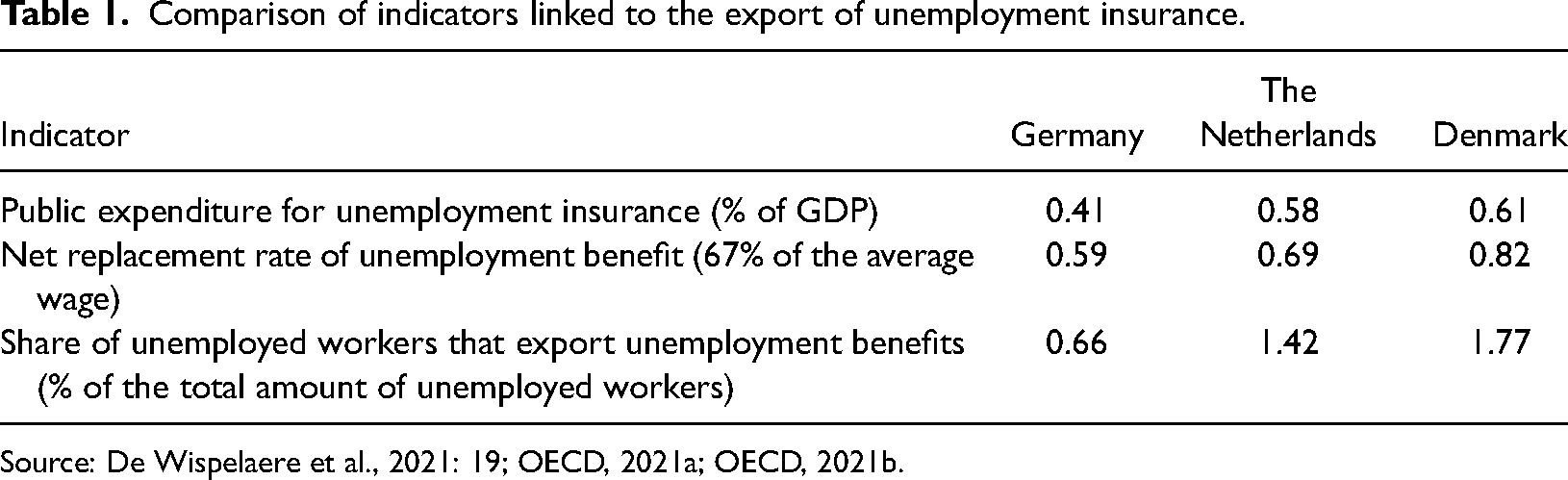
The first causal mechanism is that financial considerations are present among policymakers in the debate on the export of unemployment benefits. German policymakers did not perceive the export of unemployment benefits to be a financial burden to the national system of social security (Interviews 14 and 20), while Danish and Dutch policymakers did. The Dutch Minister of Social Affairs and Employment, Koolmees, repeatedly mentioned the costs in his letters to the Dutch Parliament. All the changes proposed for the unemployment chapter of Regulation 883/2004 – the introduction of a waiting period of three months before unemployment benefits are aggregated, the change in the country of employment principle for frontier workers and the prolongation of the export period – were expected to cost between EUR16 million and EUR32 million per year for the Netherlands (Tweede Kammer der Staten-Generaal, 2019: 6). Financial concerns among Danish policymakers could be identified as well. In an official statement to the Danish Parliament, the Minister of Employment, Poulsen, declared that the government was highly dissatisfied with the proposal to prolong the export period of unemployment benefits because ‘differences in welfare levels and labour markets of Member States put unnecessary pressure on social security in some Member States’ (translated from Danish) (Beskæftigelsesministeriet, 2018). The reform proposal was not considered fair and equitable (Beskæftigelsesministeriet, 2018). It was underlined that the reform of the chapter on unemployment benefits - that is, the prolongation of the export period, the introduction of a waiting period and the competency shift for cross-border workers – would lead to an additional cost of DKK163 million per year (approximately EUR22 million). Explanations for the perceptions of Danish and Dutch policymakers can be given by comparing three indicators that are linked to the export of unemployment insurance (see Table 1).
Comparison of indicators linked to the export of unemployment insurance.
Source: De Wispelaere et al., 2021: 19; OECD, 2021a; OECD, 2021b.
The first indicator is public expenditure on unemployment insurance. It is measured as time-limited benefits paid to workers who are members of an unemployment insurance scheme. Administrative costs, special benefits for workers with disabilities or employment incentives are not included in the indicator (OECD, 2021b). The German system is mainly based on contributions by employees and employers, and tax-financed public expenditure on unemployment insurance is small. In 2018, it made up 0.41% of GDP. In contrast, the share of public expenditure was higher in the other two states (0.61% of GDP in Denmark and 0.58% of GDP in the Netherlands), among the highest in the European comparison (OECD, 2021b). A second indicator is the net replacement rate of the unemployment benefit. The net replacement rate measures the proportion of the income of a single-person household without children against the net household income before job loss. Housing allowances or social assistance benefits are not considered (OECD, 2021a). For example, a net replacement rate of 0.6 means that unemployed persons receive 60% of their former annual salaries. The net replacement shown in Table 1 takes 67% of the average national wage as a reference. As the interviews showed that many people exporting unemployment benefits worked in the construction or agriculture sector before becoming unemployed (Interviews 1, 14, 15, 16 and 21), 67% of the average wage seems to be a better reference point than 100%. The net replacement rate is small in Germany (59% of the former salary), but it is 69% in the Netherlands and even 82% in Denmark (OECD, 2021a).
The third indicator measures the share of unemployed workers that export their unemployment benefits out of the total amount of unemployed workers in a Member State (De Wispelaere et al., 2021: 19). The proportion of workers exporting their unemployment benefits from Germany to another country is low, making the prolongation unproblematic (Interview 14). In 2019, 0.66% of the unemployed workforce exported their benefits from Germany to another country, whereas this figure was higher in Denmark, at 1.77%, and in the Netherlands, with 1.42% exporting benefits (De Wispelaere et al., 2021: 19).
Nonetheless, the differences in public expenditure, net replacement rate and the share of unemployed workers that export unemployment benefits between Germany and the other two Member States are not that significant. Therefore, financial considerations cannot be the only explanation for the positions of policymakers on unemployment benefits.
In sum, financial concerns are present in the Netherlands and Denmark, but because of the low share of the total amount of unemployed workers exporting their benefits and the fact that the differences in all three selected indicators between Germany and the other two states are not that significant, financial considerations can only partly explain the position of policymakers concerning the prolongation of the export period. To explain the different positions further, the article proceeds with an analysis of policymaker fears of moral hazard.
Fear of moral hazard
After financial concerns, the second causal mechanism is that policymakers value active job searches and reckon that they cannot ascertain whether those who export benefits are seeking a job in another country. Thus, decision-makers feared moral hazard, which led them to reject the prolongation of the export period.
Initially, policymakers in all states voiced concerns about national employment authorities being unable to monitor the process of workers seeking jobs abroad (Interviews 1, 5, 6, 7, 11, 15, 19, 22 and 23). It was felt that this would lead to the abuse of benefits or that it would be discriminatory to the local unemployed, who have to participate in regular interviews and training programmes on-site to receive unemployment benefits (Interview 5, 6, 12, 16, 21, 22 and 23). However, German policymakers were soon no longer opposed to the prolongation because they had no evidence that workers were not looking for jobs abroad (Interview 2). The German Federal Government stated in an answer to a parliamentary question of the AFD party that there is no evidence of fraud or misuse concerning the export of unemployment benefits (Deutscher Bundestag, 2018: 3). Additionally, in an interview following this response from the German Government, a representative of the Federal Ministry of Labour and Social Affairs emphasised that EU workers had worked for their claims in another Member State and that it would be only fair to grant them access to unemployment insurance (Interview 14).
In contrast, Dutch policymakers continuously opposed the revision of the export of unemployment benefits because they thought that the new Regulation did not guarantee that EU workers who export their unemployment benefits are actively searching for work in the host country (Interviews 8, 17 and 18). A representative of the Ministry of Social Affairs considered the export as ‘burning money because it is not beneficial to […] swift job resumption’ (Interview 4). Seeing that most of the exports from the Netherlands went to countries with lower income levels and higher unemployment rates than the Netherlands, the Dutch minister of Social Affairs and Employment, Koolmees, was convinced that those entitled to benefits would not have sufficient incentive to return to work (Tweede Kammer der Staten-Generaal, 2019: 5). Like Dutch policymakers, the Danish also feared moral hazard, arguing that the proposal to prolong the export period did not follow the goal of Danish unemployment policies to integrate people into the labour market (Interview 8).
Explanations for the fear of moral hazard
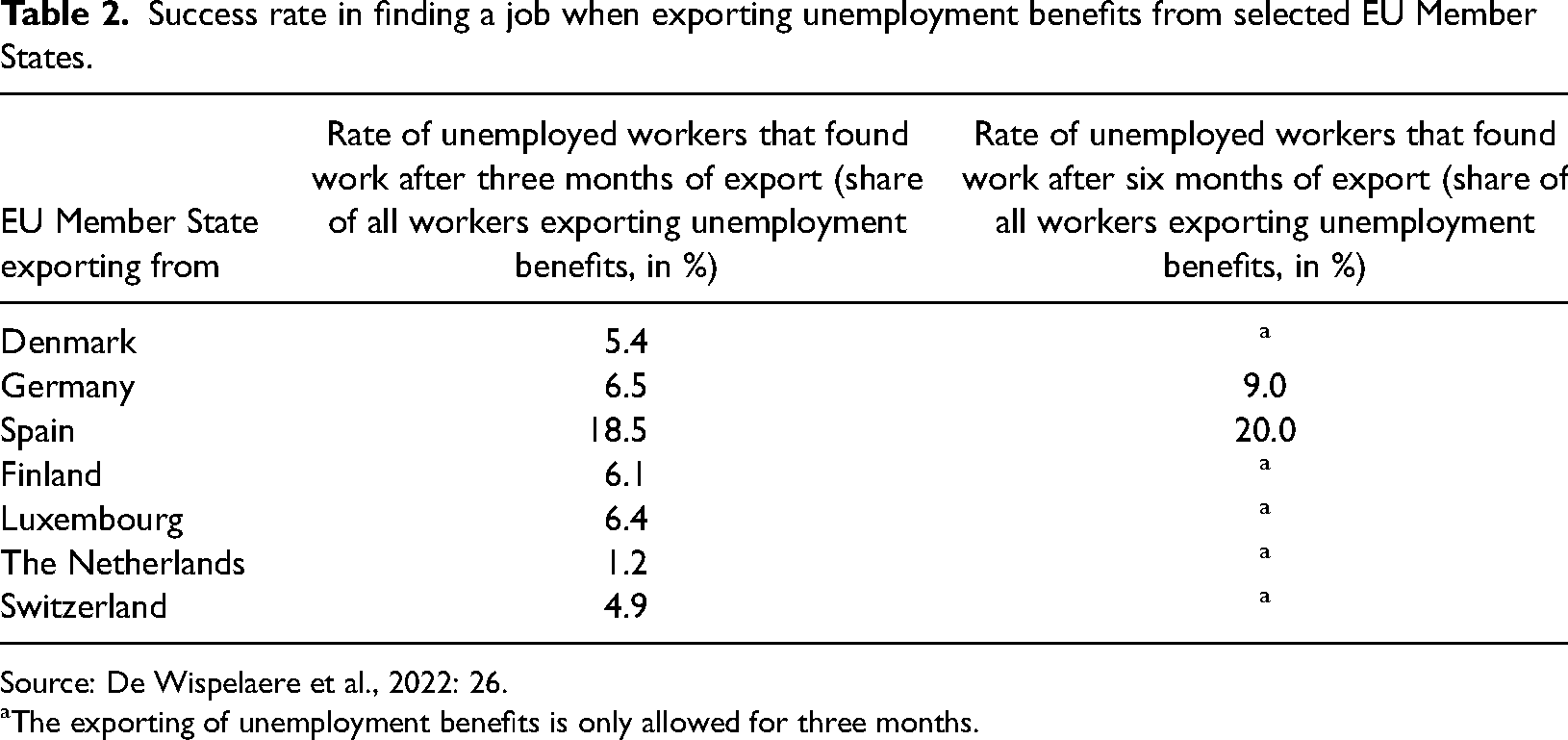
Fears of moral hazard in the Netherlands and Denmark can be understood by looking at the success rates for exiting unemployment (Table 2). For Denmark, the latest available data from 2014 reveal that the success rate of workers in finding a job in the first three months after becoming unemployed is much higher when seeking work in Denmark (52.0%) than for those who export their unemployment benefits (5.4%) (De Wispelaere et al., 2022: 26; Pacolet and De Wispelaere, 2015: 15–16). Even more remarkable is the difference in the Netherlands. In 2014, 28.1% of unemployed persons had found a new job in the Netherlands after three months, while only 1.2% of those who exported their benefits had found a job (De Wispelaere et al., 2022: 26; Pacolet and De Wispelaere, 2015: 15–16). For Germany, the success rate in finding a job when exporting unemployment benefits is slightly higher than in the other two states, but still much lower than when searching for a job in Germany. After three months of unemployment, 47% of those who searched for work in Germany had found a job (Pacolet and De Wispelaere, 2015: 15–16), while only 6.5% of those searching abroad were successful (De Wispelaere et al., 2022: 26). 6 So, the comparatively low job resumption rates in all three states can explain why Danish and Dutch decision-makers feared moral hazard, but they cannot explain why German policymakers were less concerned.
Success rate in finding a job when exporting unemployment benefits from selected EU Member States.
Source: De Wispelaere et al., 2022: 26.
aThe exporting of unemployment benefits is only allowed for three months.
Instead, the importance of active labour market policies and the influence of media reports explains why Dutch and Danish policymakers continuously feared moral hazard, while the Germans did not. All three states engage in active labour market policies. However, these play a greater role in Denmark and the Netherlands than in Germany. A comparison of active labour market policies based on an OECD survey of national country experts shows that both states have slightly stricter obligations concerning active labour market policies than Germany (Immervoll and Knotz, 2018: 30). While monitoring frequency and sanction policies are similar in the three states, 7 there are also differences; in Denmark and the Netherlands, for example, jobseekers are expected to accept jobs for which they are over-qualified (Immervoll and Knotz, 2018: 32–33).
Apart from the legal obligations, the interviews further underlined that for Dutch and Danish policymakers the individual responsibility of the EU worker to find a job and the monitoring of job searches by national authorities is crucial. A representative from the Ministry of Employment mentioned that the reason for Denmark's position on unemployment benefits is ‘a matter of principle because it is the way we think about the whole system of unemployment benefits’ (Interview 15). They believe that there is no ‘guarantee that there are sufficient possibilities in the hosting Member State that help an unemployed person to a job’ (Interview 15). Dutch policymakers value individual job searches because of recent Dutch history and national public feeling in respect of social security. Unemployment was high in the Netherlands in the 1980s until a reform introduced active labour market policies. Visser and Hemmerijck called this the ‘Dutch miracle’ (1997). Against this background in the Netherlands, it is a central feature of the unemployment system that a worker is actively seeking a job (Interviews 5 and 11). As a representative of the Dutch employment ministry mentioned, the central paradigm of the Dutch unemployment benefit system is ‘work above income’ (Interview 11). The system is shaped by a social contract in which the individual citizen is ‘willing to contribute to [others] being able to pay [their] bills’ but in return [is expecting something] from the other (Interview 11). This shows that Dutch and Danish policymakers see unemployment benefits and activation measures as joint elements of their national unemployment insurance systems, which is not the case for them in the current provisions and in the reform proposal. In contrast, German policymakers do not stress this view to the same extent.
The great importance of active labour market policies in the Netherlands and Denmark made it possible to politicise the topic. A considerable number of persons employed and insured in the Netherlands reside in Poland. On becoming unemployed, Polish jobseekers export their payments from the Netherlands to Poland, which is in accordance with Article 65 (5) (b) of Regulation 883/2004 (De Wispelaere et al., 2021: 16, 2022: 25). Although the behaviour of Polish workers is not unlawful, the Dutch media has accused Polish workers of fraud and welfare tourism from September 2018 onwards 8 (Interviews 10, 11, 12 and 18). It was reported that after three months of exporting benefits, they usually go back to the Netherlands to work there for a higher income than in Poland. 9 In reaction to these media reports, members of all parties in the Dutch Parliament strongly opposed the prolongation of the export of unemployment benefits (Tweede Kammer der Staten-Generaal, 2018).
Answers to the fear of moral hazard by EU legislators
After explaining the reasons for the Dutch and Danish fears of moral hazard, the question remains whether EU legislators have addressed the concerns. The underlying problem is that Denmark and the Netherlands consider activation and unemployment benefits a joint issue; however, the job-seeking activities of workers cannot be sufficiently monitored when the benefit is exported. The previous section has shown that in the Netherlands and Denmark this becomes a problem because they have strict activation rules that can be easily politicised if they are not followed.
In the current Coordination Regulation (EC) 883/2004, this problem is not addressed. However, in the reform proposal, the EU Commission tried to overcome the challenge of monitoring the work-seeking activities of the benefit recipient by proposing a ‘reinforced cooperation mechanism to support jobseekers to search for work, increasing the likelihood of labour market integration’. 10 To achieve this, it was proposed that Article 55(4) be added to the Implementing Regulation, ensuring that a) the Member State providing the unemployment benefit is informed when the EU worker has registered with the employment services of the host state; b) if anything is affecting the entitlements to benefits, the host Member State sends the relevant information to the Member State providing the employment benefit and the person concerned; and c) the Member State providing the unemployment benefit can request information every month if the workers are complying with organised checking procedures. As it was considered the cause of too much work for the host states, sentence b) was deleted from the compromise proposal in Spring 2019 (Pennings, 2020b: 160). Even with these additional requirements in the proposed Implementing Regulations, Member States were not convinced that these measures would ensure that persons seek work. Denmark, the Netherlands and other states voted against two provisional agreements in April 2019 and December 2021 because they were against the prolongation of the export of unemployment benefits to six months (Interviews 15, 16, 22, 24, 26 and 27).
Pennings (2020b: 160) argues that even with these additional requirements in the reform proposal, it is understandable that some Member States are not convinced that these will ensure that the unemployed are seeking work. Difficulties are that the host state has to apply its own legislation, which might have different conditions than those in the competent state. Further, given the heterogeneity in wages between Member States, incentives to search for work are low when exporting benefits from a country with high benefit levels to one with low salaries (Pennings, 2020b: 160), as in the case of the workers exporting their benefits from the Netherlands to Poland.
In sum, fear of moral hazard is caused by the dilemma that activation policies and unemployment benefits are perceived as a joint issue, while the job-seeking activities of EU workers cannot be sufficiently monitored when the benefit is exported. For the Netherlands and Denmark, this becomes a problem because they have strict activation rules that can be easily politicised if they are not followed. The current reform proposal addresses this problem with additional requirements in the Implementing Regulation for data exchange between employment authorities. However, these requirements were not able to convince the sceptical Member States.
Conclusion
Freedom of movement in the EU poses the challenge of reconciling closed welfare states and EU migration. Against this background, the article explains the positions of Western policymakers towards EU worker access to social security benefits. Positions on the export of unemployment benefits are paradigmatic for this broader research goal. The institutional features of national unemployment insurance systems can explain the diverging positions of policymakers in respect the export of unemployment benefits. In Denmark and the Netherlands, financial concerns are present, as both states have a comparatively high replacement rate and public expenditure. Nevertheless, because of the low share of workers exporting unemployment benefits from all three countries and the fact that the selected financial indicators demonstrate only minimal differences between the three states under study, financial concerns can only partly explain the positions of policymakers.
The second explanatory factor, namely, the fear of moral hazard, also contributes to illuminating policymakers’ concerns against the prolongation of the export period. This fear is caused by activation policies and unemployment benefits being perceived as a joint issue. However, the job-seeking activities of the workers cannot be sufficiently monitored when the benefit is exported. For the Netherlands and Denmark, this becomes a problem as they have strict activation rules that can be easily politicised if not followed. Due to large differences in wages and social security levels between Western and Eastern European states, there were fears in the Dutch political discourse that workers who export predominantly to Eastern Europe lack incentives to take up jobs. The current reform proposal addresses this lack of monitoring capacity with an additional Article in the Implementing Regulation that introduces rules for the data exchange between employment authorities. Nevertheless, several Member States have remained sceptical of this and have not supported the reform of the European coordination of social security.
The example illustrates the following for the research on the interplay of free movement and social security: a) the decisive institutional problems causing Member States to criticise the access of EU workers to social security are not only the fiscal costs for Member States, and b) despite the European coordination of social security, the welfare systems of Western European states remain diverse. Features of national social security systems are difficult to enforce via EU Member States with different systems and policy goals. The export logic of the European coordination of social security is incompatible with national monitoring and enforcement systems that are designed to work best if the worker is in their state of last employment. The current European coordination of social security reaches its limits when it has to coordinate such transnational situations. Rennuy (2020) as well as Ruhs and Palme (2022) make similar arguments on the posting of workers (Article 12 of Regulation 883/2004) and the export of child benefits (Article 67 to 69 of Regulation 883/2004). In conclusion, the European coordination of social security cannot equalise all the different institutional features and economic heterogeneities of its Member States. They remain firmly in place, can be politicised and determine the positions of their policymakers.
Footnotes
Acknowledgements
I would like to thank Susanne K. Schmidt, Michael Blauberger, Dorte Sindbjerg Martinsen, Josephine Assmus, Anita Heindlmaier, Carina Kobler, Dion Kramer and the participants of the Austrian Political Science Day 2021, the IDEAS Conference 2022, the 11th Biennial Conference of the SGEU as well as the team of the Centre for European Politics at the University of Copenhagen, for their comments on the manuscript. Many thanks also to my interviewees for their invaluable input.
Data access
The data provided by Eurostat was freely accessible on the internet.
Declaration of conflicting interests
The author(s) declared no potential conflicts of interest with respect to the research, authorship, and/or publication of this article.
Funding
The author(s) disclosed receipt of the following financial support for the research, authorship and publication of this article: This work was supported by the German Research Foundation (DFG) [grant number 374666841].
