




Abstract
When Tina Turner sang ‘What’s love got to do with it?’ she could have been singing about live methods. This article reflects on my experience as a reluctant ethnographer with children during COVID-19. I argue that it was ‘love’ for the community I was researching with that led me to use live methods. In this article I reflect on how love is the driving force in live methods. Taking inspiration from bell hooks, Audre Lorde and Linda Tuhiwai Smith, I explore how love does indeed have everything to do with live methods and is not ‘a second-hand emotion’ but can definitely break your heart. My reflections are based on an 18-month multimodal ethnography that I undertook for my PhD studies with children who have experienced domestic abuse and social care intervention. The multimodal ethnography began in March 2020 just as the restrictions for COVID-19 in the UK began. Whilst I had originally planned for in-person methods, the children and I had to quickly navigate and negotiate a way to continue the research. On reflection I can identify elements of Back and Puwar’s manifesto in my methods, but undergirding my research was something I now recognise as love. In this article I reflect how I reluctantly came to my methodology and methods not because of my sociological sensibilities but due to the love for the families I was researching with. I reflect and argue how love needs to underpin live methods.
Introduction
I have a confession to make. I knew very little about research methods when I started my PhD – probably not the best way to start an article in an issue that is devoted to celebrating and critiquing live methods! However, as I wrestled with trying to create knowledge with children through COVID-19, I was drawn to methods that would enable my participants to show their fleshy humanness. I was driven by my desire to do what was best for the children, what hooks (2016a, p. 6) calls ‘love’ – a desire of wanting another’s spiritual growth. Drawing from the work of Black feminist scholars bell hooks, Audre Lorde and June Jordan and decolonial scholar Linda Tuhiwai Smith, I argue that love has everything to do with live methods and deeper knowledge creation, but it involves being open to change and being vulnerable.
For this article I move away from studying and critiquing love as a subject and move towards writing about how researching with love is important to live methods. Using the work of Black feminists bell hooks, Audre Lorde and June Jordan, I define love as a praxis, an ethic, a deep feeling and way of knowing, as well as a creative energy that empowers us as researchers. I give a brief overview of the methodology and methods that I used for my research project during COVID-19 physical restrictions, and how I reluctantly came to live methods because of researching with love. Using ethnographic vignettes, I explore how love guided the project, allowing me to get to know my interlocutors through being curious and stepping uncomfortably into what I call ‘the art of not knowing’. I reflect how love challenged me out of practising what Back (2012) calls a ‘dead sociology’ (p. 20). How I clumsily embraced technology, recognised that I was at risk of enforcing stereotypical narratives about the children, and wrestled with ethical dilemmas in research. The consequence of loving is being open to emotional vulnerability, and I argue that this is important in recognising one another’s humanness. Drawing on Indigenous and decolonial feminist scholar Linda Tuhiwai Smith, I argue that researching with love is an important part of creating representations that do not dehumanise and violate the communities we research with. I conclude with a personal reflection on love as the undergirding force in live methods and why it is important.
What is love?
Tina Turner once sang ‘What’s love got to do with it? What’s love but a second-hand emotion?’ (Lyle & Britten, 1983; Turner, 1984). Love has been of much public and academic interest. It has been the subject of many forms of art, research and theorisation. In sociology, Luhmann (1998) was interested in the semantic of love, and studied love not as a feeling but as a symbolic coda which enabled effective communications in situations that seemed improbable. Whilst Giddens (2008) explored the radicalising possibilities of the transformation of sex, love and intimacy, and Beck and Beck-Gernsheim (2004) wrestled with the complexity of individuation, love and society. Further expanding the sociological understanding of love, Bauman (2003) investigated the central figure of the contemporary person who has no bonds but must make temporary links to engage in the world. The problem of love was further explored by Illouz (2012), who questioned the assumptions around love, and explored why love hurts from a sociological perspective rather than from a psychological one. Love has long been a topic of research.
Second wave feminist scholars have argued that rather than being transformative, romantic love kept women submissive to men (de Beauvoir, 1997; Friedan, 2010). Further feminist critiques saw love as a form of social reproduction that rather than liberating women, kept them beholden to producing and nurturing a workforce for a patriarchal and capitalist society (Jaffe, 2022). Gotby (2023, p. xiii) in her book They Call it Love writes that love is an emotional reproduction that maintains people’s emotional wellbeing, so that they are able and willing to engage with a capitalist system. This builds on the work of Hochschild (2003), who in her breakthrough study of flight attendants, theorised how emotions are commodified, something that could be bought and sold in order to maintain the capitalist system. Love became synonymous with work. Federici (2012) argued there needed to be clearer demarcation between love and work, so that work can be named as work, and we can discover what love is and who we are within it.
In this section I move away from the body of work about love as an object and towards researching with love. I define what I mean by love and then later in the article I reflect on what researching with love meant for both myself as a researcher and for the knowledge that was created with the children in my research. Black feminists have long claimed that love is essential in imagining and working towards a more just society (Nash, 2013). I draw on the long history of theorising and practising of love by Black feminists, in particular hooks (2016a, 2016b, 2016c), Lorde (2018, 2020), and Jordan et al. (2005) and Jordan (2016) to shape my understanding of love. I have found it hard to define my idea of love for this article, for it is not only one thing, but has many aspects which are not isolated and rigidly compartmentalised but entangled. Black feminists have long critiqued the delineation of being, theory and praxis (Hill Collins, 2009, 2020), and I feel this is clearly evident in Black feminist thoughts on love, which when embraced can embolden our commitment to live methods. In the following paragraphs I clarify the different aspects of love that I will take forward in the article. Firstly, I describe love as the commitment to the growth of both oneself and another, which is a praxis, a code of ethics, an action (hooks, 2016a, p. 14). Secondly, using Audre Lorde’s work, I expand on love as a feeling and way of knowing. Lastly, drawing on June Jordan and Audre Lorde’s work, I describe love as a creative force.
Black feminist scholar bell hooks would strongly disagree that love is a second-hand emotion. For hooks (2016a, 2016b, 2016c), love is not only a feeling, but a deep knowledge and action that is more than individual romantic relations, as it is often depicted in the post-industrial world. Defying the trivialisation of love to the realm of weakness, sentimentality and individuality, hooks draws on the work of Peck (2006) and defines love as the ‘will to extend one’s self for the purpose and nurturing of one’s own or another’s spiritual growth’ (hooks, 2016a, p. 6). The philosophy of love being about one’s own and another’s spiritual growth has a wide and long story. Philosopher Aristotle wrote of Philia, the love that we have for another that extends to us wanting good things for their sake (Torres, 2021). Buber (1937/2020) writes that life is meaningless unless we find ourselves in relations with another: when our ‘I’ meets another’s ‘thou’, we do not objectify them but are in relation with them. hooks acknowledges that at the centre of love is a connection with others.
With this commitment comes a praxis, hooks (2016a) writes that ‘love is as love does’ (p. 14). hooks advises us that we need to see love as an action first, rather than a feeling, and it is only then that we can hold anyone who uses the word to account. For hooks, love is an ethical way of being and praxis. hooks (2016a) instructs us that love entails ‘a combination of care, commitment, trust, knowledge, responsibility, and respect’ (p. 7). Thus, researching from a praxis and ethic of love means being held accountable and showing care, commitment, trust, knowledge and respect.
In her essay ‘Uses of the Erotic’, Lorde (2020) expands the concept of love to include love as a feeling and a way of knowing. The erotic for Lorde (2020, p. 32) is not only sexual, she writes that the word erotic comes from the Greek word eros, which personifies love in all its aspects. Lorde (2020) explains that the deep feelings that we have when something just feels right ‘is the first and most powerful guiding light toward any understanding’ (p. 33). This feeling is not reduced to only the sexual, but is our capacity for intense joy when we experience a deep satisfaction, be that from ‘dancing, building a bookcase, writing a poem, examining an idea’ (Lorde, 2020, p. 33). It allows us to connect with others and empowers us with a lens that we can then use to scrutinise all aspects of our lives and assess their meaning in our lives (Lorde, 2020, p. 34). Lorde (2020) believed that if we were open to these profound feelings and way of knowing, we would allow it to illuminate and inform the world around us, and would lead us to challenging oppression. The split between the spiritual (psychic and emotional) and political is false according to Lorde, and is a result of ignoring the knowledge we gain from love. Love creates the bridge between the two worlds of the spiritual and political, yet we have been taught ‘to distrust that power which arises from our deepest and nonrational knowledge’ (Lorde, 2020, p. 30). Importantly, Lorde argues that if we could harness this way of knowing, then we could transform our world.
Lorde (2020, p. 32) declares that love is a lifeforce, a creative energy and harmony that empowers us. Thus, love also has a third dimension, that of being a creative energy that makes creating knowledge possible. Black feminists June Jordan and Audre Lorde both wrote how love is a creative force that not only allows knowledge to be created but allows a different world to be imagined.
Love is lifeforce. I believe that the creative spirit is nothing less than love made manifest. I see love as the essential nature of all that supports life. Love is opposed to the death of the dream. (Jordan, 2016, p. 11)
In her essay about and to children regarding the creative spirit, Jordan (2016, p. 12) writes that love is a creative force that is larger than the individual. Jordan (2016) reveals being ‘given’ whole poems, and reflects that this creative energy, this love, is as much a process reliant on our receptivity as it is dependent on our own effort. In alignment with hooks, both Jordan and Lorde acknowledge love was not merely a creative force but can empower us to address social injustice and be transformative. Lorde (2020) writes that ‘recognising the power of the erotic within our lives can give us energy to pursue genuine change within our world, rather than merely settling for a shift of character in the same weary drama’ (p. 37). In the following section I will illustrate how it was this love, this energy that was beyond me but fuelled by love for the participants in my research, that guided me to what I now know as live methods.
What’s love got to do with research?
Before I can tell you about the story of love in my research, I need to tell you the origin story of my research. In my role as a counsellor working with children who have experienced domestic abuse, I was often saddened and enraged by the way that the services that were supposed to support them would often misunderstand and misinterpret them, leaving them in more vulnerable positions. Guided by this outrage, I applied to do a PhD to explore this dynamic. However, when I started to research the literature around children and domestic abuse, I found that with the exception of a few significant studies (Callaghan et al., 2017; Hester, 2007; Humphreys & Stanley, 2006; McGee, 2000; Mullender et al., 2002; Stanley, 2011) there was a paucity of literature on the everyday lives of children who had experienced domestic abuse. Children were essentially absent from the creation of knowledge about themselves (Øverlien & Holt, 2018, 2021). So, my research focus became the everyday lives of children who had experienced domestic abuse. I can now see how love was woven into my research from the start – from the sense of injustice and wanting to research with children beyond the narrow lens of trauma and abuse. But the research journey was not smooth, and it challenged and changed me.
I was a reluctant ethnographer. I had initially thought it unfeasible to do an ethnographic study, but I began to appreciate that the longitudinal aspect of ethnography would allow me to pay attention to the complex stories of the children’s lives, and how they are interconnected with the material, social, structural and human and non-human aspects of life. I needed a methodology that was also attentive to the small and big moments of life – its rhythms, flows and structure – to create knowledge of how children make meaning of their lives. Scholars have argued that it is in paying close attention to the everyday that we can go beyond the narrow lens of oppression and trauma and see how marginalised communities resist and make life liveable (Al-Mohammad & Peluso, 2012; Di Napoli Pastore, 2022; hooks, 1990, 2016c; Twum-Danso Imoh et al., 2022).
However, ethnography alone does not make the research project ‘accessible’ to children. To do so, I took inspiration from the Connectors Study (Nolas et al., 2017, 2018; Varvantakis & Nolas, 2019; Varvantakis et al., 2019), a three-year multimodal ethnography that looked at the relations between childhood and public life in three cities (Athens, Hyderabad and London), and dedicated my methodology to developing an ethnographic approach for working with the children. The attraction of multimodal ethnography is that it works across different mediums and modes – visual, sensorial, text, sonic, digital, in-person – and allows children the flexibility to choose the medium and mode in which they prefer to express themselves (Clark, 2011; Dicks, 2014; Nolas et al., 2018; Varvantakis & Nolas, 2019). Multimodality lends itself to working with children, especially young children, as it is not dependent solely on verbal expression but is attentive to the signs that are made though different modes like movement, gestures, gaze, facial expression, dance, songs, jokes, objects and speech (Nolas et al., 2018; Varvantakis & Nolas, 2019). Back (2012, p. 29) writes that the essence of live sociology is being attentive to a wide range of senses that affects the quality of data and makes ‘critical imagination possible’. I had to learn to use my different senses to make meaning with the children, as I explore in the paragraphs below. In my study, play and photography were the main modalities in which children documented and communicated about their everyday lives.
Having decided on my methods, I was struck, like many other researchers, with the challenge of COVID-19. For this I can clearly see how the praxis and creative force of love guided me through. I remember sitting in my chair between therapy sessions at work, when I realised that the way I worked and lived was going to change due to COVID-19. There had been speculation that physical restrictions were likely. So, what did that mean for my research? The children and mothers were still very keen on continuing with the research and it dawned on me that if the everyday lives of children involved navigating a pandemic then the research would have to deal with that too.
My driving thought and feelings were that there would be many things written by and about children and COVID-19, but I questioned how many would be with children who have experienced domestic abuse and social work interventions? So many times their voices go unnoticed. It was in this moment that I had an overwhelming feeling of purpose, drive and energy to make the research project happen. This feeling I now recognise as the love that hooks, Lorde and Jordan write about. hooks (2016a, 2016b, 2016c) writes that love is social justice and praxis – I felt that to continue the research would be the most ethical thing to do in terms of the children. If they were willing to continue and it was safe both emotionally and physically, then I felt it was an action of social justice to enable them to express their views and feelings during this time.
In her essay ‘The Creative Spirit’, Jordan (2016) describes how love is a creative force – I felt this force. Out of what seemed thin air, I imagined what the project could look like. I quickly purchased some art materials (pens, paper, stickers, lolly pop sticks, glue, toy cameras) and placed them all in a transparent folder with a brief instruction booklet (Figure 1). I then visited all the children and, standing at the doorway, I placed the art packs onto their doorstep. I negotiated with their mothers and the children how I would keep in contact with them over the forthcoming weeks (little did we know how long physical restrictions would last!). We decided to have a WhatsApp video call once a week. As time progressed and restrictions were relaxed, we continued to WhatsApp video call, then moved to meeting in parks, going for a walk, till finally being able to visit homes. The children and I played with different methods to communicate and get to know one another. In total, I visited the 10 children online or in person once a week for 18 months.
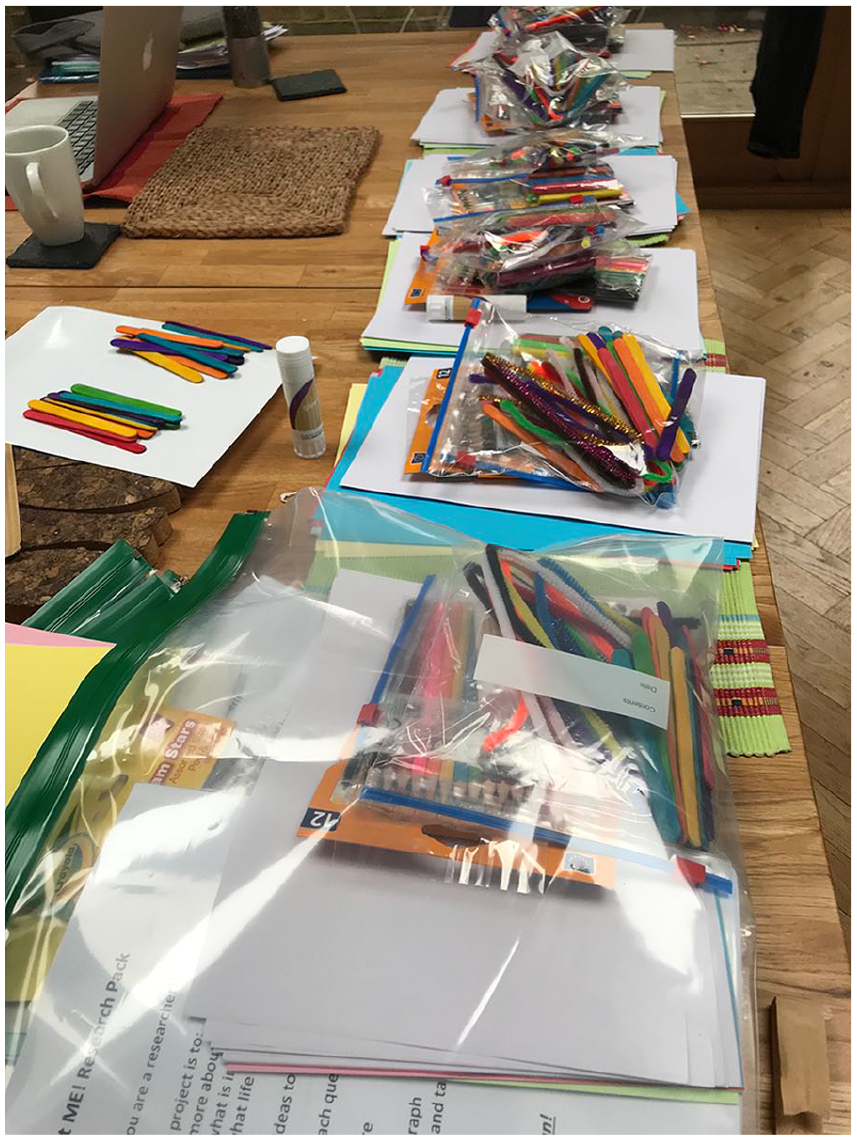
Children’s art packs.
Being a self-confessed technophobe, I found some of the digital methods difficult and I struggled at times, but I was committed to the children. Thus love as commitment to one another’s growth, a way of knowing and a creative force was essential in making the methods live, as the following ethnographic vignettes illustrate.
Being known
Researching with love means getting to know your participants. But getting to know one another is not always easy, including in research. At times the physical restrictions of COVID-19, navigating the use of technology and the awkwardness of human relations was played out in my research. One such example was my relationship with Tdrommie.
Tdrommie was (at the time) a seven-year-old boy who joined the research project during the physical restrictions period of COVID-19, commonly called ‘lockdown’. The first time I met him he was munching on a huge cheese sandwich the size of a doorstep. We giggled about it and at my own amazement at him having his two front teeth missing but still managing this huge sandwich. The first meeting went well, and we agreed to WhatsApp video call every week. I found the subsequent meetings painful.
‘Hi Tdrommie’ I greet Tdrommie on my weekly video call. ‘. . .hi. . .’ Tdrommie replies while not looking at the phone screen. ‘How are you?’ I ask. ‘Good’ Tdrommie says, as the image on my phone screen wobbles and Tdrommie appears and disappears on screen. ‘I wonder what was good about it?’ I ask. ‘Oh, . . .er. . . I don’t know. Just good’ Tdrommie replies. His face completely disappearing from my phone screen. At this point I start to sweat. I feel anxious and uncomfortable, I question my research method and process – I ask myself what the point of this call was. I feel like it was a painful question and answer session, which was not my intention at all. We continue to ‘chat’ for a few more minutes before we end the call. I worry whether we are building any rapport. A change in our relationship comes a couple of weeks later. I call Tdrommie and we start off as usual. ‘Hi’ I greet Tdrommie. ‘Hi’ replies Tdrommie. ‘How was your week at school?’ I ask. ‘OK’ he replies. ‘You know what I have been up to?’ ‘Don’t know’ answers Tdrommie. ‘I have been learning about Roblox. Do you know it?’ I ask Tdrommie. ‘Yeah, but I play Minecraft’ explains Tdrommie. ‘Oh yeah, what’s that like?’ I say.
On the mention of Minecraft, Tdrommie became animated and with the help of his mother, positioned the phone so that I could see his Minecraft world on their iPad. He showed me around his world like a proud homeowner or art collector. He became animated and showed me all the things he had created, collected and displayed. In my desire to create knowledge with the children about their everyday lives, I had to grapple with my fear of technology; I had to step into the unknown, the uncomfortable, to be open to get to know them in their world. New technology scares me, yet because of COVID-19 I had to get used to an array of online platforms (Watson & Lupton, 2022) to keep in contact with the children and build relationships. This also acted as a leveller with children, as often they were the ones teaching me how to navigate my way around different online games and apps. It felt like stepping into the unknown, yet it was a way for the children, like Tdrommie, to be known.
The art of not knowing
Embracing the unknown is an act of love in research. Researching with love means researching with a sense of ‘unknowing’ and willingness to learn, to get to know another. Fanon (1961/2001, p. 207) arrived at the conclusion that an attitude of ‘not knowing’ was important not only for his patients but was the way forward in building a more just society after colonial rule (p. 151) – a solidarity of ‘unknowing’. Similarly, Smith (2012) also emphasised that researchers must come with a sense of unknowing, curiosity and openness to learn from others.
But this sense of ‘unknowing’ requires a sense of vulnerability, a releasing of power, a willingness to make a fool of yourself. Michael (2012, p. 168) advocates a practice of ‘proactive idiocy’. Whilst he first explores how objects can act as an idiot that opens a way for speculation, he moves on to question what can this speculative design hold for sociology, what does it open? Michael (2012) concludes that not only objects but participants can be ‘idiotic’ for the researcher, meaning that their actions and reactions can escape analysis. This provides a space for ‘becoming with’ for both the participant and researcher. This was paramount in my research with the experience of play. In trying to get to know the children, I had to wrestle with the nonsensicalness of play, to let go of my preconceptions and ‘become with’ the children.
I was often left wondering what this ‘nonsensicalness’ in my interaction with children was about. I could not seem to grasp anything – was this even research? My weekly encounters with the children challenged me as a researcher, but I held firm to the thinking of building relations with the children and creating knowledge together despite how messy and uncomfortable I felt. I was reassured to find that other researchers had also struggled with this. In the Connectors Study, the researchers in the multimodal, multi-city research project with children at first struggled with the children’s playfulness (Varvantakis & Nolas, 2019). Like Nolas and Varvantakis (2019), I too often felt out of my depth and ‘missing’ something, but desire to get to know the children pulled me through. Nothing seemed to fit into the neat categories that I had anticipated my ‘findings’ to be. In time, as the children and I got to know each other I slowly became aware that the significance of our weekly calls was to play, have fun and enjoy each other’s company – of becoming with one another. Feminist scholar Lugones (1987) writes that in order to understand other people we need to ‘playfully’ travel to their world. In her essay, she rejects Huizinga’s and Gadamer’s definition of playfulness and play as being ultimately to do with contest and winning, losing and battling (Lugones, 1987, p. 15). Rather, she argues, playfulness and play involves a sense of uncertainty, an openness to being a fool, an openness to self-construction, and construction and reconstruction of the world we live in (Lugones,1987, p. 17). Thus, as Michael (2012) explains ‘attending to the nonsensicalness, we become open to a dramatic redefinition of the meaning of the event’ (p. 170).
In my area of research and practice (that of children, domestic abuse and social work), there can be a reticence to being open, unknowing and curious with children due to an institutional aversion to risks (Øverlien & Holt, 2018, 2021). Yet the children in my research showed me that when a professional came to them with a lack of curiosity and openness, they felt like a problem to be fixed rather than someone to empathetically engage with. This was illustrated in Katie’s story to me.
Katie and I are sitting on the swings. We are talking about school and her friends. ‘Yeah, I don’t like her’ Katie explains about a teacher. ‘She wants to appear nice but she’s not really’. ‘What do you mean?’ I ask. ‘Well, you know my friend Jenny that I talked about. Well, you know her dad isn’t well. This teacher told her off the other day and said, ‘I don’t think your parents are doing a good job of bringing you up’. That’s not a kind thing to say. . . and she’s supposed be the wellbeing teacher and SENCo!’ tuts Katie. ‘You know she is always trying to pull me aside to have a quiet word to see if I am OK. She thinks she understands but she really doesn’t. I just nod my head and smile while she talks’, continues Katie.
In Katie’s description and analysis, the teacher has not fostered a level of trust. The teacher had not come to the relationship with a sense of curiosity, of wanting to learn, to get to know her. Katie felt that the teacher thought she already knew the answer, and together with her treatment of Katie’s friend, showed a lack of empathy and understanding – in fact she had exercised her judgement and authority. In these everyday encounters and practices at school, Katie had assessed that the teacher was not someone she could be vulnerable with. Katie had felt like a box that needed to be ticked.
The children in my research felt that the professionals had wanted them to be vulnerable with them but had come to the situation as all-knowing – this imbalance of power had made them feel anxious. Likewise in research, when we come with an all-knowing attitude rather than one of vulnerability and curiosity, we are not researching with love. Love relies on a mutuality that creates a safe relational space where it is possible to share, give, receive and show solidarity (hooks, 2016a, 2016c, 2016b).
Ethics of researching with love
This openness led me to seeing children beyond the narrow lens of trauma and abuse. I had come to my research with a strong sense of righting injustice but in researching with love, I had to come to see the children beyond this narrow lens. In many respects, my sociological sensibilities were awakened by love. Firstly, I was mired with political intent, wanting to prove how children were being mistreated and misunderstood by the services set up to support them, but I was at risk of ‘assassinating the life contained’ within their social world (Back, 2012, p. 21). I was at risk of misrepresenting the children again by diving headfirst into proving my preconceived ideas. It was my shock at the paucity of research that included children in the social work academic literature, and the prevalent narrative of children who have experienced domestic abuse as being passive and damaged (Callaghan et al., 2017, 2018), that woke me up out of my slumber.
Back (2012) challenges sociologists to be aware of the political and ethical questions that our craft brings. Reflecting on the betrayal and perversion of knowledge being used for military and aggressive forces to uphold the status quo, Back (2012) calls for sociologists to be attentive to how methods and knowledge are used. Although Back warns us that being attentive and using the art of listening alone will not save us from committing another form of violation that Carolyn Steedman calls ‘enforced narratives’ (cited in Back, 2012, p. 24). This is where communities who are marginalised are ‘filched under the licence of sympathy and suffering’ (Back, 2012, p. 24). He argues that the fine line between portrayal and betrayal cannot be adequately settled by university ethical guidelines. Here, I would argue, is where working from an ethic and praxis of love can enable us to move beyond the ‘enforced narratives’ and the bare minimum of ethics forms – indeed working from a praxis of love may be in tension with the ethical guidelines. This was apparent in my research in several ways – both in combatting the ‘enforced narrative’ and a feminist activism that went beyond the ethical guidelines.
When I told other researchers that I was planning on doing research with children who had experienced domestic abuse, they often said ‘ooh good luck with ethics!’ The predominant belief being that the children were too fragile so it would be difficult to get ethical approval for research. This was evidenced in the literature on domestic abuse and children – there was limited, if any research done with children about their everyday lives. Children were essentially missing from creating knowledge of their lives. We had lost our critical attentiveness and had, as Back (2012, p. 27) writes, been ‘mired in ethical hypochondria and timidity’.
I came to my research because I wanted to research the ways in which the child protection system can repeat patterns of abuse, but in carrying out my literature review I found there was a paucity of research done with children themselves and so the focus of my project changed. The limited research that was done with children were often one-off interviews solely about domestic abuse and there was little about the children’s everyday lives, they were very rarely seen beyond narrow lens of trauma and abuse. I wanted to find out who the children were in their fleshy humanness. This desire is very much based on the Black feminist praxis of love that creates knowledge and solidarity not from only a place of injury but also a place celebrating difference and seeing one another in our ‘fleshiness’ and futurity and hope (Nash, 2013). Knowing that we are moving and growing and not fixed in one place (Nash, 2013) means working with love takes care and time; it is not formulaic and there is no one size that fits all. An example of children not being static was the children changing their pseudonyms multiple times over the course of the project to reflect where they were in that moment. Keeping careful notes of their changed pseudonyms was important. Our bodies changed too – as the research progressed I grew slower and some of the children grew faster and stronger. This was particularly the case with Rosie, who at first complained that I was running too fast, and she couldn’t keep up, but progressed to her telling me to ‘take a rest’. Love allows for movement and growth. Live sociology calls for researchers to work on the move, for ethnography to become a ‘social ballet’ (Back, 2012, p. 29). I felt the children guiding me, they were the choreographers of our ballet show.
Love also goes beyond an ethics form and calls for radical feminist care. This was a challenge in my research. There would be time just as I was leaving, literally on the threshold, that mothers would whisper to me, out of their children’s ear shot, a problem they were dealing with. At times it was to do with housing, other times about being afraid of an abusive ex-partner, or not having enough money. As a researcher do we write this in our notebook and move on? How do we practise a radical care that honours our role as both a fellow human and researcher? Love is not impartial in the midst of injustice, hooks (2016a, p. 19) writes: ‘There can be no love without justice.’ Likewise, Back and Puwar (2012, p. 14) write that live methods ‘have a duty to pay attention to vulnerable and precarious lives to establish the conditions that offer to them’ a liveable home. I often had to try to advocate for the family by seeking further support from the safeguarding lead for the project. At times, even with the support of the safeguarding lead, there was such sadness and frustration in bearing witness to injustice. Gunaratnam (2012), much like Lorde (2020), advises using this affect, this deep feeling, to create knowledge – I have tried to put it into words and be attentive to that which is often unsayable in order to make meaning of it and to convey the injustice. Gunaratnam (2012) writes of coming back to basics and understanding that critical methodology and care is driven by a desire to oppose unnecessary suffering – I call this desire ‘love’ in the tradition of hooks, Jordan and Lorde.
Un/loving representation
In her Sociological Review lecture to celebrate the 20th anniversary of her groundbreaking book Decolonizing Methodologies: Research and Indigenous Peoples, Smith (2019) argued that love was a fundamental essence of research because it nurtures and allows relationality. Smith illustrated how the process of decolonisation includes a sense of loving who we are – ‘we’ being the Indigenous and other communities who have been marginalised and colonised. In essence, research must enable that relationality and respect that builds love. I would be disingenuous if I did not say that researching with love was a reaction to being unlovingly represented myself. Maybe researching with love is a way for me to show my younger self the love that was missing from the (mis)representation of my life.
My methodological approach is influenced by an unexpected personal encounter with my own childhood, and being confronted with an outsider’s (mis)interpretation of the home I grew up in. In September 2016, just before the new school year, I took my two children to the Science Museum. As we were leaving, we came upon a photo exhibition ‘Make Life Worth Living’ by Shelter, the national charity for people who are homeless. Always keen to explore art, we entered the exhibition room. My children ran ahead, and I slowly walked behind. As I looked at the second photograph on display, I stopped and stood still. I felt like someone had punched me in the gut. My heart raced and I could feel bile coming up through my throat. I stepped closer to the photo and read the caption again. Yes, I was right the first time. There before my eyes was the photo of the council flat that I had grown up in till the age of 11. The photo was part of an exhibition about ‘Slums of Britain’. I felt dizzy; I called my children back and we left immediately. I could not stay a moment longer. I felt like I had been violently robbed of my story. Shelter had painted my home as a slum. There in a black-and-white photograph Nick Hedge had portrayed my home as grim and derelict. Yes, for sure there were horrible aspects of poverty and racism to contend with. I remembered a brick being thrown through our front window by the neighbour upstairs; the boy downstairs who tormented me with his pet mouse; frequent visits by immigration officers in the evening to question my parents; and the counting of coins at the checkout shopping counters, hoping we had enough to pay. However, there were other things too, like the street party in the car park outside the block of flats, the generosity of the family opposite who always let us use their landline telephone, the parties, the music, the food, being able to watch trains pass by while sitting on the roof of the block of flats. There was an array of feelings and experiences: joy, laughter, fun, fear, hunger, boredom, sadness and disappointment amongst many things. The photographic exhibition did not convey any of that – instead it portrayed my home as one of despair and hopelessness, and the residents as passive subjects. It is this visceral memory that continues to prompt me to try to create knowledge with children so that, I hope, they will not feel robbed of their story and find themselves unrecognisable as passive victims in the research about their lives.
It was an exhibition that prompted my PhD journey, and it was an exhibition that closed my research project. This time it was the children’s photographs that were on show. It was their photographic documentation of their everyday lives – the fun, beauty and love in the everyday. I hung each photograph onto strings running from one end of the room to another – a bit like a washing line (Figure 2). There were five lines, and I made sure that on each line there were photographs from each of the children. Each line had an unwritten theme in my head – home, pets, food, play, beauty. The exhibition was called ’Floating Matters’. It was a play on words, for the pictures were floating and they were ‘matter’ – something that had mass and occupied space, but they also ‘mattered’, they were of significance. I wanted to show the children that they really did matter and so did the knowledge they created.
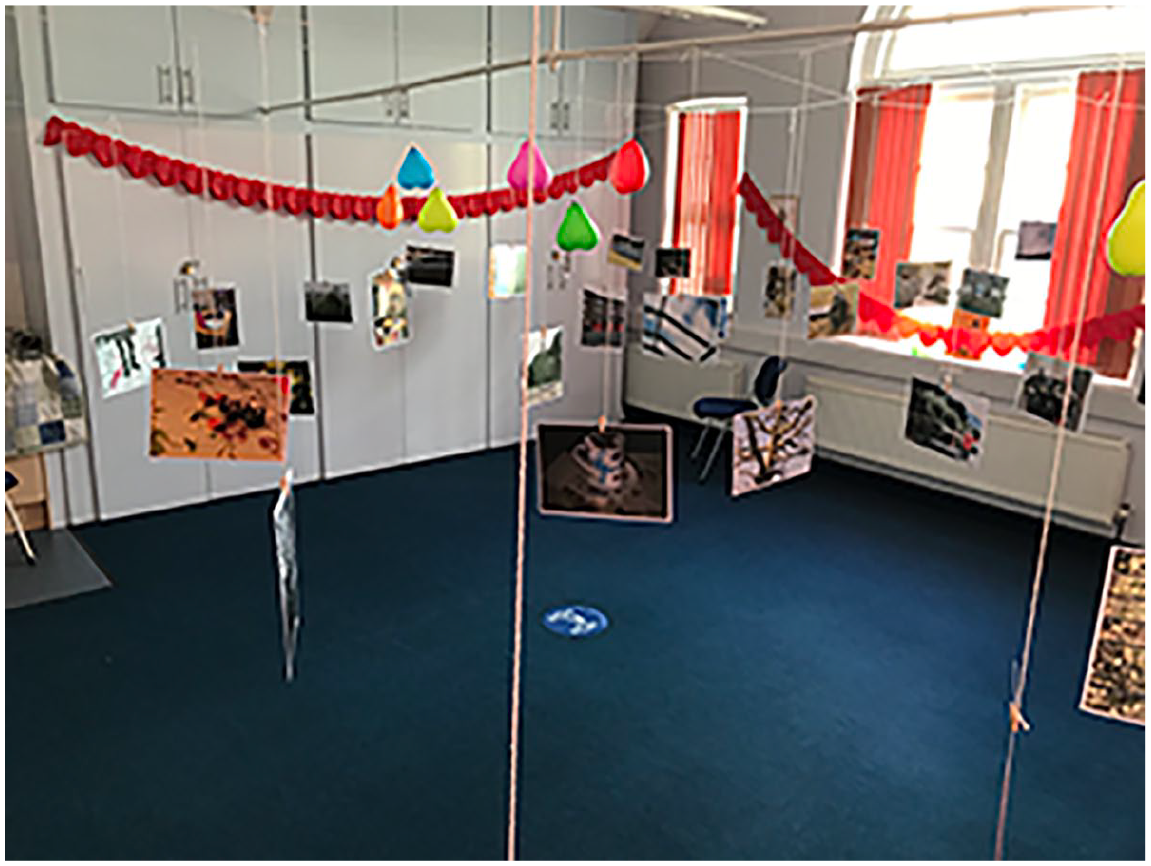
‘Floating Matters’.
On reflection, I note that the creation of the ‘Floating Matters’ exhibition was in line with Puwar and Sharma’s (2012) idea of curating sociology. I had collaborated with the children to curate an exhibition for them and the public. The exhibition was produced to show anyone and everyone their everyday lives and challenge the dominant narrative of the passive and unknowing child. Unlike Shelter’s exhibition, the ‘Floating Matters’ exhibition centred the children’s lives and was part of the research process and public engagement. However I did not come to this piece of work through my sociological sensibilities or vocation (Back & Puwar, 2012, p. 15), but through my love for the children in the research. I was guided by love as a praxis, a way of knowing and creative force that enabled me to go beyond damaged focused narratives (Tuck, 2009).
Researching with love allowed me to create knowledge with children to show their lives beyond the narrow confines of the professional adult’s gaze. Using multimodal methods including digital cameras and mobile phones, the children and their mothers demonstrated how they created a space to practise love. Whilst the literature on domestic abuse and children often centres around fear in the home, the children illustrated through their photographs and my visits that they valued and practised love. They were active in creating loving spaces, as well as being critical of care that was not loving. They created the homeplace as a site where love flourishes in the everyday despite the obstacles. They continued to challenge the tropes of the damaged and passive child. They showed me their homes, where love abides. When I reflect on my original political intention of focusing on the story of misrepresentation and misunderstanding of children’s need, I see how I nearly misrepresented them myself. It was my growing love for the children that guided and transformed my research and the creation of knowledge about their lives.
Conclusion
In this article I have reflected on my research journey from dead sociology to a live sociology and how undergirding the transformation has been my love for the children in the research. My sociological sensibilities were awoken by the love and with it my desire to be attentive to the humanness of the children in the research. It challenged me out of my practice of ‘dead sociology’ and into a live sociology where my preconceived ideas and technophobia were tested. It was uncomfortable and made me feel vulnerable, but within that a deep knowledge of the lives of children and their families was created that went beyond the narrow narrative of the damaged and passive child who had experienced domestic abuse.
Researching with love means being vulnerable, unknowing, and open to surprises. I would have been unable to research the fleshy humanness of the children if I too were not present in my own vulnerable fleshy human state. This meant that I was often left confused by the games, jokes, dances, actions and thoughts of the children, and often wondered if what I was doing was even research at all. However, this vulnerability and unknowing enabled me to be surprised by the children, to reassess what I thought I knew, to disrupt dominant narratives about the children being only passive and damaged. Katie demonstrated how the children often judged adults and professionals to see whether they were trustworthy. A key factor was whether the adult was prepared to come with an openness to create knowledge rather than with an immoveable preconceived idea. If research is to be live, then we really do need to embrace the challenges of vulnerability and be open to surprises – which means letting go of our position of power and authority.
Being vulnerable in research can break your heart. There were several times the children and their mothers’ stories made me weep and gave me sleepless nights. Researching with love meant that I did not close off that part of me or select methods that would protect me from this anxiety – I chose to be open to be affected by the children. Being attentive to the affect allowed what could not be expressed in words to be conveyed, creating an intimate knowledge of the children’s lives that went beyond the evaluation of services (important as they are). It was in the intimate and often hidden parts of the everyday that the punitive side of the systems and structures that were meant to protect them could be observed. Live sociology calls for us to be affected by our learning so that we can ‘uncover and to do something about unnecessary suffering’ (Gunaratnam, 2012, p. 120). It calls for us to go beyond the research ethics form and to show radical feminist care. Whilst I cannot claim that my research has changed social work or court practices, what it does offer is a critique of these practices using the knowledge created by the everyday lives of children and it challenges the colonialist and patriarchal narratives about the children.
Researching with love is important if we want to go beyond the enforced narrative that dehumanises people and renders them passive in their own lives. The unloving representation of my childhood home had left me bereft, hurt and angry. I felt someone had stolen my story. This (mis)representation is counter to the aims of live methods. Creative and innovative methods can be destructive tools if they are not used with love. Back and Puwar (2012) argue at the end of the live methods manifesto for ‘paying attention to the social world within a wider range of senses and placing critical evaluation and ethical judgement at the centre of research craft’ (p. 15). I argue that undergirding this aim must be a commitment to a praxis of love – a commitment to the growth of not only the researcher but the researched community too. It means meeting one another in our humanness. This, fundamentally, is why I think researching with love is important for live methods, because if we fail to see the humanness in one another, then our research will only dehumanise others and we find ourselves perpetrating what hooks (1987) would call a capitalist, white supremacist, and patriarchal system. For the first step of slavery and colonialism was always to dehumanise the other and show that they were incapable of love. As hooks writes:
Early on in our nation’s history, when white settlers colonized Africans through systems of indentured labor and slavery, they justified these acts of racial aggression by claiming that Black people were not fully human. In particular it was in relation to matters of the heart, of care and love, that the colonizers drew examples to prove that Black folk were dehumanized, that we lacked the range of emotions accepted as a norm civilized folk. (hooks, 2016c, p. xix)
Dehumanising anyone, including children, has severe consequences. It can act as the springboard for justifying violence against certain people because they are not deemed human. The dehumanisation of any child has the consequence of upholding the status quo, as I explore in my thesis (Herbert, 2023). This does not only apply to the UK but is a global issue. As I write there are an estimated 15,000 children that have been killed in Gaza, Palestine. In her work around children and childhood, Shalhoub-Kevorkian (2023) writes of how the narratives about Palestinian children have dehumanised them for so long that their imprisonment and killing have been justified and in parts seen as inevitable. Shalhoub-Kevorkian (2024) calls us to see the children not only as victims but to be attentive to the way they create life and fun, to recognise their humanity. Researching with love calls for us to meet our interlocutors in their fleshy humanness, lest we tell a tale that renders them as mere objects to be saved or a problem to be fixed, which further dehumanises them.
Lorde (2020, p. 32) writes that love is a transforming force so when, through love, we recognise people in their humanness we are at risk of becoming dangerous and ethical researchers. We are at risk of becoming disruptors, of challenging the social norms and status quo. I know in my own research that the findings have been met with some resistance in the social work arena. People wanted the children to stay in the narrow boxes that they had created for them, but my research had resisted this, not because of my wisdom, but because of researching with love. I had been driven by this creative energy, to not embolden tropes of childhood, but to work with children to create knowledge about their everyday lives.
Those in power will always call us to research without love – but we must resist if we are to practise and embody live methods. It is in researching with love that we can both shine a light on the injustices that occur in the darkness and in broad daylight. In my study, it was not only the extreme violence of domestic abuse that was noted but the everyday violence of systems, peoples and structures that colluded in further marginalising and oppressing the children and their mothers. It was researching with love that also guided me to be attentive to the ways the children and their mothers resisted, challenged and navigated these injustices. How they not only survived but thrived, creating fun, beauty and love in the everyday. It was researching with love that enabled me to be and become alongside the children, and to create knowledge that went beyond the lens of trauma and abuse. It enabled the children like Tdrommie to be known.
If we fail to research with love, we will dehumanise one another, and this would be contrary to the aims of live methods. Researching with love meant the children and I created knowledge together that showed their humanness, something that was missing in the social work research literature. They were able to create knowledge of the complexities of their lives. Lorde (2020, p. 32) writes that love is the fountain of deep knowledge and brings creativity, and I wonder how much are we missing when we research without love? To research with love, I needed to rethink my methods, and was drawn to live methods. Whilst my main driving force was love, through the practice of love in research I have humbly begun to appreciate live methods. Methods cannot become gods, but they are nonetheless how we express our love.
Footnotes
Acknowledgements
I would like to express my immense gratitude to the reviewers who were wise, patient and kind. Thank you to Dr Lisa Morriss for reading the paper several times. Thank you to my love, Antony Herbert, for all your practical and encouraging support while I tried to write.
Funding
The author received no financial support for the research, authorship, and/or publication of this article.