



Abstract
The Covid-19 pandemic made the liveness of the social world readily apparent. Everyday rhythms and routines were, for many, upended and new and uncertain ones were rapidly and repeatedly re-made. A plethora of intense and flattened feelings – from anxiety to depression to pleasure – were generated. This article considers our collaborative research project on everyday experiences of time during the early stages of the pandemic in the UK through a focus on liveness. The research included commissioning a Mass Observation (MO) directive; holding Feel Tanks with university and school students where participants wrote reflective diaries, had collective discussions and made artworks; and a co-produced artist response to the research. We build on ‘live methods’ work to explicate the significance of temporality, the present and affect to understandings of liveness and the pandemic. We make three specific contributions that focus on the methodological, conceptual and analytical dimensions of our research. First, we examine the methodological pivots involved in researching a live phenomenon as it was unfolding. Second, we develop a sociological understanding of liveness by discussing recent cultural theory on presents and affect. Third, we analyse the feelings of and about the present articulated by research participants, focusing on: stuckness and suspension; repetition, drifting and boredom; and jolts, jars and glitches. In conclusion, we argue that a sociological interest in liveness infuses many aspects of our research, and signals possibilities for attuning to the possibilities of the present for other kinds of social worlds.
If the social world is always ‘live’ – that is, as Back and Puwar (2012) suggest, takes place across ‘multiple registers’ and involves ‘the fleeting, the emotional, the sensory’ (p. 11) – the Covid-19 pandemic made this readily apparent. Everyday rhythms and routines were, for many, upended and new ones were re-made, often rapidly and repeatedly. Online and in-person and throughout popular culture, a plethora of feelings were expressed about this distinctive time, varying from worry, anxiety and depression to pleasure in learning new skills, hearing birdsong or establishing new local patterns, as well as less clear affective states including lethargy, boredom, exhaustion, stuckness and freneticness. The pandemic, then, as an extraordinary period, makes clear the value of scholarly attention to the contingent, messy, plural and affective qualities of the social – and the significance of temporality for them.
This article examines our collaborative research on everyday experiences of and feelings about time during the early stages of the Covid-19 pandemic in the UK through a focus on liveness. The project included commissioning a Mass Observation (MO) directive on Covid-19 and time; holding Feel Tanks with university and school students where participants wrote reflective diaries, had collective discussions and made artworks; and working with artists on a co-produced response to the research. 1 We explore and analyse liveness as a methodology, concept and analytical device which illuminates this research in three ways.
First, methodologically, we introduce our project and build on the contribution that live methods have made to sociological research by considering our experience of conducting research on and during the unfolding event of the pandemic, where we were both interested in the ‘liveness’ of the temporal experiences of research participants and as a research team were caught up in the twists and turns of changing restrictions, illnesses, caring and work responsibilities. We outline the ‘pivots’ the research took and frame these as necessary and important junctures to develop live methods that can grasp and participate in the liveness of the social world. We begin with this methodological point to root our discussion in work on live methods and provide context for the more conceptual and analytical discussion that follows.
Second, more conceptually, we develop the temporal aspects of liveness, arguing that in the case of our project, liveness corresponds to a present temporality. We argue that as ordinary temporal markers were removed or disrupted, the past seemed like a different age and the future was difficult to imagine or account for, and the present – in all its multiplicity, ambiguity and uncertainty – was heightened. Building on recent work on the present (e.g. Baraitser, 2017, 2021; Baraitser & Salisbury, 2020; Berlant, 2011; Coleman, 2020; Hu, 2022), we conceive these Covid times as intensely active and alive presents and argue that presents are always affective. We suggest that a focus on liveness foregrounds the present as a distinctive, if nebulous and elusive temporality.
Third, more analytically, we work across the different materials generated in our research to explore what we call ‘present feelings’, or the affectivity of the live present. We argue that such feelings help to compose and articulate a present that was particular to the pandemic – a ‘feeling present’. We therefore see ‘the present’ as designating both a temporal condition that is happening now and as pointing to a particular age or period; what Williams (1977) calls a ‘structure of feeling’.
Throughout, we emphasise the porousness of the feelings and presents that participants express, understanding affect and feeling as always messy, ambiguous and shifting and sometimes contradictory (Paasonen, 2022). We contribute to sociological understanding of the liveness of the social world by highlighting the significance and co-constitution of temporality, specifically presents, and affect to everyday life, and by demonstrating how liveness functions across multiple registers of the research process.
Researching the live Covid-19 pandemic
Back and Puwar (2012) argue that sociology must engage ‘a sense of liveliness to the present’ (p. 7). Sociology should be able to respond and relate to change as well as continuity and to the affects that permeate people’s experiences in profound and prosaic ways. This article builds on and expands the temporal and affective dimensions of the social signalled by Live Methods and by the idea of ‘liveness’ more generally. Time and temporality were core in the original formulation of live methods, for instance in proposals to ‘[d]evelop new tools for “real-time” and “live” investigation’, and to ‘take time, think carefully and slowly’ to gain understanding (Back & Puwar, 2012, pp. 7, 13; see also Back et al., 2013; Uprichard, 2012). Back and Puwar (2012) also call for sociology to ‘[d]evelop empirical devices and probes that produce affects and reactions that re-invent relations to the social and environmental’ (p. 9). We further draw out the importance of temporality and affect to an understanding of liveness.
The article examines research that is built around affect, liveness and temporality from the outset, developing methods, concepts and modes of analyses that coincide with social worlds ‘as they are happening’ (Lury & Wakeford, 2012). We aimed to do ‘live’ research on a ‘live’ social phenomenon. Our project deployed a multi-method qualitative approach to elicit feelings and reflections about time. It included analysis of an MO directive commissioned on Covid-19 and time in summer 2020. The directive asked MO volunteer writers to consider how time was made, experienced and imagined during the pandemic, and to respond to specific prompts including on everyday rhythms and routines, negotiations of time within households, use of analogue and digital media and waiting (https://massobs.org.uk/wp-content/uploads/2024/06/119-Summer-2020-Covid-19-and-Time-Black-Lives-Matter.pdf). Further, we conducted ‘Feel Tanks’ with young people exploring their feelings about time and Covid-19. Submissions to the directive were coded by Corine van Emmerik, the Research Assistant on the project, and Chloe Turner co-designed and facilitated the Feel Tanks. As the project developed, we incorporated a third aspect, which involved working with artists Paula Varjack and Chuck Blue Lowry on a response to the research (led by Emily Grabham).
Working with MO enabled us to both recruit participants to the project in an ethically sensitive manner at this volatile moment and contribute to its long-running and publicly accessible archive which ‘record[s] everyday life in Britain’. The directive was distributed prior to the development of vaccines in August 2020 to 758 people and we received 228 reflective diaries (30% success rate), consisting of a few lines to eight pages. Overall, our MO sample is dominated by writers who identify as women, have/had middle-class occupations, and are based in the south of England. 2 We do not seek to systematically analyse the experiences of different groups by socio-economic characteristics, instead seeing the data as internally heterogeneous, varied and inconsistent and offering a multiplicity of views (Highmore, 2010; see also Adkins, 2017; Casey et al., 2014; Hubble, 2006; Kramer, 2014; Savage, 2007).
Anticipating that the MO sample would include a large proportion of women and older people, and recognising how young people were affected by government education policies during the pandemic (Finn et al., 2022), we sought reflections on time, feelings and Covid-19 from them. We organised a series of ‘Feel Tanks’ with students at universities in southeast England, and, working with artist-teacher Clare Stanhope, with sixth-form students based in a girls’ secondary school in southeast London. Feel Tanks are a critical-creative method designed by Turner (2022) ‘to consider what it means to live under the complexity of capitalism in the current moment’ (p. 125). They take inspiration from Berlant’s (2012a, 2012b) work on the political investments of Feel Tank Chicago, known as the Public Feelings Project. Formed in 2001 as a collective of academics, artists and community organisers, the Project attends to textures of feelings to understand how the workings of oppression underpin power structures (Berlant, 2004; Carmody & Love, 2008; Cvetkovich, 2007, 2012a, 2012b). The Tank engaged in ‘taking the emotional temperature of the body politic’ (Berlant, 2012b) through performance art, criticism and reading groups. Turner (2020) frames Feel Tanks as an ‘urgent methodology’ as much as intellectual enquiry – an urgency amplified by the Covid-19 pandemic. In total the four Feel Tanks held with university students encompassed 15 participants in a series of mixed gender and racially diverse workshops. In the school Feel Tank, students were aged 16–18 with various gender, sexual, national, racial and ethnic identities.
Overall, we understand our project methods as ‘live’ because they invited participants to reflect on the event of the pandemic as it was happening and because of their engagement with temporality and affect. We see MO writing, in Highmore’s (2010) terms, as ‘an encouragement to produce thickly rendered accounts of the present’ (p. 128), including how this present is ‘in flux’, composed through a ‘mood, a rhythm, a feeling [that] provides a stage on which the ordinary events and happenings of the everyday unfold’ (p. 12). Feel Tanks emphasise the liveness of discussion as well as the feelings that emerge. The Feel Tank space becomes animated through discussion and gestures which foster shared understanding and collaboration between the participants and simultaneously create a ‘liveness’ and immediacy of presence.
While research often departs from its initial proposed design, doing research during the pandemic required the rapid adoption/adaption of different methods and exemplified the need to be responsive and reflexive. As Benson and O’Reilly (2022) put it when discussing their ‘live sociology project on an undeniably lively topic’ of Brexit in the lives of British citizens living in the EU-27, the project team were ‘required to keep our fingers on the pulse’ (p. 178). Their comment that they needed to ‘work [. . .] reflexively and collaboratively to make sense of a constantly shifting phenomenon’ (Benson & O’Reilly, 2022, p. 181) resonates with our own experiences of doing live research on and within live/ly conditions.
The research with MO seemed to proceed relatively smoothly, perhaps because the panel was already established (indeed grew during the pandemic) and writers could determine whether, where and when to respond to the directive. The Feel Tanks, however, did not progress as planned. Our initial design included holding eight in-person, discussion-based Feel Tanks. Faced with poor recruitment we needed to change our plans. We held two online Feel Tanks in July 2021, and a further two in autumn 2021, amalgamating undergraduates and postgraduates. Each lasted 60–90 minutes. We encountered difficulties organising Feel Tanks in secondary schools/colleges; teachers reported themselves and students being overwhelmed and there were changes in local and national restrictions as the pandemic continued. Rising Covid-19 cases meant that with a few days’ notice we needed to switch the in-person Feel Tanks we had secured to an online session as visitors were no longer permitted at the school. The very problems we were trying to research presented themselves as obstacles to how we were trying to do the research. Liveness in practice meant being flexible, responsive and willing to shift, and shift again, our approach.
Liveness in our research design included stretching specific methods to encompass new possibilities. In the Feel Tanks with university students, we invited participants to share written diaries or voice-notes and engage in whatever format felt most comfortable – voice, the chat function, physical movement, or using objects to share present feelings. In the Feel Tank at the secondary school, we swiftly put together a lesson plan in consultation with Stanhope, consisting of videoed introductions to the project and structured activities including reflective writing, art making and time for questions. At this point, we were also working with artists Varjack and Lowry, who were keen to build on their participatory approach to creating work. Varjack and Lowry led a second session, where students made videos for an artwork that explored the pandemic, time and feeling through memes (see https://vimeo.com/656596307). We had several team discussions about the methodological capacity of Feel Tanks to meet the changing conditions of the project and maintain their integrity; and interestingly how such uncertainty brought to the fore their adaptability and distinctiveness as both political project and methodological investigation of the present.
We provide these details here to explicate how our project necessitated us to respond to the liveliness of the social world, and in particular to be aware of what was required of us doing research in a changing, uncertain present. Our understanding of methodological liveness highlights the co-constitutive relationships between the social world we’re studying (and making [Law et al., 2011]), and the methods that we must adjust and deploy in order to engage and relate to this world; what Lury (2018) calls, ‘the activation of the present’. They also highlight the entrenched unequal access within academic space, such as the impact of border closures, travel restrictions and workload on colleagues who have uncertain access to visas or citizenship and insecure contracts. It was important that the project reflexively adapt to the individual burdens of our participants and our project team. Indeed, our live approach was guided by work from feminist, anti-racist and disability justice communities in the early part of the pandemic that emphasises socio-digital power relations rather than an utilitarian uptake of digital technologies (Hamraie, 2020; Thylstrup et al., 2020). This required us to make ‘sociological craft more artful and crafty’ (Back & Puwar, 2012, p. 9; see also Seregina & Van den Bossche, 2023): switching to digital methods, letting Feel Tank participants use discussions to voice uncomfortable and distressing experiences, reshaping what a Feel Tank might be, coding MO data according to the complicated and shifting themes writers raised, working collaboratively with MO and an MO writer (van Emmerik, 2023), checking in on each other and allowing the research to morph and slip.
Temporality, presents, affect
The importance of time and temporality to liveness is relevant not only to our methods but more broadly to everyday sociality. Adam’s (1995) work has been central in ‘mak[ing] explicit what constitutes a largely unreflected aspect of contemporary social science: time embedded in social interactions, structures, practices and knowledge, in artefacts, in the mindful body, and in the environment’ (p. 6; see also Adam, 1994). Sociological debates about speed and acceleration highlight the contradictions and variations in individual and social experiences of time and rhythm (Sharma, 2014; Snyder, 2016; Wajcman, 2015; Wajcman & Dodd, 2017). In recent years, a reinvigorated interest in time and temporality has begun to map out what Bastian et al. (2020) term ‘the social life of time’, which highlights how time is central to the constitution, arrangement and experience of social worlds and directs attention to the significance of temporal relations for everyday life as well as to the role of time in re/shaping inequalities and differences.
We argue that our live methods help us to attune to how temporalities permeate and compose social worlds, and that this was especially important in the pandemic. First, we see our live methods as emphasising everyday cultural practices and experiences. We draw on cultural theories of temporality, which we suggest open up sociological understanding of how time and temporality are embedded in and constituted through the social in illuminating ways. Second, we begin with the diversity of and resonances between everyday experiences as they are articulated in the MO directive and Feel Tanks. We therefore focus on temporality, which, as Sharma (2014) defines, is ‘lived time’ rather than ‘a transcendent sense of time or the time of history’ (p. 9). Third, we concentrate on the present temporality, seeing this as a distinctive feature of experiences of the pandemic for our participants, and in popular descriptors of Covid-19 as ‘blursday’ and ‘the great pause’. What our research highlights is the non-unitary and at times contradictory character of this present. As Berlant (2011) notes, its ‘very parameters (“when did the present begin?”) are also always there for debate’ (p. 4).
Berlant’s (2008, 2011, 2014) work emphasises how the present emerges as a dominant socio-cultural temporality at a historical moment where postwar, neoliberal promises of ‘the good life’ are fraying and attachments to the future are brought into question. Their concept of ‘cruel optimism’ captures the attachments to fantasies of the good life that people cultivate and maintain even when such fantasies are increasingly unachievable and when such attachments are ‘obstacles to their flourishing’ (2011, p. 1). This concept is inherently temporal; in highlighting the forms of attachments to fantasies of a better life in the future, it captures the role of futurity in everyday life and how people ‘keep on keeping on’ in the present through such attachments (see Anderson, 2022). For Berlant, fantasies of the future good life forged during the postwar period in the United States and Europe are unsustainable as upwards social mobility and equality are disturbed and overturned through insecurity, precarity and uncertainty across economic, political, social, cultural and geographical spheres, and when crisis shifts from an exceptional to ordinary experience. Cruel optimism then becomes a means to track who is most tightly bound up in attachments to the good life, with those at ‘the economic bottom’s thick space of contingency’ (Berlant, 2011, p. 167) especially feeling the lure of a better future (Coleman, 2012). It is a way to consider the imbrications of power, politics, everyday life and temporality.
Crucially, Berlant rethinks temporal relations. Their concept of the impasse places emphasis on the present as ‘a stretch of time that is being sensed and shaped’ as ‘actors do things’ in ‘a live situation’ (Berlant, 2011, p. 199). It accounts for the ‘the duration of the present’ and how precarity is encountered, felt, lived and adapted to, where norms are interrupted and new genres for making sense of the everyday are composed (Berlant, 2011, p. 199). Berlant writes:
An impasse is a holding station that doesn’t hold securely but opens out into anxiety, that dogpaddling around a space whose contours remain obscure. An impasse is decompositional – in the unbound temporality of a stretch of time, it marks a delay that demands activity. The activity can produce impacts and events, but one does not know where they are leading. (Berlant, 2011, p. 199)
Taking up Berlant’s conceptualisations of the present, in this article we consider what happens when the swirling uncertainty of the Covid present means that people feel that the impasse is all-encompassing. Furthermore, Berlant (2011) argues that ‘the present is perceived, first of all, affectively: the present is what makes itself present to us before it becomes anything else, such as an orchestrated collective event or an epoch on which we can look back’ (p. 4). The present, then, as a temporal experience, is necessarily affective (see also Williams, 1977). While they do not reflect on liveness explicitly, Berlant’s conceptualisation of the affective present is productive for expanding understandings of social worlds as temporal and affective that are inherent in work on live methods. It is also productive in beginning with the affective present and tracking the ways in which this specific affective present ‘helps exemplify shared historical time’ (Berlant, 2011, p. 15). We propose the linked terms ‘present feelings’ and ‘feeling present’ to help us move from participants’ feelings in and about the pandemic to how these feelings, in Williams’ (1977) terms, give the ‘sense of a generation or of a period’ (p. 131); a collective, but not undifferentiated or static, experience of the pandemic.
We also build on further conceptualisations of presents and liveness to understand the strange character of the Covid-19 present articulated by research participants, including how temporalities distinctive to those living with precarity in different forms come to be more prevalent. What became apparent to us in analysing the MO and Feel Tank (FT) materials were the many similarities in reflections, despite the differences of sample and methods. Our findings suggest, then, that MO and FT participants had some similar experiences of the pandemic and that there was internal variation in both groups which does not appear to be fully determined by socio-economic status. Here, the precarious present that Berlant describes as characterising the impasse is felt more broadly than by those at ‘the economic bottom’, including those who have had security in the form of the wealth and/or cultural capital of whiteness and being middle class. We are not arguing that ‘we are all in this together’. The Covid-19 pandemic did not level, diminish or make redundant power relations and inequalities (Grugel et al., 2023; Lander et al., 2023; Twambly et al., 2022), and we recognise that our samples did not include many participants who were working on the ‘front line’. Rather, we are suggesting that the participants in our specific MO and FT samples expressed their temporal experiences of and feelings about the early phase of the pandemic in the UK in varied but nevertheless similar ways.
Other work on time and the pandemic has noted that the disruption to regular temporal markers had widespread affects/effects. For example, crip time – where ‘[d]isability and illness have the power to extract us from linear, progressive time with its normative life stages and cast us into a wormhole of backward and forward acceleration, jerky stops and starts, tedious intervals and abrupt endings’ (Samuels, 2017, n.p.) – becomes a widespread possibility for those who had not previously considered themselves disabled or ill. As Samuels and Freeman (2021) argue of the Covid-19 pandemic, ‘[i]n this new and evolving situation, crip temporality feels even more urgent than before. And more than ever before, it can be said that all of us are now living in crip time (see Shew, 2020)’ (Samuels & Freeman, 2021, p. 246). In their work on waiting in and for healthcare, Baraitser and Salisbury (2020) examine the UK government’s Covid-19 healthcare ‘strategy of “containment, delay and mitigation”’ and argue that while it ‘suggests a linear temporality that seems to echo something like the progression of a disease, the experience of living with and through these phases has suggested a much less straightforward set of temporal experiences’ (n.p.), including the need to dwell in a present that, while not detached from the past and future, is nevertheless intensified and ‘thickened’. Temporality is experienced as that which does not flow but somehow ‘pools’ (Baraitser, 2017) or is on ‘standby’ (Baraitser, 2021).
The non-linear present is affective in its intensity and thickness; it is live in the sense that it is a scrambled and/or stretched immediacy and in its kinaesthetic vitality. As Berlant notes of its parameters, as affective, the present is always there for debate because of its non-coherence and ambiguity. Indeed, in a discussion of Covid-19 and affect, Paasonen (2022) highlights boredom as a collective pandemic affect of ‘stalled time and fixed place’ that ‘focuses attention on a blandness of experience where intensities of feeling come across as lacking even as these are keenly desired (Anderson, 2021, p. 198)’ (Paasonen, 2022, p. 140). Importantly, the ‘blandness of experience’ is ambiguous: ‘not the one or the other, this or that, but both and’ (Paasonen, 2022, p. 153). Similarly, although in an exploration of digital culture rather than the pandemic, Hu (2022) focuses on the affect of lethargy as a means of thinking through the simultaneous dullness and activity of liveness, arguing that lethargy ‘isn’t just absence – just the opposite in fact: it’s both feeling overwhelmed and being overwhelmed with the problem of feeling’ (p. 11). The affect of lethargy is, for Hu (2022), a distinctly temporal experience, a kind of embodied endurance in a present that is ‘live’ in its immediacy and ongoingness (p. 27). Lethargy is, for Hu, a collective affect of digital capitalism, but one that is most keenly felt by precarious workers, including racialised workers in Asia and the Global South.
In discussing some of the recent literature in sociology and beyond on temporality, the present and affect, our aim is to demonstrate the need to consider the temporal present as inherently affective. We have also highlighted the ambiguity of the affective present; it is necessary to understand the present as porous and mutable, both in terms of the boundaries of where it might begin and end, and also in terms of the differentiated array and oscillation of the affects, feelings and emotions that are generated by and compose it. As Berlant (2011) argues in relation to the impasse, ‘not all stretches of life and time in the present are suspended in the same way’ (p. 199). In the rest of the article, we therefore develop what Paasonen (2022) calls an analytical approach ‘open to and respectful of ambiguity’ and which is ‘by necessity messy’ (p. 153; see also Law, 2004; Paasonen, 2021).
Present feelings, feeling presents: MO writers and Feel Tank participants’ articulations of liveness
Participant-generated textual and visual material expressed feelings about the live present – ‘present feelings’ – in diverse ways. We discuss this material through several constellations of feelings that allow us to trace the affective tone of different experiences of liveness, and how these feelings composed and captured different presents – or ‘feeling presents’ – during the pandemic. This analysis demonstrates the co-constitution of temporality, and specifically presents, and affect to everyday life. We separate our analysis into three sections: (1) stuckness and suspension; (2) repetition, drifting and boredom; and (3) jolts, jars and glitches. While we distinguish these three feeling constellations for analytical purposes, we recognise that all of the feelings we discuss are in flux and have a ‘slippery’ quality. They emerge from one mood and quickly shift into something different, revealing their porousness, ambiguity and contradictions.
Stuckness and suspension
References to time ‘on hold’ or ‘suspended’ pervade participants’ expressions of the affective present. K7066 (Female, 49, In a Relationship, London, Librarian) writes in her MO response that ‘Life does seem to be “on hold”, and quite stuck’, continuing:
It is harder as the pandemic goes on to feel that an end is in sight. [. . .] Overall, however, the time has been one of some sadness. People I know have lost their jobs, others are working in at-risk industries, and nobody really knows when or if these situations will improve.
Here, the present is heavy, ‘thickened’ by its overwhelming presence, from which it is hard to emerge (Baraitser & Salisbury, 2020). ‘So much of life is trapped within a small space physically, mentally and emotionally’, she writes, noting the intertwining of the sense of present stuckness across physical, psychological and affective dimensions. Similarly, for W6994 (Female, 60, Single, Wiltshire, Carer), ‘It felt as if everything was stuck, nothing moving forward, an endless present of days to be filled.’
Amongst the FT participants, there were also multiple reflections on the lack of temporal markers across the day or the week and expressions of the interconnected feelings of stuckness and uncertainty. This uncertainty has a reach to both past and future which were cut off from the present in ‘the worst’ period:
I felt stuck only within that period where I didn’t work [. . .] and I think that was the worst, because when you’re outside, and you’re working, you are with people, you feel useful, you feel alive, because it reminds you of life pre-pandemic. (FT3, Female, no further information)
She is clear about what makes for a good life – activity, connection, fresh air, and, in particular, vitality in the ‘you feel alive’ – which conversely draws attention to the deadening qualities of the impasse of the pandemic present.
If numerous writers talked about stuckness in a literal sense, interestingly there were also references to the impossibility of ‘getting stuck into things’. The qualities of the present – uncertain, ambivalent, anxious – made it hard to move into a prospective activity, whether work or leisure, which further extended the present: ‘not being able to just get stuck into the work made the day so, so long’ (V3773, Female, 58, Co-habiting, Solihull, NHS Worker). The present here is all-encompassing. It diminishes capacity and limits action. FT5 (Male, White, PhD Student) is clear about how this feels: ‘I don’t like feeling stuck, and I don’t want the world to happen to me. I want to live through it, not just have it happen to me.’ Some participants expressed anxiety at this present: FT8 (Female, White, Master’s Student) notes of a trip with a friend, ‘I just couldn’t engage with it, I let her plan the whole thing and we went and I’m glad for it, but I was really, really anxious over leaving my cats alone and just like doing anything.’ For FT9 (Female, Person of Colour, Master’s Student), what generated anxiety was the lack of vitality and felt impossibility of living in a stagnating present:
It was like living in a bubble, because you couldn’t plan something for tomorrow, for the next week, because any minute everything could change, or you can’t go out or something like that. [. . .] So it was this bubble of time that I didn’t feel I really was living, so it was a lot.
This sense of ‘not really living’ was widespread amongst the participants. For FT6 (Female, White, PhD Student), it was possible to partially accommodate life being ‘suspended’ as she ‘just got used to it’ even though ‘we didn’t really know what was going to happen’. She tried to continue with plans and commitments where possible. However, having gone to visit her parents in Romania, new restrictions impeded her return:
As soon as I got there they cancelled my flight back, I was stuck home for a whole month. I hated it, the uncertainty of not knowing when I can come back and honestly the days just dragging on forever.
As another Feel Tank participant remarked, the uncertainty means that ‘it’s actually like living in a twilight zone’ (FT4, Female, Black, Mature Student). For some research participants, this suspension was ‘never ending’, making time appear to move slowly, marked only by the hyper-functioning repetition of state power: ‘I was just stuck in this forever, watching Boris [Johnson, Prime Minister in the UK at the time], just make announcement after announcement and backtracking’ (FT2, Female, Person of Colour, Undergraduate Student).
Many MO writers comment on the suspension of specific activities and the usual rhythms of life, but for some, this amounts to a shift in the quality of the present. For G7105 (Female, 50, Tunbridge Wells, Divorced, Invoice Clerk), time ‘behaved very strangely on Lockdown’. She likens it to ‘being in suspended animation, with everyone’s lives on hold’. S6835ab (Male, 78, Widower, Derbyshire, Retired Town Planner) writes:
Sometimes it seems much longer than the five or so months since the lockdown began. And the weeks before that, when it gradually dawned on the world that a cloud was on the horizon, are very hazy. It is almost as if time has been suspended.
In short, participants express ‘being stuck in’ the present without the capacity to ‘get stuck into’ it, creating a thickened, heavier sense of time; and being suspended from the rhythm and speed of everyday life which deadens the present by diluting it. We begin to see how feelings about the present – ‘present feelings’ – become a shared sense of the pandemic – ‘feeling present’.
Repetition, drifting and boredom
While the sense of stuckness and suspension indicates an uncertain ongoingness, other experiences suggest the temporal present may be more differentiated. One of the younger Feel Tank participants captures these connections:
1st wave: Staying home every day. Everyday felt repetitive. [. . .] 2nd wave: Schools closed but online live lessons. Boring but better because we were used to it. [. . .] 3rd wave: Schools open but Covid restrictions on outdoor activities. Boring and nothing felt new. Time went fast and slow at the same time. (Female, 16, Black British African)
This brief account suggests there is some movement and change although the strictures of the continuing pandemic present continue to dominate. A sense of sameness and repetition are also communicated in drawings from the Feel Tank (see Figure 1). ‘Different day, same thing’ (by a Black British man) and what we have entitled ‘2020 in the round’ (by a Black Caribbean and white woman) take different units of clock and calendar time – the hour, day and month – and render the experience of repetition as one in which the same present is relived again and again. The pictures recognise time as non-linear but emphasise the lack of variation across the cycles of the day or month, notwithstanding the subtle recognition of the ‘not quite identical’ experience of the hours which overlap but are not wholly overlaid on one another, or the months, some of which appear longer or shorter, smoother or more discordant. In the repetitive present, time cannot be processual, and rhythms cannot be configured (Lyon & Coleman, 2023). Everyday life is quite literally an experience of going round in circles.
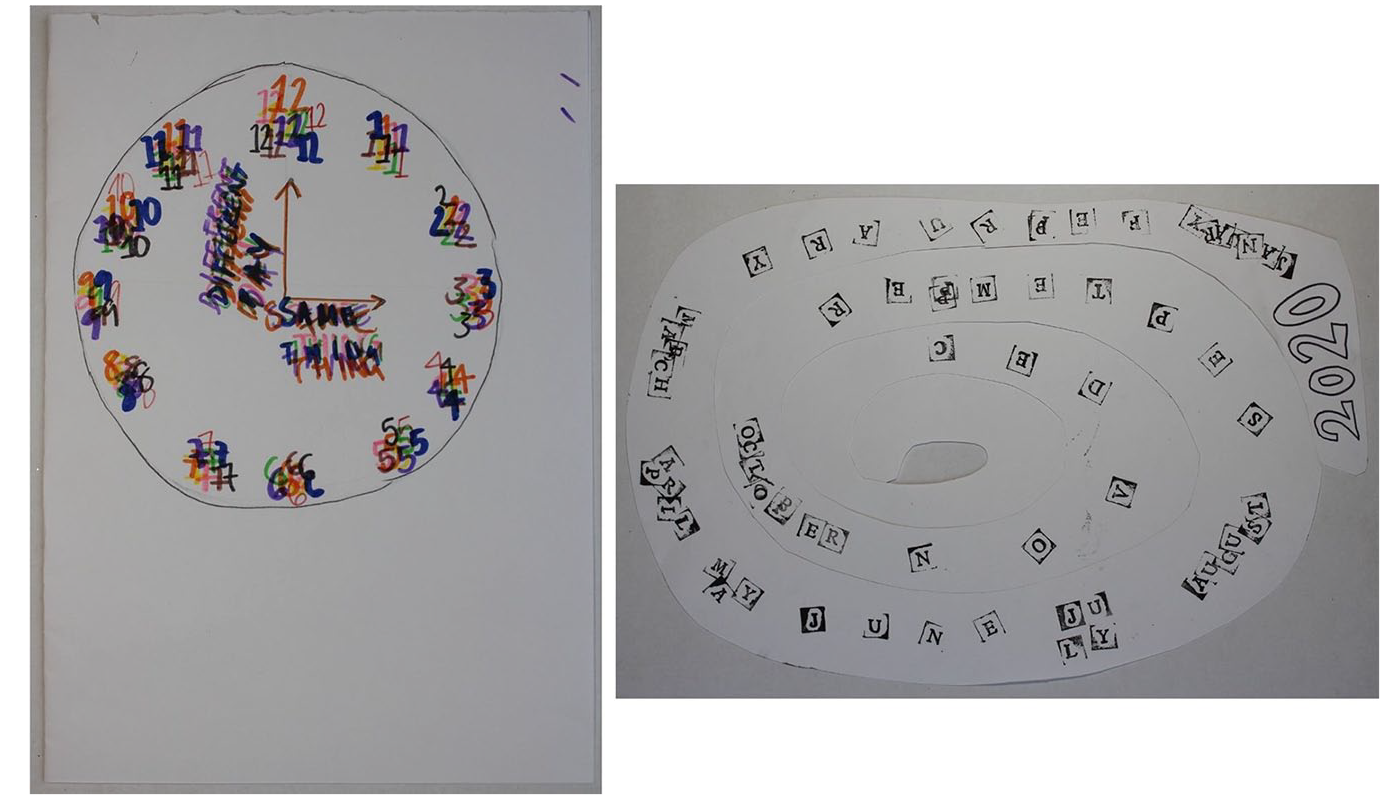
Different day, same thing and 2020 in the round.
While repetition here suggests the present as closed loops, other participants point to a more itinerant sense of time. Amongst the MO writers, B3227a (Female, Married, no additional information) recounts listening to the writer Olga Mecking on a popular radio show (Jeremy Vine, BBC Radio 2, 21.10.22) ‘talking about the Dutch concept of niksen, which literally means, to do nothing’. B3227a likens it to,
. . . the old song ‘Busy Doing Nothing’ [. . .] as if the person’s mood or levels of stress, is gently, almost accidentally arrived at – drifted into – rather than system-directed. [. . .] All but one [of the show’s listeners] were happy to engage with the concept and gave examples of how it already featured – by another name: one woman called it ‘blobbing’ – in their lives.
We see this sense of ‘drifting’ as a new configuration of Nowotny’s (1994) ‘extended present’ or what Berlant (2011) describes as time being ‘stretched out’ as people ‘dogpaddle around’.
B3227a later describes how, for her, ‘blobbing’ creates a ‘more authentic’ life. However, others point to the overwhelming intensity or busyness of the pandemic present that often includes heightened domestic activity/labour, and a loss of ‘bearings’ – ‘or rather whatever it is that allows us to get our bearings’, as M3190ab (Male, no further information) puts it. He likens it to how, in the absence of gravity, people find ‘they’ve floated away from any surface that they can hold on to or push off from, and can only drift about helplessly in mid-air until someone else comes along and pulls them back to the side’. This helplessness leaves him feeling that ‘nowadays I’m doing whatever I do in a void, with very few clear connections to what’s happening elsewhere’, in the ‘larger web’ of work and other activity ‘in the country and the wider world’. He describes himself as confused ‘underneath’ an unchanged outward appearance. M6749a (Female, 64, Married, Oxford, Retired Administrator) explains she ‘had a few days and weeks of feeling shifty, when I felt as if I didn’t know what to do or how to be’ as she grapples with ‘the awkwardness of time passing in unfamiliar ways or with uncomfortable feelings’ and the comfort that literature and a podcast offered her.
The repetitive and drifting qualities of the present are also expressed by participants in terms of boredom. In the artwork on the left-hand side created by participants in the school Feel Tank (Figure 2), being bored appears as one feeling alongside others – depression, pain, laughter – capturing the shifting mood of the pandemic present. A rudimentary clock suggests different intensities of feeling at odd times across the day, although the viewer is left uncertain, perhaps deliberately, as to whether there is any correspondence between an emotional expression and a specific hour. On the right-hand side, an interweaving of shapes and words (by a young woman describing herself as feminine, white South African, queer, 18), powerfully captures the contradictions of the present – time as frozen and fast, getting older and being stuck at a pre-pandemic age – and how this makes her confront her sense of self. Boredom appears in a large space in the centre of the page which is literally described as ‘filling up with boredom’, something that the author later remarks she is very familiar with. Paradoxically, boredom does not dominate. There is space on the page for contradiction and uncertainty and also for hope and new possibility. Boredom is intertwined with discovery and re-enchantment. Here, we see boredom both as an ‘absence’ of stimulation, associated with disenchantment (Mosurinjohn & Matorina, 2020), and as a state of potential or ‘suspended anticipation’ (Johnson, 2016, p. 1405). Paasonen (2022) and Anderson (2021) discuss how boredom is often equated with blandness. Instead, a focus on the ‘shifting intensities and qualities of experience – as in the cycles of “bored, not bored, bored, not bored, bored”’ (Paasonen, 2022, p. 151) or on the rhythms of boredom (Nash & Lyon, 2023) helpfully unsettles a totalising sense of boredom as an empty affective state.
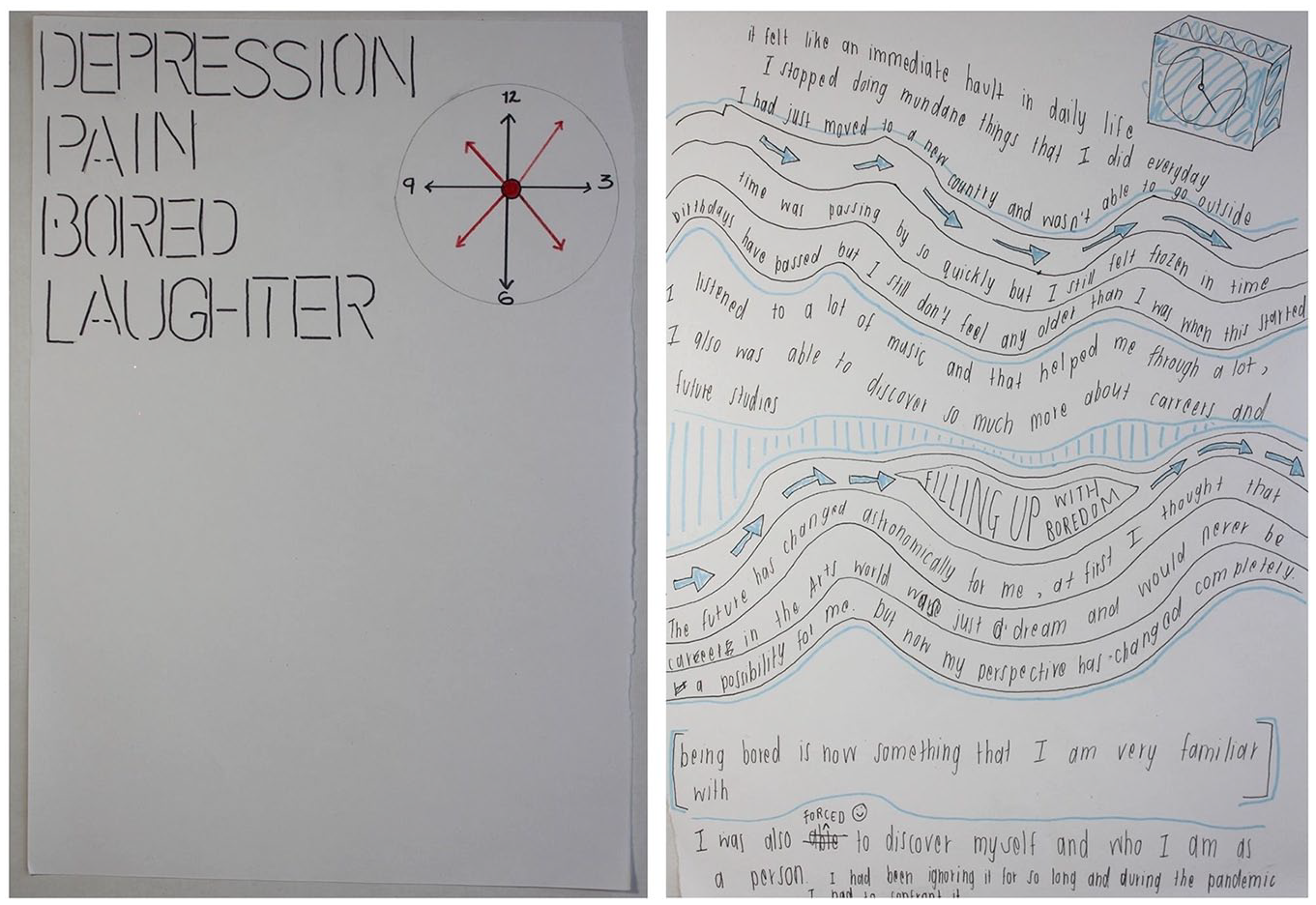
A clock of feelings and Filling up with boredom.
MO writers make different kinds of references to boredom: for instance describing themselves as bored with their local environment when compelled to do repetitive dog walks close to home, or caught in the mood of another’s boredom, especially a child they care for. Some for whom lockdown was ‘easy’, living in spacious and comfortable environments, nevertheless remarked that it was boring (e.g. P6988) or left them ‘with too much time on my hands’ (H7410a). If for many there is hope that things will change and deliberate efforts to make something of the uncertain present by ‘setting myself chores to do’ (H7512a), there were those who ‘lost enthusiasm for everything, including the things I normally enjoyed doing, let alone the idea of taking on a new challenge or hobby’ (D6958a). Here, lethargy is ‘a pessimistic dwelling in the now’ for those ‘that exist in a world of “dead time” or have lost faith in the very idea of futurity’ (Hu, 2022, p. 27). Feelings multiply and coexist, indicating that ‘feeling present’ is not a unified experience even while there may be a shared experience of time being somehow circular or wandering.
Jolts, jars and glitches
While experiences of pandemic presents as stuckness, repetition and drifting draw attention to a blurry or imprecise temporality, other present feelings expressed by participants highlight the unexpected jolting between excessive feelings of acceleration, halting and suspension. One Feel Tank participant expressed this though the word ‘jarring’:
Yeah it’s all so jarring [. . .] I think with time it was accelerated but also stagnant, which in itself is also like an emotional thing, you have to sit with that and be like ‘that’s okay’. It can feel deeply uncomfortable and being uncomfortable is okay, but we’re not used to sitting with it. (FT4)
Another discussed the jarring of life during and after lockdown as it registered at a sensory level:
I’ve been struggling with how loud everything is because during the lockdowns and pandemic I was basically just in my home in Portland, Oregon. And now my ears are super sensitive to just like being on the tube, being in crowds, around the street and the sirens. (FT14)
‘Jarring’ here can be read as the mechanical, jerky and uncomfortable feeling of shuttling between states of acceleration and stagnation. It is an ‘emotional’ and ‘sensitive’ experience that is both unexpected and needs to be ‘sat with’, or endured; a persistent uncertainty. Jarring recalls the description of crip time as one where abrupt and jerky wormholes rather than linearity characterise temporal experience. One of the drawings submitted in the school Feel Tank is an image of a series of vertical straight purple lines with one unruly red spiral of colour disrupting the pattern (Figure 3, left). In breaking from continuity, the wiggly line visualises both the surprising and sometimes bewildering rifts in rhythm caused by Covid and the elastic snap back into a ‘new normal’.
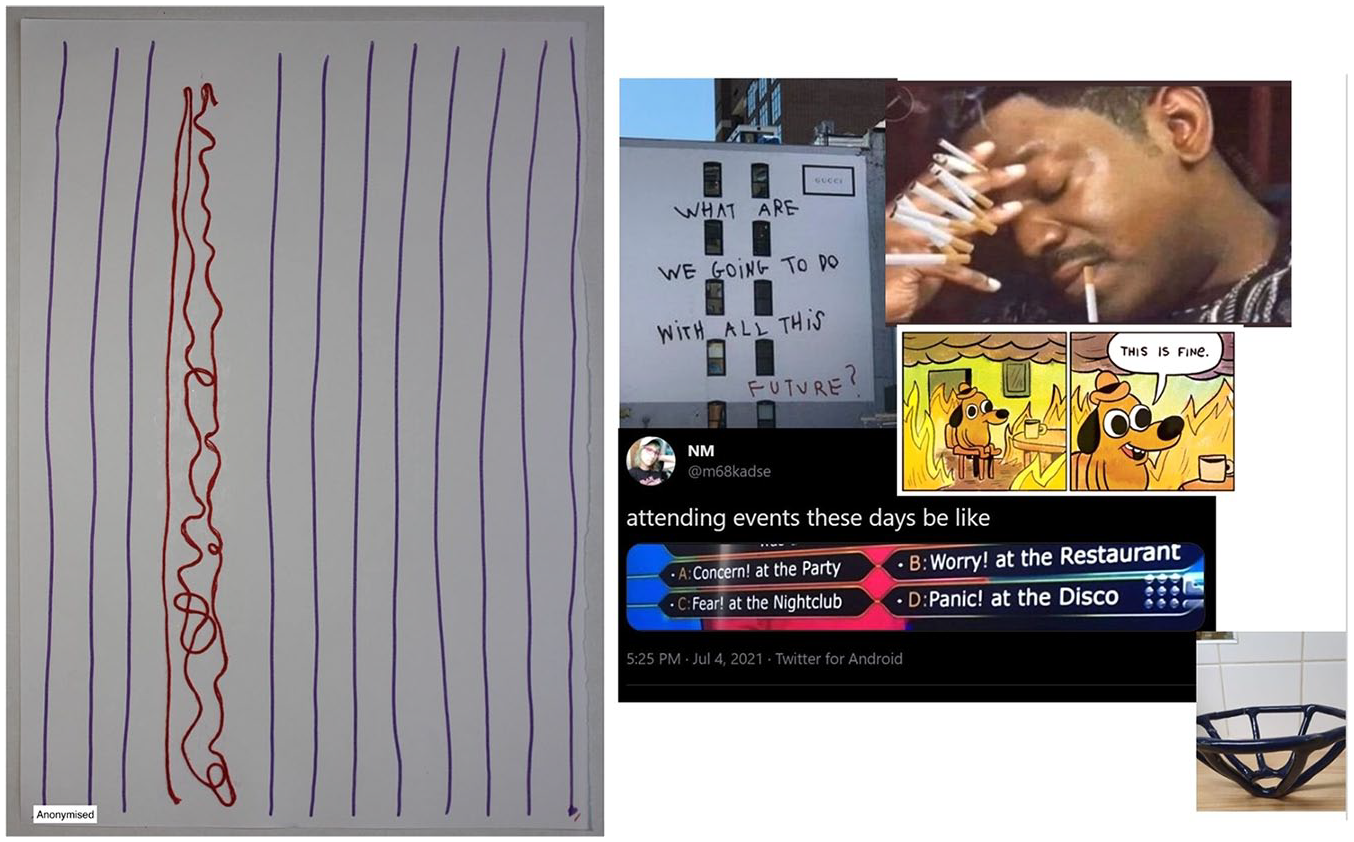
Unruly time.
One Feel Tank participant signalled this discordance in their diary entry, which consisted of three A4 sheets of overlapping memes (Figure 3, right) showing a jarring between a trash-fire present and expansive future. The present and future are tested (the present burns and the future is questioned) at the same time as they remain temporal conditions that are in relation (‘this is fine’; there is a future to question). In their assemblage on the page, the memes express these jarring temporal experiences as held together and in tension (see Turner & Coleman, 2023).
Such temporal jolts were further explored in relation to memes in the video created by Varjack and Lowry through the participatory workshop held in autumn 2021. The video begins by inviting the audience to scroll on a new TikTok style app called The Time. It includes popular pandemic memes (‘how it started; how it’s going’) and ones the professional and student artists created. For example, students reflect on their pandemic temporal experiences, saying time was ‘discombobulated’ (Figure 4) and ‘messy and unorganised’, while Lowry and Varjack provide disjunctions between their pre-pandemic selves (‘remember going out?’) with their experiences during the pandemic (‘when all the work dried up’, ‘wear a mask!’). Towards the end of the video, the artists all reflect on ‘the future’. Noting that the future ‘is . . . soon?!?!?!’, they express disbelief that 2022 was two months away (‘What is even going on at this point?’) and ends with a student’s voice, over replays of popular memes, saying that time ‘is a constant movement, and it all goes so quick’. Temporal plurality and tension are again highlighted; time moves and is gone in a flash; it drags and yet the future is almost here. The content of the memes and the fast cuts between different frames offer forms to render the liveness of the pandemic and its affective qualities.
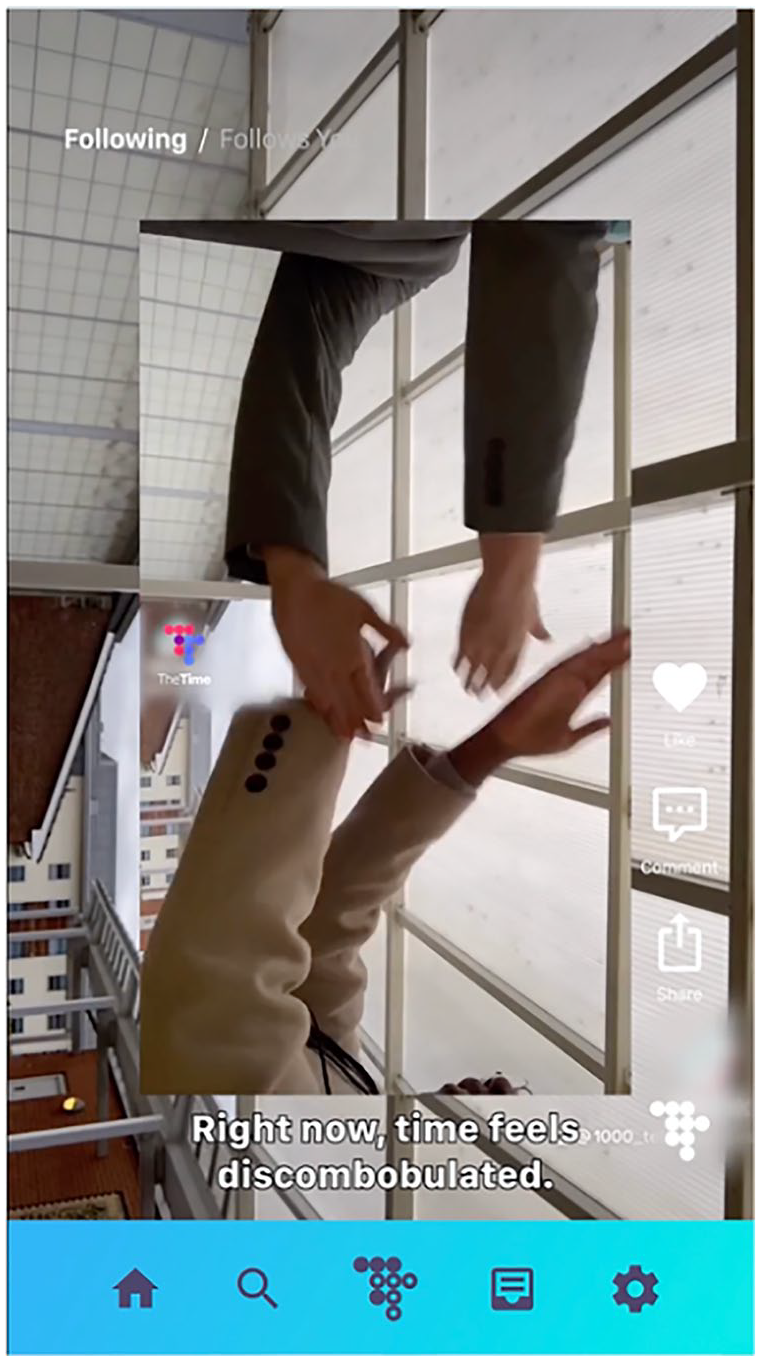
Discombobulated time.
Multiple participants invoked the future as an uncharted and speculative space that is difficult to imagine from lockdown restrictions. One Feel Tank participant noted, ‘the future was like an illusion and you couldn’t plan anymore, so I was really anxious about like, what if tomorrow something happens bigger than Covid’ (FT9). In particular, some participants expressed this in terms of the difficulty of ‘returning to normal’, that was much touted by politicians and other cultural commentators at the time:
I found it really difficult, actually I got a bit anxious, where there was talk of easing lockdown [. . .] and now I’m struggling to get back to this, because it isn’t back to normal. We’re trying to fit Covid world into the old world, and it doesn’t quite fit. (FT6) I don’t see this as a return to anything because I don’t recognise it anymore, even at my institution like it’s changed so much I don’t recognise it anymore. I haven’t returned to anything, it’s a different world, its people trying to pretend that things are the same they’re not. (FT5) I was confused about what I was allowed to do what not, still am. Feels between one thing and another and not clear. I’m not waiting for normal but do have a waiting for some ‘new’ normal, but not sure what that is. (A5854ab, Female, 75, Married, Somerset Artist)
We understand such jolts in terms of glitches in the temporal fabric of everyday life. Theories from digital media and feminist media scholars see glitches as exposing ‘the myth of linear progress’ (Menkman, 2011, p. 343; see also Cubitt, 1991; Paasonen, 2015). In troubling how linear progress is assumed to be smooth and straightforward, attending to glitches focuses attention on how errors, jolts, flaws and accidents are a ubiquitous and necessary, unexpected and unsurprising part of how systems function and are experienced. Glitches point both to interruptions in linear progress and how linear temporality exists alongside and in tension with non-linear jolting, jarring and discontinuity. The Covid present as glitch is where plural and incongruent temporalities exist and are experienced at the same time. This glitchiness is non-linear in that it is an affective and temporal impasse – a suspension of ‘the old world’ – and because it is not possible to ‘return to anything’ that once resembled normal life. This affective present is disorienting and discombobulating, as we have reflected on, and it may also be a space for pleasure, contentment and joy:
I would say I have never felt bored during this time and have occasionally felt contentment at the lack of pressure to go out and do things, the lack of a need to be in a certain place at a certain time and to fit in around other people’s plans (though this would/does crop up around video calls and making yourself available). (P7201a) I felt relaxed being at home and laying in my bed everyday. I also felt safe since I was in my house the whole time and away from problems. (FT participant, Secondary School) It was almost a beautiful experience. Being locked away from the ruthlessness of society and school kids. I was in the comfort of my family. I was beautiful and almost fun. I felt more free. [. . .] And I kind of miss it. (FT participant, Secondary School)
In these examples, the present as glitch illuminates other possibilities, other futures. In examining their disruption of linear time, Legacy Russell (2012) proposes a ‘glitch feminism’ that ‘embraces the causality of “error”, and turns the gloomy implication of glitch on its ear by acknowledging that an error in a social system that has already been disturbed by economic, racial, social, sexual and cultural stratification – may not, in fact, be an error at all, but rather a much needed erratum’ (n.p.).
Conclusions
Taking liveness seriously has involved examining its relevance across the methodological, conceptual and analytical aspects of our research. Beginning with the aim of relating to and understanding a live phenomenon as it is happening, we have discussed our research process and the adaptations it required as we attempted to coincide with the ‘newly co-ordinated reality’ (Adkins & Lury, 2009, p. 18) of the pandemic. Rooting our discussion in this way helps us to explore how our methodology and methods are central to the concepts and analysis we found productive and illuminating to make sense of, without resolving, the messy, ambiguous and open-ended ‘feeling present’ of the pandemic. Working with the important if latent aspects of temporality, presents and affect of methodological liveness shaped our conceptual and analytical understanding of participants’ articulations of Covid and time. That is, we argue that a sociological interest in liveness cannot, and should not, remain in the domain of methods but necessarily seeps into and informs wider questions of how research is theorised and analysed.
In our case, a focus on liveness alerted us to how the overbearingness of the uncertainties of the present became a central experience for those who had benefitted from the postwar ‘good life’ that Berlant tracks as diminishing and the many resonances between the ‘present feelings’ articulated by MO writers and Feel Tank participants. What becomes broadly recognisable, if not evenly distributed, was the fragility of the artificiality of temporal linearity. Here, then, theories of crip time, health and waiting, lethargy and glitches that emphasise the temporal and affective experiences of precarious peoples come to have wider, if not all-encompassing, purchase. Research on topics as varied as school absenteeism (Klein et al., 2022), ‘age-friendly’ cities (Buffel et al., 2023) and income inequality (Angelov & Waldenström, 2023) all demonstrate that socio-economic inequalities persist – indeed are reinforced – in the aftermaths of the first phases of the pandemic. What is unclear from our research materials – generated as they were in the UK in 2020 and 2021 – is whether and how the Covid impasse is resolved for those with security and wealth.
It is not only that our live methods have shaped our conceptual and analytical approach but also that our conceptual and analytical attention to the state of affective presents/presence is generative in enriching our understanding of live methods. We have suggested that our conceptual and analytical approach illuminates the varied and non-unitary experiences of an extraordinary and fast-changing period, and more specifically highlights the significance of affect and the temporal present to a collective experience. These approaches expand latent dimensions of original work on live methods and show the capacities of live methods to grasp and explicate ‘the fleeting, distributed, multiple, sensory, emotional and kinaesthetic aspects of sociality’ (Back, 2012, p. 28). While live methods may involve longitudinal studies, and all projects end in some way or other, the relative speed of our research shows that in our case, our live methods do not trace ongoing changes in affective presents/presence, and thus do not capture whether and how the structure of feeling we point to morphs and changes, including in relation to power, precarity and inequality.
However, we propose that more than a grasping of the social world as it is (happening), liveness provides a means of attuning to the possibilities of social worlds as they might be. To return to the pivots that our research had to take, we can understand them not only as diversions but as offerings or invitations. Our live research forced us to confront questions such as: how might we find a way out of a dead end, impossibility, or an impasse? How do we find ways of ‘staying with’ the problem, refiguring what the research is and how it unfolds for participants and for us as a research team? How might the research become more crafty? In these senses, pivots may be conceived in terms of glitches which are partially defined by their unpredictable short-circuiting of the ‘usual’ order of things. They are not things that can be summoned or written into the research design but rather invite a second glance as to what we take for granted. They bear the promise of ways of living otherwise.
Indeed beyond methodological concerns, liveness has focused our attention on the possibilities of the affective present of the pandemic. As Russell (2020) notes of the glitch, disruption can mobilise and glitches can ‘provide [. . .] opportunity for queer propositions for new modalities of being and newly proposed worlds’ (p. 123). We see this gestured to most clearly in some of the responses where lockdowns offer pleasure, beauty and safety; but we may also be able to consider it in relation to the more unsettling feelings registered in relation to being stuck or suspended, bored, drifting or repetition. Remembering that such feelings are simultaneously flat and lively, Hu (2022) argues that ‘[w]here lethargy is concerned, endurance can serve as its own field of potential, separate from protests or resistance (even if and when they coincide)’ (p. 16) and that ‘a pessimistic dwelling in the now is as valuable, and arguably as necessary, as crisis-driven solutions and interventions’ (p. 27). In tracking between present feelings and feeling present in the pandemic, we have noticed how, as Judith Butler puts it, ‘the limits of the presently-constituted world are shifted, which means that the world becomes new’ (Butler, 2022, p. 14). In attending to the shifting of the presently-constituted world, we suggest a focus on liveness illuminates how these shifts do, and might, constitute other presents. That is, the disruption to temporal linearity and affective coherence within the pandemic compels us to ask how live sociology might be involved in world-building other social formations, that is, in doing social worlds differently.
Footnotes
Funding
The research was supported by a British Academy Small Grant led by Rebecca Coleman and Dawn Lyon with Corine van Emmerik and Chloe Turner (‘Feeling, making and imagining time: Everyday temporal experiences in the Covid-19 pandemic’, SRG2021\211073), a Leverhulme Research Fellowship (Coleman, ‘Mediating presents: Producing “the now” in contemporary digital culture’, RF-2017-632\8) and the Edinburgh College of Art at the University of Edinburgh.
