




Abstract
This article contributes to a sociology of time and rhythm as well as a sociology of human–plant relations. It argues that sociology should take an interest in houseplants because studying human-plant relations in the domestic sphere offers novel possibilities for exploring wider sociological themes such as multispecies interactions, intimacy and identity as well as time and everyday life. The article analyses houseplant care practices and their significance for (re)shaping everyday rhythms and routines during the COVID-19 pandemic. First, we discuss plant care as re-making time in lockdown during which new rhythms emerge and plants themselves become temporal devices which structure everyday life. Second, we discuss how affective human–houseplant bonds resulting from routine care-practices lead to a new feeling for time that materialised as an intensification of the present. In the final part, we position our empirical data within the broader literature on the transformative potential of everyday life. This leads us to explore plant care as the making of new habits and routines that can reshape our understanding of the present and future. Overall, this article shows how the practices of domestic plant care in lockdown including recognition of the temporalities and rhythms of the plants themselves reshaped the experience of time of our respondents.
Introduction: The COVID-19 pandemic and its ‘plant-craze’
Arising from the global spread of the SARS-CoV-2 from late 2019, the COVID-19 pandemic resulted in changes to people’s everyday relations to one another, objects, places (Glenney & O’Connor, 2022), life ambitions, expectations (Adams, 2021) and routines (Nash & Lyon, 2023). It also led to new configurations of human and nonhuman relations, including a so-called ‘plant-craze’. The experience of ‘lockdown’, a measure widely used to contain the pandemic in which people were restricted from leaving their own homes, sparked a newfound interest, indeed obsession, with houseplants across the globe (Carabelli, 2021b; Doughty et al., 2022; Lasco, 2021; Leppänen, 2023; Phillips & Schulz, 2021; Topping, 2020). In this article, we draw on in-depth interviews with a small group of houseplant carers to reveal how the rhythms and practices of domestic plant care in lockdown reshaped time for our respondents. We argue that these pandemic human–houseplant relationships, cemented through routine care-work, stimulated new ways of being with the plants that carry transformative potentials.
Whilst other social science disciplines such as anthropology and geography have attended to domestic (Archambault, 2016; Ginn, 2016) and community gardening (Apostolopoulou & Kotsila, 2022; Braga Bizarria et al., 2022; Myers, 2017b; Pitt, 2018), the roles of plants in community wellbeing (Japson, 2014), and agriculture (Brice, 2014), sociology has, to date, had little to say about the significance of plants for everyday life, human and nonhuman relations, and world-making. This could be interpreted as sociology’s ‘plant blindness’, a concept introduced by Wandersee and Schussler (1999) 1 to describe the inability to notice plants and to appreciate their importance in sustaining life arising from hierarchies of species that position plants as inferior to humans and animals. As a consequence, plants tend to become a silent and still background in human life instead of recognised as fundamental to it. Emerging sociological literature in plant studies argues that there is a fundamental dialectical relationship between plants and human societies, through the interconnected development of agriculture and capitalist socio-ecological relations (Ergas & York, 2023; see also Brice, 2014). However, there is a limited knowledge in the discipline and beyond that considers the significance of houseplant life at a domestic scale and the human–plant relationships that evolve from their coexistence. In fact, even within the thriving interdisciplinary field of Critical Plant Studies, houseplants have yet to receive attention. We argue that sociology should take particular interest in houseplants because studying human–plant relations at home offers the possibility of exploring important sociological themes such as multispecies homemaking practices, intimacy and identity as well as time and everyday life. Overall, this article shows how human–plant relations changed the everyday experience of time during the COVID-19 pandemic – and that these changes have important implications for future social change.
This article contributes to a sociology of time and houseplants–human relations in two ways. First, it explores the significance of human–plant relations in shaping the domestic everyday experience of time and rhythm during lockdowns; and second, it analyses the practices of care that sustain human–plant relations and the resulting affective bonds in domestic space. We do so by bringing together literature on time and care: we take inspiration from the notion of rhythm (Lefebvre, 2004) to explore how care for plants shapes new understandings and experiences of time and the concept of ‘care time’, developed by Puig de la Bellacasa (2015, p. 691), to explore the transformative potential of this time spent with houseplants.
The research presented here is based on Care for Plants, a multispecies ethnography about houseplant care established during the COVID-19 pandemic that gathered original empirical data on the ‘plant-craze’. We draw on data generated through qualitative interviews with plant carers at two points in time – during and after lockdowns in 2020, and in a so-called post-pandemic period in 2022.
This article is organised as follows. After this introduction, we contextualise Care for Plants in relation to existing research about houseplants in critical plant studies and sociology. We focus on debates on care and temporality, and rhythm and everyday life, which set out the conceptual framework we use to offer novel insights into human–houseplant relations. We go on to present our methodology and critically discuss the gains and limitations of remote data collection with a small sample during the pandemic. We then introduce our empirical analysis in two parts. First, we consider plant care as the practice of re-making time in lockdown during which new rhythms emerge, and plants themselves become temporal devices which structure everyday life. Second, we discuss time with houseplants through the making of affective bonds between species that depend on co-presence, i.e. humans and plants inhabiting the same space. We demonstrate that sharing and caring practices lead to the intensification of the present. In the discussion, we explore whether and how plant care and new modes of dwelling with plants contribute to the making of new habits and routines that can reshape our understanding of the present or, following Pedwell (2021, p. 8), ‘social change in a minor key’.
Research on houseplants: A review
Critical Plant Studies (CPS) is a multidisciplinary and expanding field of research that explores the social and cultural meanings of plants in human life, spanning from literature to philosophy, from art history to creative practices, and from communication to ethics and political economy (Lawrence, 2022, p. 630). Reviewing CPS’s achievements so far, Anna Lawrence highlights the contributions made by geography, philosophy, arts practice and anthropology, which also points to a lack of sustained sociological contribution to this field. In this section, we review literature that contributes to sociological understanding of plant–human relations.
Ergas and York (2023) propose a materialist perspective as a foundation for sociological plant studies. They call for research that acknowledges plant agency and attends to the specificities of plant–human practices of world-making. Plants, they argue, ‘are central to understanding societies and social change’ (p. 8) and ‘might have compelled humans to behave in certain ways’ (p. 13) evidenced in gardens and the management of green spaces in cities. Whilst sociology articulates how plants have shaped empires, state formation and agriculture, Ergas and York also suggest the need to focus on everyday practices, recognising that ‘plants take up quite a lot of humans’ time even when they do not directly gather or farm for food’ (p. 13). Our focus on houseplants expands a sociology of human–plant relationships that considers everyday routines of plant care in the home to articulate and theorise new modes and temporalities of living with plants. Specifically, we propose an understanding of plant–human time derived from routine practices of care during lockdown and we explore its transformative potentials.
The prominent roles played by houseplants during the COVID-19 pandemic have also been recognised by other scholars. Phillips and Schulz’s (2021) research on the value of houseplants in the inner suburbs of Melbourne during lockdowns provides a window into intimate human–plant relationships built in isolation. Crucially, the authors call for further research to better understand how ‘indoor plant rhythms and movement . . . enabled sensibilities connecting [participants] with wider ecological and social cycles’ (p. 385). This article contributes new knowledge of human–plants relations through its focus on rhythms, time and care. Prior to the COVID-19 pandemic, Boke (2019) considers ‘getting down to plant time’ in her discussion of the practices of herbalist students, drawing on Indigenous knowledges (p. 204). This attunement towards plants is understood as an embodied sensory practice which enlivens the present. Similarly, Elton (2021), based on her research into human–plants relationships in Toronto, defines ‘plant time’ as ‘the feeling [to be] with the plants . . . being that grow slowly and experience the world in a different time frame than the capitalist schedule that organises time’ (p. 98). In this article, we contribute to the gaps identified in existing literature, in particular the dearth of attention to human–house plants relations in the domestic sphere. We bring together literature on care and temporality to explore the roles of houseplants in the everyday, practices of care-work and the new rhythms that emerge from reconfigured human–plant relationships at home.
The ethics and politics of care-work
In Matters of Care, Puig de la Bellacasa (2017) develops feminist scholarship on care-work and care-politics to assess the role of care in shaping human/nonhuman entanglements. Following Tronto (1993), care is presented as ‘labor/work, affect/affection and ethics/politics’ (Puig de la Bellacasa, 2017, p. 5). These three dimensions are helpful in rendering visible the ethical ambivalences of care, for example by illustrating how projects of care might be driven by colonialism or asking whether care-work must involve emotional attachments. Crucially, to explore the tensions between these dimensions recognises care’s political potential to ‘disrupt the status quo and unhinge some of the moral rigidities of ethical questioning’ (Puig de la Bellacasa, 2017, p. 11). To care then is not the innocent act of sustenance. Rather, to care is programmatic, selective, and might support projects of radical justice as well as violence and oppression. Caring for potted plants involves plant extraction from natural ecosystems, often in the Global South, as well as the forced reproduction of plants to meet the demand of a thriving market. Nevertheless, care-work or tending to plants can become ‘vital politics’ (Puig de la Bellacasa, 2017, p. 5) through the affective experience of bonding with houseplants, which changes people’s understandings of what plants are and what they do in people’s homes. Lynch et al. (2021) also draw on Puig de la Bellacasa, to explore how ‘nurturing work that produces love, care and solidarity is . . . a distinct set of social relations that have a formative impact and are deeply normative in character’ (p. 54). They argue that relations of care are important because of what they generate politically ‘in terms of heralding different ways of relating beyond separateness, competition and aggrandizement’ (p. 62). We build on this work to reflect on the dynamics between the repetitive labour of maintenance and the vital politics that emerge from houseplant–human relationships. Crucially, we pay attention to the temporality of care or, what Puig de la Bellacasa defines as ‘care time’, which allows for an investigation of the time created to support ‘a range of vital practices and experiences that are discounted, or crushed, by the productionist ethos’ (Puig de la Bellacasa, 2015, p. 694).
Building on Puig de la Bellacasa’s concept of ‘care time’, Krzywoszynska (2019) investigates how ‘attentiveness [can become] a tool for the expansion of ethics into more-than-human worlds, and for their resulting transformation’ including implications for temporal relations (p. 662). Researching British farmers’ soil care-networks, she observes how taking care of soil ‘changes the temporal orientation of the farm business from extracting the maximum from the soil today towards maintaining a productive soil in the long term’ (p. 669). In her research, the shift in how farmers value time challenges the rhythms of industrialised agriculture – oriented to optimising productivity – towards the development of new understandings of care-time as necessary even if unproductive in the short-term. For Schrader (2015, p. 668), this means to switch from the act of ‘caring for’ as goal-oriented, to one of ‘caring about’, which implies ‘affection, sympathy or compassion’ and entails a different understanding of time. Indeed, to ‘care about’ is a mode of engagement that does not ‘take time’ but rather ‘make[s] time differently’ (Schrader, 2015, p. 685) as it nurtures a type of intimacy that allows for diverse temporalities to coexist. In this article, we explicitly analyse the temporal practices of care and attention and the houseplant–human connections and shifts in everyday temporalities that emerge from them.
The rhythms and temporalities of care-work
The new houseplant–human relations that arose during COVID-19 took place in the context of a more general rupture and/or intensification of the rhythms of everyday life. A heightened sensitivity to time included the emergence of new temporalities which challenge assumptions of time as a linear, sequential and universal backdrop to the social and natural world (Bastian et al., 2020; Ruse et al., 2022; Sharma, 2014: Suckert, 2021). Shir-Wise (2021, p. 222) proposes the notion of ‘melting time’ to describe lockdown-time characterised by ‘too much unplanned, available time’, yet subject to increased restrictions and limitations set to curb the spread of the virus (see also Beynon-Jones et al., 2023). Other research identifies the varieties of temporal experience or ‘lived time’ (Sharma, 2014) of different pandemic moments, including accelerated time, suspended and intensified presents, waiting, the foreclosing of the future, and the creation of new rhythms (Baraitser et al., 2021; Nash & Lyon, 2023). Lefebvre’s (2004) conceptualisation of ‘rhythm’ is helpful here referring to patterns in time and space based on a combination of repetition and difference (p. 6). For him, ‘Everywhere there is an interaction between a place, a time and an expenditure of energy, there is rhythm’ (Lefebvre, 2004, p. 15). He argues that rhythm constitutes the everyday, whether through the linear rhythms of industrial labour or the cyclical rhythms of the seasons, and, crucially, through their combinations into different constellations. Drawing on Lefebvre, Southerton (2020) has discussed how rhythms are formed or reproduced, based on different practices. He argues that ‘activities are configured together into practices through which socio-temporal rhythms are formed, and it is through the performance of those practices that rhythms are reproduced’ (p. 148). In this article, we trace how new everyday rhythms emerge from human–houseplant relations. These new rhythms generate small changes in the everyday and may be a ‘moment’ from which more radical transformations can take hold.
Methodology
Care for Plants is a multispecies ethnography that explores mundane practices of houseplant care, the experience of living in social isolation with plants in domestic space, and the impact of caring for houseplants in everyday life (Carabelli, 2021a). It analyses life forms, both human and plant life, in their social relations (Hartigan, 2017, p. 253). Whilst research material was generated through the voice, text and images of the research participants, their botanical companions also became present in their own right. In some respects, interview participants might be thought of as informal and inadvertent ethnographers (Thorp, 2006) and ‘rhythmanalysts’ (Lefebvre, 2004) of plant worlds who brought their plants ‘to life’ for the researchers in the course of the project.
Research participants were recruited via social media. Giulia is a ‘houseplant enthusiast’, which is how this research came about. She posted calls on her personal pages on Twitter/X and Instagram as well as institutional webpages (Queen’s University Belfast in 2020 and 2021; Queen Mary University of London in 2022). Several participants were already part of Giulia’s plant-related social media networks, and some were crucial in recruiting additional participants through their online plant-communities. This has implications for the composition of our sample especially because of the ways posts are shared with people with similar interests by X and Instagram algorithms. As a result, a large part of respondents are researchers, lecturers or students in British universities (c. 46%). Other participants are in varied locations including America (North and South), Europe and East Asia. Many of them are migrants (c. 42%). Limited personal information was sought at the outset, yet participants’ biographies emerge as they articulate how plants entered their life or how they came to matter. Participants are from different generations and life stages – from university students to retirees; they identify with different genders although most respondents identify as female (82% female, 14% male and 4% non-binary). Most respondents live in urban settings with one roommate/partner (c. 60%). All participants create homes with large numbers of plants (from 30 to over a 100), which might explain why, in interviews, they often talk about ‘their plants’ as a collective rather than focusing on specific plants. Plants are identified with their botanical names only if prompted. For example, most research-participants are able to identify their ‘favourite’ plant, which is often a keepsake of people, places or events. As such, conversations collected about houseplants are about their ‘plantiness’ (Head et al., 2012) or, ‘the material performance of plants’ (De, 2024) as collective. The sample is not representative of general or particular houseplant-carer populations. Despite participants being located in different parts of the world, they nevertheless all experienced lockdown by sheltering at home. None of the plant carers interviewed in this project was a key worker thus their experience of time is narrated in terms of excess that fluctuated between a sense of stillness, once routinised activities such as work outside home and socialising stopped, or abundance, after realising that time at home could be an opportunity to do something new or different. This certainly shaped the type of stories collected, which we recognise are privileged in the middle of a global crisis. They nevertheless allow us to gain in-depth insight into human–houseplant relations and capture emerging trends to be further researched.
Giulia conducted 14 semi-structured interviews with plant carers in June 2020, 10 in February 2021 and a further 18 in June 2022, lasting from 20 minutes to over one hour. Video-interviews on Zoom and Microsoft Teams were audio-recorded with consent. The interviews were structured around four questions, which offered starting points for participants to articulate how they became interested in houseplants, the roles of these plants in everyday life, affective bonding with plants, and belonging. Although conducted remotely, video calls enabled participants to roam around their homes and show plants while talking about them. As shown by research done with gardeners (Head & Atchison, 2009; Hitchings & Jones, 2004; Pitt, 2015; Power, 2005), asking people to show their plants while walking allows ‘nonhumans to emerge as active presence demonstrating their livingness’ (Pitt, 2015, p. 49). In the current project, the emergence of plants was mediated by computer screens, which limited the sharing of ‘plantiness’ and a more sensory approach. Instead, we rely on participants’ storytelling, which following Haraway (2016, p. 12), we understand as a political undertaking that can reveal alternative ways to connect with nonhuman life and reimagine the modes and ethics of entanglements. Participants were invited to reply only if the question made sense to them, and many used the opportunity to expand on a different topic. For example, reflections on time with plants as meditation, mindfulness and resistance to capitalism, which became prominent in the interviews conducted in June 2022, were initiated by respondents. It is in these interviews that a sense of time with plants as emancipatory emerges more strongly, which shaped the final section of the analysis presented here. The project underwent a process of ethical approval at Queen’s University Belfast (June 2020) and Queen Mary University of London (February 2022). All participants have been anonymised and details that can lead to their identification have been removed.
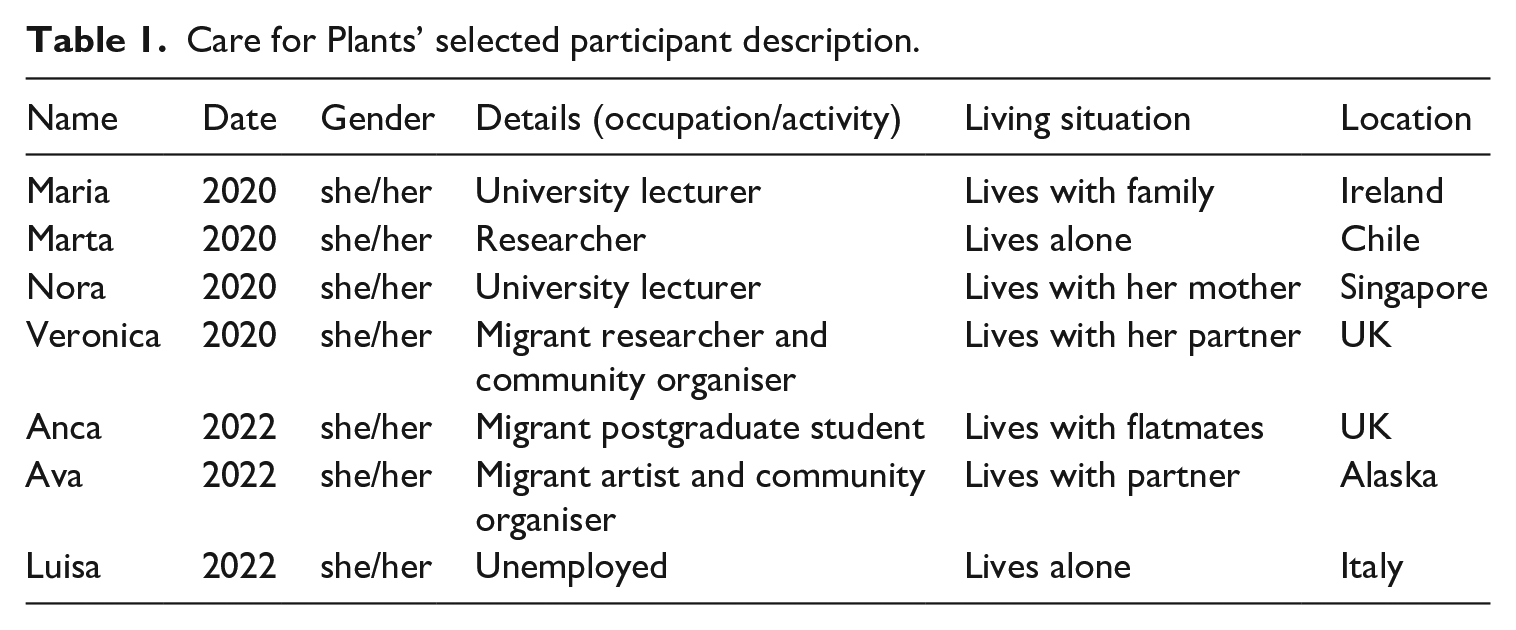
For this article, we selected seven interviews with women from 2020 and 2022. All of the 42 research participants had a strong attachment to plants, and time and rhythm were important themes across the data set. For this article we selected seven participants (see Table 1) who were especially articulate about care and time, which enabled us to go in greater depth about the temporal dimensions of the pandemic ‘plant-craze’ by working with these interviews. We therefore use these specific accounts from different settings around the world to deepen conceptual and empirical understanding of the everyday rhythms and political implications of plant care. Whilst all were women, most did not have significant caring responsibilities and our intention here is not to use these data to address important questions of gendered inequality and power during the pandemic.
Care for Plants’ selected participant description.
In terms of analysis, we explored the interviews for relevant content and themes. We undertook a ‘rhythmanalytical’ (Lefebvre, 2004) reading of the research material, attending to the ways in which change in human–houseplant relations emerged in the everyday, and how caring for plants offered new temporal markers during the COVID-19 pandemic. We noticed how the pre-existing rhythms of houseplants come to the attention of their ‘carers’, and how caring for plants came to punctuate the day or the week. Whilst rhythmanalysis is often recognised as an embodied approach, we worked with the interview narratives to draw out the everyday temporalities that underpinned them or were explicitly discussed (see also Lyon & Coleman, 2023). We argue that the constellations of these new practices of plant care and human–plant relations produced new everyday rhythms.
The rhythms of plant care: Solidifying ‘melting time’ with plants in lockdown
Marta was interviewed in 2020. At this time, she was a young woman who lived on her own in a studio flat in a large city in Chile. When the first lockdown was announced, she continued to work from home. She immediately felt that her living space had ‘become smaller and smaller’ and conversely, that time had expanded – a sense that was echoed by several research participants as we explore below. On the one hand, as temporal markers and the meaning of measures of time lost their hold during the pandemic, the impact of ‘melting time’ where ‘regimented time slots became loose, unstructured, and unpredictable’ (Shir-Wise, 2021, p. 221) left her in disarray. On the other hand, having been used to going out most evenings and travelling beyond the city at the weekends, the imposition of lockdown measures (including an all-night curfew) left her choosing whether ‘to sit on the couch or the bed’ for long periods. Paradoxically though, it was the very act of sitting on the couch that brought about a new form of attentiveness and attunement to her surroundings, and specifically to plant life as Marta first took an interest in the lonely pothos plant on the shelf facing the sofa.
It was through the act of looking attentively that Marta began to see the plant as something in its own right. She said, ‘I hadn’t noticed they were living, I mean, I did notice, some of them move in the night, but now it’s a bit more clear.’ This was echoed by some of the other participants across the whole sample. In the conditions of lockdown living, plants came to be seen and recognised, a revelation in a departure from dominant norms of ‘plant blindness’ (Wandersee & Schussler, 1999). This shift might be understood, following Holdrege (2013), as a change from ‘object thinking’ in which plants are literally objectified to ‘living thinking’ in which they are recognised as living organisms with specific needs and rhythms. ‘Living thinking’ is dynamic and relational and requires presence, that is a sensory attunement and receptivity, or a form of ‘dwelling with’ plants (Boke, 2019; Hartigan, 2017).
For several interviewees, a newfound capacity or ‘arts of noticing’ (Tsing, 2011) plants arose from the conditions of the pandemic, which led to a kind of ‘passionate immersion’ (Van Dooren et al., 2016) on the part of plant carers marked by curiosity, entanglement, the senses and affect, ‘perhaps to understand care a little differently’ (Van Dooren et al., 2016, p. 6), not least through rhythm. ‘I think what I love most is seeing my plants thrive’, stated Nora in 2020, an academic living in Singapore. This has a temporal dimension. She expressed ‘joy’ at noticing ‘a new baby leaf’, its movement and growth as well as the ‘mystery’ of what lies beneath the soil. Only partially amenable to observation, change catches the eye – the new leaf – rather than movement unfolding in the timeframe of the human observer. ‘I did not believe I could keep them alive’, exclaimed Ava in 2022, a migrant artist and community organiser living with her partner in Alaska, ‘but then during the pandemic, just step by step [I was] watching them grow their leaves’. Tending to the plant takes time in the everyday and requires an appreciation of the timescales or rhythms of plant life. At the same time, the plant draws the observer into a different world, configured not by the routines of work or socialising but by the rhythms of its own growth and needs.
As the participants’ reflections indicate, their domestic immersion and attunement to plants also involved a new relationship to temporality. For Marta, the recognition of the life of the plant with its own needs surfaced as a sudden realisation in the present. Taking the plant seriously was only possible as the pace of Marta’s life slowed such that the ‘contrasting timescales’ of human and plant worlds (Hartigan, 2017, p. 261) lessened as she sat immobile on her sofa until the plant’s rhythms and different possible trajectories emerged as perceptible. Similarly, Nora’s ‘joy’ at the new leaf reveals a newfound appreciation of the rhythm of the plant itself and the timeframe in which it develops as well as how it responds to her care. Observing his garden from a window in his apartment, Lefebvre (2004), suggests that there is ‘nothing inert in the world’ just ‘the apparent immobility [of the garden] that contains one thousand and one movements’ (p. 17). For him, the release of rhythms ‘demands attention and a certain time’ (p. 32); he further argues that we register rhythm with the body and the senses, grasping it as we are grasped by it. The interviewees attest to this. During lockdown, Nora and other interviewees reported spending more time with plants and becoming more deeply engrossed in the tasks of watering, repotting, trimming, propagating and even ‘wiping individual leaves’ (Nora) as well as moving plants around the house to test new sun exposures or other conditions conducive to their wellbeing. And as Nora explained, ‘I would walk around the apartment and like. . . see what needs trimming.’ These practices of care created new attunement to plant rhythms that are profoundly sensory – and create new ways of inhabiting time.
Veronica, a young woman living with her partner in the UK, working from home during lockdown and interviewed in 2020, struggled with forced immobility and having to share her living space, especially in contrast to her previous work as researcher and community organiser when she had travelled extensively. However, from her position of privilege, she reflected on an apparent ‘excess’ of time as ‘the bright side of lockdown’ because she could do ‘a lot of things that before were not possible’. At first, spending time with houseplants offered a welcome diversion from international Zoom calls and an opportunity to decompress. Then, time spent with plants took on greater importance and became an intentional daily ritual and rhythm that she associated with mindfulness, good mental health and a positive attitude towards the future. In short, her relationships and responsibilities to her houseplants gave new shape or rhythm to her everyday life. To mark the end of the working day, Veronica would water the plants and check the leaves, eventually prompting her to acquire many new houseplants. For Nora, the rhythm of caring for plants is stronger still. She was highly attentive and a little anxious wondering if the soil was wet or dry enough and what the plants needed. With more than 70 houseplants, it was ‘sort of reproductive labour’ and certainly ‘work’, but, she continued, ‘they became more of my everyday rhythm during lockdown’. The complexities of care-work, as discussed by Puig de la Bellacasa (2017, p. 158), involve joyful activity but are also stressful or burdening, especially when essential to maintain life. Echoing this, Ava stated that the plants remind her that it’s ‘little by little’. She continued: ‘It’s a marathon and things take time. This was really important for me especially in the pandemic where everything felt so urgent’ – plant care offering an alternative temporal counterpoint and rhythm to the relentless time of the pandemic. Veronica, Nora and Ava all narrated their plant care practices as a process of learning about plants that manifests in time. They switched from ‘caring for’ the plants aimed at keeping them alive to ‘caring about’ (Schrader, 2015) them as life companions, providing respite from pandemic-fuelled anxiety. The process of attuning to plant life and the rhythms of the plants’ needs and actions generated new temporal practices – from daily watering and tending to wondering at their growth – and a new sense of time.
The accounts discussed in this section show the slow recognition on the part of research participants of the temporalities of plants and the gradual emergence of new rhythms of caring for plants. Our research reveals that caring for plants during waves of the COVID-19 pandemic from 2020 involves distinctive temporal elements: the re-making of rhythms through new attunement to nature (see Lyon & Coleman, 2023), living with the plant in/over time (duration), and being in the present with the plant, which we explore further in the next section. Through coming to the attention of the people who care for plants in the research presented here, we see how plants themselves act as ‘pacemakers’ (Parkes & Thrift, 1979, p. 360) – a sort of living clock, marking time as they dry or thrive and in so doing, structuring the day and the week for the plant observer and carer. The interviewees’ accounts explain that whilst they learn to understand what plants need and want, they also ‘become interested’ in what they, the plants, are interested in, such as sunlight and water, and attune their senses to the needs of the plants and how they change over the course of a day, week or season. Nora referred to this as ‘Being able to “tell plant time” [which] itself takes time and arises from the connection to the rhythms of the plant itself.’
The affective and transformative power of plant care
Practices of plant care created new routines and everyday rhythms as we have heard above – and these in turn facilitated new affective bonds which underpin new relationships to time. Focusing on acts of caring-for-soil, Puig de la Bellacasa (2015, p. 705) argues that caring does not mean to control the object of care (whether soil or plant) but rather to develop affective relationships that point to a different ‘mode of life, including a different relationship to work’, everyday life and time (see also Krzywoszynska, 2019). It is in the process of caring that time is recalibrated and what Puig de la Bellacasa (2015, p. 691) calls ‘alterontologies’ emerge – that is, alternative ways to inhabit the present and imagine the future. In this section, we trace how practices of plant care cement affective bonds between humans and houseplants over/in time. We argue that the new rhythms created with plants recalibrate human life to different tempos, leading to an intensification of the present and a reorientation to the future.
When interviewed in 2022, Anca stated that before the COVID-19 lockdowns she had never been interested in houseplants, deliberately differentiating herself from her mother and grandmother who are both keen plant carers. Yet, at the beginning of the lockdown, she found herself alone in a student accommodation in the UK, surrounded by all the houseplants left behind as other students had returned to their parental homes. When she noticed some of the plants suffering, she started looking up care tips and was impressed by their quick improvement following her attention. These houseplants became ‘an amazing distraction’, she explained. ‘I knew I was not supposed to water them everyday, so that was the thing that I was looking forward to, the moment I watered the plants!’ These new caring routines gave shape to the week and helped with her mental health, which had deteriorated quickly in isolation.
Fast-forward two years, in 2022, Anca has moved three times and acquired a garden. The houseplants she encountered during lockdown are still with her. When the students who left the original plants returned and asked for them back, they quickly realised Anca had become ‘their mum now’ and they could not be separated. Anca stated that these houseplants were now an integral part of her life – a sense of connection that is echoed by other research participants. The practice of caring for and spending time with plants made it possible for Anca to develop intimate relationships and create affective bonds with them. She recounted, laughing, how her daily rituals included saying hello to the plants when returning home from work and starting conversations with them about her and their day because plants ‘are definitely part of [her] family’. Plants in her words ‘make a big difference’, especially because they helped her to focus when she experienced acute anxiety. It is the act of caring for them that creates this emotional connection, which gives joy, and anchors her in the present. This intimacy with plants at a time of crisis also taught Anca that building a world with plants could reflect the desire to build a future based on care. For her, caring for plants – taking time to observe, touch and feed them – is fundamental in building new understandings of and feelings about plants as companions, which informs her orientation to the future more generally.
The sensory, even ‘life forming’ (Myers, 2014, p. 70) qualities of human–plants entanglements are articulated by some interviewees through the liveliness and vibrancy of plants which they associate directly with rhythm, echoing the emphasis Lefebvre (2004) places on energy underpinning rhythm. Nora described the small high-rise apartment she shares with her mother as having a ‘jungle-vibe’ which makes their home ‘feel so much alive’. She continued, ‘I think this non-human addition really enhances yeah my. . . my living here.’ They are a fleshy, non-human presence that offer an energising liveliness: ‘when I’m tired I’ll just go and fuss over my plants’; and yet they offer ‘calm’ too, and happiness. ‘I guess they became more of my everyday rhythm during the lockdown.’ To spend time with plants elicited curiosity and immersed humans in the life of plants differently (see Tsing, 2011 in O’Gorman & Gaynor, 2020, p. 724). More time spent with plants created the opportunity to appreciate the liveliness of plants, to discover and celebrate their vitality, life, agency and rhythms. Caring for plants for participants in this project was, in other words, fundamental to the discovery of plants as life companions and planet co-dwellers. In turn, plants became crucial to re-making time through routines and rhythms (as discussed above) which both slowed time and intensified the present.
In their research on plant carers in Australia during lockdowns, Phillips and Schulz (2021, p. 383) argue that ‘interconnections with ecological systems were highlighted through plant temporalities’ because looking at plants ‘made caring practice more fascinating and rewarding’. In other words, time spent with plants was the time of contemplation, observation and silence that illuminated plant life and changed carers’ attitudes towards their potted companions following the development of affective bonds. This is reflected in Maria’s experience, an academic researcher who lives with husband, father and two children in rural Ireland – in a place she describes as ‘a 10-minute drive from civilization’. Already feeling isolated and remote before the lockdowns, with everybody at home, the pace of Maria’s home life, when she was interviewed in 2020, intensified. To put her hands in soil, planting and caring for plants became her way to take a break from family and work. She felt ‘a calm connection with plants’ and more time spent at home meant that she could ‘indulge in this relationship’. She came to notice and appreciate plants’ response to her presence and strongly believed her plants cared for her as much as she cared for them, a reciprocal relation and understanding also echoed by other participants (e.g. Ava). Maria thought her plants cared for her because she was able to feel ‘the energy from them’ which had strong ‘healing powers’. Lockdown helped her ‘slow down’ and sense the energy of the plants ‘a bit more’, she said. This echoes the role of energy – both plant and human – in producing rhythm (Lefebvre, 2004). Many of her plants had been rescued from supermarkets. She was explicit that she did not want plants to feel unappreciated or wasted due to capitalist overproduction. Bringing plants back to life was another rewarding care-practice that Maria explained as reciprocal care. She saved plants, and the plants rewarded her by growing healthily and filling her with joy.
Although Luisa, a young woman who returned to her native Italy in 2020 after a long period spent in the UK, was already a seasoned plant carer, during lockdowns she started feeling differently about her houseplants. When interviewed in 2022, she explained that from being a leisure activity for her downtime, plant care had become a priority that required its own dedicated time and scheduling. She said, ‘[my houseplants] did not ask to come and live with me. . . I brought them home and now they are my responsibility’. This duty of care prompted existential reflections that led her to re-evaluate her life choices. Similarly to Maria, Luisa felt plant-energy and perceived houseplants as a means to facilitate her connection to something bigger, the universe. For Luisa, plant care was no longer ‘empty time’ but rather it emptied time from the capitalist imperatives of production to refocus on what matters for her personal growth: to rebuild meaningful and more spiritual relationships with nature. Thus, plants offered something else: companionship that is understood in terms of equality. ‘I care for them’, she said, ‘but I don’t project on them because they remain their own selves, and they do their own things. If they die, that is part of life and its course.’ In short, for Luisa, caring for plants means learning about new ways of being in the world and inhabiting the present. Before lockdown, she had focused mostly on her career. During lockdown, she discovered the beauty of time with plants, following their slower pace and rhythms. Luisa realised that her time can also be slowed and not devoted exclusively to work. Luisa’s experience of lockdown was of awakening, and she shared that her houseplants were crucial in making her realise that she needed to make changes to her previous routines. Tuning into ‘plant time’ (Boke, 2019; Elton, 2021) enabled her to make new connections with the planet and to find happiness ‘outside’ of the dominant logics of capitalism. As Baker (2022, p. 388) also argues, ‘by attuning our senses and emotions with plant kin we can experience glimpses of an intense and radical way of existing in the world’. In conversation with Fort McKay First Nation and Bigstone Cree Nation teachings, Baker describes the potential of plants to offer ‘moments of enchantment’ that are ‘a spell for reconciliation’ (p. 398), a feeling shared by the majority of the people interviewed for this project. Returning to Anca’s interview, she also articulated her experience of bonding with plants in lockdown as fundamental in the development of a vision for ‘plant-inspired anti-capitalist utopia’. She experienced time slowing as she synched with plant time, where to stop being productive and ‘just go and look at the plants for a bit’ was celebrated.
The stories of Anca, Maria and Luisa presented in this section show how houseplants were fundamental in shaping their understandings of plant life during the lockdowns and beyond. Routinised plant care and affection for their green companions offered the opportunity for experiencing the world differently. This echoes Kirksey and Helmreich’s (2010) notion of ‘biocultural hope’, which illustrates the potential held by being in affective relationships with nonhumans to create a better future for all (see also O’Gorman & Gaynor, 2020, p. 716). It also relates to Haraway’s (2015) argument that making-kin with nonhumans – such as plants and animals – is a means to challenge the catastrophic thinking of the Anthropocene. Indeed, the process of re-making time with plants is potentially transformative as part of a wider set of concerns as to how life should be lived. It showcases the possibility of hopeful trajectories of human/nonhuman collaboration guided by pandemic encounters.
Discussion: The time of plant care in the present and for the future
In the discussion of the original research presented above, we have seen how practices of plant care generated new temporal patterns and commitments which in turn produced a different experience of time. Following Puig de la Bellacasa (2015, p. 709), ‘care time’ is not about ‘slowing or [a] redirection of timelines’, rather it is ‘an invitation to rearrange and rebalance the relations between a diversity of coexisting temporalities’ across different ecologies. The research participants in Care for Plants articulated how, in their privileged positions, they cultivated new temporal relations – presence, rhythm and future-imagining – with plants during the COVID-19 pandemic. For some of these plant carers, the experience of ‘vegetalising’ (Myers, 2017a) – becoming one with plants – was far-reaching, transforming the everyday and enabling the desire for bigger social changes (Lefebvre, 2004, 2014). Lundström (2022, p. 328), whose research took place in a deprived area of Stockholm during lockdowns, identified individual responses to the apparent ‘collapse’ of time as processes of de- or re-synchronisation in the present and in relation to the future. He highlights ‘the timing of Kairos’ (opportunity) as an appreciation of the way in which crisis redirects attention to what is important in life, and contrasts this with pre-lockdown rhythms when there was no time to see ‘the small things in life’. For Lundström – as for Lefebvre (2004) – moments in which the ordinary experience of time is suspended have radical potential (Lundström, 2022, pp. 329–330). We argue that the newfound temporal attunement with houseplants through care enabled participants to cultivate a critical approach to the present that extricated the individual from the overwhelming crisis to meaningfully inhabit the present and to engage with more-than-human future-making. This is echoed in other research. Indeed, ‘the coronavirus is not only a medical threat but also collides with the temporal logic inherent to capitalism’, as Suckert (2021, p. 1163) writes. She continues, ‘in hiking, baking, sewing, gardening, brewing or DYI, many have rediscovered decommodified ways of spending their time during the pandemic’ (p. 1171), questioning taken-for-granted assumptions about life and work.
Care time is a time of repetition, and repetition enables attention, knowledge and care from which new practices and possibilities arise (Puig de la Bellacasa, 2015, p. 705). Pedwell (2021, p. 8) argues that ‘we need to understand habits not simply as mindless forms of repetition that reproduce the status quo, but rather as moving assemblages that enable new affective, material, and political capacities and collectives to emerge’. Indeed, practices of plant care generated new feelings and responsibilities towards houseplants, embodied in new habits on the part of plant carers. The corporeal dimension of the practices and rhythms of plant care is fundamental. Whilst Lefebvre (2004) argues that rhythms register and are grasped in the body, this is usually discussed in terms of ‘dressage’, a process of bodily entrainment such as through military drills. Instead, in the present research, we have captured the intricate and intimate ways in which plant carers become attuned and in synch with houseplants through caring practices that are rhythmic, affective and sensory.
Furthermore, with Pedwell, we argue that plant care led to a new understanding of life where plants are part of networks of survival and flourishing. We have drawn out how ‘affective inhabitation can generate forms of attentiveness, connection and care that transform sensing into an activity which has a range of political and ethical implications’ (Pedwell, 2021, p. 27). Rituals become ingrained in the everyday and in so doing they activate our ability to see how change can happen. Many discovered plants as a coping mechanism at a time of heightened anxiety but sharing and re-making time with plants instructed new ways of being together that hold the potential to illuminate new paths for humans and plants in the making of the future, that include experiences which alter human–nonhuman dynamics positively (Soga et al., 2021).
Conclusion
This article offers an analysis of human–houseplants relations during the pandemic and a case study of the sociology of the temporalities of human–houseplant relations. This contributes to addressing the absence of attention to plants in general and human–houseplant relations in sociology and what we described earlier, following Wandersee and Schussler (1999), as ‘plant blindness’ within the discipline. It makes a conceptual contribution to thinking with human–houseplant relations for understanding social change in the everyday through a temporal lens, highlighting the significance of presence, rhythm and future-imagining. We have reflected on the specificities of living through a global crisis by focusing on the rhythms and affective bonds of plant care in the making and how they illuminate and potentially reframe human/nonhuman relations. In so doing, we have demonstrated that what was described in the media as a ‘plant-craze’ was an instance of the co-construction of new temporal relations across species and one which may have far-reaching significance into the future.
In the first analytical section, we discussed the re-making of time under COVID-19 restrictions, especially lockdown, through new routines and relations with plants, showing the impact of different rhythms – in this case, those of plants – on humans (Pschetz et al., 2024), and how the conditions of lockdown rendered them perceptible (Brice, 2014). The political conditions of the pandemic during which physical restrictions were in place inadvertently gave rise to new opportunities for the cultivation of different human–houseplant relations, appreciating newfound time with and the time-making of plants. Plants became a sort of living temporal device, marking time and structuring the everyday as they literally came to the attention of their hosts-turned-carers and together they fostered different kinds of everyday rhythms.
In the second analytical section, we explored newfound affective human–houseplant bonds and their transformative potential through the relations of making time with plants at home. Time with houseplants was a form of multispecies connection that depends on presence and practices of care: ‘fine-tuning to the temporal rhythms of an “other” and to the specific relations that are being woven together’ (Puig de la Bellacasa, 2015, p. 705). Further, we explored how care for plants shapes new understandings of time that refuse dominant neoliberal temporalities. This gave rise to both an intensification of the present – including taking time to care, attuning to the rhythms of plant life, establishing the temporal belonging of plants – and envisaging the future anew.
Overall, this article has analysed plant care practices during the COVID-19 pandemic lockdowns to show how the time and rhythms of caring for and living with plants changed the participants’ everyday experience of time.
Footnotes
Acknowledgements
We would like to thank the houseplant carers who shared their stories with us. Giulia would like to thank her houseplants for providing inspiration, love and wonder and the many houseplant-people she met through this project who contributed to shape the research. We also thank reviewers and editors for their helpful suggestions.
Funding
This work was supported by Queen’s University Belfast COVID-19 Response Fund (2020) and Queen Mary University of London Institute of Humanities and Social Sciences Large Grant Seed-corn Fund (2021).
