




Abstract
Scholars have diagnosed widespread class disidentification among working-class citizens in contemporary Britain despite high and sustained levels of inequality. Everyday narrations in working-class communities, however, reveal deeply classed accounts of politics and society, even if not expressed in the formal idiom of class. Across our field sites, practices of corruption talk were rife and aided citizens in making sense of their experiences of political powerlessness and economic dispossession. Drawing on political ethnographic studies from working-class areas in Oxford, Corby and Mansfield, and buttressed by survey data, we find that corruption talk can act as an informal political ontology. An analysis of international survey data on corruption perceptions and class identification further substantiates our ethnographic findings about the resonance and character of corruption talk. Following the Marxist historian E. P. Thompson, we argue that corruption talk reveals the complex and at times contradictory ways in which marginalised citizens define and narrate their relationship to politics and state power under conditions of class fragmentation. These findings highlight, we argue, the importance of paying attention to vernacular discourses and call into question straightforwardly teleological accounts of the decline of class consciousness in the past 50 years.
Introduction
There is now a widespread view that in recent decades, the overt politics of class contestation has dramatically declined (e.g. Evans & Tilley, 2017). The trade union movement which buttressed the 20th century labour movement has been eroded by deindustrialisation and economic restructuring, which has generated increasing precarity and insecurity and left employers and the state with the whip hand. The ‘old class politics’, in which the Labour Party was disproportionately supported by working-class voters, has been eclipsed by a ‘new class politics’ in which the well-educated ‘Brahmin left’ have come to be its main supporters (Evans & Tilley, 2017; Piketty, 2020; though see Furlong, 2019). The class coalition behind the Brexit vote points to the power of racist and nationalist identifications over class-based forms in present-day Britain (Bhambra, 2017; Flemmen & Savage, 2017; Virdee & McGeever, 2018, 2023). These coalitions proved to be fertile ground for the Conservative Party in its 2017 and 2019 victories, especially in working-class constituencies (Cutts et al., 2020).
In this article we will use in-depth qualitative and quantitative research to argue that class continues to be powerfully etched in vernacular discourses and everyday practices in Britain today. Previous sociological research has shown that class is not simply wiped out, but continues to underpin ambivalent and fraught forms of ‘mis-recognition’ and ‘de-identification’ from overt class identities (Savage, 2015; Savage et al., 2001; Savage & Meersohn Schmidt, 2020; Skeggs, 1997). Present-day patterns in class identification present ironies and paradoxes, as working-class roots are now widely evoked by middle-class, upwardly mobile professionals and managers (Friedman et al., 2021), testifying to their exuberant self-confidence (Skeggs, 2004). This should not however lead us to presume that a visceral politics of class has been eradicated in working-class communities. Attitudes to public institutions and authority figures powerfully demonstrate this (Koch, 2018).
Building on these insights, we home in on the case of ‘corruption talk’ as a form of class consciousness, which parallels processes highlighted by historical scholarship on 19th century popular mobilisations. Rather than treating endemic discussions of corruption as a direct response to identifiable corrupt practices in a narrow legal sense, we see it as evoking a broader political ontology. We return to the Marxist historian E. P. Thompson’s (1966) argument that in the early 19th century, the English working class was ‘formed’ through articulating a radical critique of political elites and ‘the system’, through mobilising an attack on ‘Old Corruption’. Listening carefully to working-class voices in precarious communities, we evoke Thompson’s clarion call to ‘rescue the poor stockinger, the Luddite cropper, the “obsolete” hand-loom weaver, the “utopian” artisan, and even the deluded follower of Joanna Southcott, from the enormous condescension of posterity’ (Thompson, 1966, p. 12).
Our argument is based on ethnographic studies of three working-class areas, the implications of which we deepen by drawing on cross-nationally representative survey data on public perceptions of corruption. The quantitative and qualitative data both point to the classed character of the corruption frame, as working-class citizens prove to be more likely to perceive widespread corruption. Meanwhile the corruption talk recorded in our ethnographic data was rich with inferences about class, inequality and power. We place this finding against the backdrop of structural transformations in our respective field sites: among our interlocutors, decades of political and economic dispossession have fostered an acute sense of moral failure to care on the part of politicians, leading to an appeal of narratives of corruption that can, at times, take conspiratorial overtones. By analysing popular ‘corruption talk’ as a lightning conductor for visceral forms of class identification, we argue that it reveals the complex and at times contradictory ways in which marginalised citizens view their relationship to politics and state power under conditions of class fragmentation.
Accordingly, we begin by returning to sociological debates regarding the nature of working-class consciousness in Britain. Following Thompson’s lead, we argue that working-class consciousness should not be measured against some intellectually authorised political project, but through the articulations of an actually existing politics (Koch, 2017). In these terms, corruption talk evokes deep rooted feelings of injustice and unfairness. We proceed to contextualise our three field sites – deindustrialised neighbourhoods in Oxford, Corby and Mansfield – within broader trajectories of working-class experiences in deindustrialising Britain. The following section shows how corruption talk raises a wider politics than simply the identification of specific corrupt incidents or individuals. Rather, it is redolent of a wider feeling that ‘no-one cares about us’. We then move on to the deeper political ontology, in which corruption talk is not to be understood as apolitical or a marker of disengagement: it reflects a powerful, visceral analysis of contemporary political life. In the last section we situate the insights from our ethnographies in both national and European contexts. Here we trace the class divides in corruption talk, uncovering the salience of this wider sense of corruption for working-class communities. In other words, these three sites demonstrate how corruption talk acts as a vernacular register through which working-class people can reflect on experiences of devaluation and disempowerment.
Recovering ‘corruption talk’: A return to E. P. Thompson
Over 60 years ago, E. P. Thompson (1966) famously and emphatically insisted that the working class were ‘present at their own making’ (p. 9). Thompson disputed the Leninist mantra that the working class had to be ‘led’ to achieve class consciousness, arguing instead that class consciousness grew from everyday experience. For Thompson, 18th century Britain was deeply divided by class, even though the overt idioms of plebeian class contestation were very limited. During the early 19th century, this was moulded into a more assertive class awareness leading to radical movements which effectively demanded political reform. In taking up this argument, Thompson saw that ‘corruption’ was a key hook by which radical movements mobilised wider constituencies. The journalist and pamphleteer William Cobbett, in particular, came to the fore by berating ‘Old Corruption’ – a system of parasitical practices whereby social and political elites were able to lay claim to public money and public office (Harling, 1995). Through this means, corruption became a rallying cry and a pressure point to expose deeper structural divisions (Thompson, 1966). Thompson was thus able to redefine 19th century radicalism not as the middle-class, ‘liberal’ project that it was later to be consecrated but as a far more plebeian endeavour. He draws out how the radical critique spoke to the experiences of proletarianisation and the changing ‘experiences’ of the rural poor, the factory proletariat and small producers. For Thompson, if the actual practices of vernacular critique and political mobilisation are made central, then class can still be seen to be configured in practice, even in the absence of more formalised idioms of class.
Thompson applauds Cobbett’s genius, ‘which enabled him to exert more influence, week after week for thirty years, than any other journalist in English history’ (p. 628), insistently staging in his writings a dramatic encounter between himself and Old Corruption (p. 627). Thompson draws out Cobbett’s social critique, notably in the campaigner’s account of changes to agricultural production through enclosure and rural depopulation (pp. 223–225). In noting how Cobbett at times embraced xenophobia and prejudice, 1 Thompson was clear that he did not see Cobbett’s writings as a ‘critique of a political system’, insisting that his economic analysis was reduced, in the last instance, ‘to a polemic against the parasitism of certain vested interest legitimacy’ (Thompson, 1966, p. 757, emphasis in original). Cobbett’s critique of wasteful and corrupt elites implies less a (quasi-)Marxist and more a Veblenesque conception of society, where ‘productive labour’ is juxtaposed to ‘conspicuous and lazy display’. Thompson ultimately viewed Cobbett as endorsing above all an ‘ideology of small producers’ (p. 759). A rising Radical movement, however, pushed Cobbett’s analysis beyond its bourgeois starting point (p. 759). Thompson went on to argue that Cobbett was pushed into a form of class awareness to the extent that he came ‘so close to being [a spokesman] of the working class’ (p. 760), though invoking the ‘historic rights of the poor’ (p. 760).
Thompson thus gives warrant for re-reading this anti-corruption politics not as a denial of class politics, but as a particular way of articulating class identities – even though not in any ‘approved’ socialist form. Subsequent scholarship has broadened and developed Thompson’s arguments to establish that the mobilisation against ‘corruption’ was not a simple response to high-profile corrupt cases. In fact, Harling (1995) argues that the radicalism culminating in Chartism peaked in the 1830s and 1840s, when corrupt practices such as the awarding of sinecures were long on the wane. Analogously, we will argue that our interlocutors’ narrations of corruption do not index corrupt acts per se. As we will see from our ethnographic evidence, ongoing processes of economic and political dispossession have been overlaid with specific events, each of which has re-animated corruption themes in one form or another: the withdrawal of local funding in processes of ‘austerity localism’ following the financial crisis of 2008–9 (Dagdeviren et al., 2019); a parliamentary expenses scandal in 2009, which revealed MPs to have claimed extravagant expenses; and the 2016 EU referendum campaign and its aftermath.
This framing allows a more nuanced perspective on how working-class communities comprehend and confront inequalities in wealth and power, which deepens the conventional sociological view that class awareness has become hesitant and ambivalent, or been rejected outright in favour of investments in respectability (Skeggs, 1997) and ordinariness (Savage et al., 2001). In fact, corruption is seen to violate these very values, facilitating a moralised denunciation of the power of untrustworthy and nepotistic elites. Similarly, the kind of deeply held meritocratic idioms which celebrate the virtues of social mobility through hard work (Mijs et al., 2022; Mijs & Savage, 2020) can be used to identify and criticise corruption. In this way, epistemic resistance and repudiation from working-class interlocutors who are aware of their own marginalisation (Bottero & Irwin, 2003; Irwin, 2018; Koch, 2018; McKenzie, 2015) can be found in the ubiquity of corruption talk.
We therefore think there is much potential for returning to Thompson’s invocation to recognise how vernacular narrations of power can still operate even in the absence of an explicit politics of class. Where Thompson studied a society on the cusp of industrialisation, we analyse our interlocutors’ narratives in three deindustrialised communities, as the opposite ‘bookend’ of an industrial era (Strangleman, 2017, p. 467). We wish to take up Thompson’s ethnographic historical sensibility by exploring how endemic ‘corruption talk’ operates as a mode of political awareness in England. In the following sections, we set out findings from interviews and participant observation in three post-industrial areas to explore the possibility of corruption narratives as ‘an emic political theory’ (Koch, 2018, p. 231) in working-class communities.
Methodology and ethnographic field sites
Our analysis draws on methodological advances in political ethnography (Auyero, 2006; Baiocchi & Connor, 2008; Benzecry & Baiocchi, 2017; Tilly, 2006) and the revival of the community-centred tradition in the works of Jeanette Edwards (2000) and others (Degnen & Tyler, 2017a, 2017b; Koch et al., 2021; Tyler, 2020). Two members of our team have been carrying out in-depth ethnographic work across three field sites. Sacha Hilhorst has been working in Corby since 2019 and Mansfield since 2021. Insa Koch has been working in Oxford since 2009, with several years of residency and continuous follow-up research over the years. Ethnographic findings (in the case of Koch) and interview findings (in the case of Hilhorst) from these periods of fieldwork inform the main thrust of our argument. We supplement these with a quantitative analysis of corruption perceptions among working-class citizens, thus allowing us to consider the resonance of corruption frames beyond our field sites. In the quantitative sections, we draw on data from the 2013 and 2019 rounds of the Eurobarometer (European Commission, 2016, 2020), a sample survey of public opinion in the European Union which includes questions on the perception and experience of corruption.
The first of our field sites is Blackbird Leys in Oxford: a post-war council estate built to accommodate the workers of a car factory. Many workers came from within Oxford though there was also migration from outside, including the Commonwealth and Ireland, making Blackbird Leys a mixed community from the start, unlike the many majority-white estates of the same era. In the early 1970s, Blackbird Leys counted as one of the largest estates in Europe. Like many other post-industrial council estates, Blackbird Leys has been harshly affected by industrial decline, especially the decline of the car factory from the 1980s onwards (see also Hayter & Harvey, 1993). This process intertwined with the impact of neoliberal reforms, the privatisation of social housing and the rise of a knowledge-based economy, enabled and driven by the universities in Oxford, that excluded large sectors of the local population from the labour market.
A second field site, Corby in Northamptonshire, is largely built around a new steel works in the 1930s. The town was significantly expanded after World War II, reflecting the central role of steel production in post-war reconstruction and mirroring some of the processes of industrial expansion that were also central to Oxford. A wide range of social and civic amenities were provided by paternalist employers, and, after nationalisation, by the state, which fostered a lively working-class social life. These included sports facilities, myriad social clubs and annual fairs, many of which have since disbanded, declared bankruptcy or been sold off. In 1980, the steel works was closed, with the exception of a small tube works. More recently the town has sought to establish itself as a commuter town for young professionals who work in London, approximately an hour away by train. The town has also received a growing Eastern European migrant community, often employed in food processing and logistics on insecure contracts managed by the town’s many employment agencies.
Our third field site is Mansfield, a former mining and manufacturing town in Nottinghamshire. Although employment in mining had been in decline since the 1920s, this long had little effect on the bountiful Nottinghamshire/Derbyshire coalfield (Emery, 2018). In the 1980s, however, the area deindustrialised rapidly (Bennett et al., 2000, pp. 11–21). The miners’ strike of 1984–5 divided the community, making the town infamous for its large numbers of working (non-striking) miners. Alongside an accelerating process of pit closures, local manufacturing declined severely. The remaining hosiery industry, which employed many local women, largely disappeared in the 1990s and 2000s as retailers like Marks and Spencer offshored their supply chains. Many of the women who worked in the factories remembered the “buzz” in the town centre on a Friday night and the thriving market, where company buses dropped off large groups of women after their shift. Now many say they avoid the town centre and the sight of the dwindled market. Mansfield, like all three sites, is marked by the disappearance of well-paid, unionised jobs, with the effects of long-term economic marginalisation deepened by public sector cuts.
After review by their respective boards of ethics, Hilhorst and Koch conducted participant observation in community spaces and, when invited, in private settings. Community members were informed about the research upon meeting the researchers or as soon as possible thereafter. Hilhorst spent four months in Corby and four months in Mansfield in 2021, where she lived with a local teacher who made initial introductions. Koch lived with individuals and families in her field site for a period of nearly two years between 2009 and 2011 and during frequent follow-up visits. Both Hilhorst and Koch met interlocutors through volunteering and everyday participation in local neighbourhood life, which led us to sites of local importance. Hilhorst also conducted recorded interviews. These included formal, recorded interviews with 96 people in secluded settings, scheduled separately, and ethnographic group interviews of a minimum of 30 minutes with 25 further participants. Shorter conversations during participant observation were included in general field notes. Research participants were drawn from community spaces and everyday local interactions. Most were white, along smaller numbers of black and brown interlocutors, particularly in the more racially diverse Oxford site. All names were pseudonymised and identifying details are withheld.
Our field sites are generative sites for an investigation of contemporary forms of working-class consciousness and vernacular discourses of power, inequality and value. Initially conceived and conducted as separate research projects, the geographical and substantive connections between their projects prompted Koch and Hilhorst to pursue a collaboration, which was broadened by discussions with Mike Savage, who brought an historical dimension, and Mark Fransham and Aaron Reeves, who were working on parallel issues using quantitative data. The authors jointly reanalysed existing materials in an iterative process, revealing resonances across the field sites. The narration of corruption, which had stood out first in the Corby fieldwork and was raised again, spontaneously, in conversations in Mansfield, proved to be present also in the Oxford data. Conversely, the practices of mutuality, care and ‘personhood’ which Koch had identified in her field site (Koch, 2018; see also Willis, 2023) helped to clarify the meaning of the overlapping elements from different field sites. The themes from the reanalysis of field notes and interview transcripts subsequently drove the direction of the quantitative work.
The prevalence of corruption talk
Across all three sites, men and women of different age groups and ethnicities identified corruption as an endemic feature of public life. These narrations of corruption did not always correspond to conventional scholarly definitions of corruption as the misuse of public office for private gain. Rather, they opened out into a deeper sense that a civic realm or a ‘moral’ way of life had become corrupted. Corruption talk can be understood as a moralised framing of political in- and exclusion, ‘a normative discourse about the abuse of entrusted power and resulting social decay’ (Doshi & Ranganathan, 2017, p. 438). Key markers included the terms ‘corrupt’ and ‘corruption’ as well as various associated phrases – being ‘on the take’, ‘lining their pockets’, taking ‘backhanders’. Corruption talk could shift between concrete accusations of bribe-taking and more abstract claims of immorality on the part of the powerful.
Consider the following excerpt from a conversation between two residents of Blackbird Leys. Pat was a local woman in her late thirties of African-Caribbean descent who had worked in different service sector jobs all her life, raising her teenage sons by herself. Her friend Kate, about 10 years younger, and white English, was also a single parent of two children. Pat and Kate had met over a decade ago when working in a Burger King restaurant. One morning shortly before the 2010 general election, both women were catching up around a large table in the reception area of the estate’s community centre when the conversation turned to then-Prime Minister’s Gordon Brown’s infamous description of one member of the public as a ‘bigoted woman’ during an election visit. Both Pat and Kate had watched the episode on TV, resulting in an animated discussion between them.
‘If we realised they’re just humans, most of the time, they’re trying to do the best for the majority of people, if they can do it within the bounds of the law, then that’s okay.’
‘But the fact is‚ people are paying their wages, and [Gordon Brown] doesn’t give anything about the public for as long as he gets his money. Obviously I don’t understand about politics and I don’t know much, but that – that just summed it up for me. Just because they are in power, I don’t think it gives them the right to just do what they wanna do. . . like they are shutting down schools, hospitals and that, and then they go out for expensive dinners with our tax money. And then with the whole expenses scandal thing as well. . . You don’t just become a politician cause they got a lot of money, it seems like they don’t care’ [This then sparked off a conversation about who politicians are and what they do]
‘They can’t make everybody happy. Alright, some politicians were involved in the expenses scandal and I think that’s a disgrace cause it reflected bad on everybody else, but that was only a minority. . . also, in order to be a politician, you gotta go with the tide. It don’t matter if your local people like you in your constituency, that’s all good and well but that’s not the testing time cause in order to be in power, you gotta go with the flow. . . politics is corrupt.’ (Compiled from field notes, Blackbird Leys, 2010)
At several points in the 2010 election campaign, Kate had expressed her view that politicians are only ‘in it’ for personal gain. Later on in the campaign, Kate reflected: ‘it’s dictatorship anyways, they do whatever they want once they’re in power, they only care about their own money!’ There were several conversations like these across our field sites discussing whether politicians were corrupt, and if so, whether it matters. Through corruption talk, Kate and many others were offering a commentary on the workings of politics today. For Kate, it served as a way to criticise actual, planned or perceived public sector cuts to schools and hospitals. Pat, by contrast, brushed aside Kate’s moralistic framing: yes, politics was corrupt, but it is just the way things are done.
Gossip and rumours helped to consolidate public opinion around a corruption frame. In 2021, just over a decade later, and with Boris Johnson’s Conservative government now in power, several ex-miners chatted in a local pub in Mansfield. After ruminating over their town’s decline, and the fact that pit and factory jobs had been replaced by supermarket jobs at Asda and Morrisons, the men came to discuss their former Labour MP, who had been voted out in the 2017 election.
‘They made him [the MP] a Sir. I could throw up.’ Dave mimes a gag, as though he is holding back vomit.
This gets all the men around the table talking at once, leaning forward to contribute. They are disillusioned with politics. ‘He did nothing about job creation or anything.’
‘Nothing about anything.’
‘Never said yes or no.’
‘He was a waste of oxygen.’
[. . .] One man tells a story of how the previous MP campaigned to have the road to his house shut off, so it was a private gated road and people couldn’t use it to get to Pleasley [one of the nearby pit villages]. ‘You tell me that ain’t quadrupled the price of his house’, he says.
‘Lots of MPs are on that game’, another chimes in. (Compiled from field notes, Mansfield, 2021)
This perception crystallised around despair for the MP’s knighthood, which highlighted the grave divergence between official markers of status and worth (being knighted by the royal family) and their own assessments of the MP as a moral outcast. The game metaphor, too, was common in people’s descriptions of politics, capturing both the sense that MPs were conniving and that they were frivolous: they were not performing acts of public service and did not live in ‘the real world’, failing to understand the gravity of the challenges that ordinary people faced.
In these conversations, several interlocutors insisted that political representatives were devious, profit-maximising individuals. ‘Corruption’ became a shorthand for capturing the diverse and complex forms of moral failure that were attributed to people in power. Political issues were narrated through the moral character of politicians, but the problem was perceived to extend beyond individual cases of wrongdoing. The corruption of MPs laid bare ‘the whole rotten system’, or in Kate’s words, it showed that ‘it’s dictatorship anyways’. For our interlocutors, talk of corruption then served to capture the lack of care for working-class communities and the anger that people felt towards a political establishment. Corruption allowed citizens to make sense of experiences of political disempowerment, as echoed by a diverse literature on corruption talk across the globe (Doshi & Ranganathan, 2019; Haller & Shore, 2005; Muir & Gupta, 2018).
Care and failures to care
To understand the prevalence of corruption as a narrative reference point in people’s lives, we can situate it in the context of its antithesis: mutuality and care. Where scholars have typically contrasted corruption with lawfulness and legal-rational modernity, our interlocutors contrasted corruption and schemes for self-enrichment also with practices of mutuality and care. Ethnographers have repeatedly documented an ethic of mutuality as a central feature of working-class life. Bev Skeggs (2011) has described this as ‘autonomist working-class values’ (p. 505), based on relationality rather than self-interested bourgeois personhood. Struggling against the odds and devalued by dominant rubrics of worth, Skeggs’s interlocutors express a conception of who and what matters based on mutual care and time spent simply in one another’s company, ‘where other people were supportive connectivities, not sources for self-accumulation’ (p. 504). Building on Skeggs, Roxana Willis’s (2023) ethnography of a Corby council estate documents a similar ethic, which she describes as a framework of mutuality. By visibly helping others and asking for help when in need themselves, community members ‘manifest a commitment to the norms of a framework of mutuality and show themselves to be a good person by the standards of the community’ (p. 84).
The narration of politicians’ betrayal of their constituents drew on such working-class notions of mutuality. Spontaneous contrasts between politicians’ behaviour and everyday practices of care highlight the fact that, in these narrations of politics, what makes a good person in local or vernacular terms cannot be separated from what makes a good citizen (Koch, 2016). As Koch has argued (2018), understandings of mutuality, care and what made a ‘good person’ provided the normative yardstick against which the actions of politicians and the daily workings of politics were judged. Politicians, many felt, had cared all too well for themselves and the rest of the political class, while failing to look after less privileged citizens and the public realm. Their personal ambition and absence from local ties of mutual support, and their perceived refusal to contribute to life in neighbourhoods that had been blighted by structural decline, marked them as irredeemably other. Narrating their venality allowed locals to collectively rehearse their own ethic of mutuality, for which politicians formed a resonant contrast, personifying the transgression which reaffirmed the norm.
Among those contrasting politicians’ corruption with their own experiences of hardship and care was Jenna, a white mother of three in her thirties living in Mansfield. Her attempts to raise her children by herself in the aftermath of a divorce and the loss of her home coincided with severe cuts to social services. She found herself having to fight to obtain care and support for her autistic son, while the care for her children often clashed with the demands of unpredictable work hours. Repeated evictions by private landlords, a failing childcare system and a scarcity of stable jobs had made life hard. Speaking in 2021, she used her own biography to illustrate her belief that the system was broken and corrupt.
‘There was a few years where I started to question, you know, and that age-old saying, they all piss in the same pot, you know. And I think, to a certain extent, it is true because they all have their own agendas that undermine what they’re saying. You know, they’re not always transparent.’
‘Yeah, and what sorts of agendas?’
‘Like, you know, the fact that, I think what annoys me is that they claim expenses for absolutely everything, you know, and they know that that comes at a cost to the taxpayer and I just think. . . You know when it came out about these second houses and holiday homes and things like that and they’re paying for new roofs or gardeners, it was like absolutely shocking. How can they expect to be respected when they’re abusing a system like that? And then, you know, the image of them asleep in the parliament chambers, where they’re meant to be like listening and working and we’re paying for them to be there, sort of thing. But, yeah, I think the whole system’s corrupt, if I’m honest.’ (Interview, Mansfield, 2021)
To Jenna, politicians were out of touch with the difficulties of getting by. ‘I don’t think for one minute any one of them would be willing to swap with somebody struggling on the breadline, even for an experiment. I think if they did it for an experiment, they’d be, you know, secretly going back to their luxury hotel or something like that.’ When politicians professed to care about the poor, she suspected ulterior motives: ‘I think they just say that to get the voters and the popularity, you know?’
Demonstrating care through community work, reproductive labour or physical work provided a moral framework against which the actions of others could be judged. ‘Others’ could include outsiders and individuals who were considered troublesome, but crucially it also included the world of political elites. In both everyday conversations in the pub, at people’s homes and on the streets as well as in longer recorded interviews, people at times describe a contrast between the burden of their own caring responsibilities and the uncaringness of politicians. Many of these themes are illustrated in the following snippet, involving Lindsey, a white working-class woman in her late forties who had raised her four children in Blackbird Leys. She had a mortgage on her two-bedroom ex-council house that set her apart from the majority of her friends and neighbours, who were renting. However, she struggled to make ends meet, being a sole earner in her household and having dedicated much of her life to local community activism and community jobs that were both short lived and rarely paid enough to allow her to save any money.
In February 2023, Lindsey had attended a protest against Oxford’s most recent environmental policies, the so-called 15-minute neighbourhoods, whose planning implications she experienced as an additional layer of segregation for the town’s working-class residents. She described how she met two ‘working-class women’ from Essex during the demonstration.
‘[They] were good people who were caring about their children and caring about themselves. You know they were struggling as carers and one of them with their disabled children and they were really doing their best. And they look at the government and they think what is the government doing for me? The government don’t care about me, they don’t care about my children, they don’t care about our lives. . . [L]ife has got so much harder and there doesn't seem much help and support for people.’ (Interview, Blackbird Leys, 2023)
Lindsey and others invoked the notion of care, both in the sense of ‘caring for’ and ‘caring about’. The impetus to care, both as care workers and for their own family members, provided a means of mutual identification, a classed solidarity, between Lindsey and these two strangers who had come from outside of Oxford to attend the protest. Conversely, politicians were failing to extend the care that regular members of the community routinely extended to one another.
These oppositions between caring, ordinary people who worked hard to get by and self-serving, venal politicians unfamiliar with the difficulties of working-class life formed the basis of a vernacular political ontology. Although corruption talk is often read through a legalistic frame, in our materials corruption emerges predominantly as a denial of mutuality and care, as citizens expressed a sense that politicians cared only about themselves (see also Muir & Gupta, 2018 on the contradictory desires animating corruption talk). Politicians’ lack of care represented an inability to understand how ‘real people’ live, a venal pursuit of their own interests and a failure to participate in the place-bound social ties which permitted community members to prove their moral worth.
Corruption talk as a political ontology
Corruption talk, as a ‘vernacular political theory’ of the marginalised (Koch, 2018), could be a charged and emotional practice. For many, politicians’ perceived corruption led to expressions of burning injustice that could be vented collectively with family members or friends. An example is Richard, a retired steelworker, and his wife Mary, a retired nurse, both of whom were lifelong Corby residents. ‘We claim to have a parliament that represents us’, Richard said in a conversation in 2019, ‘and that’s what they’ve taken away from us. That’s what the people who are in parliament have taken away from us. And I don’t care which colour they are [blue or red, Labour or Conservative] because they are all as bad as each other.’ For evidence of corruption and cronyism, Richard pointed to various scandals around expenses as well as remuneration policies which, although lawful, were nevertheless a sign of a venality and a lack of civicmindedness.
‘I’ve always felt that [politicians] were a very unsafe bunch, a very self-interested bunch. They only look after themselves. [That’s] number one. Number two they look after their family, number three, they might or might not look after their constituents. Number four, they look after the country, if they have to.’
‘We are way down the list.’
‘Yeah. I don’t. . . I think our whole system needs seriously looked at and reformed, but it won’t, because the establishment don’t want to change it. Why would I? I can go to the House of Lords and get 300 pounds a day for signing in and signing out two minutes later. Dipping into the bar and having a gin and tonic which has been subsidised by the public. That’s the worst I’ve got to do, so for 300 pounds a day I can go in and buy myself a £1.50 gin and tonic, sign out again and leave. And say, I’ve done my bit. What’s wrong with that? [sarcastic tone] What’s wrong with our politicians employing their own children as their guides and aides. While they’re attending college they’re earning 30 thousand a year, that’s not such a bad thing to do, is it.’
‘But they’re not doing anything to earn that.’
‘What’s wrong with our politicians saying, we can put in our expenses, unlike you, the general public, we don’t have to put in VAT receipts. We just simply have to put it in and say, trust us, I’ve bought the duck house. [laughter] You know, [sarcastic] and that duck house is for the best of my constituents. Even though the house that I bought it for isn’t in the constituency.’ (Interview, Corby, 2019)
Richard said he was reluctant to engage with politics, ‘because of the lack of choice in a local politician, a local person, who'd stand up for Corby’. Both Richard and Mary had become Conservative voters after the Blair years and had wholeheartedly backed Brexit.
Among some of our interlocutors, narratives about the workings of power could take implicit or explicit conspiratorial undertones. Some of the most powerful narratives on the Blackbird Leys estate included talk of secret societies, including the Freemasons and Illuminati. Politicians were perceived here to be operating in secret networks, helping their own – not unlike people on the estate would help ‘their own’ – except that politicians were expected to have a duty towards everyone. The same was the case with more local happenings, such as local regeneration projects or concerns over the allocation of local council housing – both of which could be seen as a case of where resources or benefits were channelled to a select few. Take Wilson, in Oxford, a 40-year-old black man of Afro-Caribbean descent who offered his suspicion that not all was as it seemed. In the following snippet, Wilson discusses the 7/7 London bombings, a 2005 terrorist incident in which four suicide bombers targeted London’s transport network, resulting in 52 deaths.
‘Take the case with the bombings in London a couple of years ago. This was all done by the British government, weren’t it?’
‘But why?’
‘So that they can implement the laws that they wanted to implement.’ [Wilson explained then that the government had already decided that they wanted to pass new anti-terrorism laws but they needed popular support for it.] ‘They don’t care about people’s lives, they just do it, and that’s it.’
‘How could the terrorist bombings change that?’.
‘Fear. The government is corrupt‚ you know they say we should elect people so that they can represent us but when they are in power they do what they want, they don’t listen to the people.’ (Interview, Blackbird Leys, 2010)
This snippet offers points of overlap and points of departure. The widely shared sense that the government was corrupt seemed to widen the range of plausible explanations for events such as the 7/7 bombings. Nevertheless, such conspiracy theories, while widespread, were also contentious and sharing them too freely might make oneself vulnerable to ridicule and hence diminish one’s respectability. Some interviewees took care to avoid statements that could be construed as conspiratorial, particularly when expressed outside the most intimate or familiar surroundings of the home. When pushed to explain why they believed, for example, that COVID-19 had been exaggerated for financial gain, Hilhorst found that interlocutors might decline to answer: ‘I refuse to go down that rabbit hole.’
Against studies which find citizens to be politically apathetic or disengaged (Eliasoph, 1998), and which cast working-class citizens as particularly removed from politics (Manning & Holmes, 2013), our ethnographic work finds lively and detailed discussions of political corruption. These discourses are powerful because corruption can be seen to violate values of individual autonomy, care and respectability which studies have shown to be central to earlier working-class identities (e.g. Savage, 2005; Skeggs, 1997). Although not overtly referencing class as such, they are premised on a powerful divide between ‘us’ as devalued and neglected groups who are not cared for, and figures in authority who look after each other’s interests. In the context of class fragmentation and high levels of inequality, corruption talk operates as a subaltern political ontology where class antagonisms are funnelled into a critique of a ‘political class’, which is held up as self-serving and immoral. It evokes a powerful moral register which can draw on an implicit or explicit class analysis, which can be leveraged for progressive ends, or for reactionary causes.
The wider resonance of corruption talk
Thus far, we have suggested that corruption talk expresses a vernacular political ontology of power and inequality, which draws on classed experiences and values, even if not framed in explicitly classed terms. However, the ethnography presented here, which has focused on working-class people in working-class communities, cannot reveal whether the corruption discourse deployed by our interlocutors is part of wider class antagonisms. Are middle-class people in middle-class communities similarly likely to understand politics through invocations of corruption? If so, this could undermine our contention that corruption talk draws on a vernacular politics of class. And does the prevalence of corruption talk detailed in our field sites speak to a wider development across rich nations? To begin to answer these questions, we stand back from our field sites and use large-scale representative survey data to consider whether corruption discourse is stratified by social class in the UK and beyond.
Many people across Europe believe corruption is ‘widespread’ (see Figure 1), albeit with great variation. Around 60% of people in Spain agree with this statement while only 3% of people in Finland have the same view (data pooled from Eurobarometer 2013 and 2019). Since our argument is that corruption discourse is a feature of broad class antagonisms, we would expect nations with more self-identified working-class people to also have more people who believe corruption is widespread. Our data are consistent with this expectation, although these macro-level relationships do not allow us to establish causality. While we cannot tell whether the perception of corruption may encourage more working-class identification, or whether working-class identifying people are more likely to perceive corruption, this intriguing association points to the possibility that the broader salience of working-class identities is greater when there is also a stronger belief that corruption is widespread.
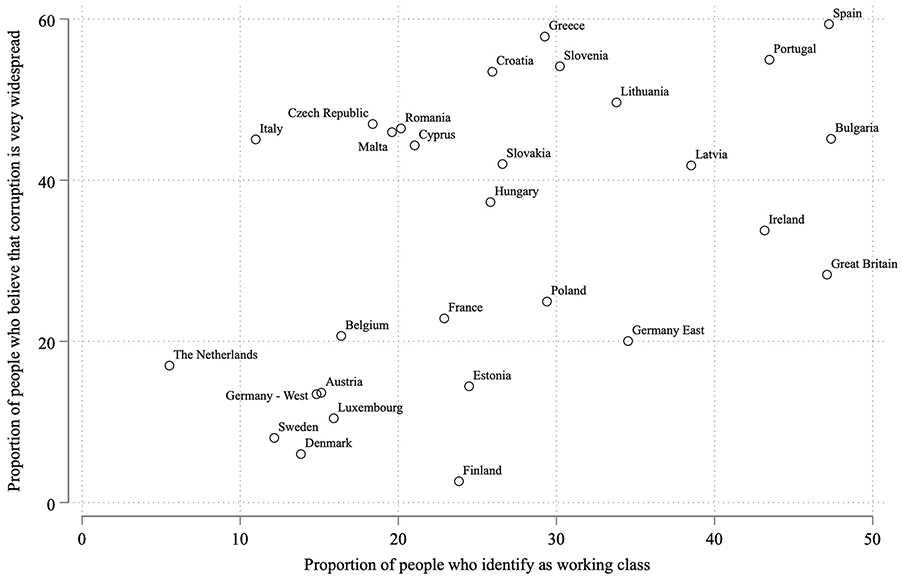
Corruption by working-class identity in European countries.
But is this association between corruption discourse and class identity consistent with the kind of political ontology described by our interlocutors? Their charges of corruption were not limited to specific instances of corrupt practices, but rather an invocation of a wider discourse which allowed them to make sense of, and pass judgement on, political matters. This has two implications for how class differences in perceptions of corruption should show up in these survey data. On the one hand, we would expect working-class people to be much more likely to say they believe corruption is widespread. On the other hand, we would not necessarily expect working-class people to disproportionately say they have in fact experienced or witnessed specific instances of corruption. If working-class people are more likely to think corruption is widespread even though they do not see more instances of corruption then this would provide strong support for our more systemic political ontology argument elaborated above.
We drill down to the individual-level in our survey data to explore these implications. Figure 2 then unpacks whether people who identify as working class are more likely to see corruption as widespread and to think it personally affects their lives. The patterns here are consistent with what we have suggested above. Nearly 40% of people who identify as working-class agree that ‘corruption is widespread’ compared to only 25% for those who identify as middle-class, a pattern which is consistent with the political ontology of corruption discourse described by our respondents.
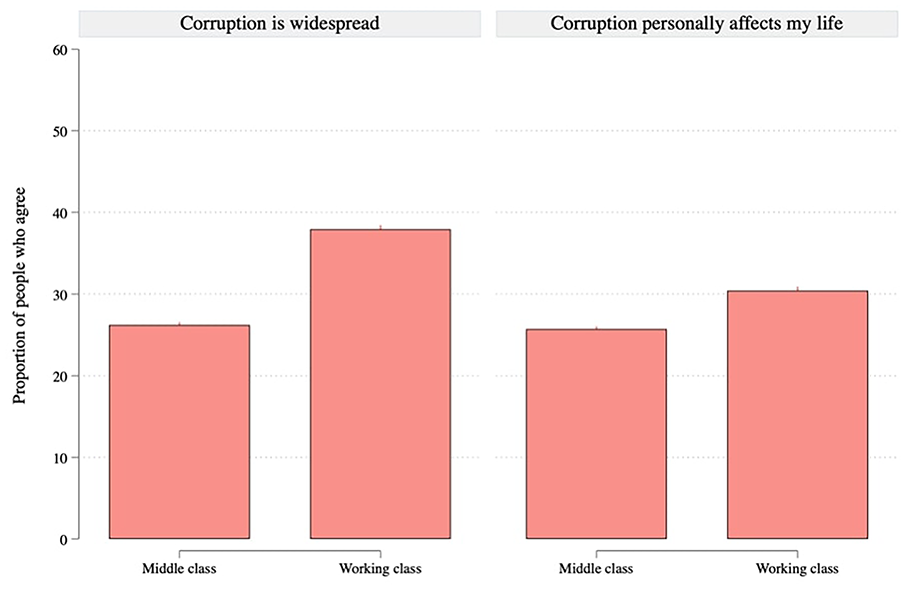
How widespread is corruption and effect on respondents’ personal lives.
The real test of our argument is whether there are class divides on the specific questions in the Eurobarometer concerned with personal experiences or witnessing of corruption and bribery in the previous 12 months. Figure 3 shows that people with lower incomes and fewer educational credentials do not perceive more corruption because they are more exposed to corrupt practices. Not only do few people report experiencing or witnessing corruption (fewer than 10% in all cases), but the class differences are very small – and it is middle-class people who are more likely to report experiencing actual bribery and corruption. The implication is that it is specifically corruption talk, rather than direct experiences of corruption, that are disproportionately associated with the working class.
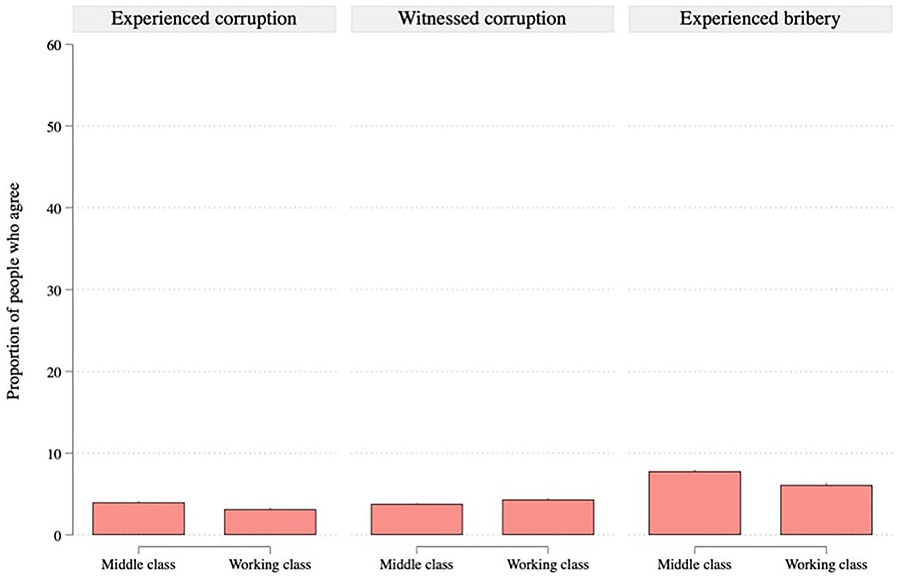
Personal experience of corruption.
We have shown that corruption talk is not simply derivative of the actual probability of witnessing such practices. Rather, it needs to be understood as a wider discursive formation. Working-class people reference corruption to diagnose the abuse of entrusted power, particularly in relation to a perceived lack of care on the part of the powerful. Read in this light, the survey data presented here suggest that the frame of corruption is a powerful and widespread mode of understanding imbalances in power and wealth, which cannot be reduced to the experience of corruption per se.
Conclusion
Our article insists on the need to place contemporary analysis in long-term historical perspective. An extensive historiography (Calhoun, 1994, 2012; Jones, 1983; Joyce, 1994) has demonstrated that in the early 19th and mid-19th century a rich vocabulary of political rights provided a mechanism around which forms of subaltern identities were forged. Here, we have applied a similar lens to the study of deindustrialised sites in which politicised class consciousness is widely thought to have receded. The three ex-industrial working-class communities which formed our field sites were once dependent on employment in manufacturing, steelmaking and mining. On the Oxford estate, daily life was determined by the rhythms of the car factory that had an intimate impact on daily sociality and relations. In Corby and Mansfield, locals recall an ebb and flow of steelworkers and miners respectively, who washed through the town at regular points throughout the day for mornings, afters and night shifts. With rich histories of trade unionism (e.g. Hayter & Harvey, 1993; Maunders, 1987; Taylor, 1972), these were historic hubs of working-class mobilisation, even if the present-day working class in each site is no longer engaged in industrial labour, but largely in service sector jobs, care work and logistics, alongside forms of non-employment.
In each of these sites, we analysed how current affairs and political developments are interpreted and narrated by our interlocutors through narratives of moral failure that foreground the trope of corruption. Pushing beyond narrow understandings of corruption as an abuse of public funds, and bolstered by the survey finding that corruption perceptions do not necessarily index corruption experiences, we argued that corruption talk needs to be taken seriously as a vernacular register through which working-class people relate to political life more broadly. It was a means of identifying their own stakes in a wider polity – in which they were excluded by insiders who could pull strings for their own benefit. As our quantitative section has shown, this correlates with class identification, as working-class people prove to be considerably more likely to perceive widespread corruption. While the cultural frame of corruption is not necessarily class-specific in any trans-historic sense, our analysis of survey data suggests that in our present moment it has particular purchase among the working class. There are historical parallels. For E. P. Thompson, corruption talk in the late 18th and 19th centuries was also an expression of a nascent class consciousness. Not directly addressing capitalist exploitation as such, it nonetheless drew attention to existential threats to ways of life. This same theme echoed across our field sites, where the complaint often is abandonment rather than exploitation. Although it sidestepped exploitation under capitalism per se, corruption talk nonetheless allowed solidarities to be identified through a differentiation from, and often opposition to, powerful individuals who are seen to be benefitting from the system, typically at the expense of others who are in greater need.
Understanding corruption as an alternative political ontology has broader implications. It questions a simple teleology of the decline of class consciousness in the past 50 years. Previous sociological research has argued that overt class identifications among working-class people have been on the decline. This has been referred to as the ‘mis-recognition’ of class and the ‘de-identification’ from overt class identities (Savage, 2015; Savage et al., 2001; Savage & Meersohn Schmidt, 2020; Skeggs, 1997). While we do not deny that such processes are at work, merely focusing on the absence or decline of class paints too stark a picture. Rather, our ethnographic findings, buttressed by quantitative data, lead us to argue that attention to class demands a fully historical and ethnographic sensibility in which careful attention is paid to the precise terms used in popular discourse. For E. P. Thompson, the terms and values which subaltern groups actually invoke need to be taken seriously: ‘we must see the crowd as it was, sui generis, with its own objectives, operating within the complex and delicate polarity of forces of its own context’ (Thompson, 1974, p. 398). Similarly, among our interlocutors, it is in the daily, mundane and often overlooked conversations about corruption that class consciousness and solidarity is articulated and expressed.
Identifying class solidarity in corruption talk is not to homogenise the working classes, nor is it to position corruption as an unproblematic political vernacular for progressive change. As the success of populist politicians demonstrates, corruption talk can be leveraged to further reactionary politics (Garrido, 2022; Muir & Gupta, 2018). In recent years, campaigns that draw on tropes of corruption have all too often taken on exclusionary forms, as corruption frames come to be concatenated with racist and xenophobic complaints. These narratives resonated with at least some of our interlocutors. Others were vehemently opposed to the racism, while identifying with the underlying diagnosis that ‘politicians don’t care’. The political and analytical challenge ahead lies in recuperating the radical potential implied in corruption talk for a solidarity across ethnic, racial, gendered and generational lines. Forging such solidarities requires, as E. P. Thompson argued, that we attend to vernacular political ontologies on their own terms.
Footnotes
Acknowledgements
We thank the editors and the two anonymous reviewers, whose comments were of great value.
Funding
The ethnographic work in Mansfield and Corby discussed in this paper was made possible by the generous support of the ESRC, award number 2098287. Initial work on the re-analysis was kindly supported by the University of St. Gallen.