




Abstract
Multiculturalism (MC) and interculturalism (IC) as approaches to governing ethnic diversity have developed an often antagonistic relationship, borne out through scholarly as well as political debates. Yet, increasingly, scholars have begun to note that while IC-consistent policies have gained some prominence, they have done so alongside MC policies. This suggests the possibility of complementarity between the two, and prominent scholars on both sides have also begun to stress complementarity. What this might look like, however, has not yet been well researched or developed. Focusing on the UK context, an important site in which debates between MC and IC have played out, this article aims to address this point of complementarity. It does so through an analysis of documents and interviews from civil society organisations who work in areas of integration, diversity and anti-discrimination at national and local levels. The article identifies four models of complementarity and shows the divergent and contested ways in which theoretical aspects of competing normative positions are combined empirically. In this way, it develops an argument for the continued centrality of MC for policy in these areas.
Introduction
In Western Europe, issues around integration and social cohesion in relation to ethnic and cultural diversity are never far from the headlines or policy concerns. Events such as the Black Lives Matter protests, Covid-19, asylum seeker and refugee arrivals, geopolitical events and the Euros have all prompted reflection on integration, inclusion and equality.
A central issue is ethno-cultural difference. Is it a problem to be overcome, a barrier to integration? Is it something positive, to be embraced and celebrated? Should it be overlooked in favour of what we have in common, or should it be the ground from which we build a more equitable sense of belonging? These issues have gained attention from a variety of scholarly positions, with the concept of integration itself contested (Spencer & Charsley, 2021). One key debate has been between two pro-diversity positions: multiculturalism (MC) and interculturalism (IC). Although critical interaction between the two can be found in different parts of the world, we focus on Western European debates as the most developed in the Anglophone literature, and take Britain as our empirical context. In this context, multiculturalism emphasises respect for and recognition of difference, the accommodation of groups as well as individuals, and a positive role for the national; interculturalism, by contrast, emphasises cross-cultural contact and mixing, what is shared or common, individuals, and the local level.
Debates between the two have especially centred around the contention that IC should or even has replaced MC as the dominant paradigm in relation to these questions. As a result, these have often appeared as oppositional, and antagonistic, positions. More recently, nascent calls for complementarity have emerged. Nevertheless, what this complementarity could or should look like has thus far been under-elaborated.
This article contributes to these calls for complementarity between MC and IC through an analysis of how the two are combined in practice, which it is argued is suggestive for how complementarity could be conceived. It first sets out the landscape of these debates. It notes in particular that theoretical arguments about what should be are closely related to arguments about what is; that is, MC and IC theorists seek to connect their theoretical positions with empirical realities. On this basis, assessing the positions of those who work in relation and response to the policy landscape is a fitting way to address more theoretical questions. This article goes on, therefore, to assess the complementarity between the two positions in bottom-up fashion. It asks how organisations engaged in ‘diversity work’ – that is, civil society organisations representing racial, ethnic, cultural or religious minorities, or working in the field of integration or anti-discrimination – conceive the current challenges, problems and what is needed to address them. From this the article outlines four alternative hybrid modes that represent analytical constructs of different forms of complementarity between MC and IC. This is suggestive of how complementary theoretical positions could develop, and the article concludes by suggesting what the main lessons might be in working through complementarity between MC and IC.
Multiculturalism and interculturalism
A general trend in debates between IC and MC is that IC has emerged as a reaction to and rejection of national state multiculturalisms. This can be seen across three politico-geographical contexts, and has gone hand in hand with rejection of scholarly theories of multiculturalism. Importantly though, conceptualisations of and debates between MC and IC have taken different shape and form in different contexts. In Latin America, ‘interculturalidad’ is more attentive to indigenous peoples and challenges state multiculturalism as a vestige of colonialism (Solano-Campos, 2016). In Quebec, IC emphasises language and developed to take greater account of Francophone culture, which although a majority in the region, forms a national minority in Canada. This ran contrary to Canadian multiculturalism’s ‘no majority culture’ principle (Bouchard, 2011, 2015; Taylor, 2012). In Europe, where multiculturalism has focused on ethno-cultural and ethno-religious minorities (Modood, 2007), IC has questioned a reliance on majority–minority dynamics, and focuses on individuals rather than groups. Highlighting the contextual and conceptual difference, one of the leading proponents of IC in Britain, Ted Cantle, criticises Bouchard’s conception of interculturalism as ‘a progressive variant of multiculturalism’ (2012, p. 141), as it maintains a majority–minority dualism. Bouchard likewise associates the key features of European IC with the Canadian MC he rejects, such as liberal individualism (Bouchard, 2011, p. 464). There are, thus, different MCs and ICs that reflect different theoretical and contextual concerns. A detailed examination of these differences remains beyond the scope of this article, but the point here highlights the need to specify the terms and context.
This article addresses the most sustained and developed debate between IC and MC, which has occurred in Western Europe. From the 2000s, multiculturalism was being called into question across Western Europe (see Vertovec & Wessendorf, 2010). Political leaders such as Angela Merkel, David Cameron and Nicolas Sarkozy, in a context of rising fears over Islamist extremism and expanding security agendas, all pronounced multiculturalism a failure, and a retrenchment of MC in favour of IC found purchase in policy. The Council of Europe’s 2008 White Paper on Intercultural Dialogue 1 commented that: ‘Whilst driven by benign intentions, multiculturalism is now seen by many as having fostered communal segregation and mutual incomprehension, as well as having contributed to the undermining of the rights of individuals – and, in particular, women – within minority communities, perceived as if these were single collective actors’ (p. 19).
In the UK, the Community Cohesion report (Cantle, 2001), carried out in response to disturbances and ethnic tensions in northern English cities, was an important turning point. The report pointed to social problems created by MC, most notably through the phrase ‘parallel lives’, and its findings and recommendations have been influential. The government’s flagship 2018 Integrated Communities Strategy 2 stated that ‘multiculturalism has too often encouraged communities to live separate lives – reinforcing distinct cultural identities to the detriment of efforts to draw attention to what we have in common – and is defunct’. Although the term interculturalism is entirely absent, IC’s emphasis on contact and mixing, and common values to address the problem of difference, are clearly apparent.
Multiculturalism was also increasingly challenged in the scholarly literature as a theoretical approach to managing diversity and integration. The author of the Community Cohesion report, Ted Cantle, became a strident advocate of IC against MC (see Cantle, 2005, 2012), and although such criticism came from different positions (e.g. Barry, 2002), interculturalists became prominent amongst them, pitching IC as a replacement paradigm. We identify and discuss five points in these scholarly debates highlighting the differences between MC and IC: identities, equality, integration, policy approach and levels of governance (see Table 1).
Comparing MC and IC.
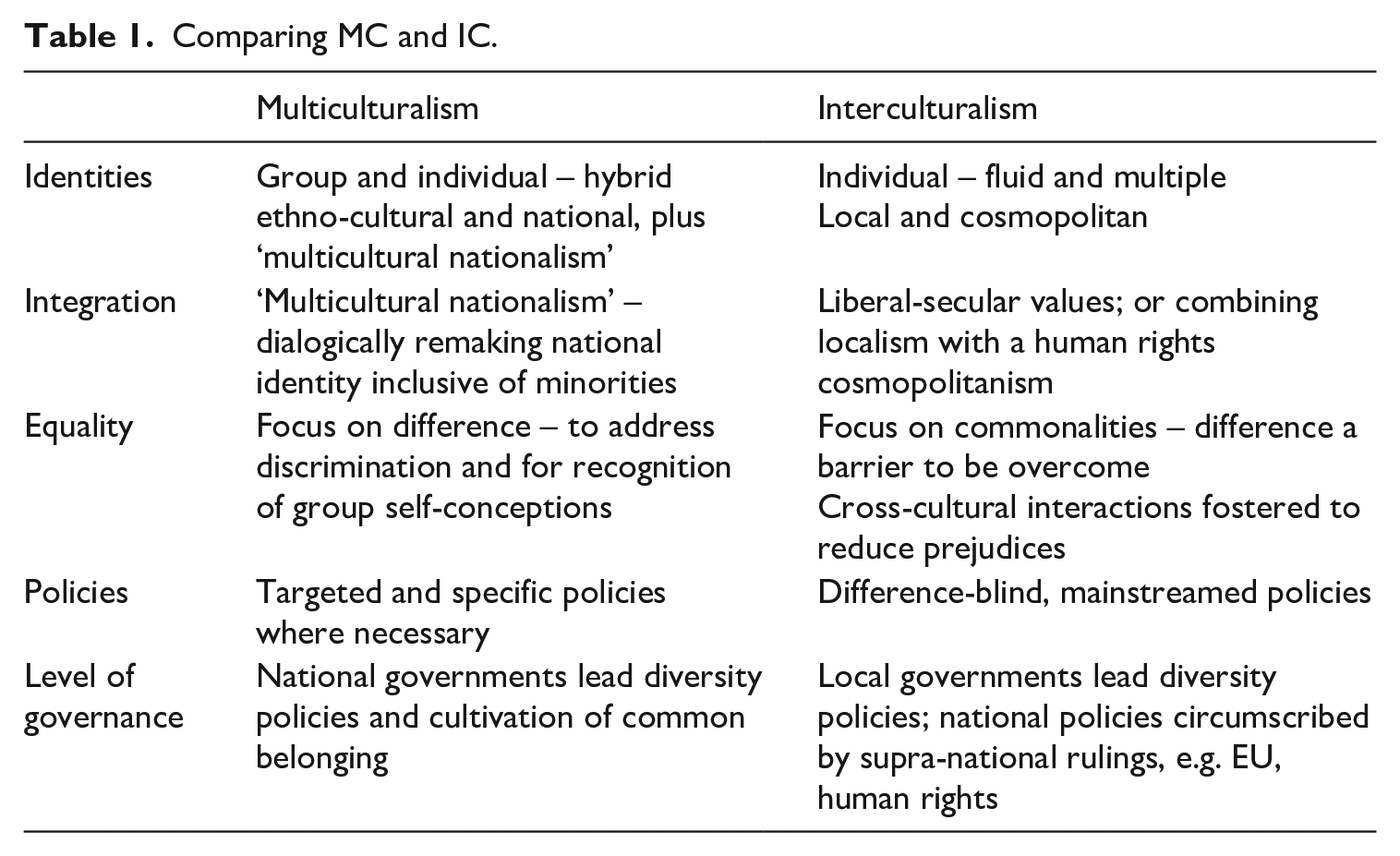
The first and underlying point is in relation to identities; Cantle in fact states that ‘the key difference between multiculturalism and interculturalism generally revolves around the way in which personal and collective identities are conceptualised and instrumentalised’ (Cantle, 2016, p. 140). At individual and group level, interculturalism is deeply sceptical of an identity politics seen to reify categorical singularities of ethno-cultural group identities against empirical multiplicities of fluid individual identities (Cantle, 2012, 2015). As a result, IC’s policy visions focus on mainstreaming policies applied to the whole population and equality of individuals. In this the emphasis falls on what should be held in common, to which a focus on difference is seen as a barrier (Cantle, 2015; Zapata-Barrero, 2019). Drawing on contact theory, interculturalism places an emphasis on cross-cultural mixing and contact to break down social distance (Cantle, 2015; Zapata-Barrero, 2019). IC also emphasises intercultural dialogue as key to achieving this, and has argued that multiculturalism dialogue is restricting in contrast to interculturalism’s openness and ability to promote ‘dangerous conversations’ (Cantle, 2016; Zapata-Barrero, 2017).
Multiculturalists, in turn, have defended MC against charges levied by IC, maintaining, for instance, that IC does not represent a new paradigm as claimed but in fact attacks a caricature of MC (Modood, 2017; also Sealy, 2018). They have averred that groups are legitimate and important units of analysis and that group targeted policies are appropriate and necessary. This is especially for addressing patterns of discrimination, but also for recognising identities that are central to people’s self-understanding. Against charges of groups as bounded, static and reified, Modood (2007, 2017) has drawn on Wittgenstein’s ‘family resemblance’ for a more flexible conception of groups and group membership. According to MC, equality which only focuses on individuals is insufficient. Interculturalism’s reliance on and conceptualising of contact theory has also come in for criticism for being superficial and unable to address patterns of ethnic inequalities, and work on ‘everyday multiculturalism’ calls into question IC’s ‘parallel lives’ thesis as well as the assumed positivity of contact (see Sealy, 2018). Multiculturalists have also pointed out that dialogue has been a foundational concept in MC, and is found in the work of all prominent MC thinkers (Modood, 2007; Parekh, 2000; Taylor, 1994).
A final point is also underpinned by the divergent theorising of identity, but simultaneously relates to levels of governance. Interculturalism emphasises the local, and especially the city, instead of, or even against, the national. At the same time, it bypasses the national in seeking to connect the local with the cosmopolitan and global in order to reflect contemporary conditions of superdiversity and more recent patterns of migration (Cantle, 2012). It seeks to free conceptual analysis from the ‘iron jacket’ of national identity and move beyond majority–minority dimensions (Zapata-Barrero, 2019). In contexts in which the national has remained a key component of political rhetoric around integration, as in ‘Fundamental British Values’ for instance, as well as vociferously employed by far-right groups, some scholars have made alternative lines of critique. One of these, not made by IC, seeks to dismantle the national not merely because it fails to reflect empirical realities but because it is irretrievably bound up with histories of colonialism and the racist exclusion of minorities (Leddy-Owen, 2019; Valluvan, 2019). Whereas these positions look to a post-national future with a focus on minority rights, other liberal strands have defended national identity as serving valuable goods (Miller, 1995) and even the legitimate consideration of majority as well as minority rights (Koopmans & Orgad, 2023). Multiculturalists, by contrast, treat with caution essentialist conceptions of national identity and rather point to the continued salience of the national. They seek to construct an inclusive national identity, a ‘multicultural nationalism’ (Modood, 2020), not least as this can be significant for minorities themselves (Antonsich, 2018).
Table 1 presents a summary of these points of contrast, points which underpin alternative policy approaches and recommendations (see Cantle, 2001; Commission on the Future of Multi-Ethnic Britain [CMEB], 2000). But what of complementarity? We might note in the first instance that both MC and IC are pro-diversity approaches oriented towards issues of social justice. In this, we can also see that both follow an approach to theorising informed by principles of contextual political theory or normative sociology; that is, they proceed through constructive (not simply deconstructive) engagement with bottom-up political concerns of citizens (rather than top-down, abstract theorisations) and the norms and goals operative in the socio-political context with which they are concerned (Modood, 2022). We might say that these features make them particularly apt for linked theoretical and policy concerns.
There are, nevertheless, two lines of disagreement, both on what does and what should exist.
There is not necessarily agreement amongst leading proponents of interculturalism as to what its relation to multiculturalism should be. Ted Cantle is more avidly anti-multiculturalism, which he sees as no longer fit for purpose, at best unnecessary and at worst translating into a dangerous policy agenda (Cantle, 2012, 2015, 2016). Zapata-Barrero, however, seems more ambivalent. IC is a new post-multiculturalism paradigm for managing diversity (2017), yet is also complementary to pre-existing MC – ‘contribut[ing] to renovate the original MC project’ (2018, p. 2), for instance – even at times couching IC as a pragmatic turn (2016) owing to MC’s failure to sufficiently consider majorities and multiple, fluid identities.
Multiculturalists also see that IC can complement MC, especially in adding a micro/everyday component to MC’s hitherto macro and national focus (Modood, 2018). Complementarity has recently been argued for, drawing from attitudinal data in Australia, along the view that IC can positively contribute to ‘the scope and value of MC’ (Mansouri & Modood, 2021, p. 4). Empirically, others have pointed out that community cohesion or interculturalism policies are in fact coterminous with multiculturalism policies (Dupont et al., 2023; Heath & Demireva, 2013; Mathieu, 2018; Thomas, 2011).
This being said, the issue of complementarity between the two is yet to be developed and elaborated, and it is shedding light on this emerging area of focus with which this article is concerned. Given that disagreements between the two are often based on a different view of what is as significant for thinking about what should be, the remaining sections turn to the question of what complementarity looks like ‘on the ground’. Beginning with the views and positions of civil society organisations involved in relevant work will be suggestive of the more theoretical complementarity between MC and IC.
Methodology
This article draws on data from a range of civil society organisations – NGOs and charities – operating in the area of racial/ethnic/religious diversity and integration/anti-discrimination. Working in these areas these organisations all engage critically with ideas and policies, which they variously seek to influence, offset and help shape through their publications, activities and engagement with policy consultations, partnerships with government departments and so on. They thus form a particularly interesting and important site for thinking about the questions raised in this article.
The sample included a mix of organisations working at national as well as local levels (in Bristol and London). There were two main sources of data. The first was a systematic analysis of documents produced between 2010 and 2020, including research and issue-based reports and submissions to government policy consultations available on the organisations’ websites. The second was a series of interviews with representatives of these organisations. The interviews were conducted in 2021, where questions elicited views on diversity-related social and political issues, problems and challenges, and how these should be addressed. The interviews themselves were conducted via Zoom, owing to the Covid-19 pandemic, and were typically around an hour in length. The documents and interviews were analysed thematically along the lines of the dimensions in Table 1 to draw out how features of multiculturalism and interculturalism appeared and what kinds of relationships emerged between the two. The rest of this article draws from a narrower range of the full sample (see Table 2).
Civil society organisations referenced.
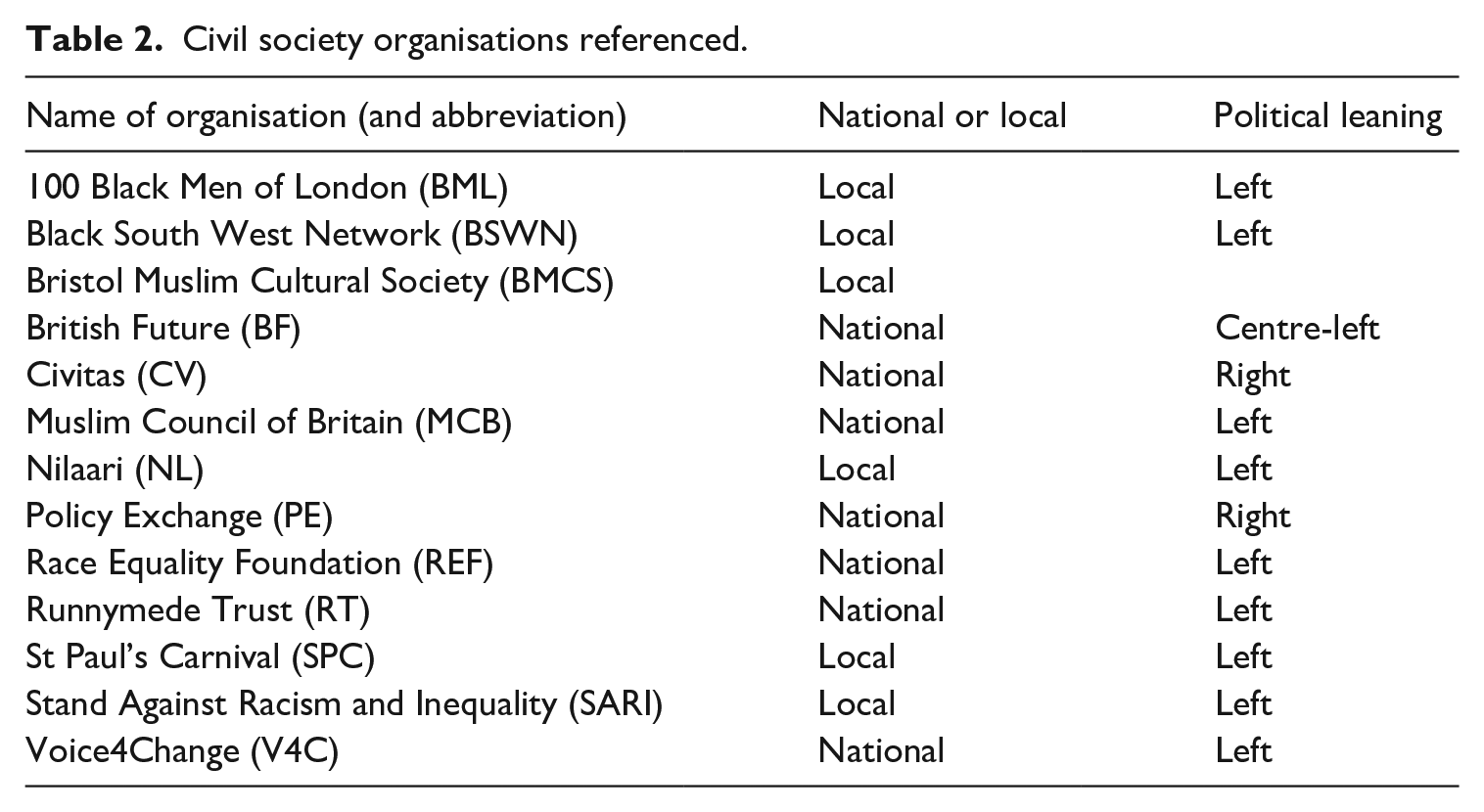
A quick note on the referencing of the empirical material drawn on is also necessary here for clarity. Where the reference is to an interview, the initials of the relevant organisation are given in brackets. Where the reference is to a document produced by an organisation, initials indicating the organisation and document title are given along with the date of publication and these correspond to references listed at the end of the article.
Multiculturalism and interculturalism in practice
While both MC and IC can be said to follow principles of normative sociology, as scholarly theoretical positions neither simply reproduces a construction of what exists in policy or amongst civil society actors. And as we have also seen, they disagree on matters of what is and what ought to be. Similarly, civil society organisations are oriented by related yet contrasting critical interpretations of the policy landscape and by different normative responses to it (whether explicitly or more implicitly), and as a result hold alternative visions for policy. Yet, as representing norms and goals ‘on the ground’, they provide a pertinent way of assessing the purchase of MC and IC, with implications for theorising their complementarity.
We now turn to elaborate modes of complementarity between multiculturalism and interculturalism from our data analysis and assess the potential complementarity between the two in practice. Findings suggest that rather than necessary antagonism, policy advocacy from civil society organisations more often combines MC and IC in various ways. This section outlines four models of complementarity, relating them to the distinguishing points summarised in Table 1. These are: principled multiculturalism, principled interculturalism, pragmatic multiculturalism and pragmatic interculturalism. As an initial broad distinction, the first two, or ‘principled’ models, are closer to more fully MC or IC approaches with the addition of some elements of the other. The second two, ‘pragmatic’ models, are couched in either MC or IC but in a more substantially qualifying or hybrid way in relation to the other (see summary in Table 3).
Comparing hybrid modes.
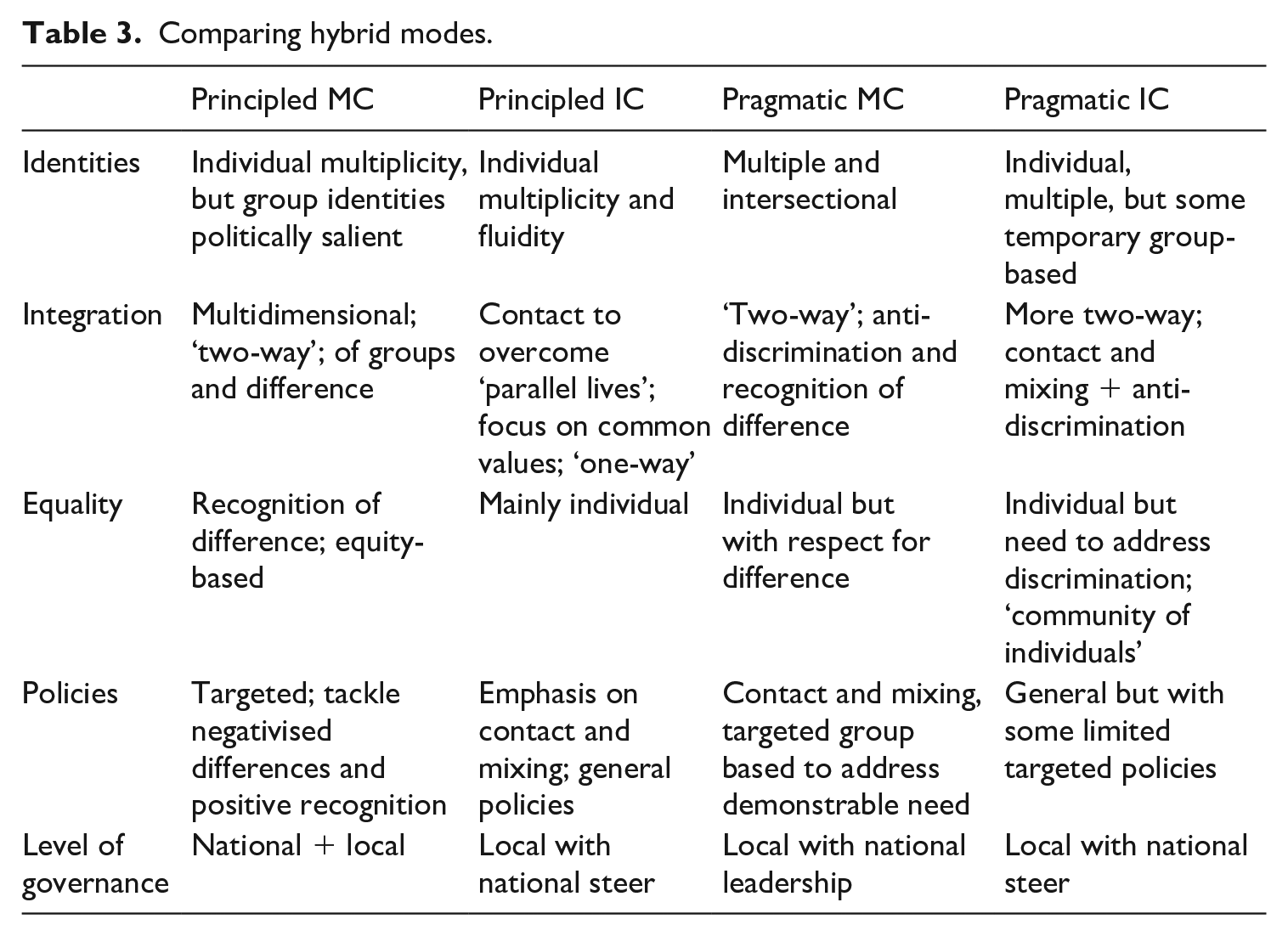
None of the organisations in Table 2 are necessarily a perfect fit for any one type, nor do they identify their own positions as multiculturalist or interculturalist in these terms. These models are analytical constructs rather than neatly mapping onto specific empirical examples, although some organisations better approximate one model rather than another. In this sense the models help to bring order to what can otherwise seem more disparate positions found amongst civil society groups, and also illustrate the matter of complementarity that theorists are becoming concerned with. The following subsections first outline the broad characteristics of each model, and then elaborate these against the points in Table 1 and drawing on the empirical material.
Principled multiculturalism
The first variation is broadly multiculturalist in emphasis and orientation but adds to it some elements of IC. It preserves the importance of difference between ethnic, cultural and faith communities whilst developing a sense of multicultural nationhood inclusive of these differences. It adds to this the need for contact and mixing between people of different ethnicities and faiths and a simultaneous emphasis on what is held in common if it is to be successful.
The multiple identities of individuals are far from denied or avoided, and the interview with the MCB stressed how identities have shifted generationally in this direction. Yet, at a political level, cultural and religious identities should not be hidden, but be publicly recognised, including striving towards greater representation of ethnic diversity across policy areas (MCB; RT), underpinned by the recognition that these identities can be central to people’s self-understanding and ‘fundamental aspects of their lives’ (RT), and so cannot themselves be ‘miniaturised’. There is a need to focus on common aspirations, but also to recognise that difference makes communities stronger (RT), reflecting the view of the Parekh report and its phrase of seeing Britain as ‘a community of communities’ (CMEB, 2000). The insistence that greater account must be taken of religious identities (MCBGE, 2019; MCBICSR, 2018; RT) also reflects a feature of MC absent or treated with great caution by IC.
Following on from this, an understanding of equality that reflects recognition of difference and the need for an equity-based understanding is emphasised. Moreover, even where intersectional equalities and multiple identities are recognised, there remains an emphasis on ethno-cultural and ethno-religious categories as key factors affecting people’s life chances that cannot be denied or ignored, and in fact should be foregrounded (RT). A focus on community cohesion is seen as desirable, but this is unachievable without ‘addressing the underlying causes of inequality’ (MCBGE, 2019), and institutional discrimination is a key factor here (MCB; RT). For Muslim organisations there is also the extra problem of a lack of political will and recognition by the Conservative government when it comes to Islamophobia (MCBBBT, 2016; also Dearden, 2021).
Integration here is seen as living cohesively and equitably across differences, where difference is important to maintain in view as part of developing belonging, and fostered by cross-ethno-cultural dialogue, and the importance of an inclusive national discourse was stressed (MCB). It is very much a two-way street. The notion of integration was called into question, emphasising how it is not appropriate to apply the notion of integration to 2nd/3rd/4th generations, who are ‘well past integration’ (RT), thus strongly emphasising the need for diverse and multidirectional ways of thinking about and building belonging that move past minoritising ethnic minorities. A further criticism expressed by the BSWN was that the language of integration as it exists in government policy, with a more one-way emphasis on minority integration, effectively sidelines issues of systemic racism. Some point out that talk of ‘British Values’ has developed not as a way to emphasise inclusion but to mark out a contrast with some ethnic minorities, notably Muslims, seen, in part at least, not to hold these values. Moreover, they insist that dialogue should be guided by and built around developing cross-cultural understanding rather than the integration of minorities into a particular set of values (BSWN).
The promotion of contact, mixing and interaction is regarded as important and desirable to build a sense of shared citizenship (RTDS, 2011), and some organisations highlight successful programmes of this kind, such as the ‘Visit My Mosque Day’ initiated by the MCB (MCBBBT, 2016). Yet there is also caution that the onus of this should not fall only or primarily on minorities, a criticism of existing policy conceptions (RT; MCB). Moreover, policies of mixing are seen as an addition to fundamental equality concerns, rather than representing these concerns, and are bound to fail unless underpinned by substantive equality measures (RT; MCB).
Generic or mainstreamed policies alone are seen as likely to fail and so more specific and targeted policies are needed to address structural issues of discrimination and disadvantage, or those such as poverty which are seen in important ways as linked to discrimination and disadvantage, as well as a lack of representation (RTWPRE, 2010), and also to ensure that services are culturally appropriate and accessible (MCB; RT; BSWN). A range of measures that would both tackle discrimination and promote recognition are strongly emphasised here across policy areas. An example can be seen in relation to education, where the MCB would like to see greater engagement with communities, greater acknowledgement of a diverse range of holidays and festivals, provisions for specific dietary requirements, provision made for pupils fasting (during Ramadan for instance), and measures such as sharia compliant finance for student loans (MCBGE, 2019). Another issue addressed is the need for a better understanding of connected histories, through which the contributions of minorities to Britain would be included, such as those who fought in the Second World War or the role of Muslims in Britain’s national history. Similar policies of accommodation and inclusion are also stressed in relation to the labour market, highlighting the danger that without robust and targeted measures, equal opportunities and diversity measures and policies become superficial tick box exercises and do not translate into culturally different workplaces (RTEDT, 2010; MCBGE, 2019; BSWN; RT). In these ways the emphasis falls more on cultural rights and the recognition of difference and diversity, rather than cultural differences as barriers. On political participation also, the issue and importance of identity politics is raised on the basis that for those ‘that feel discriminated against on the grounds of their national or ethnic identity, these identities can usefully become a platform to pursue their rights’ (RTNMBB, 2010). This thus represents a call for something akin to a multicultural nationalism rather than a post- or anti- conception of the national.
This general positive valuing of targeted policies comes alongside caution that they can also be stigmatising. But here there is a clear distinction between policies aimed at the accommodation and inclusion of ethnic minorities and with clear anti-discrimination ends, and policies which negatively target particular groups, the prime example here being the way Prevent and anti-extremism policies have operated (MCB). The main object in the emphases so far in this section is that they would also help minorities feel part of Britain and pride in being British as well as help develop inclusive conceptions of citizenship and the national story (MCBMI, 2018). These views on (in)equality and policies put a strong emphasis on both the negative (anti-discrimination) and positive (recognition) aspects of MC (see for example CMEB, 2000; Modood, 2007).
On governance levels, there is a strong emphasis on the importance of a national steer and narrative, led by central government, albeit at times as a direct criticism of the government’s failure to provide this. The national, then, is central and responsible for ensuring that an inclusive narrative and set of policies is followed at local levels. The call here, with normative implications, is not to do away with the national if the ruling government is failing in this regard, but to continue to fight for a conception of the national level on inclusive grounds and terms. The IC addition here is that local authorities are given the scope to adapt and tailor national policies and measures to suit their areas. State policies and actions are seen to ‘set the tone’ and context in which (in)equalities occur and manifest. What is more often at issue is not calls to do away with or bypass the national in favour of the local but to ensure that the national is steering in inclusive directions and that the relationship between national and local is effective. From this position the local is seen more critically, rather than as the answer or in a more romanticised sense against the national, and caution is offered (especially aimed at the localism agenda and Localism Act 2011) of how IC style measures have entrenched rather than challenged and addressed structural inequalities including at local levels (at which they can vary), and may in fact work against addressing these inequalities (RTLTO, 2010; RT).
Principled interculturalism
The second model is the mirror image of the above. It accepts the principles of IC and is consistent in terms of problems and solutions, and can be expressed in ways directly critical of MC. There are, nevertheless, some MC consistent additions that are not features of IC as articulated by theorists.
There is a strong emphasis on the multiplicity and fluidity of identities, and the dynamism of culture (V4C; PE). A representative from V4C exemplified this with Emma Raducanu: 3 ‘In the last week we’ve had a British tennis player of Chinese and Romanian background come to represent the best of British sporting identity, so go figure.’ This is not necessarily to disavow the kind of hybrid identities focused on in MC, however, although ‘the question is in a way the balance between the sort of Britishness bit and the Muslim bit or the black bit or the whatever’ (PE). Here, hybrid identity formations are fine, but the British part must be emphasised as the main orientation point for belonging and the other more of a heritage indicator. Moreover, there is great scepticism about the role of the state vis-a-vis minority identities: ‘there is a role for the state to protect cultures from being discriminated’, but this does not extend to the type of positive recognition advocated by MC as this is in tension with minority cultures being seen as dynamic and ‘a matter of personal choice’ (V4C). Equality, thus, is principally conceived in individual terms, and developing national commonality, over and even against ethnic difference.
On integration, problems of ‘parallel lives’, resulting in ‘cultural gulfs’ (PE), are referred to as underlying issues in need of redress, often in reference to Muslims in particular, but also to minority religious identities more generally: ‘a lot of more traditionally minded, piously religious Muslims probably particularly but also, I guess sort of Sikhs and Hindus, you know. Less so I guess with the Christian ethnic minority people but certainly with non-Christian religions [and especially] the more pious amongst them’ (PE). Parallel lives are also seen as a significant problem for developing common (liberal) values and the acceptance of social norms, which ‘some groups you know resist, some groups push back against common social norms, perhaps particularly more liberal ones . . . some of the greatest hostility to it comes from traditional Muslims and perhaps to a lesser extent, Hindus and Sikhs’ (PE). An emphasis is therefore placed on gaining wide acceptance of common social values and norms in order to avoid a divided society. This is not to suggest that there are definite and set norms; they ‘ha[ve] to remain a bit fuzzy and a bit of a grey area’, but, nevertheless, ‘you could sort of produce a list of 5 or 10 cultural norms that are generally an accepted part of British life’ and to which minorities should adhere (PE). A notable aspect of this is that learning English should be mandatory. This is not uncommon across a variety of positions, although the emphasis in this model tends to place the greater burden on minorities themselves rather than the state, although with some state support especially initially (see especially CVPAI, 2017).
The direction of integration here is posited in more one-way terms, with an onus on minorities to integrate into ‘British’ values and norms. Furthermore, there is also weight given to the concerns of the majority as well as minorities (reflecting critiques from IC of MC), particularly for older generations ‘who ha[ve] seen [their] local environment change over the course of [their] lifetime and[are] experiencing loss’. This needs due consideration alongside minorities standing up for their rights (V4C). The principal focus for integration is around values and ideas rather than factors and barriers associated with discrimination, or labour market and socio-economic positions. The model is also directly critical of a MC approach, which it sees as having created problems by ‘elevating cultural differences to a new level’ (V4C). However well-intentioned, ‘the conscious drive in order to celebrate identity and cultural difference has had the opposite effect of now creating cultural tensions between different groupings that didn’t exist in the past’ (V4C).
In order to overcome prejudice and address discrimination, then, there is a strong emphasis on policies of contact and mixing as ‘a sort of general principle [which should be] in the back of the mind of [policy makers] . . . it should be one of the goals of public authorities to promote mixing between ethnic groups and between ethnic groups and the majority’ (PE). Yet it is also acknowledged that this is ‘not a simple answer; contact can actually make relationships worse’. In this we can see a criticism of the reliance of IC on a superficial version of contact theory, for example, ‘when people say, “oh well contact theory says you know, let’s just have more contact”. It [contact theory] doesn’t say that at all, I mean it almost says the opposite actually’ (PE). So while contact and mixing are emphasised, what is just as important is how this is done to ensure the result is a more cohesive society.
These policies, furthermore, should be mainstreamed rather than targeted at specific groups (PE). The view is that although issues such as lack of integration by ethnicity are identified along group categorical lines, group targeted policies are in fact unnecessary, and undesirable. They are undesirable both on grounds of liberal sensibilities of not wanting to single out groups, and because it is politically better to not single out groups, either in the positive sense of group recognition (as in MC), or for the negative reason of stigmatisation and potential backlash. In this sense the model echoes the emphasis on the ‘pragmatic’ arguments for IC (Zapata-Barrero, 2019). Policies targeted by ethnicity are seen as unnecessary because mainstreamed policies of mixing and common values would automatically have the effect of targeting the specific areas and groups where these are issues. Policies can be targeted at specific policy areas (socio-economic disparity, for example), or even geographical areas (given unevenness of outcomes and so on), and this will have the effect of indirectly tackling problems that have in fact been identified along ethnic lines but without explicitly targeting ethnic groups themselves.
On governance levels, there is a general emphasis on the local, but this is also an aspect where more critical views vis-a-vis IC, and the need for an additional national orientation that is more consistent with MC, are apparent. In general, the position is one where local and national governments have to give stronger steers to mixing and preventing segregation, and not to leave it to laissez faire encounters and conviviality (PE; CVPAI, 2017). One policy proposal reflecting this is an integration index, such as the index of dissimilarity, that could work in different spheres (such as schools and housing) and indicate where policies need a greater push (PE). We might see it as IC with nation-state leadership, in contrast to IC theorists who think the national state should keep out of it and let local solutions sort it out.
Pragmatic multiculturalism
‘Pragmatic multiculturalism’ takes seriously challenges and points of principled multiculturalism, but carves out a more middle ground position. Importantly, and what distinguishes it from pragmatic interculturalism (see below), is that although features of interculturalism are seen as extremely important, and more centrally so than principled multiculturalism, they are also seen as inadequate and ineffective if not underpinned by more substantive approaches to equality consistent with multiculturalism.
On identity, in many ways the emphasis here is closer to IC, highlighting multiple and intersectional identities, and notably, multiple intersectional identities; beyond ethnicity and gender, for example. There is greater ambivalence on hybrid, hyphenated identities (SPC). These can be positive when they are important for people, but should reflect the mixity and complexity of identities and a national civic identity should be cultivated to which all can belong (no matter which part or parts of their identity they wish to highlight), without fragmenting into a series of national+ categories, but with the national at its heart (BF).
On equality, it is more cautious of strong statements about group rights as found in MC, but with a significant feature: its underlying premises can be said to be more multiculturalist than interculturalist. That is, there is a stronger sense of the need to recognise and respect difference as a fundamental way in which equality is thought about. Institutional discrimination is highlighted as in need of redress, and ethnic disparities in this vein are pointed to as being revealed by the Covid-19 pandemic (SPC; BF). Nevertheless, while difference is to be respected, there is a need to strike a balance with commonality, the ‘social glue’ (SPC), and be aware of the potential to sow division if difference is emphasised too much.
Integration is very much understood as a two-way street. As one report puts it: ‘If integration is not about everybody, it is not integration’ (BFNRLR, 2017, p. 5). Interculturalist emphases of integration into common values are important, but equally they are bound to fail if not substantively underpinned by thicker multiculturalist sensibilities and policies when it comes to identifying and addressing discrimination and positive recognition. Going beyond a state-centred view, or majority–minority orientation, the model also emphasises ‘a broader civic ownership of integration’ (BFNRLR, 2017, p. 4) that includes stakeholders and groups across different areas of civil society, business and the public. A key point is ensuring that policymakers’ engagement with civil society properly reflects the pluralism of all ethnic and faith communities and that this can positively impact integration and social cohesion by promoting plurality and mainstream acceptance (BFICSR, 2018; MCBICSR, 2018).
Targeted policies for specific groups are viewed as fine as long as they are underpinned by data clearly demonstrating their need and a lack of equality (BF; SPC), which is a kind of cautious MC position. It is right for the state to support cultural identities, and difference is a positive force to be celebrated and better represented in holidays and festivals – people should be ‘out and proud’ (SARI) about their identities and be able to bring these through publicly and resist assimilation if they wish. Such support though needs to be balanced against a caution of over-emphasising difference. Contact and mixing are highlighted as necessary and important, including an onus on the majority. The government should create the conditions for this through policies (BF) as without mixing it is difficult to develop empathy and understanding of other people’s lived experience (SPC).
On levels of governance, the local is certainly emphasised as centrally important, and policies that are not in some way developed and adapted locally are seen as doomed to fail: the national is ‘too blunt a tool to be effective’ (SPC) on its own. There is, on the one hand then, great potential in localism and devolved policy design and implementation, and a strong onus is therefore placed on local authorities to provide leadership on norms of behaviour, champion diversity and address discrimination in ways that meet the needs of different areas in genuine consultation with local communities (BFICSR, 2018; BFMCM, 2016; BFNRLR, 2017). If integration is to be successful, however, it is stressed that central government also needs to provide strong leadership and strategic vision (BFICSR, 2018). Importantly, this vision needs to be backed up with resources (BF; SPC). It is highlighted, for example, that local authorities have been hampered by heavy budget cuts. As one report puts it: ‘Integration is a national priority that requires local action to deliver it – but sustained and visible leadership from national government are essential if momentum is to be maintained’ (BFNRLR, 2017).
Pragmatic interculturalism
The fourth model, pragmatic interculturalism, is the mirror image of the above. This adopts a broadly IC stance, but is qualified in significant ways (and ways that some interculturalists would reject) by multicultural emphases, even if in the short- to mid-term with the ultimate goal of moving beyond them. It thus doesn’t reject MC in the way IC theorists do, and sees MC in a more limited sense as a necessary means to IC ends. It might identify social problems on more MC grounds, but offer policy solutions more consistent with IC, and/or with a more IC goal. This is perhaps the model that has the most ambivalence associated with it in terms of how this dynamic was expressed.
On identity, there is a certain ambivalence of, on the one hand, the importance of cultural identity, and on the other hand, identity as fluid and multiple (NL). Cultural differences should be respected and celebrated with a view to gaining better understanding of one another (BML), yet this is a more limited type of MC identity as ethnic and cultural categories are seen as more important in identifying patterns of discrimination and for identifying a lack of inclusion, but not necessarily the right basis of positive forms of recognition in the way MC would emphasise. It is for example, ‘until we’re able to eliminate that discrimination, we will have to keep identifying it and talking about it and identifying how we address it’ (REF, emphasis added). Moreover, there is a caution over ‘identity politics’, which can cause division (REF; NL; BML). As with principled IC, and IC theorists, there is great caution over religious identities. For 100 Black Men of London, for instance, religion should be dropped as divisive: ‘Let’s just do away with the religion thing and focus on cultures and I think we will then have a better space where people find themselves in that Britishness or whatever expression that looks like.’ There is less reticence than IC over invoking the national as an identity category, as long as it is inclusive, but consistent with IC there is also an emphasis on a more cosmopolitan sense of identity, and one that looks past difference to identify what is shared on the basis of humanity.
Achieving a sense of community as individuals is the goal of equality. Yet, this position, as the others above, is strongly anti-discrimination and the focus on commonality and looking past difference is tempered by the fact that some feel their culture is ‘under threat’. As a result, it is necessary to identify and address discrimination along group lines until a more cosmopolitan vision becomes feasible.
Integration, then, is seen in somewhat ambivalent terms. For example, on the one hand, it is about ‘how well you assimilate from a cultural perspective to the cultural norms, whatever those are, in the society that you are in’, but a key question also is ‘can I be comfortable in my own skin in this space that I’m in, whatever that space is?’ (BML). On the whole, it is a more two-way street, often coming out in a certain reluctance to use the term ‘integration’. As one organisation put it, for instance, ‘The language of belonging is preferrable to integration as it suggests something needs to change on the part of the host community as well and that racial discrimination is a problem to be dealt with’ (REF). While the issue of parallel lives is accepted to a certain degree, the blame for this is more likely to include factors such as discrimination (NL; BML) alongside others such as ‘inter-group suspicions’ (BML).
On policies there is a focus on meeting diverse needs on service delivery, but with a longer term aim that specialist services will disappear as mainstream ones become inclusive enough (NL). There is a particular caution around targeted services and policies, which are generally seen as stigmatising (NL), although with an acknowledged need to reach out to minorities and encourage greater involvement and representation to address disparities (NL). There is also a view that the way in which racism is thought about and addressed needs to be one which cuts across ethnic groups and highlights the ‘collective experience of racism’, rather than identifying different forms of racism (REF). Contact and mixing are emphasised, but, as above, along with caution over simplistic readings of contact theory of the kind interculturalists have been accused. On the whole, some short-/mid-term MC type policies are seen as necessary, especially for anti-discrimination aims, but with a view that these will ultimately be overcome and rendered unnecessary, and mainstream policies will be sufficient.
On a governance level, central government has a vital role, as with all four models here, in setting and steering an inclusive narrative. There is also, however, a strong caution against the involvement and interference of the state when it comes to values and social norms (V4C).
Concluding discussion
This article has sought to investigate the under-researched matter of complementarity between MC and IC, focusing on how this plays out through the views and work of civil society organisations operating in areas relevant to issues of integration, anti-racism and ethno-cultural diversity. In so doing, it has identified and elaborated four analytical models of complementarity suggestive in relation to scholarly theoretical debates. There are four main points we can highlight in concluding this discussion.
Firstly, these four models suggest that complementarity is not only feasible, but is already occurring, and that there is a necessity for MC and IC to pursue complementarity if they are to remain relevant theoretical positions able to constructively contribute to the socio-political world in which they operate. To fail to do so risks obsolescence with regard to their normative sociological orientations.
Secondly, political debates between MC and IC, even with complementarity at their heart, might not necessarily bridge the divide between the two. There appears scope to maintain an emphasis on one over the other. MC is clearly alive and well and IC clearly not a viable alternative paradigm that can simply do away with MC. MC and IC are mutually sustaining in important ways. A further point to note is that although organisations on the political right are more likely to lean to IC, those on the left are more mixed, and so there is no simple political binarism across these modes.
Thirdly, whilst the four models suggest the political prevalence and relevance of complementarity, they are more ambivalent about how this should look. We might though draw out a further argument in relation to complementarity, syntheses or hybrids. What the discussions of the four models point to is the necessity of MC remaining central; on balance, there seems to be sufficient cause to come down on the MC side of the debate, albeit with the need for it to integrate IC elements more systematically into its framework. The main reasons for this are that when we look at the four models, MC seems more able to include IC elements than the other way around. Focuses on the local and on features such as contact and mixing are not antithetical to MC, even if it has neglected them. The importance of commonality and unity, and the importance of individual rights, are also not antithetical, and are indeed features of MC, even if conceived differently and not as emphatically as in IC. Difference is not just something to overcome in relation to patterns of racism, but the importance of identities for positive self-conception and recognition is clearly evident. There is scope then to suggest that some of the core IC elements emphasised are, or can be, conceived in ways consistent with MC. It is more difficult to see how the critical points emphasised in the models above vis-a-vis IC tarry with core IC assumptions. Contact is emphasised, but only critically and it is noted that without an underlying equality, contact cannot succeed. This calls into question one of the central foundations of IC. To cite a critic of MC defending it against IC, ‘if one of the two terms is to be retained, it should be “multiculturalism”, because of its stubborn justice instincts’ (Joppke, 2018). This is found wanting in IC and comes through within three of our four models (the exception being principled IC). Moreover, whereas in the IC models the local is emphasised, and to an extent the global, the national retains a central importance (particularly in the endorsement of ‘national values’ or cultivation of national belonging), calling into question another of IC’s fundamental tenets. Although this might remain a matter of some contention, the continued salience of the national, especially for minorities and some of the most influential anti-racist organisations in the country, suggests that a ‘multicultural nationalism’ remains a worthwhile political endeavour deserving of theoretical attention.
Inevitably, in coming to a synthesis between MC and IC a decision needs to be made about which should lead, which should provide the fundamental and orienting bases for how we think about matters of equality, inclusion and integration on which policies and narratives will be built. MC and IC theorists will, we can reasonably expect, start with their preferred mode. The evidence of this article suggests, however, that, on balance, MC may prove the better guide, and IC the companion.
Finally, and with this last point in mind, the findings discussed here suggest the necessity of a contextual approach. We noted at the outset, albeit briefly, differences in global contexts in how MC and IC are conceived and relate to one another. And our empirical focus on Britain itself exemplifies the significance of contextual care and clarity. If complementarity between MC and IC is to be pursued, as we believe it should, this must be so with attention to contextualised understandings and dynamics. While this will necessarily be the focus of future research, the international debates that are already a feature of this literature can only benefit.
Footnotes
Acknowledgements
We would like to thank the anonymous reviewers and editors for their comments on earlier versions of the article, and Geoff Brahm Levey and Varun Uberoi, who read and commented on an early draft. We would also like to thank all research participants and our colleagues on the PLURISPACE project, under which this work was done: Riva Kastoryano, Jon Erik Fossum, Ricard Zapata-Barrero, Zenia Hellgren, Alexander Gamst Page and Luana Rocha.
Funding
This work was funded by Humanities in the European Research Area (HERA) through the project PLURISPACE: Negotiating Diversity in Expanded European Public Spaces (HERA.2.057).