



Abstract
What Really Counts? was a sound art installation created in 2019 through a collaboration between a sociologist and a multidisciplinary artist, working with in-depth interviews with young men recorded as part of a British feminist social research project in 1990, exploring sexualities and the threat of HIV/AIDS. In this article, we describe the evolution and staging of the sound art installation project, situating it within interdisciplinary literatures on the use of sociological archives and reanimation of analogue media in a digital age. Working within a fractured tradition of curated sociology, we consider the potential of interdisciplinary collaboration for refreshing sociological analytic practice, revealing the unrealised potential of archived data sets and utilising temporal displacement as a generative analytic strategy for feeling history. We are working with a 30-year time span characterised by a stretching of intergenerational experience in relation to expectations for and mediation of sex/gender. The project attempts to realise the potential for an experimental sociological practice through the staging of open-ended past–present encounters.
Introduction
This article presents an example of collaborative creative practice in the form of a sound art installation working with an archived collection of social science research interviews, collected in 1990 and digitised, mediated and represented in 2020. The first part of the article locates this experiment in the reanimation of data within relevant literatures, including work on the secondary analysis of qualitative social research, sociological writings on working with archives and the use of sound within social and historical research traditions including the creation of sound art installations. The design and key creative decisions involved in making the installation are then shared, with the specific insights afforded by this unusual approach to ‘analysis’ both identified and discussed. The final part of the article explores how the approach might be characterised and located within a wider methodological landscape, including the dividends and challenges involved in collaborations between arts and social science practice. Questions of ethics and how the team engaged with both care and risk in the pursuit of innovation are discussed throughout the article.
The inspiration for the work shared in this article comes from the feminist conceptual artist Susan Hiller’s 2000 work Witness, which alerted Rachel to the creative potential of an archive of voices, the kind of archive that, as a sociologist, she has been responsible for collecting and caring for. As an artist who began as an anthropologist, Hiller’s work repeatedly touches on practices of collecting, curating and representation that connect and distinguish the methods of social scientists and artists (Kenrick, 1994). Hiller’s work is concerned with the mundane, the neglected and the ridiculed, and unusually for a conceptual artist she begins her projects with material artefacts (postcards, stories, memorabilia, street signs) rather than abstract ideas. She is interested in collective experience and the struggle to express what seems to be beyond language in a shared situation constrained by culture, technology and discourse. The piece that arrested Rachel’s attention, Witness, brings together audio recordings of people describing ‘contemporary visionary experiences’, sharing the recordings through a forest of hanging speakers. Sound files are organised in cycles, providing the listener with an experience that moves through a cacophony of voices from different speakers to a synchronised single story that can be heard in unison, before returning to singular stories that require individual attention. When engaging with the piece at a retrospective of Hiller’s work at the Tate Gallery in 2011, Rachel imagined how this form could be used to experience the kind of verbatim accounts of sexual experience that she has documented in her research practice. She felt that the format would allow listeners to move from many diverse and conflicting accounts of awkward and disappointing sexual encounters to a transcendent account of pleasure that would overwhelm the listener, delivering an experience that gestured to the exchange of inner and outer sensation described. This commitment to finding the right medium through which to communicate a concept is a motif of Hiller’s work, and one which was clearly communicated through Witness. Seven years later, Rachel found the opportunity to put this intention into practice, a project that inevitably strayed from the original inspiration, yet which is presented here as an homage to Susan Hiller, who sadly died in 2019 – around the time that we first staged the sound installation What Really Counts?
Sociological archives and time displacement
As a discipline, sociology is responsible for the generation of important qualitative archives that, since the adoption of tape and digital audio recording devices, include significant collections of interviews. As Niamh Moore and others have noted, sociology has an ambivalent relationship with its archives, often focusing on ethical and epistemological obstacles to re-use. In particular, they argue that ‘against commitments to care for research participants, the traces of research – interview transcripts, audio files, video, images, or material objects, and so on – which are also the traces of participants, appear as some of the “neglected things” of research projects’ (Moore et al., 2021, p. 183). While oral historians have experimented with creative ways of animating testimonies (Jolly, 2015), such creative explorations continue to be rare within sociology. Puwar and Sharma trace a ‘fractured legacy’ of a ‘curating sociology’, which involves ‘repurposing methods’ and can constitute ‘innovation in the research process itself’ (2012, p. 45). They characterise a curating sociology as working in cross-disciplinary collaboration with artists, and involving ‘processual participatory activities engendering new practices, new meanings values and relations between things’ (2012, p. 43). In their own multi-media installation, Noise of the Past, they show how a curating sociology can be ‘an intervening methodology’ involving ‘explicit research questions that can be critically transformed into aesthetic practices’ (p. 58), with ‘research ideas and concerns’ ‘vitalized and invested with affective force beyond a sociology bound by its disciplinary conventions’ (p. 59). A curating sociology can involve generative cycles whereby aesthetic practices prompt new research questions and vice versa.
In this article, we locate ourselves within a curating sociological tradition in order to share a methodological strategy aimed at disjointing time. Our approach builds on theoretical resources from queer and cultural theory, as well as practical incitements from media archaeology, feminist archiving practice and experimental music (particularly electroacoustic traditions). Archives and data sets can be read against as well as with the grain, informing us about what collectors found important and what they wished to leave out (Stoler, 2010). Engaging with archives can evoke a sensation of time travel (Steedman, 2002), and of haunting, as we sense absences and the lost potential of alternative futures (Blackman, 2019; Gordon, 2008; Portelli, 1988). The ‘re-use’ and ‘revisiting’ of research materials means working ‘at a temporal remove’ (Hughes et al., 2022), producing analytic dividends through practices of recontextualisation and reconnection. We have witnessed how digital methodologies bring archives to the centre of both popular and academic cultural practice – what Eichhorn calls ‘archival proximity’ (Eichhorn, 2013). For Fisher, this proximity is associated with time breakdowns – moments when time seems to be ‘out of joint’ – experienced through anachronism (‘the slippage of discrete time periods into one another’) and a sense of the uncanny experienced through the degradation of materialised memory (for example, through the crackle and hiss of analogue media) (Fisher, 2014, p. 5). Following Freeman, our project deliberately set out to create mimetic connections between past and present that would conjure a sense of ‘chronotopic disjunctiveness’ (2010, p. 6) that ‘unsituates viewers from the present tense they think they know’ (p. 61). These time binds involve both connection and displacement, a ‘method of literally feeling the historical’ (p. 93), ‘suturing two times but leaving both visible’ (p. 69).
Mediated temporalities
The work discussed in this article was one in a series of experiments that formed part of a research project called ‘Reanimating Data: Experiments with People, Places and Archives’ funded by the Economic and Social Research Council through a programme called Transformative Social Science. 1 The project created a new digital archive, securing and sharing the documents of a landmark feminist social research project, undertaken between 1988 and1990 (Thomson, 2020), exploring young people’s sexual cultures and life histories. The overall aim was to show how archival social science could be a source of methodological innovation; and, for this particular experiment, the aim was to explore the value of working with archived sounds. Although the original intention had been to work with recorded interviews with young women, it transpired that only the interviews with young men could be located. Thus, this collection of in-depth tape-recorded interviews, conducted in 1990 by researchers Janet Holland, Tim Rhodes and Sue Sharpe, formed the primary data set for this work, with Janet acting as consultant and contributor. The overall project was a collaboration between sociologist Rachel Thomson and multidisciplinary artist Alex Peverett, with support from research assistants Isaac Thomson and Alex Jacobs, whose insights and responses to the material were an important part of the undertaking.
The original data were collected in 1990 on the understanding that participant contributions would be anonymous in any publication. In working with this material, we undertook for the new work to keep within the terms of these original consents. We did not attempt to contact original research participants to renegotiate consent, but did operate a take-down policy for the archival and reanimating work – undertaking to remove data on request. We worked in partnership with members of the original research team, offering them the opportunity to review and redact material from the interviews as part of the archiving process. In the generation of new documentation, we offered all participants the opportunity to be anonymous as well as respecting their right to author their own contributions. 2 The project is informed by an engagement with ethical practice in oral history and social science and the ambition to make a contribution to new ethical thinking that is emerging in the fields of community archiving, secondary data analysis and historical sociology (Flinn, 2011; Hughes & Tarrant, 2020; McLeod & O’Connor, 2020; Moore et al., 2021).
The first stage of the work involved the digitisation of 30-year-old tape recordings. This was painstaking work, involving some disappointment once the considerable damage to the recordings became apparent. Initial attempts were made to enhance the quality of the digital recordings, yet we also became interested in the ways in which the deterioration of the original media was itself part of the data record (Kane, 2019; Stuart, 2003). Here, Alex was able to engage us with a tradition within avant-garde music that includes the work of William Basinski, who deliberately explored and exploited tape degradation as a part of his Disintegration Loops (2002/3) – a process that he discovered while transferring his recordings to digital formats – and Alvin Lucier’s I Am Sitting In a Room (1969), which involved repeatedly re-recording his voice within a room, gradually destroying and replacing voice with the resonant properties of the space. The degradation that we faced was not deliberate, but rather the stamp and legacy of time that confronted us with both care (the tapes were saved) as well as benign neglect (recordings were laid over earlier recordings and media were stored without understanding of preservation). These examples, and related practice, draw our attention to the potential for opening conceptual space between what was recorded and the media on which it was recorded, and potentially adjusting the balance between these.
The transition from analogue to digital media has brought with it new theorising on temporal materialities. One resource for this is Carolyn Kane’s work on ‘glitch, noise and aesthetic failure’ which explores how musicians and media archaeologists revive zombie media (‘obsolete or marginalized forms’) as a way of exploring ‘multiple nonlinear temporalities’. For Kane, the ‘aesthetic of failure’ is valuable precisely because it provides ‘a crucial reminder of the past we continue to create in the present’ (2019, p. 183). In a similar vein, Wolfgang Ernst (2016) offers the concept of sonicity to capture ‘where time and technology meet’. For Ernst, a ‘recording does not take place in historical time but is a time operation itself’. Writing within a sociological tradition, Lisa Adkins makes a similar argument about old data (such as that held within the Mass Observation Archive), suggesting that ‘the capacities of recorded data itself’ can contribute to an ‘account that allows time itself to emerge as a key object of investigation’ (2017, p. 117). For our project, this means accepting the white noise of the deteriorating tapes, understanding that the quality of a recording listened to 30 years after creation not only communicates how a voice and ferrous tape once came together, but also how they have coexisted over time. This is not something that stops with the archived object. Ernst observes that the act of digitisation is a new moment of storage and documentation – once archived and digitised, ‘recursions fold time and thus enable direct contact between points and events’ – and ‘frozen voices, confined to long-forgotten storage media, wait for techno-algorithmic unfreezing’ (Ernst, 2016, p. 117).
We were fascinated by these ideas in several ways. First, we experienced an affective and ethical connection with the material, agreeing with Moore and colleagues that ‘it is not always necessary to have been “there” to care’; rather, ‘the “there” has moved – it is possible to be there in the archive and build connections that are meaningful and real’ (Moore et al., 2021, p. 191). In digitising these 30-year-old interviews, we create new material, ethical and aesthetic relationships with the interviewees that include questions of confidentiality. While contemporary digital recordings of voice operate as bio-markers capturing the unique identity of the speaker, the distorted voices from the archive have a more oblique relationship to identity. The distorted recordings not only guard against unwanted automated data linkage (effectively anonymising the material), but also demand new ethical labours as we struggle to ‘listen in’ to the voices of the past (Lacey, 2013). In seeking to better hear the words of the young men, we utilised transcripts and the automated voice of the computer, rearticulating words that were no longer comprehensible. We also revoiced the material ourselves, including the questions asked by original researchers (revoiced by the researcher, 30 years older) and the answers provided by young men in 1990 (revoiced by young men of the same age in 2019). Through these acts of ventriloquism (McGeeney et al., 2018) we forged emotional time binds between past and present. Not only do these new recordings alert listeners to the different qualities of analogue and digital documentation and the materialities of mediated time, but the experience of speaking verbatim texts generates insights and productive disquiet for participants.
Uncoupling questions and answers
An early creative decision involved looking critically at the questions asked in the archived interviews, as well as the answers provided. One lesson drawn from the small body of work with sociological archives has been that the questions asked by researchers may be especially revealing in terms of the historical juncture that frames a research project – for example, Mike Savage has explored how sociologists of the post-war period construct social class through the questions that they pose to research subjects, whose responses are more ambivalent than the published research might convey (Savage, 2007). We were interested to look again at the questions asked of young (heterosexual) men by feminist researchers in the 1990s, to decontextualise them and make them strange and to pose them to contemporary audiences as a way of conveying and revealing something about what may (or may not) have shifted over this time period. By disconnecting questions and answers, we also hoped to bring the research process itself into view as a historical artefact. Free floating questions, in both crisp digital and muddy analogue form, would form part of a conversation with listeners in which they might answer the questions themselves or dismiss them as intrusive or impossible. Examples of extracted questions are included in Figure 1.
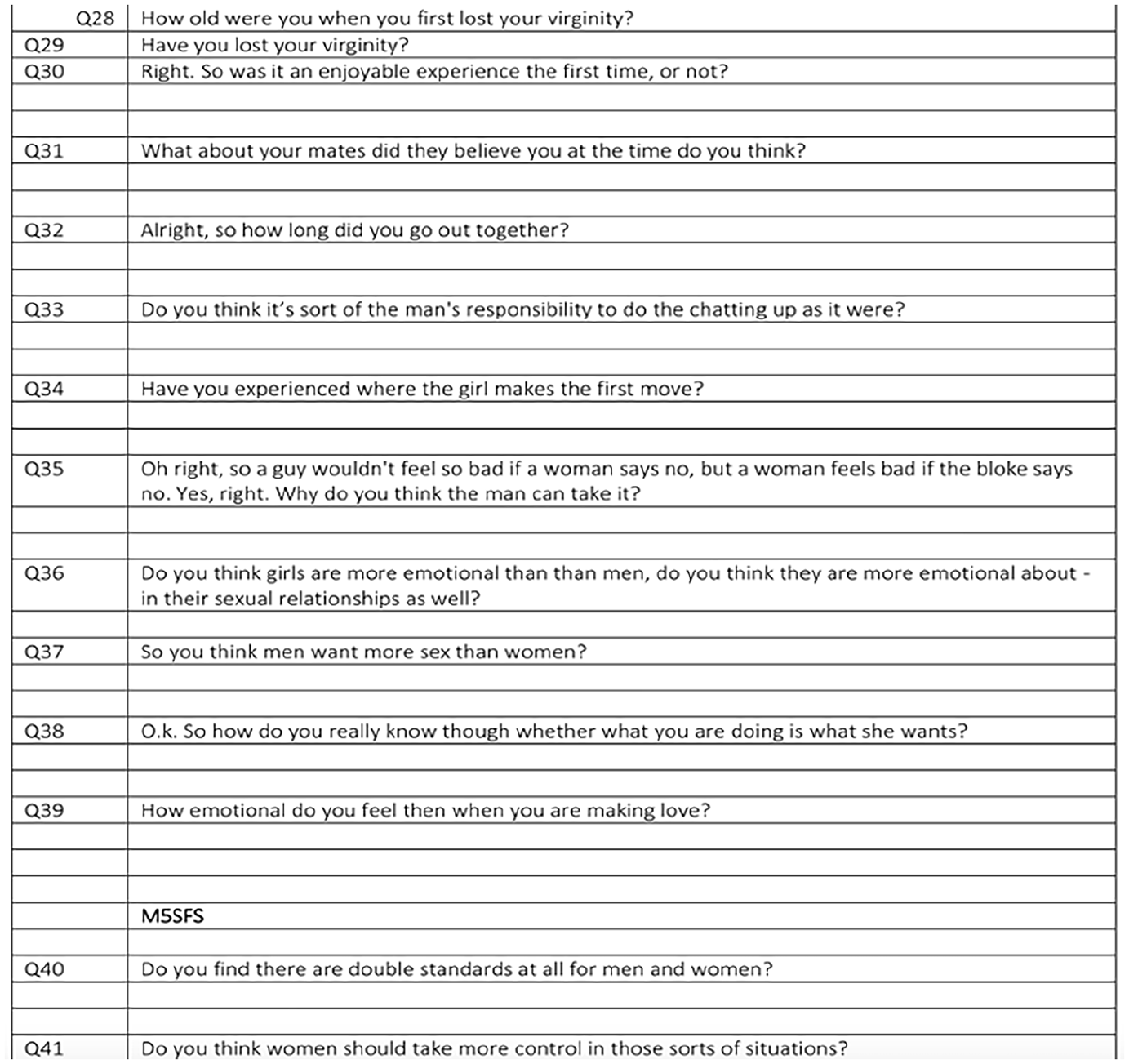
Isolating questions.
Working in this way with questions and answers involves a call and response relationship with listeners that situates them in different kinds of alignment with the original interviewees, exposing the tension of temporal distance and using temporal displacement to gain a sense of multiple perspectives, different distances and a range of possible engagements or tracks between source and spectator. This process of shifting perspectives also involved us as curators as we engaged with sources in different ways through the creative process of making the installation.
Counting and value
Our approach to this work was guided by an interest in the relationship between numbers and more affective forms of ‘value’ that may be expressed or found in interviews through different approaches to analysis (what is it that we find valuable or important in the material). This focus has involved a meditation on the divide between qualitative and quantitative approaches and the transcendence of this binary promised by the digital. Our working title for the sound installation, What Really Counts?, signals this concern, and we have tried to explore the question methodologically (in terms of number and quantity) as well as in terms of the substantive content of the talk – what is important, or meaningful. Initially, we conceptualised this in terms of movement between close (qualitative) and distant (quantitative) readings of the material made available through digital methods.
By starting with numbers and the formal qualities of the talk in both transcribed and sonic form, we wondered whether we might discover something rather different in the data than was looked for and found by the original research team (in which Rachel includes herself). The process that we followed was roughly as follows. First, a selection of interviews was made from the bigger archive (n = 11/50), ensuring that in all cases we had access both to recordings and transcripts. The material was explored through text analytic software (Voyant), presenting a quantitative ‘distant reading’ perspective that identified the most commonly used words and phrases. We also used these methods to identify the longest passages of talk – the ‘stories’ reflecting what young men wanted to talk about and what mattered to them. This number-driven approach to the formal qualities of the text is quite distinct from Alex’s experience of working with abstract sonic and visual material or Rachel’s understanding of concept-driven thematic approaches to analysis that would normally characterise a qualitative analysis (including the original analysis of the material; Holland et al., 1993). In particular, the attention we paid to the extended passages of speech re-sensitised us to the perspectives of the young men, encouraging us to think again about how they might have understood the interview encounter and to notice the stories they were interested in telling. Importantly, by working in this way we accessed them as storytellers rather than as people answering provoking questions, allowing us to attend to the material in a new way.
As a listening project, we were affected by the material we were working with. More used to working with abstract sonic and visual materials, Alex began the process of working with the interviews with caution, concerned that the original conversations and life stories should not be used in an exploitative way and travelling between relating emotionally to what was being said (recognising himself as a teenage boy at the time of the original interview), while also seeking to work with the recordings as material in a very impersonal way. He reflects: . . . a part of this was to deny myself the option to make the work poetic or cinematic in an emotionally manipulative way. The intent was not to create sensation, spectacle or to provoke emotional responses, but to present the content of the interviews in a variety of neutral ways, allowing audiences to create their own emotional, personal, impersonal ties with the material. For this reason, there was no musical elements added to the work, but the material was sometimes dealt with in a manner akin to the abstract nature of instrumental music composition. The approach was focused not on creating an artistic interpretation of the archive but in finding a way to allow the archive to speak again.
The social relations of the analysis were also shaped by the collaborators, for whom ethical questions around how we engaged and represented this material were especially acute, capturing the importance of our distinct generational locations as listeners and curators. For example, Isaac, who revoiced material, noted how some of the accounts could easily have been told by a young person such as himself today, while at the same time recoiling from attitudes and allusions that firmly located the material in the past. As part of the original research team Rachel was familiar with the material and the context of its production. She took the lead with exploring the interviews qualitatively, with sections of the talk identified on the basis of being meaningful, profound, moving, surprising or pleasing. This included the selection of talk by interviewers as well as interviewees, questions and answers. In Figure 2, we include illustrations of the two dimensions of this analysis, including counts of particular words and an example of uninterrupted speech.
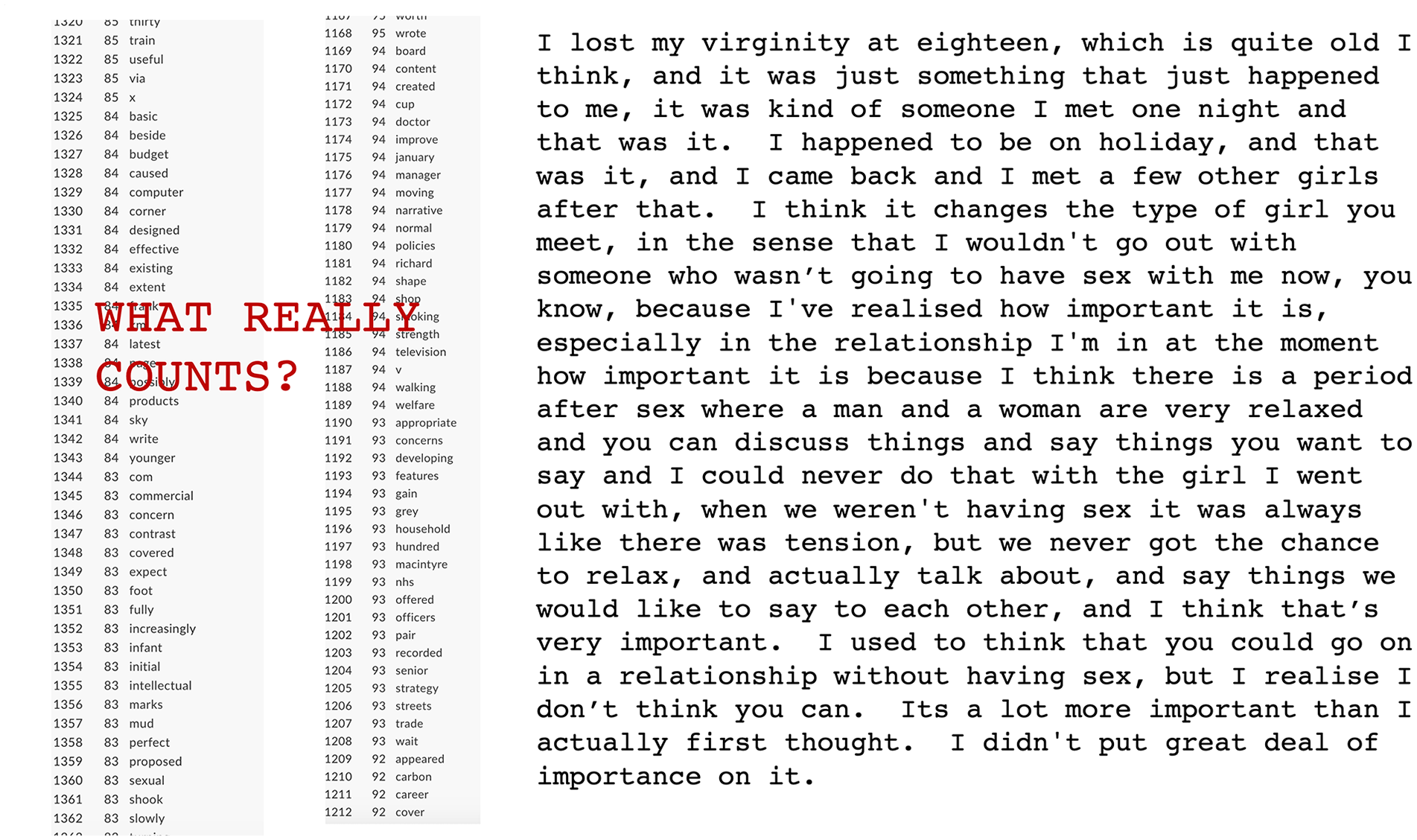
What really counts.
Our focus on numbers also included an interest in time and displacements of time. We gleaned the interview materials for discussions of waiting, the duration of relationships, the importance of age and references to the passage of time in terms of perceived social changes. In making this selection, we drew on our own perceptions of time displacement, for example selecting material that located the interviews firmly in the past, such as references to obsolete media or forms of intimacy connected to these (e.g. discussions of using a landline telephone and the difficulty of maintaining privacy when conversations could be overheard by family). By noticing time in the material, we tried to connect the ‘now’ of our work with the ‘then’ of the interviews, allowing for temporal disjunction and connection.
Sculpting, staging and reception
The selected extracts were made into a new archive within the creative coding language software Max/MSP. The algorithm was designed to select material from the archive to be played in changing sequences. We designed three cycles of material: the first focusing on questions asked by interviewers (including original and new recordings), the second on uninterrupted stories and the third on number-talk in various forms, including mentions of time, size and age. This structured corpus of material was then subject to an algorithm that shaped the selection and juxtaposition of the content, utilising basic randomness as distinct from the Markov-weighted randomness which would have prevented repetitions. These decisions reflected the self-imposed emotional distancing approach that Alex took to treating the material and his question as to whether there could be a ‘second language’ available in treating the material in this way, as music as well as extracts of spoken words (De Marinis, 1991). The decision to work with multichannel monophonic, rather than other forms of pluriphonic audio, was that the audio streams were fixed, and this, as is usually the case when sound artists opt for multichannel monophonic, gives the audience agency to navigate the work themselves.
The work was staged in a mass of ferric tape, spread across a floor with speakers embedded within. We wanted to ensure that the materiality of tape was present in the work, but we also were drawn to the beauty and reflective potentialities of the material, which, when piled on the floor and lit with changing colours, took on a mysterious physicality, like a body or landmass seen from above (Figure 3). Arranging the installation and the speakers on the ground demanded that the audience bend down, listen in, and move around the installation. We wanted to show that listening into the past required effort, and that communication is disrupted by the fragility of the ageing media, while also transcended by digital solutions such as the occasional use of the automated voice as part of the cycle. The multichannel monophonic sound design meant that sound moved around the installation, inviting audiences to crouch and get close, and although material would be repeated, the algorithm ensured an infinite variety of sequence and form and constant temporal displacement.
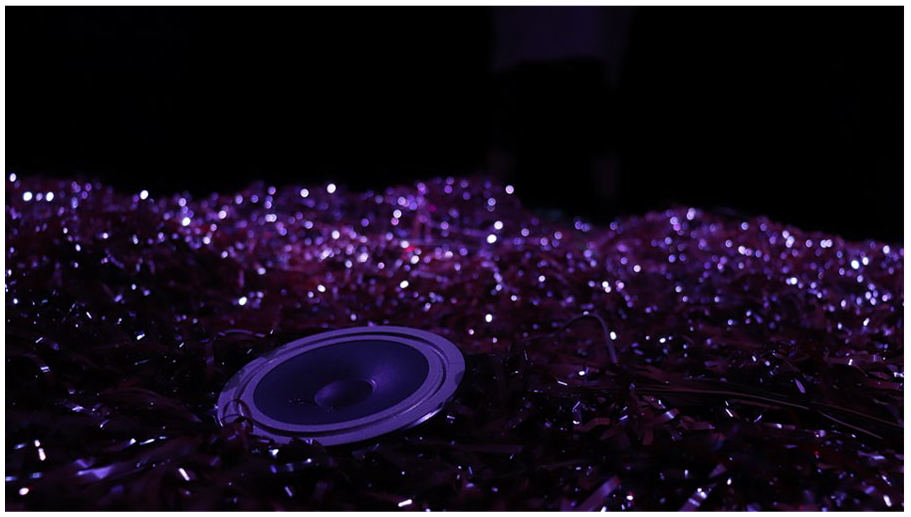
The staging of the installation.
The sculptural form of the island of inactive tape and speakers created a frame for re-presenting the original and recreated materials, enabling lightly guided yet undirected perspectives. Our strategies for disjointing time formed a vital part of the creative process of making the installation as well as characterising the final piece, which opens and closes different time windows through which the audience feels that they are perceiving the spoken words. This is an experimental method that engages in reanimation rather than reinterpretation. In an important way, we wanted to know whether this material could have a new relevance, not simply to our understandings of the past but also the future. It is this final aspect of the work that demands an audience.
The sound installation was staged twice, at the University of Sussex as part of Brighton Digital Festival 3 and the University of Edinburgh as part of a workshop on Reanimating Data. Audiences responded to the piece with excitement – moved by the sometimes distant and sometimes close voices of the young men, surprised by the questions of the researchers and filled with nostalgia in the face of so much beautiful, redundant media.
Haunted data and analytic dividends
In his manifesto for a Live Sociology, Les Back details the deadening methodological practices that turn talk into transcription: Quotations are extracted for meaningful inspection from the live contexts from which they emerge in the first place. They become epitaphs to a life passed in living. The challenge is how to find ways to represent such lives and objects that sustain rather than foreclose their vitality and ongoing life. (2012a, p. 21)
By going back to original recordings and resuscitating these with the benefit of digital sound engineering, we might claim to ‘reanimate’ these data in ways that honour the contribution of the interviewees. Yet our approach is not a critique of the text-based research methods that framed the original enquiry. We are exploring the particular qualities of ageing sonic material and how time itself can be invited into an analytic and creative process, amplifying ethical, epistemological and aesthetic registers. By asking new questions, engaging with the passage of time and involving new interlocutors, we can encounter each other and our archival traces anew. Rather than objectifying the contributions of the young men to the original study, we see this as involving what Moore et al. describe as a multiplication and proliferation of the social relations of the research process (Moore et al., 2021). In contrast to transcribed texts, sound recordings provide an illusory sensibility of ‘being there’, encouraging potent affective connections (Back, 2012b), while the degraded sound quality reminds us of the ‘inherent pastness of sound (the fact that all sound is always already gone) and its continuous unfolding in the here and now (the fact that all physical sound is heard in the present)’ (Kromhout, 2020, p. 29). Perhaps one contribution of our work is to complicate the rather romantic notions of ‘liveliness’ that can flood sociological discourse. Instead, we prise apart simplistic binaries of alive/dead, old/new, with recorded voices standing in as traces of people no longer accessible, yet existing as ‘more than texts’, ‘ethically vulnerable’ and materially fragile (Tamboukou, 2020). The invitation to stage encounters with and through archives, creating connections and windows between past, present and future, may itself help sociology out of a stuck place in relation to its own archives.
Through an attention to time, number, counting and the medium of the recordings and their transposition into digital formats with associated affordances, it becomes possible to locate and reveal a research endeavour itself as an artefact from the past that is in conversation with the present, for the future. We might think of this as a kind of ‘thick present’ described by Koselleck (2004), underpinned by a web of past–present–future relations which in turn are facilitated by generations of media and generations of researchers in conversation. The sound installation was one of a series of experiments, staged first for ourselves as part of a process of discovery within a larger project, but also made open to wider audiences as part of a digital festival and a project event. Both times we staged the work, audiences engaged enthusiastically, commenting on the pleasure of intensive listening and the uncanny feelings brought about by the temporal displacements generated in the work. The installation was highly influential in our own creative process, shaping how we went on to develop the reanimating data method, captured here by one team member who was also a member of the audience: What stood out to me as I listened to the installation were the questions. Taken out of the context of the interview they sound blunt and obtrusive, making the sociological ‘sex’ research interview strange as you reflect on what it is possible to ask and say in this public/private space. Listening to the installation I was also interested in the interplay between deliberate and random selection. Rachel had been through the MRAP data and coded it, carefully selecting questions to re-voice and material to include in the installation. But what the viewer hears at any time is selected at random by the algorithm that Alex created. There are chunks of data that come round cyclically but as a listener you are never sure what question or answer you might hear next and whether it will be Janet from 2019 that will speak or Janet from 1991. (McGeeney, September 2020)
But what about the sex?
The What Really Counts? sound installation worked with traces and multiple kinds of connections to the young men who generously shared their thoughts and experiences with researchers in 1990 about personal and intimate relationships, about sex, love and communication. Our reanimation of this material focused on number, value and time. We are left wondering how it has been possible to make and share the installation, and to write about it, without engaging with the fleshy substance of sex. In asking this question we also return to the inspiration for the project, Susan Hiller’s Witness, which conveyed a sensation of transcendence as inside and outside met through the synchronisation of inner and outer voices. For Rachel, this was a sexual metaphor, encouraging her to think about how the sound design could carry stories of sexual pleasure. The journey that we subsequently went on was generative, but it did not realise this aspect of the original vision and we are interested to think about why this is. Perhaps the project became deconstructive rather than integrative, with questions separated from answers, past juxtaposed with the present and form dominating over content? In What Really Counts? traces are recognised as much for the media affordances that they embody and the music that they make as for the interpretations that they suggest. There is something liberating in encountering the archive in this way, decontexualising and recomposing with the help of machines. This does not negate the humanity of the research participants but enables us to encounter them in a novel way, and one that arguably amplifies, rather than minimises, the value of their contributions. But what happens if we also connect with the intimacies shared?
In her discussion of the cultural figures of the New Man and New Lad, Ros Gill (2003) reflects on how difficult it is to relate discursively formed figures in the media with the empirical realities of men’s lives. Cultural figures can be read from media texts and operate as prescriptions – invocations of ‘how to be’ that are informed by competing ideas and discourses. Lived masculinities, in contrast, are more subtle, situated and contradictory, as captured in the interviews that were used in the sound installation. Yet, Gill notes, we easily fall back on the prescriptions of cultural texts when narrating the social – with, for example, the New Man apparently expressing the zeitgeist of the 1980s (a response to feminism and deindustrialisation) and the New Lad marking the rejection of this sexually emasculated figure during the early years of the next decade. Historians are alert to this important distinction between prescriptions concerning gender roles, which may abound in the archives, and the more elusive voices of experience that must be searched for in places such as the Mass Observation Archive, oral histories and the archives of qualitative sociology (Langhamer, 2016). The latter have the complication of also offering us the voices of researcher and revealing questions that may well capture something of the discursive formation of the moment (the problem that needs addressing and thus deserves public funding). For Ros Gill, 1990 was a significant moment within public discourse, when a backlash against the figure of the New Man emerged within the media sphere. She suggests that a number of forces coincided to create this discursive shift, including a backlash against feminism and the articulation of a ‘libidinous heterosexuality’ that involved a ‘desire to retrieve sex-as-fun from the shadowlands of HIV’ (2003, p. 53).
It is interesting to think about these interviews with young men being produced at precisely this historical moment in British culture. What might be at stake in a feminist social research project that began by critically interrogating heterosexuality from the standpoint of young women and which relocates attention to the perspectives of young men? What was named and theorised as ‘male power’ must then be located in actual biographical subjects: sons who distinguish themselves from their fathers, who move between the sexual bragging of teenage peer groups and the potentially transformatory intimate relationships of early adulthood. Fifty young men agreed to take part in interviews in 1990. Most chose not to be interviewed by the young man on the team, opting instead to talk to women who were old enough to be their mothers. The talk that arose from these encounters is situated in time, space and intergenerational intimacies. These conversations provide us with layered and subtle accounts of the different modes of talking about sex, including: ‘banter’ with friends and colleagues; the anxieties and skills involved in ‘chatting up’; the pleasures and perils of ‘pillow talk’; and the sharing of confidences with a feminist researcher. This complexity is captured in the original analysis of the interviews in a chapter called ‘The Languages of Love: Stories, Lines and Secrets’, which concludes: These discourses of love, sex, romance and commitment are no longer anchored in the institutions and practices of marriage and religion and can be invoked and employed in new combinations to different effect. We have listened to new stories of heterosexuality, yet they are being created with traditional materials. It may be that the ‘natural’ bond between sex, reproduction and marriage has been shattered by contraception, feminism and consumer culture, but the discourses that tell the ‘truths’ of masculine/feminine sexual identities continue to exert powerful effects. The gendered languages of heterosexuality still place young people within identities and commitments that can contain their resistance. It is clear that young people are adopting a range of masculinities and femininities, aspiring to create new and more familiar kinds of relationship, but this diversity is contained within the rules of a particular game. Ironically, language provides a way to either reinscribe or disrupt these rules. (Holland et al., 1998, pp. 104–105)
We can look back at this moment (including the analysis captured in this quotation) with hindsight enabled by 30 years. The new stories of heterosexuality today include accounts of the resilience of ‘old’ forms of sexual harassment (as captured by #METOO), the emergence of new kinds of old gender (incels), as well as the enactment of sex/gender fluidities only imagined in the feminist theory of the 1990s. Perhaps most striking is the changing material underpinnings of youth, including the evaporation of youth labour markets and the extension of dependency and education that previously gave shape to gendered transitions to adulthood. This changes what it means to be a 19-year-old young man in 1990 and 2020; it also changes our notions of what it means to be sexual, to be loved and to have a voice. There is a poignancy in hearing these voices again, going back to our original writings that made sense of their accounts and knowing that there was more to notice in their accounts both then and now, feeling the history that connects us across this passage of time.
Within the discipline of sociology, these kinds of returns are methodologically awkward. In their critique of the potential and value of the re-use of qualitative sociological data generated by teams, Natasha Mauthner and Andrea Doucet warn against the abstraction of material from its original context, which vitally includes the researchers involved in generating the conversations and interpreting them at the time. In an emotive phrase, they argue that ‘knowledge once divided can be hard to put back together again’, noting that the passage of time can also make us strangers to the data that we have been part of generating ourselves (Mauthner & Doucet, 2008). As we have shown, debates over the re-use of sociological data have developed the argument, encouraging us to engage with the inescapability and value of recontextualisation (Moore, 2006). In their landmark volume The Archive Project, Moore, Salter, Stanley and Tamboukou – each themselves feminist sociologists familiar with archival study – abandon the term ‘data’ (and associated notions of stable and abstract meaning) for the term ‘trace’, drawing on the writings of Marc Bloch to argue ‘there is nothing but traces in archive documents and collections: things that hint at what has been left behind, and which more profoundly raise what has been forgotten, never recorded, or lost, or destroyed either intentionally or unintentionally’ (2016, p. 157). Traces have infinite possibility, not only in terms of how they might relate to the conditions of their production, but also in how perspectives on these possibilities are multiplied by new moments and situations of analysis. In other words, knowledge, once broken apart, gives rise to kaleidoscopic potential.
In the second of his two volumes on Time and Narrative, Ricoeur engages with the challenge of digitisation as a documentary revolution, recognising that the ‘scientific use of data, stored and manipulated by a computer certainly gives rise to a new kind of scholarly activity’ (1978, p. 116). Yet, the fundamentals of critique remain, even if transformed in their operation. Ricoeur reminds us that the origins of the archive lie in the authorisation of an institution, with documents chosen for inclusion (and exclusion) and operating as evidence for arguments and narratives built. He reminds us that early archives were described as monuments, operating in a similar way as the statues and buildings that in stone and marble expressed the claims of their makers. We continue to need to engage critically, to ‘discover the monument hiding behind the document’ (1978, p. 117), asking questions about what a document might authorise and why this document and not another. In the discussion above, we have found ways of revealing the monument behind the archive in terms of the sociological and feminist research practice of the early 1990s. Writing in 1978, Ricoeur glimpses the prospect of digitisation and data linkage, arguing that a critical mode of enquiry is not lost when thinking about why these ‘data’ exist in the first place. We hope to have shown that digital methods need not obscure and abstract material; in fact, they can be used to amplify indexicality, helping us to counterpose moments in time in ways that escape the narrative smoothing of interpretation, and utilising the operations of random selection to help us to encounter an archive in new ways. Yet, a document is more than a claim: it is also a trace of human endeavour. In his reflections on the archive, Ricoeur embraces connection to each other over time through archival traces, the types of traces that are vulnerable to the positivist cleansing that he fears could be part of a digital documentary revolution. In his words, ‘as soon as an idea of a debt to the dead, to people of flesh and blood, to whom which something really has happened in the past, stops giving documentary research its highest end, history loses its meaning’ (1978, p. 118). In this exercise of experimental practice we hope to have maintained a relationship of care with the young men who gave generously to the sociological archive, honouring the spirit of their contributions while also balancing care and risk in the pursuit of innovation.
Conclusion
We locate our sound art installation within the fractured legacy of a curating sociology – understanding it as a collaboration across disciplines that involves, in the words of Puwar and Sharma, ‘a process whereby materials are passed and returned, transformed’ in a ‘relay of co-production’ (2012, p. 54). We hope that the project may have specifically sociological dividends, suggesting strategies for designing time into an analysis, revisiting studies of the past in the present and engaging with intergenerational experience within a tradition of feminist research. There are many paths between us and the material we have worked with that go beyond a linear ‘looking back’, enabling views from different perspectives multiplied by temporal displacement. In this respect, our project fits within a lively body of feminist archival methodologies that, in Maryanne Dever’s words, ‘push us to reconsider the “stuff” with which we work and what is accepted as archival evidence . . . expanding data sources and tools of quantification . . . considerations of affect and feeling . . . as well as matter and materiality’ (2019, p. 3). For us, temporal displacement is accessed through disjunctions that allow us to experience time as ‘out of joint’. This involves noticing obsolescence and anachronism in the interactions of past and present media materialities. It also involves a recognition of past contexts that framed research endeavours – the sense of sociology becoming source material for histories. Importantly, it forges new emotional connections between past and present that are meaningful and surprising. In this article we have shared our strategies for disjointing time which formed a vital part of the creative process of making the installation and characterised the final piece. Artistic, as well as sociological choices have enabled us to expand our analytic horizons – working with chance as well as deliberate design, using decontextualisation and recontexualisation disruptively to reveal the music of the archive. The What Really Counts? sound art installation is more of a mechanism than an analysis, with the potential to give rise to unexpected connections and insights as materials are juxtaposed in changing ways.
Footnotes
Funding
This work was supported by the Economic and Social Research Council (grant number ES/R009538/1).