




Abstract
There is a notable gender gap in enrollment in college-level sex education classes across the US, with men being reluctant to enroll. This is not surprising because, in an androcentric society, men commonly avoid feminized spaces. Men who do enter feminized spaces tend to view themselves as “good guys” who are more sensitive to gender inequality than other men. Using a grounded theory approach, we analyzed interviews with 17 men college students who had not enrolled in a sexuality education course. We found these men also saw themselves as good guys. They constructed and distanced themselves from an archetypal “hyper-masculinized other,” deploying two central narratives: (1) good guys don’t need sex education and (2) other guys aren’t interested in sex education. Ultimately, when contrasting themselves against a hyper-masculinized other, participants projected their gendered understandings of sexuality onto other men and emerged as good guys who absolved themselves from responsibility for taking action to promote equitable sexual relationships. As long as men who exclude themselves from feminized spaces project inferior forms of masculinity onto other men, they will not enter these spaces nor receive their potential benefits.
Introduction
Emerging adulthood is an important time for exploring one’s sexuality, especially for college students, and the unique social/cultural characteristics of college campuses provides students with autonomy to explore their sexuality, often through college hookups (Bogle 2008; Halpern and Kaestle 2014; Wade 2017). Importantly, college hookups may result in both positive outcomes (e.g., pleasure, positive emotions, the development of relationships) and negative outcomes (e.g., regret, guilt, shame, anger, feelings of being used, depression, lower self-esteem, STIs and pregnancy) with men being more likely to experience the positive (Armstrong et al. 2012; Bogle 2008; Claxton and Van Dulmen 2013; Kettrey and Johnson 2021; Shepardson et al. 2016; Paul and Hayes 2002).
College-level sex education courses could help young people navigate sexual interactions in a way that maximizes positive outcomes and minimizes negative outcomes of hookups. Yet, men are reluctant to enroll in such classes (King, Burke, and Gates 2020; King, Scott, et al. 2020). This is not necessarily surprising, as research indicates men tend to avoid feminized spaces (Charles and Bradley 2009; Kahn et al. 2011; Mullen 2014; Spoor and Lehmiller 2014). Furthermore, those who do enter feminized spaces employ “hybrid masculinities” by exhibiting traits that are typically coded as feminine or gay and, thus, undervalued (Bridges 2014; Bridges and Pascoe 2014). These men tend to view themselves as superior to men who avoid feminized spaces (Bridges 2014, 2021; Pfaffendorf 2017; Rabii 2021), creating a clear distinction between “good guys” and “bad guys” (Carian 2024). This division arguably keeps some men out of feminized spaces and hinders men’s cooperation with each other in addressing gender inequity. Thus, the purpose of this study is to identify gendered barriers to men’s entry into one specific feminized space: college-level sex education courses.
The Importance of College Sex Education for Men
The existing research indicates college-level sex education classes can have favorable effects on knowledge about sex, intimate relationship satisfaction, and attitudes toward LGBTQ+ identities (Cotten 2003; García-Rojas et al. 2022; Henry 2013; McMahan et al. 2023; Rogers et al. 2009; Rutledge et al. 2011). For example, García-Rojas and colleagues (2022) studied the effects of both an in-person and virtual sexuality training program compared to a control group. They found a favorable pre- to post-training improvement in knowledge about sexuality for those who received training compared to the control group. In another study, McMahan and colleagues (2023) examined the effectiveness of a sexual health e-seminar on college first years’ perceived knowledge about various sexual health topics. The authors found there were no differences in contraceptive knowledge between the treatment and control group at pre-test and there were no changes in the control group over time, but the treatment group’s knowledge increased significantly after completing the seminar.
There are also relationship benefits to those who take college-level sex education courses. A study of college couples where one partner had completed a sexuality course investigated how the pairs perceived the effects of the class on their relationship (Henry 2013). Students who took the class reported benefiting from it in a variety of ways, as did their partners. Participants reported increased openness specifically related to sex and sexuality, better communication, better understanding of healthy relationships, pleasure, self-acceptance/improved body image, awareness of sexual agency, and higher self-esteem.
There is some evidence that college sexuality courses can foster more positive attitudes toward LGBTQ+ individuals. The authors of a study comparing students enrolled in a sexuality course to a control group of students enrolled in professional or introductory social science courses found that, at the end of the course session, participants in the sexuality course exhibited less homophobia than the control group (Rogers et al. 2009).
Despite the benefits noted in this emerging body of research, college sex education courses are not compulsory and, thus, college students self-select into these courses. Importantly, women self-select into these courses at double the rate of men (King, Burke, and Gates 2020). This gender disparity arguably reflects traditional sexual scripts that make women gatekeepers who are responsible for regulating sexual interactions with men (Jozkowski and Peterson 2013) and does nothing to close the gender gap in college students’ positive and negative experiences with hookups. Thus, it is important to understand why men decline to enroll in these classes. Although one existing study has examined barriers to enrolling in such classes (King, Scott, et al. 2020), findings were largely pertinent to practical constraints and personal interests, and the authors did not examine gendered patterns among barriers to enrollment. In this study, we rely on qualitative interviews with college men who have not taken a college-level sex education course to identify ways masculinity may create barriers to men’s enrollment in these courses.
Masculinities and Feminized Spaces
Masculinity can be conceptualized as a fragile hierarchy where men must continually establish their masculine privilege over women and less-masculine men (Connell and Messerschmidt 2005). Those men who are positioned at the top of the hierarchy typically exhibit hegemonic masculinity, which is an authoritative masculinity characterized by the most socially valued masculine traits including athleticism, conventional good-looks, financial success, sexual prowess, etc. (Connell and Messerschmidt 2005; Messerschmidt 2018). Viewing masculinity as an achievement means men are frequently in danger of losing status and falling lower down the hierarchy.
To preserve their status on the masculine hierarchy, men often avoid expressing signs of femininity, which includes avoiding feminized spaces. This avoidance of feminized spaces is especially marked in higher education. Some researchers have postulated the decreasing trend in men’s enrollment in college is associated with the feminization of higher education (Kahn et al. 2011). This broader gender trend in college enrollment is also apparent within specific academic disciplines, as men tend to avoid feminized fields of study such as nursing or education (Charles and Bradley 2009). Instead, men tend to pursue fields of study that are coded as masculine (e.g., STEM) which are often perceived as rigorous and competitive, and associated with objectivity, status, agency, and instrumentality (Beutel et al. 2019; Mullen 2014; Simon et al. 2017; Thomas 1990). Alternatively, feminine fields of study such as liberal arts are seen as being subjective and non-rigorous (Mullen 2014).
Men are especially reluctant to enter explicitly feminized classrooms with labels such as “women’s studies.” Findings from one randomized experiment indicated men rated identical gender studies course syllabi differently depending on whether the course title contained the word “gender” or “women,” reserving more negative appraisals for courses with the latter term (Spoor and Lehmiller 2014). Similarly, qualitative interviews with men who elected to take a women’s studies course revealed they deploy a range of strategies to manage social disapproval of their enrollment, justify their involvement in these feminized spaces, and avoid identifying as feminist (Schmitz and Haltom 2017).
Yet, there are some indications that androcentrism (i.e., prejudice that favors men and masculinity over women and femininity) is shifting to accommodate new gender displays. In recent decades, some men have begun to adopt hybrid masculinities by exhibiting traits that are devalued in an androcentric society, such as those coded as feminine or gay, into their otherwise masculine gender display (Bridges 2014; Bridges and Pascoe 2014). For example, men who exhibit hybrid masculinities may express an interest in fashion, cooking, or the arts. They may even enter feminized spaces, such as by advocating for women’s rights or by sharing domestic tasks such as cooking and cleaning (Bridges 2014; Hill 2022).
Despite the optics of hybrid masculinities, which seemingly challenge androcentrism, scholars have argued these gender displays are largely aesthetic and do little to challenge the status quo (Bridges 2021; Eisen and Yamashita 2019). Studies have demonstrated that men who adopt hybrid masculinities often do so in ways that appear to be egalitarian while ultimately reinforcing traditional gendered power structures (Barry 2018; Carian and Abromaviciute 2023; Fefferman and Upadhyay 2018; Haltom 2022; Palmer 2022; Spector-Mersel and Gilbar 2021). For example, Haltom (2022) found that male baton twirlers compensated for the feminized stigma of their sport by aiming to be the best at twirling and seeking approval from other men. Male twirlers seemingly needed other men to know they were better twirlers than their female counterparts, constructing a hybrid masculinity “grounded in glorifying achievement as an indicator of masculinity reinforcing femininity and gayness as a failure” (538). Similarly, men express hybrid masculinities through fashion by shifting between “marking” their bodies (e.g., emphasizing feminine dress) and “unmarking” their bodies (e.g., removing feminine dress), engaging in the latter when it is beneficial to align themselves with the privileges of traditional hegemonic masculinity (e.g., during a business meeting or job interview; Barry 2018).
Men who adopt hybrid masculinities often place themselves at a special rank on the masculine hierarchy, viewing themselves as “good guys” who are more enlightened regarding gender inequalities than other men, whom they presume to be inferior (Bridges 2014, 2021; Carian 2024; Pfaffendorf 2017; Rabii 2021). Reinforcing this good/bad guy dichotomy, men who enter feminized spaces tend to receive significant social reinforcement from women. Those women who are situated in the feminine spaces where men enact hybrid masculinities sometimes celebrate these men’s gender non-conformity while simultaneously being devalued by these men’s reinforcement of traditional gendered power structures (Palmer 2023). For example, men who align themselves with feminist activism tend to receive a “gold star” for helping out with “women’s issues” (Bridges 2010; Messner et al. 2015). Receiving a gold star has its drawbacks, as these men’s voices may be elevated over women’s voices, ultimately reinforcing gender inequalities activists wish to dismantle (Messner et al. 2015; Wiley and Dunne 2019). Additionally, men who receive gold stars may absolve themselves from personal responsibility for enacting social change.
Messner (2016) noted that men who participate in prevention programs designed to prevent violence against women may assume a false dichotomy between good men (themselves) and bad men (others). They essentially assume other men need to reflect on their role in perpetuating a culture that tolerates violence against women, but believe they are not part of the problem themselves (Kretschmer and Barber 2016; Pettyjohn et al. 2019). In their analysis of news coverage of Take Back the Night marches, Kretschmer and Barber (2016) noted some men co-opted these events, interpreting them as a personal attack on men and attending for the purpose of demonstrating “not all men” are rapists. These intentions preclude the possibility of such men considering ways they may be part of the solution.
From her qualitative interviews with feminist and anti-feminist men, Carian (2024) noted that both groups of men align themselves with an ideology that supports their views of themselves as “good men.” Some align themselves with feminism in order to compensate for the guilt of gender privilege. Others align themselves with anti-feminism to refute the fact that they possess privilege (which is often invisible to those who benefit from inequality) and to reconcile their belief that being privileged in an oppressive system would make them “bad guys.” In either case, Carian argues that alignment with feminism or anti-feminism is a self-recuperative project.
Overall, past research suggests that men who enter feminized spaces may see themselves as superior to or more enlightened than other men, and this precludes introspection regarding their own privilege and/or role in maintaining gender inequalities. In our study, we found that men do not simply view themselves as superior to other men. Rather, they actively construct and contrast themselves against a purportedly inferior “hyper-masculinized other.” In drawing this contrast, they project their own problematic gendered beliefs onto other men and absolve themselves of responsibility for addressing gender inequality.
Method
Participants
Data for this study come from interviews with undergraduate men (age 18 or older) who were students at the authors’ university and had not enrolled in a college-level sex education course at any college/university. The university where we recruited is a large, rural, predominantly white institution located in the southeastern United States. Its surrounding community is politically conservative and religious.
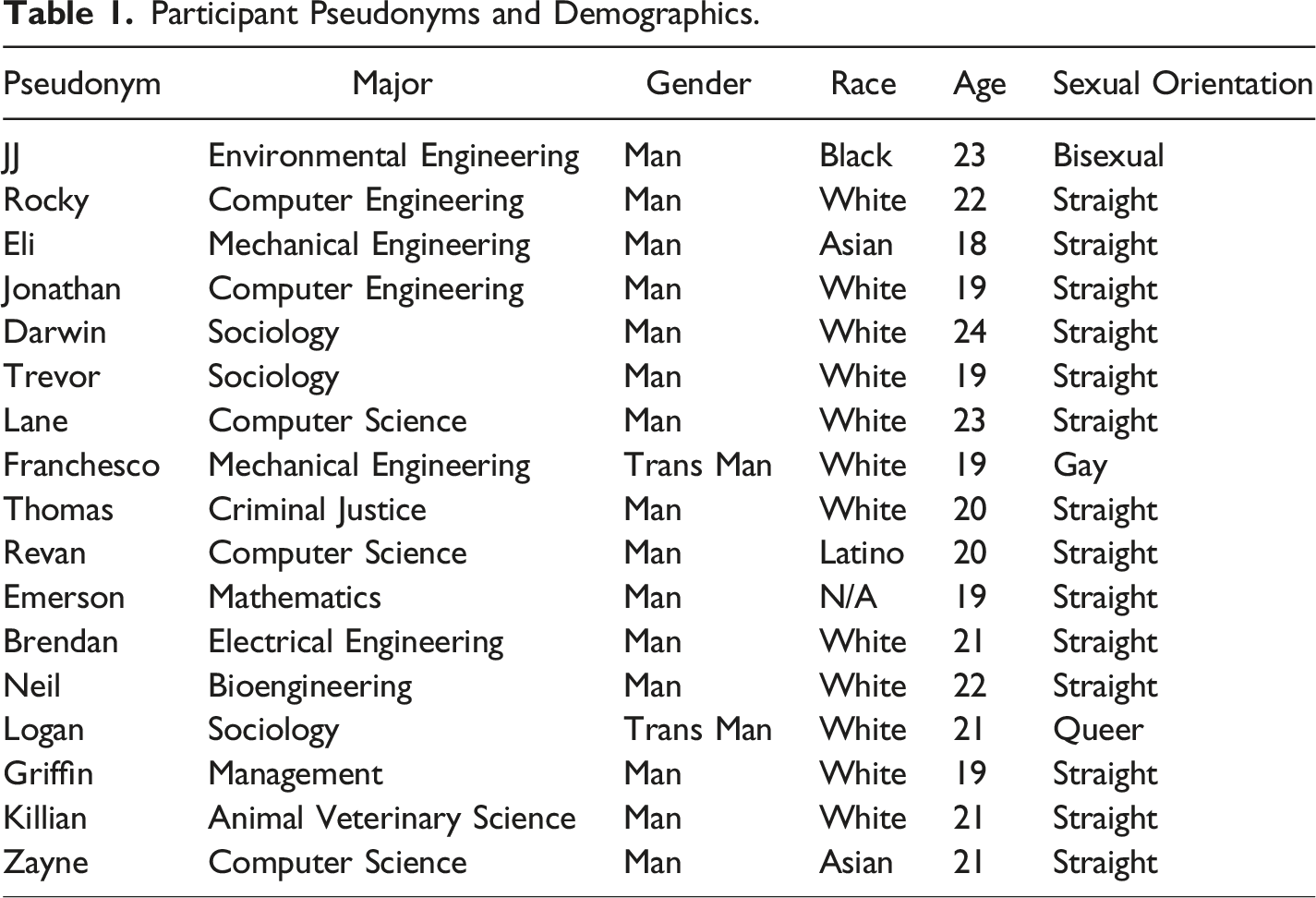
To be eligible for the study, participants had to identify as men, inclusive of both cisgender and transgender men. Recruitment efforts entailed the first author placing flyers around campus and asking course instructors to circulate recruitment materials to their students. Interested participants were directed to a Qualtrics survey that included a study consent form and a pre-interview survey that was administered to capture demographic information and ensure that potential participants met the study’s inclusion criteria. Of 22 men who completed the Qualtrics survey, 17 of them (77 percent) scheduled and completed interviews. Although recruitment and formal data analysis were not concurrent, by the seventeenth interview the participants’ comments began to converge. We were hearing similar remarks with no novel information and, thus, determined that we had achieved data saturation (Saunders et al. 2018).
Participant Pseudonyms and Demographics.
Procedures
Data were collected via in-depth, semi-structured interviews conducted during the Spring 2022 and 2023 semesters by the first author, a White cisgender woman who was a graduate student at the university where the study was conducted. The interview followed a guide that asked questions about how participants select classes, their early experiences with sex education (from parents, religious institutions, schools, etc.), their expectations of a college-level sex education course, reasons they did not enroll in a sex education course, and suggestions for how men might be encouraged to enroll. Interviews ranged in length from 31 to 81 minutes, with an average of 55 minutes. Participants received a $15 Amazon gift card after completing an interview. All study procedures were approved by Clemson University’s Institutional Review Board.
Interviews were transcribed using Otter.ai software and were checked for accuracy. Coding entailed an inductive, grounded theory approach introduced by Glaser and Strauss (2017), following methods outlined by Charmaz (2014). The first author conducted a line-by-line analysis of the transcripts to identify a list of initial codes. Then, the authors collaborated to organize each of the initial codes into focused codes that represent cohesive themes among the interview transcripts. To consolidate the initial codes into focused codes, the authors collaboratively evaluated the initial codes’ fit and usefulness, scrutinizing how “differences among team members may generate new insights” (Charmaz 2014, 118). This entailed discussing the initial codes that each member identified, engaging in discussion to select the codes that had more analytical “reach, direction, and centrality” pertinent to our research, and synthesized these into focused codes (Charmaz 2014, 141).
Researcher Reflexivity
Qualitative research can be influenced by the researchers’ position as insiders and outsiders to the topic of investigation. Insiders may occupy a “shared experience” position that grants insight while also posing a risk of imposing one’s own perceptions and/or biases onto the data (Berger 2015). Outsiders may be “unfamiliar with the specific experience under study may approach it from a fresh and different viewpoint posing new questions that may lead to innovative directions” but may also not fully understand a matter or situation that they have not experienced themselves (Berger 2015, 227). In our study, both researchers are outsiders. We are both cisgender White women and, therefore, cannot relate to our participants’ experiences of avoiding feminized spaces. While our outsider status represented a gap between our experiences and participants’ experiences, we believe that it also led us to apply a critical lens to masculine narratives that we did not uncritically accept ourselves.
Results
The men in our sample saw college sex education courses as feminized spaces that men are reluctant to occupy. However, they found masculine spaces to be acceptable. As Thomas (straight White man, 20) explained, “Guys are probably a little bit more open to talking about sex and sexual behavior with other guys.” During their interviews, participants discussed a number of barriers to men’s enrollment in sex education classes. Notably, they tended to view themselves as “good guys” who did not need sex education while offering reasons why “other guys,” who presumably needed sex education refused to enter a feminized space. In so doing, they constructed and distanced themselves from a “hyper-masculinized other” who provided a cautionary example of the consequences of endorsing dominant masculine norms. They did this by deploying two central narratives: (1) Good Guys Don’t Need Sex Education and (2) Other Guys Aren’t Interested in Sex Education. Ultimately, when contrasting themselves against a hyper-masculinized other, participants projected their gendered understandings of sexuality onto other men and emerged as good guys who absolved themselves from responsibility for taking action to promote equitable sexual relationships.
Good Guys Don’t Need Sex Education
The men in our sample did not dismiss the value of sex education themselves. Instead, they relayed the idea that they did not need sex education. Implicit in their comments was a hyper-masculinized other that served as an inferior comparison who needed sex education but was not interested in it. Many participants expressed the idea that sex education was not a necessary part of their college experience. Men in the sample typically conveyed this idea by indicating that sex education was inadequate or relaying the belief that sex education was not pertinent to their life circumstances. In either case, they did not see themselves as potential beneficiaries of sex education.
Sex Education is Inadequate or Not Pertinent to Life Circumstances
Men in our sample tended to believe college-level sex education courses would be inadequate, largely because they would focus heavily on abstinence and, thus, would provide inadequate instruction. Eli (straight Asian man, 18) expressed concerns about abstinence curriculum in the context of the stigma some people may have against casual sexual relationships, saying he hoped a sex education course would be as objective as possible and avoid “perpetuat[ing] the idea that sexual relationships should only be between two committed partners” and that college students should be abstinent. When asked what topics or content would not be helpful for him, Revan (straight Latino man, 20) mentioned abstinence, and elaborated, “All the silly, morality aspects behind it.”
Participants also expressed the perception that life circumstances dissuaded them from enrolling in a sex education course. For example, Brendan (straight White man, 21) did not think taking the class was necessary because of his relationship status: “I eventually got to the point where I [thought], ‘Okay, that’s probably factually all I really need to know… until I’m in a relationship.” Other men expressed similar sentiments related to their relationship status or moral stance on sex before marriage. For example, Rocky (straight White man, 22) shared that he was worried about his close friends questioning why he was taking a sex education class. This worry was specifically related to the fact that he and his friends identified as religious and had planned to wait until marriage to have sex. He said: We’ve talked about it before: “Oh, we’re all waiting for marriage” … But then all of a sudden, they’re like, “Oh, now you’re suddenly interested in sex…” They would assume I’m having sex…I’m just trying to get educated…it’s more of…a worry that they’re passing judgment on me for having sex.
Perceived lack of pertinence of sex education also stemmed from participants’ sexual identities. Franchesco (gay White trans man, 19) felt discomfort around sexual topics, and questioned whether such information was pertinent to an asexual individual such as himself. He shared, “My search or my start to my search to figuring out more about sexual stuff started because of being transgender. . . When I entered high school, in college, I had this strange mindset of, ‘Oh, I don’t need to have sex. I don’t think that’s for me.’”
Yet, information from a sex education class could have benefits for college men whether they are currently sexually active or not. Franchesco (gay White trans man, 19) highlighted that, although information from sex education may not seem to be personally relevant to college men now, in the future they may need to pass this information on to someone else. In this case, more information is always better. He concluded, “Everything we’ve talked about really, just being informed is one of the greatest mental weapons or mental tools a person can have. If you aren’t informed, and you don’t know what you’re talking about, you could end up making some. . . egregious errors or mistakes, or maybe end up insulting people… because you weren’t informed.” This exemplifies the need for sex education, whether it is relevant now or in the future.
Many of the men who were concerned about receiving inadequate instruction, or believed sex education was irrelevant to their current circumstances, related this to the fact that they were students of a campus located in the rural southeastern United States where the surrounding culture is largely conservative. For example, Eli (straight Asian man, 18) stated, “With the climate around [this university]. It’s not a very progressive school. We’re in the South [and people] might be less open to discussing different values like casual sexual relationships, non-heterosexual sexual relationships, or non-monogamous [relationships].” Like Eli, other participants expressed concern with how the climate of the university might prevent sex education classes from having open and respectful discussions about specific topics and diverse sexual identities and behaviors. They spoke at length about the influence of the surrounding political and religious culture, and its influence on sex education.
Religious Rhetoric and Political Stigma in the Bible Belt
When discussing the drawbacks or barriers to men’s enrollment, participants specifically mentioned the campus’s southern culture. For example, Trevor (straight White man, 19) emphasized that sex is only allowed within the confines of marriage between a man and a woman, and that sex within this context is a “gift” and a man’s “duty.” As he explained, “I was raised in a Christian house, obviously [went to] church, and then the church preaches premarital sex is a sin. But, after, our church was a little like, not as taboo about it, because the message was premarital sex is a sin. But, sex in a marriage is a duty as well as a gift from God to be something to be enjoyed between the man and his wife.”
Some men in the sample mentioned that folks may see sex education or conversations around sexual identities to be liberal propaganda. JJ (bisexual Black man, 23) mentioned the culture around his campus to assumptions people may make about sexuality. He said, “I unfortunately do think, especially at [my university], a lot of people associate like sex positivity and the discussion of sex with…certain political groups.” When asked to clarify what he meant by “certain political groups,” JJ said that liberals were the political group he was referring to. A trans man, Frachesco (gay White, 19), expressed similar sentiments in regard to the effect of political views deterring men to enroll in sex education: “I imagine people who don’t want to hear about gender and sexuality tend to feel like they’re getting that information shoved down their throat, whenever they learn about it. So, if someone of that kind of mentality entered the class, they probably would not enjoy themselves at all.”
Lane (White straight man, 23) implied that he has avoided taking a sex education class in order to insulate himself against information that conflicts with his own worldviews. When asked what he thought a college sex ed course might be like, he said, “probably a lot more politically correct and discussing more variations of lifestyles that occur, which this might sound bad… unfortunately, [that’s] something that I’m not really interested in taking…I only have to worry about my own lifestyle and my own safety and precautions more so than, ‘Oh, well, there’s all these different versions.’”
Participants’ perspectives illustrate a clear intersection of religious and political beliefs with opinions about sex and sex education. The men in our sample evoked religion to express heteronormative, patriarchal ideas about sexuality and relationships, while distancing themselves from these views. While not typically endorsing these ideas themselves, they surmised that conservative ideas about gender roles and sexuality would prohibit men from enrolling in, or benefiting from, sex education courses. In essence, their comments implicitly relied on an “other” type of man who is vested in upholding patriarchal norms and is presumably not interested in sex education.
Other Guys Aren’t Interested in Sex Education
Men in our sample tended to believe that they personally did not need, or would not benefit from, sex education. Simultaneously, they relayed the assumption that other men could benefit from sex education, if only they were interested or saw value in it. They believed that “other guys” feminized and undervalued sex education, exhibited a lack of empathy for female partners, and equated masculinity with sexual prowess.
Feminizing and Undervaluing Sex Education
The men in the sample tended to believe that men feminize and undervalue sex education, citing fear of social stigma as a barrier to enrollment. They did not claim that they personally thought sex education was feminine, and they rarely reported personal fear of their peers’ judgment. Instead, they noted that other men may fail to enroll due to social stigma.
JJ (bisexual Black man, 23) drew a connection between the feminization and invalidation of sex education by men. He explained, “I feel like most men would feel like, ‘Oh, is that like a women and gender studies class?’ or they would. . . associate some sort of stigma with it and almost try to like, invalidate it in a way.” JJ points out that women’s and gender studies classes are stigmatized, and conflating sex education with women’s studies becomes an initial avenue of invalidating sex education courses as unimportant, embarrassing, or even shameful. He was not the only participant to express this sentiment.
Thomas (straight White man, 20) similarly pointed out men’s feminization of sex education. As he explained, “A guy would look at a human sexual behavior course and be like, ‘Oh, that’s for girls.’ Sexual topics from an academic approach seem like more a feminine field of study.” Interestingly, Thomas did not claim ownership of this sentiment; instead, he attributed it to other guys. It was not uncommon for men in the sample to note that their peer groups perceived sex education to be feminine or without value. In a rare case, one participant expressed fear of personal ridicule. This social pressure seemed to be so great that Rocky (straight White man, 22) said he would receive active criticism if he were to enroll in a sex course: “I feel like, I would kind of get clowned by the boys if I was taking a sex class.” Rocky’s conclusion further demonstrates the potential social stigma, particularly from male peers, when enrolling in a course deemed feminine.
Participants also mentioned that social stigma may lead men to joke or fail to take the class seriously, even if they did enroll. As Logan (queer White trans man, 21) explained, “At the end of the day, if you don’t want to be in the sex ed class, you’re gonna skip, you’re gonna miss the information anyway. So, if you’re not interested in learning it, it’s just a waste of time.” Thomas (straight White man, 20) echoed “guys [would] just come in… sit back and laugh… joke around and not really get anything out of the course.” These participants indicate that such behavior could diminish the benefits for the whole class, demonstrating that the feminization and undervaluing of sex education could have many implications for those who do and do not choose to enroll.
Here, the men in our sample framed sex education as a feminized space and then projected discomfort with such feminized spaces onto other men. They specifically claimed that the typical man would not want to enter a feminized space or would belittle the space with base humor. Yet, they did not only believe other men would avoid or belittle feminized spaces; they also believed other men would belittle female partners.
Men’s Lack of Empathy for Female Partners
One way the men in the sample rationalized men’s avoidance of sex education was by projecting a lack of empathy for female partners onto other men. Men perceived women as sexual objects and believed that sex with women is a conquest and a competition between themselves and other men. Participants did not claim to believe this themselves; rather, they indicated that they are active witnesses who police other men when they speak about women in a disrespectful manner. For example, Jonathan (straight White man, 19) explicitly stated that if he heard another man talking about women as sexual objects, he would ask the man questions to get him to critically think about what he said. He explained what he would do in such a situation: “I’d [say], ‘Hang on, what did you say?’ And they say it and I'll [say], ‘Don’t you want to think through what you just said?’ and then I would ask him questions . . . ‘Why do you think that is?’ And then pick apart why they think it.”
Participants indicated disapproval and discomfort when they hear men in their peer group talking about women in terms of sexual conquests. JJ (bisexual Black man, 23) recounted his arrival to his campus and hearing other men in “male dominated” spaces and friend groups talk about their sexual conquests, “It was still the same old. . . [sighs] Sex as something that just happens. Like ‘Oh, I met a girl on Tinder last night, I did so and so.’ Nothing beyond that.” JJ expressed disapproval of the way these other men talked about their sexual conquests. When asked how he would like to hear men talk about sex, he laughed and said, “Definitely a more realistic view of sex. Female pleasure. Enthusiastic consent.” He explained that most men see sex as an accomplishment and “ego boost rather than something for both parties to enjoy.” Similarly, Thomas (straight White man, 20) reported he is affiliated with a fraternity and said that the majority of his friends were unable to talk about sex in a “non-toxic” way. He said it’s “very common [that] guys are like, ‘Yeah, man, I banged that chick’. . . that kind of language makes me cringe.” He also endorsed education as a possible solution for men to learn to talk about sex in a healthy way. Interestingly, Thomas conveyed the idea that his peers may benefit from sex education; yet, he has not taken such a course himself.
Apparent in these men’s perspectives are masculine norms that sexually objectify women. Participants believed that men’s dismissal of women’s sexual agency would keep them from pursuing education that could counter their adherence to norms that prioritize men’s sexual desires over women’s sexual desires. Related to their idea that men are dismissive of women’s sexual agency, the men in our sample also believed that men’s adherence to norms of sexual dominance would inhibit them from entering a feminized space that may counter their views of themselves as sexually competent.
Equating Masculinity with Sexual Prowess
Closely related to lack of empathy for female partners, men in the sample tended to equate masculinity with sexual prowess. By equating masculinity with sexual competence, these men were prone to feeling that sexual inadequacy and incompetence would make men less masculine. Thomas (straight White man, 20) captured this equation well. As he explained: It’s like they’re focused on [trying to] have as much sex with as many people as you possibly can. That’s what makes you cool, popular, whatever. . . Guys, they walk around and talk about sex very openly. And...that’s almost how you consider if somebody’s cool, if they have a bunch of sex or the women they sleep with are pretty, or that kind of thing.
If sexual prowess and adequacy are symbols of masculinity, then enrolling in a sex education course may symbolize sexual inadequacy and, thus, may be perceived as emasculating. The men in the study sample expressed this concern, but they attributed it to other men and did not acknowledge it as applying to themselves. As Trevor (straight White man, 19) explained, men who need education on sexual matters may feel embarrassed and/or lose a sense of pride. As he relayed, “It’s more so about an aspect of pride, like ‘I don’t need to know that, I do a good enough job pleasing my woman on my own.’” Similarly, Eli (straight Asian man, 18) described the emasculation other men might face if taking a sex education course, explaining that men think, “if you need help with anything regarding sexual interactions. . . you’re less of a man and that doing so [asking for advice or help with sexual matters] it makes you like, it’s emasculating to do so.” Eli elaborated by illustrating the social consequences and the line of questioning one might face (presumably from other men) due to enrolling in a sex education course: “Oh, you need to take a college course?” Or, like, “What guy needs to take a college course on sex? Like, do you not know how to do it?” kind of thing. I think most men at this age, they have a very egotistical view of sex. Like they’re good at everything, they know everything about it. I can perfectly imagine seeing men who take that course being ridiculed for it.
Participants’ perspectives demonstrate men’s devaluing of women and feminization of sex education, which results in a devaluation and stigmatization of men’s enrollment in sex education. As Thomas and Eli explained, men highly value their sexual prowess and may fear judgement from peers if they are viewed as enrolling in sex education classes due to being sexually inept. Thus, the masculine norm of sexual dominance seems to prohibit men from seeking further information on sex.
Discussion
Past research has suggested that a college-level sex education course can have important benefits such as improving interpersonal skills and intimate relationships, helping students become more tolerant of diverse sexualities and identities, increasing knowledge about sexual health, and initiating protective health behaviors (Cotten 2003; García-Rojas et al. 2022; Henry 2013; McMahan et al. 2023; Rogers et al. 2009; Rutledge et al. 2011). Yet, men are reluctant to take these courses (King, Scott, et al. 2020). Avoiding feminized spaces, such as sex education courses, is common in an androcentric society that values the masculine over the feminine (Connell and Messerschmidt 2005). Those men who do enter these spaces often see themselves as good guys who are more enlightened than other men (Bridges 2014, 2021; Pfaffendorf 2017; Rabii 2021).
Our analysis indicates that men who avoid feminized spaces may also see themselves as good guys. Rather than seeing themselves as contributing to gender inequalities in sexual relationships, they believed they did not need sex education, and contrasted themselves against other men who presumably needed sex education but were not interested in it. When men in our sample spoke of masculinity, they distanced themselves from an archetypal hyper-masculinized other by seemingly attributing their thoughts to other men. Although no man interviewed in this study had ever taken a college-level sex education course, many said they were adequately educated in this subject, but their peers were not. They reported that the embarrassment or social stigma of taking a feminized class was problematic for their peers, but they did not apply this barrier to themselves. Additionally, men in the sample said their peers displayed toxic forms of masculinity but claimed that they personally rejected this kind of ideology. In this sense, participants in the study saw themselves as what Messner (2016) calls “good men.” Commenting on men’s role in the prevention of violence against women, Messner noted that men assume a false dichotomy between good men (themselves) and bad men (others, their peers). They essentially assume that other men need to reflect on their role in perpetuating a culture that tolerates violence against women, but that they themselves are not part of the problem. Similarly, in this study, men believed that other “bad men” subscribed to toxic forms of masculinity and, thus, believed they would not benefit from sex education, but they did not see this as applying to themselves.
Our findings have implications for the way we understand masculinities, particularly that of straight, White college aged men in a diverse but Eurocentric country. Although the existence of hybrid masculinities seems to imply that gender inequality is waning, research has demonstrated that those men who adopt hybrid masculinities, often by entering feminized domains, do not challenge gender inequality and, instead, see themselves as superior to other men (Barry 2018; Bridges 2014, 2021; Carian 2024; Carian and Abromaviciute 2023; Eisen and Yamashita 2019; Fefferman and Upadhyay 2018; Haltom 2022; Palmer 2022; Pfaffendorf 2017; Rabii 2021; Spector-Mersel and Gilbar 2021). Just as men who adopt hybrid masculinities contrast themselves against other presumably inferior men, those who avoid feminized spaces circulate narratives that depict this avoidance as an active choice they made because they are more enlightened than other men. These different groups of men both contrast themselves against a hyper-masculinized other whom they depict as part of the problem of gender inequality. In essence gender inequality is always projected as somebody else’s problem.
Limitations and Directions for Future Research
Findings from this study must be interpreted within the confines of a few important limitations. First, this study sample was limited to men undergraduate students at one university in the southeastern United States. Second, all interviews were conducted by a cisgender woman, which could have affected responses. Due to the interviews being conducted during the/post-COVID 19 pandemic, interviewees were given the option to complete interviews in person or via Zoom. Most men chose online interviews. Yet, some chose in-person interviews and, thus, the differing formats may have created differences in the way participants interacted during their interviews.
Third, we only interviewed men who had not taken a college sex education class and did not interview men who had enrolled in such a course. As a result, we cannot make comparisons between the two groups and cannot ascertain how men who did enroll overcame the barriers exhibited by the men in our sample. Finally, the men who participated in this study are not necessarily representative of the broader population of college men. The majority of the sample was White (70.59 percent) and identified as straight (82.35 percent). Although the sample is demographically representative of men on this specific campus, findings are not necessarily representative of the broader population of college men. Specifically, considering the demographic limits of our sample, the narratives that we uncovered in our analysis arguably represent a form of White heteronormative masculinity. Thus, future research with larger, more diverse, samples could reveal different narratives between racial and sexual/gender groups.
Conclusion
According to Carian (2024), feminist and anti-feminist men both align themselves with an ideology that supports their views of themselves as “good men.” Some align themselves with feminism in order to compensate for the guilt of gender privilege. Others align themselves with anti-feminism to refute the fact that they possess privilege and to reconcile their belief that being privileged in an oppressive system would make them “bad guys.” Essentially, both feminist and anti-feminist men see themselves as good guys. Our findings extend Carian’s work by suggesting that, when casting themselves as good, men may project their own problematic gendered ideologies onto an archetypal hyper-masculinized other. That is, men do not simply see themselves as good men; they actively construct a presumably inferior other onto whom they project beliefs that maintain gender inequality. By contrasting themselves against the other, men emerge as good guys who absolve themselves from responsibility for taking action to promote equitable sexual relationships.
This has tangible implications considering that college hookups tend to be more positive experiences for men than for women (Armstrong et al. 2012; Bogle 2008; Claxton and Van Dulmen 2013; Kettrey and Johnson 2021; Paul and Hayes 2002; Shepardson et al. 2016). That is, entering feminized spaces and having constructive conversations about sex could foster more equitable sexual relationships among emerging adults. However, this will not be realized if young men distance themselves from the problem of gender inequality.
Relying on the good guy narrative that the men in our study constructed could be a key to recruiting men into feminized spaces. Such an approach could entail encouraging those few men who do enter feminized spaces to approach other men as fellow good guys who need to prepare themselves to educate others about a gendered topic (e.g., sexuality, violence against women, etc.). However, recruiting men into feminized spaces will not necessarily be devoid of problems. Men who enter feminized spaces are often reluctant to reflect on the ways that they personally benefit from gender inequality (Barry 2018; Bridges 2014, 2021; Carian and Abromaviciute 2023; Fefferman and Upadhyay 2018; Haltom 2022; Palmer 2022; Pfaffendorf 2017; Rabii 2021; Spector-Mersel and Gilbar 2021) and women do not like collaborating with men who do not acknowledge their masculine privilege (Wiley et al. 2024). Additionally, men who enter feminized spaces that address gender inequality sometimes overpower the women in these groups (Messner et al. 2015; Wiley and Dunne 2019). Thus, recruiting men into feminized spaces that address gender inequality is only a single step toward solving power disparities.
Overall, this study demonstrates that men who avoid a specific feminized space (e.g., college-level sex education classes) view themselves as good guys who do not need the purported benefits of such education. At the same time, they assume that other men who evade these spaces actually could benefit from such education but are disinterested or avoidant. In so doing, they construct an archetypal “hyper-masculinized other” whom they presume to be inferior and unconcerned about gender inequality. Thus, efforts to recruit men into feminized spaces that address gender inequality may benefit from appealing to this “good guy” image and approaching men as allies who can mentor other (purportedly less enlightened men) about gendered topics. Applied to the topic at hand, if men who enroll in sex education courses appeal to their peers as fellow “good guys” who could share the benefits of this space, then the gender disparities in hookup culture that relegate women to the role of sexual gatekeeper could eventually erode. Until men work to enlighten other men, such spaces will remain feminized and undervalued.
Footnotes
Declaration of Conflicting Interests
The author(s) declared no potential conflicts of interest with respect to the research, authorship, and/or publication of this article.
Funding
The author(s) received no financial support for the research, authorship, and/or publication of this article.
