




Abstract
This article considers the interface of taxonomies of race and migration crystallised through the materialities of the contemporary city in the shadow of the 7th anniversary of the Grenfell Tower fire. It draws on multi-method empirical research that interrogates the notion of the open city. The article proposes that ‘entanglement’ and ‘contaminations’ of material and cultural formations confound some claims made in the name of the good city, recognising what Marilyn Strathern might describe as the recursive ‘contamination’ of normative and empirical evidence. The article argues that it is imperative to excavate the normative domain of the empirical, and curate the empirical realisation of the normative, in rethinking a truly global sociological imagination. It concludes by suggesting that one way of approaching this is through a more forensic understanding of what is taken as ‘evidence’ in social sciences that should inform an interdisciplinary urban studies.
Introduction
Seven years on Grenfell Tower still stands: scarred and charred; a macabre mausoleum. Situated in the poorest part of one of London’s richest boroughs, the fire at the tower on 14 June 2017 became an iconic moment politically, socially and – most of all – tragically. Seventy-two out of approximately 292 people living in the building passed. The fire was so intense it was at times close to impossible to identify and enumerate the dead. Social media stories about a ‘cover up’ multiplied as rumours spread that many more had died than officials and media suggested. To combat the rumours, it was agreed to offer anonymity to those with irregular migration status in the UK. Days after the fire, regardless of residential status, people were free to identify both themselves as residents and also name anybody that might have been present but keeping under the radar of official scrutiny who had either lost their lives in the fire or made themselves scarce once the fire had started.
As with much of the contemporary city, Grenfell was in one very real sense unknowable. Official records of occupation mask diversity of tenure, occupation and precarities of dwelling and could not provide a definitive enumeration of residents present. The estate was changing as a new London emerged. As ever the city is always unfinished (Sassen, 2016). And the demographic nuances, the cultural formation of the community, were at least initially unspoken, the language of victimhood circumscribed by a fire. Until it was not. In this article we explore how what is unknowable, unfinished and unspoken is also sociologically unstable, an instability that reflects a more general uncertainty about the role of empirical evidence in shaping the sociological imagination.
The process of putting faces to people that lived in the Tower followed on rapidly from the fire itself. Initially, a tableau of victims and their stories appeared in press and TV coverage. Within months, roll calls of the dead were read at the opening of the Public Inquiry in September 2017. One year later, a different narrative of Grenfell was emerging – less a problem estate than a site of multicultural diversity. For The Guardian the backgrounds of the dead ‘shows how diverse, open and tolerant Britain has become in the past 30 years’ (our emphasis) (Rice-Oxley, 2018). Moroccans were the single largest national group among the victims after the 31 UK nationals of diverse ethnicities. There were 21 people from African nations including 6 from Morocco, but also fatalities from Egypt, Sudan, Eritrea, Ethiopia, the Gambia and Sierra Leone. Among the other 19 deaths were those who had come to London from Lebanon, Syria, Afghanistan, India, Iran, Bangladesh, the Philippines and Italy.
The faith backgrounds of the victims of the Tower remained largely unspoken in media coverage of the fire, if understood more locally. Until it was not. Very many of the roll call of the dead had Muslim names and several of the community support groups and voluntary sector organisations that became involved after the fire were also Islamic. And it was only on the first anniversary of the fire, a date that coincided with the festival of Eid, that the solemn remembrance of events was interweaved with the final iftar before Eid itself and the Tower turned green in recognition of the fact, a shading sustained to the present day. The sense that what is unspoken may be as important as what is said out loud became part of the processes of recognition of community itself. And since the incident, different genres of scholarship have circulated around the fire, considering why the catastrophe happened, what it symbolises and who should be held accountable.
Some attribute the fire to stigmatisation-fuelled neglect of a fraction of London’s population (Leaney, 2018), lack of investment in social housing, neglect of local voices of warning, the dangerous cladding on the building since found replicated across the country, and the contentious policies of the fire services (Bulley et al., 2019; Davison et al., 2020; Equality and Human Rights Commission, 2018; Shildrick, 2018). Others foregrounded inequality baked into the built environment (Madden, 2017, 2019) or more specifically a malevolent geography of injustice (MacLeod, 2018), failures and dysfunctionally embedded logics of institutional forms of ‘preparedness’ (Preston, 2019). The Tower was embedded in the material infrastructure of one of the most economically polarised landscapes in the global north. High Gini coefficients of inequality mapped onto strong labour markets characterised by low levels of unemployment and significant patterns of employment precarity (Burrows & Knowles, 2019; Lisiak et al., 2021; Weaver, 2019).
Others held that the fire has become an icon of racialised capitalism, postcolonial legacies of contemporary London (Danewid, 2020; Launchbury, 2021), the systemic erasure of representations of intense inequality (Clancy, 2020) or the consequence of path dependent property relations historically normalised (Burgum, 2019).
Some have held responsible variously the council, the government, the estate’s landlord or those who sold inadequate materials and cladding, arguing they should face legal sanction (Hudson, 2018). Moving away from the individual and the intentional allows Cooper and Whyte (2022) to classify the fire as a form of institutional violence, Tombs (2020) to argue that the fire can be analysed as an instance of state corporate violence, a sub-genre of Engels’ longstanding framing of ‘social murder’, indicating the ways in which a combination of state and corporate acts and omissions resulted in a catastrophic range of social harms.
There is value in all of these interpretations. They exemplify the etymological connections between blame and causality, the Greek aitia (guilt) and the underlying aetiology. And they highlight powerfully the disjuncture between accountability in politics, responsibility in law and the emblematic in culture. And so, in multiple ways, forms of knowledge at stake in academic scholarship differ. They variously combine an analytical empirical understanding of the fire with a powerful normative sense of the injustices at stake. And more importantly they differ in how they use evidence to prove a point, make a case, advance an argument.
In this article we reflect on how such tensions between analytical and normative entanglements of the city shape the sociological imagination, considering what this might mean when we try to describe and explain what is happening in neighbourhoods like Grenfell through a vocabulary that draws variably on lexicons of race, ethnicity and migration. We consider what it might mean to think about the claims that are made in the valorised name of the ‘open city’ of London that has become central to the city’s self-image, the urbanism of writers such as Richard Sennett and that The Guardian and others celebrated after Grenfell. We argue that just as iconography can both suppress and reveal particular narratives of the urban, the open city has the propensity to mask or confuse the dimensions of guilt, causality and symbolism: specifically to speak in tongues that are problematically both normative and analytical simultaneously. Surfacing cautionary traces of environmental determinism, we consider how forms of complex emergence entangle the material and the social, qualifying how we might judge evidence in claims that judge urbanisms and sociologies shaped by race and migration.
Three entangled urbanisms
From ecological determinism to material urbanism
Across a lifetime of work the urbanist Richard Sennett has considered how the contemporary city can both accommodate and foster hospitable and convivial forms of social life and yet also dehumanise, alienate and sequester. Sometimes paradoxically, urban forms can manage to do both simultaneously. Sennett’s prose invokes a normative sense of how the city should be, weaved into readings of how the city actually is, most often in New York or London or a European metropolis, but in more recent writing in metropolitan contexts more global. In Sennett’s most recent volume, Building and Dwelling (2019), the subtitle reads more programmatically to invoke an Ethics for the City. For Sennett the couplet captures the tensions of the urban as the juxtaposition between ‘open’ and ‘closed’. The ‘open city’ for Sennett is permeable and accommodating, while the ‘closed city’ is marked by its social, cultural and economic exclusions. He argues that the open city is a bottom-up incomplete, errant, conflictual, non-linear place, while the closed city is top-down and full of boundaries and walls. The book is an important text for its high-profile attempts to interrogate combinations of material forms and everyday lives that structure the occupation of urban spaces.
The text is weakest when occasionally lapsing into claims made in the name of generic urban forms. Blocks built through designs of additive grids are said to enhance the growth of ‘monocultures’, where – invoking the housing scholar Anne Power – for Sennett the logic of biodiversity applies to urban environments, with monocultures ‘a disruptive neighbour or drug taking among children – spread quickly like a plague because there is no reason why any other part of the estate should be different socially as well as physically’ (Sennett, 2019, p. 42). At these moments the work evokes a longstanding tradition of thinking about cities that sees the built environment determining certain forms of behaviour. Famously, in the early 1970s the architect and planner Oscar Newman developed in this register the notion of ‘defensible space’ as a theorisation of how built forms, most notably those in social housing projects of the USA, created visual signs of blight, discouraging a sense of ownership of space by people that lived there. Cherished place was displaced by anonymised space.
Newman’s landmark volume Defensible Space was decorated with an image of the demolition of the Pruitt Igoe estate in St Louis, the icon of public housing failure whose demolition resonated internationally in generic critiques of architectural modernity and political critiques of the drive to mass produce subsidised housing for rent globally. Grenfell today carries an equivalent symbolic force internationally. Newman’s work was central to what became an influential genre of both research and policy design that premised interventions in the built environment on their capacity to determine more sociable behaviours, a school of policy practice of crime prevention through environmental design. It became particularly influential in the Home Office Research Unit of the United Kingdom in the 1970s and 1980s in the wake of the collapse of Ronan Point Tower Block in Canning Town, east London, two months after it opened, a British icon to match Pruitt Igoe (Mayhew et al., 1976, 1979). And in a related domain the ‘broken windows’ genre of criminology likewise focused on the propensity of small acts of crime to multiply, a policy diagnosis justifying immediate intervention, zero tolerance of minor infractions of civility, putatively to anticipate major incidents of violence (Wilson & Kelling, 1982). Interestingly, architectural historians have at times softened the cruder determinism of some of Newman’s writing, arguing that to impact on public policy he needed to pitch simple messages, that sub-textually his writing and practice nudged gently towards an ‘open society’ (Knoblauch, 2015).
Sennett’s Building and Dwelling is also easily susceptible to a critique of its light-footed ethnography in the face of global diversities of culture and language. It is, as always with his prose, beautifully written. But most importantly we suggest here it is in tenor akin to genres of writing about the city that are in some respects increasingly common in contemporary social science.
The sense that the spaces of the city are malleable, that their design is regularly confounded by – rather than determined by – their use and that the act of dwelling is generative rather than passive can be found as commonplace across global literatures of urban studies. From Doreen Massey’s (2005) sense of the ‘throwntogetherness’ of London’s urbanism to burgeoning literature on city infrastructures, a sense of materiality also runs through much contemporary urban scholarship, particularly in work originating from critical geography of the Anglophone north that owes its intellectual heritage to the work of Bruno Latour. Famously, Latour’s work powerfully captures the sense of a social world that is always ahead of us rather than complete because of the inseparable combinations of matter, culture and nature in contemporary lifeworlds (Latour, 2005). In the sub-discipline of urban geography, the significance of the material also most commonly follows Latour’s actor network theory and the material environmental dynamics it makes visible, foregrounding the embedded sense of human forms in conditions of nature. Material infrastructure becomes a central figure that disrupts binaries of nature and culture, human occupation and built forms (Anand et al., 2018). Through such a frame the diagnostic features of the assemblage at times characterise the urban as relational configurations of the present; never modern, always material, never complete.
From materiality to emergent urbanism
The sense of the city as a space of possibility, potential and propensity also echoes through disciplines outside the standard canon of contemporary urban studies, commonly informed by a Deleuzian reading of the social and urban world as constitutively a commons that is subject to various dynamics, moments and cartographies of enclosure (Hardt & Negri, 2009; Keith & Santos, 2020). It is found also in many considerations of postcolonial theory that consider how in the work of Achille Mbembe (Mbembe, 2001; Mbembe & Nuttall, 2004) and Paul Gilroy (Gilroy, 2004, 2010) a sense of the convivial emerges in city circumstances in spite of rather than because of modes of rule. For Deleuze the city might generate cramped spaces of the contemporary, akin to places that bell hooks long ago characterised as the privileged margins (hooks, 1981; hooks & Hall, 2018; Thoburn, 2003). It is found also in studies of the social that evoke the ‘propensity of things’, as Francois Jullien characterises a tradition of thought closer to China than to Europe that frames the fundamental materiality of human life (Jullien, 1995). What might be framed as this Deleuzian provenance shares with the Latourians a city of what could be, extemporised or invented. Most persuasively this has been made visible through the genre of southern urbanisms of the last two decades, emphasising emergent fabrics of transformed urban spaces. Invocations of what is to come characterises the basements of West African cities and the ingenious occupations of Jakarta in the writing of Abdoumaliq Simone (Simone, 2018) or the ‘entangled city’ where crime provides an urban fabric in Gabriel Feltran’s Sao Paolo (Feltran, 2020), the inventive appropriations and pirate urbanisms of Delhi narrated by Ravi Sundaram (2009) and Gautam Bhan (2019) and the occupancy urbanism of Solomon Benjamin’s Mumbai (2014) or the Shanghai modern of Leo ou-fan Lee (1989).
A linked genealogy runs through this cartography that is slightly askew from geographers’ disciplinary borrowing and often sits with authors whose disciplinary loyalties are less often rooted in Anglophone critical geography. In particular, the study of mutation, combination and relationality emerges from not quite parallel disciplinary enquiries of the anthropological. The interrogation of materiality has been central to the understanding of what it means to be human since the formalisation of the discipline (Miller, 2005a, 2005b), both before Latour became influential and later in dialogue with his work. Interrogations of attempts to dwell in specific ecosystems and geographical contexts runs through the history of the anthropological. But equally, without glossing a century’s history encyclopaedically, the relational constructions and the sense of the ‘affordances’ of dwelling (Ingold, 2017), combinations of the inorganic and organic in the cyborg (Haraway, 1991, 2006) and the materialities of gendered life (Strathern, 1988, 2016, 2020a) either predate Latour’s work or run on tracks that are independent of it.
Powerfully, Marilyn Strathern, working from anthropological roots, some time ago critiqued the genealogies of Latour’s assemblage on both historical and analytical grounds. Latour analysed links between the hybrid forms of the material, social and cultural. His networks that constitute actor networks are famously neither simply human nor non-human; not modern, just unfinished. Or put more simply, they are always in the process of becoming. Strathern questioned the originality of Latour’s framing, suggesting caustically that in both Latour and also in longstanding anthropological traditions that predate his work the combinations of material objects and cultural life have always created new and emergent forms of the hybrid.
Between emergence and forensis
Three decades ago, in her well-referenced critique, Strathern argued that Latour’s logic of networks and hybrids is potentially endless through its fractal form. She suggested that what might be of more interest anthropologically and ethnographically is as much how networks are cut as how they are held in place and stabilised in the short, medium or longer term (Strathern, 1996). Reflecting later on her life’s work Strathern suggests that ‘many disciplines explicitly aim to clear the air by cleaning up words and terms in preparation for defining the concepts they deploy. Others rely on protocols of data collection that purify the material they work with. By contrast, the anthropological intervention I am proposing focuses on real time usage. It is in slippages in the way terms are used that other concepts form, and what from a purist point of view look like contaminations may turn out to underlie crucial dispositions or values’ (Strathern, 2020b).
The location of culture in (or ‘contamination’ by) the material infrastructures of the present also underscored Birmingham’s ‘school of cultural studies’ and their interest in the writing of Poulantzas, Althusser and Gramsci, clearly seen in Stuart Hall’s notion of ‘the arbitrary closure’ of the racial subject (Alexander, 2014; Back, 1996). Similarly, a sense of the fabrication of the anti-anti-essentialism of race inscribed in the cartographies of the Black Atlantic (Gilroy, 1993) resonates in demands for interconnected histories and geographies of a new sociological imagination (Bhambra, 2007). They all share a sense of the tentative and contingent nature of the research object under scrutiny, the unfinished politics of race (Back et al., 2022) and the unnerving power of racial taxonomies to reinvent themselves.
Mutations and contaminations of the urban likewise consequently frame the questions of cause, guilt and symbol slightly differently (for sociologists, anthropologists and geographers alike). They echo a sense of the Aristotelian distinction between the material, efficient and final causes of a phenomenon. For Aristotle this meant – respectively – the marble material, the sculptor’s tools and her final plan for the sculpture. In racialised Black urbanisms this equates in turn to the legacies of colonial histories and geographies of here and elsewhere, the agency of the objects of racism, the weapons of the weak and the systemic formations of racialised capitalism (Bhattacharyya, 2018; Simone, 2009). In circumstances of the racial this also frames slightly differently the guilt, the cause and the symbol.
A focus on materiality offers to studies of the racialised city across the social sciences a way of thinking the human and the non-human alongside each other in a city that is always in flux, continually mutating, a space of emergence. In our own research we have seen how London’s population churns at an extraordinary rate and at different cartographic scales (Figure 1). The 2011 Census reported a massive increase in average churn rates, which rose from less than 25% in 2001 to more than 35%, meaning that more than one-third of the London population was on the move in 2010, a year before the census date. Churn rate (defined in Scanlon et al., 2010) increased rapidly from 1981 onwards and preliminary results using consumer data measures of residential mobility suggest that notwithstanding the lockdowns of the pandemic, London’s churn of arrival and departure, migrant dwelling and transience is far higher than other parts of the country (Wang & Keith, 2022). As with all measures of dissimilarity, the geographical scale at which churn is measured qualifies the science of objective numerical values, demographic churn most obviously conflates domestic and international mobilities (see Figure 2).
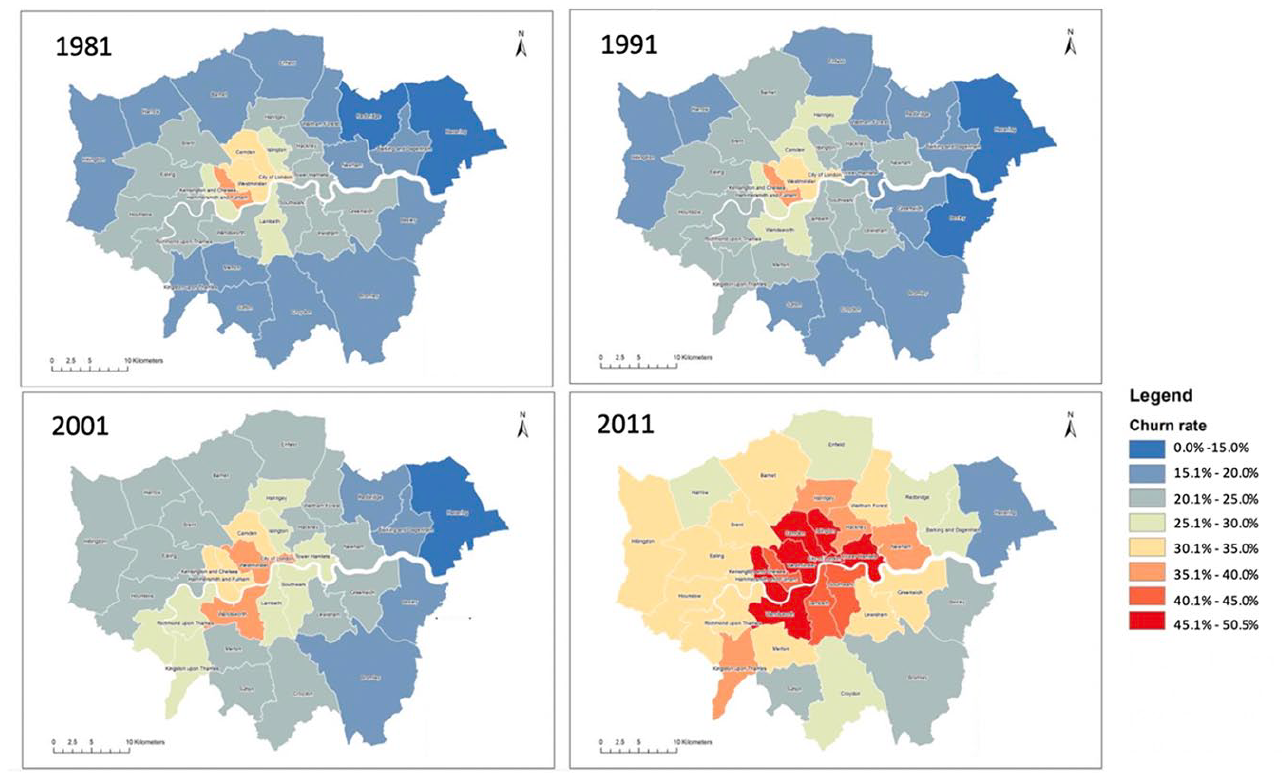
Churn rates by London Borough (using ONS census data, generated by authors).
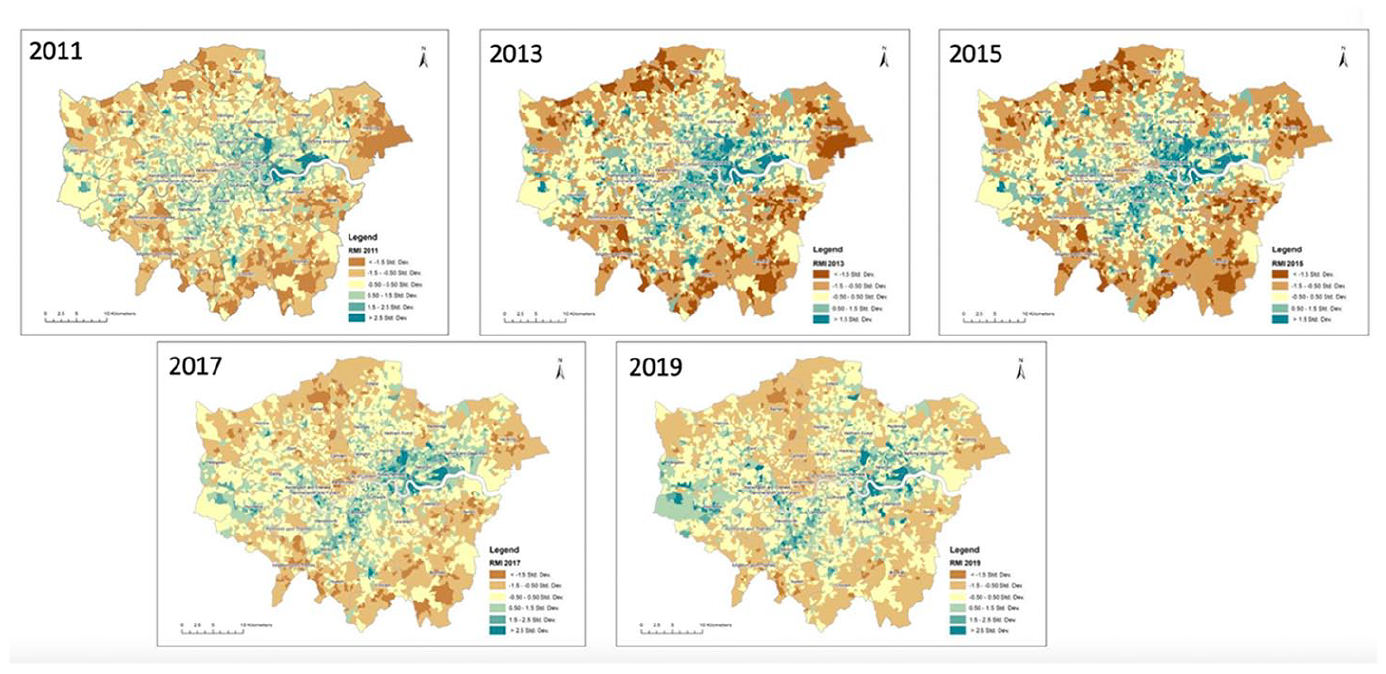
2011–2019 Residential Mobility Index in London at Super Output Area (using ESRC Consumer Data Research Centre, generated by authors).
Our research demonstrates how churn has intensified more in some parts of London than others. Some areas subject to intense gentrification in the 1980s and 1990s such as Camden move from being the highest to nearly the lowest boroughs of churn. Other boroughs have been subject both to new migrations and gentrification simultaneously, particularly many boroughs to the east of London. Both Grenfell Tower and our own empirical research highlight ways in which race and migration are mutable, intersect with patterns of mobility and openness at different geographical scales and moments in time. In descriptions of everyday sociologies race becomes entangled with migration and the built environment of dwelling analytically and conceptually in precisely the problematic fashion of Strathern’s contaminations.
Race normally starts with a moment of stigma, reproduced through routines of association. The former sets up regimes of racialisation, rooted in global histories of slavery, colonialism and faux science and local processes of racism and discrimination. These regimes of stigma are in turn countered through associational forms in the name of race aimed at their elimination. So, paradoxically, in this sense, race can become a meaningful demographic by being against race. Being against something creates a racial logic and lends a normative but ethically straightforward dimension to racial taxonomies of populations. But being for something is more challenging over time and less straightforward normatively. Social movements in the name of race are normally much clearer about what they are against than what they are for.
Racism can be measured, at least in part: through audits of racial difference and inequality, mystery shopping, blind test comparison and randomised control tests, for example. Attitudinal tests may be less reliable, asking hypothetical questions about context-free future marriages, neighbours or grandchildren. But stigma is about power as much as about attitude (Tyler, 2020). And so, it is the normative dimensions of the racial that make race so difficult to measure, racial science a deeply problematic oxymoron.
Migration may appear in contrast more objectively defined. But as migration studies demonstrates, this is perhaps not the case (Anderson, 2013, 2019). The question ‘who is a migrant?’ has many answers depending on who is asking and who is answering. Distinctions of time between what is permanent dwelling and what is temporary. Distinctions of law that may evolve through time. Distinctions of motive between who is forced and who is free to move. Distinctions of borders that may echo colonial histories and methodological nationalism. Methodological nationalisms that may taxonomise arbitrary postcolonial or post-socialist partition as migrating without moving. Continental scale movements that may label China’s urban billion and India’s mass movements as internal rather than international. I move from Jamaica to London and I am a migrant, from Martinique to Paris and I am not. As the Windrush generation found out so cruelly, history can run backwards, citizenship can be erased.
All create grey areas in answering the question ‘who is a migrant?’ (Anderson & Keith, 2014). But whilst the mobile migrant body is stigmatised at some times and places and not for others, the category of the migrant appears at least susceptible more easily to scientific measurement when the parameters are defined free of moral judgement (Rogaly, 2020). In this context the language of diversity or even ‘superdiversity’ can lend an objective gloss curating multiple forms of difference but it may obscure or subsume normative traces of typology, crucial dispositions or values, in the name of analytical rigour (Back & Sinha, 2016; Vertovec, 2007).
Normative judgements are often translated into law. And for the UK the post-1945 legislative process deliberately inscribed into law a racial hierarchy. Historians such as Clive Harris (unpublished-a, unpublished-b) and David Olusoga (2016) have examined in detail the governmental archives that demonstrate how legislation tried to taxonomise and distinguish racially between white European voluntary workers displaced by the war and ‘coloured’ colonial migrants. Taxonomies of race, ethnicity and migration moved uncertainly through subsequent case law aimed at preventing ‘racial discrimination’ founded on migrant histories. One House of Lords judgement determined that Sikhs in the UK were protected from discrimination under the 1976 Race Relations Act because as Lord Fraser of Tullybelton put it paradoxically in his final opinion, ‘My Lords, the main question in this appeal is whether Sikhs are a “racial group” for the purposes of the Race Relations Act 1976. For reasons that will appear, the answer to this question depends on whether they are a group defined by reference to “ethnic origins”.’ Although for another sitting law lord in the case, Lord Templeman, Sikhs were ‘almost a race and almost a nation’. Almost. But not quite. But Sikhs could be considered one for the purposes of the 1976 Act. The law cuts through and defines a legal subject, a ‘manipulable object’ that can then be studied.
So, the analytical building blocks of ‘race’, ‘migrant’ and ‘ethnicity’ are all fuzzy in some important respects. But perhaps not equally so. The highly normative register implicit in the notion of ‘race’ with its cognate dynamics of racism and the historical and geographical complexity of demarcations of ethnicity perhaps promotes some scholarly dispositions more than others. It makes migration at least ostensibly easier to demarcate in approaches to the social (and the sociological) that trend more to the social scientific than to the humanities; more to the disciplines of the social that prefer to measure and to replicate than to describe and differentiate, more (though not exclusively) towards quantitative social science than qualitative social science. And it is perhaps the case that there is a more extensive quantitative literature in the social sciences around migration than around either race or ethnicity in subjects such as economics, political science, demography and sociology.
And so, as an outcome of processes of racialisation, race is invariably what Stuart Hall described as ‘conjunctural’, a consequence and a facet of history and geography, the universal and the particular realised in specific moments and places (Alexander, 2011). But there is an understanding in many of the more interpretative social sciences that this is not an unusual phenomenon.
From epistemological synthesis to forensic aggregation
Returning to her 1990s critique of the work of Bruno Latour, Strathern’s valorising the cut of the network over Latour’s focus on its stabilisation suggested that interpretation ‘must hold objects of reflection stable long enough to be of use’ (Strathern, 1996, p. 522). It is in the cutting as much as the assemblage of the hybrid forms that novelty becomes, new parts of the social emerge, ontology asserts itself. In Strathern’s work she illustrates this principle by examining how law cut such networks of the material and the cultural in intellectual property. Patents that define an object owned as property rely partly on individual or corporate innovation but also partly on knowledge made by others as scientific advance stands on the shoulders of its predecessors. Intellectual labour becomes property when law cuts the network. For Strathern, law ‘cuts’ the normative domain – the limitless expansion of justice – when it creates what she calls a manipulable object of use, in her case property itself. It is not unlike law cutting the normative domain in the case of the Sikhs in relation to the 1976 Race Relations Act. In this sense when race is defined analytically as a manipulable object of use – at a moment, in a place – it too cuts the normative domain while not subsuming its fragility procedurally, substantively or ethically.
The migrant as an analytical object of study becomes a subject through different cuts to the network – through distinctions of temporality, geography, motivation and legal status that generate different manipulable objects of scholarship. The contamination and combinations of race, migration and dwelling frame how we consider the openness of the open city in a metropolis where both processes of race-making and demographics of mobility and migration are continually remaking the city itself. In these circumstances it pays to be clear about when we define manipulable objects of use. Meanings of the racial, the ethnic and the migrant are in this sense potentially not just nuanced by their realisation through dwelling in urban spaces, they are significantly reconstituted as taxonomised demographics and political subjects. Symmetrically, for the art critic Ariella Azoulay the common opposition between the political and the aesthetic should be destabilised when making sense of the photographic. An evaluative spectrum from the ‘too political’ to the ‘too aesthetic’ rigidly frames sense-making and ‘in discussion of this kind, there is no room for the photographed persons to address their spectators’ (Azoulay, 2010, p. 247). A taxonomising moment ossifies the relationality of the subject and the mode of representation, invariably a relation that is both aesthetic and political simultaneously. Registers of voice that make sense of the photographic image for Azoulay need to be able to modulate between, across and within such distinctions. Registers of affect and measures of data may not be commensurable but they can be accumulated.
This reconstitution of the subject follows Strathern’s understanding of the contaminations that may turn out to underlie crucial dispositions in her reflections on relationality; they define a way of thinking about race, migration and materiality through a ‘dwelling lens’. The migrant or the subject identified in the name of race or ethnicity is constituted in part by their presence in specific built environments of the city, including the iconic spaces of post-war social housing such as Grenfell. Lives are structured by micro and macro regimes of citizenship rights that regulate access to material resources of both dwelling and working; the means to inhabit the city and a medium of realising something material more than bare life. Micro regulations of tenure diversity, welfare benefits, journeys between home and work structure everyday life; the reproductions of social, cultural and sexualised ties and networks run through these combinations of identity and built environment.
This is a subject matter that is invariably ethically challenging. Challenging because such relationalities too commonly describe relations of precarity, exposure and vulnerability that are the artefact of power relations that are exploitative. Following Azoulay our sociological analysis qualifies a binary opposition of the normative and the analytical. Relationality asks instead what sorts of evidence counts in advancing an understanding of how the interplay of new arrivals and built form recursively ‘contaminates’ each other in reconfiguring the DNA of the city, reflections on the performative power of evidence that maps, measures and makes sense of the combinations of built environment and everyday life.
It is in this sense that whilst we recognise the normative power of appeals to the right to the city or the invocation of the ‘open city’ we also want to ask what is the sort of evidence that makes plausible the combinations of built environment and identity difference that either falsify or verify some of the claims that are made in their name? This demands primary research that is analytical and empirical rather than a priori normative. It involves a disposition that begins with an understanding of what constitutes ‘evidence’ in such a discussion and leads to a sense of enquiry that is in many ways slightly more forensic in how we advance argument and theory in sociology (or urban studies) in particular but also in social science more widely. This forensis equally implies a procedure of Strathernian disentanglement that may help to make sense of the dynamics of spaces epitomised by Grenfell and the claims made in the name of the open city or the good city alike.
If we recognise that arrival in the present can be as disorientating as arrival in place we make the familiar strange, the strange familiar; more familiar the experience of migration, more strange the uncanny displacements of material change (Keith, 2014). It prompts some to make migration visible through a ‘dwelling lens’ (Biehl, 2020), a lens where the distinction between the estate, the neighbourhood and the city as a whole form a constitutive feature of demographic formation.
The city is consequently a location through which ‘newness’ emerges in the world; through processes that are the outcome of combinations of the built environment and everyday life. Mutations of the categories through which we understand what it means to inhabit the city as an individual, a family, a community, a network, a social class or a racial or ethnic group are all likely to be subject to very distinct articulations in very different historical and geographical city contexts. Geographical scale gestates affective distinctions. Plural scales of time and space reshape the sociological imagination. If London is changing rapidly but my neighbourhood seems well known it might imply one register; if my next door neighbour changes every year it might appear less stable. The strangely familiar sights of the construction cranes on the urban horizon are different from the sounds on the bathroom wall next door.
So if the city is on the move and always unfinished, we might think about the interplay between the flux of modernity and the flows of migration slightly differently. The city that is open might be a city that is permeable through its dynamism. But dynamism might also signal a city where arriving in the present is neither so distant from nor more homely than arrival and dwelling in a new place. But how might such a claim be subject to scrutiny, to proof or even to falsification? Here we argue that the answer to such questions demands an exercise of disentanglement, a recognition of the differences between cause, guilt and symbol, a slightly more forensic disposition at the heart of the sociological imagination and a recognition of the moments when the distinctions between normative and analytical registers need to be recognised and surfaced rather than subsumed in claims to the open or the good city.
In London and other cities where vectors of mobility multiply, demographic divisions pluralise. But the normative edge of racialisation of significant difference emerging from the power of racisms can be masked by both the narcissism of minor difference of certain identity politics and taxonomies of migrant diversities in migration scholarship. What counts, what they symbolise and what they cause are three different sorts of questions that demand a degree of disentanglement in the face of scaled typologies of populations of the estate, the neighbourhood and the city.
In terms of our understanding of the interface of built environment and urban life such a disposition sits easily with those who see the city not as a system but a system of systems, itself subject to unending evolution and disequilibrium. It is in this specific sense an ‘open’ and not a ‘closed’ system. Not coincidentally, this is also one of the principal senses in which Sennett chooses to define the ‘open city’. The parts of the closed system are constant and predictable. In the open system constituent parts evolve, adding a sense of instability to city systems’ interfaces. City transport systems interface with urban public health systems, the modal mix of car, mass transit and walking reconfigure the former, technology the latter. Both in turn are mediated by built forms of real estate. The interface of the two systems in turn mutates the DNA of the whole city (Keith & Santos, 2020).
Evidence and the empirical: For a forensic disposition of sociological enquiry
When scholarly disciplines sit in an uneasy relationship with one another through alternative definitions of value, then how do they compete in a defence of (inter)disciplinary truth? When epistemological diversity is the source of radically different measurements of ‘value’ and ‘worth’, how are the numbers, information and results of different traditions of scholarly enquiry rendered equivalent, comparable, measurable and fungible (Espeland & Stevens, 1999; Sen, 1979; Stark, 2011)? Commensuration is the process through which different forms of information are transformed into comparable measurement or data, commensuration studies now a recognised domain of social science (Beckert & Aspers, 2011; Callon & Muniesa, 2005; Nussbaum, 2006). But if different objects are defined by alternative cuts to the networks of the migrant city that link built environment with cultural formations, how do we render commensurable claims made in the name of the migrant, the racialised minority, the communitarian we, or the fetish of religious intolerance? In a world of such slippery objects of study, how does a new urban science think seriously about the procedures through which the multiple forms of data are rendered comprehensible as evidence without succumbing to the disciplinary sovereignty of any particular regime of valuation (Keith, 2019)?
In an engaged practice that describes itself as ‘Forensic Architecture’ a group of research architects proffer one answer to this question. They consider how new forms of data (big and small), information, imagery, testimony and digitised matter constitute themselves through the built environment in an argument about the nature of forensis: the practice through which evidence is shaped and the arenas in which such evidence is contested. The initiative, led by Eyal Weizman, uses architectural tools and techniques to reconstruct contested events and consider how novel forms of information can be generated and structured in a fashion that might enter legal contest.
In the gallery labels of their Turner Prize nominated exhibition at the ICA in the spring of 2018 in London the Forensic Architecture team curated a consideration of the ‘the modes and means by which incidents are sensed and evidence is presented’. In this setting ‘aesthetic considerations traverse all dimensions of forensic operation’; the philosophical foundations of law shaped by narrative forces that transcend the merely epistemological.
In a series of stunning interventions, the forensic architecture programme used the medium of architectural practice to consider arenas in which hard truths are remembered, recorded and reconstructed in an array of contexts damaged by massive injustice and abuses of human rights. From a racist murder in Kassel in Germany, through systemic state erasure of Palestinian land rights and illegal shelling in Gaza, through the testimony fashioned reconstruction of a Syrian torture cell to the meticulous fabrication of the city landscape from which 43 Mexican students were extracted and disappeared in Ayotzinapa, the team used data mining, images scraped from the internet, testimonies of victims, the lies of state actors and the truths spoken by objects, how events can speak through data.
The cultures which make visual data, reconstruct and make visible computer aided design models, simulations and real-time representations of time and place generate ‘fields’ and ‘forums’ through which we can reimagine how past matter speaks back to the present day – fields the sites of investigation, forums the places where the results of investigation are presented and contested. Echoing Azoulay, the field is a dynamic and elastic space, the forum a composite apparatus that is constituted as a shifting triangulation between a contested object or site, an interpreter tasked with translating the language of things, and the assembly of a public gathering. For Weizman ‘forensis thus establishes a relation between the animation of material objects and the gatherings of political collectives’ (Weizman, 2014, p. 9). Digital recording equipment, satellite imaging, platforms for data sharing, open-sourced material and state recording of phone logs, witness statements, signalling and communication networks, commonly accompanied by geospatial data with time signatures, all generate diverse categories of information that can (at times contentiously) be assembled as evidence.
Generically, the city is a socio-technical system that is made visible as an object of knowledge that is in turn the function of disciplinary lenses that measure value differently (Muniesa, 2012, 2017). Economics, engineering, architecture, transport studies, climate science and medicine make visible very different cities. How they make the city visible sociologically demands an understanding of fora, the institutional basis and power of distinct scientific disciplines and also the performativity of these knowledges and our understanding of what is valued and how it is measured in their diverse epistemological approaches (Keith et al., 2020). Practices of valuation in neo-classical economics, spawned in the mid 20th century, may privilege the logic of utility optimising, the cognitively rational and behaviourist empiricism as a primary source of evidence. Measures of value in architecture may date back further, to the multiple valuations of Vitruvius. He suggested that every building can be assessed by three distinct measures of ‘value’: durability, utility and beauty: its capacity to last (firmitas), a measure of whether it is functionally fit for purpose (utilitas) or how beautiful it is (venustas). But these are very different measures. They are not always commensurable one with another; we may privilege one value over the other two depending on our choice (and our ‘justifications’ of that choice), and the basis for the evaluation may change over time as public preferences shift, catalysing demands for adjustment in the urban system (Keith et al., 2020). And so, the notion of commensuration is historically important because of how it served this territorialisation of expertise. It is philosophically important because it frames the fundamentals of a discussion of how things might be otherwise, both normatively and empirically.
For example, if the concept of utility mediates and translates plural disciplinary fields of value and worth into economic science the legal setting of the forensic asks questions of scholarship differently. In part, a forensic disposition asks what kinds of evidence should have traction in a digital age? How might different forms of data and information, different regimes of value and worth, measure what matters when generating truth that is mediated between sensing objects and sensing subjects? Commensuration philosophically becomes material as much as epistemological; the transdisciplinary domain of the urban a philosophical matrix, materially constituted and rhetorically contested.
This way of thinking might make us configure the interdisciplinary slightly differently. If we ask questions such as ‘what constitutes evidence in the disciplines of sociology, anthropology, geography or history?’ as much as in environmental studies, transport studies and engineering then we might in turn engage in a debate about how regimes of value and worth might be more than justifications of certain genres of knowledge production. We might begin to think differently about when such regimes are commensurable and when their very incommensurability becomes the start of transdisciplinary dialogues rather than the teleological end point of interdisciplinary synthesis. Thinking forensically about the power of the Grenfell catastrophe might in turn help us to untangle momentarily the entanglement of the normative and the empirical in contemporary scholarship.
We suggest here that if we take seriously a slightly more forensic disposition to social science then it becomes germane to consider what might constitute evidence of the open city (or even the ‘good’ city). This must involve collecting (and attempting to make commensurable in the fora of debate) diverse sources of ‘stuff’: formal and informal records of dwelling, online and offline everyday lives, access to labour markets, subjective accounts of affective relations of place, works of art and topologies of movement and routes through space that evidence the (im)permeabilities of the city, combinations of personal memories, archival histories and imagined collective futures. This is a sort of messiness that is epistemologically celebrated by John Law’s (2004) qualification of a social science that reaches beyond the recipe book version of methodologies. It is also a disposition that recognises that the construction of the contemporary fact needs to be historically sensitive as much as scientifically persuasive (Fuller & Weizman, 2021; Poovey, 1998).
But such a collection of ‘stuff’ must also be constructed as an archive that can be questioned, interrogated, tested and that makes its knowledge claims open to some sense of falsification and verification beyond the rhetorical invocation of the good city. It is in this way that we have invoked Strathern’s critique of Latour to suggest here the gentle untangling of the entanglements of the normative and the empirical in our consideration of the dynamics of how people come to settle in the city and the city itself might be understood as contingently ‘open’ or ‘closed’. It is a disentanglement of race and migration that we have focused on a multi-scalar London. It is also an approach that has the propensity to travel more widely in thinking about how a forensic disposition might help us make plausible knowledges of cities (and societies) beyond the Euro-American focus of the mainstream Anglophone academy.
Conclusion: Forensic disentanglement
If Grenfell Tower invokes multiple symbolic readings it also makes demands on the sociological imagination, just as Steve McQueen’s powerful and beautiful 2023 film Grenfell makes demanding claims in both political and aesthetic registers. Normative critique can be pious, critical distance offensive. But to suggest that scholarship might be too normative or too analytical obscures the relationality of the analyst, the event and its moral weight. Azoulay’s critical couplet too political/too aesthetic is similarly premised on the specious singularity of the object and the silence of those photographed. We argue with her for reframing the normative/analytical binary, a sociological disposition that recognises complex entanglement as constitutive of sociological formations; relationalities mapping mutabilities of sociological objects, the contaminations of the ethical and the normative a constitutive feature of reportage.
A generous collegial disposition respecting the qualified power of methodological plurality potentially reshapes the sociological imagination. Material measured by diverse regimes of valuation creates innate challenges of commensuration. The social is made visible through evidence that is aggregated more often than synthesised. Recognising the incommensurability of valuations of evidence from plural ways of making visible can move the sociological not towards relativism but instead towards a more rigorous sense of the forensic.
The open city is deployed sometimes normatively, at others making analytical claims, both a metonym of the good city and a measure of fact. So we do not write against longstanding traditions of critical theory in sociology, urban or ethnic and racial studies. We are not arguing that social sciences can ever be ethically unmarked, completely free of the normative domain. We are not arguing against the epistemic violence of deconstruction that is the medium of the best of critical theory, exposing architectures of power that are the foundations of social and economic life. We instead suggest that in search of a truly global sociological imagination that lands in global north and south alike, it is also important to consider how we handle, aggregate and interpret evidence.
A sociological imagination that is global and local, both historically sensitive and future oriented, demands a disposition that can disentangle incommensurable evidence. It is transdisciplinary and forensically aggregated rather than a synthesis that makes claims on interdisciplinary transcendence. Such a disposition qualifies our normative understandings of the open or even the good city but also makes it amenable to closer interrogation through engaged research. The entanglement of race, migration and dwelling in the horror of Grenfell or other iconic sites of tragedy and terror demands a forensis that is open to scrutiny, performatively powerful in the public arena or public enquiry. This is a difference of disposition rather than of epistemology. In our own research this implies a steadfast attempt to refuse the occasional fashion in which ‘migration talk’ obscures the historical legacies of the postcolonial and the racial hierarchy, to gloss architectures of power with the science of migration studies.
It also makes a case for the return of the figure of the city as an exemplary form of complexity to the discipline of sociology. Cities are constituted through rhythms invoking multiple temporalities; plural geographies of spaces measured through data that are affective, digital and numerical. Aggregating evidence clearly demands surfacing normative roots and ends of authorial enquiry, commonly acknowledged in canons of social science. But respecting a qualified methodological pluralism also begets an aggregation of the incommensurable that can move productively towards the forensic. Such a move reframes sometimes stale judgements about an imperative to generate research ‘impact’ and instead offers new ways of thinking about a public sociology.
In the flickering realisations and interplay of urbanisms, race and migration, space, scale and place, futures present and presents ghosted, we find invariably the paradox of extremes of intolerance and solidarity simultaneously realised, the compromises and the wicked problems of complexity. Their moral seriousness demands a more forensically empirical disposition to claims made in the name of urban life, excavating the normative in the empirical, curating the empirical through the normative, recognising at times the good or open city as a chimera that obscures tensions, conflicts and the endless trade-offs of the realised metropolis.
Footnotes
Declaration of conflicting interests
The authors declared no potential conflicts of interest with respect to the research, authorship, and/or publication of this article.
Funding
The authors received grants from the following sources: Open City ESRC ES/T009454/1; PEAK Urban programme, funded by UKRI’s Global Challenge Research Fund, Grant Reference: ES/P011055/1; and ESRC Urban Transformations Programme ES/MO10996/1.