




Abstract
What happens when practices are transferred from one place to another? This question lurks in the background of competing concepts of social order, modernization and globalization: Does it expand a homogeneous space where the functionality of original practices is reproduced? Or does it mix up any settled orders and create a dynamic space of heterogeneous assemblages? We here draw on a mobile ethnography following the travel of ‘mini-publics’, a pratice of organizing public participation, across different situations. We find three different modes by which mobilized elements of this practice (people, texts and artefacts) link up with local configurations: Firstly, colonization is when the original practice is sought to be replicated at the site of destination, reflecting a modern ambition to territorially expand the order that guarantees the original function. Secondly, appropriation is when mobilized elements of practice are left to freely change their meanings and effects as they are absorbed into various local configurations, reflecting a postmodern ambition to dissolve boundaries and hybridize settled orders. Thirdly, commensuration is when elements embedded in different sites are linked with each other through a broader abstract model within which they are positioned as functionally equivalent, reflecting a reflexive-modern ambition to build network infrastructures for integrating diversity. We find that the three modes coexist and thus propose them as components of a broader conceptual repertoire for empirically analysing how transfer happens, how translocal spaces are constituted, and how globalization takes shape, rather than a priori assuming either one, or the other mode as the generally dominant pattern.
Introduction
How can practices travel? What happens when socio-material arrangements that are attributed a specific functionality (like technologies, organizational designs or political institutions) are transferred from one place to another? How self-contained and stable are they, or how open to transformation and adaptation? These questions have been discussed for a long time and in relation to various different problem domains. And they loom in the background of competing concepts of social order, modernity and globalization: To what extent is increasing translocal mobility creating a homogeneous and functionally integrated global space? Or rather, to what extent does it stir up historically settled orders and hybridize them into a fragmented, ever swirling assemblage in which transferred practices assume very different shapes and purposes?
These are big questions. In order to treat them in a feasible way we build on recent practice theory to conceptualize practices as specific patterns of activity, or ‘doings’, constituted by a relation of heterogeneous elements: (skilled and experienced) people, texts (with discursively constructed meanings) and (designed material) artefacts (Reckwitz, 2002; Shove et al., 2012). This conception makes conceivable that it is rarely practices themselves, as a whole compound of heterogeneous elements, that travel, but usually only some isolated elements of them, like written instructions, trained bodies or pieces of material equipment. We thus ask how such mobilized bits and pieces of practices relate with different contexts as they travel? And how does this affect the combined effects of these elements and the contexts? We discuss these questions by exploring how ‘translation’ happens in the course of mobilizing practices.
Our case is the doing of ‘deliberative mini-publics’. The term is used to describe specific practices of organizing public participation that work by inviting randomly selected citizens to discuss a given policy problem, providing them with factual information, and moderating a deliberative process to produce a reasoned statement with regard to preferred policy options (Ryan & Smith, 2014). Most prominent examples include the Citizens’ Assembly on electoral reform in British Colombia, Canada, in 2004 that proposed a change in the electoral system and, more recently, so-called Climate Assemblies to develop recommendations on how to tackle climate change. Starting in the 1970s, mini-publics have at first more slowly and then more and more quickly spread across the globe as a ‘democratic innovation’ (Voß & Amelung, 2016; https://sfb1265.github.io/mini-publics/). The OECD (2020) talks of a ‘deliberative wave’ since 2010.
Applying a practice theoretical perspective the doing of mini-publics appears as a socio-material arrangement constituted by relations between heterogeneous elements like skilled organizers and moderators, randomly selected and properly instructed citizens, edited information materials, installation manuals, best practice repositories, concepts of deliberative democracy, groups of tables with six to twelve chairs around them, electronic timers, note-taking, communication and presentation equipment, catering and conference rooms, to name just a few (Chow & Leiringer, 2014). Such elements are aligned in a way that they constitute a recognizable pattern of activity which is attributed the function to produce a reasoned ‘view of the public’ to be taken into account for formulating and legitimizing collective decisions (Olsen & Trenz, 2014).
We focus on the ongoing efforts to spread deliberative mini-publics across the globe. Such efforts and the resulting processes have also earlier been analysed in terms of ‘translation’ (Soneryd & Amelung, 2016). As it is the case in social studies more broadly, the notion here points towards change and transformation on the way of travel. More generally, however, translation, as derived from transfer (Lat. transferre), refers to something having been ‘carried across’ from one context to another (Freeman, 2009). This leaves open what exactly has happened on the way. Another way of understanding and using the term of translation can be found in actor-network theory (also known as sociology of translation; Callon, 1984). There, translation is used for the process of bringing different elements under a general framework, enrolling them for a programme of reality-making. We set out to explore translation more generally as what occurs in between the two poles of uncontrolled transformation and the intended construction of integrated orders. More generically, the interest in translation lets us investigate empirically how differently situated elements are linked with each other, elements of mini-public practices in one context and another, and to re-construct the specific ways in which they are (made to be) similar or different. As the ‘term translation tells us nothing at all about how it is that links are made’ (Law, 1999, p. 8, emphasis in the original), this is what we set out to study empirically.
For this article we report on ethnographic observations focused on three instances of transferring mini-publics practices: firstly, a transfer of practices following the specific method of Deliberative Polling from Stanford (USA) to Skopje (North Macedonia); secondly, a translation of Planning Cell practices from Wuppertal (Germany) to Tokyo (Japan); thirdly, a translation of practices described as Citizens Initiative Review from Portland (USA) to Sion (Switzerland).
Assuming that practices can only be transferred in bits and pieces but never as a whole, most research on practices has so far focused on ‘translation as transformation’, showing how it is always a different practice that is performed somewhere else, constituted by relations that are specific to the site of destination (Behrends et al., 2014; Gherardi & Nicolini, 2000). By doing so, however, such research loses the possibility to empirically describe other patterns of translation that go along with establishing some kind of translocal order, or at least with the attempt to do so. In which respects can travelling practices still be found to remain the same? And are there ways to guarantee their functionality, for example, when they are promoted as a ‘best practice’ or a ‘social technology’ that should be universally adopted?
Turning to these questions, our contribution is to differentiate analytically three different ways or modes of translating practices across contexts: colonization as an attempt to replicate the practice in a new context; appropriation as an attempt to spark local ecologies of creatively adapted practices; and commensuration as an attempt to integrate diverse practices into a collective order. A further proposal is that such modes relate to different patterns of modernization and globalization. While ‘The McDonaldization of Society’ thesis diagnoses the expansion of Western culture across the globe (Ritzer, 1993), the concept of ‘Global Assemblages’ diagnoses the hybridization of cultures as they meet, intermingle and transform in relation with each other (Ong & Collier, 2005). ‘The Network Society’ in contrast diagnoses that cultures are increasingly overarched and penetrated by communication networks through which experiences, production, power and culture are processed, channelled and managed (Castells, 1996). Such different accounts of globalization further relate with different broader conceptions of modernity and how it develops, either as a more or less linear process of ‘modernization’ (Fukuyama, 1992), as its supersession by ‘post-modernism’ (Lyotard, 1979) or as its transformation into ‘reflexive modernization’ (Beck et al., 1994). These conceptions of modern cultural development are either based on the idea of some kind of functional evolution and progress (modernization), on the idea of a relativity of functions and therefore arbitrary re-combination, amalgamation and multiplication of cultural tropes (postmodernism), or on the idea of acknowledging cultural differences, but seeking to integrate them on a higher level through reflection and more abstract communication and management frameworks (reflexive modernization) (Heiskala, 2011).
In scholarly discussions there seems to be a tendency to juxtapose all these different conceptions of translation, globalization and modernization as alternatives that are epistemologically or ontologically incompatible. Only one of them can then be true. This may be due to analysts of travelling practices, of globalization and of modernization being themselves deeply rooted with their perspectives either in modern, postmodern or reflexive-modern worldviews and respective preferences for recognizing certain forms of order. Only very rarely are different modes of doing transfer and different ‘topologies’ of globalization or different patterns of modern cultural development articulated as complementary analytical devices for informing empirical studies of how they actually occur and relate to each other. One such exception is Mol and Law’s (1994) analytical differentiation of ‘region’, ‘fluid’ and ‘network’ as specific social topologies that emerge from different practical ways of transferring knowledge (of an illness, anaemia). We follow Mol and Law’s intuition that it is much more interesting to turn these broad paradigmatic orientations empirical, like Lynch (2013) has proposed to turn questions of ontology into approaches of ‘ontographical’ study. The question then is where and how the world is done in this or that way, in a modern, postmodern or reflexive-modern way, with practices being expanded, let to re-assemble, or integrated and thus producing patterns of globalization resembling rather McDonaldization, global assemblages or the network society.
Before we present the case studies to answer these questions, however, we articulate the three modes of translation that we have found in and constructed from our empirical studies as elements of an analytical repertoire. This repertoire can be employed to reconstruct concrete practices of transferring practices for how they realize different kinds of translocal connections and thus different kinds of spaces, different forms of globalization and different forms of modernity. This allows us to carve out how translocal circulations entail specific mixtures of modern regional expansion (continuously moving frontiers more and more deeply into ‘uncharted’ territories), postmodern fluidity (organically evolving patterns of meandering and mixing streams) and reflexive-modern networking (grids of pipes and channels, materially and symbolically, as systems of abstract categories, with standardized conditions of carriage). We thus propose the following three modes of translation as an analytics to capture these mixtures:
Colonization is a mode in which local configurations of practice at the site of arrival are made to fit around mobilized elements of practice with a view to reproduce the function of the transferred socio-material arrangement. We find this mode to be rooted in a modern ambition of expanding allegedly universal functionalities in successively greater regions or territories.
Appropriation is a mode in which transferred socio-material arrangements change their function since mobile elements of practice become adapted to fit the purposes of local configurations at the site of arrival. This mode, we suggest, is associated with a postmodern ambition to mix up historically settled orders by allowing for free movement and relational association of bodies, texts and artefacts and nurturing the unfolding of heterogeneous practices from each specific situation.
Commensuration is a mode in which elements of the local configuration at the site of arrival are positioned as functionally equivalent within an abstract, decontextualized model of the socio-material arrangement that is to be transferred. This mode resonates with a reflexively-modern ambition of building network infrastructures for re-integrating locally embedded and/or functionally differentiated practices.
In the following section we conceptually develop these three modes of translation. We then introduce three cases in which we observe the practices by which innovators of democracy seek to transfer mini-publics’ practices from one site to another. This order of presentation, concept first, then case studies, is not reflecting the iterative and abductive process of research through which we arrived at this conceptualization, but it is merely the way by which we present our findings. We believe that having the three modes analytically articulated in a comparative, contrasting manner can raise a specific interest and attentiveness among readers which can motivate a closer look at the details of the cases. A key finding from our studies is that the three modes of translation, globalization and modern development occur across all of our empirical cases, but they are more or less prevalent in each of them. The transfer of the Deliberative Polling from Stanford to Skopje demonstrates efforts at colonizing the local environment for controlled reproduction of the model. The travel of the Planning Cell from Wuppertal to Tokyo demonstrates conscious appropriation of the socio-material arrangement to allow for wide dissemination within the Japanese context. The travel of the Citizens Initiative Review from Portland to Sion demonstrates the reflexive commensuration of specifically American and Swiss practices of facilitating and moderating citizen meetings.
Three modes of translation
‘Translation’ has become a fashionable term in the context of various fields of social study (Bachmann-Medick, 2009). A generic analytical interest of translation studies is to follow and re-construct in detail the contingencies and contestations, and the active work of construction that is involved in ‘carrying’ contextually embedded elements ‘across’ into another context and in keeping up or in adapting their existence and functional effects upon transfer. This generic interest in translation is what we link up with in this article by setting out to study how translation works in practice. To capture the diversity of patterns between transformation and integration that occur we propose three different modes of translation. Each of them, in an ideal-typical fashion, describes a specific way by which elements of practice (texts, bodies, artefacts) are mobilized and how they link up with and become integrated with already established local configurations at a site to which they are transferred (see also Figure 1).
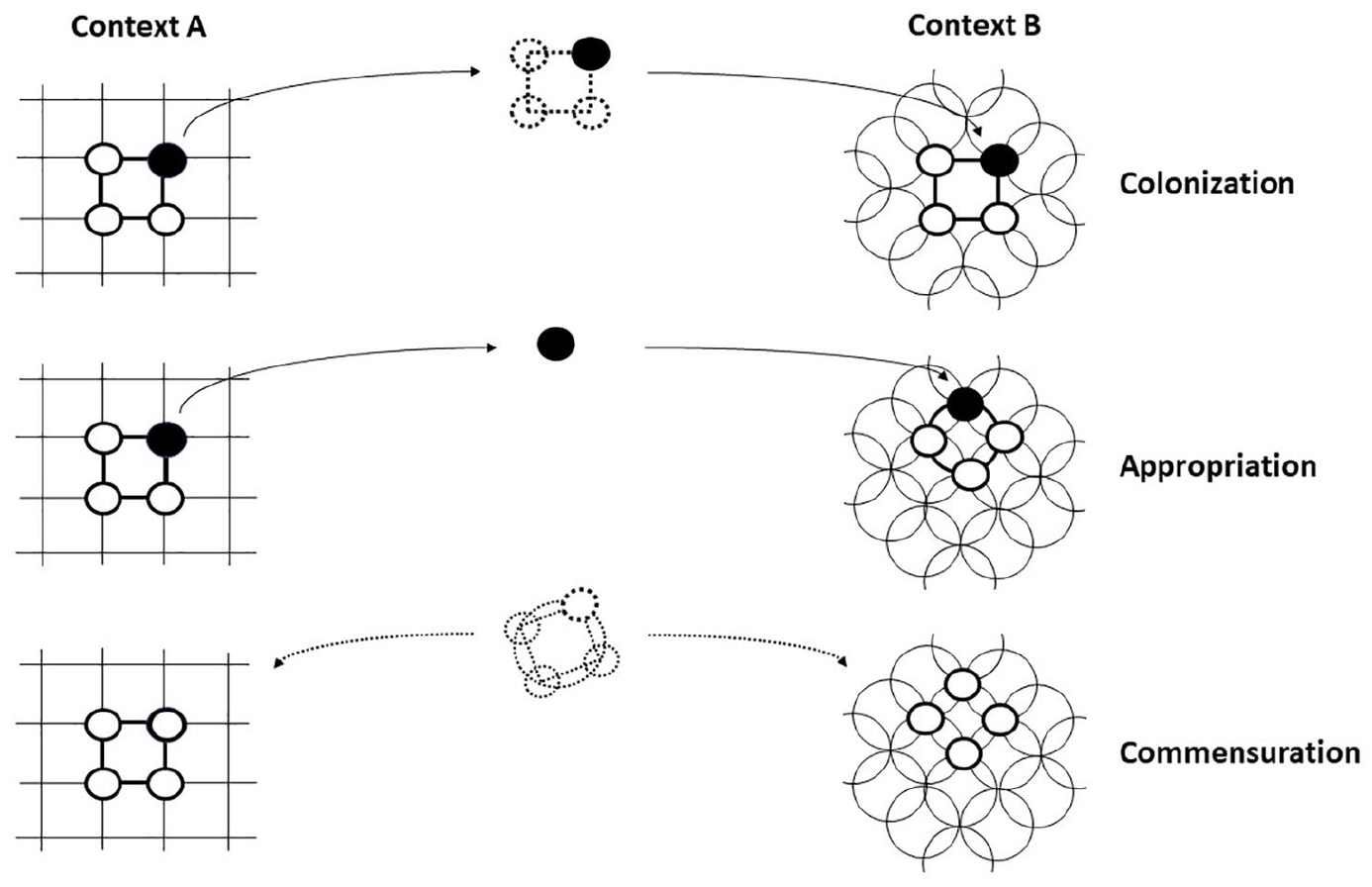
Graphic representation of the three modes of translation.
Colonization
Colonization as a mode of translocalizing practices is trying to export a socio-material arrangement by transferring the arrangement with all the context that lets it be understood and performed like ‘at home’. Colonization thus means that the context of arrival is translated into the terms of the context of departure. The local environment is adapted and put to the service of a function modelled on the basis of what exists elsewhere. Only if this adaptation is successful, the travelling practice can keep its function. This is basically the ambition followed for most technology transfers, be it more material technologies like power plants, agro-chemicals, medical equipment or more social technologies like educational programmes, management tools, democratic procedures or institutional designs. Often the context of departure has, at least in part, already artificially been prepared and confined with a view to develop certain controllable functions. For an illustrative example we may here refer to the system of international airports providing an adapted local environment that allows for near-identical reproduction of the functional configuration of translocally circulating airplanes, crews, passengers, luggage, etc. (Potthast, 2007). Next to international airports, well-known examples in Science and Technology Studies (STS) are laboratory-based technologies for which the context of the laboratory needs to be extended in order to reproduce their function (Latour, 1983), or networks of scientific laboratories which offer specific experimental settings for reproducing specific epistemic practices and facts and so enable the development of translocal epistemic cultures (Knorr-Cetina, 2003). If the contexts of departure and arrival stay the same, knowledge can flow from site to site without distortion – as ‘immutable mobiles’ (Latour, 1987). This is how isolated elements of practice can travel while being protected from contingent translations. In analogy with linguistic translations it is like making dialogue partners learn your own language in order to continue using your own words while being sure that they are correctly understood.
As a mode of transfer, colonization builds on modern ideas of regional expansion, that is continuously moving frontiers more and more deeply into ‘uncharted’ territories. The ambition is to re-build socio-material arrangements as they are known and practised at one place also in other places and so expand the territorial region where they can be relied upon and be used. If successful, it achieves the creation of translocal integration and functional control. At the same time, while such exported contexts are functionally integrated with each other, they risk being no longer embedded within the broader local surroundings. They remain alien for local cultures, enclave realities with little connection to actual life outside their functional configuration.
Appropriation
In the mode of appropriation no specific attempts are made to keep and reproduce practices and their specific functions. Socio-material arrangements are rather allowed and facilitated to circulate in bits and pieces and to be freely adopted, re-defined and re-configured in relation with other elements and established material-cultural settings in the different localities. The power of definition, the assignment of meaning and purpose, the fixing of affordances and criteria of consistency is here with the context of reception. It is like the reverse mode of colonization, one could say. Circulating bodies, texts and materialities are to be freely appropriated, adapted and domesticated to fit what is already there, rather than re-building local conditions around them so that they stay what they are and do what they are understood to do at the place where they have come from. See for example how mosquito nets provided through health programmes are commonly used as fishing nets in the Global South. It is generally through this mode of appropriation that the translation of cultural products like dishes, dances, music, clothing fashions or consumer brands is studied (Eglash, 2004). In linguistic translations ‘appropriation’ would come down to acknowledging and accepting that words disseminated with one meaning from one specific context take on a very different meaning and have different effects as they are picked up in the context of another language.
As a mode of transfer, appropriation builds on postmodern ideas of flexibility and assemblage by sending ‘mutable mobiles’ into the world. In this sense, practices of postmodern expansion come down to fluid engineering which actively supports tinkering and the creation of locally adapted versions of procedures and artefacts by deliberately open and flexible designs (Laet & Mol, 2000).
Commensuration
Commensuration allows for the creation of translocal connections without necessarily moving elements of practice from one place to another. Translation here works by creating equivalence between differently situated elements by introducing an abstract frame that captures them as two manifestations of the same more general category. The abstract category (tertium comparationis) thus provides a conceptual bridge to link embedded practices in different places by framing them as equivalent (comparable) (Espeland & Stevens, 1998). Abstract functional models work as more complex frames within which concrete local practices can be identified as functionally equivalent components. For linguistic translations, commensuration is the most common approach: rather than transporting whole languages and implanting them at the site where one wants to be understood, one sets out to find ‘functional equivalents’ to specific words or idioms of the original language for reconstructing the same abstract meaning of a text in the medium of another language. However, as translation involves betrayal (Law, 2006), commensurate terms may still have very different meanings within their specific contexts which pose limits to their translatability.
As a mode of expansion, commensuration builds on reflexive-modern ideas of building network infrastructures to harness and integrate diversity. Latour’s (1987) ‘centre of calculation’ can be seen as a case in point for a concept that seeks to capture how translocal knowledge gets composed as a synthetic re-presentation of distant, distributed and diversely embedded forms of existence. By integrating diversity, commensuration however often subsumes cultural difference under the frame of a purely techno-functional ‘meta-code’ while disagreement then has to be articulated in ‘cultural codes’ outside the interactions of the centre of calculation (Rottenburg, 2009). Examples for commensuration as an umbrella frame of more abstract categories include the application of respective comparative studies, performance evaluations and indicators (Rottenburg et al., 2015; Deville et al., 2016).
Case and method
Ongoing efforts at spreading deliberative mini-publics as a democratic innovation offer a case in point for studying concrete modes of the transfer of practices across contexts. With the recent proliferation of mini-publics across sites we can here observe from close-up and in real time how transfer is done in practice and from there develop analytical generalizations through ‘ideal typologizing’, ‘category zooming’ and ‘positioning’ (Halkier, 2011). While the construction of ‘ideal-types’ in Max Weber’s sense reduces complexity, ‘zooming in’ on the details and complexities of a particular category and ‘positioning’ interactive dynamics and performances should make it possible to identify ‘overlaps, grey zones, shifts and multiplicities’ (Halkier, 2011, p. 792). Due to a heterogeneous field of mini-publics, we selected our sites with a view to study contrasting cases of the transfer of mini-publics practices. We inferred from earlier research that transfer practices would differ in relation to specific procedural formats (Ryan & Smith, 2014) and with respect to socio-political contexts, such as different countries and regions of the world (Bächtiger et al., 2018, chapters 50–55). Thus, we examined the transfer of different formats (Deliberative Poll, Planning Cell, Citizens Initiative Review) and in different cultural contexts (Europe, US, non-Western).
We here report on three cases of transfer in which one of us (Jannik Schritt) was involved as an ethnographic observer in 2019. Inspired by methodological considerations of a ‘mobile ethnography’ (Blok, 2010), we focused ethnographic observations on identifying elements of practice that have come from elsewhere, and traced them along the path of their transfer to determine how they linked up with different contexts and underwent transformations along their way. For the first case (Deliberative Poll), we observed the transfer process by sitting in on preparatory meetings, instruction briefings and moderation trainings in Skopje over the course of nine days before, during and after the actual event, and by analysing electronic communications between exporters and importers of practice. For the second case study (Planning Cell) we retrospectively analysed the original transfer from Germany to Japan (which took place in the early 2000s) through interviews and an examination of the literature. Then, during a one-week field visit, we interviewed mini-publics experts in Tokyo and accompanied some of them to the town of Tajimi where we observed the performance of a mini-public event and a debriefing with the organizers. In the third case (Citizens Initiative Review) we observed a preparatory meeting of a mini-public event via Zoom and its implementation in-presence across five days in the city of Milwaukee (Oregon), and then travelled with the lead organizer to Sion in Switzerland. Over five days in Sion, we observed as the team tried to reproduce the practice there, witnessing preparatory meetings, moderation trainings, parts of the actual mini-public event and team debriefings.
Case 1: Transferring the Deliberative Polling from the CDD at Stanford to the EPI in Skopje – colonizing for functional control and performance
In June 2019, a Deliberative Polling was organized in Skopje, North Macedonia, on issues of democracy, social pensions and anti-discrimination as a condition for EU accession. The event was organized by the European Policy Institute (EPI) based in Skopje under the guidance of the Center for Deliberative Democracy (CDD) at Stanford University in order for the locally implemented event to conform to the ‘gold standard’ (Mansbridge, 2010) set by James Fishkin as a registered trademark in 1988. Since its development, Fishkin has been actively working on the regional expansion of his method. To show the method’s universal applicability, more than 100 events have been conducted in a fairly standardized way in about 30 countries around the globe. The results are regularly published on the centre’s website and several academic publications analyse the implementation of the method in various contexts (https://cdd.stanford.edu/research/).
In CDD’s and EPI’s preparation and execution of the event, we observed the ways in which CDD tried to uphold the standards of recruitment, briefing materials and event facilitation via the use of detailed guidelines, team communication and onsite verifications. The CDD’s detailed guidelines are used in all countries regardless of the political or socio-cultural context. The guidelines detail exemplary scripts for small group discussions, panel sessions and TV broadcasting including pictures of room setups that illustrate the best ways to materially arrange the event location. The CDD thus assumes that deliberation is possible in a standardized way everywhere, if the heterogeneous elements are correctly arranged.
To make sure the guidelines are properly applied, the CDD members controlled the location onsite before the event actually started. In addition, the moderators and volunteers received onsite training. The training was designed as a role play for moderators to learn the guidelines in order to produce skilled bodies that not only know the guidelines in an abstract sense, but could be capable of performing them. One person had to volunteer to role-play the moderator, while the others performed the role of participants. CDD members intervened regularly to correct their performances.
The array of practice – the distribution of guidelines, arranging the material setting in a standardized way and authoritatively training the enactment of the guidelines – makes the case for translation as ‘colonization’ in order to retain the original method’s form and function. The dissemination strategy of the CDD is one of (re)building a particular setup for the travelling practice to work independently of the context in which the event is to take place. Only by building a near-identical setting as in quite standardized laboratories of the natural sciences – ‘a colonization of context’ – does a circulation of the method as an ‘immutable mobile’ become possible (Latour, 1987).
During the event, however, some of the translations yielded frictions. As Felt and Fochler (2010) argue, mini-publics lock participants into particular roles that they will perform during the event. However, although everything was meticulously planned and controlled from the centre (the CDD) and the infrastructure was assembled and constructed onsite, the participants, moderators, volunteers, observers, translators and experts did not always perform their roles as planned. Firstly, even after the moderator training, some moderators forgot the introductory script during the small group deliberations and other moderators did not ensure that everyone had a voice. Due to limitations of the chosen hotel setting, the rooms assigned for small group discussions were too small to accommodate a large round table for 11–13 people. The organizers thus had to resort to smaller square tables that could seat only 10 persons, meaning the other participants literally had to sit in the corner. Partly as a result of this, some people spoke considerably less than other people, and some appeared to use their corner position as an opportunity to hide. Observation also suggested that older people and men spoke more than younger people and women, while the moderators did little to intervene to ensure equitable inclusion of all voices as stated in the moderator guidelines. Secondly, most participants barely read the briefing material, and the moderators did little to focus the participants on the briefing material. Rather, as some of moderators admitted during the coffee break, they did not want to interfere but let the discussion ‘flow’ instead. As a result, the content of the briefing material was hardly discussed at all – at least in those rooms that we observed. Thirdly, during discussion of anti-discrimination and minority rights in Macedonia, one participant made a homophobic joke, which prompted the group to laugh; and during the plenary session, some politicians answered questions concerning the issue of corruption in a way to assign blame to the other. As a result, participants started booing loudly. These unpleasant actions caused the organizers to feel ashamed, because they had clearly broken with the ideal of ‘civility’ of deliberation, which is one of the core tenets of deliberative democracy promoters, which they contrast with so-called ‘partisan politics’ in liberal-representative democracies (Dryzek et al., 2019).
All these instances of frictions of translation illustrate that an all-encompassing re-construction of the context or a ‘colonization of context’ is a near impossibility. While some organizers admitted that the event was not ‘perfect’, the CDD later publicly portrayed and marketed it as a very successful example of a Deliberative Polling, thereby standardizing an outward performance, media appearance and official reporting, rather than the event itself. As a result, the Deliberative Polling in Skopje rather remained what Sloterdijk and von der Haegen (2005) mock in their art installation of ‘the pneumatic parliament’ as ‘instant democracy’: a self-inflating parliament that is easy and quick to transport to non-Western sites in order disseminate Western democratic principles around the world. As in nearly all other places where the Deliberative Polling was applied since 1994, it is most likely that the translation from Stanford to Skopje will not help a local ecology of deliberative polls to flourish.
Case 2: Transferring the Planning Cell from the Research Centre for Citizen Participation and Planning Procedures at the University of Wuppertal, Germany to a research group on Planning Cells in Japan – appropriating cumbersome procedures for quick dissemination
In the early 2000s, the Planning Cell that was invented by Peter C. Dienel in the 1970s in Germany travelled to Japan. While the innovators initially protected the model, they did not renew the protection as it became clear to them that it serves less to ensure quality than to promote its non-proliferation. The transfer of the method was facilitated due to a personal contact between Peter C. Dienel and Akinori Shinoto, by then a businessman and employee in the state administration of North Rhine-Westphalia, Germany, and now professor at Beppu University, Japan. The German developers did not impose any requirements on the Japanese, but rather, allowed local potential to develop freely and for the innovation to be adapted and transformed. The Japanese iteration of this model has since been named shimin togikai (‘citizens deliberation meetings’). The initiative to do this was taken by the Junior Chamber of Commerce (JCC) – a politico-economic network in Japan with about 700 local organizations and 36,000 active members aged between 20 and 40 years. In March 2005, the JCC founded a research group on Planning Cells in Japan (Nihon Puranungusutsere Kenkyukai) with the explicit aim of conducting collaborative research on the best ways to translate the German method to Japan’s political culture (Shinoto, 2005). A pilot project was organized the very same year. Ten years later, with the help of the JCC network, shimin togikai have become an established practice of city planning on the municipal level. Within the last 10 years, over 500 shimin togikai have been organized in many municipalities across Japan with several cities organizing one meeting a year.
Looking at the circulating elements of practice in both contexts, we see that while both practised methods randomly select and financially compensate participants and discuss the issues in small groups of about five or six people, the functions of the Planning Cell and the shimin togikai have become quite different. While the Planning Cell was initially invented to solve conflicts of public planning projects, the shimin togikai is now mainly used as a brainstorming method to collect ideas and opinions from citizens. The different functions might also explain the different length of the two methods. While the Planning Cell normally proceeds over four full days, the shimin togkai is a very compressed appropriation of the original method, with a length of only one or two days. While its appropriators argue that this adaptation was necessary due to the Japanese working culture that does not allow for participants to take off more than one working day, it also fits a different rationality in the rather authoritarian political culture of Japan, in which shimin togikai are designed to provide input to decision-makers instead of solving conflicts. In another differentiation, organizers in Germany are mostly non-governmental organizations, while in Japan the organizers are local committees composed of members of the JCC, the municipal administration and former participants. In Japan’s case, the association of pre-existing networks with large financial and political power explains the success of the method’s fast and wide dissemination in Japan.
As we observed a shimin togikai in Tajimi in 2019 – the town’s eleventh consecutive event since 2009 – it became clear that little deliberation was actually taking place on the set topic of public transport. Four transport issues were discussed in only one and a half days. The information on the topics mostly came from municipal authorities, rather than from independent experts, as is normally the case in Germany. The public authorities introduced the topic and then asked the participants to develop ideas to improve public transport in the city. The public officials were allowed to walk around, listen, answer questions and even talk to the participants during the small group discussions. In Germany, such activities would have been considered undue influence and a misuse of the process.
The small group discussions were based on the ‘KJ-method’ that was invented by the Japanese anthropologist Jiro Kawakita in 1967. In the first two steps of this moderation technique, people write as many ideas as possible on small stickers, which are then read out loud and put on a flip chart. In the third step, the stickers are placed on a table and participants cluster them into groups. In a fourth step, the clustered groups are summarized in solutions at the bottom of the flip chart. After presenting the small group results to the large group, the participants prioritize the different suggestions with cumulative point voting. After the last round of voting in Tajimi, the event was finalized and the organizing committee collected the flip charts with the cumulative voting results, from which they drafted the citizens’ report. Brainstorming instead of problem-solving is therefore already inherent in the moderation technique itself.
The day after the event, we visited the organizing committee in the town hall, together with two Japanese colleagues. The organizers explained that they were not really satisfied with the recommendations the participants had developed. They found that many of their ideas were not really applicable. As a result, they later added new ideas in the drafting of the final citizens’ report. This would be considered an explicit misuse of power or an act of manipulation in the German context, where the random sampling and stratification of the group according to demographic criteria provide legitimacy to the final recommendations as a ‘view of the public’. In Japan, however, the process is not so much about solving contested issues or conflicts, but about using the swarm intelligence of the silent majority to offer public administration new ideas that are normally not heard in the public or policy networks.
While deliberative democracy experts might ask, given these transformations, if shimin togikai can still be qualified as deliberative mini-publics at all, the point is that the conscious appropriation of the German method to fit the Japanese political culture helped the method to disseminate quickly. Without a central overseeing body controlling its functions (such as in the ‘colonization’ mode outlined earlier), organizers are able to freely pick those elements that suit a particular event and can dismiss other elements that do not suit a purpose, thus allowing for a true appropriation and dissemination. The downside of this ‘take and run’ approach is, however, a transformation of the original function. There is an arbitrariness in how the travelling practice gets translated.
Case 3: Transferring the Citizens Initiative Review from the NGO Healthy Democracy in Portland to the demoscan research project based at the University of Geneva – commensurating culturally embedded practices
In November 2019, a US expert from Portland-based NGO Healthy Democracy advised the demoscan research team based at the University of Geneva in order to help them conduct the first ever Citizens Initiative Review (CIR) in Switzerland, in the town of Sion, which was chosen as the location for the model project. The CIR is generally placed before voting on an active ballot measure to produce a summarizing statement on the measure which is then distributed to all the state’s voters. We accompanied the US adviser on his way to Sion from Portland and Milwaukee where he had just organized a citizens’ jury, identifying three main elements that travelled along the way: the CIR manual, the programme manager and the timer. Over the years, Healthy Democracy has developed a 132-page manual of the CIR specifically for the US context. More detailed than the Deliberative Polling guidelines described above, the CIR manual includes scripts for the moderators, the sitting order, starting time, duration and even the slides to be shown. But while the manual details every step of the procedure, in contrast to the guidelines of the Deliberative Polling, it was not designed as a blueprint ready for export outside of the US context. The US expert had sent the manual to the principal investigator of the demoscan research project, where it was translated from English into French. They also held Zoom meetings to discuss the manual and the Swiss team organized a trial version with their students at the University of Geneva.
The US adviser conducted a moderator training onsite in Sion the day before the event started. But in contrast to the standardized and somewhat authoritative moderator training in Skopje, the Sion training was organized on a ‘level playing field’ along with discussion of appropriate moderation in Switzerland compared to the USA. Most important was the role of the moderator itself. While the personal style of the lead moderator of the Sion CIR was very engaging and sometimes even involved her in substantial discussions with the participants, the US practice envisages a ‘robot-like’ moderator who is one hundred percent impartial on the content. This ‘impartial moderator’ is a component of the CIR process that was designed in 2010 by Healthy Democracy to guarantee impartiality in relation to highly monetized and polarized ballot measures in Oregon. In Oregon, advocates from the pro and con campaigns sit at the back of the room to observe the neutrality of the CIR process and cry foul over any visible imbalance. As the US programme manager described, a good CIR moderator in the American context is one who laughs and exchanges good vibrations with the panellists about non-content-related issues, but becomes completely neutral when content is discussed.
Impartiality at the core of the process was illustrated even more clearly with the sports timer that the US expert brought with him from the Oregon CIRs. For him, the timer with the alarm sound is the most important artefact because it allows a transparent, strict and equal timing of the advocates’ statements. According to the CIR manual and the US practice, each advocate has two minutes for his or her statement before the buzzer interrupts the speakers, who are then not allowed to conclude their sentence. This is important in order to keep the balance between the two campaigns, limit complaints and thus assure an impartial and balanced process. In the Sion context, however, the Swiss organizers found the alarm sound annoying, impolite and unnecessary, and thus decided to switch the timer off each time before the buzzer was to go off. The advocates and experts were then allowed to finish their statement, even if they added several more points after the time had already expired. With this adaptation of the process, the timer not only became a redundant artefact, the on-off switching of the device also became an annoying and at times even asynchronous practice for the moderators. While the (mis)use of the sports timer in Switzerland came as a huge surprise to the US expert, who had envisioned an ‘impartial and balanced process’ through the working of the device, he did not insist on its intended mode of use, but allowed for adaptation and transformation of the whole process logic. According to him, this made sense as there were no campaign advocates sitting at the back of the room in Sion, and thus no contact person for them to address complaints was needed. Reflecting on the differences between the USA and Switzerland, he was particularly impressed by the good quality of deliberations in Sion, which he attributed to a generally higher standard of education and a more consensus-oriented discussion culture in Switzerland.
In contrast to the Deliberative Polling case in Skopje, the CIR case shows that the translation from Portland-based NGO Healthy Democracy to the demoscan mini-public in Sion allowed for flexibility in the script to smooth frictions between a highly monetized, polarized and heated political culture in the US and a less confrontational, less monetized and more consensus-oriented political culture in Switzerland. Although the US expert had brought the detailed manual of operations to Sion, he did not insist on its precise enactment but reflected on contextual differences between the USA and Switzerland by comparing the different political cultures. By instituting abstract categories of what good moderation and facilitation styles mean in different contexts, the US adviser made different practices comparable as local manifestations of the same functional component of the method (commensuration). Moreover, the interaction between the Swiss research team and the US expert was less organized as a one-directional ‘colonization’ as in the case of the transfer of the Deliberative Polling from Stanford to Skopje, but rather as reflexive networking and cooperative learning on a level playing field. The problem of translation as commensuration, however, is that an emerging transcultural ‘meta-code’ integrates diversity in purely techno-functional terms and thereby carries the illusion of an integrated function of the method (here the CIR) while in the context-specific ‘cultural codes’, practices mostly resume as before (Rottenburg, 2009) – when, for example, the respective other considered certain ways of doing CIR ‘very American’ or ‘the Swiss way’.
Conclusion
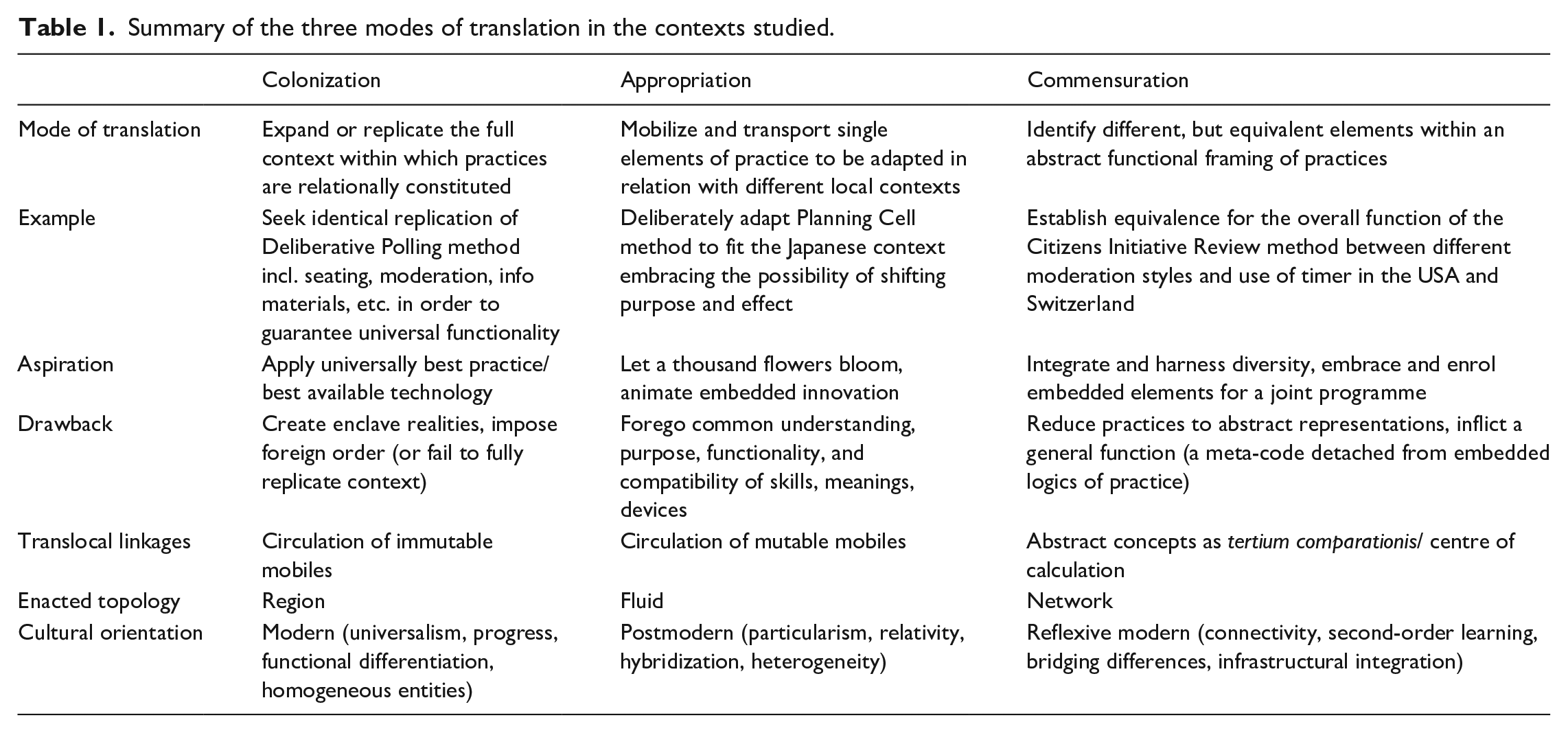
We introduced an analytics to differentiate three modes of translation according to how mobilized elements of practice (texts, bodies, artefacts) become associated with local configurations at the site to which they are transferred: firstly, colonization as a mode of translation that adapts the new context to fit the transferred arrangement; secondly, appropriation as a mode of translation that adapts the transferred arrangement to fit the new context; and thirdly, commensuration as a mode of translation that constructs functional equivalence between distinct arrangements. These ideal-types result from an abductive process of enquiry based on ethnographic observations of transfer practices in the field of democratic innovation. We indicated how these three modes of translation can be related with broader cultural orientations: (a) colonization practices can be related with a modern ontological orientation of universal progress and the enactment of a regional topology; (b) appropriation practices with elements of a postmodern ontological orientation of particularism and relativity and the enactment of a fluid topology; and (c) commensuration practices with key elements of a reflexive-modern ontological orientation of categorical integration, connectivity and second-order learning. Table 1 gives an overview.
Summary of the three modes of translation in the contexts studied.
‘Zooming in’ on each of the cases further shows that it is not only one or the other mode of translation dominating, but also that all three modes of translation are actually at work in each of them. While the case of the Deliberative Polling was mainly focused on ‘colonization’, frictions in the performance of the roles showed instances of ‘appropriation’ and Fishkin’s publications on Deliberative Polling in different parts of the world show that he is also deliberately comparing the performance of his method across contexts (‘commensuration’). The case of the Planning Cell/shimin togikai in which the ‘appropriation mode’ clearly dominated still involves ‘commensuration’ when, for example, innovators of the shimin togikai compare elements of the appropriated method with elements of the original Planning Cell method. And when practitioners of the Planning Cell in Germany ask whether the practice of doing democracy with shimin togikai can still be qualified as ‘deliberative’, instances of ‘colonization’ flare up. Finally, in the ‘commensuration’ work of the CIR case, the US expert combined ‘colonization’ of the context to produce similar practices to the US (e.g. arrangement of room settings, detailed script for moderators) with ‘appropriation’ to fit the local context (e.g. allowing for engaged moderators and advocates overstaying time). Thus, instead of playing off one mode of translation against the other, a game that often seems to be played in debating theories of globalization and modernity, we emphasize, on the basis of our empirical analysis, that all modes are indeed simultaneously existing and that they are performatively at work in producing, interweaving and overlaying their different kinds of spatiality and ordering of realities.
Further, we may not expect that any of the three modes will entirely supplant the others because each entails specific problems that provide opportunities for the others to prosper. Colonization, for example, is limited by the impossibility of fully replicating the whole context of a practice according to some functional standard. Replication is either limited to enclaves (which themselves are not embedded and whose installation produces unforeseen and uncontrollable side-effects and repercussions, like resistance against foreign impositions) or it needs to allow for appropriation, at least to some degree, in order to link into locally established configurations. This, however, inevitably transforms the socio-material arrangements and changes its dynamics. Functions cannot be technologically controlled anymore. Fully going for appropriation, however, meets limits in terms of possibilities for communication and cooperation across sites, and limits for developing synergies, because of idiosyncratic creations each with their own situated dynamics feeding a continuous bubbling of ephemeral innovations. The mode of commensuration, while apparently offering a third way allowing for embedded diversity and still providing for compatibility and learning across sites, in turn is limited by the artificiality of abstract framings of equivalence which either compel practices to align with ascribed functions (Voß et al., 2022) or produce a cleavage between performances of a translocal meta-code and the logics of practice that are actually followed on a day-to-day working basis (Amelung, 2017).
We thus suggest that the three modes are to be positioned symmetrically as elements of an analytical repertoire. Rather than stepping into the game and deciding for one mode and helping it to prevail over the others, by ‘positioning’ interactive dynamics we should investigate the intricate ways in which the three modes combine and interfere with each other. In the practice field of doing deliberative mini-publics we could also observe that the challenge of innovating democracy through one or the other mode of translation gives rise to different coalitions of actors. The most virulent cleavages in this field of practice are related with differences in how practices are sought to be transferred, from ‘expanding an optimal functional order’, via ‘anything goes’ and ‘let a thousand flowers bloom’ to ‘reflexive exchange and learning’ (Dienel, 2020, p. 4; Ryan & Smith, 2014; Mann et al., 2014). These differences show concretely the contentions on methods for developing procedural designs, on their public legitimation, on quality standards, evaluation, training, dissemination and professional organization. It seems that rather than well-known struggles between left and right, freedom and security, equality and competition, labour and capital, ecology and industry and the like, it is the struggle between colonization, appropriation and commensuration as modes of innovation, or between modernity, postmodernity and reflexive-modernity as modes of ordering that is defining relevant cleavages.
These observations ask for more in-depth studies with a specific focus on the dynamic relations between such different practices of innovating and world ordering, also in other fields besides the doing of mini-publics. It could well be that interactive relations between the three modes of translation fuel the dynamics of late modern development on a much broader scale. For these questions to be picked up and respective empirical studies to be undertaken, however, it is important, first of all, to recognize the three modes as coexisting patterns of practice, rather than constructing frameworks of analysis on the basis of ontologically assuming just one of them as given. This is what we hope this article can contribute to.
Footnotes
Acknowledgements
An earlier version of this article was presented at the workshop ‘Travelling Knowledge’ at the University of Duisburg-Essen in March 2021. We thank the organizers and participants of the workshop as well as the reviewers for The Sociological Review for their useful comments on earlier drafts of this article.
Declaration of conflicting interests
The authors declared no potential conflicts of interest with respect to the research, authorship, and/or publication of this article.
Funding
This research was funded by the Deutsche Forschungsgemeinschaft (DFG, German Research Foundation) – Projektnummer 290045248 – SFB 1265.