




Abstract
Drawing on original archive material from the Tyne and Wear Archives, this article examines the sociological significance of the Metro Centre shopping mall, built in Gateshead in North East England in 1986, at the time the biggest in Europe. It explores how the Metro Centre marked a call to accept the new and ‘prevailing ideals’ of consumption and represented a key moment for the reformulation of selfhoods as consumer identity practices. Adopting Walter Benjamin’s notion of the ‘hollow mould’ of modernity, the article positions the Metro Centre as an embodiment and material form of wider social, political and economic shifts. Its geographical location at the epicentre of British de-industrialisation is highly significant and marks a key moment where citizens and consumer selfhoods were fused. The shifting discourses around consumerism that occurred during this time, against the backdrop of the increasingly populist ideology of Thatcherism, set the foundations for the emergence of a new neoliberal consumer citizen, who was promised choice, personal growth and wellbeing via consumerism. I will show how new neoliberal ideals of aspiration and meritocracy became interwoven into a new language of consumption that was heavily promoted by the Metro Centre. In fact, the Metro Centre was pivotal in promoting new forms of social exclusion and new articulations of global capitalist production. The article concludes by proposing that the Metro Centre came to embody new neoliberal notions of social ‘worth’, value and inclusion entwined with engagement in new processes and practices of consumption.
Introduction
In this article I offer a sociological account of the Metro Centre shopping mall, built in 1986 on the newly post-industrial outskirts of Gateshead in North East England. I will show how the Metro Centre represents a pivotal moment of multiple transformations; whereby the economic structures of industry and production were rapidly replaced with new hyper-individualised economies of self and consumption. I consider how the Metro Centre’s construction coincided with new ideologies of consumption whereby shopping began to be presented as egalitarian, meritocratic and central to new subjective practices of social mobility. Importantly, the Metro Centre came to symbolise part of a new, highly commodified way of speaking to and promising a solution to wider social problems; a set of narratives which became firmly embedded in post-industrial Britain. In the article I locate the popular appeal of the Metro Centre in the mid-1980s alongside the burgeoning social inequalities and dramatic economic transformations synonymous with the widespread industrial decline that characterised North East England in the 1980s. By doing so, the article contributes to other research that has demonstrated how wider social and economic transformations are often reflected in the emergence of new practices of consumption where moments of ‘crisis’ are accompanied by new everyday processes and practices.
Little attention has historically been paid to the Metro Centre within sociological accounts of consumption. This is surprising given the high-profile visibility of the Metro Centre, and its extraordinary vociferous support from the British Conservative government, who represented some of its most vocal devotees. The Metro Centre was built in Gateshead, a town in the North East of England on the south side of the river from Newcastle-upon-Tyne which, in the 1980s, was in the midst of some of the most devastating dismantling of industrial sites and communities in living memory. In this article I describe the 1980s as a period of unprecedented economic and industrial change that was accompanied, simultaneously, with rapid, highly visible transformations in cultural and consumer practices. Drawing on an original case study of archive material from the Tyne and Wear Archives that narrates the creation, building and opening of the Metro Centre, I examine how this represents a significant historical moment that reflected and entrenched broad ideologies of ‘Thatcherism’ that were transforming British society in radical and deeply impactful ways. In doing so, I follow Stuart Hall’s seminal account of Thatcherism as Gramscian hegemony. Hall demonstrates how the true ‘power’ of Thatcherite politics and policies lies in how they offer ‘something new’ alongside the dismantling of the post-war consensus around labour and production (Hall, 1988). Written just two years after the Metro Centre was built, The Hard Road to Renewal describes how Thatcher won not only the battle for power, but also for ideological control – for ‘popular authority’ (1988). In this article I ask what role the Metro Centre played in these processes.
Drawing on the sociology of consumption and its limitations, I show that the Metro Centre is of great cultural importance, capturing industrial decline, the demise of a production economy and the rapid rise of a service and consumer economy.
The Metro Centre, Gateshead: ‘A great idea for the English winters’
In October 1986, the Newcastle Evening Chronicle newspaper devoted its entire front page and most of its content to an ‘official souvenir supplement’ celebrating the building and opening of the new shopping mall, the Metro Centre. Built on the outskirts of Gateshead, on a disused industrial site, the Metro Centre was to be the largest shopping mall in Europe, the first of its kind in the UK. It was developed by the local businessman John Hall, an ex-Ashington miner and ‘self-made’ businessman who went on to buy Newcastle United Football Club and became a major donor to the British Conservative Party. Following visits to the United States, Hall had developed the idea of bringing a US style indoor shopping mall and entertainment complex to the UK, describing the Metro Centre as ‘a shopping revolution’ and ‘a great idea for the English winters’ (Evening Chronicle, 13 October 1986). Marking a dramatic shift in terms of ‘new’ modes of consumption and commerce, the Metro Centre promised ‘choice’, ‘sparkle’ and ‘a focal point for a community’. The British Conservative government avidly supported the venture in two key ways. First, it was financially enabled via the ‘Enterprise Zone’ scheme, which cut taxes and relaxed planning laws on areas otherwise unattractive to developers. Second, the then Prime Minister Margaret Thatcher went to the effort of writing an open letter addressed to the people of the North East of England that extolled the benefits of the new shopping mall. The letter was published on the front page of the Evening Chronicle newspaper (Figure 1). It promised that the Metro Centre would bring community enhancement, employment opportunities and an increased sense of local pride.
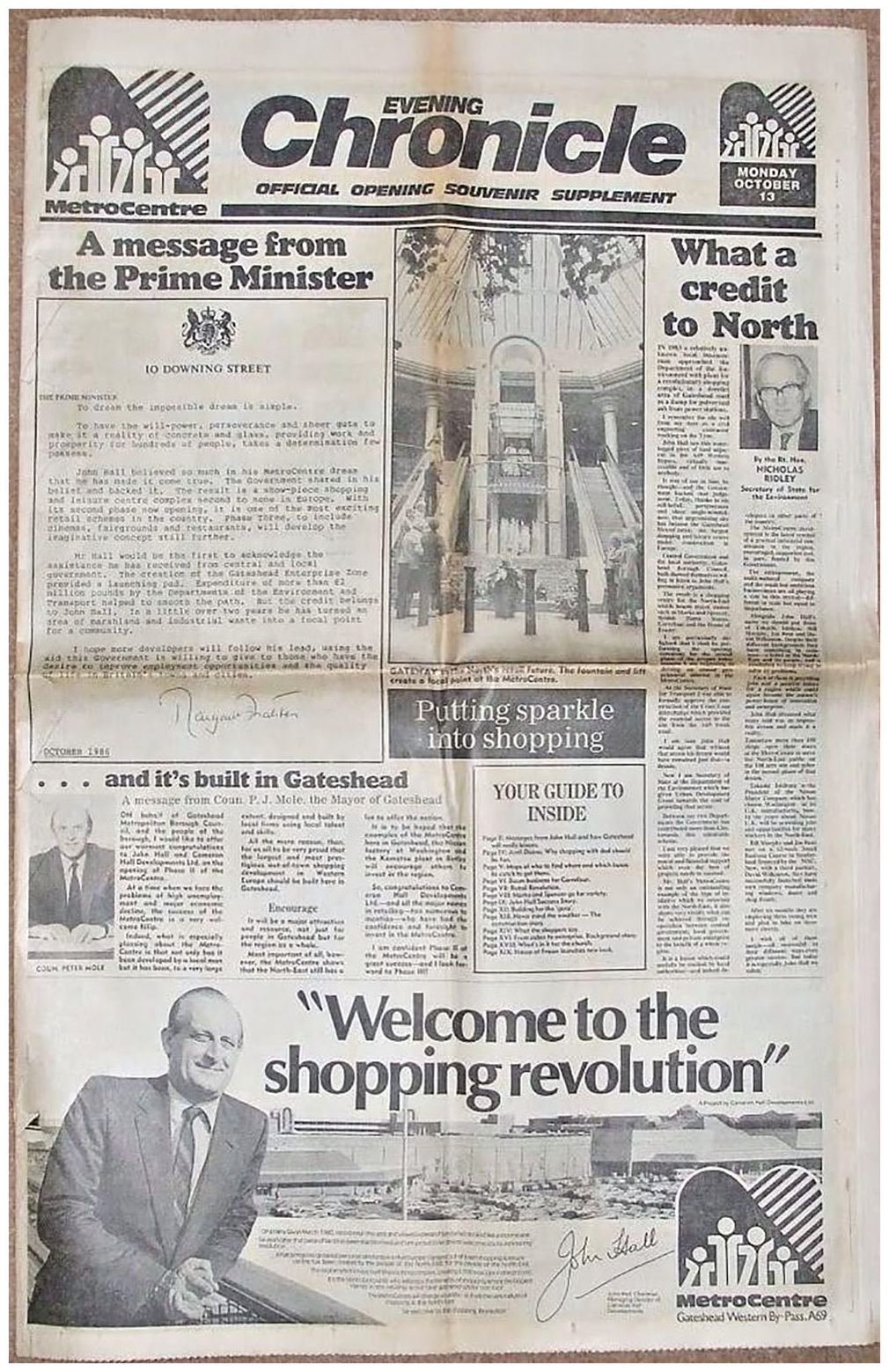
Thatcher’s open letter extolling the virtues of the new Metro Centre; Evening Chronicle, 13 October 1986.
Thatcher herself rarely visited the North East of England during her premiership, so the visits that she did make and in particular the high-profile photo-shoots of her visiting the Metro Centre during its opening months are highly significant. One widely recognised photo of Thatcher taken around the same time, shows her alone, handbag in hand, on her famous ‘walk in the wilderness’ tour of an abandoned industrial engineering site in Teesside in 1987, only a short distance from the Metro Centre. These highly publicised publicity shots of her visits to the post-industrialised sites of the North are generally seen to represent an ideological push to replace industrial production with sites for commerce, business and consumerism. Much was made of the Metro Centre being built on the ‘wasteland’ site of a disused power station, to be transformed into a futuristic shopping ‘show-piece’. As Thatcher writes in her letter ‘In a little over two years he [John Hall] has turned an area of marshland and industrial waste into a focal point for a community’ (Evening Chronicle, 13 October 1986, p. 1).
Building of the Metro Centre began in 1984 on the site of a coal-fired power station that was decommissioned in 1981. By the time it was completed in 1986, it was, as promised, the biggest shopping centre in Europe at 2 million square feet. In addition to multiple high street shops and giant department stores, including Marks and Spencer’s first commitment to an out-of-town shopping development (Davies & Howard, 1989), the Metro Centre promised activities beyond simply shopping. It also housed a 10-screen cinema, bowling alley, and by 1988, Europe’s largest indoor theme park, ‘Metroland’. Alongside this, the Metro Centre also hosted a chaplain offering services on Mothering Sunday and Remembrance Day, meaning that worship, entertainment and shopping were all available under one roof. Although there were direct bus and train routes to the Metro Centre, car-based journeys were encouraged with vast car parks offering free parking for all visitors. Early promotional material for the Metro Centre presented a visit to the new mall as a ‘family day out’, as offering ‘choice’, ‘magic’ and ‘sparkle’. In 1987, only months after its opening, Margaret Thatcher made her high-profile visit. Photo archives show her being given a guided tour by John Hall; she is famously pictured riding up the glass lift, waving at the crowd below and admiring the newly built, vast indoor shopping mall below. When asked by an ITN journalist what she thinks of the Metro Centre, she is quick to reply, ‘the precinct is lovely, a fantastic idea – this is the kind of entrepreneurship which is back in Britain now’ (Margaret Thatcher Foundation, 1987, italics mine).
Statistics from the time show that the Metro Centre was visited disproportionately by more prosperous, middle aged groups and family shoppers (Davies & Howard, 1989). For all its talk of new beginnings, the Metro Centre offered a relatively exclusive form of shopping that was out of reach to many. In 1986, only about 60% of the UK population had access to a car, with people from low income households up to seven times less likely to be able to afford a car (Health Foundation, 2021). Furthermore, like the shopping malls that came after it, the Metro Centre expressed an obvious preference for the ‘right’ type of consumer. A heavy presence of security guards meant that it was a shopping centre without buskers, homeless people, young people hanging out (rather than necessarily shopping), protesters, litter, graffiti, or many of the usual features of the old urban shopping centres. This exclusivity is further emphasised when one considers the economic and political climate of North East England in 1986, in the midst of pit closures, deep industrial disputes and mass unemployment. In the year that the Metro Centre was built, the North East of England was the poorest region in the UK, with one of the highest rates of unemployment.
The Metro Centre marked the beginnings of a new chapter in British retail history with similar out-of-town shopping malls quickly being established across the country, often on the outskirts of post-industrial northern cities, including the Metro Centre in Gateshead and Meadowhall in Sheffield, leading to what Hallsworth (1994) describes as a ‘decentralization’ of retailing in the UK. Many social commentators bemoaned the depressing sameness and lack of individual identity of the new malls. Broadsheet columnists expressed particular disdain, with Patrick Wright in The Guardian likening shopping malls to a ‘collection of vast metal sheds along the bypass’ (22 December 1994), while Suzanne Moore, also in The Guardian, lamented the ‘buzz and hum of a market-place [that is] often absent in such a sanitised space’ as a shopping mall (9 February 1995; cited in Miller et al., 1998, p. 73).
These emerging new consumer identities helped to entrench neoliberal identity practices, which in turn found a tangible reality in the Metro Centre. In particular, a new consumer ideology became interwoven with everyday narratives of consumerism which changed from a suspicion of unnecessary consumption and a focus on thrift, to a more unfettered and aspiring consumption that cut across classes and promised participation and inclusion for those who would work hard and were aspirational enough.
‘Aesthetics of change’: Sociologists in the shopping mall
The mall is the escape from the iron cage to its simulated form in multicolour neon. (Langman, 1991, p. 118)
Perhaps surprisingly, sociologists of consumption have tended to overlook the ways in which consumption intersects with inequalities and with processes of social change. On this point, Alan Warde warns against analyses that position consumption as simply a by-product or consequence of late capitalism, arguing instead that consumer practices are integral to the emergence of new identity practices (Warde, 2015). Following Warde, we might consider how contemporary ‘palaces’ of consumption such as the Metro Centre offer up new ways of exploring how modern consumer selfhood is interwoven with wider social and cultural transformations.
Early accounts of consumption tended to dichotomise the consumer and citizen and to overlook the role of the state in capitulating to the dominant ideology of the day (Warde, 2015, p. 127). One notable exception to this can be found in the work of the cultural theorist Walter Benjamin, who began work on his seminal text The Arcades Project in 1927. The Arcades Project looks backwards into the dream-worlds of 19th-century Paris, and locates these as the origin of present-day city, crowds, technology and consumption. Pusca (2010) describes this as the ‘aesthetics of change’, noting how change is reflected in Benjamin’s descriptions of a rapidly transforming European modernity. The Arcades Project examines the Paris arcades as historical sites bringing together the past and present, local and cultural and moreover anticipating both hybrid and virtual cultures (Geobel, 2011).
The Arcades Project and the ‘aesthetics of change’ offer a useful precursor to the transformative consumer processes that paved the way to the rise of the shopping mall in 1980s Britain. Here the logics of advanced capitalism and consumer ideologies are transformed and reinvented to speak directly to an industrialised recent past, casting a lively and engaging image of modernity: All at once, they were the hollow mould from which the image of ‘modernity’ was cast. Here, the century mirrored with satisfaction its most recent past. (Benjamin, 1927, p. 874)
Benjamin’s vast, unfinished collection of writings explores the iron and glass structures or ‘arcades’ constructed and popularised in Paris during the 19th century. The arcades or passages couverts de Paris, were carved out of the old commercial streets of Paris, where iron-beamed enclosed alleys were lined with ‘the most elegant shops, so that the arcade is a city, a world in miniature, in which customers will find everything they need’ (Illustrated Guide to Paris, cited in Benjamin, 1927, p. 873). By 1927, when Benjamin began The Arcades Project, the popularity of the arcades had waned. The dramatic expansion of the Boulevard Haussmann – a vast tree-lined street of shops and department stores – from the mid-19th century onwards, coincided with the ruthless demolition of old streets and structures and notably of the arcades. By 1927 only a few arcades remained and Benjamin became fascinated with arcades as interiorising the remains of a city, and of the shops displaying the commodities of a bygone age.
For Benjamin, the arcades were also a material representation of modernity, representing a ‘fading away’ of old ways of living. The focus in The Arcades Project on the transience of the material considers capitalism as it is lived and experienced. The arcades are described as streets of stimulation and energy where the consumer is born and the shopper comes into existence. They are also spaces where illicit activities were often shared with experiences of the sensory ‘feel’ of modernity. Benjamin describes the ‘dream-sleep’ that descended over Europe in the 19th century, where the intoxicating goods of an increasingly seductive capitalism, such as tobacco, perfume and chocolate, facilitated new relationships to objects which began to work their way into daydreams. The Arcades Project offers a reflection of Parisian 19th-century consumerism, once a glittering celebration of foreign cultures and the exotic; the original stage for the flaneurs, and its demise, giving way to the new boulevards and department stores of early 20th-century Paris. Benjamin describes in sensuous, evocative detail the decline of the arcades that became a relic of the past. For consumer scholars, The Arcades Project opens up a great opportunity to explore the ways in which contemporary ‘palaces’ of consumption and the aesthetics of space come to represent cultural, social change and transformation. As with Benjamin’s arcades, the dust of the past lingers.
Benjamin’s spaces of consumption pertain to visual representations of modernity and social change where the past is interwoven into images of material culture and shopping spaces. Moreover, as Graeme Gilloch describes, Benjamin’s account of the ‘dream-houses of modernity’ serve to unmask the ‘delusions, pretensions and barbarisms of the city’ (1996, p. 2). As described above, the Metro Centre alludes to a nostalgia for the Parisian arcades, but a more sanitised and less inclusive version. Rather than places where the flaneur can wander without buying – perhaps even selling their own wares, such as art or poetry – and ‘shelter from the rain’ (Benjamin, 1927, p. 873), the late 20th-century shopping malls are places where anything unrelated to active consumer purchase is discouraged. What we see reflected in the 1986 Metro Centre is a hyper-real, high-consuming nostalgic version of the shopping streets of the past, evidenced in the wrought iron bins, benches, Parisian style cafes and boulevards. Moreover, as we shall see, the Metro Centre promised a newly accessible, highly alluring spectacle of distraction and display that, crucially, was presented as reachable to the masses, not only to the bourgeoisie.
As Benjamin reminds us, consumption is not simply a practice – a thing that we do – it is also an ideology (see also Graeber, 2011). Consumption, then, represents a set of ideals and ideas that are underpinned by economics, politics and policy. Yet, consumption scholars have historically paid only scant attention to the relationships between key events in the onslaught of modernity and the impact of these on consumption. As I argue in this article, a full understanding of the shifts in consumer practices needs also to consider the economic and political context within which these shifts occur. The ideology of consumption changes over time, alongside the ideals and ideas associated with it. This concurs with David Evans’s claim that the sociology of consumption should not stray too far from the ‘classic problems’ posed by sociologists, including a focus on social change (2019). As Sharon Zukin remarks, ‘Cities are no longer seen as landscapes of production, but as landscapes of consumption’ (1998, p. 825), while Amin and Thrift (2007) show how economic mantras are often narrated via urban landscapes.
‘Centres’ for shopping are nothing new. There is a long history in Europe, North America and beyond, of retail settings combined with entertainment and social venues such as the Parisian arcades of the 19th century discussed above. One key difference between what came before and the contemporary shopping malls of which the Metro Centre is a pioneering example, is the spatial relocation of centres of shopping away from city centres and towards out-of-town malls. In the early days of planning the Metro Centre, there was much objection that stemmed from concern about the impact on local commerce and more general anxiety around the ways that broad meanings and identities of cities, especially cities like Newcastle, famed for its distinctive identity rooted in industrial heritage, might be impacted and eroded. As Chaney (1990) notes in an early paper about the Metro Centre, there was particular concern over how the Metro Centre would ‘physically evacuate the city of commercial meaning’ (p. 50).
As with the cultural regeneration projects that came later (see Jones, 2011; Miles, 2005), the Metro Centre offered up new discourses and narratives that spoke to industry, community and proud local heritage, but ultimately reduced this to a highly marketised, global, homogeneous commercial entity that benefitted a minority of global companies which profited enormously from this renewed form of consumer capitalism. During times of crisis, capitalism is often reconfigured with people tending to turn away from ‘politics’ as a solution. Thus, ‘[r]ejecting politics as usual, they began to search for new ideas, organisation, and alliances’ (Arruzza et al., 2019, p. 18). Alongside newly configured ways of restoring profitability, capitalism is reinvented so that it is presented not as something that has often wrought misery, poverty and unemployment on people and communities, but rather as offering a new, glittering, fun, pleasurable and accessible form of high consumerism and entertainment, all designed to offer freedom, choice and leisure.
What we see over time then, leading up to the creation of the Metro Centre, is the unfolding of increasingly fantastical, ‘other-worldly’ centres of shopping that carried with them a ‘dream-like’ quality, at once integral to, but promising a pleasurable distraction from the ravages of crisis capitalism. A version of this was seen in the department stores (Williams, 1982) from the late 19th century onwards where shopping among the middle classes was increasingly seen as a pleasurable practice rather than simply a functional necessity (Bowlby, 1985). As Miller argues, the late 19th-century Parisian department store, devoted to servicing the needs of the middle classes, was a ‘monument to bourgeois culture . . . a bourgeois celebration, an expression of what its culture stood for and where it had come over the past century’ (1981, p. 3). By the 1980s in the UK, the new shopping malls such as the Metro Centre were promising a broad, mass and ‘meritocratic’ appeal rather than simply narrowly appeasing the tastes and desires of the middle and upper classes. Thus, whereas once, ‘consumption was viewed as a means of driving a wedge between the urban social classes . . . by the end of the 1990s, consumption is understood to be both a means and a motor of urban social change’ (Zukin, 1998, p. 835).
The Metro Centre, then, from its outset was symbolic of new ways of thinking about and experiencing consumption. Of particular note were the ways in which it connected to and reworked legacies of the past in order to foster a popular appeal to new demographics of pleasure-seeking consumers. The architect Victor Gruen is often credited as being the pioneer of the modern mall, developing so-called ‘shopping towns’ that were based on the idea of developing the experience of shopping beyond a utilitarian practice. Instead of the gritty inner city shopping precincts, Gruen’s malls would be ‘pleasant places to shop, but also centres of cultural enrichment, education, and relaxation, a suburban alternative to the decaying downtown’ (cited in Goss, 1993, p. 23).
The ideals and practices of consumption pioneered by Gruen that had become commonplace in the US inspired shopping mall developments in the UK, of which the Metro Centre is such a notable example. John Hall’s original idea for the Metro Centre had been inspired by his trips to the US, but importantly, these ideals were reworked with a British consumer in mind. The emerging discourse of a new type of ‘Americanised’ consumption was clear from the very beginning by Metro Centre investors tasked with the job of promoting this new way of shopping to local, often traditional working class communities in the North East, many of whom were suspicious of and bemused by the sudden appearance of the Metro Centre, a never seen before consumer colossus on their doorstep. As Sean Nixon and others have argued (for example de Grazia & Furlough, 1996; Wetherell, 2020), although American commerce and consumption throughout the 20th century helped to reshape European consumption practices, ‘the US creative revolution . . . was adapted, hybridised and indigenised in its importing to Britain rather than simply replicated’ (Nixon, 2017, p. 150, italics mine). Importantly, Nixon notes the ways in which the British version of the shopping mall was ‘reworked and shaped to the sensibilities of practitioners and driven by recognition of cultural differences between UK and US consumers’ (p. 150).
Thus, the Metro Centre offered a very ‘British’ version of the mall: one that would appeal to the new post-industrial, aspirational and individualised consumer. It is easy to see how the promise of ‘sparkle’ at the Metro Centre would have seemed an alluring alternative to the decaying industrial sites but with a nostalgic nod to the shopping communities of the past. As Goss argues, the cultural value of the new consumer capitalism on offer at the new shopping malls like the Metro Centre refers nostalgically to ‘other times and places’ (1993, p. 19). The original design and style of the Metro Centre echoed industrial narratives that harked back to long-ago repackaged versions of shopping spaces of the past. Tree-lined ‘boulevards’ connected shopping streets where shoppers could browse little stalls with candy-striped canopies before venturing into the huge department and global chain stores. Wrought iron benches and matching ornate bins were placed at regular intervals. Seats were sparse and never comfortable enough to detract visitors from spending money on food and drink in one of the brasserie-style cafes, where Parisian street style furniture and waiters in white shirts and bow ties evoked European street scenes; all without the noise, clamour, dirt and riff-raff of a real outdoor street scene. A sterile, safe, clean and calm space of order ensued; a sanctuary and distraction from the messy political and economic chaos of the outside world. As the old world was being dismantled, taken apart and systematically broken down, the Metro Centre promised a ‘new world’ of shopping, fantasy and aspiration. It offered a contemporary hyper-real version of the past where autonomous individuals and families could stroll through a staged version of arcades and boulevards, thousands of people under one roof, yet not speaking or communicating with one another. Amateur video footage from 1987 shows shoppers leaning over the barriers of the upper floor gazing down in what looks like bemused wonder (Newcastle upon Tyne Videos from the Past, 1987). One shopper remarks to his companion as he surveys the crowd and scene below, ‘It’s certainly something isn’t it?’; ‘It’s lovely yes; fantastic!’ she replies.
Other authors have described how rather than offering spaces of ‘freedom’ and ‘liberty’, the spatial grids of order seen in shopping malls are mapped onto the expression and reproduction of a mass consuming selfhood (Chaney, 1990). Langman (1991) describes shopping malls as spaces where people can ‘purchase the props of selfhood in a consumer society’ (p. 118). As Kroker et al. (1989) argue, although shopping malls are busy, highly populated sites, they are also ‘sites of possessive individualism par excellence’, or as Langman describes them, as ‘lonely, voyeuristic spaces’ (1991, p. 118). This echoes Marc Augé’s notion of non-spaces: characterised as ‘spaces of circulation, communication and consumption’, non-spaces are places where ‘solitudes co-exist without creating any social bond or even a social emotion’ (Merriman, 2007, p. 148). As non-spaces, shopping malls are full of people who might regularly encounter others but also where ‘supermodernity has the effect of paralysing the individual who becomes merely a gaze’ (p. 148). In this sense, the shopping mall can be seen as a new form of social control, mediated by glances from unspoken others. Rather than offering an escape from feelings of alienation or the iron cage of rationality and control, the shopping mall simply creates a hyper-real version of this, or as Langman suggests, ‘a simulated form [of the iron cage] in multicolour neon’ (1991, p. 118) arguing that shopping malls are symptomatic of the crises of late capitalism; offering the promise of an authentic selfhood via a carefully attuned, distorted and iron-caged rational order.
What happened? What changed to mean that sceptical community driven individuals became hyper-individualised enthusiastic shopping mall consumers? The next section considers the relevance that the Metro Centre played in helping to shift and cement new consumer identities and selfhoods. It asks how our ways of thinking about consumption changed during this period and examines the role that the Metro Centre played in this. Drawing on the discourses espoused about the Metro Centre in the Chronicle archives, it considers the importance of Thatcher as the protagonist of early neoliberalism and in particular the entrenchment of ideals around ‘worthy selves’ (Evans, 2016) as able and active consumers. Thatcher was not just synonymous with economic transformations and restructuring, but also with the emergence of new cultural narratives and shifts in consumption that we see presented in popular narratives about the Metro Centre.
Stuart Hall’s account of Thatcherism as it came to harness and employ increasingly individualistic dynamics of consumer capitalism is relevant here. Drawing on Gramscian notions of the ways that all crises necessarily give rise to moments of ‘reconstruction’, Hall points out that ‘historically nothing is dismantled without attempting to put something new in its place; that every form of power not only excludes but also produces something’ (1988, p. 165). Thus what made Thatcherism and new structures of power hold good was in part the glittering promise of new consumer fulfilment, of which, as I argue in the next sections, the Metro Centre is a potent example.
‘You’ll be amazed!’: The Metro Centre as meritocratic dream come true
To dream the impossible dream is simple. To have the will-power, perseverance and sheer guts to make it a reality of concrete and glass, providing work and prosperity for hundreds of people, takes a determination few possess. John Hall believed so much in his Metro Centre dream that he made it come true. (Margaret Thatcher, letter in the Evening Chronicle, 13 October 1986)
Much has been written about and recorded of the social and cultural effects of the rapid and brutal onslaught of post-industrialism in the UK in the 1970s and 1980s. In 1986, it wasn’t simply that the old world was being dismantled, but moreover, new worlds, new ways of living, a new hyper-consumerist selfhood rooted in mass consumption were being created, with Thatcherism as the new burgeoning political ideology underpinning the shift from production to consumption. Within 10 years, the North East of England went from building the biggest ships in the world, to playing host to Europe’s biggest shopping mall. The UK was changing and Thatcher was using the Metro Centre and the geographical location of the North East of England to showcase her ideological vision of a new hyper-visible, supposedly meritocratic mass consumerism as key to addressing the old and emerging social problems that were blighting communities.
A tacit acknowledgement of the rapid social change that defined the local region in 1986 is central to narratives around the Metro Centre deployed in the Evening Chronicle articles. Words like ‘turning’, ‘changing’, ‘revolution’ and the phrase ‘problem sites to prime sites’ are used regularly. The narratives recognise and play with the cultural, social and historical context, and also the industrial heritage of the local area, utilising vocabulary that echoed the industrial decline. These narratives are presented simultaneously to the glitzy promise of the Metro Centre as a beacon of hope for a ‘better’ future. The articles boast of the Metro Centre’s ability to ‘Turn problem sites into prime sites’ and promises that ‘Now our town can really boom!’ Much is made also of the jobs on offer at the Metro Centre, with the headline ‘603 new jobs for a happy, smiling staff’ appearing alongside a picture of a group of happy looking retail workers. In a nod to the huge job losses following the vast industrial closures in the area – including the very site on which the Metro Centre was built – the articles celebrate ‘Men with steel appeal’, and ‘Metro Centre – there are enough steel rods to span the Atlantic!’ Of course, without steel there would be no Metro Centre – a fact that takes us back to the visual representation of steel in Benjamin’s arcades. But whereas in the late 19th century steel was on conspicuous display to demonstrate the prowess of French engineering, a celebration of the future of the steel industry, in 1986, steel in the Metro Centre was presented as a cog in the effort to create a new super-space of mass consumption. It was the Metro Centre as a site of consumption that was on display, not the steel that created it.
In many ways, the Metro Centre symbolises the birth of the neoliberal consumer in the UK. The narratives of shopping and consumerism that are represented in the Evening Chronicle archive material paint a picture of a newly emerging consumer citizen who is ‘worthy’, and seeks and gains personal satisfaction through their consumption. As a significant departure from traditional modes of shopping, the Metro Centre had work to do to persuade local people, living through some of the harshest economic conditions and social transformations in living memory, that they too could enjoy the shopping mall experience. One of the key ways in which this was achieved was via the broad presentation of discourses that acknowledge the myriad social inequalities and social issues that had dominated political debate in the 1970s and 1980s, but importantly, offered up consumption and specifically the Metro Centre as a solution to this.
Thatcherism espoused and cemented new ways of articulating and thinking about consumption, and importantly, these increasingly became part of a collective commitment to new ideologies of consumption. Thatcher herself was famously hostile to people who didn’t share her vision, described as the ‘enemy within’. Words such as ‘teamwork’ and ‘team spirit’ are used repeatedly throughout the Evening Chronicle articles, hinting at the emergence of new collective norms around consumption. Underpinning Thatcherite ideologies of work, ‘success’ and notions of ‘deserving’ vs ‘undeserving’ citizens was the idea borrowed from the American Dream that anyone possessing significant talent, resilience and aptitude for hard work will naturally rise to the top irrespective of personal privilege and capital. Related to this, ‘meritocracy’ is a recurring theme throughout the Evening Chronicle archives. As Jo Littler (2017) argues, individuals often remain committed to and invested in late capitalist consumer societies because of entrenched ideological beliefs in meritocratic parables: of the ‘rags to riches’ success story of the fabled individual who ‘makes it’ against the odds. Meritocratic discourses celebrating triumph against adversity are centred in the letter written by Thatcher to the people of the North East of England on the eve of the Metro Centre’s opening cited above. Focusing on the former pit worker John Hall’s upwardly mobile journey culminating in his status as global businessman who built the Metro Centre, Thatcher describes the ‘willpower, perseverance and sheer guts’ combined with believing in your ‘dreams’, while the Evening Chronicle describes Hall as a ‘man who moved one mountain and climbed another’. Today, meritocratic narratives like these are commonplace, heavily popularised and rarely challenged, but in 1986, they would have been relatively new ways of articulating social mobility success stories (see also Friedman, 2016). Increasingly, the focus on success was centred around a new sense of highly individualised optimistic aspiration, with this reframed as embodying a particular type of identity by internalising the ‘life-changing’ potential of the new consumerism. Lauren Berlant (2011) describes the lure of achievable fantasies of ‘the good life’ as a ‘cruel optimism’, the type of which was evidenced so clearly at the Metro Centre, which promised to transform not only local economies, but also lives, feelings and practices of consumption.
The Evening Chronicle articles tap into notions of ‘local pride’ while also unleashing meritocratic ideals. John Hall is repeatedly described as ‘local’, a ‘family man’, with vast personal drive, ambition and resilience. His success story is also heavily personalised, rarely acknowledging the social inequalities that characterised the region within which his success was located. Stories of Hall’s personal meritocratic success work to deflect focus away from wider structural concerns and towards a renewed focus on personal, familial mobility, possible without state interference. Thus, in an article under the headline ‘The family firm that took root in the north east’, we learn more about the meritocratic ambition behind Cameron Hall Developments: Cameron Hall Developments are unashamedly North Eastern and despite their size, very much a family concern. Its founder, John Hall, was born in North Seaton and began his working life as a colliery surveyor in various local pits. In time he began working on his own and in 1977 Cameron Hall was started up to develop a 20,000 square foot supermarket in Blyth . . . But Cameron Hall will never shed their proud North East identity even when they’re grabbing headlines outside the region. (Evening Chronicle, Metro Centre supplement, 1986, p. iii)
The Metro Centre is thus presented as a solution to problems that were pressing at the time, especially unemployment and feelings of the loss of community. At the time, there was also a highly influential collective Conservative mourning for the ‘demise’ of the family, popularised in the tabloid press with non-nuclear families often blamed and vilified for a range of social problems. Narratives around the Metro Centre in 1986 went to lengths to acknowledge the recent job losses and high unemployment and to position the Metro Centre as the solution. The front page of the Evening Chronicle souvenir supplement also includes an article by the Mayor of Gateshead, describing the Metro Centre as key to easing unemployment in the region: At a time when we face the problems of high unemployment and major economic decline, the success of the Metro Centre is a welcome fillip.
The Metro Centre was thus a pivotal cultural moment that helped to curate a new language, space, scene and ideology of consumption that quickly morphed into a new set of shared norms and values around mass consumption. Consumption and shopping in this new world were not simply about finding your ‘soul’ in the commodities that you purchased (Marcuse, 1968), but also a new way of living, a consumer selfhood that would help to ease the sense of crisis engulfing individuals’ lives and experiences in the 1980s. As John Hall wrote in the Evening Chronicle: The Metro Centre will change your life – as it will the very nature of shopping in the North East. (Italics mine)
Consumption at the Metro Centre is presented as offering a wide choice and ‘lifestyle’, incorporating not only speaking to style through clothes, but also, as Featherstone describes, ‘experiences, home, furnishings, decoration, car’ (1991, p. 59). Marketing campaigns at the time positioned a trip to the Metro Centre as offering an exotic, varied experience: ‘a shopping showpiece’ and crucially, an experience that transcends shopping and instead lends itself to a heavily commodified ‘lifestyle’ experience.
The Metro Centre was thus presented as offering a great range and choice of ‘never-seen-before’ experiences that incorporate shopping but also extend to a wide range of entertainment including eating out, going to the multiplex cinema or 10-pin bowling, or from 1988 onwards visiting the indoor funfair ‘Metroland’. The idea popularised in 1986 was that the Metro Centre would open up new opportunities for ordinary people to consume in pleasurable, useful and novel ways. One shopper quoted in the Evening Chronicle describes the ‘exotic’ flavour of new opportunities to consume in new ways that are reminiscent of far flung places: I like the continental flavour. I have been abroad and always thought that Britain should have shops like these. Here you feel cosseted, you feel like they want you to be here.
Importantly, the Metro Centre is presented as giving a ‘voice’ to consumers, as offering a space where ‘shoppers have their say’. The idea of feeling ‘cosseted’ as the customer quoted above describes, safe, indulged and welcome is a key part of an emerging vocabulary of shopping and consumerism more generally whereby individuals were increasingly enclosed in indoor spaces where consumer selfhoods were encouraged to flourish. Metro Centre visitors were thus enticed to believe that the new mall was built ‘for you’; the language of altruism masking a highly corporate enterprise of escalating global capitalist reproduction. The Metro Centre began to create a language of ‘friendly intimacy’ between consumers and producers, which although popularised today in mainstream advertising and social media, in 1986 represented a new way of communicating with consumers. This new language increasingly became interwoven into the way people talked about shopping at the Metro Centre; as representing a ‘way of life’, a way of being and embodying the shopping experience; a newly emerging selfhood. One shopper cited in the Evening Chronicle elaborates on the way she feels about the Metro Centre and her role as consumer within it: I love it. I come every day. It’s more than a shopping centre to me. I won’t say it’s a way of life, but it is certainly a lovely place. (Italics mine)
The depiction of the Metro Centre in the Chronicle offers an optimistic portrayal of the opening up of new consumer and employment opportunities that worked to defy evidence to the contrary at the time. In 1986 unequal and limited life chances, employment opportunities and significant discriminatory practices in the workplace were widespread. Thus, this renewed optimism perpetuated in the popular discourses surrounding the Metro Centre promises ‘progress’, and a transformative potential, but in doing so masks the reality of the Metro Centre as key machinery for global capitalist accumulation, offering to benefit individuals rather than communities; and rewarding the willing consumer. This is exacerbated by the knowledge that although the Metro Centre was presented as a type of communal shopping space rooted in and dedicated to local people, from the beginning there was a palpable sense of exclusivity and exclusion – that not everyone was welcome. Although the department stores of the past had long been ‘exclusive’, the Metro Centre in its promise of affordable consumer goods such as the restaurant serving ‘lasagne and vegetables for under £2’ went to lengths to present itself as accessible to all; or at least to those who were ‘respectable’ enough and possessed sufficient financial resources to present themselves as willing and worthy consumers. Two Metro Centre customers describe their satisfaction at the cleanliness, lack of accessibility to anyone unwilling or unable to spend money and the presence of security guards to police entry to the mall: It’s dead clean and there are no yobbos about. I’m very impressed by the security. They are more in evidence than at Eldon Square [shopping centre in the nearby city of Newcastle], which is teeming with drunks and people tapping you for money.
The depiction in these quotes of the absence of ‘yobbos’, ‘drunks’ and ‘people tapping you for money’ stands in stark contrast to that of the 19th-century Paris arcades as open to anyone including tourists and homeless people ‘sheltering from the rain’, and flaneurs who occupied shopping centres frequently without any intention to consume and the merging of illicit activities alongside consumerism.
‘Now Dad can shop with a smile!’: Post-feminist consumers
Concurrent with new narratives of consumption at the Metro Centre described above, in the Chronicle archives we also see the emergence of a type of ‘post-feminist’ consumer sensibility where, as Angela McRobbie (2020) has argued, the gap between feminism and capitalism is bridged. Described as a heavily commercialised, highly normative ideology shrouded in notions of ‘choice’, individual freedom and empowerment, post-feminism is often closely aligned with neoliberalism and is a central component of the new narratives of consumerism bolstered by the Metro Centre. Thus, women are placed firmly as consumers via a language of gendered inclusion with the Metro Centre presented as opening up new ‘opportunities’ for women to join in and become savvy, ‘worthy’ consumers. Women were promised that the Metro Centre would bring them flexible jobs and a safe, accessible space to shop with family. For example, a photo of three generations of women shopping under the headline ‘ideal for all the family’ positions the Metro Centre as a women’s day out: Mrs Doreen Young is Metro mad – for the wheelchair bound shopping has now been transformed from a nightmare to a dream day out. Doreen from Anfield Place, Stanley loves the friendly atmosphere and the mixture of ages. She’s pictured here with her daughter Michelle Coulson and mother Jean Humphries. Granny Jean admits: ‘At first we weren’t keen to come but now you can’t keep us away.’
Throughout her premiership, Thatcher worked to develop a dialogue with women by appealing to them as ‘savvy’ consumers, housewives and mothers (Campbell, 1987) while simultaneously advocating a political ideology that deflected any recognition of social inequalities. Furthermore, her idealising of the individual who autonomously prioritises the needs of themselves and their families fits perfectly with the new shopping mall, where shoppers roam anonymously in families – crowded together with multiple others but without communicating. The emphasis on families is further rooted in narratives that appear to offer a witty rebuttal to the idea that shopping is ‘women’s work’ and a claim that despite being a mainly ‘womanly activity’, one of the successes of the Metro Centre is that for the first time, as new shoppers, ‘men give it the thumbs up too!’
After almost two decades of active feminist campaigning for improved childcare provision, and where access to childcare was specifically curtailed under Thatcher’s government, especially for women who were also paid workers, there was an irony to the fact that free childcare was provided to shoppers and heavily promoted with the promise of making it easier for women to shop. An article about the new Carrefour ‘hypermarket’ promised a ‘place for kids to play’ with a free creche for customers: Carrefour gives mums a helping hand by providing further play facilities for children. Near the information centre in the store is a play den, which can cater for up to 20 children aged two to five.
The Metro Centre is thus presented as a newly positive experience, a ‘helping hand’ for women who had previously adopted mundane shopping practices into their household labour and where shopping pre-Metro Centre is presented as a monotonous, joyless experience. Instead of resisting the growing demands of consumerism and the unequal division of labour, the solution posed is to bring men into the fold too. Thus, in a humorous article in the Evening Chronicle, Avril Deane, a local journalist and women’s editor at another local newspaper, challenges the myth that shopping in the ‘old way’ was fundamentally ‘women’s work’, an activity often performed for ‘fun’, and cheerfully proposes a futuristic ‘revolutionary’ shopping experience, that begins in the Metro Centre, where men and women can shop happily together: There are those who think that shopping is women’s work, that pushing a trolley or struggling with carrier bags is something we do for fun . . . They’ll [women shoppers] start a little shopping revolution of their own by persuading the male of the species that he’s missing out if he doesn’t start his shopping career at the Metro Centre.
Thus, the savvy and worthy neoliberal consumer is born: who seeks pleasure, choice and moreover finds a new joyful way of shopping that can involve the whole family. Furthermore, we see a new ‘personalising’ of the shopping experience and a friendly intimacy between the consumer and producer, whereby via altruistic discourses, women are given a ‘helping hand’ to consume.
Conclusion
I think the next 10 years is going to tell us basically whether [shopping malls] have a long-term future or whether they are going to die – and we go back to how big an effect is online retailing taking its place, that’s the big question but nobody knows. (Sir John Hall, founder of the Metro Centre, BBC, 2021)
Like Walter Benjamin’s declining Parisian arcades of the 1920s, the Metro Centre in Gateshead evokes a moment in time. This is especially the case, given that as is evidenced in the quote above from John Hall, in today’s post-pandemic, digital age, shopping malls are declining in popularity and the number of abandoned or ‘dead malls’ (Parlette & Cowen, 2011) are growing as people increasingly swap in-person trips to out-of-town shopping centres for online and social media shopping. At the time of writing, Intu, the owners of the Metro Centre, had gone into administration and two of the biggest department stores, Debenhams and House of Fraser, in the shopping mall had closed, ostensibly due to changes in retail habits particularly in the aftermath of Covid and the rapid rise in online shopping practices.
By the late 1980s, the neoliberal positioning of consumption as the solution to social problems was becoming increasingly entrenched, and is almost completely normalised today, rarely challenged in contemporary culture. The Metro Centre thus embodies narratives of so-called ‘progressive’ neoliberal thinking. In 1986, it came to symbolise the future and in particular the flows from production to consumption, from communities to autonomous individuals. Importantly, as spaces for the conspicuous display of class, value and inclusion, shopping malls became sites for the presentation of neoliberal high-consuming selves. These sites quickly developed in other post-industrial northern cities too, such as the Meadowhall shopping mall in Sheffield built in 1990 on the former site of the Hadfields steelworks and Meadow Hall ironworks.
The Metro Centre represents a pivotal moment in the social history of consumption and production, where consumer capitalism is dramatically rearticulated. During this time, consumers were given the impression that they had been invested with a ‘voice’; that the Metro Centre would directly respond to and provide a solution to everyday problems. The ‘choice’ on offer was of course a mirage. In fact, what consumers were actually witnessing at the Metro Centre was a vast range of mass-produced goods repackaged to a global audience of consumers. Effectively, this was the same system of capitalist reproduction, only with a new way of speaking to customers and narrating the consumer experience. Thus, from its original conception, the Metro Centre was represented as transcending merely ‘shopping’. It promised a drudge-free experience, choice, sparkle, and ultimately lent itself to a heavily commodified ‘lifestyle’ experience.
Finally, this is not just a paper about consumption and social change. It is also an ode to growing up in 1980s North East England against a backdrop of industrial decline, and the glittering promises offered by the new palaces of consumption, epitomised so plainly by the mass, popular appeal of the Metro Centre. Walking through the Metro Centre today you can sense the ghosts of the past and hints of more change to come. Like in Benjamin’s arcades, the dust lingers; the ground beneath your feet is the industrial wasteland on which the Metro Centre was built; the gleaming glass lift in which Thatcher stood as she surveyed the future-looking dream-worlds of consumption.
Footnotes
Acknowledgements
I am grateful to David Morton, nostalgia editor at the Chronicle newspaper for his advice about the archive material. Professor Dave Beer offered generous and enthusiastic feedback on an early version of the paper. Alfie Sparrowhawk assisted with the microfiche data collection at Tyne and Wear Archives.
Funding
The author received no financial support for the research, authorship, and/or publication of this article.