



Abstract
Shopping malls in the global South have been expanding rapidly, especially in sub-Saharan Africa, since 2000. Among others, they are seen as part of the processes of globalization, modernization and modernity. Using a mixed-methods approach based on case study of malls in Accra, Ghana, this study argues that malls in the global South, particularly sub-Saharan Africa, project images of modernity on account that they are framed as multiple loci of collective consumption and, as well, tend to represent nodes of global convergence.
Introduction
This study investigates how shopping malls shape notions of modernity in Accra, Ghana, through a case study methodology of Accra’s malls, using mixed methods involving 33 semi-structured interviews and 409 survey respondents from two malls. Also, pre-existing discourses on Accra’s malls, in terms of physical and symbolic representations, and modernity informed the approach. Advertisements and media commentaries have front-loaded modernity into discourses around the city’s malls since Accra Mall opened in 2007. A popular advertisement of malls’ wares goes ‘yede aburokyire aba Ghana’, in local parlance, to wit, ‘we have brought Euro-American modernity to Ghana’. By showing sensitivities to such pre-existing discourses, particularly, the framing of questions, the research assumed an exploratory nature.
The study’s contribution stems from its effort to better understand the relationship between consumption, malls and modernity by exploring how western-style shopping malls in a sub-Saharan African (SSA) city help redefine the concept of modernity through our investigation of citizens’ association with malls. As Wagner (2015: 270) notes, a better understanding of modernity is important because it helps to appreciate ‘the rupture and… ensuing social transformation, and… events that [are] most significant for transformations’. Such understanding may help retheorize modernity and enable policymakers optimize benefits malls hold for Southern cities like Accra through policymaking.
Since mall development in Ghana is only recent (Oteng-Ababio and Arthur, 2015), there is no study on how malls shape modernity, although one study (Murillo, 2012) explores the development of Accra’s 1957 Kingsway Department Store as a postcolonial project of modernity, focussing on ‘how Ghanaian [s]… understood and appropriated modernity and modernization between 1950 and 1970’ (ibid:370). This study adds to the literature on how malls, modernity and consumption interact and coevolve, from SSA context.
Despite the dearth of research on malls and modernity in Ghana, in some global South cities, studies have linked malls to modernity. For instance, in Argentina, Guano (2002: 187) studied how mall development became part of the ‘metropolitan modernity’ project, noting ‘malls exert a compelling control’ on how citizens experience Euro-American modernity. In SSA, Murray (1997) explores malls’ varied representations: as exemplary models of modernity and socio-architectural institution; ambiguous symbols of beliefs and practices of consumer culture and inhibitors of authentic cultural identity. In the global North, the roles malls play in defining modernity and consumption are extensively studied (Goss, 1993; Trevinal, 2013).
We situate our analysis on a conceptual framework built on Robinson’s (2006) ‘urban modernity’, construed in terms of built forms and designs, cultural practices and style and fashion. The study’s theoretical contribution is that malls’ functionalities, in terms of form and practice, have been tailored to meet contemporary consumption and these functionalities, framed partly with ‘modernity’ rhetoric by city authorities, mall developers and operators, etc., are intrinsically discrete, strategically articulated and targeted to meet needs and desires of different socio-economic groups. As such, malls are a node of convergence of capital, materialities and for a broad spectrum of users. Modernity is, thus, perceived and appropriated differently by different users in Accra.
Ghana is one SSA country where, due to economic and middle-class growth, international investors are tapping into its service sector (Fifield, 2011). The sector thus experienced increased growth between 2000 and 2015. Ghana Investment Promotion Centre’s data indicates that from 1995 to 2015, the service sector, accounting for 19.1% of all FDIs, attracted over US$6.79b (US). Most of these investments went to Accra, Ghana’s capital. In the service sector, the shopping mall sub-sector experienced increased expansion between 2005 and 2015. Thus, the decade ‘may go down in Ghana’s history as… [when] western-style shopping malls became entwined with the nation’s consumption history' (Eduful, 2019b: 266).
Three malls opened in succession: A&C Shopping Centre (2006), Accra Mall [AM] (2007) and West Hills Mall [WHM] (2014). Accra Mall was developed by a Ghanaian private businessman, Joseph Owusu-Akyaw (15%), and an equity firm, UK’s Actis (85%). West Hills Mall was developed by Delico Investments (owned by a Ghanaian businessman, Kofi Sekyere, and South Africa’s Atterbury; 60%) and Ghana’s Social Security and National Insurance Trust (SSNIT; 40%). WHM, with about 27,000 m2 floor space, is reported to be West Africa’s biggest mall. Others – Junction Mall, Achimota Retail Centre, Osu Oxford Street and Marina Malls – were completed by 2015. These and other hypermarkets have become outlets for reshaping notions of modernity and consumption which this study investigates 1 .
The study is divided into five sections. Section two reviews literatures on modernity, consumption and malls. Section three is the methodology. Section four is results and discussion and section five is the conclusion.
Modernity, consumption and malls: Malls as spaces of consumption and artefacts and creators of modernity
Across the literature on consumption, malls and modernity, two theoretical concepts, which view malls as extensions of global modernity and collective consumption, this study finds central to its findings and forming our analytical basis include ‘shopping malls as glamorous loci of collective consumption’ (Goss, 1993; Firat and Venkatesh, 1995; Logemann, 2009; Trevinal, 2013) and ‘malls as artefacts of globalization’ (De Mattos, 1999; Murillo, 2012). Whilst the former is based on global North literature, the latter is on Southern scholarship. We rely on both scholarships because malls, although originally a Northern project, have currently become universal expression, in terms of their (physical) form and socio-cultural representations, ‘straddl[ing] the cleavage between [the] hemispheres’ (Comaroff and Comaroff, 2012: 127). This study associates the former with malls and consumption and the latter with malls as projectors of modernity.
Several scholars (Habermas et al., 1981; Lu, 2011) explore the concept of modernity and modernization across various disciplines, cultures and epochs. Political-economic theorists (Willis, 2012) argue that new economic and political imperatives necessitate societal transformation, leading to a rupture between the old past and the new present. Further, Wagner (2015: 271) maintains that the ‘social theory of modernity works with the notion of a forceful trend in transformation of social bonds’. These elucidate our understanding of how both political-economic and socio-cultural processes shape transformations, relating to political-economic and social theories of modernity, respectively (Ugwuanyi, 2018; Wagner, 2015). Yet, both political-economic and social processes are mutually interdependent in how modernity is perceived and construed.
In the global North, modernity signifies ‘something of the moment’, ‘scientific and technological advancement’, ‘civility and order’ as well as significant changes in economic, political and social spheres (Lu, 2011; Ogborne, 2012). Ogborne (2012: 480) argues that it involves ‘application of scientific processes to the human and natural world… [and]… transformation of spaces, places and landscapes’. In that view, Northern models tend to become the golden standard for other cultures (Ferguson, 1999; Ogborne, 2012).
Now, these viewpoints present both contextual and conceptual problematics for two reasons, especially since this study is contextualized within SSA. The first challenge arises with respect to the disciplinary boundary modernity is referenced. Tied to this, Ugwuanyi (2018) problematizes that modernity tends to be framed within political economic processes. Yet, African political economy is founded largely on colonial and postcolonial events, which are somewhat built on Northern models because modernity was transported as part of the colonial project (Ogborne, 2012). Further, postcolonial Africa pursued policies intended to translate their countries from traditional to modern ones; and the referent models were, invariably, the global North (Willis, 2012). Hence, Afro-modernity becomes obscured or is thought to be non-existent.
The second problematic is a tendency to neglect other forms of modernity – sino-, indo-, nippo- and Afro-modernities – some of which formed the foundations of western modernity (Ugwuanyi, 2018). Indeed, the development of cities like London and New York, the bastions and archetypes of Euro-American modernity, have borrowed ideas and appropriated capital, resources and symbols from across the globe (Robinson, 2002). Resultantly, Robinson questions the global North’s claim to ‘originary modernity’, arguing that modernity is borrowed, invented and valorized in both the North and South (Robinson, 2006: 66). Hence, the pursuit of modernity by the global South, even if copied, could be viewed as such. Comaroff and Comaroff (1997) posit that modernity’s circulation engenders a process of creative adaptation.
Yet, in some respects, it would seem Africa has a ‘claim to originary modernity’. Comaroff and Comaroff (2012) indicate that particularly in aspects of ethnicity and socio-economic survival (the creation of new informal economies), Euro-American modernity lags behind Afro-modernity. They argue that ‘Africa is a source of inventive responses to the contingencies of our times…, the rise of profitable economies built on counterfeit and mimicry… security, intimacy, affect’. These give meaning to ‘globalizing modernity’, defined as ‘modernity sui generis’ rather than ‘alternative modernity’ (ibid:123–125).
With this, scholars reveal opposing perspectives on modernity in Africa. In Zambia’s copper belt towns, Ferguson (1999) indicates the idea of modern meaning ‘to be like the west’ is widespread. In Nairobi, Kenya, Spronk (2012) reveals that young professionals insist on modern lifestyles respectful of African tradition rather than blindly copying Euro-American.
These views suggest, given SSA’s diversity, modernity needs to be properly contextualized, geographically, socio-culturally and socio-economically. Robinson (2006: 9) also suggests that ‘if being modern is to be contemporary, to embrace change and dynamism, then the condition of modernity is present in every changing society’ (Robinson, 2006: 66).
Obviously, reference to contemporary in Robinson’s (2006) can be construed in terms of the current globalization era, in which, according to standardization-homogenization theorists (Zukin, 1998), the world is converging to a point of global standardization and homogenization of cultures, lifestyles and built forms, leading Besnier (2004: 9) to observe that modernity is ‘a reasonably unified phenomenon’. Such standardization and homogenization, in the epoch of an ‘urban revolution’ (Lefebvre, 2003) world, we argue, are strongly articulated in urban areas. However, it is noteworthy that some scholars (Abaza, 2001; Anjaria, 2008; Miller, 2013) have broadened the globalization discourse beyond the standardization-homogenization thesis, particularly as pertains to malls. Besides Abaza’s ‘hybridization’ thesis, Miller (2013: 852) argues that globalization can be understood through ‘what [mall] building does to [human] bodies that pass through them’, and Anjaria (2008) links proliferation of malls in Mumbai, India, to its emergence as a ‘world city’ and new consumer cultures.
On that score, we contextualize the frame of analysis for this study within Robinson’s (2006) ‘urban modernity’ construct. In delimiting urban modernity, Robinson (2006: 72–78) notes that it is an imagination that brings into view a range and multi-dimensionality of built forms, cultural practices and style and fashion. In conceptualizing urban modernity, we associate built forms with architecture and building; cultural practices with merchandize and consumption and style and fashion with global brands and how these are intertwined with the processes of transportation and decentering of modernity.
Malls are among urban design projects used to create salubrious and glamorous city images (Harvey, 1989). Al (2017) notes that emerging new mall configurations around the world attest to increasing growth of consumerism and evolving taste. Within these views, it seems, malls, consumption and modernity associate and coevolve.
For instance, Goss (1993) argues that malls are ‘ideological dreamspaces’ because they attract people to consume. Following Goss’ (1993), two stages are identified: attraction to malls and the ensuing activities. In that sense, we identify two types of consumption: one symbolic and another that involves actual purchase of goods (Douglas and Isherwood, 1980). Symbolic consumption dwells on the tendency to be attracted by the glamour and spectacle of malls. That is, in symbolic consumption, consumption does not occur merely through actual acts of purchase but through consumption of artefacts and symbols (Bourdieu, 1986; Baudrillard, 1996; Dunn, 2008). Bourdieu’s (1986) perspective that consumption could be in a form of semiotics, the consumption of signs and symbols, as well as Campbell’s (1987) concept of ‘daydreaming’, grounds this view.
With the increasing pace of globalization, symbolic consumption has been made easier through information flow and the media. Consequently, both low-income and middle-income people anywhere become increasingly exposed and, hence, attracted by glamour elsewhere, from both the global North and South.
Following attraction to malls, patrons may then seize the opportunity, or otherwise, to engage in actual purchasing, where use value and exchange value get interchanged. Thus, within malls’ spatialities, low-income, middle-income and, even, upper-class people have a common point of convergence.
This argument finds support in Bourdieu’s (1984) work, ‘Distinction’. According to Bourdieu, society’s middle class may catch up with upper placed members on account of accumulation of cultural and symbolic capital. Accumulation of cultural-symbolic capital is a form of consumption (ibid). In Thorstein Veblen’s emulative consumption, lower placed members of society also copy lifestyles and practices of the upper class (Berg, 2005). This emulative consumption has been evident earlier in both 19th century English and French department stores (Miller, 1981; Stobart et al., 2007). In the postmodern era, such lifestyles and emulation thereof could be associating with people, places and brands that higher members of societies associate with, as may be the case with what is offered by malls.
Malls also enhance opportunities for social gathering and consumption of leisure (Stobart et al., 2007), which is associated with images of middle-class modernity where the middle class do not only consume physical goods. Such middle-class tendencies may be copied by low-income groups. As such, malls offer opportunity for both symbolic and non-symbolic consumption for all: low-income and middle-income. How then is this achieved, particularly in a neoliberal SSA city, like Accra? We find answers in the study’s two-handle theoretical frame, namely, malls as ‘glamorous locus of consumption’ and ‘artefacts of globalization’.
Firstly, Logemann (2009) argues that in western societies, malls became a central focus for mass consumption with important differing spatial implications, on both sides of the Atlantic, after WWII. Goss (1993: 32) argues that ‘[mall’s] floorplan exerts strong centripetal tendencies, and the shopper is drawn further into… fantasy by tantalizing glimpses of attractive… features, … into colourful and well-lit consumption wonderland’. That is, a new consumption culture was born through the ‘magic of the mall’ which seduces consumers to spend. Further, Trevinal (2013: 32) contends that ‘shopping mall is a locus for particular experiences, a territory that… proposes social and symbolic dimensions’ while Firat and Venkatesh (1995: 251) argue, on the basis of Debord (1983), that ‘[i]n… [postmodern] markets, ordinary gestures and activities… are pre-packaged as glamorous and seductive; [and] commodities come complete with preordained roles and lifestyles’. Therefore, reading Goss, Firat and Venkatesh, Logemann and Trevinal lead us to conclude that malls are a ‘glamorous locus of consumption’.
Secondly, since shopping malls were first developed, they have assumed an important part of contemporary urban development (Harvey, 1989) and global flows (Salcedo, 2003) because they offer access to basic commodities, space for cross-class social interactions, recreation and jobs (Stillerman and Salcedo, 2012). Also, through the media, malls are used to project modernity by investors, developers and politicians (Murillo, 2012).
During the globalization era, malls have sprung up in several Southern cities from Asia to Latin America to Africa. Indeed, the global South now houses both the world's biggest mall by total area (Dubai Mall) and gross leasable area (South China Mall) (Eduful, 2019a). As such, De Mattos (1999) notes that malls have become ‘artefacts of globalization’ for two reasons. First, they are generally seen as quintessential ‘globalized spaces’ in which ‘tendencies of homogenization and segregation of consumption are expressed’ (Salcedo, 2003: 1084). This notwithstanding, in South Africa, Heer (2017: 109) notes that malls are sites of ‘boundary crossing’, allowing different social classes to cross socio-cultural boundaries and relate with each other on account of ‘shopping solidarity’. Second, malls have been carried across the world through global flows. On that score, mall forms and consumption practices bear semblance to each other irrespective of the locale: North or South. This study’s theoretical contribution, articulated in the discussion section, draws from these perspectives.
Methodology
Descriptive statistics on survey respondents broken down by mall.
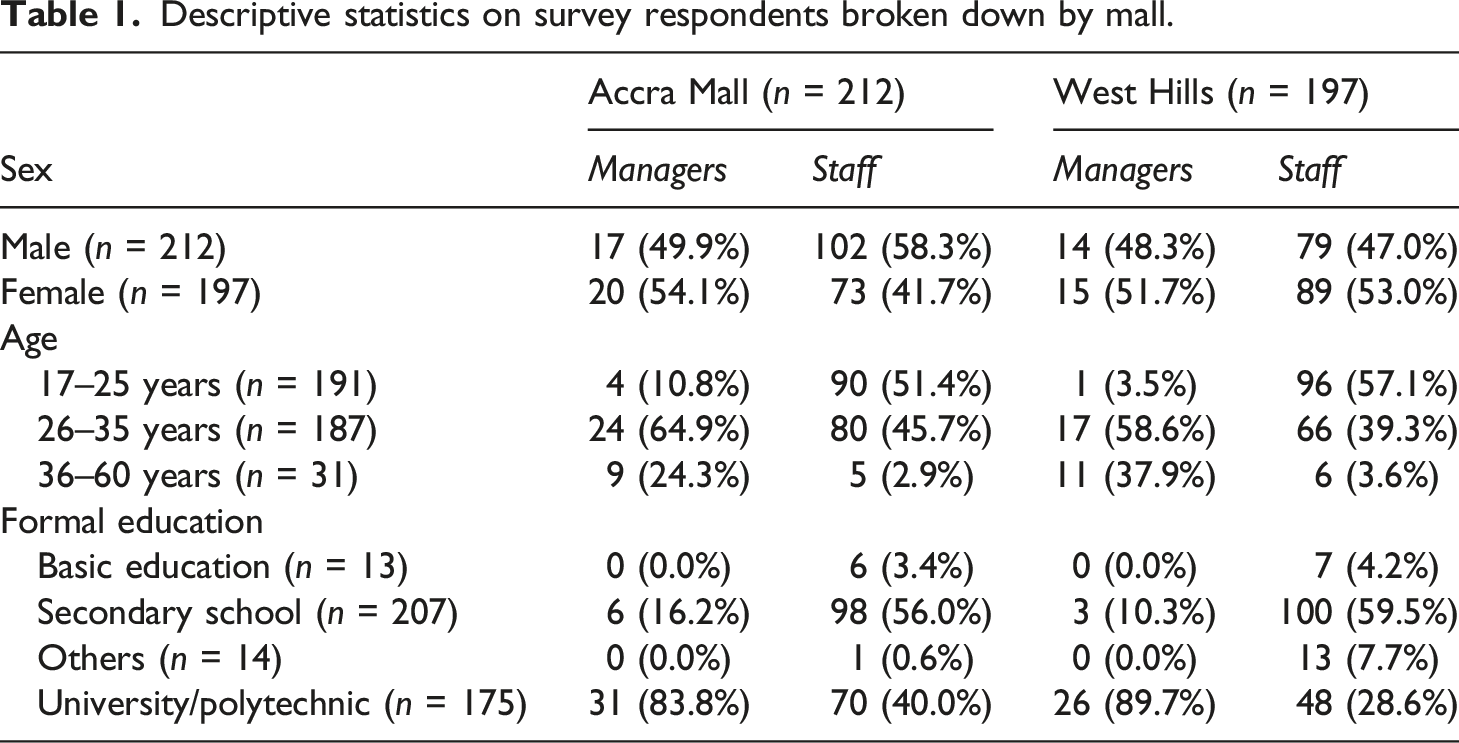
Quantitative data analysis used descriptive statistics, averaging and tallying. Thematic content analysis was used to analyse qualitative data: responses from interviews and survey were manually analysed to check recurrent themes. Those from people seen as low-income and middle-income were isolated to identify similarities and dissimilarities. Inferences and conclusions were drawn between perspectives of low-income and middle-income groups. As such, customer interviews, except the middle-class couple, and shop staff are classified as low-income, while other interviewees and shop managers/owners are classified as middle-income. Core questions on modernity and consumption were asked: What is your understanding of modernity? Does the presence of malls make Accra a modern city? How do you think malls project modernity in Accra? Which attribute of the mall (architecture, merchandize or international brands) project modernity in Accra and why?
Findings and Discussion
Most research participants construe modernity as ‘something new, efficient and relevant to contemporary living’, indicating some similitude of Western modernity and Accra modernity. Yet, a sense prevails that modernity also means what mimics western models. In turn, these relate to consumption, where most participants view malls as places of newness and efficiency while recreation, items that were previously obtainable only through overseas travels, glamour and (social) networking are easily accessed. Hence, Accra’s malls represent new nodes and offer new norms of consumption culture. As such, we isolate two inter-related and interdependent key findings to further explore. First, malls offer not only shopping spaces but also multiple functions: recreation, social networking, symbolic consumption, etc., especially for middle-income and, to some extent, low-income groups. Second, architecture, merchandize and international brands work together to frame malls as modern and consequently project the city as modern.
Malls as Projectors of Modernity and New Consumer Culture in Accra
Accra’s malls have become central reference points for modernity and new cultures of consumption for both middle-income and low-income groups.
Relating to modernity, first, low-income and middle-income people agree that modernity mean something new, efficient and relevant to contemporary living.
Modernity is the advancement of [how]… things are done… efficient and better ways of doing things… (Marketing Manager, WHM, Dec. 2016).
Modernity means realistically changing things to conform with our current way of living. (Facilities Manager, Broll Ghana, January 2017).
Respondents connected such modernity understanding to cities and malls and how they enhance living conditions. Virtually all interviewees tended to associate ‘new, efficiency and relevance’ to what pertains in western societies and, broadly, with globalization.
[Modernity is]…, looking at what goes into an efficient city, and that city comparable to… any other city in European or even African countries. (Senior Officer, Ministry of Tourism; Dec. 2016).
[T]he [WHM], if you look at it…, those of us who have travelled, it reminds you of some areas you know… [T]he [Junction Mall] at Nungua, recently last year, I went to Wooster, Ohio, and went to a place where they have malls, and if you look at the way malls have been arranged at Junction Mall…, it resembles the Wooster Mall area. (Head, Department of Marketing, Ashesi University College; August 2016).
But [shopping mall] is not something that is of place. It is an experience that has become global and has not been an experience you can easily customize. A mall in Chicago is like a mall here [in Accra]. A mall in Brazil is like a mall in Rome. I have been to all of them… And so, in design here, when we tried to see whether there was a need for [customizing it], you see the need is the problem… So, I am yet to see anybody who has been successful [customizing it]. (AM Architect; November 2016). Customer1: [I like Accra] Because you see good things [like malls] and it is closer to what others want to travel outside the country for.
Response to definition of modernity and how malls project Accra as modern.
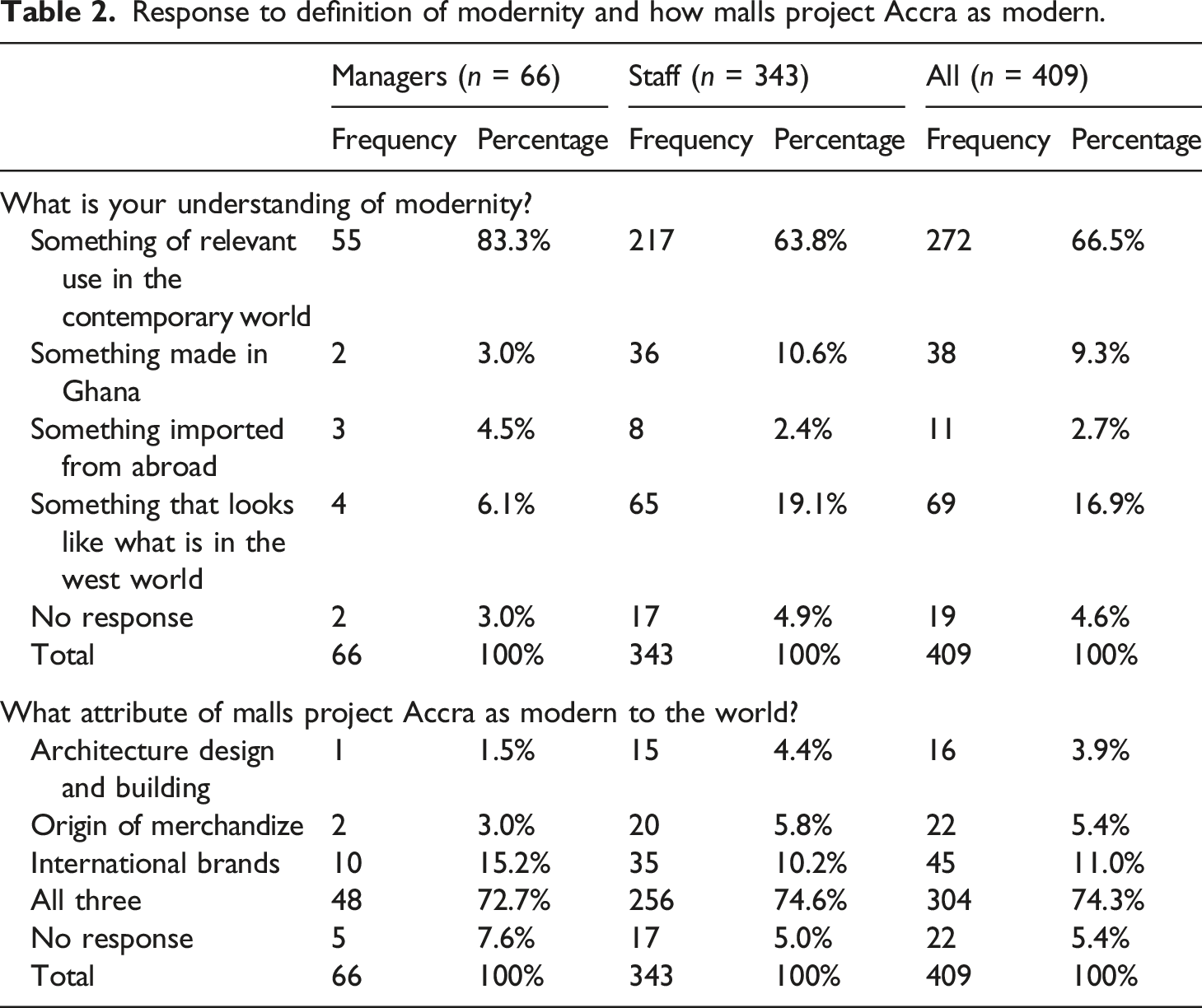
Thus, what is thought to be western modernity is obtainable in Accra. Nearly all interviewees and two-thirds of survey participants hold this view. On one level, the consensus is that there is a similarity between western modernity and Accra-, or Afro-modernity, at least, as brought about by malls. On another, western models are seen as the golden standard, that is, modernity in Accra mimics western modernity where nearly all interviewees and 16.9% of survey participants hold this view. We argue, therefore, that shopping malls represent a spatial node where tendencies of mimicry and similitude tend to be expressed and/or coexist.
Second, most interviewees agree that malls project Accra as modern through a combination of malls’ materialities, merchandize and brands. Statements from an Urban Planning consultant (UPC) and customers show this.
People enjoy the architecture [malls] provide… So, it… should have been in existence long ago and has been absent and suddenly comes in. And as a novelty, you get the applause. But clearly, it is a civilized way of shopping… I mean, … the benefits… in the western world are applicable. (UPC., March 2017). Question: You talked about the building being nice. What makes it nice? Customer1: So many decorations around… like being in the USA (laughter)… I have been watching it in films, so it looks like, sort of, in the US. Customer2: The building is so nice. The atmosphere is cool. When you are here at night you think you are in US or UK or Dubai. Let us say Dubai...!
Further, in the survey, 96% managers and 94% of staff agree malls make Accra modern and 74.3% of both managers and staff believe that architecture/building form, international brands and origin of merchandize help project Accra as modern (Table 2).
Finally, there is a notion, particularly among low-income groups that Accra’s malls allow patronage from all people and also offer excellent shopping experience (Figure 1). Staff response on how malls project Accra as modern.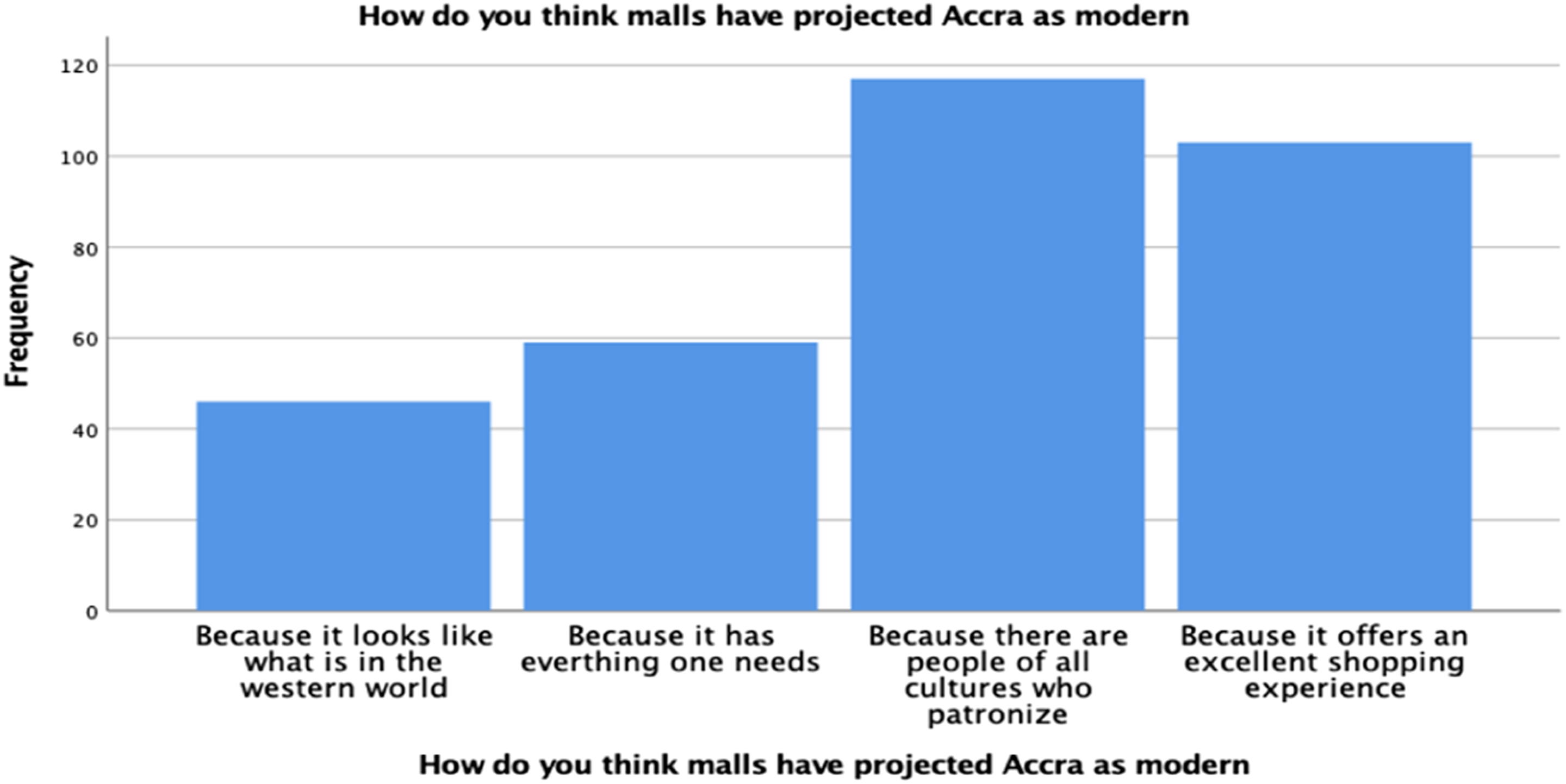
This is tied to how malls’ modernity is associated with consumption because if modernity means something new, efficient and relevant to contemporary living, everyone would like to patronize it. Indeed, more than a third of staff (low-income) indicated the presence of multi-cultural groups contribute to make Accra modern. Thus, modernity, in this case, is associated with diversity and openness. From our observation, the operation of ‘open-door’ policy by mall operators allows this openness. In turn, openness helps malls shape the city’s consumption culture across various socio-economic groups. Indeed, even with the middle class, this understanding of modernity, as outlined above, is connected with a new consumption culture, as noted by some middle-class interviewees: Accra has the biggest mall in West Africa… If you want any brand item to buy…, and it is modern… you get what you get in New York, possibly there [WHM]… You don’t get food stacked on the floor (Head, Regional Town and Country Planning [T&CP], Accra. January 2017).
This new consumption culture, as further outlined below, is predicated on standardization, finesse and hygiene which are much more attuned to the status of the middle- and upper classes.
In relation to emergent new consumption culture, first, most research participants view malls as offering social spaces for recreation and networking rather than merely spaces for meeting investor’s economic aspirations. A planning officer at T&CP head office in Accra noted: So, [AM]… people were travelling from… all over… to… have experience…, [malls] represent… the pace of globalization in Ghana. They represent how the tastes and lifestyles of Ghanaians are neutralized by international experiences… whether… dressing patterns…; people… there; it is not only Ghanaians. Expatriates are many. The… food… is not necessarily Ghanaian. You see something on the shelves of New York right here in Ghana… So, there are also such symbols. Young people go there for fun…, just go walking about; … meeting people. They are nodes. And they also have huge recreational appeal. (December 2016)
Further, from our observations, middle-class people use malls as meeting points with their business associates while those with children use the recreation areas as spaces for re-enacting or deepening family bonds during weekends and holidays, which is consistent with other studies (Stillerman and Salcedo, 2012). This is important in a city with inadequate recreational facilities for the middle class and young people. While Hobden (2015) and Oteng-Ababio and Arthur (2015) corroborate this, the perspective of a middle-class family (Kate and Patrick) gives further credence: When we were growing up, you had your cousins and everybody around to play with, so you don’t really value this kind of playground… But now you are hiding in your apartments. No further kids… So, when kids come out like that, in this modern world, this is the best you can find. (Kate; Dec. 2016). [D]efinitely it has helped change from the usual home setting to this…, you come out here and realize that… you can make friends here, get to have acquaintances… that’s relationship. You can even meet your business associates here at the food court. (Patrick; December 2016).
Low-income people also view shopping malls as places where they can meet and make contacts with middle-class people to positively impact their lives.
[WHM] is the place you can come and make friends, chat, have contacts… You can come to… have a connection… [to] make you something in life. (Customer 5, Used clothing dealer; December 2016).
The idea of low-income people hoping to connect with affluent people at malls to enhance their economic lives reminisces the emulative consumption theory (Berg, 2005) because it mimics middle-class people’s use of malls to advance their economic interests.
Second, most low-income shoppers, particularly young people, are attracted to malls not because of shopping but to enjoy malls’ glamour. This is deduced from perspectives of multiple socio-economic groups. Malls are patronized [by low-income groups] but it does not… mean they are buying. (Architect Hanson, AM. November 2016). Now the big malls have become one major attraction; people just dress up, go… walk there, see the nice things there and go home. No! They do not buy anything! Even that has become a tourist attraction… (Deputy Director, T&CP, Accra Metropolitan Assembly; Dec. 2016). Customer2: I love coming here. Any least time that I get… to go round, have a look at items they have…, take pictures, eat, etc. (Dec. 2016).
Finally, the middle class view malls as offering relatively better hygienic environment compatible with their status.
It is not just the structure, but it has changed our lifestyle;… today, you can go to one place and probably get some… necessities you need… Ghana’s middle class is really growing,... So, people prefer to buy tomatoes in malls than going to Agbobloshie
3
…, there, tomatoes are on the floor;… So, with a growing middle class,… malls will be so attractive… The [other] thing about malls is the other trappings: it allows you to walk inside, there are things you can see… clothing to food, and hardware. So, malls offer new experiences (Past President, Ghana Institution of Engineers; October 2016).
Therefore, malls offer common point or node where middle-income and low-income groups’ needs for glamour, hygiene, shopping, recreation and social networking are met. Together with other offerings such as positioning malls as ‘one-stop convenience shop’, it is our contention that this is offering a rupture between traditional shopping practices and new practices brought by malls.
We are trying to go all directions so that… customers… are comfortable… One thing you give them is… [convenience and it is] one reason malls will work eventually… This is where malls will win! It is convenient; we put it ‘convenience through you!’ And… we are… tell[ing] our community that ‘I am here to bring convenience into your life and… trying to give... a secured place where you are convenient…’ (AM Developer; Oct. 2016). [Mall] is not a place where you go to bargain. This is where you pick things up and pay. It is quite contrary to our tradition of shopping;… and that I regret. Because our traditional markets have very important role to play in our social cohesion. And these ones do not. (Former Mayor of Accra; Oct. 2016).
Notwithstanding the open-door policy, mall facility managers pursue activities targeted at attracting the middle class who have the purchasing power to sustain the malls. They accomplish this by embarking on many programmes (talk shows, musical concerts, product launching, local fairs, movies, etc.) which bring in lots of (young) people.
Malls as multiple loci of (collective) consumption
Like malls in other parts of the world, Accra’s malls are sites of multiple functions: shopping, recreation, networking, healthcare and, even, university education, as found in the A&C Shopping Centre where UK’s Lancaster University’s Accra campus is located.
From planning to the operations phase, operators and developers have conceived malls as ‘one-stop shop’ so that the middle class can conveniently access virtually everything. Marketing managers indicated that the malls’ idea is to ‘provide shopping at your door-step’ through the provision of broad-based service to draw large foot traffic. Some shop managers share this view. An ICT shop manager at WHM opined that ‘mall’s wide range of goods and services makes it a one-stop shop’.
On that score, site and location selection were consciously done to enhance developers’ objectives, including selling malls as one-stop shop. AM’s Marketing manager noted: [O]ur location has helped us a lot! We are in the middle: you can go to Tema [Ghana’s industrial/port city], you can go to Spintex, East Legon
4
,… So, our foot traffic… is huge! And, we also have very good expatriate community because… of… the location where they… reside. It is… most convenient for them… (Sept. 2016).
SSNIT, one of WHM’s developers, also noted that the location was selected to enhance Accra west’s appeal.
In that light, facility managers are aggressively pursuing various community-wide marketing strategies. Hence, from the outset, Accra’s developers and operators see malls as meeting needs and desires of people. This is in tandem with practices elsewhere in both the global North and South. For instance, Staeheli and Mitchell (2006) indicate that the Mall of America contains a community meeting room, while Salcedo (2003) note that malls in Chile offer low-income groups opportunity to side-step profit motives of developers, thus, meeting their social-recreational needs.
Emanating from these, we make two propositions. First, since Accra’s malls provide multiple functions, we argue that malls have evolved into ‘multiple loci for collective consumption’ rather than merely ‘glamorous locus of consumption’ (Goss, 1993; Firat and Venkatesh, 1995; Trevinal, 2013). Second, mall forms and attendant (cultural) practices bear similarities with practices in the global North. That is, in ‘crossing boundaries’ (Heer, 2017) from North to South, malls have undergone no significant mutation in terms of form or practices that flow from them.
In conceptualizing malls as multiple loci of collective consumption, and to situate this within the broader consumption literature, we distinguish between the low-income and middle-income groups, as it pertains to the Accra case. We make this distinction because several interviewees maintain that low-income people patronize malls not in terms of meeting mall owners’ economic aspirations but their own recreational needs. Indeed, for low-income group and the youth, malls may well represent a glamorous locus, as they may be drawn by the glamour to enjoy the spectacle of malls, to window shop and take selfies, and to meet their inherent desire to associate with modernity. However, for the middle-income and perhaps upper class, Accra’s malls are not merely glamorous locus (Goss, 1993; Logemann, 2009; Trevinal, 2013). For them, malls may well represent ‘multiple loci’ of consumption in that they are attracted not merely by the glamour they provide but by the services they offer. Of course, in Accra, given the glamourous outlook, the middle class may easily construe glamour as additional service: of quality and finesse. In a ‘globalizing Accra’, the glamorous image malls offer is attuned to middle class’ tastes. Thus, if glamour is seen as another service, one might well speak of recreation locus, or shopping locus, etc. with all these combining to make malls multiple loci of consumption. This clearly departs from practices in the global North where malls are perhaps seen as glamorous locus of consumption for everyone.
Malls as nodes of global convergence
Arising from the position that most research participants indicated that architecture, merchandize and international brands work together to project Accra as modern and modernity means ‘new and efficient ways of doing things’ and drawing from our personal observations, we argue that malls give people the opportunity to associate with modernity. Further, malls grant both the low-income and middle-income a common point of convergence. Indeed, mall patrons include cross-cultural groups (Oteng-Ababio and Arthur, 2015).
Hence, it is evident that funding, building and its form, products (merchandize), investors (local/foreign) and mall patrons have global origin and/or connections. Consequently, while malls may be referred to as ‘artefacts of globalization’ (De Mattos, 1999), we argue ab initio that malls in Accra represent a node of global convergence. Thus, we identify two levels of convergence: convergence of capital, built forms and materialities and convergence as a form of culture and lifestyle: mimicry and similitude.
Convergence of capital, built forms and materialities
First, the architectural forms of both AM and WHM have been pioneered by South African architects. Bentel and Associates designed AM while Arc Architects designed WHM. Architect Hanson, while justifying wholesale importation of mall prototypes, argued that a mall is a universal form that cannot be easily customized. He opined that South African architects literally copied shopping mall (built) forms from the United States, in line with observation by scholars (Murray, 1997), and transported them to Ghana. Similarly, WHM’s local architect noted that the design came from Arc Architects with the bulk of the local architect’s role being post-contract supervision and advising on statutory permitting processes. Second, malls contain various merchandize and brands which are deeply rooted in global networks. In Oteng-Ababio and Arthur’s (2015) study, they found that foreign shops in AM, controlling about 81% of retail space, are from North America, Europe, Asia and continental Africa while local/Ghanaian shops control 19%. Finally, Accra’s malls have been funded through international capital: AM, through UK’s Actis and WHM through South Africa’s Atterbury.
Convergence in culture forms and lifestyle: mimicry, emulation and similitude
Both AM and WHM contain shops such as GAP, Mango, Mac, Sunglass Hut and Payless Shoes. Needless to say, most of these brands are essentially of western origin. Nonetheless, a number of shops (Truworth, American Swiss, etc.) and the investors are South African. Yet, a reading of scholars (Guassardo, 1979; Murray, 1997) suggests that, in addition to being originally foreign to South Africa, malls have succeeded in upending South African consumption culture to conform to Euro-American typology. There is evidence, although, of mimicry, emulation and similitude, concurrently, in the lifestyle and cultural practices occasioned by Accra’s malls.
On mimicry and emulation, as Idoko et al. (2017: 7) note, some local consumers (middle-income and low-income) who want to ‘catch up with western culture through consumption’ are attracted by these brands. Hence, malls are shaping consumption lifestyle on two fronts, mimicry and emulative for the middle-income and low-income classes, respectively.
First, malls cater to middle-income (Ghanaians and non-Ghanaians) consumption needs, in terms of their hygienic environment and brands. For the middle-income, malls offer an opportunity to re-imagine and re-connect with the consumption culture they were previously accustomed to overseas and, by their lifestyles, including the development of new consumption tastes, additionally tend to become important pointer to the transport of western consumption lifestyle and culture. This is against the background that most interviewees associate modernity with images and models in the global North while 10.6% of managers indicate modernity means to ‘look like the west’ or ‘something imported from abroad’. This suggests an association of Accra’s malls with consumption lifestyle emanating from the West. On that basis, through malls, the middle-income have a means of both mimicking and converging with their global North counterparts through symbolic and non-symbolic consumption.
Yet, in further explicating modernity, nearly all interviewees agree that modernity means new and efficient ways of doing things and an overwhelming majority of managers (83.3%) indicated that modernity means ‘efficiency, something new and of relevance to contemporary living’. Something ‘new’ invokes idea of modernity, not merely by the nature of the thing or because it is emanating from the West, but by the way malls enhance efficiency and lifestyle (Robinson 2006). Now, this needs to be properly contextualized in Accra, a city of high socio-economic asymmetry, where most people shop in traditional markets where a growing middle class express concern about how wares are displayed, and where transportation and mobility are impaired. The malls, especially through operation of their ‘one-stop shop’ policy, therefore come in handy and cater conveniently for their middle-class customers. As such, malls have been accepted not so much because of how they are reminiscent of the West, but largely on how they help meet consumption needs efficiently, conveniently and hygienically as well as serving to redefine identity (through new consumption lifestyles). Undoubtedly, these experiences help shape the city’s evolving worldview on consumption, including serving to entrench mall culture in Ghana.
Second, for low-income groups, Goss’ (1993) view of malls as ‘ideological dreamspaces’ and Berg’s (2005) idea of emulative consumption seem to apply. In Accra, the existence of malls as nodes of global convergence grants low-income people proximity and the opportunity to associate (Stobart et al., 2007) with middle-class consumers whose consumption lifestyles tend to ripple on low-income groups. In turn, they copy, or emulate, consumption patterns of higher income groups (Berg, 2005).
However, far from being victims of the ‘ideological dreamspaces’, seduced to spend money, low-income people rather use malls to advance their self-promotion as ‘being modern’ in a globalizing Accra. They do this, partly because of their negligible purchasing power, through envisioning malls largely as social spaces, extracting use value, rather than commercial space which supports investors profit motives (i.e. exchange value). This may well represent modernity: to experience a bit of what is obtained in the western world. As a customer indicated, being in the mall gives feelings of being in the United States or United Kingdom. Hence, the desire to associate with malls. Architect Hanson stated, on the first night of AM’s opening, ‘The corridors looked like some place in America and people just came there, did nothing, just stood… those who had never… travel[led]… were [psychologically] transported by this environment… [to America] and it was exciting, really exciting!’
On similitude, finally, tied to the notion of malls as ‘multiple loci’ of consumption, the opportunity is created for different socio-economic groups to meet various consumption needs within common spaces. To the extent that malls in Accra represent wholesale importation from Northern models, as noted by architects and scholars (Murillo, 2012; Hobden, 2015), the cultural practices in Accra vary less from its antecedents. Hence, we argue that there is no difference between global forms of modernity and that of Accra. Even so, in respect of using malls as sites for musical and radio talk shows, as well as operating open-door, non-exclusion policy, etc. it would seem Accra charting a new course for others. Or, to borrow from Comaroff and Comaroff (2012), Accra is ‘evolving’ ahead of Euro-American modernity.
Relatedly, it is important to underscore that low-income and middle-income people alike have often referenced modernity forms located in or emanating from the global South: ‘when you are here… you think you are in… Let us say Dubai’ and ‘modernity is… what goes into an efficient city,… that… is comparable to… any other city in… African countries’. We argue this is a case of ‘convergence modernity’ where distinction between Northern and Southern forms of modernity is increasingly being blurred. Indeed, the rise of China and the growth of India as well as impressive strides by African countries such as Rwanda give credence to convergence modernity much as emergent dominant mall forms (Dubai and South China Malls) in the South do. Hence, the position where modernity is continuously seen as the exclusive preserve of the North, particularly in this era of globalization, is therefore increasingly becoming somewhat anachronistic.
Conclusion
This study investigated how malls enhance understanding of modernity in Accra. We argue that malls represent multiple loci of collective consumption because of the multiple services malls provide. This is an extension of the notion of malls as a glamorous locus of consumption. Also, while malls may be referred to as ‘artefacts of globalization’ (De Mattos, 1999), they also represent a node of global convergence. Hence, both help redefine modernity and, hence, are inter-linked and interdependent.
To finally conclude, we made a number of propositions: Accra’s malls have been funded by international capital; developed with international architectural forms; have been occupied and run by international brands and merchandize, though local products are also showcased; and are patronized by various categories of people including Ghanaians, Africans and foreigners in Accra and beyond: expatriates, diplomatic corps, etc. Additionally, the practices are all steeped in global mall culture. On that score, there is little or no difference in the forms of modernity presented through malls in Accra and elsewhere.
Hence, we argue that malls in Accra represent a node of convergence of global capital, merchandize, brands, architecture and culture. In that case, they convert city spaces and places into nodes where global culture, merchandize and indeed materialities of the mall itself are showcased. And, in being showcased, merchandize, brands, practices and materialities also tend to commingle, and in commingling, they coevolve. In coevolving, all these (products, practices/culture and materialities) conflate to produce a glamorous image.
This glamour tends to become, on the one hand, an attraction for low-income groups and, on another, an additional service for middle-income groups. Resultantly, together with the other services malls offer, we argue that malls are ‘multiple loci’ for collective consumption. These help to project malls as modern in terms of being convenient, efficient and hygienic. Yet, there is a sense that this reminisces the global North. Nevertheless, in several cases relating to the use of malls, Accra’s case demonstrates tendencies for ‘originary modernity’ in how operators, particularly, tend to situate malls in order to ensure sustainability. Consequently, both ‘nodes of convergence’ and ‘multiple loci’ lead to the emergence of new forms of mall-induced consumption culture in Accra, which are demonstrative of the current wave of globalization.
Footnotes
Acknowledgements
The research was made possible through funds provided by the Ghana Education Trust Fund (GETFund), the GETFund field research grant and the St. Antonys’ College, Oxford University travel grant (STAR) to Alexander K. Eduful in 2016. Special appreciation to them. Also, special thanks go to city authorities, mall developers and facility managers, mall shop workers, customers and expert informants who provided information for the research. We are also indebted to Professor Patricia Daley of the Oxford University School of Geography and the Environment (SoGE), who provided helpful feedback on an initial draft of the paper, and our research assistants in Accra, Ghana. Last but not least, special appreciation goes to all four anonymous reviewers and the Editor, Professor Steve Miles, who provided helpful feedback in multiple review cycles the paper had to go through.
Declaration of Conflicting Interests
The author(s) declared no potential conflicts of interest with respect to the research, authorship, and/or publication of this article.
Funding
The author(s) disclosed receipt of the following financial support for the research, authorship, and/or publication of this article: Ghana Education Trust Fund (GETFund) scholarship, GETFund field research grant and St. Antonys’ Research (STAR) travel grant.
