



Abstract
The discussions on the future of work are pulled between technological optimism and the increasing concerns regarding the precarity brought about by the gig economy. Often, these scenarios fail to meaningfully engage and account for the workers’ experiences, whose agency in effectively shaping their working future is denied and obscured behind discourses of autonomy, entrepreneurship and individual responsibility. In the context of the increased use of gamification strategies by platforms to both monitor and incentivise couriers, this article examines the capacity of playful methods to act as effective forms of engagement and mobilisation amongst gig workers. A workshop with this aim was run online in April 2021, at the end of the third Covid lockdown in the UK, using a role-playing card game with food couriers in Manchester. It drew on ethnographic data to explore how to support empathy and solidarity amongst couriers, how to facilitate the creation of a shared pool of knowledge about the job and how to reconfigure other stakeholders’ roles to improve working conditions. We finally offer some ideas to take the game beyond the workshop space suggesting several pathways for the future: a face-to-face game using printed cards, an open-source version of the game and collaborating with trade unions to reach more couriers.
The problem is in us. We shout between each other, but we don’t shout somewhere where it is important. (Dianka, Deliveroo and Uber Eats courier)
Introduction
In the last seven years or so protests over working conditions by platform food couriers in the United Kingdom and elsewhere in the world have generated considerable publicity and outrage. The first demonstrations in the UK date back to 2016, when Deliveroo couriers in London staged a six-day protest over a new pay deal. Collective actions multiplied across the country and the world in the following years: globally, between January 2015 and July 2019 there were 324 protests by platform workers (Joyce et al., 2020). Since the start of the Covid-19 pandemic, in March 2020, the number of strikes has decreased in Europe (Bessa et al., 2022). In the UK, among the reasons for this reduction are the high level of churn amongst the workforce as well as worker organisations moving towards unionisation and legal campaigning (Woodcock & Cant, 2022).
It was within this context, in September 2020, between the first and second lockdown in the UK, that the research informing this article began. In April 2021 we (the Principal Investigator and two colleagues) organised an online workshop with platform food couriers from Manchester, where ethnographic work for this project had initially started. The workshop drew on ethnographic fieldwork launched in September 2020, which involved, amongst other activities, participant observation as a Deliveroo and Uber Eats courier in Manchester and 15 in-depth semi-structured interviews with workers from both platforms. By relying on ethnographic data to structure and animate the workshop we follow the recent call for multimodal ethnography (Pink, 2011; Varvantakis & Nolas, 2019), which involves making connections between our research topic, our data, as well as between the different types of data we gathered.
Developing a creative approach we called cards against gamification, we wanted to investigate how collective action could be crystallised and mobilised again amongst a workforce which seemed reluctant to strike. Throughout the ethnographic research, we realised how difficult it was for food delivery workers to organise due to the different working patterns (sometimes conditioned by the platforms), the different cultural and ethnic backgrounds, and the fear to share their stories openly. This online workshop and method enabled us to bring together six food delivery workers and to prompt difficult conversations in a safe environment. Drawing on such ethnographically-driven considerations, the aims of this gathering were, on the one hand, to explore in more depth, and in a collective manner, some of the commonly experienced issues faced by food couriers and, on the other, to map alternative working futures.
In the following section, ‘Why we play’, we delineate the purpose of the workshop within the bigger research project, situating it within existing research on the gig economy, as well as placing it in the context of collective worker organisation amongst food couriers in the UK, and Manchester more specifically. We detail how the empirical data gathered through ethnographic methods informed the design of the workshop. We also discuss some of the adaptations made to the initial concept, due to the Covid pandemic.
In the second section, ‘Games against gamification’, we describe the creative and playful methods we deployed to contrast the more utilitarian use of game elements (gamification) with which food delivery platforms algorithmically manage workers. We then present the workshop structure and its unfolding, as well as the profile of participants.
In the third section, ‘How we play’, we contend that the role-playing card game used to engage workers during the workshop is not merely an escapist pastime, but a methodological and epistemological tool to critically engage our research topic. We draw on ethnographic data to show how the content of the workshop was structured using two types of cards: ‘Stories’, which capture common issues couriers experience at work, and ‘Roles’, which designate stakeholders that can have a role in improving working conditions.
In the fourth section, ‘Making the play work’, we present the main workshop results, grouped under three themes: creating a sense of empathy and solidarity amongst couriers, generating a wealth of common knowledge about the job and reimagining the role that other stakeholders in the gig economy could play to improve working conditions.
The final section, ‘Keep the ball rolling’, provides a discussion on how we plan to take the game forward. Amongst the propositions we make are printing the cards and distributing them to workers and the public in order to enable more fruitful face-to-face interactions, making the game available online and open source and collaborating with trade unions to reach more couriers.
Why we play?
For more than a decade, digital platforms have dramatically reconfigured social life across the world, providing the digital infrastructure that nowadays intermediates a multitude of interactions between different user groups. Work, in particular, has been profoundly impacted by the rise of these platforms, with the advent of the so-called gig economy where the supply of, and demand for, labour are brought together through labour platforms (Graham & Woodcock, 2018). Describing a labour market characterised by the prevalence of short-term insecure work as opposed to permanent jobs, platform work has received several criticisms in recent years, ranging from its contribution to the dissolution of jobs into atomised tasks that could undermine the role of jobs as anchors of the social structure (Pesole et al., 2018), the algorithmic management of work which enhances digital control and discipline (Rosenblat, 2018), to the challenges it poses to workplace organisation and unionisation (Woodcock, 2017).
Because of this generalised precarisation of work, substantial academic interest in the gig economy has sought to draw on workers’ lived experience and contribute, when possible, to organising them (Popan, 2021; see also Briziarelli, 2018; Cant, 2020; Tassinari & Maccarrone, 2020). While our article follows this tradition, it does so in a context where the collective organisation of food delivery platform workers in Manchester was absent. Although two strikes took place in Manchester in mid-March 2019, no other protests had been held since. Supported with leafleting and placards by the local branch of the labour union the Industrial Workers of the World, the strikes involved 40 riders, which represented at the time 80% of full-time riders in the city. Despite resulting in the closure of the Deliveroo office in Manchester, and office workers being sent home, the strikes did not lead to any improvements in working conditions (Popan, 2021). On the contrary, some of the couriers who initiated the protests had their accounts permanently suspended.
Two and a half years later, our respondents were understandably reluctant to organise another strike. ‘You can’t participate in any kind of strike action. They will deactivate your account. Well, I’m going to back off from this, I don’t want to lose my account.’ Echoing the sentiment expressed by many couriers, this rebuff comes from Charlie, 1 a 27-year-old courier who has been working for Deliveroo for more than two years, long enough to have witnessed the disastrous outcome of previous strikes. Furthermore, in the context of the pandemic, the sudden increase in new couriers contracted by Deliveroo and Uber Eats in the autumn of 2020 made the critical mass needed to organise a strike much harder to mobilise. Many of the newer couriers, often driving cars that hid them from view on city roads, were not even added to the WhatsApp group that was instrumental to organise the protests in 2019 (Popan, 2021). Women doing deliveries were often not very welcomed in these male-dominated groups, while undocumented migrants, increasingly numerous to rent courier accounts, found it equally difficult to join them, not least due to language barriers. The strikes called in December 2020 in Manchester to demand fairer working conditions failed to materialise.
In light of these considerations, while designing the workshop we wanted to address the isolation experienced by couriers at work, as voiced by Dianka, whose quote opens the article. We aimed to create an environment where a sense of community could be forged. The initial idea of the workshop was to assemble, alongside some of the couriers we already interviewed, various other stakeholders such as trade unions, cooperatives and academics researching the topic to map out alternative futures for platform food deliveries. Yet, since workers’ isolation and their apprehension to articulate collective solutions became so apparent, we decided to assist with strengthening these links and, in the end, only invited couriers to attend the workshop. We also decided to engage a diverse range of couriers who otherwise would have been less likely to meet.
Another empirical observation informing the subsequent design of the game is the entrepreneurial subjectivity that platforms actively encourage. ‘Being flexible’ and ‘being your own boss’ are part of the powerful rhetoric platforms deployed to attract prospective workers as they launched their operations across the world. With our workshop, we wanted to stimulate empathy amongst couriers by engaging them in a collaborative effort to reflect on and share their work experiences with other colleagues for the benefit of everyone. At times, couriers themselves embrace and appropriate the entrepreneurial rhetoric and attitude (Barratt et al., 2020; Gregory & Sadowski, 2021) as they regard earning better wages as their sole responsibility. The entrepreneurial attitude takes different forms, from boasting on WhatsApp about one’s substantial earnings, to using multiple apps to avoid waiting around for orders, to claiming that working hard enough ultimately compensates for the decreasing fees received per delivery. While the platforms’ algorithmic management of workers relies on competition, individualism and entrepreneurialism, our use of games focused instead on teamwork and collaboration.
The relationship between platforms and gig workers is characterised by an information asymmetry resulting in a lack of transparency and accountability on the platform’s side. This unequal dynamic becomes visible throughout daily interactions couriers have with clients and restaurants, whose negative ratings or formal complaints can lead to sanctions and account deactivations which workers can rarely contest. As also reported by some couriers we interviewed, couriers can be victims of street attacks, racism or sexual abuse. Furthermore, couriers voiced their frustrations about local authorities, who seem to do little to address their complaints about parking fines, bans to access pedestrian areas or dismissals of vehicle theft incidents. Crucially enough, couriers themselves reproduce such a lack of understanding and even hostility towards fellow couriers. Drawing on the insights we collected through interviews with couriers, we conceived the game as a role-playing activity which could enhance the couriers’ solidarity and cooperation. For this, we prepared seven distinct cards featuring ‘roles’ that the couriers could play in order to reflect how a specific problem could be addressed differently if they were to act, for example, as a local authority, a restaurant manager or a platform CEO. We thus generated the possibility to imagine alliances with stakeholders whose agendas are often divergent from those of gig workers.
Games against gamification
Platform work is characterised by algorithmic management of tasks set for individuals performing gigs. In the absence of direct face-to-face supervision, the management of work is either attempted through direct control which takes the form of automated output control or through indirect control which ensures motivation and commitment through ranking and reputation systems (Krzywdzinski & Gerber, 2021). This latter strategy is known as gamification and proposes the restructuring of social behaviour based on systems and metrics drawn from games (Behl et al., 2021; Woodcock & Johnson, 2018).
Gamification strategies date back to the early 20th century when coercion in the workplace has been replaced with games (Burawoy, 1979). Setting up workers against challenges rather than punishing them triggers their desire to beat the game. This ultimately leads to ‘the manufacturing of consent’ amongst workers. The gig economy, where challenges and the workers’ progress in overcoming them can be devised and tracked in great detail, has taken gamification to the next level. As Sarah Mason (2018) observes, the rating, which is the measure of the workers’ capacity to beat the game, ‘preys on our desire to be of service, to be liked, to be good’.
Gamification has a considerable impact on food couriers also because cycling is often not seen as ‘serious’ mobility (Aldred, 2015; Bennett, 2019; Furness, 2010). Since their inception, food delivery platforms have initially taken advantage of the bicycle and its versatile role for both work and play (Popan & Anaya-Boig, 2022). Riders, for their part, are also ‘getting played’ by the platforms: they are not considered employees and, at times, even their status as workers is contested. Instead, they are presented as freelancers, or even users, performing ‘gigs’. In other words, they are not working, they are playing in their free time from ‘real work’. While we, alongside many platform work researchers, contest this misclassification (see also De Stefano, 2019; Woodcock, 2021), the gamification of the work experience in the gig economy is certainly a powerful incentive to stay in the job (Krzywdzinski & Gerber, 2021).
Our approach to the workshop is also intimately related to games, but instead of conceiving them as means to exert control over the workforce, we relied on them to challenge this algorithmic control and the work arrangements specific to the gig economy. Using games, which involve, amongst others, participants producing drawings, photos or collages, has been mainly associated with play and children-focused research (Barker & Weller, 2003; Leeson, 2014; Mizen & Ofosu-Kusi, 2010; Quiroz et al., 2014). Yet, following Flanagan’s (2009, p. 1) contention that games and play do not ‘only provide outlets for entertainment but also function as means for creative expression, as instruments for conceptual thinking, or as tools to help examine or work through social issues’, we also believe that games are more than developmental and educational; they are both a methodology and an epistemology for thinking about and around our research topic (Varvantakis & Nolas, 2019, p. 373).
There is also a close connection between games and the military, providing an opportunity to act out tactics and strategies before implementing them. For example, chess provided a representation that allowed for experimentation with abstract military battles. Wargames have therefore been an important part of both the military-industrial complex and the videogames industry (Hammar & Woodcock, 2019). In the case of the card game presented here, a game provides a moment to reflect on the experience of work and to imagine how work can be improved, rather than planning military action. There is another radical history of using games to experiment with alternatives. For example, Caillois (2001, p. 12) saw surrealist potential in gameplay. The process of playing games can provide a ‘means for the worker to cease being a worker, for a limited time, and to become, in a surrealist sense, “something else”’ (Kristensen & Wilhemsson, 2017, p. 393). Similarly, videogames provide a powerful example of the tensions between games that reinforce the dynamics of contemporary capitalism, while also providing a space for radical experimentation and critique (Woodcock, 2019).
Drawing on grievances expressed individually during interviews, we used a card game to address them collectively during the workshop, in an attempt to challenge the prevailing discourses of individualism and entrepreneurship in the gig economy. By inviting research participants to draw cards from a deck and distributing roles amongst them, we also wanted to question the established research norms: the decision to develop new research devices is ultimately an invitation to being playful and to undermine and interrogate the prevailing research conventions of our field while producing ‘affects and reactions that re-invent relations to the social and the environmental’ (Back & Puwar, 2012, p. 9).
How we play
The workshop took place on 26 April 2021 and was coordinated by the three co-authors. Each of the authors contributed different aspects to the methodological approach for the game and the article. Popan has conducted ethnographic work informing this game, having spent nine months doing participant observation as a food courier for Deliveroo and Uber Eats in Manchester. Thus, he gained critical insights into their working conditions, which informed the development of the content of the ‘Stories’ cards which were used for the game. In direct relation to the future-orientation of the game, Popan drew on his doctoral experience, which focused on using utopian thinking as a method to imagine alternative futures to tackle car dependency in urban environments.
Perez brought his experience from co-design research. He has worked with a wide number of organisations and community groups, co-designing tools for engagement. In this project, Perez utilised the same collaborative approach to design a collective discussion (as an intangible artefact) about the working experiences of the workshop participants. He planned the workshop and facilitation in an engaging and creative manner to provide a safe space to promote communication, knowledge exchange and engagement (Bustamante et al., 2021). Also, he designed the cards based on the ethnographic insights gained by Popan. Woodcock has been undertaking ethnographic research with food delivery workers for the past five years, both in London and during periods of fieldwork in South Africa and India. He has experience as a researcher and organiser. In the case of the game, Woodcock draws on his experience of organising with videogame workers and hosting a series of game jams with workers. As part of a Notes from Below project, these experimented with short videogames on the themes of worker organising. While his research did not contribute to the design of the game, he participated in the running of the gameplay session.
Six couriers previously interviewed were invited to participate in the game, but only five were present. Their age ranges from the early twenties to mid-thirties, four of them are migrants, and one is a woman. The sample reflects the overall socio-demographic structure of food delivery workers in the UK, where there is a majority of migrants and a minority of women undertaking these jobs (Popan & Anaya-Boig, 2022).
We used two digital platforms simultaneously to host the workshop. We used Zoom as a video conferencing platform to host the discussion within the whole group and in smaller groups, as described in the structure of the workshop in the paragraph below. We also used a visual collaboration platform, Miro, to play the game. The benefit of having both platforms working in parallel was that participants could have access to and contribute to the discussion remotely using their mobile phones.
At the beginning of the workshop, the research team introduced the aims of the workshop and explained some technicalities, such as the platforms we would be using and the data that would be captured (videorecording). This stage was important to align expectations and to show transparency regarding our motivations for involving them in our research.
The first activity discussed some ethnographic insights collected in the first stage of the research. We divided the group into two smaller groups of two and three participants, each with one of the researchers. The main idea was to generate a safe space for them to talk and express themselves freely. Having a small group also allowed enough time for each participant to contribute to the discussion. For this activity, we created a deck of cards with a selection of the most salient points of contention expressed by couriers during the fieldwork and placed them under four categories (Figure 1): App Transparency (how the algorithm allocates jobs or calculates riders’ fees), Waiting Times (complaints about long waiting times to be allocated an order or to pick up meals from restaurants), Listening to Workers (when they appeal low ratings, non-payment and payment issues, deactivations, penalties) and Health and Safety (working long hours in inclement weather, road accidents and street attacks). In doing so, we aimed to follow a similar logic to the classic card game suits: hearts, clubs, diamonds and spades.
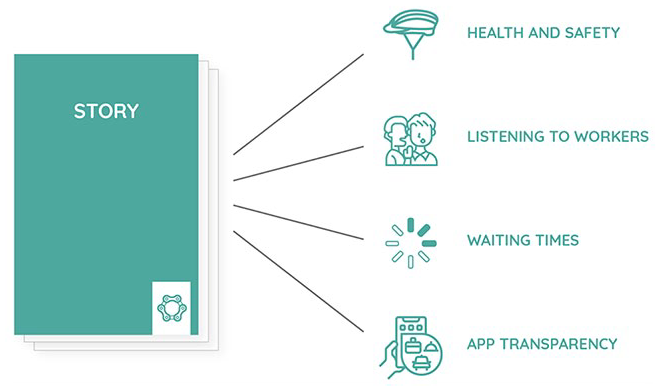
The couriers’ grievances, which we called ‘Stories’, were placed on a card deck under four categories: App Transparency, Waiting Times, Listening to Workers and Health and Safety.
Using the ‘hide’ function of Miro, we hid all the contents of the cards. This could be an analogy of what would have been facing cards down in a physical setting. We choose to use Miro in addition to Zoom to add an interactive functionality that could attempt to recreate some of the functions of playing in-person. Miro acts as a kind of online collaborative whiteboard. Running this alongside Zoom, with the screenshare function, this meant that we could see in real-time the interactions of the participants in the game, as well as manipulating the game space (as in Figure 2). We believe that this provided an analogous digital experience of manipulating the cards, allowing information – in the case of Figure 3 about moving on to discuss health and safety – to be revealed at different points of the game.
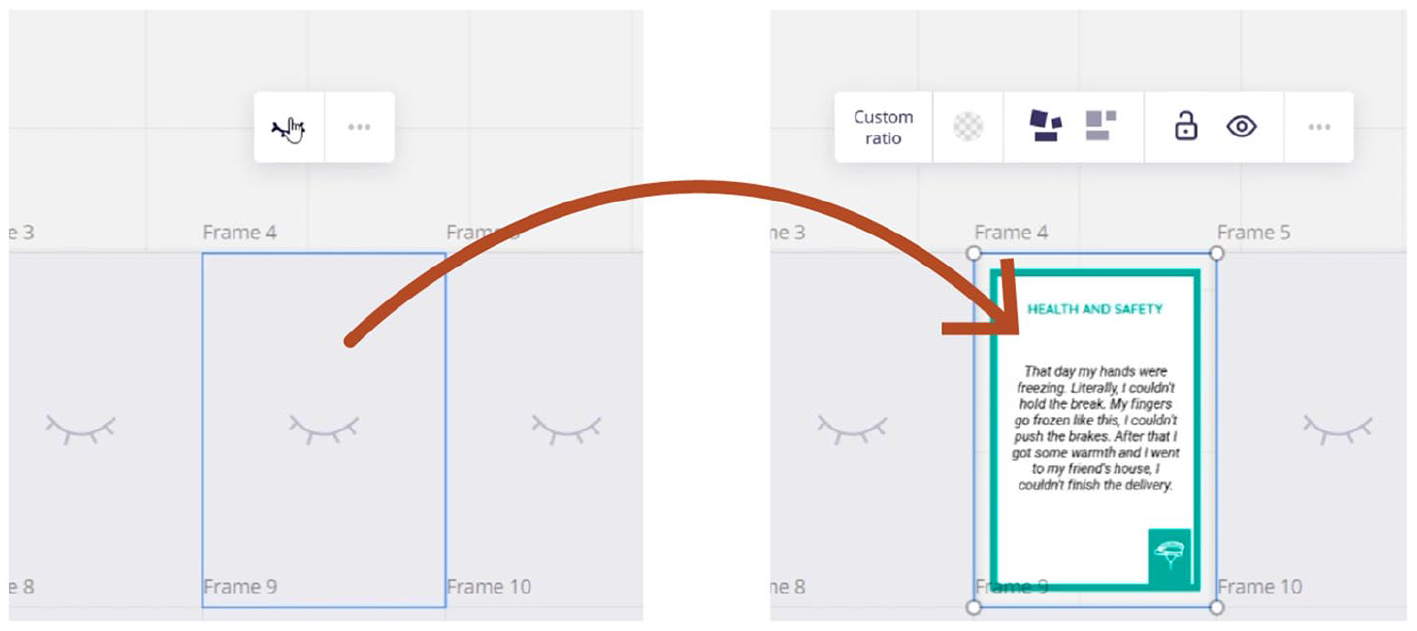
One ‘Stories’ card, where app transparency issues were highlighted, was drawn from the card deck. The participants were asked to react to the story.
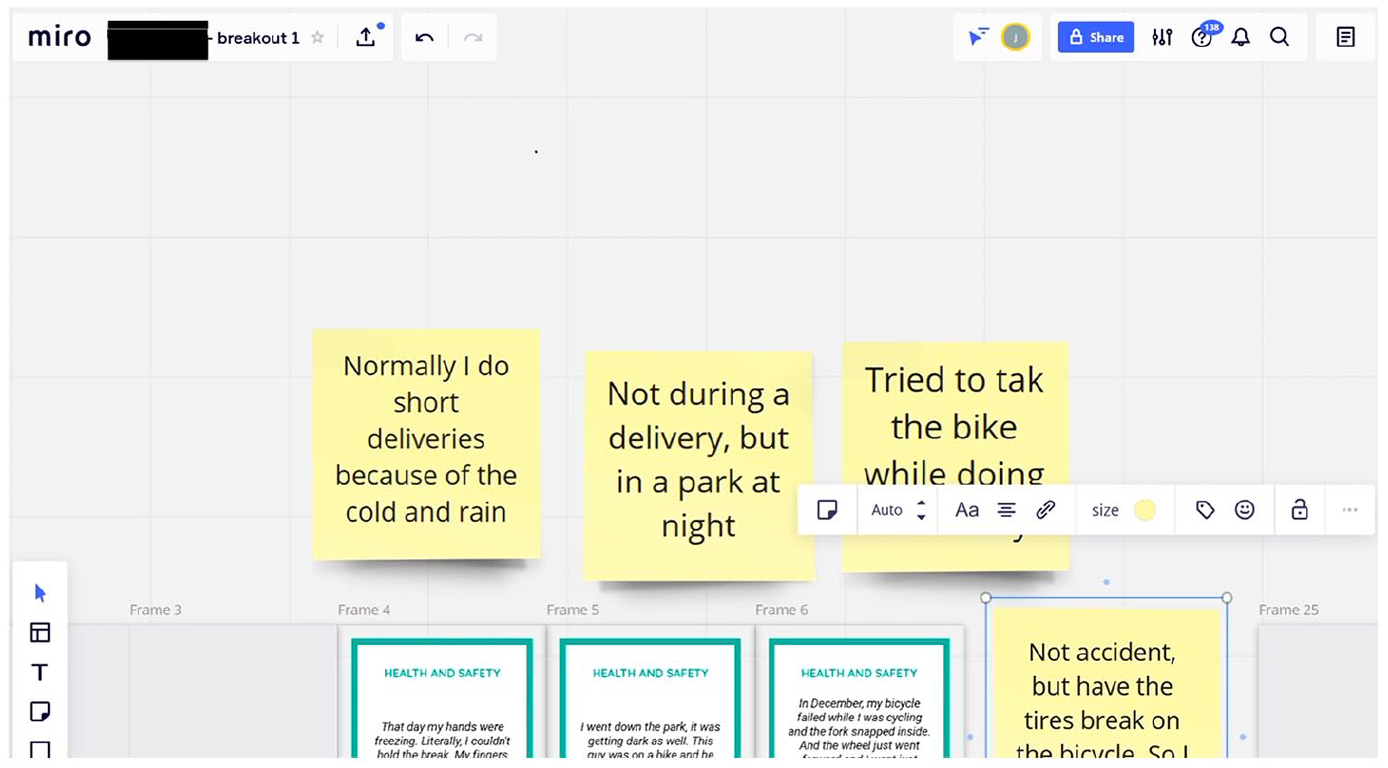
Note taking during the discussions workshop participants engaged in.
In terms of the play of the game, we asked participants to select one card from the deck, which then the facilitator made visible. This process is illustrated in Figure 2, in which clicking on one of the grey cards with the stylised closed eye transforms it into a ‘revealed’ card featuring the topic and quote in colour. The visibility of other players’ cursors on Miro provided an opportunity to see which cards were being picked and reproduced an element of interactivity and engagement. This provided a focus for the discussion on Miro/Zoom, while also providing the text to be referred back to during the game.
The main benefit of this randomness is that there was no set agenda of topics to be discussed. The topics of discussion were generated by the couriers themselves, despite us producing the selection of quotes and their design into a deck of cards from which participants could draw. This method echoes the use of visual prompts such as participants’ drawings in similar research. These artefacts can facilitate, when used in interviews, investigating layers of experience that cannot easily be put into words (Bagnoli, 2009; Gauntlett, 2007). Object elicitation, relying on ‘cultural probes’ (Gaver et al., 2004), is a method originating in design studies to explicitly attempt to provoke responses in participants (Hoskins, 1998). From being merely an ‘object’, these probes have increasingly become a part of the empirical ‘process of engagement’ (Holmes & Hall, 2020; Woodward, 2016).
In our workshop setting, these elicitation tools functioned in a similar fashion, allowing for exchanges of experiences with work colleagues that would not have been possible otherwise. For example, upon revealing one ‘Story’ card which described a street attack scene involving one of their colleagues, the couriers in the workshop quickly reacted, sharing similar experiences. ‘Such an attack didn’t happen to me during the time I was delivering, but in a park at night, on my way home. They beat me up’, confessed Hazeem; while Adeeb added: ‘I was cycling on a busy road when a bunch of teenagers tried to steal my bike’. Similarly, a card featuring the story of a bicycle accident triggered recollections of their misfortunes among participants. Interestingly, when asked about accidents during interviews, many couriers did not necessarily recall them; yet when confronted with similar stories, the recollection proved much more effective. It is the case of Adeeb, who mentioned an instance when a driver ran her car over his bicycle wheel, or Jérôme, who could easily remember the many instances when he had punctures and had to stop working.
The four categories of grievances were placed on a total of 15 cards from which the couriers could pick one (but without seeing its content in advance) to discuss it in more detail. We used cards as visual props that can be reconfigured and manipulated straightforwardly (Lucero et al., 2016). Through this elicitation technique, using direct quotes from interviews, we explored couriers’ subjective experiences of work. More specifically, the workers were asked first to express their own feelings with regard to a particular situation and then share with the others a similar experience they encountered. To elicit these affective responses, prompting questions were placed on five additional cards: ‘What is your response to this story?’, ‘What could be a positive conclusion to this story?’, ‘What could be a negative conclusion to this story?’, ‘How would you change this story?’ and ‘How does this story make you feel?’
For the second part of the game, we oriented our conversations towards the future and used ‘What if?’ as an implicit prompt question to capture how this experience could be improved. Since most of the discussions during individual interviews with couriers aimed at producing a comprehensive account of the workers’ experience and less so on how this could be improved, we used this opportunity to imagine gig work differently and encouraged solidarity beyond the workers themselves. For this purpose, we added a final set of seven cards where we placed different roles that the workers were asked to perform to address work grievances. Thus, couriers were invited to suggest changes which other stakeholders in the gig economy could deliver to improve the former’s working conditions. The seven roles we devised are: Restaurant Manager/Staff, Workers Association, Police Officer, Rider/Worker, Local Government, Platform (CEO/Developer) and National Government.
Making the play work: Workshop results
By assigning different roles to our workshop participants, we aimed to contribute to the debate on the future of gig work and platform food deliveries. Using creative methods involving scenario building and utopianism to envision plausible, probable, possible and preferred futures has a tradition within sociological research, especially in relation to investigating environmental futures such as sustainable transitions, car-free urbanism or cycling cities (Popan, 2019; Porritt, 2013; Urry, 2016). Utopia, understood not as a blueprint or a perfect future but as a method to explore contested futures (Levitas, 2013), represents our point of departure to the role-playing game. This means that, instead of advancing one single future, as it might be envisioned by a certain group (in our case, the platform workers), we open it up and ask what these different futures could look like if other stakeholders were drawn into imagining better working conditions.
Three conclusions were taken from the workshop. They all suggest that alternative futures are actually possible for platform workers. First, the workshop succeeded in creating a sense of empathy and solidarity amongst couriers, which challenges the prevalent sentiments of isolation and competition at work. Second, it contributed to generating a wealth of common knowledge about the job, which otherwise is not readily shared by platforms and work colleagues. Third, it reimagined the role other stakeholders in the gig economy could play in improving working conditions. Below we present these in more detail.
First, we observed that couriers expressed a variety of feelings towards what they perceived as injustices at work, which further enabled empathy among themselves during our meeting. Disappointment was one such reaction as couriers were faced with platforms’ lack of transparency. Dianka, for example, was not aware that Deliveroo could change vehicle priority when allocating orders, favouring motor scooters against bicycles and e-bikes. When she found out about the modification from one of the ‘Stories’ card, she replied: ‘I didn’t know I could get more orders when I switched to an e-bike. I was surprised and felt grateful I am not the only one and I can share this information with others.’ Her bafflement was echoed by Ronald, who added: ‘It was annoying to have to spend more money to get an electric bike.’ A sense of disillusionment was shared as well by Adeeb, whose experience of bike theft was similar to one presented on a different card: ‘It makes you feel terrible. You’re helpless; you can’t do anything. I reported it to Deliveroo, but they said they can’t do anything. Luckily, I had the insurance.’
Second, by reading other colleagues’ stories from the cards and subsequently sharing their personal ones with one another, the couriers managed to gather information which would have been otherwise difficult, if not impossible, to access. One such precious tip was offered by Adeeb, who has been doing the job full-time for more than a year and a half and who knows by now both Deliveroo and Uber Eats apps very well. Since Uber Eats does not show riders the address of the customers before they accept the order, Adeeb shared a trick which allows workers to see the destination. By exploiting a bug in the app, couriers are now able to decide if they accept or not an order taking them far away or to a dangerous area of the city. This ‘algorithm breaking’ is common amongst gig workers and is part of a broader repertoire of individual resistance practices (Bronowicka & Ivanova, 2021; Irani & Silberman, 2013). Other tips might be more basic and practical, but they can make a difference for someone who recently started the job or only works part-time, as was the case with two of the workshop participants. For example, Dianka noticed that Google Maps navigation is not very reliable for bicycles, prompting couriers to follow dangerous routes. Similarly, Adeeb warned his colleagues that platforms are not quick to address couriers’ often pressing problems: when he tried to get in touch with Uber Eats following an accident, he was made to wait almost a week.
Third, our role cards explored new directions for a better future, as seen from different vantage points. When prompted to take the role of a platform representative, one of the couriers, Dianka, suggested that designers could test the app themselves and try to improve the health and safety of riders: ‘This could be done with the help of riders. The platform could also collaborate with local authorities to improve the quality of the maps and navigation options.’ Another rider, Hazeem, thinks that platforms could implement an emergency button in the app which would alert police and ambulance when riders’ health and safety are at stake. Playing the role of a union representative, Adeeb also believes that ‘there should be an app for the workers’ association as well’, while Hazeem added that couriers ‘should have a riders’ representative who is linked to the companies and can report a problem and demand for a solution’. The use of cards as visual prompts and knowledge visualisation techniques to encourage the revelation and stimulation of future orientations thus allowed couriers to talk about their work in a ‘linguistically flexible’ way (Carabelli & Lyon, 2016; Smuts & Scholtz, 2020), despite English not being the native language for most of them.
As we enabled different voices to be drawn in the telling of the future, we argue that the role-playing card game is attuned to what Back (2012, p. 18) describes as live sociology, which is ‘able to attend to the fleeting, distributed, multiple and sensory aspects of sociality through research techniques that are mobile, sensuous and operate from multiple vantage points’. More importantly, in our endeavour to assist platform workers to collectively express their grievances and hopes for the future, we contribute to shaping an alternative future to the individualised and entrepreneurial one currently promoted by the gig economy. Following Law and Urry (2004), we demonstrated that methods are political as they help make realities. ‘But the question is: which realities? Which do we want to help make more real, and which less real?’ (2004, p. 404). Our hope is that some of the realities we contributed to enacting through our card game represent a stepping stone towards a better future for platform workers.
Keep the ball rolling: Conclusions
This article introduced a card game that was used as part of ongoing research into platform work. We have examined and reflected upon the use of this game with platform workers in Manchester. We suggest that our card game has proven to be a generative method. It was particularly useful during the limited face-to-face research possible during the ongoing Covid-19 pandemic. The use of games is also interesting in the context of platform work, given the widespread use of gamification. Unlike the platform-led use of game dynamics to intensify the work process, this game provided an opportunity to play with different roles involved in platform work. In practice, this meant opening up debates more organically and collectively experimenting with scenario building.
Following the first game we played in Manchester, we devised a set of observations and explored further steps to develop the game which could improve the playing experience and the impact of the game in the future. These touch upon the content and the form of the game and focus on the following: the affordances resulting from a face-to-face gaming experience, the local context from which the players are drawn, the capacity of trade unions, workers’ collectives and additional public events to reach more couriers and engage broader audiences and the impact an online open-source version of the game could have.
During our workshop, we managed to gather around a virtual table five Manchester couriers during a particularly difficult time to meet, as Covid restrictions were still in place across the UK. The game was mediated through online communication, with Zoom and screen sharing. This (as anyone who is familiar with Zoom will know) removed many of the playful aspects that are usually associated with in-person play. It was not possible to interact across a table, physically move the cards and engage in non-verbal communication and feedback. Face-to-face interaction provides the possibilities for meaningful interaction that virtual communication cannot fully replace (Goffman, 1983). Moreover, face-to-face interaction is essential to social life, as co-present bodies are actively involved in turn-taking and touching within conversations (Molotch & Boden, 1994). The following iterations of the game would benefit from face-to-face interactions, which could involve more players using multiple sets of cards. This will allow for richer and more diverse insights to be gathered than we did during the first iteration of the game. As the Covid restrictions were lifted, we printed several decks of cards (Figure 4). Even if couriers were not invited to play with them in a real-life game, we distributed the decks of cards to the couriers who participated in the workshop.
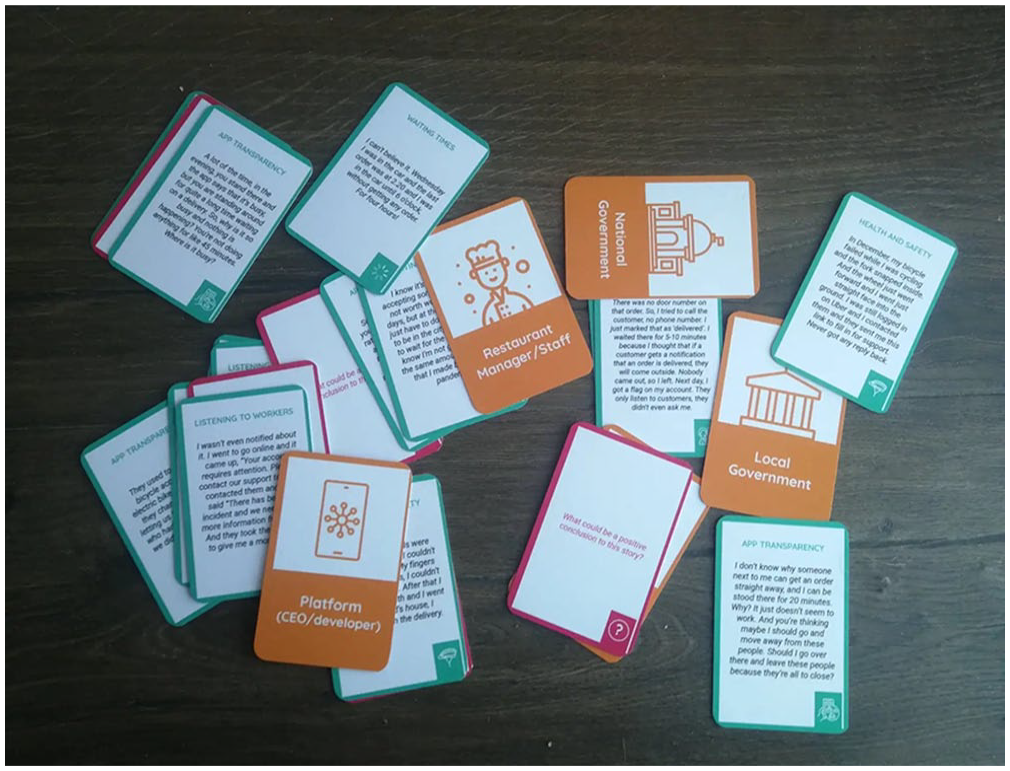
A pack of the printed cards.
First tested in Manchester, the game is intended to be played in two other different cities across Europe where this research project takes place, namely Cluj (Romania) and Lyon (France). As a result, the local specificities informing the stories we use to kickstart our conversations with couriers need to be considered. While overall, the inner workings of food delivery platforms and the resulting working experiences of couriers are somehow similar across borders, there are still important differences. These are linked to the demography of the couriers themselves (there are national and local migration policies that impact/shape the workforce in platform work), are related to the legal, economic, social and cultural underpinnings of platform work arrangements and are influenced by the geography and climate of the cities where these work mobilities unfold.
Our limited access, as researchers, to a substantial number of platform workers which we managed to mobilise for the game is something that could also be improved for the following sessions. Our efforts to engage in the workshop with the local trade union (Industrial Workers of the World), which had been active in supporting food couriers in Manchester, were not fruitful because the links they forged with couriers during the strikes in 2019 were considerably severed since the beginning of the pandemic. However, in other cities where this research already takes place (for example, Lyon, in France), the collaboration with trade unions will be more effective since two such organisations we already approached are regularly assisting food couriers with grievances in the workplace. These unions, alongside other workers’ organisations which are active across France, are more likely to aggregate workers and to function as intermediaries between the researcher and the food couriers, therefore facilitating our research access and consequently increasing the chances of getting the couriers more interested in playing the game. This could represent an opportunity to distil and refine the list of concerns and requests couriers have with regard to platform work and articulate grievances and complaints in a more meaningful way.
We have also considered making an open-source version of this game, in which different communities will be able to share their experiences. In the open-source version of the game, we consider developing a platform that replicates the ethnographic and design work described in this article. The idea is to allow people from different locations to resituate the game to their contexts. In this way, we will be able to expand our understanding of the grievances of food delivery workers internationally.
We would like to include a new section around tactics in a future version. This section will gather examples of workers’ actions in the three cities. For example, some tactics could be campaigning, forming workers’ unions or organising protests. The idea is also to share some evidence of actions taken by workers upon specific issues. If the game was played with workers from cities in which there were more overt or active forms of workers’ organisation, it is worth considering nevertheless what effect this would have. One possibility is that workers who were already engaged in strikes or campaigns would have taken the opportunity to experiment with something closer to the wargaming discussed earlier. Rather than considering the different options for futures, this could have involved mapping out the tactics required to achieve a strategy of worker organising – rather than considering trade unions as one part of a wider picture of actors who could have an influence on platforms.
More widely than this, it is also interesting to consider what would happen if we involved different stakeholders in the game. For example, if representatives from unions, cooperatives, local government or other academics had been invited, how would this have changed the dynamics? It could have benefited the role-playing to have people with experience of the other roles bringing these to the game – as well as providing the space for other actors to consider alternative points of view. On the other hand, it could have also limited the engagement from workers if they felt that other actors would judge their actions within the game.
We want to expand our card game by including insights from different cities in the future. The aim is to initiate conversations that are not necessarily bound to the context of the participants of the first stage of the project. The first step will be to include insights from the research conducted in Cluj and Lyon. We will use the insights from these two cities to validate and refine our categories. We additionally aim to foster a more active involvement of the public in playing this game, as part of three art exhibitions organised for this research project (March 2022 in Cluj, June 2022 in Manchester and summer 2023 in Lyon). Within these events, where food courier experiences at work are narrated in comics and illustrations formats, we will invite the general audience to draw cards from the deck and encourage them to reflect on and discuss the ‘stories’ presented to them. We hope that this creative exercise will contribute to generating more understanding, empathy and solidarity with these workers.
While much of the existing research on food delivery platform workers has focused on the use of qualitative (and to some extent quantitative) methods, this project has sought to experiment with a more participatory and playful approach. The aim of the game was not only to experiment and try to generate novel data, but also to contribute to the wider debates about methodology and the importance of participatory methods. Too often, workers are positioned only as subjects from which data can be extracted, rather than participants who can shape not only the data but also how we can make sense of these new forms of work. The most exciting future developments for the project are avenues through which workers could not only shape the game playing but also shape the card game themselves. Following the first instance of playing the game (which ensured the game was actually playable), future iterations could be more deeply shaped by the issues and concerns that workers themselves are interested in. Given how important the discussions of gamification have been for the debates on platform work and the gig economy, we believe playful methods like the one outlined here have the potential to contribute to the wider sociological debates on play, work and games – as well as generate new data and engagement from stakeholders going forward.
Footnotes
Funding
Cosmin Popan’s work was supported by the Leverhulme Trust (grant number ECF-2020-523).