



Abstract
Has rising income inequality become a scandalous social problem as the English ethical socialist R. H. Tawney anticipated in an earlier era? We examine the salience and framing of income inequality within major UK and US newspapers over the period 1990–2015. Specifically, this includes the global banking crisis of 2008, which was the most significant financial crisis in capitalist economies since the Great Depression of 1929. Did this event trigger a public outcry? We divide the overall search into a full corpus for quantitative analysis of media salience and a smaller corpus for in-depth qualitative analysis of media frames. We find that media coverage of income inequality increased across the period in both countries and especially after 2008. With this increase, there is a shift in frame prevalence, with pre-2008 frames focusing on conceptualising rising income inequality while post-2008 frames focus on managing rising inequality (through interventions, policies and identifying scale of solutions needed). This shift is accompanied by a more polarised sentiment on income inequality, an increase in moralising language and a more balanced political slant. The proposed ‘solutions’ become absorbed within established repertoires offered by the political right and left, limiting the emergence of a Tawney Moment. Consequently, the rise in income inequality has not generated the kind of scandalising public outcry that Tawney would expect. We conclude by examining the possible reasons for the lack of outrage in the mass media.
Introduction
Since the 1980s, income inequality has reached historic highs within many of the countries that make up the OECD (2015). Among these countries, the largest increases were in the liberal market economies of the English-speaking world, notably in the UK and the USA where the Gini coefficient rose by more than 30% in the years between 1979 and 1992 (Smeeding, 2005, p. 963). Accompanying the general rise in inequality was a striking surge in the earnings of those on high incomes, particularly those in the top percentile, over an even longer period (Atkinson et al., 2011). Significantly, this rise in income inequality has not been accompanied by any noticeable shift in public attitudes towards inequality in the UK, the USA, or indeed, elsewhere (Mijs, 2019).
Aside from personal experience and talking to friends, the news media are our most significant source of information on economic affairs (Van Dalen et al., 2018). When an issue gains media attention it may do so because it is in the process of becoming a public concern. One way in which underlying social problems may appear is through a triggering or focusing event drawing attention to the phenomenon in a way that it has not previously experienced (Birkland, 1997). In the case of income inequality, it seems reasonable to examine whether an event like the global financial crisis of 2008 raised media interest and perhaps also changed the way inequality is portrayed. Fourcade and colleagues (2013) observe that economic crises invariably raise questions of moral economy in which economic decisions and institutions are evaluated according to prevailing social and political values and not just by the laws of supply and demand. In such instances, economic phenomena that had been taken for granted or even ignored by the public can suddenly become an affront to common decency and raise the ire of journalists and other public commentators.
Our contribution to the puzzle of unprecedented increases in economic inequality and relatively stable public attitudes comes by focusing on the role of the media, and its capacity to present income inequality in moral terms, particularly in times of economic crisis. It is, therefore, a response to the programmatic call by Fourcade et al. (2013) for research into the different ways moral categories are mobilised following financial and other crises (pp. 603, 606).
We do so by introducing the concept of a ‘Tawney Moment’, which, following the work of R. H. Tawney (1880–1962), refers to a public outcry arising from a sense of rage at the ‘evil of economic inequality’ (Tawney, 1931/1964, pp. 33ff.). In a much-quoted passage, he wrote that: ‘when crime is known as crime, and disease as disease, the ravages of both are circumscribed by the mere fact that they are recognized for what they are, and described by their proper names, not by flattering euphemisms. And a society which is convinced that inequality is an evil need not be alarmed because the evil is one which cannot wholly be subdued. In recognizing the poison, it will have armed itself with an antidote’ (p. 48).
A Tawney Moment will have five key escalating features:
Increased media attention or a hype cycle with an alarm, retreat and resurgence phase.
The triggering of the moment by an event that captures public attention.
An emerging frame coalition or a potentially new master frame.
The framing transcends the traditional left–right polarisation in politics.
The definite scandalisation of economic inequality.
In Figure 1 we schematise this hypothetical ‘Tawney Moment’ of the scandalisation of inequality, brought on by the confluence of market problems, academic analysis, and public outrage throwing the spotlight onto the intolerable disparity between ‘rich and poor’ as a modern ‘evil.’
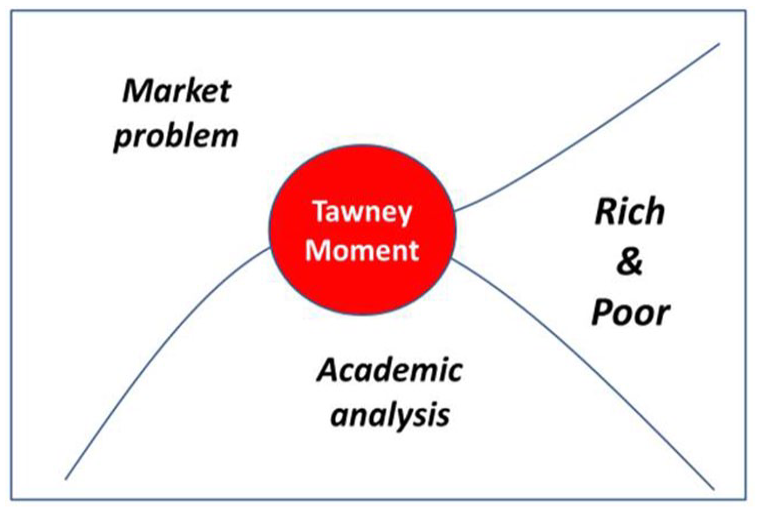
The Tawney Moment schematised: inequality is initially a matter of economic analysis under market conditions; once ‘inequality’ becomes scandalous in what we call the ‘Tawney Moment’ the issue turns into a political problem of ‘rich and poor’ in society.
A key element in our examination of the relationship between income inequality and media coverage is the role of events that have the potential to function as triggers that ‘sound the alarm’ on a social problem (Van Dalen et al., 2018). We focus on the global banking crisis of 2008, which was the most significant financial crisis since the Great Depression of 1929. The bursting of the housing bubble in the United States in 2008, along with the collapse in the value of the associated mortgage-backed securities and derivatives led to the collapse of Lehman Brothers bank in the USA and the Royal Bank of Scotland in the UK. To shore up the financial system, governments introduced rescue packages that were funded by taxpayers, with the result that many countries had to endure prolonged periods of economic austerity in order to stabilise public finances.
In this article we search for the possibility of a Tawney Moment arising following the 2008 crisis in two ways. First, we investigate whether income inequality moved from the margins to mainstream public attention, thus rendering a problem less ambiguous, more legitimate and part of routine conversation as shown with the rise of the environment issue in the 1980s (Strodthoff et al., 1985). Such rise in salience would signal to society that something is wrong, that it is widespread, and that it is likely to harm individuals, communities and society (Hilgartner & Bosk 1988, pp. 6–7). Second, we examine how the framing of the issue has shifted over time. Are we witnessing the emergence of a new master concept such as economic injustice that denotes a clear sense of scandal? Does this or any coalition of frames take us beyond the existing right–left perspective on inequality? Finally, are any new policy solutions becoming prominent enough to be consistent with an alternative politicisation of an issue attention cycle? 1
Rising inequality, but no public outcry
Having been ignored for many years, the question of how the mass media report income inequality has received more attention over the past decade (e.g. Champlin & Knoedler, 2008; Gandy, 2017; Grisold & Preston, 2020). Many are in the form of reviews or essays, and none examines mass media responses to economic shocks. Of the existing empirical studies, four are, however, worth noting. The first is Leslie McCall’s (2013) study of economic inequality which explored the possibility that one reason why US Americans acquiesced to growing inequality was because it was a media blind-spot, that is, journalists simply failed to cover the topic. To test this ignorance hypothesis, McCall searched for articles in leading mainstream weekly periodicals that included Newsweek, Time, and US News & World Report over a 30-year period (1980–2010).
Significantly, she found that the coverage was not much greater in 2010 than it had been in 1980, though coverage did rise and fall in a series of waves, peaking in the early 1980s and again in the mid-1990s. From this McCall concludes, cautiously, that Americans did know about rising inequality even if the topic did not gain in salience overall. On the other hand, her analysis of the way in which the media packaged and presented economic inequality, restricted to a limited set of frames, yielded a discourse in which income inequality is perceived to have a negative impact on most Americans, especially when the irresponsible behaviour of economic elites is seen to undermine opportunities for the hardworking middle classes. Stories of this kind, which generally had a negative sentiment, surfaced repeatedly across the three decades.
Schroeder and Vietze (2015) examine the salience of coverage of ‘inequality’, ‘poverty’ and ‘injustice’ in three German newspapers from 1946 to 2015. They show that coverage of inequality generally increased in the 1950s, in the 1970s and after 2000, with a peak in 2005. The study seeks to take issue with an agenda-setting approach which assumes a relative independence between real-world indicators and media coverage. Their annual Gini indicators of inequality and media coverage of ‘inequality’ are correlated, which initially suggests a ‘mirror’ function of the press. However, statistical cleaning for time-series autocorrelations (ARIMA modelling) makes this correlation disappear, suggesting there is no direct relation between real-world measures and the media discourse of inequality (see also Bauer et al., 2023). This brings the authors back to asking about the role of actor sponsoring and issue framing, which is consistent with an agenda-setting role of mass media. They realise that salience modelling of ‘inequality’ is not sufficient to understand the media coverage of inequality.
Bank (2017) examines the representation of economic inequality in 62 articles across two leading German newspapers during 2016. Bank finds income inequality is presented as a problem and this tendency is especially pronounced in the more left-wing of the two newspapers. Nonetheless, those recommending some form of redistributive policy were much less common than those rejecting public intervention. So, even though a majority of the articles had inequality concerns, Bank observed that when it came to policy approaches, ‘economic liberalism prevails’ (p. 4386).
The final empirical study adopts a quite different approach in that it examines newspaper reporting of what might be considered a trigger event: the publication of Thomas Piketty’s (2014) Capital in the Twenty First Century (Grisold & Theine, 2020). Piketty’s book was selected as an exemplar of the mediation of economic inequality in the public sphere and the research examined the press coverage across four countries, namely Austria, Germany, Ireland and the UK. As expected, discussions of the book highlighted the problematic aspects of inequality, notably in the centre left/social liberal newspapers. In their frame analysis, which ranged from whether inequality was or was not a problem, the researchers identify frames on meritocracy as well as on economic, social and political consequences.
In relation to economic consequences, which was the second largest category in quantitative terms, Grisold and Theine (2020, p. 1081) highlighted a rationalisation that featured in articles from all four countries: ‘inequality produces growth, that the poor are actually dependent on the rich, and the rich create value for other people’. To elaborate, this framing urged readers to see high levels of inequality as an important precondition for growth. Generally, they find that the problem of growing inequality is only interpreted as a problem if it undermines equal opportunity. When it comes to discussing policy, many of the articles are either highly elusive or limit the discussion because of hostility to the proposals.
A number of points emerge from this empirical literature. First, the evidence on the increased salience of income inequality is clear: it rose in Germany in the same way as it did in the UK and the USA at the end of a 30-year period (1980–2010). However, one of the conclusions drawn by Schroeder and Vietze (2015) is that salience alone is not enough for us to understand the function of the media, we also need to examine ‘what the normative arguments are and how they have changed’ (p. 60). Second, within the studies that do explore normative arguments, through a focus on framing, one clearly emerging frame is that inequality is a function of economic growth and so must be tolerated so long as it does not undermine meritocratic principles. What we propose to do is to extend this literature by investigating whether media coverage of income inequality has increased and changed over a longer period, one that features the global financial crisis of 2008.
Media framing and sentiment
Framing shows how the mass media create meaning in society, guide audiences how to think about inequality and thus release or build political pressure. Framing is part of a systemic view of mass media, assuming a relative temporal and topical independence between media and reality that is consistent with agenda setting (McCombs, 2005); media coverage is selective and constructed for resonance along the lines of news values and local relevance; this includes ‘pack journalism’ of observing what competitor media currently are reporting to avoid missing a good story (Luhmann, 1996). Issue framing thus requires a minimal critical mass of coverage and presents the issue in a particular light, which some people might call a ‘bias’, though it is not entirely clear what non-biased or undistorted reporting might look like. We follow Entman (2010) and adopt the language of ‘political slant’ to conceptualise how framing is often one-sided, where emphasis is placed on some elements while ignoring others, encouraging the reader to prime evaluative attributes that privilege one perspective over others. In reporting, a frame defines the problem X as A, which is an axis of disagreement, and offers a solution B; it thus links a diagnosis to treatment, and it apportions blame and thus positions actors. It presents a collective action-schema that links the problem to what needs to be done and identifies the culprit (Entman, 2004). A frame is such a package of meaning often anchored in metaphorical terms and objectified in iconic images (Gamson & Modigliani, 1989).
As the topic of income inequality is likely to draw different views from the political right and left, we must emphasise that we do not use ‘frames’ uncritically as a synonym for ‘ideology’. Ideology is a wider concept related to worldviews; ideological elements guarantee the success of a frame with public resonance, which amplifies its salience. Certainly, framing processes involve the accenting of events, experiences, existing beliefs and values, most of which may also be the topics of ideologies. In this respect, Snow and Benford (2005, p. 209) acknowledge that ‘ideologies constitute cultural background resources that can be tapped and exploited for the purpose of constructing collective action frames’. Like ideologies, framing processes are not just cognitive processes, but are more readily observable symbolic activities that claims makers mobilise repeatedly for strategic purposes.
We adopt a formal approach to frame analysis, examining key elements used to ‘build’ a particular frame around an issue. This includes considering how income inequality is discussed (frames), the emotional tone of the stories (sentiment) and alignment of frames with political ideologies (political slant).
Crucially, we wish to investigate the possibility of change in the framing over time, especially in response to major catalyst events. In our case, the major event is the banking crisis of 2008 when politicians, social commentators and others created headlines about the fairness of the enormous salaries paid to the named chief executive officers of failing banks, especially after governments had bailed them out (e.g. Hopkin & Shaw, 2016). As such, we would expect that this event would fuel the ‘scandalisation’ of income inequality generally as a social problem. Therefore, we pay particular attention to whether the prevalent frames post-2008 use this kind of moral language.
Methodology: Corpus construction and analysis
We focus on print media in the UK and the USA over the period 1990–2015. Though social media have exploded into the public arena since the early 2000s, we use print media because they retain a significant role in the formation of public opinion despite the strains on their business model (Australian Competition and Consumer Commission [ACCC] 2019, pp. 279ff.). TV news may play a mediating role, but the major newspapers set the agenda more often than not, also with their presence in social media. Additionally, it provides us with continuity in a data source over a 25-year period.
We examine the UK and the USA not only because they are English-speaking liberal market economies that have experienced sharp rises in income inequality over the last 30 years but also because they were both at the epicentre of the banking crisis in 2008. Specifically, Lehman Brothers went bankrupt in the US in September 2008, making it the largest bankruptcy in history; while the Royal Bank of Scotland, briefly the world’s largest bank, collapsed a month later leading to a government takeover. In both cases, the management received widespread criticism from customers who lost savings and employees who lost their jobs while politicians criticised their greed and incompetence (Martin, 2013; Stein, 2013).
Crucially, we examine the discourse over time to better understand the role of media salience and framing in contributing to any public outcry. We sample newspaper articles over a 25-year period (1990–2015) which includes the significant economic event that was the banking crisis of 2008. Our expectation is that this should fuel a surge in media coverage that scandalises inequality and, consequently, leads to a search for new policies to address what has become a core economic problem. Accordingly, we divide our analysis into pre-crisis (1990–2007) and post-crisis (2008–2015).
The selected print media included four daily newspapers and two specialist weekly magazines (see Table 1). For variation, we chose one business newspaper from each country along with one liberal/left newspaper. We also included one specialist weekly magazine from each country with a focus on business and the economy and both are commonly viewed as centre-right leaning. Note that we do not have reliable annual estimates for the Economist or Forbes, so we will use these corpus items only for our overall content analysis.
Selected print media 1990–2015.
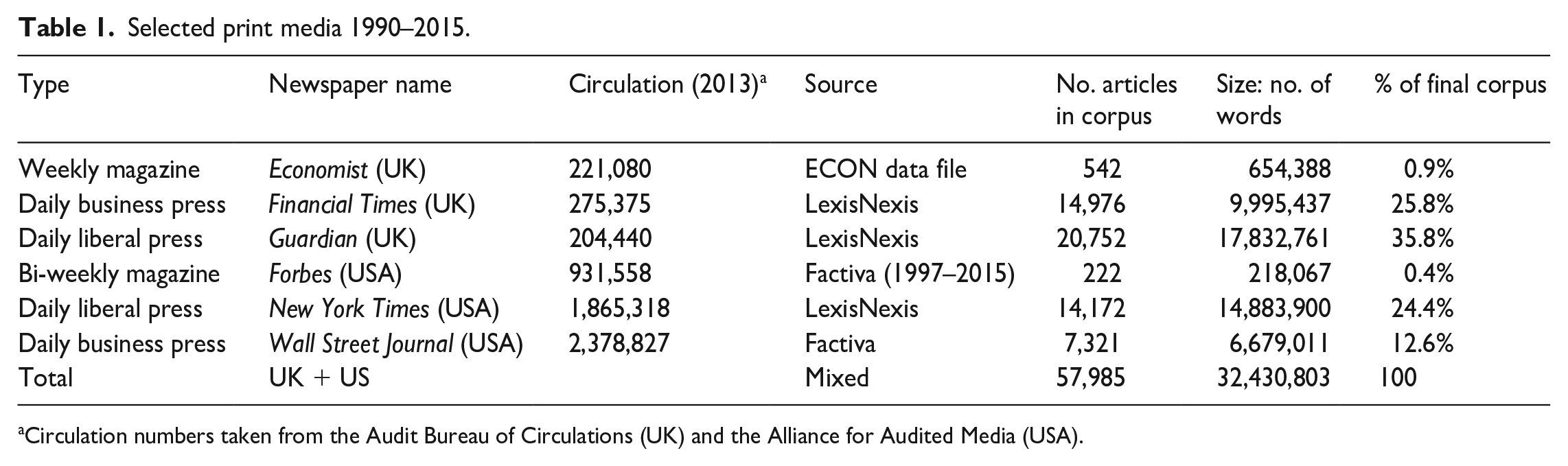
Circulation numbers taken from the Audit Bureau of Circulations (UK) and the Alliance for Audited Media (USA).
The data were collected using two online databases: LexisNexis and Factiva. For each newspaper, we initially explored the potential corpus size by first searching for the term ‘income inequality’. A codebook was developed with primary and secondary keywords (total = 19 keywords), which guided the selection of articles (see online Supplementary Material 1). We divided the overall search into a full corpus for quantitative analysis of media salience (full corpus, N = 57,985), and a smaller, refined corpus for in-depth qualitative analysis of media frames, sentiments and political slant (qualitative corpus, N = 240). The smaller corpus for qualitative analysis was developed from the full corpus. 2 The procedure for sampling for the qualitative corpus included sampling in two batches of 120 articles. The first set of 120 articles included 60 articles (10 from each news outlet, pre- and post-crisis) and another 60 articles were selected by examining the co-occurrence of ‘income inequality’ alongside other keywords in QDA Miner. The top 12 co-occurring keywords were selected (covering 20% of articles) and these included ‘economic, education, government, health, labour, law, market, minimum wage, pay and poor’. The second set of 120 articles was sampled randomly; for each news outlet and the two timeframes (1990–2007 and 2008–2015) we imposed a systematic strategy with variable sampling fractions. For example, in a time-window with 145 articles in paper X and a target of 10, every 14th item would be selected. For details on the qualitative codebook, see online Supplemental Materials 2–3.
Our findings pertain to (1) the changing media salience and (2) the framing of inequality in the British and US American mass media before and after the 2008 crisis (1990–2015). We will briefly state how these were measured and present our results for each of these in sequence.
Media salience: The unsteady rise of income inequality
Our first set of observations on inequality in the press concerns the salience curve as shown in Figure 2. Media salience is a key feature of a potential agenda-setting effect of reportage. We graph our index of salience in mainstream UK and US ‘broadsheets’ over the period 1990–2015 on annual figures. We note that the salience curves move more or less identically in the UK and the US and, as there is little difference here, this allows us to pool them together. Taking a three-year moving average across all newspapers we can identify a bi-modal hype cycle on inequality: an initial wave that started in the early 1990s and peaked towards the end of the decade before declining into the mid-2000s when a second wave emerges. This second wave took off 2005/6, stalled between 2008 and 2009 at the level of the previous peak, and rose vigorously into the 2010s to double intensity. It is worth noting that over the same period, academic publications on ‘income inequality’ – overwhelmingly the work of economists – increased exponentially (y = 3.1278 e0.1346X; R2 = 0.92). 3 By contrast, it grew more or less continuously.
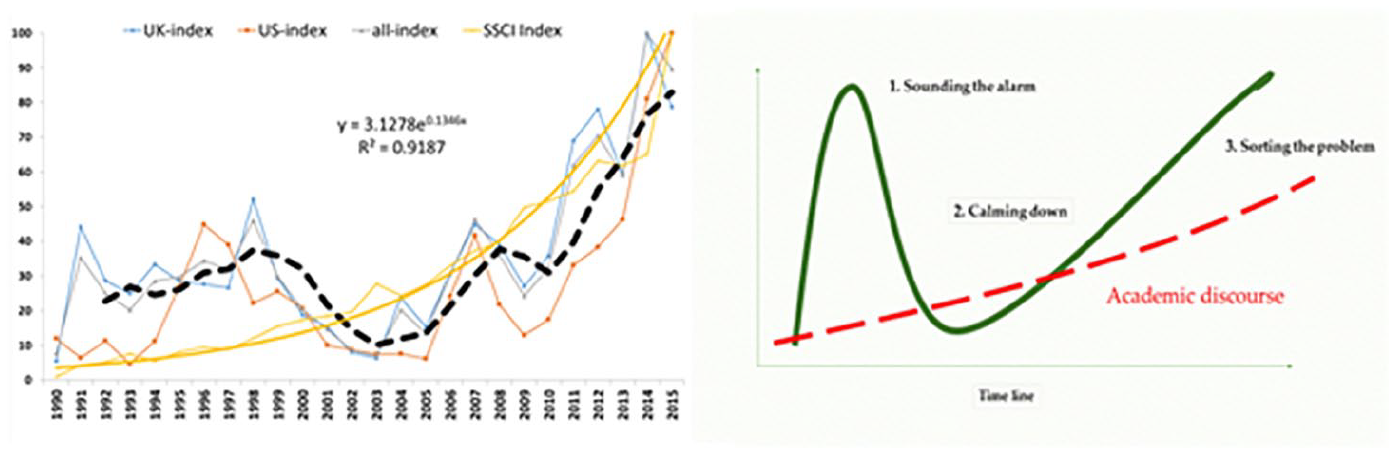
On the left, the growth of scholarly economic literature in ‘income inequality’; SSCI frequency of publications on ‘income inequality’, 1990–2015, with the log fit curve. UK- and US-index show the salience of ‘inequality’ relative to newshole indexed to 2015 = 100; the dashed line is a three-year moving average on the all-index of news, combining UK + US news. On the right, a stylised bi-modal hype cycle of public discourse X in relation to academic publications (dashed line) on X showing the three phases of ‘sounding the alarm’, ‘calming down’ and ‘sorting the problem’.
To put it another way, our 25-year observation period, a period in which academic research on inequality grows continuously, can be divided into three distinct surges: with the first peak in 1998, a second wave peaking in 2007 before declining, and a third surge from 2010 going far beyond anything seen before. During this final surge the news intensity doubled over five years. Therefore, the sheer scale of the rise in coverage after the ‘Great Recession of 2008–9’ means that we will make a simple distinction between the period before and after the recession for our later analysis. Overall, we conclude that inequality takes the shape of a bi-modal hype cycle as schematised in Figure 2 with little deviation between the UK and US: an initial surge in coverage that sounds the alarm on inequality, followed by a gradual decline; a second surge takes the issue into a new stage, possibly bringing a resolution of the problem, at least according to the issue attention model. However, as our observations end in 2015, we cannot be certain whether this second surge reached its peak or continued to date. Our three-phase hype model predicts, however, that the narrative will have shifted across these phases; we will come back to this below with our frame analysis.
A second set of observations on media salience of inequality arises from comparing the peak of news with other issue attention cycles over the period. We ask ourselves, is the peak of 2014 in the coverage of inequality a large peak or not? We find that in 2014, The Guardian carries about 2,000, the FT about 950, the NYT about 1,450, and WSJ about 650 items on ‘inequality’; this according to our full corpus. This shows that ‘inequality’ has consistently gained in salience since the 1990s in Britain and in the US, and in all newspapers. What was in the 1990s at most an occasional news item on a monthly cycle, is by 2015 clearly a regular news item on a weekly if not daily cycle. Clearly the salience of inequality has increased; but how hot exactly is the topic, compared with others? If we compare inequality with other topics that indicate social problems in modern society, such as global warming, controversies over GM food and stem cell cloning, and controversies over AI, surveillance and privacy protection, income inequality shows a much smaller surge and peak (see Bauer et al., 2023).
With reference to media salience, we conclude that news about inequality does not differ in intensity between the US and the UK (Figure 2). However, in contrast to McCall’s analysis (2013) but more in line with Schroeder and Vietze (2015), we find that it certainly increases in salience, particularly towards the end of the period. Furthermore, our evidence shows that the issue attention cycle of inequality is consistent with a hype cycle often observed in scientific technological developments such as AI or GM food (Van Lente et al., 2013) As the topic grows within the academic literature, it unwinds a bi-modal surge of news in three phases: an initial alarm is followed by a calmer phase, after which the surge resumes into a different stage. For inequality, we find a first surge between 1990 and 1998 that falls back, and a second surge in 2006 that drops back to earlier levels in 2007/8 before redoubling in intensity to 2015.
But this leaves us with our second research question: has the framing of the media discourse of inequality shifted over time and if so, might this be consistent with an emerging politicisation of an issue attention cycle?
Media framing of income inequality
As indicated earlier, we are analysing the shifting narrative of inequality by examining three dimensions over time: the inequality frames, the emotional tone of the stories (sentiment) and the political slant of news coverage. Through our in-depth qualitative analysis of our smaller corpus (N = 240), we identified eight frame dimensions of income inequality (see online Supplementary Materials 3 for additional details).
Conceptualisation: As inequality is a relational concept, it is no surprise to find that the discussions are preoccupied with measurement, indicators and comparisons. This frame covers comparison between the extremes of the pay distribution, which was one of the regular ways that reporters sought to explain this abstract concept. ‘Top versus the bottom’ was a regular reference across all newspapers, where the top 10% of the income distribution were compared to the bottom 10%. Another comparison, which featured initially in the US press, was the ratio of ‘CEO to worker pay’: worker pay being the median earning employee (i.e. ‘the compensation of top CEOs was about 35 times the pay of the average employee in the mid-1970s; by 1990 the ratio had risen to 120’, WSJ, July 1992). Temporal comparisons also feature to highlight growing income inequality (i.e. ‘If we want to get a valid measure of U.S. trends over the past two decades, all the same people in 1979 – wherever they lived – should be compared with all the same people in the U.S. workforce in 1999’, The Guardian, April 1991). It was the research by economists that fed the media coverage, with the result that a previously obscure measure such as the ‘Gini coefficient’ entered the public discourse to indicate growing inequality.
Type of Technological Change: This frame, which relates to the impact of new technology on incomes, describes whether the impact was universal or else skewed towards some groups rather than others. The early consensus among economists was that skill-biased technological change, notably in the form of computerisation, created a strong demand for skilled employees and this would eventually raise their wages (see, for instance, Acemoglu, 2002). Consequently, journalists either point to technological change ‘as the main driver of the growing earnings gap between high-skilled and low-skilled in the US and the UK’ (FT, October 2004) or else explain the rise in inequality as the ‘result of the demand for skilled, college-educated workers in an ever more high-technology workplace’ (NYT, January 2002).
Equality: In the pre-crisis period, the focus of problem identification and conceptualisation was also evident in the frame ‘Equality’, which focused on debates around whether societies should provide equal opportunity or equal outcomes in the job market. ‘Now that recession looms and without the demonstrable social mobility that might justify such disparities, demand for a new sort of equality is growing. And this is equality of sacrifice – that those at the top suffer as much as the rest’ (Economist, October 2008). In this sense, concerns around fairness were present within this frame, with some arguing that equal opportunity is already available but should not stifle intelligence and hard work, while others argued that true egalitarianism comes from equal outcomes.
Market: Within this frame, income inequality is given meaning in the context of market forces. The frame dimension ranges from viewing it as a necessarily evil of capitalist society to one in which income inequality is a source of social ills (poverty, unemployment, lack of healthcare access). While similar to Economic Growth (below), the focus of the Market frame was explicitly about how market forces interact with other parts of society rather than growth/anti-growth arguments. This frame is the closest to a ‘Tawney Moment’ being articulated in the data, as it frequently contains moral language: ‘Name a rich country and our inequality rates beat them by a long shot – though it’s hardly something to brag about. We also have the highest rates of homicide, infant mortality, teenage births, drug addiction, mental illness, incarceration, social immobility, and illiteracy. Name the social ill and we excel at it’ (The Guardian, October 2011). As is clear, the political slant of the article matters for how the frame is actualised, and ideologically linked (see Figure 6 below).
Geography is another discourse frame that features in economic explanations. This frame compares the level of inequality in different locations and examines differential impact across the labour force as ‘the earnings of the unskilled have been far more exposed to the pressures of low-wage competition from developing countries’ (FT, February 1995). As in the case of technology, rising inequality is attributed to abstract forces that seem both impersonal and inevitable. This sense of inevitability was also echoed in the Market frame.
Economic Growth: The growth frame forms a ‘jeopardy argument’ around income inequality: is it worth tackling income inequality if it hampers economic growth? On the one hand, the theme emphasises that economic growth should be unconstrained, as it enables productivity and provides better circumstances for all (i.e. ‘the rising tide lifts all boats’ metaphors) while the counter-dimension within this frame emphasises the need for top-down regulations on both economic and social inequalities, the result of which is argued to enable economic growth as an outcome.
Attribution Level: A prominent frame of the post-crisis period discusses the level at which income inequality originated as a problem, and thus where remedies should be focused. Here the frame ranged from individual to institutional attribution. For instance, an article attributing inequality to the behaviour of individuals stated that: ‘A better and more compassionate policy to fight income inequality would be helping the poor realize that the most important decision they can make is to stay in school, get married and have children – in that order’ (WSJ, January 2014). One end of this dimension is closely aligned to the concept of human capital in assuming that workers with different individual characteristics, such as education and training, will achieve different levels of remuneration. By contrast, the institutional argument claims that structural barriers, such as lack of access to educational opportunities, prevent the market from operating fairly. In other words, ‘the game is rigged’. Accordingly, policies should therefore address the basic premises of how a market economy operates.
Policy Making: This frame links inequality to policies or to the rhetoric of political actors. Here we distinguished between old and new policies to see if inequality was framed in a way that would suggest new kinds of policy solutions. Old policy solutions might include raising the minimum wage or reforming the tax system to make it more progressive. New policy solutions might follow on a radical new frame of economic injustice, for instance.
Considering two periods of pre and post credit crunch 2008, we find that the framing of inequality is indeed changing, taking a different emphasis pre- and post-crisis. Figure 3 shows the shifting proportions of each frame: Conceptualisation and Type of Change had more than 70% of their mentions pre-crisis, while Attribution Level and Policy Making had similar weight in the second period. This shift in frames from pre- to post-crisis shows a movement from understanding (pre) to managing (post) rising income inequality.
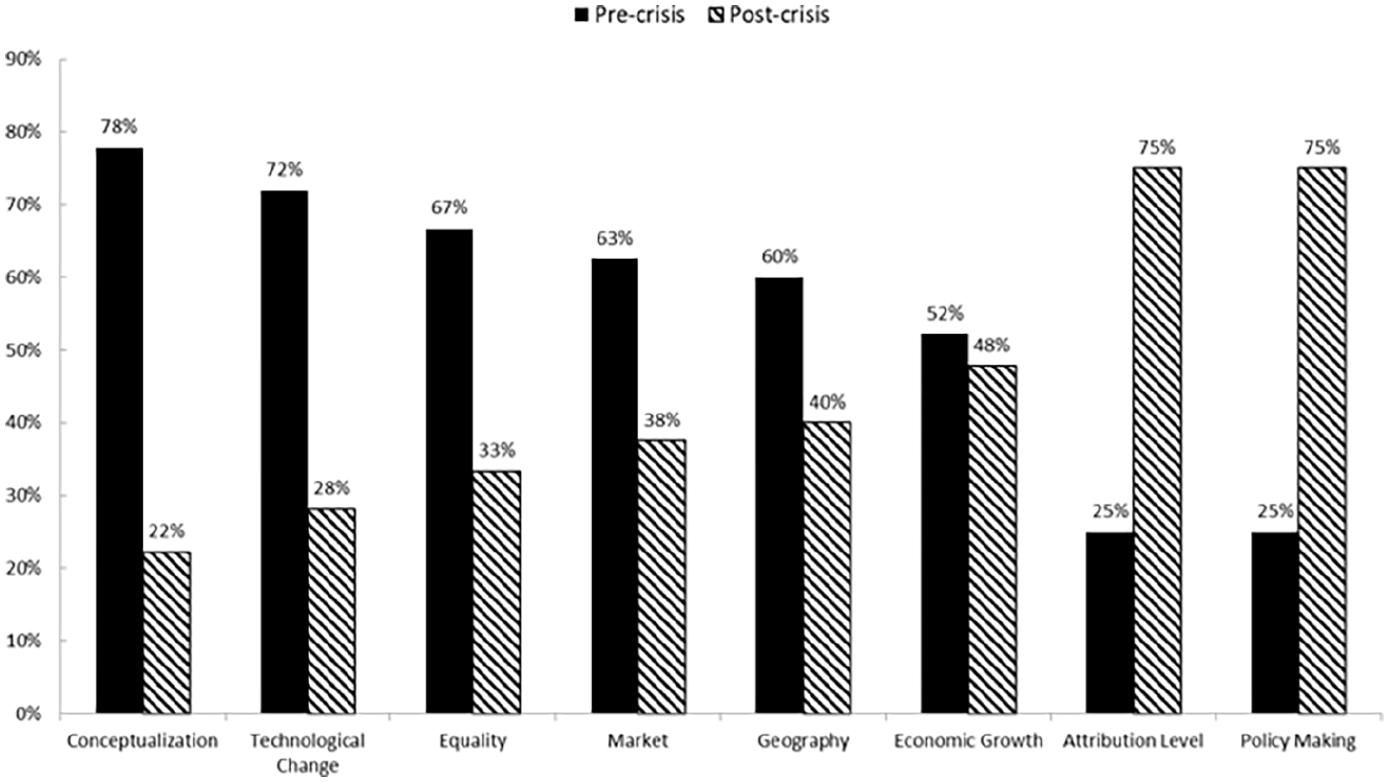
The shifting distribution of ‘inequality frames’ in the press pre- and post-crisis of 2008 (qualitative sample, N = 240; pre = 1990–2007, post = 2008–2015).
Sentiment of income inequality
To examine the overall tone of the reportage, we coded the ‘sentiment’ of each article using four categories: Negative, Neutral, Positive and Contested. Sentiment here refers to whether income inequality was framed in ways that emphasised it as a positive or negative aspect of society, or whether there was a more neutral or contested (positive and negatives discussed but no ultimate ‘judgement’ made).
For example, a neutral sentiment, most common with 42%, would entail articles that simply report statistics on the rise or fall of income inequality without judgement while contested articles (18%) would present different sides of contradicting arguments without taking sides (e.g. ‘income inequality within the nation may rise but global inequality probably declines, especially if the new arrivals send money back home’, NYT, July 2014). Positive (8%) or negative (32%) articles include value-laden and moral words in either direction. Significantly for our purposes, neutral and negative articles were the most common, echoing McCall’s (2013) findings on the negative tone of US coverage.
We examined changes in sentiment pre- and post-crisis (Figure 4). Here we see that Contested sentiment declined over time, which is consistent with the findings on framing which indicate that the pre-crisis period focused more on the conceptualisation and measurement of income inequality. However, we do observe a rise from pre- to post-crisis in both negative and positive articles, which shows a growing polarisation in the framing of income inequality, with fewer articles presenting balanced positions on the topic and more taking either a positive or negative approach to the topic.
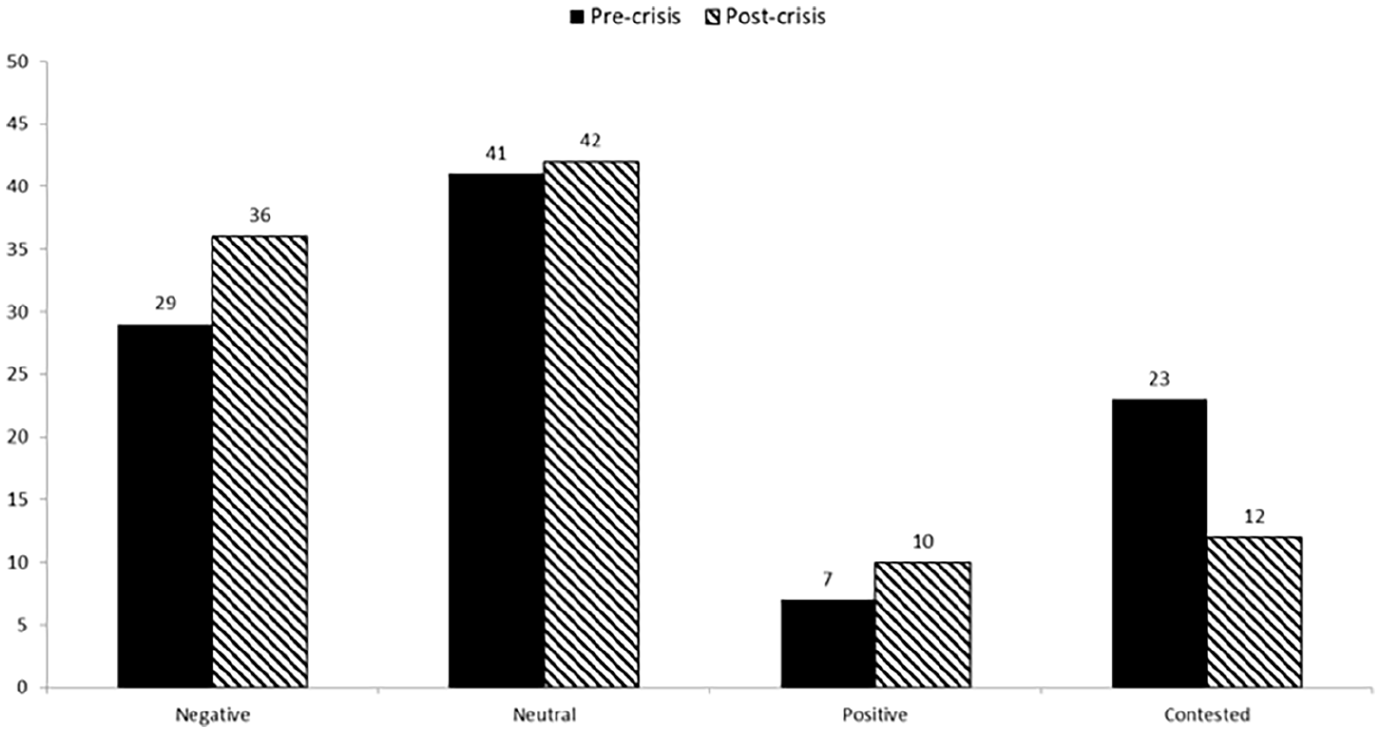
Comparing news sentiment of income inequality pre- and post-crisis in percentages of items (total keyword occurrence divided by small sample size) (N = 240).
We then examined each frame for the presence of morality-laden words in relation to discussions around income inequality (i.e. ‘income inequality offends basic American ideals of fairness’ [Forbes, November 1999]; see online Supplementary Materials 4 for morality dictionary). These words occurred both with explicit references to forms of morality in relation to policies and changes in economic trends and implicit references to how income inequality either challenged or threatened the moral fabric of society (i.e. ‘US is steadily separating into a two-caste system’ [WSJ, January 2014]) and causing other social injustices and problems (‘grotesque concentration of wealth in the hands of a tiny minority is fracturing our society’ [The Guardian, May 2014]). A morality dictionary was developed from reading the papers, followed by a second round of reading with the complete dictionary.
We find an increase in morality-related keywords in the post-crisis dataset. Figure 5 illustrates the increase in four morality-laden words identified in the qualitative dataset: scandal, ill, obscene and appalling. Examples of these include discussing income inequality as an ‘economic and social ill’ (Forbes, October 2005; NYT, March 2006) and ‘greater inequality, apart from an appalling human cost. . .’ (The Guardian, June 1992).
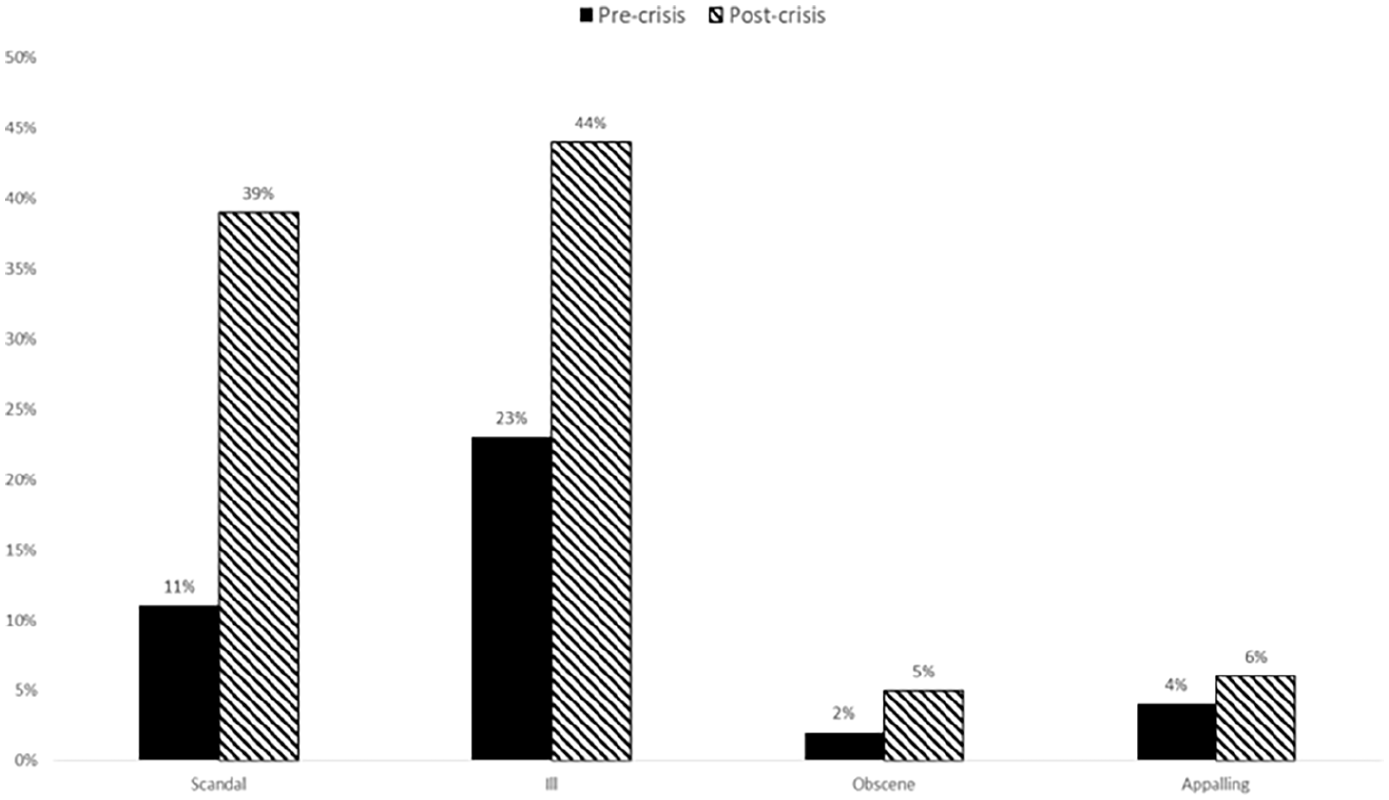
Comparing presence of morality keywords in articles on income inequality pre- and post-crisis in percentages of items (N = 240); inequality is ‘a scandal’, ‘ill’, ‘obscene’ or ‘appalling’.
Political slant of income inequality
We also assess whether the slant of the article is politically left or right leaning (Entman, 2010). We coded each article for evaluative statements on income inequality, examining which actors were seen to make these statements and which actors were mentioned (if at all). As such, for each article we created a double code, one for left-leaning tone and another for right-leaning tone; a 5/5 refers to a highly politicised story extensively covering both left and right actors and arguments, while a score 2/5 would indicate a stronger right-leaning ‘tone’ despite the mentioning of left-leaning actors. From this we create a combined index, the rating of right-leaning (0–5) minus the rating of left-leaning (0–5); this yields an index (range −4 to +4; M = −0.31; SD = 1.41; MD = 0; N = 135). Our analysis indicates that more of the frames are associated with the Left than with the Right; an association between frames and Left slant (Cramer’s V = 0.32, p ⩽ 0.01) is in evidence, i.e. different from zero, the association with the Right slant is not (V = 0.26, n.s.). Also, the ‘attribution level’ frame, in which inequality is ascribed to either individual or institutional causes, is strongly related to the Left (see Figure 5). In other words, inequality is not simply a problem of individuals, their skill level or personality traits but a structural feature of market societies.
Figure 6 shows how the political slant of frames shifts from pre- to post-2008 crisis. Pre-crisis there is an association of frames with political slant (V = 0.40, p ⩽ 0.01); for post-crisis this association is not clear (V = 0.38, n.s). Before 2008 ‘attribution’, ‘growth’, ‘market’ and ‘type’ frames tended towards a Left argument, this is less the case after 2008. Post-crisis ‘geography’, ‘markets’, ‘growth’ and ‘equality’ arguments tend to recruit more of a Right position. Overall, post-crisis frames of inequality lose their clear political positioning, as both Left and Right are equally inclined to make use of the same frames.
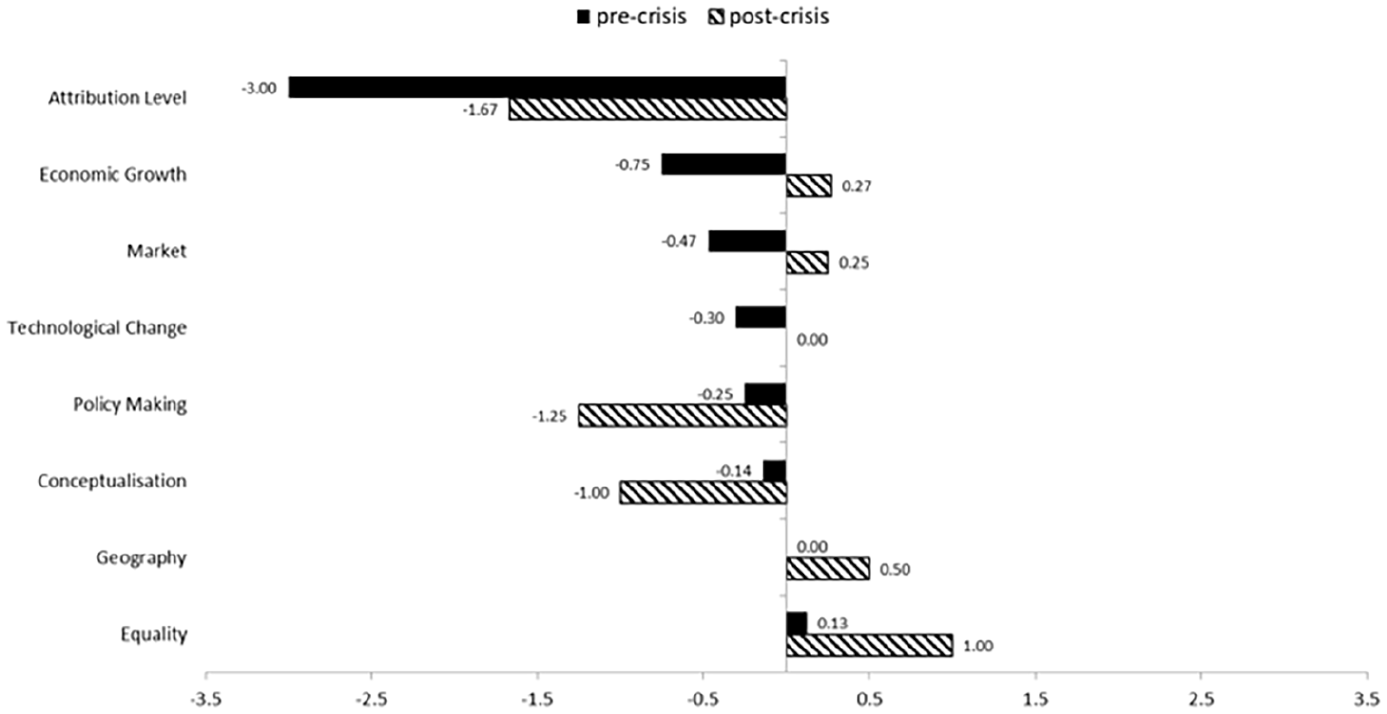
Average left–right slant of inequality reportage in different frames, pre- and post-crisis, ordered by pre-crisis values (N = 240). The scale ranges −4 to +4, with negative scores indicating more left-liberal leaning, positive scores indicating more right-market leaning.
Overall, the frame analysis indicates that the frames move from focusing on offering the public an understanding of the causes of rising income inequality (including using different measurements to define the phenomenon, geographical parameters to put it in comparative terms to other countries and explaining it in terms of changing market forces), to focusing, post-crisis, on how to manage rising income inequality (including identifying at what level – individual or systematic – management was needed, and how different existing/traditional policy solutions could offer remedies). This change in frame focus is echoed in the decrease in contested sentiment in the post- 2008 period and rise in moralising language, indicating that we move from a period of questioning what income inequality is, and how we can understand it in different ways, to focusing more on moral understandings. Furthermore, the lessening of a clear-cut political slant post-2008 suggests increasing uncertainty as to which frame in a whole set of frames is endorsed by which political ideology, which potentially foreshadows public uncertainty as to how income inequality can subsequently be managed (see also Van Dalen et al., 2018).
Summary
This article set out to examine media coverage of inequality against a background of rising inequality and stable public attitudes. A particular concern was to assess whether the financial crisis of 2008 was an event that raised questions of moral economy and perhaps developed into a public scandal and an affront to common decency. It is now time to review how the evidence fits with the conceptualisation of a Tawney Moment outlined in the introduction. The first two features of the Tawney Moment, namely increased media attention and the influence of a trigger moment, are supported by our data. We found that income inequality emerged as a relatively new social fact as coverage increased from 1990 to 2015 in both the UK and the USA. Inequality takes the shape of a bi-modal hype cycle (Figure 2) with an initial surge (increased media attention) which ‘sounds the alarm’ in rising income inequality (Van Dalen et al., 2018), followed by a gradual decline and second surge brought on by the financial crisis (trigger moment). Our evidence on salience is therefore similar to that reported for German newspapers with increasing coverage over the long term (Schroeder & Vietze, 2015). What was striking in our research was that these waves of coverage appeared at broadly the same rhythm and had the same levels of intensity across both the US and the UK.
Was the surge in prominence accompanied by an equally dramatic shift in framing? The next three features of a Tawney Moment that relate to framing (emerging frame, frame transcendence beyond left–right and moralisation of the issue) are not supported by our data. Certainly, the framing of inequality discourse shifted between the initial surge before 2008 and the second surge afterwards. The earlier narratives focused on describing the concept by using measurement comparisons and by explaining it in terms of skill-biased technological change. In the later period, ‘problem oriented’ frames gained prominence as they discussed interventions at national and international level, which suggests a growing sophistication in the treatment of the issue as it moved from diagnosis to seeking solutions. However, despite this change in frame focus, we see no ‘new’ framing of income inequality (i.e. no new ‘emerging frames’) that mobilise the political masses (i.e. transcend beyond left–right). The Occupy Wall Street movement (and similar events in London) attempted to achieve this under the slogan ‘We are the 99%’, but this ultimately did not occur. The absence of a new master frame meant that the discourses on inequality were unable to come together into a new paradigm suggesting new kinds of policy measures. Accordingly, we could find no evidence for the emergence of a new frame of ‘economic injustice’ similar to the ‘global warming’ and ‘environmental injustice’ frames that mobilised the worldwide environmental movement (Taylor, 2000). While we do see a slight rise in the moralising language (Figure 5) the evidence is limited, and without the presence of new frames, this moralising language was not enough to develop into a full-blown outcry against an intolerable disparity between ‘rich and poor’.
These observations on salience and framing of inequality suggest that while the issue gained in salience when it went through an alarm phase in the 1990s it has not been able to mobilise strong and distinct political voices promoting a radical new framing of the problem, even after the trigger events of the banking crisis of 2008. This lack of mobilisation hints at a lack of resonance between the problem and the public in both the UK and the USA. Why so?
Discussion: Why is there no ‘Tawney Moment’?
Rather than directly explaining this absence, we want to offer a few plausible explanations for it by way of abductive logic. Our observed facts regarding salience and framing are consistent with some explanatory inferences.
First, several of the frames lend themselves to the idea that rising inequality is inevitable, resulting from impersonal forces. That is, it is seen to be inherent in ‘technological change’, ‘market’ forces, ‘geography’ and the requirement for ‘economic growth’. In the case of the ‘market’ frame, our findings are similar to those of others (i.e., Bank 2017; Grisold and Theine 2020) in that when inequality is viewed as an inevitable market outcome then there is little that policy makers can or should do about it.
Second, research on media agenda setting has shown that news coverage can lead the public to focus their attention either on the individual or on the system (Iyengar, 1987). In terms of our ‘attribution level’ frame, when the focus is on the individual, observers tend to blame people for their own misfortune (e.g. single parents). Similarly, reports of CEOs on salaries so enormous that they provoke disbelief and outrage at ‘obscene’ levels of remuneration may be understood as the actions of ‘greedy’ individuals. By individualising and relating the problem to personal motivation the media contribute to the belief that the system is not to blame (see Carter et al., 2011). It is not so much that moral economy is weak (Fourcade et al., 2013, p. 609) but that it is probably easier to tell a moral story in which vices and virtues are attributed to identifiable actors or types of actors rather than to structural features of market economies.
Third, we observe a rise from pre- to post-crisis in both negative and positive articles, which indicates a growing polarisation in the framing of income inequality, with fewer articles presenting balanced positions on the topic and more taking either a positive or negative approach. In other words, the framing of inequality became more polarised in terms of sentiment as it is absorbed by the established conflict between the political right and left over the way they view economic matters. In effect, through absorbing the rising income inequality within existing right–left divides, the topic became part of political ‘business as usual’ rather than a potentially new, and radical, concern. As such, ‘inequality’ is but a continuation of an ancient political contest between the right and the left: that is, between those who want to regulate markets and contain the excesses of capitalism and those who want to liberate markets to generate prosperity and wealth. Consequently, any new and overarching frame of economic injustice would have to enter a crowded field in which the various political interests have a history of attachment to established frames and policy solutions. Future efforts by sociologists to analyse responses to economic crises must begin by recognising the interconnectedness of the economic and political spheres and indeed imbalances of power between different interest groups (see also Grisold & Theine, 2020, pp. 1081–1082).
We also think there is a resonance between media framing and the views of audiences. That is, the framing resonates with the perspective of the typical readers of their newspapers as much as the journalists and editors inform those views. Here we highlight research in psychology (Jost et al., 2003) on system justifying beliefs which has shown that the people most disadvantaged by existing social arrangements (such as economic inequality) have the greatest psychological need to believe that the game is not rigged and are therefore more likely to perceive the status quo as legitimate, even when it works against them. Indeed, for system justification theory, the puzzle of rising inequality and stable public attitudes is not really a puzzle once citizens believe that this inequality is fair and legitimate (i.e. they endorse system justifying beliefs; Jost et al., 2003). As such, if public attitudes towards ‘success’, ‘poverty’ and the ‘redistribution of income and wealth’ are not shifting away from the meritocratic consensus that is hanging on from the 1980s and 1990s, there is little likelihood of inequality becoming a scandal and being perceived as the ‘evil’ that Tawney deems it to be. At least, up to 2015, a Tawney Moment did not occur. Whether this might occur in the aftermath of Brexit in the UK (2016) or the ‘cost-of-living crisis’ (2021–) could be the subject of further research.
Lastly, a potential useful avenue of future research might be to consider the five features of a Tawney Moment as elements of a Guttman scale, that is, as escalating criteria that define a Tawney Moment as a gradient. The evidence of our article would suggest that by 2015 we have reached just 2, maybe 2.5, on a 5-point scale of scandalising economic inequality in a Tawney Moment. In addition to analysing the moral categories that are mobilised as part of the moral economy, we also need to consider the morally challenging moments, especially when induced by economic crises; the period post-2015 might significantly add to this story.
Supplemental Material
sj-docx-1-sor-10.1177_00380261231176365 – Supplemental material for In search of a Tawney Moment: Income inequality, financial crisis and the mass media in the UK and the USA
Supplemental material, sj-docx-1-sor-10.1177_00380261231176365 for In search of a Tawney Moment: Income inequality, financial crisis and the mass media in the UK and the USA by Patrick McGovern, Sandra Obradović and Martin W. Bauer in The Sociological Review
Footnotes
Funding
The research was supported by a small grant from the LSE’s International Inequalities Institute.
Supplemental material
Supplemental material for this article is available online.
Notes
References
Supplementary Material
Please find the following supplemental material available below.
For Open Access articles published under a Creative Commons License, all supplemental material carries the same license as the article it is associated with.
For non-Open Access articles published, all supplemental material carries a non-exclusive license, and permission requests for re-use of supplemental material or any part of supplemental material shall be sent directly to the copyright owner as specified in the copyright notice associated with the article.
