




Abstract
Sewage management is crucial to the functioning of cities, yet, in the global North, seldom acknowledged in public. Wastewater infrastructures are mainly hidden underground and human excrement is considered a private matter. However, to make sanitation stay invisible, its dysfunctionality (e.g., leaking pipes, aging wastewater plants) is sometimes in acute need of being highlighted. Moreover, the work essential to keep the infrastructures maintained needs to be recognized and compensated for. Based on interviews with actors in the sewage management sector in Sweden, news articles, and public information campaigns, the present article explores how political action and public engagement are mobilized through moves between visibility and invisibility. The analysis focuses on four different modes of problematization: inproblematization, problematization, deproblematization, and unproblematization. Inscribed in the research fields of urban infrastructures and public engagement, the article sheds light on how the public secret of managing feces is upheld, through balancing acts such as creating discursive space, negotiating infrastructural disruptions, making problems treatable, and individualizing solutions. These different modes of problematization are crucial to achieving the right public attention and political measures.
Sewage as (in)visible
Water is packed with symbolism, signifying purity as a creator and sustainer of life, as well as – when flushed away – dirt, contagion and even death. As such, it is a highly cultural matter (Hawkins, 2006, p. 46). Sustainable sewage management is organized and structured to prevent water pollution, health hazards and, ultimately, the breakdown of cities. However, it is an invisible business. In the global North, sewage management is often taken for granted as a straightforward cycle: from worthless dirt flushed down toilets to economic and ecological valuables such as bio-fertilizers and clean water. Moreover, as human feces and defecation are secret matters (Oberg, 2019), the system that facilitates their invisibility is itself obscured, ‘veiled behind double curtains of invisibility’ (Wallsten & Krook, 2016, p. 830). Wastewater is in this sense ‘unremarkable’ (Hawkins & Muecke, 2003, p. ix).
However, to remain unremarkable, wastewater supply needs the right conditions, including the materiality, localization, and dimensionality of drains, pumps and wastewater plants, etc. Likewise, smooth flows are temporally contingent, intensified by autumn rains, or slowed down when usage is less, such as at night. Fat threatens to cause occlusion and create ‘clogged cities’ (Marvin & Medd, 2010). Continuous urbanization and growth push the limits of capacity. Heavy rainfall makes drains and treatment plant sewage pools overflow, sometimes massively, resulting in the pollution of water recipients. In times of breakdowns and crises, supply systems move from functional invisibility to unwanted visibility: they become ‘remarkable’ (Hawkins & Muecke, 2003). Such disruptions might even be beneficial to the maintenance of infrastructural systems, as political legitimacy for large investments – such as in wastewater treatment plants – demands that public awareness be raised. Crises might lead to much-needed activation of ‘urban sanitation imaginaries,’ allowing for shared action (Morales et al., 2014). The present article demonstrates the work needed to maintain the dynamics and flows of urban infrastructures, with the focus on wastewater management actors’ mobilization of political and public interest.
Human excrement and its removal are, as stated above, peculiar political objects. Stakeholders need to control information – balancing secrecy and transparency (Simmel, 1906) – to see that human waste receives the right kind of political attention. Successful control over information may secure public and political trust and legitimacy for increased costs. But by failing to control information and losing the balance, it may strike the other way. Thus, the framing of the problem itself is of great concern and we analyze the process through which this framing is made. The article aims to investigate the making of (in)visibility in sewage management through different ‘modes of problematization.’ These modes work as foreground and background – making a problem (in)visible: namely, human excrement and the system that cares for it, with different political, economic, and social effects, such as political and public legitimacy for investments in and construction of sewage infrastructure.
Our article springs from a study of Swedish waste management. 1 The national context is interesting and relevant for several reasons. First, we approach the theme of water-borne waste removal from a national context in the global North. While a large proportion of the research literature addresses wastewater management within the global South (e.g., Acey, 2018; Oberg, 2019; Terreni Brown, 2019), we approach the issue through the lens of a high-tech country with strict regulation regarding water pollution. Sweden is recognized as employing among the world’s highest standards for water purification and for the country’s ambitious environmental goals (Naturvårdsverket, 2019). Water services are invariably organized and secured by municipalities. Costs for new construction, renovation, and maintenance of wastewater systems and treatment plants are financed through water fees and taxes. 2
However, the sewerage systems in Sweden are getting old. Most treatment facilities were built in the 1960s and 1970s, and a considerable part of the sewerage infrastructure dates from the 19th century. These facts, together with factors such as city growth, stricter environmental regulation, and effects of climate change, are turning the wastewater system into an urgent political and economic concern. For a medium-sized municipality, investments of several billion SEK are often required to improve and repair existing drains and plants in relation to modern standards. These investments are hard to legitimize and prioritize in light of more pressing political issues, such as education and healthcare. It can also be considered politically risky to raise taxes for projects that will take 10–15 years to complete and that demand investments for the next 60–80 years. In other words, efforts to legitimize these costs are called for: the public needs to be willing to pay and the municipal bodies must be willing to decide on costs for their citizens/voters. Beyond the economic aspects, issues concerning localization of new treatment plants, environmental effects, and public disturbance caused by construction work must be dealt with. The trick that authorities must master is to find a way to offer citizens a return to the ‘privilege of ignorance’ (cf. Anand, 2015).
In the following sections, we outline the article’s theoretical underpinnings, drawing together literature on urban infrastructure and its maintenance through the making and unmaking of a public secret. After reviewing the methodological approaches, we move on to the empirically based sections, in which the balancing act of controlling visibility is analyzed using four modes of ‘problematization.’ The first section concerns inproblematization, highlighting the political silences that stakeholders need to handle and the strategies they use. The second section deals with problematization, and the strategies used when disruptions in terms of leakages and pollution are revealed, e.g., in the media. Deproblematization – the topic of the third section – involves the creative tackling of the problems posed and the presentation of tasteful solutions. In the last section, we analyze strategies for preventing disruptions through humorous information campaigns directed to the public, framing wastewater management as a shared – but unproblematic – responsibility. We argue that this study challenges existing literature by theorizing invisibility and transparency through problematization and empirically, by investigating the sector’s way of handling the paradoxes inherent in sewage infrastructures, leading to public awareness political mobilization.
Wastewater infrastructures as public secret
Wastewater is rich in cultural meaning and the sanitary imagination ranges from the detritus of the human body and environmentally hazardous matter to the lively capital of biogas, fertilizers, and purified water. The architecture of water-borne waste treatment is embedded in and structured by a series of interrelated dimensions: waste disposal and water ecology, construction work, politics, organizational practices, circular economies, law, and social relations (e.g., Benedickson, 2007; Gandy, 2004; Lofrano & Brown, 2010). As noted above, the present study investigates movements between frames of visibility and invisibility and draws on multiple theoretical sources on communicative governance of wastewater infrastructures in order to enable the investigation.
There are several, admittedly overlapping, strands of social science research on urban infrastructure in general, and on wastewater in particular. One of these strands emphasizes the political ecology of urban waterscapes. Water infrastructures, including those meant for water-borne waste removal, are urban flows where nature is fully intertwined in the modern city (Kaika, 2005; Swyngedouw et al., 2002). Historically, the creation of water-borne waste removal is a Western, hygienic, modernization project, in which the safe and continuous removal of excrement from the city home became a prerequisite for urbanization (Laporte, 2002), and an underlying rationale for the creation of the ‘pipe bound city’ (cf. Hallström, 2003; see also Lofrano & Brown, 2010). Through the installation of water-borne waste removal systems in the 19th century, individuals have become increasingly dependent on the collective authorities – the municipality (Benedickson, 2007, p. 97). The city authority was, and still is, the principal body, in that it executes governance through the provision, regulation, screening, and taxation of water flows; excrement is governed as an object of political interest (Anand, 2015; Hawkins, 2003, p. 43). Wastewater is, as Gandy noted (2004, p. 373), a critical, political, and spatial concern. Post-colonial studies are particularly useful for investigating these concerns, as they problematize the global economies and geographies of waste (McFarlane, 2008; Morales et al., 2014). However, it is similarly important to note that although there are differences across the North and the South when it comes to specificities of political ecologies, the valuation and governance of waste work remain an important aspect (Millington & Lawhon, 2019).
From a slightly different perspective, infrastructures have been approached in science and technology studies (STS) and urban geography terms, as assemblages that mediate and transgress material-semiotic actors and spaces (e.g., Farias & Bender, 2010; Gille, 2010). They are not frozen in any given moment, but always already ongoing disorderly processes. This does not mean that there is no order, or that disorder equals chaos. Studying waste flows and landfill practices in Athens, Kallianos (2018, p. 759) argued that disorder ‘develops in the liminal space between the planned and the contingent.’ In other words, infrastructures as dynamic and fragile processes are ‘precarious achievements’ (Graham, 2010, p. 9) that are in constant need of ‘repair work’ (Graham & Thrift, 2007; Holmberg & Ideland, 2021). Repair work can entail both human and non-human maintenance – for example, by bacteria. Non-humans are essential but potentially unruly agents that are involved in the transformation of dirty sludge into biogas (Holmberg, 2021), which is considered a clean energy resource – a ‘sustainability object’ (Corvellec, 2016). Urban infrastructure is further colored by the complexity and openness characteristic of cities (e.g., Farias & Bender, 2010). Their contingent fabric and vulnerability highlight the need to attend to the making of infrastructures.
We draw on insights from both the aforementioned political ecology and STS perspectives on infrastructures to shed light on the empirical case of how sewage management workers perform their balancing act of moderate visibility, which includes the need to incur disturbances without blaming anyone in particular, and without revealing too much of the stinky stuff. We also acknowledge the importance of pinpointing the urban political fabric. Our empirical case entails economical conflicts, localization disputes, environmental effects, and other disturbances. Moreover, we focus on the handling of such disturbances, both in material terms (clogs, flooding, pollution) and in the social sphere (political discourse, citizen awareness, behavior modifications).
Paradoxically, governance of human debris means that it needs to be hidden and noted at the same time – a ‘public secret,’ meaning what is generally known but cannot be spoken of, a politically strategic absence (Hawkins, 2003, p. 48; cf. Taussig, 1999). Secrecy is a well-known sociological phenomenon, ultimately about control of information in interactions and organizations (Simmel, 1906). People indisputably act through keeping and revealing secrets, but one can also claim that secrets themselves act: they produce and legitimate a social order – as they are veiled, but also revealed. In addition, they act as abjects, through their constant threat of returning to the public (Taussig, 1999), not least when it comes to the secrets we do not want to know – such as the afterlife of human feces. Hawkins stated that the smell or sight of feces is disturbing, not because we are surprised that it exists, ‘but because of our active desire not to know’ (Hawkins, 2003, p. 41; cf. Anand, 2015; Laporte, 2002). Breakdowns in the system interfere with the moral order, security concerns, and a general faith in infrastructure (Sims, 2010). However, problems, whether real or imagined, can also be mobilized to get public and political attention. Hawkins (2003) conceptualized this as a politics of disturbances, emphasizing the ‘techniques for deploying the negative in relation to positive value’ (p. 42). Paradoxically, disturbances can also be used to keep this public secret at the same time as the truth is exposed. In other words, there is a movement between displaying and hiding sewage services – an ongoing making of (in)visibility.
Elaborating further on this balancing act and the making of (in)visibility: in order to achieve a legitimate intervention, such as investing in new drains, there must first be agreement that there is a problem that needs to be fixed – often before the problem has appeared. To study this, we draw on the concept of ‘problematization,’ meaning that a social problem is discursively produced to govern political agendas as well as people’s willingness to act or change (Bacchi & Goodwin, 2016; Foucault, 1983). Studies on problematization often emphasize the need to deconstruct how a problem is made and how it governs through different technologies, making solutions and interventions natural and inevitable. The aim is then to problematize the problematizations, as in Oberg’s study on human waste and its practices in Agra, India. She denaturalized ‘the bourgeois toilet habitus’ and taken-for-granted assumptions about ‘shit(ting)’ through studying the construction of social problems and its consequences (Oberg, 2019, p. 378). The present study takes a slightly different approach on problematizations of the handling of human feces since it investigates how certain categories of stakeholders showcase some problems and hide others.
Studying wastewater management
The body of empirical data underpinning the analysis is ‘multisited’ and composed of interview transcripts and media material to follow the work put into keeping and exposing public secrets (Marcus, 1995). The main data consist of 41 interviews with people working with waste removal (food waste and sewage) in three municipalities: Gävle, Malmö, and Uppsala (see below). The informants were chosen based on their key positions and specific expertise in waste management. They are mainly positioned within the municipal organization of wastewater management, working with policy, legislation, technical development, and communication. 3 The informants share a background in higher education (in engineering or communication, for example), but vary in gender and age. The interviews were conducted individually at the informants’ workplaces, which were municipality offices, educational activities centers, private companies, and treatment plants. The interviews took different forms depending on the informant’s work tasks. Some were conducted as walk-and-talks at the wastewater plant facility or educational center, while others were more traditional interviews at their offices. The interviews lasted between one and three hours and addressed different aspects of the informants’ work, such as daily work tasks, collaborations with different actors within the organization, and challenges within these practices. Informed consent was obtained and interview transcripts were shared with informants. All names that appear in this article are pseudonyms.
Additional empirical data are text-based. From the websites of the public organizations within the three selected municipalities, we have analyzed information campaigns for so-called upstream work. Moreover, media reports from the three municipalities were retrieved from the national database Mediearkivet. The articles report on news of flooding and leakages. as well as controversies surrounding the construction of water purification plants and their location.
The three studied cities have their own specific challenges, but also important commonalities. In Malmö there are plans to build a new treatment system at the cost of 10 billion SEK (about €1 billion). The plans involve reconstruction of one of the main sewage treatment facilities. The new plant will have a functional capacity equivalent to 800,000 people (PE), and connect to the adjacent cities, and a new underground draining system is also proposed. Gävle plans for an increased capacity from 100,000 to 150,000 PE. The situation in Uppsala is similar to that in the other two cities, and after debates and negotiations, the municipality has settled on reconstructing the existing plant, while increasing the capacity from 200,000 to 300,000 PE. Apart from challenges in terms of designing for growth, city authorities need to handle issues concerning future discharge limitations, cost efficiency, and not least, controversies around location.
In the analysis of media texts, information campaigns, and interviews, we attend to how problems are made – and unmade – in relation to political decision-making and public investments, through movements between four different modes of problematizations:
Inproblematization refers to the discursive silences that organize the politics and practices of sewage services (such as the problems of getting the right political attention).
Problematization concerns how sewerage sometimes becomes a social problem through unwanted, accidental disturbances (such as leakages).
Deproblematization pertains to how problems are framed as treatable, presented with political solutions, by the people in the sector of wastewater management.
Unproblematization defines the activities through which potential future problems are presented as simple and easy to handle (for example, information campaigns targeting citizens).
These modes are constructed from an inductive analysis of the empirical material, focusing on how problems and solutions in relation to politicians and the public are framed and how movements between hiding and displaying sewage and its management are made. By addressing and analyzing these modes, we shed light on the paradoxes, problems, and obstacles of transforming wastewater removal from a public secret into a political and public issue and vice versa, and how that process takes place between visible disturbances and invisible secrets. The analysis is underpinned by a selection of illustrative quotes from the interviews with waste workers, newspaper articles, and campaigns.
It is taken for granted – public and political inproblematizations
As mentioned above, sewage operation is – traditionally and preferably – invisible. This means that not only is it predominantly a subsurface and geo-socially hidden infrastructure, but it is also an often-forgotten, marginalized political question. In recent surveys of what Swedish voters consider to be important political issues, healthcare, education, and immigration are at the top of the priority list. Issues such as the labor market, environment, economy, and social equality also appear further down the list. In 2017, only 1% of voters identified societal infrastructure and public services as important (Martinsson & Weissenbilder, 2017). We conceptualize this as a ‘discursive silence’ (Holmberg & Ideland, 2012). Sewage management is downplayed in the public and political agenda through forces beyond the control of the sector.
In the cities that were studied for the present article, water and waste removal systems are managed through corporations owned by one or several municipalities.
4
These corporations are steered by a board of lay politicians, representing the member municipalities. The task of the municipal corporations is to take responsibility for a societally vital function in the face of political ignorance – a dilemma that leads to the emergence of a common theme among the interviewees. Martin, who has a leading role in planning for the construction of a new wastewater plant, pointed to the problem of mobilizing political interest in wastewater systems and their maintenance. According to Martin, education and healthcare are domains that are always prioritized in the political debate:
On the society’s hierarchy of needs, it [wastewater] is lowest, but without a functioning water and sewage system, the city cannot grow. We get ill, we cannot get foodstuffs, water, and so on. But it is not, it is not so visible, it is hidden and it is not noticed and you take it for granted. (Martin)
Martin found the invisibility of the sewage system deeply frustrating, given that its functioning is essential to society. But how can the municipal corporations break through the political discourse to make politicians aware of the acute problems faced?
The CEOs of the three water and sewage organizations studied expressed different dilemmas associated with articulating the need for investment, public acceptance of higher fees, and not least political good will. One dilemma regarding the articulation of wastewater structures derives from the fact that investments are significant, while for the consumer this service is quite cheap.
I haven’t yet met a person who has said to me: ‘I’ve invested in my property because I want to save water because it’s so expensive.’ I can’t imagine that for 1 SEK a day you would invest like that in your property. (Lina)
As stated in this quote from a CEO, people in general do not make investments in order to reduce water consumption. Sewage management has not (yet) been privatized in Sweden, meaning that consumers are not supposed to ‘choose,’ as is the case with other infrastructural services, such as electricity, telephone, and internet connection services. Property owners are not concerned about water-related services – as long as they work (cf. Anand, 2015; Gandy, 2004). This is a sign of a functioning society, but it causes trouble with regard to public engagement.
According to the interviewees, the organization of political decision-making does not help when it comes to making sewage a matter of concern. The sector is governed by local politicians elected for four-year periods, and they are not – like the property owners referred to above – inclined to make investments that will not pay off during their term, but are essential from a long-term perspective (50–100 years). This means that the decision makers are novices in a complex field, while the decisions are pressing: ‘We don’t have time to sit around and discuss these things if we are to move forward with this program. They need to trust us and take in what we tell them and dare to make brave decisions’ (Martin). Accordingly, trust building and solid relationships between the sector and the politicians are essential for getting the job done.
However, a second dilemma is that, to break through the silence, it is necessary to articulate the existence of a problem and, thus, in a sense, confess one’s own failure to deal with it. As Yvonne, one of the CEOs, said:
I, and one of my coworkers who is leading the process, were at the municipal executive board a few weeks ago and talked about this regional [project]. I told them that ‘I just want you to know that your sewage treatment plant isn’t holding up. We patch and mend, I mean, it’s been brought to its knees.’ Well, maybe they haven’t heard that before, no one has told them . . . perhaps you feel it’s a bit shameful to say that it’s as damn bad as it is. And then you wait and then you wait and then you wait, and in the end it’s so bad, it can’t hold any longer. Who’s going to tell them that? (Yvonne)
Yvonne partly blamed this lack of political awareness on the sector itself. The recognition of failures and the potential shame that comes with it have been put forward as a possible explanation for the silence. As long as the flows keep running, people are happy with less involvement from outside authorities. But to have a readiness for infrastructural investments, the system’s everyday functionality needs to be noted. It is perhaps not a coincidence that when Swedish sewerage started getting old in the 2010s and large investments became serious, awareness-raising public campaigns and waste edutainment were launched basically everywhere. Displaying the marvels and fragility of the underground systems is certainly also a gratifying affair within the sustainability discourse.
Informants working within the sector struggle with the hidden position and inproblematization of sewage management in the public and political discourse. The interviewees explain this position by putting it in relation to other more politicized issues. They blame the problem on the overall political organization, which leaves the decisions to politicians who are ignorant of the system and engaged for only four-year periods. The notion that infrastructures are hard to study because they are simultaneously mundane and complex (Star, 1999) also holds true for a politically elected layperson. However, there is also a certain amount of self-criticism involved in the explanations; for example, that it is shameful to bring malfunction to the table. The discursive silence discerned has effects on the political and public justifications for large monetary investments. In the following, we explore how such awareness might be facilitated.
Shit happens! – problematizations through breakdowns
Even though sewage management is predominantly absent on the political agenda and in the public discourse, it sometimes becomes extremely visible. When the infrastructure – being the precarious achievement it is (Graham, 2010, p. 9) – breaks down because of natural forces and/or technological failures, it becomes visible. As the mass media pick the issue up and turn it into a problem, it leads to public problematization. One infamous example of plumbing disruption with globally mediated coverage is the London ‘fat blob’ of 2017. The news about the occluded drains stirred some debate over similar fat-induced disruptions in Sweden as well. Most newsworthy on a local level, however, are the overflows caused by occlusions or broken pipes. News articles often use imaginative headlines, as in Upsala Nya Tidning, the major morning newspaper in Uppsala:
Strange noises and odors made Mattias Hammarsten from Storvreta investigate the local woodland close to his home. A one-hundred-meter-long creek wound between pines and fir trees. However, it was not a common creek that flowed past Mattias Hammarsten’s feet. An unknown blockage in a sewage pipe had caused the forest to fill up with toilet paper, plastic and human excrement. A stench spread among the trees. – I was out walking the dog when I discovered this flood of human feces, he says. (Upsala Nya Tidning, 2019)
Stories about overflows, feces, odors, and so on recur in the local and national newspapers. When in May 2020 the news hit about the Danish government allowing ‘poo water’ to flow into Öresund (the inlet between Denmark and Sweden) without being purified, revulsion and repulsion quickly spread from the Swedish parts of the Öresund region to the national media. Outraged citizens and journalists cried for political consequences (Aftonbladet, 2020). These examples demonstrate that when the subsurface bursts open, it evokes feelings of disgust. As Hawkins noted, ‘the smell of shit or the sight of brown slick behind the breakers is disturbing not because of the shock of surprise discovery, but because of the collapse of our active desire to not know’ (2003, p. 41). In this way, sewerage moves to the top of the agenda and, as such, may stir up debate and enable the mobilization of solutions (Hawkins & Muecke, 2003).
The interviewees reflected on the opportunities that such breakdowns can produce. The city of Malmö experienced a discursive shift when almost the entire city was flooded because of extremely heavy ‘rain of the century’: ‘There was a time before 2014, and there was a time after 2014’ (Martin). The heavy rain resulted in local political decisions to make huge investments and a new plan for the city’s sewage water system. A 10 billion SEK project was launched, aimed at improving waste and rainwater management in the Malmö region. The project includes the construction of a ‘super tunnel,’ a huge pipe that can accommodate enormous amounts of water. Other incidents, like polluted drinking water, have created political awareness and, somewhat surprisingly, confidence in the system:
Last year, or even longer than that, we had problems with the tap water quality. And then our confidence figures actually almost improved, or no it’s mixed . . . People don’t know what it [the water and sewage system] is. They just open the tap and flush and have no idea who is handling it. (Per)
As Per testified, specific crises and catastrophes may well be decisive for turning the political agenda (Bacchi & Goodwin, 2016). In this particular case, it probably helped in that it gave public legitimacy to both city disturbances and economic investments. As Anand stated in his study of Mumbai, ignorance of leaking pipes brings certain institutions into being, but the leakages also ‘reveal the limits of human power to govern, regulate, and control the obdurate material infrastructures that structure the city’ (2015, p. 310).
Media coverage of leaking pipes and smelly overflows brings the backgrounded to the forefront, as it displays fragility. Thus, mediated crisis-induced awareness can be advantageous for the sector in the short run. However, media attention is short-lived, so one must move fast to capitalize on it. As we showed above, political decision-making rarely moves quickly, and the media agenda is not easy to control. The interviewees reflect on mediated disruptions as a two-sided coin: the above-mentioned potential positive effects of political mobilization, and the risk that negative framing might kick back at one’s own organization:
Someone at the municipal organization might say: ‘I understand how you’ve been thinking, but now there’s too much publicity in the local newspaper. So, we have to say that our organization has to shape up.’ (Mikael)
As Mikael described it, when the newspapers start digging up dirt, a crisis can kick back and fail to raise either public acceptance or political will. These kinds of problematizations are not straightforward, but exacerbated by other phenomena such as alternative issues, lack of economic resources, and bad conditions for drilling and digging. Reno referred to a similar phenomenon of making waste management facilities public as ‘unstable publicity’ (2011, p. 843). Thus, one central concern of ensuring that the framing targets the right awareness is to take control of the public narrative and ‘make problems treatable.’ The systems’ deficits must be placed in the light to mobilize resources, but not just any light. In order to be politically administrable, disturbances must be possible to handle, not messy. In the next section, we draw on how treatable problems are made through deproblematizations – that is, by providing solutions.
Making treatable problems – the deproblematization of sewage problems
Because depending on disruption to get political attention is not a reliable option, people working in the sector need to find other ways of being heard through the discursive silences. In this section, we show how they use different strategies to make complex, long-term problems manageable. They engage in deproblematization when they turn broad ‘issues’ into ‘treatable’ problems (Callon, 2009, p. 543).
One strategy is to put the facts on the table in order to leave no other options. Yvonne, CEO, has a straightforward way of speaking with the board of local politicians. As stated already, the board consists of local politicians who are non-experts. In one of the meetings, she argued as follows in an attempt to persuade them to invest in a new wastewater plant:
‘You have no choice, just chew and swallow.’ Well, the plant doesn’t account for the stipulated emission levels. It’s built for a considerably smaller population . . . and it is totally breaking down. And a city cannot function without a wastewater plant . . . So it’s just to . . . No, just let’s do it, you know. We can’t ‘cuddle’ up to them anymore, we just have to move forward fast. (Yvonne)
In a sense, Yvonne advocates the ‘let-the-shit-hit-the-fan’ strategy when reaching out to politicians, who, according to her, are sometimes more concerned about being re-elected than taking responsibility for the next 100 years. Another strategy of deproblematization – making problems treatable – is to frame the issue differently. Instead of focusing on feces and pipes, it may be framed in more tasteful terms: as a prerequisite of a new attractive residential area or even the creation of a new beach. CEO Helena tells a story about how the board managed to pitch investments needed for reconstruction:
Politically it was super-super-important a few years ago that the river water should be as clean as possible. We had a lot of overflows at the wastewater plant, and we had a lot of emissions that we couldn’t explain. And then the politicians were extremely clever, I think. They didn’t express it [as complicated] such as, ‘The tests are this and that and we need to go below those parameters by such and such time, at the latest.’ Instead they said: ‘We want a city beach, by 2015 at the latest.’ (Helena)
What is novel here, according to Helena, is that instead of arguing in negative terms and demonstrating a problem, making a treatable problem goes through a more positive frame. The municipality agreed on a city beach and, in effect, accomplished purer water through ‘the backdoor.’ Hawkins (2003) reminded us that when the plumbing system was built, in her hometown of Sydney, Australia in the 1850s, the beach and the ocean were not valued for their recreational possibilities, but as a potential place for elimination of non-wanted matter. ‘Here was the ultimate source for allowing waste to disappear, to be rendered invisible’ (2003, p. 40). Here, the beach and the ocean have different connotations, but still operate as potential allied actors and powerful justifications for change.
As mentioned in the previous section, it is essential for stakeholders to take control of the public discourse by framing an issue. Thus, taking the chance to lay things out straight while communicating demands is one strategy for making problems treatable. In Uppsala, as in other places, the wastewater treatment facility is becoming obsolete, and raising funds through increased taxes and water fees has been the subject of public and political debate. Recent bad publicity has surrounded the smell coming from the wastewater treatment facility, located just outside the city center. Making use of the visibility that the smell brought with it, the municipal corporation that manages waste, including water-borne waste, took politicians onboard by promising to build an odor-free facility.
We are very close to the city and the municipality wants to know if they can build [residential areas] closer [to the wastewater plant]. So, we have conducted air investigations to see where . . . and now we have a specific focus on smells, which we need to consider in every project. (Pia)
By promising an odor-free facility, Pia’s organization provided an opportunity for the municipality to eliminate complaints and plan for new residential areas. Thus, the municipality also became willing to make considerable investments in the system. We see this as an example of deproblematizing sewage management – simultaneously recognizing the problems and presenting the solutions. Thus, the mode of deproblematization is not just about the problems, but also the ways of solving – or at least managing (May, 2011) – them. This must be done in ways that are acceptable to both politicians and the public. Sometimes it is done through small repairs, at other times in the form of big projects, like the ‘super tunnel’ (or ‘super poop tunnel’ as it also has been called) in Malmö. By making the solution ‘big,’ it seems to be easier to stage it in public, as well as it being a long-term investment.
In Gävle, as well, the project leader for construction of the new water purification plant elaborated on whether it is smartest to go ‘small’ or ‘big’ with regard to obtaining funding as well as acceptance:
But then we need a technical solution, we need to decide on what level of wastewater plant we should have. So, I’ve defined possible levels: one small grey industrial building that chugs along. Or if we should have a flashy super-plant with grass on the roof that people from all over Sweden come to study. Because it is flashy and cool. (Mikael)
According to Mikael, politicians must make the decision on the scale of the project and choose between hiding away and being flashy. As he later said, it is ultimately a matter of costs. From other interviews, we learn that some aspects should be hidden, like smell, while others might benefit from a frontstage position – like a ‘super tunnel’ or a ‘flashy super-plant.’ We can also see how the political work is done between what has been termed solve-solving and manage-solving (May, 2011). In the political discourse, the definitive solving of the problem is emphasized (solve-solving), while in the interviews, the never-ending story of fixing, repairing, and managing the system is highlighted (manage-solving). Treatable problems are preferable with regard to mobilizing resources, but one still needs to be alert to the fact that problems will remain and that new ones may occur. Nevertheless, by deproblematizing the issues through technical, aesthetic, and political solutions, promises of invisibility and non-disturbance are made.
Pee and poop in upstream work – unproblematizing sewage
In the above analysis, we showed how an invisible business, obscured by more frontstage issues, may break through the political discourse. This leap is facilitated, for example, by natural and technological breakdowns that become indicators of a lack of infrastructural sustainability. The challenge faced is to restore public confidence to mobilize legitimacy for investments and increased fees. In this section, we show how disruptions are made preventable through upstream work aimed at the public, such as information campaigns and educational activities. The message is simple: ‘Flushing right’ is easy and something that even a small child can do. By highlighting the correct method of flushing in an almost infantilizing manner, wider political responsibilities become obscured and unproblematized.
A common theme in the interviews with communication officers at the municipal corporations was the urgent need to inform citizens about the work being done. Making the invisible grid visible depends on framing the right public and political narrative. The primary strategies for achieving this move were through awareness-raising campaigns and educational activity centers, like Kretseum in Malmö (Figure 1).
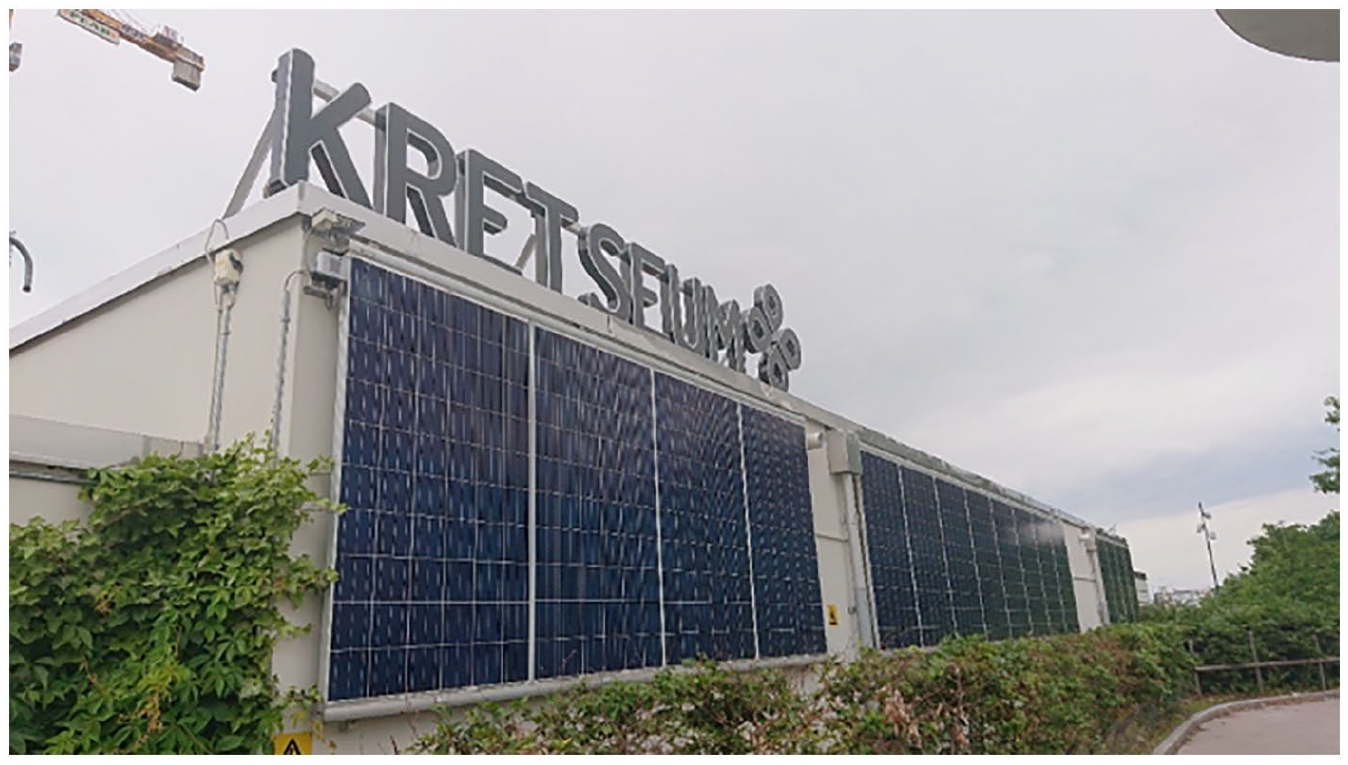
Kretseum, Malmö.
Kretseum is primarily aimed at schools, and it is open for guided tours. It also serves as a meeting point, facilitating sustainability collaborations between the municipality and local companies (Maria). At the facility, a three-dimensional model of Malmö’s underground wastewater flows is displayed. It allows participants to literally follow the flow, as they can insert their smartphones into the model and investigate from within, using their cameras. At Pumphuset, a similar center based in Uppsala, children are trained how to flush the right matter down the toilet. The correct and incorrect sorting of wooden pieces, representing feces and cotton, for example, result in a corresponding sound that reinforces or corrects behavior. This is all framed in a playful manner. Another common technique is to display things that become caught up in the sewerage system. As an illustration of the problem, George (2008) stated that Britons flush 850,000 mobile telephones down the toilet annually. In Uppsala, according to displays, mobile phones are accompanied by silverware, combs, and even dead pets.
The fact that Kretseum and other similar centers target youngsters is not a coincidence; they are seen as future citizens (Ideland, 2018). Children are also viewed as a link to the adult world: ‘Because if you reach the students, they become really good civil policemen at home. They go home and spread information’ (Maria). By displaying the sewerage and potential disruptions, the communicators express their strong belief that behavior needs to change and can be changed for the better.
A telling example of upstream work aimed at simplification is a campaign on toileting know-how, concerning the composition of the matter to be flushed down (Svenskt Vatten, 2015). Only urine and feces and toilet paper – definitely not grease, cotton swabs, and tampons – should go down the drains. Rhymes like ‘att spola rätt är lätt’ (‘flushing right is easy’) and ‘toalettvett’ (‘toilet sense,’ VA Syd, 2020) are common in campaigns like this (e.g., Figure 2). So are the colorful – almost naïve – pictures, which intertextually refer to children’s books (van der Geest, 2016). Similarly, informative films in which well-known Swedish comedians explore the subsurface pipes in Malmö in an entertaining way are published on the municipality’s website (VA Syd, 2020). Humor is a well-rehearsed strategy that works to downplay ‘dangerous’ issues in society (Bakhtin, 1984). It provides relief from the cultural repressions and discomforts (van der Geest, 2016).
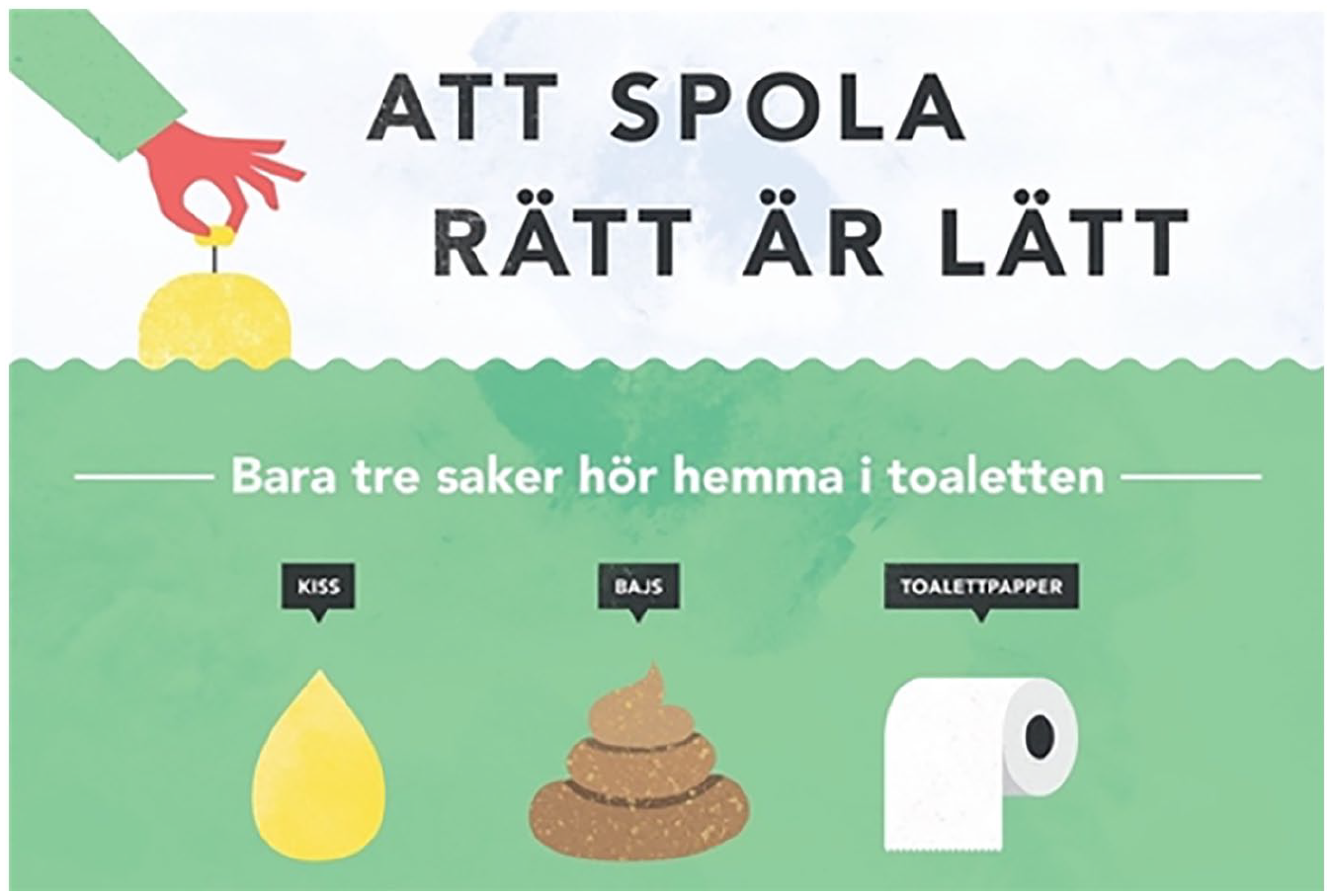
Campaign image.
The humorous approach to pee and poop, the childish rhymes, the playfulness and the simplistic tone of the campaigns all contribute to the unproblematization of sanitization. But this approach can also be interpreted as the construction of hygienic ‘good’ citizens by empowering them to do the right thing (cf. Ibáñez Martín & de Laet, 2018). Moral fostering based on hygiene goes hand in hand with the mobilization of environmentalism (Agrawal, 2005; Oberg, 2019). Unproblematization entails unmaking problems through tools of governance. By emphasizing how easy it is to help keep the system going, the upstream work simultaneously displays trustworthiness and fosters toilet know-how among citizens.
An interesting consequence is that the focus on the prevention of problems at the individual level – governing minor issues – downplays outdated pipes, undersized plants, and heavy rain. Thus, although infrastructural vulnerability is at the forefront, the paths to prevent disturbances appear as easy. Making waste an individual concern effectively hides public responsibilities and costs (Hird et al., 2014). While we learn to only flush poop, century-old pipes are breaking and treatment plant pools are overflowing. Thus, making things easy in a sense means unmaking major problems. This double move is what we refer to by the term unproblematization.
However, one could also argue that displaying private matters like pee and poop, unveiling the secret, can also be seen as truth telling. Taussig (1999, p. 2) argued that the truth is not about revealing a secret; instead, ‘the revelation should do justice to the secret.’ The truth and the secret are mutually embedded and destroying a secret could mean empowering it. In the unproblematization of the public secret of the sewage system, the secret is empowered and elevated. Consequently, citizens may maintain the privilege of ignorance.
Concluding discussion
The article began by highlighting the dilemma that the wastewater sector faces. On one hand, the wastewater system is expected to function flawlessly and thus stay invisible; on the other, in order to obtain the resources needed for future functionalities, flaws need to be made visible and problematized. The trick is to cause the remarkable to continue to go unremarked upon, at the same time ensuring that the unremarked upon is drawn into the public realm. The making of (in)visibility and public secrets are not just about bringing certain facts and certain publics into the political domain, but also about framing the discourse of sewage to make citizens adopt it as a part of their everyday life (Hawkins, 2003; Ibáñez Martín & de Laet, 2018; Taussig, 1999). Different modes of problematization have been identified as crucial for achieving the right political attention, for controlling the information through the right balance between secrets and transparency (Simmel, 1906) in order to produce the right knowledge, get funding and public legitimacy for interventions.
We showed how political silences – the inproblematization of sewage management – are constituted and how informants carve out discursive space for their investment claims. Problematization, such as through media attention, is helpful in this regard, as it breaks through the silence and operates as a politics of disturbances. However, it also draws unwanted attention to the sector’s own potential failures. Deproblematization is a strategy for putting forward the right kind of problems – those that are treatable – and in effect promising solutions. Finally, we highlighted strategies for preventing disturbances through unproblematizations. These strategies include upstream work in a simplified, playful, and almost childish manner and aim to make citizens aware of and individually responsible for acting ethically in relation to the common good.
Our development of the concept of problematization opens up an understanding of how sewage management illuminated the multiple dilemmas that the waste workers handle. It is clear that stakeholders’ specific skills and strategies are essential to control public secrets, e.g., that the maintenance of wastewater infrastructures gets the right kind of political attention. Taussig (1999, p. 3) argued that knowledge is powerful because it is socially active, even when it is not spoken of, and constantly threatens to return to the public consciousness. As demonstrated, this threat can be handled in strategic ways, through presenting problems as manageable through deproblematization and unproblematization. Secrecy and transparency, invisibility, and visibility interact in a politics of disturbances where the negative sides of sewage management (such as outdated drains and treatment plants) are dressed in sustainability discourses and promises of simple solutions. As in the tale of the emperor’s new clothes, the absence of cover – in this case, the out-of-date sewage systems – must become visible to persuade both politicians and the public to pay for taken-for-granted services. According to the interviewees, this inproblematization is a challenge in sewage management. This invisibility might even increase the risks, since the uncovering of disruptions such as overflows and leakages operates as powerful reminders of the fragility that is otherwise possible to ignore (cf. Anand, 2015; Hawkins, 2003).
Graham and Thrift (2007, p. 4) discussed failures and breakdowns in technical systems, and highlighted their vital contributions to cities, focusing on the social and political and the importance of ‘human labour and ingenuity’ to infrastructural flows. We agree and add to these insights that one needs to recognize the discursive work – ingenuity indeed. Disorder is tightly tied to political tensions, as the concealing of fragility might ensure the public of safe circulation (Kallianos, 2018). We have found similar evidence of both, here and in other contexts: selective openness and flexible transparency have vigorous political, ecological, and social effects (Holmberg & Ideland, 2012).
Urban water systems are not only technological fabrics and sewage is not just something to get rid of. They are embedded in cultural and political layers, such as institutions with norms, policies, and practices; matter in the shape of, for example, excrement, water, and pipes; human actors as citizens, politicians, and those working within the organization; cultural understandings of human excrement and water; temporalities regarding political cycles, as well as imagined futures; and economic values in the costs of infrastructure, etc. Through addressing how the public secrets of feces and drains are kept and displayed in this complex web, we have intended to give both a theoretical contribution on how politics is made in practice and an empirical contribution of the multiple challenges and the mundane practices of how to get citizens and politicians engaged in a public secret. Ultimately, trust and willingness to pay are prerequisites for maintaining infrastructural flows of sewage, of politics, and of information. By investigating the making of (in)visibility through modes of problematization, we have hopefully contributed a novel and critical take on the social scientific ‘infrastructure imagination’ (Steele & Legacy, 2017). The future of flushing and its environmental, technological, political, and cultural worth are urgent matters. Clearly, nobody wants the shit to hit the fan.
Footnotes
Acknowledgements
We thank our project team members Sebastian Abrahamsson, Clas-Fredrik Helgesson, and Björn Wallsten for collaborations and comments on the manuscript.
Declaration of conflicting interests
There are no conflicting interests to declare.
Funding
The article is an outcome of the research project ‘Waste Work in the Sustainability Economy: Transforming Values of Biological Waste.’ The project received funding from the Swedish Research Council (DNR 2017-02142).