



Abstract
This article examines the role of graphic ethnography in mapping the objects and feelings of fear through the silence of images, through the aurality of this silence. By aurality, I refer to the sounds and feelings felt by the reader when seeing these images in their colours, visuality and contexts which are not brought out by words and texts alone. The article explores the new sociographies that emerge from this intercitationality of visceral fear, from the aurality of this dread, that survivors of sexual violence during the Bangladesh war of 1971 feel till today. It suggests that we need to go beyond the search for the ‘unsayable and unseeable’ to understand how survivors and their quotidian existence are intertwined with these objects of fear. Nothing is unseeable or unsayable for survivors here as they live through fear ‘as an environment’. The article explores the intertextual, intercitational registers between my book The Spectral Wound and my co-authored graphic novel, Birangona, in order to bring out the reparative aspects of graphic ethnography and the new forms of knowledge production.
I still feel scared with the sounds of boots, of someone banging loudly on the door. I remember the feeling of fear of waiting for these sounds.
What does it mean to live with the memory of fear, memory of the anticipation of dread through the sounds of boots and banging on the doors? How do ordinary objects stand in for that feeling of fear in our quotidian existences producing fear as an ‘environment’ (Virilio, 2012)? In my two decades of working on the public memories of wartime sexual violence during the Bangladesh war of 1971, I have constantly come across this memory of fear and the feeling of fear among survivors of sexual violence as well as many family members of the disappeared of the Bangladesh war of 1971. The deathly consequences of these aural presences are all too well known. The sound of boots and banging on doors are often followed by women and men being taken away to be raped or to disappear. In thinking, reading and writing about the various processes of memorialisation during the Bangladesh war and other contexts of genocidal conflicts, I have been asking: how do we live with everyday objects which remind us of the fear of a past event? I have explored these feelings of fear in my book The Spectral Wound: Sexual Violence, Public Memories and the Bangladesh War of 1971 (Mookherjee, 2015). In 2016, as I was planning to co-author a graphic novel, Birangona with the fantastic Dhaka-based Bangladeshi visual artist Najmunnahar Keya, we decided to explore this sense of fear in the first pages (see Image 1) of this graphic novel (Mookherjee & Keya, 2019). 1 This article juxtaposes texts and images of objects of fear related to sexual violence of the Bangladesh war of 1971 and how it produces fear as an ‘environment’ (Virilio, 2012). It draws from the intertextual, intercitational registers between my book and the graphic novel (based on the monograph) to configure how can we ethically elucidate experiences of sexual violence which are inherently felt as incoherent, non-linear and fragmented and create new sociographies. By intertextual, I refer to the intertwined, circulatory traces of discourses, symbols and images which cross-reference each other in different texts, contexts and times.
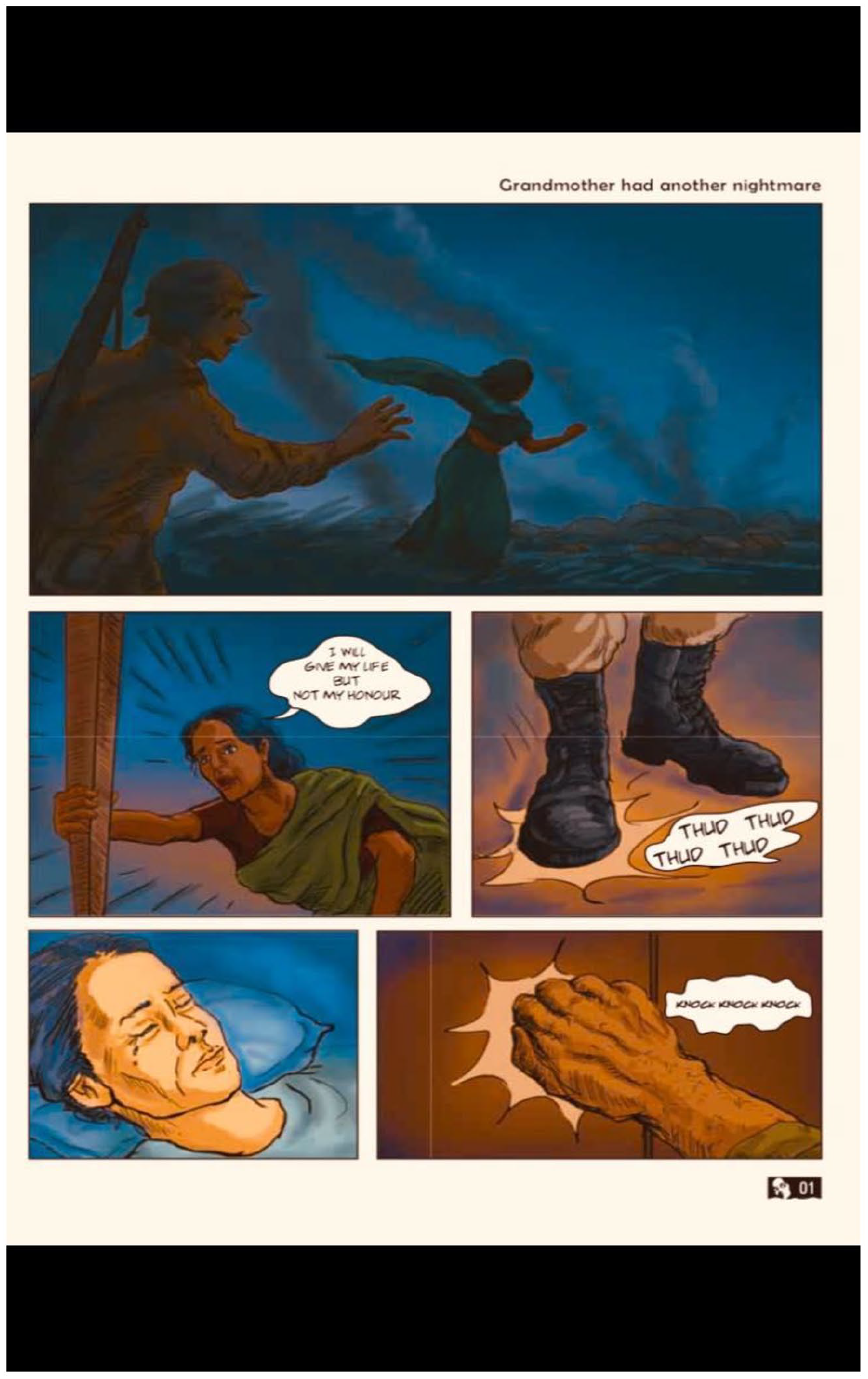
From the opening page of Birangona.
Memorialisation of valour and losses of war by governments, organisations, and at war memorials and museums presumes that material objects stand for and embody memory. However, the role of the national feeling in these spaces remains unexplored (Mookherjee, 2011). In this article, I wish to explore the quotidian experiences of survivors and their memories of fear around objects linked to past wars, which makes one dread the visual, aural presence of these objects today. As a representational and aesthetic practice, the new sociography as framed by this monograph edition of The Sociological Review suggests new ways of depictions along with the critical and analytical frameworks we deploy in our writing. In trying to do justice to only the ‘unseen and unsayable’, there is an assumption that the sociological field is riven with evidences of what needs to be readily tapped, to be seen and said by the sociologists among us. This might be a limitation of the lens of ‘unseen and unsayable’. This is because the ‘seeability’ and ‘sayability’ on the part of theorists seem to be hinged on a methodological positivism which needs to make space for communities who cannot see or say anymore as their everyday lives are strewn with the horrors of the sayable and seeable.
How do we translate how communities themselves experience their past horrors in their quotidian existences? Sociography can only be evocative and compelling if we make sense of the traces of the unrepresentable, unbearable witnessing that individuals and communities carry out on a daily basis. As storytellers we need to conjure the social life as felt and elicited by various interlocuters whose stories we seek to work with. In attempting to visualise fear among the survivors of wartime sexual violence, the images drawn from my research among them – what I refer to as graphic ethnographies – allows me to open a closed textual narrative. What the images allow us to do is not only visualise the objects and feelings of fear experienced by their survivors in their everyday. It also allows us to map the objects and feelings of fear through the silence of images, through the aurality of this silence that graphic narrative is able to bring out. By aurality, I refer to the sounds and feelings felt by the reader when seeing these images in their colours, visuality and contexts which are not brought out by words and texts alone. With an aim to work with the resonances among survivors of the objects of horror around them, in the following section I wish to contextualise the Bangladesh war of 1971 and the making of the graphic ethnography with reflections on the process and the decisions about what went into which mode of writing. The section thereafter will elaborate on the objects of horror, namely that of: doors and boots; wooden poles and weather. I will conclude this article with the possibilities of reparative non-closure of graphic ethnography and the likelihood of collaboration, dialogue and knowledge production engendered through this process.
The trajectory and choices of the graphic ethnography
To elaborate on the aesthetics of the graphic ethnography we need to contextualise the historical trajectory of the Bangladesh war. In 1947, with the independence of India from British colonial rule, a sovereign homeland for the Muslims of India was created in the eastern and north-western corners of the subcontinent as West and East Pakistan. The two ‘wings’ of the country were separated not only geographically but also by sharp cultural and linguistic differences. Successive Pakistani governments in the immediate postcolonial period embarked on a strategy of forcible cultural assimilation towards the Bengalis in East Pakistan. Resistance to this programme, and more generally to West Pakistani administrative, military, linguistic, civil and economic control for over two decades, culminated in 1971 with a nine-month-long war between the Pakistani army and the Bengali liberation fighters. This conflict resulted in the formation of Bangladesh.
The creation of Bangladesh in 1971 coincided with the death of around 50 intellectuals, 2 3 million civilians and the rape of 200,000 women (according to official, contested figures) (Mookherjee, 2015) by the West Pakistani army and local East Pakistani collaborators. As I show in my aforementioned book (Mookherjee, 2015), what is distinctive about the Bangladesh case in relation to other instances of sexual violence in twentieth and twenty-first century wars is that there was no silence about the invocation of wartime rape in the 1971 war in independent Bangladesh. Instead, there was widespread public recognition of sexual violations during the conflict. This was evidenced in the globally unprecedented Bangladeshi government declaration in 1971 of women raped as birangonas, (meaning ‘brave women’). Thereafter, in independent Bangladesh the figure of the raped woman would be present in photographs, advertisements, testimonials and various literary and visual representations. This enumerative community of ‘3 million dead and 200,000 raped’ has been further canonised in the last two decades of hypernationalist commemorative discourse concerning the war in Bangladesh.
After the publication of my book in 2015 and of its South Asian version in 2016, I felt we needed to go beyond the limited lens of the ‘unseeable and unsayable’ to identify how people themselves see and feel the horrors of the past through their daily, mnemonic, aural and visual resonances. For me there was still work to be done with regard to the aurality of the silence of images and how survivors and their quotidian existence are intertwined with these objects of fear. Drawing on the long trajectory of comic books in South Asia that we as children grew up on, the decision to produce a graphic novel was initially based on my long-term engagement with ethics which was core to my findings on wartime sexual violence. In 2003, I contributed an article on how to ethically record testimonies of sexual violence as part of an activist organisation and raised money for survivors. Thereafter, as the ethics officer of the Association of Social Anthropologists of the UK and Commonwealth (ASA) I had in consultation with the ASA members, updated the ASA ethics code. We needed to take into account the complexities of overt and covert research in the light of the Human Terrain System, where social scientists and psychologists were being hired by armies in Iraq and Afghanistan to give the occupied forces an insight into ‘cultures’ to enable better compliance from local people. When my book was published in 2015, the interest in it and the kind of invitations I was receiving also made it imperative to develop a set of guidelines on how to ethically record testimonies of wartime sexual violence. These guidelines were central to my ethnography among the survivors.
To visualise this ethnography in words as well as images was a very challenging task. I myself had not done anything like this before and found myself raising complex questions around ethics, subjectivity and voyeurism/pornography of violence (which I am not exploring in this present article) as I developed the storyboards to be transformed into drawings by the visual artist and my co-author, Najmunnahar Keya. So, we were developing a set of guidelines for professionals seeking to record testimonies of sexual violence but as an ethical exercise. The guidelines became alive as images and the intergenerational story of the graphic novel (later also made into an animation film using the slides of the graphic novel) that was scaffolding the procedures helped us to make it a form of familial witnessing of the unravelling of the story of the birangonas. The pedagogical witnessing in the graphic novel thereby made it relevant for children of 12 years and above. The possibility of having this text as a public facing scholarship and how it intersected with various public discourses was brought home to me by my friend Dr Meghna Guhathakurta. We were partnering with Meghna’s organisation Research Initiatives Bangladesh for the graphic novel and Meghna’s father was also killed by the Pakistani army during the war. After the graphic novel was completed, Meghna said she was carrying the graphic novel in her bag, reading it on and off and she said she was welling up on reading it. Meghna’s response made it clear that the graphic novel would also have resonance among many who had lost their loved ones during 1971.
I was also inspired by the ethnoGRAPHIC series launched by the University of Toronto Press and the growing scholarship on writing ethnography through images/comics in anthropology. Within this growing repertoire Shirine Hamdy and Coleman Nye’s Lissa: A Story about Medical Promise, Friendship and Revolution (2017) was a protagonist in the field. This genre is growing and has resulted in the Royal Anthropological Institute’s ‘Illustrating Anthropology’ exhibition, which was launched on 14 September 2020, included our graphic novel 3 and shows the possibilities of graphic ethnography and anthropology. In doing the storyboards, I was guided by the ethnographic examples I would often cite in my various book launch events. These examples illustrate the poignant, metaphorical, fragmented and nuanced narratives which many of the survivors deployed to reflect on the testimonial cultures they were part of. As a result, we decided to begin the graphic novel (Image 1) by interspersing various events. This included one of the survivors’ – Moyna’s – powerful and poignant expression where she holds onto the pole of her house and says: jaan dibo to maan dibo na (I will give my life but not my honour). While the reifying of maan/honour could be located in patriarchal entanglements, nonetheless this existential truth was important for Moyna. Along with imaging Moyna’s experience, the first page also includes a cinematic dreamscape of the war as encountered by the grandmother in her sleep as well as the sounds of boots and that of knocking on the door by the soldier which transfigures into the knock by the grandchild. This transformation allows us to segue into the intergenerational story which was scaffolding the guidelines and which had a resonance among individuals across generations.
In talking to the survivors and their families there was a lot of support for this graphic novel as some of them were not literate but could engage with images much more extensively. Along with the graphic imagery, I decided to use some of the archival images which had not passed the muster of the art criteria of the publisher of my book (Duke University Press). Juxtaposing the archival documents and graphic imagery was also a way to signal that the narrative I was presenting was not fictional. If a young reader thought of it as only a fictive account, the archival images reminded them of the archives and life stories it was drawing from. It also gave us a chance to move between different textures of imagery and storytelling. I wrote the dialogue and transcript of the graphic novel and got a lot of help from colleagues and PhD students in the UK and Bangladesh, who were all acknowledged. These were tasks I had no expertise in and it took me long to get the edits in place and synchronise the images with the text across a six-hour time difference with Keya and the publisher based in Dhaka.
In thinking through which aspect of the ethnography could be translated into the graphic novel, I was particularly keen to map how individuals live with various objects linked to the war. These are different from practices of memorialisation, as I have mentioned before. Here, the objects stand in for the horrors of the war and show how individuals live with these objects which bring back fearful memories of the war in the everyday. We explore these fearful memories through the memories of doors and boots, the wooden pole and weather, and try to explore intertextual, intercitational registers that the graphic novel draws on.
Objects of fear: Doors and boots
Just before the independence of Bangladesh on 16 December 1971, around 50 intellectuals were taken from their homes and killed on 14 December 1971. The intellectuals were both Hindus and Muslims and included one female journalist, Selina Parveen. Their bodies were found in a brick kiln in Rayerbajar, in Dhaka, lying face down, blindfolded, hands tied behind their backs with red pieces of cloth, their bodies submerged in water. The photograph of their bodies lying in the brick kiln has become metonymic with the killing of the intellectuals (Mookherjee, 2007). As a result, the birth and independence of Bangladesh corresponded with the loss of these intellectuals and the ideals they stood for, of that of secularist nationalism based on a Bengali Muslim identity. 4 The uncontested celebration of 14 December as the Martyred Intellectual Day since the Bangladesh war shows that the dead intellectuals continue their role of that of the ‘dead and their double duties’ (Taussig, 1997, p. 10), in independent Bangladesh. As recently as 14 February 2022 I received an email with the request for an interview by one of the children of a renowned martyred journalist who was abducted as a part of intellectual killing six days before Bangladesh was formed. The body of the journalist has never been found and he had children as young as three years old when he was taken away.
The taking away of these intellectuals was carried out by various individuals, and in many instances they were known to the intellectuals and their families. Apart from the role of betrayal and complicity of these individuals, one of the dominant memories among the families of martyred intellectuals is the memory of fear. This fear primarily comprised of the anticipation of the bang on the door. This banging would signify the arrival of the Pakistani military or of their collaborators in their attempt to take women away for sexual violence and the men would be taken away to be killed. The significance of taking the intellectuals away and killing them was meant as an attempt to attack the cultural foundations of the emerging country of Bangladesh. To commemorate the martyred intellectuals’ day, various exhibitions in Bangladesh have over time included installations of the door and that of the red piece of cloth (with which some of the corpses of intellectuals were found to be tied) which is recognised by many as a signifier of the killing of the intellectuals.
5
I have found the presence of the door in various conversations I have had in my research on the public memories of wartime sexual violence during the Bangladesh war of 1971. Along with the presence of the door, the dhup dhap sounds of boots (Image 1) also produces Virilio’s fear ‘as an environment’. The sounds of boots emerge across numerous accounts of experiences of terror during the Bangladesh war. I refer here to the articulations of three survivors – Kajoli, Moyna and Rohima – three landless rural women who publicly spoke about their experiences of wartime sexual violence. I did extended ethnographic research among them and I elaborate on the ethical dilemmas in my book and graphic novel. To the survivors of wartime sexual violence, the anticipation of the sounds of boots emerges again and again. As a result, for Kajoli, she would talk about living in fear after her violent experience. She felt that since the war was not over ‘they’ (the army who raped her) would come back for her again:
That fear is my fear, my life’s fear. I am always terrified, panic-stricken. I would wait for the dhup dhap sounds of boots, which I remembered when they entered that house. I always feel somebody is coming after me. (Mookherjee, 2015, p. 112)
Another survivor, Rohima, constantly feels chomok (startled) and she cannot stand sudden noises and shouting:
Even if there is a bird on the tree and it cries out I feel alarmed and I startle. My jaan (life/heart) seems to take leave, it cries out every moment if somebody says something. (Mookherjee, 2015, p. 113)
The circulatory presence of the fear of the sounds of boots, the banging on the door within ethnographic instances among survivors of sexual violence and of the disappeared and that of the exhibitions as installations creates an intercitational text which also emerges as an aesthetic choice in the graphic novel and recreates Virilio’s fear ‘as an environment’ (Virilio, 2012). Michael Warner (2002, p. 62), in his description of publics, rightfully insists that ‘a text to have a public must continue to circulate through time, and because this can be confirmed only through an intertextual environment of citation and implication, all publics are intertextual, even intergeneric’. Because of the intertextuality of the memories and feelings of fear in relation to the door and the boots, the installation of the everyday object of the red cloth and the door in the exhibitions are identifiable as these resonances of dread. That the feelings of fear also permeate into one’s dreamscape as identified by the chomok/startle by the movement of a bird as expressed by Rohima, also becomes a significant starting point for us in the graphic novel. The beginning of the graphic novel also draws on a cinematic canvas of that of dreams to be interspersed with the prevalence of everyday idioms of ‘fear as an environment’ linked to the fear of the sounds of boots and a knock on the door.
Objects of fear: Wooden poles and weather
Being raped within their homes, there is no respite from the signposts of the violent memories for many survivors. Kajoli refers to the two houses of her neighbours – one who did not allow her to hide and the other who did. She speculates how things would have been had she hidden in the other neighbour’s house. Another time, as I tried my hand at rice-husking at Moyna’s place, she started saying:
That day I was carrying this rice-husk paddle bar but I couldn’t use it as I was carrying my one-month-old daughter who was flung in the mud. I gave a good struggle as I am a very strong woman. I was telling myself, jaan dibo to, maan dibo na (I will give my life, but not my honour). (Mookherjee, 2015, p. 114)
Moyna laments that when she was being pulled away by the Pakistani military, she held onto the pole and thought that she would give her life but not her honour. She held onto this wooden pole tightly but she was still ‘taken away’/raped in her own home. The graphic novel has the visual presence of this wooden pole and Moyna’s poignant comment about choosing to give up her life instead of being raped (Images 1, 2 and 3). This is juxtaposed alongside the nightmare of the grandmother in the graphic novel along with the sounds of boots and banging on the door.
To Moyna, the wooden pole which supports her home is a witness to her event. Holding onto this pole she clearly sees the events of that day, is reminded of that day. The wooden pole in fact does not allow Moyna to forget the experience of rape even if she wanted to put aside those memories (Images 1, 2 and 3). The wooden pole reminds her every day of her violent experience during the war, an experience which she tried to avoid by holding onto the wooden pole. Here, the global empty signifier of ‘trauma’ 6 as being embodied and being a ‘return of the repressed’ is not relevant for the survivors. For them these everyday objects provide a trigger of that violent memory, a memory they might want to keep aside. This trigger is instead located outside their bodies in the objects and environments around them.
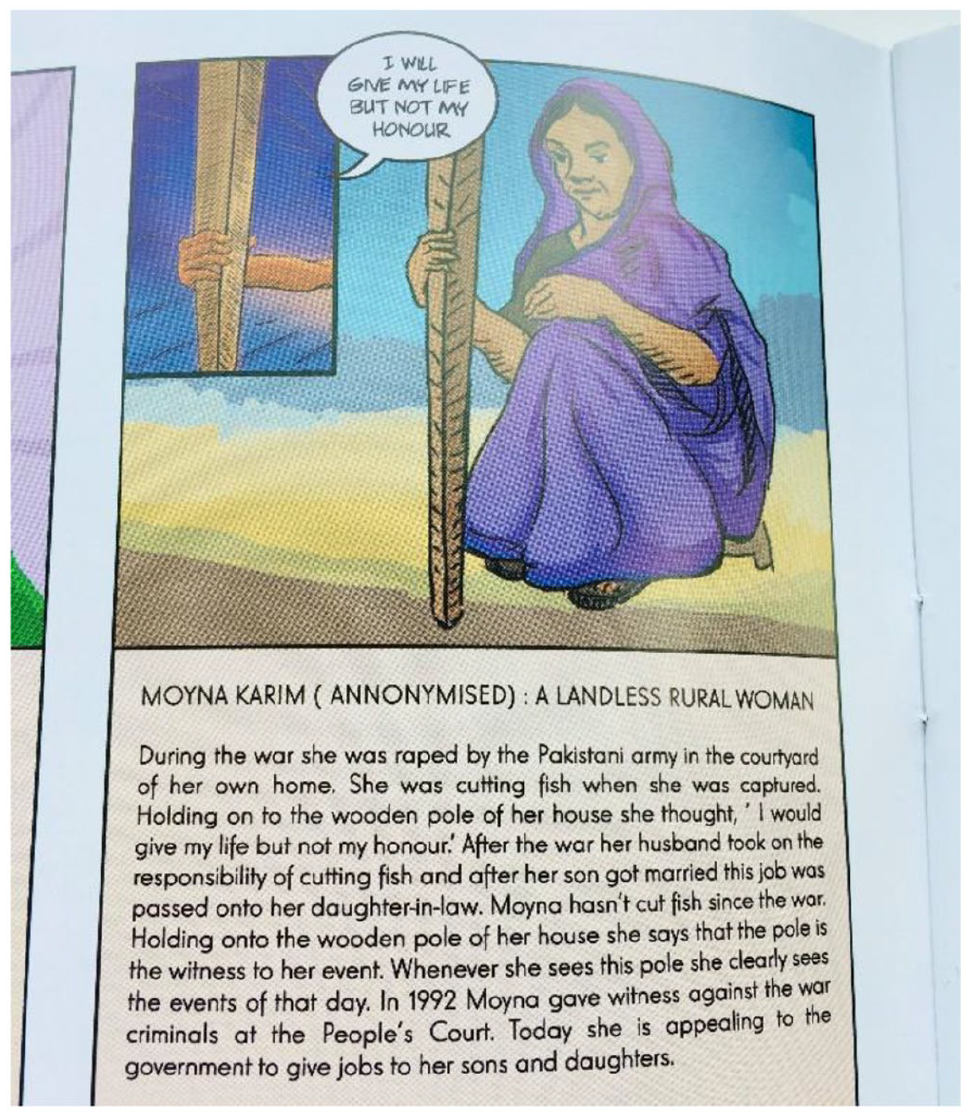
Moyna Karim’s story.
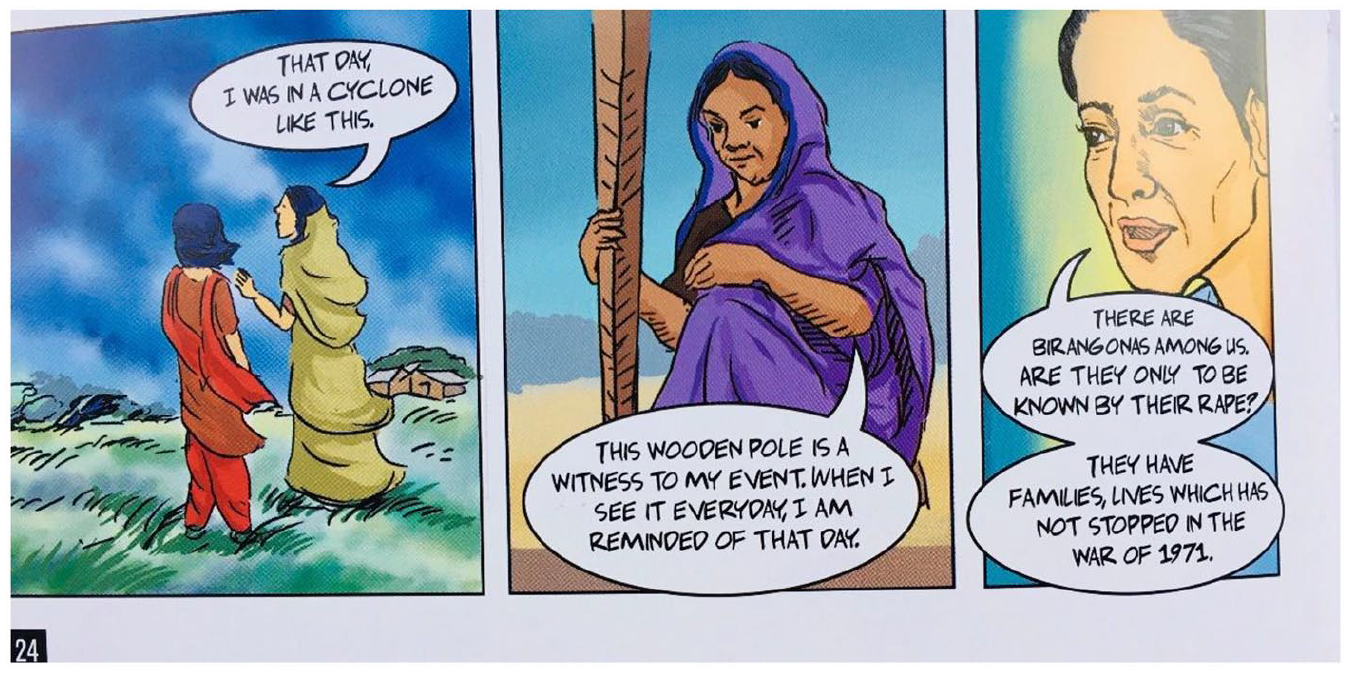
Weather events and everyday objects alike trigger memories.
The vagaries of the weather are also triggers for the survivors. The devastating floods of Bangladesh in 1998 reminded the women of the floods of 1971. Kajoli recalled ‘that year’ when ‘there was panii, shadaa’ (it was white all over with water). Moyna remembered how in 1971 her cow died as there was no grass available for the cattle. ‘There was such food problem that year. The pressures of the stomach had to be above the pain of the body.’ Moyna’s mnemonic memory is signposted through the memories of the weather and the day. Hence the event is bounded within a hot, sunny mid-afternoon ‘this time of the day like today’ and the time frame of ashin mash (from mid September to mid October according to the Bengali calendar).
One day as I stood by Kajoli (Image 3), who was shouting across the field, asking her 10-year old son to come home due to the oncoming jhor (storm), she suddenly said, ‘I was also caught in a toofan (cyclone).’ Jhor is usually common during summer and monsoon months, while toofan with its connotative destruction is much more feared in rural areas. Here, Kajoli gives a description of her rape through use of everyday climatic idioms.
The feeling of panic, fear, being stricken, listening out constantly for the sounds of boots and also the banging on the door is viscerally captured in all the survivors’ comments and their constant feeling that someone is coming after them. As a result, doors, boots, holding onto the wooden pole, dreamscapes of fleeing and vagaries of weather become the means through which the survivors have to engage with the memories and feelings of horror on a daily basis. There is no unseeable and unsayable for them. They want respite from what they see and are reminded everyday of their violent experience as it emanates from the everyday objects and their surroundings. The graphic ethnography allows us to visualise the memory of the fear felt in the everyday by the survivors. A certain aurality of this fear also comes through the silent images in the beginning of the graphic novel through the presence of the door, the pole, the boots and the hands. The metaphoric deployment of the imagery of the storm and the wooden pole allows us to go beyond the words in the text and visualise and hear the memory of the fear felt by the survivors. At the same time, it also brings out the resilience of demure, landless Moyna, even though that resilience is coded in patriarchal norms of honour/maan. While the images of the graphic novel draw from the extensive ethnography in my book, the images have their own visual as well as aural resonance. The images in the introduction of the graphic novel have minimal text but allow us to sense the feeling of fear that resonates among the survivors. For me, the graphic novel has enabled me to convey the aurality of the images through their silence. This aurality is further elaborated in the role of hands and non-closure which also makes the graphic novel a possible tool of reparation.
The hand as a reparative non-closure
The graphic novel starts with the everyday objects of horror. However, the loud banging on the door can be of the soldier as well as of the young girl Labony coming back from school to wake her grandmother. The transmutability of the hand (Images 4 and 5) as a symbol of violence to that of affection is significant for the contemporary contexts of the survivors. Through an intergenerational story, the graphic novel opens with Labonno/Labony needing to do a school project on family memories of 1971, the Bangladesh war. When coming to ask her grandmother, she wakes the latter from one of her frequent dreams. What follows is her grandmother’s (Nanu/Rehana) narration of the history of birangona. Her mother, Hena, also tells her of the Oral History Project through which they tried to collect testimonies. This leads them to talk about the various points that need to be covered for an ethical guidance to record testimonies of sexual violence during conflict. Hidden in these discussions of the guidelines, Labonno discovers an intricate secret family history. Interspersed with archival images the graphic novel is meant for children of 12 and above. It highlights 10 guidelines through which the anthropological concepts and ethnographic manifestations related to ethics, stigma, honour and shame are interrogated and visualised. These guidelines are categorised into: before the testimonial process (covering training, positionality and frameworks of exchange, approaching survivors), during the testimonial process (addressing the role of time, trust, contexts, empathy; use of sources; informed consent and contextualising shame and stigma) and after the testimonial process (exploring ethics of writing; role of fragments and socialities; use of images and language; anonymity and confidentiality; relations beyond the ‘project’). The purpose is to suggest ways for activists and researchers to document accounts of wartime rape and avoid exacerbating conditions for survivors.
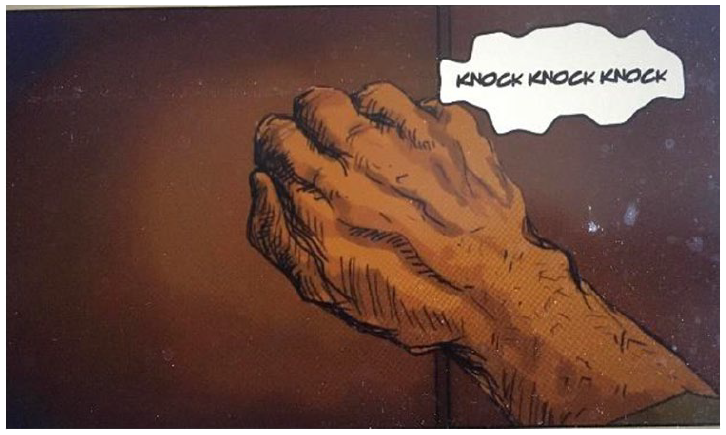
Hand of soldier.
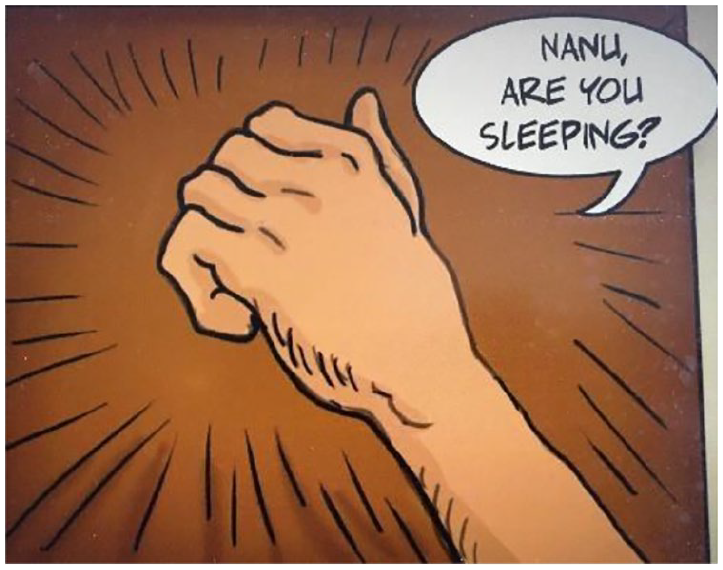
Hand of young girl, Labony.
The intergenerational narrative in the graphic novel allows a reparative trajectory which however does not suggest closure to the accounts of the survivors. The quotidian horrors of the everyday objects that draw the survivors back to their violent experience is nevertheless not their only narrative. As Nanu/grandmother says (Image 3):
There are many birangonas among us. Are they only to be known by their rape? They have families, lives which has not stopped in the war of 1971.
Through six workshops in Bangladesh and London, funded by Durham University and the Economic and Social Research Council in the UK, we co-developed 10 survivor-led guidelines for those seeking to record testimonies of wartime sexual violence. These ethical practices are visualised with various illustrations in the graphic novel around an intergenerational life story, thereby making it more accessible. Throughout the process, myself and Keya worked with my partners Research Initiatives Bangladesh (RIB), LSE’s Centre for Women, Peace and Security as well as invited participants, which included survivors who were in the public eye, academics, researchers, government officials, policy makers, NGO representatives, feminists, human rights activists, journalists, filmmakers and photographers. Over a span of two and a half years, the co-produced guideline, graphic novel and animation film were also supported by the Ministry of Liberation War Affairs of the Government of Bangladesh and the Foreign and Commonwealth Office’s Prevent Sexual Violence Initiative (PSVI). The graphic novel, film and guidelines have been used by those who record testimonies of sexual violence in conflict (government officials in UK and Bangladesh, researchers, human rights activists, feminists, lawyers, filmmakers, photographers, journalists, writers) and future researchers and activists. It also generated interest on sexual violence during conflict and enabled sensitisation of these issues among children (12 years old and above). The guidelines and graphic novel were launched by survivors, their families and the Ministry of Liberation War Affairs of the Government of Bangladesh in August 2018 and April 2019 and they were included by the UK’s Foreign Office in their Murad Code, an international code for researchers and named after 2018 Nobel Prize winner Nadia Murad, who is also a Yazidi survivor.
The graphic novel has also enabled varied and easier dissemination of these texts. On reading the graphic novel the survivors said:
We cried and laughed on reading this book. It should be read and seen by all children and their parents. By reading this book children will not question the war again. No one will question who fought and no will ever give khota/scorn to birangonas. Along with children, their parents would read, their mothers would read and they would get to know about the war. All our stories are here in this book and I want this book to be in every school in Bangladesh so that all children know about us. (Rural birangonas and their children, May 2020, via WhatsApp)
The banging hand of the soldier is today the knocking hand of the young granddaughter. It is this intergenerational trope that particularly provides a reparative symbol for the survivors. An academic panellist, reflecting on the role of the graphic novel in a roundtable discussion in May 2019, noted that the graphic novel is a cultural intervention, a part of forging social change and ‘is actually a part of a symbolic reparation’. The hand of the grandchild also stands for the intergenerational connection and affection for the birangonas and this affection and respect is foundational to the reparation due to the survivors. The graphic novel thus builds on the ethnography of the monograph and the images allow us to visualise not only the feelings and memories of fear of sexual violence. The aurality of the images of the door, boots, hands, the pole and storm is also brought out in their silence and makes the fear and pain resonant for the readers. The list of pedagogical guidelines are brought to life through the images which are again drawn from the lyrical narratives of the survivors. The graphic novel is a form of witness and the guidelines are for researchers, academics, professionals and schoolchildren alike.
This article has pondered on the question as to how can we write about, talk about, ethically elucidate on experiences of fearful memories of sexual violence during conflicts while the memories of these incidents are inevitably incoherent, fragmented and non-linear. What is the role of graphic ethnography in tracing the gaps and tumultuous configurations in our written texts? What intertextual, intercitational registers do graphic novels draw on? What are the reparative aspects of the graphic ethnography and what doors does it open rather than creating a closure? Different from practices of memorialisation, daily objects of the survivors stand in for the horrors of the war and show how individuals live with these objects, which bring back fearful memories of the war in the everyday. As a result, doors, boots, holding onto the wooden pole, dreamscapes of fleeing, fragmented embodied experiences and vagaries of weather become the means through which the survivors have to engage with the memories and feelings of horror on a daily basis. These everyday objects are also intertextually linked with events of the disappearance of intellectuals during the war, exhibitions memorialising these disappearances and continuing memories of the fear of rape. The graphic ethnography has allowed a certain aurality of the images of fear. The metaphoric deployment of the various imageries allows us to go beyond the words in the text and visualise and hear the resonance of dread felt by the survivors. At the same time, it also brings out the resilience of survivors expressed either within patriarchal codes or as expressed by the grandmother that survivors are not to be known only by their wartime experiences.
The visual and aural resonance of the graphic ethnography is elaborated in the role of hands and non-closure which also makes the graphic novel a possible tool of reparation, as an intergenerational text of affection, solidarity and pedagogy. The status of the graphic novel as a public facing scholarship exists in an intertextual public discourse where the pain and fear is also felt by other survivors of wars beyond Bangladesh and across generations. Claiming the graphic novel as a tool of reparation, the birangonas themselves can claim that it should be taught in all schools and by all parents with the recognition that socialisation about the impacts of wartime sexual violence needs to start within the home and networks of kinship.
Footnotes
Acknowledgements
I am thankful to Jane Kilby and Graeme Gilloch for inviting me to submit to this Special Issue, for the comments received from anonymous reviewers and the editors of Sociological Review.
Funding
This article draws from the graphic novel Birangona (www.ethical-testimonies-svc.org.uk) the production of which was funded by Economic and Social Research Council, Durham University’s Research Impact Fund and supported by Research Initiatives Bangladesh and Centre for Women, Peace and Security at London School of Economics and Social Science.