



Abstract
Festivals have been conceptualised as serious leisure activities as well as arenas for cultural capital acquisition and embodiment. However, there is still theoretical confusion surrounding the process of cultural embodiment, especially in leisure practices. This article suggests that the serious leisure perspective, in combination with cultural capital ideas, offers a means of deepening understanding of how cultural capital can be embodied in festival settings. To make its arguments, the article draws on qualitative data collected at two long-established literary festivals, one in Ireland and one in Italy. Observations and interviews with festival participants were used to develop an understanding of participants’ cultural capital embodiment. The article suggests that the serious leisure perspective is a valuable theory to throw light on three elements of cultural embodiment at festivals: (1) body; (2) pre-existing cultural resources; (3) time. Interlinking serious leisure with cultural capital leads to an in-depth analysis of how culture is embodied during festivals. This article demonstrates the value of using serious leisure and the embodied state of cultural capital ideas in tandem to further understand cultural embodiment in festivals. The study concludes by suggesting potential future studies and areas of research.
Introduction
Festivals are proliferating worldwide and have become an increasingly significant component of cultural participation. However, relatively little is known about how people consume culture while attending festivals. As might be expected, Bourdieu’s concept of cultural capital has been applied and operationalised in festival studies in a variety of ways (Picaud et al., 2019), but there is little overall agreement as to which approaches have most to offer (Vryonides, 2007). Undoubtedly, festivals constitute opportunities for people to learn and acquire cultural capital (Kruger, 2019; Rossetti & Quinn, 2021), but it is true to say that ‘to date, the role that festivals play in forming, maintaining and shaping cultural capital is under-researched’ (Wilks & Quinn, 2016, p. 35). In particular, there is a need for more studies on how culture is embodied at festivals (Szabó, 2015). In an attempt to progress knowledge, this study follows Robertson and Yeoman (2014) in conceiving of festivals as both a form of leisure, and of cultural consumption. It proposes seeking inspiration from Stebbins’ (1992) serious leisure perspective (SLP) to further understanding of cultural capital embodiment in festival settings. The SLP identifies three types of leisure: casual, project-based and serious. People can engage with these types of leisure activities, all of which require different skills and knowledge and lead to different outcomes and rewards.
Festivals have been conceptualised as examples of serious leisure activities (Begg, 2011; Brown, 2007). However, somewhat surprisingly, while serious leisure has been integrated with Csikszentmihalyi’s (1975) flow theory, Bryan’s (1977) recreation specialisation, and Selman et al.’s (1998) lifelong learning theory, links between Stebbins’ SLP and Bourdieu’s cultural capital are infrequently drawn. To redress this, the study reported here puts the SLP and cultural capital in dialogue with the aim of furthering understandings of cultural capital embodiment among festival attendees. It advocates integrating cultural capital with the SLP so as to better understand how cultural capital becomes embodied, and to more fully understand what festivals mean to those who attend. In terms of methodology, the authors concur with several scholars who argue that qualitative studies are appropriate for investigating the meanings associated with festival participation (Quinn, 2009). Accordingly, the study employs in situ observations and interviews, with in-depth follow-up interviews conducted post festival in two literary festivals. As such, the article addresses the call for more qualitative studies about cultural capital (Vryonides, 2007).
Literature review
Cultural capital embodiment
Bourdieu (1986/2002, p. 84) described the embodied state of cultural capital as the ‘long-lasting dispositions of the mind and the body’. These dispositions are assimilated and become an integral part of the person. Bourdieu explained that ‘the process of accumulation of cultural capital in the embodied state’ is linked to the body, as a process of ‘incorporation’, which involves an act of ‘assimilation’ of culture, ‘cultivation’ and ‘Bildung’ (1986/2002, p. 85). In this way, cultural capital embodiment is a form of ‘self-improvement’, an ‘investment’ of cultural knowledge (1986/2002, p. 85). Since Bourdieu claimed that ‘the accumulation of cultural capital in the embodied state . . . presupposes a process of embodiment’ (1986/2002, p. 85), this article focuses on the process of how cultural capital comes to be embodied. The terms cultural capital embodiment or embodied cultural capital are therefore used.
Bourdieu also illustrated the embodied state as an ‘external wealth converted into an integral part of the person, into a habitus’ (1986/2002, p. 85). As a result, the embodied state is linked with the concept of habitus. Habitus is embodied as a system of dispositions, a way of being, a habitual state, a tendency, or inclination (Bourdieu, 1979/1984). These dispositions are, for instance, ‘ways of walking or blowing one’s nose, ways of eating or talking’ (1979/1984, p. 466). They are durable, oriented towards practice and transportable to different fields of activity (Webb et al., 2002). Habitus is ‘embodied history, internalised as a second nature and so forgotten as history’ (Bourdieu, 1980/1990, p. 56) since all these individual past experiences are durably internalised and embodied. Bourdieu (1980/1990) called this embodied past history hexis corporal, which includes, for example, posture, facial expressions and stance. This article’s interpretation of habitus is similar to that of Reay (2004), who concluded that habitus is inclusive of cultural capital. It is the socialised part, through which the embodied state is expressed via, for instance, bodily hexis and dispositions of the body.
However, defining the concept of habitus and its relationship with the embodied state is not easy. It is one of the most misunderstood and contested of Bourdieu’s ideas and several different interpretations exist (Noble & Watkins, 2003; Reay, 2004). Likewise, the embodied state of cultural capital itself remains an ambiguous concept (Prieur & Savage, 2011; Webb et al., 2002). Bourdieu did not fully explain how hexis corporal is embodied (Grenfell, 2012). He argued that cultural capital can be acquired consciously and unconsciously but he did not deeply take on board the role of the body in this process and its engagement with the physical environment (Webb et al., 2002). As Noble and Watkins (2003, p. 523) argued, cultural capital embodiment and ‘learning is reduced to “the imposition and methodical inculcation of the schemes of perception and action which, in practice, organize the practices”, with little detail of how this happens ([Bourdieu] 1984: 212, 217)’.
According to Bourdieu (1979/1984), the field is the social space in which practices take place. He claimed that people’s actions follow the equation: ‘[(habitus) X (capital)] + field = practice’ (1979/1984, p. 101). Different levels of capital determine people’s positions in the field. People struggle to accumulate capital, which is a form of power, and try to position themselves in the field, with interest and illusio (Bourdieu, 2000). Interest is ‘habitus incarnate, which itself is created by the field conditions through which individual pass’ (Grenfell, 2012, p. 152). Illusio refers to an ‘investment in a social game’ (Bourdieu, 2000, p. 208). Thus, cultural capital embodiment is a process that requires an interest to learn, a libido sciendi. The positioning in the field starts when children start acquiring cultural capital via the family during primary socialisation. Later, in adulthood, individuals possess specific dispositions and cultural capital related to their social origin, which form trajectories in the field. So, cultural capital development is not static, but is an ongoing process during a person’s life. However, Bourdieu’s (1979/1984) work on cultural capital did not fully explore time spent outside family, schooling and the work environment although he wrote about how cultural capital creates distinction in school attainment (Bourdieu, 1973/1977, 1979/1984), museum-going (Bourdieu et al., 1966/1991), hiring practices in firms, and choice of spouse (Bourdieu, 1979/1984).
Thus, Bourdieu’s (1973/1977, 1979/1984) studies mainly focused on understanding how different levels of cultural capital create trajectories and distinction. Some researchers shifted the focus from exploring social distinction to understanding how cultural capital and habitus are embodied. For instance, Noble and Watkins (2003, p. 526) investigated how sporting habitus is acquired as well as ‘the dynamic nature of embodiment and the functions of different modalities of consciousness’. However, still absent from this debate on cultural capital is an in-depth examination of how people actually acquire cultural capital beyond the confines of the family (Kisida et al., 2014). Likewise, how cultural capital is embodied in adulthood, including in specific contexts like festivals, is under-researched. Accordingly, this opens up the opportunity to interweave cultural capital theory with the SLP to advance knowledge about cultural capital, cultural capital acquisition and embodiment in festival settings.
By delving into the under-explored process of cultural capital acquisition in a specific field of cultural consumption, in this case literary festivals, this article asks questions about cultural capital development in adulthood beyond the occupational field. While most studies on literary festivals conceptualise them solely as literary fields (Ommundsen, 2009; Weber, 2018), this article considers them to be the union of multiple fields that intersect each other.
Cultural capital embodiment in festival consumption
The prospect of building cultural capital through festival participation has been explored by several theorists from different perspectives. Academic deliberations have predominantly focused on cultural capital leading to urban generation (Robertson & Yeoman, 2014). Some other scholars focused on how people’s cultural resources shape participation at festivals (Matheson et al., 2014). For instance, Wilks (2009) argued that certain pre-existing levels of cultural capital are necessary to participate. However, only a few researchers have investigated how people’s cultural capital is shaped by festival participation (Kruger, 2019; Wilks & Quinn, 2016). The general argument is that literary festival participation can develop attendees’ literary capital (Kruger, 2019; Picaud et al., 2019) and their cultural capital more broadly (Rossetti & Quinn, 2021).
Nevertheless, much work on understanding how cultural capital embodiment occurs at festivals is needed. Currently, when researchers investigate the process of cultural capital embodiment in festival contexts they think about: body, pre-existing cultural capital; and time. Festivals have been conceptualised as immersive experiences (Jordan, 2016) and arenas of performative practices (Lucas & Wright, 2013), and here the idea of the body is central. For instance, Meehan (2005) explored the importance of the physical involvement here and now at literary festivals, arguing that nowadays the physical presence of audience and performers is more important than books and discussions. Research like this clearly acknowledges the physicality of festival attendance and participation, recognising, for example, that festival-goers move around venues, see and listen to the performers and other participants, talk with each other, eat, drink, sing, write or dance, according to the type of festival. Senses are clearly crucial and a key question is how the use of the sentient body can shape participants’ cultural capital embodiment. For Ommundsen (2009, p. 21), consumption at literary festivals is ‘active involvement – physical, emotional, intellectual and social’. A few researchers have examined the bodily experiential consumption of festivals (Lea, 2006), and the incorporation of knowledge through participation (Rossetti & Quinn, 2021). However, much about the immersive nature of festivals, festival participation and cultural capital remains to be explored (O’Grady, 2015).
As Ommundsen (2009) notes, festival participants do not merely perform physical movements, they can also engage in cognitive involvement, which leads to questions about the role of the mind, level of willingness and consciousness. Are participants conscious and willing to embody culture? According to Bourdieu, people embody culture consciously and unconsciously. How does this occur in festival fields? The notion of affect is useful to investigate people’s degrees of illusio, investment and struggle in the field (Threadgold, 2020). It could partially explain what drives attendees to embody cultural capital at festivals. However, the ‘notion of affect is theorized and defined in multiple ways. There does not seem to be a consistent definition’ (Threadgold, 2020, p. 4). Additionally, it might explain the degree of willingness, but does not fully explain the degree of body consciousness in relation to the physical environment during cultural capital embodiment (Webb et al., 2002). Noble and Watkins (2003) investigated the process of cultural embodiment and habitus of people playing tennis, and argued that consciousness allows repeated actions, like knowing how to play tennis, to take place. These skills become automatic, naturalised, in a process of habituation. However, according to Shilling (2017, p.1206), sociologists rarely have ‘elaborated theoretically on the role of thought in embodying culture’ and have certainly not done so in the context of the festival settings of interest here. Mindful of this, the study reported here considers participants’ intentionality and consciousness in embodying cultural capital, and asks: what is the role of the body in cultural capital embodiment during festival practices?
Secondly, the manner in which pre-existing cultural capital influences embodiment is another pressing matter. Bourdieu tried to understand differential participation in high-cultural activities formulating the theory of social distinction. Later, Holt (1998), who was one of the first scholars to employ cultural capital to understand leisure activities, argued that people’s pre-existing cultural capital determines what and how they attend, and the personal outcomes of the leisure experience. Participants with higher cultural capital can achieve ‘self-actualization’ and personal enrichment, while people with lower cultural capital can only experience ‘autotelic sociality’, which is ‘intrinsic enjoyment’ (Holt, 1998, pp. 17–18) from social interaction. Again, this question has not been posed in festival contexts and so a key question of this study is: how does pre-existing cultural capital influence cultural capital embodiment at festivals?
Lastly, for Bourdieu it takes time to acquire cultural capital and ‘it is difficult to break the cycle where cultural capital is added to cultural capital’ (1973/1977, p. 493). Time is a complex component of this discussion and as Noble and Watkins (2003) observe, the element of temporality in the process of habitus creation is a problem in Bourdieu’s toolkit. They call it ‘ironic that Bourdieu emphasizes habitus as embodied history (1981, p. 305), because there is little sense of the acquisition of habitus’ (Noble & Watkins, 2003, p. 525). Likewise, he did not fully explain the role of time in the process of cultural capital embodiment, either in general, or in the context of leisure practices. While temporality has been a theme of analysis in festival studies with Lucas and Wright (2013) conceptualising festivals as liminal zones and Quinn and Wilks (2017) conceiving of festivals as heterotopic sites, the question as to how cultural capital could come to be embodied in ostensibly ephemeral settings like festivals is under-explored. Thus, a key question is: can cultural capital embodiment occur during festival consumption?
All the above suggests that there is a need for more research into how cultural capital can be embodied at festivals (Picaud et al., 2019; Robertson & Yeoman, 2014). In relation to this, Getz and Page (2016, p. 618) recently called for further research into ‘personal development through event engagement and participation’. To date, the idea of personal development through engaging in events or festivals has been the preserve of serious leisure researchers with, for instance, studies on dance festivals (Brown, 2007), folk festivals (Begg, 2011) and literary festivals (Robertson & Yeoman, 2014). Begg (2011), for instance, has argued that festival participation can lead to the acquisition of status, skills, knowledge and experience. Robertson and Yeoman (2014) similarly describe festivals as serious leisure activities where attendees acquire knowledge and skills. All of this research resonates very strongly with ideas about cultural capital embodiment in terms of knowledge, skills and interest development. Accordingly, it seems useful to bring the two theories together to try to further understand cultural capital embodiment in festival settings.
The serious leisure perspective
According to Stebbins, three types of leisure inform the serious leisure perspective (SLP): casual, project-based and serious leisure. Casual leisure is a short-term pleasurable activity that does not require pre-existing knowledge of skills, such as napping or watching TV (Stebbins, 1997). Casual leisurists experience brief pleasure, sensory stimulation, or infotainment, when they happen to learn something inadvertently while being entertained (Stebbins, 2015). Project-based leisure involves a degree of serious pursuit, and is a one-off or occasional activity, like tourism or volunteering (Stebbins, 2005). It involves effort, pre-existing skill or knowledge, and generates the same rewards that serious leisure does (Stebbins, 2005). Serious leisure is the third type of leisure, which according to Stebbins (1992, p. 3) is ‘the systematic pursuit of an amateur, hobbyist, or volunteer activity that is sufficiently substantial and interesting for the participant to find a career there in the acquisition and expression of its special skills and knowledge’. It is a self-directed learning process which is systematic and intentional. Serious leisurists possess knowledge and skills and gain durable benefits, such as personal enrichment, self-actualisation, self-gratification and recreation (Stebbins, 1992). While personal enrichment is the process of augmenting people’s resources via serious participation, self-actualisation is the use and realisation of people’s knowledge and abilities in the activity (Gould et al., 2008). Here can be seen strong similarities between the concept of personal enrichment and cultural capital acquisition, as well as between self-actualisation and embodiment.
One may ask how festivals can be forms of serious leisure. Festivals, even if they are once a year events, can constitute serious leisure as commitments to go to each year. For instance, Begg (2011) analysed festival participation as a form of serious leisure, while Stebbins (1996) claimed that cultural tourism, which includes festival tourism, can be a form of serious leisure. At festivals, hobbyists can acquire cultural knowledge. Here, serious leisurists meet people and create a social world where they share a condition of sameness (Stebbins, 2013) and create a ‘unique ethos’ (1992, p. 7).
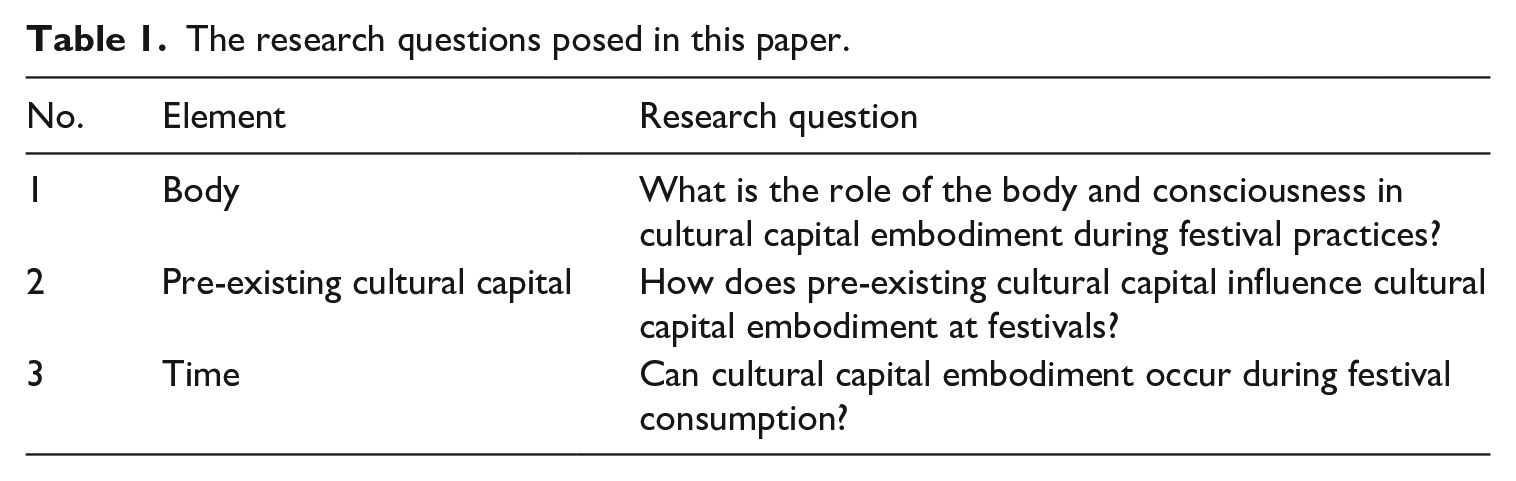
The SLP is used in this article as a valuable theory that can help provide answers to the research questions posed (Table 1). Firstly, engaging in leisure pursuits involves people embodying information and experiences in a variety of ways. Thus, in serious leisure, the body is a source of information (Cox et al., 2017). For instance, while listening to music, reading and running, people acquire and embody information. Sensory properties, like visual, tactile and auditory, are therefore fundamental in serious leisure. Knowledge and skills are embodied in what Stebbins (1992) defined as a long-lasting process of self-actualisation. For instance, he discussed experiential knowledge acquisition during serious leisure, where people learn and shape their behaviours according to the situations and context they lived: ‘skiing alternatively in shady and sunny areas in well-above freezing temperature, I learn to anticipate abrupt changes in “glide” (rate of speed)’ (Stebbins, 2014, p. 34). Cox et al. (2017) investigated the role of the body in the process of information embodiment in three types of serious leisure: running, amateur music and the liberal arts hobby. They found that the body and its senses had a crucial role, including visual sensations, sound, smells and sensations of the skin. O’Connor (2007, p. 131) also observed that there is also a degree of ‘bodily intentionality’ while acquiring knowledge and abilities in serious leisure. All this can be used in tandem with the concepts of illusio and affect to answer the first research question on the body. Secondly, Stebbins’ concept of involvement is used to address the second question on the role of pre-existing cultural capital. Stebbins (2007) argues that the continuum of different amounts of knowledge, skills and abilities, from casual to serious leisurists, creates the concept of leisure career. Leisure career involves a ‘steady development as a skilled, experienced, and knowledgeable participant’ in a particular activity (Stebbins, 2007, p. 19). This continuum creates the SLP involvement scale (Seriousleisure, 2020). 1 However, he also argued that levels of involvement can peak at any point on the scale. This helps to further understand the role of pre-existing cultural resources in gaining different rewards and cultural embodiment at festivals. Lastly, the benefits produced by casual and serious leisure are used to answer the last research question on the role of time. Particularly, the concept of infotainment as the process of acquiring information through a short-time casual leisure activity.
The research questions posed in this paper.
Approach and methods
This article draws on data generated at two different festivals in Ireland and Italy through 92 semi-structured, in situ interviews and 34 in-depth semi-structured, in-depth, follow-up interviews with festival participants, and participant observations (Rossetti & Quinn, 2021). The in situ interviews lasted on average 24 minutes while the follow-up interviews averaged 49 minutes. Data include information on festival experiences and cultural capital embodiment during and after the festivals studied. Specifically, this study investigated the embodiment process both during and after the festivals (from 10 to 20 days), since ‘in situ observation only reveals certain aspects of body techniques to us’ (Crossley, 2007, p. 91). Crossley (2007) suggested integrating observations with quantitative surveys; however, this study argues that in situ observations and interviews can also be used in conjunction with in-depth follow-up interviews to investigate the roles of the body, the environment (physical and social), and awareness/intentionality in the process of cultural capital embodiment. The follow-up interviews allowed more time for in-depth questions, since the respondents were not taking part in festival activities and the double interview process was very useful for understanding people’s perceptions, including after the festival experiences.
The study adopted an interpretivist approach. The epistemological assumption was intersubjective and emic in perspective, in that we prioritised respondents’ perspectives. As a result, the study employed a qualitative approach to understand the phenomenon in terms of the meanings that participants bring to it. The study involved a non-probability sample (Yin, 2016) since the aim was not to measure, or to generalise results, but to foster the understanding of a process of cultural capital embodiment. Data collection included a screening phase, a pilot study phase, and the main study phase. Finally, all the interviews were transcribed verbatim and analysed with NVivo following the thematic analysis technique (Braun & Clarke, 2006).
The festivals
Pordenonelegge is an Italian literary festival that takes place every year in September for five days in Pordenone. The festival was founded in 2000 and in 2017 had 120,000 attendees. Listowel Writers’ Week is one of the oldest Irish book festivals, founded in 1970. In 2017, the festival ran for five days in June and had 15,575 participants. While the Italian festival was initiated to foster local tourism, the Irish festival was founded to promote local writers. Both festival programmes include different types of events, such as book launches, authors’ discussions, workshops, competitions and evening shows.
The participants
The research involved 92 in situ participants and 34 interviewees for the follow-up interviews. To provide an overview of the audience, the background of the in situ cohort is presented. Overall, the in situ participants were mainly female and aged in their 40s/50s/60s. In Ireland, they were also mostly domestic tourists with highly ranked occupations (e.g. managers or jobs connected to literature) or retired people. In Italy, participants were mainly locals or regionals, with unskilled occupations (e.g. service workers) or jobs connected to literature (e.g. teachers). In terms of pre-existing cultural resources, in situ participants in Ireland mainly possessed high institutionalised cultural capital (postgraduate degree/bachelor’s degree), while in Italy middle-high (bachelor’s degree/diploma) was more common. Overall, participants in both countries possessed high pre-existing levels of objectified cultural capital (e.g. books). However, most of the respondents were not writers, and there were diverse levels of literary capital. For instance, in Ireland they read more than in Italy. The in-depth interviews also reveal that the majority of respondents were able to speak foreign languages, but only a few could play a musical instrument.
Using the serious leisure perspective to understand cultural capital embodiment at festivals
This article contends that by seeking inspiration from the SLP, it is possible to further understand three under-researched elements of cultural capital embodiment in festivals: (1) body; (2) pre-existing cultural resources; and (3) time.
Body
What is the role of the body in cultural capital embodiment during festival practices?
When trying to conceptualise the process of cultural capital embodiment, understanding the role of the body is crucial. Stebbins’ ideas about the sentient body as a source of information and about the physical environment as perceived by sensory properties are useful to enhance the understanding of cultural capital embodiment at festivals. Stebbins’ ideas can be used in tandem with Bourdieu’s (1986/2002, p. 85) concepts of ‘incorporation’ and ‘assimilation’ of culture at festivals. The findings reveal that cultural capital was acquired via the five senses during festival participation and then incorporated and absorbed into participant’s bodies.
Firstly, the senses played a key role in helping people acquire and embody cultural capital. Observational data show that participants sensuously engaged with the physical space and other people, especially through sight and hearing. As such, a festival creates ‘an atmosphere that people can tangibly experience’ (Lea, 2006, p. 62). Just like Stebbins (2013), this study acknowledges a link between body senses and the environment, claiming that spaces in festival practices can be perceived by visual, olfactory, tactile and auditory properties. Hearing was recognised as a key sense in the act of embodying culture as notions skills, and taste. For instance, Simon revealed that he is dyslexic and ‘that’s probably why I go to listen to a lot of poetry and go to theatre, because I can consume literature in a different way’. Other participants were engaging in visual and tactile sensations, reading and touching the printed books or their digital versions, or even smelling the books (Cox et al., 2017). This recalls Stebbins’ (2013, p. 10) definition of reading as a ‘conscious, purposeful activity, the enactment of which requires concentration with the eyes (ears, fingers) focused intently on the material at hand’.
Secondly, bodily movements and physical activities were also routes to acquire cultural capital. The observations shed light on the behavioural dimensions of festival participation. People used their bodies in different ways to participate in festival activities. They sat and listened to writers talk, walked around the towns, wrote notes on what they heard, read author bios, and spoke to other audience members. All these different actions shaped how they participated in the festivals and, in turn, the opportunities and ways in which they acquired cultural capital. For example, Camilla and Mario listened to the authors while being sat down quietly during the event, while Rita attended a writing workshop where she wrote songs with pen and paper. Listening, watching and touching involved both senses and physical bodily actions and so the embodiment process relied on both of these engagements.
Lastly, the cultural capital that was acquired via the senses and bodily movements was absorbed into the bodies and manifested in people’s behaviours. For instance, Camilla explained that she is more conscious of her way of wearing perfumes after an event she attended during Pordenonelegge in 2015: ‘two years ago I went to a meeting that talked about the importance of perfume, in the sense that very often we tend to forget about our senses . . . later I thought about it and it’s true, we remember a moment, something special because we associate it with a taste or a smell’ (Camilla). She said that her favourite perfume is out of production and she has to wear it carefully since she has good memories of moments where ‘I was wearing this perfume’. So, during the festival she acquired cultural knowledge on perfumes that she embodied by reflecting on the roles of perfumes and how she wears her favourite scent.
Similarly, Mario explained that he attended a festival event and acquired new information on food labels: ‘the author gave some information, a community regulation that regulates labelling in Europe . . . that I did not know about’. Mario said that he changed his way of checking the labels after that event: ‘I tried it before, but I didn’t know what I was doing, for example, the calorie count’. So, even if he was checking labels before the event, he modified his way of shopping. He embodied the information received at the festival and modified his behaviours accordingly. These are examples of cultural capital embodiment as a form of ‘self-improvement’, an ‘investment’ (1986/2002, p. 85) of cultural knowledge. Findings support, therefore, the view that the body is a source of information in leisure and festival practices (Lea, 2006). Also, Bourdieu’s concepts of incorporation and investment can be used together with Stebbins’ ideas about the sentient body and the environment to better explore the role of the body during cultural capital embodiment at festivals. The findings show, therefore, that literary festivals are intense interplays of actors that talk, listen, move across spaces, and engage with the environment (Ommundsen, 2009). They support the view that festivals are ‘immersive experiences’ (Jordan, 2016, p. 50) and performative practices (Lucas & Wright, 2013). By chatting, sharing opinions, asking questions during the events, or being the performers at the open-mic sessions, participants become actively involved in the festival. All this supports the view of festivals as physical experiences that allow cultural capital acquisition and embodiment (Jordan, 2016; Lea, 2006).
Bourdieu argued that cultural capital embodiment can occur consciously and unconsciously. However, he failed ‘to explain the complex processes of consciousness and their relation to embodied practice’ (Noble & Watkins, 2003, p. 530). This study’s findings concur with Bourdieu in conceiving of cultural capital embodiment as a conscious and unconscious process. For instance, some interviewees became only conscious of the embodiment of cultural resources during the interview. However, even if respondents were not consciously aware of having embodied cultural resources like interests, knowledge, or cultural participation, there were always different degrees of bodily consciousness and some sort of intentionality because it was a multisensory experience with visual sensations, sensations of the skin, and sounds like ‘the cello’ at the evening show (Leonardo). While the notion of affect can explain the degree of willingness, struggle and investment that people put into the field (Threadgold, 2020), the SLP notion of bodily intentionality can further the understanding of bodily awareness and intentionality in embodying cultural capital. For example, Rita attended a songwriting workshop in Listowel where she wrote three songs. Here, she was bodily aware and conscious that she was acquiring songwriting skills. She also said that, for one of the songs, ‘I’m trying to find someone to write music for it . . . because I can’t write it . . . so I made contact with the person that writes music and she says that I’m going to meet her next week, I think in Dublin . . . and I’m trying to get people to perform it because I want to have it recorded and I’m going to submit it to the Eurovision contest in Ireland’. Thus, during the festival she acquired songwriting skills and taste that she intentionally internalised and embodied and led her organising all this, including a trip to Dublin, to record a song for the Eurovision. This recalls the two pursuits of liberal art hobbies: acquiring and expressing knowledge and skills (Stebbins, 1994). Thus, this study suggests that cultural capital is acquired and embodied at festivals with a degree of bodily consciousness and intentionality through sensory bodies. Here again serious leisure was a valuable tool to further understand the role of consciousness. The findings support O’Connor’s (2007, p. 131) claim that there is ‘bodily intentionality’ while acquiring knowledge and abilities in serious leisure. Cultural capital was acquired and internalised through the sensory body, and the multisensory experience happened with a degree of bodily consciousness and intentionality. Even though for some there was not a mental consciousness involved in acquiring knowledge and skills, there was always a degree of bodily awareness and intentionality via the sensory body.
Pre-existing cultural resources
How does pre-existing cultural capital influence cultural capital embodiment at festivals?
When people attend festivals, they bring their own pre-existing levels of cultural capital. As discussed above, interviewees mainly possessed middle-high cultural capital. Thus, this seems to support the view that literary capital shapes access to literary festivals and that attendees mainly possessed high levels of engagement with literature (Ommundsen, 2009; Wilks, 2009). However, findings also show that levels of engagement with literature varied, i.e. from passionate readers to people who hardly read. So, this study also agrees with Giorgi (2011) in refuting the concept of a ‘typical’ literary festival audience member and contends that nowadays participants possess mixed levels of cultural capital and are no longer exclusively passionate literature enthusiasts. Here, it is possible to see that participants positioned themselves differently in the literary field. They also experienced the festivals with different degrees of seriousness, from casual to serious leisurists like Alice, who said that attending Pordenonelegge is a serious commitment as ‘every year you want to come back’.
Bourdieu (1986/2002) argued that taste shapes cultural participation. Likewise, Stebbins (2007) claims that pre-existing cultural resources influence how leisurists develop knowledge and skills. This study reveals that pre-existing cultural resources influenced how visitors participated in the festivals, which kind of cultural capital they embodied and how. Interviewees observed that their interests and tastes shaped how they selected events to attend, and in turn shaped their opportunities to embody culture. Anna, for example, enjoyed an event about world wars because she ‘love[s] wars and history’. Similarly, Paolo explained that he goes ‘only to the event I’m interested in’. Thus, this study agrees with Stebbins in observing that people need to have a taste for the activity. Here, it is also evident that Stebbins’ concept of taste can be related to Bourdieu’s, as for both, tastes influence participation.
As already mentioned, instead of focusing on how people position themselves in the literary field, this article aims to understand whether and how the process of cultural capital embodiment happens at literary festivals. However, results reveal that literary capital was a marker of distinction. In Ireland, distinction was spatially recognisable: events featuring well-known authors were held at the hotel while those featuring aspiring authors took place in pubs. As such, ‘festivals play a growing role in the professionalization of writers by providing . . . literary recognition’ (Sapiro, 2016, p. 18). This spatial pattern shaped the occasions and ways participants had to embody culture and the type of culture they could embody.
Bourdieu (1986/2002) claimed that people with high cultural capital are more likely to acquire further cultural capital. Holt (1998), while analysing leisure activities, agreed with Bourdieu. Here, Stebbins’ concept of leisure career and the SLP involvement scale (Seriousleisure, 2020) are used to further explore the role of pre-existing cultural resources and engagement. According to Stebbins (2007), in the continuum from casual to serious leisurists, people possess different amounts of knowledge, skills and abilities. However, everyone can gain some sort of reward, from infotainment to self-actualisation, and involvement can peak at any time in the leisure career continuum. Results do not show that participants with high cultural capital were more likely to embody further cultural capital. There were several examples of people with low cultural resources who ended up acquiring and embodying culture. For instance, Cassie recognised different levels of literary capital in people at the festival, and identified herself as not being a member of the literary community: ‘I wouldn’t have the full understanding of literature [like the others]’. However, she learned about ‘local authors’ and described the festival as ‘very educational’, which ‘made [her] interested [in books]’. Likewise, Norah described the Writers’ Week as ‘satisfying to the mind’ and she felt ‘enriched, fulfilled, [and] happier after’. This recalls Stebbins’ (Seriousleisure, 2020) idea of infotainment, when people learn something during casual leisure. The knowledge acquisition was embodied and shaped how participants were using their bodies. For instance, Alice explained how she and her sister did not want to disturb the performers by walking away in the middle of an event in Pordenone: ‘the one [event] about philosophy, I’m telling you I do not even remember what they were talking about, I was thinking so much about my own stuff, we [my sister and I] also wanted to leave but it seemed . . . the room was also small . . . we did not want to disturb’ (Alice).
Norah explained how the cultural capital acquired at the festival is embodied and shapes people’s actions and ways of being, even with pre-existing low cultural resources: at the festival ‘you get the information that you use in your life, you know, that for instance, if you keep doing the things that you always do, you keep getting the things that you have always got, right? . . . You can hear it in Listowel, pieces of information and you use it, it makes different, your life.’ As such, ‘festivals possess a transformative quality’ (Quinn & Wilks, 2017, p. 36). Norah also explained that cultural capital acquisition and embodiment can happen during the festival as well as after, because of festival participation, regardless of one’s level of cultural capital. At Listowel she discovered some books that she downloaded on her Kindle and read after. Reading them allowed her to acquire cultural capital related to the topic of the books (e.g. refugees): reading ‘broadens your mind and it makes you understand people better, other people better, so, my view of refugees, or people [in] marginalised societies, would have been different’. Thus, all this questions Bourdieu’s (1986/2002) theory that people with high cultural capital are more likely to acquire further cultural capital.
Time
Can cultural capital embodiment occur during festival consumption?
Noble and Watkins (2003) claimed that with the process of habituation, actions can become automatic and naturalised, like being able to play tennis. Repeated actions are partly conscious and create ‘awareness [in] . . . the process of bodily transformation’ (p. 536). While Bourdieu (1973/1997) claimed that it takes time to acquire cultural capital, Stebbins (2007) argued that short-time casual leisure activities can produce infotainment, where people can acquire information. So, what about those not-so-frequent actions, like the act of attending festivals? Do they allow people to embody cultural capital?
A first point to note in this context is that while festival-going is usually an infrequent occurrence, several studies associate high levels of repeat attendance with festival-going (Begg, 2011; Kruger & Saayman, 2013; Shanka & Taylor, 2004). This was confirmed in the current study with most of the respondents being recurrent participants, having attended the festival more than once. Only a few were first-time participants. So for repeat visitors, the festivals were recurrent occasions to learn, acquire skills, taste, reflect on values, increase cultural participation, change bodily hexis, and experience ‘personal growth’ (Serena). This also supports the view that ‘satisfaction leads to visitor loyalty’ (Kruger, 2019, p. 202).
Similarly to the different rewards of casual and serious leisurists (Stebbins, 2007), the results show that there were some differences in cultural capital embodiment according to frequency of participation. Findings reveal that repeat and first-time participants embodied cultural capital with different degrees and in different manners. Repeat participants developed their tastes, interests and behaviour more than those who were attending the festivals for the first time. In contrast, first-time participants developed their cultural participation more than repeat participants. For example, for Michele, who was in Pordenone for the first time, the festival was an occasion to visit the local church. Additionally, cultural participation was developed mostly by respondents who spent one or two days at the festivals, while skills and values were developed more by respondents who spent three or more days at the festivals. For instance, as seen before, Rita, who attended songwriting workshops, acquired and embodied knowledge and skills related to songwriting.
So, the findings show that even for first-time participants, the festivals were occasions of cultural capital acquisition and incorporation. This cohort was able to acquire information, develop skills and new interests. For example, Giulio started to ‘read more’ after Pordenonelegge, for Missy the Writers’ Week was encouragement ‘to write more’, and for April it ‘reinforced my beliefs’. All this is in line with previous research on acquiring cultural resources at festivals (Kruger, 2019; Weber, 2018; Wilks, 2011) and it questions scholars like Négrier (2015) and Meehan (2005). First-time participants were acquiring culture and enjoying themselves at the same time. For instance, George, who attended the Writers’ Week for the first-time, observed that he went ‘for my pleasure. Purely that, pure enlightenment, to learn new things.’ He also said that ‘I leant something’ and explained that for him, enjoyment is ‘stretching my mind and having another point of view on something I have not considered before’. Likewise, Ashlyn said that since ‘I came back, I have been reading stuff of some authors I have seen that I might not have heard [of] before’.
All this recalls Stebbins’ concept of infotainment, where the leisurist is both educated and entertained at the same time. Stebbins argued that in short-term casual leisure people can gain information. Findings support this view, and suggest that acquiring information is the first step in the process of cultural capital embodiment. However, they also reveal that some first-time participants embodied the information they acquired. For instance, Missy, a first-time visitor, during the follow-up interview, said: ‘I’ve written a poem already’. She also said ‘I’m writing more and I’m reading 2 books a week.’ Moreover, after attending the festival Missy started a painting course: ‘I go to art classes now . . . I started after I came back from Listowel . . . I wasn’t doing that before, I was painting myself.’ She explained that after the festival ‘my brain was working better’ and she realised how nice it is to share experiences, so she started art classes ‘for the company of the women’. Similarly, Ashlyn, a first-time visitor, said that the week after the festival she went to Carlow. She explained that this was because some authors ‘were doing an event and I wouldn’t have known only for the people I was speaking to in Listowel so I drove to Carlow for a day, so I’ll definitely do more festivals’.
Jimmy is another example. He was not a first-time participant, but for the first time he read a poem at the open-mic and this helped him to feel more comfortable and less self-conscious. He explained that attending the festival helped him to ‘become more comfortable in reading in public’. The act of reading in front of people allowed him to start improving his public speaking skills, to embody how to be less shy. The fact that not everyone was listening helped him to feel less nervous and he decided to try it again in the future: ‘I wrote for years but I have never read, I wouldn’t read because I was not comfortable enough to read . . . [I] think I’ll push a better effort to read, so that was a change even if most people don’t really concentrate, they drink and have a chat and you read.’
All this suggests that in some cultural practices like festivals, cultural capital does not necessarily need a lot of time to be acquired and embodied. Thus, this article uses the SLP to further understanding of Bourdieu’s (1973/1977, p. 493) ‘cycle’ of cultural capital embodiment. Festival participants could embody culture by learning new notions, developing new interests, or visiting local heritage without repeat participation. Sometimes cultural capital embodiment had a long-term effect.
Conclusions
The article interlinks two theoretical ideas: Bourdieu’s cultural capital embodiment and Stebbins’ SLP. The aim was to further understand the cultural capital embodiment process in festival consumption. The analysis has advanced academic knowledge by aligning Stebbins’ SLP and Bourdieu’s cultural capital. The two toolkits can be used in tandem in festival studies. Just like Noble and Watkins (2003), this study focuses less on power dynamics and distinction, and more on the process of how culture can be embodied. The article argues that by using the SLP, the process of cultural capital embodiment in informal learning arenas can be understood more fully. Here, three elements have been explored: (1) body; (2) pre-existing cultural resources; (3) time. This article answers the calls for more research on the role of festivals in shaping participants’ cultural capital (Rossetti & Quinn, 2021; Szabó, 2015), for qualitative studies about cultural capital (Vryonides, 2007) and on the conceptualisation of the embodied state (Prieur & Savage, 2011).
By seeking inspiration from the SLP, it was possible to answer the three key research questions and further understand whether and how culture can be embodied during festival consumption. Firstly, in terms of the role of the body, results show that participants engaged with the physical space in and outside of festival venues with different actions and senses. The findings showed how participants received and acquired cultural capital via bodily senses and physical actions, as well as how this cultural capital was embodied and shaped how people used their bodies. Participants also engaged with each other and co-created the experience. This supports the argument that festivals are physical experiences (Meehan, 2005; Ommundsen, 2009) and occasions for performative practices (Lucas & Wright, 2013). Stebbins’ (2013) view of the sentient body as a source of information and how the environment can be perceived by sensory properties was found to be critical in the process of understanding cultural capital embodiment in festivals. All this throws light on how knowledge, skills and interests are embodied through festival participation (Lea, 2006; O’Grady, 2015). Moreover, by using Bourdieu’s concepts of affect and investment in tandem with O’Connor’s (2007, p. 131) ideas of ‘bodily intentionality’, this article contends that cultural embodiment in festivals can occur consciously and unconsciously, but always with a certain degree of bodily awareness. This answers the call for more sociological studies on the role of consciousness in embodying culture (Shilling, 2017).
Secondly, the article explores how pre-existing cultural capital influences cultural capital embodiment at festivals. While findings show forms of literary distinction, they do not reveal a direct relationship between higher pre-existing cultural resources and higher cultural capital embodiment. Thus, this article questions Holt’s (1998) theory of self-actualisation and autotelic sociality in festival contexts. Instead, Stebbins’ idea of involvement was useful to better understand the relationship between pre-existing cultural resources, engagement at the festival, and cultural capital acquisition and embodiment.
Lastly, using Stebbins’ (2015) idea of infotainment, this study suggests that cultural capital does not necessarily need time to be acquired and embodied at festivals since both repeat and first-time festival participants can embody it. This expands the analysis of cultural capital embodiment in adulthood in the under-explored festival practices.
In conclusion, by seeking inspiration from the SLP, this article has contributed to a deeper understanding of how cultural capital embodiment happens at festivals. However, while it offers valuable insights into the cultural capital embodiment process, it has limitations. The phenomenon being investigated is under-researched in the literature and this study is exploratory in nature. It does not aim to generalise. Clearly, there is much potential to extend research into individual cultural capital embodiment associated with festival participation, using Stebbins’ serious leisure theory. To that end, this article can be used to inform further studies on cultural capital embodiment in other literary festivals. Moreover, the study’s findings do not include examples of loss of pre-existing cultural capital. It is also suggested that further research should use the serious leisure perspective to investigate cultural embodiment in other types of festivals or other types of leisure activities.
Footnotes
Acknowledgements
The authors would like to express their sincere gratitude to Technological University Dublin for funding this research, and the editor and reviewers for their comments.
Funding
This article draws on Dr Rossetti’s PhD thesis (2020), which was funded by the Technological University Dublin’s Fiosraigh PhD Scholarship. Dr Bernadette Quinn was the PhD supervisor.