




Abstract
Popular and sociological intuitions tell us that men and women ought to have manifestly different cultural tastes. Yet empirical results do not always agree: scholars have often found surprising between-gender homogeneity when it comes to aggregate cultural tastes. Why? In this article, the author argues that such homogeneity is ultimately an artifact of our reliance on affective preference as the first approximation of taste. Building on Bourdieusian work on the unity of taste and data from a nationally representative survey of U.S. residents in 2024, the author shows that there is a deep, surprising, and persistent gendered dynamic to tastes that emerges only when we account for the multidimensional complexity of taste. These gendered dynamics are deep in that they are hidden when taste is approximated in unidimensional form. They are surprising in that they provide only inconsistent support for standing theories on gendered differences in cultural tastes. Finally, these gendered differences are persistent to the accumulation of cultural capital.
She must be a variety. // Change so that nothing will change.
Taste should be intimately gendered. This we know by our intuitions and social theories. If we take tastes to reflect the internalization of social structure, it follows that taste must carry the mark of gender, one of the most fundamental organizing principles of social life (e.g., Bourdieu 1984; Lizardo 2017; Ridgeway 2011). Yet empirical support for such gendered differences in tastes can be scant. Consider, for instance, the findings on gendered differences from some of the landmark studies of cultural omnivorousness: neither Peterson and Kern’s (1996) nor Bryson’s (1996) work revealed any statistically significant differences between men’s and women’s tendency to like or dislike music genres (Figure 1). What explains this surprising disjuncture? Are the researchers reporting homogeneity between men and women doing something wrong? Or are our intuitions and theories about the gendered nature of taste retrograde?

The surprising absence of gendered differences in aggregate tastes: (A) from Peterson and Kern (1996), (B) from Bryson (1996), (C) from Bihagen and Katz-Gerro (2000), and (D) from Lizardo and Skiles (2016a).
The answer we offer in this article is a mixture of both. Drawing on data from a nationally representative survey of U.S. residents in 2024, we show that between-gender homogeneity in tastes is attributable to a reliance on affective preference as a first approximation of taste. There is a deep, surprising, and persistent gendered structure to tastes, but this emerges only when we account for the multidimensional complexity of taste (Ma 2024). These gendered dynamics are deep in that they are hidden when taste is approximated in unidimensional form, requiring instead a fuller consideration of taste’s multidimensional complexity. They are surprising in that they provide only inconsistent support for standing theories on gendered differences in cultural tastes. Contrary to Bourdieusian theories about the gendered habitus (Bourdieu 1984), men are not more likely to hold the asymmetric tastes associated with the “pure gaze.” Contrary to theories of gendered status beliefs from expectation state theory (Ridgeway 2011), women are not more likely to hold guilty pleasure tastes. Finally, these gendered differences are persistent to the accumulation of cultural capital. Cultural capital moderates both the valence and magnitude of gendered differences in complex tastes. Although the accumulation of cultural capital ameliorates gendered differences in some complex tastes, it can also introduce fresh sets of gendered differences in others.
These findings carry implications for scholars working in the sociology of culture, gender, and stratification. First, this study demonstrates both the importance and the usefulness of treating taste as a multidimensional concept. Despite being a central concept within the sociology of culture, taste has often been measured and operationalized in multiple ways, with little consensus among scholars (Ma 2024). We show that the three dominant paradigms of measuring taste—as preference, as consumption habits, and as a form of judgement—can be important to consider in a joint fashion. First approximations of taste along one dimension risk eliding and overlooking deep homologies in the structure of cultural tastes. Using such a multidimensional conceptualization of taste with spatial and relational methods of analyses (e.g., Atkinson 2016) may help us uncover a deeper understanding of the regularities in contemporary social life, helping clarify the empirical puzzles around aggregate tastes that continue to puzzle contemporary scholars (Lizardo and Skiles 2012). Second, our findings reveal a set of gendered differences that run counter to normative expectations within the sociology of culture and gender. Gender is crucial to the structure of cultural taste, yet it receives comparatively little attention (Atkinson 2016). Not only do we find gendered differences that are substantial and persistent, we also find that they are surprising in that they are not well explained by hypotheses extending from Bourdieusian theories of gender and culture or from expectation state theory (Ridgeway 2011). Third, our findings have implications for stratification in cultural fields. The accumulation of cultural capital does not imply the amelioration of gendered differences. A common sentiment in the cultural world is the idea that higher status groups have more omnivorous tastes and are more likely to hold progressive and feminist values. Accordingly, one might expect that those gendered differences in tastes would be smaller among those with higher cultural capital than those with lower cultural capital. This is not so. Cultural capital does not consistently ameliorate gendered differences in complex tastes. It does so only in select cases and may even generate fresh sets of gendered differences in other complex tastes.
Literature Review
The closest thing the sociology of culture has to an axiom might be its central insight that taste is the product of socialization. In Distinction, Bourdieu (1984) famously used the case of taste to illustrate the dialectical relationship between subjective agency and social structure. Although experienced on the phenomenological level as deeply subjective and personal, taste is the product of socialization, bearing a regularity forged in the crucible of social structure. The human body, he argued, is conditioned by social structure into a set of master dispositions (habitus), and these dispositions are applied in habitual and practical ways to all domains of social action, including but not limited to our expressions of taste. Distinction was focused on the role social class plays in taste formation. But class does not act alone. In matters of cultural taste, gender is expected to work alongside class: anxieties about class status and status distinctions are played out and performed through the categories of masculinities and femininities (McCall 1992; McNay 1999). In this study, we explore how gender shapes taste in music. Gendered logics of social life shape a person’s dispositions just as class structures do, “constructing the body as a sexually defined reality and as the depository of sexually defining principles of vision and division” (Bourdieu 2001:11). Surely, then, we should find gendered dynamics of music taste as saliently and obviously as we find class dynamics thereof.
On the Surprising Between-Gender Homogeneity in Tastes
It would not appear so. Gendered dynamics in taste, should they exist, are more disguised than expected. This is surprising in no small part because gender seems to be so deeply coupled with how music is produced and consumed. The production of music is similarly structured along gendered lines (Bayton 1998; Koren 2022). Women artists are underrepresented in genres such as rock and rap and overrepresented in genres such as rhythm and blues, country, and folk music (Donze 2011). Music producers often closely adhere to conventions around masculine and feminine preferences in music in their creative choices (Koren 2022). Much of popular music is motivated by and preoccupied with gendered romantic relationships; public consumption of music in live performances and concerts is also directly integrated into gendered courtship rituals and activities (Christensen and Peterson 1988). Gender also affects how audiences receive music. Men tend to favor music genres that have associations of hardness and toughness; women prefer music genres that are associated with softness and romance (Millar 2008). Shepherd’s (1986) early work on music tastes among the Quebecois discusses such gendered differences in genre preferences: hard rock, punk, and new wave were the most liked music genres among men, while chanson française, soul, and disco were the most liked genres for women. In their survey of youth in Canada, Tanner, Asbridge, and Wortley (2008) found gender to be a significant predictor of membership in taste clusters: boys were overrepresented in taste clusters involving hard rock and heavy metal, while girls were overrepresented in taste clusters containing classical and folk music. Christensen and Peterson (1988) found that “males tended to prefer the more ‘macho’ hard rock forms whereas females preferred softer, more romantic and dance-oriented music types such as mainstream pop and contemporary rhythm and blues.”
Yet whether there are robust gender differences in aggregate tastes across music, not just particular subfields or types of music, remains an open empirical question (Tanner et al. 2008). Taste structures in music appear much more uniform than we might expect. To the extent that gendered differences in aggregate tastes exist, they have been demonstrated primarily among “highbrow” cultural forms (Christin 2012; Lizardo 2006; Planson 2023).1,2 Across the United States and the Global North, women have much higher rates of participation in high-status cultural activities such as dance and the fine arts (Katz-Gerro 2002; Lehman and Dumais 2017). Women are more than twice as likely as men to be readers of fiction (Tepper 2000), and women are much more likely to attend dance and theater performances (Ateca-Amestoy 2008; Chan and Goldthorpe 2005). When it comes to music tastes specifically, there can be surprisingly little to separate between men and women. Two of the most influential studies of aggregate music tastes of the past decades, Peterson and Kern’s (1996) work on changes in cultural omnivorousness in the United States and Bryson’s (1996) work on symbolic exclusion, revealed that null effects were associated with gender in their respective statistical models (Figures 1A and 1B, respectively). In a major study of aggregate cultural tastes in the United Kingdom, Savage (2006) found that outside of two particular male-dominated music genres (rock music and heavy metal), there are no significant gender differences in music tastes (Figure 1C). In their replication of Bryson’s work, Lizardo and Skiles (2016a) found that gendered homogeneity in the expression of symbolic exclusion largely persisted (Figure 1D); indeed, in some of their work, they found the obverse (Lizardo and Skiles 2016b), that women are actually more likely to express aversions than men. In Hanquinet and Taylor’s (2025) recent study of music tastes among residents of the European Union, they found that gender had “very little differentiating power” at distinguishing between taste clusters produced in their geometric data analysis. Between-gender differences in cultural participation are greatly ameliorated when we restrict participation to lower status forms of culture (Bihagen and Katz-Gerro 2000). Willekens and Lievens (2014) found no between-gender differences among Dutch survey respondents when it came to tastes in popular music genres. When comparing the cultural habits of husbands and wives in Italian households, Lazzaro and Frateschi (2017) found that outside of a select group of activities (such as theater and dance), men were actually more omnivorous and active than women when it came to cultural participation, although in this case, the authors attributed the gendered differences primarily to women’s reduced access to leisure in Italy.
In the first part of our analysis, we seek to replicate previous findings that there are no between-gender differences in people’s aggregated preferences for music genres through an additive index of genre preferences. A succession of cultural sociologists have argued that a person’s cultural aversions may be a better indicator of a person’s tastes because aversions are able to better function as resources for symbolic exclusion (Bryson 1996; Lizardo and Skiles 2016b). Following these scholars, we also consider an additive index of genre aversions. We test the following hypothesis:
Hypothesis 1: There are no gendered differences in aggregate preferences or aversions.
Complex Tastes and Gendered Differences
What explains the surprising homogeneity in tastes? The simple answer we offer is that between-gender differences are concealed by our reliance on affective preferences as a first approximation of taste. In its place, we advocate a Bourdieu-inspired approach that respects both the “unity” and “indivisibility” of taste (Bourdieu 1984:487, 502). Elsewhere, scholars have made the argument that taste is not just a semantically ambiguous polyseme but can be usefully thought of as a complex, multidimensional phenomena (Ma 2024). In this approach, affective preferences are but one of multiple modalities to taste. In this article, we wish to first establish the existence of such complex tastes for music and, second, show how gendered difference emerges when accounting for the multidimensional complexity of taste.
What do complex tastes in music look like? To begin, a person’s complex taste is jointly described by three modalities of action: not solely by reference to their affective preferences for a piece of music but also by their social valuations of said music and the extent to which they participate in or consume it. Take the case of beloved, canonical works of classical music such as Don Giovanni. Such works are critically acclaimed and much beloved yet often go unlistened to. To paraphrase Mark Twain, these works are the music that everybody wants to have heard and nobody wants to hear. We may understand such tastes as part of a general form of complex tastes, the taste pose. The taste pose describes a taste in which a person sincerely enjoys and praises music without following through with consumption. If we were to think of each modality of taste as existing in stylized positive-negative binaries, it is possible to come up with 8 (23) possible combinations of complex tastes (Becker 1998). In Table 1, we present one such combinatorial truth table, with an accompanying example of what such complex taste might look like in music. As previous work on complex tastes has rested on a patchwork of evidence across cultural fields, we begin by establishing some existence claims. We ask first if such complex tastes in music genres are measurable and exist in nonnegligible quantities across a representative sample:
Hypothesis 2: Complex tastes in music genres exist.
Examples of Complex Tastes in Music Genres.

Complex tastes can be symmetric or asymmetric. Symmetric complex tastes are straightforward: they refer to tastes in which the three modalities of preferences, consumption, and valuations are symmetric with one another. For the sake of clarity, we discuss complex tastes with their combinations of taste mode polarities in parentheses (preferences, consumption, and valuations, in this order). This is the case with congruent preferences and congruent aversions. In the case of the former, all three taste modalities have positive valences (+/+/+); that is, a person expressing congruent preferences toward music X enjoys, consumes, and praises X. In the case of the latter, they all share negative valences (−/−/−); that is, a person expressing congruence aversions would dislike, avoid, and censure music X. Asymmetric complex tastes make up the remaining complex tastes. In categorical terms, asymmetric complex tastes make up the majority of complex tastes. Guilty pleasure, preacquired taste, taste pose, distant consumption, justified abstention, and distant praise are each a distinct variety of asymmetric complex taste, each containing a characteristic antinomy among the modalities of taste (Table 1). Guilty pleasures (+/+/−) refer to the pleasurable consumption of music a person considers to be bad for one reason or another. A person who self-censures the music that they enjoy and consume as “lowbrow” could be described as having a guilty pleasure. Preacquired tastes (−/+/+) refers to the antecedent of acquired tastes, the development of tastes for which pleasure did not come “naturally” for a person (i.e., one must spend time or resources “acquiring” said taste). As an example, consider someone who is in the process of “developing” a taste for opera; they want to admire opera, are actively consuming it, and yet do not currently have an affective preference for opera. Tase pose (+/−/+) refers to a complex taste whereby a person prefers and admires particular cultural article, yet at the same time, there is at least one meaningful sense in which they did not participate in the full consumption of the cultural article despite a lack of resource constraints. We provided an example of a taste pose in music in the previous section. Distant consumption (−/+/−) refers to the volitional consumption of culture a person considers neither good nor pleasurable. As an example, consider a person who consumes the music of choice of their significant other, despite their personal aversion of such music. Justified abstention (+/−/−) refers to the justified abstention of cultural articles a person finds enjoyable. As an example, consider someone who is abstaining from hip-hop out of their belief that the genre’s portrayal of Black street masculinity is bad for the Black community. Distant praise (−/−/+) refers to sincere praise that flies in the face of contradictory affective preferences and consumption habits. An example of this is a music critic who is able to fairly and sincerely praise music that they themselves do not personally enjoy or consume.
We hypothesize that complex tastes in music contain gendered dynamics, whereas aggregate preferences and aversions do not:
Hypothesis 3: Gendered differences emerge when we account for the complexity of tastes.
Conditioning for Cultural Capital
To what extent are these gendered differences in complex tastes conditional on social position? There are contrasting schools of thought about this. One line of thought is that class and status group differences are superordinate to gender, such that class, social position, and cultural capital are inversely related to gendered differences in tastes (and by extension to complex tastes). According to this line of thought, gendered differences are tied to class conditions that are particular to those in the working and low-middle classes. As such, gendered differences in tastes should be ameliorated by women’s education and accumulation of cultural capital. Bourdieu counts among them. For Bourdieu, the gendered habitus is the literal embodiment of the division of labor between the genders. Gender differences thus are fundamentally rooted in class differences, “as inseparable from class properties as the yellowness of a lemon is from its acidity” (Bourdieu 1984:102). Women from subordinate social stations are not only the “greatest victims of symbolic domination, but also the natural vectors for the relaying of its effects towards the dominated categories” (Bourdieu 2001:101). In Distinction, Bourdieu (1984) offered a specific hypothesis about the inverse relation between cultural capital and gendered differences, writing that “the whole set of socially constituted differences between the sexes tends to weaken as one moves up the social hierarchy and especially towards the dominated fractions of the dominant class” (p. 383). He expected women’s elevated tendencies for aversions to be “expressed more overtly . . . the weaker their cultural capital, the lower their position in the social hierarchy” (p. 32). Under this Bourdieusian hypothesis, we can expect gendered differences in complex tastes to be ameliorated by cultural capital, such that there is a monotonically decreasing relationship between cultural capital and gendered differences.
This line of thought is challenged by a robust body of feminist scholarship that contests Bourdieusian subordination of gender to class. A common refrain among unsympathetic feminist scholars that is that “[Within Bourdieusian theory], gender as an analytic category almost never appears in the construction of concepts, except when it is given secondary status,” so much so that gender may as well as be reduced to an index of the structure itself (McCall 1992:851). They contest that gender operates as an autonomous principle of social life, capable of imposing a logic that can contradict class-based expectations. Lovell (2000) drew on her work on women passing as military men as an example. “The habitus of the working woman, when forged by necessity in particular work-regimes, may have given her not only the motive but also the means for passing as a (working-class) man,” she wrote (p. 19). The ease with which they are able to do so suggests that Bourdieu’s claim that gender differentiation is less marked the higher one moves up the social hierarchy may be restricted to a particular time and space and may be far less generalizable than we think. Gendered differences and gendered habitus have their own autonomy and can vary up and down the social hierarchy. Cultural capital would then moderate gendered differences, in some cases ameliorating them and at other times creating new axes of gendered differences.
To adjudicate between these two contending approach, we test the following hypothesis:
Hypothesis 4: Cultural capital ameliorates the gendered socialization of complex tastes, such that there is a monotonically decreasing relationship between cultural capital and gendered differences.
Data and Methods
Data
This study draws primarily on original survey data of a quota-sampled panel of 1,494 residents in the United States conducted in 2024 as part of the Tastes, Complex Tastes and Meta-Tastes project at Nanyang Technological University. In October 2024, we fielded a public survey of music tastes that was designed to complement and extend previous efforts at measuring cultural taste in the United States, in particularly the National Endowment for the Arts (2022) Survey of Public Participation in the Arts (SPPA). From 1982 to 2022, the SPPA included items that tapped individuals’ preferences for music genres. 3 Because of its longevity and representativeness, the SPPA serves as effectively “canonical” data that have provided the empirical basis for an enormous body of research on cultural tastes (e.g., Peterson and Kern 1996). The present survey serves as an updated extension of the SPPA that increases both the depth and breadth of measures related to music tastes. The survey was designed on Qualtrics, approved by the Nanyang Technological University institutional review board (IRB-2024-099), and fielded through Prolific Academic. The survey was fielded to 2,000 survey respondents who were randomly selected for participation according to their age, gender, race, education, and geographic region to approximate a representative sample of the U.S. population. Respondents were paid $4 for the completion of the survey. The final sample included the 1,494 respondents who passed the attention checks we put in place. Appendix I shows how survey responses from the present study compare with similar survey items from the 2022 wave of the SPPA.
Key Measures
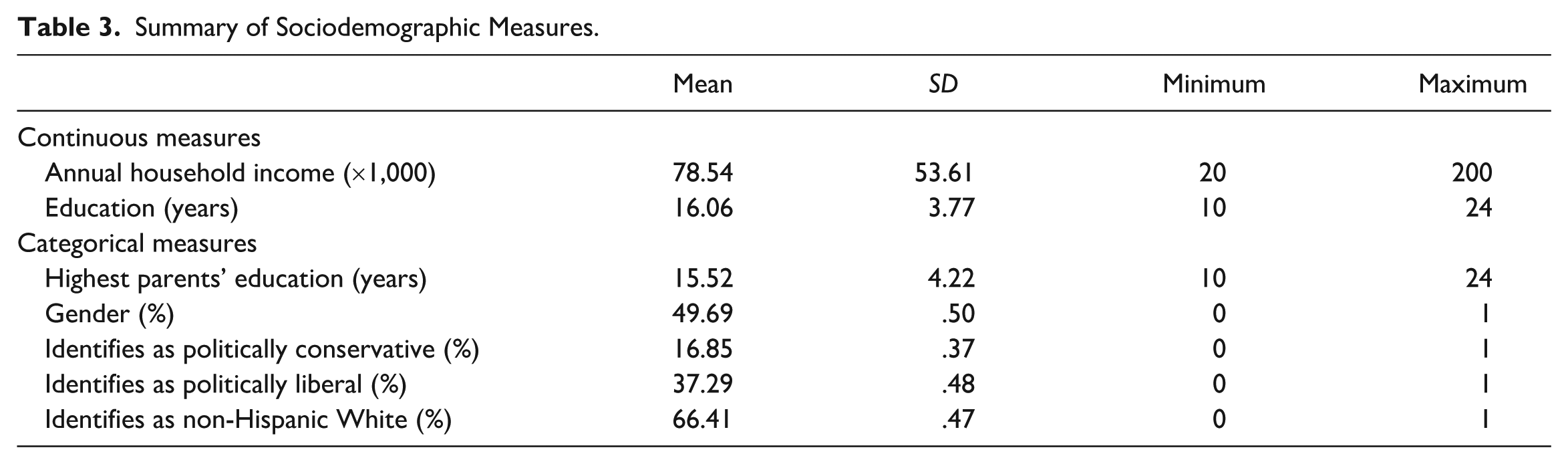
Tables 2 and 3 present, respectively, the summary statistics of key taste-related measures and sociodemographic characteristics of the respondents in the survey.
Summary of Taste Statistics.

Note: Two-sided t tests against m = 0.
p < .01.
Summary of Sociodemographic Measures.
Taste as Affective Preferences
To assess respondents’ affective preferences for music genres, they are asked the following question: “On a scale from ‘highly disliked’ to ‘highly liked,’ what are your personal preferences when it comes to [music genre]?” Respondents are given the following response options: “highly disliked,” “disliked,” “neutral,” “liked,” “highly liked,” and an option to indicate their unfamiliarity. Following previous studies (National Endowment for the Arts 2022), we include 16 music genres in our questionnaire. They include the following: classical music, jazz, classic rock, alternative rock, pop, country music, dance or electronic music, hip-hop, blues, Latin music, Asian music (other than K-pop), K-pop, Middle Eastern music, African music, folk music, and gospel. To measure a respondent’s aggregated preferences, we create an additive index that aggregates the total count of genres a respondent indicates as “liked” or “highly liked.” Conversely, to measure a respondent’s aggregated aversions, we create an additive index that aggregates the total count of genres a respondent indicates as “disliked” or “highly disliked.”
Complex Tastes
To create a measure for complex tastes, we create two additional survey items that assess respondents’ social valuations of music genres as well as consumption practice with respect to music. To assess social valuations, we ask respondents the following question: “On a scale from ‘very bad’ to ‘very good,’ how would you personally rate the quality of music from [music genre]?” Respondents are asked to evaluate only genres with which they indicate familiarity (i.e., follows a skip pattern from the preceding question). They are given the following response options: “very bad,” “bad,” “neutral,” “good,” and “very good.” A person is considered to “praise” a genre if they rate it as “good” or “very good.” Conversely, they are said to “censure” a music genre if they rate it as “bad” or “very bad.” To assess consumption practices, we ask respondents the following: “How often do you listen to music from these genres?” They are given the following response options: “almost never,” “at least once a year,” “at least once a month,” “at least once a week,” and “almost every day.” A person is considered be an active listener of a genre if they have listened to music from that genre at least once a month. A person is considered to be someone who avoids a music genre if they described themselves as “almost never” listening to it.
To construct a complex taste, we consider a person’s preferences, valuations and consumption practices jointly. There are eight possible kinds of complex tastes, each characterized by a distinct combination of the three modalities of taste. Following Ma (2024), we construct eight varieties of complex tastes (previously identified in Table 1) for each genre of music: (1) congruent preference, where a person expresses a preference for a music genre that they also praise and actively listen to; (2) congruent aversion, where a person expresses an aversion for a music genre that they also censure and avoid; (3) guilty pleasure, where a person censures a music genre despite liking and actively listening to it; (4) preacquired taste, where a person expresses an aversion for a music genre despite both liking and actively listening to it; (5) taste pose, where a person avoids a music genre despite liking and praising it; (6) distant consumption, where a person actively listens to a music genre despite disliking and censuring it; (7) justified abstention, where a person prefers a music genre despite censuring and avoiding it; and (8) distant praise, where a person praises a music genre despite disliking and censuring it. For each complex taste, we aggregate the responses across all music genres into an additive index. Figure 2 shows the frequency distributions of each complex taste in our sample.

Frequency distribution of complex tastes for music genres.
Gender
We rely on a binary measure of gender. We ask respondents for a self-report of their gender and given three response options: “male,” “female,” and “nonbinary.” A respondent is labeled as a woman if they self-report as female and as “not woman” otherwise. For the sake of parsimony, we refer to those in the “not woman” category as men in the remainder of the article.
Cultural Capital
We rely on an individual’s highest reported education attainment for the measure of cultural capital. We label a person as having “high cultural capital” if they report having a bachelor’s degree or more. Otherwise, we label them as having “low cultural capital.”
Sociodemographic Covariates
Finally, we include controls for annual household income, parental education, age, race/ethnicity, political conservatism, and political liberalism.
Methods
Because respondents’ tastes in music genres are discrete, nonnegative measures, we use negative binomial regression to estimate the relationships between a person’s gender and their aggregated music tastes (Long and Freese 2006). More specifically, we model respondent i’s aggregated taste Y using the following exponential function:

where X1 . . . XQ include measures of a respondent’s gender and other sociodemographic covariates. We assume that Yi follows a negative binomial distribution with mean m i and variance Var(Yi | Xi) = m i + am i 2. Negative binomial regression are a generalization of Poisson regression that uses the a parameter to account for overdispersion in the dependent variable. Failure to account for overdispersion can lead to inconsistent estimates and spuriously small standard errors (Cameron and Trivedi 2013). To decide between negative binomial and Poisson models, we (1) tested for overdispersion in tastes and (2) compared goodness-of-fit measures (Bayesian information criterion) between the two classes of models (Table 4). We find overdispersion across most of the taste measures (guilty pleasure being the lone exception), justifying the use of negative binomial models over the Poisson. Bayesian information criterion values are likewise lower across all negative binomial models. We also considered the use of a zero-inflated negative binomial (ZINB) regression because of the excess zeros among some varieties of complex tastes. We prefer negative binomial regression for two reasons. First, there was no theoretical reason to make the ZINB assumption that there are two distinct processes at work, one producing the zeros and the other producing the nonzero counts. The excess zeros in complex tastes such as justified abstentions are the result of natural variation in taste expression rather than a structural zero. The second reason is model parsimony. Negative binomial models are simpler with fewer parameters to estimate and are easier to interpret than ZINB counterparts because there is no need to account for two distinct processes.
Dispersion Test and BIC Comparison between Poisson and Negative Binomial Models of Tastes.
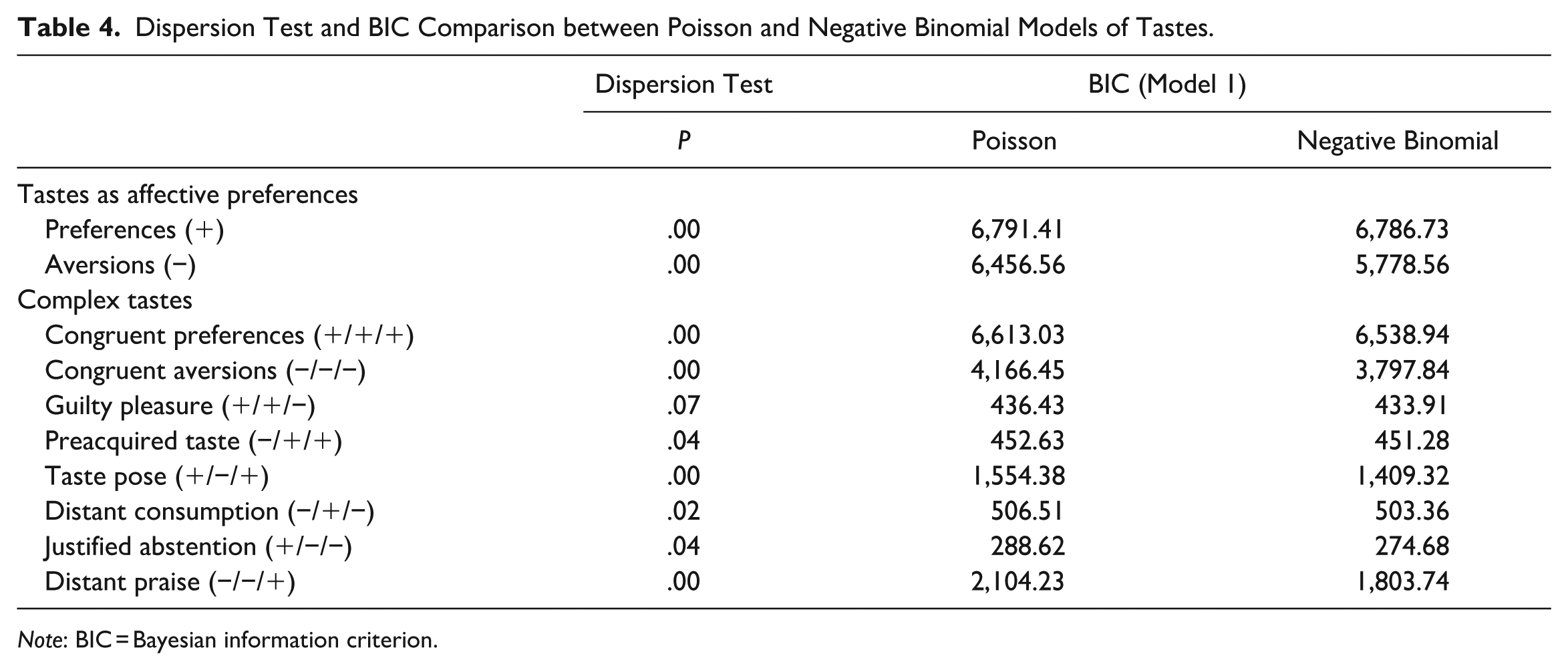
Note: BIC = Bayesian information criterion.
We build two models for each variety of taste Y. Model 1 includes the main effects of gender, cultural capital, and the rest of the sociodemographic covariates (annual household income, parental education, age, race, ethnicity, and political orientation). Model 2 is an extension of model 1 that includes the interaction between gender and cultural capital. Following recent literature on the use and interpretation of count models (Arel-Bundock, Greifer, and Heiss 2024; Kendler and Gardner 2010; Long and Mustillo 2021; Mize, Doan, and Long 2019), we examine the following estimands with heteroskedasticity-consistent standard errors: (1) b coefficient estimates of the main and interaction effects of gender, (2) model predictions of complex tastes, and (3) average marginal effects of gender. 4 We estimate the negative binomial model using quasi–maximum likelihood estimation, as implemented in the MASS package in R, and compute predictions and marginal effects using the marginaleffects package in R.
Results
Table 5 shows the comparison of means of all tastes across men and women. Table 6 and Figure 3 report the coefficient estimates of the main effect of gender from our negative binomial models. Table 6 also reports the average marginal effects of gender from our models. Table 7 and Figure 4 report the coefficient estimates of the main effect of gender along with its interactions with cultural capital. Table 7 also reports the average marginal effects of gender across groups with low and high cultural capital. Complete tables of all regressions can be found in Appendix I. We find the following.
Comparison of Means across All Tastes.

p < .10. *p < .05. **p < .01.
Relationship between Gender and Tastes.

Note: AME = average marginal effect.
p < .10. *p < .05. **p < .01.
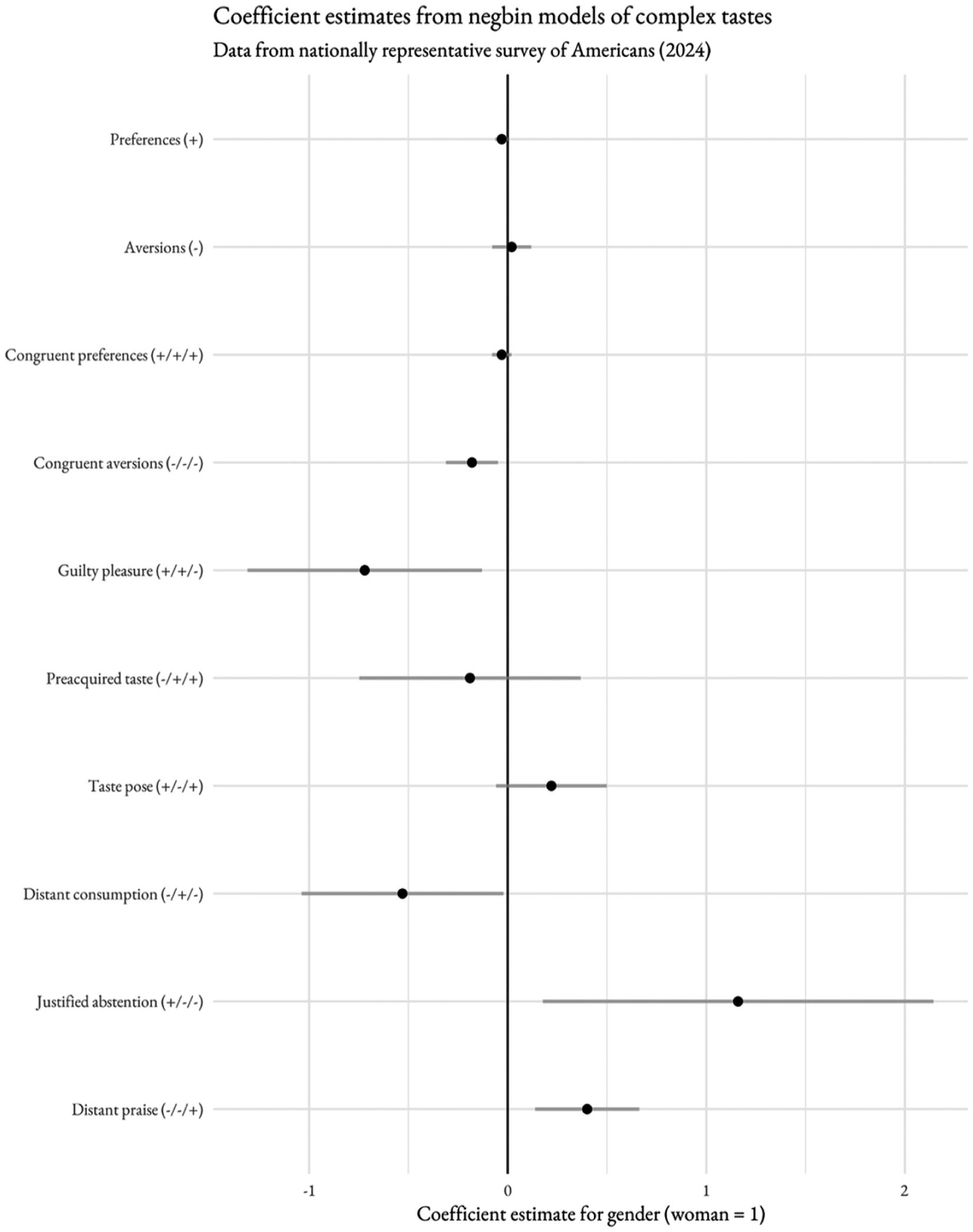
Forest plots of coefficient estimates of gender from negative binomial models.
Coefficient Estimates for Gender from Negative Binomial Models.
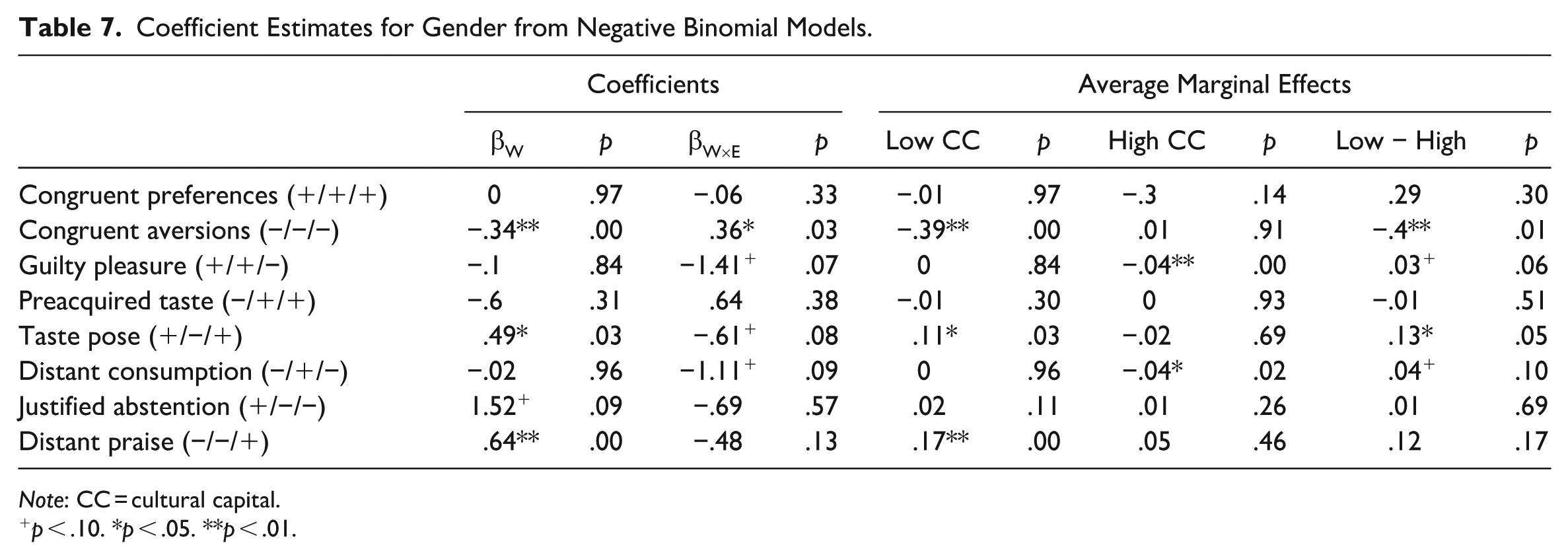
Note: CC = cultural capital.
p < .10. *p < .05. **p < .01.

Forest plots of coefficient estimates of main and interaction effects of gender.
First, there are no between-gender differences when it comes to aggregate preferences or aversions. We find support for hypothesis 1, that on average, men and women have similar amounts of aggregated preferences and aversions. There are no statistically significant associations between gender and observed preferences or aversions (Table 5). Similarly, there are no statistically significant differences between gender and predicted preferences or aversions from our negative binomial models.
Second, complex tastes exist. We find support for hypothesis 2: complex tastes of all varieties exist (Table 5), even if some (e.g., taste poses) are more common than others (e.g., justified abstentions). What is more, we can be fairly confident about their existence among each of the genders, with one possible exception (justified abstentions among men are significant only at p = .06). Congruent preferences and aversions are the most common of the group, for understandable reasons: these are the complex tastes for which there are no mismatches among the modalities of taste. Of the remaining complex tastes containing asymmetries, the taste pose and distant praise are most common.
Third, gendered differences emerge among complex tastes. We find support for hypothesis 3. Table 5 includes comparisons of means of complex tastes across men and women. Table 6 reports the coefficient estimates for gender from the negative binomial models as well as the average marginal effects of gender. We find from both that there are statistically gendered differences across five of the eight varieties of complex tastes. This underscores the importance of accounting for the multidimensionality of tastes. Of these, three varieties of complex tastes have a masculine bias, and two have a feminine bias. On the masculine bias, looking at regression estimates (Table 6), we find that women are 16.5 percent less likely to hold congruent aversions (e −0.18, p < .01), 51.3 percent less likely to hold guilty pleasures (e −0.72, p < .05), and 41.1 percent less likely to hold distant consumption tastes (e −0.53, p < .09), while holding other factors constant. On average across the sample (Table 6), being a woman leads to a −0.17 (p < .05) decrease in congruent aversions, a −0.02 (p = .05) decrease in guilty pleasures, and a −0.02 (p = .09) decrease in distant consumption, while holding other factors constant. On feminine bias in complex tastes, looking at regression estimates (Table 6), we find that women are 201 percent more likely to hold justified abstentions (e1.16, p = .05) and 0.4 percent more likely to hold distant praises (e0.40, p < .01), while holding other factors constant. On average across the sample (Table 6), being a woman leads to a 0.02 (p = .05) increase in justified abstentions and a 0.11 (p < .01) increase in distant praise, while holding other factors constant. The main effects and average marginal effects of gender are not statistically significant for congruent preferences, preacquired tastes, and taste poses.
Fourth, the influence of cultural capital on gendered differences in taste is manifest, but unlikely to be monotonic. We find limited support for hypothesis 3. Although we do evidence for the influence of cultural capital, it is unlikely to have a monotonically decreasing relationship with gendered differences in tastes. We observe cultural capital ameliorating gendered differences in complex tastes in three instances. One, among congruent aversions. When looking at coefficient estimates, we see that the male bias (−0.34, p < .01; Table 7) among those with low cultural capital shrinks by 0.36 (p = .03; Table 7) among those with high cultural capital. Average marginal effects corroborate the picture: the large average marginal effects of gender observed among those of low cultural capital shrinks by 0.40 (p = .01, Table 7) compared with those of high cultural capital. Two, the taste pose. The main effect of gender shows a women bias (0.49, p = .03; Table 7) that shrinks by −0.61 (p = .08) among those with high cultural capital. We see similar from the average marginal effects: the woman bias among those of low cultural capital (0.11, p = .03) decreases by 0.13 (p = .05) compared with those of high cultural capital. Three, with distant praise. Although the delta between the average marginal effects of gender for distant praise among high and low cultural capital groups cannot be reliably distinguished from the null (0.12, p = .17; Table 7), we note that gendered differences are statistically significant among the low cultural capital group (biased toward women at 0.17, p < .01), whereas they are not statistically significant among those with low cultural capital (p = .46).
The picture from the rest of the complex tastes do not support hypothesis 3. We find that the accumulation of cultural capital can also introduce a fresh set of gendered dynamics to some complex tastes. For instance, we find that the male bias toward both guilty pleasure and distant consumption can be found only among those of higher cultural capital. Gender has an average marginal effect of −0.04 (p < .01; Table 7) on guilty pleasures among with high cultural capital, a 0.03 (p = .06) increase from the average marginal effect among those with low cultural capital. Similarly, gender also has an average marginal effect of −0.04 (p = .02; Table 7) on distant consumption among with high cultural capital, a 0.04 (p = .10) increase from the average marginal effect among those with low cultural capital.
Discussion
In this section, we discuss the empirical results from our modeling of gendered differences in taste, and consider how they relate to the broader literature in the sociology of culture. Table 8 provides a brief review of the hypotheses tested and the relevant support (if any) we found for each in our analysis.
Review of Hypotheses Tested.

Complex Tastes Are Real and Measurable
Tastes can be complex and are only imperfectly approximated by unidimensional conceptions of taste. Previous work on complex tastes has drawn on case studies and meta-analyses of taste measurements and is primarily theoretical in thrust. We complement such work by providing an empirical account of complex tastes in music. Following Ma (2024), we show the distributions of an eight-member family of complex tastes across a nationally representative sample of U.S. residents. The existence of symmetric complex tastes such as congruent preferences and congruent aversions is unlikely to be surprising. But there is a larger burden of proof upon asymmetric complex tastes, some of which may strike readers as rare if not unlikely. Some varieties of asymmetric complex tastes are certainly rarer than others (taste poses are the commonest; justified abstentions the rarest), but their mere existence in a representative population of listeners should not be doubted.
First Approximations of Taste Can Hide Gendered Differences
Unidimensional approximations of taste can conceal deep regularities in the structure of cultural taste. Complex tastes are not only theoretically interesting but can be empirically useful. In this instance, we have seen how complex tastes can help identify social differences that are otherwise hidden by simpler approximations of taste. We began by reproducing an empirical puzzle among scholars of cultural omnivorousness, that there is a surprising between-gender homogeneity in aggregate preferences and aversions despite theoretical expectation of gendered differences. Although taking affective preference as a first approximation of taste can be a necessary and even reasonable thing to do in many empirical studies, it is also a heuristic that can conceal the hands of social structure. This is the case when it comes to the gendered dynamics of taste. Reducing taste to affective preferences requires that we flatten of the contradictions, asymmetries, and complex antinomies that make up the body of our tastes. As we do so, we also hide important gendered differences in tastes. When we treat taste to a complex, multidimensional concept that involves multiple modalities of action, gendered differences reveal themselves across a family of complex tastes.
Theorizing Gendered Differences in Complex Tastes
The gendered dynamics behind complex tastes are surprising and do not neatly fit extant theories about gendered differences in tastes. Although there is yet to be an extended theoretical account of how gender structures complex tastes, we can build inductively from previous theories that speak about gender and tastes more broadly. We discuss two: (1) Bourdieu’s theories of the gendered habitus and (2) theories about gendered status beliefs from expectation state theory.
First, consider Bourdieu’s theories of the gendered habitus (Bourdieu 2001). Bourdieu made two statements about gendered differences in tastes that have implications for complex tastes. Bourdieu wrote consistently about the multidimensionality of taste and of the import of key asymmetries in tastes. He recognized one such asymmetry in the case of highbrow, “pure,” tastes valorized by the midcentury French elite. As he saw it, the pure gaze demanded a retreat from “[culture] which speak most immediately to the senses and the sensibility” (Bourdieu 1984:24) and in its place deference to “enunciation and systematization of the principles of specifically aesthetic legitimacy” (p. 22). The “pure” aesthete must necessarily have asymmetric tastes: they must be willing and able to praise culture contrary to their sensibility; conversely, be willing and able to censure culture amenable to it. Bourdieu speculated that such asymmetric tastes are more commonly held by men. He theorized that there is a gendered division in aesthetics that descends from gendered divisions in labor:
The traditional division of labor between the sexes assigns “humane” or “humanitarian” tasks and feelings to women and more readily allows them effusions and tears, in the name of the opposition between reason and sensibility. . . . Women are therefore less imperatively required to censor and repress “natural” feelings as the aesthetic disposition demands. (Bourdieu 1984:32)
Put differently, Bourdieu hypothesized women to be liberated from the demand of holding asymmetric tastes. Women should be more likely to express tastes like congruent aversions. Men, especially high-status men, ought to be more likely to cultivate asymmetric aesthetic dispositions.
In all, we find little support for Bourdieusian hypotheses about the gendered habitus. Women are not more likely to have symmetric complex tastes than men. In fact, we find that men are more likely to have congruent aversions 5 than women. We note further than the genre composition of congruent aversions look remarkably similar. Men and women share congruent aversions for the same set of genres (hip-hop, country, and dance), although the former to a larger extent. Second, there is not a simple masculine bias across all the asymmetric complex tastes. Men have more guilty pleasures 6 and engage in more distant consumption, 7 but women are more likely to practice justified abstentions 8 or express distant praise. 9
Second, consider theories of gendered status beliefs from expectation state theory. There is a robust body of literature within sociology that speaks to male bias in valuations within cultural fields (Miller 2016). As Miller (2016) pointed out in her review, “women artists, musicians, and writers describe being taken less seriously than men, being treated as novices when they are actually skilled professionals, and having to work harder than men for equal recognition” (p. 124). According to expectation state theory (Ridgeway and Correll 2006), such male bias in evaluations can be internalized by individuals in the form of third-order status beliefs about aesthetics: individuals are aware that others think that culture produced and consumed by women is of inferior quality, even if they do not personally endorse such a statement. Status beliefs are most influential under conditions of uncertainty (Ridgeway 2011). Because quality in cultural fields can be so ambiguous (Hirsch 1972; Podolny 2004), individuals tend to draw on these third-order status beliefs about the worthiness of genres as a heuristic to guide their valuations. The gendering of status beliefs can affect the distributions of certain asymmetric complex tastes. Because these status beliefs are gendered, women are more likely to encounter status beliefs contravening their own preferences and consumption habits. For example, women may be more likely to censure their own music preferences and consumption (guilty pleasure); conversely, they may be more likely to praise music that they neither like nor consume (distant praise).
Our findings do not fully support the hypotheses extended from expectation state theory. We find that guilty pleasures and distant praises operate with contrasting gendered dynamics, only one of which supports expectation state theory. Contrary to expectations, women do not have more guilty pleasures than men. Although the literature has written extensively about women’s participation in such guilty pleasure tastes in select domain (e.g., Radway’s [1984] work on romance fiction, McCoy and Scarborough’s [2014] work on reality television), our standing evidence is that when it comes to music, guilty pleasure are not the lone province of women. Men on average have more guilty pleasure tastes than women. As mentioned in an earlier note (note 6), a similar set of genres are most represented men and women’s guilty pleasure, with the main difference being the inclusion of pop music in place of Latin music for women. But perhaps more interestingly, there is a difference in the “tails” of the distribution of genres: only three genres (hip-hop, pop, and dance) are represented more than once among guilty pleasures for women, compared with eight genres for men. That is to say, men have a more diverse set of guilty pleasures than women. On the other hand, we find that women do express more distant praise than men. Although similar genres are represented among distant praise for both men and women (see note 9), the magnitude of the counts are significantly higher for women. This is particularly so for jazz. Although frequently cited as an object of distant praise for both men and women, far more women do so than men.
How Cultural Capital Moderates Gendered Differences in Complex Tastes
Cultural capital plays an important role moderating the association between gender and complex tastes, but it does not assume the straightforwardly ameliorative role that had been expected. Rather, the accumulation of cultural capital changes the axes along which men and women differ, decreasing the magnitude of gendered differences in some complex tastes while creating fresh new ones in others. In this respect, our findings support the feminist scholarship contesting the Bourdieusian hypothesis about cultural capital and gendered difference. There are always gendered dynamics to complex tastes, but both the valence and magnitude of these gendered dynamics are conditional on cultural capital.
Cultural capital does reduce some gendered differences in tastes. We find that cultural capital ameliorates gendered differences in congruent aversions, 10 taste poses, 11 and distant praise. 12 In all three cases, gendered differences cease to be statistically significant among those with high cultural capital. This is not the case with rest of the remaining complex tastes. We find that the accumulation of cultural capital can also introduce a fresh set of gendered dynamics to some complex tastes. That is the same for guilty pleasures 13 and distant consumption. 14 Among those with higher cultural capital, men are more likely to hold guilty pleasure and distant consumption tastes. There are no statistically significant differences among those with low cultural capital.
Conclusion
Tastes can be complex. Although our preferences, consumption habits, and aesthetic valuations are often congruent and aligned with one another, they are not always so. Actually existing tastes often contain characteristic asymmetries and antinomies among the modalities of taste. The guilty pleasure is an example: we may be ashamed of the things we like and consume. In this article, we have provided an empirical account of complex tastes in music and used them to reveal deep, surprising, and persistent between-gender differences in tastes.
We show that gendered dynamics in taste structures are deep in that the sense that they are concealed by first approximations of taste. They dwell instead in the asymmetries and antinomies that exist across a person’s taste. Accordingly, revealing such deep gendered homologies requires the joint measurement and consideration of taste as a multimodal action. These gendered dynamics are also surprising. They do not conform neatly to relevant theories about the gendered distribution of tastes. Contrary to Bourdieusian theories about the gendered habitus, we find that the asymmetric tastes that are associated with the “pure gaze” do not have the masculine bias that was expected. Contrary to theories of gendered status beliefs from expectation state theory, women do not hold more guilty pleasures than men. Taken together, they suggest that long-standing cultural theories provide only partial explanations of empirical regularities in contemporary tastes. If further work using complementary qualitative designs is able to corroborate our findings, then the need for a theoretical explanation that can suitably fill remaining lacunae will become more urgent. Finally, we also show how these gendered differences are persistent to the accumulation of cultural capital. Our findings support feminist scholarship contesting Bourdieusian hypotheses over the monotonically negative relationship between cultural capital and gendered differences. Cultural capital moderates both the valence and magnitude of gendered differences in complex tastes. Although cultural capital can ameliorate gendered differences among a set of complex tastes, it can also introduce fresh gendered dynamics among others.
Supplemental Material
sj-pdf-1-srd-10.1177_23780231251410969 – Supplemental material for On the Deep, Surprising, and Persistently Gendered Dynamics in Complex Music Tastes
Supplemental material, sj-pdf-1-srd-10.1177_23780231251410969 for On the Deep, Surprising, and Persistently Gendered Dynamics in Complex Music Tastes by Xiangyu Ma in Socius
Footnotes
Acknowledgements
We thank Sai Krishana Anathan, Adiba Binte Tareq, and Liying Li for their assistance across the course of the project.
Author’s Note
An earlier iteration of this research was shared at the 2025 International Conference on Survey Methodology, Application, and New Developments.
Funding
The author disclosed receipt of the following financial support for the research, authorship, and/or publication of this article: This research was made possible by a Nanyang Technological University Start-Up Grant.
Supplemental Material
Supplemental material for this article is available online.
1
To be sure, this feminine bias in highbrow culture does not imply that these gendered differences are restricted to highbrow culture, or monolithic within it. For instance,  reported that among French middle schoolers, “girls are more frequent readers, particularly of the more legitimate genres but not history/science books.” When it came to television, girls preferred reality television and romantic comedies; boys preferred sports and documentaries.
2
We note that a proclivity for highbrow culture is not necessarily valorized or esteemed by society. As scholars of symbolic hierarchies in culture have noted (Coulangeon 2017; Lizardo and Skiles 2012; ), contemporary distinction is often practiced through a curated logic of omnivorousness that some refer to as “bounded-openness,” having a taste for the
“right mix” of highbrow and lowbrow culture.
3
As of this writing, the SPPA no longer includes these items. The latest wave, fielded in 2024, did not contain any questions on genre preferences.
4
We thank a reviewer for urging me to include marginal effects in these analyses.
5
Hip-hop, country, and dance or electronic music were the top three most represented genres for both men and women. More men have congruent aversions for these genres than women.
6
Hip-hop, dance or electronic music, and Latin music are the top three represented guilty pleasures for men; hip-hop, pop, and dance or electronic music for women.
7
Hip-hop, pop, and country are the top three represented distant consumption for men; hip-hop, classical rock, and pop music for women.
8
Classic rock, country, and dance or electronic music are the top three represented genres among justified abstention for men; folk, K-pop, and Middle Eastern music for women.
9
Classical music, jazz, and Asian (other than K-pop) music are the top three represented genres among distant praise for men; classical music, jazz, and Latin music for women.
10
Among those with high cultural capital, the distribution of genres contributing to congruent aversions for men and women is similar. Among those with lower cultural capital, one salient difference is the higher representation of hip-hop as a congruent aversion for men. Men identify hip-hop as a congruent aversion at almost double the rate as women.
11
Among those with high cultural capital, the distribution of genres contributing to taste poses for men and women are again similar. Among those with lower cultural capital, Asian (other than K-pop) music emerges as a major contributor to taste poses for women, but not for men.
12
Among those with lower cultural capital, Latin music emerges as a major contributor to distant praise for women, but not for men. Among those with high cultural capital, the distribution of genres contributing to distant praise for men and women are similar.
13
Among women with high cultural capital, pop music is the only genre that was identified as a guilty pleasure; among men with high cultural capital, there is a larger variety of genres identified as guilty pleasure tastes. Guilty pleasures are rare among both men and women of lower cultural capital.
14
Among women with high cultural capital, country music is the only genre that was identified as a distant consumption; among men with high cultural capital, pop, hip-hop, and country are all significant contributors to distant consumption tastes. Although distant consumption is rare among both men and women of lower cultural capital, hip-hop is identified by both groups as the main contributor to distant consumption tastes.
Author Biography
References
Supplementary Material
Please find the following supplemental material available below.
For Open Access articles published under a Creative Commons License, all supplemental material carries the same license as the article it is associated with.
For non-Open Access articles published, all supplemental material carries a non-exclusive license, and permission requests for re-use of supplemental material or any part of supplemental material shall be sent directly to the copyright owner as specified in the copyright notice associated with the article.
