



Abstract
This article explores the challenges faced by working-class environmentalism through the case study of the industrial decline of Porto Marghera’s petrochemical complex, in Venice, Italy. It argues that there is a class dimension in environmentalist struggles in both workplaces and communities. Workplace-centred struggles are conflicts over the conditions under which workers produce commodities or reproduce labour-power, while community-centred struggles are conflicts over the conditions of workers’ own reproduction. The distinction between workplace-centred and community-centred struggles is based on three theoretical expansions: (1) a conception of working-class based on dispossession rather than exploitation; (2) a conception of work including both production and reproduction; (3) a conception of working-class interests encompassing both the workplace and the community. The article thus contributes to environmental labour studies with an original analysis of the interplay between workplace-centred and community-centred working-class environmentalist struggles. In Porto Marghera, in the 1990s and 2000s, the community-centred and workplace-centred working-class environmentalist camps diverged over chlorine-based production, with the former demanding a just transition away from chlorine and the latter a just transition within it. While the rival mobilisations limited damage to health and the environment on the one hand, and to chlorine workers’ livelihoods on the other hand, chlorine-based production was closed without full environmental remediation and without the relocation of all its workers to comparable jobs. The article concludes that the convergence between workplace and community organising is a critical step in the construction of alternatives to the jobs versus environment dilemma.
Keywords
Introduction
On 15 March 2019, thousands of students flooded the narrow streets of Venice – a symbol of global heating due to its vulnerability to rising sea levels – to join the first Global Climate Strike, demanding ‘System change, not climate change’ and a transition out of fossil fuels. The Climate Strike movement underlined the intrinsic connection between ‘environmental’ and ‘social’ justice, pushing debates on just transition higher in the political agenda. In Venice, such issues had been fought over for decades, most notably in the context of working-class environmentalist struggles around Porto Marghera’s industries, located in the less famed mainland side of the council area. Indeed, the organisations that supported the Climate Strikes in Venice had been active participants in the history of local working-class environmentalism.
This article explores the challenges faced by working-class environmentalism through the case study of the industrial decline of one of the most important petrochemical complexes in Europe. It argues that there is a class dimension in environmentalist struggles in both workplaces and communities. Workplace-centred struggles are conflicts over the conditions under which workers produce commodities or reproduce labour-power (e.g. job security or wage levels); community-centred struggles are conflicts over the conditions of workers’ own reproduction (e.g. housing or public services). Workplace-centred environmentalist struggles demand a cleaner labour process from the workplaces, while community-centred environmentalist struggles reclaim a healthier and safer ecology in the neighbourhoods.
The argument rests on three theoretical expansions: (1) a conception of working-class based on dispossession rather than exploitation; (2) a conception of work including both production and reproduction; (3) a conception of working-class interests encompassing both the workplace and the community. Based on this, the article contributes to environmental labour studies – which have traditionally focused on workplace-centred disputes – with an analysis of the interplay between workplace-centred and community-centred working-class environmentalist struggles.
The first section develops a theoretical perspective – building on the existing literature – to analyse community-centred struggles within the framework of working-class environmentalism. The second section is a methodological note explaining how interviews and archives were combined to build the empirical bases of the article. The third section introduces the two working-class environmentalist perspectives, one workplace-centred and the other community-centred, that emerged to address Porto Marghera’s environmental degradation. The following section explains how the court case against industry managers over health and environmental damage in Marghera highlighted the divergences between the two camps. The final section tells how the community-centred and workplace-centred camps clashed over Porto Marghera’s so-called ‘chlorine cycle’. The article concludes that the convergence between workplace and community mobilisations is a critical step in the construction of alternatives to the jobs versus environment dilemma.
Cracked lives: Environmental labour studies and the abode of reproduction
Over the last decade, academic research has paid increasing attention to a relatively neglected topic: workers and the environment (e.g. Brand & Niedermoser, 2019; Clarke & Lipsig-Mummé, 2020; Hampton, 2015; Morena et al., 2020; Stevis & Felli, 2015). Räthzel and Uzzell (2013) named this field as environmental labour studies. The key insight is that – while workers are often depicted as environmentally regressive – they bear little responsibility for environmental degradation while being highly affected by it. Therefore, workers and unions have an interest in the defence of the environment, have in many instances acted upon it, and are potentially a crucial collective actor needed to address the ecological crisis.
Environmental labour studies constitute an important progress relative to earlier understandings of environmentalism merely as a middle-class ‘post-materialist’ value (Inglehart, 1977). However, most of this work was initially based on a somewhat narrow conception of ‘labour’ as constituted by waged workers acting through workplace-centred organisations, mainly trade unions. Such a ‘trade union environmentalism’ frame has recently been complemented by the ‘working-class environmentalism’ proposal (Barca, 2012; Barca & Leonardi, 2018; Bell, 2019, 2021) and its incorporation in environmental labour studies (Stevis et al., 2018). Working-class environmentalism builds on ecofeminism (Federici, 2018; Mies, 1986/2014) to reach an expanded understanding of who the workers are and how they organise. It encompasses waged and unwaged workers, workplace-centred and community-centred mobilisations, and trade unions as well as other organisational forms, such as social movement organisations, community associations, or informal networks.
As noted in the introduction, this article proposes a perspective on working-class environmentalism oriented around: (1) a conception of working-class based on dispossession rather than exploitation; (2) a conception of work including both production and reproduction; (3) a conception of working-class interests encompassing both the workplace and the community. 1
First, dispossession is defined as the lack of ownership and control of significant magnitudes of means of production. To live, the dispossessed must acquire money to buy means of subsistence on commodity markets, which is usually done by working. Unlike conceptions solely based on exploitation – which restrict the working-class to producers of commodities – a definition of working-class based on dispossession includes all those who face the compulsion to sell their labour-power to produce commodities or reproduce other labour-power, no matter how successful they are in finding a buyer (see Clarke, 2002).
The capitalist class delegates to the middle-class some responsibilities in running society, including oversight of people who are excluded from such power, and usually remunerates this accordingly. The middle-class is thus made by people who perform significant shares of both worker functions (production or reproduction) and capitalist functions (ownership or control). In this sense, middle-class people are both workers and capitalists in varying proportions (Wright, 1997, p. 20). While excluding the middle-class, my conception of working-class is still broader than culturally dominant understandings – broadened to comprise the unemployed, reproductive workers, informal workers, subordinated intellectual workers and dependent self-employed workers.
Second, following social reproduction feminism (Dalla Costa & James, 1972; Fortunati, 1981/1995), I define capitalist work as encompassing all activities – waged and unwaged, directly productive and reproductive – subordinated in obvious and hidden ways to capital accumulation, no matter the economic sector. The dispossessed, in fact, work either in the making of commodities, as in directly productive work, or in the non-directly-commodified making of an employable workforce for capital, as in reproductive work.
Different approaches to reproductive work have been elaborated recently (e.g. Bhattacharya, 2018; Ferguson, 2019; Gonzalez & Neton, 2013; Jeffries, 2018; Mezzadri, 2020). The relationship between reproductive workers and capital, as understood here, is indirect because it is mediated by the waged household member – as in housework – or by the state – as in the provision of non-commodified welfare services. The mediators acquire money from capital through wages or taxes and distribute it to reproductive workers in exchange for their labour.
The distinction between directly productive and reproductive work is determined by the frontier of commodification (Moore, 2015), not by types of concrete activities. For example, food is necessary to the reproduction of the workforce. Yet, growing food for an agricultural company is directly productive; cultivating it for self-consumption within a capitalist context is reproductive. However, some concrete activities and spaces tend to fall structurally to a higher extent under direct production, while others under reproduction. Manufacturing tends to be done by directly productive workers in factories, while many activities related to raising children are more often kept outside of direct commodification and done in homes and public institutions.
Third, the distinction between workplace and community is not based on physical boundaries, but on social relations. The workplace is the domain of ‘workers-as-producers-or-reproducers’, while the community is the domain of ‘workers-as-reproduced’. In some cases, a physical space is both a workplace and a community milieu to the same people. For example, the home is both a workplace for reproductive work (or for productive work too, as in remote working) and a community milieu. In others, a physical space is a workplace to some and a community milieu to others. For example, a hospital is the workplace of its employees and a community milieu for its patients.
Working-class interests are often thought of as workplace-centred: secure jobs, higher wages, shorter hours, safer conditions, etc. Indeed, wealth redistribution via higher wages for shorter hours would help to overcome the jobs versus environment dilemma by reducing the need for jobs in the first place. However, workers do not vanish after exiting their workplaces, they rather return to their neighbourhoods, breathe the air outside factories and offices, enjoy their free time by relating to their ecologies. Workers’ interests, therefore, do not lie solely on their conditions of production but also on their conditions of reproduction (e.g. price levels, welfare services, healthy ecologies). Workplace-centred struggles are those waged for workplace-centred interests, while community-centred struggles are those fought for community-centred, reproductive interests.
In workerist theory, the ways in which workers are deployed, segmented and stratified in the workplace through different economic sectors, labour processes, wage hierarchies, etc. constitute the technical composition of the working-class (Cleaver, 1992). The political composition of the working-class, instead, indicates the extent to which workers as a class overcome, or not, their divisions to assert their common interests vis-a-vis capital, i.e. their forms of consciousness, struggle and organisation. Seth Wheeler and Jessica Thorne usefully proposed to update this frame by adding the social composition of the working-class, that is, the ways in which workers are reproduced in the community, for example through family, housing, welfare and health regimes (Wheeler & Thorne, 2018). As the technical and social compositions of different working-class segments tend to be highly fragmented, workplace-centred and community-centred interests are not automatically aligned: they need to be recomposed at the political level.
The threefold conceptual expansion of working-class, work and working-class interests just outlined is meant to move beyond narratives that reinforce the jobs versus environment dilemma. If ‘real’ work is waged and industrial only and thus the ‘real’ working-class is disproportionately male (and white, until recently), and if ‘real’ working-class interests mainly consist in keeping one’s job, it is hard to see a way out. More so if community mobilisations are seen as devoid of any class content, as if the inhabitants of the mostly working-class communities affected by severe environmental injustices (Navas et al., 2022) did not have to work for a living. Conversely, an inclusive understanding of such concepts lends itself more easily to the building of coalitions among workers differentially located within the gender–race–class system (Bhattacharyya, 2018).
This is not to say the jobs versus environment dilemma can be resolved through a theoretical sleight of hand. Commodification splits production away from reproduction and subordinates the latter to the former. Such dualism is specific to capitalism, a mode of production in which the commodity is the dominant form of wealth (Postone, 1995). Instead, in pre-capitalist societies wealth creation was mostly unified under small-scale self-consumption, while in a hypothetical socialist society wealth creation would be unified under different layers of democratic planning.
As commodity production is driven by profit, money is invested only if a gain on the initial sum is expected, which means that endless growth is necessary for jobs to be created and maintained (Malm, 2016). Furthermore, profitability does not result from efficiency only, but also from the ability to produce commodities people will buy. However, market-based consumption is intrinsically individualist and short-term, while democratic planning is collective and potentially far-sighted. In sum, the profit motive makes capitalist commodity production quantitatively unbound while the market makes it qualitatively blind to environmental degradation.
The subsistence of the dispossessed is conditional on capitalist work, and thus most people in a capitalist society need endless commodity-production growth to survive. Therefore, the so-called ‘job blackmail’ does not apply solely to large-scale, highly toxic industrial complexes justifying pollution based on the provision of jobs. The dilemma holds sway across capitalist society and is intrinsic to it. If reproductive interests are the material basis of working-class environmentalism, the link between workers’ reproduction and capitalist work is the material basis of working-class denialism (Feltrin, 2020).
Moreover, workers themselves are unevenly affected by environmental degradation. Fenceline communities living by highly polluting industries are often disproportionately composed of the most disadvantaged ranks of the working-class, in many cases racialised too, and do not necessarily have widespread access to jobs in the factories (Lerner, 2012). For these working-class segments, ecological transitions would mean a welcome drop in higher-than-average cancer rates and other diseases. To workers employed in polluting industries, though, ecological transitions more likely represent high chances of ending up in more precarious and lower-paying jobs.
The following sections show how the theoretical lenses proposed here can be applied to a concrete case. The threefold expansion of working-class, work and working-class interests shows that a large share of Marghera residents affected by industrial pollution and hazards are part of the same class of the workers employed in the factories. The distinction between workplace-centred and community-centred interests explains why – as the employment and residential situations of the different working-class segments involved diverged – it was difficult to converge on a unified platform to address noxiousness in Marghera.
Methodology: The written and the spoken word
I grew up in Treviso, 13 miles – but a world away – from Marghera. Most people in the Veneto region know Marghera indirectly, through a mythology of immense and deadly factories, endemic heroin addiction, sex trafficking and crime, left-wing ‘extremism’ yesterday and ‘excessive’ immigration today. This picture clashes to some extent with the one offered by the neighbourhood when actually visited: large and well-kept green areas, strong public services, lively and crowded open spaces. My first time in Marghera, at 14, was Ska-P’s massive concert in the Rivolta Social Centre, no doubt a defining moment in my upbringing. The Spanish band’s Vals del obrero (Worker’s Waltz) fitted well in the setting: an occupied former factory covered with radical graffiti. I thus began to sporadically explore the neighbourhood, attending some of the many cultural and political events Marghera incubated.
This project started from such earlier superficial knowledge. It is based on original fieldwork in Marghera, including 30 semi-structured interviews with fenceline community residents, industrial workers, activists and experts as well as extensive research in Marghera Municipal Library’s Local History Documentation Centre and Luciano Mazzolin’s AmbienteVenezia archive. It is the first academic publication using these archives for the period under examination.
The interviewees were selected for their experience of living or working in Marghera, for their role as environmentalist or labour activists, or because their expertise was relevant. The first participants were contacted through my previously existing networks, and it snowballed from there. I interviewed men and women from different age groups, the youngest being in their thirties and the oldest in their eighties. The questions revolved around the occupational and residential composition of the collective actors involved, biographical trajectories of employment and activism, changes in the relationship between neighbourhood and factories, the role of community organisations, trade unions and political parties in negotiating with firms and public authorities, and possible solutions to the jobs versus environment dilemma.
The interviews thus explored the participants’ perceptions on different aspects of socio-environmental conflict relating to Porto Marghera’s chlorine-based production complex in the 1990s and 2000s, and – combined with employment statistics – allowed to mould a class analysis of such processes. The archives, on the other hand, were used to build the historical narrative and verify the positions publicly expressed by the relevant organisations. The next section outlines a class analysis of the collective actors under research, while the following two sections present their struggles and interpret them based on the theoretical framework proposed above.
Marghera vs Marghera: Working-class environmentalism between community and workplace
Marghera, the neighbourhood, is the Other of Porto Marghera, the industrial area. Here, the separation between production and reproduction – with its structurally uneven distribution of activities in space – is at first glance closely mirrored by physical geography: the two Margheras are divided by a mere road, Via Fratelli Bandiera, severing the dark smokestacks from the red-tiled condos.
Established from 1917 onwards, Porto Marghera used to be the largest industrial hub of north-eastern Italy and a major labour stronghold. The 2000-hectare area comprised a multitude of factories, power stations, the industrial port and important transport hub. The most important factory in Porto Marghera’s history is called Petrolchimico (Zazzara, 2009). This integrated petrochemical complex was established in 1951 by electric company Edison and passed through Montedison in 1966, to be then gradually bought up by Ente Nazionale Idrocarburi (ENI). 2 Since the late 1970s, Petrolchimico’s slow-motion downswing came to symbolise the crisis of the whole industrial area.
The residential counterpart to Porto Marghera’s industry is the mostly working-class neighbourhood of Marghera, with its rough and rowdy reputation. In 2000, the Venice council area had a population of 275,000 inhabitants, 28,000 of them living in Marghera (Città di Venezia, 2020). In line with the findings of the environmental justice literature (e.g. Lerner, 2012), Marghera’s poorest area, the slum of Ca’ Emiliani, was the nearest to Petrolchimico (before being flooded and mostly demolished in 1974). Indeed, a medical report from 1971 stated: ‘The urban organisation of Mestre-Marghera 3 means that the lowest-income people live where the air is most unhealthy’ (cited in Bettin, 1998, p. 40). 4
Since the late 1960s, Porto Marghera became the site of fierce workplace struggles against noxiousness, i.e. production-induced health damage and environmental degradation (Feltrin & Sacchetto, 2021). Over the decades, two competing working-class environmentalist perspectives emerged from such struggles, one mostly organised in the factories through unions and party factory branches and the other mainly organised in the neighbourhood through social movement organisations and party neighbourhood branches.
Both camps were made up of a mixture of working-class and middle-class activists. In my view, however, the criterion to consider a movement or an organisation as ‘working-class’ is not the sociological composition of its leaders or activists, which is almost always mixed. 5 A movement is working-class if its self-understanding is largely based on a working-class perspective and if such perspective is validated by a significant working-class constituency. I treat Marghera’s workplace-centred and community-centred camps as legitimately ‘working-class environmentalist’ because they both based their proposals on the principle that ‘social’ and ‘environmental’ rights should be mutually reinforcing rather than opposed, and because their appeals to the working-class were made credible by their sizable working-class constituencies, amongst industrial workers for the workplace-centred camp and amongst fenceline community residents for the community-centred camp. In fact, Marghera’s average income is lower than the Venice council area’s average, a proxy for a high working-class presence.
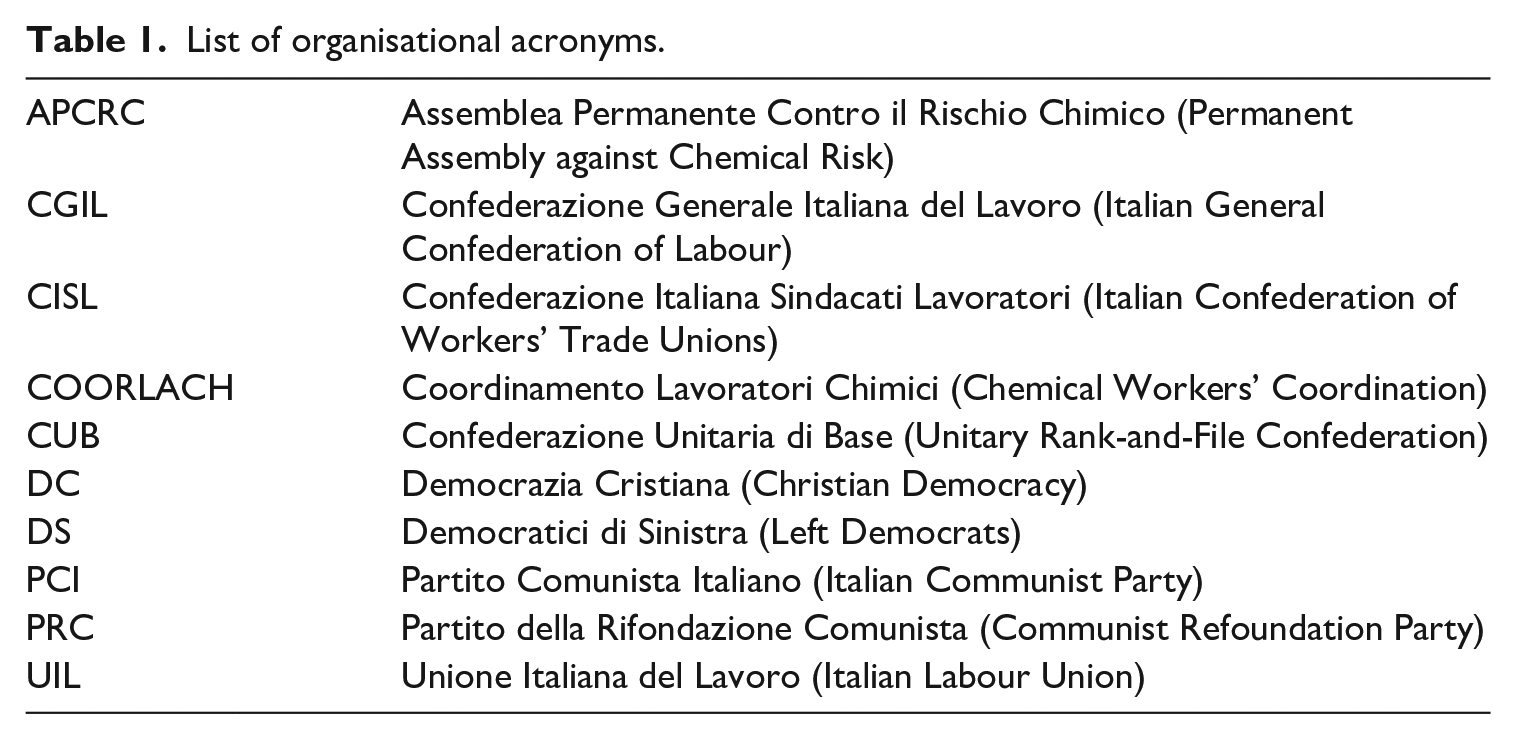
The workplace-centred camp was composed of the ‘confederal’ unions, CGIL, CISL and UIL, 6 and the majorities of the Centre-Left parties DS – originated from PCI – and Margherita – derived from DC’s Left (see Table 1). The community-centred camp had also originated in the workplace with the New Left factory groups, particularly the Porto Marghera workerist group, which had a key role in workplace struggles against noxiousness (Feltrin & Sacchetto, 2021). However, after being marginalised in the factories, the New Left put down stronger roots in the neighbourhoods. The community-centred camp thus became composed of environmentalist and workers’ health associations rooted in the history of struggles against factory noxiousness (most prominently AmbienteVenezia, Associazione Bortolozzo, Ecoistituto Langer and Medicina Democratica), the leftist PRC, the Green Party, the post-autonomist Rivolta Social Centre and the radical union CUB.
List of organisational acronyms.
In traditionally left-wing Marghera, the New Left gained popularity also by opposing industrial pollution, as shown by the fact that all Borough Presidents between 2005 and 2020 belonged to PRC or the Green Party. Many Green Party local leaders, such as Gianfranco Bettin and Michele Boato, had formerly belonged to the extra-parliamentary group Lotta Continua (Boato, 2019). The local CUB branches and the Rivolta Social Centre, instead, emerged mainly from the workerist organisations Potere Operaio and Autonomia Operaia. In the early 2000s, CUB still represented a vocal minority of Porto Marghera workers. In Petrolchimico, CUB was led by environmentalist employees such as Luciano Mazzolin, who had established the COORLACH news agency to denounce the industry’s noxiousness. Rivolta, instead, was based in a large, disused factory in Porto Marghera, self-managed by the local group of the post-autonomist Tute Bianche movement. It was also an important social milieu for working-class youths, for example the Venice football team supporters.
The workplace-centred and community-centred camps were both represented in the Venice administrations of the 1990s and 2000s, mostly led by ‘mayor-philosopher’ Massimo Cacciari. Even Tute Bianche had elected activist Beppe Caccia as a city councillor with the Green Party. The point of contention regarding Petrolchimico was, however, the complex of factories known in the public debate as the ‘chlorine cycle’: three integrated plants located downstream from ‘Petrolchimico’s heart’, its ethylene cracker, and producing respectively chlorine and sodium hydroxide, polyvinyl chloride (PVC) and toluene diisocyanate (TDI).
The community-centred camp held that Porto Marghera’s chlorine cycle constituted an unacceptable source of risk and health damage for the densely populated area, due to toxic emissions, the contamination of soil and water, and the storage of hazardous substances such as chlorine, vinyl chloride monomer (VCM) and highly lethal phosgene. Moreover, the ageing plants were subject to frequent leaks and accidents. In 1999, Associazione Bortolozzo published a report linking carcinogenic industrial emissions to higher-than-average cancer incidence amongst fenceline communities, demanding epidemiological research. In their view, the three plants should be closed and environmental remediation was needed to make space for cleaner production. Their position on employment was that workers’ income had to be protected through a combination of subsidies, employment in remediation works, and redeployment in other local factories (already existing or to be created post-remediation). Additionally, they supported Greenpeace’s calls for a global decrease in plastic production (particularly PVC).
The workplace-centred camp agreed that Petrolchimico had been a major source of noxiousness in the past but held that the trajectory of substantial technical improvements existing since the 1970s could be further progressed to achieve a sustainable cohabitation between the chlorine cycle and communities. It was with the double objective of relaunching industrial employment in Porto Marghera while improving the industries’ environmental performance that the Agreement for Chemistry between trade unions, employers (mainly ENI) and public authorities was signed on 21 October 1998.
Many activists in the community-centred camp stressed the heritage of Porto Marghera’s 1970s workplace-centred environmentalism but held that changing employment patterns had driven a wedge between factories and neighbourhood. As interviewee, janitor, and Rivolta leader Roberto Trevisan said: ‘My partner’s dad used to work with VCM, and he died of lung cancer. . . Almost everyone [from Marghera] in my generation, I’m 60, had someone in the family who died or had health issues. [. . .] Then employment went down because, obviously, technological innovation lessened the demand for labour. The wall they built along Via Fratelli Bandiera is also a political wall, separating the factories from the city.’
As Gianfranco Bettin, born and raised in a Ca’ Emiliani council estate, recalled: ‘In Marghera a different environmentalism emerged, in a narrower version even from within the factories. [. . .] At that point, some trade unionists did try to say we were elitist like previous environmentalists. But it was frankly untenable because some of us worked in the factories, or were the children, siblings, wives, or partners of factory workers. I mean, we were part of the working class.’
Just like the community-centred camp rejected the ‘elitist’ label, the workplace-centred camp insisted that it too cared for the environment. As Petrolchimico union activist Nicoletta Zago reflected: ‘The lab was my life, it was a job I always liked. This is why my pride was on the line with this story [the possible plant closure] and I’ve always considered it to be an injustice. [. . .] In any case, there had been a process of “environmentalisation” at Petrolchimico, that is, caring more for safety, workers’ safety and environmental safety. [. . .] We too were part of environmentalism.’
However, the relationship between the two camps had always been strained. The basis of this divergence arguably laid in the discrepancy between the social and technical compositions of the two camps. Throughout Marghera’s history, only a minority of the industrial area’s workers lived in Marghera (Nappi, 1994), which is hardly surprising as for many decades the number of jobs in Porto Marghera exceeded that of Marghera residents. However, in the 1960s, when Porto Marghera employed between 33,000 and 40,000 workers, 7 a high share of Marghera residents were employed in the factories (Bonello, 2017, p. 179). This gradually changed when employment in the industrial area started to decline in the 1970s (see Figure 1).
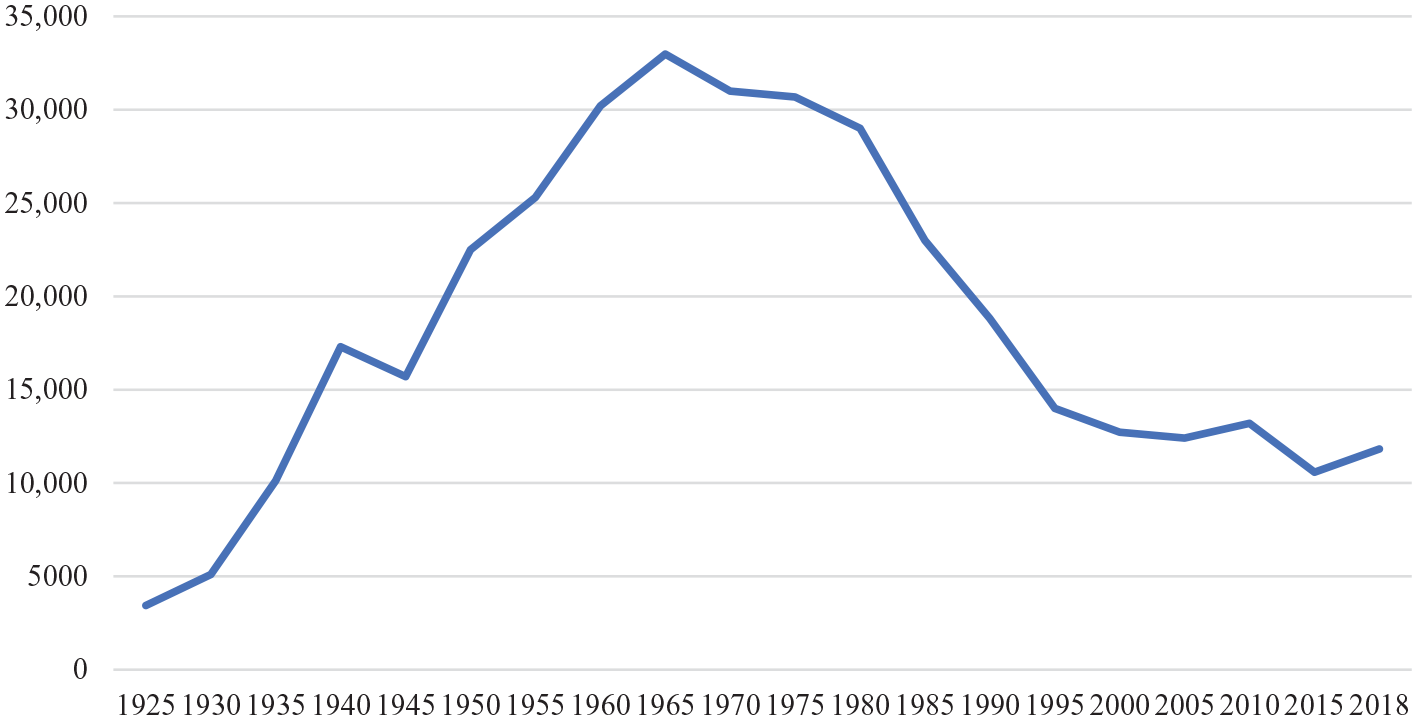
Number of employed in Porto Marghera.
By the 1980s, the relationship between neighbourhood and factories became uneasy as the locals found fewer and fewer jobs on the other side of Via Fratelli Bandiera. This malaise surfaced provocatively when the local reggae band Pitura Freska rose to fame singing: ‘Marghera without factories would be healthier: a jungle of corn, tomatoes, and marijuana’ (Marghera, 1991). Marghera was thus undergoing a deep ‘noxious employment deindustrialisation’ process, i.e. a situation in which the share of manufacturing employment in an area declines but burdensome industry remains (Feltrin et al., 2022).
The chlorine cycle directly employed about 600 workers, a large majority of whom commuted from the further urban centres of Mestre and Chioggia as well as rural localities scattered within and beyond the province. In turn, many Marghera residents commuted to insular Venice to work in its cultural sector, public services, hotels, shops and restaurants. Based on the framework adopted here, the majority of Marghera residents were working-class. However, as they were less industrially employed than before, most did not perceive the possible closure of the chlorine complex as a threat.
This widening divergence between the spaces of community and spaces of work set the stage for a political bifurcation between those employed in the chlorine cycle and those working elsewhere but living close to it. The next two sections provide an account of the resulting conflicts, interpreting them as the outcome of rising intra-working-class tensions due to the contrasting social and technical compositions of the class segments involved – a contrast that overrode to some extent their common interests vis-a-vis capital.
The Petrolchimico case: From occupational disease to environmental disaster
In the summer of 1994, retired petrochemical worker Gabriele Bortolozzo entered the office of Public Prosecutor Felice Casson to submit a complaint against his previous employers Montedison and ENI, based on his own lay research on the health of his colleagues at Petrolchimico (see Table 2). The blue-collar turned green activist believed the high number of deaths from cancer was due to exposure to VCM, an intermediate material in PVC production (Bortolozzo, 1994). Casson did open an inquiry, but Bortolozzo never saw the beginning of the trial. He was killed in a road accident while riding his bicycle on 12 September 1995.
Timeline of key events.
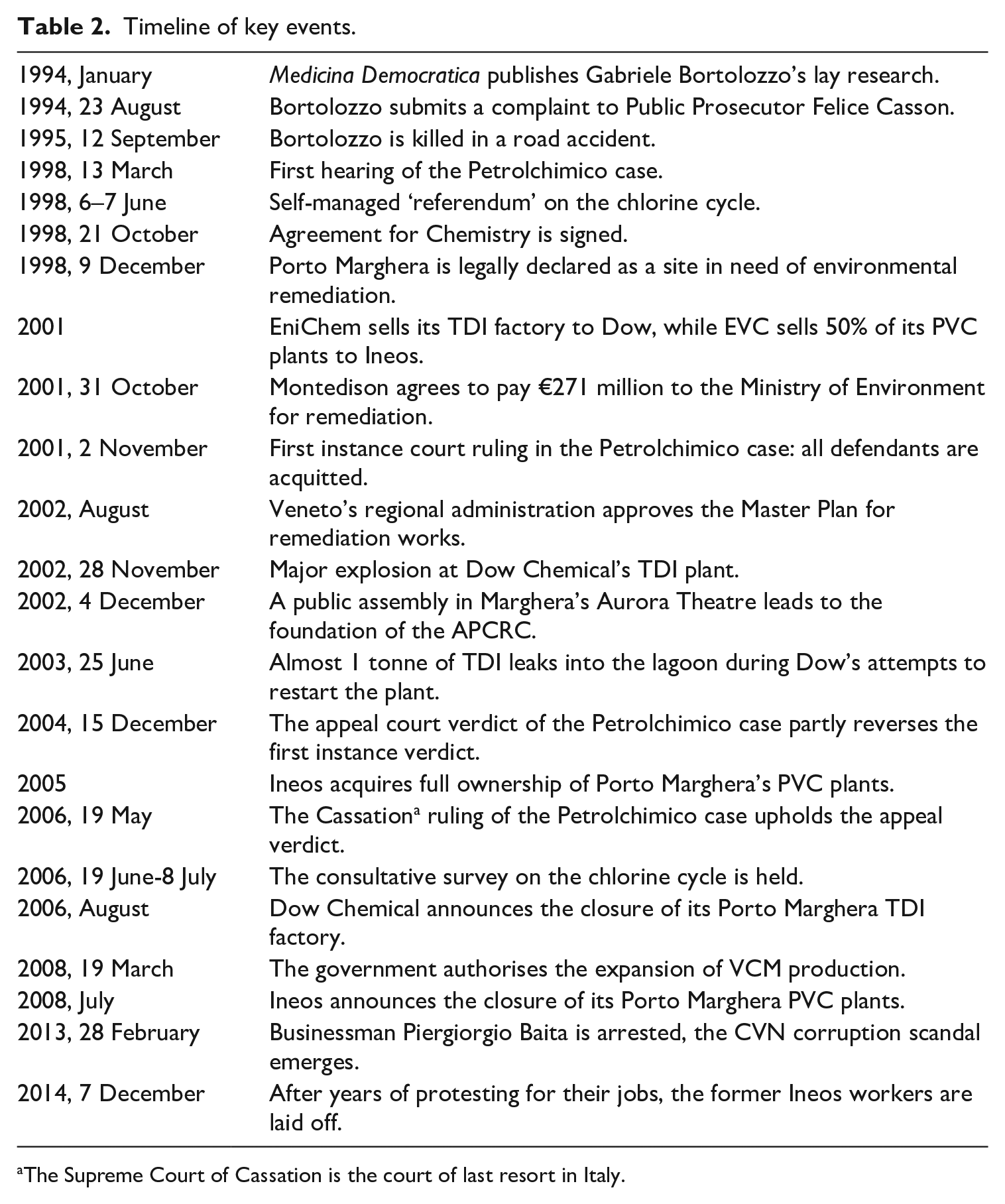
The Supreme Court of Cassation is the court of last resort in Italy.
Large numbers turned up for the first hearing of the Petrolchimico case, on 13 March 1998 in Mestre’s bunker-courtroom 8 (Allen, 2011). Thirty Montedison and ENI managers and doctors stood accused of charges including manslaughter, injury and environmental disaster, while hundreds of former Petrolchimico workers, relatives of the victims, unions, NGOs and public authorities participated as civil parties. The charge of manslaughter concerned the death by cancer of 149 Petrolchimico workers who had been exposed to VCM, although subsequent research updated the number to 248 (Pirastu et al., 2003). The charge of environmental disaster referred to the contamination of the soil and water surrounding the factories, the severe pollution of the Venice Lagoon, and the proliferation of noxious landfills in different areas. In fact, in December 1998, the government declared Porto Marghera a highly polluted site in need for remediation.
The stakes were high, as the legal case had become a battle over the narrative of Porto Marghera’s past with potential projections on its future (Cerasi, 2007). The workplace-centred and community-centred camps both endorsed the trial, but they diverged on how to interpret it. According to the community-centred camp, the lawsuit contributed to show that the chlorine cycle had to be closed down. To this end, it held a ‘self-managed referendum’ on 6–7 June 1998, collecting 23,000 signatures. The workplace-centred camp, led by CGIL’s chemical federation local leader, Bruno Filippini, countered that union action had substantially reformed Petrolchimico, and thus – while the trial was needed to address past wrongdoings – it had no implications for the future. These differences reflected an intra-working-class split that saw, on the one side, most workers currently employed in the chlorine cycle and, on the other side, a range of service sector and reproductive workers living in the area, with elderly and retired industrial workers – as well as middle-class allies – more evenly distributed between the two camps.
CUB was the only workplace-based organisation backing the community-centred camp. As the most direct inheritor of the 1970s’ workerist environmentalism, the radical union was adamant about holding on tight to the connection between workplace and community struggles. For example, in 1998 and 1999, prosecutor Luca Ramacci requisitioned the main Petrolchimico wastewater treatment plant and its SG31 incinerator under the charge that waste disposal violated legal requirements (15 ENI managers would plead guilty two years later). In response, the confederal unions staged strikes and roadblocks, but CUB criticised their move: ‘The workers must indeed defend their right to employment but without becoming hostage to those who only care for profits, and without agreeing to pay the price of diseases and deaths among workers and the population’ (CUB flyer, 22 June 1998). However, since the early 1980s, the relentless haemorrhage of industrial jobs and the resulting cogency of dismissal threats eroded the material bases of a workerist sway in the factories. By the late 1990s, CUB was far from having enough support in Petrolchimico to pressure the confederal unions to adopt a different approach.
Among the public at the Petrolchimico trial, a constant presence was the deceased workers’ widows, mostly housewives. The media, in line with hegemonic narrow conceptions of the working-class, represented them as ‘non-workers’, casting them in the role of passive victims. Instead, the definition of work adopted here, in line with social reproduction theory (Dalla Costa & James, 1972), sees them as workers in their own right, on the frontline of the care work required to mitigate the effects of noxious productive processes.
The first instance ruling came on 2 November 2001, after 150 testimonies and 1.5 million pages of documentation. The bunker-courtroom was packed and the atmosphere tense. Judge Ivano Nelson Salvarani slowly read out his verdict, reiterating ‘acquitted’ for each and every charge. The public – mostly retired workers, family members and activists – reacted with disbelief. Rivolta members led by Tute Bianche spokesman Luca Casarini broke into the courtroom and hung a banner reading ‘Guilty, yesterday like today’ under the inscription ‘The law is equal for all’. A heated debate erupted across the news media. What had happened?
The prosecution had shown that the carcinogenicity of VCM was first revealed in 1969–1970 by Dr Pier Luigi Viola and confirmed to Montedison by Professor Cesare Maltoni in 1972 (Casson, 2007). Yet Montedison did not publicise the information due to a ‘secrecy agreement’ subscribed to by the largest petrochemical multinationals (Markovitz & Rosner, 2002). VCM’s carcinogenicity became publicly known only in 1974, after the correlation between VCM exposure and death from the rare angiosarcoma cancer emerged in BF Goodrich’s Kentucky plants. The court, however, rejected the secrecy agreement thesis, interpreting it as a confidentiality clause to be respected until research on VCM could be completed. Moreover, the judges accepted the defence’s argument that, since 1974, Montedison had taken satisfactory safety measures.
Concerning the charge of environmental disaster, the court (like the defence) acknowledged the severe contamination of the soil, canals and lagoon by a great variety of pollutants (metals, polycyclic aromatic hydrocarbons, dioxins, etc.). However, it held that it could not be proven that Montedison and ENI were the main culprits or had violated any existing laws. Ironically, two days before the verdict, Montedison had agreed with the Ministry of Environment – until then a civil party in the trial – a compensation of €271 million for environmental remediation.
The community-centred and workplace-centred camps both appealed against Salvarani’s ruling. The appeal court verdict was reached on 15 December 2004. Five defendants were convicted for the angiosarcoma death of Petrolchimico worker Tullio Faggian, because – as VCM’s high toxicity had been known since the 1950s – Montedison had the legal responsibility of reducing workers’ exposure even before carcinogenicity was fully proven. Judge Francesco Aliprandi thus recognised Montedison’s responsibility for all other angiosarcoma deaths and Raynaud syndrome cases, but the statute of limitations for them had expired. The verdict also acknowledged Montedison’s responsibility for illegal discharges into the lagoon until the 1990s, but the statute of limitations for these irregularities had also elapsed. On 19 May 2006, the Cassation Court upheld the appeal court ruling.
Three days after the first instance court ruling, two different assemblies were held: one at Petrolchimico and the other in Mestre’s town hall. These locations mirrored the split between factories and communities. According to news reports, many Petrolchimico workers questioned the unions’ decision to appeal the verdict, wary that further bad publicity for the factory might jeopardise its survival. Trade unionist Luca Bianco argued instead that: ‘This verdict gave more room for manoeuvre to those [. . .] who want to shut down the factory pretending that nothing has changed since our struggles for health [began]’ (Il Gazzettino, 6 November 2001, p. 10). The latter were precisely those locals and activists gathered in Mestre’s town hall.
The mobilisations around the Petrolchimico case thus made public the schism between the two working-class environmentalist camps presented in the former section. On the one hand, most Petrolchimico workers championed a campaign to keep the chlorine cycle in Porto Marghera while improving its environmental performance, thus defending their interests as workers-as-producers. On the other hand, the community-centred camp prioritised a just transition away from the chlorine cycle as a way to defend the reproductive interests of the mostly working-class residents living by Petrolchimico. The next section demonstrates how the following events pushed such tensions to their limits.
Marghera on fire: The last fight over the chlorine cycle
On 28 November 2002, the operators of Petrolchimico’s TDI units are dealing with a malfunctioning due to the prolonged overheating of a TDI and chlorinated pitches vessel. Shortly after 7.30 pm, operator Pavan 9 hears a loud hiss from tank D525/1 and once on the spot notices white smoke seeping out. 7.42 pm, Pavan runs for cover, but he is hit by a hot, viscous substance. Tank D528/2 has exploded. The operator escapes to safety, albeit with a broken knee, but the unit is on fire. At 7.47 pm the fire brigades are alerted and at 8.30 pm the sirens screech through Marghera, the population is told to go home and shut their windows. For long minutes, the apocalyptic prophesy of Marghera ablaze seems to have at last come to pass. At 8.25 pm, while the firefighters are trying to control the flames, tank D525/1 explodes too. Its shock wave extinguishes the main fire, allowing the firefighters to rapidly gain the upper hand. The fire department’s official report later famously thanked all those ‘who, at their own risk, prevented the accident from having worse consequences, certainly benefitting from the assistance of divine Providence’.
In what many saw as ENI’s betrayal of the 1998 Agreement for Chemistry, Petrolchimico’s TDI plant had been sold to Dow Chemical in 2001. In 2005, three Dow managers would be convicted for the 2002 explosion. However, after the first instance court ruling in the Petrolchimico case, legal proceedings could scarcely appease the infuriated fenceline communities. This time, the focus of accusations was the highly lethal phosgene gas that was stored in a 15-tonne tank close to the TDI unit where the explosions happened.
On 4 December 2002, a large gathering of locals and activists led to the foundation of the APCRC, which united all the organisations that had already been campaigning against the chlorine cycle in addition to non-politicised residents whose trust in the industry had been broken by the accident. Even if some retired factory workers were still involved, the APCRC’s most prominent leaders were a mixture of middle-class professionals – such as IT consultant Anthony Candiello and health and environmental inspector Franco Rigosi – and service sector workers – such as janitor Roberto Trevisan and social worker Michele Valentini. While the older cohorts of my working-class interviewees who participated in the community-centred camp had a relatively stable employment trajectory as blue-collar workers, white-collar workers, or low-ranking public sector employees, the younger cohorts walked much more intricate paths, shifting between social work, hospitality, catering, manufacturing, logistics, subordinated cultural work and homemaking.
Isabella Aprile – a catering worker and Green Party activist who grew up on a Marghera council estate, and the daughter of a waste processing worker and a cook at Petrolchimico’s canteen – reflected: ‘In our group [of friends], all those who had lost their dads, their dads worked at Petrolchimico. [. . .] So you figure out you don’t want to end up like your dad and. . . Either you go away, and in fact most of them don’t live in Marghera anymore. Or you struggle to change the situation, and this is how you become an environmentalist. [. . .] My mom fell ill when she was 35 and died at 40. Plus, you didn’t need to work there [for your health to be affected], because Petrolchimico was here [close to her house].’ This exemplifies well what is meant here by community-centred working-class environmentalism, in which workers organise in their neighbourhoods to improve their conditions of reproduction.
Noting that ‘jobs keep going down while cancers go up’ (APCRC flyer, March 2003), APCRC began a long anti-chlorine campaign featuring several mass demonstrations (Benatelli et al., 2006; Chesta et al., 2014). Its largest event was the performance, on 23 November 2003, of a play titled ‘Bhopal’ by actor Marco Paolini, which attracted thousands to Marghera’s market square. Paolini drew a parallel between the 1984 Bhopal disaster caused by an accident at Union Carbide’s plant and the risks posed by the phosgene stored in Porto Marghera by Dow, which had in fact bought Union Carbide in 1999.
Meanwhile, remediation works were relaunched in 2002, using a combination of public funds and mandatory contributions by the industry, engendering hopes for a regeneration of the declining industrial area. However, between 2001 and 2005, maverick petrochemical multinational Ineos acquired full ownership of Porto Marghera’s PVC plants. According to Ineos and ENI’s plans, ENI would convert its chloralkali plant from mercury to membrane cells and Ineos would buy it if the public authorities granted permits to increase VCM production. Such ownership changes strengthened the prevailing view among Porto Marghera’s chemical workers that a transition beyond chlorine would be a leap in the dark.
Disagreements were also fuelled by the fact that, based on existing research, it was impossible to prove or disprove whether the chlorine cycle as operating at the time was a significant factor in the high cancer incidence amongst fenceline communities. Pollution, in fact, came from a wide variety of sources changing over the decades. The most recent review of health data and studies on Porto Marghera finds excess deaths for all causes, all tumours, and circulatory and digestive diseases (see Table 3). Evidence of causality between an excess of all tumours and occupational exposure is considered as ‘Sufficient’, while that between an excess of colorectal cancers, lung cancers and pleural mesotheliomas and environmental exposure is considered as ‘Limited’, an intermediate category between ‘Sufficient’ and ‘Inadequate’ (Zona et al., 2019, pp. 70–73).
Mortality for the main causes of death.
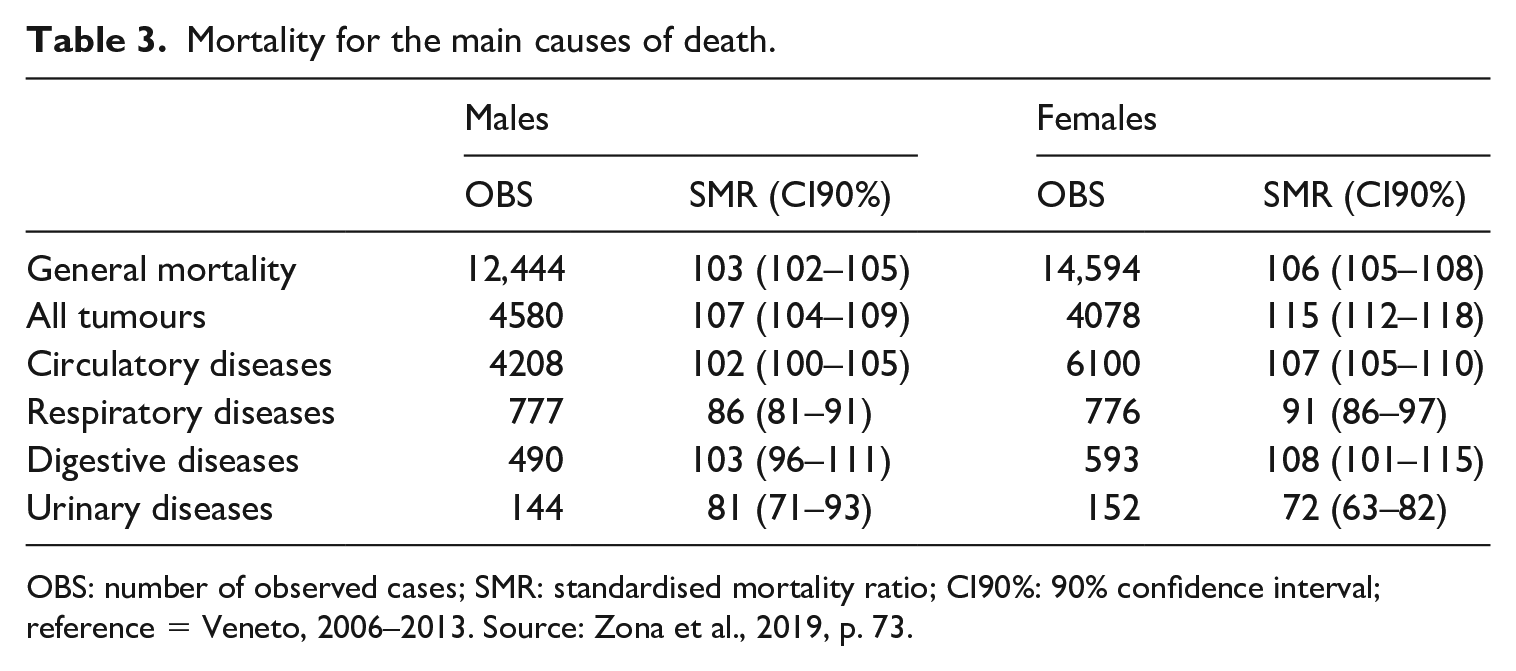
OBS: number of observed cases; SMR: standardised mortality ratio; CI90%: 90% confidence interval; reference = Veneto, 2006–2013. Source: Zona et al., 2019, p. 73.
In 2005, chemical workers staged a determined campaign of strikes and roadblocks demanding that the public authorities grant the permits required by Ineos. Meanwhile, APCRC collected 12,600 signatures in support of a consultative referendum on the chlorine cycle in the council area. After a heated debate, the council ruled that a consultative referendum on the matter would be illegal but agreed to organise a postal ‘survey’ instead. The run-up to the survey marked the highest point of acrimony between the two camps.
Between 19 June and 8 July 2006, all Venice citizens received a postal ballot with the question: ‘Do you want the production and processing of chlorine, VCM, and phosgene to continue?’ A week later, the survey results were out: 34.3% eligible participants expressed their view and 80% of these chose the ‘No’ option. Marghera was the borough with the highest participation rate (41%), with 80% against the chlorine cycle. The only area that delivered a ‘Yes’ majority was the rural neighbourhood of Trivignano, where a numerous group of Petrolchimico workers resided. If the Marghera result indicated that the community-centred camp had a significant working-class following, the Trivignano vote confirmed the same for the workplace-centred camp. However, Marghera residents voted according to their reproductive interests (a less hazardous and polluted environment), while the Trivignano residents voted according to their workplace-centred interests (job security).
In August 2006, Dow announced it would decommission its Porto Marghera plant. The corporation never explained if the survey had influenced its decision or not, although Dow Italia manager Roberto Lombardi only mentioned ‘market issues’ (Liberazione, 24 August 2006, p. 1). In any case, Dow’s 180 workers were furious. Remediation works were progressing at a snail’s pace and no ‘green chemistry’ investments were in sight for the workers to be redeployed. In December 2006, ENI agreed to re-hire the Dow workers who were not near retirement and would not find alternative employment, but this happened slowly and, for some, after years on income support schemes.
Meanwhile, in March 2008, the government overrode the national environmental commission to grant Ineos the final permits to expand VCM production. But the financial crisis was erupting and, in July 2008, Ineos announced it would abandon its Italian PVC plants, to the dismay of its 270 Porto Marghera employees. The factory was put under special administration in an attempt to find a buyer, while the workers – led by technician Nicoletta Zago – began a tenacious campaign in defence of their jobs, including spectacular actions such as the symbolic occupation of the plant’s flare stack and San Marco Square’s bell tower. ENI was this time unwilling to re-hire the Ineos workforce, although extra-ordinary income protection schemes were kept in place until late 2014.
The PVC plants never resumed production, and ENI’s chloralkali factory closed in 2009. At the time of writing, in 2022, ENI’s ethylene cracker is in the process of being decommissioned to be replaced with a plastic recycling plant, while some smaller chemical factories formerly part of Petrolchimico are still operating. The acetone plant 3V Sigma, however, exploded on 15 May 2020 and its reopening is uncertain. Despite the sudden and unplanned closure of the chlorine cycle, the bulk of Porto Marghera jobs were lost in the 1980s (see Figure 1). Yet, the composition of employment changed radically, with services rising and industry declining. Jobs in the chemical industry, according to EZIPM data, decreased from over 14,000 in 1965 to 2200 in 2005, to reach about 700 in 2018 (Città di Venezia, 2019).
An invisible part of this story was uncovered in 2013, when it turned out that Consorzio Venezia Nuova (CVN) – the consortium of companies tasked with carrying out Porto Marghera’s remediation works – was behind a network of bribes and illicit financing (for an alleged €1 billion) of politicians in exchange for public tenders. It emerged that Altero Matteoli – environment minister between 2001 and 2006 for the post-fascist party Alleanza Nazionale – had secretly obtained through CVN the award of an inflated public tender for Porto Marghera’s remediation works to crony entrepreneur Erasmo Cinque, after having brokered Montedison’s compensation in 2001. The tender for Porto Marghera’s remediation – worth an ever-inflating sum of hundreds of millions – was then awarded to CVN without competition. During the CVN trial, businessman Piergiorgio Baita allegedly declared: ‘Without CVN, Porto Marghera’s clean-up would have been easily completed by now’ (Il Gazzettino, 8 July 2016, p. 3).
Perhaps, a convergence between the workplace-centred camp and the community-centred one would have generated more effective pressure on employers and the state authorities to deliver environmental remediation that, to the present day, is far from realisation. Such remediation would have been in the interest of both camps, as it would have removed much pollution from the vicinities of residential Marghera while making space for new sources of employment. However, even if both sides were sincere in their efforts to apply the principles of working-class environmentalism, the discrepancy between their social and technical compositions was a major obstacle in the search for a unified political platform, also because it obscured the common class base of their grievances.
Conclusion
With the chlorine cycle gone and remediation far from completion, neither the workplace-centred camp nor the community-centred one realised their goals. The environmentally sustainable chlorine cycle envisioned by the unions did not materialise, and neither did the regeneration based on post-remediation green jobs advocated by the environmentalists. Moreover, the increased reliance of the local economy on commodified tourism in Venice generated its own problems – and related social movements – particularly more precarious employment patterns, the further expulsion of Venetian residents to the mainland, the damage to the lagoon’s ecosystem engendered by large cruise ships, and a considerable contribution to excessive air traffic. Yet, on the one hand, the workplace-centred mobilisations protected workers’ income to some extent through the re-hiring by ENI and extra-ordinary income support schemes. On the other hand, the community-centred camp achieved significant environmental improvements in terms of partial remediation and reduced industrial pollution and hazards.
The separation between workplace and community – with the ensuing differences in patterns of interest formation – led to divergent perspectives. In fact, behind the information war waged between the two camps through the media there was also a different political vision. The workplace-centred camp embraced a horizon of green growth (backing investments to expand production while making it safer), while the community-centred camp had a more anti-productivist view (supporting a global decrease in plastic production). The split was compounded by the general trend towards labour market flexibilisation and employment deindustrialisation, which diminished the chemical workers’ chances of successfully taking up community grievances.
As a reflection on this experience, Gianfranco Bettin published a novel titled Cracking (2019), a reference to Petrolchimico’s last major plant. The protagonist is a retired petrochemical worker enraged about the fact that his former colleagues are being left without viable employment alternatives. The narrative, written by one of the most visible leaders of the anti-chlorine campaign, is meant as a contribution to heal the fracture between the workplace-centred and community-centred camps through the perspective of its protagonist, both Marghera resident and former union activist.
Based on the threefold expansion of conceptions of working-class, work and working-class interests, this story has uncovered class in community-centred struggles and environmentalism in workplace-centred struggles. While calls for a broad conception of working-class are not rare (e.g. Antunes, 1999/2013; Cleaver, 1979/2000), and the acknowledgement of reproductive work has been an established feminist theme since the 1970s (Dalla Costa & James, 1972; Fortunati, 1981/1995), this article roots these two concepts in dispossession and links them to a third, that of working-class-interests. This contributes to the emerging literature on working-class environmentalism (Barca & Leonardi, 2018; Bell, 2019) by showing how reproductive interests are the material basis for working-class environmentalism, but also explaining the divergences between working-class segments with different social and technical compositions through the distinction between workplace-centred and community-centred interests. Further research is needed to apply these insights to conflicts around polluting industries making products that, unlike plastics, would be key to an ecological transition, as well as to cases in which efforts to bridge the separation between workplace and community organising were more successful.
Such efforts are necessary because, like the molecules pumped into petrochemical cracking plants, life in capitalism is cracked by the frontier of commodification that separates production from reproduction. As commodified production – based on dispossession and driven by profit – is structurally geared towards environmental degradation, an element of future just transitions could be that of pushing back the frontier of commodification to bring more wealth creation outside of the market. Coalition building across workplaces and communities will be decisive in the creation of the broad social movements necessary for this to happen.
Footnotes
Acknowledgements
I would like to thank David Brown, Alice Mah, Devi Sacchetto and Leo Singer for their valuable feedback on this article, the Toxic Expertise team, all participants in this research, as well as the Marghera Municipal Library’s (outsourced) workers.
Declaration of conflicting interests
The author has declared no conflict of interest.
Funding
This study received funding from the European Research Council under the European Union’s Horizon 2020 research and innovation programme (Grant Agreement No. 639583) and by the Leverhulme Trust (ECF-2020-004).