




Abstract
This article offers a creative disjunctive feminist analysis of affective rhythms within a complexly bordered complex of favelas in Rio de Janeiro. It explores the gendered atmospheric constitution of authority in the favela’s violent border spaces, arguing that authority is partly embodied through a channelling of attention. Attention is conceptualised as involving not just conscious intentions, perceptions and emotions, but also non-conscious rhythms of autonomous affective self-regulation. The article is structured through a tripartite disjunctive form that expresses the bordering of city, body and experience. Drawing on qualitative interview data, quantitative electrodermal activity physiological data and creative writing, the article dwells with the materiality of words and the forms of affects to express material and physiological aspects of emotion and affect in journeys around the internal border-spaces of the city. Adapting the modernist tradition of ‘stream of consciousness’ writing, we style a ‘stream of attention’ form of writing that expresses multiple modes of embodied, conscious and preconscious attention.
Keywords
Introduction
This article extends traditions of creatively exploring the forms and styles of sociological writing (Agger, 2007; Back & Puwar, 2012; Leavy, 2016), experimenting with new ways of writing the embodied emotional and affective rhythms of a violently bordered community in Rio de Janeiro. Its ‘disjunctive’ form expresses aspects of the bordering of body, city and subjectivity in a community that suffers high levels of gendered and racialised violence, stigma and territorial fragmentation. Drawing on qualitative interview and observational data, quantitative physiological data, as well as creative writing, the article dwells with the materiality of words and the forms of affects (Brinkema, 2014) in writing a creative sociography of the material and physiological rhythms of violent urban border spaces.
Methodologically, the article extends recent experiments with using mobile electrodermal biosensors to understand the affective rhythms of a Rio de Janeiro favela. Linking feminist new materialist debates to discussions of the biosocial and neuro-urbanism (Fitzgerald et al., 2016; Meloni et al., 2016; Pykett, 2018; Pykett et al., 2020), through a focus on the embodied rhythms of what we theorise as the ‘urban skinscape’, the study sheds light on the embodied, atmospheric circulation of authority within urban communities that are organised through a violent multiplication of borders (Mezzadra & Neilson, 2013). We show how authority in the favela is embodied partly through a channelling of attention. It achieves this by placing extremely high emotional and attentional demands upon women living in the favela. ‘Attention’, here, will be conceptualised through a feminist materialist lens that locates attention, not solely in perception and conscious awareness, but also in embodied spatial practices and distributed cognitive assemblages (Frost, 2020). The organisation of embodied attention in the favela, we will argue, works by shaping gendered rhythms of affective and emotional self-regulation.
Whilst much research using mobile biosensors takes a broadly positivist approach to urban emotions (Osborne & Jones, 2017), we suggest that a great deal of caution is needed in claiming scientifically valid inferences from mobile biometric data, given the impossibility of establishing the kinds of controls that are standard in laboratory-based research. We do not make such claims in this study. This is not to say, however, that mobile biometric data do not provide important and revealing insights into the embodiment of affect. Yet it is important not to assume that emotion is the same as affect, or that physiological processes translate neatly into lived experiences. Often, the quantitative physiological data tell a different story to the qualitative data based on the lived experiences of our research participants. Making sense of these disjunctive stories requires interpretive and creative forms of sociographical imagination. The form of this article expresses this disjunctive story. Rather than synthesising quantitative and qualitative data into a single unified narrative, it is formally structured through the development of three different analytical voices, which offer different ways of interpreting the different bodies of data. Rather than synthesis, the article aims for creative disjunctions, exploiting the potential of the gaps and narratives between different narratives and forms of evidence.
The urban skinscape
Brazil’s favelas are splintered and fragmented into multiple territories controlled by rival criminal factions and militias. Borders separating favelas from the formal city are policed through forms of spatial stigma that mark out those living in the peripheries as ‘discounted’, devalued lives (Mbembe, 2019). The borders of the favela function as a kind of social skin, marking out anyone in the peripheries as undesirable, disposable, surplus, woundable, or killable. Routine use of lethal violence by police, everyday harassment, abuse and stigmatisation of residents of the country’s favelas, and the violence of narcotics gangs, along with widening economic inequalities, create a climate of terror among the urban poor (Wacquant, 2008). Systematic anti-black violence is concentrated in the country’s favelas (Da Silva, 2010; Flauzina, 2006; Nascimento, 2016). Lethal violence is predominantly targeted at young, black men. Partly for this reason, women’s experiences of violence in favelas have been relatively neglected (Wilding, 2011, 2012). This invisibility of violence against women occurs because of a tendency to over-emphasise the immediate, physical effects of violent police encounters, and to under-emphasise the effects of subtler, slower forms of violence, intimidation, suffering and grief (Smith, 2016, pp. 185–186). In favelas, women are much less likely than men to be killed (though see Barbosa, 2001; Romio, 2009), but disproportionately suffer the effects of non-lethal, routine forms of violence and terror (Alves, 2018; Krenzinger et al., 2021; Perry, 2013; Rocha, 2012; Santiago et al., 2019). This violence has profound impacts on women’s mobility – a key aspect of the right to the city. However, the distinctive patterns of women’s experience of mobility in favelas, which are fragmented into several different gang territories, have not received sustained attention. An important exception is Wilding’s (2012) remarkable study of boundaries and experiences of gender and violence in Brazil’s favelas. We aim to build on this research by applying novel conceptual frameworks and experimental empirical methods to shed further light on women’s experiences of mobility in violently bordered urban communities.
How, then, does violent bordering impact gendered and raced experiences of mobility, authority and urban space? In this study, we address this question through an analysis of women favela residents’ embodied, lived experiences of urban mobility, in particular the distinctive forms of attention that are required when navigating the city. In developing this intersectional phenomenology, we extend recent feminist sociologies of skin (Probyn, 2015), which shift the focus of feminist analysis from ‘body’ to ‘skin’. This enables us to emphasise relations between, within and across bodies: to sensuous, affective scenes of touching and mingling between flesh, city, technology, atmosphere and community. Thinking with skin draws attention to the mutual implication of bodies and borders (Billé, 2017; Connor, 2004; Serres, 2008). Rather than asking how the violent splintering of the city stamps power upon the body, we ask how bodies perform active labour in co-producing the authority of urban borders, constructing an ‘urban skinscape’ – a topological mingling of body and environment – that enacts a distinctive form of attention and authority.
Or
Our analytics of gender, violence and mobility in Brazil’s favelas starts from a feminist new materialist way of ‘thinking through the skin’ (Ahmed & Stacey, 2001). We start with skin because gendered and racialised urban borders distribute authority in ways that not only use skin as a marker of identity and target the skin as an object of violence, but also enrol skin in producing the border, partly through their mobilisation of the body’s autonomous nervous system. Skin is the largest organ of the body, and has several functions, including immunity, perception and controlling body temperature. The levels of sweat on the skin also reflect unconsciously controlled changes in the body’s autonomic nervous system, which is responsible for unconscious processes that regulate the internal environment of the body (Dawson et al., 2007). An important component of the autonomous nervous system is the sympathetic nervous system, a rapid-response mobilising system that facilitates immediate motor action (the ‘fight or flight’ response). Increased sympathetic activity is associated with corporeal indicators of autonomic arousal including sweating, increased heart rate and blood pressure. When we are affectively stimulated, the skin sweats more, leading to measurable changes in the electrical conductivity of the skin. The result of this is that variations in individuals’ affective responses are expressed in measurable changes in the electrical conductivity of their skin.
Recognising skin’s role in the sympathetic nervous system, we suggest that border and skin are co-composed as an urban skinscape through intersecting materials and processes: embodied infrastructure, affective atmospheres, bordering practices, technologies, buildings, bullets, clothes, ecologies, emotions, buildings, bricks, guns . . . as well as the mundane rhythms of everyday practices. This emotionally and affectively charged skinscape is a topological space in which organic skin touches, enfolds and mingles with the atmospheric, technological skin of the city (Griffero, 2018). It is a border region between city and soul (Serres, 2008). It is the place where affective atmospheres make an impression (Ahmed, 2006, p. 9). Bodies respond to an atmosphere that envelopes them, guiding their capacity to affect and to be affected. The city’s climate of terror seeps into the skin’s surfaces and lesions, moulding the physiology of the body. Conversely, skins are enrolled into performing active labour and co-producing urban borders. Thus, in lingering on the materialities of skin, our analytics of embodied authority traces the folds of a skinscape that bears the scars of violent bordering, but also is invested with potential and possibility.
Or
This article crafts a form of sociographic imagination that experiments with thinking with the skin: an affective, perceptual and attentional surface upon which consciousness only occasionally and fleetingly passes. The article styles a ‘stream of attention’ that creatively explores the affective atmosphere of the favela, as it impacts upon preconscious affective rhythms, conscious thoughts and feelings, and more-than-human, dispersed relations of authority. It is the fruit of an exploratory collaborative research project between: an NGO programme coordinator and doctoral candidate (Malanquini); a UK-based human geographer (Brigstocke); a Rio de Janeiro-based neuroscientist (Froes); a Rio-based artist (Cabral); and a translator and producer (Baptista). Data collection was coordinated by Malanquini, who conducted the qualitative interviews. The quantitative research was designed, analysed and interpreted by Froes and Cabral. Cabral led a participatory art installation, discussed elsewhere (Brigstocke & Cabral, 2015), which explored the data and the issues raised by the study with research participants and other members of the public. Brigstocke led the project and drafted the writing for this article. The thoughts and observations described in these ‘stream of attention’ passages are inventive syntheses of the empirical research data, including close paraphrases of interview quotes or ethnographic observations, as well as imaginative reconstructions of the quantitative data. All research participants granted permission for the data to be used in through creative forms of interpretation. The research participants did not take part in the drafting of this article; however, they were invited to take part in a new, larger participatory project where participants co-produce research outputs using expressive forms with which they feel most comfortable.
Disjunctive writing
Our research draws on semi-structured interviews with 8 adult women living in the Maré community of favelas. The participants discussed their experiences of everyday mobility within the favela, as well as one or two specific journeys that were undertaken with an electrodermal activity sensor. We aimed to understand the embodied, lived experience of living in a violently bordered urban environment, and to understand the emotional circuits of fear, stress, comfort and other emotional relations around the favela’s border spaces. By doing so, we contribute to a feminist analysis of violence ‘from below’ (Fluri, 2009), hoping to understand how women’s agency and labour transform the ambience of the favela, making room to breathe in a stifling regime of atmospheric terror (Fregonese, 2017).
Or
Our research methodology is informed by ongoing debates around neuro-urbanism and biosociality (Meloni et al., 2016; Pykett, 2018; Pykett et al., 2020), responding to sociologists’ calls for creative responses to the interface between city, society and brain (Fitzgerald et al., 2016). We make experimental use of biophysical data derived from participants’ electrodermal activity (EDA) – in other words, the level of electrical conductivity on their skin. In doing so, our research offers a significant advance in empirical research on biosociality, addressing the overwhelming emphasis on the global north in such work by siting our study in urban peripheries in the global south. To our knowledge this is the first academic study to use biosensors in research environments such as favelas or other informal urban communities.
Working with these biophysical data opens up interesting and creative possibilities for sociological work exploring the physiological, affective and non-human dimensions of emotion. For this research, we asked our eight research participants to wear a small Shimmer3 electrodermal biosensor: a small box strapped to their wrist, with two sensors attached to two of their fingers. 1 The participants then embarked on one or two routine journeys that are part of their ordinary everyday life. Unlike other biosensors like electroencephalography (brain scanning) sensors, this device is unobtrusive, making it ideal for our purposes here, where concerns around security and anonymity are paramount. A GPS tracked the participants’ location and these data were linked to the biometric data. The biophysical data give us insight into the preconscious rhythms of women’s neurophysiological and affective bodily states, and how these rhythms changed as our participants moved across different areas of the city, including the border regions. By doing so, we become able to see how skin, as a dynamic and active component of the neurophysiological link between body, city and soul, actively co-creates the atmosphere of the city’s border spaces.
In contrast to the broadly positivist approach of most research using biometric sensors, our approach extends recent experiments with tracking people’s affective states across space (Nold, 2009; Osborne, 2019; Osborne & Jones, 2017; Resch et al., 2015; Zeile et al., 2015), using an approach which is qualitative and experimental. Electrodermal activity data are very challenging to interpret (Poplin, 2020). The data offer the researcher quantitative information about levels of affective arousal. However, they tell us nothing about the quality of the affect, or how it is experienced at a subjective level. In electrodermal activity readings, an episode of joy may look the same as a feeling of fear, and dwelling on a memory may be indistinguishable from reacting to an external stimulus. Our suggestion is that electrodermal activity data are useful only insofar as they prompt the researcher to work with (not against) the ambiguity, uncertainty and opacity of affective life. Biophysical data should not be used as a privileged source of authority for pinning down the ‘objective truth’ of a city’s emotional or affective energy. Nevertheless, biophysical technologies enabling researchers to read the body in new ways have promise as performative and experimental research tools that can elicit rich emotional and narratives from research participants (Beljaars, 2020; Osborne, 2019; Osborne & Jones, 2017). Such studies do not use biometric data to mobilise the body as an authoritative source of data that somehow ‘speaks for itself’; instead, they use them as generative and experimental tools for qualitative and theoretical analysis.
In working with the quantitative biophysical data, we refuse the temptation to interpret the quantitative data by asking questions along the lines of ‘what really happened, and why?’, or ‘what does it really mean?’ This would be a kind of ‘restrictive disjunctive’ reasoning, one that assumes the form of ‘either/or’; ‘true/false’; it happened or it didn’t; this is what it really means (Deleuze & Guattari, 2004). What interests us is whether quantitative neurophysiological data and qualitative interview data might instead be reassembled through an inclusive and affirmative disjunctive synthesis which works with and multiplies gaps and absences (Deleuze & Guattari, 2004, p. 84). We thereby inhabit the dissonance and discontinuities between disjointed terms, rather than resolving them. Disjunctive synthesis embraces the pluralising formulation ‘either. . .or. . .or’, not the restrictive formulation ‘either/or’, which fixes borders and boundaries. The inclusive disjunctive synthesis we stage in this article expresses a logic of difference, multiplication and affirmation. It is aligned with the kind of ‘additive and accretive’ reparative reading theorised by Sedgwick (2003, p. 149).
Or
We are searching for a style of writing that might communicate non-representational aspects of the intimacies and exclusions of the urban skinscape. New materialist theories recall to us the importance of asking how we can think the world through the materiality of our words. Writing does not only describe and represent the world as it appears to us, but can think ‘beyond’ our world, stretching words and meanings, to enact an ‘oscillation of writing between the functional, the speculative, the worldly and the cosmic’ (Roberts, 2019, p. 645). This task is especially pertinent for feminist and anti-racist sociologies that mobilise experimental materialisms to resituate and reimagine global divisions.
Atmospheric authority
Patrícia has lived in the Maré since she was little. A single mother with two daughters, she works as a cleaner. Her daily journey, first to her children’s daycare and then to work, takes her across the borders between communities controlled by different criminal groups. In describing her experiences of moving around the favela’s border regions, Patrícia emphasises how stressful walking in the border region is – especially when accompanying children. Very high levels of attentiveness are required to navigate the favela safely. Managing stress and fear requires directing all her attention to the ambience of the urban environment: I feel unsafe at any moment, because these things [shootouts] happen at any moment; every time we go by . . . [I am] very watchful, looking at everything, always focusing . . . because it [a shootout] happens at any moment . . . Yeah, at any time, we have to pay a lot of attention, be very watchful. (Interview, Patrícia)
Mobility within the favela is directed through a diffuse form of authority that guides and directs residents’ conscious attention. This requires a carefully calibrated attunement to the affective and emotional composition of the city (Stewart, 2011). Authority functions by directing attention, working through ‘detailed directional movement of embodied attentional engagement’ with surroundings that afford and solicit certain orientations, and withhold and discourage others (Hannah, 2019). In the streets of the favela authority is partly constituted through directing attention, towards certain phenomena (potential risks or signs of trouble) and away from others (everyday conviviality, building relationships, social connections). This produces the urban skinscape as a relational field of tension, disconnection, stress and isolation.
Whilst Patrícia says that she can cross the borders between communities relatively easily, the borders are still clearly spaces of tension. ‘Look, for me . . . there’s no problem, you know? Because I move around anywhere . . . The boys [guarding the border] may look . . . If he looks and he doesn’t like your face, if he sees you crossing, it’s already trouble. It’s not much of a problem for me, because they know I come here to work, but I think that if it were, like, normal, me going back and forth every day, if they didn’t know, they would have a kind of mistrust. You know?’
The threat of violence, threaded into the seams of the everyday, demands constant vigilance. The ever-present danger is of getting caught up in the crossfire during a police raid. Such traumatic experiences guide residents’ orientations within the favela. However, fear can be reappropriated, restyled and re-armed. One interviewee, who had witnessed her son (who was unarmed and wearing his school uniform) being shot and severely injured by police, lives in constant fear of her family becoming caught up in another shootout. She is determined to put fear to good use: Here as well as in any other place . . . I walk around armed. I don’t mean in the sense of being armed with a weapon. It’s a manner of speaking, because I’m afraid of being somewhere and a shootout starting at any moment . . . After what happened to [my son], I walk around armed in that sense. Armed to protect myself, wanting to protect my family. Scared. That’s the weapon I mean: fear. (Interview, Juliana)
Here, fear becomes an embodied resource through which to navigate and orient herself within an asphyxiating urban milieu. Fear solicits an active, embodied and exhausting hyper-attentiveness.
Or
Patrícia takes a bicycle journey from her workplace in the favela to drop off her daughter at daycare and later, in the evening, returns home again. Each time, she crosses two borders dividing the territories of different criminal factions. The rhythms of this tense skinscape fold into Patrícia’s body, mingling in unpredictable ways with non-conscious biophysical responses. Authority prints itself upon the surface of the body, folding into and under the skin. It moulds – and in turn is moulded by – the neurophysiological architecture of the body.
Figure 1 shows a graphic representation of Patrícia’s biophysical data over two journeys. How are we to interpret these data? Rather than trying to connect individual peaks and troughs to specific events (corresponding each peak and trough to what ‘really happened’), our approach is to look at the broader rhythms of affective self-regulation, viewing them as autonomous processes that cannot or should not be given representational meaning by linking them to specific lived experiences or emotions. These rhythms of Patrícia’s affective responses offer us insight into how her sympathetic nervous system responds to, adapts to and actively co-constructs the authority of the skinscape. In the graphic representation of electrodermal activity, two aspects of the data are particularly important: changes in the ‘phasic’ levels, and the changes in the ‘tonic’ levels. The phasic levels are the fast-changing elements, responding to changing stimuli. The tonic level is the slower-changing baseline. We also see changes in skin temperature, where low skin temperature is a possible indicator of stress. One key feature is ‘autonomic variability’ – the difference between the highest peaks and the lowest troughs of affective activation. This is because the levels of autonomic variability give important insight into the sympathetic nervous system’s capacity to be affected.
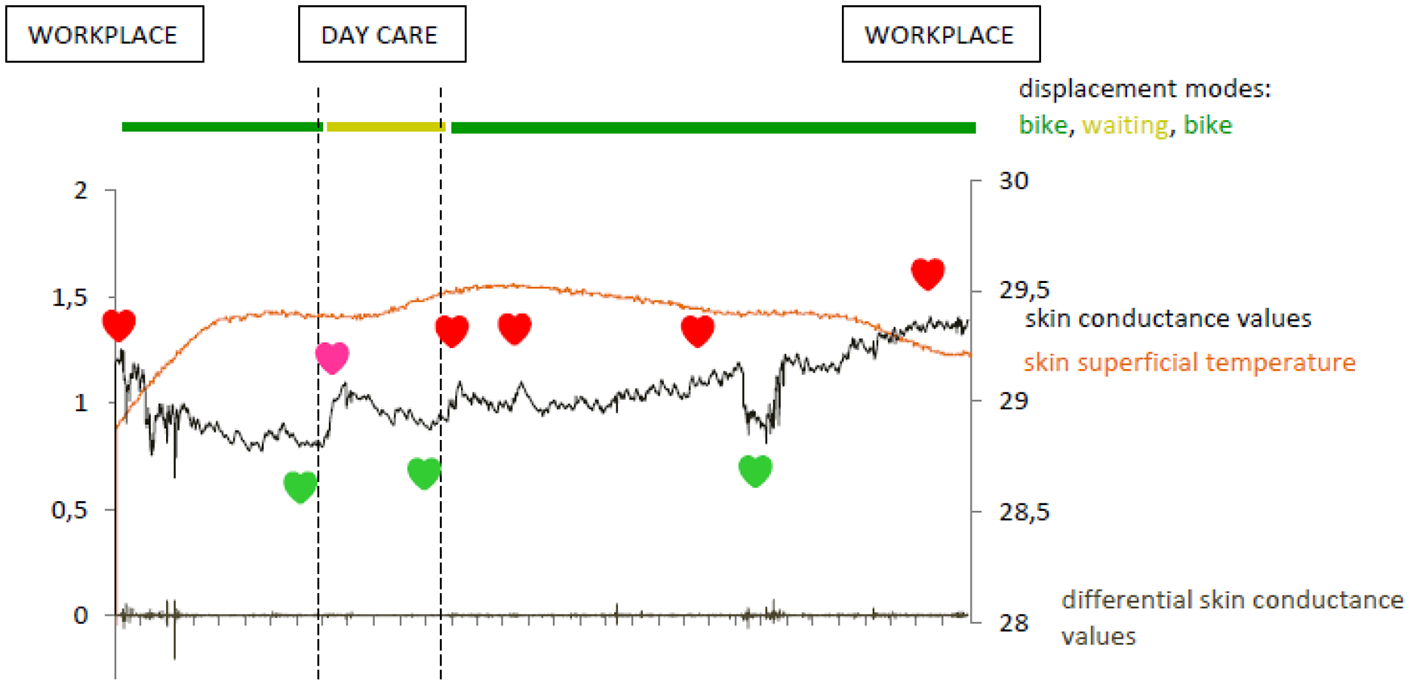
GSR readings for Patrícia, travelling from her workplace to her daughter’s daycare.
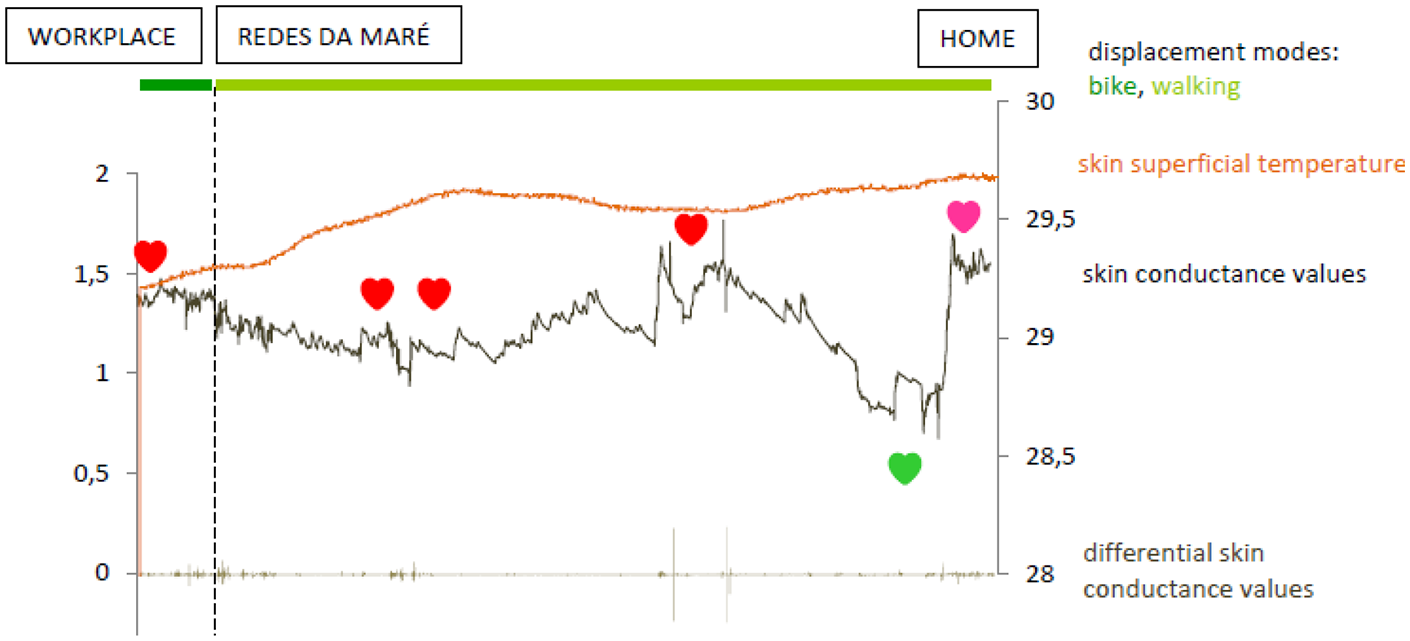
GSR data for Patrícia, returning home in the evening.
Several striking aspects to Patrícia’s electrodermal activity are noticeable. First, during her journeys across the favela, her levels of sympathetic arousal are high, and also show fairly strong autonomic variability. The journey generates high levels of sympathetic arousal. It is very stimulating; it generates considerable affective and cognitive demands. Second, Patrícia’s autonomic variability (her body’s range of sympathetic responses) appears to be highest during the journeys with her daughter. When she stops at daycare, her levels of arousal decrease, and show higher levels of variability. This is an indication she is feeling more relaxed: in a calm state, the body’s affects are more supple and responsive. When she is with her daughter in the most dangerous border spaces of the favela, Patrícia’s levels of affective arousal show high variability – her sympathetic nervous system responds with agility to the attentional demands of the favela. She is very alert, performing high levels of mental workload. By contrast, when she arrives at work, Patrícia’s skin temperature lowers, her tonic level of sympathetic arousal is high, but her affective responses fluctuate quickly but not strongly. These rapid but shallow reactions are consistent with high levels of stress.
We can see that the streets of the favela make demands on attention that enrol bodies’ affective capacities in the production of a gendered skinscape. The labour of social reproduction (in this case, the journey to drop a child at daycare) – becomes visible in terms of the extraordinarily high levels of cognitive labour it demands. By focusing on the biophysical rhythms of affective stimulation, we see that authority, far from being stamped upon the skin, is co-constituted through a dynamic interplay of body and environment that functions to channel and direct attention in certain directions, to the exclusion of others.
Or
Two hands, a mother’s and a daughter’s, find comfort in the touching of skin in the afternoon heat, chatting away, the road bustling with street vendors, and all is quiet, and, the atmosphere is thickening, the heat and noise and memory, pressed into the skin of the city, into the touch of the sidewalk, into the air, and, asphalt and concrete and the heat of the sun and the sticky smell of the sewer, and boys watching them, observing, judging, and cascading surges of acetylcholine, sending chemical messages to the sympathetic nervous system, releasing noradrenaline and then adrenaline, and now it is hard to breathe, and, a memory flickers in the skin, in the flesh, of being caught up in a shootout at this very spot, and, gripping hands a little tighter, taking comfort in each other’s touch, and, a release of receptors on peripheral tissues bind and trigger the effects of fight-and-flight responses, heart rate accelerating, sweat on the skin, a tiny surge of electrical conductivity, a tightening of pressure, harder and harder to focus on the chatter of her daughter, give her the attention she needs, distracted, remembering that terrifying police raid, and a thought bubbles into conscious, and, ‘there was one time I came to work, I got really scared. There was an operation, and the Skull [military police armoured vehicle] came into the main street. That’s how it is . . . I was scared, I didn’t want to come through, but since I had a lot of work, I had to come . . . When I went by, when I turned the corner, girl . . . the shoot-out broke loose. . .’, and, approaching daycare now, chatting more freely, the grip of fear loosened, the rush of cortisol and adrenaline slowing, skin warming, feeling calmer, the air is lighter, filled with the clatter of shouting children shifting the tone of the atmosphere, safely sheltered, a surge of warmth as daughter greets friends and sets to play, and, already she is thinking of the walk home, in the dark, apprehensive already, and, ‘I think the police should really provide us with safety. You know? But they don’t, they don’t care, they just want to know that it’s written in their little piece of paper that they came here, they did the operation, they arrested this, they arrested that. But the truth . . . the truth that is spoken here, is it’s not like that. They terrorize us and they leave.’ (Based on interviews with Patrícia. Passages in quote marks are direct quotes from the interview.)
Wounded attention
The story of Letícia, a 28-year-old recovering drug user, illustrates how violent bordering can drastically curtail women’s mobility. For Letícia, the favela’s convoluted borderscape manifests itself in a fear and anxiety that make it impossible to move outside a highly stigmatised territory known as ‘Crackland’. This undermines her capacities to form connections with others. Letícia has suffered a history of gender-based violence, including sexual abuse as a child, and violence from her current partner. Although she spends much of the day walking around the community, she never crosses from the favela into the formal city and she takes long detours to avoid crossing into areas controlled by rival gangs. For Letícia, these borders are sites of fear and violence. When asked if she is afraid to cross the boundary into the territory of a different criminal faction, she replies: I am, I am, I don’t go that way, I don’t walk around there. I’ve never been there and I never will. Because I’m from this side, the guys over there know who’s who . . . they’ll take me in there, they’ll tell me . . . they’ll do mean things to me. (Interview, Letícia)
Unlike the other women interviewed for this study, who felt relatively free to cross into communities controlled by rival criminal organisations, Letícia does not have a job or other legitimate ‘excuse’ to cross the boundary, and as a known drug-user and occasional sex worker, suffers high levels of stigma within the patriarchal gang culture of the favela. Fearful of gang members within and beyond the territory, Letícia is compelled to stay in place, leading a life that is spatially constrained and cut off from social ties and connections. This produces a borderscape that is individualising, alienating and profoundly isolating. As Letícia puts it, ‘I don’t ask for nothing, but I also don’t give nothing. This asking business doesn’t work.’ She is cautious of ‘phony’ people ‘who say they’re your friends . . . and nobody is nobody’s friend, just God and family, of course . . . few people are true, are honest, get it?’
Like Patrícia, Letícia describes how the tense and hectic sights and sounds of the favela demand extremely attentive forms of engagement with the city. Her language evokes a form of attention that is more introspective and fatalistic, based less on close observation of the urban environment and more on intuitive judgements about the character of the people around her. She is afraid of crossing the boundaries of the community, but within her own territory she feels confident and fearless: No, I’m not afraid, because I’m the kind of person who when I walk on the street, I’m a very observant person, I observe everything . . . Like now, I’m talking to you and paying attention to outside. If I see meanness in people I feel it right away, it’s God, my Guardian Angel is very powerful, I feel it right away, get it? . . . No, because if it [violence] happens it’s going to be with God’s permission. (Interview, Letícia)
Letícia’s story, like Patrícia’s, shows us how the authority of the skinscape manifests itself by directing attention. The differences in the two women’s angle of orientation reflect their contrasting social status. Whereas Patrícia’s attention is directed towards the wider urban environment, Letícia’s attention is directed towards people around her – to intuitive judgements about soul and character – in response to the fear of being deliberately targeted by those around her.
Or
Letícia takes a journey, by moped and by foot, around her local neighbourhood (see Figure 2). Looking at Letícia’s electrodermal activity, we see it looks flatter than Patrícia’s, with much lower variability. It exhibits variable rhythms and magnitudes. It responds to a continuous succession of events that create rapid but shallow peaks and troughs in her state of affective arousal. The amplitude range of these responses is very small. Letícia’s electrodermal activity registers numerous, rapid but small changes in her state of affective stimulation. Various events, of differing significance or importance, all appear to have similar effects. Her tonic level of arousal (the baseline curve) shows little variation. Letícia’s journey appears to involve a frenetic series of stimulations that cause momentary affective response, but the broader rhythm of her autonomous nervous system is highly attenuated.
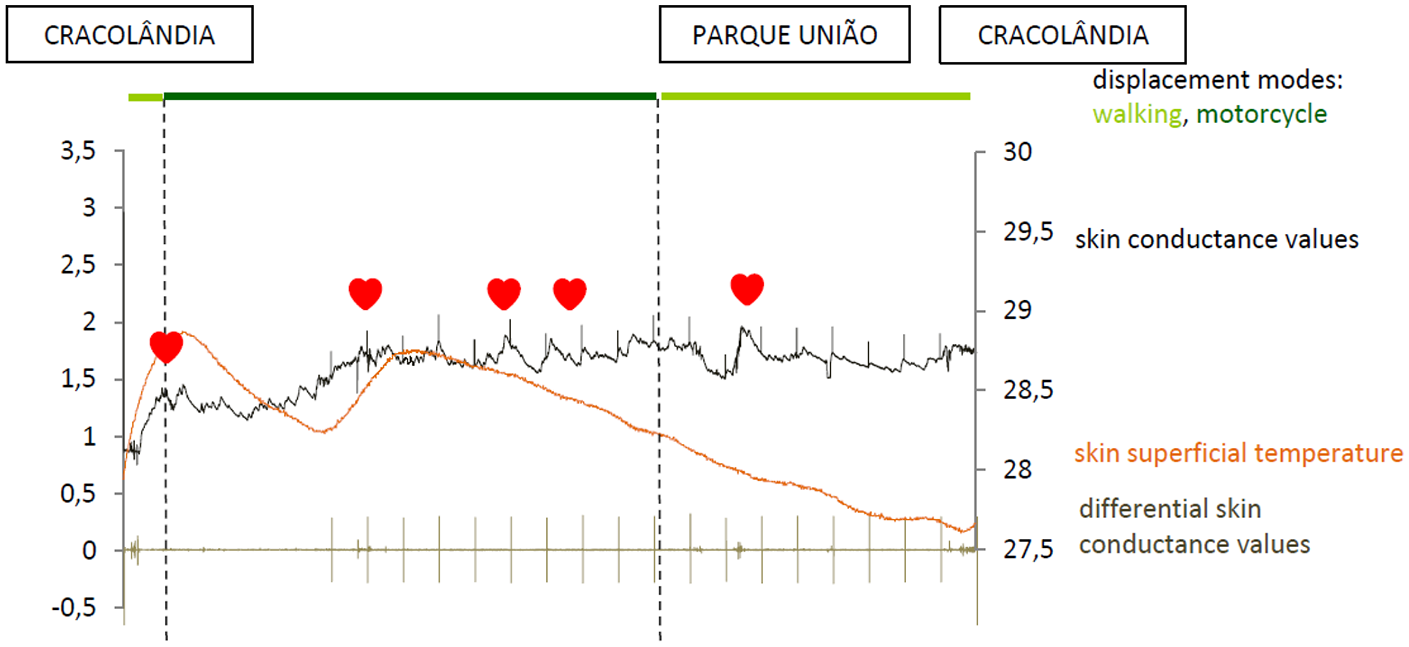
GSR data for Leticia, during a walk around her neighbourhood.
It would be easy to misinterpret this relatively shallow curve as indicating a state of tranquillity and calm. However, from the perspective of affective self-regulation, the most striking aspect of Letícia’s electrodermal data is the very low level of autonomic variability on this journey. Her body appears to be dealing with the stresses and fears of moving around the favela by reducing its affective responsiveness. It is not an absence of affective stimulation that leads to the flatter readings, but a state of acute tension that makes her body less responsive to those stimulations. Moreover, returning home does not induce any kind of slackening or relaxation. The low variability of the affective responses indicates a state of tension which lowers the capacity to be affected. Indeed, Letícia’s biophysical data seem consistent with the neurophysiological state known as ‘autonomic hyporeactivity’: a reduced activity of the autonomous nervous system that is associated with conditions such as acute depression or chronic pain (see Sarchiapone et al., 2018). Body, city and border come together in a rhythm of continual attention and stress response, resulting in a wounding of the body’s capacity to be affected.
Letícia’s electrodermal activity registers a physiological enfolding of authority, such that her co-production of the skinscape transforms it into a space of exhausted watchfulness and hypoactive affective response. These neurophysiological rhythms form an important but under-acknowledged part of the urban economy of attention. New materialist accounts of materiality, distributed agency and embodiment suggest to us that attention is an attribute, not merely of conscious intentional attitudes, but also of bodies’ dynamic materiality. Such work indicates that the politics of attention must be considered, not only in terms of conscious perception and emotion, but also at the level of autonomous, non-conscious bodily processes. Indeed, Frost extends this argument to the cellular and molecular level, arguing that bodies’ capacities for attention and interpretation of their environments extend all the way down, such that no flesh is inert or unthinking (Frost, 2020, p. 8). Working with an extended conceptualisation of embodied attention, we suggest that our participants’ EDA data help illuminate elements of a distributed biosocial architecture of attention, where the bordering of city, community and subjectivity is enacted on the surface of the skin, as one part of a distributed biosocial assemblage linking body, city, soul and atmosphere. From this perspective, the politics of attention is as much a question of embodied rhythms of affective attunement, as it is a question of conscious perception and intention. The channelling of attention in the favela is materialised by altering non-conscious rhythms of affective self-regulation. In Letícia’s case, this reduces the body’s capacities to affect and to be affected.
Or
She takes a stroll around the neighbourhood to pick up a cigarette lighter, glad to be out of the house, away from domestic strife, wondering what he will get up to while she’s gone, keeping an ear to the ground, watchful but not fearful, and, scanning the crowded street, searching people’s eyes, ready to defend herself, for a hustle, for flight, on the lookout for phony people, mean people, and, yet there is nothing to worry about, ‘if it happens it’s going to be with God’s permission, everything happens with His permission and I don’t fear nobody, I’m not afraid of ghosts, I’m not afraid of human beings, I’m not afraid of anyone or anything, I mean I’m God fearing, him I fear, because a God-fearing woman will be blessed. And what makes me tick is meanness, get it? Because God is God and he escaped, who am I to escape?’, and hormones surging through the body, priming it into alertness to danger, fight or flight, but flight is impossible, nowhere to go, no passage beyond the border, no way out, past the drugs traffickers, not going there, ‘just the other day, they said someone raped a girl down there, I didn’t see it, I just heard’, and, adrenaline surging into the bloodstream, heart beating faster, breathing more rapidly, and, her senses have become sharper, glucose and fat releasing from storage sites in the body and flooding the bloodstream, supplying energy, and, firecrackers go off and is this the, and, no not this time but what happens when she gets home, and, the atmosphere softens for a moment, music playing, people chatting, and a momentary relaxation, the flood of hormones slowing for a moment, and, a sudden dull thud of anger, no way out, passing a group of men, obviously high, and, calmer now, chill, and, in Crackland there’s nowhere safe, and, what is this feeling, and, ‘it’s not fear, but there’s that risk, because I don’t know what’s going on in people’s head’, ‘because of the crazy things they do around here, I don’t know’, and, not just for me, ‘it’s not just me, just like any other girls, these girls that end up here’, and ‘many of them stay out at night, turning tricks, they go out with one guy, then another guy, get it? There’s a lot of that. I don’t trust the guys when they’re high’, and, thoughts subsiding, a body moving across the asphalt, step, step, step, and, noradrenergic neurons spreading from the brain stem to the rest of the brain, regulating her attention, and, there are not enough major monomine neurotransmitters, serotonin, dopamine, norepinephrine, and, her attention wanders, it is hard to concentrate, feelings dulled, and, hearing the cars on the highway thud past nearby, speeding tourists into town from the airport, spared from having to see the favela by the high walls along the road, though some of the tourists will be back for parties, girls and drugs, and, body still moving, keep calm, and, another burst of adrenaline, and another, and another, and, thinking about returning home, bursting with anger, remembering last week’s fight, feeling her bruises, remembering, shrinking.
Softening the skinscape
In the Bairro da Maré women often enjoy greater levels of mobility than men, since they are allowed by gang members to cross the borders of the favela into rival territories. This is an interesting counterpoint to the usual gender inequalities in mobility. The price of this, however, is having to expend a great deal of feminised affective labour in building emotional relationships with gang members. Take, for example, Aline, a grandmother and wheelchair user whose son was hospitalised for three months after being shot by police, whilst attending a protest against police violence. Asked about her experience of crossing an extremely volatile border-space marking the boundary between three different criminal factions, Aline explains: It’s normal. For me, it’s normal. I normally come and go . . . If they [the boys guarding the favela’s internal borders] bother me, I say right away, ‘It’s nobody’s fault we live here and so-and-so lives there.’ . . . If I have to say something, I will. I’ll say, ‘I’ve been living here for many years, no one ever bothered me, why are you going to bother me now?’ Do you see? And, the same way I know people here, I know people over there too. Sometimes they call me ‘Auntie’. Every time, they call me ‘Auntie’: ‘Hi, Auntie, how are you?’ I answer, ‘Hi, son’ . . . Like yesterday, the girl who was with me was startled. The boys went, ‘Hi, Auntie’. They jumped up when they saw me, so she was scared. He said, ‘Take it easy, I’m just talking to my aunt. Hi, how are you?’ I answered, ‘I’m fine’. A normal coming and going thing. (Interview, Aline)
Aline’s freedom to cross the community’s borders requires expending the affective labour of de-escalating a tense atmosphere. Mobility, in this case, is enabled by the performance of a friendly, ‘aunt’-like persona to the armed teenage boys. This affective labour co-produces the skinscape in ways that make the border less tense and stifling. Yet this is a risky business. Aline emphasises that although she is friendly to the border guards, it is essential not to be too friendly, otherwise she could be accused of favouring a particular side: I’m not familiar with them . . . I go straight by, because you know how it is, we have to avoid it, so tomorrow you’re in the clear to be able to speak, because if you have . . . I chat with people there, I came here, I chat with people here, you know? I’ll be asked about it, from both sides, so I try to avoid it . . . (Interview, Aline)
Mobility within the border-spaces of the favela, therefore, is a complex task requiring acute emotional attention. It requires being friendly but not too friendly, nurturing a less hostile, more family-like atmosphere, whilst not overstepping an invisible limit where she could be accused of siding with one group over another. Indeed, Aline’s story suggests that women may take advantage of their greater level of mobility (compared to most men living in the community) to perform affective labour that keeps fragile social connections alive. Aline tells us that she sometimes agrees to pass on messages between boys in different territories. If they become involved with a gang, boys are immediately cut off from school friends who live in rival territories, and are banned from having contact with them. The violent bordering of the favela destroys fragile social connections. But Aline mentions that she is often asked by young gang members, when crossing into a rival territory, to send a message to their friend. ‘Like, saying very low, “Oh, aunt, tell so-and-so I said hi”. It’s so sad. There are people who were raised together, who are there, who grew up in a project and now they can’t even talk to each other, even though there’s still a feeling . . . Then they send a message and sometimes I can say, “Oh, so-and-so . . . my regards . . . I saw your mother”. Delivering messages between members of rival gangs keeps threads of social connectivity alive, and serves to soften the favela’s borders. Doing so, however, is risky, and constitutes another form of gendered emotional labour.
Or
Aline is a wheelchair user and primary carer for one of her grandchildren. Her grandson wheels her from home to school, passing through an area of acute conflict. Aline’s tonic level of affective arousal is very dynamic. There is a lot of variation, both in skin conductance and in skin temperature, with many phasic components (Figure 3). We see a large difference between the highest and lowest level of the tonic. As they pass through some of the most volatile areas of the city, we see large jumps in her levels of affective arousal: when she crosses the border spaces, Aline’s levels of affective stimulation are extremely high. When she arrives at school, Aline relaxes, and her levels of affective excitability increase. Here, Aline’s neurophysiological responses have become more elastic and register greater changes. Going back home by herself across the conflicted border, her biophysical rhythms become more constricted, and her skin temperature lowers, indicating heightened levels of stress. She has significant fluctuations in electrodermal activity: the border region is evidently a place of great tension. As she returns home, her affective arousal quickly drops, and her skin temperature goes up again; here we see her relaxing in the safety of home.
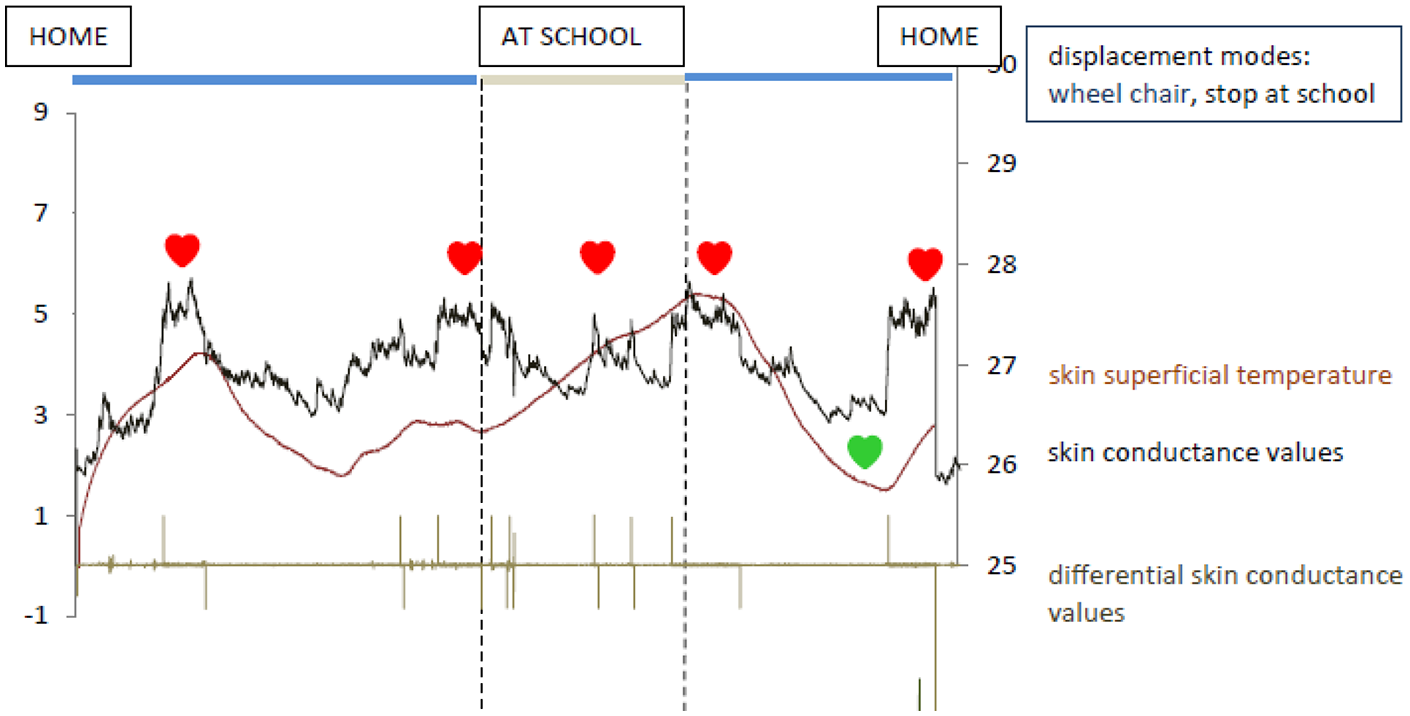
GSR data for Aline, travelling with her son to his school, using a wheelchair.
We see here a skinscape in which Aline’s autonomic responses respond exceptionally actively and dynamically to the stresses of navigating a dangerous border space. Aline’s body is very switched on, and her affective responses are supple. Her sympathetic nervous system is highly adept in the rhythms of autonomic affective regulation that are required to safely navigate the community’s border regions. With Aline, her use of a wheelchair intersects with her age and gender to code her body as unthreatening, shaping an affective neurophysiological assemblage that is controlled, plastic and sensitive. This equips her to perform significant amounts of affective labour in softening the atmospheric atmosphere of the border (cf. Kolehmainen & Mäkinen, 2021). Her physiological data indicate that she is performing a very high mental workload, with high levels of affective stimulation, but without falling into the kind of stress reaction that reduces cognitive and affective capacities (Borghini et al., 2020).
The highly dynamic rhythms of Aline’s sympathetic nervous system are indicators of the high levels of ‘affective plasticity’ demanded of women living in the favela. Feminist work on plasticity emphasises the brain’s creative capacity both to receive form, and also to autonomously generate new forms (Malabou, 2008). The brain is simultaneously formed by its environment, and has the capacity to create new forms. In fact, new materialist theories emphasising the agency of all matter imply the need to conceptualise the whole body, not just the brain, as characterised by plasticity (Sparrow, 2014). This entails thinking the skinscape in terms of the interaction between body and environment, with bodily sensation and affect emerging as relational effects of encounters between bodies, borders, skin, materials, environments and atmospheres. However, affective plasticity is unevenly distributed, making plasticity a key logic underpinning the construction of race, gender and class (Pitts-Taylor, 2016). Whereas highly-valued bodies (white, male, wealthy) are framed in this colonial logic as energetically self-forming, superfluous and discounted bodies, such as those in the urban peripheries, are dismissed as passively absorbing external environmental factors, lacking active capacities for self-formation and self-creation, their bodies seen as ‘rigid, inflexible, overly reactive, and insufficiently absorptive’ (Schuller & Gill-Peterson, 2020, p. 2).
The physiological profiles of participants such as Aline offer resources for developing empirical counter-narratives to this racialised way of imagining bodies’ capacities, since they offer evidence of extremely dynamic forms of biophysical adaptability mobilised to successfully navigate the city’s volatile border spaces. Aline has suffered deeply traumatic events whilst walking in the favela, but this trauma does not show itself as a reduction of affective life. Instead, it manifests as an agile capacity to respond to and intervene in the favela’s violent border spaces. The biophysical data help us see how women living in favelas, far from being passive receptacles of dominating power, are skilled, active co-producers of the favela’s borders. Yet they are forced to expend high levels of affective attentional labour in softening the threatening ambience of the favela’s border spaces. Through this labour, women’s affective capacities are harnessed and made productive in the neoliberal splintering, partitioning and bordering of the urban skinscape.
Or
Two bodies and a wheelchair make their way along the street, negotiating bumps, blocks and obstacles, feeling frustration at the difficulty of everything, and, ‘It’s hard because . . . it’s not the community; it’s the lack of access. You want to go into a store, there isn’t any. If you don’t have the good will of going in and depending on other people’s help, you don’t have any’, or, looking out for the easiest routes, the fewest obstructions, joking with street traders as she weaves around the stands, a body habituated to subtle movements and dexterous manoeuvres, and, a thought comes from nowhere, wondering where the next police raid might happen, should she be here, because ‘walking, moving around Maré, when there’s all that running around [in a shootout], if there’s running around, you’d better stay home’, and, crossing the border now, a surge of adrenaline triggers an urge to flee, and, she knows how to be calm, control herself, regulate her affects, soften the atmosphere, like always, and, her body returns to a calmer state, breathe in, breathe out, heart rate slowing, a cold sweat, moving from the eccrine sweat gland, a coiled, compact secretory body, through the sweat duct, making its way through the horny layer of dead cells, opening onto the surface of the skin, and, it was here she got caught up in the middle of a gunfight, bullets blazing all around her, but it wasn’t she who froze, ‘A guy that was with me, his legs froze . . . The criminals were coming and the police were coming too, so I got caught up in the middle. And he got nervous, his legs froze; he said his legs were sweating and he couldn’t move and he grabbed the chair, I had to push him with the wheelchair, so that he could get into that alley and hide’, and, look at those boys, so young, and, that time she asked a social worker for help, ‘I went up to him and asked for help for a godson of mine, I feel he’ll end up getting involved, you know? You ask for help and there’s no help. You either chase it, or you go yourself. There’s nothing really . . . I didn’t have any help . . . Then later, they say, “Oh, why did that 11-year-old boy get into drug trafficking?”, because I always say, some mothers are to blame for it, but some mothers didn’t have any help’, and, energy dipping, losing focus, why doesn’t she just stay home, but that’s what this whole place wants you to do, know your place, stick to your side, don’t cross over, but she has struggled her whole life against staying in place, once when she was a child with polio she could only move her eyes, everything else was stuck, but she learned to move again, she knows what it feels like, she will never stop. (Based on interview with Aline, with direct quotes from the interview in quote marks.)
Conclusion
In the favelas of Brazil mobility, a key aspect of the right to the city, is hugely constrained, due to the splintering of the city into security enclaves, on the one hand, and zones of abandonment, on the other. These constrictions on mobility are highly gendered. In this article we have shown that an important aspect of the violently bordered necropolis (McIntyre & Nast, 2011) is a form of authority that is embodied through commanding attention. Such authority is felt in rhythms of noticing, perceiving and feeling certain elements of the social milieu. Urban subjects are kept in place through a bordering of body and city, imposing rhythms of attention that reproduce structures of gender, class, race and sexuality.
These structures of attention not only structure perception, emotion and consciousness, but also non-conscious affective rhythms. The authority of the violent borderscape shapes body, skin and affective capacities. Far from necessarily leading to affective debilitation, however, the stressful demands of the street can lead women living in the favela to develop highly sensitive, supple, agile affective physiologies. These findings help us critique discourses that associate high levels of ‘affective plasticity’ with elite social positions, and low levels of affective plasticity with populations consigned to ‘racial banishment’ (Roy, 2019), ‘slow death’ (Berlant, 2011), or necropolitical ‘death-in-life’ (Mbembe, 2003; Valim & de Freitas Rasga, 2018). At the same time, they show us how this heightened affective capacity is enrolled in the affective labour of co-constructing violent borders, particularly through easing and relaxing the tense atmospheres of the community’s internal borders. Authority, therefore, functions through a channelling of attention both at the level of lived experience and in shaping non-conscious rhythms of autonomic affective self-regulation.
Through the disjunctive style of writing, we have tried to work with, not against, gaps and absences in our story. Close readers may have noticed that in places, interviewees’ accounts of their lived experiences did not clearly align with, or seem to directly contradict, the physiological patterns of their sympathetic nervous system. Through disjunctive writing, our analysis can mark these differences without trying to explain them away, or minimising them, or giving an account of what really happened and why. Our method of disjunctive writing strives to achieve an inclusive, affirmative disjuncture: holding together different datasets and different stories in their irreducible difference from one another, in a way that makes a difference, or which creates something new.
In doing so, we have not resolved the evident tensions between the two datasets, but have acknowledged the ‘autonomy of affect’ (Massumi, 2002), avoiding mapping non-conscious affects onto lived experiences and feelings (or vice versa), whilst affirming the importance and value of each. Holding different narratives in tension, we hold that all of them are true.
Bringing quantified biosocial analysis into this urban community has skirted a number of dangers. First among these is the danger of naturalising the placement of poor women, especially black women, within ‘unliveable’ spaces such as favelas, thereby reproducing narratives denying women spatial agency and sense of place (McKittrick, 2006). We have gone some way to addressing this in foregrounding the spatial agency of women living in the favela, showing their important roles in co-constructing the borders and affective atmospheres of the city, and foregrounding voices that remain relatively unheard amidst the fascination with lethal violence in favelas, and hence with men and masculinities. Yet we fully acknowledge that there is important work to be done in analysing forms of spatial practice that escape, challenge or subvert the violent bordering of the favela.
Related to this is the risk of objectifying our research participants as passive data sources, regarding their value in terms of information to be extracted, and thereby reproducing colonial economies of extraction. To address this, a participatory artwork was designed with the aim of helping women in the community creatively explore their own biophysical rhythms (Brigstocke & Cabral, 2015). Moreover, the data offer important resources for contesting certain entrenched gendered and racialised biopolitical narratives, by showing the extraordinarily high levels of affective plasticity and self-formation routinely enacted by some women living in favelas. This enables a fuller recognition of women’s spatial agency undertaking highly skilled, demanding affective labour in co-producing and softening the favela’s socio-spatial order.
Despite these risks, our research demonstrates that mobile biosensing methods have significant potential for understanding and conceptualising the everyday emotional and affective effects of living in an urban environment characterized by high levels of violence. Whilst the use of these methods is challenging and difficult to interpret, it opens up creative potentials for new understandings of the relations between body, city, and power.
Footnotes
Funding
The authors received no financial support for the research, authorship, and/or publication of this article.